John 12:17

Greek (Tischendorf 8th ed.) John 12:17 appears in the Greek New Testament. The text above is from the Tischendorf 8th edition. Each word links to its Strong’s number and a concise gloss. Click any word for its full Thayer’s Greek Lexicon entry.
Download image
Cite this verse

John 12:17 (World English Bible). Public Domain. Lemma interlinear Bible study tool, https://lemma.gebible.app/v/john/12/17.

Show BibTeX & RIS
BibTeX
RIS
English Translation
The multitude therefore that was with him when he called Lazarus out of the tomb, and raised him from the dead, was testifying about it.
World English Bible · Public Domain
Download a study sheet

One document with this verse’s original text, its word-by-word gloss line, the meaning frame, cross-references with their text, attributed commentary, and full source and license credits — printable, and it pastes into notes with its structure intact.

This verse Autodidact and up

Study sheet (.html) Plain text (.txt)

A passage Seminary Student

Up to 50 verses in one chapter. A passage sheet keeps up to 6 commentary sources and 12 cross-references per verse, in the order this page ranks them, and says so on the sheet whenever that leaves anything out. Ask for a single verse and you get the Autodidact verse sheet above.

Everything on this page stays free to read, with no account — the sheet is a download of what is already on screen, not access to it.

Want to remove ads? Support Godless Engineer
Compare translations 3

The same verse in 3 English versions, stacked beneath the original-language interlinear above. Click any original word for its lexicon entry.

Each is an independent rendering of the whole verse — the interlinear is not word-aligned to these translations.

Highlighted words mark where these versions differ — a whole-verse word diff, not a word-by-word alignment.

  • World English Bible Public Domain
    The multitude therefore that was with him when he called Lazarus out of the tomb, and raised him from the dead, was testifying about it.
  • King James Version Public Domain
    The people therefore that was with him when he called Lazarus out of his grave, and raised him from the dead, bare record.
  • unfoldingWord Literal Text CC BY-SA 4.0
    Then testified the crowd being with him when he called Lazarus out of the tomb and raised him up from the dead.

unfoldingWord Literal Text — © unfoldingWord, licensed CC BY-SA 4.0. Word-aligned USFM3 via Door43 (git.door43.org/unfoldingWord/en_ult).

Versions to compare (up to 4)

3 of 4 selected

Show all 19 translations

Every available English version of this verse, each an independent rendering of the whole verse.

  • World English Bible Public Domain
    The multitude therefore that was with him when he called Lazarus out of the tomb, and raised him from the dead, was testifying about it.
  • Berean Standard Bible Public Domain
    Meanwhile, many people continued to testify that they had been with Jesus when He called Lazarus from the tomb and raised him from the dead.
  • Majority Standard Bible Public Domain
    Meanwhile, many people who had been with Jesus when He called Lazarus from the tomb and raised him from the dead continued to testify.
  • King James Version Public Domain
    The people therefore that was with him when he called Lazarus out of his grave, and raised him from the dead, bare record.
  • American Standard Version (1901) Public Domain
    The multitude therefore that was with him when he called Lazarus out of the tomb, and raised him from the dead, bare witness.
  • Revised Version (1885) Public Domain
    The multitude therefore that was with him when he called Lazarus out of the tomb, and raised him from the dead, bare witness.
  • Geneva Bible (1599) Public Domain
    The people therefore that was with him, bare witnesse that hee called Lazarus out of the graue, and raised him from the dead.
  • Douay-Rheims (1899) Public Domain
    The multitude therefore gave testimony, which was with him, when he called Lazarus out of the grave, and raised him from the dead.
  • Young's Literal Translation Public Domain
    The multitude, therefore, who are with him, were testifying that he called Lazarus out of the tomb, and did raise him out of the dead;
  • Literal Standard Version CC BY-SA 4.0
    The multitude, therefore, who are with Him, were testifying that He called Lazarus out of the tomb, and raised him out of the dead;
  • Unlocked Literal Bible CC BY-SA 4.0
    Now the crowd testified that they had been with him when he called Lazarus out of the tomb and raised him up from the dead.
  • unfoldingWord Literal Text CC BY-SA 4.0
    Then testified the crowd being with him when he called Lazarus out of the tomb and raised him up from the dead.
  • Darby Bible Public Domain
    The crowd therefore that was with him bore witness because he had called Lazarus out of the tomb, and raised him from among [the] dead.
  • World Messianic Bible Public Domain
    The multitude therefore that was with him when he called Lazarus out of the tomb and raised him from the dead was testifying about it.
  • Webster's Bible Public Domain
    The people therefore that were with him when he called Lazarus out of his grave, and raised him from the dead, bore testimony.
  • Free Bible Version CC BY-SA 4.0
    Many in the crowd had seen Jesus call Lazarus from the tomb and raise him from the dead, and were telling the story.
  • Bible in Basic English Public Domain
    Now the people who were with him when his voice came to Lazarus in the place of the dead, and gave him life again, had been talking about it.
  • Text-Critical English NT CC BY 4.0
    Now the crowd that had been with him when he called Lazarus out of the tomb and raised him from the dead was testifying about it.
  • Tyndale New Testament (1534) Public Domain
    The people that was with him when he called Lazarus out of his grave and raysed him from deeth bare recorde.

Literal Standard Version (2020), Covenant Press — licensed CC BY-SA 4.0. Text via the HelloAO Bible API (eBible.org). Unlocked Literal Bible (unfoldingWord) — licensed CC BY-SA 4.0. Text via the HelloAO Bible API (eBible.org). unfoldingWord Literal Text — © unfoldingWord, licensed CC BY-SA 4.0. Word-aligned USFM3 via Door43 (git.door43.org/unfoldingWord/en_ult). Free Bible Version, Dr. Jonathan Gallagher — licensed CC BY-SA 4.0. Text via the HelloAO Bible API (eBible.org).

Word by word

More ways to search: Search by grammar → Find every occurrence → Compare this word →

Practice this passage: Drill this verse → Learn its vocabulary →

Λάζαρον
Lázaros
G2976
“Lazarus”
Noun, Accusative, Singular, Masculine
Part of Speech
Noun
Case
Accusative
Number
Singular
Gender
Masculine
Full Thayer's Definition

Origin: probably of hebrew origin H499

TDNT: None

Lazarus = "whom God helps" (a form of the Hebrew name Eleazar) 1. an inhabitant of Bethany, beloved by Christ and raised from the dead by him 2. a very poor and wretched person to whom Jesus referred to in Luke 16:20-25
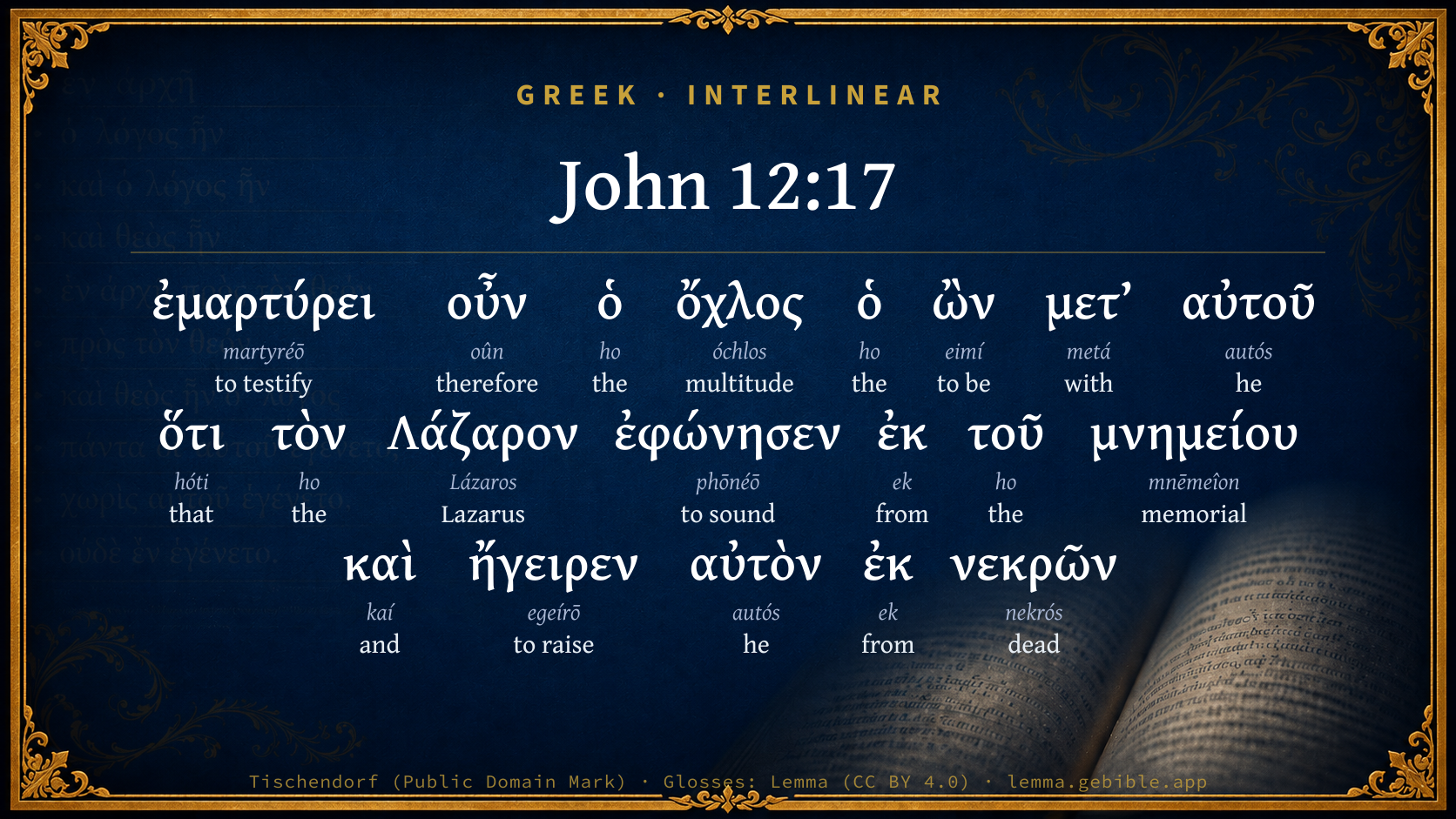
  1. ἐμαρτύρει martyréō G3140 “to testify” Verb, Imperfect, Active, Indicative, 3rd person, Singular
  2. οὖν oûn G3767 “therefore” Conjunction
  3. ὁ ho G3588 “the” Article, Nominative, Singular, Masculine
  4. ὄχλος óchlos G3793 “multitude” Noun, Nominative, Singular, Masculine
  5. ὁ ho G3588 “the” Article, Nominative, Singular, Masculine
  6. ὢν eimí G1510 “to be” Verb, Present, Active, Participle, Nominative, Singular, Masculine
  7. μετ’ metá G3326 “with” Preposition
  8. αὐτοῦ autós G846 “he” Personal pronoun, Genitive, Singular, Masculine
  9. ὅτι hóti G3754 “that” Conjunction
  10. τὸν ho G3588 “the” Article, Accusative, Singular, Masculine
  11. ἐφώνησεν phōnéō G5455 “to sound” Verb, Aorist, Active, Indicative, 3rd person, Singular
  12. ἐκ ek G1537 “from” Preposition
  13. τοῦ ho G3588 “the” Article, Genitive, Singular, Neuter
  14. μνημείου mnēmeîon G3419 “memorial” Noun, Genitive, Singular, Neuter
  15. καὶ kaí G2532 “and” Conjunction
  16. ἤγειρεν egeírō G1453 “to raise” Verb, Aorist, Active, Indicative, 3rd person, Singular
  17. αὐτὸν autós G846 “he” Personal pronoun, Accusative, Singular, Masculine
  18. ἐκ ek G1537 “from” Preposition
  19. νεκρῶν nekrós G3498 “dead” Adjective, Genitive, Plural, Masculine

About this verse

These counts appear in no published source. They are computed here, from the morphology-tagged text and Lemma’s own curated glosses. What Lemma adds →

20
words
15
distinct lemmas
Gospels
section

Notable vocabulary

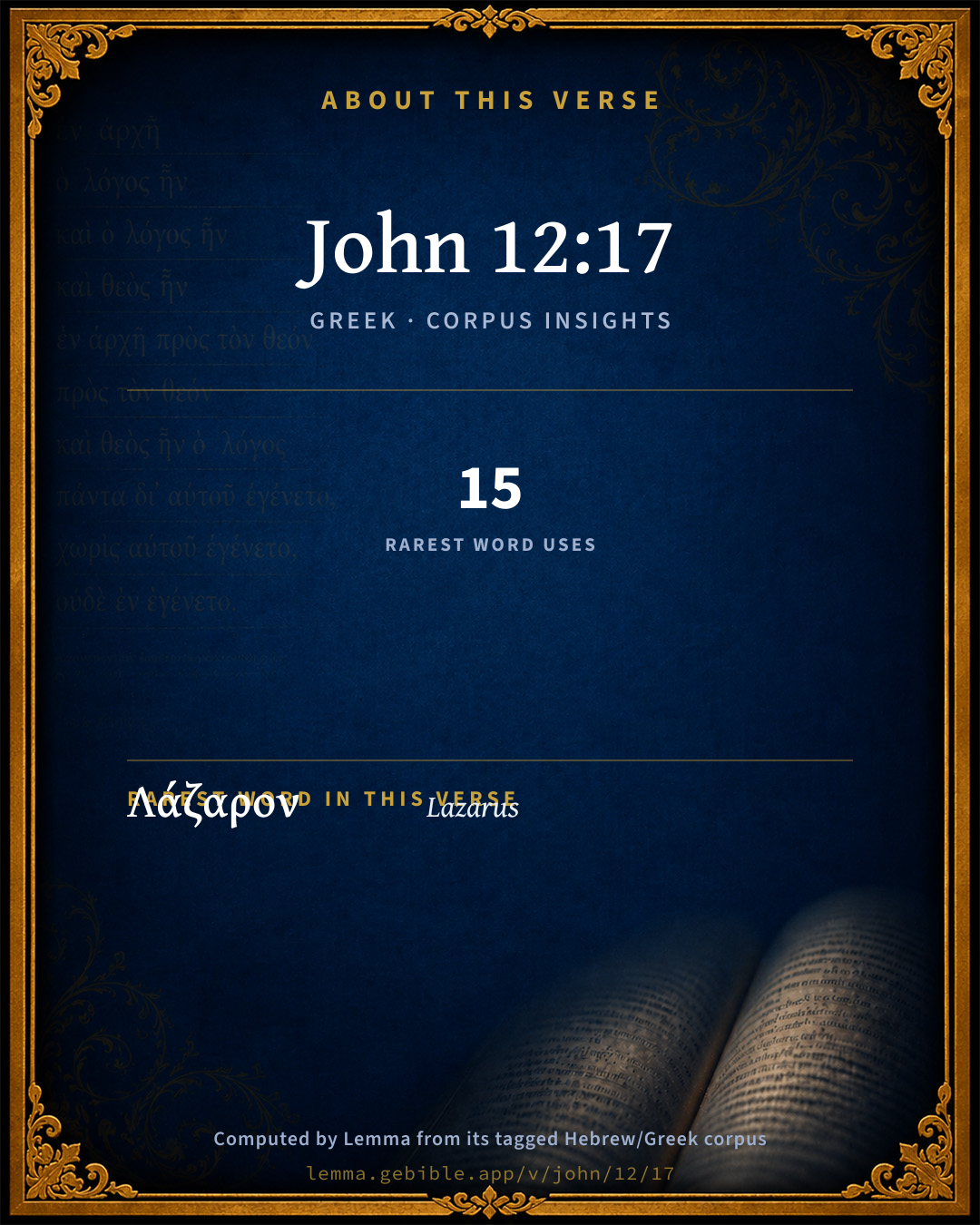
The rarest word here is Λάζαρον Lazarus G2976 — appearing just 15 times in the whole Greek New Testament.

Shared distinctive vocabulary

Λάζαρον Lazarus G2976 occurs in 15 verses of the Greek New Testament. Also found in:

Repetition

Words recur within this verse:

Cross-references

17

Topical passages linked to John 12:17 in the Treasury of Scripture Knowledge — connected by theme and wording, ordered by reader-vote popularity; previews shown in the World English Bible.

  • 1 John 5:9–12 If we receive the witness of men, the witness of God is greater; for this is God's testimony which he has testified concerning his Son.
  • Revelation 1:2 who testified to God's word, and of the testimony of Jesus Christ, about everything that he saw.
  • John 12:9 A large crowd therefore of the Jews learned that he was there, and they came, not for Jesus' sake only, but that they might see Lazarus also, whom he had raised from the dead.
  • John 19:35 He who has seen has testified, and his testimony is true. He knows that he tells the truth, that you may believe.
  • Acts 1:22 beginning from the baptism of John, to the day that he was received up from us, of these one must become a witness with us of his resurrection."
  • Acts 5:32 We are His witnesses of these things; and so also is the Holy Spirit, whom God has given to those who obey him."
  • Psalms 145:6–7 Men will speak of the might of your awesome acts. I will declare your greatness.
  • John 1:19 This is John's testimony, when the Jews sent priests and Levites from Jerusalem to ask him, "Who are you?"
  • John 1:32 John testified, saying, "I have seen the Spirit descending like a dove out of heaven, and it remained on him.
  • John 1:34 I have seen, and have testified that this is the Son of God."
  • John 5:35–39 He was the burning and shining lamp, and you were willing to rejoice for a while in his light.
  • John 8:13–14 The Pharisees therefore said to him, "You testify about yourself. Your testimony is not valid."
  • John 11:31 Then the Jews who were with her in the house, and were consoling her, when they saw Mary, that she rose up quickly and went out, followed her, saying, "She is going to the tomb to weep there."
  • John 11:42 I know that you always listen to me, but because of the multitude that stands around I said this, that they may believe that you sent me."
  • John 11:45–46 Therefore many of the Jews, who came to Mary and saw what Jesus did, believed in him.
  • John 21:24 This is the disciple who testifies about these things, and wrote these things. We know that his witness is true.
  • John 15:26–27 "When the Counselor has come, whom I will send to you from the Father, the Spirit of truth, who proceeds from the Father, he will testify about me.

Cross-references courtesy of OpenBible.info (CC BY 4.0).

Commentary

Notes on John 12:17 from classic Christian and Jewish commentators (each source and its license shown beneath its notes). The classic Christian expositions comment on the surrounding passage and are grouped to its opening verse, so a note may address several verses; the Jewish commentaries on the Tanakh (Rashi and others) are per-verse, so they appear only where the commentator wrote on this verse.

Lemma curates 59 commentaries, every one of them public domain or Creative Commons licensed, each selected and text-cleaned for this edition rather than reprinted as found. About our sources →

Joseph Benson's Commentary

Joh 12:17-19. The people, therefore — “Because the forwardness which the multitude now showed to acknowledge Jesus as the Messiah was altogether extraordinary, the evangelist assigns the cause thereof. The witnesses of the resurrection of Lazarus had published the miracle far and near. As they were many in number, and persons of reputation, their report gained general credit; and this drew out a great multitude of people to meet Jesus. In saying, he called Lazarus out of the grave, the evangelist admirably expresses, as well the greatness of the miracle, as the facility with which it was wrought. The easiness of the Scripture style, on the most grand occurrences, is more sublime than all the pomp of orators. For this cause the people also met him — Because they heard from those who had been eye-witnesses thereof, that he had performed that extraordinary miracle; therefore they went out to meet him, and the multitude coming with him; so that, in a little time, both joined together, partly to go before and partly to follow after. The Pharisees therefore said, Perceive ye how ye prevail nothing? — In the mean time, the Pharisees and the great men were exceedingly enraged because every measure they had taken to hinder the people from following Jesus had proved ineffectual.

Joseph Benson's Commentary on the Old and New Testaments (1811–1818) — public domain. Text from a community e-Sword module.

Tyndale Open Study Notes

Tyndale Open Resources

12:17-19 This scene describes the apex of Jesus’ popularity.

Tyndale Open Study Notes — © Tyndale Open Resources, licensed CC BY-SA 4.0. Text via the HelloAO Bible API.

Bengel's Gnomon

Johann Albrecht Bengel

Joh 12:17. Ἐμαρτύρει, bare record) as to the miracle, at which they were present.—ἐφώνησεν ἐκ τοῦ μνημείου, called out of the tomb) The greatness of the miracle, and the ease with which it was performed, are most skilfully expressed. The style of Scripture is easy, when treating of the greatest things, therein surpassing in sublimity every sample of the sublime in oratory. The raising up of Lazarus is the crowning triumph of Christ’s miracles: the order of which latter may be compared with the order observed in the restoration of the human race. Let the expression, [God] said, Genesis 1., be compared with the verb, called, here.—καί) and so.

Bengel's Gnomon of the New Testament — English translation (T&T Clark, Edinburgh, 1860) — public domain. Text from a community e-Sword module.

Meyer's Critical & Exegetical Commentary

Heinrich August Wilhelm Meyer

Joh_12:17-18. Οὖν] Leading back again after the intermediate observation of Joh_12:16 to the story, and that in such a way that it is now stated how it was the raising of Lazarus which so greatly excited both the people who thronged with Jesus from Bethany to Jerusalem (the Ἰουδαῖοι who had become believers, Joh_12:9; Joh_12:11, and others, certainly including many inhabitants of Bethany itself), and the multitude which came to meet them from Jerusalem (Joh_12:12).

ἐμαρτ. κ.τ.λ. ὅτι]

[107] for they had, in truth, themselves seen the reanimated man; had also, perhaps, themselves witnessed in part the process of the miracle, or at least heard of it from eye-witnesses, and could accordingly testify to His resurrection.

ἐφώνησεν … νεκρῶν] The echo of their triumphant words.

διὰ τοῦτο … ὅτι] On this account (on account of this raising from the dead), namely, because; see on Joh_10:17.

ὑπήντησεν] not pluperfect in sense, but: they went to meet (as already stated above, Joh_12:12-13).

ὁ ὄχλος] The article points to Joh_12:12.

ἤκουσαν] namely, previously, in Jerusalem.

τοῦτο] with emphasis; hence also the separation in the order of the words.

[107] With the reading ὅτε (see critical notes), ἐμαρτ would have to be taken absolutely the people bore witness, who, viz. were with Him at the raising of Lazarus. Comp. Luther, Erasmus, and many others. Thus the ὄχλος would be the same as in Joh_11:42, which, however, is not appropriate to ver. 12 and ver. 18, and would only tend to confuse.

NOTE.

While we necessarily recognise the main difference between the Synoptics and John, namely, that according to the former, the journey of Christ to Jerusalem is made from Jericho, where He had remained for the night at the house of Zacchaeus, and the stay in Bethany is excluded (see on Mat_21:1, note), the Messianic entry is yet one and the same event in all four evangelists. Against the assumption of an entry on two occasions (Paulus, Schleiermacher, üb. d. Schriften des Luk. p. 243 ff., and L. J. p. 407 ff.), according to which He is said first to have made an entry from Jericho, and, one or two days later, again from Bethany, the very nature of the transaction is decisive, to which a repetition, and one moreover so early, was not appropriate, without degenerating into an organized procession. Only in the view of its occurring once, and of its being brought about accidentally, as it were, by the circumstances, does it retain a moral agreement with the mind of Jesus. With this view, too, all four accounts conform, and they all show not merely by their silence respecting a second procession, but also by the manner in which they represent the one, that they are entirely ignorant of any repetition. Such a repetition, especially one so uniform in character, would be as improbable in itself, as it must be opposed to the course of development of the history of Jesus, which here especially, when the last bloody crisis is prepared for by the entry of the Messianic King, must preserve its divine decorum, and finds its just measure in the simple fulfilment of the prophetic prediction.

Meyer — Critical and Exegetical Commentary on the New Testament — English translation by Peter Christie, edited by Frederick Crombie (T&T Clark, 1880) — public domain. Text from a community e-Sword module.

Expositor's Greek Testament

ed. W. Robertson Nicoll

Joh 12:17 . In Joh 12:17-18 this demonstration is carefully traced to the raising of Lazarus: “the crowd which was with Him when He summoned Lazarus from the tomb, and raised him from the dead, testified [that He had done so], and on this account the crowd went out to meet Him, because they had heard this testimony”. The demonstration is thus rendered intelligible. In the Synoptists it is not accounted for. He is represented as entering the city with the pilgrims, and no reason is assigned for the sudden outburst of feeling. See Mar 11:1 , etc.

The Expositor's Greek Testament, edited by W. Robertson Nicoll (1897–1910) — public domain. Text from a community e-Sword module.

Godet's Commentaries

Frédéric Louis Godet

Vv. 17, 18. “The multitude therefore who were with him when he called Lazarus out of the tomb and raised him from the dead bore witness to him; 18 and it was for this cause also that the multitude went to meet him, because they had heard that he had done this miracle.”

John does not have it as his aim to present the complete picture of the entrance of Jesus, but rather to show the double relation of this event to the resurrection of Lazarus (its cause), on the one hand, and to the condemnation of Jesus (its effect), on the other. It is this connection which he brings out in Joh 12:17-19. If ὅτι, that, is read in Joh 12:17 with five Mjj. and the most ancient translations, the meaning is: that by coming forward the multitude bore testimony that He had caused the resurrection of Lazarus. There is nothing in this case to prevent the multitude of Joh 12:18 from being the same as that of Joh 12:17. John would simply say that the miracle which they were celebrating by accompanying Jesus (Joh 12:17) was the same one which had induced them to come to meet him (Joh 12:18). But the reflection of Joh 12:18 is, with this meaning, an idle one. It is self-evident that the event which they celebrated is also that which made them hasten to Him. If ὅτε (when) is read, with the most ancient Mjj., it is quite otherwise. John relates that the multitude which had been with Jesus at the tomb of Lazarus, and which had been present at his resurrection, by accompanying Jesus bore testimony to this great miracle of which they had themselves been witnesses. And here are the true authors of the ovation of Palm-day. They were there relating to the numerous pilgrims who were strangers what they had themselves heard and seen. We thus understand better this dramatic amplification, which in the former reading makes the effect quite prolix:When he called Lazarus out of the tomb and raised him from the dead. The mere mention of the fact. with the ὅτι, would have been sufficient. If ὅτε (when) is read, the participle ὀ ὤν is an imperfect: “who was with him when...” Joh 11:42.

In the 18th verse, John speaks of the second multitude—the one which came to meet Jesus on the road to Bethany. The διὰ τοῦτο, for this cause, refers to the following ὅτι, because. And it was for this that the multitude came to meet Him, to wit, because. Not only did this miracle form the principal subject of the conversations of those who came; but it was also (καί) this same miracle, which, having come to the knowledge of the whole multitude of pilgrims, impelled them to go and meet Him. The comparison of the words of Luke (Luk 19:37) which we have already cited, shows that which we have so often established: how frequently the outlines of the Synoptic picture are vague and undecided as compared with the so distinctly marked features of the Johannean narrative.

Frédéric Louis Godet — Commentaries on Luke, John, Romans, and 1 Corinthians — English translation (T&T Clark, Edinburgh, 1870s–1890s) — public domain. Text from a community e-Sword module.

Adam Clarke's Commentary

Verse 17. When he called] It appears that these people, who had seen him raise Lazarus from the dead, were publishing abroad the miracle, which increased the popularity of Christ, and the envy of the Pharisees.

Adam Clarke's Commentary on the Bible (1810–1826) — public domain. Text from a community e-Sword/MySword module.

John Calvin's Commentaries

17. The multitude gave their testimony. He again repeats what he had said, that many persons, aroused by the report of so great a miracle, came to meet Christ. The reason why they go out in crowds is, that the rumor, respecting Lazarus who had been restored to life, was widely spread. They had good reason, therefore, for ascribing to the son of Mary the honor of the Messiah, since he was known to possess such extraordinary power.

John Calvin's Commentaries (1540-1563) — public domain. Text from the Calvin Translation Society English edition (1840s-50s) via the Christian Classics Ethereal Library (ccel.org). Calvin's coverage is partial (roughly two-thirds of the Bible); uncommented books and verses are honest gaps, never fabricated. The 19th-century editor's footnotes and remarks are omitted so the notes are faithfully Calvin's own voice.

Ellicott's Commentary for English Readers

(17) When he called Lazarus . . . . bare record.—Several MSS. and some of the oldest versions read, “bare record that He called Lazarus out of the grave, and raised him from the dead.” The difference in the texts is only that of one letter (ὅτε and ὅτι). If we take the reading which was adopted by our translators, and which is best supported, we must distinguish between the multitude mentioned in this verse, and that mentioned in Joh_12:18. The meaning of this text is that the Jews of Joh_12:9; Joh_12:11, and those of Joh_11:45, with the people of Bethany, bear witness of the event, the recurrence of which they had themselves seen; and that this testimony was received by the multitude of pilgrims who went forth therefore to receive Jesus as the Messiah. (Comp. especially Luk_19:37.) This interpretation makes the Jews of Jerusalem themselves the witnesses whose testimony leads the multitude to receive our Lord as the Christ.

If we take the alternative, but less probable text, the multitude in both verses will be one and the same.

A Bible Commentary for English Readers, edited by Charles John Ellicott (1878–1897) — public domain. Text from a community e-Sword module.

The Cambridge Bible for Schools and Colleges

gen. ed. J. J. S. Perowne

17. when he called Lazarus] See on Joh_12:10. There is another reading, well supported, which gives ‘that He called Lazarus,’ and the whole will then run;—The multitude, therefore, which was with Him, kept bearing witness (Joh_1:7) that He called Lazarus out of the sepulchre and raised him from the dead. But ‘when’ is to be preferred; so that there are two multitudes, one coming with Jesus from Bethany and one (Joh_12:13; Joh_12:18) meeting Him from Jerusalem. See on Joh_12:41.

The Cambridge Bible for Schools and Colleges (gen. ed. J. J. S. Perowne; Cambridge University Press, 1878–1918) — public domain. Text from a community e-Sword module.

John Gill's Exposition

For this cause the people also met him,.... This was a principal reason, among others, which induced them to set out in the manner they did, with palm tree branches in their hands, and accost him as the king of Israel, when they met him, and hosanna'd him into the city:

for that they heard that he had done this miracle; the witnesses were so many, and the proofs they gave so strong, that they firmly believed it: and this being a most amazing miracle, and which exceeded even any of the same kind; Jairus's daughter was but just dead, and the widow of Nain's son was not buried, when they were raised, but Lazarus had been dead and buried four days; it made a very strong impression upon the minds of the people, and engaged their attention to him, and belief in him.

John Gill's Exposition of the Whole Bible (1746–1763) — public domain (CC PDM 1.0). Text via the HelloAO Bible API.

Trapp's Complete Commentary

John Trapp

17 The people therefore that was with him when he called Lazarus out of his grave, and raised him from the dead, bare record.

Ver. 17. When he called Lazarus, &c.] This notable miracle, the evangelist, as he had punctually described it, Joh 11:41-44, so he cannot but again and again recite it. We should set forth God’s noble acts, and not be sated. David never tires talking of what God had done for his soul. Those in heaven have no rest (and yet no unrest either) crying, "Holy, holy, holy," &c., Rev 4:8.

John Trapp, A Commentary or Exposition upon All the Books of the Old and New Testament (1647–1656) — public domain. Text from a community e-Sword module.

Matthew Poole's English Annotations

These three verses let us know the external cause of the people’s coming to see Christ, which was the fame of the miracle wrought by our Saviour on Lazarus; this increased the number of those who came to see his entrance into Jerusalem; but the unseen cause was, doubtless, the influence of God upon their hearts, directing them to it, for the further glorifying of his Son before his passion. But this enraged the Pharisees, to see that their decree that those who owned Christ should be turned out of the synagogue should have no better effect: but the multitude rather more owned him, and ran after him. Here again we find the term world signifying many, though those many made up but a very small part of the world.

Matthew Poole's English Annotations on the Holy Bible (1683–1685) — public domain. Text from a community e-Sword/MySword module.

The Pulpit Commentary

Vers. 17-19. These verses connect the enthusiasm of the multitudes with the great miracle of John 11., indicating a point concerning which the synoptic narrative is silent, and further they consociate the miracle and its effect upon the multitude with aggravation of the malignant feeling of the constituted authorities which leads to the capture and crucifixion of the Lord Jesus.

The multitude therefore which was with him when he called Lazarus out of the tomb, and raised him from the dead, were bearing witness. The seventeenth verse goes back to the (oclov) multitude who are mentioned in Joh_11:42; i.e. to the friends of Mary and Martha and to other inhabitants of Bethany, as well as visitors from Jerusalem. (Joh_11:31) All these are involved in the explicit declaration, o wn met autou . Which was with him when he called Lazarus out of his grave, and (not only so, but) raised him from among the dead. Those who had actually beheld the miracle, and were as eye and ear witnesses of the event, who had hovered about Bethany since his return to it, these were bearing witness. They spread themselves abroad in the crowd of Galilaean pilgrims and others, and were uttering their testimony on all sides. The word is used absolutely, as in Joh_19:35, and the imperfect tense should not be turned here into a mere preterit.

The Pulpit Commentary (1880–1919), ed. H.D.M. Spence-Jones & Joseph S. Exell — public domain. Text from a community e-Sword module.

John Wesley's Explanatory Notes

When he called Lazarus out of the tomb - How admirably does the apostle express, as well the greatness of the miracle, as the facility with which it was wrought! The easiness of the Scripture style on the most grand occurrences, is more sublime than all the pomp of orators.

John Wesley, Explanatory Notes Upon the Whole Bible (1754–1765) — public domain. Text via the GEBible commentary corpus.

Kretzmann's Popular Commentary

Paul E. Kretzmann

Further results of the raising of Lazarus:

v. 17. The people therefore that was with Him when He called Lazarus out of his grave, and raised him from the dead, bare record.

v. 18. For this cause the people also met Him for that they heard that He had done this miracle

v. 19. The Pharisees therefore said among themselves, Perceive ye how ye prevail nothing? Behold, the world is gone after Him.

The ovation given to Jesus on the day of His entry into Jerusalem would probably never have reached such proportions, if it had not been for the fact that the witnesses of the raising of Lazarus spread the news on all sides. They had been present upon that occasion; they had heard the all of Jesus while the man still lay in his grave; they had seen Jesus raise the dead man and bring him back to life. This miracle therefore made Jesus the object of such great interest at this time, the knowledge that it had been performed brought many people out with the multitude that would under other circumstances have probably stayed at home. For the moment the sentiment was strongly in favor of Christ. And the Pharisees, the rulers of the people, had to acknowledge their helplessness in the face of such popular acclaim. Neither threatenings nor excommunications had any effect upon the people; they all, with one accord, took the side of Jesus. So the Pharisees had to admit their failure. In spite of all their crafty plans they could not get Jesus into their power. When His time had come, He came of His own free will, He took the suffering and death upon Himself for the benefit of the world. He delivered Himself into the hands of His enemies, just as He had planned it and at His time.

Paul E. Kretzmann, Popular Commentary of the Bible (1921–1924) — public domain. Text from a community e-Sword module.

Burkitt's Expository Notes on the New Testament

William Burkitt

Observe here, 1. How the multitude at Jerusalem came forth to meet Christ, when he was making his public entry into the city, hearing the fame of his miracles; For this cause the people also met him, for that they had heard that he had done this miracle.

Observe, 2. How amongst others who came forth to meet our Saviour, certain Greeks, or Gentile proselytes, who came up to worship in the outward court of the temple, apply themselves to Philip, that he would help them to a sight of Jesus. Sir, we would see Jesus. It is probable that this desire to see Christ, in these persons, proceeded from curiosity only.

But if it did produce true faith in them, we may hence infer, that a spiritual sight of Christ, by the discerning eye of a believer’s faith, is the most glorious and consequently the most desirable sight in the world; and so must needs be, for it is a soul-ravishing, a soul-satisfying, a soul-transforming, and a soul-saving sight. This sight of Christ by faith will constrain a soul highly to admire, and greatly to commend him. It will incline a soul to chuse him, and cleave unto him, and will set a soul a longing for the full fruition and final enjoyment of him, Mine eyes have seen thy salvation; now let thy servant depart. Luk 2:29.

Observe lastly, How the envious Pharisees were galled, and cut to the heart, to see such a multitude both of Jews and Greeks, crowding out of the city, to meet Jesus in his triumphant entrance into the city. The Pharisees said, behold the world is gone after him.

Learn hence, That in the day of Christ’s greatest solemnity and triumph, there will not be wanting some persons of such a cankered disposition, that they will neither rejoice themselves, nor can they endure that others should. This was the case of the wicked Pharisees here.

William Burkitt's Expository Notes on the New Testament (1700–1703) — public domain. Text from a community e-Sword module.

unfoldingWord translationNotes

Door43 World Missions Community

Now

This word is used here to mark a break in the main narrative. Here John explains that many of the people came to meet Jesus because they heard others say that he had raised Lazarus from the dead. (See: Background Information)

they heard that he had done this sign

"they heard others say that he had done this sign"

this sign

A "sign" is an event or occurrence that proves something is true. In this case, the "sign" of raising Lazarus proves that Jesus is the Messiah.

Look, you can do nothing

The Pharisees imply here that it might be impossible to stop Jesus. AT: "It seems like we can do nothing to stop him" (See: Assumed Knowledge and Implicit Information)

see, the world has gone after him

The Pharisees use this exaggeration to express their shock that so many people have come out to meet Jesus. AT: "It looks like everyone is becoming his disciple" (See: Hyperbole and Generalization)

the world

Here "the world" is a metonym that represents (in exaggeration) all of the people in the world. You may need to make explicit that the hearers would have understood that the Pharisees were speaking only of the people in Judea. (See: Metonymy and Assumed Knowledge and Implicit Information)

translationWords

Lazarus

grave

testimony

sign

Pharisee

unfoldingWord translationNotes — © Distant Shores Media and the Door43 World Missions Community, licensed CC BY-SA 4.0. Source: git.door43.org/Door43/en_tn.

Cambridge Greek Testament for Schools and Colleges

17. ὅτε τ. Λάζ. See on Joh 12:9. The multitude, therefore, that was with Him when He raised … were bearing witness. See on Joh 12:41. This special mention of the ‘calling from the tomb’ is very natural in one who was there, and remembered the φωνὴ μεγάλη (Joh 11:43) and the excitement which it caused; not so in a writer of fiction.

Cambridge Greek Testament for Schools and Colleges (Cambridge University Press, 1896; 21 vols, various authors incl. Carr, Maclear, Plummer, Farrar, Lumby, Moule, M. R. James, Simcox) — public domain. Text from a community e-Sword module.

Alford’s Greek Testament

Henry Alford

17.] The testimony which they bore is given in Luk 19:37, Luk 19:38. Meyer regards the ἐφώνησεν ἐκ τοῦ μνημείου κ. ἤγειρεν ἐκ νεκρῶν as an echo of their song of triumph.

Henry Alford, The Greek Testament (1849–1861) — public domain. Text from a community e-Sword module.

International Critical Commentary

17. The interpretation of this verse depends mainly upon whether ὅτε (rec. with אABWΓΔΘ) or ὅτι (DL) is adopted as the true reading before τὸν Λάζαρον. If ὅτι be approved (with Tischendorf), we translate, “So the crowd that was with Him was testifying that He called Lazarus from the tomb, and raised him from the dead, ” ὅτι introducing the actual words used by the crowd when acclaiming the entry of Jesus. Cf. Luk 19:37: “the whole multitude of the disciples began to rejoice and praise God with a loud voice for all the mighty works which they had seen.” According to this rendering, the shouts of the crowd made special reference to the raising of Lazarus. This is entirely consistent with the view which Jn. gives his readers of the extraordinary effect which that miracle had on the public mind (vv. 9, 18). But, attractive as this rendering is, ὅτε must be preferred to ὅτι on the MS. evidence; and we translate: “So the crowd that was with Him when He called Lazarus from the tomb, and raised him from the dead,” i.e. the onlookers at the scene described 11:33-44, “bore their testimony.” The true authors of the ovation were the people who had been spectators of the miracle, who no doubt inspired all their acquaintances with their wondering enthusiasm. They “bore their witness.” See for the idea of μαρτυρία in Jn., the note on 1:7; and cf. Introd., p. xc.

International Critical Commentary — older volumes (1896–1929), various authors — public domain. Text from a community e-Sword module.

Lesson kit

Teaching starters — assembled from the data on this page, not authored interpretation. Every prompt links to the verse data it draws on. Edit before teaching.

John, in the Gospels, opens this verse with 20 words (15 distinct Greek lemmas). Its most distinctive word is Lázaros (“Lazarus”). A historical commentator’s framing appears above. Read the whole chapter for the surrounding context.

Discussion questions

  1. How does “Lazarus” (Lázaros) shape what this verse is saying?
  2. Luke 16:20 shares the word «Lazarus» with this verse. How do the two illuminate each other?
  3. “the” occurs 4× in this one verse. What is the effect of the repetition?
  4. These translations render this verse differently. What is at stake in choosing one wording over another?
  5. Reading how Joseph Benson's Commentary and Tyndale Open Study Notes read this verse, where do the two commentators agree and where do they part?

Things to notice

Reading settings

Reading text

Shown beneath each verse's original-language words.

Old Testament
Old Testament edition

Read the OT as the Masoretic Hebrew (MT) or the Greek Septuagint (LXX).

English shown for the Greek Septuagint (in the Hebrew ↔ Greek comparison).

Comparing translations? Open the Compare panel on any verse page to stack up to four side by side.