John 7:33

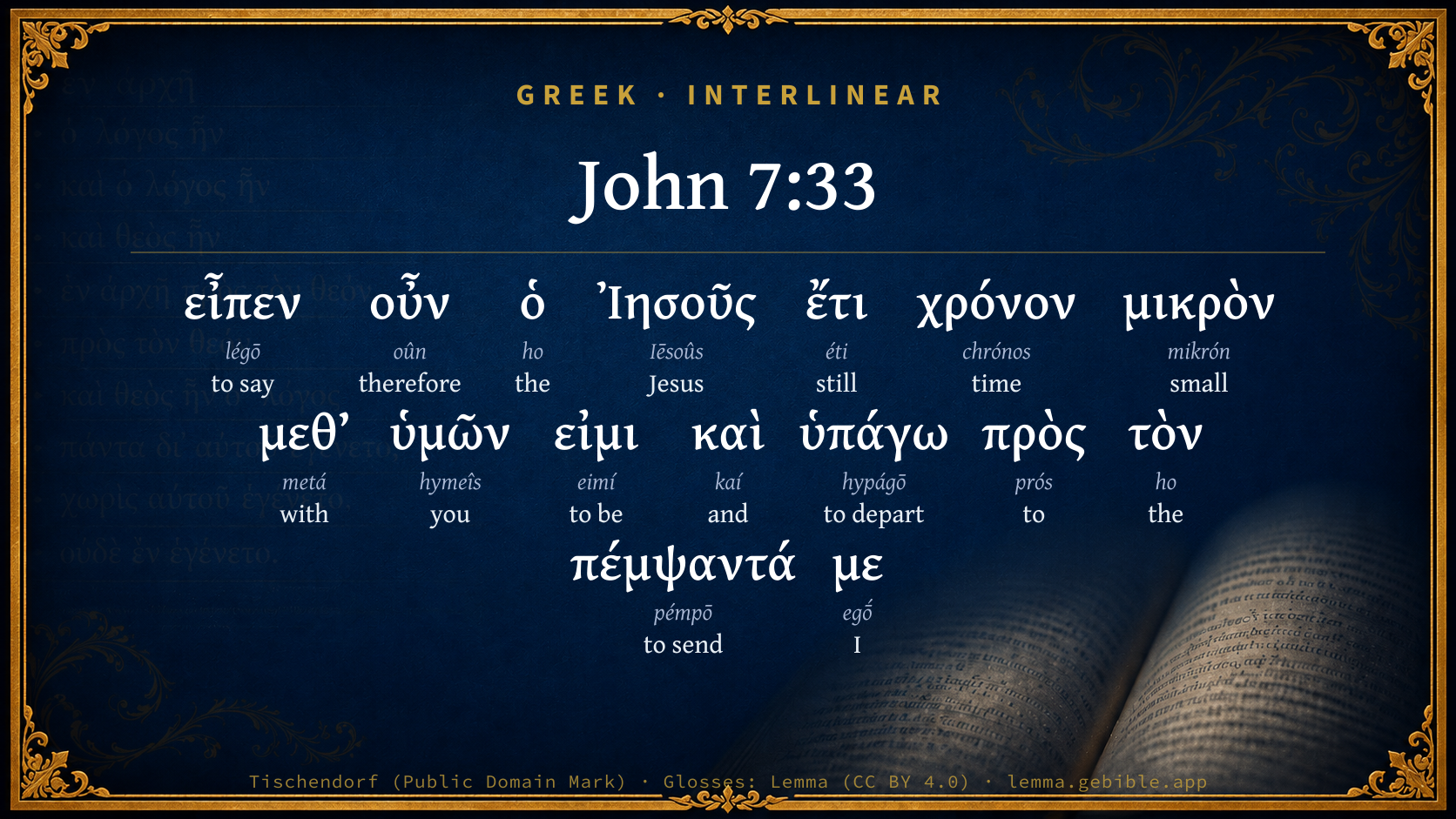
Greek (Tischendorf 8th ed.) John 7:33 appears in the Greek New Testament. The text above is from the Tischendorf 8th edition. Each word links to its Strong’s number and a concise gloss. Click any word for its full Thayer’s Greek Lexicon entry.
Download image
Cite this verse

John 7:33 (World English Bible). Public Domain. Lemma interlinear Bible study tool, https://lemma.gebible.app/v/john/7/33.

Show BibTeX & RIS
BibTeX
RIS
English Translation
Then Jesus said, "I will be with you a little while longer, then I go to him who sent me.
World English Bible · Public Domain
Highlights
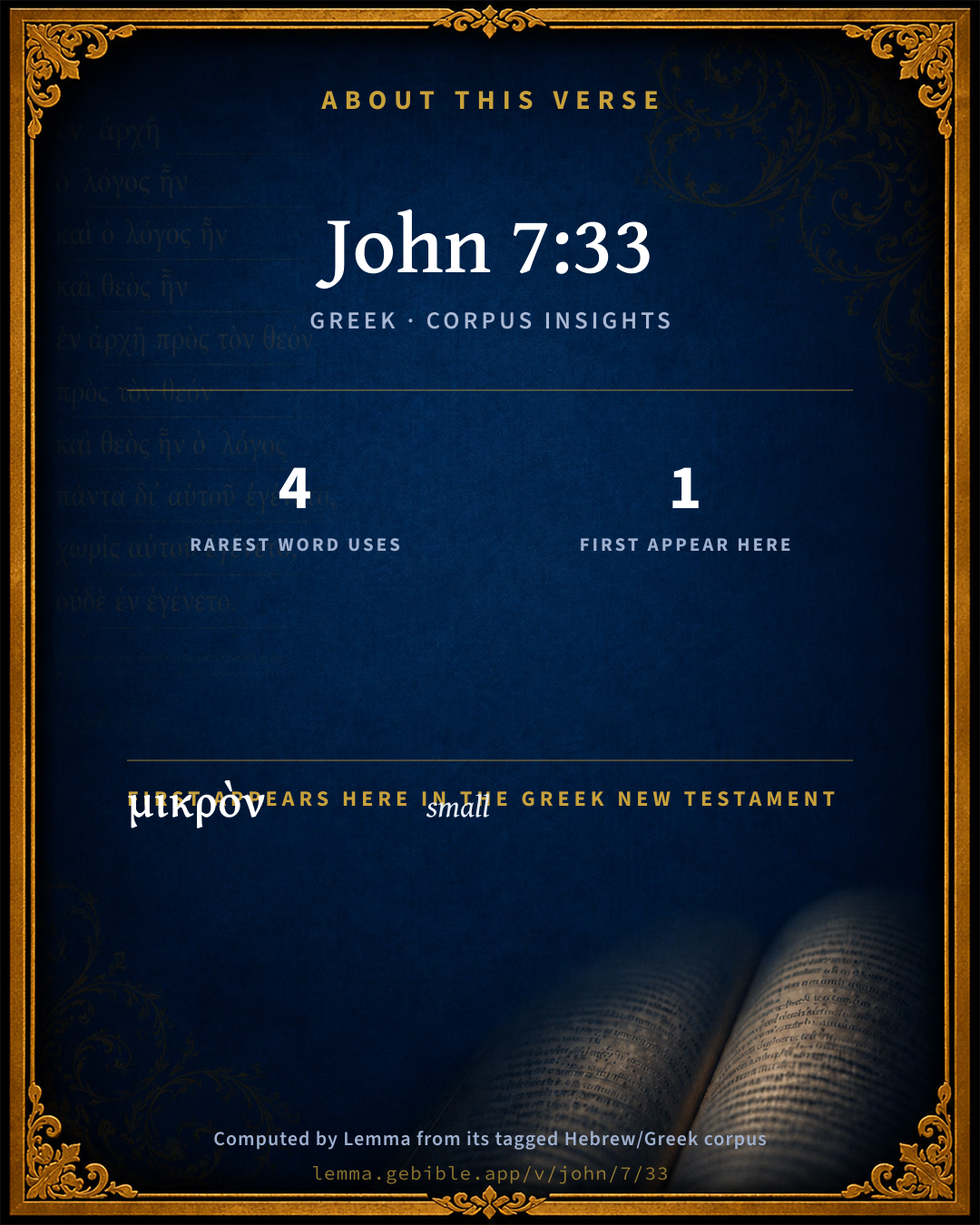
  • 1 first appearance in the Greek New Testament
Full analysis ↓
Download a study sheet

One document with this verse’s original text, its word-by-word gloss line, the meaning frame, cross-references with their text, attributed commentary, and full source and license credits — printable, and it pastes into notes with its structure intact.

This verse Autodidact and up

Study sheet (.html) Plain text (.txt)

A passage Seminary Student

Up to 50 verses in one chapter. A passage sheet keeps up to 6 commentary sources and 12 cross-references per verse, in the order this page ranks them, and says so on the sheet whenever that leaves anything out. Ask for a single verse and you get the Autodidact verse sheet above.

Everything on this page stays free to read, with no account — the sheet is a download of what is already on screen, not access to it.

Want to remove ads? Support Godless Engineer
Compare translations 3

The same verse in 3 English versions, stacked beneath the original-language interlinear above. Click any original word for its lexicon entry.

Each is an independent rendering of the whole verse — the interlinear is not word-aligned to these translations.

Highlighted words mark where these versions differ — a whole-verse word diff, not a word-by-word alignment.

  • World English Bible Public Domain
    Then Jesus said, "I will be with you a little while longer, then I go to him who sent me.
  • King James Version Public Domain
    Then said Jesus unto them, Yet a little while am I with you, and then I go unto him that sent me.
  • unfoldingWord Literal Text CC BY-SA 4.0
    Therefore, Jesus said, “I am still with you for a short time, and then I go away to the one having sent me.

unfoldingWord Literal Text — © unfoldingWord, licensed CC BY-SA 4.0. Word-aligned USFM3 via Door43 (git.door43.org/unfoldingWord/en_ult).

Versions to compare (up to 4)

3 of 4 selected

Show all 19 translations

Every available English version of this verse, each an independent rendering of the whole verse.

  • World English Bible Public Domain
    Then Jesus said, "I will be with you a little while longer, then I go to him who sent me.
  • Berean Standard Bible Public Domain
    So Jesus said, “I am with you only a little while longer, and then I am going to the One who sent Me.
  • Majority Standard Bible Public Domain
    So Jesus said, “I am with you only a little while longer, and then I am going to the One who sent Me.
  • King James Version Public Domain
    Then said Jesus unto them, Yet a little while am I with you, and then I go unto him that sent me.
  • American Standard Version (1901) Public Domain
    Jesus therefore said, Yet a little while am I with you, and I go unto him that sent me.
  • Revised Version (1885) Public Domain
    Jesus therefore said, Yet a little while am I with you, and I go unto him that sent me.
  • Geneva Bible (1599) Public Domain
    Then saide Iesus vnto them, Yet am I a little while with you, and then goe I vnto him that sent mee.
  • Douay-Rheims (1899) Public Domain
    Jesus therefore said to them: Yet a little while I am with you: and then I go to him that sent me.
  • Young's Literal Translation Public Domain
    Jesus, therefore, said to them, `Yet a little time I am with you, and I go away unto Him who sent me;
  • Literal Standard Version CC BY-SA 4.0
    Jesus, therefore, said to them, “Yet a short time I am with you, and I go away to Him who sent Me;
  • Unlocked Literal Bible CC BY-SA 4.0
    Jesus then said, “I am still with you for a short amount of time, and then I go to him who sent me.
  • unfoldingWord Literal Text CC BY-SA 4.0
    Therefore, Jesus said, “I am still with you for a short time, and then I go away to the one having sent me.
  • Darby Bible Public Domain
    Jesus therefore said, Yet a little while I am with you, and I go to him that has sent me.
  • World Messianic Bible Public Domain
    Then Yeshua said, “I will be with you a little while longer, then I go to him who sent me.
  • Webster's Bible Public Domain
    Then said Jesus to them, Yet a little while am I with you, and then I go to him that sent me.
  • Free Bible Version CC BY-SA 4.0
    Then Jesus told the people, “I'll be with you just a little longer, but then I'll return to the one who sent me.
  • Bible in Basic English Public Domain
    Then Jesus said, I will be with you a little longer and then I go to him who sent me.
  • Text-Critical English NT CC BY 4.0
    Then Jesus said, “I will be with you for only a little while longer, and then I am going to him who sent me.
  • Tyndale New Testament (1534) Public Domain
    Then sayde Iesus vnto the: Yet am I a lytell whyle with you and then goo I vnto him that sent me.

Literal Standard Version (2020), Covenant Press — licensed CC BY-SA 4.0. Text via the HelloAO Bible API (eBible.org). Unlocked Literal Bible (unfoldingWord) — licensed CC BY-SA 4.0. Text via the HelloAO Bible API (eBible.org). unfoldingWord Literal Text — © unfoldingWord, licensed CC BY-SA 4.0. Word-aligned USFM3 via Door43 (git.door43.org/unfoldingWord/en_ult). Free Bible Version, Dr. Jonathan Gallagher — licensed CC BY-SA 4.0. Text via the HelloAO Bible API (eBible.org).

Word by word

More ways to search: Search by grammar → Find every occurrence → Compare this word →

Practice this passage: Drill this verse → Learn its vocabulary →

μικρὸν
mikrón
G3397
“small”
Adjective, Accusative, Singular, Masculine
Part of Speech
Adjective
Case
Accusative
Number
Singular
Gender
Masculine
Full Thayer's Definition

Origin: masculine or neuter singular of G3398 (as noun)

TDNT: None

1. small, little a. of size: of stature, of length b. of space c. of age: less by birth, younger d. of time: short, brief, a little while, how little! e. of quantity: i.e. number, amount f. of rank or influence When translated "a little while", the Greek emphasises theshortness of the time interval, "oh how little". This phrase usedoften in the NT of the return of Christ.
  1. εἶπεν légō G3004 “to say” Verb, Aorist, Active, Indicative, 3rd person, Singular
  2. οὖν oûn G3767 “therefore” Conjunction
  3. ὁ ho G3588 “the” Article, Nominative, Singular, Masculine
  4. Ἰησοῦς Iēsoûs G2424 “Jesus” Noun, Nominative, Singular, Masculine
  5. ἔτι éti G2089 “still” Adverb
  6. χρόνον chrónos G5550 “time” Noun, Accusative, Singular, Masculine
  7. μεθ’ metá G3326 “with” Preposition
  8. ὑμῶν hymeîs G5210 “you” Personal pronoun, 2nd person, Genitive, Plural
  9. εἰμι eimí G1510 “to be” Verb, Present, Active, Indicative, 1st person, Singular
  10. καὶ kaí G2532 “and” Conjunction
  11. ὑπάγω hypágō G5217 “to depart” Verb, Present, Active, Indicative, 1st person, Singular
  12. πρὸς prós G4314 “to” Preposition
  13. τὸν ho G3588 “the” Article, Accusative, Singular, Masculine
  14. πέμψαντά pémpō G3992 “to send” Verb, Aorist, Active, Participle, Accusative, Singular, Masculine
  15. με egṓ G1473 “I” Personal pronoun, 1st person, Accusative, Singular

About this verse

These counts appear in no published source. They are computed here, from the morphology-tagged text and Lemma’s own curated glosses. What Lemma adds →

16
words
15
distinct lemmas
Gospels
section

Notable vocabulary

The rarest word here is μικρὸν small G3397 — appearing just 4 times in the whole Greek New Testament.

First appearance in Scripture

This word makes its first canonical appearance in the Greek New Testament here:

  • μικρὸν small G3397

Shared distinctive vocabulary

μικρὸν small G3397 occurs in 4 verses of the Greek New Testament. Also found in:

Repetition

A word recurs within this verse:

Cross-references

12

Topical passages linked to John 7:33 in the Treasury of Scripture Knowledge — connected by theme and wording, ordered by reader-vote popularity; previews shown in the World English Bible.

  • John 13:33 Little children, I will be with you a little while longer. You will seek me, and as I said to the Jews, 'Where I am going, you can't come,' so now I tell you.
  • John 16:5 But now I am going to him who sent me, and none of you asks me, 'Where are you going?'
  • Mark 16:19 So then the Lord Jesus, after he had spoken to them, was received up into heaven, and sat down at the right hand of God.
  • John 14:19 Yet a little while, and the world will see me no more; but you will see me. Because I live, you will live also.
  • John 17:11 I am no more in the world, but these are in the world, and I am coming to you. Holy Father, keep them through your name which you have given me, that they may be one, even as we are.
  • John 17:13 But now I come to you, and I say these things in the world, that they may have my joy made full in themselves.
  • John 12:35–36 Jesus therefore said to them, "Yet a little while the light is with you. Walk while you have the light, that darkness doesn't overtake you. He who walks in the darkness doesn't know where he is going.
  • John 13:1 Now before the feast of the Passover, Jesus knowing that his time had come that he would depart from this world to the Father, having loved his own who were in the world, he loved them to the end.
  • John 13:3 Jesus, knowing that the Father had given all things into his hands, and that he came forth from God, and was going to God,
  • John 16:10 about righteousness, because I am going to my Father, and you won't see me any more;
  • John 16:16–22 A little while, and you will not see me. Again a little while, and you will see me."
  • John 16:28 I came out from the Father, and have come into the world. Again, I leave the world, and go to the Father."

Cross-references courtesy of OpenBible.info (CC BY 4.0).

Commentary

Notes on John 7:33 from classic Christian and Jewish commentators (each source and its license shown beneath its notes). The classic Christian expositions comment on the surrounding passage and are grouped to its opening verse, so a note may address several verses; the Jewish commentaries on the Tanakh (Rashi and others) are per-verse, so they appear only where the commentator wrote on this verse.

Lemma curates 59 commentaries, every one of them public domain or Creative Commons licensed, each selected and text-cleaned for this edition rather than reprinted as found. About our sources →

Joseph Benson's Commentary

Joh 7:33-34. Then said Jesus — Continuing his discourse, (from Joh 7:29,) which they had interrupted, Yet a little while am I with you — My ministry among you is drawing toward a conclusion; you ought, therefore, while it lasts, to make the best possible improvement of it. For ye shall seek me, and shall not find me — You shall earnestly desire my presence with you, but shall not obtain it. “This seeking for the Messiah was general through the nation, during the calamities in Judea, occasioned by Titus and his armies; and has continued among the Jews ever since, in all the countries where they have been dispersed, but to no purpose, for their Messiah having already appeared, it is in vain to expect another. By thus predicting his own death, our Lord insinuated that he both knew the present disposition of the council, and foresaw that they would soon put an end to his ministry by taking away his life.” And where I am — Or, where I shall then, and always be; ye cannot come — Referring to his speedy exaltation to the heavenly world, and the impossibility of their being admitted thither: for so a similar expression, used Joh 8:21, evidently means, namely, Ye shall seek me, and shall die in your sins: whither I go, ye cannot come. Perhaps, also, our Lord might refer to the impotent malice with which, after his exaltation to the Father’s right hand, they should oppose his triumphant cause.

Joseph Benson's Commentary on the Old and New Testaments (1811–1818) — public domain. Text from a community e-Sword module.

MacLaren's Expositions of Holy Scripture

Alexander MacLaren

John

ONE SAYING WITH TWO MEANINGS

Joh 7:33 - Joh 7:34. - Joh 13:33.

No greater contrast can be conceived than that between these two groups to whom such singularly similar words were addressed. The one consists of the officers, tools of the Pharisees and of the priests, who had been sent to seize Christ, and would fain have carried out their masters’ commission, but were restrained by a strange awe, inexplicable even to themselves. The other consists of the little company of His faithful, though slow, scholars, who made a great many mistakes, and sometimes all but tired out even His patience, and yet were forgiven much because they loved much. Hatred animated one group, loving sorrow the other.

Christ speaks to them both in nearly the same words, but with what a different tone, meaning, and application! To the officers the saying is an exhibition of His triumphant confidence that their malice is impotent and their arms paralysed; that when He wills He will go, not be dragged by them or any man, but go to a safe asylum, where foes can neither find nor follow. The officers do not understand what He means. They think that, bad Jew as they have always believed Him to be, He may very possibly consummate His apostasy by going over to the Gentiles altogether; but, at any rate, they feel that He is to escape their hands.

The disciples understand little more as to whither He goes, as they themselves confess a moment after; but they gather from His words His loving pity, and though the upper side of the saying seems to be menacing and full of separation, there is an under side that suggests the possibility of a reunion for them.

The words are nearly the same in both cases, but they are not absolutely identical. There are significant omissions and additions in the second form of them. ‘Little children’ is the tenderest of all the names that ever came from Christ’s lips to His disciples, and never was heard on His lips except on this one occasion, for parting words ought to be very loving words. ‘A little while I am with you,’ but He does not say, ‘And then I go to Him that sent Me.’ ‘Ye shall seek Me,’ but He does not say, ‘And shall not find Me.’ ‘As I said unto the Jews, whither I go ye cannot come, so now I say to you,’ that little word ‘now’ makes the announcement a truth for the present only. His disciples shall not seek Him in vain, but when they seek they shall find. And though for a moment they be parted from Him, it is with the prospect and the confidence of reunion. Let us, then, look at the two main thoughts here. First, the two ‘seekings,’ the seeking which is vain, and the seeking which is never vain; and the two ‘cannots,’ the inability of His enemies for evermore to come where He is, and the inability of His friends, for a little season, to come where He is.

I. The two seekings.

As I have observed, there is a very significant omission in one of the forms of the words. The enemies are told that they will never find Him, but no such dark words are spoken to the friends. So, then, hostile seeking of the Christ is in vain, and loving seeking of Him by His friends, though they understand Him but very poorly, and therefore seek Him that they may know Him better, is always answered and over-answered.

Let me deal just for a moment or two with each of these. In their simplest use the words of my first text merely mean this: ‘You cannot touch Me, I am passing into a safe asylum where your hands can never reach Me.’

We may generalise that for a moment, though it does not lie directly in our path, and preach the old blessed truth that no man with hostile intent seeking for Christ in His person, in His Gospel, or in His followers and friends, can ever find Him. All the antagonism that has stormed against Him and His cause and words, and His followers and lovers, has been impotent and vain. The pursuers are like dogs chasing a bird, sniffing along the ground after their prey, which all the while sits out of their reach on a bough, and carols to the sky. As in the days of His flesh, His foes could not touch His person till He chose, and vainly sought Him when it pleased Him to hide from them, so ever since, in regard to His cause, and in regard to all hearts that love Him, no weapon that is formed against them shall prosper. They shall be wrapped, when need be, in a cloud of protecting darkness, and stand safe within its shelter. Take good cheer, all you that are trying to do anything, however little, however secular it may appear to be, for the good and well-being of your fellows! All such service is a prolongation of Christ’s work, and an effluence from His, if there be any good in it at all; and it is immortal and safe, as is His. ‘Ye shall seek Me and shall not find Me.’

But then, besides that, there is another thought. It is not merely hostile seeking of Him that is hopeless vain. When the dark days came over Israel, under the growing pressure of the Roman yoke, and amidst the agonies of that last siege, and the unutterable sufferings which all but annihilated the nation, do you not think that there were many of these people who said to themselves: ‘Ah! if we had only that Jesus of Nazareth back with us for a day or two; if we had only listened to Him!’ Do you not think that before Israel dissolved in blood there were many of those who had stood hostile or alienated, who desired to see ‘one of the days of the Son of Man,’ and did not see it? They sought Him, not in anger any more; they sought Him, not in penitence, or else they would have found Him; but they sought Him simply in distress, and wishing that they could have back again what they had cared so little for when they had it.

And are there no people listening to me now, to whom these words apply?-

‘He that will not, when he may,

When he will it shall be-Nay!’

Although it is {blessed be His name} always true that a seeking heart finds Him, and whensoever there is the faintest trace of penitent desire to get hold of Christ’s hand it does grasp ours, it is also true that things neglected once cannot be brought back; that the sowing time allowed to pass can never return; and that they who have turned, as some of you have turned, dear friends, all your lives, a deaf ear to the Christ that asks you to love Him and trust Him, may one day wish that it had been otherwise, and go to look for Him and not find Him.

There is another kind of seeking that is vain, an intellectual seeking without the preparation of the heart. There are, no doubt, some people here to-day that would say, ‘We have been seeking the truth about religion all our lives, and we have not got to it yet.’ Well, I do not want to judge either your motives or your methods, but I know this, that there is many a man who goes on the quest for religious certainty, and looks at, if not for Jesus Christ, and is not really capable of discerning Him when he sees Him, because his eye is not single, or because his heart is full of worldliness or indifference, or because he begins with a foregone conclusion, and looks for facts to establish that; or because he will not cast down and put away evil things that rise up between him and his Master.

My brother! if you go to look for Jesus Christ with a heart full of the world, if you go to look for Him while you wish to hold on by all the habitudes and earthlinesses of your past, you will never find Him. The sensualist seeks for Him, the covetous man seeks for Him, the passionate, ill-tempered man seeks for Him; the woman plunged in frivolities, or steeped to the eyebrows in domestic cares,-these may in some feeble fashion go to look for Him and they will not find Him, because they have sought for Him with hearts overcharged with other things and filled with the affairs of this life, its trifles and its sins.

I turn for a moment to the seeking that is not vain. ‘Ye shall seek Me’ is not on Christ’s lips to any heart that loves Him, however imperfectly, a sentence of separation or an appointment of a sorrowful lot, but it is a blessed law, the law of the Christian life.

That life is all one great seeking after Christ. Love seeks the absent when removed from our sight. If we care anything about Him at all, our hearts will turn to Him as naturally as, when the winter begins to pinch, the migrating birds seek the sunny south, impelled by an instinct that they do not themselves understand.

The same law which sends loving thoughts out across the globe to seek for husband, child, or friend when absent, sets the really Christian heart seeking for the Christ, whom, having not seen, it loves, as surely as the ivy tendril feels out for a support. As surely as the roots of a mountain-ash growing on the top of a boulder feel down the side of the rock till they reach the soil; as surely as the stork follows the warmth to the sunny Mediterranean, so surely, if your heart loves Christ, will the very heart and motive of your action be the search for Him.

And if you do not seek Him, brother, as surely as He is parted from our sense you will lose Him, and He will be parted from you wholly, for there is no way by which a person who is not before our eyes may be kept near us except only by diligent effort on our part to keep thought and love and will all in contact with Him; thought meditating, love going out towards Him, will submitting. Unless there be this effort, you will lose your Master as surely as a little child in a crowd will lose his nurse and his guide, if his hand slips from out the protecting hand. The dark shadow of the earth on which you stand will slowly steal over His silvery brightness, as when the moon is eclipsed, and you will not know how you have lost Him, but only be sadly aware that your heaven is darkened. ‘Ye shall seek Me,’ is the condition of all happy communion between Christ and us.

And that seeking, dear brother, in the threefold form in which I have spoken of it-effort to keep Him in our thoughts, in our love, and over our will-is neither a seeking which starts from a sense that we do not possess Him, nor one which ends in disappointment. But we seek for Him because we already have Him in a measure, and we seek Him that we may possess Him more abundantly, and anything is possible rather than that such a search shall be vain. Men may go to created wells, and find no water, and return ashamed, and with their vessels empty, but every one who seeks for that Fountain of salvation shall draw from it with joy. It is as impossible that a heart which desires Jesus Christ shall not have Him, as it is that lungs dilated shall not fill with air, or as it is that an empty vessel put out in a rainfall shall not be replenished. He does not hide Himself, but He desires to be found. May I say that as a mother will sometimes pretend to her child to hide, that the child’s delight may be the greater in searching and in finding, so Christ has gone away from our sight in order, for one reason, that He may stimulate our desires to feel after Him! If we seek Him hid in God, we shall find Him for the joy of our hearts.

A great thinker once said that he would rather have the search after truth than the possession of truth. It was a rash word, but it pointed to the fact that there is a search which is only one shade less blessed than the possession. And if that be so in regard to any pure and high truth, it is still more so about Christ Himself. To seek for Him is joy; to find Him is joy. What can be a happier life than the life of constant pursuit after an infinitely precious object, which is ever being sought and ever being found; sought with a profound consciousness of its preciousness, found with a widening appreciation and capacity for its enjoyment? ‘Ye shall seek Me’ is a word not of evil but of good cheer; for buried in the depth of the commandment to search is the promise that we shall find.

II, Secondly, let us look briefly at these two ‘cannots.’

‘Whither I go, ye cannot come,’ says He to His enemies, with no limitation, with no condition. The ‘cannot’ is absolute and permanent, so long as they retain their enmity. To His friends, on the other hand, He says, ‘So now I say to you,’ the law for to-day, the law for this side the flood, but not the law for the beyond, as He explains more fully in the subsequent words: ‘Thou canst not follow Me now, but thou shalt follow Me afterwards.’

So, then, Christ is somewhere. When He passed from life it was not into a state only, but into a place; and He took with Him a material body, howsoever changed. He is somewhere, and there friend and enemy alike cannot enter, so long as they are compassed with ‘the earthly house of this tabernacle.’ But the incapacity is deeper than that. No sinful man can pass thither. Where has He gone? The preceding words give us the answer. ‘God shall glorify Him in Himself.’ The prospect of that assumption into the inmost glory of the divine nature directly led our Lord to think of the change it would bring about in the relation of His humble friends to Him. While for Himself He triumphs in the prospect, He cannot but turn a thought to their lonesomeness, and hence come the words of our text. He has passed into the bosom and blaze of divinity. Can I walk there, can I pass into that tremendous fiery furnace? ‘Who shall dwell with the everlasting burnings?’ ‘Ye cannot follow Me now.’ No man can go thither except Christ goes thither.

There are deep mysteries lying in that word of our Lords,-’I go to prepare a place for you.’ We know not what manner of activity on His part that definitely means. It seems as if somehow or other the presence in Heaven of our Brother in His glorified humanity was necessary in order that the golden pavement should be trodden by our feet, and that our poor, feeble manhood should live and not be shrivelled up in the blaze of that central brightness.

We know not how He prepares the place, but heaven, whatever it be, is no place for a man unless the Man, Christ Jesus, be there. He is the Revealer of God, not only for earth, but for heaven; not only for time, but for eternity. ‘No man cometh unto the Father but by Me,’ is true everywhere and always, there as here. So I suppose that, but for His presence, heaven itself would be dark, and its King invisible, and if a man could enter there he would either be blasted with unbearable flashes of brightness or grope at its noonday as the blind, because his eye was not adapted to such beams. Be that as it may, ‘the Forerunner is for us entered.’ He has gone before, because He knows the great City, ‘His own calm home, His habitation from eternity.’ He has gone before to make ready a lodging for us, in whose land He has dwelt so long, and He will meet us, who would else be bewildered like some dweller in a desert if brought to the capital, when we reach the gates, and guide our unaccustomed steps to the mansion prepared for us.

But the power to enter there, even when He is there, depends on our union with Christ by faith. When we are joined to Him, the absolute ‘cannot,’ based upon flesh, and still more upon sin, which is a radical and permanent impossibility, is changed into a relative and temporary incapacity. If we have faith in Christ, and are thereby drawing a kindred life from Him, our nature will be in process of being changed into that which is capable of bearing the brilliance of the felicities of heaven. But just as these friends of Christ, though they loved Him very truly, and understood Him a little, were a long way from being ready to follow Him, and needed the schooling of the Cross, and Olivet, and Pentecost, as well as the discipline of life and toil, before they were fully ripe for the harvest, so we, for the most part, have to pass through analogous training before we are prepared for the place which Christ has prepared for us. Certainly, so soon as a heart has trusted Christ, it is capable of entering where He is, and the real reason why the disciples could not come where He went was that they did not yet clearly know Him as the divine Sacrifice for theirs and the world’s sins, and, however much they believed in Him as Messiah, had not yet, nor could have, the knowledge on which they could found their trust in Him as their Saviour.

But, while that is true, it is also true that each advance in the grace and knowledge of our Lord and Saviour will bring with it capacity to advance further into the heart of the far-off land, and to see more of the King in His beauty. So, as long as His friends were wrapped in such dark clouds of misconception and error, as long as their Christian characters were so imperfect and incomplete as they were at the time of my text being spoken, they could not go thither and follow Him. But it was a diminishing impossibility, and day by day they approximated more and more to His likeness, because they understood Him more, and trusted Him more, and loved Him more, and grew towards Him, and, therefore, day by day became more and more able to enter into that Kingdom.

Are you growing in power so to do? Is the only thing which unfits you for heaven the fact that you have a mortal body? In other respects are you fit to go into that heaven, and walk in its brightness and not be consumed? The answer to the question is found in another one-Are you joined to Jesus Christ by simple faith? The incapacity is absolute and eternal if the enmity is eternal.

State and place are determined yonder by character, and character is determined by faith. Take a bottle of some solution in which heterogeneous substances have all been melted up together, and let it stand on a shelf and gradually settle down, and its contents will settle in regular layers, the heaviest at the bottom and the lightest at the top, and stratify themselves according to gravity. And that is how the other world is arranged-stratified. When all the confusions of this present are at an end, and all the moisture is driven off, men and women will be left in layers, like drawing to like. As Peter said about Judas with equal wisdom and reticence, ‘He went to his own place.’ That is where we shall all go, to the place we are fit for.

God does not slam the door of heaven in anybody’s face; it stands wide open. But there is a mystic barrier, unseen, but most real, more repellent than cherub and flaming sword, which makes it impossible for any foot to cross that threshold except the foot of the man whose heart and nature have been made Christlike, and fitted for heaven by simple faith in Him.

Love Him and trust Him, and then your life on earth will be a blessed seeking and a blessed finding of Him whom to seek is joyous effort, whom to find is an Elysium of rest. You will walk here not parted from Him, but with your thoughts and your love, which are your truest self, going up where He is, until you drop ‘the muddy vesture of decay’ which unfits you whilst you wear it for the presence-chamber of the King, and so you will enter in and be ‘for ever with the Lord.’

Alexander MacLaren, Expositions of Holy Scripture (1904–1910) — public domain. Text from a community e-Sword module.

Godbey's Commentary on the New Testament

William B. Godbey

THE DISPERSION OF THE GREEKS

Joh 7:33-36. “Then Jesus said, Yet a little while I am with you, and I go to Him that sent Me. You shall seek Me, and shall not find Me, and where I am you are not able to come. Then the Jews said to one another, Whither is He about to go, that we shall not find Him? Whether is He about to go into the dispersion of the Greeks, and to teach the Greeks? What is this word which He said, Ye shall seek and not find Me, and where I am you are not able to come?” During the Alexandrian conquests, the Greeks conquered the whole world, and became the rulers of all nations, thus establishing their beautiful, concise, definite, vivid, perspicuous, and in every way wonderful language in every nation under heaven, preparatory for the preaching of Jesus and His apostles and the evangelization of the globe. The Jews, the most enterprising people in the world, had gone away on mercantile expeditions, and settled in all the important cities of the world, — a glorious preparation for the evangelization of all nations, the Jews constituting the nucleus of the gospel Church, and becoming the heralds of the living Word to the ends of the earth. Now the meaning of this passage is, they propound the question whether Jesus, forsaking the home- lands, will go away into the Jewish settlements of the Gentile cities, and preach to the Jews in their world-wide dispersion among all nations.

William B. Godbey, Commentary on the New Testament (1896–1900) — public domain. Text from a community e-Sword module.

Bengel's Gnomon

Johann Albrecht Bengel

Joh 7:33. Ἐτι, as yet) He continues the discourse, which they had interrupted after Joh 7:29.

Bengel's Gnomon of the New Testament — English translation (T&T Clark, Edinburgh, 1860) — public domain. Text from a community e-Sword module.

Expositor's Greek Testament

ed. W. Robertson Nicoll

Joh 7:33 . εἶπεν οὖν αὐτοῖς [ αὐτοῖς omitted by modern editors] ἔτι μικρὸν χρόνον … πέμψαντά με . Seeing the servants of the Sanhedrim [ οὖν ], Jesus said to the crowd: “Yet a little while am I with you, and then I go to Him that sent me”. The “little while” is prompted by the actively hostile step taken by the Sanhedrim. The utterance was a word of warning. ὑπάγω does not convey any sense of secrecy, as has been alleged. [It has been supposed that τὸν πέμψαντά με is a Johannine addition; chiefly because of Joh 7:35 . But this misunderstanding proves nothing; for the people never apprehended who was meant by “Him that sent Him”.]

The Expositor's Greek Testament, edited by W. Robertson Nicoll (1897–1910) — public domain. Text from a community e-Sword module.

Godet's Commentaries

Frédéric Louis Godet

Vv. 33, 34. “Jesus said therefore: I am with you yet a little while, and then I go to him that sent me. 34. You shall seek me and shall not find me;and where I am you cannot come.”

Jesus was not ignorant of this hostile measure; and this is what awakened in Him the presentiment of His approaching death which is so solemnly expressed in the following words (therefore). In this discourse, He invites the Jews to take advantage of the time, soon to pass away, during which He is still to continue with them. There is a correspondence between the expressions: I go away, and: He who sent me. The idea of a sending involves that of a merely temporary sojourn here below. The practical conclusion of Joh 7:33, which is understood, “Hasten to believe!” is made more pressing by Joh 7:34.

Of the two clauses of this verse, the first refers to their national future; the second, to their individual fate. In the first, Jesus describes, in a striking way, the state of abandonment in which this people will soon find itself, provided it persists in rejecting Him who alone can lead it to the Father; a continual and ever disappointed expectation; the impotent attempt to find God, after having suffered the visitation of Him to pass by who alone could have united them to God. This sense is that in which Jesus cites this word in Joh 13:33 (comp. Joh 14:6). It is also that in which He will repeat it, soon afterwards, in a more emphatic form, Joh 8:21-22.

There cannot be any difficulty in applying the notion of the pronoun με, me, to the idea of the Messiah in general. To expect the Messiah is, indeed, on the part of the Jewish people, and without their being aware of it, to seek Jesus, the only Messiah who can be given to them. But there is something more terrible than this future of the nation—it is that of individuals. The expression:where I am, denotes symbolically the communion with the Father and the state of salvation which one enjoys in that communion. This is the blessed goal which they cannot reach after having rejected Him; for it is He alone who could have led them thither (Joh 14:3). If then they allow this time to pass by, in which they can yet attach themselves to Him, all will be over for them. The present: where I am, signifies: “where I shall be at that moment;” it can only be rendered in French by the future. This second part of the verse does not allow us to explain the term : you shall seek me, in the first part, either of a seeking inspired by hatred (Origen)—comp. Joh 13:33—or of a sigh of repentance; such a feeling would not have failed to lead them to salvation.

Frédéric Louis Godet — Commentaries on Luke, John, Romans, and 1 Corinthians — English translation (T&T Clark, Edinburgh, 1870s–1890s) — public domain. Text from a community e-Sword module.

Jamieson, Fausset & Brown

Robert Jamieson, A. R. Fausset & David Brown

Yet a little while, &c.--that is, "Your desire to be rid of Me will be for you all too soon fulfilled. Yet a little while and we part company--for ever; for I go whither ye cannot come: nor, even when ye at length seek Him whom ye now despise, shall ye be able to find Him"--referring not to any penitential, but to purely selfish cries in their time of desperation.

Jamieson, Fausset & Brown — Commentary Critical and Explanatory on the Whole Bible (1871) — public domain (CC PDM 1.0). Text via the HelloAO Bible API.

Adam Clarke's Commentary

Verse 33. Yet a little while am I with you] As he knew that the Pharisees had designed to take and put him to death, and that in about six months from this time, as some conjecture, he should be crucified, he took the present opportunity of giving this information to the common people, who were best disposed towards him, that they might lay their hearts to his teaching, and profit by it, while they had the privilege of enjoying it.

The word αυτοις, to them, in the beginning of this verse, is wanting in BDEGHLMS, more than eighty others, both the Syriac, later Persic, Coptic, Sahidic, Armenian, Gothic, Slavonic, Saxon, most copies of the Vulgate and the Itala. It is omitted also by Euthymius, Theophylact, Augustin, and Bede. Our Lord did not speak these words to the officers who came to apprehend him, as αυτοις here implies, but to the common people, merely to show that he was not ignorant of the designs of the Pharisees, though they had not yet been able to put them into practice.

Adam Clarke's Commentary on the Bible (1810–1826) — public domain. Text from a community e-Sword/MySword module.

John Calvin's Commentaries

33. Yet a little while am I with you. Some think that this sermon was addressed to the assembly of the people who were present, and others, that it was addressed to the officers who had been sent to seize Christ. But for my own part, I have no doubt that Christ particularly addresses his enemies, who had taken counsel to destroy him; for he ridicules their efforts, because they will be utterly ineffectual, until the time decreed by the Father be come And at the same time, he reproaches them for their obstinacy, because they not only reject, but furiously oppose, the grace which is offered to them; and threatens that ere long it will be taken from them. When he says, I am with you, he rebukes their ingratitude, because, though he had been given to them by the Father, though he had come down to them from the heavenly glory, though, by calling them to be his familiar associates, he desired nothing more than to assist them, still there were few who received him. When he says, Yet a little while, he warns them that God will not long endure that his grace should be exposed to such shameful contempt. Yet he also means, that neither his life nor his death is placed at their disposal, but that his Father has fixed a time, which must be fulfilled.

I go to him who hath sent me. By these words he testifies that he will not be extinguished by his death, but, on the contrary, when he shall have laid aside his mortal body, will be declared to be the Son of God by the magnificent triumph of his resurrection; as if he had said, “Labour as much as you please, yet you will never hinder my Father from receiving me into his heavenly glory, when I have discharged the embassy which he has committed to me. Thus not only will my rank remain undiminished after my death, but a more excellent condition is then provided for me.” Besides, we ought to draw from it a general admonition; for as often as Christ calls us to the hope of salvation by the preaching of the Gospel, he is present with us. For not without reason is the preaching of the Gospel called Christ’s descent to us, where it is said,

he came and preached peace to those who were far off, and to those who were near, (Ephesians 2:17.)

If we accept the hand which he holds out, he will lead us to the Father; and so long as we must sojourn in the world, not only will he show himself to be near us, but will constantly dwell in us. And if we disregard his presence, he will lose nothing, but, departing from us, will leave us altogether strangers to God and to life.

John Calvin's Commentaries (1540-1563) — public domain. Text from the Calvin Translation Society English edition (1840s-50s) via the Christian Classics Ethereal Library (ccel.org). Calvin's coverage is partial (roughly two-thirds of the Bible); uncommented books and verses are honest gaps, never fabricated. The 19th-century editor's footnotes and remarks are omitted so the notes are faithfully Calvin's own voice.

Ellicott's Commentary for English Readers

(33) Then said Jesus unto them.—It should rather be, Therefore said Jesus. He said this because they sent to take Him. The better MSS. omit “unto them,” and it is clear, from Joh_7:35, that the words are addressed to the hierarchy generally.

Yet a little while am I with you.—Their action is the first attempt to take Him by force. It brings to His mind the thought that the end is at hand. But a little while more, and the hour will have come. The manifestation of God’s love to man will then be completed in its crowning sacrifice, and when the work of His mission is completed, He will return to Him that sent Him.

A Bible Commentary for English Readers, edited by Charles John Ellicott (1878–1897) — public domain. Text from a community e-Sword module.

The Cambridge Bible for Schools and Colleges

gen. ed. J. J. S. Perowne

33. Then said Jesus] Better, as in Joh_7:30 and often, Therefore said Jesus, i.e. in consequence of their sending to arrest Him: probably He recognised the officers waiting for an opportunity to take Him. According to the best MSS., ‘Unto them’ should be omitted: Christ’s words are addressed to the officers and those who sent them.

It is very difficult to decide on the precise meaning of Christ’s words. Perhaps the simplest interpretation is the best. ‘I must remain on earth a little while longer, and during this time ye cannot kill Me: then ye will succeed, and I shall go to My Father. Thither ye will wish to come, but ye cannot; for ye know Him not (Joh_7:28), and such as ye cannot enter there.’ This is the first formal attempt upon His life. It reminds Him that His death is not far off, and that it will place a tremendous barrier between Him and those who compass it. It is the beginning of the end; an end that will bring a short-lived loss and eternal triumph to Him, a short-lived triumph and eternal loss to them.

unto him that sent me] One suspects that here S. John is translating Christ’s words into plainer language than He actually used. Had He said thus clearly ‘unto Him that sent Me,’ a phrase which they elsewhere understand at once of God (see on Joh_7:30), they could scarcely have asked the questions which follow in Joh_7:35. Unless we are to suppose that they here pretend not to understand; which is unlikely, as they speak not to Him but ‘among themselves.’

The Cambridge Bible for Schools and Colleges (gen. ed. J. J. S. Perowne; Cambridge University Press, 1878–1918) — public domain. Text from a community e-Sword module.

John Gill's Exposition

Ye shall seek me,.... That is, the Messiah, who he was; meaning, that after his departure they should be in great distress, and be very much on the inquiry after, and solicitous for the coming of the Messiah, to be a Redeemer and Deliverer of them out of their troubles:

and shall not find me; no Messiah will appear, no Saviour will be sent, no Redeemer will come to relieve them; they shall inquire, and look for one in vain, as they did.

And where I am, thither ye cannot come; intimating hereby, that not only their temporal estate and condition would be very distressed and miserable, but also their eternal estate; since they should not be able to come where he would be in his human nature, and where he now was as a divine person, namely, in heaven.

John Gill's Exposition of the Whole Bible (1746–1763) — public domain (CC PDM 1.0). Text via the HelloAO Bible API.

Trapp's Complete Commentary

John Trapp

33 Then said Jesus unto them, Yet a little while am I with you, and then I go unto him that sent me.

Ver. 33. Yet a little while am I with you] Christ is but a while with men in the opportunities of grace. There is a prime of man’s life, yea, a prime of every man’s ministry. Christ stands (not sits at the door) and knocks. Now, while one is standing, he is going.

John Trapp, A Commentary or Exposition upon All the Books of the Old and New Testament (1647–1656) — public domain. Text from a community e-Sword module.

Albert Barnes' Notes on the Bible

Yet a little while am I with you - It will not be long before my death. This is supposed to have been about six months before his death. This speech of Jesus is full of tenderness. They were seeking his life. He tells them that he is fully aware of it; that he will not be long with them; and implies that they should be diligent to seek him while he was yet with them. He was about to die, but they might now seek his favor and find it. When we remember that this was said to his persecutors and murderers; that it was said even while they were seeking his life, we see the special tenderness of his love. Enmity, and hate, and persecution did not prevent his offering salvation to them.

I go unto him that sent me - This is one of the intimations that he gave that he would ascend to God. Compare Joh 6:62.

Albert Barnes' Notes on the Bible (1834–1885) — public domain. Text from a community e-Sword/MySword module.

Haydock's Catholic Bible Commentary

Yet a little while and I am with you: and then I go, and return to him that sent me, with whom I am always; but as man, I shall leave the world. (Witham)

George Leo Haydock (1774–1849), Haydock's Catholic Family Bible and Commentary, 1859 edition — public domain. Excludes Psalms (Douay-Rheims chapter numbering differs from Protestant) and Deuterocanonical books (Catholic canon only).

Matthew Poole's English Annotations

Whether Christ spake these words to the officers sent to apprehend him, or to the people in the temple, is not much material to be known: he by them plainly declareth, that all their endeavours against him were vain and foolish; for he should yet live with them six months, (this was in September or October, he died at the next passover, which was about six months after this), and then he should go and willingly lay down his life for the sins of the world, rise again from the dead, and ascend unto his Father who sent him into the world.

Matthew Poole's English Annotations on the Holy Bible (1683–1685) — public domain. Text from a community e-Sword/MySword module.

Whedon's Commentary on the Bible

Daniel D. Whedon

33. Then said Jesus—The consciousness of Jesus that, spite of these attempts to apprehend him, his hour is not yet come, points his thought to the hour when they should be empowered to crucify him and his departure take place. There is a tender plaintiveness in his language in contrast with his previous exclamation. But his melting is less for himself than for them.

Daniel D. Whedon (gen. ed.), Commentary on the Old and New Testaments (1874–1909) — public domain. Text from a community e-Sword module.

The Pulpit Commentary

Jesus therefore said. We are left in doubt to whom he addressed these weighty words, probably to the entire group of friends and foes. Yet a little while am I with you (six months would bring round the last Passover). The movement had not escaped him. It is as though he had said, "I see all that will happen. This is my death struggle with those whom I am sent to teach and save. For a little while only will the possibility of approach to me for life and peace be continued. You have taken steps to shorten my career. You would even now silence me." And I gounto him that sent me. I am going; you are hurrying me back to the Father who sent me on this commission of instruction and of life giving. This was in a sense enigmatical and puzzling. It might bear other meanings than the one which we now see it to have borne. It is quite extravagant of Reuss to describe the misunderstandings of Christ"s hearers as an intolerable contradiction. We are not so ready or able to understand any of our Lord"s words in all their fulness even now.

The Pulpit Commentary (1880–1919), ed. H.D.M. Spence-Jones & Joseph S. Exell — public domain. Text from a community e-Sword module.

John Wesley's Explanatory Notes

Then said Jesus - Continuing his discourse (from ver. 29) which they had interrupted.

John Wesley, Explanatory Notes Upon the Whole Bible (1754–1765) — public domain. Text via the GEBible commentary corpus.

The People's New Testament

B. W. Johnson

33–36. Yet a little while I am with you. Aware of the counsel of the rulers, he foretells his death and return to heaven.

Where I am, ye cannot come. Not while on earth, neither after life is over, if they die in their sins (8:21). The Jews did not comprehend his words, plain as they are to us.

B. W. Johnson's The People's New Testament with Notes (1889–1891) — public domain. Electronic text from the Christian Classics Ethereal Library (CCEL) ThML edition.

unfoldingWord translationNotes

Door43 World Missions Community

I am still with you for a short amount of time

"I will remain with you for only a short period of time"

then I go to him who sent me

Here Jesus refers to God the Father, who sent him.

where I go, you will not be able to come

"you will not be able to come to the place where I am"

unfoldingWord translationNotes — © Distant Shores Media and the Door43 World Missions Community, licensed CC BY-SA 4.0. Source: git.door43.org/Door43/en_tn.

Cambridge Greek Testament for Schools and Colleges

33. εἶπεν οὖν ὁ Ἰ. Therefore said Jesus, i.e. in consequence of their sending to arrest Him: probably He recognised the officers waiting for an opportunity to take Him. Christ’s words are addressed to the officers and those who sent them, and it is very difficult to decide on their precise meaning. Perhaps the simplest interpretation is the best. ‘I must remain on earth a little while longer, and during this time ye cannot kill Me: then ye will succeed, and I shall go to My Father. Thither ye will wish to come, but ye cannot; for ye know Him not (Joh 7:28), and such as ye cannot enter there.’ This is the first formal attempt upon His life. It reminds Him that His death is not far off, and that it will place a tremendous barrier between Him and those who compass it. It is the beginning of the end; an end that will bring a short-lived loss and eternal triumph to Him, a short-lived triumph and eternal loss to them.

χρόν. μικρόν. About six months; from the F. of Tabernacles to the Passover.

ὑπάγω. The voluntariness of His dying is implied in the word: see on Joh 10:17-18, Joh 19:30; Joh 19:34, and on Joh 16:7.

πρὸς τ. πέμψ. με. See on Joh 1:33. One suspects that here S. John is translating Christ’s words into plainer language than He actually used. Had He said thus clearly ‘unto Him that sent Me,’ a phrase which they elsewhere understand at once of God (see on Joh 7:30), they could scarcely have asked the questions which follow in Joh 7:35. Unless we are to suppose that they here pretend not to understand; which is unlikely, as they speak not to Him but ‘among themselves.’

Cambridge Greek Testament for Schools and Colleges (Cambridge University Press, 1896; 21 vols, various authors incl. Carr, Maclear, Plummer, Farrar, Lumby, Moule, M. R. James, Simcox) — public domain. Text from a community e-Sword module.

International Critical Commentary

33. εἶπεν οὖν ὁ Ἰη. If we press the causative force of οὖν, the meaning is that Jesus said that He would be only among them a little while longer, so that there was nothing to be gained by arresting Him. οὖν, however (see on 1:22), is not always to be rendered “therefore,” and may be only a conjunction, “and so.”

The rec. adds αὐτοῖς after οὖν, but om. אBDLNWΘ.

ἔτι χρόνον μικρόν κτλ. The end of His ministry was near, and He knew it; it would come in “a little while”—in fact in about six months. The phrase μικρὸν χρόνον (or μικρόν alone) is repeatedly on His lips henceforth, according to Jn. (12:35, 13:33, 14:19, 16:16). Cf 9:4.

The rec. has μικρὸν χρόνον (DNΓΔ), but אBLTWΘ give the order. χρ. μικρ.

καὶ ὑπάγω πρὸς τὸν πέμψαντά με. The words are repeated 16:5. For the phrase “Him that sent me,” frequent in Jn., see on 3:17. This was a saying of mystery, and the Jews could not understand it.

ὑπάγειν is a favourite verb with Jn., and it is often used in the Gospel of Jesus “going to God” (cf. 8:14, 21, 13:3, 33, 36, 14:4, 5, 28, 16:5, 10, 17). It means strictly “to depart,” and so is specially appropriate of the withdrawal of Christ’s visible presence from among men, and His “going to the Father” or “going home.” See on 15:16, 16:7; and cf. Mar 14:21 ὁ μὲν υἱὸς τοῦ ἀνθρώπου ὑπάγει, καθὼς γέγραπται.

International Critical Commentary — older volumes (1896–1929), various authors — public domain. Text from a community e-Sword module.

Vincent's Word Studies in the New Testament

Marvin R. Vincent

Unto them. Omit.

I go [υπαγω] . I withdraw. See on 6 21.

Marvin R. Vincent, Word Studies in the New Testament (1887–1900) — public domain. Text from a community e-Sword/MySword module.

Lesson kit

Teaching starters — assembled from the data on this page, not authored interpretation. Every prompt links to the verse data it draws on. Edit before teaching.

John, in the Gospels, opens this verse with 16 words (15 distinct Greek lemmas). Its most distinctive word is mikrón (“small”). A historical commentator’s framing appears above. Read the whole chapter for the surrounding context.

Discussion questions

  1. What does “small” (mikrón) contribute to the verse as a whole?
  2. The word “small” first appears here in Scripture. What is being introduced at this debut?
  3. John 12:35 shares the word «small» with this verse. How do the two illuminate each other?
  4. “the” occurs 2× in this one verse. What is the effect of the repetition?
  5. The translations on this page render this verse differently — a whole-verse word diff, not a word-by-word alignment. What might account for the different wordings?
  6. Reading how Joseph Benson's Commentary and MacLaren's Expositions of Holy Scripture read this verse, where do the two commentators agree and where do they part?

Things to notice

  • 1 word makes its first canonical appearance in Scripture here.
  • These translations choose different wording for 14 words in this verse.
  • “the” occurs 2× in this single verse.
  • 15 distinct Greek lemmas span 16 words in this verse.

Reading settings

Reading text

Shown beneath each verse's original-language words.

Old Testament
Old Testament edition

Read the OT as the Masoretic Hebrew (MT) or the Greek Septuagint (LXX).

English shown for the Greek Septuagint (in the Hebrew ↔ Greek comparison).

Comparing translations? Open the Compare panel on any verse page to stack up to four side by side.