
John 12:13

Greek (Tischendorf 8th ed.) John 12:13 appears in the Greek New Testament. The text above is from the Tischendorf 8th edition. Each word links to its Strong’s number and a concise gloss. Click any word for its full Thayer’s Greek Lexicon entry.
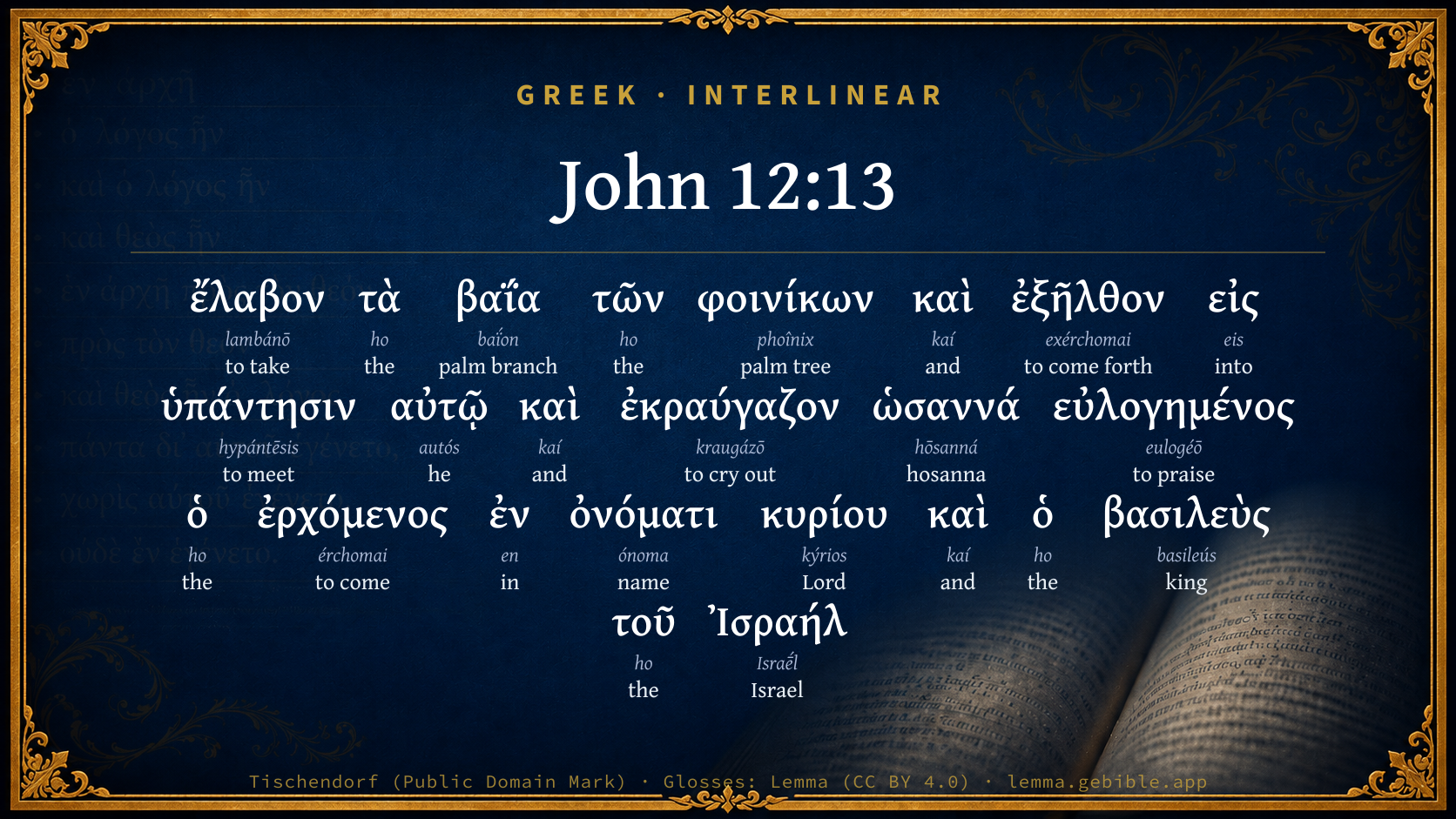
Download image
Cite this verse

John 12:13 (World English Bible). Public Domain. Lemma interlinear Bible study tool, https://lemma.gebible.app/v/john/12/13.

Show BibTeX & RIS
BibTeX
RIS
English Translation
they took the branches of the palm trees, and went out to meet him, and cried out, "Hosanna! Blessed is he who comes in the name of the Lord, the King of Israel!"
World English Bible · Public Domain
Highlights
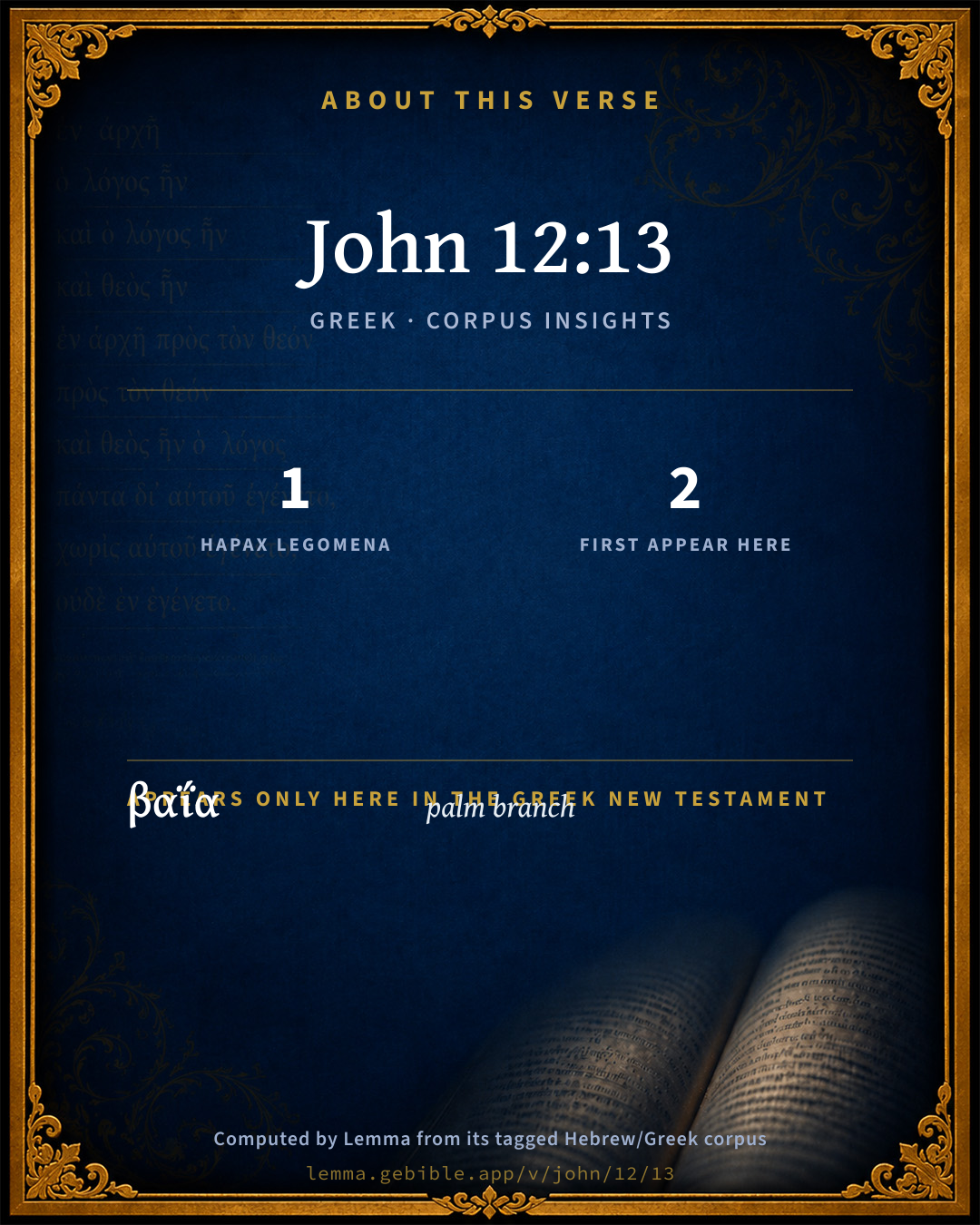
  • 1 hapax legomenon — only here in the Greek New Testament
  • 2 first appearances in the Greek New Testament
Full analysis ↓
Download a study sheet

One document with this verse’s original text, its word-by-word gloss line, the meaning frame, cross-references with their text, attributed commentary, and full source and license credits — printable, and it pastes into notes with its structure intact.

This verse Autodidact and up

Study sheet (.html) Plain text (.txt)

A passage Seminary Student

Up to 50 verses in one chapter. A passage sheet keeps up to 6 commentary sources and 12 cross-references per verse, in the order this page ranks them, and says so on the sheet whenever that leaves anything out. Ask for a single verse and you get the Autodidact verse sheet above.

Everything on this page stays free to read, with no account — the sheet is a download of what is already on screen, not access to it.

Want to remove ads? Support Godless Engineer
Compare translations 3

The same verse in 3 English versions, stacked beneath the original-language interlinear above. Click any original word for its lexicon entry.

Each is an independent rendering of the whole verse — the interlinear is not word-aligned to these translations.

Highlighted words mark where these versions differ — a whole-verse word diff, not a word-by-word alignment.

  • World English Bible Public Domain
    they took the branches of the palm trees, and went out to meet him, and cried out, "Hosanna! Blessed is he who comes in the name of the Lord, the King of Israel!"
  • King James Version Public Domain
    Took branches of palm trees, and went forth to meet him, and cried, Hosanna: Blessed is the King of Israel that cometh in the name of the Lord.
  • unfoldingWord Literal Text CC BY-SA 4.0
    took the branches of the palm trees and went out to meet him and cried out, “Hosanna! Blessed the one coming in the name of the Lord, even the King of Israel.”

unfoldingWord Literal Text — © unfoldingWord, licensed CC BY-SA 4.0. Word-aligned USFM3 via Door43 (git.door43.org/unfoldingWord/en_ult).

Versions to compare (up to 4)

3 of 4 selected

Show all 19 translations

Every available English version of this verse, each an independent rendering of the whole verse.

  • World English Bible Public Domain
    they took the branches of the palm trees, and went out to meet him, and cried out, "Hosanna! Blessed is he who comes in the name of the Lord, the King of Israel!"
  • Berean Standard Bible Public Domain
    They took palm branches and went out to meet Him, shouting: “Hosanna!” “Blessed is He who comes in the name of the Lord!” “Blessed is the King of Israel!”
  • Majority Standard Bible Public Domain
    They took palm branches and went out to meet Him, crying out: “Hosanna!” “Blessed is He who comes in the name of the Lord!” “Blessed is the King of Israel!”
  • King James Version Public Domain
    Took branches of palm trees, and went forth to meet him, and cried, Hosanna: Blessed is the King of Israel that cometh in the name of the Lord.
  • American Standard Version (1901) Public Domain
    took the branches of the palm trees, and went forth to meet him, and cried out, Hosanna: Blessed `is' he that cometh in the name of the Lord, even the King of Israel.
  • Revised Version (1885) Public Domain
    took the branches of the palm trees, and went forth to meet him, and cried out, Hosanna: Blessed is he that cometh in the name of the Lord, even the King of Israel.
  • Geneva Bible (1599) Public Domain
    Tooke branches of palme trees, and went foorth to meete him, and cried, Hosanna, Blessed is the King of Israel that commeth in the Name of the Lord.
  • Douay-Rheims (1899) Public Domain
    Took branches of palm trees, and went forth to meet him, and cried: Hosanna, blessed is he that cometh in the name of the Lord, the king of Israel.
  • Young's Literal Translation Public Domain
    took the branches of the palms, and went forth to meet him, and were crying, `Hosanna, blessed `is' he who is coming in the name of the Lord -- the king of Israel;'
  • Literal Standard Version CC BY-SA 4.0
    took the branches of the palms, and went forth to meet Him, and were crying, “Hosanna! Blessed [is] He who is coming in the Name of the LORD—the King of Israel”;
  • Unlocked Literal Bible CC BY-SA 4.0
    they took the branches of the palm trees and went out to meet him and cried out, “Hosanna! Blessed is he who comes in the name of the Lord, the King of Israel.”
  • unfoldingWord Literal Text CC BY-SA 4.0
    took the branches of the palm trees and went out to meet him and cried out, “Hosanna! Blessed the one coming in the name of the Lord, even the King of Israel.”
  • Darby Bible Public Domain
    took branches of palms and went out to meet him, and cried, Hosanna, blessed [is] he that comes in the name of [the] Lord, the King of Israel.
  • World Messianic Bible Public Domain
    they took the branches of the palm trees and went out to meet him, and cried out, “Hoshia'na! Blessed is he who comes in the name of the Lord, the King of Israel!”
  • Webster's Bible Public Domain
    Took branches of palm-trees, and went forth to meet him, and cried, Hosanna; Blessed is the King of Israel that cometh in the name of the Lord.
  • Free Bible Version CC BY-SA 4.0
    They cut off palm branches and went to welcome him, shouting, “Hosanna! Blessed is the one coming in the name of the Lord. Blessed is the king of Israel.”
  • Bible in Basic English Public Domain
    Took branches of palm-trees and went out to him, crying, A blessing on him who comes in the name of the Lord, the King of Israel!
  • Text-Critical English NT CC BY 4.0
    they took palm branches and went out to meet him. They were crying out, “Hosanna! Blessed is he who comes in the name of the Lord, the King of Israel!”
  • Tyndale New Testament (1534) Public Domain
    toke braunches of palme trees and went and met him and cryed: Hosanna blessed is he that in the name of the Lorde commeth kynge of Israel.

Literal Standard Version (2020), Covenant Press — licensed CC BY-SA 4.0. Text via the HelloAO Bible API (eBible.org). Unlocked Literal Bible (unfoldingWord) — licensed CC BY-SA 4.0. Text via the HelloAO Bible API (eBible.org). unfoldingWord Literal Text — © unfoldingWord, licensed CC BY-SA 4.0. Word-aligned USFM3 via Door43 (git.door43.org/unfoldingWord/en_ult). Free Bible Version, Dr. Jonathan Gallagher — licensed CC BY-SA 4.0. Text via the HelloAO Bible API (eBible.org).

Word by word

More ways to search: Search by grammar → Find every occurrence → Compare this word →

Practice this passage: Drill this verse → Learn its vocabulary →

βαΐα
baḯon
G902
“palm branch”
Noun, Accusative, Plural, Neuter
Part of Speech
Noun
Case
Accusative
Number
Plural
Gender
Neuter
Full Thayer's Definition

Origin: a diminutive of a derivative probably of the base of G939

TDNT: None

1. a palm branch
  1. ἔλαβον lambánō G2983 “to take” Verb, Aorist, Active, Indicative, 3rd person, Plural
  2. τὰ ho G3588 “the” Article, Accusative, Plural, Neuter
  3. τῶν ho G3588 “the” Article, Genitive, Plural, Masculine
  4. φοινίκων phoînix G5404 “palm tree” Noun, Genitive, Plural, Masculine
  5. καὶ kaí G2532 “and” Conjunction
  6. ἐξῆλθον exérchomai G1831 “to come forth” Verb, Aorist, Active, Indicative, 3rd person, Plural
  7. εἰς eis G1519 “into” Preposition
  8. ὑπάντησιν hypántēsis G5222 “to meet” Noun, Accusative, Singular, Feminine
  9. αὐτῷ autós G846 “he” Personal pronoun, Dative, Singular, Masculine
  10. καὶ kaí G2532 “and” Conjunction
  11. ἐκραύγαζον kraugázō G2905 “to cry out” Verb, Imperfect, Active, Indicative, 3rd person, Plural
  12. ὡσαννά hōsanná G5614 “hosanna” Hebrew transliteration
  13. εὐλογημένος eulogéō G2127 “to praise” Verb, Perfect, Passive, Participle, Nominative, Singular, Masculine
  14. ὁ ho G3588 “the” Article, Nominative, Singular, Masculine
  15. ἐρχόμενος érchomai G2064 “to come” Verb, Present, Middle or Passive deponent, Participle, Nominative, Singular, Masculine
  16. ἐν en G1722 “in” Preposition
  17. ὀνόματι ónoma G3686 “name” Noun, Dative, Singular, Neuter
  18. κυρίου kýrios G2962 “Lord” Noun, Genitive, Singular, Masculine
  19. καὶ kaí G2532 “and” Conjunction
  20. ὁ ho G3588 “the” Article, Nominative, Singular, Masculine
  21. βασιλεὺς basileús G935 “king” Noun, Nominative, Singular, Masculine
  22. τοῦ ho G3588 “the” Article, Genitive, Singular, Masculine
  23. Ἰσραήλ Israḗl G2474 “Israel” Noun, Proper, indeclinable

About this verse

These counts appear in no published source. They are computed here, from the morphology-tagged text and Lemma’s own curated glosses. What Lemma adds →

24
words
18
distinct lemmas
Gospels
section

Notable vocabulary

1 hapax legomenon — a word that appears only here in the entire Greek New Testament:

  • βαΐα palm branch G902

First appearance in Scripture

These words make their first canonical appearance in the Greek New Testament here:

  • βαΐα palm branch G902
  • φοινίκων palm tree G5404

Shared distinctive vocabulary

φοινίκων palm tree G5404 occurs in 2 verses of the Greek New Testament. Also found in:
Repetition

Words recur within this verse:

Cross-references

17

Topical passages linked to John 12:13 in the Treasury of Scripture Knowledge — connected by theme and wording, ordered by reader-vote popularity; previews shown in the World English Bible.

  • Psalms 118:25–26 Save us now, we beg you, Yahweh; Yahweh, we beg you, now send prosperity.
  • Revelation 15:3 They sang the song of Moses, the servant of God, and the song of the Lamb, saying, "Great and marvelous are your works, Lord God, the Almighty; Righteous and true are your ways, you King of the nations.
  • Matthew 21:9–11 The multitudes who went before him, and who followed kept shouting, "Hosanna to the son of David! Blessed is he who comes in the name of the Lord! Hosanna in the highest!"
  • Luke 19:35–38 They brought it to Jesus. They threw their cloaks on the colt, and set Jesus on them.
  • Mark 11:8–10 Many spread their garments on the way, and others were cutting down branches from the trees, and spreading them on the road.
  • Revelation 7:9 After these things I looked, and behold, a great multitude, which no man could number, out of every nation and of all tribes, peoples, and languages, standing before the throne and before the Lamb, dressed in white robes, with palm branches in their hands.
  • Psalms 72:17–19 His name endures forever. His name continues as long as the sun. Men shall be blessed by him. All nations will call him blessed.
  • Hosea 3:5 Afterward the children of Israel shall return, and seek Yahweh their God, and David their king, and shall come with trembling to Yahweh and to his blessings in the last days.
  • Matthew 23:39 For I tell you, you will not see me from now on, until you say, 'Blessed is he who comes in the name of the Lord!'"
  • John 1:49 Nathanael answered him, "Rabbi, you are the Son of God! You are King of Israel!"
  • Zephaniah 3:15 Yahweh has taken away your judgments. He has thrown out your enemy. The King of Israel, Yahweh, is in the midst of you. You will not be afraid of evil any more.
  • John 19:15 They cried out, "Away with him! Away with him! Crucify him!" Pilate said to them, "Shall I crucify your King?" The chief priests answered, "We have no king but Caesar!"
  • Leviticus 23:40 You shall take on the first day the fruit of goodly trees, branches of palm trees, and boughs of thick trees, and willows of the brook; and you shall rejoice before Yahweh your God seven days.
  • John 19:19–22 Pilate wrote a title also, and put it on the cross. There was written, "JESUS OF NAZARETH, THE KING OF THE JEWS."
  • Revelation 19:16 He has on his garment and on his thigh a name written, "KING OF KINGS, AND LORD OF LORDS."
  • Isaiah 44:6 Thus says Yahweh, the King of Israel, and his Redeemer, Yahweh of Hosts: I am the first, and I am the last; and besides me there is no God.
  • John 12:15 "Don't be afraid, daughter of Zion. Behold, your King comes, sitting on a donkey's colt."

Cross-references courtesy of OpenBible.info (CC BY 4.0).

Commentary

Notes on John 12:13 from classic Christian and Jewish commentators (each source and its license shown beneath its notes). The classic Christian expositions comment on the surrounding passage and are grouped to its opening verse, so a note may address several verses; the Jewish commentaries on the Tanakh (Rashi and others) are per-verse, so they appear only where the commentator wrote on this verse.

Lemma curates 59 commentaries, every one of them public domain or Creative Commons licensed, each selected and text-cleaned for this edition rather than reprinted as found. About our sources →

Tyndale Open Study Notes

Tyndale Open Resources

12:13 palm branches: The date palm was a celebratory symbol of Jewish nationalism. • meet him: The Greek word commonly describes crowds greeting a returning, triumphant king. • Blessings on the one: The crowd quoted Ps 118:25-26, with a greeting for those who came to Jerusalem. The phrase Hail to the King of Israel is not in the psalm (but see Zeph 3:15). Although the people saw Jesus as a national political liberator, he rejected this role (John 6:15).

Tyndale Open Study Notes — © Tyndale Open Resources, licensed CC BY-SA 4.0. Text via the HelloAO Bible API.

Bengel's Gnomon

Johann Albrecht Bengel

Joh 12:13. Ἔλαβον, took) not caring for that ‘commandment,’ as to which ch. Joh 11:57 speaks, “The chief priests and Pharisees had given a commandment, that if any man knew where He was, he should show it, that they might take Him.”—τὰ βαιΐα τῶν φοινίκων, branches of palms) The use of the palm was frequent in Judea. Lev 23:40, “Ye shall take you on the first day—of the feast of tabernacles, on the fifteenth day of the seventh month, when for seven days they dwelt in booths—branches of palm trees.”

Bengel's Gnomon of the New Testament — English translation (T&T Clark, Edinburgh, 1860) — public domain. Text from a community e-Sword module.

Expositor's Greek Testament

ed. W. Robertson Nicoll

Joh 12:13 . εἰς ὑπάντησιν αὐτῷ . “Substantives derived from verbs which govern a dative are sometimes followed by this case, instead of the ordinary genitive.” Winer, 264. They left no doubt as to the meaning of the demonstration, ἔκραζον Ὡσαννά … Ἰσραήλ . These words are taken from Psa 118:25-26 ; written as the Dedication Psalm of the second Temple. Ὡσαννά is the Hebrew הוֹשִׁיעָה נָּא , “save now”. The words were originally addressed to approaching worshippers; here they designate the Messiah; but that no mistake might be possible as to the present reference, the people add, ὁ βασιλεὺς τοῦ Ἰσραήλ .

The Expositor's Greek Testament, edited by W. Robertson Nicoll (1897–1910) — public domain. Text from a community e-Sword module.

Adam Clarke's Commentary

Verse 13. Took branches] See Clarke on Mt 21:1, &c., and Mr 11:1-6, where this transaction is largely explained.

Adam Clarke's Commentary on the Bible (1810–1826) — public domain. Text from a community e-Sword/MySword module.

John Calvin's Commentaries

13. Took branches of palm-trees. The palm was the emblem of victory and peace among the ancients; but they were wont to employ branches of palm-trees, when they bestowed kingly power on any one, or when they humbly supplicated the favor of a conqueror. But those persons appear to have taken into their hands branches of palm-trees, as a token of gladness and rejoicing at receiving a new king.

Shouted, Hosanna. By this phrase they testified that they acknowledged Jesus Christ to be the Messiah, who had anciently been promised to the fathers, and from whom redemption and salvation were to be expected. For the Psalm 118:25 from which that exclamation is taken was composed in reference to the Messiah for this purpose, that all the saints might continually desire and ardently long for his coming, and might receive him with the utmost reverence, when he was manifested. It is therefore probable, or rather it may be inferred with certainty, that this prayer was frequently used by the Jews, and, consequently, was in every man’s mouth; so that the Spirit of God put words into the mouths, of those men, when they wished a prosperous arrival to the Lord Jesus; and they were chosen by him as heralds to attest that Christ was come.

The word Hosanna is composed of two Hebrew words, and means, Save, I beseech you. The Hebrews, indeed, pronounce it differently, (הושיע-נא) Hoshianna; but it usually happens that the pronunciation of words is corrupted, when they are transferred to a foreign language. Yet the Evangelists, though they wrote in Greek, purposely retained the Hebrew word, in order to express more fully that the multitude employed the ordinary form of prayer, which was first employed by David, and afterwards throughout an uninterrupted succession of ages, received by the people of God, and peculiarly consecrated for the purpose of blessing the kingdom of the Messiah. To the same purpose are the words which immediately follow, Blessed be the King of Israel, who cometh in the name of the Lord; for this is also a joyful prayer for the happy and prosperous success of that kingdom, on which the restoration and prosperity of the Church of God depended.

But as David appears to speak of himself rather than of Christ in that psalm, we must first of all solve this difficulty; nor will the task be hard. We know for what purpose the kingdom was established in the hand of David and of his posterity; and that purpose was, that it might be a sort of prelude of the everlasting kingdom which was to be manifested at the proper time. And, indeed, it was not necessary that David should confine his attention to himself; and the Lord, by the prophets, frequently commands all the godly to turn their eyes to a different person from David. So then all that David sung about himself is justly referred to that king who, according to the promise, was to arise from the seed of David to be the redeemer.

But we ought to derive from it a profitable admonition; for if we are members of the Church, the Lord calls upon us to cherish the same desire which he wished believers to cherish under the Law; that is, that we should wish with our whole heart that the kingdom of Christ should flourish and prosper; and not only so, but that we should demonstrate this by our prayers. In order To give us greater courage in prayer, we ought to observe that he prescribes to us the words. Woe then to our slothfulness, if we extinguish by our coldness, or quench by indifference, that ardor which God excites. Yet let us know that the prayers which we offer by the direction and authority of God will not be in vain. Provided that we be not indolent or grow weary in praying, He will be a faithful guardian of his kingdom, to defend it by his invincible power and protection. True, indeed, though we remain drowsy and inactive, the majesty of his kingdom will be firm and sure; but when — as is frequently the ease — it is less prosperous than it ought to be, or rather falls into decay, as we perceive it to be, at the present day, fearfully scattered and wasted, this unquestionably arises through our fault. And when but a small restoration, or almost none, is to be seen, or when at least it advances slowly, let us ascribe it to our indifference. We daily ask from God that his kingdom may come, (Matthew 6:10,) but scarcely one man in a hundred earnestly desires it. Justly, therefore, are we deprived of the blessing of God, which we are weary of asking.

We are also taught by this expression, that it is God alone who preserves and defends the Church; for He does not claim for himself, or command us to give him, anything but what is his own. Since, therefore, while He guides our tongues, we pray that he may preserve the kingdom of Christ, we acknowledge that, in order that this kingdom may remain in a proper state, God himself is the only bestower of salvation. He employs, indeed, the labors of men for this purpose, but of men whom his own hand has prepared for the work. Besides, while he makes use of men for advancing, or maintaining the kingdom of Christ, still every thing is begun and completed, through their agency, by God alone through the power of his Spirit.

Who cometh in the name of the Lord. We must first understand what is meant by this phrase, to come in the name of the Lord. He who does not rashly put himself forward, or falsely assume the honor, but, being duly called, has the direction and authority of God for his actions, cometh in the name of God This title belongs to all the true servants of God. A Prophet who guided by the Holy Spirit, honestly delivers to men the doctrine which he has received from heaven, — cometh in the name of God. A King, by whose hand God governs his people cometh in the same name. But as the Spirit of the Lord rested on Christ, and he is the Head of all things, (Ephesians 1:22,) and all who have ever been ordained to rule over the Church are subject to his say, or rather, are streams flowing from him as the fountain, he is justly said to have come in the name of God. Nor is it only by the high rank of his authority that he surpasses others, but because God manifests himself to us fully in him; for in him dwelleth the fullness of the Godhead bodily, as Paul says, (Colossians 2:9,) and he is the lively image of God, (Hebrews 1:3,) and, in short, is the true lmmanuel, (Matthew 1:23.) It is therefore by a special right that he is said to have come in the name of the Lord, because by him God has manifested himself fully, and not partially, as he had formerly done by the Prophets. We ought therefore to begin with him as the Head, when we wish to bless the servants of God.

Now since the false prophets arrogantly boast of the name of God, and shelter themselves under this false pretense, we ought to supply an opposite clause in the prayer, that the Lord may scatter and utterly destroy them. Thus we cannot bless Christ without cursing the Pope and that sacrilegious tyranny which he has raised up against the Son of God. He huffs his excommunications against us, indeed, with great violence, as if they were thunderbolts, but they are mere air-bladders, and therefore we ought boldly to despise them. On the contrary, the Holy Spirit here dictates to us an awful curse, that it may sink the Pope to the lowest hell, with all his pomp and splendor. Nor is it necessary that there should be any Bishop or Pontiff to pronounce the curse against him, since Christ at one time bestowed this authority on children, when he approved of their crying in the temple, and saying, Hosanna to the Son of David, as the other Evangelists relate, (Matthew 21:15, 16.)

John Calvin's Commentaries (1540-1563) — public domain. Text from the Calvin Translation Society English edition (1840s-50s) via the Christian Classics Ethereal Library (ccel.org). Calvin's coverage is partial (roughly two-thirds of the Bible); uncommented books and verses are honest gaps, never fabricated. The 19th-century editor's footnotes and remarks are omitted so the notes are faithfully Calvin's own voice.

Ellicott's Commentary for English Readers

(13) Took branches of palm trees.—Better, took branches of the palm trees. Literally, the Greek means “the palm branches of the palm trees.” They were branches of the palms growing on the spot, or possibly such as were in general use at festivities. For the word rendered “branches,” comp. 1Ma_13:51 (“branches of palm trees”), and for that rendered “palm trees,” comp. Rev_7:9. Neither word occurs elsewhere in the New Testament. Again, the fuller Synoptic narrative includes but does not state this particular.

Hosanna: Blessed is the King of Israel that cometh in the name of the Lord.—The better reading is, Blessed is He that cometh in the name of the Lord, and the King of Israel. These words of their cry are peculiar to St. John. The fullest report is St. Matthew’s (see Note on Joh_12:9). That all the accounts differ is natural, and they have all preserved to us some distinctive acclamation with which the crowds welcomed Him whom they received as the Messiah. The 118th Psalm, from which these acclamations are taken (see Joh_12:25-26), was currently interpreted as Messianic, and formed part of the Hallel chanted at Tabernacles and Passover. (Comp. Note on Joh_7:37.)

It is important to observe that St. John, like St. Matthew, does not follow the Greek of the LXX. in translating the Hebrew word “Hosanna,” but preserves the Hebrew sound in Greek letters. Comp. Rev_19:6, where the word “Alleluia” is transliterated in the same way.

A Bible Commentary for English Readers, edited by Charles John Ellicott (1878–1897) — public domain. Text from a community e-Sword module.

The Cambridge Bible for Schools and Colleges

gen. ed. J. J. S. Perowne

13. branches of palm trees] More literally, the palm-branches of the palm-trees; i.e. those which grew there, or which were commonly used at festivals. Comp. Simon’s triumphal entry into Jerusalem (1Ma_13:51). The palm-tree was regarded by the ancients as characteristic of Palestine. ‘Phœnicia’ (Act_11:19; Act_15:3) is probably derived from phœnix = ‘palm.’ The tree is now comparatively rare, except in the Philistine plain: at ‘Jericho, the city of palm-trees’ (Deu_34:3; 2Ch_28:15) there is not one.

Hosanna] This is evidence that the writer of this Gospel knows Hebrew. In the LXX. at Ps. 117:25 we have a translation of the Hebrew, ‘save we pray,’ not a transliteration as here. (Comp. ‘Alleluia’ in Rev_19:1; Rev_19:6.) This Psalm is said by some to have been written for the Feast of Tabernacles after the return from captivity, by others for the founding or dedicating of the second Temple. In what follows the better reading is Blessed is He that cometh in the name of the Lord even the king of Israel. The cry of the multitude was of course not always the same, and the different Evangelists give us different forms of it.

The Cambridge Bible for Schools and Colleges (gen. ed. J. J. S. Perowne; Cambridge University Press, 1878–1918) — public domain. Text from a community e-Sword module.

John Gill's Exposition

Took branches of palm trees,.... The Ethiopic version adds, "and young shoots from Jerusalem"; these grew in great plenty, on one part of the Mount of Olives, that next to Bethany, from whence that town had its name; for it signifies the house of dates, the fruit of the palm tree; See Gill on Mat 21:17. And as that tree was a sign of joy and victory, they carried branches of it in their hands, as they met the King Messiah, who was about to make his public entrance into Jerusalem, in triumph; and where by his sufferings and death, he should gain the victory over sin, Satan, the world, and death; and lay a solid foundation for joy and peace, to all that believe in him: the Jews say (n),

"if a man takes (the very Greek word here used,) palm tree branches in his hands, we know that he is victorious.''

The Persic version reads, "branches of olives".

And went forth to meet him, and cried; when they came up to him, and as he passed by them:

Hosanna, blessed is the King of Israel, that cometh in the name of the Lord; See Gill on Mat 21:9.

(n) Vajikra Rabba, sect. 30. fol. 170. 3.

John Gill's Exposition of the Whole Bible (1746–1763) — public domain (CC PDM 1.0). Text via the HelloAO Bible API.

Trapp's Complete Commentary

John Trapp

13 Took branches of palm trees, and went forth to meet him, and cried, Hosanna: Blessed is the King of Israel that cometh in the name of the Lord.

Ver. 13. Took branches of palm trees] Plutarch writeth that the Babylonians make 360 benefits of the palm tree, and therefore do highly honour it. Pintus upon Daniel telleth us, that the palm tree will not grow in a rich ground, but in a light and sandy; and if the soil be rich and fertile, they must cast salt and ashes at the root, to diminish the strength of the ground. Sure it is, that if prosperity be not seasoned with the salt of grace it will be unfruitful and unprofitable.

Hosanna, Blessed is the King, &c.] This shows they were well seen in David’s psalms, which are, saith Chrysostom, a rich storehouse of all good doctrines: ταντων αγαθων διδαγματων ταμιειον. And they are so penned, saith Athanasius, that every man may think they speak de se, in re sun, of himself, and for his particular purpose; which of other parts of Scripture cannot be affirmed.

John Trapp, A Commentary or Exposition upon All the Books of the Old and New Testament (1647–1656) — public domain. Text from a community e-Sword module.

John Wesley's Explanatory Notes

Psalm cxviii, 26; Mark xi, 8; Luke xix, 36.

John Wesley, Explanatory Notes Upon the Whole Bible (1754–1765) — public domain. Text via the GEBible commentary corpus.

Cambridge Greek Testament for Schools and Colleges

13. ἐκραύγαζον for ἔκραζον (from Matt. and Mark) with אBDLQ against A.

13. τὰ βαΐα τῶν φ. Literally, the palm-branches of the palm-trees; i.e. those which grew there, or which were commonly used at festivals. Βαῑ̔ον (here only) means a palm-branch, apparently of Coptic origin. S. Matthew (Mat 21:8) has κλάδους ἀπὸ τ. δένδρων; S. Mark (Mar 11:8) στιβάδας ἐκ τ. δ. As often, it is S. John who is the most precise. Comp. Simon’s triumphal entry into Jerusalem (1Ma 13:51). The palm-tree was regarded by the ancients as characteristic of Palestine. ‘Phœnicia’ (Act 11:19; Act 15:3) is probably derived from φοίνιξ. The tree is now comparatively rare, except in the Philistine plain: at ‘Jericho, the city of palm-trees’ (Deu 34:3; 2Ch 28:15) there is not one. For κραυγάζω see on Joh 18:40.

Ὡσαννά. This is evidence that the writer of this Gospel knows Hebrew. see on Joh 6:45. In the LXX. at Ps. 117:25 we have a translation of the Hebrew, σῶσον δή, ‘save we pray,’ not a transliteration as here. (Comp. ‘Alleluia’ in Rev 19:1; Rev 19:6). This Psalm was sung both at the F. of Tabernacles and also at the Passover, and would be very familiar to the people. It is said by some to have been written for the F. of Tabernacles after the return from captivity, by others for the founding or dedicating of the second Temple. It was regarded as Messianic, and both the Psalm and the palm-branches seem to imply a welcoming of the Messiah. In what follows the better reading gives Blessed is He that cometh in the name of the Lord, even the king of Israel. The cry of the multitude was of course not always the same, and the different Evangelists give us different forms of it.

Cambridge Greek Testament for Schools and Colleges (Cambridge University Press, 1896; 21 vols, various authors incl. Carr, Maclear, Plummer, Farrar, Lumby, Moule, M. R. James, Simcox) — public domain. Text from a community e-Sword module.

Alford’s Greek Testament

Henry Alford

13. τὰ β. τ. φοιν.] The articles shew that the palm-trees were on the spot: the branches of the palm-trees: or perhaps (Lücke) that the custom was usual at such festivities.

βαΐα] The classical word is βαΐς, from the Coptic bai.

Henry Alford, The Greek Testament (1849–1861) — public domain. Text from a community e-Sword module.

International Critical Commentary

13. ἔλαβον τὰ βαΐα τῶν φοινίκων. βαΐον, a “palm branch,” occurs again in the Greek Bible only at 1 Macc. 13:51, in the account of Simon’s triumphal entry into Jerusalem, μετὰ αἰνέσεως καὶ βαΐων κτλ. (cf. 2 Macc. 10:7). To carry palms was a mark of triumphant homage to a victor or a king (cf. Rev 7:9). Either βαΐα or φοίνικες, separately, would mean “palms,” so that Jn.’s τὰ βαΐα τῶν φοινίκων is superfluously precise (see Abbott, Diat. 2047), “the palm branches of the palm trees,” perhaps trees which grew on the slopes of Olivet. The Synoptists do not mention the bearing of palms: Mk. has στιβάδας, i.e. “litter” of leaves, etc., which were strewn in the road; Mt. says ἔκοπτον κλάδους ἀπὸ τῶν δένδρων καὶ ἐστρώννυον ἐν τῇ ὁδῷ. There seem to have been two crowds, one accompanying Jesus, the other going out from the city to meet Him (ἐξῆλθον εἰς ὑπάντησιν αὐτῷ); see Swete on Mar 11:9, and cf. v. 18 below.

καὶ ἐκραύγαζον κτλ., “they kept crying out Hosanna.” ἐκραύγαζον is read by אB3DLW, as against ἔκραζον of the rec. text (AΓΔΘ) For κραυγάζειν applied to the shouting of crowds, cf. Ezr 3:13; and see note on 11:43 above.

Before Ὡσαννά, the rec., with אADW, ins. λέγοντες: om. BLΓΔΘ

The words from the Psalter with which (according to the Synoptists as well as Jn.) the acclaiming crowds greeted Jesus as He rode into the city, were the words with which in the original use of the Psalm the priests blessed the procession entering the Temple. “Hosanna: Blessed in the Name of Yahweh is he that cometh” (Psa 118:25, Psa 118:26). The sense is missed if ἐν ὀνόματι κυρίου is connected with ὁ ἐρχόμενος. The Hebrew priests were chosen “to bless in the name of Yahweh” (Deu 21:5); and so also it is written of David εὐλόγησεν τὸν λαὸν ἐν ὀνόματι κυρίου (2Sa 6:18). Cf. also 1Ki 22:16, 2Ki 2:24; and see note on 16:23.

The quotation of Psa 118:25, Psa 118:26 by the crowds who hailed Jesus on His entry to Jerusalem was something more than a mere blessing of welcome, as of One who had done wonderful things (cf. Psa 129:8). It recognised in Him ὁ ἐρχόμενος, “the Coming One,” even as Martha had said to Him σὺ εἶ … ὁ εἰς τὸν κόσμον ἐρχόμενος (11:27; cf. Mat 11:3).

The cry of Hosanna (in Aramaic הוֹשַׁעְנָא, rendered σῶσον δή in the LXX of Psa 118:25) was the refrain sung by the people in the processional recitation of Psa 118 at the Feast of Tabernacles. When v. 25 was reached, the palm branches which were carried by the worshippers were waved; and hence these sprigs of palm with myrtle and willow (lulab was the technical name) came themselves to be called hosannas.

The practice, however, of bearing palm sprigs and crying Hosanna was not confined to the Feast of Tabernacles, although it originated in the Temple services at that festival; and we have already cited from 1 Macc. 13:51 an instance of palm branches being borne on the occasion of a popular welcome to a hero at another time of the year. There is thus no historical improbability in Jn.’s statement that palms and hosannas were accompaniments of the entry of Jesus to the city.1

καὶ ὁ βασιλεὺς τοῦ Ἰσραήλ. Mk. has instead of this εὐλογημένη ἡ ἐρχομένη βασιλεία τοῦ πατρὸς ἡμῶν Δαυείδ, which conveys the same idea, sc. that the crowds were acclaiming Jesus as the Messianic king. Lk. has ὁ ἐρχόμενος ὁ βασιλεύς, but Mt. puts it differently, reporting the cry as Ὡσαννὰ τῷ υἱῷ Δαυείδ (a different use of hosanna, perhaps derived from some liturgical refrain). Jn. has already (1:49) attributed the confession σὺ βασιλεὺς εἶ τοῦ Ἰσραήλ to Nathanael. It was this public acclamation of Jesus as King of Israel or King of the Jews which was the foundation of the charge made against Him before Pilate (18:33). He had refused earlier in His ministry to allow the eager people to “make Him king” (6:15); but now He did not disclaim the title (cf. Luk 19:38-40). Pseudo-Peter represents the inscription on the cross as being in the form οὗτος ἐστιν ὁ βασιλεὺς τοῦ Ἰσραήλ (see on 19:19).

International Critical Commentary — older volumes (1896–1929), various authors — public domain. Text from a community e-Sword module.

Vincent's Word Studies in the New Testament

Marvin R. Vincent

Branches of palms [τα βαια των φοινικων] . The A. V. overlooks both the articles, the branches of the palms. baia occurs only here in the New Testament, and means palm branches, or, strictly, tops of the palms where the fruit is produced. Of the palms may have been added by John for readers unacquainted with the technical term, but the expression palm branches of the palms, is similar to housemaster of the house (oijkodespothv thv oijkiav, Luk 22:11). The articles are commonly explained as marking the trees which were by the wayside on the route of the procession. Some think that they point to the well - known palm branches connected with the Feast of Tabernacles. On the different terms employed by the Evangelists for "branches," see on Mr 11:8.

To meet [εις υπαντησιν] . Very literally, to a going to meet.

Cried [εκραζον] . Imperfect, kept crying as he advanced.

Hosanna. Meaning O save !

Blessed [ευλογημενος] . A different word from the blessed of Mt 5:3 [μακαριος] . This is the perfect participle of the verb eujlogew, to speak well of, praise, hence our eulogy. Matthew's word applies to character; this to repute. The ascription of praise here is from Psa 118:25, 26. This Psalm, according to Perowne, was composed originally for the first celebration of the Feast of Tabernacles after the completion of the sacred temple. The words of the twenty - fifth verse were sung during that feast, when the altar of burnt - offering was solemnly compassed; that is, once on each of the first six days of the feast, and seven times on the seventh day. This seventh day was called "the Great Hosanna," and not only the prayers for the feast, but even the branches of trees, including the myrtles which were attached to the palm branch, were called "Hosannas." The King of Israel. The best texts add kai, even the king, etc.

Marvin R. Vincent, Word Studies in the New Testament (1887–1900) — public domain. Text from a community e-Sword/MySword module.

Lesson kit

Teaching starters — assembled from the data on this page, not authored interpretation. Every prompt links to the verse data it draws on. Edit before teaching.

John, in the Gospels, opens this verse with 24 words (18 distinct Greek lemmas). Its most distinctive word is baḯon (“palm branch”). A historical commentator’s framing appears above. Read the whole chapter for the surrounding context.

Discussion questions

  1. The word baḯon carries the sense “palm branch.” How does it shape the verse?
  2. This verse holds 1 word here found nowhere else in the Greek New Testament. What might the rare word draw attention to?
  3. 2 words here appear for the first time in Scripture. What is being introduced at this debut?
  4. Revelation 7:9 shares the word «palm tree» with this verse. How do the two illuminate each other?
  5. “the” occurs 5× in this one verse. What is the effect of the repetition?
  6. The translations on this page render this verse differently — a whole-verse word diff, not a word-by-word alignment. What might account for the different wordings?
  7. Reading how Tyndale Open Study Notes and Bengel's Gnomon read this verse, where do the two commentators agree and where do they part?

Things to notice

  • 1 word in this verse appears nowhere else in the Greek New Testament.
  • 2 words make their first canonical appearance in Scripture here.
  • These translations choose different wording for 8 words in this verse.
  • “the” occurs 5× in this single verse.
  • 18 distinct Greek lemmas span 24 words in this verse.

Reading settings

Reading text

Shown beneath each verse's original-language words.

Old Testament
Old Testament edition

Read the OT as the Masoretic Hebrew (MT) or the Greek Septuagint (LXX).

English shown for the Greek Septuagint (in the Hebrew ↔ Greek comparison).

Comparing translations? Open the Compare panel on any verse page to stack up to four side by side.