John 11:25

Greek (Tischendorf 8th ed.) John 11:25 appears in the Greek New Testament. The text above is from the Tischendorf 8th edition. Each word links to its Strong’s number and a concise gloss. Click any word for its full Thayer’s Greek Lexicon entry.
Download image
Cite this verse

John 11:25 (World English Bible). Public Domain. Lemma interlinear Bible study tool, https://lemma.gebible.app/v/john/11/25.

Show BibTeX & RIS
BibTeX
RIS
English Translation
Jesus said to her, "I am the resurrection and the life. He who believes in me, though he die, yet will he live.
World English Bible · Public Domain
Download a study sheet

One document with this verse’s original text, its word-by-word gloss line, the meaning frame, cross-references with their text, attributed commentary, and full source and license credits — printable, and it pastes into notes with its structure intact.

This verse Autodidact and up

Study sheet (.html) Plain text (.txt)

A passage Seminary Student

Up to 50 verses in one chapter. A passage sheet keeps up to 6 commentary sources and 12 cross-references per verse, in the order this page ranks them, and says so on the sheet whenever that leaves anything out. Ask for a single verse and you get the Autodidact verse sheet above.

Everything on this page stays free to read, with no account — the sheet is a download of what is already on screen, not access to it.

Want to remove ads? Support Godless Engineer
Compare translations 3

The same verse in 3 English versions, stacked beneath the original-language interlinear above. Click any original word for its lexicon entry.

Each is an independent rendering of the whole verse — the interlinear is not word-aligned to these translations.

Highlighted words mark where these versions differ — a whole-verse word diff, not a word-by-word alignment.

  • World English Bible Public Domain
    Jesus said to her, "I am the resurrection and the life. He who believes in me, though he die, yet will he live.
  • King James Version Public Domain
    Jesus said unto her, I am the resurrection, and the life: he that believeth in me, though he were dead, yet shall he live:
  • unfoldingWord Literal Text CC BY-SA 4.0
    Jesus said to her, “I am the resurrection and the life; the one believing in me, even if he dies, will live;

unfoldingWord Literal Text — © unfoldingWord, licensed CC BY-SA 4.0. Word-aligned USFM3 via Door43 (git.door43.org/unfoldingWord/en_ult).

Versions to compare (up to 4)

3 of 4 selected

Show all 19 translations

Every available English version of this verse, each an independent rendering of the whole verse.

  • World English Bible Public Domain
    Jesus said to her, "I am the resurrection and the life. He who believes in me, though he die, yet will he live.
  • Berean Standard Bible Public Domain
    Jesus said to her, “I am the resurrection and the life. Whoever believes in Me will live, even though he dies.
  • Majority Standard Bible Public Domain
    Jesus said to her, “I am the resurrection and the life. Whoever believes in Me will live, even though he dies.
  • King James Version Public Domain
    Jesus said unto her, I am the resurrection, and the life: he that believeth in me, though he were dead, yet shall he live:
  • American Standard Version (1901) Public Domain
    Jesus said unto her, I am the resurrection, and the life: he that believeth on me, though he die, yet shall he live;
  • Revised Version (1885) Public Domain
    Jesus said unto her, I am the resurrection, and the life: he that believeth on me, though he die, yet shall he live:
  • Geneva Bible (1599) Public Domain
    Iesus saide vnto her, I am the resurrection and the life: he that beleeueth in me, though he were dead, yet shall he liue.
  • Douay-Rheims (1899) Public Domain
    Jesus said to her: I am the resurrection and the life: he that believeth in me, although he be dead, shall live:
  • Young's Literal Translation Public Domain
    Jesus said to her, `I am the rising again, and the life; he who is believing in me, even if he may die, shall live;
  • Literal Standard Version CC BY-SA 4.0
    Jesus said to her, “I AM the resurrection, and the life; he who is believing in Me, even if he may die, will live;
  • Unlocked Literal Bible CC BY-SA 4.0
    Jesus said to her, “I am the resurrection and the life; he who believes in me, even if he dies, will live;
  • unfoldingWord Literal Text CC BY-SA 4.0
    Jesus said to her, “I am the resurrection and the life; the one believing in me, even if he dies, will live;
  • Darby Bible Public Domain
    Jesus said to her, I am the resurrection and the life: he that believes on me, though he have died, shall live;
  • World Messianic Bible Public Domain
    Yeshua said to her, “I am the resurrection and the life. He who believes in me will still live, even if he dies.
  • Webster's Bible Public Domain
    Jesus said to her, I am the resurrection, and the life: he that believeth in me, though he were dead, yet shall he live:
  • Free Bible Version CC BY-SA 4.0
    Jesus said, “I am the resurrection and the life. Those who trust in me will live, even though they die.
  • Bible in Basic English Public Domain
    Jesus said to her, I am myself that day and that life; he who has faith in me will have life even if he is dead;
  • Text-Critical English NT CC BY 4.0
    Jesus said to her, “I am the resurrection and the life. He who believes in me, though he may die, yet shall he live.
  • Tyndale New Testament (1534) Public Domain
    Iesus sayde vnto her: I am the resurreccion and the lyfe: He that beleveth on me ye though he were deed yet shall he lyve.

Literal Standard Version (2020), Covenant Press — licensed CC BY-SA 4.0. Text via the HelloAO Bible API (eBible.org). Unlocked Literal Bible (unfoldingWord) — licensed CC BY-SA 4.0. Text via the HelloAO Bible API (eBible.org). unfoldingWord Literal Text — © unfoldingWord, licensed CC BY-SA 4.0. Word-aligned USFM3 via Door43 (git.door43.org/unfoldingWord/en_ult). Free Bible Version, Dr. Jonathan Gallagher — licensed CC BY-SA 4.0. Text via the HelloAO Bible API (eBible.org).

Word by word

More ways to search: Search by grammar → Find every occurrence → Compare this word →

Practice this passage: Drill this verse → Learn its vocabulary →

κἂν
kán
G2579
“and if”
Conditional, Aramaic form
Part of Speech
Conditional
Degree
Aramaic form
Full Thayer's Definition

Origin: from G2532 and G1437

TDNT: None

1. and if 2. also or even if a. of only, at least b. even if
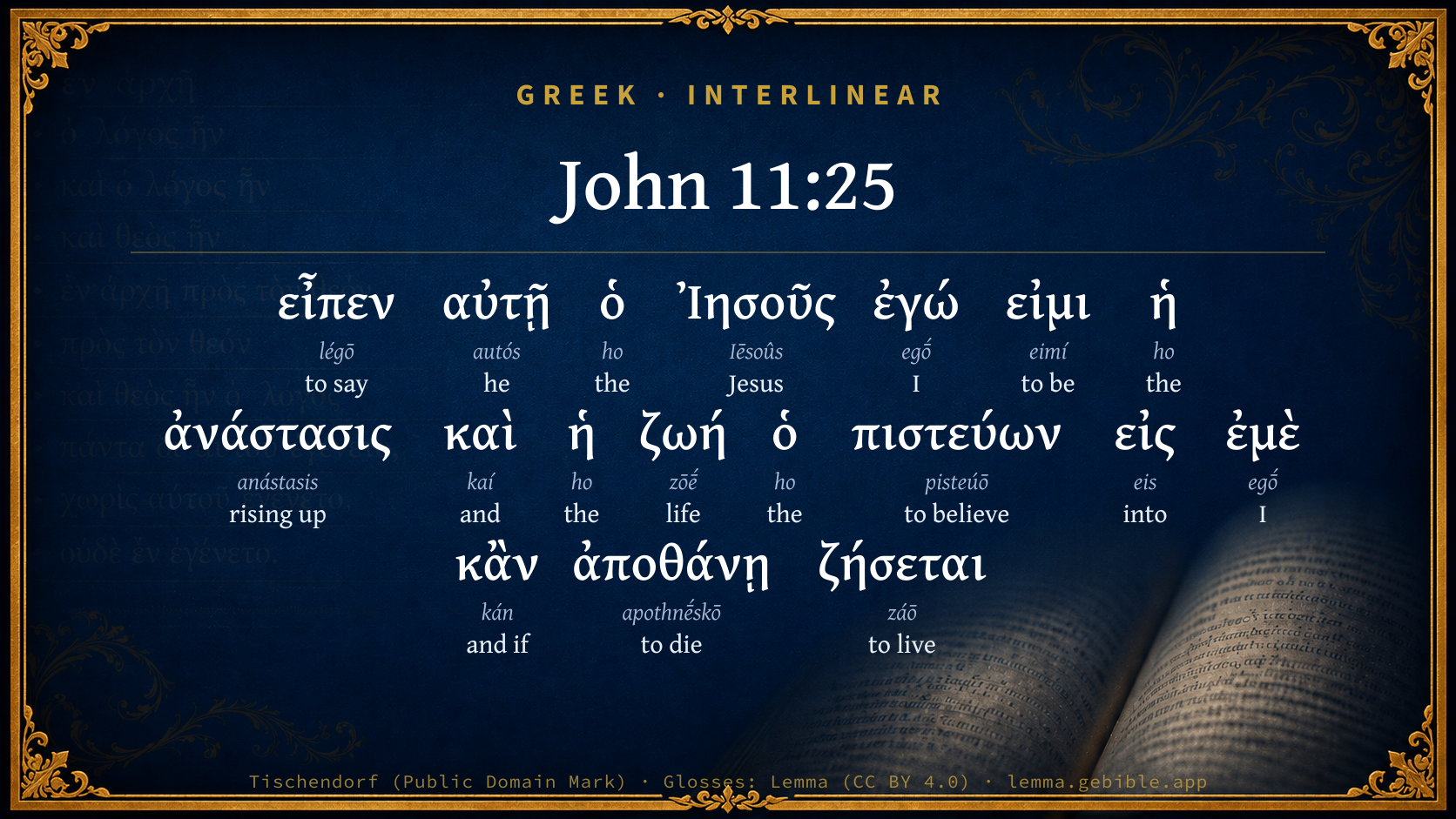
  1. εἶπεν légō G3004 “to say” Verb, Aorist, Active, Indicative, 3rd person, Singular
  2. αὐτῇ autós G846 “he” Personal pronoun, Dative, Singular, Feminine
  3. ὁ ho G3588 “the” Article, Nominative, Singular, Masculine
  4. Ἰησοῦς Iēsoûs G2424 “Jesus” Noun, Nominative, Singular, Masculine
  5. ἐγώ egṓ G1473 “I” Personal pronoun, 1st person, Nominative, Singular
  6. εἰμι eimí G1510 “to be” Verb, Present, Active, Indicative, 1st person, Singular
  7. ἡ ho G3588 “the” Article, Nominative, Singular, Feminine
  8. ἀνάστασις anástasis G386 “rising up” Noun, Nominative, Singular, Feminine
  9. καὶ kaí G2532 “and” Conjunction
  10. ἡ ho G3588 “the” Article, Nominative, Singular, Feminine
  11. ζωή zōḗ G2222 “life” Noun, Nominative, Singular, Feminine
  12. ὁ ho G3588 “the” Article, Nominative, Singular, Masculine
  13. πιστεύων pisteúō G4100 “to believe” Verb, Present, Active, Participle, Nominative, Singular, Masculine
  14. εἰς eis G1519 “into” Preposition
  15. ἐμὲ egṓ G1473 “I” Personal pronoun, 1st person, Accusative, Singular
  16. ἀποθάνῃ apothnḗskō G599 “to die” Verb, Aorist, Active, Subjunctive, 3rd person, Singular
  17. ζήσεται záō G2198 “to live” Verb, Future, Middle deponent, Indicative, 3rd person, Singular

About this verse

These counts appear in no published source. They are computed here, from the morphology-tagged text and Lemma’s own curated glosses. What Lemma adds →

18
words
14
distinct lemmas
Gospels
section

Notable vocabulary

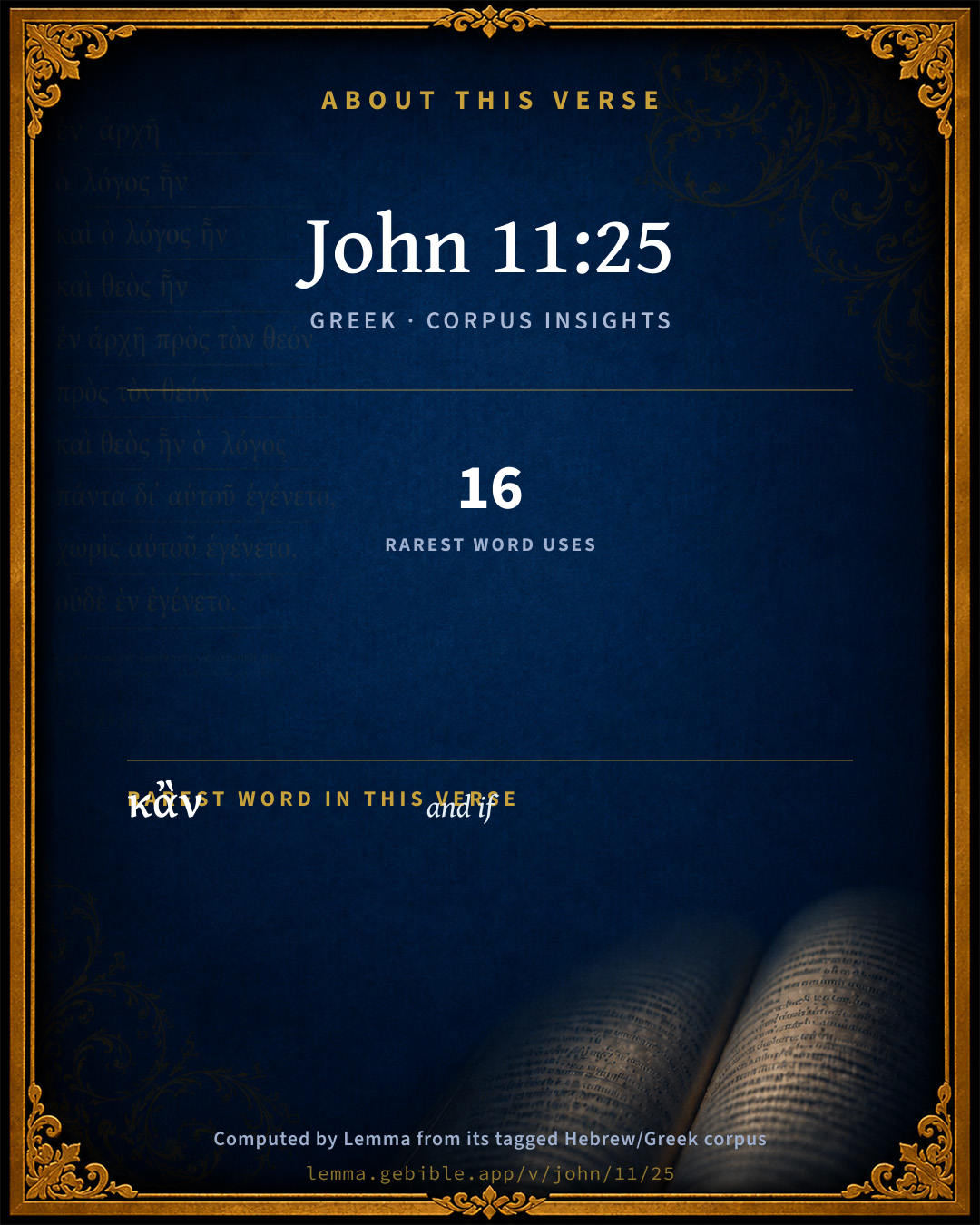
The rarest word here is κἂν and if G2579 — appearing just 16 times in the whole Greek New Testament.

Shared distinctive vocabulary

κἂν and if G2579 occurs in 15 verses of the Greek New Testament. Also found in:

Repetition

Words recur within this verse:

Cross-references

39

Topical passages linked to John 11:25 in the Treasury of Scripture Knowledge — connected by theme and wording, ordered by reader-vote popularity; previews shown in the World English Bible.

  • 1 Thessalonians 4:14 For if we believe that Jesus died and rose again, even so those who have fallen asleep in Jesus will God bring with him.
  • John 3:36 One who believes in the Son has eternal life, but one who disobeys the Son won't see life, but the wrath of God remains on him."
  • 1 John 5:11–12 The testimony is this, that God gave to us eternal life, and this life is in his Son.
  • John 1:4 In him was life, and the life was the light of men.
  • Romans 8:10–11 If Christ is in you, the body is dead because of sin, but the spirit is alive because of righteousness.
  • John 5:21 For as the Father raises the dead and gives them life, even so the Son also gives life to whom he desires.
  • Isaiah 26:19 Your dead shall live; my dead bodies shall arise. Awake and sing, you who dwell in the dust; for your dew is [as] the dew of herbs, and the earth shall cast forth the dead.
  • John 6:39–40 This is the will of my Father who sent me, that of all he has given to me I should lose nothing, but should raise him up at the last day.
  • John 6:44 No one can come to me unless the Father who sent me draws him, and I will raise him up in the last day.
  • Romans 8:2 For the law of the Spirit of life in Christ Jesus made me free from the law of sin and of death.
  • Philippians 3:20–21 For our citizenship is in heaven, from where we also wait for a Savior, the Lord Jesus Christ;
  • Job 19:25–27 But as for me, I know that my Redeemer lives. In the end, he will stand upon the earth.
  • Romans 8:38–39 For I am persuaded, that neither death, nor life, nor angels, nor principalities, nor things present, nor things to come, nor powers,
  • John 6:35 Jesus said to them, "I am the bread of life. He who comes to me will not be hungry, and he who believes in me will never be thirsty.
  • Philippians 3:10 that I may know him, and the power of his resurrection, and the fellowship of his sufferings, becoming conformed to his death;
  • Revelation 21:4 He will wipe away from them every tear from their eyes. Death will be no more; neither will there be mourning, nor crying, nor pain, any more. The first things have passed away."
  • 2 Corinthians 5:1–8 For we know that if the earthly house of our tent is dissolved, we have a building from God, a house not made with hands, eternal, in the heavens.
  • Colossians 3:3–4 For you died, and your life is hidden with Christ in God.
  • Revelation 20:5 The rest of the dead didn't live until the thousand years were finished. This is the first resurrection.
  • John 14:6 Jesus said to him, "I am the way, the truth, and the life. No one comes to the Father, except through me.
  • Acts 3:15 and killed the Prince of life, whom God raised from the dead, to which we are witnesses.
  • John 5:26 For as the Father has life in himself, even so he gave to the Son also to have life in himself.
  • Psalms 36:9 For with you is the spring of life. In your light shall we see light.
  • Isaiah 38:16 Lord, by these things men live; Wholly therein is the life of my spirit: You restore me, and cause me to live.
  • John 14:19 Yet a little while, and the world will see me no more; but you will see me. Because I live, you will live also.
  • Hebrews 11:13–16 These all died in faith, not having received the promises, but having seen them and embraced them from afar, and having confessed that they were strangers and pilgrims on the earth.
  • Romans 5:17–19 For if by the trespass of the one, death reigned through the one; so much more will those who receive the abundance of grace and of the gift of righteousness reign in life through the one, Jesus Christ.
  • 1 Corinthians 15:20–26 But now Christ has been raised from the dead. He became the first fruits of those who are asleep.
  • Philippians 1:23 But I am in a dilemma between the two, having the desire to depart and be with Christ, which is far better.
  • 1 John 1:1–2 That which was from the beginning, that which we have heard, that which we have seen with our eyes, that which we saw, and our hands touched, concerning the Word of life
  • Revelation 22:17 The Spirit and the bride say, "Come!" He who hears, let him say, "Come!" He who is thirsty, let him come. He who desires, let him take the water of life freely.
  • Luke 23:43 Jesus said to him, "Assuredly I tell you, today you will be with me in Paradise."
  • 1 Corinthians 15:29 Or else what will they do who are baptized for the dead? If the dead aren't raised at all, why then are they baptized for the dead?
  • 1 Corinthians 15:43–57 It is sown in dishonor; it is raised in glory. It is sown in weakness; it is raised in power.
  • 2 Corinthians 4:14 knowing that he who raised the Lord Jesus will raise us also with Jesus, and will present us with you.
  • Revelation 20:10–15 The devil who deceived them was thrown into the lake of fire and sulfur, where the beast and the false prophet are also. They will be tormented day and night forever and ever.
  • Romans 4:17 As it is written, "I have made you a father of many nations." This is in the presence of him whom he believed: God, who gives life to the dead, and calls the things that are not, as though they were.
  • 1 Corinthians 15:18 Then they also who are fallen asleep in Christ have perished.
  • Revelation 22:1 He showed me a river of water of life, clear as crystal, proceeding out of the throne of God and of the Lamb,

Cross-references courtesy of OpenBible.info (CC BY 4.0).

Commentary

Notes on John 11:25 from classic Christian and Jewish commentators (each source and its license shown beneath its notes). The classic Christian expositions comment on the surrounding passage and are grouped to its opening verse, so a note may address several verses; the Jewish commentaries on the Tanakh (Rashi and others) are per-verse, so they appear only where the commentator wrote on this verse.

Lemma curates 59 commentaries, every one of them public domain or Creative Commons licensed, each selected and text-cleaned for this edition rather than reprinted as found. About our sources →

Joseph Benson's Commentary

Joh 11:25. Jesus said, I am the resurrection — The author and cause of the resurrection of the dead; and the life — The source of life, natural, spiritual, and eternal; of the living, both in the present world and in the world to come. Martha believed that in answer to his prayer God would give any thing; but he would have her to know that by his power he could effect any thing. Martha believed a resurrection to take place at the last day; but Christ tells her he had now the power whereby it should be effected lodged in his hands: from whence it was easy to infer, that he who could raise the world of men that had been dead many ages, could, doubtless, raise one man that had been dead only a few days. Observe, reader, it ought to be a source of unspeakable comfort to us, that Christ is the resurrection and the life, and that he will be such to us, if we be his true disciples. A resurrection is a return to life, and Christ is the author of that return. We profess, in the Creed, to look for the resurrection of the dead, and the life of the world to come. Let us remember, then, that Christ is the author and principle of both; and that our hope of both must be built on him. Jesus proceeds: He that believeth in me — With a faith overcoming the world, (1Jn 5:4-5,) and purifying the heart; (Act 15:9;) though he were dead — Or, though he should die, as καν αποθανη is properly rendered; yet shall he live — Not only shall his soul survive the death of his body, and continue immortal, but, ere long, his reanimated body shall be again united to that soul; and even at present I can loose the bonds of death, and though thy brother now is holden by them, I can recall him when I please. Observe well, reader, to whom this promise is made; namely, to them that believe in Christ Jesus, to them that consent to, and confide in him, as the only Mediator of reconciliation and of intercourse between God and man; that receive the record God has given in his word concerning his Son; who sincerely comply with it, and answer all the great and gracious intentions of it. Both the promise and the conditions are further explained in the next verse.

Joseph Benson's Commentary on the Old and New Testaments (1811–1818) — public domain. Text from a community e-Sword module.

MacLaren's Expositions of Holy Scripture

Alexander MacLaren

John - Job

CHRIST’S QUESTION TO EACH

JOB’S QUESTION, JESUS’ ANSWER

Job 14:14. - Joh 11:25 - Joh 11:26.

Job’s question waited long for an answer. Weary centuries rolled away; but at last the doubting, almost despairing, cry put into the mouth of the man of sorrows of the Old Testament is answered by the Man of Sorrows of the New. The answer in words is this second text which may almost be supposed to allude to the ancient question. The answer, in fact, is the resurrection of Christ. Apart from this answer there is none.

So we may take these two texts to help us to grasp more clearly and feel more profoundly what the world owes to that great fact which we are naturally led to think of to-day.

I. The ancient and ever returning question.

The Book of Job is probably a late part of the Old Testament. It deals with problems which indicate some advance in religious thought. Solemn and magnificent, and for the most part sad; it is like a Titan struggling with large problems, and seldom attaining to positive conclusions in which the heart or the head can rest in peace. Here all Job’s mind is clouded with a doubt. He has just given utterance to an intense longing for a life beyond the grave. His abode in Sheol is thought of as in some sense a breach in the continuity of his consciousness, but even that would be tolerable, if only he could be sure that, after many days, God would remember him. Then that longing gives way before the torturing question of the text, which dashes aside the tremulous hope with its insistent interrogation. It is not denial, but it is a doubt which palsies hope. But though he has no certainty, he cannot part with the possibility, and so goes on to imagine how blessed it would be if his longing were fulfilled. He thinks that such a renewed life would be like the ‘release’ of a sentry who had long stood on guard; he thinks of it as his swift, joyous ‘answer’ to God’s summons, which would draw him out from the sad crowd of pale shadows and bring him back to warmth and reality. His hope takes a more daring flight still, and he thinks of God as yearning for His creature, as His creature yearns for Him, and having ‘a desire to the work of His hands,’ as if His heaven would be incomplete without His servant. But the rapture and the vision pass, and the rest of the chapter is all clouded over, and the devout hope loses its light. Once again it gathers brightness in the twenty-first chapter, where the possibility flashes out starlike, that ‘after my skin hath been thus destroyed, yet from my flesh shall I see God.’

These fluctuations of hope and doubt reveal to us the attitude of devout souls in Israel at a late era of the national life. And if they show us their high-water mark, we need not suppose that similar souls outside the Old Testament circle had solid certainty where these had but a variable hope. We know how large a development the doctrine of a future life had in Assyria and in Egypt, and I suppose we are entitled to say that men have always had the idea of a future. They have always had the thought, sometimes as a fear, sometimes as a hope, but never as a certainty. It has lacked not only certainty but distinctness. It has lacked solidity also, the power to hold its own and sustain itself against the weighty pressure of intrusive things seen and temporal.

But we need not go to the ends of the earth or to past generations for examples of a doubting, superficial hold of the truth that man lives through death and after it. We have only to look around us, and, alas! we have only to look within us. This age is asking the question again, and answering it in many tones, sometimes of indifferent disregard, sometimes flaunting a stark negative without reasoned foundation, sometimes with affirmatives with as little reason as these negatives. The modern world is caught in the rush and whirl of life, has its own sorrows to front, its own battles to fight, and large sections of it have never come as near an answer to Job’s question as Job did.

II. Christ’s all-sufficing answer.

He gave it there, by the grave of Lazarus, to that weeping sister, but He spoke these great words of calm assurance to all the world. One cannot but note the difference between His attitude in the presence of the great Mystery and that of all other teachers. How calmly, certainly, and confidently He speaks!

Mark that Jesus, even at that hour of agony, turns Martha’s thoughts to Himself. What He is is the all-important thing for her to know. If she understands Him, life and death will have no insoluble problems nor any hopelessness for her. ‘I am the Resurrection and the Life.’ She had risen in her grief to a lofty height in believing that ‘even now’-at this moment when help is vain and hope is dead-’whatsoever thou wilt ask of God, God will give it thee,’ but Jesus offers to her a loftier conception of Him when He lays a sovereign hand on resurrection and life, and discloses that both inhere in Him, and from Him flow to all who shall possess them. He claims to have in Himself the fountain of life, in all possible senses of the word, as well as in the special sense relevant at that sad hour. Further, He tells Martha that by faith in Him any and all may possess that life. And then He majestically goes on to declare that the life which He gives is immune from, and untouched by, death. The believer shall live though he dies, the living believer shall never die. It is clear that, in these two great statements, to die is used in two different meanings, referring in the former case to the physical fact, and in the latter carrying a heavier weight of significance, namely the pregnant sense which it usually has in this Gospel, of separation from God and consequently from the true life of the soul. Physical death is not the termination of human life. The grim fact touches only the surface life, and has nothing to do with the essential, personal being. He that believes on Jesus, and he only, truly lives, and his union with Jesus secures his possession of that eternal life, which victoriously persists through the apparent, superficial change which men call death. Nothing dies but the death which surrounds the faithful soul. For it to die is to live more fully, more triumphantly, more blessedly. So though the act of physical death remains, its whole character is changed. Hence the New Testament euphemisms for death are much more than euphemisms. Men christen it by names which drape its ugliness, because they fear it so much, but Faith can play with Leviathan, because it fears it not at all. Hence such names as ‘sleep,’ ‘exodus,’ are tokens of the victory won for all believers by Jesus. He will show Martha the hope for all His followers which begins to dawn even in the calling of her brother back from the grip of death. And He shows us the great truth that His being the ‘Life’ necessarily involved His being also the ‘Resurrection,’ for His life-communicating work could not be accomplished till His all-quickening vitality had flowed over into, and flooded with its own conquering tides, not only the spirit which believes but its humble companion, the soul, and its yet humbler, the body. A bodily life is essential to perfect manhood, and Jesus will not stay His hand till every believer is full-summed in all his powers, and is perfect in body, soul, and spirit, after the image of Him who redeemed Him.

III. The pledge for the truth of the answer.

The words of Jesus are only words. These precious words, spoken to that one weeping sister in a little Jewish village, and which have brought hope to millions ever since, are as baseless as all the other dreams and longings of the heart, unless Jesus confirms them by fact. If He did not rise from the dead, they are but another of the noble, exalted, but futile delusions of which the world has many others. If Christ be not risen, His words of consolation are swelling words of emptiness; His whole claims are ended, and the age-old question which Job asked is unanswered still, and will always remain unanswered. If Christ be not risen, the hopeless colloquy between Jehovah and the prophet sums up all that can be said of the future life: ‘Son of man, can these bones live?’ And I answered, ‘O Lord God, Thou knowest!’

But Christ’s resurrection is a fact which, taken in connection with His words while on earth, endorses these and establishes His claims to be the Declarer of the name of God, the Saviour of the world. It gives us demonstration of the continuity of life through and after death. Taken along with His ascension, which is but, so to speak, the prolongation of the point into a line, it declares that a glorified body and an abode in a heavenly home are waiting for all who by faith become here partakers in Jesus and are quickened by sharing in His life.

So in despite of sense and doubt and fear, notwithstanding teachers who, like the supercilious philosophers on Mars Hill, mock when they hear of a resurrection from the dead, we should rejoice in the great light which has shined into the region of the shadow of death, we should clasp His divine and most faithful answer to that old, despairing question, as the anchor of our souls, and lift up our hearts in thanksgiving in the triumphant challenge, ‘O death! where is thy sting? O grave! where is thy victory?’

Alexander MacLaren, Expositions of Holy Scripture (1904–1910) — public domain. Text from a community e-Sword module.

Tyndale Open Study Notes

Tyndale Open Resources

11:25 Jesus helped Martha to believe in him not simply as a healer, but as one who vanquishes death. • I am the resurrection and the life: Victory over death is an aspect of living in association with Jesus. Although his followers are still mortal, they will enjoy eternal life after death. Regarding Jesus’ I am statements, see the study note on 6:35.

Tyndale Open Study Notes — © Tyndale Open Resources, licensed CC BY-SA 4.0. Text via the HelloAO Bible API.

Bengel's Gnomon

Johann Albrecht Bengel

Joh 11:25. Ἐγώ) I, present, not limited to the future. Do not suppose, Martha, that you are being put off to the distant future. Death yields to Life, as darkness to Light, forthwith.—ἡ ἀνάστασις καὶ ἡ ζωή, the resurrection and the life) The former title is peculiarly suitable to this occasion; the latter is frequently used. The former is explained presently in this verse; the latter in Joh 11:26, “Whosoever liveth, and believeth in Me, shall never die.” I am the Resurrection of the dying, and the Life of the living. The former deals with the case of believers dying before the death of Christ; for instance, Lazarus. For there was none of his prey which death was not obliged to restore, in the presence of Christ: the daughter of Jairus, and the young man at Nain. And it is probable that all who at that time saw with faith Jesus Christ, and died before His death, were among those who rose again, as described in Mat 27:52-53, [After the crucifixion] “the graves were opened; and many bodies of the saints, which slept, arose, and came out of the graves after His resurrection, and went into the holy city, and appeared unto many.” The latter title treats of the case of believers falling asleep after the death of Christ. The death of Christ deprived death of its power. Before the death of Christ, the death of believers was death: after the death of Christ, the death of believers is not death: ch. Joh 5:24, “He that—believeth—hath everlasting life—is passed from death unto life:” Joh 8:51, “If a man keep My saying, he shall never see death.”—ζήσεται, shall live) even in body.

Bengel's Gnomon of the New Testament — English translation (T&T Clark, Edinburgh, 1860) — public domain. Text from a community e-Sword module.

Meyer's Critical & Exegetical Commentary

Heinrich August Wilhelm Meyer

Joh_11:25-26. Jesus connects with her answer that which He intended to say, as fitted to draw her faith from her own interest to His person: I, no other than I, am the resurrection and the life, i.e. the personal power of both, the one who raises again, and who makes alive. Comp. Joh_14:6; Col_3:4. The ζωή after the ἀνάστασις is its positive result (not its ground, as Luthardt and Ewald think), the eternal life, which, however, also presupposes the happy state of ζωή in Hades, in Paradise (Luk_16:22; Luk_23:43). In the course of what follows, Jesus tells who it is that experiences Him as this power of resurrection and life,[82] namely, ὁ πιστεύων εἰς ἐμέ. The thought is in both clauses the same; they form a parallelism with a positive and negative declaration concerning the same subject, which, however, in the second clause, is described not merely by πιστεύων again, but by ζῶν καὶ πιστεύων, because this was the only way of making the significant antithetical reciprocal relationship complete. With a view to this end, dying denotes in the first clause physical death, whereas in the second clause it is used in the higher sense; whereas, vice versâ, life is spoken of in the first clause in the higher sense, in the second in its physical sense. Whoso believeth in me, even if he shall have died (physically), will live (be a partaker of ζωή, uninterruptedly, as, prior to the resurrection, in Paradise, so, by means of the resurrection, eternally); and every one who lives (is still alive in time) and believes in me, will assuredly not die for ever, i.e. he will not lose his life in eternity, Joh_8:51,a promise which, though not excluding physical death in itself, does exclude it as the negation of the true and eternal ζωή, Joh_6:50. Compare Rom_8:10. In accordance herewith, ζῶν neither can nor may be taken in the spiritual sense (Calvin and Olshausen): to apply κἂν ἀποθ., however, to Lazarus, and ζῶν to the sisters (Euth. Zigabenus, Theophylact), is inadmissible, simply because Lazarus was to be raised again solely to temporal life. Both are to be left in their generality.

On πᾶς Bengel remarks ingeniously: hoc versu 25 non adhibitum ad majora sermonem profert, and on πιστ. τοῦτο: applicatio … per improvisam interrogationem valde pungens.

[82] It is not merely ζωή that is carried out in what follows (Luthardt); for the life which Jesus ascribes to the believer, even in death, finds its completion precisely in the resurrection.

Meyer — Critical and Exegetical Commentary on the New Testament — English translation by Peter Christie, edited by Frederick Crombie (T&T Clark, 1880) — public domain. Text from a community e-Sword module.

Expositor's Greek Testament

ed. W. Robertson Nicoll

Joh 11:25 . Nor does this faith satisfy Jesus, who at once replaces it by another in the words, Ἐγώ εἰμι ἡ ἀνάστασις καὶ ἡ ζωή . Resurrection and life are not future only, but present in His person; she is to trust not in a vague remote event but in His living person whom she knew, loved, and trusted. Apart from Him there was neither resurrection nor life. He carried with Him and possessed there and then as He spoke with her all the force that went to produce life and resurrection. Therefore ὁ πιστεύων εἰς ἐμὲ … αἰῶνα (Joh 11:26 ), “He that believeth on me, even though he die, shall live; and every one who liveth and believeth on me shall never die”. Belief in Him or acceptance of Him as the source of true spiritual life, brings the man into vital union with Him, so that he lives with the life of Christ and possesses a life over which death has no power.

The Expositor's Greek Testament, edited by W. Robertson Nicoll (1897–1910) — public domain. Text from a community e-Sword module.

Godet's Commentaries

Frédéric Louis Godet

Vv. 25, 26. “Jesus said to her, I am the resurrection and the life; he that believes on me, even though he were dead, yet shall he live; 26 and whosoever lives and believes on me shall never die; believest thou this?”

Martha has just spoken of the resurrection as of a future event; Jesus sets in opposition to this event His person (ἐγώ, I; εἰμί, I am), as being in reality the resurrection. Victory over death is not a physical fact; it is a moral work, a personal act; it is the doing of Jesus Himself (Joh 11:28-29 : Joh 6:39-40; Joh 6:44); and consequently He can accomplish it when he pleases, to-day even, if He wishes, as well as after the passing of ages. Jesus thus brings back the thought of Martha to Himself and gives to her faith its true object. He substitutes for adherence to dogmatic truth confidence in His person. This is what He had also done in chaps. 4 and 6, where, after some moments of conversation, He had substituted Himself for the abstract notions of living water and bread from heaven.

After having declared Himself to be the resurrection, Jesus proclaims Himself as the life. It might be supposed that He means to speak of the glorious and perfect life which follows the resurrection. But according to the explanation which follows (Joh 11:25-26), it is better to hold, with Luthardt, that Jesus passes from the outward resurrection to the more profound fact which is its spiritual condition. If He is the principle of the physical resurrection, it is because He is that of life in the most exalted sense of that word (Joh 11:26, Joh 6:51). The spiritual life which He communicates to His own is for them, if they are dead, the pledge of a return to corporeal life; and, on the other hand, while still living, they are raised by it above the passing accident of physical death. The first declaration applies to Lazarus and to the other believers who were already dead. In virtue of the new life which they have received by faith, they continue living, and consequently they may, at the moment when Jesus wills, be recalled to corporeal existence. The second declaration (Joh 11:26) applies to the two sisters and to all the believers who were still living; they remain sheltered from death; for to die in full light, in the serene brightness of the life which is in Jesus, and to continue to live in Him (Joh 11:25) is no more the fact which human language has designated by the name of death (see on Joh 6:50, Joh 8:51). Jesus means therefore: In me the dead lives, and the living does not die. The terms to die, in the first clause, and to live, in the second, are to be taken in the strict sense.

This saying, by carrying the thought of Martha from the momentary and corporeal fact of the resurrection to its spiritual and permanent principle, gives to the person of Christ its true place in the miracle, and to the miracle its true religious significance. The resurrection of her brother becomes for her as if an emanation of the life of Jesus Himself, a ray of His glory, and thus the means of uniting the soul of Martha to Him, the source of life. Reuss sees in this answer of Jesus a means of setting aside the popular idea of the corporeal resurrection, or at least of divesting it of all theological value. One must be singularly preoccupied by his own theory to draw from this reply a conclusion which is so foreign to the context and so contrary to the perfectly free and clear affirmation of Joh 5:28-29. Jesus thus returned to the subject from which Martha had turned aside, the resurrection of Lazarus. Before acting, He asks her further: “Believest thou this?”

Frédéric Louis Godet — Commentaries on Luke, John, Romans, and 1 Corinthians — English translation (T&T Clark, Edinburgh, 1870s–1890s) — public domain. Text from a community e-Sword module.

Jamieson, Fausset & Brown

Robert Jamieson, A. R. Fausset & David Brown

Jesus said, I am the resurrection and the life--"The whole power to restore, impart, and maintain life, resides in Me." (See on Joh 1:4; Joh 5:21). What higher claim to supreme divinity than this grand saying can be conceived?

he that believeth in me, though . . . dead . . . shall he live--that is, The believer's death shall be swallowed up in life, and his life shall never sink into death. As death comes by sin, it is His to dissolve it; and as life flows through His righteousness, it is His to communicate and eternally maintain it (Rom 5:21). The temporary separation of soul and body is here regarded as not even interrupting, much less impairing, the new and everlasting life imparted by Jesus to His believing people.

Believest thou this?--Canst thou take this in?

Jamieson, Fausset & Brown — Commentary Critical and Explanatory on the Whole Bible (1871) — public domain (CC PDM 1.0). Text via the HelloAO Bible API.

Adam Clarke's Commentary

Verse 25. I am the resurrection, and the life] Thou sayest that thy brother shall rise again in the resurrection at the last day; but by whom shall he arise if not by ME, who am the author of the resurrection, and the source of life? And is it not as easy for me to raise him now as to raise him then? Thus our blessed Lord raises her hope, animates her faith, and teaches her that he was not a mere man, but the essential principle and author of existence.

Though he were dead] Every man who has believed or shall believe in me, though his believing shall not prevent him from dying a natural death, yet his body shall be re-animated, and he shall live with me in an eternal glory. And every one who is now dead, dead to God, dead in trespasses and sins, if he believe in me, trust on me as his sole Saviour, he shall live, shall be quickened by my Spirit, and live a life of faith, working by love.

Adam Clarke's Commentary on the Bible (1810–1826) — public domain. Text from a community e-Sword/MySword module.

John Calvin's Commentaries

25. I am the resurrection and the life. Christ first declares that he is the resurrection and the life, and then he explains, separately and distinctly, each clause of this sentence. His first statement is, that he is the resurrection, because the restoration from death to life naturally comes before the state of life. Now the whole human race is plunged in death; and, therefore, no man will be a partaker of life until he is risen from the dead. Thus Christ shows that he is the commencement of life, and he afterwards adds, that the continuance of life is also a work of his grace. That he is speaking about spiritual life, is plainly shown by the exposition which immediately follows,

He who believeth in me, though, he were dead, shall live. Why then is Christ the resurrection? Because by his Spirit he regenerates the children of Adam, who had been alienated from God by sin, so that they begin to live a new life. On this subject, I have spoken more fully under John 5:21 and 24; and Paul is an excellent interpreter of this passage, (Ephesians 2:5, and Ephesians 5:8.) Away now with those who idly talk that men are prepared for receiving the grace of God by the movement of nature. They might as well say that the dead walk. For that men live and breathe, and are endued with sense, understanding, and will, all this tends to their destruction, because there is no part or faculty of the soul that is not corrupted and turned aside from what is right. Thus it is that death everywhere holds dominion, for the death of the soul is nothing else than its being estranged and turned aside from God. Accordingly, they who believe in Christ, though they were formerly dead, begin to live, because faith is a spiritual resurrection of the soul, and — so to speak — animates the soul itself that it may live to God; according to that passage,

The dead shall hear the voice of the Son of God, and they who hear shall live (John 5:25.)

This is truly a remarkable commendation of faith, that it conveys to us the life of Christ, and thus frees us from death.

John Calvin's Commentaries (1540-1563) — public domain. Text from the Calvin Translation Society English edition (1840s-50s) via the Christian Classics Ethereal Library (ccel.org). Calvin's coverage is partial (roughly two-thirds of the Bible); uncommented books and verses are honest gaps, never fabricated. The 19th-century editor's footnotes and remarks are omitted so the notes are faithfully Calvin's own voice.

Ellicott's Commentary for English Readers

(25) I am the resurrection, and the life.—She has spoken of the resurrection as a truth which she believes, and as an event in the far-off future, so remote from the present life indeed, as to be powerless to comfort her now. The two first words of His answer, expressed in the fulness of emphasis, teach her that the resurrection is to be thought of as His person, and that it is to be thought of as actually present. “I,”—his words mean—“and none beside Me, am the Resurrection. I am the Resurrection—a. present life, and not simply a life in the remoteness of the last day.” In the same sense in which He has declared Himself to be the Water of Life and the Bread of Life, supplying in Himself every need of spiritual thirst and spiritual hunger, He declares Himself to be the Resurrection, revealing in His own person all that men had ever thought and hoped of a future life, being Himself the power which shall raise them at the last day, and could therefore raise them now. This is because He is also “the Life,” and therefore every one in communion

He that believeth in me, though he were dead, yet shall he live.—Better, though he have died . . . She thinks and speaks of Lazarus as dead. He asserts that in the true thought of the spiritual life the fact of physical death does not interrupt that life.

A Bible Commentary for English Readers, edited by Charles John Ellicott (1878–1897) — public domain. Text from a community e-Sword module.

The Cambridge Bible for Schools and Colleges

gen. ed. J. J. S. Perowne

25. I am the resurrection, and the life] He draws her from her selfish grief to Himself. There is no need for Him to pray as man to God (Joh_11:22); He (and none else) is the Resurrection and the Life. There is no need to look forward to the last day; He is (not ‘will be’) the Resurrection and the Life. Comp. Joh_14:6; Col_3:4. In what follows, the first part shews how He is the Resurrection, the second how He is the Life. ‘He that believeth in Me, even if he shall have died (physically), shall live (eternally). And every one that liveth (physically) and believeth in Me, shall never die (eternally).’

The Cambridge Bible for Schools and Colleges (gen. ed. J. J. S. Perowne; Cambridge University Press, 1878–1918) — public domain. Text from a community e-Sword module.

John Gill's Exposition

And whosoever liveth and believeth in me,..... Whoever will be found alive at Christ's second coming, and is a believer in him,

shall never die, but shall be changed, and shall be for ever with Christ; and such as shall be raised to life by him, shall never die any more, not even a bodily death, and much less an eternal one, or the second death: and though believers die a corporeal death as others do, yet their souls live, and live in happiness, whilst their bodies are under the power of death; nor shall they always continue so, but being raised, shall become immortal, and die no more. So living believers in Christ shall never die more a spiritual death; they are passed from death to life, and shall never return to death more; their spiritual life cannot be lost; grace in them is an immortal seed, a well of living water springing up into everlasting life: grace may be very low in its exercise, and may seem to be ready to die; they may be in lifeless frames, and without the comforts of a spiritual life, and be under the hidings of God's face, which is as death unto them, and may reckon themselves as free among the dead; yet the principle of life will never be extinct in them; nor shall they die the second death, which lies in an eternal separation from God, and in an everlasting sense of his wrath; that shall have no power on them, nor shall they be in the least hurt by it; for they are ordained to eternal life, and have the promise of it; they are united to Christ, and their life is secured in him; and he has redeemed them from death; and they have the Spirit of life dwelling in them, as the pledge and earnest of eternal glory.

Believest thou this? the whole of this concerning the power of Christ, and privilege of believers; every tittle of it is to be believed. And as with respect to a corporeal resurrection, so with regard to a spiritual one; that men by nature are dead in sins; that Christ is the author of the resurrection from such a state, to a spiritual life; that this life is only by Christ, and can never be lost: this is a doctrine to be believed; it is the doctrine of the Scriptures; it is according to godliness; it makes for the comfort of the people of God, and glorifies the divine perfections.

John Gill's Exposition of the Whole Bible (1746–1763) — public domain (CC PDM 1.0). Text via the HelloAO Bible API.

Trapp's Complete Commentary

John Trapp

25 Jesus said unto her, I am the resurrection, and the life: he that believeth in me, though he were dead, yet shall he live:

Ver. 25. He that believeth in me, though, &c.] Oh the wonderful force of faith! Questionless (saith a reverend man, Mr S. Ward) justifying faith is not beneath miraculous in the sphere of its own activity, and where it hath warrant of God’s word, &c.

John Trapp, A Commentary or Exposition upon All the Books of the Old and New Testament (1647–1656) — public domain. Text from a community e-Sword module.

Albert Barnes' Notes on the Bible

I am the resurrection - I am the author or the cause of the resurrection. It so depends on my power and will, that it may be said that I am the resurrection itself. This is a most expressive way of saying that the whole doctrine of the resurrection came from him, and the whole power to effect it was his. In a similar manner he is said to be made of God unto us “wisdom and righteousness, and sanctification, and redemption,” 1Co 1:30.

And the life - Joh 1:4. As the resurrection of all depends on him, he intimated that it was not indispensable that it should be deferred to the last day. He had power to do it now as well as then.

Though he were dead - Faith does not save from temporal death; but although the believer, as others, will die a temporal death, yet he will hereafter have life. Even if he dies, he shall hereafter live.

Shall he live - Shall be restored to life in the resurrection.

Albert Barnes' Notes on the Bible (1834–1885) — public domain. Text from a community e-Sword/MySword module.

Haydock's Catholic Bible Commentary

I am the resurrection, and the life. That is, the author of both. (Witham) --- I am the resurrection, I am he who will at the last day raise him up; I can, therefore, if I will, raise him up now also. (St. Augustine)

George Leo Haydock (1774–1849), Haydock's Catholic Family Bible and Commentary, 1859 edition — public domain. Excludes Psalms (Douay-Rheims chapter numbering differs from Protestant) and Deuterocanonical books (Catholic canon only).

Matthew Poole's English Annotations

Martha by her speech seemed not to have a true notion of Christ; she believed that there should be a general resurrection from the dead in the last day, by the mighty power of God, but she did not truly understand what influence Christ had upon this resurrection, that the raising of the dead should be the peculiar work of Christ, not without the Father, but as he was ordained by the Father to be the Judge of the quick and of the dead. Christ doth therefore here further instruct her, and tell her, he was

the resurrection; where (as is usual in Scripture) the effect is put for the cause:

I am the resurrection, is no more than, I am, and shall be, the principal cause of the resurrection: the dead shall hear the voice of the Son of God, Joh 5:28. He also adds, and the life; that is, the cause of life; both that life which the dead shall in the resurrection recover, and also that eternal life which shall follow. And whosoever looketh upon me in that notion, and committeth himself unto me, though he doth die, yet he shall rise again, and live eternally; and this power being in me, I am not tied to the last day, but have a power when I please to raise the dead. Our Saviour indeed hath more in his answer than respected the present case; but there was nothing more usual with him, than in his discourses to raise up the hearts of his people to higher things, as he doth in this place raise Martha beyond the thoughts of a resurrection of her brother’s body to a natural life, to the thoughts of a spiritual and eternal life.

Matthew Poole's English Annotations on the Holy Bible (1683–1685) — public domain. Text from a community e-Sword/MySword module.

Whedon's Commentary on the Bible

Daniel D. Whedon

25. I am… resurrection… life—The due understanding of these two sublime verses requires an analysis of the two principal terms. Resurrection is the reunion of a conscious soul to a body by it vitalized. Thence results actual physical life compositely of soul and body. Yet life, as often used, especially in John’s Gospel, designates something over and above this. Certainly does this higher meaning exist when the life is conditioned, as here, upon faith. It is then a life upon life; THE life supereminently; the glorified, celestial Life, over and above a life consisting in mere conscious existence. When, therefore, Martha names the resurrection, Christ responds, I am not only the resurrection but I am more; I am the life. He is author not only of that mere life resulting from union of soul and body, but of the celestial life by which man is a glorified being. We then paraphrase the words thus: I am not only the physical resurrection, but I am the life celestial; he that believeth in me, though he (like Lazarus) should die, yet the life celestial survives; and he that (unlike Lazarus) is still alive, and is a believer in me, shall never experience any death of that celestial life. To be the resurrection is one thing; to be the life another.

Daniel D. Whedon (gen. ed.), Commentary on the Old and New Testaments (1874–1909) — public domain. Text from a community e-Sword module.

The Pulpit Commentary

Vers. 25, 26. Jesus said to her, I am the Resurrection. Not merely that God will give me what I ask, but that I am in some sense already his gift to man of resurrection, inasmuch as I am that of Life . (So Luthardt and Godet, but not Meyer, who makes zwh the positive result of anastasiv .) By taking humanity into his Person, Christ reveals the permanence of human individuality, that is, of such individuality as is in union with himself. He associates (Joh_14:6) "the Life" which he gives with" the Way" and "the Truth," i.e. with the whole sum of human experience and of human meditation and speculation, i.e. with all the conduct of the will and the mind. He that believeth on me, though he die, yet shall he live. In these words he identifies the "life" with the transfiguration of the bodily life. The grand method of this blessed life is faith. The life which is the condition and ground of resurrection is the natural consequence of a faith which accepts Christ, and identifies itself with him. But "there are some who have believed, and have what you call diedthough they die, they shall live. In such cases, so-called "death" is veritable "life." The life of faith will survive the shock of death, and whosoever liveth, and believeth on me, shall never die shall never taste of death. (cf. Joh_6:51, Joh_8:51) This is no new teaching for the more thoughtful of his hearers. There are multitudes now believing (and therefore living) in him. They shall never die in the sense in which death has been hitherto regarded; they shall by no means die forever. Faith is eternal life: death is only a momentary shadow upon a life which is far better. Whether the corruption of the grave passes over the believer or not, he lives an eternal life, which has no element of death nor proclivity to death in it. So far the Lord is lifting Martha to a higher experience of life and a comparative in difference to death. Before he offers any further consolation, he probes to the quick her faith in him and in the eternal life. Believest thou this? Touto ; "Is this thy belief?" not toutw ; "Dost thou believe in my statement?" "Believest thou that the Resurrection which I am and which I give can thus transform for thee the whole meaning of death?" The fullness of life after death is assured in virtue of the resurrection which Christ could effect at any moment, and will eventually effect for all. This life of which Christ speaks may be the life which is the consequence of the resurrection (anastasiv) of man effected in the Incarnation, or it may be the condition of "resurrection" and sufficient proof that, if a man receive it by faith, he is free" from all the curse of physical death, and assured of a perfect victory over it. So also the ou mh eiv to may either mean "not forever," and thus the words may be taken to refer to the resurrection. "He will not forever die," i.e. death may supervene, but will be conquered; or ou mh may mean "never," "in no wise," and the "never die" may refer to spiritual death, overlooking physical death altogether. The whole narrative is a great parable of life through death.

The living and life-giving Lord.

The confession of Martha was a good and sound one. Yet it is clear that our Lord did not wish her to rest in her creed. He pointed her to himself as the Sum and Substance of all true beliefs, as the Object of all true faith. Creeds are good for the memory, Christ is good for the heart.

I LIFE IS IN CHRIST. The miracles of raising from the dead which Jesus wrought were intended not only for the assuagement of human sorrow, but for the satisfying of human aspirations. He drew the attention away from the great work to the greater Worker. In him was life; and by his incarnation and sacrifice he brought the life of God to this world of sin and death.

II THE LIFE OF CHRIST, WHEY COMMUNICATED TO MEN, BECOMES A SPIRITUAL IMMORTALITY. "The Son quickeneth whom he will." He introduced the new life into our humanity. How it has spread! In how many soils have barrenness and death disappeared, and spiritual vitality, vigor, and fruitfulness abounded in their place! Christ has taught the independence of the spiritual life upon the life of this body of our humiliation. In his own resurrection he manifestly conquered death. Living, he has the keys of death and Hades. He is both the Firstfruits of the rising again, and the Agent and quickening Power in raising his people. What can compare for spiritual potency with the life-giving authority of the Savior? In what other is there hope for man"s deathless spirit? Like morning after a stormy night, like spring after a dreary winter, like triumph after arduous warfare, like the haven after a tempestuous voyage, so is the immortality of the righteous who, living in Christ, live in perpetual blessedness. All their aspirations are realized, and all their hopes fulfilled.

III IT IS BY FAITH THAT THE GLORIOUS IMMORTALITY OF THE BLESSED IS ACHIEVED. Christ presents himself as the Divine Object of faith. It is no arbitrary connection which is exhibited in these words of our Redeemer as existing between faith and life. Life is personal, and spiritual life comes from the Lord and Giver of life to those who believe. Faith is spiritual union with the Christ who died and rose for us, and is the means, first of a death unto sin and a life unto righteousness, and then of all which this spiritual change involves. A life in God is a life eternal. T.

The Pulpit Commentary (1880–1919), ed. H.D.M. Spence-Jones & Joseph S. Exell — public domain. Text from a community e-Sword module.

John Wesley's Explanatory Notes

l am the resurrection - Of the dead. And the life - Of the living. He that believeth in me, though he die, yet shall he live - In life everlasting.

John Wesley, Explanatory Notes Upon the Whole Bible (1754–1765) — public domain. Text via the GEBible commentary corpus.

The People's New Testament

B. W. Johnson

25. I am the resurrection, and the life. Christ makes the grand, striking declaration that he is the Resurrection and the Life, words that never could have fallen from the lips of a sane mortal. They mean that he is the power which opens every grave, gives life to the sleepers, and calls them forth to a new existence; that the life that endows men with eternal being is in him and proceeds from him. In the light of his own resurrection they mean that when he burst open the tomb he did it for humanity and in him humanity has won the victory over death.

B. W. Johnson's The People's New Testament with Notes (1889–1891) — public domain. Electronic text from the Christian Classics Ethereal Library (CCEL) ThML edition.

Cambridge Greek Testament for Schools and Colleges

25. ἐγώ εἰμι. see on Joh 6:35. He draws her from her selfish grief to Himself. There is no need for Him to pray as man to God (Joh 11:22); He (and none else) is the Resurrection and the Life. There is no need to look forward to the last day; He is (not ‘will be’) the Resurrection and the Life. Comp. Joh 14:6; Col 3:4. In what follows, the first part shews how He is the Resurrection, the second how He is the Life. ‘He that believeth in Me, even if he shall have died (physically), shall live (eternally). And every one that liveth (physically) and believeth in Me, shall never die (eternally).’ The dead shall live; the living shall never die. Physical life and death are indifferent to the believer; they are but modes of existence.

Cambridge Greek Testament for Schools and Colleges (Cambridge University Press, 1896; 21 vols, various authors incl. Carr, Maclear, Plummer, Farrar, Lumby, Moule, M. R. James, Simcox) — public domain. Text from a community e-Sword module.

International Critical Commentary

25. ἐγώ εἰμι ἡ ἀνάστασις καὶ ἡ ζωή. For the form of this solemn pronouncement, ἐγώ εἰμι …, and for the claim to an equality with God which is involved in such a way of speaking, see Introd., p. cxix.

For the Divine prerogative of Jesus as a “quickener” of the dead, see 5:21 and the note there. It is asserted again in the proclamation, four times repeated, ἀναστήσω αὐτὸ [ἐν] τῇ ἐσχάτῃ ἡμέρᾳ (see note on 6:39). Here, what is said goes beyond even that great assurance.

All the great similitudes by which Jesus describes Himself in the Fourth Gospel are introduced by the opening phrase ἐγώ εἰμι, which marks the style of Deity (see Introd., p. cxviii). But ἐγώ εἰμι ἡ ἀνάστασις differs from the other pronouncements in this respect, that it is not a similitude. When Jesus is represented as saying that He is the Bread of Life, or the Light of the World, or the Door, or the Way, or the True Vine, or the Good Shepherd, every one understands that these are only figures of speech, used to illustrate and explain that He strengthens and guides mankind. Here, however, in reply to Martha’s allusion to the Resurrection at the Last Day, Jesus uses no explanatory figure of speech. “I am the Resurrection” is not a similitude; it is the reference to Himself of what Martha had said about the final resurrection. The sentence is comparable to ἐγώ εἰμι ὁ μαρτυρῶν περὶ ἐμαυτοῦ (8:18), rather than to any of the so-called similitudes; but it is more difficult to interpret. For how can a person represent an event in the future? Yet this is what is asserted. ἡ ἀνάστασις in v. 25 must refer back to ἡ ἀνάστασις in v. 24. Jesus does not say ἐγώ εἰμι ἀνάστασις (without the article), or identify Himself with the act or process of “rising again”; but He diverts the thought of Martha, as it were, from the Resurrection at the Last Day, which she feels is very far distant, to the Resurrection of which He is potentially the Source as well as the Agent.

“I will raise him up at the Last Day.” That is a frequent theme of the Fourth Gospel (see on 6:39). But, if Jesus had said no more on the subject, it would have postponed the possibility of resurrection to the new and heavenly life until the day of the Final Assize. And it is equally, and more particularly, a doctrine of the Fourth Gospel, that as men are judged now, so the entrance on the ζωὴ αἰώνιος is a present possibility (see Introd., p. clx). Jesus is the Door to the Kingdom, i.e. to the enjoyment of “eternal life”; and it is through Him that man enters into its possession here and now.

Thus, in vv. 24, 25, the old Jewish and the new Christian eschatology are explicitly confronted with each other. Jn. never represents Jesus as denying the Jewish doctrine of a Last Judgment; but he perpetually represents Him as insisting upon the judgment of the present hour, not pronounced by a fiat of external authority, but determined by the man’s own self and his relation to God in Christ (see on 3:18).

So ἐγώ εἰμι ἡ ἀνάστασις is meant to convey to Martha, not indeed a rebuke for her belief in the General Resurrection at last, but an assurance that the “rising again” of believers in Him is not to be postponed until then. If a man believe in Him, although his body dies yet his true self shall live (v. 25). Or, as it may be put in other words, no believer in Jesus shall ever die, so far as his spirit is concerned (v. 26). The consolation which Jesus offers to those mourning the death of a Christian believer is not that their friend will rise again at some distant day when the dead shall be raised by a catastrophic act of God (however true that may be), but that the Christian believer never dies, his true life is never extinguished. “Your friend is alive now; for in me he touched the life of God which is eternal; in me he had already risen, before his body perished.” This is the Johannine doctrine of life (see Introd., p. clxi); it is also the doctrine of Paul (cf. Col 3:1).

Neither Jn. nor Paul discuss or contemplate the future life of those who are not “in Christ.” The assurance of life, here and hereafter, in the Fourth Gospel, is for all “believers”; and in this passage no others are in view.

καὶ ἡ ζωή. This second clause in the great pronouncement of Jesus is omitted by Syr. sin., and also by Cyprian (de Mortal. 21), who quotes these verses in the form: “Ego sum Resurrectio. Qui credit in me, licet moriatur, uiuet; et omnis qui uiuit et credit in me non morietur in aeternum.” Cyprian appears to have missed the distinction between the two clauses 25b and 26, and he may have omitted et uita, not perceiving that the words are essential, if what follows is to be understood. But this does not explain the omission in Syr. sin. All other authorities have the words καὶ ἡ ζωή, which are indispensable for the argument.

Jesus is not only the Resurrection, and thus the pledge and the source of the believer’s revival after death; but He is the Life, for this revival is unending. In the two sentences which follow, the twofold presentation of Jesus as the Resurrection and as the Life is expanded and explained. He is the Resurrection, and therefore the believer in Him, though he die, yet shall live again. He is the Life, and therefore the believer in Him, who has been “raised from the dead” and is spiritually alive, shall never die. See further on v. 26.

That Jesus is the Life is, in one sense, the main theme of the Fourth Gospel. Cf. 1:4, 6:57, 14:6, 20:31; and see Introd., p. clxi.

ὁ πιστεύων εἰς ἐμέ κτλ., “he who believes in me” (see on 1:12 for the constr. πιστεύειν εἰς, and cf. 9:35) “even if he die (sc. physically), yet shall he live” (sc. spiritually, in the spiritual body, as Paul has it). So it has been said already (3:36).

Westcott compares Philo’s saying that “the wise man who appears to have died in respect of this corruptible life, lives in respect of the incorruptible life” (quod det. pot. 15). But the distinctive feature of the Johannine teaching is that the privilege of the immortal, spiritual life is for him who “believes in Christ,” and so has touched the life of God.

International Critical Commentary — older volumes (1896–1929), various authors — public domain. Text from a community e-Sword module.

Vincent's Word Studies in the New Testament

Marvin R. Vincent

I am the resurrection and the life. The words I am are very significant. Martha had stated the resurrection rather as a doctrine, a current tenet : Jesus states it as a fact, identified with His own person. He does not say, I raise the dead; I perform the resurrection, but I am the resurrection, In His own person, representing humanity, He exhibits man as immortal, but immortal only through union with Him.

The life. The life is the larger and inclusive idea. Resurrection is involved in life as an incident developed by the temporary and apparent triumph of death. All true life is in Christ. In Him is lodged everything that is essential to life, in its origin, its maintenance, and its consummation, and all this is conveyed to the believer in his union with Him. This life is not affected by death. "Every believer is in reality and forever sheltered from death. To die with full light, in the clear certainty of the life which is in Jesus, to die only to continue to live to Him, is no longer that fact which human language designates by the name of death. It is as though Jesus had said : In me death is certain to live, and the living is certain never to die" (Godet). On zwh, life, see on 1 4.

He were dead [αποθανη] . The aorist denotes an event, not a condition. Hence, much better, Rev., though he die.

Marvin R. Vincent, Word Studies in the New Testament (1887–1900) — public domain. Text from a community e-Sword/MySword module.

Lesson kit

Teaching starters — assembled from the data on this page, not authored interpretation. Every prompt links to the verse data it draws on. Edit before teaching.

John, in the Gospels, opens this verse with 18 words (14 distinct Greek lemmas). Its most distinctive word is kán (“and if”). A historical commentator’s framing appears above. Read the whole chapter for the surrounding context.

Discussion questions

  1. How does “and if” (kán) shape what this verse is saying?
  2. Matthew 21:21 shares the word «and if» with this verse. How do the two illuminate each other?
  3. “the” occurs 4× in this one verse. What is the effect of the repetition?
  4. The translations on this page render this verse differently — a whole-verse word diff, not a word-by-word alignment. What might account for the different wordings?
  5. Reading how Joseph Benson's Commentary and MacLaren's Expositions of Holy Scripture read this verse, where do the two commentators agree and where do they part?

Things to notice

Reading settings

Reading text

Shown beneath each verse's original-language words.

Old Testament
Old Testament edition

Read the OT as the Masoretic Hebrew (MT) or the Greek Septuagint (LXX).

English shown for the Greek Septuagint (in the Hebrew ↔ Greek comparison).

Comparing translations? Open the Compare panel on any verse page to stack up to four side by side.