
John 7:16

Greek (Tischendorf 8th ed.) John 7:16 appears in the Greek New Testament. The text above is from the Tischendorf 8th edition. Each word links to its Strong’s number and a concise gloss. Click any word for its full Thayer’s Greek Lexicon entry.
Download image
Cite this verse

John 7:16 (World English Bible). Public Domain. Lemma interlinear Bible study tool, https://lemma.gebible.app/v/john/7/16.

Show BibTeX & RIS
BibTeX
RIS
English Translation
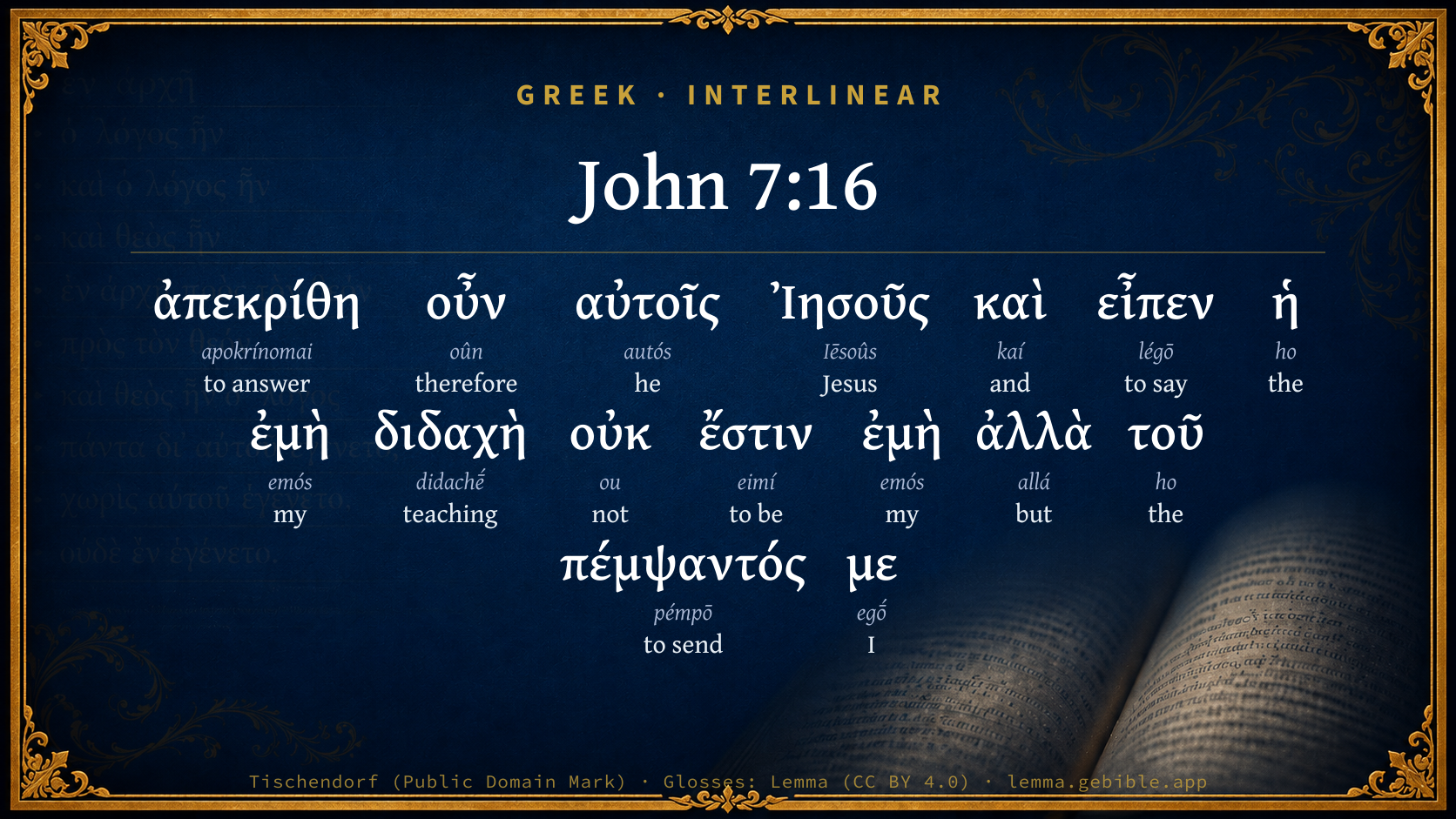
Jesus therefore answered them, "My teaching is not mine, but his who sent me.
World English Bible · Public Domain
Download a study sheet

One document with this verse’s original text, its word-by-word gloss line, the meaning frame, cross-references with their text, attributed commentary, and full source and license credits — printable, and it pastes into notes with its structure intact.

This verse Autodidact and up

Study sheet (.html) Plain text (.txt)

A passage Seminary Student

Up to 50 verses in one chapter. A passage sheet keeps up to 6 commentary sources and 12 cross-references per verse, in the order this page ranks them, and says so on the sheet whenever that leaves anything out. Ask for a single verse and you get the Autodidact verse sheet above.

Everything on this page stays free to read, with no account — the sheet is a download of what is already on screen, not access to it.

Want to remove ads? Support Godless Engineer
Compare translations 3

The same verse in 3 English versions, stacked beneath the original-language interlinear above. Click any original word for its lexicon entry.

Each is an independent rendering of the whole verse — the interlinear is not word-aligned to these translations.

Highlighted words mark where these versions differ — a whole-verse word diff, not a word-by-word alignment.

  • World English Bible Public Domain
    Jesus therefore answered them, "My teaching is not mine, but his who sent me.
  • King James Version Public Domain
    Jesus answered them, and said, My doctrine is not mine, but his that sent me.
  • unfoldingWord Literal Text CC BY-SA 4.0
    Then Jesus answered them and said, “My teaching is not mine, but of the one having sent me.

unfoldingWord Literal Text — © unfoldingWord, licensed CC BY-SA 4.0. Word-aligned USFM3 via Door43 (git.door43.org/unfoldingWord/en_ult).

Versions to compare (up to 4)

3 of 4 selected

Show all 19 translations

Every available English version of this verse, each an independent rendering of the whole verse.

  • World English Bible Public Domain
    Jesus therefore answered them, "My teaching is not mine, but his who sent me.
  • Berean Standard Bible Public Domain
    “My teaching is not My own,” Jesus replied. “It comes from Him who sent Me.
  • Majority Standard Bible Public Domain
    “My teaching is not My own,” Jesus replied. “It comes from Him who sent Me.
  • King James Version Public Domain
    Jesus answered them, and said, My doctrine is not mine, but his that sent me.
  • American Standard Version (1901) Public Domain
    Jesus therefore answered them and said, My teaching is not mine, but his that sent me.
  • Revised Version (1885) Public Domain
    Jesus therefore answered them, and said, My teaching is not mine, but his that sent me.
  • Geneva Bible (1599) Public Domain
    Iesus answered them, and saide, My doctrine is not mine, but his that sent me.
  • Douay-Rheims (1899) Public Domain
    Jesus answered them, and said: My doctrine is not mine, but his that sent me.
  • Young's Literal Translation Public Domain
    Jesus answered them and said, `My teaching is not mine, but His who sent me;
  • Literal Standard Version CC BY-SA 4.0
    Jesus answered them and said, “My teaching is not Mine, but His who sent Me;
  • Unlocked Literal Bible CC BY-SA 4.0
    Jesus answered them and said, “My teaching is not mine, but is of him who sent me.
  • unfoldingWord Literal Text CC BY-SA 4.0
    Then Jesus answered them and said, “My teaching is not mine, but of the one having sent me.
  • Darby Bible Public Domain
    Jesus therefore answered them and said, My doctrine is not mine, but [that] of him that has sent me.
  • World Messianic Bible Public Domain
    Yeshua therefore answered them, “My teaching is not mine, but his who sent me.
  • Webster's Bible Public Domain
    Jesus answered them, and said, My doctrine is not mine, but his that sent me.
  • Free Bible Version CC BY-SA 4.0
    Jesus answered, “My teaching is not from me but from the one who sent me.
  • Bible in Basic English Public Domain
    Jesus gave them this answer: It is not my teaching, but his who sent me.
  • Text-Critical English NT CC BY 4.0
    Jesus answered them, “My teaching is not my own; it comes from him who sent me.
  • Tyndale New Testament (1534) Public Domain
    Iesus answered them and sayde: My doctrine is not myne: but his that sent me.

Literal Standard Version (2020), Covenant Press — licensed CC BY-SA 4.0. Text via the HelloAO Bible API (eBible.org). Unlocked Literal Bible (unfoldingWord) — licensed CC BY-SA 4.0. Text via the HelloAO Bible API (eBible.org). unfoldingWord Literal Text — © unfoldingWord, licensed CC BY-SA 4.0. Word-aligned USFM3 via Door43 (git.door43.org/unfoldingWord/en_ult). Free Bible Version, Dr. Jonathan Gallagher — licensed CC BY-SA 4.0. Text via the HelloAO Bible API (eBible.org).

Word by word

More ways to search: Search by grammar → Find every occurrence → Compare this word →

Practice this passage: Drill this verse → Learn its vocabulary →

διδαχὴ
didachḗ
G1322
“teaching”
Noun, Nominative, Singular, Feminine
Part of Speech
Noun
Case
Nominative
Number
Singular
Gender
Feminine
Full Thayer's Definition

Origin: from G1321

TDNT: 04:43,2

1. teaching a. that which is taught b. doctrine, teaching, concerning something 2. the act of teaching, instruction a. in religious assemblies of the Christians, to speak in the way of teaching, in distinction from other modes of speaking in public
  1. ἀπεκρίθη apokrínomai G611 “to answer” Verb, Aorist, Middle deponent, Indicative, 3rd person, Singular
  2. οὖν oûn G3767 “therefore” Conjunction
  3. αὐτοῖς autós G846 “he” Personal pronoun, Dative, Plural, Masculine
  4. Ἰησοῦς Iēsoûs G2424 “Jesus” Noun, Nominative, Singular, Masculine
  5. καὶ kaí G2532 “and” Conjunction
  6. εἶπεν légō G3004 “to say” Verb, Aorist, Active, Indicative, 3rd person, Singular
  7. ἡ ho G3588 “the” Article, Nominative, Singular, Feminine
  8. ἐμὴ emós G1699 “my” Possessive pronoun, 1st person, Nominative, Singular, Feminine
  9. οὐκ ou G3756 “not” Particle, Negative
  10. ἔστιν eimí G1510 “to be” Verb, Present, Active, Indicative, 3rd person, Singular
  11. ἐμὴ emós G1699 “my” Possessive pronoun, 1st person, Nominative, Singular, Feminine
  12. ἀλλὰ allá G235 “but” Conjunction
  13. τοῦ ho G3588 “the” Article, Genitive, Singular, Masculine
  14. πέμψαντός pémpō G3992 “to send” Verb, Aorist, Active, Participle, Genitive, Singular, Masculine
  15. με egṓ G1473 “I” Personal pronoun, 1st person, Accusative, Singular

About this verse

These counts appear in no published source. They are computed here, from the morphology-tagged text and Lemma’s own curated glosses. What Lemma adds →

16
words
14
distinct lemmas
Gospels
section

Shared distinctive vocabulary

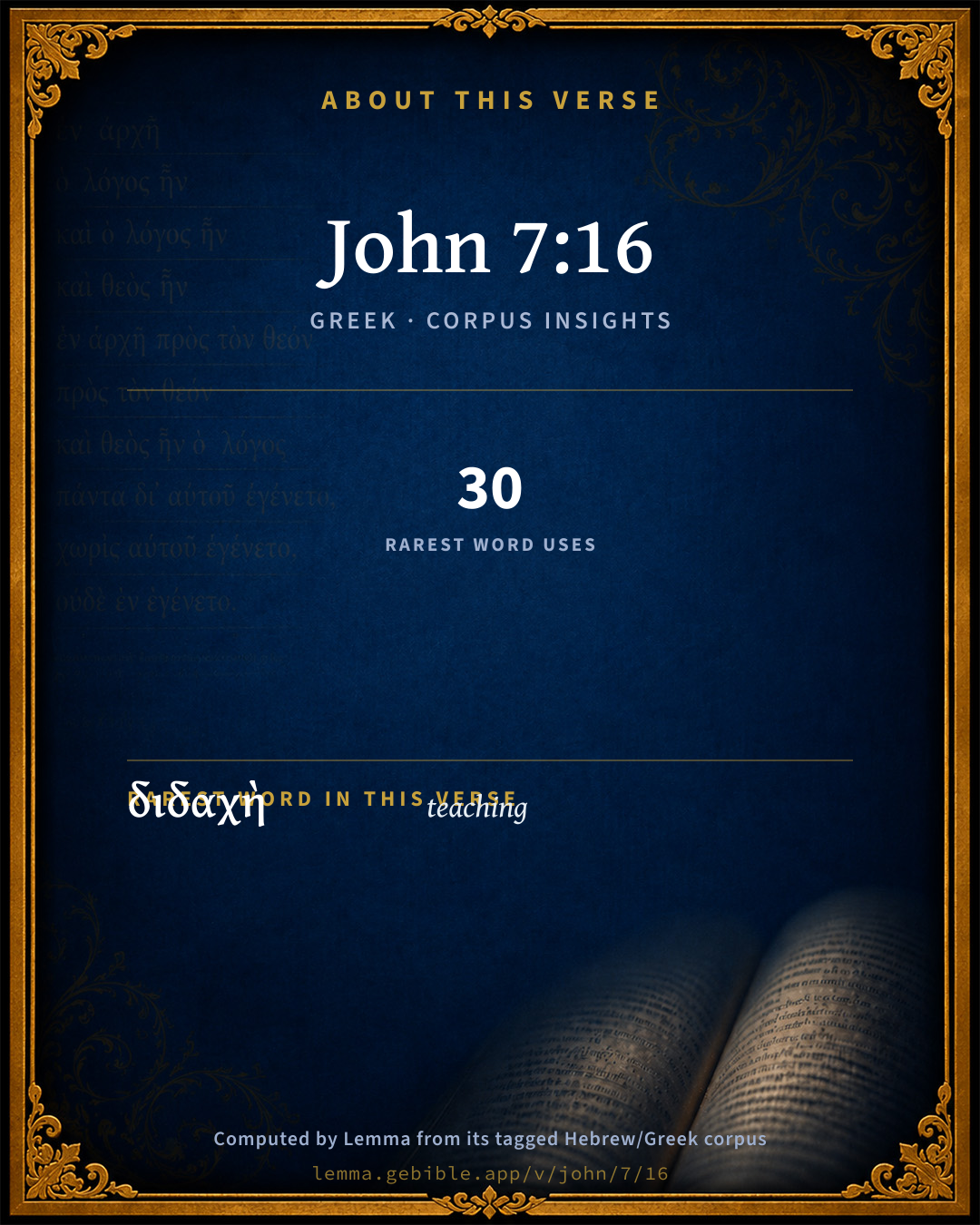
διδαχὴ teaching G1322 occurs in 29 verses of the Greek New Testament. Also found in:
Repetition

Words recur within this verse:

Cross-references

13

Topical passages linked to John 7:16 in the Treasury of Scripture Knowledge — connected by theme and wording, ordered by reader-vote popularity; previews shown in the World English Bible.

  • John 14:10 Don't you believe that I am in the Father, and the Father in me? The words that I tell you, I speak not from myself; but the Father who lives in me does his works.
  • John 14:24 He who doesn't love me doesn't keep my words. The word which you hear isn't mine, but the Father's who sent me.
  • John 5:23–24 that all may honor the Son, even as they honor the Father. He who doesn't honor the Son doesn't honor the Father who sent him.
  • John 5:30 I can of myself do nothing. As I hear, I judge, and my judgment is righteous; because I don't seek my own will, but the will of my Father who sent me.
  • John 6:38–40 For I have come down from heaven, not to do my own will, but the will of him who sent me.
  • John 12:49–50 For I spoke not from myself, but the Father who sent me, he gave me a commandment, what I should say, and what I should speak.
  • John 17:8 for the words which you have given me I have given to them, and they received them, and knew for sure that I came forth from you, and they have believed that you sent me.
  • John 3:11 Most assuredly I tell you, we speak that which we know, and testify of that which we have seen, and you don't receive our witness.
  • John 8:28 Jesus therefore said to them, "When you have lifted up the Son of Man, then you will know that I am he, and I do nothing of myself, but as my Father taught me, I say these things.
  • John 17:14 I have given them your word. The world hated them, because they are not of the world, even as I am not of the world.
  • John 6:44 No one can come to me unless the Father who sent me draws him, and I will raise him up in the last day.
  • John 3:31 He who comes from above is above all. He who is from the Earth belongs to the Earth, and speaks of the Earth. He who comes from heaven is above all.
  • Revelation 1:1 This is the Revelation of Jesus Christ, which God gave him to show to his servants the things which must happen soon, which he sent and made known by his angel to his servant, John,

Cross-references courtesy of OpenBible.info (CC BY 4.0).

Where the printed editions differ

1 variant

Places in this verse where the major printed Greek editions disagree on the wording in a way that affects the translation — a comparison of editions, not a manuscript-by-manuscript collation. The editions are the modern critical texts (Nestlé-Aland 28/27, SBL, Westcott-Hort, Tregelles, Tyndale House) and the traditional texts behind the KJV (the Textus Receptus and the Byzantine/Majority text). It is not a claim about which reading is original.

  1. Extra text
    οὖν

    “therefore”

    In NA28NA27TynSBLWHTregByz Not in TR

    οὖν (oun) 'therefore' is only in older manuscripts (NA28+NA27+Tyn+SBL+WH+Treg+Byz)

Textual data: Translators Amalgamated Greek New Testament (STEPBible TAGNT) · CC BY 4.0.

Commentary

Notes on John 7:16 from classic Christian and Jewish commentators (each source and its license shown beneath its notes). The classic Christian expositions comment on the surrounding passage and are grouped to its opening verse, so a note may address several verses; the Jewish commentaries on the Tanakh (Rashi and others) are per-verse, so they appear only where the commentator wrote on this verse.

Lemma curates 59 commentaries, every one of them public domain or Creative Commons licensed, each selected and text-cleaned for this edition rather than reprinted as found. About our sources →

Bengel's Gnomon

Johann Albrecht Bengel

Joh 7:16. Οὐκ ἔστιν ἐμή, is not Mine) not acquired by any labour on My part in learning.—τοῦ πέμψαντός με, who sent Me) For this reason, saith He, that I should learn after the manner of men: The Father hath taught Me: ch. Joh 8:28, “As My Father hath taught Me, I speak these things.”

Bengel's Gnomon of the New Testament — English translation (T&T Clark, Edinburgh, 1860) — public domain. Text from a community e-Sword module.

Meyer's Critical & Exegetical Commentary

Heinrich August Wilhelm Meyer

Joh_7:16. Jesus at once solves for them the riddle. The contradictory relation: that of learning in the case of one who had been uninstructed, would be found in my teaching only if it were mine, etc.

ἡ ἐμή and οὐκ ἐ. ἐμή are used in different senses: the teaching which I give, and it is not my possession, but Gods; how far, see Joh_7:17, comp. Joh_5:19; Joh_5:30.

τοῦ πέμψ. με] a carefully-chosen designation, because the Sender has communicated to His messenger, and continually communicates what He is to say in His name.[261]

οὐκ … ἀλλά] here also not: non tam … quam, but simply excluding human individuality. Comp. Joh_8:28, Joh_14:24.

[261] Bengel (in Wächter in the Beitr. z. Beng. Schrifterklär. 1865, p. 125). If we may speak after the manner of men, the heavenly Father gives him a collegium privatissimum, and that upon no author. This relation, however, does not justify such onesided exaggerations as those of Delitzsch, Jesus u. Hillel, 1866.

Meyer — Critical and Exegetical Commentary on the New Testament — English translation by Peter Christie, edited by Frederick Crombie (T&T Clark, 1880) — public domain. Text from a community e-Sword module.

Expositor's Greek Testament

ed. W. Robertson Nicoll

Joh 7:16 . But though not received from them, it was a derived teaching. He is not self-taught. Ἡ ἐμὴ διδαχὴ … με . The teaching which I give has not its source in my knowledge but in Him that sent me. “Der Autodidakt in Wahrheit ein Theodidakt ist,” Holtzmann. The truest self-renunciation is the highest claim. That this claim was true He proceeds to show (1) from the conviction of every one who desired to do God’s will, Joh 7:17 ; and (2) from His own character, Joh 7:18 .

The Expositor's Greek Testament, edited by W. Robertson Nicoll (1897–1910) — public domain. Text from a community e-Sword module.

Geneva Bible (1599)

Geneva Bible translators

Therefore are there few to whom the Gospel favoreth well, because the study of godliness is very rare.

See John 5:22, and he speaketh this after the opinion of the Jews, as if he said, My doctrine is not mine, that is, it is not his whom you take to be a man as others are, and therefore set light by him, but it is his that sent me.

Geneva Bible (1599) marginal notes — public domain. Text via Bolls.life.

Jamieson, Fausset & Brown

Robert Jamieson, A. R. Fausset & David Brown

doctrine . . . not mine, &c.--that is, from Myself unauthorized; I am here by commission.

Jamieson, Fausset & Brown — Commentary Critical and Explanatory on the Whole Bible (1871) — public domain (CC PDM 1.0). Text via the HelloAO Bible API.

Adam Clarke's Commentary

Verse 16. My doctrine is not mine] Our blessed Lord, in the character of Messiah, might as well say, My doctrine is not mine, as an ambassador might say, I speak not my own words, but his who sent me: and he speaks these words to draw the attention of the Jews from the teaching of man to the teaching of God; and to show them that he was the promised Messiah, the very person on whom, according to the prophet, (Isa 11:2,) the Spirit of Jehovah-the Spirit of wisdom, counsel, understanding, might, and knowledge, should rest.

Adam Clarke's Commentary on the Bible (1810–1826) — public domain. Text from a community e-Sword/MySword module.

John Calvin's Commentaries

16. My doctrine is not mine. Christ shows that this circumstance, which was an offense to the Jews, was rather a ladder by which they ought to have risen higher to perceive the glory of God; as if he had said, “When you see a teacher not trained in the school of men, know that I have been taught by God.” For the reason why the Heavenly Father determined that his Son should go out of a mechanic’s workshop, rather than from the schools of the scribes, was, that the origin of the Gospel might be more manifest, that none might think that it had been fabricated on the earth, or imagine that any human being was the author of it. Thus also Christ chose ignorant and uneducated men to be his apostles, and permitted them to remain three years in gross ignorance, that, having instructed them in a single instant, he might bring them forward as new men, and even as angels who had just come down from heaven.

But that of him who sent me. Meanwhile, Christ shows whence we ought to derive the authority of spiritual doctrine, from God alone. And when he asserts that the doctrine of his Father is not his, he looks to the capacity of the hearers, who had no higher opinion of him than that he was a man. By way of concession, therefore, he allows himself to be reckoned different from his Father, but so as to bring forward nothing but what the Father had enjoined. The amount of what is stated is, that what he teaches in the name of his Father is not a doctrine of men, and did not proceed from men, so as to be capable of being despised with impunity. We see by what method he procures authority for his doctrine. It is by referring it to God as its Author. We see also on what ground, and for what reason, he demands that he shall be heard. It is, because the Father sent him to teach. Both of these things ought to be possessed by every man who takes upon himself the office of a teacher, and wishes that he should be believed.

John Calvin's Commentaries (1540-1563) — public domain. Text from the Calvin Translation Society English edition (1840s-50s) via the Christian Classics Ethereal Library (ccel.org). Calvin's coverage is partial (roughly two-thirds of the Bible); uncommented books and verses are honest gaps, never fabricated. The 19th-century editor's footnotes and remarks are omitted so the notes are faithfully Calvin's own voice.

Ellicott's Commentary for English Readers

(16) My doctrine is not mine, but his that sent me.—The answer carries them once more to the words uttered by Him. (Comp. Joh_5:19; Joh_5:30.) Then he had again and again referred to the Father who sent Him (Joh_7:24; Joh_7:36-38), and claimed as His own work the doing of the Father’s will (Joh_7:30). In the Capernaum synagogue, in the hearing of some of these Jews, He had declared that all who were taught of God, and heard and learned the lesson, would come to Him (Joh_6:45). There is, then, no ground for their present wonder. The teaching which is His in relation to them, is not His of original source. He claims to be in His humanity as a messenger, carrying the message of Him that sent Him. He is the Word by whom the mind of God is spoken.

Doctrine represents a word which is frequently used in the Gospels, of our Lord, but only here and in the next verse by Him. It has acquired a definite and concrete meaning not found in the original, which is better rendered by teaching (comp., e.g., Mar_4:2).

A Bible Commentary for English Readers, edited by Charles John Ellicott (1878–1897) — public domain. Text from a community e-Sword module.

The Cambridge Bible for Schools and Colleges

gen. ed. J. J. S. Perowne

16. My doctrine is not mine] ‘The teaching which I give does not originate with Me; that is the reason why I have no need to learn in the schools. He Who sent Me communicates it to Me.’

16–36. The remark made on the Jews’ question in Joh_7:15 applies also to their questions and comments throughout this dialogue. They are too exactly in keeping with what we know of the Jews in our Lord’s day to be the invention of a Greek more than a century later. They “are all exactly what we should expect from the popular mode of interpreting and applying the Messianic prophecies.” S. p. 146.

The Cambridge Bible for Schools and Colleges (gen. ed. J. J. S. Perowne; Cambridge University Press, 1878–1918) — public domain. Text from a community e-Sword module.

John Gill's Exposition

If any man will do his will,.... Meaning, not one that perfectly fulfils the law, which is the good, and perfect, and acceptable will of God; for there is no man that does this, or can do it; nor is it so said here, "if any man do his will", but "if any man will do" it; that is, is desirous of doing it; who has it wrought in him both to will and do, of the good pleasure of God, by his grace and Spirit; with whom to will is present, though, he has not power to perform, and so is a spiritual man; and who believes in the Lord Jesus Christ, which is one branch of the will of God; and who depends upon the Spirit and grace of God, and acts from a principle of love to God, and in the exercise of faith on Christ:

he shall know of the doctrine, whether it be of God, or whether I speak of myself; not a man of mere natural knowledge and learning, or a man of theory and speculation, is a judge of doctrine; but he that leans not to his own understanding, and implores the assistance of the Divine Spirit, and who is for reducing doctrine into practice: he knows by the efficacy of the doctrine upon his heart, and the influence it has on his life and conversation; by its coming not in word only, but in power; and by its working effectually in him, whether it is divine or human, of God or of man.

John Gill's Exposition of the Whole Bible (1746–1763) — public domain (CC PDM 1.0). Text via the HelloAO Bible API.

Trapp's Complete Commentary

John Trapp

16 Jesus answered them, and said, My doctrine is not mine, but his that sent me.

Ver. 16. My doctrine is not mine] As if he had said, this should not be scandalum, sed scala; not a stumblingblock, but a ladder to lift you up to see the Divine handiwork, and to make you say, as Eze 3:12; "Blessed be the glory of the Lord from his place:" since I have my learning from above, and am (as Nicodemus acknowledged) "a teacher sent from God."

John Trapp, A Commentary or Exposition upon All the Books of the Old and New Testament (1647–1656) — public domain. Text from a community e-Sword module.

Albert Barnes' Notes on the Bible

My doctrine - My teaching, or what I teach. This is the proper meaning of the word “doctrine.” It is what is taught us, and, as applied to religion, it is what is taught us by God in the Holy Scriptures.

Is not wine - It is not originated by me. Though I have not learned in your schools, yet you are not to infer that the doctrine which I teach is devised or invented by me. I teach nothing that is contrary to the will of God, and which he has not appointed me to teach.

His that sent me - God’s. It is such as he approves, and such as he has commissioned me to teach. The doctrine is divine in its origin and in its nature.

Albert Barnes' Notes on the Bible (1834–1885) — public domain. Text from a community e-Sword/MySword module.

Haydock's Catholic Bible Commentary

My doctrine is not mine; i.e. not mine only, but also the Father’s; from whom I proceed, and with whom I am always. (Witham)

George Leo Haydock (1774–1849), Haydock's Catholic Family Bible and Commentary, 1859 edition — public domain. Excludes Psalms (Douay-Rheims chapter numbering differs from Protestant) and Deuterocanonical books (Catholic canon only).

Matthew Poole's English Annotations

My doctrine is not mine, considering me as the Son of man; not taught, or to be taught, me by men; not learned out of books, or by the precepts of men; not invented by me; but it is mine as it is the doctrine of the Father that sent me, and I and my Father both are one, and agree in one, 1Jo 5:7,8; and being so, there was no such need that Christ should be learned, in their sense, viz. at the feet of their doctors, and in their schools. But enthusiasts vainly argue from hence, that there is no need of human learning for him who is to be a preacher of the gospel; for Christ was not mere man, but one in whom the fulness of the Godhead dwelt bodily. No such thing will follow from the prophesying of Amos, who was a herdsman, or the apostles, who were fishermen; much less from the preaching of Christ. We must distinguish betwixt an extraordinary and an ordinary calling. And though it be truth, that the ministers of the gospel preach doctrine which is not theirs, but his that sent them; yet it doth not follow, that they must come by the knowledge of this doctrine in the same manner that Christ did, who was in the bosom of the Father, and knew his will, and came from him to communicate it to the world; nor yet in the same manner that the prophets and the apostles came to the knowledge of it, as by Christ’s vocal instruction. So also by the influence of the Holy Spirit upon them in the days of Pentecost, which abode upon them.

Matthew Poole's English Annotations on the Holy Bible (1683–1685) — public domain. Text from a community e-Sword/MySword module.

Whedon's Commentary on the Bible

Daniel D. Whedon

16. My doctrine—The words teaching and doctrine mean the same thing.

His that sent me—It is God’s own teaching through my lips.

Daniel D. Whedon (gen. ed.), Commentary on the Old and New Testaments (1874–1909) — public domain. Text from a community e-Sword module.

The Pulpit Commentary

Jesus thereforeanswered them and said, etc. He met this particular allegation as follows: My teaching is not mine. The "my" refers to the teaching itself, the "mine" to the ultimate authority on which it rests. I am not a self-taught Man, as though out of the depths of my own independent human consciousness I span it. I do not mean you to suppose that my mere human experience is the sole source of my instructions. (Joh_5:31) If you have sat at the feet of those who taught you, I, too, am a Representative of another; but (the alla after ouk is not equivalent to tam...quam. It introduces here the absolute source of all his teaching) it is the teaching of him who sent me. I have not learned in your schools, but am uttering the thoughts that come from an infinitely deeper source. "He who sent me" gave them to me. I have been in intimate communion with HIM. All that I say is Divine thought. I have drawn it all from the Lord of all. I came from him, and represent to you the will of God. This is a lofty prophetic claim, more urgent, more complete, than that made by Moses or Isaiah. Special messages, oracles, and burdens were delivered by the prophets with a "Thus saith the Lord." But Jesus says his thoughts are God"s thoughts, his ways God"s ways, his teachings not his own, but altogether those of him who sent him.

The Pulpit Commentary (1880–1919), ed. H.D.M. Spence-Jones & Joseph S. Exell — public domain. Text from a community e-Sword module.

John Wesley's Explanatory Notes

My doctrine is not mine - Acquired by any labour of learning; but his that sent me - Immediately infused by him.

John Wesley, Explanatory Notes Upon the Whole Bible (1754–1765) — public domain. Text via the GEBible commentary corpus.

The People's New Testament

B. W. Johnson

16. My doctrine is not mine. This is an answer to the question of verse 15. His knowledge came not from man, but from God.

B. W. Johnson's The People's New Testament with Notes (1889–1891) — public domain. Electronic text from the Christian Classics Ethereal Library (CCEL) ThML edition.

Cambridge Greek Testament for Schools and Colleges

16. οὐκ ἔστιν ἐμή. Jewish teachers commonly quoted their authorities. These Jews thought that Jesus was self-taught, and marvelled at His literary proficiency. Jesus here gives the authority for His teaching and accounts for its power. ‘My teaching does not originate with Me; that is why I have no need to learn in the schools. He who sent Me communicates it to Me.’

Cambridge Greek Testament for Schools and Colleges (Cambridge University Press, 1896; 21 vols, various authors incl. Carr, Maclear, Plummer, Farrar, Lumby, Moule, M. R. James, Simcox) — public domain. Text from a community e-Sword module.

Alford’s Greek Testament

Henry Alford

16.] Here only does our Lord call His teaching διδαχή, as being now among the διδάσκαλοι, the Rabbis, in the temple. It is often so called by the Evangelists, see reff.

The words may bear two meanings:—either, ‘the sense of Scripture which I teach is not my own, but that in which it was originally penned as a revelation from God;’ or, My teaching (generally) is not mine, but that of Him who sent me. The latter is preferable, as agreeing better with what follows, and because the former assumes that He was expounding Scripture, which, though probable, is not asserted.

Henry Alford, The Greek Testament (1849–1861) — public domain. Text from a community e-Sword module.

International Critical Commentary

16. Ἡ ἐμὴ διδαχὴ οὐκ ἔστιν ἐμή κτλ. Here only does Jesus call His message διδαχή, a “teaching”; it is a significant word, as He is now dealing with the professional διδασκάλοι. That His teaching is not His own, but the Father’s, is repeated often (8:28, 12:49, 14:10, 24); and this has already been said in effect at 5:30. διδαχή occurs again in Jn. only at 18:19; cf. 2Jn 1:9, 2Jn 1:10.

The answer of Jesus to the Jews’ objection that He had never learnt from a recognised Rabbi is remarkable. He does not say (which might seem to us the natural answer) that He needed no Master. Indeed, Mk. reports that it was a feature of His teaching to the multitudes that it was given “with authority, and not as the scribes” (Mar 1:22), i.e. that He appealed in His popular teaching to no Rabbinical precedents; and the Synoptic discourses sufficiently illustrate this. But in Son_5 and 7:15-24 we have the report of a long-drawn-out argument with the Rabbis, and it is conducted throughout (see on 5:31) in the style of the Jewish schools. If Jesus had said, in reply to their implied question “Whose disciple are you?” that He was no man’s disciple, but that He spoke of His own authority, they would at once have told Him that He was an

impostor and adventurer. But, exactly as at 5:31, He follows their line of thought. He does not claim to be self-taught, which would only have aroused contemptuous indignation; but He claims that His teacher was the Father who had sent Him, as He had said so often before (cf. especially 5:36-38).

International Critical Commentary — older volumes (1896–1929), various authors — public domain. Text from a community e-Sword module.

Vincent's Word Studies in the New Testament

Marvin R. Vincent

Doctrine [διδαχη] . Better, teaching, as Rev. Doctrine has acquired a conventional sense which might mislead.

Marvin R. Vincent, Word Studies in the New Testament (1887–1900) — public domain. Text from a community e-Sword/MySword module.

Godet's Commentaries

Frédéric Louis Godet

Vv. 16, 17. “Jesus answered them and said, My teaching is not mine, but his that sent me; 17 if any one wills to do his will, he shall know of the teaching whether it comes from God or whether I speak of myself.”

Jesus enters for form’s sake into the thought of His hearers: in order to teach, it is surely necessary to have been the disciple of some one. But He shows that He satisfies this demand also: “I have not passed through the teachings of your Rabbis; but I nevertheless come forth from a school, and from a good school. He who gave me my mission, at the same time instructed me as to my message, for I do not derive what I say from my own resources. I limit myself to laying hold of and giving forth with docility His thought.”

But how prove this assertion as to the origin of His teaching? Every man, even the most ignorant, is in a condition to do it. For the condition of this proof is a purely moral one. To aspire after doing what is good with earnestness is sufficient. The teaching of Jesus Christ, in its highest import, is in fact only a divine method of sanctification; whoever consequently seeks with earnestness to do the will of God, that is to say, to sanctify himself, will soon prove the efficaciousness of this method, and will infallibly render homage to the divine origin of the Gospel. Several interpreters, especially among the Fathers (Augustine) and the reformers (Luther), have understood by the will of God the commandment as to faith in Jesus Christ: “He who is willing to obey God by believing in me, will not be slow in convincing himself by his own experience that he is right in acting thus.”

The sense given by Lampe approaches this; he refers the will of God to the precepts of Christian morality: “He who is willing to practise what I command will soon convince himself of the divine character of what I teach.” Reuss, in like manner: “Jesus declares (Joh 7:17) that, in order to comprehend His discourses, one must begin by putting them in practice.” The earnest practice of the Gospel law must lead in fact to faith in the Christian dogma. But, true as all these ideas may be in themselves, it is evident that Jesus can here use the words will of God only in a sense understood and admitted by His hearers, and that this term consequently in this context designates the contents of the divine revelation granted to the Israelites through the law and the prophets. The meaning of this saying amounts, therefore, to that of Joh 5:46 : “If you earnestly believed Moses, you would believe in me,” or to that of Joh 3:21 : “He who practices the truth, comes to the light.” Powerless to realize the ideal which flees before it in proportion as it believes itself to be drawing near to it, the sincere soul feels itself forced to seek rest at first, and then strength, in the presence of the divine Saviour who offers Himself to it in the Gospel.

Faith is, therefore, not the result of a logical operation; it is formed in the soul as the conclusion of a moral experience: the man believes because his heart finds in Jesus the only effectual means of satisfying the most legitimate of all its wants, that of holiness. Θέλῃ, wills, indicates simply aspiration, effort; the realization itself remains impossible, and this it is precisely which impels the soul to faith. The intrinsic and communicative holiness of the Gospel answers exactly to the need of sanctification which impels the soul. See the normal experience of this fact in St. Paul: Rom 7:24; Rom 8:2. Suavis harmonia(between θέλειν and θέλημα), says Bengel. There is a special feature in the teaching of Jesus which will not fail to strike him who is in the way of making the trial indicated in Joh 7:17. This feature will reveal to him in the most decisive way the divine origin of the teaching of Jesus:

Frédéric Louis Godet — Commentaries on Luke, John, Romans, and 1 Corinthians — English translation (T&T Clark, Edinburgh, 1870s–1890s) — public domain. Text from a community e-Sword module.

Lesson kit

Teaching starters — assembled from the data on this page, not authored interpretation. Every prompt links to the verse data it draws on. Edit before teaching.

John, in the Gospels, opens this verse with 16 words (14 distinct Greek lemmas). Its most distinctive word is didachḗ (“teaching”). A historical commentator’s framing appears above. Read the whole chapter for the surrounding context.

Discussion questions

  1. How does “teaching” (didachḗ) shape what this verse is saying?
  2. How does Matthew 7:28, which shares the word «teaching», read alongside this verse?
  3. What does the repetition of “the” (2× in this one verse) do in this verse?
  4. These translations render this verse differently; the difference is in the English rendering, not the original. What questions does that raise?
  5. Compare how Bengel's Gnomon and Meyer's Critical & Exegetical Commentary read this verse. Where do they agree or differ?

Things to notice

Reading settings

Reading text

Shown beneath each verse's original-language words.

Old Testament
Old Testament edition

Read the OT as the Masoretic Hebrew (MT) or the Greek Septuagint (LXX).

English shown for the Greek Septuagint (in the Hebrew ↔ Greek comparison).

Comparing translations? Open the Compare panel on any verse page to stack up to four side by side.