John 10:34

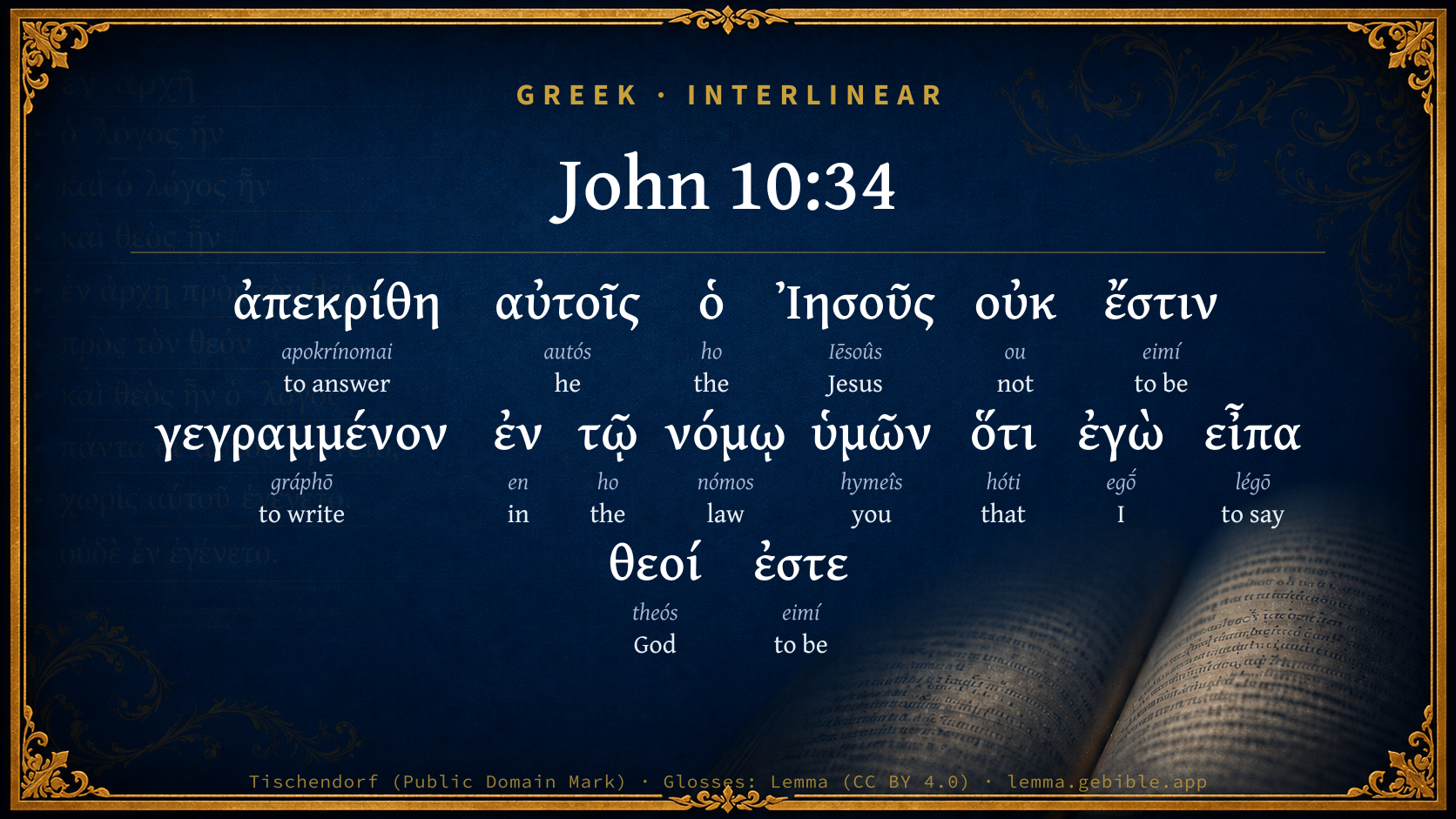
Greek (Tischendorf 8th ed.) John 10:34 appears in the Greek New Testament. The text above is from the Tischendorf 8th edition. Each word links to its Strong’s number and a concise gloss. Click any word for its full Thayer’s Greek Lexicon entry.
Download image
Cite this verse

John 10:34 (World English Bible). Public Domain. Lemma interlinear Bible study tool, https://lemma.gebible.app/v/john/10/34.

Show BibTeX & RIS
BibTeX
RIS
English Translation
Jesus answered them, "Isn't it written in your law, 'I said, you are gods?'
World English Bible · Public Domain
Download a study sheet

One document with this verse’s original text, its word-by-word gloss line, the meaning frame, cross-references with their text, attributed commentary, and full source and license credits — printable, and it pastes into notes with its structure intact.

This verse Autodidact and up

Study sheet (.html) Plain text (.txt)

A passage Seminary Student

Up to 50 verses in one chapter. A passage sheet keeps up to 6 commentary sources and 12 cross-references per verse, in the order this page ranks them, and says so on the sheet whenever that leaves anything out. Ask for a single verse and you get the Autodidact verse sheet above.

Everything on this page stays free to read, with no account — the sheet is a download of what is already on screen, not access to it.

Want to remove ads? Support Godless Engineer
Compare translations 3

The same verse in 3 English versions, stacked beneath the original-language interlinear above. Click any original word for its lexicon entry.

Each is an independent rendering of the whole verse — the interlinear is not word-aligned to these translations.

Highlighted words mark where these versions differ — a whole-verse word diff, not a word-by-word alignment.

  • World English Bible Public Domain
    Jesus answered them, "Isn't it written in your law, 'I said, you are gods?'
  • King James Version Public Domain
    Jesus answered them, Is it not written in your law, I said, Ye are gods?
  • unfoldingWord Literal Text CC BY-SA 4.0
    Jesus answered them, “Is it not written in your law, ‘I said, “You are gods”’?

unfoldingWord Literal Text — © unfoldingWord, licensed CC BY-SA 4.0. Word-aligned USFM3 via Door43 (git.door43.org/unfoldingWord/en_ult).

Versions to compare (up to 4)

3 of 4 selected

Show all 19 translations

Every available English version of this verse, each an independent rendering of the whole verse.

  • World English Bible Public Domain
    Jesus answered them, "Isn't it written in your law, 'I said, you are gods?'
  • Berean Standard Bible Public Domain
    Jesus replied, “Is it not written in your Law: ‘I have said you are gods’?
  • Majority Standard Bible Public Domain
    Jesus replied, “Is it not written in your Law: ‘I have said you are gods’?
  • King James Version Public Domain
    Jesus answered them, Is it not written in your law, I said, Ye are gods?
  • American Standard Version (1901) Public Domain
    Jesus answered them, Is it not written in your law, I said, ye are gods?
  • Revised Version (1885) Public Domain
    Jesus answered them, Is it not written in your law, I said, Ye are gods?
  • Geneva Bible (1599) Public Domain
    Iesus answered them, Is it not written in your Lawe, I sayd, Ye are gods?
  • Douay-Rheims (1899) Public Domain
    Jesus answered them: Is it not written in your law: I said you are gods
  • Young's Literal Translation Public Domain
    Jesus answered them, `Is it not having been written in your law: I said, ye are gods?
  • Literal Standard Version CC BY-SA 4.0
    Jesus answered them, “Is it not having been written in your law: I said, you are gods?
  • Unlocked Literal Bible CC BY-SA 4.0
    Jesus answered them, “Is it not written in your law, 'I said, “You are gods”'?
  • unfoldingWord Literal Text CC BY-SA 4.0
    Jesus answered them, “Is it not written in your law, ‘I said, “You are gods”’?
  • Darby Bible Public Domain
    Jesus answered them, Is it not written in your law, I said, Ye are gods?
  • World Messianic Bible Public Domain
    Yeshua answered them, “Isn’t it written in your law, ‘I said, you are gods’?
  • Webster's Bible Public Domain
    Jesus answered them, Is it not written in your law, I said, Ye are gods?
  • Free Bible Version CC BY-SA 4.0
    Jesus answered them, “Isn't it written in your law, ‘I said, you are gods’?
  • Bible in Basic English Public Domain
    In answer, Jesus said, Is there not a saying in your law, I said, You are gods?
  • Text-Critical English NT CC BY 4.0
    Jesus answered them, “Is it not written in your law, ‘I said, you are gods’?
  • Tyndale New Testament (1534) Public Domain
    Iesus answered them: Is it not written in youre lawe: I saye ye are goddes?

Literal Standard Version (2020), Covenant Press — licensed CC BY-SA 4.0. Text via the HelloAO Bible API (eBible.org). Unlocked Literal Bible (unfoldingWord) — licensed CC BY-SA 4.0. Text via the HelloAO Bible API (eBible.org). unfoldingWord Literal Text — © unfoldingWord, licensed CC BY-SA 4.0. Word-aligned USFM3 via Door43 (git.door43.org/unfoldingWord/en_ult). Free Bible Version, Dr. Jonathan Gallagher — licensed CC BY-SA 4.0. Text via the HelloAO Bible API (eBible.org).

Word by word

More ways to search: Search by grammar → Find every occurrence → Compare this word →

Practice this passage: Drill this verse → Learn its vocabulary →

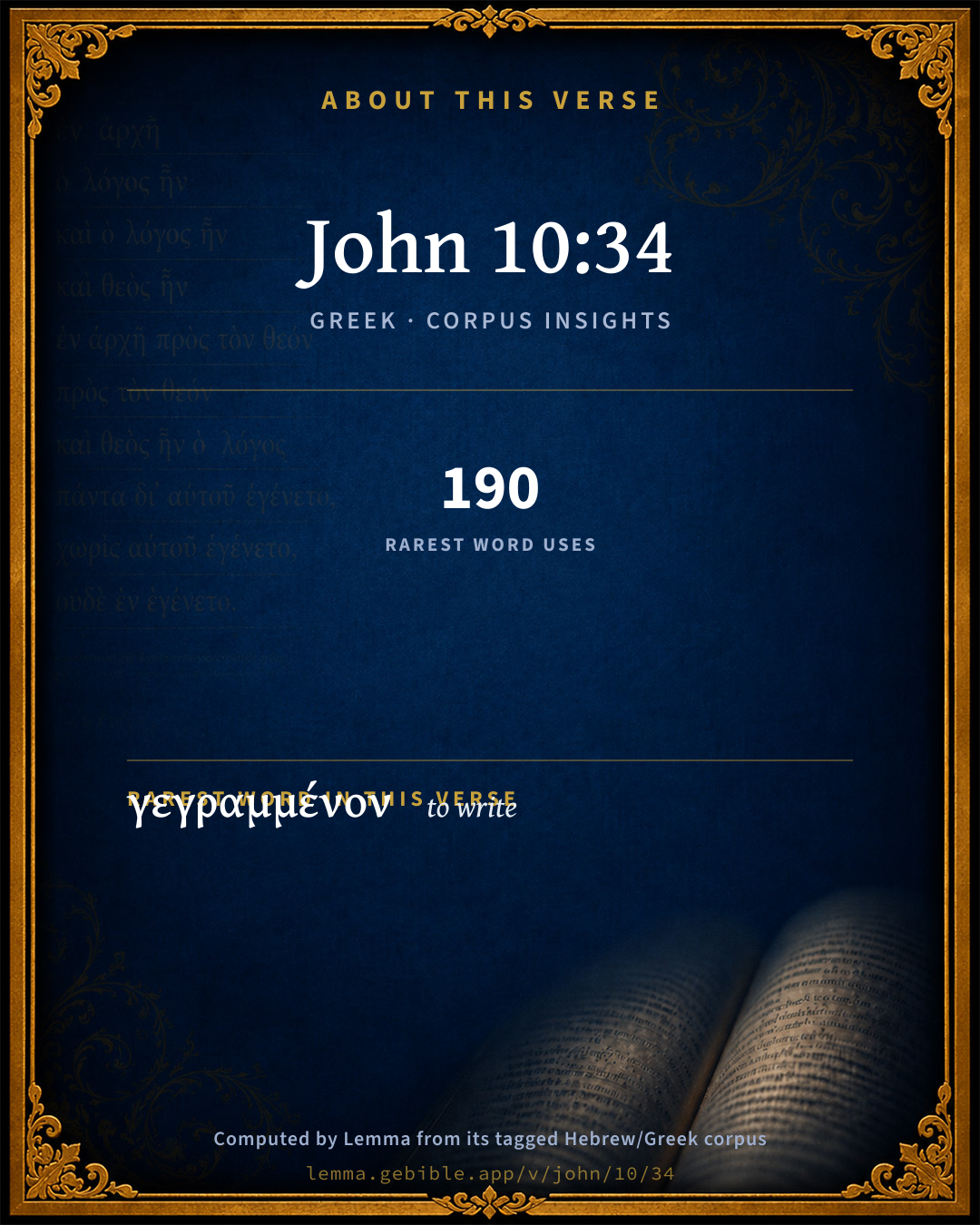
γεγραμμένον
gráphō
G1125
“to write”
Verb, Perfect, Passive, Participle, Nominative, Singular, Neuter
Part of Speech
Verb
Tense
Perfect
Voice
Passive
Mood
Participle
Case
Nominative
Number
Singular
Gender
Neuter
Full Thayer's Definition

Origin: a root word

TDNT: 13:22,1

1. to write, with reference to the form of the letters a. to delineate (or form) letters on a tablet, parchment, paper, or other material 2. to write, with reference to the contents of the writing a. to express in written characters b. to commit to writing (things not to be forgotten), write down, record c. used of those things which stand written in the sacred books (of the OT) d. to write to one, i.e. by writing (in a written epistle) to give information, directions 3. to fill with writing 4. to draw up in writing, compose
  1. ἀπεκρίθη apokrínomai G611 “to answer” Verb, Aorist, Middle deponent, Indicative, 3rd person, Singular
  2. αὐτοῖς autós G846 “he” Personal pronoun, Dative, Plural, Masculine
  3. ὁ ho G3588 “the” Article, Nominative, Singular, Masculine
  4. Ἰησοῦς Iēsoûs G2424 “Jesus” Noun, Nominative, Singular, Masculine
  5. οὐκ ou G3756 “not” Particle, Negative
  6. ἔστιν eimí G1510 “to be” Verb, Present, Active, Indicative, 3rd person, Singular
  7. ἐν en G1722 “in” Preposition
  8. τῷ ho G3588 “the” Article, Dative, Singular, Masculine
  9. νόμῳ nómos G3551 “law” Noun, Dative, Singular, Masculine
  10. ὑμῶν hymeîs G5210 “you” Personal pronoun, 2nd person, Genitive, Plural
  11. ὅτι hóti G3754 “that” Conjunction
  12. ἐγὼ egṓ G1473 “I” Personal pronoun, 1st person, Nominative, Singular
  13. εἶπα légō G3004 “to say” Verb, Aorist, Active, Indicative, 1st person, Singular
  14. θεοί theós G2316 “God” Noun, Nominative, Plural, Masculine
  15. ἐστε eimí G1510 “to be” Verb, Present, Active, Indicative, 2nd person, Plural

About this verse

These counts appear in no published source. They are computed here, from the morphology-tagged text and Lemma’s own curated glosses. What Lemma adds →

16
words
14
distinct lemmas
Gospels
section

Repetition

Words recur within this verse:

Cross-references

5

Topical passages linked to John 10:34 in the Treasury of Scripture Knowledge — connected by theme and wording, ordered by reader-vote popularity; previews shown in the World English Bible.

  • Psalms 82:6–7 I said, "You are gods, All of you are sons of the Most High.
  • Exodus 7:1 Yahweh said to Moses, "Behold, I have made you as God to Pharaoh; and Aaron your brother shall be your prophet.
  • Psalms 82:1 God presides in the great assembly. He judges among the gods.
  • Exodus 4:16 He will be your spokesman to the people; and it will happen, that he will be to you a mouth, and you will be to him as God.
  • Psalms 138:1 I will give you thanks with my whole heart. Before the gods, I will sing praises to you.

Cross-references courtesy of OpenBible.info (CC BY 4.0).

Commentary

Notes on John 10:34 from classic Christian and Jewish commentators (each source and its license shown beneath its notes). The classic Christian expositions comment on the surrounding passage and are grouped to its opening verse, so a note may address several verses; the Jewish commentaries on the Tanakh (Rashi and others) are per-verse, so they appear only where the commentator wrote on this verse.

Lemma curates 59 commentaries, every one of them public domain or Creative Commons licensed, each selected and text-cleaned for this edition rather than reprinted as found. About our sources →

Albert Barnes' Notes on the Bible

Jesus answered them - The answer of Jesus consists of two parts. The first Joh 10:34-36 shows that they ought not to object to his use of the word God, even if he were no more than a man. The second Joh 10:37-38 repeats substantially what he had before said, left the same impression, and in proof of it he appealed to his works.

Joh 10:34

In your law - Psa 82:6. The word “law” here, is used to include the Old Testament.

I said - The Psalmist said, or God said by the Psalmist.

Ye are gods - This was said of magistrates on account of the dignity and honor of their office, and it shows that the Hebrew word translated “god,” אלהים ̀elohiym, in that place might be applied to man. Such a use of the word is, however, rare. See instances in Exo 7:1; Exo 4:16.

Joh 10:35

Unto whom the word of God came - That is, who were his servants, or who received their dignity and honor only because the law of God was intrusted to them. “The Word of God” here means the command of God; his commission to them to do justice.

The scripture cannot be broken - See Mat 5:19. The authority of the Scripture is final; it cannot be set aside. The meaning is, “If, therefore, the Scripture uses the word “god” אלהים ̀elohiym as applied to magistrates, it settles the question that it is right to apply the term to those in office and authority. If applied to them, it may be to others in similar offices. It cannot, therefore, be blasphemy to use this word as applicable to a personage so much more exalted than mere magistrates as the Messiah.”

Joh 10:36

Whom the Father hath sanctified - The word “sanctify” with us means to make holy; but this is not its meaning here, for the Son of God was always holy. The original word means to set apart from a common to a sacred use; to devote to a sacred purpose, and to designate or consecrate to a holy office. This is the meaning here. God has consecrated or appointed his Son to be his Messenger or Messiah to mankind. See Exo 28:41; Exo 29:1, Exo 29:44; Lev 8:30.

And sent into the world - As the Messiah, an office far more exalted than that of magistrates.

I am the Son of God - This the Jews evidently understood as the same as saying that he was equal with God. This expression he had often applied to himself. The meaning of this place may be thus expressed: “You charge me with blasphemy. The foundation of that charge is the use of the name God, or the Son of God, applied to myself; yet that same term is applied in the Scriptures to magistrates. The use of it there shows that it is right to apply it to those who sustain important offices (see the notes of Joh 10:34-35). And especially you, Jews, ought not to attempt to found a charge of blasphemy on the application of a word to the Messiah which in your own Scriptures is applied to all magistrates. And we may remark here:

That Jesus did not deny that he meant to apply the term to himself. He did not deny that it was properly applied to him. He did not deny that it implied that he was God. He affirmed only that they were inconsistent, and were not authorized to bring a charge of blasphemy for the application of the name to himself.

Joh 10:37

The works of my Father - The very works that my Father does. See Joh 5:17; “My Father worketh hitherto, and I work.” See the note on that place. The works of his Father are those which God only can do. As Jesus did them, it shows that the name “Son of God,” implying equality with God, was properly applied to him. This shows conclusively that he meant to be understood as claiming to be equal with God. So the Jews naturally understood him Joh 10:39, and they were left with this impression on their minds.

Joh 10:38

Believe the works - Though you do not credit me, yet consider my works, for they prove that I came from God. No one could do them unless he was sent of God.

Father is in me ... - Most intimately connected. See Joh 5:36. This expression denotes most intimate union - such as can exist in no other case. See Mat 11:27; Notes, Joh 17:21.

Albert Barnes' Notes on the Bible (1834–1885) — public domain. Text from a community e-Sword/MySword module.

Tyndale Open Study Notes

Tyndale Open Resources

10:34-36 I say, you are gods! If the word god could be applied to people other than the Lord, then Jesus was not breaking the law by referring to himself in this way. Yet Jesus is not just any son of God; he is the Son of God who was sent . . . into the world.

Tyndale Open Study Notes — © Tyndale Open Resources, licensed CC BY-SA 4.0. Text via the HelloAO Bible API.

Bengel's Gnomon

Johann Albrecht Bengel

Joh 10:34. Ἀπεκρίθη, answered) The Jews had said, Thou sayest that Thou art God, and indeed God by nature (for their blindness lay in joining this Godhead with the manhood): and Jesus acknowledge [as His claims] this Godhead of nature, without denying His manhood, and does not lower His claims by His subsequent language, but defends them: comp. Joh 10:39, “Therefore they sought again to take Him,” as to the question in what sense the Jews understood His words. From these considerations a reply can easily be made to Artemonius, P. ii., c. 1. They had surrounded Jesus, Joh 10:24; and so in this menacing attitude were threatening Him with death; yet His wisdom and presence of mind remains unshaken.—ἐγώ) I, God; for from the εἶπα in the first person, the inference is drawn, to whom the word of God came, in the following ver.—θεοί, gods) Psa 82:6; the parallel is added; υἱοὶ ὑψίστου, sons of the Most High. Therefore also at Joh 10:36,[288] there ought to be understood Θεός, God, to Υἱὸς τοῦ Θεοῦ, the Son of God.[289] The Jews did not admit Jesus to be God in any sense: therefore, in refutation of them, He quotes the psalm. But a comparison drawn from a psalm does not prove that the Godhead of Christ approaches nearer to the godhead of mortals, than to the Godhead of the eternal Father; for He did not ever quote this passage of the psalm to believers.

[288] To complete the correspondence of the parallels.—E. and T.

[289] God, the Son of God, answering respectively to gods and children of the Most High.—E. and T.

Bengel's Gnomon of the New Testament — English translation (T&T Clark, Edinburgh, 1860) — public domain. Text from a community e-Sword module.

Meyer's Critical & Exegetical Commentary

Heinrich August Wilhelm Meyer

Joh_10:34-36. In Psa_82:6, unrighteous authorities of the theocratic peoplenot angels (Bleek), nor yet heathen princes (De Wette, Hitzig)whose approaching destruction, in contrast to their high dignity, is intended to stand out, are called gods, agreeably to the old sacred view of rulers as the representatives of God, which was entertained in the theocratic nation. Compare Exo_21:6; Exo_22:8; Exo_22:28. From this, Jesus draws the conclusion a minori ad majus, that He might call Himself Gods Son without blasphemy. He is surely far more exalted than they (ὃν ὁ πατὴρ ἡγίασε, etc.); and nevertheless had designated Himself, not θεός, as though wishing to make a God of Himself, but merely υἱὸς τ. θεοῦ.[67]

ἐν τῷ νόμῳ] Spoken of the Old Testament generally, of which the law was the fundamental and authoritative portion. Comp. Joh_12:34, Joh_15:25; Rom_3:19; 1Co_14:21.

ὑμῶν] as in Joh_8:17.

ἐκείνους] whom? Jesus takes for granted as known.

εἶπε] namely, ὁ νόμος (compare afterwards ἡ γραφή), not God (Hengstenberg).

πρὸς οὕς] to whom, not adversus quos (Heinsius, Stolz), which does not follow from the context. There is nothing to warrant the supposition that the prophets are also referred to (Olshausen).

ὁ λόγος τοῦ θεοῦ] Neither the λόγος ἄσαρκος (Cyril), nor the revelations of God (Olshausen, comp. Godet), but the saying of God just mentioned: ἐγὼ εἶπα, etc. This saying belongs, not to the time when the Psalm was written, but to that earlier period (the period of the induction of the authorities into their office, comp. Psa_2:7), to which God, the speaker, points back.

καὶ οὐ δύναται, etc.] This clause, though containing only an auxiliary thought, and not a main point of the argumentation (Godet), has been without reason treated as a parenthesis; whereas both in point of structure and sense it is dependent on εἰ: and it is impossible, etc. So also Ewald, Godet, Hengstenberg.

λυθῆναι] The Scripture (consequently, also, that saying of the. Psalms) cannot be loosened, i.e. cannot be deprived of its validity. Comp. Mat_5:19; Joh_5:18; Joh_7:23; Herod. 3. 82; Plat. Phaedr. p. 256 D; Gorg. p. 509 A; Dem. 31. 12, 700, 13. The auctoritas normativa et judicialis of the Scriptures must remain unbroken. Note, in connection herewith, the idea of the unity of the Scriptures as such, as also the presupposition of their theopneustia.

ὃν ὁ πατὴρ ἡγ, etc.] That is surely something still greater than the λόγος τ. θεοῦ, addressed to authorities when they were installed in their offices. In this question, which is placed in the apodosis, and which expresses surprise, the object, which is correlate to the ἐκείνους of Joh_10:35, is very emphatically placed at the commencement; and ὑμεῖς (you people) is placed over against the inviolable authority of the Scripture.

ἡγίασε] hath consecrated, a higher analogue of the consecration to the office of prophet (Jer_1:5; Sir_45:4; Sir_49:7), denoting the divine consecration to the office of Messiah, who is the ἅγιος τοῦ θεοῦ (Joh_6:69; Luk_4:34). This consecration took place on His being sent from heaven, and immediately before His departure (hence ἡγίασε καὶ ἀπέστ.), in that the Father not merely set apart the Son to the work (as though the word ἐξελέξατο had been used; Hofmann, Schriftbew. I. p. 86; comp. Euth. Zigabenus, Hengstenberg, and Brückner), but also conferred on Him the Messianic ἐντολή and ἐξουσία, with the fulness of the Spirit appertaining thereunto (Joh_3:34), and the power of life (Joh_5:26), and the πλήρωμα of grace and truth (Joh_1:14).

ὅτι βλασφημεῖς] The reply which, in view of ὃν, etc., we should have expected to be in the oblique construction (βλασφημεῖν or ὅτι βλασφημεῖ, comp. Joh_9:19), passes over with the increasing vivacity of the discourse into the direct construction; compare Joh_8:54, and see Buttm. Neuf. Gr. p. 234 [E. T. p. 272].

ὅτι εἶπον] because I said. He had said it indirectly in Joh_10:29-30.

[67] Hengstenberg incorrectly remarks: He accepts the charge, Thou makest thyself God. On the contrary, He does not enter on it at all, but simply justifies the predicate, Son of God, which He had assumed for Himself. But Beyschlag also is wrong when he says (p. 106): That which Jesus here affirms concerning Himself (ὃν ὁ πατὴρ ἡγίασε, etc.) might equally have been affirmed by every prophet. On such a view, no regard would be paid to the relation of πατήρ and υἱός.

Joh_10:34-38. Jesus justifies Himself from the reproach of blasphemy by defending His assertion that He was the Son of Godthe words of Joh_10:30 which had excited the opposition amounted to thisfrom the Scriptures (Joh_10:34-36); He then sets forth the unity affirmed in Joh_10:30 as credibly attested by His works (Joh_10:37-38).

Meyer — Critical and Exegetical Commentary on the New Testament — English translation by Peter Christie, edited by Frederick Crombie (T&T Clark, 1880) — public domain. Text from a community e-Sword module.

Expositor's Greek Testament

ed. W. Robertson Nicoll

Joh 10:34 . On this occasion He merely shows that even a man could without blasphemy call himself “Son of God”; because their own judges had been called “gods”. Οὐκ ἔστι γεγραμμένον ἐν τῶ νόμῳ ὑμῶν , “Is it not written in your law, I said ‘ye are Gods’?” In Psa 82 the judges of Israel are rebuked for abusing their office; and God is represented as saying: “I said, Ye are gods, and all of you are children of the Most High”. “The law” is here used of the whole O.T. as in Joh 12:34 , Joh 15:25 , Rom 3:19 , 1Co 14:21 . Εἰ ἐκείνους … “If it [that ὁ νόμος is the nominative to εἶπε is proved by the two following clauses, although at first sight it might be more natural to suppose the nearer and more emphatic ἐγώ supplied the nominative] called them gods, to whom the word of God came,” that is, who were thus addressed by God at their consecration to their office and by this word lifted up to a new dignity “and that they were so called is certain because Scripture cannot be denied or put aside then do you, shutting your eyes to your own Scriptures, declare Him whom the Father consecrated and sent into the world to be a blasphemer because He said, I am God’s Son?” The a fortiori element in the argument lies in this, that the judges were made “gods” by the coming to them of God’s commission, which found them engaged otherwise and itself raised them to their new rank, whereas Jesus was set apart by the Father and sent into the world for the sole object of representing the Father. If the former might be legitimately called “gods,” the latter may well claim to be God’s Son. The idea of the purpose for which Christ was sent into the world is indicated in the emphatic use of ὁ πατήρ ; and this is still further accentuated in Joh 10:37 .

The Expositor's Greek Testament, edited by W. Robertson Nicoll (1897–1910) — public domain. Text from a community e-Sword module.

Godet's Commentaries

Frédéric Louis Godet

Vv. 34-36. “Jesus answered them, Is it not written in your law I said ye are gods? 35. If it called them gods to whom the word of God was addressed,—and the Scripture cannot be broken,—36 do you say of him whom the Father has sanctified and sent into the world, Thou blasphemest! because I said, I am the Son of God?”

This argument has often been presented as an implicit retractation of the expressions in which Jesus seemed to have affirmed His divine nature. In this sense, He is supposed to say: “Mere creatures have been called gods, because they represent God in some one of His functions, that of judge, for example; this is the only sense in which I have ascribed divinity to myself.” But Jesus would thereby, at the same time, retract all His earlier testimonies, the meaning of which we have established. Jesus is occupied solely, in this first part of His reply, Joh 10:34-36, with repelling the accusation of blasphemy. With this end in view, He reasons as follows: “The Scripture called mere human beings gods, as being invested with an office in which they were the representatives and organs of God on earth; were I then nothing more than a mere man, sent to accomplish a divine work, I should not deserve, according to the Scripture itself, to be treated as a blasphemer for having called myself Son of God.”

As an argument ad hominem the reasoning is irrefutable. Nevertheless, it still leaves room for this objection: Jesus called Himself God in an altogether different sense from that in which the Scripture gave this title to the Israelite judges. But a second point is to be observed here: it is the gradation in Joh 10:35-36 : “If the Scripture did not blaspheme in calling the persons gods to whom the revelation was addressed, how can I have spoken blasphemy in declaring myself God, I, whom God sends into the world as His revelation itself?” This altogether different position of Jesus as regards the divine revelation justifies the higher sense in which He attributes to Himself the title of God. The monotheism of the Bible differs absolutely from the cold and dead Deism which Jewish orthodoxy had extracted from the sacred books, and which separates the Creator by a gulf from man.

This petrified monotheism is the connecting link between degenerate Judaism, Mahometanism and modern rationalism; but it is only a gross caricature of the Scriptural conception. Every theocratic function exercised in the name of Jehovah, who has conferred it, places its depositary in living connection with the Most High, makes him participate in His inspiration, and constitutes him His agent. Thereby the man, king, judge or prophet, becomes relatively a manifestation of God Himself. “At that time, the house of David shall be as Elohim, as the angel of the Lord.” Zec 12:8. The Old Testament is, in its deepest tendency, in a constant advancing progress towards the incarnation, the crowning-point of the increasing approximation between God and man. This is the true basis of the reasoning of Jesus: If this entire course has nothing in it of blasphemy, the end in which it issues, the appearance of a man who declares Himself one with God, has in itself nothing in contempt of the majesty of God.

The quotation is derived from Psa 82:6; and the term law denotes here, as in Joh 7:49, Joh 12:34, etc., the entire Old Testament, not as a denomination a potiori parte, but rather inasmuch as this whole book formed a law for the Israelitish thought and life. On the expression your law, see on Joh 8:17. Asaph, in this Psalm, addresses the theocratic judges. Joh 10:1 describes their greatness, in virtue of their function as organs of the divine justice, which has been intrusted to them. God Himself sits in the midst of them; it is from Him that their judgments emanate. Then in Joh 10:2-5, Asaph contrasts the sad reality, the injustice of the actual judges, with the ideal greatness of their function. In Joh 10:6, he returns to the idea of the first verse, that of their official dignity. The words: I said, refer undoubtedly to the expression of Asaph himself in Joh 10:1 : “God is present in the congregation of God.” And thus he prepares for the transition to the warning of Joh 10:7-8, in which he reminds them that they will themselves be one day judged, for an account will be demanded of them respecting this divine function with which they had been clothed. Jesus draws from the words of the Psalmist a conclusion a minori ad majus, precisely as in Joh 7:23. The basis of the reasoning is the admitted principle: that the Scriptures cannot blaspheme. By those to whom the word of God is addressed, Jesus evidently understands those judges, to whom the Holy Spirit addresses Himself, saying: You are ...The parenthetical remark: And the Scripture cannot be broken, shows the unlimited respect which Jesus feels for the word of Scripture.

Let us suppose that it was the evangelist who invented all this argument; could he, the so-called author of the theory of the Logos, have resisted the temptation to put into the mouth of Jesus here this favorite title by which he had designated Him in the Prologue? This would be the altogether natural gradation: The law calls them judges to whom the Word is addressed; how much less can I be accused of blasphemy, who am the Word itself, when I attribute to myself the title of God! John does not yield to this temptation; it is because it did not exist for him, since he limited himself to giving a faithful report of what his Master had said. Jesus designates Himself as Him whom the Father has sanctified and sent. The first expression might strictly refer to a fact in the earthly life of Jesus, such as that of the miraculous birth (Luthardt) or that of the baptism (Weiss). But in that case it would be necessary to refer the following expression: sent into the world, to an act later than the one or the other of these two events: according to Weiss, for example, to the command to begin His public ministry. Or it would be necessary to admit a retrograde order in the position of the two terms sanctify and send, which is quite as unnatural. The term to send into the world can of course only designate the mission which He received when He came from God to fulfill His work as Redeemer; and the term to sanctifymust consequently designate the celestial act by which God specially set Him apart and consecrated Him for this mission. It was to this commandment, previous to the incarnation, that we were already referred by the expressioncommandment, ἐντολή, used in Joh 5:18; comp. 1Pe 1:20.

There was a consulting together between the Father and the Son before the coming of Jesus to the world, of which He Himself formulates the result when He says: “I am come down from heaven, not to do my own will, but the will of him who sent me” (Joh 6:38). How great is the superiority of such a being to all those to whom the divine revelation addresses itself here below! In reproducing the charge alleged against Him, Jesus passes to the direct discourse: Thou blasphemest. It is the lively repetition of the accusation, as it was still sounding in His ears. The following words: because I said, depend not on thou blasphemest, but on you say. The title Son of God evidently here reproduces the substance of the declaration of Joh 10:30 : I and my Father are one. This example shows again how erroneous it is to see in the title Son of God the indication of a function, even of the highest theocratic function. Taken in this sense, this term does not involve absolutely any blasphemy at all. These Jews who had just addressed to Him the question: “If thou art the Christ, tell us plainly,” evidently could not have found in this title of Christ a blasphemy. And, as for Jesus, He is here thinking, as Joh 10:30 shows, on something altogether different from His dignity as Messiah. That is only a corollary following from His altogether peculiar union with God. He is only endeavoring therefore to awaken in the hearts of His hearers the feeling of His close relation to God, being certain, not only that the conviction of His Messiahship will naturally result from it, but also that in this way only that idea will not be erroneously conceived. Hence what follows:

Frédéric Louis Godet — Commentaries on Luke, John, Romans, and 1 Corinthians — English translation (T&T Clark, Edinburgh, 1870s–1890s) — public domain. Text from a community e-Sword module.

Jamieson, Fausset & Brown

Robert Jamieson, A. R. Fausset & David Brown

Is it not written in your law--in Psa 82:6, respecting judges or magistrates.

Ye are gods--being the official representatives and commissioned agents of God.

Jamieson, Fausset & Brown — Commentary Critical and Explanatory on the Whole Bible (1871) — public domain (CC PDM 1.0). Text via the HelloAO Bible API.

Adam Clarke's Commentary

Verse 34. Is it not written in your law] The words which our Lord quotes are taken from Ps 82:6, which shows that, under the word law, our Lord comprised the Jewish sacred writings in general. See also Joh 12:34; Joh 15:25.

Ye are gods?] That is, judges, who are called אלהים elohim. That judges are here meant appears from Ps 82:2, &c., and also from what follows here. And this is probably the only place where the word אלהים is applied to any but the true God. See Parkhurst under the root אלה.

Adam Clarke's Commentary on the Bible (1810–1826) — public domain. Text from a community e-Sword/MySword module.

John Calvin's Commentaries

34. Is it not written in your Law? He clears himself of the crime charged against him, not by denying that he is the Son of God, but by maintaining that he had justly said so. Yet he adapts his reply to the persons, instead of giving a full explanation of the fact; for he reckoned it enough for the present to expose their malice. In what sense he called himself the Son of God he does not explain fully, but states indirectly. The argument which he employs is not drawn from equals, but from the less to the greater.

I said, You are gods. Scripture gives the name of gods to those on whom God has conferred an honorable office. He whom God has separated, to be distinguished above all others, is far more worthy of this honorable title. Hence it follows, that they are malicious and false expounders of Scripture, who admit the first, but take offense at the second. The passage which Christ quotes is in Psalm 82:6,

I have said, You are gods, and all of you are children of the Most High;

where God expostulates with the kings and judges of the earth, who tyrannically abuse their authority and power for their own sinful passions, for oppressing the poor, and for every evil action. He reproaches them that, unmindful of Him from whom they received so great dignity, they profane the name of God. Christ applies this to the case in hand, that they receive the name of gods, because they are God’s ministers for governing the world. For the same reason Scripture calls the angels gods, because by them the glory of God beams forth on the world. We must attend to the mode of expression:

John Calvin's Commentaries (1540-1563) — public domain. Text from the Calvin Translation Society English edition (1840s-50s) via the Christian Classics Ethereal Library (ccel.org). Calvin's coverage is partial (roughly two-thirds of the Bible); uncommented books and verses are honest gaps, never fabricated. The 19th-century editor's footnotes and remarks are omitted so the notes are faithfully Calvin's own voice.

Ellicott's Commentary for English Readers

(34) Is it not written in your law?—Comp. Note on Joh_8:17. The passage here quoted is in Psa_82:6, but the term “Law” is here used in a wide sense for the whole of the Old Testament. There are other examples of this usage in Joh_7:49; Joh_12:34; Joh_15:25; Rom_3:19; 1Co_14:21.

I said, Ye are gods?—In the Hebrew of the Psalm, as in the Greek here, the pronoun is emphatic. “I myself said, Ye are gods?” The words are probably to be understood in the Psalm as spoken by God, who sits in judgment on the judges whom He had appointed, and gives the name of “gods” (Elohim) as representing Himself. See Exo_4:16; Exo_7:1; Exo_18:15; Exo_21:6; Exo_22:8; Exo_22:28; Deu_1:17; 1Sa_28:13; Psa_8:5; Psa_45:6; and comp. Perowne’s Notes on Psalms 82, and article “God,” in Kitto’s Biblical Cyclopœdia, Ed. 3, vol. ii., p. 144 et seq.

A Bible Commentary for English Readers, edited by Charles John Ellicott (1878–1897) — public domain. Text from a community e-Sword module.

The Cambridge Bible for Schools and Colleges

gen. ed. J. J. S. Perowne

34. in your law] ‘Law’ is here used in its widest sense for the whole of the Old Testament; so also in Joh_12:34 and Joh_15:25; in all three places the passage referred to is in the Psalms. Comp. Joh_7:19, 1Co_14:21. The force of the pronoun is, ‘for which you profess to have such a regard:’ comp. Joh_8:17. On the Greek for ‘is it written’ see on Joh_2:17.

I said, Ye are gods] The argument is both à fortiori and ad hominem. In the Scriptures (Psa_82:6) even unjust rulers are called ‘gods’ on the principle of the theocracy, that rulers are the delegates and representatives of God (comp. Exo_22:28). If this is admissible without blasphemy, how much more may He call Himself ‘Son of God.’

34–38. Christ answers the formal charge of blasphemy by a formal argument on the other side.

The Cambridge Bible for Schools and Colleges (gen. ed. J. J. S. Perowne; Cambridge University Press, 1878–1918) — public domain. Text from a community e-Sword module.

John Gill's Exposition

If he called them gods, unto whom the word of God came,.... The Syriac version reads, "because the word of God came to them"; either the divine "Logos", the essential word, the Son of God, who appeared to Moses, and made him a God to Pharaoh, and who appointed rulers and magistrates among the Jews; and who is the King of kings, and Lord of lords, from whom all receive their power and dominion: this sense is favoured by the Ethiopic version, which renders it, "if he called them gods to whom God appeared, the word of God was with them": or else the commission from God, authorizing them to act in the capacity of rulers and governors, is here meant; or rather the word of God, which, in the passage of Scripture cited, calls them so, as it certainly does:

and the Scripture cannot be broken; or be made null and void; whatever that says is true, there is no contradicting it, or objecting to it: it is a Jewish way of speaking, much used in the Talmud (y); when one doctor has produced an argument, or instance, in any point of debate, another says, , "it may be broken"; or objected to, in such and such a manner, and be refuted: but the Scripture cannot be broken, that is not to be objected to, there can be no confutation of that.

(y) T. Bab. Zebachim, fol. 4. 1. & Becorot, fol. 32. 1. & passim.

John Gill's Exposition of the Whole Bible (1746–1763) — public domain (CC PDM 1.0). Text via the HelloAO Bible API.

Trapp's Complete Commentary

John Trapp

34 Jesus answered them, Is it not written in your law, I said, Ye are gods?

Ver. 34. In your law] So he calls it, to show that there was no necessity on his part to prove what he delivered by any Scripture, since he was to be believed on his bare word, αυτοπιστος; but for their sakes only he did it.

John Trapp, A Commentary or Exposition upon All the Books of the Old and New Testament (1647–1656) — public domain. Text from a community e-Sword module.

Haydock's Catholic Bible Commentary

This is addressed to princes established to govern the people of God. They are the image of God on earth by the authority they exercise, and which they have received from Him. --- Is it not written in you law, (under which were also comprehended the Psalms) I have said: you are Gods? &c. Christ here stops the mouths of the Jews, by an argument which they could not answer, that sometimes they were called Gods, who acted by God’s authority. I have said: you are Gods. (Psalm lxxxi. 6.) But then he immediately declares, that it is not in this sense only that he is God. 1st, Because he has been sanctified by the Father, which St. Augustine and others understand of that infinite sanctification, which he has necessarily by always proceeding from the Father. Others expound it of a greater sanctity and fulness of grace above all other saints, given to him, even as he was man. But 2ndly, he adds at the same time, and confirms what he had often told them, that he was the Son of God, sent into the world: that his works shew that he was in the Father, and the Father in him. by this they saw that he was far from recalling or contradicting what he had said before. And therefore (ver. 30.) they sought to apprehend him, and put him to death for blasphemy. (Witham) --- Eloim, which name of God was so called from judging, and may be interpreted judges. (Menochius)

George Leo Haydock (1774–1849), Haydock's Catholic Family Bible and Commentary, 1859 edition — public domain. Excludes Psalms (Douay-Rheims chapter numbering differs from Protestant) and Deuterocanonical books (Catholic canon only).

Matthew Poole's English Annotations

This was written, Psa 82:6. The whole Scripture of the Old Testament, being wrote by holy men, inspired of God, and directive of men’s conversation before men, and towards God, is sometimes called the law, Psa 19:7. It was spoken concerning magistrates, and the governors of God’s people, who, being God’s deputies and vicegerents, intrusted to execute the judgments and vengeance of God, are dignified with the name of gods.

Matthew Poole's English Annotations on the Holy Bible (1683–1685) — public domain. Text from a community e-Sword/MySword module.

Whedon's Commentary on the Bible

Daniel D. Whedon

34-38. In this answer Jesus shows, 1. That it is perfectly sustained by the Old Testament, that the term god is and may be extended down from God to one “being a man,” so that it is no blasphemy to suppose that it includes his human person. But, 2. He has a supernatural claim to the divine, running upward they know not how high. 3. His works, performed in unison with his words, authenticate from God whatever claims he presumes to make. If his works are from God, then his words are from the Father. And, then, his sonship is demonstrated. Thus does this argument furnish a bridge for these Jews to admit his divinity; a bridge leading upward, indefinitely high; nay, if so be, infinitely. Nothing but their unchanging preference for a human hero-Messiah prevents their ascending the bridge he presents with the step of a firm faith.

34. Law… gods—In the term law, here, the Psalms are, according to Jewish custom, included. Jesus here quotes Psa_82:6 : “I have said ye are gods; and all of you are children of the Most High; but ye shall die like men.” The words are addressed to judicial magistrates of Israel or of the earth. Similarly Homer styles the Grecian princes god-born. As they are divinely authorized, have a divine work of justice to do, are the images of the divine Judge, so the term of divinity is conferred upon them. Government is from God; and every good man sustains the magistrate with a respect for his office.

Daniel D. Whedon (gen. ed.), Commentary on the Old and New Testaments (1874–1909) — public domain. Text from a community e-Sword module.

The Pulpit Commentary

The justification of Jesus which follows is often supposed to be a retraction of the claim a repudiation of the inference which the Jews drew from the words recorded in ver. 30. On the contrary, our Lord took up one illustration from among many in Holy Scripture, that the union between man and God lay at the heart of their (nomov) Law. True, he quoted from Psa_82:6 with reference to the high official title given by the Holy Spirit to the false and tyrannical judges of the old covenant. Jesus answered them, Is it not written in your Law? The Psalms are here spoken of as "the Law," showing that they did form part of the revelation and law of the Divine kingdom. (Joh_7:49 Joh_12:34 Joh_15:25) Jesus does not imply that the Law was theirs and not his. There is not a shadow of disrespect cast on the Law by the pronoun, but such an identification of it with his hearers that they ought, by its aid, to have been saved from utterly misconceiving his words I said, Ye are gods (elohim, yeoi). To stand in close relation with the theocracy was to be covered with its glory. He seems to force upon them thus a host of similar blendings of the Divine and human in the age-long preparation for himself, and to free all these from the suspicion of blasphemy. The Hebrew thought was really calculated to prepare the world for this high intercommunion, not to abolish it. Judaism, rabbinism, had widened the chasm between God and man. Christ came to fill up the chasm; nay more, to show the Divine and human in living, indissoluble union.

The Pulpit Commentary (1880–1919), ed. H.D.M. Spence-Jones & Joseph S. Exell — public domain. Text from a community e-Sword module.

John Wesley's Explanatory Notes

Psalm lxxxii, 6.

John Wesley, Explanatory Notes Upon the Whole Bible (1754–1765) — public domain. Text via the GEBible commentary corpus.

Burkitt's Expository Notes on the New Testament

William Burkitt

Here our Saviour by a two-fold argument vindicates himself from the imputation of blasphemy, in assertion himself to be God.

1. Because the Old Testament gave to magistrates and judges the title of gods, I have said ye are gods Psa 82:6. Now Christ argues strongly from the less to the greater, thus: "If judges and magistrates may be called gods, because they are commissioned by him, and derive their authority from him, how much more is that title due to me, who was sanctified, separated, and ordained for a Mediator, and appointed to the work of redemption, before I came into the world, and consequently was God from all eternity?"

This place the Socinians (whose professed adversaries of our Saviour’s godhead) produce to prove, that Christ was not God by nature, but only in respect of his sanctification and mission. It is a certain truth, that he was not therefore the Son of God, because sanctified and sent. His sanctification was not the ground of his sonship; but his sonship was the cause of his sanctification. Christ was not therefore God’s Son, because he was sanctified and sent; but he was therefore sanctified and sent, because he was his Son. He was a Son before he was sent, even from eternity, otherwise, it must have been said, that God sent him to be his Son, and not that God sent his Son. This supposes him before he was sent out have been actually his Son, as certainly he was, from before the foundation of the world. Pro 8:25 I was set up from everlasting, from the beginning, or ever the world was.

William Burkitt's Expository Notes on the New Testament (1700–1703) — public domain. Text from a community e-Sword module.

The People's New Testament

B. W. Johnson

34–36. Is it not written in your law. In Psa. 82. I said, Ye are gods? It was there addressed to judges. Christ's argument is: If your law calls judges gods, why should I be held guilty of blasphemy for saying that I am the Son of God?

Sanctified. Set apart.

B. W. Johnson's The People's New Testament with Notes (1889–1891) — public domain. Electronic text from the Christian Classics Ethereal Library (CCEL) ThML edition.

unfoldingWord translationNotes

Door43 World Missions Community

Is it not written ... gods"'?

This remark appears in the form of a question to add emphasis. AT: "You should already know that it is written in your law that I said, 'you are gods.'" (See: Rhetorical Question)

You are gods

Here Jesus quotes a scripture where God calls his followers "gods," perhaps because he has chosen them to represent him on earth.

the word of God came

Jesus speaks of God's message as though it were a person who moved toward those who heard it. AT: "God spoke his message"

the scripture cannot be broken

Possible meanings are 1) "no one can change the scripture" or 2) "the scripture will always be true."

do you say to him whom the Father set apart and sent into the world, 'You are blaspheming,' because I said, 'I am the Son of God'?

Jesus used this question to rebuke his opponents for saying that he was blaspheming when he called himself "the Son of God." AT: "you should not say to the very one whom the Father set apart to send into the world, 'You are blaspheming,' when I say that I am the Son of God!" (See: Rhetorical Question)

You are blaspheming

"You are insulting God." Jesus' opponents understood that when said that he is the Son of God, he was implying that he is equal with God.

Father ... Son of God

These are important titles that describe the relationship between God and Jesus. (See: Translating Son and Father)

translationWords

written

law

set apart

world

blasphemy

Son of God

unfoldingWord translationNotes — © Distant Shores Media and the Door43 World Missions Community, licensed CC BY-SA 4.0. Source: git.door43.org/Door43/en_tn.

Cambridge Greek Testament for Schools and Colleges

34–38. Christ answers a formal charge of blasphemy by a formal argument on the other side.

34. ἔστιν γεγραμμένον. see on Joh 2:17.

ἐν τ. νόμῳ ὑμ. As in Joh 12:34, Joh 15:25 ‘the Law’ is used in its widest sense for the whole of O. T. In all three places the reference is to the Psalms: comp. Rom 3:19; 1Co 14:21. Ὑμῶν means, ‘for which you profess to have such a regard:’ comp. Joh 8:17.

ἐγὼ εἶπα, θεοί ἐστε. The argument is both à fortiori and ad hominem. In the Scriptures (Psa 82:6) even unjust rulers are called ‘gods’ on the principle of the theocracy, that rulers are the representatives of God (comp. Exo 22:8). If this is admissible without blasphemy, how much more may He call Himself ‘Son of God.’

Cambridge Greek Testament for Schools and Colleges (Cambridge University Press, 1896; 21 vols, various authors incl. Carr, Maclear, Plummer, Farrar, Lumby, Moule, M. R. James, Simcox) — public domain. Text from a community e-Sword module.

Alford’s Greek Testament

Henry Alford

34.] νόμος here is in its widest acceptation,—the whole O.T.,—as ch. 12:34; 15:25. The Psalm (82) is directed against the injustice and tyranny of judges (not, the Gentile rulers of the world (De Wette), nor, the angels (Bleek)) in Israel. And in the Psalm reference is made by εἶπα to previous places of Scripture where judges are so called, viz. Exo 21:6; Exo 22:9, Exo 22:28.

Henry Alford, The Greek Testament (1849–1861) — public domain. Text from a community e-Sword module.

International Critical Commentary

34. For the formula of citation ἔστιν γεγραμμένον, see on 2:17.

The quotation is from Psa 82:6, the “Law” embracing the O.T. generally; cf. 12:34, 15:25, Rom 3:19, 1Co 14:21. Thus in Philo, de Iona (§ 44, extant only in an Armenian version), we find, “Hast thou not read in the Law …?” quoting Psa 102:26. So also in Sanhedrin, f. 91. 2, cited by Wetstein: “Quomodo probatur resurrectio mortuorum ex lege? quia dicitur (in Psa 84:5) non laudauerunt sed laudabunt te.”

ἐν τῷ νόμῳ ὑμῶν. So אaABL latt. and some syrr.; but om. ὑμῶν א*DΘ and Syr. sin. For the phrase “your law” on the lips of Jesus, see on 8:17.

The argument is thoroughly Jewish: “In your Scriptures, judges are addressed as אֶלֹהִים by the Divine voice, being commissioned by God for their work and thus being His delegates and representatives; where, then, is the blasphemy in my description of myself as υἱὸς τοῦ θεοῦ, being (as I am) the Ambassador of God and sent by Him into the world?” In Psa_82, which represents God as the Judge of judges, He is represented as reminding unjust judges that it is by His appointment they hold their office, which is therefore divine: “I have said (sc. when you were made judges), Ye are gods.” Cf. Exo 21:6, Exo 21:22:9, Exo 21:28 for אֶלֹהִים used of judges in the same way. The argument is one which would never have occurred to a Greek Christian, and its presence here reveals behind the narrative a genuine reminiscence of one who remembered how Jesus argued with the Rabbis on their own principles.

The natural retort (obvious to a modern mind) would be that the argument is insecure, because it seems to pass from “gods” in the lower sense to “God” in the highest sense of all. But (1) ad hominem the argument is complete. On Jewish principles of exegesis it was quite sound. Jesus never called Himself “son of Yahweh”; such a phrase would be impossible to a Jew. But “sons of Elohim” occurs often in the O.T. (Gen 6:2, Job 1:6, Psa 29:1, Psa 89:6, etc.). That Jesus should call Himself υἱὸς τοῦ θεοῦ could not be blasphemous, having regard to O.T. precedents, however unwarranted His opponents might think the claim to be. And (2) there is a deeper sense in which the argument as presented in Jn. conveys truth. The strict Hebrew doctrine of God left no place for the Incarnation. God and man were set over against each other, as wholly separate and distinct. But even in the Jewish Scriptures there are hints and foreshadowings of potential divinity in man (cf. Psa 82:6, Zec 12:8); and it is to this feature of Hebrew theology that attention is drawn in v. 34. The doctrine of the Incarnation has its roots, not in bare Deism, but in that view of God which regards Him as entering into human life and consecrating human activities to His own purposes.

International Critical Commentary — older volumes (1896–1929), various authors — public domain. Text from a community e-Sword module.

Vincent's Word Studies in the New Testament

Marvin R. Vincent

Is it not written [ουκ εστιν γεγραμμενον] . More strictly, does it not stand written.

Law [νομω] . The word is sometimes used in the New Testament of other scriptures. See Joh 12:34; Joh 14:25; Rom 3:19; 1Co 14:21. I said, etc. The reference is to Psa 82:6.

Marvin R. Vincent, Word Studies in the New Testament (1887–1900) — public domain. Text from a community e-Sword/MySword module.

Lesson kit

Teaching starters — assembled from the data on this page, not authored interpretation. Every prompt links to the verse data it draws on. Edit before teaching.

John, in the Gospels, opens this verse with 16 words (14 distinct Greek lemmas). Its most distinctive word is gráphō (“to write”). A historical commentator’s framing appears above. Read the whole chapter for the surrounding context.

Discussion questions

  1. The word gráphō carries the sense “to write.” How does it shape the verse?
  2. How does Psalms 82:6–7, which shares this passage’s theme, read alongside this verse?
  3. What does the repetition of “to be” (2× in this one verse) do in this verse?
  4. These translations render this verse differently; the difference is in the English rendering, not the original. What questions does that raise?
  5. Compare how Albert Barnes' Notes on the Bible and Tyndale Open Study Notes read this verse. Where do they agree or differ?

Things to notice

  • These translations choose different wording for 2 words in this verse.
  • “to be” occurs 2× in this single verse.
  • 14 distinct Greek lemmas span 16 words in this verse.

Reading settings

Reading text

Shown beneath each verse's original-language words.

Old Testament
Old Testament edition

Read the OT as the Masoretic Hebrew (MT) or the Greek Septuagint (LXX).

English shown for the Greek Septuagint (in the Hebrew ↔ Greek comparison).

Comparing translations? Open the Compare panel on any verse page to stack up to four side by side.