John 11:20

Greek (Tischendorf 8th ed.) John 11:20 appears in the Greek New Testament. The text above is from the Tischendorf 8th edition. Each word links to its Strong’s number and a concise gloss. Click any word for its full Thayer’s Greek Lexicon entry.
Download image
Cite this verse

John 11:20 (World English Bible). Public Domain. Lemma interlinear Bible study tool, https://lemma.gebible.app/v/john/11/20.

Show BibTeX & RIS
BibTeX
RIS
English Translation
Then when Martha heard that Jesus was coming, she went and met him, but Mary stayed in the house.
World English Bible · Public Domain
Download a study sheet

One document with this verse’s original text, its word-by-word gloss line, the meaning frame, cross-references with their text, attributed commentary, and full source and license credits — printable, and it pastes into notes with its structure intact.

This verse Autodidact and up

Study sheet (.html) Plain text (.txt)

A passage Seminary Student

Up to 50 verses in one chapter. A passage sheet keeps up to 6 commentary sources and 12 cross-references per verse, in the order this page ranks them, and says so on the sheet whenever that leaves anything out. Ask for a single verse and you get the Autodidact verse sheet above.

Everything on this page stays free to read, with no account — the sheet is a download of what is already on screen, not access to it.

Want to remove ads? Support Godless Engineer
Compare translations 3

The same verse in 3 English versions, stacked beneath the original-language interlinear above. Click any original word for its lexicon entry.

Each is an independent rendering of the whole verse — the interlinear is not word-aligned to these translations.

Highlighted words mark where these versions differ — a whole-verse word diff, not a word-by-word alignment.

  • World English Bible Public Domain
    Then when Martha heard that Jesus was coming, she went and met him, but Mary stayed in the house.
  • King James Version Public Domain
    Then Martha, as soon as she heard that Jesus was coming, went and met him: but Mary sat still in the house.
  • unfoldingWord Literal Text CC BY-SA 4.0
    Then Martha, when she heard, “Jesus is coming,” went to meet him, but Mary was sitting in the house.

unfoldingWord Literal Text — © unfoldingWord, licensed CC BY-SA 4.0. Word-aligned USFM3 via Door43 (git.door43.org/unfoldingWord/en_ult).

Versions to compare (up to 4)

3 of 4 selected

Show all 19 translations

Every available English version of this verse, each an independent rendering of the whole verse.

  • World English Bible Public Domain
    Then when Martha heard that Jesus was coming, she went and met him, but Mary stayed in the house.
  • Berean Standard Bible Public Domain
    So when Martha heard that Jesus was coming, she went out to meet Him; but Mary stayed at home.
  • Majority Standard Bible Public Domain
    So when Martha heard that Jesus was coming, she went out to meet Him, but Mary stayed at home.
  • King James Version Public Domain
    Then Martha, as soon as she heard that Jesus was coming, went and met him: but Mary sat still in the house.
  • American Standard Version (1901) Public Domain
    Martha therefore, when she heard that Jesus was coming, went and met him: but Mary still sat in the house.
  • Revised Version (1885) Public Domain
    Martha therefore, when she heard that Jesus was coming, went and met him: but Mary still sat in the house.
  • Geneva Bible (1599) Public Domain
    Then Martha, when shee heard that Iesus was comming, went to meete him: but Mary sate still in the house.
  • Douay-Rheims (1899) Public Domain
    Martha therefore, as soon as she heard that Jesus had come, went to meet him: but Mary sat at home.
  • Young's Literal Translation Public Domain
    Martha, therefore, when she heard that Jesus doth come, met him, and Mary kept sitting in the house.
  • Literal Standard Version CC BY-SA 4.0
    Martha, therefore, when she heard that Jesus comes, met Him, and Mary kept sitting in the house.
  • Unlocked Literal Bible CC BY-SA 4.0
    Then Martha, when she heard that Jesus was coming, went to meet him, but Mary was sitting in the house.
  • unfoldingWord Literal Text CC BY-SA 4.0
    Then Martha, when she heard, “Jesus is coming,” went to meet him, but Mary was sitting in the house.
  • Darby Bible Public Domain
    Martha then, when she heard Jesus is coming, went to meet him; but Mary sat in the house.
  • World Messianic Bible Public Domain
    Then when Martha heard that Yeshua was coming, she went and met him, but Miriam stayed in the house.
  • Webster's Bible Public Domain
    Then Martha, as soon as she heard that Jesus was coming, went and met him: but Mary sat in the house.
  • Free Bible Version CC BY-SA 4.0
    When Martha found out that Jesus was coming, she went to meet him, but Mary stayed at home.
  • Bible in Basic English Public Domain
    When Martha had the news that Jesus was on the way, she went out to him, but Mary did not go from the house.
  • Text-Critical English NT CC BY 4.0
    When Martha heard that Jesus was coming, she went to meet him, but Mary remained seated in the house.
  • Tyndale New Testament (1534) Public Domain
    Martha assone as she hearde that Iesus was comynge went and met him: but Mary sate still in the housse.

Literal Standard Version (2020), Covenant Press — licensed CC BY-SA 4.0. Text via the HelloAO Bible API (eBible.org). Unlocked Literal Bible (unfoldingWord) — licensed CC BY-SA 4.0. Text via the HelloAO Bible API (eBible.org). unfoldingWord Literal Text — © unfoldingWord, licensed CC BY-SA 4.0. Word-aligned USFM3 via Door43 (git.door43.org/unfoldingWord/en_ult). Free Bible Version, Dr. Jonathan Gallagher — licensed CC BY-SA 4.0. Text via the HelloAO Bible API (eBible.org).

Word by word

More ways to search: Search by grammar → Find every occurrence → Compare this word →

Practice this passage: Drill this verse → Learn its vocabulary →

ἐκαθέζετο
kathézomai
G2516
“to sit down”
Verb, Imperfect, Middle or Passive deponent, Indicative, 3rd person, Singular
Part of Speech
Verb
Tense
Imperfect
Voice
Middle or Passive deponent
Mood
Indicative
Person
3rd person
Number
Singular
Full Thayer's Definition

Origin: from G2596 and the base of G1476

TDNT: 10:20,4

1. to sit down, seat one's self, sit
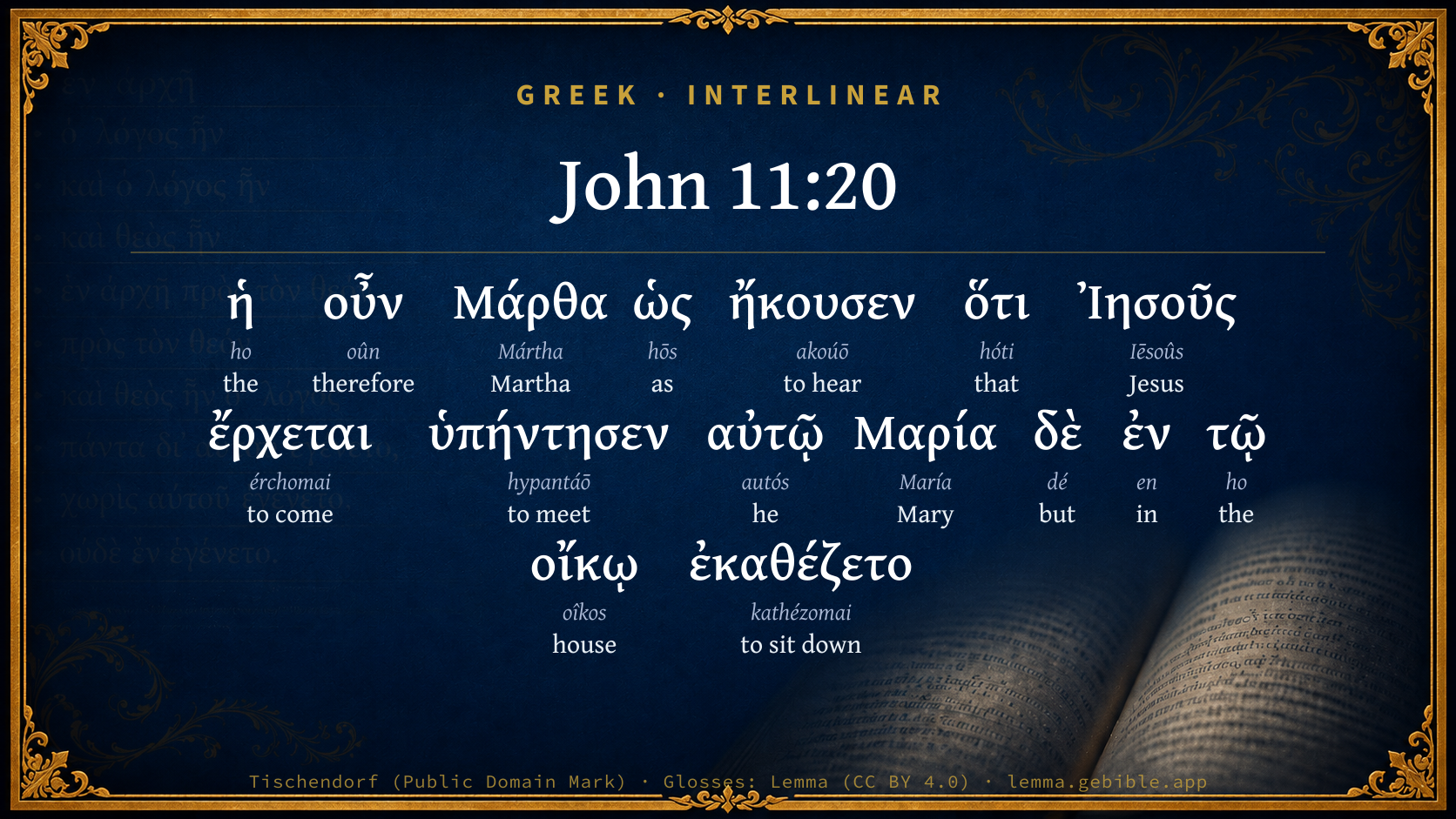
  1. ἡ ho G3588 “the” Article, Nominative, Singular, Feminine
  2. οὖν oûn G3767 “therefore” Conjunction
  3. Μάρθα Mártha G3136 “Martha” Noun, Nominative, Singular, Feminine
  4. ὡς hōs G5613 “as” Adverb
  5. ἤκουσεν akoúō G191 “to hear” Verb, Aorist, Active, Indicative, 3rd person, Singular
  6. ὅτι hóti G3754 “that” Conjunction
  7. Ἰησοῦς Iēsoûs G2424 “Jesus” Noun, Nominative, Singular, Masculine
  8. ἔρχεται érchomai G2064 “to come” Verb, Present, Middle or Passive deponent, Indicative, 3rd person, Singular
  9. ὑπήντησεν hypantáō G5221 “to meet” Verb, Aorist, Active, Indicative, 3rd person, Singular
  10. αὐτῷ autós G846 “he” Personal pronoun, Dative, Singular, Masculine
  11. Μαρία María G3137 “Mary” Noun, Nominative, Singular, Feminine
  12. δὲ dé G1161 “but” Conjunction
  13. ἐν en G1722 “in” Preposition
  14. τῷ ho G3588 “the” Article, Dative, Singular, Masculine
  15. οἴκῳ oîkos G3624 “house” Noun, Dative, Singular, Masculine

About this verse

These counts appear in no published source. They are computed here, from the morphology-tagged text and Lemma’s own curated glosses. What Lemma adds →

16
words
15
distinct lemmas
Gospels
section

Notable vocabulary

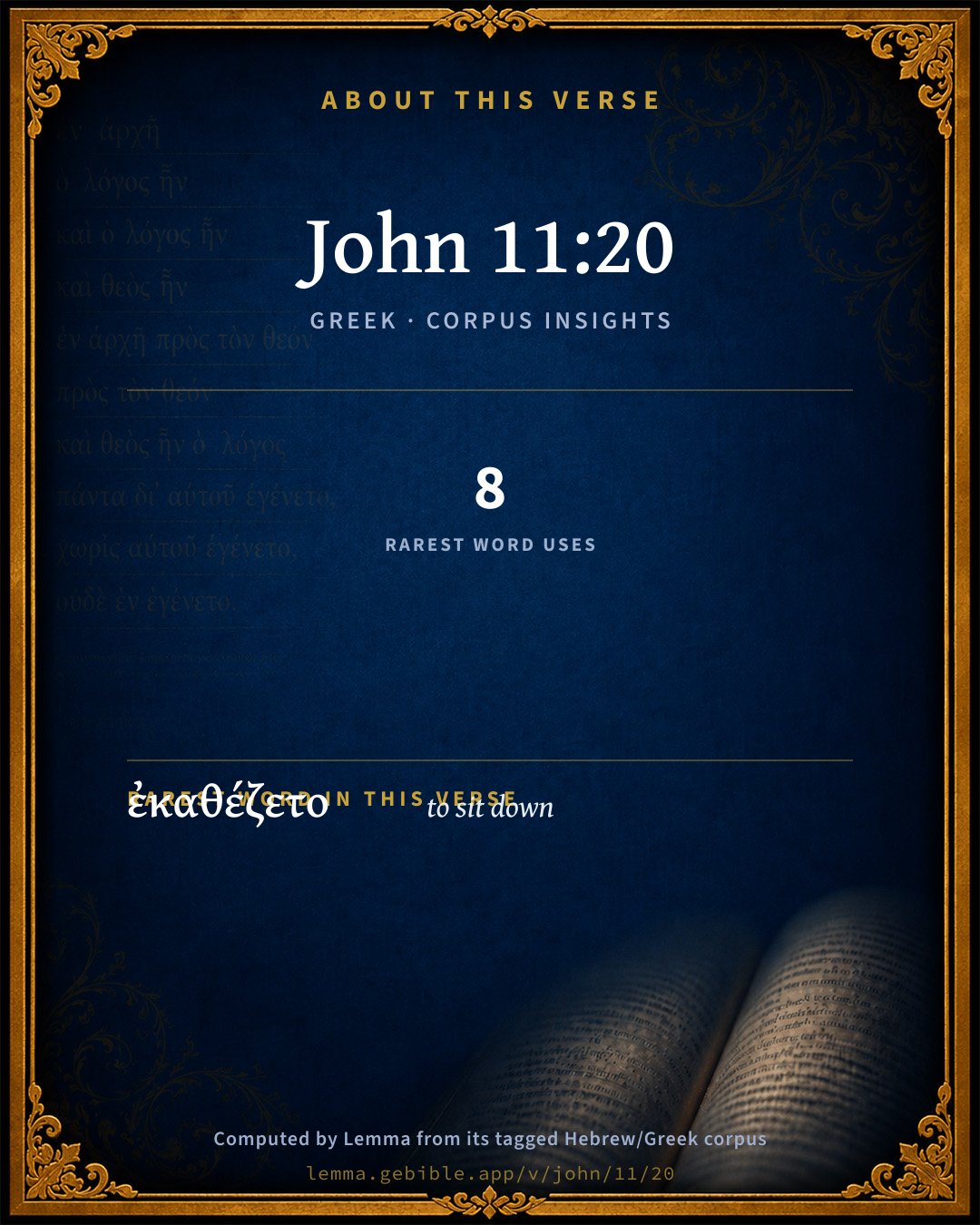
The rarest word here is ἐκαθέζετο to sit down G2516 — appearing just 8 times in the whole Greek New Testament.

Shared distinctive vocabulary

ἐκαθέζετο to sit down G2516 occurs in 8 verses of the Greek New Testament. Also found in:

Repetition

A word recurs within this verse:

Cross-references

7

Topical passages linked to John 11:20 in the Treasury of Scripture Knowledge — connected by theme and wording, ordered by reader-vote popularity; previews shown in the World English Bible.

  • 1 Thessalonians 4:17 then we who are alive, who are left, will be caught up together with them in the clouds, to meet the Lord in the air. So we will be with the Lord forever.
  • Luke 10:38–42 It happened as they went on their way, he entered into a certain village, and a certain woman named Martha received him into her house.
  • Matthew 25:1 "Then the Kingdom of Heaven will be like ten virgins, who took their lamps, and went out to meet the bridegroom.
  • John 11:30 Now Jesus had not yet come into the village, but was in the place where Martha met him.
  • Matthew 25:6 But at midnight there was a cry, 'Behold! The bridegroom is coming! Come out to meet him!'
  • Acts 10:25 When it happened that Peter entered, Cornelius met him, fell down at his feet, and worshiped him.
  • Acts 28:15 From there the brothers, when they heard of us, came to meet us as far as The Market of Appius and The Three Taverns. When Paul saw them, he thanked God, and took courage.

Cross-references courtesy of OpenBible.info (CC BY 4.0).

Commentary

Notes on John 11:20 from classic Christian and Jewish commentators (each source and its license shown beneath its notes). The classic Christian expositions comment on the surrounding passage and are grouped to its opening verse, so a note may address several verses; the Jewish commentaries on the Tanakh (Rashi and others) are per-verse, so they appear only where the commentator wrote on this verse.

Lemma curates 59 commentaries, every one of them public domain or Creative Commons licensed, each selected and text-cleaned for this edition rather than reprinted as found. About our sources →

Joseph Benson's Commentary

Joh 11:20-22. Then Martha, &c. — Jesus was no sooner come into the neighbourhood, but presently the news of his approach was brought to the afflicted family, that had so long impatiently desired to see him. Martha, therefore, immediately went out; and, being told what way he was coming, soon met him: but Mary sat still in the house — Probably not hearing of his coming: for Martha, overjoyed at the news of his approach, did not take time to tell her sister of it, but went out in all haste. Her intention, no doubt, was to welcome him; but being in an excess of grief, the first thing she uttered was a complaint that he had not come sooner, saying, Lord, if thou hadst been here, my brother had not died — In which words she shows both the strength and weakness of her faith. 1st, The strength of it, in that she believed Christ’s power was such, that though her brother’s sickness was very grievous, yet he could have cured it, and so have prevented his death; and that his goodness was such, that if he had been present, and seen Lazarus in his extreme illness, and his dear relations all in tears about him, he would have had compassion, and have prevented so sad a breach upon the peace and comfort of the family. 2d, Her words show also the weakness of her faith; for she limits the power of Christ in saying, If thou hadst been here; whereas she ought to have known that Christ could cure at a distance, and that his gracious operations were not confined to his bodily presence. She reflects likewise on the wisdom and kindness of Christ, because he had not hastened to them when they sent for him, intimating that by delaying to come, she thought he had neglected to save her brother’s life. She, however, corrects and comforts herself with the consideration of the prevailing interest which Christ had in heaven, adding, But I know that even now — Though he be dead; whatsoever thou wilt ask of God — Whatsoever thou shalt think proper to ask; God will give it thee — Will assuredly grant thy request, how great soever the favour may be which thou askest: thus intimating, that she believed his prayer might yet restore her brother to life. She has not courage, however, to ask Jesus that he would pray to his Father for such an extraordinary exertion of divine power to be displayed on their behalf, there having yet been no precedent of any one being raised who had been so long dead: but, like a modest petitioner, she humbly recommends their case to the wise and compassionate consideration of Jesus. Thus when we know not what in particular to ask, or expect, let us, in general, refer ourselves to God; let him do as seemeth him good. And let it comfort us to be assured, when we are in doubt what to pray for, that our great Intercessor knows what to ask for us, and is always heard. But we have in this latter sentence, uttered by Martha on this occasion, a further proof, as of the strength, so also of the weakness of her faith: she believed Jesus could obtain of God by prayer whatever he should think fit to ask, even the restoration of her brother to life, though he had been so many days dead, but she did not believe that he himself could raise him; forgetting, or not considering, that he had life in himself, yea, was the Prince of life and Conqueror of death. She founded her hopes of her brother’s resurrection, so far as she entertained any hopes of so wonderful an event, not on Christ’s own power, but on the power of God, to be exerted at his intercession.

Joseph Benson's Commentary on the Old and New Testaments (1811–1818) — public domain. Text from a community e-Sword module.

Bengel's Gnomon

Johann Albrecht Bengel

Joh 11:20. Μαρία δέ, but Mary) either because she was unwilling to leave the Jews alone, or because she chose to sit and wait until she should be called. She was of a more sedate disposition. Comp. Luk 10:39, “Mary sat at Jesus’ feet, and heard His word.”

Bengel's Gnomon of the New Testament — English translation (T&T Clark, Edinburgh, 1860) — public domain. Text from a community e-Sword module.

Meyer's Critical & Exegetical Commentary

Heinrich August Wilhelm Meyer

Joh_11:20. Martha, now also discharging her duties as hostess, and in consequence coming more into contact with others from without, is first informed of the coming of Jesus (how? must be left undecided), and with judicious haste goes at once to meet Him, without exciting attention by communicating the fact to her sister.

ἐκαθέζετο] For the manifestations of sympathy were received sitting. See Geier, de Luctu Hebraeorum, p. 211 ff. Comp. Dougt. Anal. ad Ez. vii. 14.

Note the different nature of the two sisters, as in Luk_10:38 ff.

Meyer — Critical and Exegetical Commentary on the New Testament — English translation by Peter Christie, edited by Frederick Crombie (T&T Clark, 1880) — public domain. Text from a community e-Sword module.

Expositor's Greek Testament

ed. W. Robertson Nicoll

Joh 11:20 . ἡ οὖν Μάρθα … ἐκαθέζετο . Martha as the elder sister and mistress of the house (Luk 10:38-40 ) goes out to meet Jesus, while Mary remained seated in the house. “After the body is carried out of the house all chairs and couches are reversed, and the mourners sit on the ground on a low stool.” Edersheim, loc. cit . On sitting as an attitude of grief see Doughty, Analecta Sacra , on Eze 8:14 .

The Expositor's Greek Testament, edited by W. Robertson Nicoll (1897–1910) — public domain. Text from a community e-Sword module.

Jamieson, Fausset & Brown

Robert Jamieson, A. R. Fausset & David Brown

Martha, as soon as she heard that Jesus was coming, went and met him--true to the energy and activity of her character, as seen in Luk 10:38-42. (See on Luk 10:38-42).

but Mary sat . . . in the house--equally true to her placid character. These undesigned touches not only charmingly illustrate the minute historic fidelity of both narratives, but their inner harmony.

Jamieson, Fausset & Brown — Commentary Critical and Explanatory on the Whole Bible (1871) — public domain (CC PDM 1.0). Text via the HelloAO Bible API.

Adam Clarke's Commentary

Verse 20. Martha - went and met him] Some suppose she was the eldest of the two sisters - she seems to have had the management of the house. See Lu 10:40.

Mary sat still in the house.] It is likely that by this circumstance the evangelist intended to convey the idea of her sorrow and distress; because anciently afflicted persons were accustomed to put themselves in this posture, as expressive of their distress; their grief having rendered them as it were immovable. See Ezr 9:3-4; Ne 1:4; Ps 137:1; Isa 47:1; Lu 1:79; and Mt 27:61.

Adam Clarke's Commentary on the Bible (1810–1826) — public domain. Text from a community e-Sword/MySword module.

John Calvin's Commentaries

20. Martha having heard that Jesus was coming. Martha travels beyond the village, as we shall afterwards see, not only perhaps on account of the reverence which she bore to Christ, but that she might meet him more secretly; for his danger was fresh in his recollection, and the rage of enemies had not well subsided, which had been a little abated by Christ’s departure into Galilee, but might, on their hearing of his arrival, break out anew with greater violence.

John Calvin's Commentaries (1540-1563) — public domain. Text from the Calvin Translation Society English edition (1840s-50s) via the Christian Classics Ethereal Library (ccel.org). Calvin's coverage is partial (roughly two-thirds of the Bible); uncommented books and verses are honest gaps, never fabricated. The 19th-century editor's footnotes and remarks are omitted so the notes are faithfully Calvin's own voice.

Ellicott's Commentary for English Readers

(20) Then Martha, as soon as she heard that Jesus was coming . . .—This is partly to be explained from the position in which they stood towards Him, and partly from the fact of the presence of the Jews at the house. She goes forth to meet Him in a place where she can speak her heart’s thoughts, apart from the oppressive ceremonial of the formal lamentation, and where He would not be exposed to a renewal of the attempts against His life.

But Mary sat still in the house.—Better, without the word in italics, but Mary was sitting in the house. The characteristics of the two sisters, which we find in Luk_10:38 (see Note there), are strikingly preserved in this narrative. The clause describes precisely the position of the mourner, who sat on or near the ground, while those who came to lament with her sat around. (Comp. Job_2:13-13.)

A Bible Commentary for English Readers, edited by Charles John Ellicott (1878–1897) — public domain. Text from a community e-Sword module.

The Cambridge Bible for Schools and Colleges

gen. ed. J. J. S. Perowne

20. Then Martha] Or, Martha, therefore. Information would be brought to her as the elder sister and (apparently) mistress of the house (Luk_10:38). She as usual takes the lead in entertaining, and Mary shrinks from it. “One most remarkable feature in the history is the coincidence between the characters of Mary and Martha as depicted here and in S. Luke.” S. p. 185. It is incredible that this coincidence should be either fortuitous or designed. It is much easier to believe that both Gospels give us facts about real persons. Christ is unwilling to mingle at once in the crowd of mourners, and halts outside the village.

Jesus was coming] Rather, Jesus is coming, probably the very words of the message. Perhaps they were still on the look-out for His arrival, although they supposed that it was too late for His coming to avail anything.

Mary sat still in the house] Or, was sitting in the house: the attitude of sorrow and meditation (Job_2:13). She does not know of Christ’s approach (Joh_11:28-29): Martha, in discharging the duties of hospitality to fresh arrivals, would be more likely to hear of it.

The Cambridge Bible for Schools and Colleges (gen. ed. J. J. S. Perowne; Cambridge University Press, 1878–1918) — public domain. Text from a community e-Sword module.

John Gill's Exposition

Then Martha, as soon as she heard that Jesus was coming,.... Which she might hear of, either by a messenger sent by Christ to her, to acquaint her of it; or rather by some of the people of the town, who knew him, and ran and told her of it; and she being an active person, and stirring about house, might receive the report unknown to her sister, as it seems she did; and as soon as she had the hint, without staying to communicate it to her sister,

went and met him; either through her great affection to him, and eager desire of seeing him; or to consult his safety, and let him know what number of Jews were in their house, that he might consider whether it would be safe for him to be at their house or not.

But Mary sat still in the house; not out of disrespect to Jesus, or through want of affection to him, or through any indifference and sloth, but because she knew not that Jesus was coming; see Joh 11:28.

John Gill's Exposition of the Whole Bible (1746–1763) — public domain (CC PDM 1.0). Text via the HelloAO Bible API.

Trapp's Complete Commentary

John Trapp

20 Then Martha, as soon as she heard that Jesus was coming, went and met him: but Mary sat still in the house.

Ver. 20. But Mary sat still in, the house] So, while faith sits at the centre, love walks the round. Dicit Fides, Parata sunt mihi omnia: Dicit Spes, Mihi ista servantur: Dicit Charitas, Ego curro ad illa, Faith says, everything is prepared for me: Hope says, such affairs preserve me: Love says, I run for these matters; saith Bernard.

John Trapp, A Commentary or Exposition upon All the Books of the Old and New Testament (1647–1656) — public domain. Text from a community e-Sword module.

Albert Barnes' Notes on the Bible

Then Martha ... - To Martha was intrusted the management of the affairs of the family, Luk 10:40. It is probable that she first heard of his coming, and, without waiting to inform her sister, went immediately out to meet him. See Joh 11:28.

Sat still in the house - The word “still” is not in the original. It means that she remained sitting in the house. The common posture of grief among the Jews was that of sitting, Job 2:8; Eze 8:14. Often this grief was so excessive as to fix the person in astonishment, and render him immovable, or prevent his being affected by any external objects. It is possible that the evangelist meant to intimate this of Mary’s grief. Compare Ezr 9:3-4; Neh 1:4; Isa 47:1.

Albert Barnes' Notes on the Bible (1834–1885) — public domain. Text from a community e-Sword/MySword module.

Matthew Poole's English Annotations

It should seem by the story, Luk 10:41, that Martha had the care of the house keeping upon her, (Mary was more retired), so that the news of Christ’s coming might come to her first. She in great joy ran out to meet him; how far she went we are not told, but it appeareth from Joh 11:30 that she went out of the town.

Matthew Poole's English Annotations on the Holy Bible (1683–1685) — public domain. Text from a community e-Sword/MySword module.

Whedon's Commentary on the Bible

Daniel D. Whedon

20. Martha… heard… went—Jesus approaches but enters not the town; avoiding the crowd of Jews at the house. Martha, probably by a secret message, learns his arrival; and with apparent secrecy, as if sharing the disciples’ fears of danger to the Master, meets him at his place of stoppage. There ensues a conversation between the two, apparently alone.

Mary sat still in the house—Omit the word still, added in italics by the translators. It is not clear that Martha was also in the house; and the message of Jesus’s approach probably reached her alone. It is not until her return (Joh_11:28) that Mary learns, and from her, that the Master is come.

Daniel D. Whedon (gen. ed.), Commentary on the Old and New Testaments (1874–1909) — public domain. Text from a community e-Sword module.

The Pulpit Commentary

The oun points back probably to ver. 1. The type of character so beautifully contrasted in the previous reference to the family at Bethany appears again, and confirms the historical character of Luk_10:38, etc., as well as of the narrative before us. Thoma says that this picture is "simply painted with synoptic color." Martha is the mistress of the house. Martha therefore, when she heard that Jesus was coming, went and met him: but Mary sat still in the house. Martha was a woman of impulse, energy, practical duty; like Peter, she was ready even to give advice to her Lord, and eager to put everybody in his rightful place. On the first opportunity she hastened at once to "meet" Jesus, even without at first warning her sister of his approach. Mary, contemplative, pensive, undemonstrative under ordinary circumstances, but with a great fund of love, was sitting in the house receiving the condolences of the Jews (cf. ver. 19). Weiss suggests that Jesus was well aware, from the station of the family, and from the fact that hitherto his own friendship for the sisters had not submitted them to the ban, that "many Jews" would have congregated in the house of mourning. Consequently, Jesus does not come straight to the house, but allows it to be known that he is there.

The Pulpit Commentary (1880–1919), ed. H.D.M. Spence-Jones & Joseph S. Exell — public domain. Text from a community e-Sword module.

John Wesley's Explanatory Notes

Mary sat in the house - Probably not hearing what was said.

John Wesley, Explanatory Notes Upon the Whole Bible (1754–1765) — public domain. Text via the GEBible commentary corpus.

Cambridge Greek Testament for Schools and Colleges

20. ἡ οὖν Μάρθα. Martha therefore. As in Luk 10:40, she takes the lead in entertaining, while Mary shrinks from it; and she was probably now engaged in some duty of this kind. As elder sister, and apparently mistress of the house (Luk 10:38), information would naturally come to her first. Without waiting to tell her sister she hurries out to meet Jesus. It is incredible that the coincidence between S. John and S. Luke as regards the characters of the sisters should be either fortuitous or designed. It is much easier to believe that both give us facts about real persons.

ἔρχεται. Is coming; the exact word of the message. They were perhaps still looking for His arrival, although they believed that it was now too late for Him to aid. Unwilling to mingle at once in the crowd of conventional mourners, He halts outside the village.

ἐκαθέζετο. The attitude of sorrow and meditation (Job 2:13). She does not know of Christ’s approach (Joh 11:28-29): Martha, in discharging the duties of hospitality to fresh arrivals, would be more likely to hear of it.

Cambridge Greek Testament for Schools and Colleges (Cambridge University Press, 1896; 21 vols, various authors incl. Carr, Maclear, Plummer, Farrar, Lumby, Moule, M. R. James, Simcox) — public domain. Text from a community e-Sword module.

Alford’s Greek Testament

Henry Alford

20.] The behaviour of the two sisters is quite in accordance with their character, Luk 10:38-42: and thus we have a most interesting point of connexion between two Gospels so widely various in their contents and character. Stier thinks (v. 19, edn. 2), as also Trench (Mirr. 398, edn. 2), that Mary did not hear of the approach of Jesus, and that we must not bring the characters to bear on this case (?).

Henry Alford, The Greek Testament (1849–1861) — public domain. Text from a community e-Sword module.

International Critical Commentary

20. The congruity of the characters of Martha and Mary, as suggested by what we read of them in Luk 10:38f., with what Jn. tells in this chapter about their demeanour is remarkable.1 Martha is the busy housewife who, as the mistress of the house, is the first to be told of the approach of Jesus (v. 20). She goes to meet Him, and expresses at once her own conviction and that of Mary (vv. 21, 32), that if He had been present, Lazarus would not have died. She is puzzled by the enigmatical words of hope which Jesus addresses to her (v. 23), and supposes that He is giving the usual orthodox consolation (v. 24). She does not understand what He then says (vv. 25, 26); but her faith in Him as the Messiah is strong, and of this she assures Him (v. 27), although she does not expect that He can do anything now to restore her brother. Then she goes to tell her sister that Jesus has arrived and is asking for her.

Before Martha told her, Mary had not heard of the arrival of Jesus (v. 29): she was seated inside the house (v. 20) as a mourner, and it had been to her that the condolences of the friends who had come from Jerusalem were specially addressed (v. 45). But as soon as she learnt that Jesus had come, she got up hastily and left the house without acquainting the mourners of her purpose in going out (v. 29). Her friends thought that she was going to wail at the tomb (v. 30). When she met Jesus, she fell at His feet (unlike her more staid sister), greeting him with the same assurance that Martha had given (v. 32), but wailing unrestrainedly (v. 33). Her cries of grief seem to have affected the human heart of Jesus as the grave sorrow of Martha did not do (v. 33). But, as they proceed to the tomb, Martha is with them, and, practical woman as she is, demurs to its being opened (v. 39). Throughout, her figure is in sharp contrast with that of her more emotional sister. See further, Introd., p. clxxxv.

ἡ οὖν Μάρθα ὡς ἤκουσεν ὅτι κτλ. She is the first to be told, as the mistress of the house. ὅτι is recitantis: what was said to her was Ἰησοῦς ἔρχεται.

The rec. has ὁ Ἰης. but om. ὁ אABCDW. See on 1:29.

ὑπήντησεν αὐτῷ, “met Him,” but without any display of emotion such as Mary exhibited. She met Jesus before He entered the village (see v. 30).

ἐν τῷ οἴκῳ ἐκαθέζετο, “she was seated in the house”; see on 4:6 for ἐκαθέζετο. It was customary for mourners to be seated when receiving the condolences of their friends; see Job 2:8, Job 2:13, and cf. Eze 8:14. Sitting down was also a common posture for mourners among the Romans. It was adopted, e.g., by Cato after Pharsalia, and Varro after Cannæ (Plutarch, Cato, 56).

Μαρία is attested by most authorities, but Θ 33 give Μαριάμ (see also 12:3), in accordance with the general usage of Jn. (see on v. 2).

International Critical Commentary — older volumes (1896–1929), various authors — public domain. Text from a community e-Sword module.

Vincent's Word Studies in the New Testament

Marvin R. Vincent

That Jesus was coming [οτι ο ιησους ερχεται] . Literally, is coming. The exact words of the message : Jesus is coming.

Went and met [υπηντησεν] . The verb means to go to meet.

Marvin R. Vincent, Word Studies in the New Testament (1887–1900) — public domain. Text from a community e-Sword/MySword module.

Godet's Commentaries

Frédéric Louis Godet

Vv. 20-24. “When Martha heard that Jesus was coming, she went out to meet him; but Mary still sat in the house. 21. Martha therefore said to Jesus: Lord, if thou hadst been here, my brother would not have died; 22 And even now, I know that whatsoever thou shalt ask of God, God will give it thee. 23. Jesus says to her, Thy brother shall rise again. 24. Martha says to him, I know that he shall rise again in the resurrection, at the last day.”

Martha, no doubt occupied with her household affairs, was the first to receive the news of the Lord’s arrival, and, in her eagerness, she ran to meet Him, without the thought of telling her sister, whose grief was keeping her in the inner apartment. Such as the two sisters are represented to us in Luk 10:38 ff., such precisely we find them again here. The narrative of John seems even to allude to that of his predecessor. On the opposite supposition, the harmony in the characters is only the more striking. The words of Martha (Joh 11:21) are not a reproach. How could she be ignorant that her brother was dead even before Jesus had received the news of his sickness? How, especially, could she allow herself to complain of His mode of acting, at the very moment when she is about to ask of Him the greatest of gifts? She simply expresses her regret that Jesus had not been there at the time of the sickness, and this regret serves only to prepare the way for the request which she has to make. She says, according to the T. R. and the Byzantine authorities: οὐκ ἐτεθνήκει, “would not be at this moment sunk in death,” instead of ἀπέθανεν, “would not have gone through the act of dying,” which is read by the Alexandrian authorities (see on Joh 11:32). The T. R. adds, with several Mjj., ἀλλά before καὶ νῦν: “but even now.” This but is unnecessary: “I know that even now in his death my brother can experience the virtue of Thy prayer.” The indefinite expression whatsoever leaves that to be understood which is too great to be expressed. There is an evident reserve of delicacy in this indirect request. It is no doubt the greatness of the work expected which is expressed in the repetition of the word θεός, God, at the end of the two clauses of Joh 11:22 : “Thou art the well-beloved of God, God will give Thee the life of my brother.” This confidence is inspired in Martha not only by the general knowledge which she has of Jesus and by the resurrections which had been effected in Galilee, but more especially by the message of Joh 11:4, and by this sudden arrival, which involved in itself also a promise.

There is in Martha’s faith more of vivacity than of light. She believes in the miracle of power; but she is not yet initiated into the spiritual sphere within which alone such an act will assume its true meaning and value. Before satisfying her request, Jesus endeavors to put her into a condition to receive it. He proceeds, with this end in view, as He did in chaps. 5 and 6, by giving to His promise at first the most general form: Thy brother shall rise again. Hengstenberg even supposes that He makes no allusion in these words to the approaching resurrection of Lazarus, which, according to him, does not deserve the name of a resurrection. For the return to this wretched earthly existence cannot be called by this fair name. But is it not doing violence to the text, to refuse to see in these words the promise of the event which is to follow? The belief in the resurrection of the pious Israelites, as the opening act of the Messianic kingdom, had been already announced in Dan 12:2 and 2Ma 7:9; 2Ma 7:14, etc.; it was generally spread abroad in Israel, and that especially “in the circles in which the Pharisaic teaching prevailed.”

There is not by any means, in the answer of Martha, an indication, as has been supposed, of a fall from the height of faith to which her heart had been raised. Only, in speaking thus, she wishes to assure herself of the meaning which Jesus Himself attaches to His promise. If she speaks only of the final resurrection which is to her mind certain, it is that she may give to Jesus the opportunity to explain Himself, and to declare expressly what she scarcely dares to hope for in the present case. There is as it were an indirect question here. Everything in Martha breathes a masculine faith, full of energy and activity. But this faith is not as spiritual as it is strong; it has not yet in a sufficient degree the person of the Lord as its object. Jesus, on His part, endeavors, in His reply, to develop it in this direction.

Frédéric Louis Godet — Commentaries on Luke, John, Romans, and 1 Corinthians — English translation (T&T Clark, Edinburgh, 1870s–1890s) — public domain. Text from a community e-Sword module.

Lesson kit

Teaching starters — assembled from the data on this page, not authored interpretation. Every prompt links to the verse data it draws on. Edit before teaching.

John, in the Gospels, opens this verse with 16 words (15 distinct Greek lemmas). Its most distinctive word is kathézomai (“to sit down”). A historical commentator’s framing appears above. Read the whole chapter for the surrounding context.

Discussion questions

  1. What does “to sit down” (kathézomai) contribute to the verse as a whole?
  2. How does Matthew 26:55, which shares the word «to sit down», read alongside this verse?
  3. What does the repetition of “the” (2× in this one verse) do in this verse?
  4. These translations render this verse differently. What is at stake in choosing one wording over another?
  5. Compare how Joseph Benson's Commentary and Bengel's Gnomon read this verse. Where do they agree or differ?

Things to notice

Reading settings

Reading text

Shown beneath each verse's original-language words.

Old Testament
Old Testament edition

Read the OT as the Masoretic Hebrew (MT) or the Greek Septuagint (LXX).

English shown for the Greek Septuagint (in the Hebrew ↔ Greek comparison).

Comparing translations? Open the Compare panel on any verse page to stack up to four side by side.