

John 7:28
Greek (Tischendorf 8th ed.) John 7:28 appears in the Greek New Testament. The text above is from the Tischendorf 8th edition. Each word links to its Strong’s number and a concise gloss. Click any word for its full Thayer’s Greek Lexicon entry.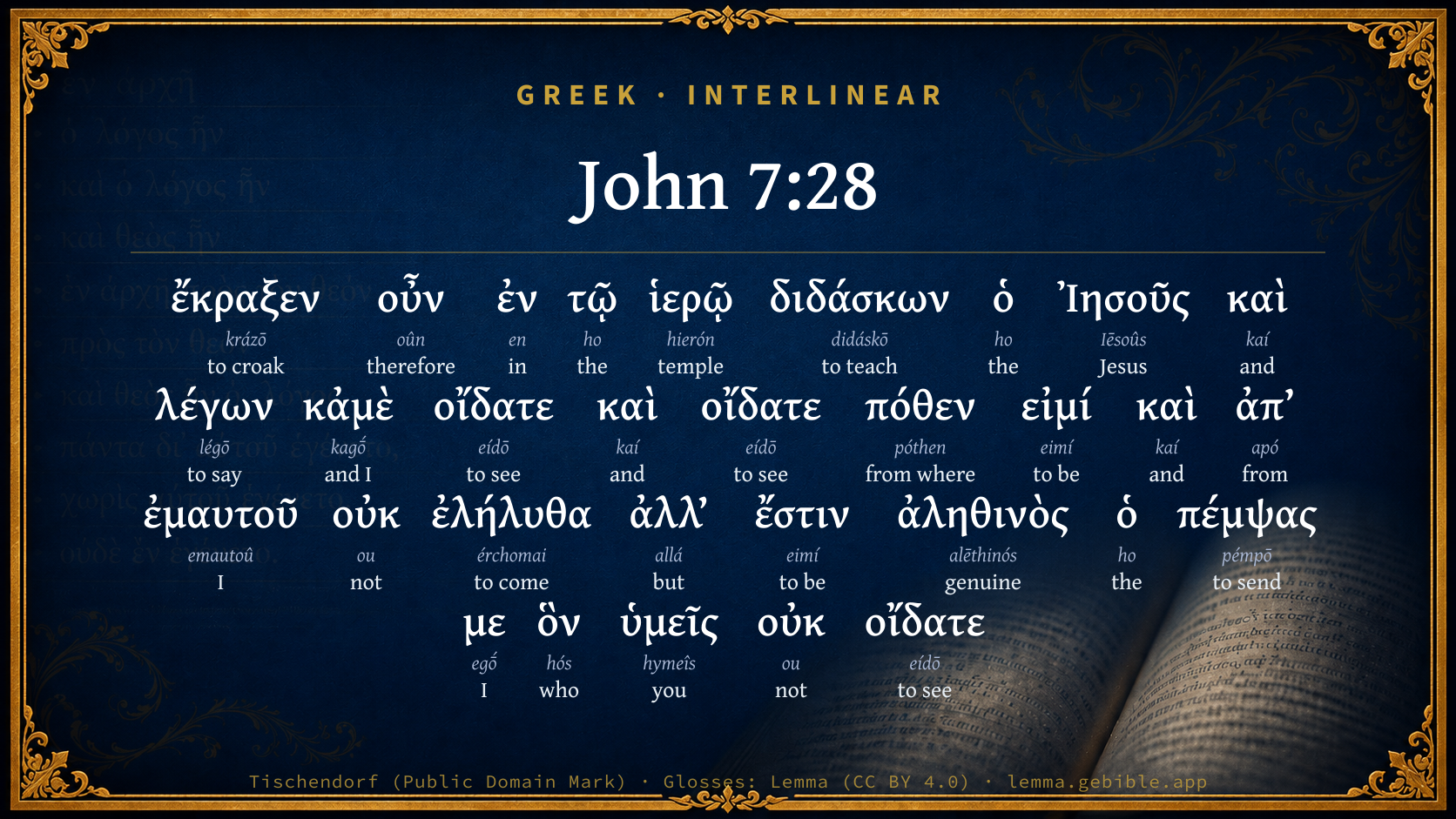
Jesus therefore cried out in the temple, teaching and saying, "You both know me, and know where I am from. I have not come of myself, but he who sent me is true, whom you don't know.
Download a study sheet
One document with this verse’s original text, its word-by-word gloss line, the meaning frame, cross-references with their text, attributed commentary, and full source and license credits — printable, and it pastes into notes with its structure intact.
This verse Autodidact and up
A passage Seminary Student
Up to 50 verses in one chapter. A passage sheet keeps up to 6 commentary sources and 12 cross-references per verse, in the order this page ranks them, and says so on the sheet whenever that leaves anything out. Ask for a single verse and you get the Autodidact verse sheet above.
Everything on this page stays free to read, with no account — the sheet is a download of what is already on screen, not access to it.
Compare translations 3
The same verse in 3 English versions, stacked beneath the original-language interlinear above. Click any original word for its lexicon entry.
Each is an independent rendering of the whole verse — the interlinear is not word-aligned to these translations.
Highlighted words mark where these versions differ — a whole-verse word diff, not a word-by-word alignment.
-
World English Bible Public Domain
Jesus therefore cried out in the temple, teaching and saying, "You both know me, and know where I am from. I have not come of myself, but he who sent me is true, whom you don't know.
-
King James Version Public Domain
Then cried Jesus in the temple as he taught, saying, Ye both know me, and ye know whence I am: and I am not come of myself, but he that sent me is true, whom ye know not.
-
unfoldingWord Literal Text CC BY-SA 4.0
Then Jesus cried out in the temple, teaching and saying, “You both know me and know where I am from. And I have not come from myself, but the one having sent me is true, whom you do not know.
unfoldingWord Literal Text — © unfoldingWord, licensed CC BY-SA 4.0. Word-aligned USFM3 via Door43 (git.door43.org/unfoldingWord/en_ult).
Show all 19 translations
Every available English version of this verse, each an independent rendering of the whole verse.
-
World English Bible Public Domain
Jesus therefore cried out in the temple, teaching and saying, "You both know me, and know where I am from. I have not come of myself, but he who sent me is true, whom you don't know.
-
Berean Standard Bible Public Domain
Then Jesus, still teaching in the temple courts, cried out, “You know Me, and you know where I am from. I have not come of My own accord, but He who sent Me is true. You do not know Him,
-
Majority Standard Bible Public Domain
Then Jesus, still teaching in the temple courts, cried out, “You know Me, and you know where I am from. I have not come of My own accord, but He who sent Me is true. You do not know Him,
-
King James Version Public Domain
Then cried Jesus in the temple as he taught, saying, Ye both know me, and ye know whence I am: and I am not come of myself, but he that sent me is true, whom ye know not.
-
American Standard Version (1901) Public Domain
Jesus therefore cried in the temple, teaching and saying, Ye both know me, and know whence I am; and I am not come of myself, but he that sent me is true, whom ye know not.
-
Revised Version (1885) Public Domain
Jesus therefore cried in the temple, teaching and saying, Ye both know me, and know whence I am; and I am not come of myself, but he that sent me is true, whom ye know not.
-
Geneva Bible (1599) Public Domain
Then cried Iesus in the Temple as hee taught, saying, Ye both knowe mee, and knowe whence I am: yet am I not come of my selfe, but he that sent me, is true, whome ye knowe not.
-
Douay-Rheims (1899) Public Domain
Jesus therefore cried out in the temple, teaching, and saying: You both know me, and you know whence I am: and I am not come of myself; but he that sent me, is true, whom you know not.
-
Young's Literal Translation Public Domain
Jesus cried, therefore, in the temple, teaching and saying, `Ye have both known me, and ye have known whence I am; and I have not come of myself, but He who sent me is true, whom ye have not known;
-
Literal Standard Version CC BY-SA 4.0
Jesus cried, therefore, in the temple, teaching and saying, “You have both known Me, and you have known from where I am; and I have not come of Myself, but He who sent Me is true, whom you have not known;
-
Unlocked Literal Bible CC BY-SA 4.0
Then Jesus cried out in the temple, teaching and saying, “You both know me and know where I come from. I have not come of myself, but he who sent me is true, and you do not know him.
-
unfoldingWord Literal Text CC BY-SA 4.0
Then Jesus cried out in the temple, teaching and saying, “You both know me and know where I am from. And I have not come from myself, but the one having sent me is true, whom you do not know.
-
Darby Bible Public Domain
Jesus therefore cried out in the temple, teaching and saying, Ye both know me and ye know whence I am; and I am not come of myself, but he that sent me is true, whom ye do not know.
-
World Messianic Bible Public Domain
Yeshua therefore cried out in the temple, teaching and saying, “You both know me, and know where I am from. I have not come of myself, but he who sent me is true, whom you don’t know.
-
Webster's Bible Public Domain
Then cried Jesus in the temple, as he taught, saying, Ye both know me, and ye know whence I am: and I am not come of myself, but he that sent me is true, whom ye know not.
-
Free Bible Version CC BY-SA 4.0
While he was teaching in the Temple, Jesus called out in a loud voice, “So you think you know me and where I'm from? However, I did not come for my own sake. The one who sent me is true. You don't know him,
-
Bible in Basic English Public Domain
Then, when he was teaching in the Temple, Jesus said with a loud voice, You have knowledge of me and you have knowledge of where I come from; and I have not come of myself; but there is One who has sent me; he is true, but you have no knowledge of him.
-
Text-Critical English NT CC BY 4.0
Then Jesus cried out as he taught in the temple courts, “You know me and you know where I am from. Yet I have not come on my own authority, but he who sent me is true. You do not know him,
-
Tyndale New Testament (1534) Public Domain
Then cryed Iesus in the temple as he taught sayinge: ye knowe me and whence I am ye knowe. And yet I am not come of my selfe but he that sent me is true whom ye knowe not.
Literal Standard Version (2020), Covenant Press — licensed CC BY-SA 4.0. Text via the HelloAO Bible API (eBible.org). Unlocked Literal Bible (unfoldingWord) — licensed CC BY-SA 4.0. Text via the HelloAO Bible API (eBible.org). unfoldingWord Literal Text — © unfoldingWord, licensed CC BY-SA 4.0. Word-aligned USFM3 via Door43 (git.door43.org/unfoldingWord/en_ult). Free Bible Version, Dr. Jonathan Gallagher — licensed CC BY-SA 4.0. Text via the HelloAO Bible API (eBible.org).
Word by word
More ways to search: Search by grammar → Find every occurrence → Compare this word →
Practice this passage: Drill this verse → Learn its vocabulary →
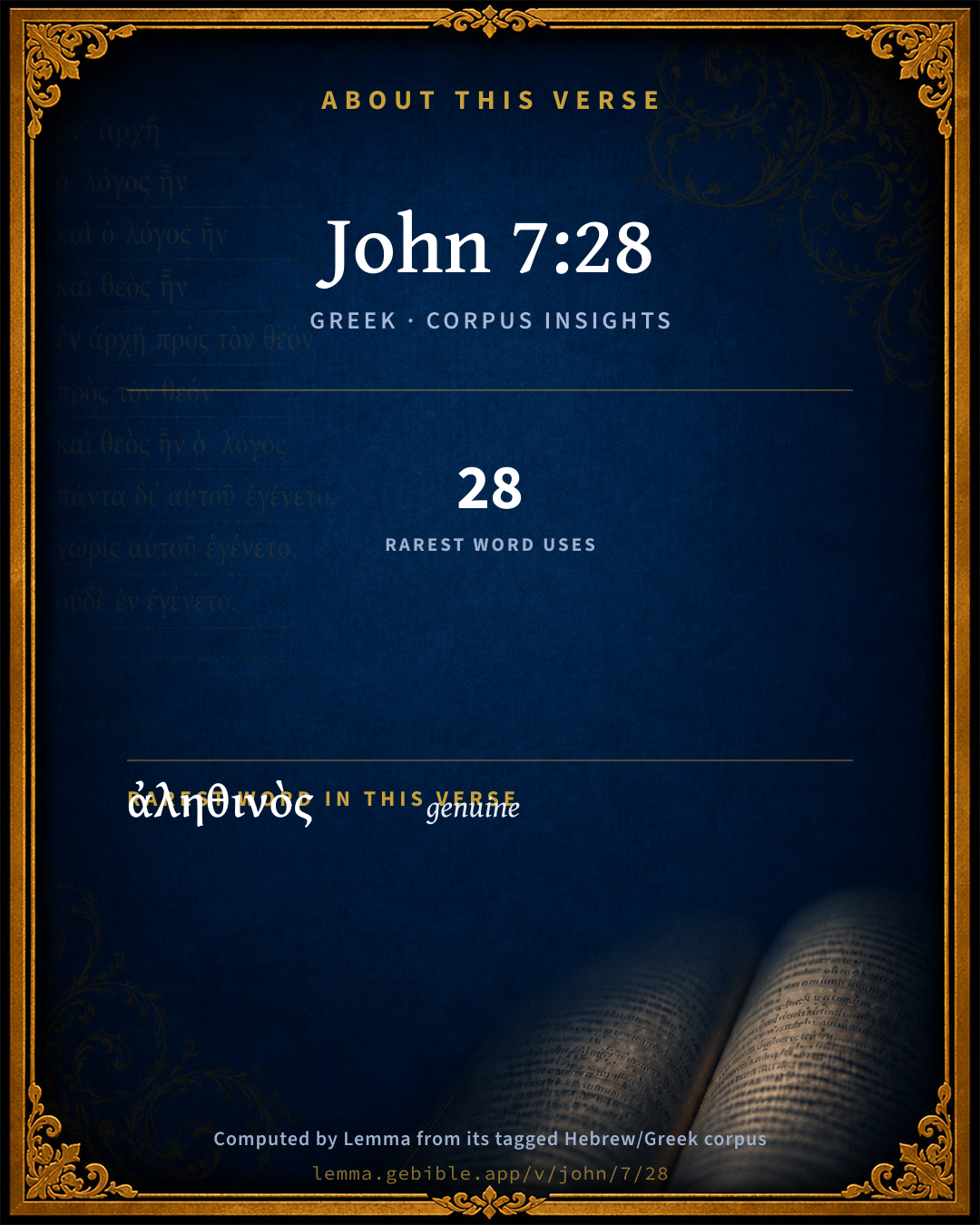
- Appears 28× in the Greek New Testament
- First appears at Luke 16:11
- Part of Speech
- Adjective
- Case
- Nominative
- Number
- Singular
- Gender
- Masculine
Full Thayer's Definition
- ἔκραξεν krázō G2896 “to croak” Verb, Aorist, Active, Indicative, 3rd person, Singular
- οὖν oûn G3767 “therefore” Conjunction
- ἐν en G1722 “in” Preposition
- τῷ ho G3588 “the” Article, Dative, Singular, Neuter
- ἱερῷ hierón G2411 “temple” Noun, Dative, Singular, Neuter
- διδάσκων didáskō G1321 “to teach” Verb, Present, Active, Participle, Nominative, Singular, Masculine
- ὁ ho G3588 “the” Article, Nominative, Singular, Masculine
- Ἰησοῦς Iēsoûs G2424 “Jesus” Noun, Nominative, Singular, Masculine
- καὶ kaí G2532 “and” Conjunction
- λέγων légō G3004 “to say” Verb, Present, Active, Participle, Nominative, Singular, Masculine
- κἀμὲ kagṓ G2504 “and I” Personal pronoun, 1st person, Accusative, Singular, Aramaic form
- οἴδατε eídō G1492 “to see” Verb, Perfect, Active, Indicative, 2nd person, Plural
- καὶ kaí G2532 “and” Conjunction
- οἴδατε eídō G1492 “to see” Verb, Perfect, Active, Indicative, 2nd person, Plural
- πόθεν póthen G4159 “from where” Adverb, Interrogative
- εἰμί eimí G1510 “to be” Verb, Present, Active, Indicative, 1st person, Singular
- καὶ kaí G2532 “and” Conjunction
- ἀπ’ apó G575 “from” Preposition
- ἐμαυτοῦ emautoû G1683 “I” Reflexive pronoun, 1st person, Genitive, Singular, Masculine
- οὐκ ou G3756 “not” Particle, Negative
- ἐλήλυθα érchomai G2064 “to come” Verb, Perfect, Active, Indicative, 1st person, Singular
- ἀλλ’ allá G235 “but” Conjunction
- ἔστιν eimí G1510 “to be” Verb, Present, Active, Indicative, 3rd person, Singular
- ἀληθινὸς alēthinós G228 “genuine” Adjective, Nominative, Singular, Masculine
- ὁ ho G3588 “the” Article, Nominative, Singular, Masculine
- πέμψας pémpō G3992 “to send” Verb, Aorist, Active, Participle, Nominative, Singular, Masculine
- με egṓ G1473 “I” Personal pronoun, 1st person, Accusative, Singular
- ὃν hós G3739 “who” Relative pronoun, Accusative, Singular, Masculine
- ὑμεῖς hymeîs G5210 “you” Personal pronoun, 2nd person, Nominative, Plural
- οὐκ ou G3756 “not” Particle, Negative
- οἴδατε eídō G1492 “to see” Verb, Perfect, Active, Indicative, 2nd person, Plural
About this verse
These counts appear in no published source. They are computed here, from the morphology-tagged text and Lemma’s own curated glosses. What Lemma adds →
- 31
- words
- 23
- distinct lemmas
- Gospels
- section
Shared distinctive vocabulary
ἀληθινὸς genuine G228 occurs in 26 verses of the Greek New Testament. Also found in:
Cross-references
43Topical passages linked to John 7:28 in the Treasury of Scripture Knowledge — connected by theme and wording, ordered by reader-vote popularity; previews shown in the World English Bible.
- John 8:42 Therefore Jesus said to them, "If God were your Father, you would love me, for I came out and have come from God. For I haven't come of myself, but he sent me.
- Jeremiah 9:6 Your habitation is in the midst of deceit; through deceit they refuse to know me, says Yahweh.
- John 8:19 They said therefore to him, "Where is your Father?" Jesus answered, "You know neither me, nor my Father. If you knew me, you would know my Father also."
- John 8:14 Jesus answered them, "Even if I testify about myself, my testimony is true, for I know where I came from, and where I am going; but you don't know where I came from, or where I am going.
- John 8:26 I have many things to speak and to judge concerning you. However he who sent me is true; and the things which I heard from him, these I say to the world."
- John 12:49 For I spoke not from myself, but the Father who sent me, he gave me a commandment, what I should say, and what I should speak.
- Matthew 11:27 All things have been delivered to me by my Father. No one knows the Son, except the Father; neither does anyone know the Father, except the Son, and he to whom the Son desires to reveal him.
- John 5:43 I have come in my Father's name, and you don't receive me. If another comes in his own name, you will receive him.
- John 17:3 This is eternal life, that they should know you, the only true God, and him whom you sent, Jesus Christ.
- 1 John 2:3–4 This is how we know that we know him: if we keep his commandments.
- 1 Samuel 2:12 Now the sons of Eli were base men; they didn't know Yahweh.
- Psalms 9:10 Those who know your name will put their trust in you, For you, Yahweh, have not forsaken those who seek you.
- Proverbs 2:3–5 Yes, if you call out for discernment, And lift up your voice for understanding;
- Jeremiah 31:34 and they shall teach no more every man his neighbor, and every man his brother, saying, Know Yahweh; for they shall all know me, from the least of them to the greatest of them, says Yahweh: for I will forgive their iniquity, and their sin will I remember no more.
- Hosea 4:1 Hear the word of Yahweh, you children of Israel; For Yahweh has a charge against the inhabitants of the land: "Indeed there is no truth, Nor goodness, Nor knowledge of God in the land.
- Hosea 5:4 Their deeds won't allow them to turn to their God; For the spirit of prostitution is within them, And they don't know Yahweh.
- Hosea 6:3–6 Let us acknowledge Yahweh. Let us press on to know Yahweh. As surely as the sun rises, Yahweh will appear. He will come to us like the rain, Like the spring rain that waters the earth."
- Matthew 2:23 and came and lived in a city called Nazareth; that it might be fulfilled which was spoken through the prophets: "He will be called a Nazarene."
- Luke 2:4 Joseph also went up from Galilee, out of the city of Nazareth, into Judea, to the city of David, which is called Bethlehem, because he was of the house and family of David;
- Luke 2:11 For there is born to you, this day, in the city of David, a Savior, who is Christ the Lord.
- Luke 2:39 When they had accomplished all things that were according to the law of the Lord, they returned into Galilee, to their own city, Nazareth.
- Luke 2:51 And he went down with them, and came to Nazareth. He was subject to them, and his mother kept all these sayings in her heart.
- Luke 10:22 Turning to the disciples, he said, "All things have been delivered to me by my Father. No one knows who the Son is, except the Father, and who the Father is, except the Son, and he to whomever the Son desires to reveal him."
- John 1:46 Nathanael said to him, "Can any good thing come out of Nazareth?" Philip said to him, "Come and see."
- John 3:2 The same came to him by night, and said to him, "Rabbi, we know that you are a teacher come from God, for no one can do these signs that you do, unless God is with him."
- John 3:33 He who has received his witness has set his seal to this, that God is true.
- John 5:32 It is another who testifies about me. I know that the testimony which he testifies about me is true.
- John 8:16 Even if I do judge, my judgment is true, for I am not alone, but I am with the Father who sent me.
- John 8:54–55 Jesus answered, "If I glorify myself, my glory is nothing. It is my Father who glorifies me, of whom you say that he is our God.
- John 10:36 Do you say of him whom the Father sanctified and sent into the world, 'You blaspheme,' because I said, 'I am the Son of God?'
- John 14:10 Don't you believe that I am in the Father, and the Father in me? The words that I tell you, I speak not from myself; but the Father who lives in me does his works.
- John 14:31 But that the world may know that I love the Father, and as the Father commanded me, even so I do. Arise, let us go from here.
- John 16:3 They will do these things because they have not known the Father, nor me.
- John 17:25 Righteous Father, the world hasn't known you, but I knew you; and these knew that you sent me.
- Acts 17:23 For as I passed along, and observed the objects of your worship, I found also an altar with this inscription: 'TO AN UNKNOWN GOD.' What therefore you worship in ignorance, this I announce to you.
- Romans 1:28 Even as they refused to have God in their knowledge, God gave them up to a reprobate mind, to do those things which are not fitting;
- Romans 3:4 May it never be! Yes, let God be found true, but every man a liar. As it is written, "That you might be justified in your words, And might prevail when you come into judgment."
- 2 Corinthians 1:18 But as God is faithful, our word toward you was not "Yes and no."
- 2 Corinthians 4:6 seeing it is God who said, "Light will shine out of darkness," who has shone in our hearts, to give the light of the knowledge of the glory of God in the face of Jesus Christ.
- Titus 1:2 in hope of eternal life, which God, who can't lie, promised before eternal times;
- Hebrews 6:18 that by two immutable things, in which it is impossible for God to lie, we may have a strong encouragement, who have fled for refuge to take hold of the hope set before us.
- 1 John 5:10 He who believes in the Son of God has the testimony in himself. He who doesn't believe God has made him a liar, because he has not believed in the testimony that God has given concerning his Son.
- John 7:14 But when it was now the midst of the feast, Jesus went up into the temple and taught.
Cross-references courtesy of OpenBible.info (CC BY 4.0).
Lesson kit
Teaching starters — assembled from the data on this page, not authored interpretation. Every prompt links to the verse data it draws on. Edit before teaching.
John, in the Gospels, opens this verse with 31 words (23 distinct Greek lemmas). Its most distinctive word is alēthinós (“genuine”). A historical commentator’s framing appears above. Read the whole chapter for the surrounding context.
Discussion questions
- The word alēthinós carries the sense “genuine.” How does it shape the verse?
- Luke 16:11 shares the word «genuine» with this verse. How do the two illuminate each other?
- “to see” occurs 3× in this one verse. What is the effect of the repetition?
- These translations render this verse differently; the difference is in the English rendering, not the original. What questions does that raise?
- Reading how Joseph Benson's Commentary and Bengel's Gnomon read this verse, where do the two commentators agree and where do they part?
Things to notice
- These translations choose different wording for 13 words in this verse.
- “to see” occurs 3× in this single verse.
- 23 distinct Greek lemmas span 31 words in this verse.
Commentary
Notes on John 7:28 from classic Christian and Jewish commentators (each source and its license shown beneath its notes). The classic Christian expositions comment on the surrounding passage and are grouped to its opening verse, so a note may address several verses; the Jewish commentaries on the Tanakh (Rashi and others) are per-verse, so they appear only where the commentator wrote on this verse.
Lemma curates 59 commentaries, every one of them public domain or Creative Commons licensed, each selected and text-cleaned for this edition rather than reprinted as found. About our sources →
Joseph Benson's Commentary
Joseph Benson's Commentary on the Old and New Testaments (1811–1818) — public domain. Text from a community e-Sword module.
Bengel's Gnomon
Johann Albrecht Bengel
Bengel's Gnomon of the New Testament — English translation (T&T Clark, Edinburgh, 1860) — public domain. Text from a community e-Sword module.
Meyer's Critical & Exegetical Commentary
Heinrich August Wilhelm Meyer
Meyer — Critical and Exegetical Commentary on the New Testament — English translation by Peter Christie, edited by Frederick Crombie (T&T Clark, 1880) — public domain. Text from a community e-Sword module.
Geneva Bible (1599)
Geneva Bible translators
Geneva Bible (1599) marginal notes — public domain. Text via Bolls.life.
Jamieson, Fausset & Brown
Robert Jamieson, A. R. Fausset & David Brown
Jamieson, Fausset & Brown — Commentary Critical and Explanatory on the Whole Bible (1871) — public domain (CC PDM 1.0). Text via the HelloAO Bible API.
Adam Clarke's Commentary
Adam Clarke's Commentary on the Bible (1810–1826) — public domain. Text from a community e-Sword/MySword module.
John Calvin's Commentaries
John Calvin's Commentaries (1540-1563) — public domain. Text from the Calvin Translation Society English edition (1840s-50s) via the Christian Classics Ethereal Library (ccel.org). Calvin's coverage is partial (roughly two-thirds of the Bible); uncommented books and verses are honest gaps, never fabricated. The 19th-century editor's footnotes and remarks are omitted so the notes are faithfully Calvin's own voice.
Ellicott's Commentary for English Readers
A Bible Commentary for English Readers, edited by Charles John Ellicott (1878–1897) — public domain. Text from a community e-Sword module.
The Cambridge Bible for Schools and Colleges
gen. ed. J. J. S. Perowne
The Cambridge Bible for Schools and Colleges (gen. ed. J. J. S. Perowne; Cambridge University Press, 1878–1918) — public domain. Text from a community e-Sword module.
John Gill's Exposition
John Gill's Exposition of the Whole Bible (1746–1763) — public domain (CC PDM 1.0). Text via the HelloAO Bible API.
Trapp's Complete Commentary
John Trapp
John Trapp, A Commentary or Exposition upon All the Books of the Old and New Testament (1647–1656) — public domain. Text from a community e-Sword module.
Albert Barnes' Notes on the Bible
Albert Barnes' Notes on the Bible (1834–1885) — public domain. Text from a community e-Sword/MySword module.
Haydock's Catholic Bible Commentary
George Leo Haydock (1774–1849), Haydock's Catholic Family Bible and Commentary, 1859 edition — public domain. Excludes Psalms (Douay-Rheims chapter numbering differs from Protestant) and Deuterocanonical books (Catholic canon only).
Matthew Poole's English Annotations
Matthew Poole's English Annotations on the Holy Bible (1683–1685) — public domain. Text from a community e-Sword/MySword module.
Whedon's Commentary on the Bible
Daniel D. Whedon
Daniel D. Whedon (gen. ed.), Commentary on the Old and New Testaments (1874–1909) — public domain. Text from a community e-Sword module.
The Pulpit Commentary
The Pulpit Commentary (1880–1919), ed. H.D.M. Spence-Jones & Joseph S. Exell — public domain. Text from a community e-Sword module.
John Wesley's Explanatory Notes
John Wesley, Explanatory Notes Upon the Whole Bible (1754–1765) — public domain. Text via the GEBible commentary corpus.
unfoldingWord translationNotes
Door43 World Missions Community
unfoldingWord translationNotes — © Distant Shores Media and the Door43 World Missions Community, licensed CC BY-SA 4.0. Source: git.door43.org/Door43/en_tn.
Cambridge Greek Testament for Schools and Colleges
Cambridge Greek Testament for Schools and Colleges (Cambridge University Press, 1896; 21 vols, various authors incl. Carr, Maclear, Plummer, Farrar, Lumby, Moule, M. R. James, Simcox) — public domain. Text from a community e-Sword module.
International Critical Commentary
International Critical Commentary — older volumes (1896–1929), various authors — public domain. Text from a community e-Sword module.
Vincent's Word Studies in the New Testament
Marvin R. Vincent
Marvin R. Vincent, Word Studies in the New Testament (1887–1900) — public domain. Text from a community e-Sword/MySword module.
Godet's Commentaries
Frédéric Louis Godet
Frédéric Louis Godet — Commentaries on Luke, John, Romans, and 1 Corinthians — English translation (T&T Clark, Edinburgh, 1870s–1890s) — public domain. Text from a community e-Sword module.