
John 8:32

Greek (Tischendorf 8th ed.) John 8:32 appears in the Greek New Testament. The text above is from the Tischendorf 8th edition. Each word links to its Strong’s number and a concise gloss. Click any word for its full Thayer’s Greek Lexicon entry.
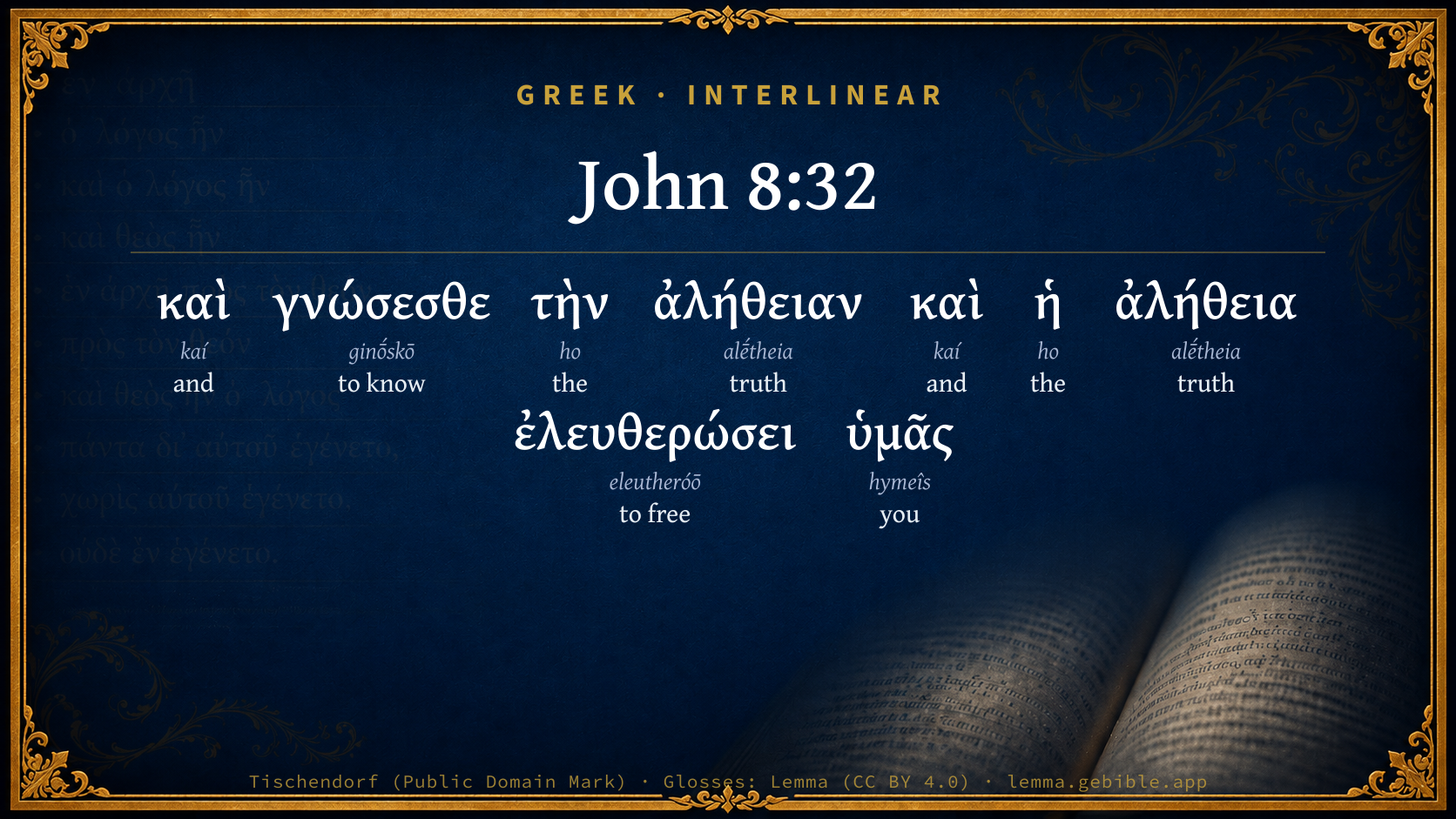
Download image
Cite this verse

John 8:32 (World English Bible). Public Domain. Lemma interlinear Bible study tool, https://lemma.gebible.app/v/john/8/32.

Show BibTeX & RIS
BibTeX
RIS
English Translation
You will know the truth, and the truth will make you free."
World English Bible · Public Domain
Highlights
  • 1 first appearance in the Greek New Testament
Full analysis ↓
Download a study sheet

One document with this verse’s original text, its word-by-word gloss line, the meaning frame, cross-references with their text, attributed commentary, and full source and license credits — printable, and it pastes into notes with its structure intact.

This verse Autodidact and up

Study sheet (.html) Plain text (.txt)

A passage Seminary Student

Up to 50 verses in one chapter. A passage sheet keeps up to 6 commentary sources and 12 cross-references per verse, in the order this page ranks them, and says so on the sheet whenever that leaves anything out. Ask for a single verse and you get the Autodidact verse sheet above.

Everything on this page stays free to read, with no account — the sheet is a download of what is already on screen, not access to it.

Want to remove ads? Support Godless Engineer
Compare translations 3

The same verse in 3 English versions, stacked beneath the original-language interlinear above. Click any original word for its lexicon entry.

Each is an independent rendering of the whole verse — the interlinear is not word-aligned to these translations.

Highlighted words mark where these versions differ — a whole-verse word diff, not a word-by-word alignment.

  • World English Bible Public Domain
    You will know the truth, and the truth will make you free."
  • King James Version Public Domain
    And ye shall know the truth, and the truth shall make you free.
  • unfoldingWord Literal Text CC BY-SA 4.0
    and you will know the truth, and the truth will free you.”

unfoldingWord Literal Text — © unfoldingWord, licensed CC BY-SA 4.0. Word-aligned USFM3 via Door43 (git.door43.org/unfoldingWord/en_ult).

Versions to compare (up to 4)

3 of 4 selected

Show all 19 translations

Every available English version of this verse, each an independent rendering of the whole verse.

  • World English Bible Public Domain
    You will know the truth, and the truth will make you free."
  • Berean Standard Bible Public Domain
    Then you will know the truth, and the truth will set you free.”
  • Majority Standard Bible Public Domain
    Then you will know the truth, and the truth will set you free.”
  • King James Version Public Domain
    And ye shall know the truth, and the truth shall make you free.
  • American Standard Version (1901) Public Domain
    and ye shall know the truth, and the truth shall make you free.
  • Revised Version (1885) Public Domain
    and ye shall know the truth, and the truth shall make you free.
  • Geneva Bible (1599) Public Domain
    And shall know the trueth, and the trueth shall make you free.
  • Douay-Rheims (1899) Public Domain
    And you shall know the truth, and the truth shall make you free.
  • Young's Literal Translation Public Domain
    and the truth shall make you free.'
  • Literal Standard Version CC BY-SA 4.0
    and you will know the truth, and the truth will make you free.”
  • Unlocked Literal Bible CC BY-SA 4.0
    and you will know the truth, and the truth will set you free.”
  • unfoldingWord Literal Text CC BY-SA 4.0
    and you will know the truth, and the truth will free you.”
  • Darby Bible Public Domain
    and ye shall know the truth, and the truth shall set you free.
  • World Messianic Bible Public Domain
    You will know the truth, and the truth will make you free.”
  • Webster's Bible Public Domain
    And ye shall know the truth, and the truth shall make you free.
  • Free Bible Version CC BY-SA 4.0
    You will know the truth, and the truth will set you free.”
  • Bible in Basic English Public Domain
    And you will have knowledge of what is true, and that will make you free.
  • Text-Critical English NT CC BY 4.0
    Then you will know the truth, and the truth will set you free.”
  • Tyndale New Testament (1534) Public Domain
    They answered him: We be Abrahams seede and were never bonde to eny man: why sayest thou then ye shalbe made fre.

Literal Standard Version (2020), Covenant Press — licensed CC BY-SA 4.0. Text via the HelloAO Bible API (eBible.org). Unlocked Literal Bible (unfoldingWord) — licensed CC BY-SA 4.0. Text via the HelloAO Bible API (eBible.org). unfoldingWord Literal Text — © unfoldingWord, licensed CC BY-SA 4.0. Word-aligned USFM3 via Door43 (git.door43.org/unfoldingWord/en_ult). Free Bible Version, Dr. Jonathan Gallagher — licensed CC BY-SA 4.0. Text via the HelloAO Bible API (eBible.org).

Word by word

More ways to search: Search by grammar → Find every occurrence → Compare this word →

Practice this passage: Drill this verse → Learn its vocabulary →

About this verse

These counts appear in no published source. They are computed here, from the morphology-tagged text and Lemma’s own curated glosses. What Lemma adds →

9
words
6
distinct lemmas
Gospels
section

Notable vocabulary

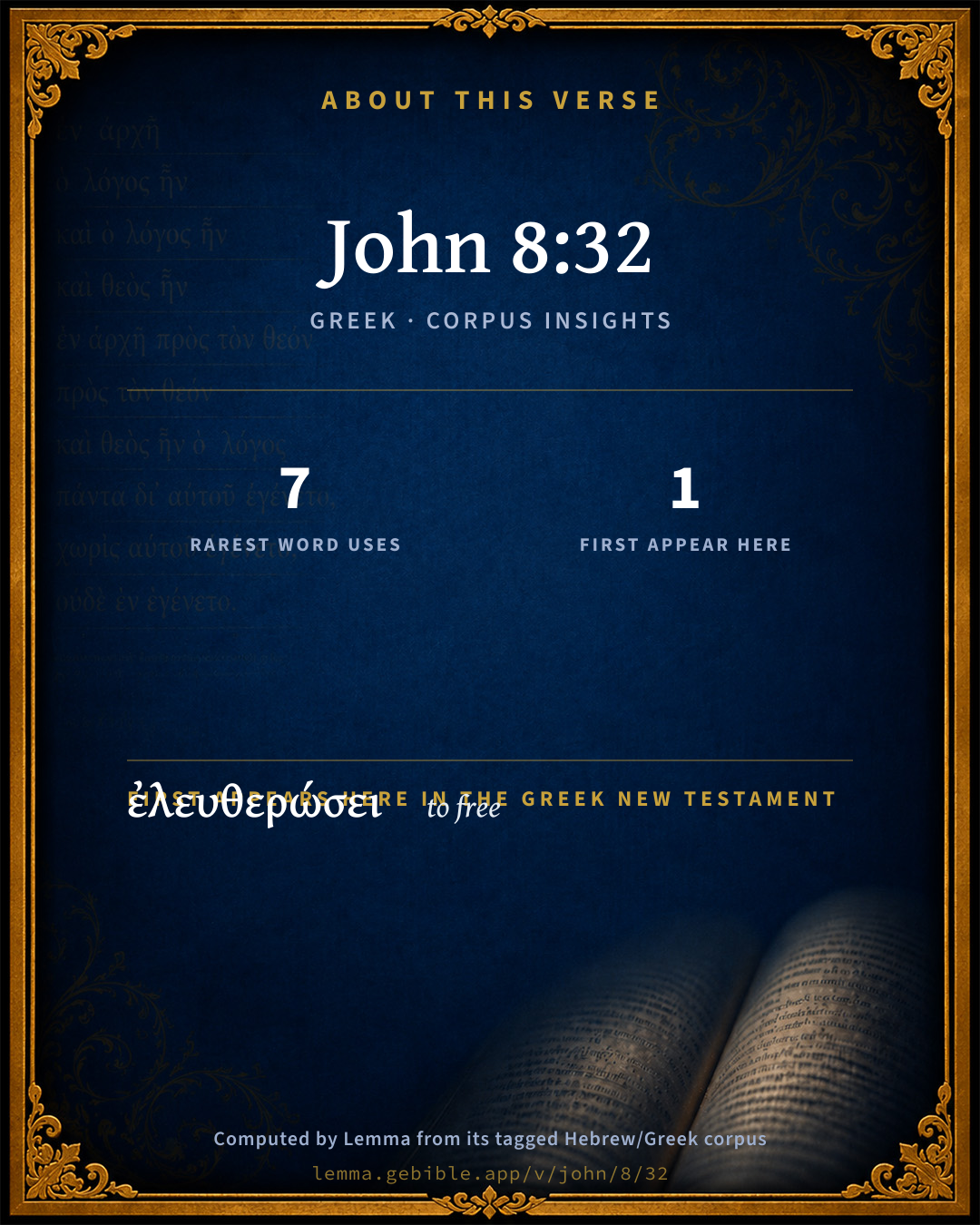
The rarest word here is ἐλευθερώσει to free G1659 — appearing just 7 times in the whole Greek New Testament.

First appearance in Scripture

This word makes its first canonical appearance in the Greek New Testament here:

  • ἐλευθερώσει to free G1659

Shared distinctive vocabulary

ἐλευθερώσει to free G1659 occurs in 7 verses of the Greek New Testament. Also found in:
Repetition

Words recur within this verse:

  • ἀλήθειαν truth G225 ×2
  • καὶ and G2532 ×2
  • τὴν the G3588 ×2

Cross-references

37

Topical passages linked to John 8:32 in the Treasury of Scripture Knowledge — connected by theme and wording, ordered by reader-vote popularity; previews shown in the World English Bible.

  • Romans 8:2 For the law of the Spirit of life in Christ Jesus made me free from the law of sin and of death.
  • John 8:36 If therefore the Son makes you free, you will be free indeed.
  • John 17:17 Sanctify them in your truth. Your word is truth.
  • 1 Peter 2:16 as free, and not using your freedom for a cloak of wickedness, but as bondservants of God.
  • John 14:6 Jesus said to him, "I am the way, the truth, and the life. No one comes to the Father, except through me.
  • Romans 6:22 But now, being made free from sin, and having become servants of God, you have your fruit of sanctification, and the result of eternal life.
  • Romans 6:14–18 For sin will not have dominion over you. For you are not under law, but under grace.
  • Isaiah 61:1 The Spirit of the Lord Yahweh is on me; because Yahweh has anointed me to preach good news to the humble; he has sent me to bind up the broken-hearted, to proclaim liberty to the captives, and the opening [of the prison] to those who are bound;
  • Psalms 25:5 Guide me in your truth, and teach me, For you are the God of my salvation, I wait for you all day long.
  • Proverbs 2:1–7 My son, if you will receive my words, And store up my commandments within you;
  • Galatians 5:1 Stand firm therefore in the liberty by which Christ has made us free, and don't be entangled again with a yoke of bondage.
  • James 1:25 But he who looks into the perfect law, the law of freedom, and continues, not being a hearer who forgets but a doer of the work, this man will be blessed in what he does.
  • 2 Corinthians 3:17–18 Now the Lord is the Spirit and where the Spirit of the Lord is, there is liberty.
  • James 2:12 So speak, and so do, as men who are to be judged by a law of freedom.
  • Jeremiah 6:16 Thus says Yahweh, Stand you in the ways and see, and ask for the old paths, where is the good way; and walk therein, and you shall find rest for your souls: but they said, We will not walk [therein].
  • John 16:13 However when he, the Spirit of truth, has come, he will guide you into all truth, for he will not speak from himself; but whatever he hears, he will speak. He will declare to you things that are coming.
  • Galatians 5:13 For you, brothers, were called for freedom. Only don't use your freedom for gain to the flesh, but through love be servants to one another.
  • John 7:17 If anyone desires to do his will, he will know about the teaching, whether it is from God, or if I am speaking from myself.
  • Hosea 6:3 Let us acknowledge Yahweh. Let us press on to know Yahweh. As surely as the sun rises, Yahweh will appear. He will come to us like the rain, Like the spring rain that waters the earth."
  • Psalms 25:8–9 Good and upright is Yahweh, Therefore he will instruct sinners in the way.
  • Isaiah 30:21 and your ears shall hear a word behind you, saying, This is the way, walk you in it; when you turn to the right hand, and when you turn to the left.
  • Romans 8:15 For you didn't receive the spirit of bondage again to fear, but you received the Spirit of adoption, by whom we cry, "Abba! Father!"
  • Proverbs 1:23 Turn at my reproof. Behold, I will pour out my spirit on you. I will make known my words to you.
  • Malachi 4:2 But to you who fear my name shall the sun of righteousness arise with healing in its wings. You will go out, and leap like calves of the stall.
  • Proverbs 4:18 But the path of the righteous is like the dawning light, That shines more and more until the perfect day.
  • Isaiah 35:8 A highway shall be there, and a way, and it shall be called The way of holiness. The unclean shall not pass over it, but is shall be for for him who walks in the Way. Wicked fools will not go there.
  • 2 Timothy 2:25–26 in gentleness correcting those who oppose him: perhaps God may give them repentance leading to a full knowledge of the truth,
  • 2 Timothy 3:7 always learning, and never able to come to the knowledge of the truth.
  • Proverbs 1:29 Because they hated knowledge, And didn't choose the fear of Yahweh.
  • Isaiah 2:3 Many peoples shall go and say, "Come, let's go up to the mountain of Yahweh, To the house of the God of Jacob; And he will teach us of his ways, And we will walk in his paths. For out of Zion the law shall go forth, And the word of Yahweh from Jerusalem.
  • Isaiah 54:13 All your children shall be taught of Yahweh; and great shall be the peace of your children.
  • John 6:45 It is written in the prophets, 'They will all be taught by God.' Therefore everyone who hears from the Father, and has learned, comes to me.
  • Psalms 119:45 I will walk in liberty, For I have sought your precepts.
  • Matthew 11:29 Take my yoke upon you, and learn from me, for I am gentle and lowly in heart; and you will find rest for your souls.
  • Song of Solomon 1:7–8 Tell me, you whom my soul loves, Where you graze your flock, Where you rest them at noon; For why should I be as one who is veiled Beside the flocks of your companions? Lover
  • Jeremiah 31:33–34 But this is the covenant that I will make with the house of Israel after those days, says Yahweh: I will put my law in their inward parts, and in their heart will I write it; and I will be their God, and they shall be my people:
  • Matthew 13:11–12 He answered them, "To you it is given to know the mysteries of the Kingdom of Heaven, but it is not given to them.

Cross-references courtesy of OpenBible.info (CC BY 4.0).

Commentary

Notes on John 8:32 from classic Christian and Jewish commentators (each source and its license shown beneath its notes). The classic Christian expositions comment on the surrounding passage and are grouped to its opening verse, so a note may address several verses; the Jewish commentaries on the Tanakh (Rashi and others) are per-verse, so they appear only where the commentator wrote on this verse.

Lemma curates 59 commentaries, every one of them public domain or Creative Commons licensed, each selected and text-cleaned for this edition rather than reprinted as found. About our sources →

Godbey's Commentary on the New Testament

William B. Godbey

EGREGIOUS BLINDNESS OF THE JEWS

Joh 8:32-33. “You shall know the truth, and the truth shall make you free. They responded to Him, We are the seed of Abraham, and have never been in bondage to any one; how do You say, That you shall be free?” This illustrates the alarming fact that even religious people may become so hallucinated by the devil as to tell falsehoods with unblushing effrontery and amazing volubility, and at the same time not know it, but think they are preaching the truth. Not only had these Jews been in bondage to the Egyptians two hundred and fifteen years, but at that very moment they were in bondage to the Romans, and, worst of all, to the devil.

William B. Godbey, Commentary on the New Testament (1896–1900) — public domain. Text from a community e-Sword module.

Bengel's Gnomon

Johann Albrecht Bengel

Joh 8:32. Τὴν ἀλήθειαν) the truth, concerning Me, as sent by the Father; concerning yourselves, as being My disciples indeed.—ἡ ἀλήθεια) The truth, being known, concerning Me; and I Myself. For the Son makes free, Joh 8:36. Comp. ch. Joh 1:12, “To them gave He power to become the Sons of God, even to them that believe on His name:” and He is the truth, ch. Joh 14:6, “I am the Way, the Truth,” etc.—ἐλευθερώσει shall make free) We ought not to wonder, that Jesus suddenly threw in the mention of this, which the Jews were sure to contradict. For always, in accordance with His own infinite wisdom, He spake especially that which would assail the prejudices of men, and be most beneficial to men; although men would take from thence occasions of disputing with Him. The Freedom is the exemption of the sons of God from all adverse control [namely, from sin, and its slavery; Joh 8:34, “Whosoever committeth sin, is the servant of sin:” and from death; Joh 8:51, “If a man keep My saying, he shall never see death.”—V. g.]

Bengel's Gnomon of the New Testament — English translation (T&T Clark, Edinburgh, 1860) — public domain. Text from a community e-Sword module.

Expositor's Greek Testament

ed. W. Robertson Nicoll

Joh 8:32 . καὶ γνώσεσθε … ὑμᾶς . By abiding in Christ’s word, making it the rule of their life and accepting Him as their Guide and Teacher, they would come to that knowledge of the truth which only experimental testing of it can bring; and the truth regarding their relation to Him and to God would turn all service and all life into liberty. Freedom, a condition of absolute liberty from all outward constraint, is only attained when man attains fellowship with God (who is absolutely free) in the truth: when that prompts man to action which prompts God. [ Cf. the striking parallel in Epictetus, iv. 7. εἰς ἐμὲ οὐδεὶς ἐξουσίαν ἔχει · ἠλευθέρωμαι ὑπὸ τοῦ θεοῦ , ἔγνωκα αὐτοῦ τὰς ἐντολὰς , οὐκέτι οὐδεὶς δουλαγωγῆσαί με δύναται .]

The Expositor's Greek Testament, edited by W. Robertson Nicoll (1897–1910) — public domain. Text from a community e-Sword module.

Geneva Bible (1599)

Geneva Bible translators

From the slavery of sin.

Geneva Bible (1599) marginal notes — public domain. Text via Bolls.life.

Adam Clarke's Commentary

Verse 32. Ye shall know the truth] Shall have a constant experimental knowledge of its power and efficacy.

And the truth shall make you free.] It was a maxim of the Jews, "That no man was free, but he who exercised himself in the meditation of the law." No man is truly free, but he in whose heart the power of sin is destroyed, and who has received the Spirit of adoption, through which he cries, Abba! Father! See Ro 8:15. The bondage of sin is the most grievous bondage; and freedom from its guilt and influence is the greatest liberty.

Adam Clarke's Commentary on the Bible (1810–1826) — public domain. Text from a community e-Sword/MySword module.

John Calvin's Commentaries

32. And you shall know the truth. He says, that they who have arrived at some knowledge of it shall know the truth True, those whom Christ addresses were as yet uneducated, and scarcely knew the first elements, and therefore we need not wonder if he promises them a more full understanding of his doctrine. But the statement is general. Wherefore, whatever progress any of us have made in the Gospel, let him know that he needs new additions. This is the reward which Christ bestows on their perseverance, that he admits them to greater familiarity with him; though in this way he does nothing more than add another gift to the former, so that no man ought to think that he is entitled to any reward. For it is he who impresses his word on our hearts by his Spirit, and it is he who daily chases away from our minds the clouds of ignorance which obscure the brightness of the Gospel. In order that the truth may be fully revealed to us, we ought sincerely and earnestly to endeavor to attain it. It is the same unvarying truth which Christ teaches his followers from the beginning to the end, but on those who were at first enlightened by him, as it were with small sparks, he at length pours a full light. Thus believers, until they have been fully confirmed, are in some measure ignorant of what they know; and yet it is not so small or obscure a knowledge of faith as not to be efficacious for salvation.

The truth shall make you free. He commends the knowledge of the Gospel from the fruit which we derive from it, or — which is the same thing — from its effect, namely, that it restores us to freedom This is an invaluable blessing. Hence it follows, that nothing is more excellent or desirable than the knowledge of the Gospel. All men feel and acknowledge that slavery is a very wretched state; and since the Gospel delivers us from it, it follows that we derive from the Gospel the treasure of a blessed life.

We must now ascertain what kind of liberty is here described by Christ, namely, that which sets us free from the tyranny of Satan, sin, and death. And if we obtain it by means of the Gospel, it is evident from this that we are by nature the slaves of sin. Next, we must ascertain what is the method of our deliverance. For so long as we are governed by our sense and by our natural disposition, we are in bondage to sin; but when the Lord regenerates us by his Spirit, he likewise makes us free, so that, loosed from the snares of Satan, we willingly obey righteousness. But regeneration proceeds from faith, and hence it is evident that freedom proceeds from the Gospel.

Let Papists now go and proudly vaunt of their free-will, but let us, who are conscious of our own slavery, glory in none but Christ our Deliverer. For the reason why the Gospel ought to be reckoned to have achieved our deliverance is, that it offers and gives us to Christ to be freed from the yoke of sin. Lastly, we ought to observe, that freedom has its degrees according to the measure of their faith; and therefore Paul, though clearly made free, still groans and longs after perfect freedom, (Romans 7:24.)

John Calvin's Commentaries (1540-1563) — public domain. Text from the Calvin Translation Society English edition (1840s-50s) via the Christian Classics Ethereal Library (ccel.org). Calvin's coverage is partial (roughly two-thirds of the Bible); uncommented books and verses are honest gaps, never fabricated. The 19th-century editor's footnotes and remarks are omitted so the notes are faithfully Calvin's own voice.

Ellicott's Commentary for English Readers

(32) And ye shall know the truth.—In the great Intercessory Prayer of John 17, Jesus prays for His disciples: “Sanctify them in the truth: Thy word is truth” (Joh_8:17). In the answer to the question of Thomas in John 14, He declares, “I am the way, the truth, and the life” (Joh_8:6). It is this thought that is present in the connection between continuance in His word and knowledge of the truth here. These Jews professed to know the truth, and to be the official expounders of it. They had yet to learn that truth was not only a system, but also a power; not only something to be written or spoken, but also something to be felt and lived. If they abide in His word they will indeed be His disciples; living the life of truth, they will gain perception of truth. “Being true,” they will “in love grow up into him in all things, which is the head, even Christ” (Eph_4:15).

And the truth shall make you free.—Here, as in Joh_17:17, truth and holiness are spoken of as correlative. The light of truth dispels the darkness in which lies the stronghold of evil. Sin is the bondage of the powers of the soul, and this bondage is willed because the soul does not see its fearful evil. When it perceives the truth, there comes to it a power which rouses it from its stupor, and strengthens it to break the fetters by which it has been bound. Freedom from the Roman rule was one of the national hopes bound up with Messiah’s Advent. There is indeed a freedom from a more crushing foe than the legions of Rome. (Comp. Mar_5:9; Luk_8:30.)

A Bible Commentary for English Readers, edited by Charles John Ellicott (1878–1897) — public domain. Text from a community e-Sword module.

The Cambridge Bible for Schools and Colleges

gen. ed. J. J. S. Perowne

32. the truth] Both Divine doctrine (Joh_17:17) and Christ Himself (Joh_14:6) ‘whose service is perfect freedom.’ See on Joh_18:37.

shall make you free] Free from the moral slavery of sin. Comp. the Stoics’ dictum—‘The wise man alone is free.’

The Cambridge Bible for Schools and Colleges (gen. ed. J. J. S. Perowne; Cambridge University Press, 1878–1918) — public domain. Text from a community e-Sword module.

John Gill's Exposition

And the servant abideth not in the house for ever,.... The servant of God, and of Christ, does, but not the servant of sin: there may be servants of sin in the house or church of God here below; and such were these Jews Christ is speaking to; but such shall not abide there for ever: some that get into this house are quickly discerned, as Simon Magus was, and are soon removed; and others that may stay longer, are sometimes suffered to fall into some foul sin, or into some gross error and heresy, for which they are cast out of the house or church of God, according to the rules of God's word; others make parties, draw disciples after them, and separate themselves, and go out of their own accord, to serve their own purposes: and others, when persecution and tribulation arise because of the word, they are offended and gone; this is the fan with which Christ sometimes winnows his floor, and removes the chaff; and those that continue longest, even to the end of their days, or of the world, or the second coming of Christ, as the foolish virgins, will then be discerned and separated; for the ungodly shall not stand in judgment, nor sinners in the congregation of the righteous; they shall not enter into the house above, into the house not made with hands, eternal in the heavens, which is Christ's Father's house: none but sons are brought to glory; these are the only heirs of salvation; others will be bid to depart, as workers of iniquity, as the servants of sin; even such who have made a profession of religion, and have been, and have had a standing in the house of God below. The allusion is to the case of servants in common; and, in a literal sense, it is true both of good and bad servants: good servants do not always continue in their master's house; even an Hebrew servant, that loved his master, and would not go out free at the end of his servitude; and who, after having his ear bored, is said to serve him for ever, Exo 21:6; yet that "for ever" was but until the year of jubilee, whether near or remote, as the Jewish commentators (d) in general explain it; nay, if his master died before that time, he went out free: he was not obliged to serve his son or heirs; and so say the Misnic doctors (e):

"one that is bored is obtained by boring, and he possesses himself (or becomes free) by the year of jubilee, and by the death of his master.''

And to this agrees what Maimonides (f) says;

"he that has served six years, and will not go out, lo, this is bored, and he serves until the year of jubilee, or until his master dies; and although he leaves a son, he that is bored does not serve the son; which may be learned from the letter of the words, "he shall serve him", not his son, "for ever", until the jubilee: from whence it appears, that he that is bored does not possess himself (or is free) but by the jubilee, and by the death of his master.''

And one of their writers (g) observes, that the word rendered, "shall serve him", is by Gematry, and not his son. And among the Romans, good servants were oftentimes made free, and bad ones were turned out, and put into a work house, to grind corn in mills, a sort of bridewell; and such evil servants may more especially be respected, since Christ is speaking of servants of sin:

but the Son abideth ever: the Son of God, the only begotten Son of God the Lord Jesus Christ will always continue as a Son in his own house, as the Lord and proprietor of it; and as an high priest over it, having an unchangeable priesthood; and as he that takes care of it, provides for it, and manages all the affairs thereof, the family in heaven and in earth being named of him. And as he, so all the adopted sons of God shall continue, being pillars in this house, that shall never go out: such are no more servants, nor foreigners, but fellow citizens with the saints and of the household of God; and being sons, are heirs and shall never be cast out, as the bondwoman and her son have been: but these being the children of the free, shall for ever enjoy the inheritance they are adopted to; once sons, always so; the relation ever continues; they will ever remain in the family, and being entitled to the heavenly estate, shall ever possess it.

(d) Jarchi, Aben Ezra, & ben Gersom in Exod. xxi. 6. (e) Misn. Kiddushin, c. 1. sect. 1. (f) Hilchot Abadim, c. 3. sect. 6, 7. (g) Baal Hatturim in Exod. xxi. 6.

John Gill's Exposition of the Whole Bible (1746–1763) — public domain (CC PDM 1.0). Text via the HelloAO Bible API.

Trapp's Complete Commentary

John Trapp

32 And ye shall know the truth, and the truth shall make you free.

Ver. 32. The truth shall make you free] From the tyranny of sin and terror of hell. Paul’s freedom saved him from whipping, Act 22:29, this, from perishing.

John Trapp, A Commentary or Exposition upon All the Books of the Old and New Testament (1647–1656) — public domain. Text from a community e-Sword module.

Albert Barnes' Notes on the Bible

Shall know the truth - See the notes at Joh 7:17.

The truth shall make you free - The truth here means the Christian religion. Compare Gal 3:1; Col 1:6. The doctrines of the true religion shall make you free - that is, it will free you from the slavery of evil passions, corrupt propensities, and grovelling views. The condition of a sinner is that of a captive or a slave to sin. He is one who serves and obeys the dictates of an evil heart and the promptings of an evil nature, Rom 6:16-17; “Ye were the servants of sin;” - Rom 6:19; “Ye have yielded your members servants unto iniquity;” - Rom 6:20; Rom 7:6, Rom 7:8,Rom 7:11; Rom 8:21; Act 8:23; “Thou art in the - bond of iniquity;” Gal 4:3, Gal 4:9. The effect of the gospel is to break this hard bondage to sin and to set the sinner free. We learn from this that religion is not slavery or oppression. It is true freedom.

“He is the freeman whom the truth makes free,

And all are slaves beside.” - Cowper.

The service of God is freedom from degrading vices and carnal propensities; from the slavery of passion and inordinate desires. It is a cheerful and delightful surrender of ourselves to Him whose yoke is easy and whose burden is light.

Albert Barnes' Notes on the Bible (1834–1885) — public domain. Text from a community e-Sword/MySword module.

Haydock's Catholic Bible Commentary

And the truth shall make you free. They were affronted at these words, as if he hinted they were slaves, and not a free people. They tell him, therefore, that they were never slaves to any one. They can only pretend this of themselves: for, their forefathers were slaves to the Egyptians, to the Babylonians, &c. and besides they were now the subjects, if not slaves, to the Romans. But Christ speaks of the worst of slaveries, and tells them the such as live in sin, are slaves to sin. (Witham)

George Leo Haydock (1774–1849), Haydock's Catholic Family Bible and Commentary, 1859 edition — public domain. Excludes Psalms (Douay-Rheims chapter numbering differs from Protestant) and Deuterocanonical books (Catholic canon only).

Matthew Poole's English Annotations

And ye shall know the truth; that is, you shall more fully and clearly know the truth; by which may be either understood Christ, who styles himself, The way, the truth, and the life; or those propositions of truth which Christ hath revealed. There must be some knowledge of truth in a soul before it can believe; for how shall they believe (saith the apostle) in him of whom they have not heard? but a fuller and clearer knowledge of the truth is got by degrees, by those who studiously seek after it, and walk close with God.

And the truth shall make you free: it appears by Joh 8:36, that by the truth he means himself; there he saith, If the Son make you free: and indeed, though the knowledge of the proposition of truth gives men some liberty from the bondage of ignorance and some lusts, yet it is only the saving knowledge of Christ which brings men into a perfect liberty from the law, the rigour, curse, and terror of it, and from the dominion of sin and corruption.

Matthew Poole's English Annotations on the Holy Bible (1683–1685) — public domain. Text from a community e-Sword/MySword module.

Whedon's Commentary on the Bible

Daniel D. Whedon

32. Truth… make… free—Our Lord forthwith applies the test to the genuineness of their faith. The word free, the favourite political term of the zealous Jew, waiting for an emancipator to break the Roman yoke, is a test word. For that gracious freedom which truth affords, in emancipating the soul from irrational and self-destructive action, this Hebrew patriot has no patience. For him the only freedom is release from Rome; the only Messiah is the liberator.

Daniel D. Whedon (gen. ed.), Commentary on the Old and New Testaments (1874–1909) — public domain. Text from a community e-Sword module.

The Pulpit Commentary

The liberating truth.

There are two kinds of freedom: the freedom of the liberated prisoner and the freedom of the manumitted slave. Living in a country like England, we are most likely to think of the former kind. But it is quite evident that Jesus was thinking of servitude rather than captivity. Many may have to be under restraint because they have broken laws; it is right that they should be prisoners for a time, perhaps even for all their lives. But servitude never can be right; it has had to remain awhile because of the hardness of men"s hearts, and as men have got more light upon human equality, they have seen that no man should be legally compelled into the service of another, whether he would or not. In the time of Jesus there were many bond slaves, and he had no magic process whereby he could liberate them. But there were bond slaves besides, unconscious of their servitude, deluded with the notion that they were already free, and therefore all the harder to liberate. To such Jesus spoke here. He spoke to slaves, and told them what would liberate them.

I THE PROCESS OF LIBERATION MAY BE REAL, THOUGH FOR A WHILE WE ARE NOT CONSCIOUS OF IT. The prisoner is free when no longer in prison; the slave is free when no longer under the legal control of his owner. But Christian liberty cannot thus be made up of negations; it would be a poor thing if it could. It is of no use to attempt a definition of Christian liberty; it is a thing into which we must grow. We must grow until, even as Paul did, we look back on the days once counted free as days of the worst servitude. Going where Christ wants us to go, being what Christ wants us to be, we shall see in due time what a real and blessed thing spiritual freedom is. Still, though it must be a time before we know this properly, yet we may know something of it at once in studying the very greatest illustration of real liberty we can find, namely, the Lord Jesus himself. It is not abstract truth that liberates, but truth as embodied in the wisdom and power of Jesus.

II TRUTH BRINGS US INTO THE LIBERTY OF DOING GOD"S WILL. Christ"s own liberty was not that of doing as he liked. He went by the likings of his Father in heaven. He did nothing without liking to do it; yet he also did nothing just because he liked to do it. To desire what God desires, that is liberty, without a check, a jar, or a fret. Sowing just what we like, we shall certainly reap what we do not like. Christ wants to liberate us from the thraldom of our own strong, foolish desires. The psalmist exactly expresses the Christian"s privilege and attainment, when he says so cheerfully. "I will run the way of thy commandments, when thou shalt enlarge my heart.

III TRUTH BRINGS US INTO THE LIBERTY OF SEEING THINGS WITH OUR OWN EYES. The reputed wise in Jerusalem would only have led Jesus into a bondage of falsehoods and delusions. What a Pharisee they would have tried to make him! Really freethinking is the only right thinking, and our Teacher was the freest thinker that ever lived. It is our duty as much as our right to judge everything in connection with Christ for ourselves. By that rule we shall be judged at last. Others may help us in the way when chosen, but they are not to choose it for us.

IV TRUTH BRINGS US INTO THE LIBERTY OF A LOVING HEART. The heart of Jesus could not be kept within rules and precedents and prejudices. It was a Divine love, shed abroad in his heart, that kept him safe, pure, and unspotted, in a world abounding with things to pollute.

V TRUTH BRINGS US INTO THE LIBERTY OF A GRACIOUS LIFE. That is, the liberty of Jesus never interfered with the true liberty of others, but increased and established it. He never broke away from the beaten track for the mere sake of doing it. Y.

The Pulpit Commentary (1880–1919), ed. H.D.M. Spence-Jones & Joseph S. Exell — public domain. Text from a community e-Sword module.

John Wesley's Explanatory Notes

The truth - Written in your hearts by the Spirit of God, shall make you free - From guilt, sin, misery, Satan.

John Wesley, Explanatory Notes Upon the Whole Bible (1754–1765) — public domain. Text via the GEBible commentary corpus.

The People's New Testament

B. W. Johnson

32. And ye shall know the truth. Disciples are learners. Their object is to know the truth. The way to know the truth is to obey the truth. The truth shall make you free. The Gospel obeyed, frees—frees from the yoke of Satan, from spiritual task-masters, from fear, fills the soul with hope and the free spirit of a son who serves the Father from love.

B. W. Johnson's The People's New Testament with Notes (1889–1891) — public domain. Electronic text from the Christian Classics Ethereal Library (CCEL) ThML edition.

Cambridge Greek Testament for Schools and Colleges

32. γνώσεσθε. Ye shall come to know (Joh 6:69, Joh 7:17; Joh 7:26).

τὴν ἀλήθειαν. Divine doctrine (Joh 1:17, Joh 17:17) and Christ Himself (Joh 14:6, Joh 5:33), ‘whose service is perfect freedom.’ See Joh 18:37.

ἐλευθερώσει. Free from the moral slavery of sin. The power of sin is based on a delusion, a fascination, the real nature of which the truth exposes, and so breaks the spell. Truth and freedom are inseparable. Truth destroys the bondage to appearances, whether attractive or repulsive; the seductions of sin and the servile fears of an ignorant conscience. Socrates taught that vice is ignorance, and the Stoics that the wise man alone is free. Plato Rep. IX. 589 E.

Cambridge Greek Testament for Schools and Colleges (Cambridge University Press, 1896; 21 vols, various authors incl. Carr, Maclear, Plummer, Farrar, Lumby, Moule, M. R. James, Simcox) — public domain. Text from a community e-Sword module.

Alford’s Greek Testament

Henry Alford

32.] In opposition to the mere holding of the truth. The knowing of the truth answers to the feeding on Christ;—is the inner realization of it in the man. And in the continuing increase of this comes true freedom from all fear and error and bondage.

Henry Alford, The Greek Testament (1849–1861) — public domain. Text from a community e-Sword module.

International Critical Commentary

32. καὶ γνώσεσθε τὴν ἀλήθειαν. For the conception of ἀλήθεια in Jn., see on 1:14; and cf. vv. 40, 44, 45.

καὶ ἡ ἀλήθεια ἐλευθερώσει ὑμᾶς. The words express a great principle, which is applicable in many directions, and which has been enunciated by Jewish and heathen teachers as well as by Christian. It was a Stoic paradox ὅτι μόνος ὁ σοφὸς ἐλεύθερος καὶ πᾶς ἄφρων δοῦλος (Cicero, Parad. 5). This was repeated in another form by Seneca, “unum studium uere liberale est quod liberum facit, hoc est sapientiae” (Ep. lxxxviii. 2). Philo, in the same spirit, wrote a book to prove that the σπουδαῖος is free (quod omnis probus liber sit). In another book (de confus. ling. 20) he asks τίς οὖν ἐλευθερία βεβαιοτάτη; to which he gives the answer ἡ τοῦ μόνου θεραπεία σοφοῦ. But there is no trace of generalisations of this kind either in O.T. or N.T.

The freedom which truth brings (in the view of Jn.) is emancipation from the slavery of sin. This appears from v. 34, where see note. In v. 36 the Son is said to be the Agent of this emancipation (ἐὰν ὁ υἱὸς ὑμᾶς ἐλευθερώσῃ) and the juxtaposition of vv. 32, 36 is instructive, when the great utterance ἐγώ εἰμι ἡ ἀλήθεια (14:6) is recalled. The purpose of the self-consecration of Jesus is declared (17:19) to be that His disciples may be ἡγιασμένοι ἐν ἀληθείᾳ.

There is, perhaps, a hint of the emancipating influence of truth at 1:17: “The law came by Moses, but grace and truth by Jesus Christ.” See note in loc.

International Critical Commentary — older volumes (1896–1929), various authors — public domain. Text from a community e-Sword module.

Godet's Commentaries

Frédéric Louis Godet

Ver. 32. Καί : and on this condition. They will really possess the quality of disciples; and on this path they will reach the complete illumination from which will result within them complete emancipation. The truth is the contents of the word of Jesus; it is the full revelation of the real essence of things, that is to say, of the moral character of God, of man, and of their relation. This new light will serve to break the yoke, not of the Roman power, but, what is more decisive for salvation, of the empire of sin. On what, indeed, does the power of sin in the human heart rest? On a fascination. Let the truth come to light, and the charm is broken. The will is disgusted with that which seduced it, and, according to the expression of the Psalmist, “the bird is escaped from the snare of the fowler.” This is the true Messianic deliverance. If there is to be another more external one, it will be only the complement of this.

Frédéric Louis Godet — Commentaries on Luke, John, Romans, and 1 Corinthians — English translation (T&T Clark, Edinburgh, 1870s–1890s) — public domain. Text from a community e-Sword module.

Lesson kit

Teaching starters — assembled from the data on this page, not authored interpretation. Every prompt links to the verse data it draws on. Edit before teaching.

John, in the Gospels, opens this verse with 9 words (6 distinct Greek lemmas). Its most distinctive word is eleutheróō (“to free”). A historical commentator’s framing appears above. Read the whole chapter for the surrounding context.

Discussion questions

  1. What does “to free” (eleutheróō) contribute to the verse as a whole?
  2. The word “to free” first appears here in Scripture. What is being introduced at this debut?
  3. John 8:36 shares the word «to free» with this verse. How do the two illuminate each other?
  4. “truth” occurs 2× in this one verse. What is the effect of the repetition?
  5. These translations render this verse differently. What is at stake in choosing one wording over another?
  6. Reading how Godbey's Commentary on the New Testament and Bengel's Gnomon read this verse, where do the two commentators agree and where do they part?

Things to notice

  • 1 word makes its first canonical appearance in Scripture here.
  • These translations choose different wording for 3 words in this verse.
  • “truth” occurs 2× in this single verse.
  • 6 distinct Greek lemmas span 9 words in this verse.

Reading settings

Reading text

Shown beneath each verse's original-language words.

Old Testament
Old Testament edition

Read the OT as the Masoretic Hebrew (MT) or the Greek Septuagint (LXX).

English shown for the Greek Septuagint (in the Hebrew ↔ Greek comparison).

Comparing translations? Open the Compare panel on any verse page to stack up to four side by side.