John 12:7

Greek (Tischendorf 8th ed.) John 12:7 appears in the Greek New Testament. The text above is from the Tischendorf 8th edition. Each word links to its Strong’s number and a concise gloss. Click any word for its full Thayer’s Greek Lexicon entry.
Download image
Cite this verse

John 12:7 (World English Bible). Public Domain. Lemma interlinear Bible study tool, https://lemma.gebible.app/v/john/12/7.

Show BibTeX & RIS
BibTeX
RIS
English Translation
But Jesus said, "Leave her alone. She has kept this for the day of my burial.
World English Bible · Public Domain
Download a study sheet

One document with this verse’s original text, its word-by-word gloss line, the meaning frame, cross-references with their text, attributed commentary, and full source and license credits — printable, and it pastes into notes with its structure intact.

This verse Autodidact and up

Study sheet (.html) Plain text (.txt)

A passage Seminary Student

Up to 50 verses in one chapter. A passage sheet keeps up to 6 commentary sources and 12 cross-references per verse, in the order this page ranks them, and says so on the sheet whenever that leaves anything out. Ask for a single verse and you get the Autodidact verse sheet above.

Everything on this page stays free to read, with no account — the sheet is a download of what is already on screen, not access to it.

Want to remove ads? Support Godless Engineer
Compare translations 3

The same verse in 3 English versions, stacked beneath the original-language interlinear above. Click any original word for its lexicon entry.

Each is an independent rendering of the whole verse — the interlinear is not word-aligned to these translations.

Highlighted words mark where these versions differ — a whole-verse word diff, not a word-by-word alignment.

  • World English Bible Public Domain
    But Jesus said, "Leave her alone. She has kept this for the day of my burial.
  • King James Version Public Domain
    Then said Jesus, Let her alone: against the day of my burying hath she kept this.
  • unfoldingWord Literal Text CC BY-SA 4.0
    Therefore Jesus said, “Leave her alone so that she might have kept it for the day of my burial.

unfoldingWord Literal Text — © unfoldingWord, licensed CC BY-SA 4.0. Word-aligned USFM3 via Door43 (git.door43.org/unfoldingWord/en_ult).

Versions to compare (up to 4)

3 of 4 selected

Show all 19 translations

Every available English version of this verse, each an independent rendering of the whole verse.

  • World English Bible Public Domain
    But Jesus said, "Leave her alone. She has kept this for the day of my burial.
  • Berean Standard Bible Public Domain
    “Leave her alone,” Jesus replied. “She has kept this perfume in preparation for the day of My burial.
  • Majority Standard Bible Public Domain
    “Leave her alone,” Jesus replied. “She has kept this perfume in preparation for the day of My burial.
  • King James Version Public Domain
    Then said Jesus, Let her alone: against the day of my burying hath she kept this.
  • American Standard Version (1901) Public Domain
    Jesus therefore said, Suffer her to keep it against the day of my burying.
  • Revised Version (1885) Public Domain
    Jesus therefore said, Suffer her to keep it against the day of my burying.
  • Geneva Bible (1599) Public Domain
    Then said Iesus, Let her alone: against the day of my burying she kept it.
  • Douay-Rheims (1899) Public Domain
    Jesus therefore said: Let her alone, that she may keep it against the day of my burial.
  • Young's Literal Translation Public Domain
    Jesus, therefore, said, `Suffer her; for the day of my embalming she hath kept it,
  • Literal Standard Version CC BY-SA 4.0
    Jesus, therefore, said, “Permit her; she has kept it for the day of My embalming,
  • Unlocked Literal Bible CC BY-SA 4.0
    Jesus said, “Allow her to keep what she has for the day of my burial.
  • unfoldingWord Literal Text CC BY-SA 4.0
    Therefore Jesus said, “Leave her alone so that she might have kept it for the day of my burial.
  • Darby Bible Public Domain
    Jesus therefore said, Suffer her to have kept this for the day of my preparation for burial;
  • World Messianic Bible Public Domain
    But Yeshua said, “Leave her alone. She has kept this for the day of my burial.
  • Webster's Bible Public Domain
    Then said Jesus, Let her alone: against the day of my burial hath she kept this.
  • Free Bible Version CC BY-SA 4.0
    “Don't criticize her,” Jesus replied. “She did this in preparation for the day of my burial.
  • Bible in Basic English Public Domain
    Then Jesus said, Let her be. Let her keep what she has for the day of my death.
  • Text-Critical English NT CC BY 4.0
    So Jesus said, “Leave her alone; she has kept this ointment for the day of my burial.
  • Tyndale New Testament (1534) Public Domain
    Then sayde Iesus: Let her alone agaynst the daye of my buryinge she kept it.

Literal Standard Version (2020), Covenant Press — licensed CC BY-SA 4.0. Text via the HelloAO Bible API (eBible.org). Unlocked Literal Bible (unfoldingWord) — licensed CC BY-SA 4.0. Text via the HelloAO Bible API (eBible.org). unfoldingWord Literal Text — © unfoldingWord, licensed CC BY-SA 4.0. Word-aligned USFM3 via Door43 (git.door43.org/unfoldingWord/en_ult). Free Bible Version, Dr. Jonathan Gallagher — licensed CC BY-SA 4.0. Text via the HelloAO Bible API (eBible.org).

Word by word

More ways to search: Search by grammar → Find every occurrence → Compare this word →

Practice this passage: Drill this verse → Learn its vocabulary →

ἐνταφιασμοῦ
entaphiasmós
G1780
“burial preparation”
Noun, Genitive, Singular, Masculine
Part of Speech
Noun
Case
Genitive
Number
Singular
Gender
Masculine
Full Thayer's Definition

Origin: from G1779

TDNT: None

1. preparation of a body for burial
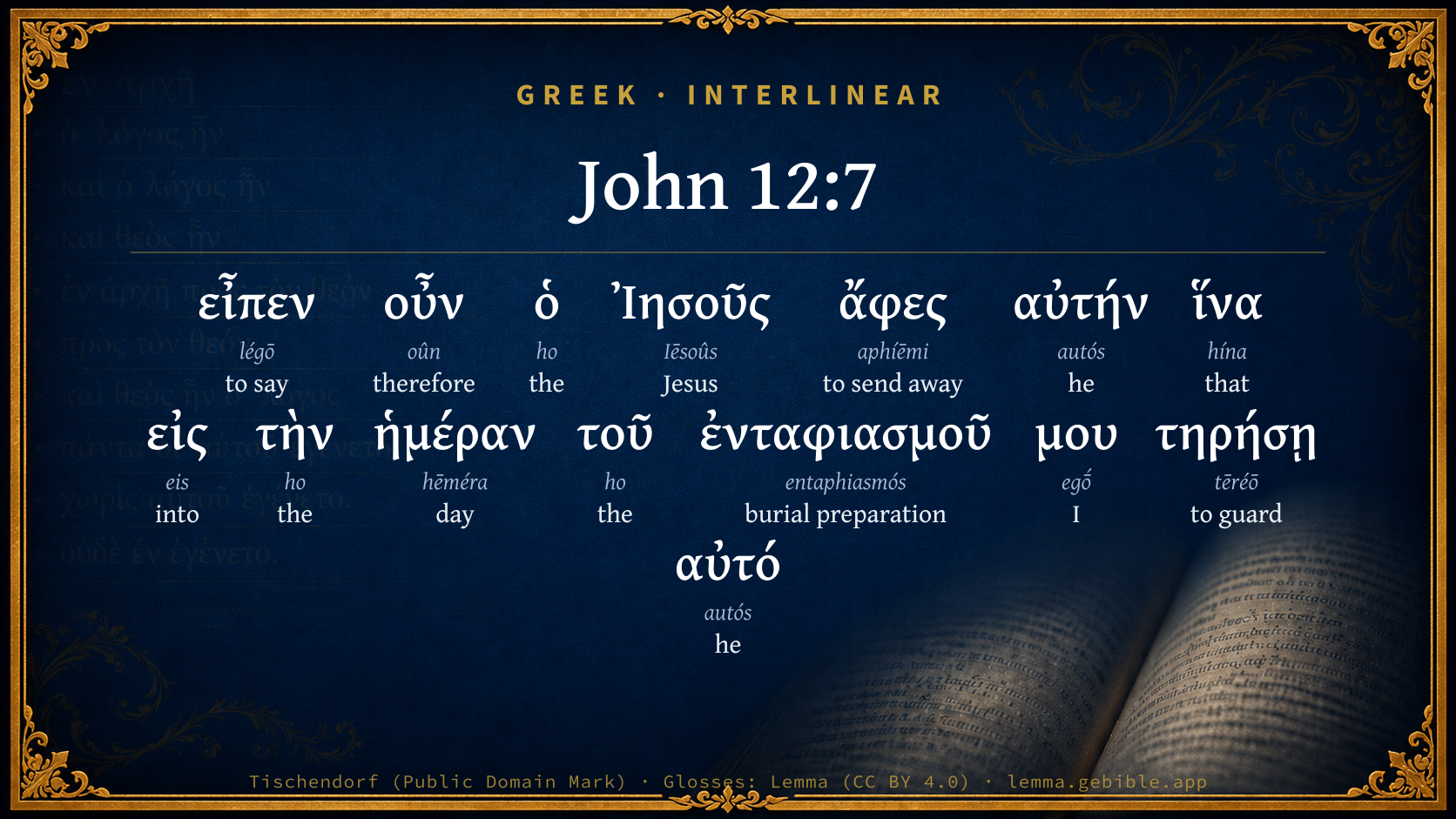
  1. εἶπεν légō G3004 “to say” Verb, Aorist, Active, Indicative, 3rd person, Singular
  2. οὖν oûn G3767 “therefore” Conjunction
  3. ὁ ho G3588 “the” Article, Nominative, Singular, Masculine
  4. Ἰησοῦς Iēsoûs G2424 “Jesus” Noun, Nominative, Singular, Masculine
  5. ἄφες aphíēmi G863 “to send away” Verb, Aorist, Active, Imperative, 2nd person, Singular
  6. αὐτήν autós G846 “he” Personal pronoun, Accusative, Singular, Feminine
  7. ἵνα hína G2443 “that” Conjunction
  8. εἰς eis G1519 “into” Preposition
  9. τὴν ho G3588 “the” Article, Accusative, Singular, Feminine
  10. ἡμέραν hēméra G2250 “day” Noun, Accusative, Singular, Feminine
  11. τοῦ ho G3588 “the” Article, Genitive, Singular, Masculine
  12. μου egṓ G1473 “I” Personal pronoun, 1st person, Genitive, Singular
  13. τηρήσῃ tēréō G5083 “to guard” Verb, Aorist, Active, Subjunctive, 3rd person, Singular
  14. αὐτό autós G846 “he” Personal pronoun, Accusative, Singular, Neuter

About this verse

These counts appear in no published source. They are computed here, from the morphology-tagged text and Lemma’s own curated glosses. What Lemma adds →

15
words
12
distinct lemmas
Gospels
section

Notable vocabulary

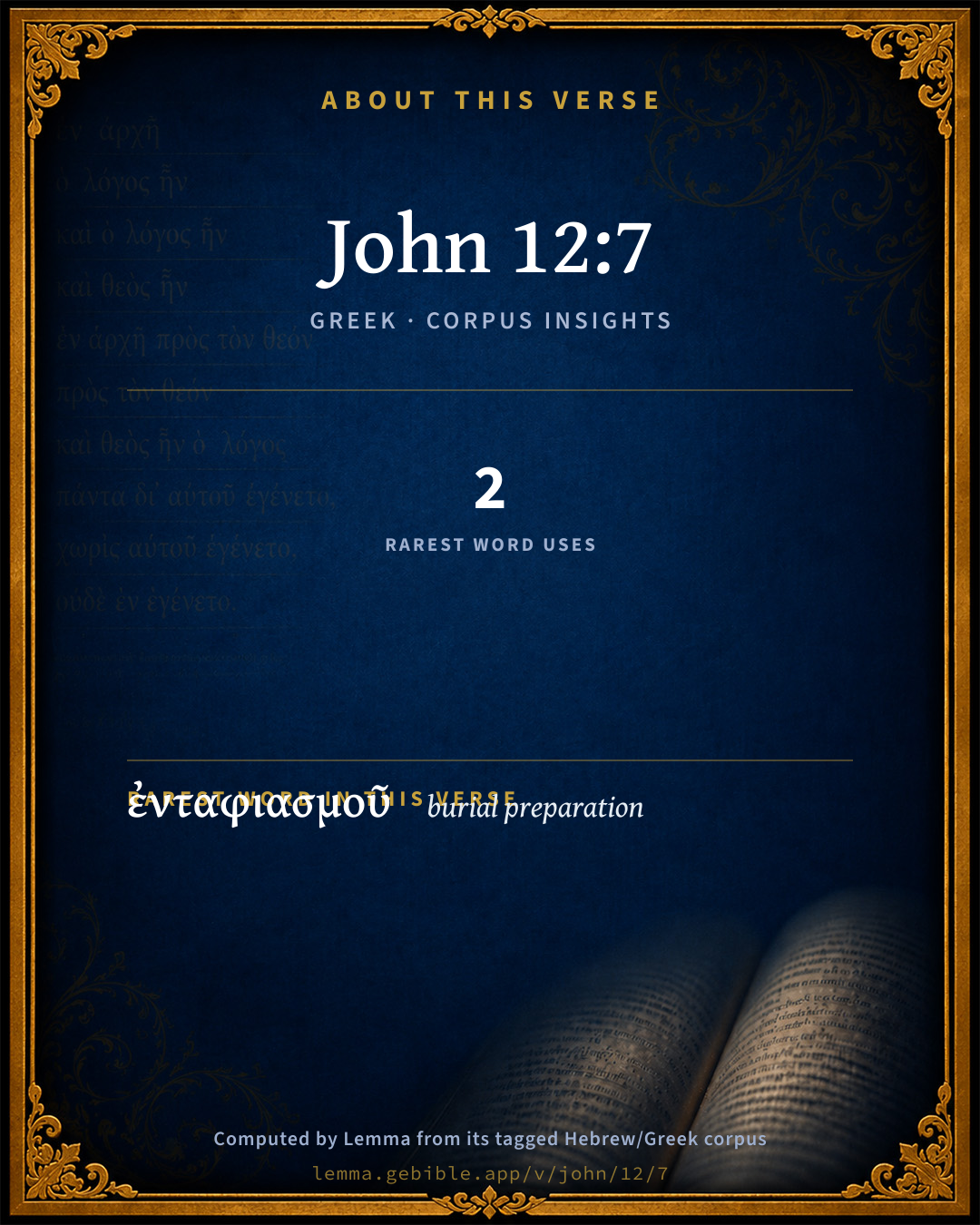
The rarest word here is ἐνταφιασμοῦ burial preparation G1780 — appearing just 2 times in the whole Greek New Testament.

Shared distinctive vocabulary

ἐνταφιασμοῦ burial preparation G1780 occurs in 2 verses of the Greek New Testament. Also found in:

Repetition

Words recur within this verse:

Cross-references

9

Topical passages linked to John 12:7 in the Treasury of Scripture Knowledge — connected by theme and wording, ordered by reader-vote popularity; previews shown in the World English Bible.

  • Matthew 26:12 For in pouring this ointment on my body, she did it to prepare me for burial.
  • Mark 14:6 But Jesus said, "Leave her alone. Why do you trouble her? She has done a good work for me.
  • Matthew 26:10 But Jesus, knowing this, said to them, "Why do you trouble the woman? Because she has done a good work for me.
  • Matthew 27:57–60 When evening had come, a rich man from Arimathaea, named Joseph, who himself was also Jesus' disciple came.
  • Psalms 109:31 For he will stand at the right hand of the needy, To save him from those who judge his soul.
  • Zechariah 3:2 Yahweh said to Satan, "Yahweh rebuke you, Satan! Yes, Yahweh who has chosen Jerusalem rebuke you! Isn't this a burning stick plucked out of the fire?"
  • Mark 15:42–47 When evening had now come, because it was the Preparation Day, that is, the day before the Sabbath,
  • Luke 23:50 Behold, a man named Joseph, who was a member of the council, a good and righteous man
  • John 19:38–42 After these things, Joseph of Arimathaea, being a disciple of Jesus, but secretly for fear of the Jews, asked of Pilate that he might take away Jesus' body. Pilate gave him permission. He came therefore and took away his body.

Cross-references courtesy of OpenBible.info (CC BY 4.0).

Where the printed editions differ

1 variant

Places in this verse where the major printed Greek editions disagree on the wording in a way that affects the translation — a comparison of editions, not a manuscript-by-manuscript collation. The editions are the modern critical texts (Nestlé-Aland 28/27, SBL, Westcott-Hort, Tregelles, Tyndale House) and the traditional texts behind the KJV (the Textus Receptus and the Byzantine/Majority text). It is not a claim about which reading is original.

  1. Extra text
    ἵνα

    “so that”

    In NA28NA27TynSBLWHTreg Not in TRByz

    ἵνα (ina) 'so that' is only in older manuscripts (NA28+NA27+Tyn+SBL+WH+Treg)

Textual data: Translators Amalgamated Greek New Testament (STEPBible TAGNT) · CC BY 4.0.

Commentary

Notes on John 12:7 from classic Christian and Jewish commentators (each source and its license shown beneath its notes). The classic Christian expositions comment on the surrounding passage and are grouped to its opening verse, so a note may address several verses; the Jewish commentaries on the Tanakh (Rashi and others) are per-verse, so they appear only where the commentator wrote on this verse.

Lemma curates 59 commentaries, every one of them public domain or Creative Commons licensed, each selected and text-cleaned for this edition rather than reprinted as found. About our sources →

Tyndale Open Study Notes

Tyndale Open Resources

12:7 Leave her alone: Jesus’ defense of Mary interpreted her deed. The nard was a burial spice for his death. Jesus was readied for burial as he moved toward the hour of glorification and death (see study note on 12:23).

Tyndale Open Study Notes — © Tyndale Open Resources, licensed CC BY-SA 4.0. Text via the HelloAO Bible API.

Bengel's Gnomon

Johann Albrecht Bengel

Joh 12:7. Εἶπεν, said) Jesus does not openly reprove the mind of Judas: He rather marks [stigmatises] the thing itself.—ἡμέραν) This very day[not “against the day of My burying,” as if it were future]: at that time was the day;[312] Mat 26:12, notes. His death, and the burial itself, was in six days after (comp. Joh 12:1) about to follow this present ἘΝΤΑΦΙΑΣΜΌΝ, preparation for the sepulchre. See Ord. Temp. p. 263, etc. [Ed. ii. 228].—ἵνα—τηρήσῃ)[313] Understand, this has been done. Let her alone: this has been done, that she might keep it, etc. So ἵνα, ch. Joh 9:3, etc. [ΟὔΤΕ ΟὟΤΟς ἭΜΑΡΤΕΝ, ἈΛΛʼ ἽΝΑ ΦΑΝΕΡΩΘῇ ΤᾺ ἜΡΓΑ ΤΟῦ ΘΕΟῦ]. The ΔΙΑΤΊ, why, which had been started as an objection by Judas, is aptly repelled [by this ἵνα τηρήσῃ εἰς ἡμέραν τ. ἐνταφιασμοῦ]), and at the same time Judas is warned; for his treachery waxed stronger and stronger until it eventuated in the Saviour’s death.—ΤΗΡΉΣῌ, that she might keep it) So there was no ‘waste.’ She had been previously prepared to contribute it to the poor, if it should be needed; but she was guided by the Divine counsel, that she should keep it for the object for which it was needed, although she herself was unconscious of it.

[312] Of the ἐνταφιασμός, not the committal to the sepulchre, but the preparation of the body for it.—E. and T.

[313] This reading, which had been placed by the margin of the Ed. Maj. as it were in equilibrium [the arguments being regarded as equally balanced on both sides], has obtained the preference in Ed. 2 and Vers. Germ.—E. B. [BDQLXabc Vulg. have ἵνα τηρήσῃ: A and Rec. Text, τετήρηκεν.—E. and T.]

Bengel's Gnomon of the New Testament — English translation (T&T Clark, Edinburgh, 1860) — public domain. Text from a community e-Sword module.

Meyer's Critical & Exegetical Commentary

Heinrich August Wilhelm Meyer

Joh_12:7-8. According to the Recepta, Jesus says: She has fulfilled a higher purpose with the spikenard ointment (αὐτό); in order to embalm me with it to-day (as though I were already dead), has she (not given it out for the poor, but) reserved it. Comp. on Mat_26:12. According to the correct reading, however (see the critical notes): Let her alone, that she may preserve it (this ointment, of which she has just used a portion for the anointing of my feet, not give it away for the poor, but) for the day of my embalmment (for behoof of that). Nonnus aptly remarks: ὄφρα φυλάξῃ σώματος ἡμετέρου κειμήλιον, εἰσόκεν ἔλθῃ ἡμετέρων κτερέων ἐπιτύμβιος ὥρη. Comp. also Baeumlein. According to this view, the ἡμέρα τοῦ ἐνταφ. is the actual, impending day of embalmment, in opposition to which, according to the Recepta, the present day of the anointing of the feet would be represented proleptically as that of the anointing of the corpse. The thought of the Recepta is that of the Synoptics; the Johannean carries with it the supposition of originality, and, comparing the thoughtful significance of the two, the Johannean is more in harmony with the circumstance that Mary anointed the feet merely, and by no means resembles a faulty correction (Hengstenberg, Godet). The circumstance that, afterwards, the corpse of Jesus was not actually anointed (Mar_16:1), can, in view of an utterance so rich and deep in feeling, afford no ground for deserting the simple meaning of the words.

τηρεῖν is to be explained, agreeably to the context (comp. Joh_2:10), as an antithesis to ἐπράθη, Joh_12:5, but not by the quite arbitrary assumption that the ointment had remained over from the burial of Lazarus (Kuinoel and several others); but to understand τηρήσῃ of the past; that she may have preserved it (B. Crusius, Ebrard) is grammatically wrong.[106] According to Ewald, ΤΗΡΕῖΝ is to be understood, as elsewhere, of festal usages (Joh_9:16): Let her so observe this on the day of my burial, so that Jesus would have that day already regarded as equivalent to the day of His burial, when such a loving custom was suitable. But as regards τηρεῖν, see what precedes; instead of the indefinite ΑὐΤΌ, it, however, τοῦτο was at least to have been expected.

Joh_12:8. Reason of the statement introduced with ἽΝΑ, Κ.Τ.Λ.

ΜΕΘʼ ἙΑΥΤῶΝ] in your own neighbourhood, so that you have sufficiently immediate opportunity to give alms to such. For the rest, see on Mat_26:11.

[106] The modification of this rendering in Luthardt: Let her rest as regards the fact that she has kept the ointment for me with the design (even though unconscious) of preserving it for the representation, beforehand, of the day of my embalmment, is a grammatical impossibility. Similarly, however, Bengel.

Meyer — Critical and Exegetical Commentary on the New Testament — English translation by Peter Christie, edited by Frederick Crombie (T&T Clark, 1880) — public domain. Text from a community e-Sword module.

Geneva Bible (1599)

Geneva Bible translators

This Extraordinary anointing, which was for a sign, is so allowed of God, that he witnesseth how he will not be worshipped with outward pomp, or costly service, but with alms.

Geneva Bible (1599) marginal notes — public domain. Text via Bolls.life.

Jamieson, Fausset & Brown

Robert Jamieson, A. R. Fausset & David Brown

said Jesus, Let her alone, against the day of my burying hath she done this--not that she thought of His burial, much less reserved any of her nard to anoint her dead Lord. But as the time was so near at hand when that office would have to be performed, and she was not to have that privilege even alter the spices were brought for the purpose (Mar 16:1), He lovingly regards it as done now.

Jamieson, Fausset & Brown — Commentary Critical and Explanatory on the Whole Bible (1871) — public domain (CC PDM 1.0). Text via the HelloAO Bible API.

Adam Clarke's Commentary

Verse 7. Let her alone: against the day of my burying hath she kept this.] Several MSS. and versions read thus: - Αφες αυτην, ἱνα εις την ἡμεραντου ενταφιασμου μου τηρησῃ - Let her alone, THAT she may keep it to the day of my embalming. This is the reading of BDLQ, four others, Arabic, Coptic, AEthiopic, Armenian, later Syriac in the margin, Slavonic, Vulgate, all the Itala but one; Nonnus, Ambrosius, Gaudentius, and Augustin. This reading, which has the approbation of Mill, Bengel, Griesbach, Pearce, and others, intimates that only a part of the ointment was then used, and that the rest was kept till the time that the women came to embalm the body of Jesus: Lu 24:1. See the notes on Mt 26:12; Mt 26:13.

Adam Clarke's Commentary on the Bible (1810–1826) — public domain. Text from a community e-Sword/MySword module.

John Calvin's Commentaries

7. Let her alone. When Christ bids them let Mary alone, he shows that they act improperly and unjustly who disturb their neighbors without a good reason, and raise a disturbance about nothing. Christ’s reply, as given by the other Evangelists, is longer; but the meaning is the same. The anointing, which Judas finds fault with, is defended on this ground, that it will serve for his burial. Christ, therefore, does not approve of! it as an ordinary service, or one which ought to be commonly used in the Church; for if he had intended that an office of this sort should be performed daily, he could have said something else instead of speaking of it as connected with his burial. God certainly does not approve of outward display. Nay, more, perceiving that the mind of man is too prone to carnal observances, He frequently enjoins us to be sober and moderate in the use of them. Those persons, therefore, are absurd interpreters, who infer from Christ’s reply, that costly and magnificent worship is pleasing to God; for he rather excuses Mary on the ground of her having rendered to him an extraordinary service, which ought not to be regarded as a perpetual rule for the worship of God.

For the day of my burial she hath kept it. When he says, that the ointment was kept, he means that it was not poured unseasonably, but with a due regard to the time when it occurred; for a thing is said to be kept, which is reserved in store to be brought cut at a fit time and place. It is certain that, if any person, at a former period, had burdened him with costly delicacies, he would not have endured it. But he affirms that Mary did not do this as a customary matter, but in order to discharge her last duty towards him. Besides, the anointing of bodies was not at that time a useless ceremony, but rather a spiritual symbol, to place before their eyes the hope of a resurrection. The promises were still obscure; Christ had not risen, who is justly designated the first-fruits of them that rise, (1 Corinthians 15:20.) Believers, therefore, needed such aids to direct them to Christ, who was still absent; and, accordingly, the anointing of Christ was not at that time superfluous, for he was soon to be buried, and he was anointed as if he were to be laid in the tomb. The disciples were not yet aware of this, and Mary unquestionably was suddenly moved to do, under the direction of the Spirit of God, what she had not previously intended. But Christ applies to the hope of his resurrection what they so greatly disapproved, in order that the usefulness, which he pointed out to them in this action, might lead them to renounce the fretful and wicked opinion which they had formed respecting it. As it was the will of God that the childhood of his ancient people should be guided by such exercises, so, in the present day, it would be foolish to attempt the same thing; nor could it be done without offering an insult to Christ, who has driven away such shadows by the brightness of his coming. But as his resurrection had not yet brought the fulfillment of the shadows of the Law, it was proper that his burial should be adorned by an outward ceremony. The odor of his resurrection has now sufficient efficacy, without spikenard and costly ointments, to quicken the whole world. But let us remember that, in judging of the actions of men, we ought to abide by the decision of Christ alone, at whose tribunal we must one day stand.

John Calvin's Commentaries (1540-1563) — public domain. Text from the Calvin Translation Society English edition (1840s-50s) via the Christian Classics Ethereal Library (ccel.org). Calvin's coverage is partial (roughly two-thirds of the Bible); uncommented books and verses are honest gaps, never fabricated. The 19th-century editor's footnotes and remarks are omitted so the notes are faithfully Calvin's own voice.

Ellicott's Commentary for English Readers

(7) Against the day of my burying hath she kept this.—The majority of the better MSS. read, “that she keep this against the day of My burying.” Comp. Mat_26:12 and Mar_14:8. The thought here differs from that in the earlier Gospels, and the common reading has therefore been adapted to harmonise with it. Taking the better text, the meaning here is, “Let her alone, that she may keep this for the day of My embalmment.” She had taken a pound of ointment (Joh_12:3) and had anointed His feet. This reminds Him of the embalmment of the dead, which had been but lately in that very place, and in the person of one sitting with them, present to their minds. Her act is significant of the future which is approaching. Let them not stay that deed of love. Before the week ends His body will be carried to the sepulchre. The preparations for the grave have already been begun.

A Bible Commentary for English Readers, edited by Charles John Ellicott (1878–1897) — public domain. Text from a community e-Sword module.

The Cambridge Bible for Schools and Colleges

gen. ed. J. J. S. Perowne

7. hath she kept] The large majority of authorities, including the best, read that she may keep, and the whole will run: Let her alone that she may preserve it for the day of My burial. The simplest interpretation of this is ‘Let her preserve what remains of it; not, however, to be sold for the poor, but to be used for My burial, which is near at hand.’ The text has probably been altered to bring it more into harmony with the Synoptists, with whom the present anointing appears as anointing for the burial by anticipation. The word for ‘burial’ or ‘entombment’ occurs only here and Mar_14:8.

The Cambridge Bible for Schools and Colleges (gen. ed. J. J. S. Perowne; Cambridge University Press, 1878–1918) — public domain. Text from a community e-Sword module.

John Gill's Exposition

Then said Jesus, let her alone,.... Do not disturb her in what she does, or hinder her, or blame her for it:

against the day of my burial hath she kept this; this ointment, which she now poured on Christ; it was usual to embalm the dead with ointments and spices: Christ suggests, that the time of his death and burial were nigh, and that this woman had kept this ointment till now, for such a purpose; and whereas she would not be able to make use of it at the time of his interment, she had embalmed his body with it now, beforehand; though without any knowledge of his death, or any such intention and design in her, but the Holy Ghost so directing her: for this is not to be understood of her keeping any part of it till that time, which it does not appear she did.

John Gill's Exposition of the Whole Bible (1746–1763) — public domain (CC PDM 1.0). Text via the HelloAO Bible API.

Trapp's Complete Commentary

John Trapp

7 Then said Jesus, Let her alone: against the day of my burying hath she kept this.

Ver. 7. Let her alone] Christ crossed the traitor in his covetous desire of fingering such a sum. Hence his discontent put him upon that desperate design of contracting with the chief priests. He is resolved to have it, however he come by it; Rem, rem, quocunque modo rem. Horat. Take heed of discontent. It was the devil’s sin that threw him out of heaven. Ever since which this restless spirit loves to fish in troubled waters, to dwell in a darkened soul: as in Saul, envious at David: and as some heretics, missing preferment, have invented their heresies, ut se consolarentur, as Epiphanius observed.

Against the day] Being at a feast he speaketh of his funeral.

John Trapp, A Commentary or Exposition upon All the Books of the Old and New Testament (1647–1656) — public domain. Text from a community e-Sword module.

The Pulpit Commentary

The two readings of the text must here be compared with one another and with the synoptic narrative. The T.R. reads, Let her alone:unto the day of the preparation for my burial she has carefully guarded this precious perfume . This is, in one sense, that very day, and she has found out the solemn fact in a way in which the disciples had as yet failed to do. With this agrees the language of the synoptists, "Why trouble ye the woman? she hath wrought a good work on me; ... she hath done that which was possible to her" (o escen epoihsen) of Mar_14:8. In fact, Mark expressly conveys this thought has anticipated the anointing of my body for the burial." If we have the direct testimony of Mark ( i.e. Peter), Christ must have expressed himself thus. Matthew also in different words records the same pathetic and subtle thought: "For in that she poured cast this ointment upon my body, she did it to prepare me for burial" (Mat_26:12) Hengstenberg, Godet, and Stier abide by the reading of the T.R.; but the principal manuscripts, in most powerful combination, have led Lachmann, Alford, Tischendorf, and Westcott and Hort to read here, Ina eiv thran tou entafiasmou thrhsh auto , "In order that she may keep or guard this for the day of my burial." Westcott says that the synoptists imply rather, by the word kateceen , that She had not already consumed the whole of the ointment. Meyer, with this text, translates, "Let her alone, that she may preserve it (this ointment, of which she has just poured some over my feet) for the day of my embalmment." This certainly seems inconsistent with the complaint of the disciples or of Judas, at the apparently superfluous expenditure, and would compel us to restrict the abed to the unused portion. The advocates of the T.R. reading say that it represents the original text, which has been altered by criticism arising from misunderstanding of the idea of the day of burial having ideally arrived; but why did they not alter on the same principle the language of the synoptists? The advocates of Lachmann"s text say that it has been altered by copyists, to bring it into accord with the text of the synoptists. Lange justifies the Revised Version, "Suffer her to keep it against the day of my burying," and puts it thus: "Permit her to keep it i.e. to have kept the ointment which she might have used at the burial of Lazarus for the day of my burial," now ideally present in the outbreak of Judas"s devilish malignity. So virtually Luthardt and Baumgarten-Crusius. Godet argues that this is forced and ungrammatical. But there is this advantage in it, that it brings the language into much closer relation with the synoptists. Westcott prefers the idea of Meyer. The older view is to me far mere satisfactory. Edersheim (2:35) adds to this, "Mary may have had that alabaster box from early days, before she had learned to serve Christ. When she understood that decease of which he constantly spake, she may have put it aside, "kept it," "against the day of his burying." And now the decisive hour is come.

The Pulpit Commentary (1880–1919), ed. H.D.M. Spence-Jones & Joseph S. Exell — public domain. Text from a community e-Sword module.

John Wesley's Explanatory Notes

Against the day of my burial - Which now draws nigh.

John Wesley, Explanatory Notes Upon the Whole Bible (1754–1765) — public domain. Text via the GEBible commentary corpus.

unfoldingWord translationNotes

Door43 World Missions Community

Allow her to keep what she has for the day of my burial

Jesus implies that the woman's actions can be understood as anticipating his death and burial. AT: "Allow her to show how much she appreciates me! In this way she has prepared my body for burial" (See: Assumed Knowledge and Implicit Information)

You will always have the poor with you

Jesus implies that there will always be opportunities to help the poor people. AT: "There will always be poor people among you, and you can help them whenever you want" (See: Assumed Knowledge and Implicit Information)

But you will not always have me

In this way, Jesus implies that he will die. AT: "But I will not always be here with you" (See: Assumed Knowledge and Implicit Information)

translationWords

Jesus

bury

unfoldingWord translationNotes — © Distant Shores Media and the Door43 World Missions Community, licensed CC BY-SA 4.0. Source: git.door43.org/Door43/en_tn.

Cambridge Greek Testament for Schools and Colleges

7. Insert ἵνα after αὐτήν and read τηρήσῃ for τετήρηκεν (changes to escape a difficulty), with אBDKLQX against AIa.

7. ἄφες αὐτήν, ἵνα. Let her alone, that for the day of the preparation for My burial she may preserve it: or, more simply, Suffer her to keep it for the day of My burial. But ἐνταφιασμός (here and Mar 14:8 only) means the embalming and other preparations rather than the actual entombment: comp. Joh 19:40. The meaning is not clear: (1) Suffer her to keep what remains of it; not, however, for the poor, but for My burial, which is close at hand.’ But was there any of it left? (2) ‘Let her alone; (she has not sold it for the poor) that she may keep it for My burial.’ (3) ‘Suffer her to keep it (for she intended to do so) for the day of My burial:’ i. e. do not find fault with a good intention which she has unwittingly carried out. The words are spoken from the point of view of the past, when Mary’s act was still only a purpose.

Cambridge Greek Testament for Schools and Colleges (Cambridge University Press, 1896; 21 vols, various authors incl. Carr, Maclear, Plummer, Farrar, Lumby, Moule, M. R. James, Simcox) — public domain. Text from a community e-Sword module.

Alford’s Greek Testament

Henry Alford

7.] See note on Matt. ver. 12. To suppose that it was a remnant from that used at the burial of Lazarus, is not only fanciful, but at variance with the character of the deed as apparent in the narrative. The . reading, εἰς τ. ἡμ. τ. ἐντ. μου τετήρηκεν αὐτό, seems to be an adaptation to Mar 14:8, in order to escape from the difficulty of understanding how she could keep for His burial, what she poured out now. Meyer understands the text of the remnant: but Luthardt rightly observes that the history clearly excludes the idea of a remnant: cf. ἐπράθη and ἐδόθη. He himself, with Baumg.-Crusius, takes τηρήοῃ as past, “Let her have kept it,” i.e. blame her not for having kept it: but this is vapid in sense, and ungrammatical. I understand the words, which, like all our Lord’s proleptical expressions, have something enigmatical in them, of her whole act, not regarded as a thing past, but spoken of in the abstract as to be allowed or disallowed: Let her keep it for the day of my burial: not meaning a future day or act, but the present one, as one to be allowed.

Henry Alford, The Greek Testament (1849–1861) — public domain. Text from a community e-Sword module.

International Critical Commentary

7. With vv. 7, 8, cf. Mar 14:6-9.

The rec. text, with AΓΔ, omits ἵνα and reads τετήρηκεν, while אBDLWΘ support ἵνα … τηρήσῃ.

We must render “let her alone, in order that she may keep it (sc. the remainder of the spikenard) against the day of my burying.” In Mk.’s narrative (here being corrected silently by Joh_1) the flask of ointment was broken and its entire contents poured upon the head of Jesus; but Jn. says nothing of the flask being broken, and it is not to be supposed that all the ointment was used for His feet. ἐνταφιασμός (cf. 19:40) is “preparation for burial,” and might or might not include the anointing of the whole body. The words of Jesus tell of His impending death and burial to any of the company who had sufficient insight; the rest of the spikenard will soon be needed, and will not be wasted.

We have above (p. 412) identified Mary of Bethany with Mary Magdalene; and thus she who began His ἐνταφιασμός by anointing the Lord’s feet in Bethany, was among the women who finished the anointing of His body eight days later (cf. 20:1, Mar 16:1).

For ἄφες αὐτήν, cf. Mar 14:6, Mat 15:14, 2Sa 16:11, 2Ki 4:27. We might translate (with R.V.mg) “Let her alone; (it was) that she might keep it,” or (with R.V.txt) “Suffer her to keep it,” but we prefer to render “Let her alone, in order that, etc.”

International Critical Commentary — older volumes (1896–1929), various authors — public domain. Text from a community e-Sword module.

Vincent's Word Studies in the New Testament

Marvin R. Vincent

Let her alone : against the day of my burying hath she kept this (afev aujthn eijv thn hJmeran tou ejntafiasmou). This passage presents great difficulty. According to the reading just given, the meaning is that Mary had kept the ointment, perhaps out of the store provided for Lazarus ' burial, against the day of Christ 's preparation for the tomb. The word ejntafiasmou is wrongly rendered burial. It means the preparation for burial, the laying out, or embalmment. It is explained by Joh 19:40, as the binding in linen cloths with spices, "as the manner of the Jews is ejntafiazein to prepare for burial," not to bury. It is the Latin pollingere, to wash and prepare a corpse for the funeral pile. Hence the name of the servant to whom this duty was committed was pollinctor. He was a slave of the libitinarius, or furnishing undertaker. Mary, then, has kept the ointment in order to embalm Jesus with it on this day, as though He were already dead. This is the sense of the Synoptists. Matthew (xxvi. 12) says, she did it with reference to my preparation for burial. Mark, she anticipated to anoint.

The reading of the Received Text is, however, disputed. The best textual critics agree that the perfect, tethrhken, she hath kept, was substituted for the original reading thrhsh, the aorist, she may keep, or may have kept, by some one who was trying to bring the text into harmony with Mr 14:8; not understanding how she could keep for His burial that which she poured out now. Some, however, urge the exact contrary, namely, that the perfect is the original reading, and that the aorist is a correction by critics who were occupied with the notion that no man is embalmed before his death, or who failed to see how the ointment could have been kept already, as it might naturally be supposed to have been just purchased. (So Godet and Field.) According to the corrected reading, ina, in order that, is inserted after afev aujthn, let her alone, or suffer her; tethrhken, hath kept, is changed to thrhsh, may keep, and the whole is rendered, suffer her to keep it against the day of my burying. So Rev.

But it is difficult to see why Christ should desire to have kept for His embalmment what had already been poured out upon Him. Some, as Meyer, assume that only a part of the ointment was poured out, and refer aujto, it, to the part remaining. "Let her alone, that she may not give away to the poor this ointment, of which she has just used a portion for the anointing of my feet, but preserve it for the day of my embalmming." Canon Westcott inclines to this view of the use of only a part. But the inference from the synoptic narratives can be only that the whole contents of the flask were used, and the mention of the pound by John, and the charge of waste are to the same effect. There is nothing whatever to warrant a contrary supposition.

Others explain, suffer her to have kept it, or suffer that she may have kept it. So Westcott, who says : "The idiom by which a speaker throws himself into the past, and regards what is done as still a purpose, is common to all languages."

Others, again, retain the meaning let her alone, and render ina, in order that, with an ellipsis, thus : "Let her alone : (she hath not sold her treasure) in order that she might keep it," etc.

The old rendering, as A. V., is the simplest, and gives a perfectly intelligible and consistent sense. If, however, this must be rejected, it seems, on the whole, best to adopt the marginal reading of the Rev., with the elliptical ina : let her alone : it was that she might keep it. This preserves the prohibitory force of afev aujthn, which is implied in Mt 26:10, and is unquestionable in Mr 14:6. Compare Mt 14:14; Mt 19:14; Mt 27:49. 40 Note that the promise of the future repute of this act (Mt 26:13; Mr 14:9) is omitted by the only Evangelist who records Mary 's name in connection with it.

Marvin R. Vincent, Word Studies in the New Testament (1887–1900) — public domain. Text from a community e-Sword/MySword module.

Godet's Commentaries

Frédéric Louis Godet

Vv. 7, 8. “Jesus therefore said to him: Let her alone; she has kept it for the day of my burial. 8. For the poor you have always with you; but me you have not always.”

We translate according to the reading of the T. R. which alone seems to us admissible. The imperative ἄφες is absolute: “Let her alone (in peace); cease to disturb her by thy observations.” The reason is given afterwards. With the Alexandrian variant, ἄφες has for its object the following clause, either in the sense given by the Vulgate, Meyer, Baumlein, etc. “Let her keep this (αὐτό, the remainder of the ointment of which she had poured out only a part) to embalm me on the day of my death,”—or in that given byBengel, Lange, Luthardt, Weiss, Keil: “Allow her to have reserved this ointment for this day, which, by the act which she has done with respect to me, becomes, as it were, that of an anticipated burial.” This last sense is grammatically inadmissible. The expression ἀφιέναι ἵνα, to allow, necessarily refers to the future, not to the past. With that meaning, why not say quite simply: ἄφες αὐτὴν τετηρηκέναι ? How are we to understand that Weiss justifies so forced an explanation by asserting that there was no other way of expressing this idea? The meaning given byMeyer is still more impossible. By what right can we suppose that only a part of the ointment had been poured out; that there was a remainder, and that it is this remainder which is designated by αὐτό?

Moreover, when thus understood, the words of Jesus no longer form an answer to the objection of Judas. The latter had not disputed Mary’s right to keep the whole or a part of this ointment for the purpose of using it in the future on a more suitable occasion; quite the contrary; that which he charged against her was that she had wasted and not kept it. We must acknowledge therefore with Lucke and Hengstenberg, that, however this reading is interpreted, it offers no tolerable meaning. It is an unhappy correction from the hands of critics who thought that the embalming of a man did not take place before his death. The received reading, on the contrary, offers a simple and delicate sense. Jesus ascribes to the act of Mary precisely that which was wanting to the view of Judas, a purpose, a practical utility. “It is not for nothing, as thou chargest her, that she has poured out this ointment. She has to-day anticipated my embalming;” comp. Mar 14:8 : “She has been beforehand in embalming my body for my burial;” in other terms: She has made this day the day of my funeral rites of which thou wilt soon give the signal. ᾿Ενταφιασμός : the embalming and, in general, the preparations for burial. The word τετήρηκεν, she has kept, is full of delicacy. It is as if there had been here on Mary’s part a contrived plan and one in harmony with the utilitarianism on which the reproach of Judas rested.

Can Joh 12:8, which is wanting in D, have been introduced here by the copyists from the text of the two Synoptics, and can this manuscript alone be right as against all the other documents? It is more probable that it is one of those faulty omissions which are so frequent in D. The sense is: “If the poor are really the object of your solicitude, there will always be opportunity to exercise your liberality towards them; but my person will soon be taken away from the assiduous care of your love.” The first clause seems to contain an allusion to Deu 15:11. The present ἔχετε, you have, in the first clause, is owing to the πάντοτε, always, and the following present is introduced by the first.

Beyschlag correctly observes respecting this passage: “It is asserted that the fourth evangelist likes to depreciate the Twelve; but why then does he, and he alone, place all to the account of Judas?” It is further said: He has a special hatred to Judas. This is to affirm beyond question the authenticity of the Gospel; for what writer of the second century could have cherished a personal hatred against Judas? Let us also remark that the slight modifications which John introduces into the Synoptic narrative are perfectly insignificant from the standpoint of theidea of the Logos. They can only be explained by the more distinct knowledge which he has of the fact and by the more thoroughly historical character of the whole representation. We see, finally, how false is the idea ofdependence with relation to the narrative of Mark, which Weizsacker attributes to the fourth evangelist, by reason of the three hundred denarii which are common to the two accounts and the coincidences in expressions (Untersuch, p. 290). The superiority of the narrative of John shows its independence.

Frédéric Louis Godet — Commentaries on Luke, John, Romans, and 1 Corinthians — English translation (T&T Clark, Edinburgh, 1870s–1890s) — public domain. Text from a community e-Sword module.

Lesson kit

Teaching starters — assembled from the data on this page, not authored interpretation. Every prompt links to the verse data it draws on. Edit before teaching.

John, in the Gospels, opens this verse with 15 words (12 distinct Greek lemmas). Its most distinctive word is entaphiasmós (“burial preparation”). A historical commentator’s framing appears above. Read the whole chapter for the surrounding context.

Discussion questions

  1. The word entaphiasmós carries the sense “burial preparation.” How does it shape the verse?
  2. How does Mark 14:8, which shares the word «burial preparation», read alongside this verse?
  3. What does the repetition of “the” (3× in this one verse) do in this verse?
  4. The translations on this page render this verse differently — a whole-verse word diff, not a word-by-word alignment. What might account for the different wordings?
  5. Compare how Tyndale Open Study Notes and Bengel's Gnomon read this verse. Where do they agree or differ?

Things to notice

Reading settings

Reading text

Shown beneath each verse's original-language words.

Old Testament
Old Testament edition

Read the OT as the Masoretic Hebrew (MT) or the Greek Septuagint (LXX).

English shown for the Greek Septuagint (in the Hebrew ↔ Greek comparison).

Comparing translations? Open the Compare panel on any verse page to stack up to four side by side.