John 11:5

Greek (Tischendorf 8th ed.) John 11:5 appears in the Greek New Testament. The text above is from the Tischendorf 8th edition. Each word links to its Strong’s number and a concise gloss. Click any word for its full Thayer’s Greek Lexicon entry.

Download image
Cite this verse

John 11:5 (World English Bible). Public Domain. Lemma interlinear Bible study tool, https://lemma.gebible.app/v/john/11/5.

Show BibTeX & RIS
BibTeX
RIS
English Translation
Now Jesus loved Martha, and her sister, and Lazarus.
World English Bible · Public Domain
Download a study sheet

One document with this verse’s original text, its word-by-word gloss line, the meaning frame, cross-references with their text, attributed commentary, and full source and license credits — printable, and it pastes into notes with its structure intact.

This verse Autodidact and up

Study sheet (.html) Plain text (.txt)

A passage Seminary Student

Up to 50 verses in one chapter. A passage sheet keeps up to 6 commentary sources and 12 cross-references per verse, in the order this page ranks them, and says so on the sheet whenever that leaves anything out. Ask for a single verse and you get the Autodidact verse sheet above.

Everything on this page stays free to read, with no account — the sheet is a download of what is already on screen, not access to it.

Want to remove ads? Support Godless Engineer
Compare translations 3

The same verse in 3 English versions, stacked beneath the original-language interlinear above. Click any original word for its lexicon entry.

Each is an independent rendering of the whole verse — the interlinear is not word-aligned to these translations.

Highlighted words mark where these versions differ — a whole-verse word diff, not a word-by-word alignment.

  • World English Bible Public Domain
    Now Jesus loved Martha, and her sister, and Lazarus.
  • King James Version Public Domain
    Now Jesus loved Martha, and her sister, and Lazarus.
  • unfoldingWord Literal Text CC BY-SA 4.0
    (Now Jesus loved Martha and her sister and Lazarus.)

unfoldingWord Literal Text — © unfoldingWord, licensed CC BY-SA 4.0. Word-aligned USFM3 via Door43 (git.door43.org/unfoldingWord/en_ult).

Versions to compare (up to 4)

3 of 4 selected

Show all 19 translations

Every available English version of this verse, each an independent rendering of the whole verse.

  • World English Bible Public Domain
    Now Jesus loved Martha, and her sister, and Lazarus.
  • Berean Standard Bible Public Domain
    Now Jesus loved Martha and her sister and Lazarus.
  • Majority Standard Bible Public Domain
    Now Jesus loved Martha and her sister and Lazarus.
  • King James Version Public Domain
    Now Jesus loved Martha, and her sister, and Lazarus.
  • American Standard Version (1901) Public Domain
    Now Jesus loved Martha, and her sister, and Lazarus.
  • Revised Version (1885) Public Domain
    Now Jesus loved Martha, and her sister, and Lazarus.
  • Geneva Bible (1599) Public Domain
    Nowe Iesus loued Martha and her sister, and Lazarus.
  • Douay-Rheims (1899) Public Domain
    Now Jesus loved Martha, and her sister Mary, and Lazarus.
  • Young's Literal Translation Public Domain
    And Jesus was loving Martha, and her sister, and Lazarus,
  • Literal Standard Version CC BY-SA 4.0
    And Jesus was loving Martha, and her sister, and Lazarus,
  • Unlocked Literal Bible CC BY-SA 4.0
    Now Jesus loved Martha and her sister and Lazarus.
  • unfoldingWord Literal Text CC BY-SA 4.0
    (Now Jesus loved Martha and her sister and Lazarus.)
  • Darby Bible Public Domain
    Now Jesus loved Martha, and her sister, and Lazarus.
  • World Messianic Bible Public Domain
    Now Yeshua loved Martha, and her sister, and Lazarus.
  • Webster's Bible Public Domain
    Now Jesus loved Martha, and her sister, and Lazarus.
  • Free Bible Version CC BY-SA 4.0
    Even though Jesus loved Martha, Mary, and Lazarus,
  • Bible in Basic English Public Domain
    Now Jesus had love in his heart for Martha and her sister and Lazarus.
  • Text-Critical English NT CC BY 4.0
    Now Jesus loved Martha, her sister Mary, and Lazarus.
  • Tyndale New Testament (1534) Public Domain
    Iesus loved Martha and her sister and Lazarus.

Literal Standard Version (2020), Covenant Press — licensed CC BY-SA 4.0. Text via the HelloAO Bible API (eBible.org). Unlocked Literal Bible (unfoldingWord) — licensed CC BY-SA 4.0. Text via the HelloAO Bible API (eBible.org). unfoldingWord Literal Text — © unfoldingWord, licensed CC BY-SA 4.0. Word-aligned USFM3 via Door43 (git.door43.org/unfoldingWord/en_ult). Free Bible Version, Dr. Jonathan Gallagher — licensed CC BY-SA 4.0. Text via the HelloAO Bible API (eBible.org).

Word by word

More ways to search: Search by grammar → Find every occurrence → Compare this word →

Practice this passage: Drill this verse → Learn its vocabulary →

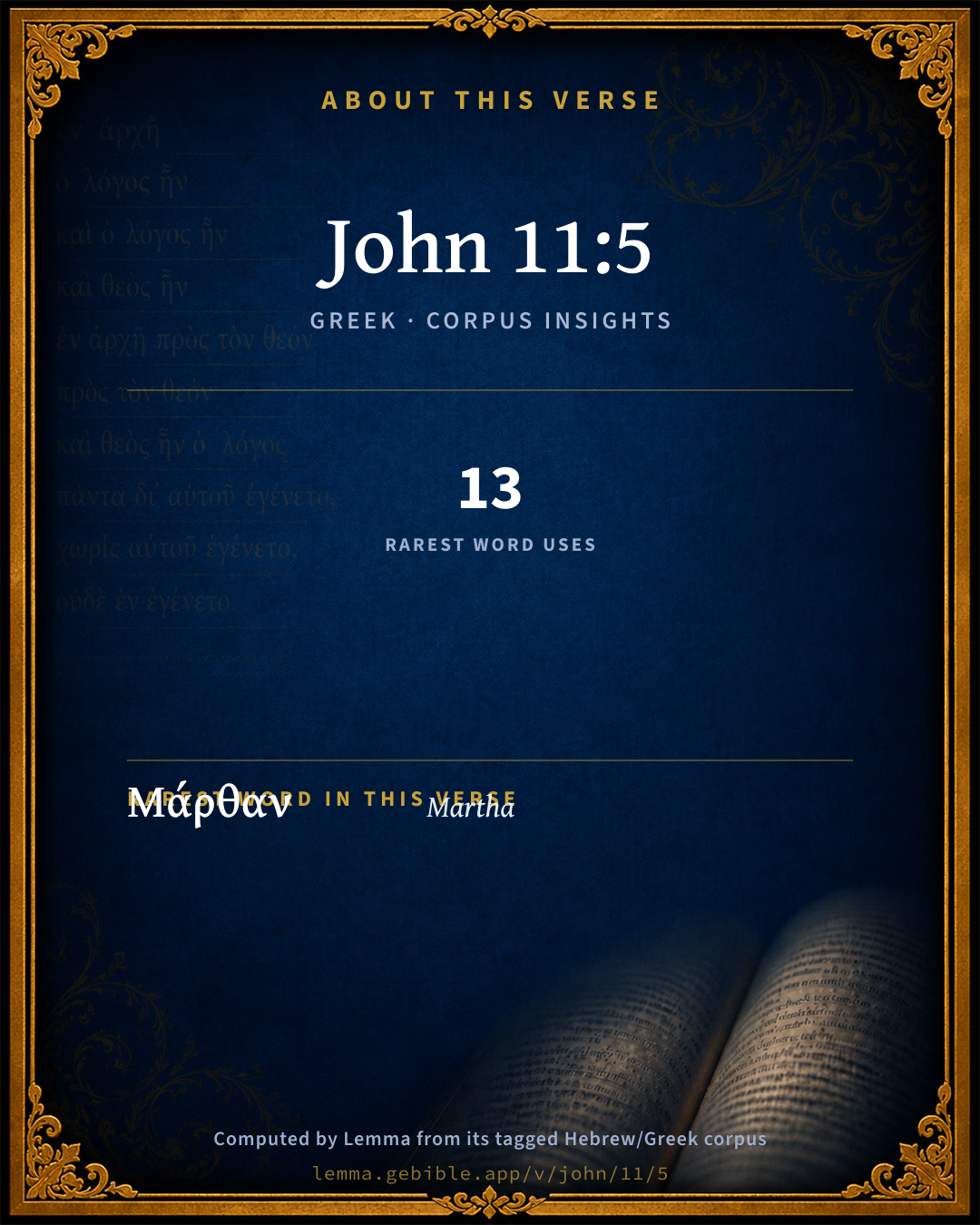
About this verse

These counts appear in no published source. They are computed here, from the morphology-tagged text and Lemma’s own curated glosses. What Lemma adds →

13
words
9
distinct lemmas
Gospels
section

Notable vocabulary

The rarest word here is Μάρθαν Martha G3136 — appearing just 13 times in the whole Greek New Testament.

Shared distinctive vocabulary

Μάρθαν Martha G3136 occurs in 12 verses of the Greek New Testament. Also found in:

Repetition

Words recur within this verse:

Cross-references

5

Topical passages linked to John 11:5 in the Treasury of Scripture Knowledge — connected by theme and wording, ordered by reader-vote popularity; previews shown in the World English Bible.

  • John 15:9–13 Even as the Father has loved me, I also have loved you. Remain in my love.
  • John 11:36 The Jews therefore said, "See how much affection he had for him!"
  • John 17:26 I made known to them your name, and will make it known; that the love with which you loved me may be in them, and I in them."
  • John 16:27 for the Father himself loves you, because you have loved me, and have believed that I came forth from God.
  • John 11:8 The disciples told him, "Rabbi, the Jews were just trying to stone you, and are you going there again?"

Cross-references courtesy of OpenBible.info (CC BY 4.0).

Commentary

Notes on John 11:5 from classic Christian and Jewish commentators (each source and its license shown beneath its notes). The classic Christian expositions comment on the surrounding passage and are grouped to its opening verse, so a note may address several verses; the Jewish commentaries on the Tanakh (Rashi and others) are per-verse, so they appear only where the commentator wrote on this verse.

Lemma curates 59 commentaries, every one of them public domain or Creative Commons licensed, each selected and text-cleaned for this edition rather than reprinted as found. About our sources →

Ellicott's Commentary for English Readers

(5) Now Jesus loved Martha.—It is not easy to see the connection of this verse with that which precedes, or with that which immediately follows. The fact of His abiding two days where He was, seems indeed opposed to the thought of His special love for the family. The most probable explanation is that which connects Joh_11:5-7 together, and makes the love the motive for going into Judæa again.

The word rendered “loved” here is different from that in Joh_11:3. There the word signifies the love of tender affection; here the word, means the love of chosen friendship. (Comp. Joh_20:2; Joh_21:15 et seq.) The difference here is not to be explained, as it frequently has been, by the difference in the persons who were the objects of the love; but by the difference of the persons whose words we read. In the language of the sisters, whose hearts are moved by the brother’s illness, the word of fullest emotion is natural. In the language of the Evangelist the other word is no less so.

It will be observed that in this verse, as in Joh_11:19 et seq., Martha takes the first place as the elder sister.

A Bible Commentary for English Readers, edited by Charles John Ellicott (1878–1897) — public domain. Text from a community e-Sword module.

MacLaren's Expositions of Holy Scripture

Alexander MacLaren

John

THE DELAYS OF LOVE

Joh 11:5 - Joh 11:6.

We learn from a later verse of this chapter that Lazarus had been dead four days when Christ reached Bethany. The distance from that village to the probable place of Christ’s abode, when He received the message, was about a day’s journey. If, therefore, to the two days on which He abode still after the receipt of the news, we add the day which the messengers took to reach Him and the day which He occupied in travelling, we get the four days since which Lazarus had been laid in his grave. Consequently the probability is that, when our Lord had the message, the man was dead. Christ did not remain still, therefore, in order to work a greater miracle by raising Lazarus from the dead than He would have done by healing, but He stayed-strange as it would appear-for reasons closely connected with the highest well-being of all the beloved three, and because He loved them.

John is always very particular in his use of that word ‘therefore,’ and he points out many a subtle and beautiful connection of cause and effect by his employment of it. I do not know that any of them are more significant and more full of illumination with regard to the ways of divine providence than the instance before us. How these two sisters must have looked down the rocky road that led up from Jericho during those four weary days, to see if there were any signs of His coming. How strange it must have appeared to the disciples themselves that He made no sign of movement, notwithstanding the message. Perhaps John’s scrupulous carefulness in pointing out that His love was Christ’s reason for His quiescence may reflect a remembrance of the doubts that had crept over the minds of himself and his brethren during these two days of strange inaction. The Evangelist will have us learn a lesson, which reaches far beyond the instance in hand, and casts light on many dark places.

I. Christ’s delays are the delays of love.

We have all of us, I suppose, had experience of desires for the removal of bitterness or sorrows, or for the fulfilment of expectations and wishes, which we believed, on the best evidence that we could find, to be in accordance with His will, and which we have been able to make prayers out of, in true faith and submission, which prayers have had to be offered over and over and over again, and no answer has come, It is part of the method of Providence that the lifting away of the burden and the coming of the desires should be a hope deferred. And instead of stumbling at the mystery, or feeling as if it made a great demand upon our faith, would it not be wiser for us to lay hold of that little word of the Apostle’s here, and to see in it a small window that opens out on to a boundless prospect, and a glimpse into the very heart of the divine motives in His dealings with us?

If we could once get that conviction into our hearts, how quietly we should go about our work! What a beautiful and brave patience there would be in us, if we habitually felt that the only reason which actuates God’s providence in its choice of times of fulfilling our desires and lifting away our bitterness is our own good! Nothing but the purest and simplest love, transparent and without a fold in it, sways Him in all that He does. Why should it be so difficult for us to believe this? If we were more in the way of looking at life, with all its often unwelcome duty, and its arrows of pain and sorrow, and all the disappointments and other ills that it is heir to, as a discipline, and were to think less about the unpleasantness, and more about the purpose, of what befalls us, we should find far less difficulty in understanding that His delay is born of love, and is a token of His tender care.

Sorrow is prolonged for the same reason as it was sent. It is of little use to send it for a little while. In the majority of cases, time is an element in its working its right effect upon us. If the weight is lifted, the elastic substance beneath springs up again. As soon as the wind passes over the cornfield, the bowing ears raise themselves. You have to steep foul things in water for a good while before the pure liquid washes out the stains. And so time is an element in all the good that we get out of the discipline of life. Therefore, the same love which sends must necessarily protract, beyond our desires, the discipline under which we are put. If we thought of it, as I have said, more frequently as discipline and schooling, and less frequently as pain and a burden, we should understand the meaning of things a great deal better than we do, and should be able to face them with braver hearts, and with a patient, almost joyous, endurance.

If we think of some of the purposes of our sorrows and burdens, we shall discern still more clearly that time is needed for accomplishing them, and that, therefore, love must delay its coming to take them away. For example, the object of them all, and the highest blessing that any of us can obtain, is that our wills should be bent until they coincide with God’s, and that takes time. The shipwright, when he gets a bit of timber that he wants to make a ‘knee’ out of, knows that to mould it into the right form is not the work of a day. A will may be broken at a blow, but it will take a while to bend it. And just because swiftly passing disasters have little permanent effect in moulding our wills, it is a blessing, and not an evil, to have some standing fact in our lives, which will make a continual demand upon us for continually repeated acts of bowing ourselves beneath His sweet, though it may seem severe, will. God’s love in Jesus Christ can give us nothing better than the opportunity of bowing our wills to His, and saying, ‘Not mine, but Thine be done.’ If that is why He stops on the other side of Jordan, and does not come even to the loving messages of beloved hearts, then He shows His love in the sweetest and the loftiest form. So, dear friends, if you carry a lifelong sorrow, do not think that it is a mystery why it should lie upon your shoulders when there are omnipotence and an infinite heart in the heavens. If it has the effect of bending you to His purpose, it is the truest token of His loving care that He can send. In like manner, is it not worth carrying a weight of unfulfilled wishes, and a weariness of unalleviated sorrows, if these do teach us three things, which are one thing-faith, endurance, prayerfulness, and so knit us by a threefold cord that cannot be broken, to the very heart of God Himself?

II. This delayed help always comes at the right time.

Do not let us forget that Heaven’s clock is different from ours. In our day there are twelve hours, and in God’s a thousand years. What seems long to us is to Him ‘a little while.’ Let us not imitate the shortsighted impatience of His disciples, who said, ‘What is this that He saith, A little while? We cannot tell what He saith.’ The time of separation looked so long in anticipation to them, and to Him it had dwindled to a moment. For two days, eight-and-forty hours, He delayed His answer to Mary and Martha, and they thought it an eternity, while the heavy hours crept by, and they only said, ‘It’s very weary, He cometh not, they said.’ How long did it look to them when they had got Lazarus back?

The longest protraction of the fulfilment of the most yearning expectation and fulfilled desire will seem but as the winking of an eyelid when we get to estimate duration by the same scale by which He estimates it, the scale of Eternity. The ephemeral insect, born in the morning and dead when the day fades, has a still minuter scale than ours, but we should not think of regulating our estimate of long and short by it. Do not let us commit the equal absurdity of regulating the march of His providence by the swift beating of our timepieces. God works leisurely because God has eternity to work in.

The answer always comes at the right time, and is punctual though delayed. For instance, Peter is in prison. The Church keeps praying for him; prays on, day after day. No answer. The week of the feast comes. Prayer is made intensely and fervently and continuously. No answer. The slow hours pass away. The last day of his life, as it would appear, comes and goes. No answer. The night gathers; prayer rises to heaven. The last hour of the last watch of the last night that he had to live has come, and as the veil of darkness is thinning, and the day is beginning to break, ‘the angel of the Lord shone round about him.’ But there is no haste in his deliverance. All is done leisurely, as in the confidence of ample time to spare, and perfect security. He is bidden to arise quickly, but there is no hurry in the stages of his liberation. ‘Gird thyself and bind on thy sandals.’ He is to take time to lace them. There is no fear of the quaternion of soldiers waking, or of there not being time to do all. We can fancy the half-sleeping and wholly-bewildered Apostle fumbling at the sandal-strings, in dread of some movement rousing his guards, and the calm angel face looking on. The sandals fastened, he is bidden to put on his garments and follow. With equal leisure and orderliness he is conducted through the first and the second guard of sleeping soldiers, and then through the prison gate. He might have been lifted at once clean out of his dungeon, and set down in the house many were gathered praying for him. But more signal was the demonstration of power which a deliverance so gradual gave, when it led him slowly past all obstacles and paralysed their power. God is never in haste. He never comes too soon nor too late. ‘The Lord shall help them, and that right early.’ Sennacherib’s army is round the city, famine is within the walls. To-morrow will be too late. But to-night the angel strikes, and the enemies are all dead men. So God’s delay makes the deliverance the more signal and joyous when it is granted. And though hope deferred may sometimes make the heart sick, the desire, when it comes, is a tree of life.

III. The best help is not delayed.

The principle which we have been illustrating applies only to one half-and that the less important half-of our prayers and of Christ’s answers. For in regard to spiritual blessings, and our petitions for fuller, purer, and diviner life, there is no delay. In that region the law is not ‘He abode still two days in the same place,’ but ‘Before they call I will answer, and while they are yet speaking I will hear.’ If you have been praying for deeper knowledge of God, for lives liker His, for hearts more filled with the Spirit, and have not had the answer, do not fall back upon the misapplication of such a principle as this of my text, which has nothing to do with that region; but remember that the only reason why good people do not immediately get the blessings of the Christian life for which they ask lies in themselves, and not at all in God. ‘Ye have not, because ye ask not. Ye ask and have not, because’-not because He delays, but because-’ye ask amiss,’ or because, having asked, you get up from your knees and go away, not looking to see whether the blessing is coming down or not.

Ah! there is a sad amount of lying and hypocrisy in prayers for spiritual blessings. Many petitioners do not want to have them. They would not know what to do with them if they got them. They make the requests because their fathers did so before them, and because these are the right kind of things to say in a prayer. Such prayers get no answers. If a man prays for some spiritual enlargement, and then goes out into the world and lives clean contrary to his prayers, what right has he to say that God delays His answers? No, He does not delay His answers, but we push back His answers, and the gift that is given we will not take. Let us remember that the two halves of the divine dealings are not regulated by the same principle, though they be regulated by the same motive; and that the love which often delays for our good, in regard to the desires that have reference to outward things, is swift as the lightning to answer every petition which moves within the circle of our spiritual life.

‘Whatsoever things ye desire, when ye stand praying, believe that’ then and there ‘ye receive them’; and the undelaying God will take care that ‘you shall have them.’

Alexander MacLaren, Expositions of Holy Scripture (1904–1910) — public domain. Text from a community e-Sword module.

Bengel's Gnomon

Johann Albrecht Bengel

Joh 11:5. Ἠγάπα) loved, in such a way as that it was evident to all; Joh 11:3, “Lord, he whom Thou lovest.” [Therefore there is no reason that any one should exceedingly dread the death of those whom Jesus loves.—V. g.] The motive cause of the raising again of the dead man, and of the whole of His mode of action preceding it, is herein contained.—καὶ, καί, and, and) Happy family!

Bengel's Gnomon of the New Testament — English translation (T&T Clark, Edinburgh, 1860) — public domain. Text from a community e-Sword module.

Meyer's Critical & Exegetical Commentary

Heinrich August Wilhelm Meyer

Joh_11:5 is not an elucidation of Joh_11:3 (De Wette), seeing that Joh_11:4 intervenes; nor is it a preparation for Joh_11:6 (B. Crusius: although He loved them all, He nevertheless remained); but explains the motive impelling Him to open up to them the consolatory prospect referred to in Joh_11:4 : Felix familia, Bengel.

ἠγάπα] An expression chosen with delicate tenderness (the more sensuous φιλεῖν is not again used as in Joh_11:4), because the sisters are also mentioned. Comp. Xen. Mem. ii. 7. 12; Tittmann, Synon. p. 53; and Wetstein. Martha is named first, as being the mistress of the house, and the eldest (Joh_11:19 f.). Compare the preceding note. Hengstenbergs remark is arbitrary: Mary could not bear to be separated from Lazarus, because she had been most deeply affected by his death.

Meyer — Critical and Exegetical Commentary on the New Testament — English translation by Peter Christie, edited by Frederick Crombie (T&T Clark, 1880) — public domain. Text from a community e-Sword module.

Expositor's Greek Testament

ed. W. Robertson Nicoll

Joh 11:5 . Ἠγάπα δὲ ὁ Ἰησοῦς … It is quite true that φιλεῖν denotes the more passionate love, and ἀγαπᾶν the more reasoning; but it is doubtful whether this distinction is observed in this Gospel. Passages proving the distinction are given by Wetstein.

The Expositor's Greek Testament, edited by W. Robertson Nicoll (1897–1910) — public domain. Text from a community e-Sword module.

Godet's Commentaries

Frédéric Louis Godet

Vv. 5-7. “Now Jesus loved Martha and her sister and Lazarus. 6. When therefore he heard that he was sick, he remained yet two days in the place where he was; 7 then, when this time had passed, he says to the disciples,Let us go into Judea again.”

It might be supposed that the remark introduced parenthetically into the narrative, in Joh 11:5, has as its purpose to prevent the idea that the delay of two days mentioned in Joh 11:6 arose from indifference. But the οὖν, therefore, of Joh 11:6, is opposed to this explanation. In order fully to understand the design of this remark, account must be taken of the μέν of Joh 11:6, which supposes a δέ understood in Joh 11:7 : “Jesus loved Martha and Mary...and Lazarus....When therefore He heard of it, He remained, it is true (μέν); but, afterwards He said: Let us go...” We perceive thus that the remark of Joh 11:5 : He loved, refers not to the:He remained, of Joh 11:6, but to the order to set out given in Joh 11:7. This quite simple explanation does away with several forced suppositions, for example, that Jesus meant: Although Jesus loved, or this other: Because He loved, He remained, to the end of testing longer the faith of the two sisters. Jesus uses here the term of dignity, ἀγαπᾷν, instead of that of tenderness φιλεῖν (Joh 11:3), either, as the interpreters think, because the question is of the affection of Jesus for the two sisters—but would not the Lord’s disciple be raised above such prepossessions?—or rather because the nobler term is better suited to the pen of the evangelist, while the expression of tenderness was more appropriate in the mouth of the sisters. Martha occupies here, as in Joh 11:19, the first place (see on Joh 11:1).

Bretschneider, Strauss and Baur explain the two days’ delay mentioned in Joh 11:6 by a personal motive on Jesus’ part. He purposely desired to allow Lazarus to die, in order that He might have the opportunity, not only of healing him, but of raising him to life; these writers find here a proof of the non-authenticity of the narrative. But there is no allusion in the text to such an intention of Jesus; and even Joh 11:15 : “I rejoice for your sakes that I was not there,” positively excludes it; for Jesus may well rejoice in a divine dispensation, but not in a thing which He had voluntarily and purposely caused. Moreover, it will appear from the sequel of the story that, at the moment when Jesus received the message of the sisters, Lazarus had already breathed his last. If indeed, counting backwards, we reckon the four days mentioned in Joh 11:17; Joh 11:39, which elapsed from the burial of Lazarus to the arrival of Jesus at Bethany, these days can only be as follows: the fourth and last is that in which Jesus makes the journey from Peraea to Bethany. From Bethany to Jericho is a journey of about six hours, and from Jericho to the Jordan of an hour and a half. It was therefore, in all, a journey of seven and a half or eight leagues from the Jordan, near the place where Jesus was, to Bethany; it might easily be made in one day. The second and third days are the two which Jesus passed in Peraea after having received the message of the sisters. Finally, the first is that in which the messenger arrived in Peraea to inform Jesus. It was therefore in the course of this day, a little while after the departure of the messenger, that Lazarus died, and also in the course of the same day that he was buried, according to the Jewish custom.

Thus towards evening, when Jesus received the tidings of His friend’s sickness, He was already in the tomb. We see clearly how erroneous is the reckoning of Keim who says (i., p. 495): “Three days were needed for Jesus to go from that region of Peraea to Bethany.” Meyer is no less in error when he takes as the starting point of the four days which had elapsed since the burial of Lazarus (Joh 11:17) the day which followed the two days of waiting in Peraea. How could Jesus have taken three whole days for reaching Bethany from the Jordan? As to the reason which prevented Jesus from setting out on the journey immediately, it may be supposed, no doubt, with Lucke and Neander, that it was the work of His ministry in Peraea. But is it not better to say, with Meyer, that it was the waiting for the signal from the Father, by which Jesus always regulated His action? God might certainly act as Jesus, as a man, would not have done, and prolong the time of waiting with the design of making the miracle more manifest and more striking, with a view to the glory of His Son and His own glory.

Frédéric Louis Godet — Commentaries on Luke, John, Romans, and 1 Corinthians — English translation (T&T Clark, Edinburgh, 1870s–1890s) — public domain. Text from a community e-Sword module.

Jamieson, Fausset & Brown

Robert Jamieson, A. R. Fausset & David Brown

Jesus loved Martha and her sister and Lazarus--what a picture!--one that in every age has attracted the admiration of the whole Christian Church. No wonder that those miserable skeptics who have carped at the ethical system of the Gospel, as not embracing private friendships in the list of its virtues, have been referred to the Saviour's peculiar regard for this family as a triumphant refutation, if such were needed.

Jamieson, Fausset & Brown — Commentary Critical and Explanatory on the Whole Bible (1871) — public domain (CC PDM 1.0). Text via the HelloAO Bible API.

Adam Clarke's Commentary

Verse 5. Now Jesus loved Martha, and her sister, and Lazarus.] Therefore his staying two days longer in Bethabara was not through lack of affection for this distressed family, but merely that he might have a more favourable opportunity of proving to them how much he loved them. Christ never denies a less favour, but in order to confer a greater. God's delays, in answering prayers offered to him by persons in distress, are often proofs of his purpose to confer some great kindness, and they are also proofs that his wisdom finds it necessary to permit an increase of the affliction, that his goodness may be more conspicuous in its removal.

Adam Clarke's Commentary on the Bible (1810–1826) — public domain. Text from a community e-Sword/MySword module.

John Calvin's Commentaries

5. And Jesus loved Martha and her sister, and Lazarus. These two things appear to be inconsistent with each other, that Christ remains two days beyond Jordan, as if he did not care about the life of Lazarus, and yet the Evangelist says, that Christ loved him and his sisters; for, since love produces anxiety, he ought to have hastened immediately. As Christ is the only mirror of the grace of God, we are taught by this delay on his part, that we ought not to judge of the love of God from the condition which we see before our eyes. When we have prayed to him, he often delays his assistance, either that he may increase still more our ardor in prayer, or that he may exercise our patience, and, at the same time, accustom us to obedience. Let believers then implore the assistance of God, but let them also learn to suspend their desires, if he does not stretch out his hand for their assistance as soon as they may think that necessity requires; for, whatever may be his delay, he never sleeps, and never forgets his people. Yet let us also be fully assured that he wishes all whom he loves to be saved.

John Calvin's Commentaries (1540-1563) — public domain. Text from the Calvin Translation Society English edition (1840s-50s) via the Christian Classics Ethereal Library (ccel.org). Calvin's coverage is partial (roughly two-thirds of the Bible); uncommented books and verses are honest gaps, never fabricated. The 19th-century editor's footnotes and remarks are omitted so the notes are faithfully Calvin's own voice.

The Cambridge Bible for Schools and Colleges

gen. ed. J. J. S. Perowne

5. Now Jesus loved Martha] The English Version loses much here, and still more in Joh_21:15-17, by using the same word ‘love’ to translate two different Greek words: nor can the loss be remedied satisfactorily. The word used in Joh_11:3, philein (Lat. amare), denotes a passionate, emotional warmth, which loves and cares not to ask why; the affection of lovers, parents, and the like. The word used here agapân, (Lat. diligere), denotes a calm, discriminating attachment, which loves because of the excellence of the loved object; the affection of friends. Philein is the stronger, but less reasoning; agapân the more earnest, but less intense. The sisters naturally use the more emotional word, describing their own feeling towards their brother; the Evangelist equally naturally uses the loftier and less impulsive word. The fact that the sisters are here included is not the reason for the change of expression.

Martha, and her sister, and Lazarus] The names are probably in order of age. This and Joh_11:19 confirm what is almost certain from Luk_10:38, that Martha is the elder sister.

The Cambridge Bible for Schools and Colleges (gen. ed. J. J. S. Perowne; Cambridge University Press, 1878–1918) — public domain. Text from a community e-Sword module.

John Gill's Exposition

Now Jesus loved Martha, and her sister, and Lazarus. Not only with an everlasting love, a love of complacency and delight, an unchangeable one, and which never varies, nor will ever end, with which he loves all his people alike; but with a very great human affection, and which was very singular and peculiar to them: these were the intimate friends, and familiar acquaintance of Christ, whom he often visited, at whose house he frequently was when in those parts; they were very hospitable to him; they kindly received him into their houses, and generously entertained him, and which he returned in love to them: hence Nonnus paraphrases the words,

"Jesus loved the women, "who were lovers of hospitality", by the law of kindness.''

John Gill's Exposition of the Whole Bible (1746–1763) — public domain (CC PDM 1.0). Text via the HelloAO Bible API.

Trapp's Complete Commentary

John Trapp

5 Now Jesus loved Martha, and her sister, and Lazarus.

Ver. 5. Jesus loved Martha] The saints are all round about his throne, Rev 4:4, because he is alike near to them for solace and tuition. Howbeit, as man; living among men, he was affected to some more than some, as to these three, and the beloved disciple. These were his Jedediahs, his singularly affected, and this was a high prerogative. Plato commendeth his country of Athens for antiquity of the people, &c., but chiefly for this, that they were beloved of the gods, το πρωτον και μεγιστον εστι οιτ τογχανει ουν θεοφιλης. (Plato.)

John Trapp, A Commentary or Exposition upon All the Books of the Old and New Testament (1647–1656) — public domain. Text from a community e-Sword module.

Matthew Poole's English Annotations

He doubtless loved them with a special, distinguishing love, as persons chosen in him to eternal life before the foundation of the world, given unto him by an eternal donation, called by him with an effectual calling, to own and receive him as their Saviour; but this text seemeth to speak of him as loving this family with a human love, which inclineth man to a complacency in an object beloved: he had a kindness for the whole family; they had showed them kindness in his state of humiliation, and he loved those that so loved him, Pro 8:17.

Matthew Poole's English Annotations on the Holy Bible (1683–1685) — public domain. Text from a community e-Sword/MySword module.

Whedon's Commentary on the Bible

Daniel D. Whedon

5. Jesus loved Martha—By placing Martha’s name first, John puts an unconscious contradiction upon all irreverent thought that the tenderest love of Jesus for one of the opposite sex was other than divinely sacred. The Greek term for love, in Joh_11:3, implies the love of affection; that in this verse of esteem or friendship.

Daniel D. Whedon (gen. ed.), Commentary on the Old and New Testaments (1874–1909) — public domain. Text from a community e-Sword module.

The Pulpit Commentary

Now Jesus loved (hgapa) Martha, and her sister, and Lazarus. "Felix familia!" (Bengel). Martha is here mentioned first, because in all probability the head of the household. The love of selection, friendship, or esteem is the result of long acquaintance, and reveals "the fragmentariness of the evangelic records" (Westcott); see note on ver. 3.

HOMILIES BY J.R. THOMSON Ver. 5. Jesus as a Friend.

Whilst the narratives of the four evangelists are chiefly concerned with the Savior"s public ministry, it is interesting to be allowed, with their aid, now and again to gain a glimpse into the sanctuary of his more private life, his more intimate associations with his personal friends. The simplicity of the statement made in this verse is just what might be expected from St. John. Himself a chosen and beloved companion and friend, he knew how tender was the Master"s heart, and took pleasure in recording instances of his sympathy and affection.

I LIGHT IS HERE CAST UPON THE CHARACTER OF THE FAMILY AT BETHANY. What manner of people must those have been whom Jesus loved! The narrative gives us several particulars regarding the sisters, so that we can appreciate the affectionate temper of both the eager and practical nature of Martha, and the more contemplative habit and the quiet enthusiasm of Mary. Perhaps too much has been made of the slight indications afforded by the evangelists of the characters of these two sisters respectively. However this may be, they and their brother Lazarus were all mutually attached, and were all in common devoted to Jesus. That it was exquisite grace and condescension on the part of Jesus to honor them with his society and his intimacy is undeniable. Yet there was a sense in which he counted this household "worthy," so that his peace rested upon it. The life of all three inmates of this happy and harmonious home was made radiant by the visits of Jesus during his lifetime; and by the memory of his friendship it must have been sanctified and sweetened as long as the circle was unbroken.

II LIGHT IS HERE CAST UPON THE CHARACTER AND DISPOSITIONS OF THE LORD JESUS HIMSELF. We see him in his true and perfect humanity, when we see him in the household of Bethany. It is the same figure, the same Divine Teacher and Master whom we see upon the mountain or by the shore, and in the judgment-hall of Pilate. Yet we are familiar with the newness of aspect under which here and there a man appears to us when we meet him amidst his family, or as we English say, "by his fireside." It is in the home that the softer, gentler, more sympathetic features of the character reveal themselves. Imagination pictures Jesus as he visited the home at Bethany in its days of tranquility and prosperity, and reproduces the tones of his discourse, the expression of his countenance; or as he came when the household was plunged in sorrow, and when his sympathy soothed them, and when his omnipotence restored their dead one to life and fellowship. As the perfect Son of man, Jesus was not merely the public Preacher; he was the private Friend. His ministry was not only one of general benevolence; it was one of personal affection.

III LIGHT IS HERE CAST UPON THE PROVISION MADE FOR A PERPETUAL FRIENDSHIP BETWEEN JESUS AND HIS PEOPLE. Our Lord, as St. John has recorded, declared his people to be his friends, and mentioned unquestionable proofs of his friendship toward his people. It is, however, somewhat difficult for us to realize this friendship on the part of the unseen and glorified Son of God towards us in our humiliation and imperfections. But the statement made in the text brings to our minds an actual instance of the Lord"s friendship, which helps us to apprehend and to feel that it is not a mere matter of theory; that Jesus is indeed a Friend to those who welcome him into their heart and home with reverence and gratitude, and with the response of devout and ardent love. Jesus is, to those who love him, a Friend who can hallow their joys, and can soothe their griefs, who can make their dwelling bright with his radiant smile, musical with his gracious voice. T.

The Pulpit Commentary (1880–1919), ed. H.D.M. Spence-Jones & Joseph S. Exell — public domain. Text from a community e-Sword module.

Burkitt's Expository Notes on the New Testament

William Burkitt

Observe, 1. What an happy, because an holy and religious family, was here, and much honoured by Christ; Jesus loved Martha, Mary, and Lazarus: wherever true piety dwells, it draws the eye and heart of Christ towards it. Christ had frequently and familiarly lodged under their roof, and he rewards them for their entertainment with his love; Jesus loved Martha, and her sister.

Where note, That Martha is here named first, though elsewhere Mary had the precedency, to shew, no doubt, that they were both equally dear to Christ.

Observe, 2. That although Christ loved Lazarus, yet he seems to neglect him, he delays going to him for some days: but could Christ absent himself from one so long, whom he loved so well? We find he did. Let us take heed then that we do not misinterpret Christ’s delays. He seldom comes at our time , but never stays beyond his own; our Saviour had a double end in staying thus long: namely, for greatening of the miracle, and confirming of their faith. Had Christ gone before Lazarus was dead, they might have attributed his recovery rather to the strength of nature, than to Christ’s miraculous power; or had Christ raised Lazarus as soon as he was dead, they might peradventure have thought it rather some trance or ecstasy, than a death and dissolution: therefore Christ stays so many days, that God might be the more glorified, and his own omnipotent power the more magnified.

We learn then, That when Christ delays to help them whom he dearly loves, it is always for wise ends and holy purposes.

Observe, 3. How the disciples, though they were dearly affected to Lazarus (for they had learned to love where their Master loved) yet they discourage Christ from going to him into Judea, for fear of violence offered to him. Master, the Jews of late sought to stone thee, and goest thou thither again? Here the disciples pleaded for their Master’s safety, at the same time aiming at their own: they were to go with him into Judea, and they well knew that their danger was inwrapped in his, therefore they seek to divert him from his intention.

O how has the fear of suffering made many of the friends of Christ decline an opportunity of glorifying God, and doing good to others!

But cannot God give safety in the midst of danger, if he pleaseth? Let us then not chuse our way according to our own apprehension, either of danger or safety: but as we see God going before us, if our call be clear, let us go on with courage, whatever difficulties lie in our way.

Observe, 4. How our Saviour corrects these fears of his disciples, by acquainting them with his call from God, to undertake this journey into Judea, Are there not twelve hours in the day? If man walk therein, he stumbleth not: but in the night he stumbleth. As if Christ had said, "As he that walks in the day is in no danger of stumbling, but in the night he is in danger; so as long as I have a call from God, and my working time lasts, there is a divine providence that will watch over me, and secure me from all danger; now my day is not fully spent, and therefore it is not in the power of mine enemies to precipitate my passion, or to bring the night of sufferings upon me before the appointed time; but ere long the night will come on, the working time will get over, and then shall both I and you stumble upon death; but while the day lasteth we are safe."

Learn hence, 1. Every man has his twelve hours, that is, his working time, assigned him by God in this world.

2. Whilst these hours are not spent, and whilst his working time is unexpired, he shall not stumble, he shall not die, he shall not be disabled from working, while God has any work for him to do: neither the malice of men, nor the rage of devils, shall take him off till his work be finished.

3. Every man has his night as well as his day, in which he must expect and prepare to stumble; that is, to fall by death; for, when God has done his work by us and with us, he will withdraw his protection from us, but not his care over us.

We stumble upon death, and fall into the grave: but God receives us to himself, and at the end of our working season rewards us for our work.

William Burkitt's Expository Notes on the New Testament (1700–1703) — public domain. Text from a community e-Sword module.

unfoldingWord translationNotes

Door43 World Missions Community

Now Jesus loved Martha and her sister and Lazarus

This is background information. (See: Background Information)

translationWords

Jesus

love

Martha

Lazarus

disciple

Judea

unfoldingWord translationNotes — © Distant Shores Media and the Door43 World Missions Community, licensed CC BY-SA 4.0. Source: git.door43.org/Door43/en_tn.

Cambridge Greek Testament for Schools and Colleges

5. ἠγάπα. The loss involved here, and still more in Joh 21:15-17, in translating both ἀγαπᾶν and φιλεῖν by ‘love’ cannot be remedied satisfactorily. Φιλεῖν (amare) denotes a passionate, emotional warmth, which loves and does not care to ask why; the affection which is based on natural relationship, as of parents, brothers, lovers, and the like. Ἀγαπᾶν (diligere) denotes a calm discriminating attachment, which loves because of the excellence of the loved object; the affection which is based on esteem, as of friends. Φιλεῖν is the stronger, but less reasoning; ἀγαπᾶν the more earnest, but less intense. The sisters naturally use the more emotional word (Joh 11:3), describing their own feeling towards their brother; the Evangelist equally naturally uses the loftier and less impulsive word. The fact that the sisters are here included is not the reason for the change of expression. Both words are used of the love of the Father to the Son; φιλεῖν (Joh 5:20), because the love is founded on relationship; ἀγαπᾶν (Joh 3:35, Joh 10:17, Joh 15:9, Joh 17:23-24; Joh 17:26), because of the character of the love.

τ. Μάρθαν κ.τ.λ. The names are probably in order of age. This and Joh 11:19 confirm what is almost certain from Luk 10:38, that Martha is the elder sister. The separate mention of each of the three is touching and impressive.

Cambridge Greek Testament for Schools and Colleges (Cambridge University Press, 1896; 21 vols, various authors incl. Carr, Maclear, Plummer, Farrar, Lumby, Moule, M. R. James, Simcox) — public domain. Text from a community e-Sword module.

International Critical Commentary

5. Moffatt transposes this verse, placing it after the parenthetical v. 2; and this is the most natural position for it, as it then explains in proper sequence why it was that the sisters sent to Jesus the news that Lazarus was ill. Jesus was their friend, and they hoped that He would come and heal their sick brother. In the traditional position of v. 5, it seems to suggest as the reason why Jesus did not immediately leave Peræa and start for the sick man’s house, that because He loved the household at Bethany, He stayed for two days longer where He was. That is, no doubt, a possible explanation of His action or delay, sc. that because He loved them, He wished to exhibit in their case the greatness of His power and the reach of His compassion. But, if that were so, He was content to leave the sisters in the agony of grief for three or four days, in order that the “glory of God” might be more signally vindicated in the end.

There is no textual authority for Moffatt’s transposition of the text, and I have left v. 5 in its traditional position. It is possible, however, that v. 5 is an explanatory gloss added by an editor which has got into the wrong place (see 4:44 for a like case of displacement). Two small points suggest that v. 5 is not from the pen of the author of vv. 1, 3. In v. 1 we have Mary and her sister Martha, while in v. 5 we have the more usual order, Martha and her sister,1 a sudden change (but cf. v. 19). Again, the verb twice used in this chapter for the affection which Jesus had for Lazarus is φιλεῖν (vv. 3, 36), while in v. 5 it is ἀγαπᾶν. We must not, indeed, sharply distinguish these verbs (see on 21:17); but we should expect the same verb to be used in v. 3 and v. 5. It is possible that v. 5 is a non-Johannine gloss, which ought to be placed where Moffatt places it, after v. 2.

International Critical Commentary — older volumes (1896–1929), various authors — public domain. Text from a community e-Sword module.

Vincent's Word Studies in the New Testament

Marvin R. Vincent

Loved [ηγαπα] . Notice the verb here : not fileiv, as ver. 3. See on 5 20. Lazarus is not mentioned in Luk 10:38 sqq.

Marvin R. Vincent, Word Studies in the New Testament (1887–1900) — public domain. Text from a community e-Sword/MySword module.

Lesson kit

Teaching starters — assembled from the data on this page, not authored interpretation. Every prompt links to the verse data it draws on. Edit before teaching.

John, in the Gospels, opens this verse with 13 words (9 distinct Greek lemmas). Its most distinctive word is Mártha (“Martha”). A historical commentator’s framing appears above. Read the whole chapter for the surrounding context.

Discussion questions

  1. What does “Martha” (Mártha) contribute to the verse as a whole?
  2. Luke 10:38 shares the word «Martha» with this verse. How do the two illuminate each other?
  3. “the” occurs 4× in this one verse. What is the effect of the repetition?
  4. Reading how Ellicott's Commentary for English Readers and MacLaren's Expositions of Holy Scripture read this verse, where do the two commentators agree and where do they part?

Things to notice

Reading settings

Reading text

Shown beneath each verse's original-language words.

Old Testament
Old Testament edition

Read the OT as the Masoretic Hebrew (MT) or the Greek Septuagint (LXX).

English shown for the Greek Septuagint (in the Hebrew ↔ Greek comparison).

Comparing translations? Open the Compare panel on any verse page to stack up to four side by side.