John 12:35

Greek (Tischendorf 8th ed.) John 12:35 appears in the Greek New Testament. The text above is from the Tischendorf 8th edition. Each word links to its Strong’s number and a concise gloss. Click any word for its full Thayer’s Greek Lexicon entry.
Download image
Cite this verse

John 12:35 (World English Bible). Public Domain. Lemma interlinear Bible study tool, https://lemma.gebible.app/v/john/12/35.

Show BibTeX & RIS
BibTeX
RIS
English Translation
Jesus therefore said to them, "Yet a little while the light is with you. Walk while you have the light, that darkness doesn't overtake you. He who walks in the darkness doesn't know where he is going.
World English Bible · Public Domain
Download a study sheet

One document with this verse’s original text, its word-by-word gloss line, the meaning frame, cross-references with their text, attributed commentary, and full source and license credits — printable, and it pastes into notes with its structure intact.

This verse Autodidact and up

Study sheet (.html) Plain text (.txt)

A passage Seminary Student

Up to 50 verses in one chapter. A passage sheet keeps up to 6 commentary sources and 12 cross-references per verse, in the order this page ranks them, and says so on the sheet whenever that leaves anything out. Ask for a single verse and you get the Autodidact verse sheet above.

Everything on this page stays free to read, with no account — the sheet is a download of what is already on screen, not access to it.

Want to remove ads? Support Godless Engineer
Compare translations 3

The same verse in 3 English versions, stacked beneath the original-language interlinear above. Click any original word for its lexicon entry.

Each is an independent rendering of the whole verse — the interlinear is not word-aligned to these translations.

Highlighted words mark where these versions differ — a whole-verse word diff, not a word-by-word alignment.

  • World English Bible Public Domain
    Jesus therefore said to them, "Yet a little while the light is with you. Walk while you have the light, that darkness doesn't overtake you. He who walks in the darkness doesn't know where he is going.
  • King James Version Public Domain
    Then Jesus said unto them, Yet a little while is the light with you. Walk while ye have the light, lest darkness come upon you: for he that walketh in darkness knoweth not whither he goeth.
  • unfoldingWord Literal Text CC BY-SA 4.0
    Jesus then said to them, “The light will be with you yet a short time. Walk while you have the light, so that darkness might not overtake you. And the one walking in the darkness does not know where he goes.

unfoldingWord Literal Text — © unfoldingWord, licensed CC BY-SA 4.0. Word-aligned USFM3 via Door43 (git.door43.org/unfoldingWord/en_ult).

Versions to compare (up to 4)

3 of 4 selected

Show all 19 translations

Every available English version of this verse, each an independent rendering of the whole verse.

  • World English Bible Public Domain
    Jesus therefore said to them, "Yet a little while the light is with you. Walk while you have the light, that darkness doesn't overtake you. He who walks in the darkness doesn't know where he is going.
  • Berean Standard Bible Public Domain
    Then Jesus told them, “For a little while longer, the Light will be among you. Walk while you have the Light, so that darkness will not overtake you. The one who walks in the darkness does not know where he is going.
  • Majority Standard Bible Public Domain
    Then Jesus told them, “For a little while longer, the Light will be with you. Walk while you have the Light, so that darkness will not overtake you. The one who walks in the darkness does not know where he is going.
  • King James Version Public Domain
    Then Jesus said unto them, Yet a little while is the light with you. Walk while ye have the light, lest darkness come upon you: for he that walketh in darkness knoweth not whither he goeth.
  • American Standard Version (1901) Public Domain
    Jesus therefore said unto them, Yet a little while is the light among you. Walk while ye have the light, that darkness overtake you not: and he that walketh in the darkness knoweth not whither he goeth.
  • Revised Version (1885) Public Domain
    Jesus therefore said unto them, Yet a little while is the light among you. Walk while ye have the light, that darkness overtake you not: and he that walketh in the darkness knoweth not whither he goeth.
  • Geneva Bible (1599) Public Domain
    Then Iesus sayd vnto them, Yet a litle while is the light with you: walke while ye haue that light, lest the darkenes come vpon you: for hee that walketh in the darke, knoweth not whither he goeth.
  • Douay-Rheims (1899) Public Domain
    Jesus therefore said to them: Yet a little while, the light is among you. Walk whilst you have the light, that the darkness overtake you not. And he that walketh in darkness, knoweth not whither he goeth.
  • Young's Literal Translation Public Domain
    Jesus, therefore, said to them, `Yet a little time is the light with you; walk while ye have the light, that darkness may not overtake you; and he who is walking in the darkness hath not known where he goeth;
  • Literal Standard Version CC BY-SA 4.0
    Therefore Jesus said to them, “Yet a short time is the light with you; walk while you have the light, that darkness may not overtake you; and he who is walking in the darkness has not known where he goes;
  • Unlocked Literal Bible CC BY-SA 4.0
    Jesus then said to them, “The light will still be with you for a short amount of time. Walk while you have the light, so that darkness does not overtake you. He who walks in the darkness does not know where he is going.
  • unfoldingWord Literal Text CC BY-SA 4.0
    Jesus then said to them, “The light will be with you yet a short time. Walk while you have the light, so that darkness might not overtake you. And the one walking in the darkness does not know where he goes.
  • Darby Bible Public Domain
    Jesus therefore said to them, Yet a little while is the light amongst you. Walk while ye have the light, that darkness may not overtake you. And he who walks in the darkness does not know where he goes.
  • World Messianic Bible Public Domain
    Yeshua therefore said to them, “Yet a little while the light is with you. Walk while you have the light, that darkness doesn’t overtake you. He who walks in the darkness doesn’t know where he is going.
  • Webster's Bible Public Domain
    Then Jesus said to them, Yet a little while is the light with you. Walk while ye have the light, lest darkness come upon you: for he that walketh in darkness knoweth not whither he goeth.
  • Free Bible Version CC BY-SA 4.0
    Jesus replied, “The light is here with you for a little longer. Walk while you have the light so that the darkness doesn't overtake you. Those who walk in the dark don't know where they're going.
  • Bible in Basic English Public Domain
    Jesus said to them, For a little time longer the light will be among you; while you have the light go on walking in it, so that the dark may not overtake you: one walking in the dark has no knowledge of where he is going.
  • Text-Critical English NT CC BY 4.0
    Jesus said to them, “The light is with you for a little while longer. Walk while you have the light, so that the darkness will not overtake you. He who walks in the darkness does not know where he is going.
  • Tyndale New Testament (1534) Public Domain
    Then Iesus sayde vnto them: yet a lytell whyle is the light with you. Walke whill ye have light lest the darcknes come on you. He that walketh in the darke wotteth not whither he goeth.

Literal Standard Version (2020), Covenant Press — licensed CC BY-SA 4.0. Text via the HelloAO Bible API (eBible.org). Unlocked Literal Bible (unfoldingWord) — licensed CC BY-SA 4.0. Text via the HelloAO Bible API (eBible.org). unfoldingWord Literal Text — © unfoldingWord, licensed CC BY-SA 4.0. Word-aligned USFM3 via Door43 (git.door43.org/unfoldingWord/en_ult). Free Bible Version, Dr. Jonathan Gallagher — licensed CC BY-SA 4.0. Text via the HelloAO Bible API (eBible.org).

Word by word

More ways to search: Search by grammar → Find every occurrence → Compare this word →

Practice this passage: Drill this verse → Learn its vocabulary →

μικρὸν
mikrón
G3397
“small”
Adjective, Accusative, Singular, Masculine
Part of Speech
Adjective
Case
Accusative
Number
Singular
Gender
Masculine
Full Thayer's Definition

Origin: masculine or neuter singular of G3398 (as noun)

TDNT: None

1. small, little a. of size: of stature, of length b. of space c. of age: less by birth, younger d. of time: short, brief, a little while, how little! e. of quantity: i.e. number, amount f. of rank or influence When translated "a little while", the Greek emphasises theshortness of the time interval, "oh how little". This phrase usedoften in the NT of the return of Christ.
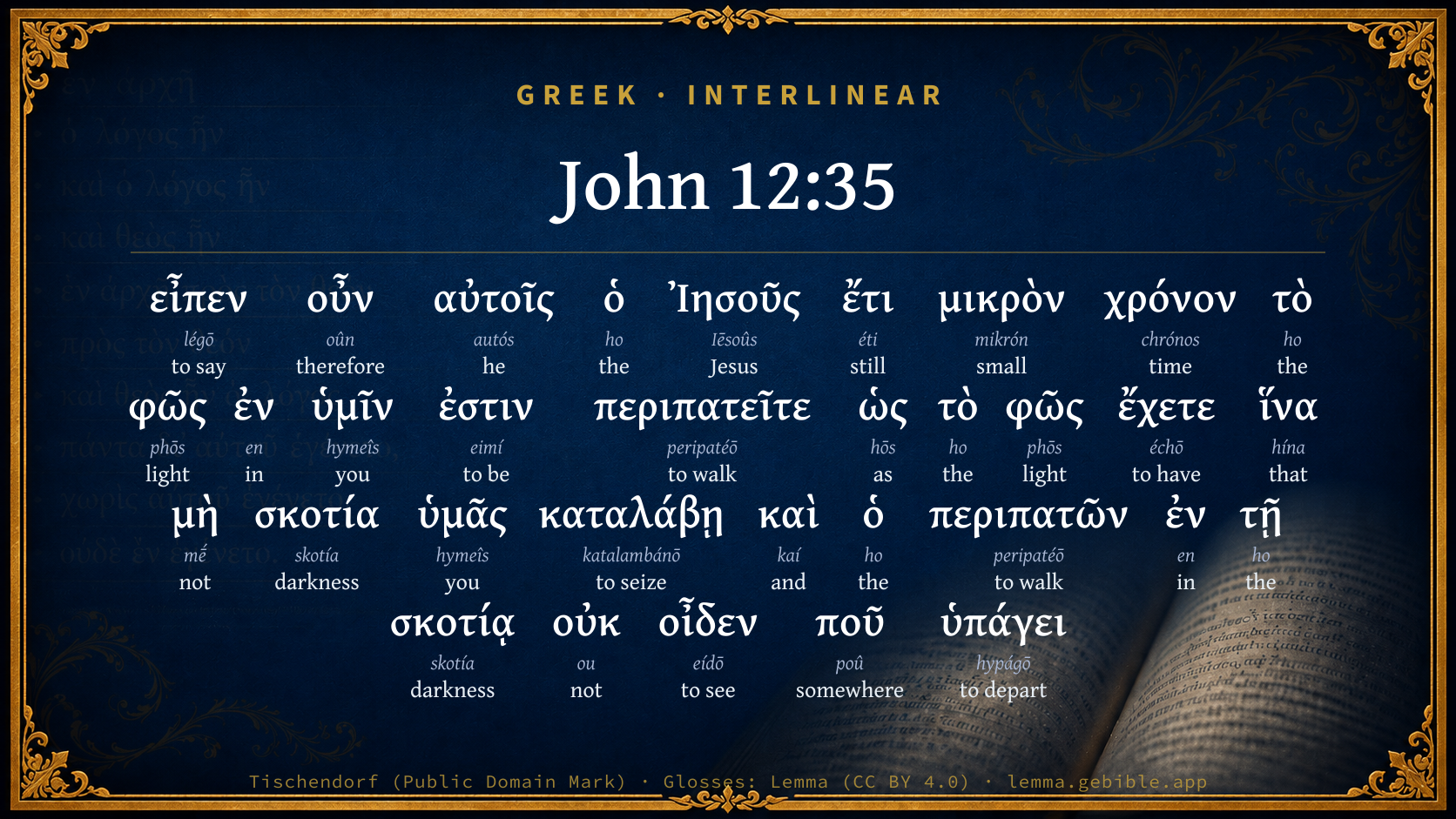
  1. εἶπεν légō G3004 “to say” Verb, Aorist, Active, Indicative, 3rd person, Singular
  2. οὖν oûn G3767 “therefore” Conjunction
  3. αὐτοῖς autós G846 “he” Personal pronoun, Dative, Plural, Masculine
  4. ὁ ho G3588 “the” Article, Nominative, Singular, Masculine
  5. Ἰησοῦς Iēsoûs G2424 “Jesus” Noun, Nominative, Singular, Masculine
  6. ἔτι éti G2089 “still” Adverb
  7. χρόνον chrónos G5550 “time” Noun, Accusative, Singular, Masculine
  8. τὸ ho G3588 “the” Article, Nominative, Singular, Neuter
  9. φῶς phōs G5457 “light” Noun, Nominative, Singular, Neuter
  10. ἐν en G1722 “in” Preposition
  11. ὑμῖν hymeîs G5210 “you” Personal pronoun, 2nd person, Dative, Plural
  12. ἐστιν eimí G1510 “to be” Verb, Present, Active, Indicative, 3rd person, Singular
  13. περιπατεῖτε peripatéō G4043 “to walk” Verb, Present, Active, Imperative, 2nd person, Plural
  14. ὡς hōs G5613 “as” Adverb
  15. τὸ ho G3588 “the” Article, Accusative, Singular, Neuter
  16. φῶς phōs G5457 “light” Noun, Accusative, Singular, Neuter
  17. ἔχετε échō G2192 “to have” Verb, Present, Active, Indicative, 2nd person, Plural
  18. ἵνα hína G2443 “that” Conjunction
  19. μὴ mḗ G3361 “not” Particle, Negative
  20. σκοτία skotía G4653 “darkness” Noun, Nominative, Singular, Feminine
  21. ὑμᾶς hymeîs G5210 “you” Personal pronoun, 2nd person, Accusative, Plural
  22. καταλάβῃ katalambánō G2638 “to seize” Verb, Aorist, Active, Subjunctive, 3rd person, Singular
  23. καὶ kaí G2532 “and” Conjunction
  24. ὁ ho G3588 “the” Article, Nominative, Singular, Masculine
  25. περιπατῶν peripatéō G4043 “to walk” Verb, Present, Active, Participle, Nominative, Singular, Masculine
  26. ἐν en G1722 “in” Preposition
  27. τῇ ho G3588 “the” Article, Dative, Singular, Feminine
  28. σκοτίᾳ skotía G4653 “darkness” Noun, Dative, Singular, Feminine
  29. οὐκ ou G3756 “not” Particle, Negative
  30. οἶδεν eídō G1492 “to see” Verb, Perfect, Active, Indicative, 3rd person, Singular
  31. ποῦ poû G4226 “somewhere” Particle, Interrogative
  32. ὑπάγει hypágō G5217 “to depart” Verb, Present, Active, Indicative, 3rd person, Singular

About this verse

These counts appear in no published source. They are computed here, from the morphology-tagged text and Lemma’s own curated glosses. What Lemma adds →

33
words
24
distinct lemmas
Gospels
section

Notable vocabulary

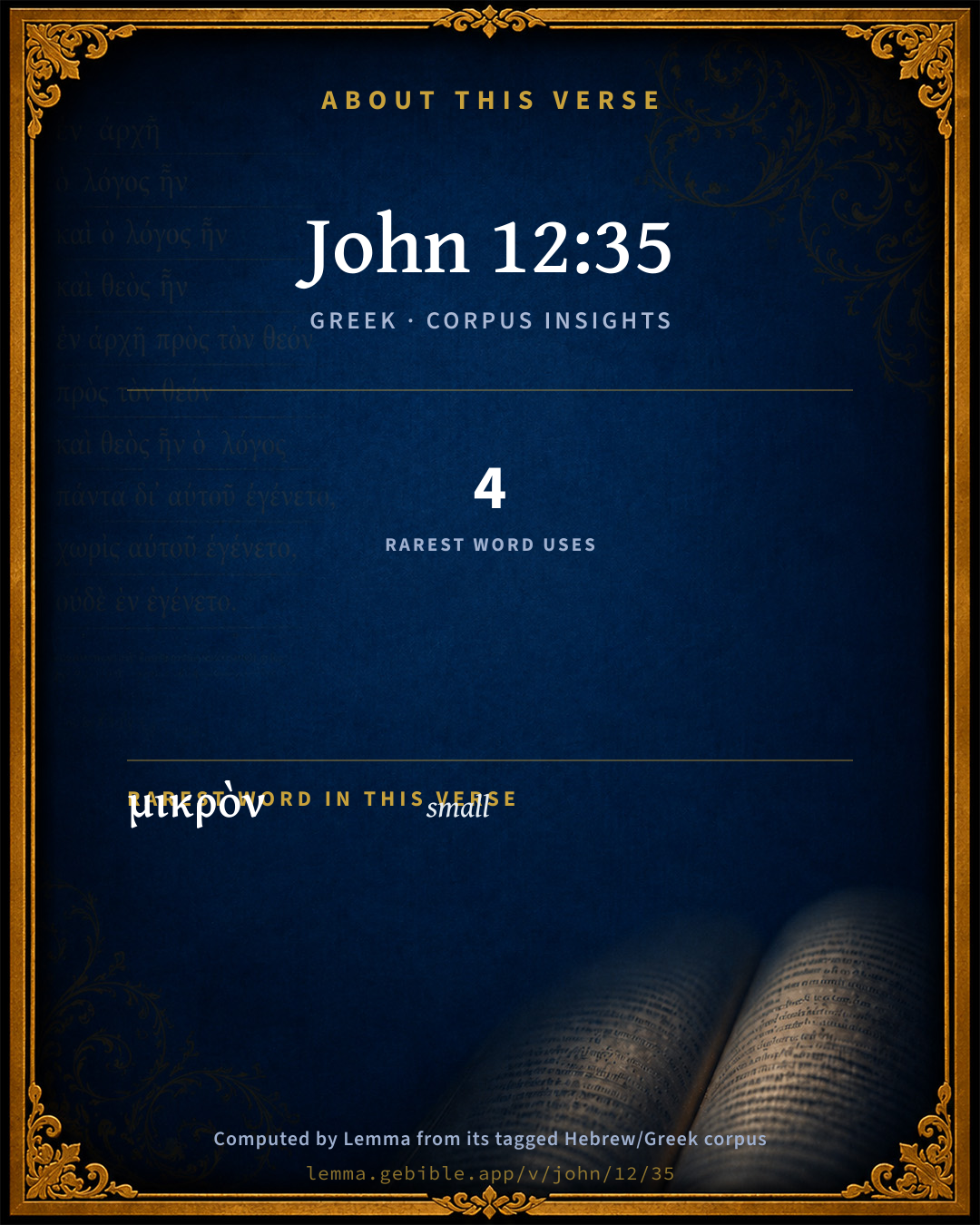
The rarest word here is μικρὸν small G3397 — appearing just 4 times in the whole Greek New Testament.

Shared distinctive vocabulary

μικρὸν small G3397 occurs in 4 verses of the Greek New Testament. Also found in:

Repetition

Words recur within this verse:

  • φῶς light G5457 ×2
  • περιπατεῖτε to walk G4043 ×2
  • σκοτία darkness G4653 ×2
  • ὁ the G3588 ×5
  • ἐν in G1722 ×2
  • ὑμῖν you G5210 ×2

Cross-references

22

Topical passages linked to John 12:35 in the Treasury of Scripture Knowledge — connected by theme and wording, ordered by reader-vote popularity; previews shown in the World English Bible.

  • John 12:46 I have come as a light into the world, that whoever believes in me may not remain in the darkness.
  • John 16:16 A little while, and you will not see me. Again a little while, and you will see me."
  • Ephesians 5:8 For you were once darkness, but are now light in the Lord. Walk as children of light,
  • 1 John 1:6–7 If we say that we have fellowship with him and walk in the darkness, we lie, and don't tell the truth.
  • John 8:12 Again, therefore, Jesus spoke to them, saying, "I am the light of the world. He who follows me will not walk in the darkness, but will have the light of life."
  • John 11:10 But if a man walks in the night, he stumbles, because the light isn't in him."
  • Jeremiah 13:16–17 Give glory to Yahweh your God, before he cause darkness, and before your feet stumble on the dark mountains, and, while you look for light, he turn it into the shadow of death, and make it gross darkness.
  • John 9:4–5 I must work the works of him who sent me, while it is day. The night is coming, when no one can work.
  • John 12:36 While you have the light, believe in the light, that you may become children of light." Jesus said these things, and he departed and hid himself from them.
  • Isaiah 2:5 House of Jacob, come, and let us walk in the light of Yahweh.
  • John 7:33 Then Jesus said, "I will be with you a little while longer, then I go to him who sent me.
  • John 1:5–9 The light shines in the darkness, and the darkness hasn't overcome it.
  • John 12:39–40 For this cause they couldn't believe, for Isaiah said again,
  • 1 Thessalonians 5:5–8 You are all children of light, and children of the day. We don't belong to the night, nor to darkness,
  • Isaiah 42:6–7 I, Yahweh, have called you in righteousness, and will hold your hand, and will keep you, and give you for a covenant of the people, for a light of the Gentiles;
  • 1 John 2:8–11 Again, I write a new commandment to you, which is true in him and in you; because the darkness is passing away, and the true light already shines.
  • Psalms 69:22–28 Let their table before them become a snare. May it become a retribution and a trap.
  • Romans 11:7–10 What then? That which Israel seeks for, that he didn't obtain, but the chosen ones obtained it, and the rest were hardened.
  • Romans 13:12–14 The night is far gone, and the day is near. Let's therefore throw off the works of darkness, and let's put on the armor of light.
  • 2 Corinthians 3:14 But their minds were hardened, for until this very day at the reading of the old covenant the same veil remains, because in Christ it passes away.
  • Ephesians 5:14–15 Therefore he says, "Awake, you who sleep, and arise from the dead, and Christ will shine on you."
  • Proverbs 4:19 The way of the wicked is like darkness. They don't know what they stumble over.

Cross-references courtesy of OpenBible.info (CC BY 4.0).

Commentary

Notes on John 12:35 from classic Christian and Jewish commentators (each source and its license shown beneath its notes). The classic Christian expositions comment on the surrounding passage and are grouped to its opening verse, so a note may address several verses; the Jewish commentaries on the Tanakh (Rashi and others) are per-verse, so they appear only where the commentator wrote on this verse.

Lemma curates 59 commentaries, every one of them public domain or Creative Commons licensed, each selected and text-cleaned for this edition rather than reprinted as found. About our sources →

MacLaren's Expositions of Holy Scripture

Alexander MacLaren

John

A PARTING WARNING

Joh 12:35 - Joh 12:36.

These are the last words of our Lord’s public ministry. He afterwards spoke only to His followers in the sweet seclusion of the sympathetic home at Bethany, and amid the sanctities of the upper chamber. ‘Yet a little while am I with you’; -the sun had all but set. Two days more, and the Cross was reared on Calvary, but there was yet time to turn to the light. And so His divine charity ‘hoped all things,’ and continued to plead with those who had so long rejected Him. As befits a last appeal, the words unveil the heart of Christ. They are solemn with warning, radiant with promise, almost beseeching in their earnestness. He loves too well not to warn, but He will not leave the bitterness of threatening as a last savour on the palate, and so the lips, into which grace is poured, bade farewell to His enemies with the promise and the hope that even they may become ‘the sons of light.’

The solemnity of the occasion, then, gives great force to the words; and the remembrance of it sets us on the right track for estimating their significance. Let us see what lessons for us there may be in Christ’s last words to the world.

I. There is, first, a self-revelation.

It is no mere grammatical pedantry that draws attention to the fact that four times in this text does our Lord employ the definite article, and speak of ‘the light.’ And that that is no mere accident is obvious from the fact that, in the last clause of our text, where the general idea of light is all that is meant to be emphatic, the article is omitted. ‘Yet a little while is the light with you; walk while ye have the light . . . . While ye have the light, believe in the light, that ye may be the children of light.’

So then, most distinctly here, in His final appeal to the world, He draws back the curtain, as it were, takes away the shade that had covered the lamp, and lets one full beam stream out for the last impression that He leaves. Is it not profoundly significant and impressive that then, of all times, over and over again, in the compass of these short verses, this Galilean peasant makes the tremendous assertion that He is what none other can be, in a solitary and transcendent sense, the Light of Mankind? Undismayed by universal rejection, unfaltering in spite of the curling lips of incredulity and scorn, unbroken by the near approach of certain martyrdom, He presents Himself before the world as its Light. Nothing in the history of mad, fanatical claims to inspiration and divine authority is to be compared with these assertions of our Lord. He is the fontal Source, He says, of all illumination; He stands before the whole race, and claims to be ‘the Master-Light of all our seeing.’ Whatsoever ideas of clearness of knowledge, of rapture of joy, of whiteness of purity, are symbolised by that great emblem, He declares that He manifests them all to men. Others may shine; but they are, as He said, ‘lights kindled,’ and therefore ‘burning.’ Others may shine, but they have caught their radiance from Him. All teachers, all helpers, all thinkers draw their inspiration, if they have any, from Him, in whom was life, and the Life was the Light of men.

There has been blazing in the heavens of late a new star, that burst upon astonished astronomers in a void spot; but its brilliancy, though far transcending that of our sun, soon began to wane, and before long, apparently, there will be blackness again where there was blackness before. So all lights but His are temporary as well as derived, and men ‘willing for a season to rejoice’ in the fleeting splendours, and to listen to the teacher of a day, lose the illumination of his presence and guidance of his thoughts as the ages roll on. But the Light is ‘not for an age, but for all time.’

Now, brethren, this is Christ’s estimate of Himself. I dwell not on it for the purpose of seeking to exhaust its depth of significance. In it there lies the assertion that He, and He only, is the source of all valid knowledge of the deepest sort concerning God and men, and their mutual relations. In it lie the assertion that He, and He only, is the source of all true gladness that may blend with our else darkened lives, and the further assertion that from Him, and from Him alone, can flow to us the purity that shall make us pure. We have to turn to that Man close by His Cross, on whom while He spoke the penumbra of the eclipse of death was beginning to show itself, and to say to Him what the Psalmist said of old to the Jehovah whom he knew, and whom we recognise as indwelling in Jesus: ‘With Thee is the fountain of life. Thou makest us to drink of the river of Thy pleasures. In Thy light shall we see light.’

So Christ thought of Himself; so Christ would have as to think of Him. And it becomes a question for us how, if we refuse to accept that claim of a solitary, underived, eternal, and universal power of illuminating mankind, we can save His character for the veneration of the world. We cannot go picking and choosing amongst the Master’s words, and say ‘This is historical, and that mythical.’ We cannot select some of them, and leave others on one side. You must take the whole Christ if you take any Christ. And the whole Christ is He who, within sight of Calvary, and in the face of all but universal rejection, lifted up His voice, and, as His valediction to the world, declared, ‘I am the Light of the world.’ So He says to us. Oh that we all might cast ourselves before Him, with the cry, ‘Lighten our darkness, O Lord, we beseech Thee!’

II. Secondly, we have here a double exhortation.

‘Walk in the light; believe in the light.’ These two sum up all our duties; or rather, unveil for us the whole fullness of the possible privileges and blessings of which our relation to that light is capable. It is obvious that the latter of them is the deeper in idea, and the prior in order of sequence. There must be the ‘belief’ in the light before there is the ‘walk’ in the light. Walking includes the ideas of external activity and of progress. And so, putting these two exhortations together, we get the whole of Christianity considered as subjective. ‘Believe in the light; trust in the light,’ and then ‘walk’ in it. A word, then, about each of these branches of this double exhortation.

‘Trust in the light.’ The figure seems to be dropped at first sight; for it wants little faith to believe in the sunshine at midday; and when the light is pouring out, how can a man but see it? But the apparent incongruity of the metaphor points to something very deep in regard to the spiritual side. We cannot but believe in the light that meets the eye when it meets it, but it is possible for a man to blind himself to the shining of this light. Therefore the exhortation is needed-’Believe in the light,’ for only by believing it can you see it. Just as the eye is the organ of sight, just as its nerves are sensitive to the mysterious finger of the beam, just as on its mirroring surface impinges the gentle but mighty force that has winged its way across all the space between us and the sun, and yet falls without hurting, so faith, the ‘inward eye which makes the bliss’ of the solitary soul, is the one organ by which you and I can see the light. ‘Seeing is believing,’ says the old proverb. That is true in regard to the physical. Believing is seeing, is much rather the way to put it in regard to the spiritual and divine.

Only as we trust the light do we see the light. Unless you and I put our confidence in Jesus Christ, the Son of God and Son of Man, we have no adequate knowledge of Him and no clear vision of Him. We must know that we may love; but we must love that we may know. We must believe that we may see. True, we must see that we may believe, but the preliminary vision which precedes belief is slight and dim as compared with the solidity and the depth of assurance with which we apprehend the reality and know the lustre of Him whom our faith has grasped. You will never know the glory of the light, nor the sweetness with which it falls upon the gazing eye, until you turn your face to that Master, and so receive on your susceptible and waiting heart the warmth and the radiance which He only can bestow. ‘Believe in the light.’ Trust it; or rather, trust Him who is it. He cannot deceive. This light from heaven can never lead astray. Absolutely we may rely upon it; unconditionally we must follow it. Lean upon Him-to take another metaphor-with all your weight. His arm is strong to bear the burden of our weaknesses, sorrows, and, above all, our sins. ‘While ye have light, trust the light.’

But then that is not enough. Man, with his double relations, must have an active and external as well as an inward and contemplative life. And so our Lord, side by side with the exhortation on which I have been touching, puts the other one, ‘Walk in the light.’ Our inward emotions, however deep and precious, however real the affiance, however whole-hearted the love, are maimed and stunted, and not what the light requires, unless there follows upon them the activity of the walk. What do we get the daylight for? To sit and gaze at it? By no means; but that it may guide us upon our path and help us in all our work. And so all Christian people need ever to remember that Jesus Christ has indissolubly bound together these two phases of our relation to Him as the light of life-inward and blessed contemplation by faith and outward practical activity. To walk is, of course, the familiar metaphor for the external life of man, and all our deeds are to be in conformity with the Light, and in communion with Him. This is the deepest designation, perhaps, of the true character of a Christian life in its external aspect-that it walks in Christ, doing nothing but as His light shines, and ever bearing along with it conscious fellowship with Him who is thus the guiding and irradiating and gladdening and sanctifying life of our lives, ‘Walk in the light as He is in the light.’ Our days fleet and change; His are stable and the same. For, although these words which I have quoted, in their original application refer to God the Father, they are no less true about Him who rests at the right hand of God, and is one light with Him. He is in the light. We may approximate to that stable and calm radiance, even though our lives are passed through changing scenes, and effort and struggle are their characteristics. And oh! how blessed, brother, such a life will be, all gladdened by the unsetting and unclouded sunshine that even in the shadiest places shines, and turns the darkness of the valley of the shadow of death into solemn light; teaching gloom to glow with a hidden sun!

But there is not only the idea of activity here, there is the further notion of progress. Unless Christian people to their faith add work, and have both their faith and their consequent work in a continual condition of progress and growth, there is little reason to believe that they apprehend the light at all. If you trust the light you will walk in it; and if your days are not in conformity nor in communion with Him, and are not advancing nearer and nearer to the central blaze, then it becomes you to ask yourselves whether you have verily seen at all, or trusted at all, ‘the Light of life.’

III. Thirdly, there is here a warning.

‘Walk whilst ye have the light, lest the darkness come upon you.’ That is the summing up of the whole history of that stiff-necked and marvellous people. For what has all the history of Israel been since that day but groping in the wilderness without any pillar of fire? But there is more than that in it. Christ gives us this one solemn warning of what falls on us if we turn away from Him. Rejected light is the parent of the densest darkness, and the man who, having the light, does not trust it, piles around himself thick clouds of obscurity and gloom, far more doleful and impenetrable than the twilight that glimmers round the men who have never known the daylight of revelation. The history of un-Christian and anti-Christian Christendom is a terrible commentary upon these words of the Master, and the cries that we hear all round us to-day from men who will not follow the light of Christ, and moan or boast that they dwell in agnostic darkness, tell us that, of all the eclipses that can fall upon heart and mind, there is none so dismal or thunderously dark as that of the men who, having seen the light of Christ in the sky, have turned from it and said, ‘It is no light, it is only a mock sun.’ Brethren, tempt not that fate.

And if Christian men and women do not advance in their knowledge and their conformity, like clouds of darkness will fall upon them. None is so hopeless as the unprogressive Christian, none so far away as those who have been brought nigh and have never come any nigher. If you believe the light, see that you growingly trust and walk in it, else darkness will come upon you, and you will not know whither you go.

IV. And lastly, there is here a hope and a promise.

‘That ye may be the sons of light.’

Faith and obedience turn a man into the likeness of that in which he trusts. If we trust Jesus we open our hearts to Him; and if we open our hearts to Him He will come in. If you are in a darkened room, what have you to do in order to have it filled with glad sunshine? Open the shutters and pull up the blinds, and the light will do all the rest. If you trust the light, it will rush in and fill every crevice and cranny of your hearts. Faith and obedience will mould us, by their natural effect, into the resemblance of that on which we lean. As one of the old German mystics said, ‘What thou lovest, that thou dost become.’ And it is blessedly true. The same principle makes Christians like Christ, and makes idolaters like their gods. ‘They that make them are like unto them; so is every one that trusteth in them,’ says one of the Psalms. ‘They followed after vanity and are become vain,’ says the chronicler of Israel’s defections. ‘We with unveiled faces beholding’-or mirroring-’the glory of the Lord, are changed into the same image.’ Trust the light and you become ‘sons of the light.’

And so, dear friends, all of us may hope that by degrees, as the reward of faith and of walking, we still may bear the image of the heavenly, even here on earth. While as yet we only believe in the light, we may participate in its transforming power, like some far-off planet on the utmost bounds of some solar system, that receives faint and small supplies of light and warmth, through a thick atmosphere of vapour, and across immeasurable spaces. But we have the assurance that we shall be carried nearer our centre, and then, like the planets that are closer to the sun than our earth is, we shall feel the fuller power of the heat, and be saturated with the glory of the light. ‘We shall see Him as He is’; and then we too ‘shall blaze forth like the sun in the kingdom of our Father.’

Alexander MacLaren, Expositions of Holy Scripture (1904–1910) — public domain. Text from a community e-Sword module.

Bengel's Gnomon

Johann Albrecht Bengel

Joh 12:35. [326] ἜΤΙ, as yet) Jesus does not reply to their objection, but subjoins truths which are most necessary for them.—μικρόν, a little while) The antithetic words are, for ever, Joh 12:34. The Jews were supposing that the Christ, when once He came, would never be but with them [would always remain with them].—ἐν ὑμῖν, among [with] you) The Light itself remains, but not always among [with] you. So ἐν αὐτοῖς, among them, ch. Joh 15:24. Ἐν is for the Hebrew á.—ΠΕΡΙΠΑΤΕῖΤΕ, walk) with onward progress. What is required of us is, to walk, not to dispute. Faith is not indolent, but active in [using] the light, Joh 12:36.—ΚΑΤΑΛΆΒῌ, overtake) unexpectedly.—καί, and [for]) The conjunction for the relative; in which darkness he who walketh, etc. So καί, and, is used, Luk 24:18, “Art thou only a stranger in Jerusalem, and (who therefore) hast not known the things?” etc.—ποῦ, where) whither.

[326] σὺ λέγεις, Thou sayest) We have them therefore confessing, that Jesus presented Himself to them, so as to be known and acknowledged as the Christ.—V. g.

Bengel's Gnomon of the New Testament — English translation (T&T Clark, Edinburgh, 1860) — public domain. Text from a community e-Sword module.

Meyer's Critical & Exegetical Commentary

Heinrich August Wilhelm Meyer

Joh_12:35-36. Jesus does not enter upon the question raised, but directs the questioners to that one point which concerns them, with the intensity and seriousness of one who is on the point of taking His departure. To follow this one direction must indeed of itself free them from all those doubts and questions.

ἐν ὑμῖν] among you.

περιπ. ὡς τὸ φῶς ἔχετε] On the reading ὡς, see the critical notes. Walk as you have the light, i.e. in conformity with the fact that you have among you the possessor and bearer of the divine truth (comp. on Joh_8:12); be not slothful, but spiritually active, and awake in the enjoyment of this relation, just as one does not rest and lie still when he has the bright light of day, but walks in order to attain the end in view before the darkness breaks in (see what follows). On ὡς as assigning the motive (in the measure that), comp. generally on Joh_13:34, and here especially on Gal_6:10. Ellendt aptly says, Lex. Soph. II. p. 1008: nec tamen causam per se spectatam, sed quam qnis, qualis sit, indicat. The signification quamdiu (Baeumlein) is not borne by ὡς, not even in Soph. Aj. 1117 (see, Schneidewin in loc.), Phil. 635. 1330.

ἵνα μὴ σκοτία, κ.τ.λ.] in order thatwhich would smite you as a penal destiny in retribution of your μὴ περιπατεῖνdarkness (the element opposed to the divine truth of salvation, which still at present shines upon you) may not seize you, like a hostile power. Comp. Joh_1:21 : ἐσκοτίσθη ἡ ἀσύνετος αὐτῶν καρδία. On καταλάβῃ, comp. 1Th_5:4; also in the classics very frequently of danger, misfortune, and the like, which befall any one. Arrian, Alex. i. 5. 17 : εἰ νὺξ καταλήψεται αὐτούς.

καὶ ὁ περιπ., κ.τ.λ.] and how dangerous would this condition be! This is brought home in a sentence from ordinary life; comp. Joh_11:9, Joh_9:4.

ποῦ ὑπάγει] whither he is departing, Joh_3:8. Thus the ἐσκοτισμένος goes away, without knowing the unhappy end, into everlasting destruction; comp. 1Jn_2:11. For the opposite of this ποῦ ὑπάγει, see Joh_8:14; Joh_8:21, Joh_16:5, et al.

ὡς τ. φῶς ἔχετε] Repeated and placed first with great emphasis.

πιστεύετε εἰς τ. φῶς, ἵνα, κ.τ.λ.] More minute designation of that which was previously intended by the figurative περιπατεῖτε.

υἱοὶ τοῦ φῶτ.] Enlightened persons. See on Luk_16:8; Eph_5:8.

γένησθε] not be, but become. Faith is the condition and the beginning of it; comp. Joh_1:12.

ἐκρύβη ἀπʼ αὐτῶν] The situation in Joh_8:59 is different. He now, according to the account of John, withdraws from them into concealment, probably to Bethany, in order to spend these last days of life, before the arrival of His hour, in the quiet confidential circle, not as a prelude, summi judicii occultationis Domini (Lampe, Luthardt), which is not indicated, and is all the more without support, that the last discourse was not condemnatory, but only hortatory.

Meyer — Critical and Exegetical Commentary on the New Testament — English translation by Peter Christie, edited by Frederick Crombie (T&T Clark, 1880) — public domain. Text from a community e-Sword module.

Expositor's Greek Testament

ed. W. Robertson Nicoll

Joh 12:35 . Εἶπεν οὖν ὁ Ἰησοῦς . In replying Jesus vouchsafes no direct solution of their difficulty. It is as if He said: Do not entangle yourselves in sophistries. Do not seek such logical proofs of Messiahship. Allow the light of truth and righteousness to enter your conscience and your life. “Yet a little while is the light with you.” “Walk while ye have the light, lest darkness overtake you” ( cf. 1Th 5:4 ), that is, lest Jesus, the light of the world, be withdrawn. καὶ ὁ περιπατῶν … ὑπάγει , cf. Joh 11:10 .

The Expositor's Greek Testament, edited by W. Robertson Nicoll (1897–1910) — public domain. Text from a community e-Sword module.

Godet's Commentaries

Frédéric Louis Godet

Vv. 35, 36. “Jesus therefore said to them, The light is with you only a little while longer; walk while you have the light, lest the darkness overtake you; and he that walks in the darkness knows not whither he goes. 36.While you have the light, believe on the light, that you may become children of light. Jesus said this to them; then, departing, he hid himself from them.”

Jesus does not reply to them directly. It was no longer the time to teach and discuss. He addresses to their hearts a last warning, a final appeal, by making them feel the decisive importance of the present hour for themselves and for their whole people. This is the reason why John says εἶπεν he said, declared, not ἀπεκρίθη, he answered. The day of salvation is at its end; the sun which still enlightens Israel is going to disappear in a few moments. When the sun sets, those who have a journey to make must hasten before the night comes on. By this journey, Jesus means the act of believing, for all those who are still far removed from Him. When once the heavenly revealer shall be no longer present, the unbelieving people will be like a traveler lost in the night, who wanders at a venture without seeing either pathway or end. If Joh 12:31-32 sum up the whole history of the Church, it may be well said that Joh 12:35 contains that of Israel from the day on which Jesus was speaking to the present hour.

The apostolic preaching was no doubt still granted to this people, but how, when once launched on the declivity of unbelief, could Israel, as a people, have changed its course. And when the preaching of the apostles, that last gift of grace, had rescued a certain number of individuals from the ruin, it was soon withdrawn from the nation. Since then, Israel wanders in the wilderness of this world, as a caravan without a goal and without a guide. The two readings: with you and among you differ only in the figure. It is not altogether so with the readings ἕως, while (T. R.) and ὡς, as or according as. Meyer, Weiss, Luthardt, Keil, adopting the second, give to ὡς its ordinary logical sense: as, conformably to the fact that: “Walk according as you have the light,” that is to say: “Because of the fact that you still have the light, come to it, believe!” It is with reason, as it seems to me, that Baumlein declares this explanation of ὡς impossible. The words: yet a little time, force us to give it the temporal sense. We must, therefore, either understand it in the sense of when which the French comme so often has (comp. for this use of ὡς in the New Testament, Luk 12:58 : “As thou goest,” for: “While thou goest),” or read ἕως, while, notwithstanding the Alexandrian authorities. The initial ε of this word was undoubtedly confounded with the final ε of the preceding word περιπατεῖτε . I should not be surprised, however, if it were otherwise in Joh 12:36, and if the true reading here were ὡς.

The idea of because of the fact that is much more admissible in this sentence, “Because of the fact that you have the light, believe in the light;” comp. Gal 6:10, where the ὡς may be explained in the same way. This is precisely the reading of the Sinatic MS. It is the more easily explained, in this case, how in Joh 12:35 the ὡς may have been substituted for ἕως . In two sentences so near together and so similar, the copyists may have made either the first conform to the second, or the reverse. An equal solemnity reigns in these two appeals of Joh 12:35-36; only in the former the tone of pity prevails; in the latter, that of tenderness. The last word of the Saviour to His people was to be an invitation, not a menace: “Since you still possess in me the living revelation of God (φῶς, the light), acknowledge it, believe on it, to the end that you may become (γένησθε) children of light.” Through faith in Christ man is so penetrated by light that he himself becomes luminous.

Such was the farewell of Jesus to Israel. The words: He said these things, signify that He gave them no other response. Thereupon He withdraws; and on the following day He does not reappear. The people waited for Him in the temple as usual (Luk 21:38); but in vain. It was at this time no longer a mere cloud which veiled the sun; the sun had set, the night was come.

Frédéric Louis Godet — Commentaries on Luke, John, Romans, and 1 Corinthians — English translation (T&T Clark, Edinburgh, 1870s–1890s) — public domain. Text from a community e-Sword module.

Geneva Bible (1599)

Geneva Bible translators

Unmeasurable is the mercy of God, but an horrible judgment followed, if it be contemned.

Geneva Bible (1599) marginal notes — public domain. Text via Bolls.life.

Jamieson, Fausset & Brown

Robert Jamieson, A. R. Fausset & David Brown

Yet a little while is the light with you. Walk while ye have the light, &c.--Instead of answering their question, He warns them, with mingled majesty and tenderness, against trifling with their last brief opportunity, and entreats them to let in the Light while they have it in the midst of them, that they themselves might be "light in the Lord." In this case, all the clouds which hung around His Person and Mission would speedily be dispelled, while if they continued to hate the light, bootless were all His answers to their merely speculative or captious questions. (See on Luk 13:23).

Jamieson, Fausset & Brown — Commentary Critical and Explanatory on the Whole Bible (1871) — public domain (CC PDM 1.0). Text via the HelloAO Bible API.

Adam Clarke's Commentary

Verse 35. Yet a little while is the light with you.] In answer to their objection, our Lord compares himself to a light, which was about to disappear for a short time, and afterwards to shine forth with more abundant lustre; but not to their comfort, if they continued to reject its present beamings. He exhorts them to follow this light while it was among them. The Christ shall abide for ever, it is true; but he will not always be visible. When he shall depart from you, ye shall be left in the thickest darkness; in impenitence and hardness of heart. Then shall ye wish to see one of the days of the Son of man, and shall not see it, Lu 17:22. Then shall ye seek me, but shall not find me, Joh 7:34. For the kingdom of God shall be taken from you, and given to the Gentiles, Mt 21:43. If ye believe not in me now, ye shall then wish ye had done it, when wishing shall be for ever fruitless.

Instead of μεθ υμων, with you, εν υμιν, among you, is the reading of BDL, seventeen others; Coptic, Gothic, Slavonic, Vulgate, Itala; Cyril, Nonnus, and Victorinus. Griesbach has received it into the text. The meaning of both is nearly the same.

Lest darkness come upon you] Ye have a good part of your journey yet to go: ye cannot travel safely but in the daylight - that light is almost gone - run, that the darkness overtake you not, or in it ye shall stumble, fall, and perish!

Reader, is thy journey near an end? There may be but a very little time remaining to thee. O, run, fly to Christ, lest the darkness of death overtake thee, before thy soul have found redemption in his blood!

Adam Clarke's Commentary on the Bible (1810–1826) — public domain. Text from a community e-Sword/MySword module.

John Calvin's Commentaries

35. Yet a little while the light is with you. Though in this reply the Lord gently admonishes them, yet at the same time he reproves them sharply; for he charges them with shutting their eyes against the light, and at the same time threatens that ere long the light will be taken away from them. When he says that yet a little while there is some remaining light, he confirms what he had already said about his death; for though by the light he does not mean his bodily presence, but his Gospel, yet he alludes to his departure; as if he had said, When I shall have gone away, I will not cease to be the light, and thus my glory will not be diminished through your darkness. When he says that the light is with them, he indirectly reproves them for closing their eyes and shutting out the light; and thus he declares that they do not deserve an answer to their objection, because of their own accord they seek an opportunity of falling into error.

Walk while you have the light lest darkness overtake you. This statement, that the light does not continue to shine on them but for a little while, Applies equally to all unbelievers; for Scripture promises that to the children of God the Sun of righteousness (Malachi 4:2) will rise, and will never go down.

The sun shall no longer be your light by day, nor the moon by night, but the Lord shall be your everlasting light, (Isaiah 60:19.)

But all ought to walk cautiously, because contempt of the light is followed by darkness. This, too, is the reason why night so thick and dark sat down on the world for many centuries. It was because there were few who deigned to walk in the brightness of heavenly wisdom; for Christ enlightens us by his Gospel, in order that we may follow the way of salvation, which he points out to us. For this reason, they who do not avail themselves of the grace of God extinguish, as far as lies in their power, the light which is offered to them.

And he who walketh in darkness knoweth not where he goeth. To strike them with still deeper alarm, he reminds them how wretched is the condition of those who, being destitute of light, do nothing but wander throughout the whole course of, their life. For they cannot move a step without the risk of falling or even of destruction. But now Christ declares that we are in darkness, unless he shine upon us. Hence infer what is the value of the sagacity of the human mind, when it is the sole guide and instructor, apart from Christ.

John Calvin's Commentaries (1540-1563) — public domain. Text from the Calvin Translation Society English edition (1840s-50s) via the Christian Classics Ethereal Library (ccel.org). Calvin's coverage is partial (roughly two-thirds of the Bible); uncommented books and verses are honest gaps, never fabricated. The 19th-century editor's footnotes and remarks are omitted so the notes are faithfully Calvin's own voice.

Ellicott's Commentary for English Readers

(35) Then Jesus said unto them, Yet a little while is the light with you.—It is better, as we have often seen, to read Therefore for “Then.” The word connects what follows closely with what has gone before. It was because of their question that Jesus said this. And yet it is not said that “He answered them,” because what He said was not a direct answer. They are asking questions in which we may trace the spirit, if not the very words, of the formal, literal objectors who had, with like technicalities, stifled the truth whenever it was springing up in their minds. Such questions cannot be really answered, because they are not really questions. And now the day has gone, and the night is at hand. The old thought comes back to Him (Joh_9:4; Joh_11:9). The last rays of light are shining. It is but a little while, and He warns them with all the solemnity of this thought.

Walk while ye have the light, lest darkness come upon you.—The better reading is, Walk according as ye have the light—i.e., “Walk as men who are conscious that the light is among them, use your opportunities; do not ask questions to raise objections, but ask them in order that you may know the truth.” The man who thus used the light would by no means walk in darkness, but would have the light of life (Joh_8:12). For him that neglected to use the means and faculty he had, both would cease to exist. (Comp. Note on Rom_1:21.)

The words “come upon,” or “overtake,” is used of some sudden seizure. There are two parallels in Biblical Greek, “But ye, brethren, are not in darkness that the day should overtake you as a thief” (1Th_5:4), and “Be sure your sin will find you out” (Num_32:23).

He that walketh in darkness.—Comp. Notes in Joh_8:12; Joh_9:4; Joh_11:9; and 1Jn_2:11.

Knoweth not whither he goeth.—The last word means “goeth away,” “departeth.” The frequent use of the word by St. John to express departure to the other world suggests that meaning here. He was going away. They ask, “Who is this Son of man who is lifted up,” “who goes away?” He warns them lest darkness seize them, and they go away into darkness. In the next four chapters the same word is used twelve times of Christ’s departure. (Comp. e.g. Joh_13:3; Joh_13:33; Joh_13:36.)

A Bible Commentary for English Readers, edited by Charles John Ellicott (1878–1897) — public domain. Text from a community e-Sword module.

The Cambridge Bible for Schools and Colleges

gen. ed. J. J. S. Perowne

35. Then Jesus said] Better, Jesus therefore said: instead of answering their contemptuous question He gives them a solemn warning.

while ye have] The better reading is, as ye have: ‘walk in a manner suitable to the fact of there being the Light among you: make use of the Light and work.’

darkness] that darkness ‘in which no man can work.’

come upon you] like a bird of prey. The same Greek verb is used of the last day; 1Th_5:4; and in the LXX. of sin overtaking the sinner; Num_32:23.

for he that walketh in darkness] And he that walketh in the darkness.

whither he goeth] Or, goeth away; knows not to what end he is departing: comp. 1Jn_2:11.

The Cambridge Bible for Schools and Colleges (gen. ed. J. J. S. Perowne; Cambridge University Press, 1878–1918) — public domain. Text from a community e-Sword module.

John Gill's Exposition

While ye have light, believe in the light,.... Receive the Messiah, and credit the Gospel revelation; this is an explanation of the exhortation in the preceding verse:

that ye may be the children of the light; that is, that they might appear to be such who are enlightened persons; and such are truly so, who are made light in the Lord, or who are enlightened by the Spirit of God to see their own sinfulness, impotency, and unrighteousness, and their need of Christ, and his righteousness and strength, and of salvation by him; and who are made meet, by the grace of God, to be partakers of the inheritance of the saints in light; and which is made manifest by believing in Christ, and walking on in him, as they have received him, and by walking honestly, as in the daytime, and circumspectly, not as fools, but as wise, for such walk as children of the light.

These things spake Jesus, and departed; from those Jews, as being unworthy of any further conversation with him; and from Jerusalem, very likely to Bethany, whither he frequently retired, especially at night, during the few days before the passover:

and did hide himself from them: for his safety, for he knew that they were irritated by what he said, and would seek to lay hold upon him, and deliver him to the sanhedrim; and whereas his hour was not yet fully come, there were a few more sands in the glass to run, he provided for his security, by absconding from them; and this was an emblem of his wholly removing from them, and leaving them, and their house, desolate; and it is very likely that from this time forward they saw him no more as ministering the word unto them; and also of his taking his Gospel from them in a little time, and of his hiding the things of it from them, which respected himself, and salvation by him.

John Gill's Exposition of the Whole Bible (1746–1763) — public domain (CC PDM 1.0). Text via the HelloAO Bible API.

Trapp's Complete Commentary

John Trapp

35 Then Jesus said unto them, Yet a little while is the light with you. Walk while ye have the light, lest darkness come upon you: for he that walketh in darkness knoweth not whither he goeth.

Ver. 35. Yet a little while is the light, &c.] The day of grace, which is very clear and bright, is usually a short one. Therefore break off your sins by repentance; be abrupt in the work, for life is short, opportunities headlong, and once past, irrecoverable. He is the wise man that prefers opportunity before time, in laying hold upon eternal life; but fools are semper victuri, saith Seneca, they will, and they will, &c.; so they trifle, and by futuring, fool away their own salvation. Amend before the draw bridge be taken up. Charles, king of Sicily and Jerusalem, was called Cunctator the Delayer: not in the sense as Fabius Maximus, because he stayed till opportunity came, but because he stayed till opportunity was past. Too many such. Manna must be gathered in the morning, or not at all; and not kept till the morrow, lest it stink.

John Trapp, A Commentary or Exposition upon All the Books of the Old and New Testament (1647–1656) — public domain. Text from a community e-Sword module.

Albert Barnes' Notes on the Bible

Yet a little while is the light with you - Jesus did not reply directly to their question. He saw that they were offended by the mention of his death, and he endeavored to arrive at the same thing indirectly. He tells them, therefore, that the light would be with them a little while, and that they ought to improve the opportunity while they had it to listen to his instructions, to require with candor, and thus to forsake their false notions respecting the Messiah.

The light - Joh 1:4. It is probable that they understood this as denoting the Messiah. See Joh 8:12; “I am the light of the world;” Joh 9:4.

Walk ... - Joh 11:9. Whatever you have to do, do it while you enjoy this light. Make good use of your privileges before they are removed. That is, while the Messiah is with you, avail yourselves of his instructions and learn the way to life.

Lest darkness - Lest God should take away all your mercies, remove all light and instruction from you, and leave you to ignorance, blindness, and woe. This was true that darkness and calamity were to come upon the Jewish people when the Messiah was removed; and it is also true that God leaves a sinner to darkness and misery when he has long rejected the gospel.

For he ... - See Joh 11:10.

Albert Barnes' Notes on the Bible (1834–1885) — public domain. Text from a community e-Sword/MySword module.

Haydock's Catholic Bible Commentary

Yet a little while,[2] that is, for a very few days, I, who am the light of the world, am with you. (Witham) --- How much do the Jews now do, and yet they know not what they do: but like men that are walking in the dark, they think they are in the right way, when alas! they are quite the contrary. (St. John Chrysostom, hom. lxvi. in Joan.)

===============================

[BIBLIOGRAPHY]

Adhuc modicum lumen in vobis est, Greek: eti mikron chronon, to phos meth umon esti. They mistake, who take modicum for an adjective, that agrees with lumen.

George Leo Haydock (1774–1849), Haydock's Catholic Family Bible and Commentary, 1859 edition — public domain. Excludes Psalms (Douay-Rheims chapter numbering differs from Protestant) and Deuterocanonical books (Catholic canon only).

Matthew Poole's English Annotations

Our Saviour thinketh not fit further to open himself as to that point concerning the Messiah, and his Divine nature; into a direct assertion of which he must have entered, had he given a direct answer to their questions; otherwise what they had objected might easily have been answered by our Saviour, by distinguishing between the two natures in his own person: according to his Divine nature he was not to die, though he died according to his human nature; and after his suffering and resurrection, his whole person, in which both the Divine and human nature were united, were to endure for ever: but he thinks not fit to discourse this point, but returns to what John had told them, Joh 1:9, and what he himself had said, Joh 9:5, that he was the light of the world, though possibly by light he here understandeth those beams of gospel doctrine which issued out from him as the fountain of light. Yet a little while, I, who am the great Light, and the true Light of the world, am with you: or, Yet a little while, the gospel, which is light, and directs you in the way to heaven, is with you, for within a few years (under forty) after this, their city was destroyed, and their nation ruined; and before that time the apostles were turned away from the generality of that nation to the Gentiles, Act 13:46; 19:9. He in the next verse expounds himself as to what he meant by walking, viz. believing: Make use of the light, both to guide your understandings and judgments, and also to direct your feet: for look on men in the world, while they have the guidance of the light of the sun, they know how to order their steps, and to direct their feet; but if once it be dark, they know not how to direct their feet in their way, but err, and stumble, and fall. So it will be with you, when I shall be gone, who am the great Light of the world while I am in the world (as he spake Joh 9:5); and not only I gone, but the gospel, which is that light which I shall leave behind me, be gone, by my apostles turning to the Gentiles, through your perverse refusal of the salvation of it, as Act 13:46; 19:9; when you shall be utterly ruined, (as it will be at the destruction of your city), then you will walk in darkness, having no means of salvation left you.

Matthew Poole's English Annotations on the Holy Bible (1683–1685) — public domain. Text from a community e-Sword/MySword module.

The Pulpit Commentary

Christ"s reply is introduced with a simple eipen . Jesus therefore said to them, not in answer to their question, but by taking up a title of dignity that he had claimed before, tie evidently assumes to be the Light of the world, (Joh_8:12) and now the time is almost over when they could see its luster or discern other things, either themselves, or their sins, or this world, or the next world, by that Light. The time for further instruction, or remonstrance, or declarations is at an end. The evangelist sums up, in vers. 44-50, the general substance of our Lord"s teaching with reference to himself and his disciples and the world which would not believe; and thus, then, in a wonderful way, justifies, as it were, the non-answer to the captious question, "Who is this Son of man?" Yet a little while is the Light amongst you. The "little while" of our Lord"s day of ministry was often upon his lips.Verily (Joh_7:33 Joh 13:33 Joh 14:19 Joh_16:16) to his consciousness it must have been but as the twinkling of an eye, and now it was a very little while even for his hearers. Based on this solemn fact, he makes a last public appeal to individuals, propounding gracious invitation, Divine promise, solemn warning; and so he terminated his public ministry, and vanished from before them. As far as the memory of his living words and deeds might influence them, the Light, though not among them, might still shine, and the glory of Pentecost would renew the appeal. Walk as ye have the Light; make progress in the understanding of self, of duty, of time, of eternity, and act accordingly. The wv is the reading preferred to the ewv of the T.R. in this and the following verse by Tischendorf, Meyer, Westport and Hort, and the Revisers" text. Meyer here differs from Godet and others who, accepting the reading wv , give it, in virtue of certain passages in the classics, the sense of quamdiu, and justly maintains the sense "as," "in the measure that." According to the light that you see, walk, lest (ina mh , "in order that not") darkness overtake you: and he that walketh in the darkness knoweth not whither he goeth; lest the possibility of seeing the Divine revelation in me be taken from you, and lest there be taken away from you that which you seem to have. (cf. Jer_13:16) Then, in harmony with the great sayings of Joh_9:4, 5 and Joh_11:9, "In the night no man can work;" "In the night, when men cannot see the light of this world, they stumble over unseen perils and pitfalls;" so here, he says, in the darkness that will come upon men from making no use of the Light of the world, "they will not know whither they are going," they will find no work, have no perception of imminent danger, but, driven on and on by measureless force, they will drift over the fathomless unknown into infinite and endless suspense. When the Light of the world is spurned, and a godless evolution made to supply its place, humanity and the world have no goal set before them; there is no end at which they aim no mind or will to guide the progress of mankind.

Light on the path.

The occasion of this admonition is intelligible enough. The Jews were naturally perplexed at Jesus" saying (ver. 32) concerning his approaching death, and the mysterious power which in and after his death he should exercise over men. No wonder that they asked who this Son of man could be. Jesus did not want to discourage them from this inquiry as one of great speculative interest; truth, especially upon the highest themes, must be reverently and earnestly sought. Yet it was the desire of Jesus that the Jews should remember the practical bearing of his language. His ministry among them was a probation to those who were brought into contact with him. Some used that probation aright; many misused it. Now that the light shone, it was for those favored with its shining to walk by its celestial guidance.

I AS INJUNCTION.

1. What is the light in which we are directed to walk? Undoubtedly the spiritual light shed upon the world by Christ and his gospel the light which is Divine, glorious, unsetting, and sufficient for the illumination of all men. This is the clear light of knowledge, the pure light of holiness, the bright light of joy, the welcome light of counsel and of safety.

2. What is it to walk, having the light? It is in the first place to accept the true and Divine light in preference- to false, delusive lights of earth. Then to be practically guided by it so as to escape the errors and follies and sins into which men are prone to be misled. Then to learn by experience so to love the light as to partake its very nature, and so to become the children of the light.

II A WARNING. "That darkness overtake you not." A traveler in a lonely desert or a dangerous country is anxious to travel by daylight, and to reach his halting-place or his destination before nightfall. Making use of this similitude, our Lord enjoins all who value his counsel to speed their onward way, lest, if they be slothful and inattentive to Divine guidance, they be overtaken by the night of judgment and destruction. The darkness to be dreaded is the darkness of spiritual insensibility. The soul that shuns the light learns to hate the light. And such a moral failure to use aright the precious advantages conferred involves the privation of privilege. Thus the unfaithful is brought into the darkness of Divine displeasure and death. How the warning of Christ was fulfilled in the experience of Israel as a nation, history has recorded. The destruction of Jerusalem, and the dispersion of the once favored nation, show that "darkness overtook" them. No more solemn warning exists against negligence and unfaithfulness. T.

A warning to the traveler.

I A HINT THAT HE IS MAKING NO PROGRESS. We are in this life like travelers, who have so much of their journey to do in so many hours. There is ample time if only they will keep steadily on, remembering that the sun does not stop, waiting on their convenience and their indolence. While these Jews were disputing, doubting, and deferring, their opportunities were slipping away. They talked as if their decision affected Jesus rather than themselves, as if the validity of his position depended on their assent, whereas it was the validity of their own position that came in question. Jesus was the Christ; he needed not to discuss that point among men, save as discussion made it clearer to them. And if men in their perversity chose to deny that Jesus was the Christ, assuredly they would get no other. We have to come to Jesus at last. We may think we have light among us, but if that light be darkness, then how great will that darkness be. We may be moving, but mere move-merit is not progress. Year after year finds no advance; we are older, that is all; but nothing nearer to the reward and crown of all true work.

II WHAT MUST HAPPEN WHERE THE LIGHT OF JESUS IS TRULY USED. That light is not merely to exhibit what would otherwise be dark and hidden. Light comes that we may use our eyes, but use of eyes leads to use of hands and also use of feet. The word of Jesus here must be compared with his similar word in John 9., where he says, "The night cometh, when no man can work." The light of Jesus is given to us that we may make safe and speedy progress in all the activities of life. Thus we make the very best that can be made out of life"s short opportunities. Y.

The Pulpit Commentary (1880–1919), ed. H.D.M. Spence-Jones & Joseph S. Exell — public domain. Text from a community e-Sword module.

John Wesley's Explanatory Notes

Then Jesus said to them - Not answering them directly, but exhorting them to improve what they had heard already. The light - I and my doctrine.

John Wesley, Explanatory Notes Upon the Whole Bible (1754–1765) — public domain. Text via the GEBible commentary corpus.

The People's New Testament

B. W. Johnson

35. Yet a little while is the light with you. He refuses to answer their questions directly, but imparts to them needed truths. The light was then present with them. Let them seek the light and walk in it while they had opportunity. The opportunity might soon pass away and the darkness come.

B. W. Johnson's The People's New Testament with Notes (1889–1891) — public domain. Electronic text from the Christian Classics Ethereal Library (CCEL) ThML edition.

Cambridge Greek Testament for Schools and Colleges

35, 36. ὡς for ἕως, and ἐν ὑμῖν for μεθ’ ὑμῶν.

35. εἶπεν οὖν αὐ. ὁ Ἰ. Jesus therefore said to them: instead of answering their contemptuous question He gives them a solemn warning. Walk as ye have the light (ὡς not ἔως) means ‘walk in a manner suitable to the fact of there being the Light among you: make use of the Light and work, in order that darkness (see on Joh 1:5), in which no man can work, overtake you not.’ Καταλαμβάνειν is used 1Th 5:4 of the last day, and in LXX. of sin overtaking the sinner (Num 32:23). Some authorities have it in Joh 6:17 of darkness overtaking the Apostles on the lake.

Cambridge Greek Testament for Schools and Colleges (Cambridge University Press, 1896; 21 vols, various authors incl. Carr, Maclear, Plummer, Farrar, Lumby, Moule, M. R. James, Simcox) — public domain. Text from a community e-Sword module.

Alford’s Greek Testament

Henry Alford

35.] He does not answer them, but enjoins them to make use of the time of His presence yet left them. ὡς, as, not exactly ‘while:’ walk, according to your present state of privilege in possessing the Light: which indeed can only be done while it is with you.

τὸ φῶς, ‘Myself’—see ch. 7:33; 8:12; 9:4, 5.

ἐν ὑμ., among you: see ref., and ch. 15:24 (or in the deeper meaning of ch. 11:10, which see, and note).

The light is an easy transition from their question, if, as above supposed, Psa 89:36 was alluded to: “His (David’s) seed shall endure for ever, and his throne as the sun before Me.”

περιπατ., i.e. ‘make use of the Light, do your work in it, and by it.’

οὐκ οἶδ. ὑπ. π., ‘has no guide nor security, no principle to lead him.’

Henry Alford, The Greek Testament (1849–1861) — public domain. Text from a community e-Sword module.

International Critical Commentary

35. “Who is this Son of Man?” Jesus does not answer the question, or explain Himself further. But He repeats the austere warning which He gave before (9:4 and 7:33, where see note), that He would not be much longer among them: it would only be μικρὸν χρόνον, “for a little while.” Even this He expresses in mystic words which not all could have understood in their fulness; or, at least, the evangelist represents Him as speaking only indirectly of Himself and His approaching departure, when He said ἔτι μικρὸν χρόνον τὸ φῶς ἐν ὑμῖν ἐστιν. He had claimed to be the Light of the World (8:12), but not many had believed that the Light was really among them, or had grasped what was meant.

ἐν ὑμῖν is the true reading (אBDWΘ and the Latin vss.) rather than the rec. μεθʼ ὑμῶν (A). Cf. for ἐν as equivalent to “among,” Act 4:34; and note ἐσκήνωσεν ἐν ἡμῖν (1:14).

He goes on with an exhortation: “Walk while ye have the light”2 (ὡς τὸ φῶς ἔχετε, not ἕως of the rec. text, is the best attested reading). For περιπατεῖν as used of conduct, cf. 8:12; and see especially 9:4, 11:9, 10.

ἵνα μὴ σκοτία ὑμᾶς καταλάβῃ, “lest darkness overtake you,” and so get the better of you. See on 1:5, the only other place where καταλαμβάνειν is found in Jn. (but cf. [8:4] and note on 6:17); and cf. 1Th 5:4, where the “day” is said to “overtake” one engaged in dark pursuits.

The second half of the verse is almost verbally identical with 1Jn 2:11 ἐν τῇ σκοτίᾳ περιπατεῖ καὶ οὐκ οἶδεν ποῦ ὑπάγει. See 11:10.

International Critical Commentary — older volumes (1896–1929), various authors — public domain. Text from a community e-Sword module.

Lesson kit

Teaching starters — assembled from the data on this page, not authored interpretation. Every prompt links to the verse data it draws on. Edit before teaching.

John, in the Gospels, opens this verse with 33 words (24 distinct Greek lemmas). Its most distinctive word is mikrón (“small”). A historical commentator’s framing appears above. Read the whole chapter for the surrounding context.

Discussion questions

  1. The word mikrón carries the sense “small.” How does it shape the verse?
  2. John 7:33 shares the word «small» with this verse. How do the two illuminate each other?
  3. “light” occurs 2× in this one verse. What is the effect of the repetition?
  4. The translations on this page render this verse differently — a whole-verse word diff, not a word-by-word alignment. What might account for the different wordings?
  5. Reading how MacLaren's Expositions of Holy Scripture and Bengel's Gnomon read this verse, where do the two commentators agree and where do they part?

Things to notice

Reading settings

Reading text

Shown beneath each verse's original-language words.

Old Testament
Old Testament edition

Read the OT as the Masoretic Hebrew (MT) or the Greek Septuagint (LXX).

English shown for the Greek Septuagint (in the Hebrew ↔ Greek comparison).

Comparing translations? Open the Compare panel on any verse page to stack up to four side by side.