
John 10:4

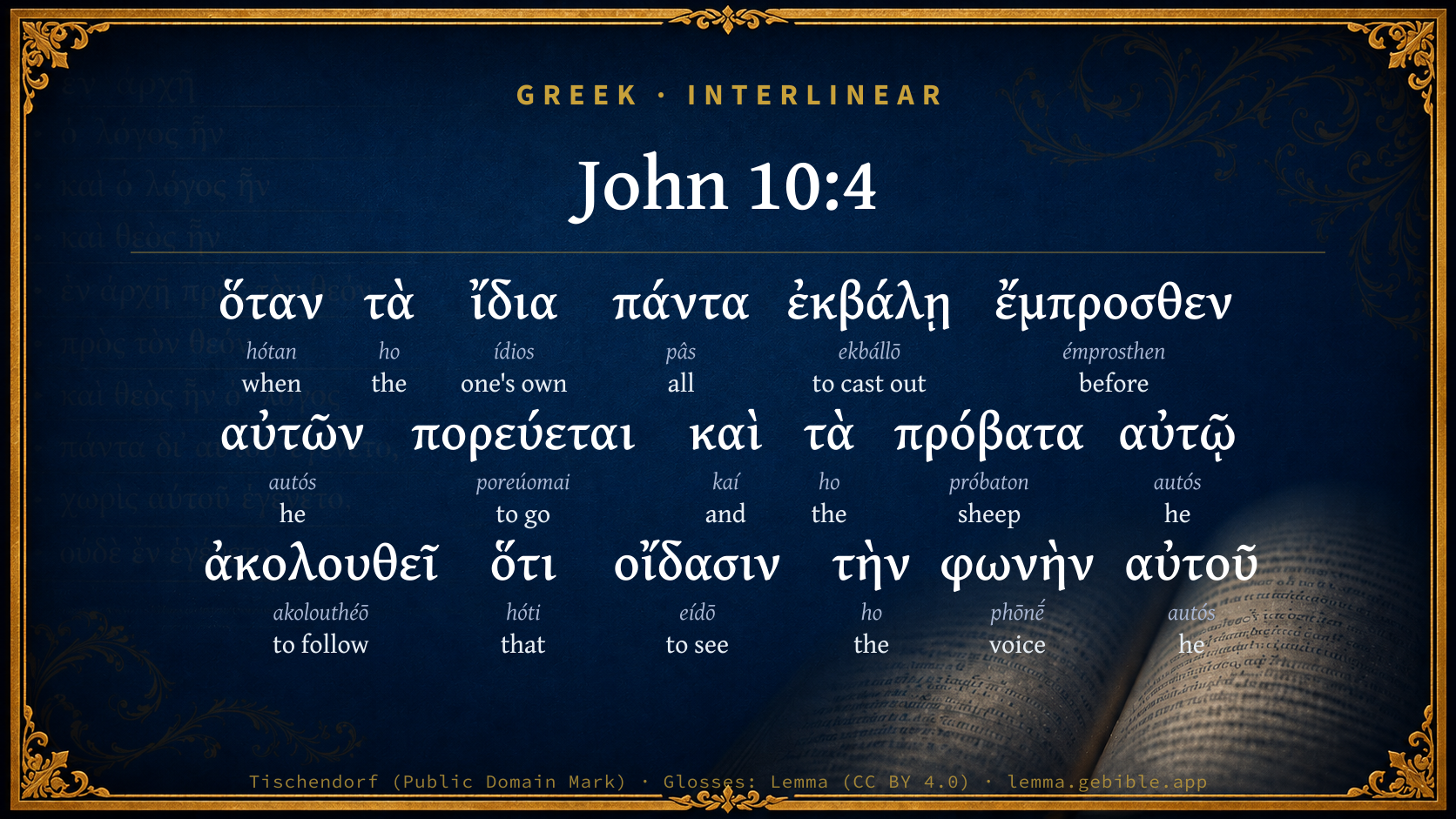
Greek (Tischendorf 8th ed.) John 10:4 appears in the Greek New Testament. The text above is from the Tischendorf 8th edition. Each word links to its Strong’s number and a concise gloss. Click any word for its full Thayer’s Greek Lexicon entry.
Download image
Cite this verse

John 10:4 (World English Bible). Public Domain. Lemma interlinear Bible study tool, https://lemma.gebible.app/v/john/10/4.

Show BibTeX & RIS
BibTeX
RIS
English Translation
Whenever he brings out his own sheep, he goes before them, and the sheep follow him, for they know his voice.
World English Bible · Public Domain
Download a study sheet

One document with this verse’s original text, its word-by-word gloss line, the meaning frame, cross-references with their text, attributed commentary, and full source and license credits — printable, and it pastes into notes with its structure intact.

This verse Autodidact and up

Study sheet (.html) Plain text (.txt)

A passage Seminary Student

Up to 50 verses in one chapter. A passage sheet keeps up to 6 commentary sources and 12 cross-references per verse, in the order this page ranks them, and says so on the sheet whenever that leaves anything out. Ask for a single verse and you get the Autodidact verse sheet above.

Everything on this page stays free to read, with no account — the sheet is a download of what is already on screen, not access to it.

Want to remove ads? Support Godless Engineer
Compare translations 3

The same verse in 3 English versions, stacked beneath the original-language interlinear above. Click any original word for its lexicon entry.

Each is an independent rendering of the whole verse — the interlinear is not word-aligned to these translations.

Highlighted words mark where these versions differ — a whole-verse word diff, not a word-by-word alignment.

  • World English Bible Public Domain
    Whenever he brings out his own sheep, he goes before them, and the sheep follow him, for they know his voice.
  • King James Version Public Domain
    And when he putteth forth his own sheep, he goeth before them, and the sheep follow him: for they know his voice.
  • unfoldingWord Literal Text CC BY-SA 4.0
    When he has brought out all his own, he goes ahead of them, and the sheep follow him, for they know his voice.

unfoldingWord Literal Text — © unfoldingWord, licensed CC BY-SA 4.0. Word-aligned USFM3 via Door43 (git.door43.org/unfoldingWord/en_ult).

Versions to compare (up to 4)

3 of 4 selected

Show all 19 translations

Every available English version of this verse, each an independent rendering of the whole verse.

  • World English Bible Public Domain
    Whenever he brings out his own sheep, he goes before them, and the sheep follow him, for they know his voice.
  • Berean Standard Bible Public Domain
    When he has brought out all his own, he goes on ahead of them, and his sheep follow him because they know his voice.
  • Majority Standard Bible Public Domain
    When he has brought out his own sheep, he goes on ahead of them, and his sheep follow him because they know his voice.
  • King James Version Public Domain
    And when he putteth forth his own sheep, he goeth before them, and the sheep follow him: for they know his voice.
  • American Standard Version (1901) Public Domain
    When he hath put forth all his own, he goeth before them, and the sheep follow him: for they know his voice.
  • Revised Version (1885) Public Domain
    When he hath put forth all his own, he goeth before them, and the sheep follow him: for they know his voice.
  • Geneva Bible (1599) Public Domain
    And when hee hath sent foorth his owne sheepe, he goeth before them, and the sheepe follow him: for they know his voyce.
  • Douay-Rheims (1899) Public Domain
    And when he hath let out his own sheep, he goeth before them: and the sheep follow him, because they know his voice.
  • Young's Literal Translation Public Domain
    and when his own sheep he may put forth, before them he goeth on, and the sheep follow him, because they have known his voice;
  • Literal Standard Version CC BY-SA 4.0
    and when he may put forth his own sheep, he goes on before them, and the sheep follow him, because they have known his voice;
  • Unlocked Literal Bible CC BY-SA 4.0
    When he has brought out all his own, he goes ahead of them, and the sheep follow him, for they know his voice.
  • unfoldingWord Literal Text CC BY-SA 4.0
    When he has brought out all his own, he goes ahead of them, and the sheep follow him, for they know his voice.
  • Darby Bible Public Domain
    When he has put forth all his own, he goes before them, and the sheep follow him, because they know his voice.
  • World Messianic Bible Public Domain
    Whenever he brings out his own sheep, he goes before them; and the sheep follow him, for they know his voice.
  • Webster's Bible Public Domain
    And when he putteth forth his own sheep, he goeth before them, and the sheep follow him: for they know his voice.
  • Free Bible Version CC BY-SA 4.0
    After bringing them out, he walks ahead of them, and the sheep follow him because they recognize his voice.
  • Bible in Basic English Public Domain
    When he has got them all out, he goes before them, and the sheep go after him, for they have knowledge of his voice.
  • Text-Critical English NT CC BY 4.0
    When he has brought out his own sheep, he goes ahead of them, and the sheep follow him because they recognize his voice.
  • Tyndale New Testament (1534) Public Domain
    And when he hath sent forthe his awne shepe he goeth before them and the shepe folowe him: for they knowe his voyce.

Literal Standard Version (2020), Covenant Press — licensed CC BY-SA 4.0. Text via the HelloAO Bible API (eBible.org). Unlocked Literal Bible (unfoldingWord) — licensed CC BY-SA 4.0. Text via the HelloAO Bible API (eBible.org). unfoldingWord Literal Text — © unfoldingWord, licensed CC BY-SA 4.0. Word-aligned USFM3 via Door43 (git.door43.org/unfoldingWord/en_ult). Free Bible Version, Dr. Jonathan Gallagher — licensed CC BY-SA 4.0. Text via the HelloAO Bible API (eBible.org).

Word by word

More ways to search: Search by grammar → Find every occurrence → Compare this word →

Practice this passage: Drill this verse → Learn its vocabulary →

πρόβατα
próbaton
G4263
“sheep”
Noun, Nominative, Plural, Neuter
Part of Speech
Noun
Case
Nominative
Number
Plural
Gender
Neuter
Full Thayer's Definition

Origin: probably from a presumed. derivative of G4260

TDNT: 17:29,9

1. any four footed, tame animal accustomed to graze, small cattle (opp. to large cattle, horses, etc.), most commonly a sheep or a goat a. a sheep, and so always in the NT
  1. ὅταν hótan G3752 “when” Conjunction
  2. τὰ ho G3588 “the” Article, Accusative, Plural, Neuter
  3. ἴδια ídios G2398 “one's own” Adjective, Accusative, Plural, Neuter
  4. πάντα pâs G3956 “all” Adjective, Accusative, Plural, Neuter
  5. ἐκβάλῃ ekbállō G1544 “to cast out” Verb, Aorist, Active, Subjunctive, 3rd person, Singular
  6. ἔμπροσθεν émprosthen G1715 “before” Preposition
  7. αὐτῶν autós G846 “he” Personal pronoun, Genitive, Plural, Neuter
  8. πορεύεται poreúomai G4198 “to go” Verb, Present, Middle or Passive deponent, Indicative, 3rd person, Singular
  9. καὶ kaí G2532 “and” Conjunction
  10. τὰ ho G3588 “the” Article, Nominative, Plural, Neuter
  11. αὐτῷ autós G846 “he” Personal pronoun, Dative, Singular, Masculine
  12. ἀκολουθεῖ akolouthéō G190 “to follow” Verb, Present, Active, Indicative, 3rd person, Singular
  13. ὅτι hóti G3754 “that” Conjunction
  14. οἴδασιν eídō G1492 “to see” Verb, Perfect, Active, Indicative, 3rd person, Plural
  15. τὴν ho G3588 “the” Article, Accusative, Singular, Feminine
  16. φωνὴν phōnḗ G5456 “voice” Noun, Accusative, Singular, Feminine
  17. αὐτοῦ autós G846 “he” Personal pronoun, Genitive, Singular, Masculine

About this verse

These counts appear in no published source. They are computed here, from the morphology-tagged text and Lemma’s own curated glosses. What Lemma adds →

18
words
14
distinct lemmas
Gospels
section

Shared distinctive vocabulary

πρόβατα sheep G4263 occurs in 37 verses of the Greek New Testament. Also found in:
Repetition

Words recur within this verse:

  • τὰ the G3588 ×3
  • αὐτῶν he G846 ×3

Cross-references

20

Topical passages linked to John 10:4 in the Treasury of Scripture Knowledge — connected by theme and wording, ordered by reader-vote popularity; previews shown in the World English Bible.

  • Deuteronomy 1:30 Yahweh your God who goes before you, he will fight for you, according to all that he did for you in Egypt before your eyes,
  • John 10:16 I have other sheep, which are not of this fold. I must bring them also, and they will hear my voice. They will become one flock with one shepherd.
  • John 12:26 If anyone serves me, let him follow me. Where I am, there will my servant also be. If anyone serves me, the Father will honor him.
  • John 10:8 All who came before me are thieves and robbers, but the sheep didn't listen to them.
  • John 18:37 Pilate therefore said to him, "Are you a king then?" Jesus answered, "You say that I am a king. For this reason I have been born, and for this reason I have come into the world, that I should testify to the truth. Everyone who is of the truth listens to my voice."
  • 1 Peter 2:21 For to this you were called, because Christ also suffered for us, leaving you an example, that you should follow his steps,
  • 1 Peter 5:3 neither as lording it over the charge allotted to you, but making yourselves examples to the flock.
  • Micah 2:12–13 I will surely assemble, Jacob, all of you; I will surely gather the remnant of Israel; I will put them together as the sheep of Bozrah, As a flock in the midst of their pasture; They will swarm with people.
  • Matthew 16:24 Then Jesus said to his disciples, "If anyone desires to come after me, let him deny himself, and take up his cross, and follow me.
  • 1 Corinthians 11:1 Be imitators of me, even as I also am of Christ.
  • Song of Solomon 2:8 The voice of my beloved! Behold, he comes, Leaping on the mountains, Skipping on the hills.
  • John 3:29 He who has the bride is the bridegroom; but the friend of the bridegroom, who stands and hears him, rejoices greatly because of the bridegroom's voice. This, my joy, therefore is made full.
  • John 14:2–3 In my Father's house are many mansions. If it weren't so, I would have told you. I am going to prepare a place for you.
  • Ephesians 5:1 Be therefore imitators of God, as beloved children.
  • Hebrews 6:20 where as a forerunner Jesus entered for us, having become a high priest forever after the order of Melchizedek.
  • Hebrews 12:2 looking to Jesus, the author and perfecter of faith, who for the joy that was set before him endured the cross, despising shame, and has sat down at the right hand of the throne of God.
  • John 13:15 For I have given you an example, that you also should do as I have done to you.
  • Philippians 2:5–11 Have this in your mind, which was also in Christ Jesus,
  • Song of Solomon 5:2 I was asleep, but my heart was awake. It is the voice of my beloved who knocks: Open to me, my sister, my love, my dove, my undefiled; For my head is filled with dew, My hair with the dampness of the night.
  • 1 Peter 4:1 Forasmuch then as Christ suffered for us in the flesh, arm yourselves also with the same mind; for he who has suffered in the flesh has ceased from sin;

Cross-references courtesy of OpenBible.info (CC BY 4.0).

Where the printed editions differ

1 variant

Places in this verse where the major printed Greek editions disagree on the wording in a way that affects the translation — a comparison of editions, not a manuscript-by-manuscript collation. The editions are the modern critical texts (Nestlé-Aland 28/27, SBL, Westcott-Hort, Tregelles, Tyndale House) and the traditional texts behind the KJV (the Textus Receptus and the Byzantine/Majority text). It is not a claim about which reading is original.

  1. Different wording
    πάντα

    “all”

    In NA28NA27TynSBLWHTreg Not in TRByz

    πρόβατα (probata) 'sheep' occurs in traditional manuscripts (TR+Byz) instead of πάντα (panta) 'all' in older manuscripts (NA28+NA27+Tyn+SBL+WH+Treg)

Textual data: Translators Amalgamated Greek New Testament (STEPBible TAGNT) · CC BY 4.0.

Commentary

Notes on John 10:4 from classic Christian and Jewish commentators (each source and its license shown beneath its notes). The classic Christian expositions comment on the surrounding passage and are grouped to its opening verse, so a note may address several verses; the Jewish commentaries on the Tanakh (Rashi and others) are per-verse, so they appear only where the commentator wrote on this verse.

Lemma curates 59 commentaries, every one of them public domain or Creative Commons licensed, each selected and text-cleaned for this edition rather than reprinted as found. About our sources →

Tyndale Open Study Notes

Tyndale Open Resources

10:4 A good shepherd always leads his sheep; he never drives them. When they recognize his voice, they trust his leadership and follow him.

Tyndale Open Study Notes — © Tyndale Open Resources, licensed CC BY-SA 4.0. Text via the HelloAO Bible API.

Bengel's Gnomon

Johann Albrecht Bengel

Joh 10:4. Ἐκβάλη, He putteth forth) Synonymous with the verb, ἐξάγει, He leadeth out, but more general.

Bengel's Gnomon of the New Testament — English translation (T&T Clark, Edinburgh, 1860) — public domain. Text from a community e-Sword module.

Meyer's Critical & Exegetical Commentary

Heinrich August Wilhelm Meyer

Joh_10:4. And when he has brought out all his own sheep (those belonging to his flock), and so forth. He leaves none behind (πάντα, see the critical note). ἐκβάλῃ pictures forth the manner of the ἐξάγειν. He lays hold on the sheep which he has called to him, and brings them out to the door.

The idea, which is symbolically set forth in Joh_10:3-4, is that of the living, loving fellowship which subsists between the leaders of the people of God, whom Christ has appointed, and Christ Himself, for the satisfaction of the spiritual needs of the Church, both in general and in particular.

Meyer — Critical and Exegetical Commentary on the New Testament — English translation by Peter Christie, edited by Frederick Crombie (T&T Clark, 1880) — public domain. Text from a community e-Sword module.

Adam Clarke's Commentary

Verse 4. He goeth before them] A sixth mark of a true pastor is, he gives them a good example: he not only preaches, but he lives, the truth of the Gospel; he enters into the depths of the salvation of God; and, having thus explored the path, he knows how to lead those who are entrusted to his care into the fulness of the blessings of the Gospel of peace. He who does not endeavour to realize in his own soul the truths which he preaches to others will soon be as salt without its savour; his preaching cannot be accompanied with that unction which alone can make it acceptable and profitable to those whose hearts are right with God. The minister who is in this state of salvation the sheep, genuine Christians, will follow, for they know his voice. It was the custom in the eastern countries for the shepherd to go at the head of his sheep, and they followed him from pasture to pasture. I have seen many hundreds of sheep thus following their shepherd on the extensive downs in the western parts of England.

Adam Clarke's Commentary on the Bible (1810–1826) — public domain. Text from a community e-Sword/MySword module.

John Calvin's Commentaries

4. Because they know his voice. Though he speaks here of ministers, yet, instead of wishing that they should be heard, he wishes that God should be heard speaking by them; for we must attend to the distinction which he has laid down, that he alone is a faithful pastor or shepherd of the Church, who conducts and governs his sheep by the direction of Christ. We must attend to the reason why it is said that the sheep follow; it is, because they know how to distinguish shepherds from wolves by the voice This is the spirit of discernment, by which the elect discriminate between the truth of God and the false inventions of men. So then, in the sheep of Christ a knowledge of the truth goes before, and next follows an earnest desire to obey, so that they not only understand what is true, but receive it with warm affection. And not only does he commend the obedience of the faith, because the sheep assemble submissively at the voice of the shepherd, but also because they do not listen to the voice of strangers, and do not disperse when any one cries to them.

John Calvin's Commentaries (1540-1563) — public domain. Text from the Calvin Translation Society English edition (1840s-50s) via the Christian Classics Ethereal Library (ccel.org). Calvin's coverage is partial (roughly two-thirds of the Bible); uncommented books and verses are honest gaps, never fabricated. The 19th-century editor's footnotes and remarks are omitted so the notes are faithfully Calvin's own voice.

Ellicott's Commentary for English Readers

(4) And when he putteth forth his own sheep.—The majority of the better MSS. add the word “all.” The tense is past. We should read, therefore, when he has put forth all his own sheep. The addition is important as marking the care of the shepherd to count his flock and see that none is missing. The word “put forth” is stronger than “lead out,” in the previous verse, and represents the details of the action as it took place in the sheepfold. The shepherd would call each sheep by name, and when it answered to its name would drag it outside the fold. Though it knew its shepherd, it would be unwilling to separate itself from the whole flock. One by one, then, he calls his sheep, and places them outside the fold.

He goeth before them, and the sheep follow him.—This is one of the incidents in the management of an Eastern flock, which strikes all who see it for the first time, and is abundantly illustrated in books of Eastern travel. The details are here given with minute accuracy. When the last sheep has been brought out the shepherd places himself at their head, and the flock together follow him.

For they know his voice.—The word is stronger than the one in Joh_10:3, “and the sheep hear his voice.” It expresses the familiar knowledge which the little flock has of the voice of their own shepherd who leads them day by day.

A Bible Commentary for English Readers, edited by Charles John Ellicott (1878–1897) — public domain. Text from a community e-Sword module.

The Cambridge Bible for Schools and Colleges

gen. ed. J. J. S. Perowne

4. when he putteth forth his own sheep] Better, when he hath put forth all his own. Most of the best MSS. have ‘all’ for ‘sheep:’ ‘there shall not an hoof be left behind’ (Exo_10:26). The word for ‘put forth’ is remarkable; it is the same as is used in Joh_9:34-35 of the Pharisees ‘casting out’ the man born blind. This is perhaps not accidental: the false shepherds put forth sheep to rid themselves of trouble; the true shepherds put forth sheep to feed them. But even the true shepherds must sometimes use a certain amount of violence to their sheep to ‘compel them to come’ (Luk_14:23) to the pastures. But note that there are no ‘goats’ in the allegory: all the flock are faithful. It is the ideal Church composed entirely of the elect. The object of the allegory being to set forth the relations of Christ to His sheep, the possibility of bad sheep is not taken into account. That side of the picture is treated in the parables of the Lost Sheep, and of the Sheep and the Goats.

The Cambridge Bible for Schools and Colleges (gen. ed. J. J. S. Perowne; Cambridge University Press, 1878–1918) — public domain. Text from a community e-Sword module.

John Gill's Exposition

And when he putteth forth his own sheep,.... The Ethiopic version reads, "when he leads them all out"; in order to bring them into proper pastures:

he goeth before them; in allusion to the eastern shepherds, who when they put out their flocks, did not, as ours do, drive them before them, and follow after them, at least not always, but went before them: so Christ, the great shepherd, goes before his flock, not only to provide for them, but by way of example to them; in many instances he is an ensample to the flock, as under shepherds, according to the measure of grace received, should be: he has left them an example in many respects, that they should tread in his steps:

and the sheep follow him; in the exercise of the graces of humility, love, patience, self-denial, and resignation of will to the will of God; and in the discharge of duty, walking, in some measure, as he walked.

For they know his voice; in the Gospel, which directs and encourages them to exercise grace in him, and to walk in the path of duty: this they know by the majesty and authority of it; and by the power with which it comes to their souls; and by its speaking of him, and leading to him; and by the evenness, harmony, and consistency of it. The Persic version renders the whole thus; "when he calls and leads out the sheep, they go before him, and their lambs after them, for they know his voice".

John Gill's Exposition of the Whole Bible (1746–1763) — public domain (CC PDM 1.0). Text via the HelloAO Bible API.

Trapp's Complete Commentary

John Trapp

4 And when he putteth forth his own sheep, he goeth before them, and the sheep follow him: for they know his voice.

Ver. 4. He goeth before them] According to the custom of shepherds in that country, not to drive their sheep, but to lead them, as David shows in his divine Bucolicon, Psa 23:2.

John Trapp, A Commentary or Exposition upon All the Books of the Old and New Testament (1647–1656) — public domain. Text from a community e-Sword module.

Albert Barnes' Notes on the Bible

He putteth forth - Or leads them out of the fold.

He goeth before them - He leads them, and guides them, and does not leave them. A shepherd spent his time with his flocks. He went before them to seek the best pastures and watering-places, and to defend them from danger. In this is beautifully represented the tender care of him who watches for souls as one that must give account.

Albert Barnes' Notes on the Bible (1834–1885) — public domain. Text from a community e-Sword/MySword module.

Haydock's Catholic Bible Commentary

He goeth before them, leads them by his instructions and example. (Witham)

George Leo Haydock (1774–1849), Haydock's Catholic Family Bible and Commentary, 1859 edition — public domain. Excludes Psalms (Douay-Rheims chapter numbering differs from Protestant) and Deuterocanonical books (Catholic canon only).

Matthew Poole's English Annotations

In our country at this day, shepherds generally follow their sheep, which go before them. In other countries, as France, &c., it is otherwise at this day; the shepherds go before their flocks, and their flocks follow them, upon some sounds they make. In Palestine (which was the Jews country) it should seem that the shepherds sometimes went before their sheep, and sometimes followed them. David followed his father’s sheep, 2Sa 7:8; Psa 78:71. On the other side, God is spoken of, Psa 80:1, under the notion of the Shepherd of Israel, who leadeth Joseph like a flock. And the psalmist, Psa 23:1, speaking of God as his Shepherd, saith, Psa 23:2, he leadeth me beside the still waters. Christ here speaketh of himself under the notion of a shepherd that went before his sheep, and whom the sheep followed; and thereby lets us know the duty of all faithful pastors in the church, so to live, that their flocks may follow them with safety; which cannot be, unless they follow Christ, 1Co 11:1. For, saith our Saviour, those that are my true sheep, they know my voice; thereby signifying that power of discerning between truth and damnable errors, which the Lord gives unto all true believers, 1Jo 2:27.

Matthew Poole's English Annotations on the Holy Bible (1683–1685) — public domain. Text from a community e-Sword/MySword module.

Whedon's Commentary on the Bible

Daniel D. Whedon

4. Goeth before them—The Palestinian shepherd goes before the sheep, while the Grecian shepherd drives them before himself. It is curious to note that the very word in Greek for sheep, προβατον, signifies a goer-before. The sheep is trained not to turn to the corn fields lying unfenced beside his path to tempt him, as trouble then ensues. The true pastor is a true leader, by his example of holiness, his zeal in benevolent enterprise, his faith and earnestness for the salvation of men.

Sheep—Not merely the actually justified, but those who feel the need of the Saviour, and, even before they find him, are predisposed and spiritually ready to trust and obey him. These are his sheep, not by a predestination from all eternity, but by a predetermination of their own heart and will under the blessed influences and guidances of the divine Spirit. See note on Joh_9:36.

Know his voice—As the sheep by animal instinct learns to know his shepherd’s voice, so do the spiritual sheep, like the blind-born, by a discerning of spirit, recognize the pastor who truly feeds their souls.

Daniel D. Whedon (gen. ed.), Commentary on the Old and New Testaments (1874–1909) — public domain. Text from a community e-Sword module.

The Pulpit Commentary

In like manner, our Lord continues to describe what every true shepherd of men has done and ever will do: When he hath put forth allhis own, and not another"s, drawn them by the music of his voice, or constrained them by the sweet violence of his love, or even compelled them to go forth from a fold in which they may find security, but not pasture; and when he has marshaled them into obedience and into thankful trust by the strength of his sympathy and knowledge of their need, he goeth before them. He is their leader and example; he shows them in his own life the kind of provision made for them; he shares with them the perils of the wilderness, and first of all is prepared to grapple with their fierce foes, "He drinks of the brook in the way." The highest meaning, the only complete interpretation, of this passage is found when Christ himself is the Shepherd, who does summon from the old enclosure "all his own," all who have entered into living harmony with himself. And the sheep follow him: for they know his voice. Nothing is here said of "lost sheep" or of "goats;" these are all the "ideal sheep" of the flock, individuals who recognize the voice of the true Leader, and discriminate their own shepherd from all others, whether pretenders to their affections or destroyers of their lives wolves or butchers, thieves or robbers. Should we persist in interpreting the apologue as it stands, a question arises about the probata that are not the shepherd"s" own." Some have answered it by supposing that the latter are the chief of his own flock, who will bring the rest after them. The truth is not obscurely hinted of that election to highest privileges and duties, which does not declare that the rest are not sheep at all.

HOMILIES BY D. YOUNG Ver. 4. The familiar voice.

Here we have an illustration of the advantage in some respects of ear over eye, of sound over light. By the shepherd"s voice the sheep know him even when they cannot see him. They never make any mistake. A stranger might come and bellow himself hoarse, and they would just stop where they were. This statement, of course, we have to take on trust. It would be much more forcible to us if we had stood by the common fold and seen the sheep rushing toward the shepherd upon the hearing of his voice. But we may make little parables out of our own observation. Other brute beasts beside sheep recognize these on whom they are dependent.

I THE GREAT PROMISE CONNECTED WITH THE KNOWLEDGE OF THE VOICE OF JESUS. See vers. 27 and 28, "My sheep hear my voice, and I know them, and they follow me: and I give unto them eternal life; and they shall never perish, neither shall any man pluck them out of my hand." As there are gifts for sheep corresponding to their nature and needs, so there are gifts for men. As the shepherd gives to the sheep sustenance for its natural life, making it his business and responsibility to find out the green pastures and still waters, so Jesus is the Shepherd who gives to his sheep eternal life, introducing them to a scene of growth and occupation and blessedness to which he alone has the key. Thus also Jesus stands between his flock and peril. There is that goeth about as a roaring lion, seeking whom he may devour. There is that would drive every Christian into unbelief and backsliding and love of this present evil world, and so into ultimate destruction. But Jesus stands as the good Shepherd, armed at every point against every foe.

II ALL IS USELESS UNLESS THE SHEEP KNOW THE VOICE. Ample provision is nothing unless the sheep come to make use of it. The bravery and vigilance of the Shepherd are all in vain if the sheep wander out of earshot. Even a sheep must do something to contribute to its own nourishment and security, and how much more a human being? If we would attain the very height of life and be invulnerable at every point, we must know the voice of Jesus. And yet though the sheep, silly, stupid thing as it is often reckoned, knows its shepherd"s voice, the children of men, those for whom Jesus has stored up such abundance of the bread of life, and to whose salvation he has devoted himself, know not his voice. Oftentimes, too, the knowledge of that voice has to come very gradually.

III OUR OWN NEEDY AND DANGEROUS POSITION MUST BE PERCEIVED. We must comprehend why the voice of Jesus speaks to us at all. That voice sounds out because of need and danger. The sheep and shepherd, as it were, make up one whole. Unless we feel our need to know the voice of Jesus, we never can know that need. Mere reading of his words is not knowing his voice. The voice of Jesus must become familiar just as every other voice does. There must be a beginning. There must be attentiveness. We may hear that voice continually if we choose to hear it, and take the right way to hear it. Nothing is easier than to stop our ears. The din of the world"s babble will easily drown the voice that speaks to us of support and salvation. All hangs on our willingness to listen. We carry our needs about with us, wrapt in the complications and anxieties of our lives, and we must carry our Shepherd about with us too. If we are as much alive to our needs and dangers as Jesus is, then all will be right; for his voice is ever sounding in the midst of need and danger. Y.

The Pulpit Commentary (1880–1919), ed. H.D.M. Spence-Jones & Joseph S. Exell — public domain. Text from a community e-Sword module.

John Wesley's Explanatory Notes

He goeth before them - In all the ways of God, teaching them in every point, by example as well as by precept; and the sheep follow him - They tread in his steps: for they know his voice - Having the witness in themselves that his words are the wisdom and the power of God. Reader, art thou a shepherd of souls? Then answer to God. Is it thus with thee and thy flock?

John Wesley, Explanatory Notes Upon the Whole Bible (1754–1765) — public domain. Text via the GEBible commentary corpus.

The People's New Testament

B. W. Johnson

4, 5. The sheep follow him: for they know his voice. Also literally true in the East as all travelers testify, but a stranger they will not follow, because his voice is strange. So true is it that when a traveler has changed dress with the shepherd for an experiment, they still have followed the disguised shepherd's voice and refused to listen to the voice of a stranger in the garb of their own shepherd.

B. W. Johnson's The People's New Testament with Notes (1889–1891) — public domain. Electronic text from the Christian Classics Ethereal Library (CCEL) ThML edition.

Cambridge Greek Testament for Schools and Colleges

4. πάντα (BDLX) for πρόβατα (A).

4. ὅταν τὰ ἴδια πάντα ἐκβ. When he hath put forth all his own. ‘There shall not an hoof be left behind’ (Exo 10:26). Ἐκβάλῃ is remarkable, as being the very word used in Joh 9:34-35 of the Pharisees putting forth the man born blind: here we might have expected ἐξάγειν rather than ἐκβάλλειν. The false shepherds put forth sheep to rid themselves of trouble; the true shepherds put forth sheep to feed them. But even the true shepherds must use some violence to their sheep to ‘compel them to come’ (Luk 14:23) to the pastures. This was true at this very moment of the Messiah, who was endeavouring to bring His people out of the rigid enclosure of the Law into the free pastures of the Gospel. But there are no ‘goats’ in the allegory; all the flock are faithful. It is the ideal Church composed entirely of the elect. The object of the allegory being to set forth the relations of Christ to His sheep, the possibility of bad sheep is not taken into account. That side of the picture is treated in the parables of the Lost Sheep, and of the Sheep and the Goats.

ἔμπροσθεν. As soon as they are out he does not drive but leads them, as Oriental shepherds do still: and they follow, because they not only hear (Joh 10:3) but know his voice. Note the change from sing. ἀκολουθεῖ to plur. οἴδασιν; Winer, p. 646.

Cambridge Greek Testament for Schools and Colleges (Cambridge University Press, 1896; 21 vols, various authors incl. Carr, Maclear, Plummer, Farrar, Lumby, Moule, M. R. James, Simcox) — public domain. Text from a community e-Sword module.

Alford’s Greek Testament

Henry Alford

4.] When he has led forth (ἐκβάλλειν = ἐξάγειν) to pasture all his sheep (there shall not an hoof be left behind), he goes before them (see The Land and the Book, p. 202); in his teaching pointing out the way to them; they follow him, because they know his voice; his words and teaching are familiar to them. But observe that the expression here becomes again more general; not τὰ ἴδ. πρ., but τὰ πρ. as in ver. 3. The sheep know the voice of every true shepherd.

Henry Alford, The Greek Testament (1849–1861) — public domain. Text from a community e-Sword module.

International Critical Commentary

4. ὅταν τὰ ἴδια πάντα ἐκβάλῃ. So אcaBDLΘ, but AΓΔ read πρόβατα for πάντα. The rec. has καὶ ὅταν (with ADΓΔ), but אBLWΘ omit καί. It probably came in from καὶ τὰ ἴδια in the preceding verse. “When he has put out (of the fold) all his own”: he is careful to forget none, as he leads his flock to pasture. ἐκβάλλειν suggests a certain measure of constraint, the shepherd thrusting out a sheep that delays unduly in coming forth at his call.

The shepherd, having collected his own flock from the fold, goes before them (ἔμπροσθεν αὐτῶν). At 3:28 ἔμπροσθεν is used of priority in time; here it refers to space, as at 12:37. His own sheep follow him (cf. v. 27), because they know his voice (cf. vv. 26, 3).

International Critical Commentary — older volumes (1896–1929), various authors — public domain. Text from a community e-Sword module.

Vincent's Word Studies in the New Testament

Marvin R. Vincent

Putteth forth [εκβαλη] . Rev., more strictly, hath put forth. Instead of leadeth out, in ver. 3. It implies a constraint; as if some of the sheep were unwilling to leave the fold. Meyer says that putteth forth pictures the manner of the leading out. He lays hold on the sheep and brings them out to the door.

His own sheep [τα ιδια προβατα] . The best texts read panta, all, for probata, sheep : all his own. So Rev.

Goeth before. As the Eastern shepherd always does. Having pushed them forth, he now leads them.

Follow. "It is necessary that they should be taught to follow, and not stray away into the unfenced fields of wheat which lie so temptingly on either side. The shepherd calls from time to time to remind them of his presence. They know his voice and follow on; but if a stranger call, they stop, lift up their heads in alarm, and if the call is repeated, they turn and flee from him; for they know not the voice of strangers. This is not the fanciful costume of a parable; it is simple fact. I have made the experiment often" (Thomson).

Marvin R. Vincent, Word Studies in the New Testament (1887–1900) — public domain. Text from a community e-Sword/MySword module.

Lesson kit

Teaching starters — assembled from the data on this page, not authored interpretation. Every prompt links to the verse data it draws on. Edit before teaching.

John, in the Gospels, opens this verse with 18 words (14 distinct Greek lemmas). Its most distinctive word is próbaton (“sheep”). A historical commentator’s framing appears above. Read the whole chapter for the surrounding context.

Discussion questions

  1. How does “sheep” (próbaton) shape what this verse is saying?
  2. Matthew 7:15 shares the word «sheep» with this verse. How do the two illuminate each other?
  3. “the” occurs 3× in this one verse. What is the effect of the repetition?
  4. The translations on this page render this verse differently — a whole-verse word diff, not a word-by-word alignment. What might account for the different wordings?
  5. Reading how Tyndale Open Study Notes and Bengel's Gnomon read this verse, where do the two commentators agree and where do they part?

Things to notice

Reading settings

Reading text

Shown beneath each verse's original-language words.

Old Testament
Old Testament edition

Read the OT as the Masoretic Hebrew (MT) or the Greek Septuagint (LXX).

English shown for the Greek Septuagint (in the Hebrew ↔ Greek comparison).

Comparing translations? Open the Compare panel on any verse page to stack up to four side by side.