John 8:11

Greek (Tischendorf 8th ed.) John 8:11 appears in the Greek New Testament. The text above is from the Tischendorf 8th edition. Each word links to its Strong’s number and a concise gloss. Click any word for its full Thayer’s Greek Lexicon entry.
Download image
Cite this verse

John 8:11 (World English Bible). Public Domain. Lemma interlinear Bible study tool, https://lemma.gebible.app/v/john/8/11.

Show BibTeX & RIS
BibTeX
RIS
English Translation
She said, "No one, Lord." Jesus said, "Neither do I condemn you. Go your way. From now on, sin no more."
World English Bible · Public Domain
Download a study sheet

One document with this verse’s original text, its word-by-word gloss line, the meaning frame, cross-references with their text, attributed commentary, and full source and license credits — printable, and it pastes into notes with its structure intact.

This verse Autodidact and up

Study sheet (.html) Plain text (.txt)

A passage Seminary Student

Up to 50 verses in one chapter. A passage sheet keeps up to 6 commentary sources and 12 cross-references per verse, in the order this page ranks them, and says so on the sheet whenever that leaves anything out. Ask for a single verse and you get the Autodidact verse sheet above.

Everything on this page stays free to read, with no account — the sheet is a download of what is already on screen, not access to it.

Want to remove ads? Support Godless Engineer
Compare translations 3

The same verse in 3 English versions, stacked beneath the original-language interlinear above. Click any original word for its lexicon entry.

Each is an independent rendering of the whole verse — the interlinear is not word-aligned to these translations.

Highlighted words mark where these versions differ — a whole-verse word diff, not a word-by-word alignment.

  • World English Bible Public Domain
    She said, "No one, Lord." Jesus said, "Neither do I condemn you. Go your way. From now on, sin no more."
  • King James Version Public Domain
    She said, No man, Lord. And Jesus said unto her, Neither do I condemn thee: go, and sin no more.
  • unfoldingWord Literal Text CC BY-SA 4.0
    And she said to him, “No one, Lord.” And he said, “Neither do I condemn you. Go, from now sin no longer.”]

unfoldingWord Literal Text — © unfoldingWord, licensed CC BY-SA 4.0. Word-aligned USFM3 via Door43 (git.door43.org/unfoldingWord/en_ult).

Versions to compare (up to 4)

3 of 4 selected

Show all 19 translations

Every available English version of this verse, each an independent rendering of the whole verse.

  • World English Bible Public Domain
    She said, "No one, Lord." Jesus said, "Neither do I condemn you. Go your way. From now on, sin no more."
  • Berean Standard Bible Public Domain
    “No one, Lord,” she answered. “Then neither do I condemn you,” Jesus declared. “Now go and sin no more.”
  • Majority Standard Bible Public Domain
    “No one, Lord,” she answered. “Then neither do I condemn you,” Jesus declared. “Go and sin no more.”
  • King James Version Public Domain
    She said, No man, Lord. And Jesus said unto her, Neither do I condemn thee: go, and sin no more.
  • American Standard Version (1901) Public Domain
    And she said, No man, Lord. And Jesus said, Neither do I condemn thee: go thy way; from henceforth sin no more.
  • Revised Version (1885) Public Domain
    And she said, No man, Lord. And Jesus said, Neither do I condemn thee: go thy way; from henceforth sin no more.]
  • Geneva Bible (1599) Public Domain
    She said, No man, Lord. And Iesus said, Neither do I condemne thee: go and sinne no more.
  • Douay-Rheims (1899) Public Domain
    Who said: No man, Lord. And Jesus said: Neither will I condemn thee. Go, and now sin no more.
  • Young's Literal Translation Public Domain
    and she said, `No one, Sir;' and Jesus said to her, `Neither do I pass sentence on thee; be going on, and no more sin.'
  • Literal Standard Version CC BY-SA 4.0
    And she said, “No one, Lord”; and Jesus said to her, “Neither do I pass sentence on you; be going on, and sin no more.”]]
  • Unlocked Literal Bible CC BY-SA 4.0
    She said, “No one, Lord.” Jesus said, “Neither do I condemn you. Go and sin no more.”]
  • unfoldingWord Literal Text CC BY-SA 4.0
    And she said to him, “No one, Lord.” And he said, “Neither do I condemn you. Go, from now sin no longer.”]
  • Darby Bible Public Domain
    And she said, No one, sir. And Jesus said to her, Neither do I condemn thee: go, and sin no more.
  • World Messianic Bible Public Domain
    She said, “No one, Lord.” Yeshua said, “Neither do I condemn you. Go your way. From now on, sin no more.”
  • Webster's Bible Public Domain
    She said, No man, Lord. And Jesus said to her, Neither do I condemn thee: go, and sin no more.
  • Free Bible Version CC BY-SA 4.0
    “No one did, sir,” she replied. “I don't condemn you either,” Jesus told her. “Go, and don't sin anymore.”
  • Bible in Basic English Public Domain
    And she said, No man, Lord. And Jesus said, And I do not give a decision against you: go, and never do wrong again.]
  • Text-Critical English NT CC BY 4.0
    She said, “No one, Lord.” Jesus said, “Neither do I pass judgment on yoʋ; go and sin no more.”
  • Tyndale New Testament (1534) Public Domain
    She sayde: No man Lorde. And Iesus sayde: Nether do I condempne the. Goo and synne no moare.

Literal Standard Version (2020), Covenant Press — licensed CC BY-SA 4.0. Text via the HelloAO Bible API (eBible.org). Unlocked Literal Bible (unfoldingWord) — licensed CC BY-SA 4.0. Text via the HelloAO Bible API (eBible.org). unfoldingWord Literal Text — © unfoldingWord, licensed CC BY-SA 4.0. Word-aligned USFM3 via Door43 (git.door43.org/unfoldingWord/en_ult). Free Bible Version, Dr. Jonathan Gallagher — licensed CC BY-SA 4.0. Text via the HelloAO Bible API (eBible.org).

Word by word

More ways to search: Search by grammar → Find every occurrence → Compare this word →

Practice this passage: Drill this verse → Learn its vocabulary →

κατακρίνω
katakrínō
G2632
“to condemn”
Verb, Present, Active, Indicative, 1st person, Singular
Part of Speech
Verb
Tense
Present
Voice
Active
Mood
Indicative
Person
1st person
Number
Singular
Full Thayer's Definition

Origin: from G2596 and G2919

TDNT: 18:51,5

1. to give judgment against, to judge worthy of punishment a. to condemn b. by one's good example to render another's wickedness the more evident and censurable
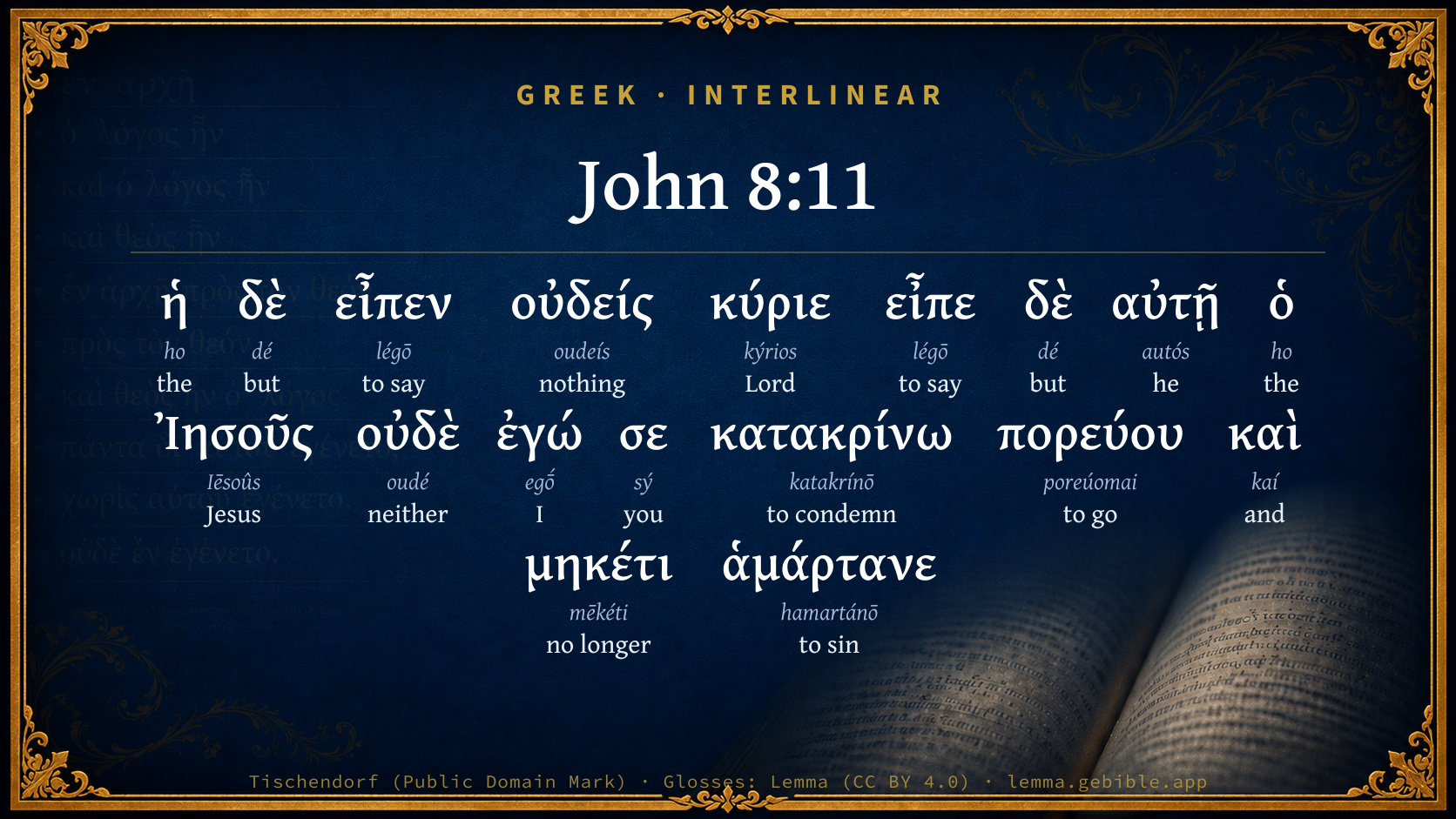
  1. ἡ ho G3588 “the” Article, Nominative, Singular, Feminine
  2. δὲ dé G1161 “but” Conjunction
  3. εἶπεν légō G3004 “to say” Verb, Aorist, Active, Indicative, 3rd person, Singular
  4. οὐδείς oudeís G3762 “nothing” Adjective, Nominative, Singular, Masculine, Negative
  5. κύριε kýrios G2962 “Lord” Noun, Vocative, Singular, Masculine
  6. εἶπε légō G3004 “to say” Verb, Aorist, Active, Indicative, 3rd person, Singular
  7. δὲ dé G1161 “but” Conjunction
  8. αὐτῇ autós G846 “he” Personal pronoun, Dative, Singular, Masculine
  9. ὁ ho G3588 “the” Article, Nominative, Singular, Masculine
  10. Ἰησοῦς Iēsoûs G2424 “Jesus” Noun, Nominative, Singular, Masculine
  11. οὐδὲ oudé G3761 “neither” Conjunction, Negative
  12. ἐγώ egṓ G1473 “I” Personal pronoun, 1st person, Nominative, Singular
  13. σε sý G4771 “you” Personal pronoun, 2nd person, Accusative, Singular
  14. πορεύου poreúomai G4198 “to go” Verb, Present, Middle or Passive deponent, Imperative, 2nd person, Singular
  15. καὶ kaí G2532 “and” Conjunction
  16. μηκέτι mēkéti G3371 “no longer” Adverb, Negative
  17. ἁμάρτανε hamartánō G264 “to sin” Verb, Present, Active, Imperative, 2nd person, Singular

About this verse

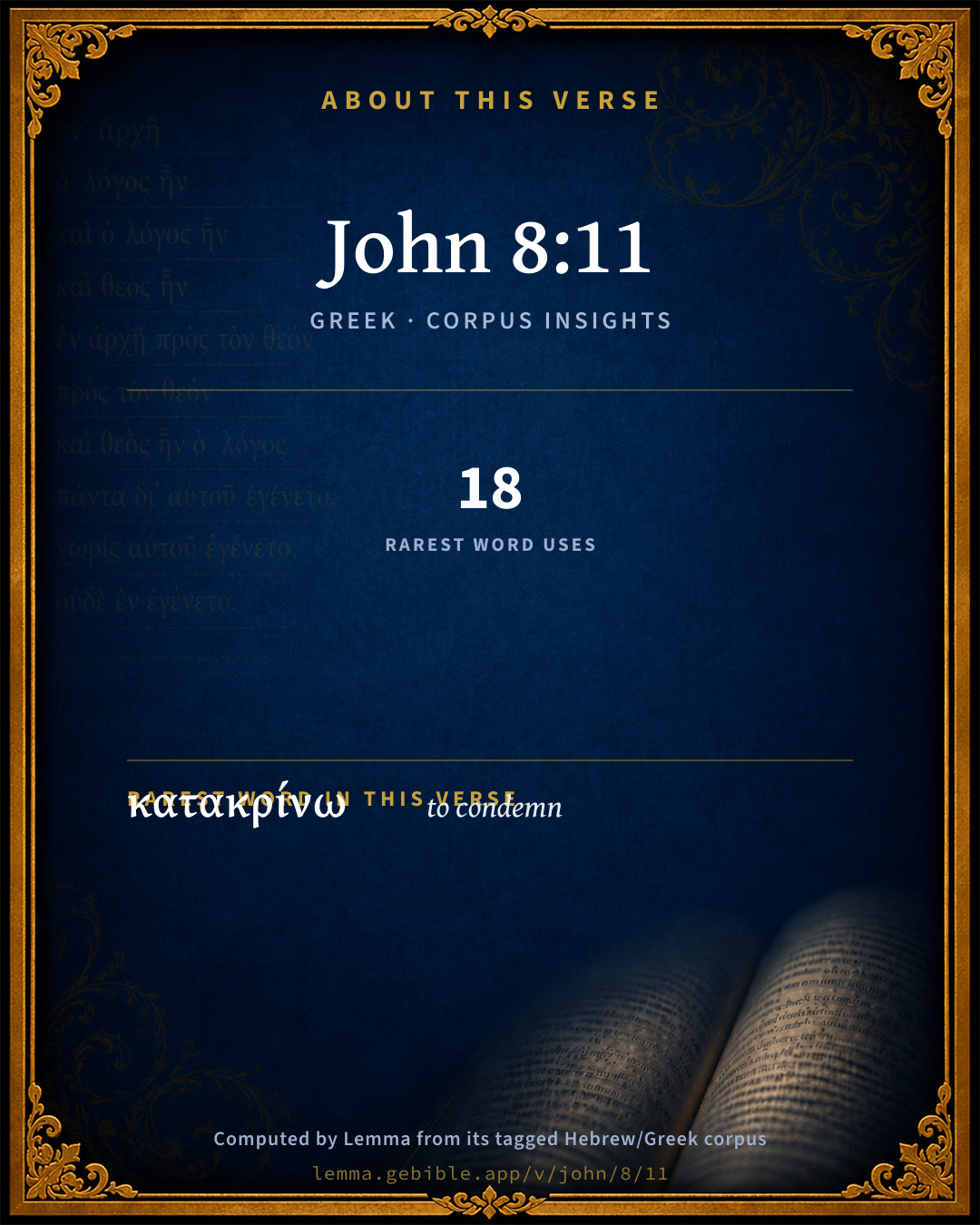
These counts appear in no published source. They are computed here, from the morphology-tagged text and Lemma’s own curated glosses. What Lemma adds →

18
words
15
distinct lemmas
Gospels
section

Notable vocabulary

The rarest word here is κατακρίνω to condemn G2632 — appearing just 18 times in the whole Greek New Testament.

Shared distinctive vocabulary

κατακρίνω to condemn G2632 occurs in 18 verses of the Greek New Testament. Also found in:

Repetition

Words recur within this verse:

Cross-references

27

Topical passages linked to John 8:11 in the Treasury of Scripture Knowledge — connected by theme and wording, ordered by reader-vote popularity; previews shown in the World English Bible.

  • John 3:17 For God didn't send his Son into the world to judge the world, but that the world should be saved through him.
  • John 5:14 Afterward Jesus found him in the temple, and said to him, "Behold, you are made well. Sin no more, so that nothing worse happens to you."
  • Isaiah 1:16–18 Wash yourselves, make yourself clean. Put away the evil of your doings from before my eyes; Cease to do evil.
  • John 8:15 You judge according to the flesh. I judge no one.
  • Luke 15:7 I tell you that even so there will be more joy in heaven over one sinner who repents, than over ninety-nine righteous people who need no repentance.
  • Luke 5:32 I have not come to call the righteous, but sinners to repentance."
  • Job 34:31 "For has any said to God, 'I am guilty, but I will not offend any more.
  • Proverbs 28:13 He who conceals his sins doesn't prosper, But whoever confesses and renounces them finds mercy.
  • Romans 2:4 Or do you despise the riches of his goodness, forbearance, and patience, not knowing that the goodness of God leads you to repentance?
  • 1 Timothy 1:15–16 The saying is faithful and worthy of all acceptance, that Christ Jesus came into the world to save sinners; of whom I am chief.
  • Luke 13:3 I tell you, no, but, unless you repent, you will all perish in the same way.
  • Ezekiel 18:30–32 Therefore I will judge you, house of Israel, everyone according to his ways, says the Lord Yahweh. Return you, and turn yourselves from all your transgressions; so iniquity shall not be your ruin.
  • Luke 15:10 Even so, I tell you, there is joy in the presence of the angels of God over one sinner repenting."
  • Romans 5:20–21 The law came in besides, that the trespass might abound; but where sin abounded, grace did abound more exceedingly;
  • Deuteronomy 16:18 Judges and officers shall you make you in all your gates, which Yahweh your God gives you, according to your tribes; and they shall judge the people with righteous judgment.
  • Deuteronomy 17:9 and you shall come to the priests the Levites, and to the judge who shall be in those days: and you shall inquire; and they shall show you the sentence of judgment.
  • Isaiah 55:6 Seek you Yahweh while he may be found; call you on him while he is near:
  • Matthew 21:28–31 But what do you think? A man had two sons, and he came to the first, and said, 'Son, go work today in my vineyard.'
  • Luke 12:13–14 One of the multitude said to him, "Teacher, tell my brother to divide the inheritance with me."
  • Luke 13:5 I tell you, no, but, unless you repent, you will all perish in the same way."
  • Luke 15:32 But it was appropriate to celebrate and be glad, for this, your brother, was dead, and is alive again. He was lost, and is found.'"
  • John 18:36 Jesus answered, "My Kingdom is not of this world. If my Kingdom were of this world, then my servants would fight, that I wouldn't be delivered to the Jews. But now my Kingdom is not from here."
  • Romans 13:3–4 For rulers are not a terror to the good work, but to the evil. Do you desire to have no fear of the authority? Do that which is good, and you will have praise from the same,
  • Revelation 2:21–22 I gave her time to repent, but she refuses to repent of her sexual immorality.
  • 2 Peter 3:15 Regard the patience of our Lord as salvation; even as our beloved brother Paul also, according to the wisdom given to him, wrote to you;
  • 1 Corinthians 5:12 For what have I to do with also judging those who are outside? Don't you judge those who are within?
  • Luke 9:56 For the Son of Man didn't come to destroy men's lives, but to save them." They went to another village.

Cross-references courtesy of OpenBible.info (CC BY 4.0).

Where the printed editions differ

8 variants

Places in this verse where the major printed Greek editions disagree on the wording in a way that affects the translation — a comparison of editions, not a manuscript-by-manuscript collation. The editions are the modern critical texts (Nestlé-Aland 28/27, SBL, Westcott-Hort, Tregelles, Tyndale House) and the traditional texts behind the KJV (the Textus Receptus and the Byzantine/Majority text). It is not a claim about which reading is original.

  1. Extra text
    ἡ δὲ εἶπεν, οὐδείς, κύριε. εἶπεν δὲ

    “<the> And she said, No [one], Sir. Said then”

    In NA28NA27WHTRByz Not in TynSBLTreg
  2. Extra text
    αὐτῇ

    “to her”

    In TR Not in NA28NA27TynSBLWHTregByz
  3. Extra text
    ὁ Ἰησοῦς, οὐδὲ ἐγώ σε

    “<the> Jesus, Neither I myself you”

    In NA28NA27WHTRByz Not in TynSBLTreg
  4. Extra text
    κατακρίνω·

    “do condemn;”

    In NA28NA27WHTR Not in TynSBLTregByz
  5. Extra text
    πορεύου

    “do go”

    In NA28NA27WHTRByz Not in TynSBLTreg
  6. Extra text
    καὶ

    “and”

    In NA28NA27TRByz Not in TynSBLWHTreg
  7. Extra text
    ἀπὸ τοῦ νῦν

    “from <the> now [on]”

    In NA28NA27WH Not in TynSBLTregTRByz
  8. Extra text
    μηκέτι ἁμάρτανε.¶]]

    “no more do sin.”

    In NA28NA27WHTRByz Not in TynSBLTreg

    ἡ δὲ εἶπεν, οὐδείς, κύριε. εἶπεν δὲ αὐτῇ ὁ Ἰησοῦς, οὐδὲ ἐγώ σε κατακρίνω· πορεύου καὶ ἀπὸ τοῦ νῦν μηκέτι ἁμάρτανε.¶]] (hē de eipen oudeis kurie eipen de autēa ho Iēsous oude egō se katakrinō poreuou kai apo tou nun mēketi hamartane) ' And she said, No [one], Sir. Said then to her Jesus, Neither I myself you do condemn; do go and from now [on] no more do sin.' is only in traditional manuscripts

Textual data: Translators Amalgamated Greek New Testament (STEPBible TAGNT) · CC BY 4.0.

Commentary

Notes on John 8:11 from classic Christian and Jewish commentators (each source and its license shown beneath its notes). The classic Christian expositions comment on the surrounding passage and are grouped to its opening verse, so a note may address several verses; the Jewish commentaries on the Tanakh (Rashi and others) are per-verse, so they appear only where the commentator wrote on this verse.

Lemma curates 59 commentaries, every one of them public domain or Creative Commons licensed, each selected and text-cleaned for this edition rather than reprinted as found. About our sources →

Tyndale Open Study Notes

Tyndale Open Resources

8:11 Neither do I: Jesus’ words of assurance did not suggest that the woman was innocent. Jesus views sin and judgment seriously, yet he looks graciously and forgivingly on those caught in sin’s grip.

Tyndale Open Study Notes — © Tyndale Open Resources, licensed CC BY-SA 4.0. Text via the HelloAO Bible API.

Bengel's Gnomon

Johann Albrecht Bengel

Joh 8:11. Πορεύου, go) He does not add, in peace; nor does He say, Thy sins are forgiven thee; but, hereafter sin no more: ch. Joh 5:14, [Jesus to the impotent man] “Sin no more, lest a worse thing come unto thee.”

Bengel's Gnomon of the New Testament — English translation (T&T Clark, Edinburgh, 1860) — public domain. Text from a community e-Sword module.

Expositor's Greek Testament

ed. W. Robertson Nicoll

Joh 8:11 . And she said: “No one, Lord”. Εἶπε … ἁμάρτανε . “Neither do I condemn thee,” that is, do not adjudge thee to stoning. That He did condemn her sin was shown in His words μηκέτι ἁμάρτανε . Therefore Augustine says: “Ergo et Dominus damnavit, sed peccatum, non hominem”.

The Expositor's Greek Testament, edited by W. Robertson Nicoll (1897–1910) — public domain. Text from a community e-Sword module.

Adam Clarke's Commentary

Verse 11. Neither do I condemn thee] Bishop Pearce says: "It would have been strange if Jesus, when he was not a magistrate, and had not the witnesses before him to examine them, and when she had not been tried and condemned by the law and legal judges, should have taken upon him to condemn her. This being the case, it appears why Jesus avoided giving an answer to the question of the scribes and Pharisees, and also how little reason there is to conclude from hence that Christ seems in this case not enough to have discouraged adultery, though he called it a sin. And yet this opinion took place so early among the Christians, that the reading of this story was industriously avoided, in the lessons recited out of the Gospels, in the public service of the churches; as if Jesus's saying, I do not condemn thee, had given too much countenance to women guilty of that crime. In consequence of this, as it was never read in the churches, and is now not to be found in any of the Evangelistaria, and as it was probably marked in the MSS. as a portion not to be read there, this whole story, from Joh 8:1-11, inclusive, came, in length of time, to be left out in some MSS., though in the greater part it is still remaining." Thus far the judicious and learned bishop. How the passage stands in all the MSS. hitherto collated may be seen in Wetstein and Griesbach. After weighing what has been adduced in favour of its authenticity, and seriously considering its state in the MSS., as exhibited in the Var. Lect. of Griesbach, I must confess, the evidence in its favour does not appear to me to be striking. Yet I by no means would have it expunged from the text. Its absence from many MSS., and the confused manner in which it appears in others, may be readily accounted for on the principles laid down by Bishop Pearce above. It may however be necessary to observe, that a very perfect connection subsists between Joh 7:52 and Joh 8:12 - all the intermediate verses having been omitted by MSS. of the first antiquity and authority. In some MSS. it is found at the end of this Gospel; in others a vacant place is left in this chapter; and in others it is placed after the 21st chapter of Luke. See at the end of this chapter. Joh 8:59

Adam Clarke's Commentary on the Bible (1810–1826) — public domain. Text from a community e-Sword/MySword module.

John Calvin's Commentaries

11. Neither do I condemn thee. We are not told that Christ absolutely acquitted the woman, but that he allowed her to go at liberty. Nor is this wonderful, for he did not wish to undertake any thing that did not belong to his office. He had been sent by the Father to gather the lost sheep, (Matthew 10:6;) and, therefore, mindful of his calling, he exhorts the woman to repentance, and comforts her by a promise of grace. They who infer from this that adultery ought not to be punished with death, must, for the same reason, admit that inheritances ought not to be divided, because Christ refused to arbitrate in that matter between two brothers, (Luke 12:13.) Indeed, there will be no crime whatever that shall not be exempted from the penalties of the law, if adultery be not punished; for then the door will be thrown open for any kind of treachery, and for poisoning, and murder, and robbery. Besides, the adulteress, when she bears an unlawful child, not only robs the name of the family, but violently takes away the right of inheritance from the lawful offspring, and conveys it to strangers. But what is worst of all, the wife not only dishonors the husband to whom she had been united, but prostitutes herself to shameful wickedness, and likewise violates the sacred covenant of God, without which no holiness can continue to exist in the world.

Yet the Popish theology is, that in this passage Christ has brought to us the Law of grace, by which adulterers are freed from punishment. And though they endeavor, by every method, to efface from the minds of men the grace of God, such grace as is every where declared to us by the doctrine of the Gospel, yet in this passage alone they preach aloud the Law of grace. Why is this, but that they may pollute, with unbridled lust, almost every marriage-bed, and may escape unpunished? Truly, this is the fine fruit which we have reaped from the diabolical system of celibacy, that they who are not permitted to marry a lawful wife can commit fornication without restraint. But let us remember that, while Christ forgives the sins of men, he does not overturn political order, or reverse the sentences and punishments appointed by the laws.

Go, and sin no more. Hence we infer what is the design of the grace of Christ. It is, that the sinner, being reconciled to God, may honor the Author of his salvation by a good and holy life. In short, by the same word of God, when forgiveness is offered to us, we are likewise called to repentance. Besides, though this exhortation looks forward to the future, still it humbles sinners by recalling to remembrance their past life.

John Calvin's Commentaries (1540-1563) — public domain. Text from the Calvin Translation Society English edition (1840s-50s) via the Christian Classics Ethereal Library (ccel.org). Calvin's coverage is partial (roughly two-thirds of the Bible); uncommented books and verses are honest gaps, never fabricated. The 19th-century editor's footnotes and remarks are omitted so the notes are faithfully Calvin's own voice.

Ellicott's Commentary for English Readers

(11) She said, No man, Lord.—She simply answers His question. There is no plea for forgiveness. There is no attempt at defence. We know not what passed in her heart; we know not what was written upon her countenance. We know not whether the word “Lord” was simply the “Sir” of courtesy, or whether it contained something of the reverence of worship. He knew all.

Neither do I condemn thee: go, and sin no more.—Or, more exactly, and be no longer a sinner. There is no expression of forgiveness or peace as we find in other cases. (Comp. Mat_9:2; Luk_7:48.) He does not condemn her, for “God sent not His Son into the world to condemn the world, but that the world through Him might be saved” (Joh_3:17). His words must have come to her as words of mercy in contrast to the angry words of those who dragged her before Him. He does not condemn her, and yet by these words she must have been condemned more truly than by any words of accuser. He does not condemn her; and yet the very words which bid her go are the condemnation of her sin. (Comp. Joh_5:14.) As in the case of the woman of Samaria (John 4), there is something in the tone and manner of dealing with this woman which goes beyond all words; and as we read the narrative the heart completes the picture, and we feel it preserves for us a real incident in our Lord’s ministry of mercy. It is a mark of truthfulness that the narrative tells us no more. It has not the completeness of an apocryphal story. We feel we should like to know more. She passed from His presence as her accusers had before. What came afterwards to her and to them? Did she, in obedience to the words now heard, go forth to a new life, rising through penitence and faith to pardon, peace, purity? Did they who shrink from His presence now, so learn His words as to come to that Presence again, seeking not judgment on others, but pardon for themselves? Over all the veil is drawn. We may not trace the history of lives known only to themselves and to God; but the lessons are patent, and remain to condemn every human judgment of another’s sin; to condemn every sin in our own lives; to declare to every sinner the forgiveness which condemns not.

A Bible Commentary for English Readers, edited by Charles John Ellicott (1878–1897) — public domain. Text from a community e-Sword module.

The Cambridge Bible for Schools and Colleges

gen. ed. J. J. S. Perowne

11. No man, Lord] We must bear in mind that ‘Lord’ may be too strong a translation of the Greek word, which need not mean more than ‘Sir’ (see on Joh_6:34). But as we have no such ambiguous word in English, ‘Lord’ is best.

Neither do I condemn thee] He maintains in tenderness towards her the attitude which He had assumed in sternness towards her accusers: He declines the office of judge. He came not to condemn, but to seek and to save. And yet He did condemn, as S. Augustine remarks, not the woman, but the sin. With regard to the woman, though He does not condemn, yet He does not pardon: He does not say ‘thy sins have been forgiven thee’ (Mat_9:2; Luk_7:48), or even ‘go in peace’ (Luk_7:50; Luk_8:48). “We must not apply in all cases a sentence, which requires His Divine knowledge to make it a just one” (Alford). He knew whether she was penitent or not.

go, and sin no more] Or, go and continue no longer in sin. The contrast between the mere negative declaration and the very positive exhortation is striking. See on Joh_5:14.

The Cambridge Bible for Schools and Colleges (gen. ed. J. J. S. Perowne; Cambridge University Press, 1878–1918) — public domain. Text from a community e-Sword module.

John Gill's Exposition

The Pharisees therefore said unto him,.... On account of his declaring himself the light of the world: these were either the same who went out of the temple, filled with remorse of conscience, and were now returned, and bearing him a grudge, came to take some advantage against him, if they could; or they were others of the same complexion, sent by them, to make their observations on him:

thou bearest record of thyself. The Ethiopic version renders it, "dost thou thyself?" which does not seem so decent and comely; see Pro 27:2; though it does not follow, that what a man says of himself is not truth, as these suggest:

thy record is not true; for John testified of himself, that he was not the Christ, nor Elias, nor that prophet; but the voice of one crying in the wilderness; and this testimony he bore of himself, at the importunity of the Jews themselves, Joh 1:19; and his testimony was true; so was that which Christ bore of himself; but their sense rather seems to be, that it was not firm and authentic, and would not pass in any court of judicature, since no man can be a witness in his own cause.

John Gill's Exposition of the Whole Bible (1746–1763) — public domain (CC PDM 1.0). Text via the HelloAO Bible API.

Trapp's Complete Commentary

John Trapp

11 She said, No man, Lord. And Jesus said unto her, Neither do I condemn thee: go, and sin no more.

Ver. 11. Neither do I condemn thee] Hence an Anabaptist will argue that adultery is not to be punished (as they did from that text, "whoremongers and adulterers God will judge," therefore men ought not to meddle with them). But they may as well say that inheritances are not to be divided between brethren, because our Saviour refused to divide them, Luk 12:14, it being without the lists of his calling, no proper employment of his.

John Trapp, A Commentary or Exposition upon All the Books of the Old and New Testament (1647–1656) — public domain. Text from a community e-Sword module.

Albert Barnes' Notes on the Bible

Neither do I condemn thee - This is evidently to be taken in the sense of judicial condemnation, or of passing sentence as a magistrate, for this was what they had arraigned her for. It was not to obtain his opinion about adultery, but to obtain the condemnation of the woman. As he claimed no civil authority, he said that he did not exercise it, and should not condemn her to die. In this sense the word is used in the previous verse, and this is the only sense which the passage demands. Besides, what follows shows that this was his meaning.

Go, and sin no more - You have sinned. You have been detected and accused. The sin is great. But I do not claim power to condemn you to die, and, as your accusers have left you, my direction to you is that you sin no more. This passage therefore teaches us:

1.That Jesus claimed no civil authority.

2.That he regarded the action of which they accused her as sin.

3.That he knew the hearts and lives of men.

4.That men are often very zealous in accusing others of that of which they themselves are guilty. And,

5.That Jesus was endowed with wonderful wisdom in meeting the devices of his enemies, and eluding their deep-laid plans to involve him in ruin.

It should be added that this passage, together with the last verse of the preceding chapter, has been by many critics thought to be spurious. It is wanting in many of the ancient manuscripts and versions, and has been rejected by Erasmus, Calvin, Beza, Grotius, Wetstein, Tittman, Knapp, and many others. It is not easy to decide the question whether it be a genuine part of the New Testament or not. Some have supposed that it was not written by the evangelists, but was often related by them, and that after a time it was recorded and introduced by Papias into the sacred text.

Albert Barnes' Notes on the Bible (1834–1885) — public domain. Text from a community e-Sword/MySword module.

Haydock's Catholic Bible Commentary

Hence we may see how impious is the doctrine of those who say that God is the author of sin. Christ did not say to the woman: I do not condemn thy sin; or, go and live now as thou pleasest, I will free thee from all punishment due to any sin thou shalt commit: but he only said, Go, and from henceforth sin no more: thus preserving his amiable virtue of clemency, and still not encouraging vice. (St. Augustine)

George Leo Haydock (1774–1849), Haydock's Catholic Family Bible and Commentary, 1859 edition — public domain. Excludes Psalms (Douay-Rheims chapter numbering differs from Protestant) and Deuterocanonical books (Catholic canon only).

Matthew Poole's English Annotations

She tells him, None had. He replies, Neither did he. He did not acquit her, for he was not to make void the law of God; nor did he condemn her: he was neither a witness in the case, nor yet a secular judge, to whom such judgments did belong; he was only to speak to her, as the Mediator and Saviour of man.

Go, I discharge thee, as being coram non judice, before one who in my present capacity am no judge to hear this cause, and to give sentence in it.

Sin no more; whatever becometh of thee as to man’s judgment, thou hast reason to fear the greater judgment of God, if thou goest on in a course of sin. Nor doth he say, Commit adultery no more; but, sin no more. No partial repentance or sorrow for any particular sin will suffice a penitent that hopes for any mercy from God; but a leaving off all sin, of what kind soever it be.

Matthew Poole's English Annotations on the Holy Bible (1683–1685) — public domain. Text from a community e-Sword/MySword module.

Whedon's Commentary on the Bible

Daniel D. Whedon

11. Neither do I condemn thee—Namely, as a legal judge pronouncing a judicial sentence; such as they had required of him. Nor, indeed, as a divine judge; for that office he reserves to his second coming, (Joh_8:15.)

Neander says: “He takes the sin out of the domain of earthly judicature, which is foreign to his own divine office, into his own peculiar province of morality.” He deals with her not by human but by divine law. Go—As he claimed no municipal authority to detain her.

Sin no more—Though as a judge Jesus, as having no jurisdiction, could not condemn her, yet, as a preacher of righteousness, he rebukes her of sin, and as a Redeemer points her to repentance and reformation.

On the whole, though unable to assign this narrative to the authorship of John, we conclude that in none of the instances of Jewish tempting of Jesus are his replies more delicately discriminating or more transparently wise.

Daniel D. Whedon (gen. ed.), Commentary on the Old and New Testaments (1874–1909) — public domain. Text from a community e-Sword module.

John Wesley's Explanatory Notes

Neither do I condemn thee - Neither do I take upon me to pass any such sentence. Let this deliverance lead thee to repentance.

John Wesley, Explanatory Notes Upon the Whole Bible (1754–1765) — public domain. Text via the GEBible commentary corpus.

The People's New Testament

B. W. Johnson

11. Neither do I condemn thee. Here is mercy. Go, and sin no more. Here is admonition; the condition of her final pardon. He is very merciful, but does not excuse sin.

B. W. Johnson's The People's New Testament with Notes (1889–1891) — public domain. Electronic text from the Christian Classics Ethereal Library (CCEL) ThML edition.

Cambridge Greek Testament for Schools and Colleges

11. ἀπὸ τοῦ νῦν for καί.

11. οὐδείς, κύριε. We must remember that κύριε need not mean more than ‘Sir’ (see on Joh 6:34): but as we have no such ambiguous word in English, ‘Lord,’ though possibly too strong, is best.

οὐδὲ ἐγώ. Ἐγώ is very emphatic, ‘not even I, though ἀναμάρτητος.’ He maintains in tenderness towards her the attitude which He had assumed in sternness towards her accusers: He declines the office of judge. He came not to condemn, but to seek and to save. And yet He did condemn, as S. Augustine remarks, not the woman, but the sin. With regard to the woman, though He does not condemn, yet He does not pardon: He does not say ‘thy sins have been forgiven thee’ (Mat 9:2; Luk 7:48), or even ‘go in peace’ (Luk 7:50; Luk 8:48). “We must not apply in all cases a sentence, which requires His Divine knowledge to make it a just one” (Alford). He knew, what her accusers did not know, whether she was penitent or not.

ἀπὸ τ. ν. μ. ἁμάρτανε. From henceforth continue no longer in sin (see on Joh 5:14). The contrast between the mere negative declaration and the very positive exhortation is striking. There is πάρεσις, but not ἄφεσις, τῶν ἁμαρτημάτων (Rom 3:25); her sins are passed by for the present, while she has time to amend.

Joh 8:12 to Joh 9:41. CHRIST THE SOURCE OF TRUTH AND LIGHT

In Joh 8:12-46 ἀλήθεια occurs 7 times, ἀληθής 4 times, ἀληθινός and ἀληθῶς each once.

Cambridge Greek Testament for Schools and Colleges (Cambridge University Press, 1896; 21 vols, various authors incl. Carr, Maclear, Plummer, Farrar, Lumby, Moule, M. R. James, Simcox) — public domain. Text from a community e-Sword module.

Alford’s Greek Testament

Henry Alford

11.] πλήν (v. r.) is only found here in John, Gosp. and Epp.

κατακρίνω also is not found elsewhere in John, who uses κρίνω in its strict sense for it. The question is evidently so worded for the sake of οὐδὲ ἐγώ σε κατακρίνω: but it expresses the truth in the depth of their hearts. The Lord’s challenge to them would lead to a condemnation by comparison with themselves, if they condemned at all: which they had not done. The words of Jesus were in fact a far deeper and more solemn testimony against the sin than could be any mere penal sentence. And in judging of them we must never forget that He who thus spoke knew the hearts,—and what was the peculiar state of this woman as to penitence. We must not apply in all cases a sentence, which requires His divine knowledge to make it a just one.]

Henry Alford, The Greek Testament (1849–1861) — public domain. Text from a community e-Sword module.

International Critical Commentary

11. Οὐδείς, κύριε. “No one, sir.” That is all the woman says from beginning to end. Indeed, she has no excuse for her conduct.

Οὐδὲ ἐγώ σε κατακρίνω. The verbal similarity of these words to ἐγὼ οὐ κρίνω of 8:15 (where see note) may have suggested the position which the interpolated section occupies in the rec. text, viz. at the beginning of c. 8. But κατακρίνειν conveys condemnation in a degree which the simple verb κρίνειν does not connote. Jesus does not say here that He does not pass judgment, even in His own mind, upon the woman’s conduct, but that He does not condemn her judicially or undertake the duty of a judge who had to administer or interpret the Mosaic law (cf. Luk 12:14). Still less does His reply convey forgiveness; the woman who was forgiven in Luk 7:48 was a penitent, but there is no hint of penitence in this case.

Probably, the apparent leniency of the words οὐδὲ ἐγώ σε κατακρίνω (which could readily be misunderstood) led to their omission in the tenth-century Armenian MS. quoted above on v. 6, and also in a Syriac paraphrase given by Dionysius Barsalibi.1 The Armenian codex ends, “Go in peace, and present the offering for sins, as in their law is written,” while the Syriac paraphrase has only, “Go thou also now and do this sin no more.”

The warning μηκέτι ἁμάρτανε is found also at 5:14, where (as here) the person addressed has not confessed any sin. The woman had still time to repent.

ἀπὸ τοῦ νῦν is om. by fam. 13, but ins. DMSUΓ 1071. The phrase is Lucan (Luk 1:48, Luk 5:10, Luk 12:52, Luk 22:69) but not Johannine.

Jesus Declares Himself the Light of the World (8:12-20.)

8:12. πάλιν οὖν αὐτοῖς ἐλάλησεν ὁ Ἰησοῦς.1 The introductory πάλιν does not fix the context of the discourse which follows, for it is merely resumptive or indicative of the beginning of a new section, as at v. 21 (see on 1:35). Verses 12-20 have points of contact with c. 7 (cf. 7:28 and 8:14), and it is possible (although not certain; see on 7:45) that they should be taken in continuation of the sayings 7:28-38. If vv. 12-20 follow directly on 7:52, as we take them, we must suppose the words of 8:12 to be addressed to the Pharisees, who proceed (8:13) to find fault with them. This, indeed, is implied in αὐτοῖς. Nevertheless, the proclamation “I am the Light of the World” recalls such sayings as 7:37, 38, which were addressed to all and sundry.

ἐλάλησεν λέγων, λέγων introducing the words spoken; see on 3:11, and cf. Mat 14:27.

ἐγώ εἰμι τὸ φῶς τοῦ κόσμου. This is one of the great “I am’s” of the Fourth Gospel, for which see Introd., p. cxviii.

Just as the word of Jesus about the Living Water (7:37, 38) may have been suggested by the water ceremonial at the Feast of Tabernacles, so it has been thought that the claim “I am the Light of the World” may also have a reference to the festal ceremonies. On the first night of the feast, there was a ceremony of lighting the four golden candlesticks in the Court of the Women (see v. 20), and there is some evidence for the continuance of the ceremony on other nights. This may have provided the occasion for the words of Jesus about light and darkness. But Philo’s account of the Feast of Tabernacles would furnish an equally plausible explanation. He says that this feast is held at the autumnal equinox, in order that the world (κόσμος) may be full, not only by day but also by night, of the all-beautiful light (τοῦ παγκάλου φωτός), as at that season there is no twilight (de septen. 24). We have in this passage a close parallel to τὸ φῶς τοῦ κόσμου, but no stress ought to be laid upon such verbal coincidences. The passage of Philo shows, however, that the Feast of Tabernacles suggested the idea of light to some minds.2

The Hebrews had thought of God as giving them light, and as being their light. “The Lord is my Light” was the confession of a Psalmist (Psa 27:1); “the Lord shall be thy everlasting Light” was the promise of a prophet (Isa 60:19). The later Rabbis applied the thought to the Messiah: “Light is the Name of Messiah,” they said.1 The vision of Deutero-Isaiah was larger, for he proclaimed that the Servant of Yahweh would be a Light to the Gentiles (Isa 42:6, 49:6; cf. Luk 2:32). But the saying ἐγώ εἰμι τὸ φῶς τοῦ κόσμου goes far beyond this, for the κόσμος (see on 1:9) includes all created life.2 There is no Hebraic parallel to be found for such a thought,3 the expression of which here is thoroughly Johannine in form. See Introd., p. cxviii.

In the Prologue, the Word of God is spoken of as the Light. John the Baptist was not the Light, but he came to bear witness of the Light (1:8), which was τὸ φῶς τὸ ἀληθινόν, lighting every man (1:9). In the Person of Jesus, the Light came into the world (3:19), as Jesus Himself said, ἐγὼ φῶς εἰς τὸν κόσμον ἐλήλυθα (12:46). And so here (8:12) and at 9:5, the majestic phrase ἐγώ εἰμι τὸ φῶς τοῦ κόσμου is put into the mouth of Jesus.

In the Sermon on the Mount, according to Mat 5:14, Jesus said to His hearers ὑμεῖς ἐστε τὸ φῶς τοῦ κόσμου. This is apparently to say more than Paul said to his converts when he called them φωστῆρες ἐν κόσμῳ (Php 2:15); and it is not certain that Mt.’s Greek rendering of our Lord’s words is accurate here.4 But if it is precise, the application of the words τὸ φῶς τοῦ κόσμου to faithful citizens of the kingdom of heaven must be wholly different from its application when Christ used it of Himself and said, “I am the Light of the World.” This is to make an exclusive claim, such as could be made by no other speaker, although others might claim to share in the assurance of Christ that His people are, as contrasted with non-Christians, the world’s light. Cf. 7:38 and the note thereupon.

ὁ ἀκολουθῶν μοι οὐ μὴ περιπατήσῃ ἐν τῇ σκοτίᾳ. To “follow” Jesus is to walk in the light. It is the first act of discipleship (1:37), and the last precept in the Gospel enjoins it as the essential thing (21:22). See 12:26. Jesus Himself is “the Way” (14:6).

The Hebrew verb הָלַךְ “to walk” is often used in the O.T. figuratively of conduct in general (e.g. 2Ki 20:3), and is sometimes, when used in this sense, rendered in the LXX by περιπάτειν (e.g. Pro 8:20, Ecc 11:9). This use of περιπάτειν is found only once in the Synoptists (Mar 7:5; cf. Act 21:21), but occurs over 30 times in Paul, and frequently in Jn. (see 12:35, 1Jn 1:6, 1Jn 1:7, 1Jn 1:2:6, 11; cf. 2Jn 1:6, 3Jn 1:3, 3Jn 1:4). It is, in fact, a Hebraism.

The contrast between the Two Ways, of Darkness and of Light, is not peculiar to Jn. (cf. Barnabas, § 18), but it is a favourite topic in his Gospel (see, for “walking” in light or in darkness, 11:9, 12:35, 1Jn 1:6, 1Jn 1:7). Job (29:3) speaks of the days when God watched over him: “and by His light I walked through darkness” (cf. Mic 7:8). This is part of the thought in “he that followeth me shall not walk in darkness, but shall have the light of life”; but it is less explicit. The Light of God is the Light of Life (τὸ φῶς τῆς ζωῆς).

The Odes of Solomon several times express the idea of the believer walking in the Light of Christ, e.g. “He set over [His way] the footprints of His light, and I walked therein” (7:17; cf. 29:7, 32:1).

The phrase τὸ φῶς τῆς ζωῆς may mean the Light which imparts life or illuminates life; or it may mean the Light which issues from Life. We have seen that in 6:35 the primary meaning of “I am the Bread of Life” is understood by the evangelist to be “the Bread which gives life” (6:33), but the deeper meaning of “the Living Bread” is not excluded (6:51). So here we must allow for a double suggestiveness in the phrase τὸ φῶς τῆς ζωῆς. When we apply such concepts as ζωή, φῶς, to God or to Christ, we cannot treat them as if we knew them to be fundamentally distinct. They are qualities or aspects of Absolute Being, and it is beyond our powers to define them adequately or explain their mutual relation. In the Fourth Gospel, Christ is the Light: He is also the Life (11:25, 14:6). Perhaps Light is Life, in its essence; perhaps Life, truly understood, is Light. See on 1:4, and Introd., p. cxl.

International Critical Commentary — older volumes (1896–1929), various authors — public domain. Text from a community e-Sword module.

Lesson kit

Teaching starters — assembled from the data on this page, not authored interpretation. Every prompt links to the verse data it draws on. Edit before teaching.

John, in the Gospels, opens this verse with 18 words (15 distinct Greek lemmas). Its most distinctive word is katakrínō (“to condemn”). A historical commentator’s framing appears above. Read the whole chapter for the surrounding context.

Discussion questions

  1. The word katakrínō carries the sense “to condemn.” How does it shape the verse?
  2. How does Matthew 12:41, which shares the word «to condemn», read alongside this verse?
  3. What does the repetition of “to say” (2× in this one verse) do in this verse?
  4. The translations on this page render this verse differently — a whole-verse word diff, not a word-by-word alignment. What might account for the different wordings?
  5. Compare how Tyndale Open Study Notes and Bengel's Gnomon read this verse. Where do they agree or differ?

Things to notice

  • These translations choose different wording for 9 words in this verse.
  • “to say” occurs 2× in this single verse.
  • 15 distinct Greek lemmas span 18 words in this verse.

Reading settings

Reading text

Shown beneath each verse's original-language words.

Old Testament
Old Testament edition

Read the OT as the Masoretic Hebrew (MT) or the Greek Septuagint (LXX).

English shown for the Greek Septuagint (in the Hebrew ↔ Greek comparison).

Comparing translations? Open the Compare panel on any verse page to stack up to four side by side.