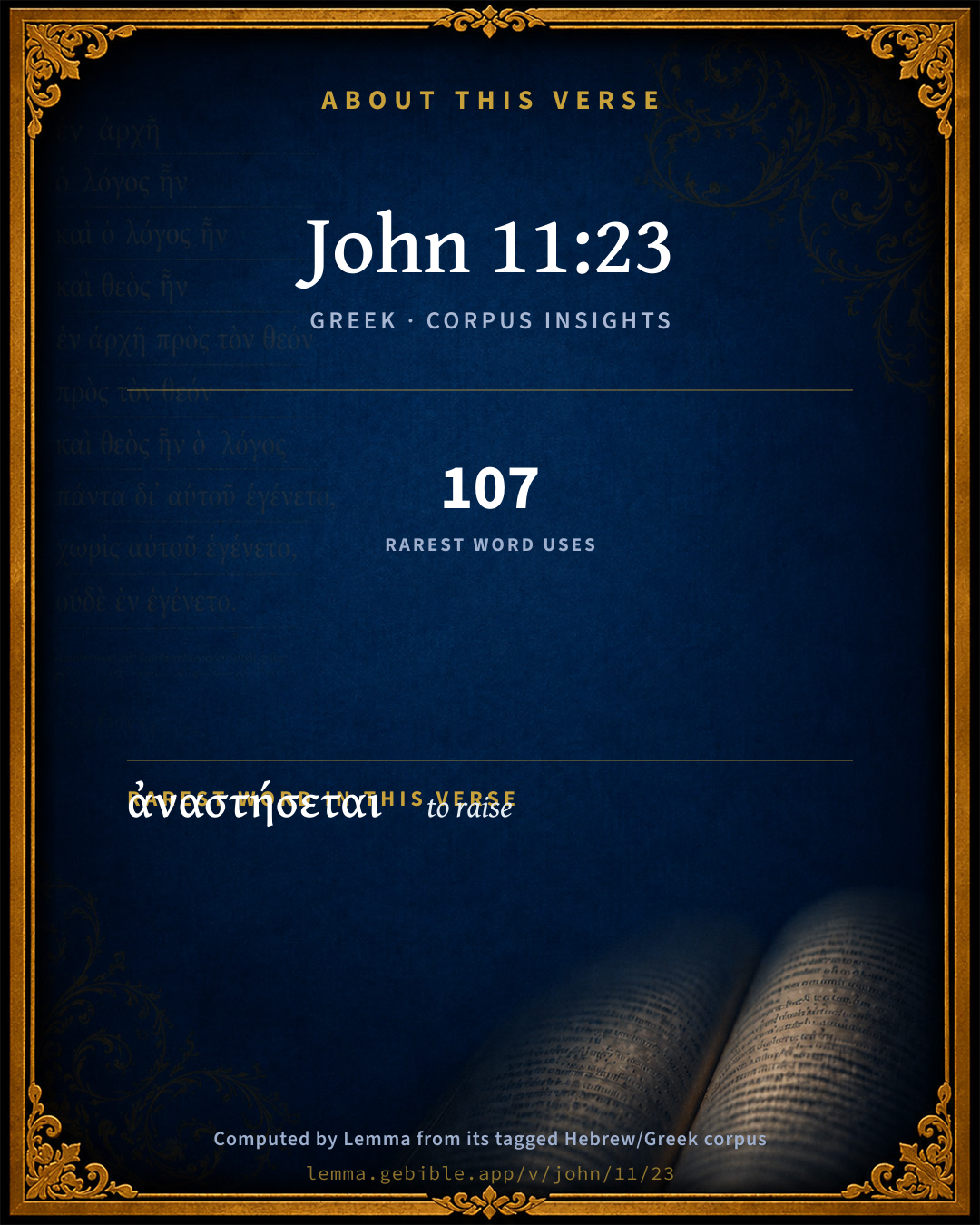
John 11:23

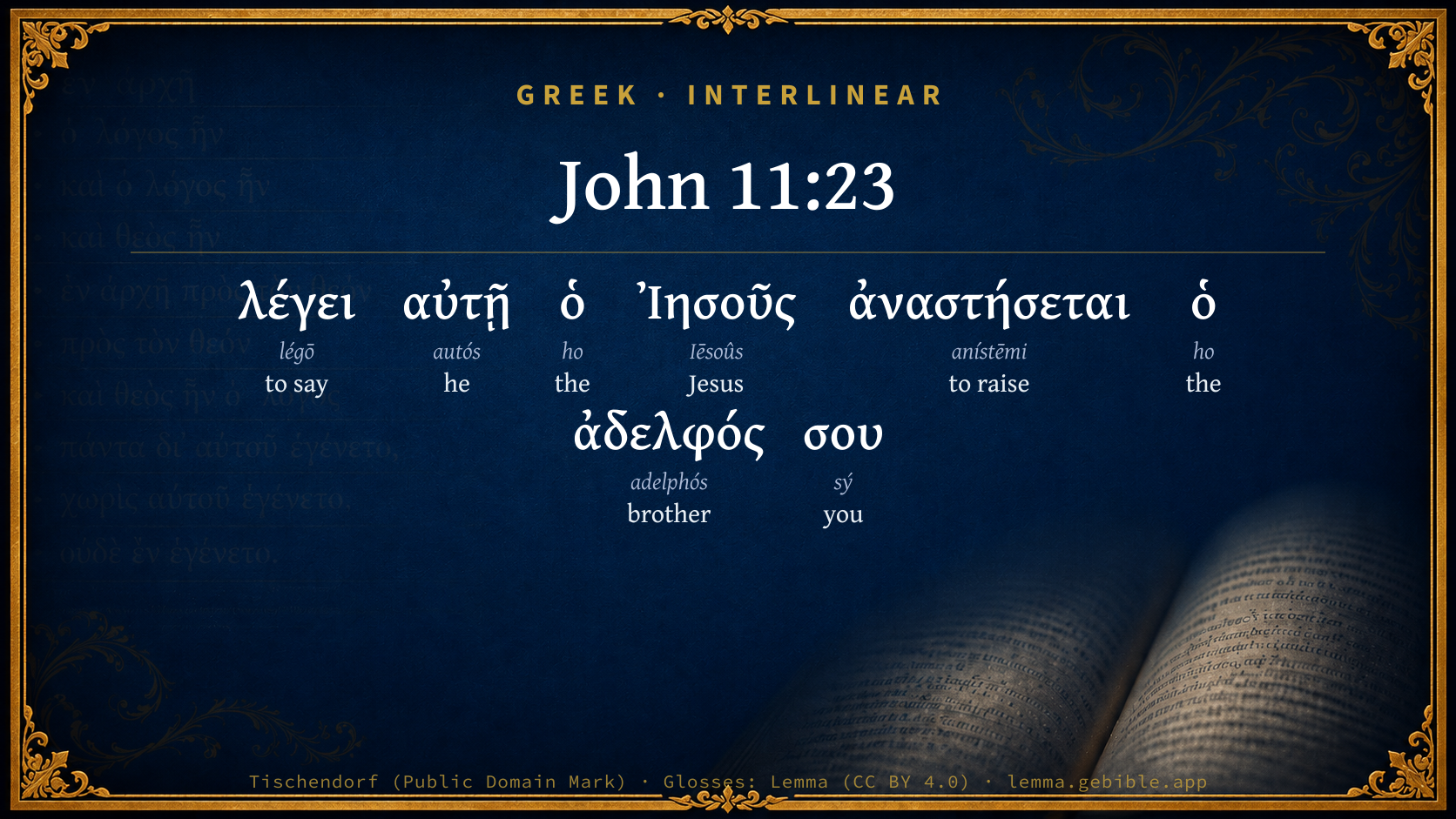
Greek (Tischendorf 8th ed.) John 11:23 appears in the Greek New Testament. The text above is from the Tischendorf 8th edition. Each word links to its Strong’s number and a concise gloss. Click any word for its full Thayer’s Greek Lexicon entry.
Download image
Cite this verse

John 11:23 (World English Bible). Public Domain. Lemma interlinear Bible study tool, https://lemma.gebible.app/v/john/11/23.

Show BibTeX & RIS
BibTeX
RIS
English Translation
Jesus said to her, "Your brother will rise again."
World English Bible · Public Domain
Download a study sheet

One document with this verse’s original text, its word-by-word gloss line, the meaning frame, cross-references with their text, attributed commentary, and full source and license credits — printable, and it pastes into notes with its structure intact.

This verse Autodidact and up

Study sheet (.html) Plain text (.txt)

A passage Seminary Student

Up to 50 verses in one chapter. A passage sheet keeps up to 6 commentary sources and 12 cross-references per verse, in the order this page ranks them, and says so on the sheet whenever that leaves anything out. Ask for a single verse and you get the Autodidact verse sheet above.

Everything on this page stays free to read, with no account — the sheet is a download of what is already on screen, not access to it.

Want to remove ads? Support Godless Engineer
Compare translations 3

The same verse in 3 English versions, stacked beneath the original-language interlinear above. Click any original word for its lexicon entry.

Each is an independent rendering of the whole verse — the interlinear is not word-aligned to these translations.

Highlighted words mark where these versions differ — a whole-verse word diff, not a word-by-word alignment.

  • World English Bible Public Domain
    Jesus said to her, "Your brother will rise again."
  • King James Version Public Domain
    Jesus saith unto her, Thy brother shall rise again.
  • unfoldingWord Literal Text CC BY-SA 4.0
    Jesus says to her, “Your brother will rise again.”

unfoldingWord Literal Text — © unfoldingWord, licensed CC BY-SA 4.0. Word-aligned USFM3 via Door43 (git.door43.org/unfoldingWord/en_ult).

Versions to compare (up to 4)

3 of 4 selected

Show all 19 translations

Every available English version of this verse, each an independent rendering of the whole verse.

  • World English Bible Public Domain
    Jesus said to her, "Your brother will rise again."
  • Berean Standard Bible Public Domain
    “Your brother will rise again,” Jesus told her.
  • Majority Standard Bible Public Domain
    “Your brother will rise again,” Jesus told her.
  • King James Version Public Domain
    Jesus saith unto her, Thy brother shall rise again.
  • American Standard Version (1901) Public Domain
    Jesus saith unto her, Thy brother shall rise again.
  • Revised Version (1885) Public Domain
    Jesus saith unto her, Thy brother shall rise again.
  • Geneva Bible (1599) Public Domain
    Iesus said vnto her, Thy brother shall rise againe.
  • Douay-Rheims (1899) Public Domain
    Jesus saith to her: Thy brother shall rise again.
  • Young's Literal Translation Public Domain
    Jesus saith to her, `Thy brother shall rise again.'
  • Literal Standard Version CC BY-SA 4.0
    Jesus says to her, “Your brother will rise again.”
  • Unlocked Literal Bible CC BY-SA 4.0
    Jesus said to her, “Your brother will rise again.”
  • unfoldingWord Literal Text CC BY-SA 4.0
    Jesus says to her, “Your brother will rise again.”
  • Darby Bible Public Domain
    Jesus says to her, Thy brother shall rise again.
  • World Messianic Bible Public Domain
    Yeshua said to her, “Your brother will rise again.”
  • Webster's Bible Public Domain
    Jesus saith to her, Thy brother shall rise again.
  • Free Bible Version CC BY-SA 4.0
    Jesus told her, “Your brother will rise again.”
  • Bible in Basic English Public Domain
    Jesus said to her, Your brother will come to life again.
  • Text-Critical English NT CC BY 4.0
    Jesus said to her, “Yoʋr brother will rise again.”
  • Tyndale New Testament (1534) Public Domain
    Iesus sayde vnto her: Thy brother shall ryse agayne.

Literal Standard Version (2020), Covenant Press — licensed CC BY-SA 4.0. Text via the HelloAO Bible API (eBible.org). Unlocked Literal Bible (unfoldingWord) — licensed CC BY-SA 4.0. Text via the HelloAO Bible API (eBible.org). unfoldingWord Literal Text — © unfoldingWord, licensed CC BY-SA 4.0. Word-aligned USFM3 via Door43 (git.door43.org/unfoldingWord/en_ult). Free Bible Version, Dr. Jonathan Gallagher — licensed CC BY-SA 4.0. Text via the HelloAO Bible API (eBible.org).

Word by word

More ways to search: Search by grammar → Find every occurrence → Compare this word →

Practice this passage: Drill this verse → Learn its vocabulary →

ἀναστήσεται
anístēmi
G450
“to raise”
Verb, Future, Middle, Indicative, 3rd person, Singular
Part of Speech
Verb
Tense
Future
Voice
Middle
Mood
Indicative
Person
3rd person
Number
Singular
Full Thayer's Definition

Origin: from G303 and G2476

TDNT: 07:08,6

1. to cause to rise up, raise up a. raise up from laying down b. to raise up from the dead c. to raise up, cause to be born, to cause to appear, bring forward 2. to rise, stand up a. of persons lying down, of persons lying on the ground b. of persons seated c. of those who leave a place to go elsewhere 1. of those who prepare themselves for a journey d. of the dead 3. at arise, appear, stand forth a. of kings prophets, priests, leaders of insurgents b. of those about to enter into conversation or dispute with anyone, or to undertake some business, or attempt something against others c. to rise up against any one
  1. λέγει légō G3004 “to say” Verb, Present, Active, Indicative, 3rd person, Singular
  2. αὐτῇ autós G846 “he” Personal pronoun, Dative, Singular, Feminine
  3. ὁ ho G3588 “the” Article, Nominative, Singular, Masculine
  4. Ἰησοῦς Iēsoûs G2424 “Jesus” Noun, Nominative, Singular, Masculine
  5. ὁ ho G3588 “the” Article, Nominative, Singular, Masculine
  6. ἀδελφός adelphós G80 “brother” Noun, Nominative, Singular, Masculine
  7. σου sý G4771 “you” Personal pronoun, 2nd person, Genitive, Singular

About this verse

These counts appear in no published source. They are computed here, from the morphology-tagged text and Lemma’s own curated glosses. What Lemma adds →

8
words
7
distinct lemmas
Gospels
section

Repetition

A word recurs within this verse:

Cross-references

1

Topical passages linked to John 11:23 in the Treasury of Scripture Knowledge — connected by theme and wording, ordered by reader-vote popularity; previews shown in the World English Bible.

  • John 11:43–44 When he had said this, he cried with a loud voice, "Lazarus, come out!"

Cross-references courtesy of OpenBible.info (CC BY 4.0).

Commentary

Notes on John 11:23 from classic Christian and Jewish commentators (each source and its license shown beneath its notes). The classic Christian expositions comment on the surrounding passage and are grouped to its opening verse, so a note may address several verses; the Jewish commentaries on the Tanakh (Rashi and others) are per-verse, so they appear only where the commentator wrote on this verse.

Lemma curates 59 commentaries, every one of them public domain or Creative Commons licensed, each selected and text-cleaned for this edition rather than reprinted as found. About our sources →

Joseph Benson's Commentary

Joh 11:23-24. Jesus — Beholding her distress with a compassionate concern; saith unto her, Thy brother shall rise again — Martha, in her complaint, looked back, reflecting with regret that Christ had not come before her brother’s death, and thinking, if he had, her brother would have been now alive. And we are very apt, in such cases, like her, to add to our trouble, by fancying what might have been, if we had taken other measures or used other means, had employed certain physicians, or administered some particular medicines. But, alas! what use is there in such reflections, when God’s will is done, and our duty is to submit to it? Christ directs Martha, and us in her, to look forward, and to think what shall be, for that yields sure comfort: Thy brother shall rise again. Here observe, 1st, This was true of Lazarus in a sense peculiar to him; he was now immediately to be raised. Christ, however, does not say this in express words, much less that he himself should effect his resurrection, (for humility was a distinguishing trait in his character,) but, for the further trial of her faith and patience, he speaks ambiguously, and leaves her in uncertainty whether he should be raised presently, or not till the last day. 2d, It is applicable to all the saints, and the future resurrection. And it is surely matter of comfort to us, when we have buried our godly friends and relations, to believe and consider that they shall rise again; and that, as the soul at death is not lost, but gone before, so the body is not lost, but laid up. Let us think we hear Christ saying, Thy father, thy mother, thy wife, thy husband, thy child, shall rise again; these dry bones shall live! Martha — Not daring to understand him in a sense that favoured her wishes, namely, that he should be raised immediately; said, I know that he shall rise again at the last day —

Though the doctrine of a general resurrection was to have its full proof from Christ’s resurrection, yet, as it had been revealed in the Old Testament, she firmly believed it, as the pious Jews in general did, Act 24:15; yet she seems to think this doctrine not so important, or calculated to comfort mourners on the death of their relatives, as it really was. For her words seem to imply, Though I know he shall rise again at the last day, yet that affords us but little support now, in the distressing bereavement that we have experienced: as if the blessing of a resurrection to eternal life were not of much greater importance, and much more replete with comfort to a truly pious person, than any recovery from sickness, or restoration to temporal health or life, in this present world of trial and trouble. Alas! that we should be so weak and foolish, as to suffer present, sensible things, to make a deeper impression upon us, both of grief and joy, than those spiritual and eternal things which are the great objects of faith and hope! I know that he shall rise again at the last day — And is not that sufficient? She seems not to think it is. Thus, by our discontent under our present trials, we greatly undervalue our future expectations, and put a slight upon them, as if they were not worth regarding.

Joseph Benson's Commentary on the Old and New Testaments (1811–1818) — public domain. Text from a community e-Sword module.

Bengel's Gnomon

Johann Albrecht Bengel

Joh 11:23. Ἀναστήσεται, he shall rise again) Jesus does not immediately add the mention of the time, but exercises the faith of Martha.

Bengel's Gnomon of the New Testament — English translation (T&T Clark, Edinburgh, 1860) — public domain. Text from a community e-Sword module.

Meyer's Critical & Exegetical Commentary

Heinrich August Wilhelm Meyer

Joh_11:23-24. Jesus understood her, and promises ἀναστήσεται ὁ ἀδ. σου! He meant[81] to carry out the purpose stated in Joh_11:11, but expressed Himself ambiguouslyno doubt intentionallyin order to lead the faith of Martha away from her merely personal interest, and to raise it rather to the higher general domain of the one thing that is needful. His words might as easily denote a raising up to be accomplished at once, as the resurrection at the last day. Martha ventures to take it only as a consolatory word of promise relatively to Lazarus participation in this latter resurrection; she had previously dared to hope for so much, that she was not now able to interpret so indefinite a reply in her own favour. Accordingly, her response expresses the resignation of disappointment, which would now so naturally present itself to her mind; at the same time, it was an answer full of submission, and not one of as it were further inquiry (De Wette, compare Calvin).

[81] That is, He meant the raising of Lazarus, which actually afterwards took place, and which was the fulfilment of the ἐξυπνίζειν; παλίνορσος ἐγείρεται, Nonnus. Quite in opposition to the progress and connection of the narrative, with its beautiful significance, is Hengstenbergs remark: Jesus means specially the resurrection at the last day, and along therewith, also, His transference to Paradise. The soul of the deceased must already have been in Paradise, Luk_23:43.

Meyer — Critical and Exegetical Commentary on the New Testament — English translation by Peter Christie, edited by Frederick Crombie (T&T Clark, 1880) — public domain. Text from a community e-Sword module.

Expositor's Greek Testament

ed. W. Robertson Nicoll

Joh 11:23 . λέγει … σου . “Thy brother shall rise again.” “The whole history of the raising of Lazarus is a parable of life through death.… Here, then, at the beginning the key-note is struck.” Westcott. Whether the words were meant or not to convey only the general truth of resurrection, and that death is not the final state, Martha did not find in them any assurance of the speedy restoration of Lazarus.

The Expositor's Greek Testament, edited by W. Robertson Nicoll (1897–1910) — public domain. Text from a community e-Sword module.

Geneva Bible (1599)

Geneva Bible translators

That is, shall recover life again.

Geneva Bible (1599) marginal notes — public domain. Text via Bolls.life.

Jamieson, Fausset & Brown

Robert Jamieson, A. R. Fausset & David Brown

Jesus saith unto her, Thy brother shall rise again--purposely expressing Himself in general terms, to draw her out.

Jamieson, Fausset & Brown — Commentary Critical and Explanatory on the Whole Bible (1871) — public domain (CC PDM 1.0). Text via the HelloAO Bible API.

Adam Clarke's Commentary

Verse 23. Thy brother shall rise again.] That is, directly; for it was by raising him immediately from the dead that he intended to comfort her.

Adam Clarke's Commentary on the Bible (1810–1826) — public domain. Text from a community e-Sword/MySword module.

John Calvin's Commentaries

23. Thy brother shall rise again. The kindness of Christ is amazing, in forgiving those faults of Martha which we have mentioned, and in promising her, of his own accord, more than she had ventured plainly and directly to ask.

John Calvin's Commentaries (1540-1563) — public domain. Text from the Calvin Translation Society English edition (1840s-50s) via the Christian Classics Ethereal Library (ccel.org). Calvin's coverage is partial (roughly two-thirds of the Bible); uncommented books and verses are honest gaps, never fabricated. The 19th-century editor's footnotes and remarks are omitted so the notes are faithfully Calvin's own voice.

Ellicott's Commentary for English Readers

(23) Thy brother shall rise again.—These words, spoken as they were by our Lord after the purpose of His journey, as expressed in Joh_11:11, and immediately before the accomplishment of it, cannot be taken to exclude the restoration of Lazarus to physical life. At the same time, the form of the words clearly point, as Martha understood them to point, to “the resurrection at the last day.” They are chosen for this very purpose; to lead her from the passionate longing for her brother’s restoration, and from a vague thought of the Lord’s power and will to restore him, to a wider and truer conception of what life really is, and to a realisation of the truth that for a true believer in Him there can be no such thing as death. This “sign,” like every other, is to be no mere wonder, nor is it to be limited to our restored life. It is to lead to the spiritual truth which is signified; and is to be for them and for mankind the true conquest of death by Life.

A Bible Commentary for English Readers, edited by Charles John Ellicott (1878–1897) — public domain. Text from a community e-Sword module.

The Cambridge Bible for Schools and Colleges

gen. ed. J. J. S. Perowne

23. shall rise again] He uses an ambiguous expression as an exercise of her faith. Some think that these words contain no allusion to the immediate restoration of Lazarus, and that Martha (Joh_11:24) understands them rightly. More probably Christ includes the immediate restoration of Lazarus, but she does not venture to do so, and rejects the allusion to the final Resurrection as poor consolation.

The Cambridge Bible for Schools and Colleges (gen. ed. J. J. S. Perowne; Cambridge University Press, 1878–1918) — public domain. Text from a community e-Sword module.

John Gill's Exposition

Jesus saith unto her, thy brother shall rise again. Christ knew what she meant, and accordingly gave her an answer, and yet in such general terms, that she could not tell whether his meaning was, that he should rise now, or at the general resurrection.

Jesus saith unto her, thy brother shall rise again. Christ knew what she meant, and accordingly gave her an answer, and yet in such general terms, that she could not tell whether his meaning was, that he should rise now, or at the general resurrection.

John 11:24

joh 11:24

joh 11:24

joh 11:24Martha saith unto him,.... Being desirous of knowing the sense and meaning of Christ, as well as to express her own faith;

I know that he shall rise again in the resurrection, at the last day. The Jews were divided about the doctrine of the resurrection, the Sadducees denied it, the Pharisees asserted it; and on this latter side was Martha; she believed there would be a resurrection of the dead; that this would be at the last day, or at the end of the world; and that her brother would rise at that general resurrection: wherefore, if Christ meant no more than that, this was what she always believed. The Syriac version renders it, "in the consolation at the last day"; and so the time of the resurrection is, by the Jews, called "the days of consolation" (o). And good reason there is for it in those who shall have part in the first resurrection, or come forth to the resurrection of life; their bodies will rise glorious, powerful, spiritual, and incorruptible, fashioned like to the glorious body of Christ; they will no more be attended with infirmities, disorders, and diseases; they will feel no more pain, nor die any more; being reunited to their souls they will meet the Lord in the air, and in the judgment they will stand at his right hand; they will enter into his joy, and be for ever with him; with their bodily eyes they will behold Christ, and see him for themselves, and not another; they will meet their spiritual friends and acquaintance, and enjoy their company for ever; they will have uninterrupted communion with angels and saints, and with God, Father, Son, and Spirit; their consolation will be inconceivable and inexpressible.

(o) Targum Jon. in Gen i. 21. & in Hos. vi. 2.

John Gill's Exposition of the Whole Bible (1746–1763) — public domain (CC PDM 1.0). Text via the HelloAO Bible API.

Trapp's Complete Commentary

John Trapp

23 Jesus saith unto her, Thy brother shall rise again.

Ver. 23. Thy brother shall rise again] Let this consideration comfort us in the decease of our dearest friends, they are not lost, but laid up with Christ, who will bring them back with him at his coming, 1Th 4:14. As the same divine hand that buried Moses, that locked up this treasure and kept the key of it, brought it forth afterwards glorious in the transfiguration. The body that was hidden in the valley of Moab appeared again in the hill of Tabor.

John Trapp, A Commentary or Exposition upon All the Books of the Old and New Testament (1647–1656) — public domain. Text from a community e-Sword module.

Albert Barnes' Notes on the Bible

Thy brother shall rise again - Martha had spoken of the power of Jesus. He said nothing of himself in reply. It was not customary for him to speak of himself, unless it was demanded by necessity. It cannot be doubted that by rising again, here, Jesus referred to the act which he was about to perform; but as Martha understood it, referring to the future resurrection, it was full of consolation. The idea that departed friends shall rise to glory is one that fills the mind with joy, and one which we owe only to the religion of Christ.

Albert Barnes' Notes on the Bible (1834–1885) — public domain. Text from a community e-Sword/MySword module.

Haydock's Catholic Bible Commentary

Thy brother shall rise again. Martha took notice that Christ did not express, whether immediately, or at the general resurrection, which she and the Jews generally believed. (Witham)

George Leo Haydock (1774–1849), Haydock's Catholic Family Bible and Commentary, 1859 edition — public domain. Excludes Psalms (Douay-Rheims chapter numbering differs from Protestant) and Deuterocanonical books (Catholic canon only).

Matthew Poole's English Annotations

Christ takes no notice of Martha’s failings before mentioned, (he can have compassion upon his people’s infirmities), but applies himself to the relief of her under her affliction. He doth not tell her that her brother should be raised to life presently, nor that he would do it; but only saith he shall rise again: to let us know, that a belief of the general resurrection is enough, and ought to be improved by us, to curb our immoderate mourning and passions for those of our friends who are dead in the Lord.

Matthew Poole's English Annotations on the Holy Bible (1683–1685) — public domain. Text from a community e-Sword/MySword module.

Whedon's Commentary on the Bible

Daniel D. Whedon

23. Thy brother shall rise—Jesus truly closes upon her transient words. He promises what she dares not hope, and dares not believe in its fulness.

Daniel D. Whedon (gen. ed.), Commentary on the Old and New Testaments (1874–1909) — public domain. Text from a community e-Sword module.

The Pulpit Commentary

Jesus saith unto her, Thy brother shall rise again. Hengstenberg thinks that the reply of Jesus is a grand dogmatic assertion of the resurrection of the dead, in special application to Lazarus, and it covers the kind of anastasiv which takes place at death, as well as the resurrection at the last day. If so, surely our Lord would have said, "Lazarus is risen again." The Lord does elsewhere speak of the dead as risen, and of their angelic state, and of all the dead living unto God; but he is here speaking of the immediate resurrection of Lazarus from what is called death to that which is called life, and which would be a pledge and type of the final resurrection of all.

The Pulpit Commentary (1880–1919), ed. H.D.M. Spence-Jones & Joseph S. Exell — public domain. Text from a community e-Sword module.

Kretzmann's Popular Commentary

Paul E. Kretzmann

Jesus, the Resurrection and the Life:

v. 23. Jesus saith unto her, Thy brother shall rise again.

v. 24. Martha saith unto Him, I know that he shall rise again in the resurrection at the last day.

v. 25. Jesus said unto her, I am the Resurrection and the Life; he that believeth in Me, though he were dead, yet shall he live;

v. 26. and whosoever liveth and believeth in Me shall never die. Believest thou this?

v. 27. She saith unto Him, Yea, Lord; I believe that Thou art the Christ, the Son of God, which should come into the world.

Jesus answered Martha’s pleading with a beautiful word of comfort, which incidentally tests her faith. The words sounded as though Jesus were referring only to the final resurrection, on the last day. Here was the hope of faith to which she could always cling. And Martha proved equal to the test; she, with all the other true believers among the Jews, believed in the resurrection of the dead. If nothing more were forthcoming from the hand of Jesus, she would be fully satisfied with this gift of His grace. But her words: I know that he will rise in the resurrection on the last day, conveyed her hope that the Lord would help also at the present time, at once. This proof of Martha’s humble, but firm trust in Him drew from Jesus that. gem of sayings which is the glorious anchor of faith throughout the ages. Jesus, our Savior, is the Resurrection and the Life. All life, and the giving and returning of life to men, is centered in Him. Eternal life is in Him from eternity. And therefore He can give life, even when death had apparently claimed a person for his own. And with the resurrection the true life in and with Him will have its beginning. We Christians believe in the resurrection of the body and the life everlasting, because our faith rests upon Him who died for us and rose again, in order that we might live with Him forever. The believers, therefore, though they seemingly succumb to temporal death, yet have life, are full possessors of life in the very midst of death, they are partakers and sharers with Christ in the full and complete life that had no beginning for Him and shall have no end for them that put their trust in His redemption alone. Death is only the gateway to the full and perfect life; it has no terrors for the Christian, since it has been swallowed up in victory by the resurrection of Jesus. Whatever experience believers have of death is all on this side of the grave; here the fear of death and the terrors of hell sometimes assail them very keenly. But they conquer all these horrors through faith in the words of Christ, and in the very moment of dying, death is overcome; they fall asleep in the wounds of Jesus, and in the next moment they awake in heaven. Since this trust must be found in the heart of every believer, Jesus puts the searching question to Martha: Believest thou this? And Martha joyfully assents and expresses her unwavering faith in her Lord as the promised Christ, the Son of God, as He was prophesied by all the patriarchs and sages of old, whose work should culminate in the overcoming of the last bitter enemy, death. Note: The certainty of the resurrection of the body, as based upon the work of Jesus Christ, the Son of God, always inspires new hope in the hearts of the believers, even in the days of the greatest sorrow and misfortune, in the midst of sickness and death. This word: I believe in the resurrection of the body, is stronger than death. Though the dead may have rested in their graves for hundreds and even thousands of years, though their flesh has long since been consumed by worms and their bones have fallen into dust, yet they shall arise on the last day.

Paul E. Kretzmann, Popular Commentary of the Bible (1921–1924) — public domain. Text from a community e-Sword module.

Burkitt's Expository Notes on the New Testament

William Burkitt

Here observe, 1. Christ’s meek answer to Martha’s passionate discourse. He takes no notice of the forementioned failings, but comforts her with a promise of her brother’s resurrection: Thy brother shall rise again.

Thence learn, That the knowledge and belief of the general resurrection, is, and ought to be, a sufficient support under the loss of our endeared friends, who die in the Lord.

Observe, 2. That the doctrine of the general resurrection was no new doctrine; Job believed it, Job 19:26. Daniel published it, Dan 12:1; the Pharisees had a notion of it; but Martha here makes it an article of faith, I know he shall rise again in the resurrection at the last day.

Observe, 3. How Christ particularly instructs Martha in the cause of her resurrection, acquainting her, that he himself is the author and efficient cause of it: I am the resurrection and the life: that is, I am the author, and principal efficient cause of the resurrection; and this with respect to both natures:

1. His divine nature is the efficient cause of the resurrection; he shall raise our bodies out of the dust, by the power of his godhead.

2. His human nature is the exemplary cause or pattern of the resurrection; for which reason Christ is called the first born from the dead. For though some were raised before him, yet was his resurrection the cause of their resurrection.

Hence St. Paul argues, from Christ’s resurrection, the certainty of the resurrection of his members; Christ and believers are one mystical body, therefore is not Christ perfectly risen till all his members are risen with him. Indeed Christ’s, personal resurrection was perfect when he arose, and all believers arose representatively in him; yet, has not received its utmost perfection: but there is somewhat behind of the resurrection of Christ. Most fitly then might our Saviour assert, I am the resurrection and the life.

Observe, 4. That Christ not only asserts himself to be the resurrection, but also the life; I am the resurrection and the life: that is, I am the cause of life natural, spiritual, and eternal; And whosoever liveth and believeth in me, shall never die; that is, eternally: though his body shall die because of sin, yet his spirit shall live because of righteousness.

William Burkitt's Expository Notes on the New Testament (1700–1703) — public domain. Text from a community e-Sword module.

The People's New Testament

B. W. Johnson

23. Thy brother shall rise again. She takes this as an allusion to the final resurrection.

B. W. Johnson's The People's New Testament with Notes (1889–1891) — public domain. Electronic text from the Christian Classics Ethereal Library (CCEL) ThML edition.

Cambridge Greek Testament for Schools and Colleges

23. ἀναστήσεται. He uses an ambiguous expression as an exercise of her faith. Some think that these words contain no allusion to the immediate restoration of Lazarus, and that Martha (Joh 11:24) understands them rightly. More probably Christ includes the immediate restoration of Lazarus, but she does not venture to do so, and rejects the allusion to the final Resurrection as poor consolation.

Cambridge Greek Testament for Schools and Colleges (Cambridge University Press, 1896; 21 vols, various authors incl. Carr, Maclear, Plummer, Farrar, Lumby, Moule, M. R. James, Simcox) — public domain. Text from a community e-Sword module.

Alford’s Greek Testament

Henry Alford

23.] I believe these words of our Lord to contain no allusion to the immediate restoration of Lazarus; but to be pædagogically used, to lead on to the requisite faith in her mind. I have to learn whether ἀναστήσεται in this direct absolute sense could be used of his recall into human life.

Henry Alford, The Greek Testament (1849–1861) — public domain. Text from a community e-Sword module.

International Critical Commentary

23. ἀναστήσεται ὁ ἀδελφός σου. This must often have been said both to Martha and Mary during the past four days; it was (and is) a commonplace of consolation in bereavement offered by friends. By the first century, belief in the resurrection, at any rate of good men, was widely spread among the Jews (see on 5:28). The doctrine is plainly expressed in the Psalms of Solomon (about 80 b.c.): οἱ δὲ φοβούμενοι κύριον ἀναστήσονται εἰς ζωὴν αἰώνιον (3:16). And Jesus commends this assurance to Martha as a truth which should assuage her grief. A doctrine which is trite may, nevertheless, be both true and important.

International Critical Commentary — older volumes (1896–1929), various authors — public domain. Text from a community e-Sword module.

Lesson kit

Teaching starters — assembled from the data on this page, not authored interpretation. Every prompt links to the verse data it draws on. Edit before teaching.

John, in the Gospels, opens this verse with 8 words (7 distinct Greek lemmas). Its most distinctive word is anístēmi (“to raise”). A historical commentator’s framing appears above. Read the whole chapter for the surrounding context.

Discussion questions

  1. How does “to raise” (anístēmi) shape what this verse is saying?
  2. John 11:43–44 shares this passage’s theme. How do the two illuminate each other?
  3. “the” occurs 2× in this one verse. What is the effect of the repetition?
  4. These translations render this verse differently; the difference is in the English rendering, not the original. What questions does that raise?
  5. Reading how Joseph Benson's Commentary and Bengel's Gnomon read this verse, where do the two commentators agree and where do they part?

Things to notice

  • These translations choose different wording for 4 words in this verse.
  • “the” occurs 2× in this single verse.
  • 7 distinct Greek lemmas span 8 words in this verse.

Reading settings

Reading text

Shown beneath each verse's original-language words.

Old Testament
Old Testament edition

Read the OT as the Masoretic Hebrew (MT) or the Greek Septuagint (LXX).

English shown for the Greek Septuagint (in the Hebrew ↔ Greek comparison).

Comparing translations? Open the Compare panel on any verse page to stack up to four side by side.