
John 12:3

Greek (Tischendorf 8th ed.) John 12:3 appears in the Greek New Testament. The text above is from the Tischendorf 8th edition. Each word links to its Strong’s number and a concise gloss. Click any word for its full Thayer’s Greek Lexicon entry.
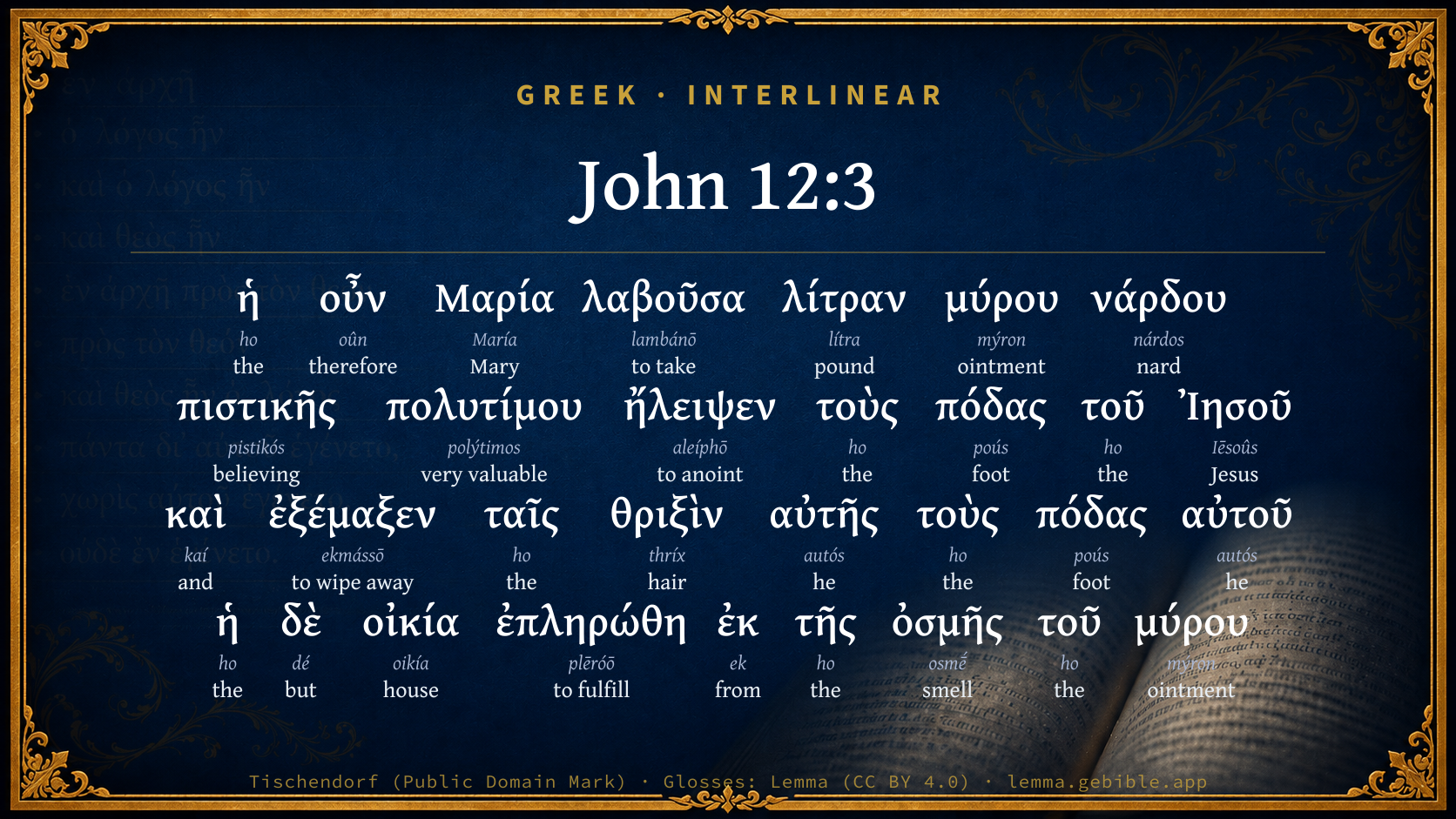
Download image
Cite this verse

John 12:3 (World English Bible). Public Domain. Lemma interlinear Bible study tool, https://lemma.gebible.app/v/john/12/3.

Show BibTeX & RIS
BibTeX
RIS
English Translation
Mary, therefore, took a pound of ointment of pure nard, very precious, and anointed the feet of Jesus, and wiped his feet with her hair. The house was filled with the fragrance of the ointment.
World English Bible · Public Domain
Highlights
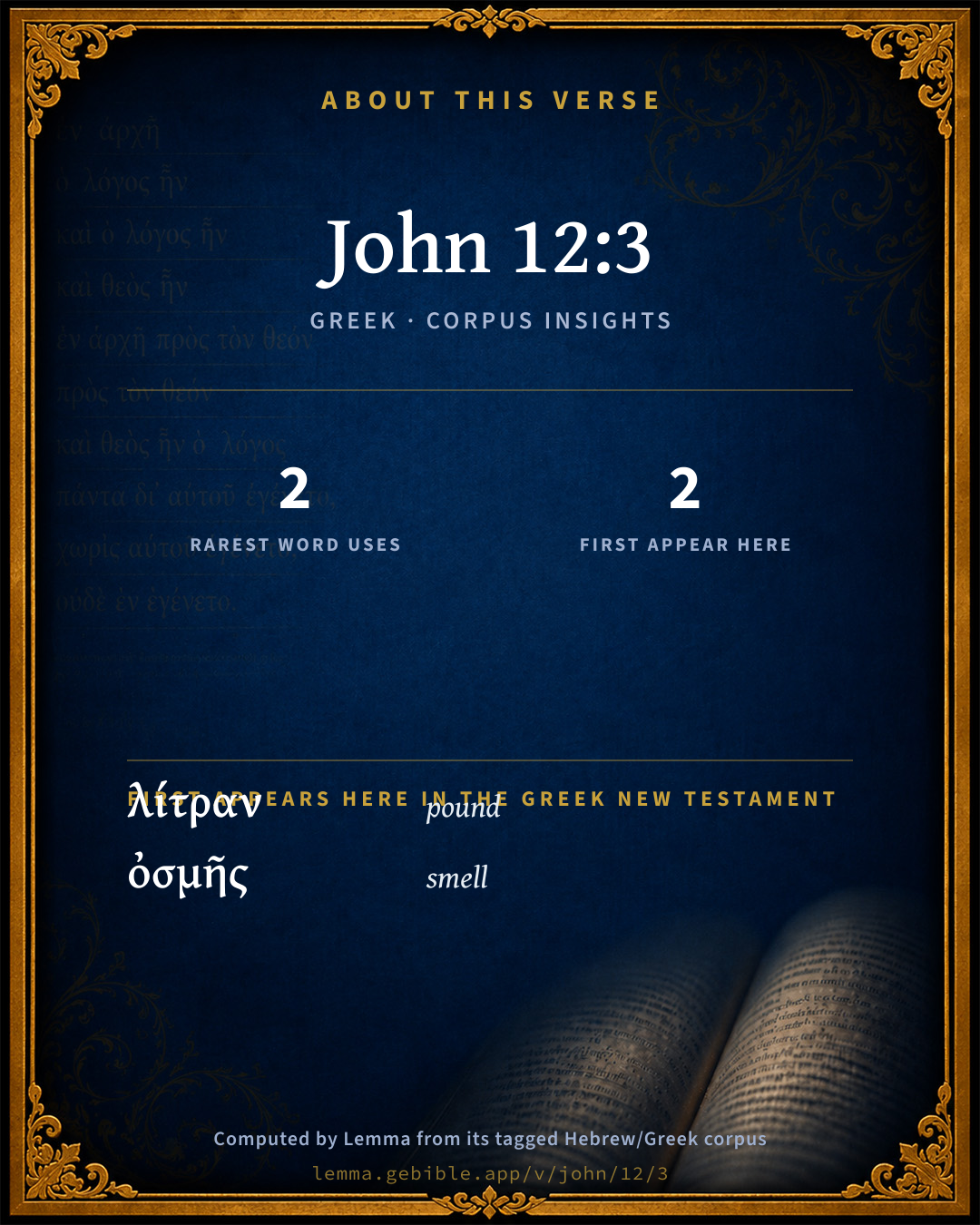
  • 2 first appearances in the Greek New Testament
Full analysis ↓
Download a study sheet

One document with this verse’s original text, its word-by-word gloss line, the meaning frame, cross-references with their text, attributed commentary, and full source and license credits — printable, and it pastes into notes with its structure intact.

This verse Autodidact and up

Study sheet (.html) Plain text (.txt)

A passage Seminary Student

Up to 50 verses in one chapter. A passage sheet keeps up to 6 commentary sources and 12 cross-references per verse, in the order this page ranks them, and says so on the sheet whenever that leaves anything out. Ask for a single verse and you get the Autodidact verse sheet above.

Everything on this page stays free to read, with no account — the sheet is a download of what is already on screen, not access to it.

Want to remove ads? Support Godless Engineer
Compare translations 3

The same verse in 3 English versions, stacked beneath the original-language interlinear above. Click any original word for its lexicon entry.

Each is an independent rendering of the whole verse — the interlinear is not word-aligned to these translations.

Highlighted words mark where these versions differ — a whole-verse word diff, not a word-by-word alignment.

  • World English Bible Public Domain
    Mary, therefore, took a pound of ointment of pure nard, very precious, and anointed the feet of Jesus, and wiped his feet with her hair. The house was filled with the fragrance of the ointment.
  • King James Version Public Domain
    Then took Mary a pound of ointment of spikenard, very costly, and anointed the feet of Jesus, and wiped his feet with her hair: and the house was filled with the odour of the ointment.
  • unfoldingWord Literal Text CC BY-SA 4.0
    Then Mary, having taken a litra of perfumed oil of very precious pure nard, anointed the feet of Jesus and wiped his feet with her hair. Now the house was filled with the fragrance of the perfumed oil.

unfoldingWord Literal Text — © unfoldingWord, licensed CC BY-SA 4.0. Word-aligned USFM3 via Door43 (git.door43.org/unfoldingWord/en_ult).

Versions to compare (up to 4)

3 of 4 selected

Show all 19 translations

Every available English version of this verse, each an independent rendering of the whole verse.

  • World English Bible Public Domain
    Mary, therefore, took a pound of ointment of pure nard, very precious, and anointed the feet of Jesus, and wiped his feet with her hair. The house was filled with the fragrance of the ointment.
  • Berean Standard Bible Public Domain
    Then Mary took about a pint of expensive perfume, made of pure nard, and she anointed Jesus’ feet and wiped them with her hair. And the house was filled with the fragrance of the perfume.
  • Majority Standard Bible Public Domain
    Then Mary took about a pint of expensive perfume, made of pure nard, and she anointed Jesus’ feet and wiped them with her hair. And the house was filled with the fragrance of the perfume.
  • King James Version Public Domain
    Then took Mary a pound of ointment of spikenard, very costly, and anointed the feet of Jesus, and wiped his feet with her hair: and the house was filled with the odour of the ointment.
  • American Standard Version (1901) Public Domain
    Mary therefore took a pound of ointment of pure nard, very precious, and anointed the feet of Jesus, and wiped his feet with her hair: and the house was filled with the odor of the ointment.
  • Revised Version (1885) Public Domain
    Mary therefore took a pound of ointment of spikenard, very precious, and anointed the feet of Jesus, and wiped his feet with her hair: and the house was filled with the odour of the ointment.
  • Geneva Bible (1599) Public Domain
    Then tooke Mary a pound of oyntment of Spikenarde very costly, and anoynted Iesus feete, and wiped his feete with her heare, and the house was filled with the sauour of the oyntment.
  • Douay-Rheims (1899) Public Domain
    Mary therefore took a pound of ointment of right spikenard, of great price, and anointed the feet of Jesus, and wiped his feet with her hair; and the house was filled with the odour of the ointment.
  • Young's Literal Translation Public Domain
    Mary, therefore, having taken a pound of ointment of spikenard, of great price, anointed the feet of Jesus and did wipe with her hair his feet, and the house was filled from the fragrance of the ointment.
  • Literal Standard Version CC BY-SA 4.0
    Mary, therefore, having taken a pound of ointment of spikenard, of great price, anointed the feet of Jesus and wiped His feet with her hair, and the house was filled from the fragrance of the ointment.
  • Unlocked Literal Bible CC BY-SA 4.0
    Then Mary took a litra of perfume made of very precious pure nard, anointed the feet of Jesus with it, and wiped his feet with her hair. The house was filled with the fragrance of the perfume.
  • unfoldingWord Literal Text CC BY-SA 4.0
    Then Mary, having taken a litra of perfumed oil of very precious pure nard, anointed the feet of Jesus and wiped his feet with her hair. Now the house was filled with the fragrance of the perfumed oil.
  • Darby Bible Public Domain
    Mary therefore, having taken a pound of ointment of pure nard of great price, anointed the feet of Jesus, and wiped his feet with her hair, and the house was filled with the odour of the ointment.
  • World Messianic Bible Public Domain
    Therefore Miriam took a pound of ointment of pure nard, very precious, and anointed Yeshua’s feet and wiped his feet with her hair. The house was filled with the fragrance of the ointment.
  • Webster's Bible Public Domain
    Then Mary took a pound of ointment of spikenard, very costly, and anointed the feet of Jesus, and wiped his feet with her hair: and the house was filled with the odor of the ointment.
  • Free Bible Version CC BY-SA 4.0
    Mary brought a pint of pure nard perfume and anointed Jesus' feet, wiping them dry with her hair. The scent of the perfume filled the whole house.
  • Bible in Basic English Public Domain
    Then Mary, taking a pound of perfumed oil of great value, put it on the feet of Jesus and made them dry with her hair: and the house became full of the smell of the perfume.
  • Text-Critical English NT CC BY 4.0
    Then Mary took a pound of expensive ointment made of pure nard, anointed Jesus' feet, and wiped his feet with her hair. The house was filled with the fragrance of the ointment.
  • Tyndale New Testament (1534) Public Domain
    Then toke Mary a pounde of oyntmet called Nardus perfecte and precious and anoynted Iesus fete and wipt his fete with her heer and the housse was filled of the savre of the oyntmet.

Literal Standard Version (2020), Covenant Press — licensed CC BY-SA 4.0. Text via the HelloAO Bible API (eBible.org). Unlocked Literal Bible (unfoldingWord) — licensed CC BY-SA 4.0. Text via the HelloAO Bible API (eBible.org). unfoldingWord Literal Text — © unfoldingWord, licensed CC BY-SA 4.0. Word-aligned USFM3 via Door43 (git.door43.org/unfoldingWord/en_ult). Free Bible Version, Dr. Jonathan Gallagher — licensed CC BY-SA 4.0. Text via the HelloAO Bible API (eBible.org).

Word by word

More ways to search: Search by grammar → Find every occurrence → Compare this word →

Practice this passage: Drill this verse → Learn its vocabulary →

λίτραν
lítra
G3046
“pound”
Noun, Accusative, Singular, Feminine
Part of Speech
Noun
Case
Accusative
Number
Singular
Gender
Feminine
Full Thayer's Definition

Origin: of Latin origin [libra]

TDNT: None

1. a pound, a weight of 12 ounces (340 gm)
  1. ἡ ho G3588 “the” Article, Nominative, Singular, Feminine
  2. οὖν oûn G3767 “therefore” Conjunction
  3. Μαρία María G3137 “Mary” Noun, Nominative, Singular, Feminine
  4. λαβοῦσα lambánō G2983 “to take” Verb, Aorist, Active, Participle, Nominative, Singular, Feminine
  5. μύρου mýron G3464 “ointment” Noun, Genitive, Singular, Neuter
  6. νάρδου nárdos G3487 “nard” Noun, Genitive, Singular, Feminine
  7. πιστικῆς pistikós G4101 “believing” Adjective, Genitive, Singular, Feminine
  8. πολυτίμου polýtimos G4186 “very valuable” Adjective, Genitive, Singular, Feminine
  9. ἤλειψεν aleíphō G218 “to anoint” Verb, Aorist, Active, Indicative, 3rd person, Singular
  10. τοὺς ho G3588 “the” Article, Accusative, Plural, Masculine
  11. πόδας poús G4228 “foot” Noun, Accusative, Plural, Masculine
  12. τοῦ ho G3588 “the” Article, Genitive, Singular, Masculine
  13. Ἰησοῦ Iēsoûs G2424 “Jesus” Noun, Genitive, Singular, Masculine
  14. καὶ kaí G2532 “and” Conjunction
  15. ἐξέμαξεν ekmássō G1591 “to wipe away” Verb, Aorist, Active, Indicative, 3rd person, Singular
  16. ταῖς ho G3588 “the” Article, Dative, Plural, Feminine
  17. θριξὶν thríx G2359 “hair” Noun, Dative, Plural, Feminine
  18. αὐτῆς autós G846 “he” Personal pronoun, Genitive, Singular, Feminine
  19. τοὺς ho G3588 “the” Article, Accusative, Plural, Masculine
  20. πόδας poús G4228 “foot” Noun, Accusative, Plural, Masculine
  21. αὐτοῦ autós G846 “he” Personal pronoun, Genitive, Singular, Masculine
  22. ἡ ho G3588 “the” Article, Nominative, Singular, Feminine
  23. δὲ dé G1161 “but” Conjunction
  24. οἰκία oikía G3614 “house” Noun, Nominative, Singular, Feminine
  25. ἐπληρώθη plēróō G4137 “to fulfill” Verb, Aorist, Passive, Indicative, 3rd person, Singular
  26. ἐκ ek G1537 “from” Preposition
  27. τῆς ho G3588 “the” Article, Genitive, Singular, Feminine
  28. ὀσμῆς osmḗ G3744 “smell” Noun, Genitive, Singular, Feminine
  29. τοῦ ho G3588 “the” Article, Genitive, Singular, Neuter
  30. μύρου mýron G3464 “ointment” Noun, Genitive, Singular, Neuter

About this verse

These counts appear in no published source. They are computed here, from the morphology-tagged text and Lemma’s own curated glosses. What Lemma adds →

31
words
21
distinct lemmas
Gospels
section

Notable vocabulary

The rarest word here is λίτραν pound G3046 — appearing just 2 times in the whole Greek New Testament.

First appearance in Scripture

These words make their first canonical appearance in the Greek New Testament here:

  • λίτραν pound G3046
  • ὀσμῆς smell G3744

Shared distinctive vocabulary

λίτραν pound G3046 occurs in 2 verses of the Greek New Testament. Also found in:
Repetition

Words recur within this verse:

  • μύρου ointment G3464 ×2
  • πόδας foot G4228 ×2
  • ἡ the G3588 ×8
  • αὐτῆς he G846 ×2

Cross-references

13

Topical passages linked to John 12:3 in the Treasury of Scripture Knowledge — connected by theme and wording, ordered by reader-vote popularity; previews shown in the World English Bible.

  • Mark 14:3–9 While he was at Bethany, in the house of Simon the leper, as he sat at the table, a woman came having an alabaster jar of ointment of pure nard-- very costly. She broke the jar, and poured it over his head.
  • John 11:2 It was that Mary who had anointed the Lord with ointment, and wiped his feet with her hair, whose brother, Lazarus, was sick.
  • Luke 10:38–39 It happened as they went on their way, he entered into a certain village, and a certain woman named Martha received him into her house.
  • Matthew 26:6–13 Now when Jesus was in Bethany, in the house of Simon the leper,
  • Luke 7:37–38 Behold, a woman in the city who was a sinner, when she knew that he was reclining in the Pharisee's house, she brought an alabaster jar of ointment.
  • John 11:32 Therefore when Mary came to where Jesus was, and saw him, she fell down at his feet, saying to him, "Lord, if you would have been here, my brother wouldn't have died."
  • John 11:28 When she had said this, she went away, and called Mary, her sister, secretly, saying, "The Teacher is here, and is calling you."
  • Luke 7:46 You didn't anoint my head with oil, but she has anointed my feet with ointment.
  • Song of Solomon 4:13–14 Your shoots are an orchard of pomegranates, with precious fruits: Henna with spikenard plants,
  • Song of Solomon 1:3 Your oils have a pleasing fragrance. Your name is oil poured forth, Therefore the virgins love you.
  • Psalms 132:2 How he swore to Yahweh, And vowed to the Mighty One of Jacob:
  • Song of Solomon 1:12 While the king sat at his table, My perfume spread its fragrance.
  • Song of Solomon 4:10 How beautiful is your love, my sister, my bride! How much better is your love than wine! The fragrance of your perfumes than all manner of spices!

Cross-references courtesy of OpenBible.info (CC BY 4.0).

Commentary

Notes on John 12:3 from classic Christian and Jewish commentators (each source and its license shown beneath its notes). The classic Christian expositions comment on the surrounding passage and are grouped to its opening verse, so a note may address several verses; the Jewish commentaries on the Tanakh (Rashi and others) are per-verse, so they appear only where the commentator wrote on this verse.

Lemma curates 59 commentaries, every one of them public domain or Creative Commons licensed, each selected and text-cleaned for this edition rather than reprinted as found. About our sources →

Joseph Benson's Commentary

Joh 12:3-8. Then took Mary a pound of ointment, &c. — See notes on Mat 26:6-13; Mar 14:1-9. She did what is here related in token of the warm sense she had of the many favours Christ had conferred on her and her relations, but especially for the wonderful kindness he had lately shown to her brother Lazarus. Then saith Judas, Why was not this ointment sold, &c. — Judas was angry because his Master had not taken the ointment with a view to sell it, pretending that the price received for it might have been bestowed on the poor. Nevertheless, his real motive was covetousness; for as he carried the bag, he thought if his Master had sold the ointment, he would have gotten the money to keep, and so might have applied part of it to his own private use. But it is no new thing for the basest men to cover their blackest crimes with the fair pretence of zeal for the honour of God and the interests of religion. For three hundred pence — These were Roman pence, and consequently amounted to nine pounds seven shillings and sixpence. The expression only intimates a general guess at the value by a round sum, as we speak, for such three hundred denarii were, though the correspondent value with us is not so. Against the day of my burying, which now draws nigh, hath she kept this — Mr. Whiston thinks this is as if our Lord had said, “She has spent but a little of this ointment, but has reserved the main part of it to pour on my head some days hence, which shall be so near my death, that it may be considered as a kind of embalming.” But it is unnatural to suppose that, in the transport of her love and gratitude, she would use this little management of keeping back most that was in the vessel; or that, if she had, John would have mentioned the quantity she took, which was no way to his purpose, or have taken notice of the room being filled with the odour of it.

Joseph Benson's Commentary on the Old and New Testaments (1811–1818) — public domain. Text from a community e-Sword module.

Tyndale Open Study Notes

Tyndale Open Resources

12:3 Mary . . . anointed Jesus’ feet: Doing so was not awkward, because Jews reclined at formal meals, but it was certainly a dramatic gesture (cp. Matt 26:6-16; Mark 14:3-9). • Nard, a precious spice imported from North India, was sweet, red, and smelled like gladiola perfume. Twelve ounces of nard cost a year’s wages (John 12:5). According to Mark, Mary also anointed Jesus’ head (Mark 14:3), and the perfume ran down and scented his garments (Mark 14:8). • her hair: Women never unveiled their hair in public (see Luke 7:38). Mary was acting with extravagant abandon and devotion.

Tyndale Open Study Notes — © Tyndale Open Resources, licensed CC BY-SA 4.0. Text via the HelloAO Bible API.

Bengel's Gnomon

Johann Albrecht Bengel

Joh 12:3. Ἐκ τῆς ὀσμῆς, owing to [“with”] the odour) It was at this very odour that Judas took offence.

Bengel's Gnomon of the New Testament — English translation (T&T Clark, Edinburgh, 1860) — public domain. Text from a community e-Sword module.

Meyer's Critical & Exegetical Commentary

Heinrich August Wilhelm Meyer

Joh_12:3-4. To explain the great quantity of the ointment (12 ounces) as the outcome of the superabundance of her love (Olshausen), is arbitrary. Mary did not anoint with the whole pound, but with a portion of it (comp. on Joh_12:7). On πιστικός,[104] genuine, unadulterated, see on Mar_14:3.

πολυτίμου] belongs to ΜΎΡΟΥ, as ΠΟΛΥΤΕΛ., Mar_14:3.

ΤΟῪς ΠΌΔΑς ΑὐΤΟῦ] repeated, on account of the correlation with ΤΑῖς ΘΡΙΞῚΝ ΑὐΤῆς, in order to make prominent the greatness of the love; with her hairs, His feet.

ἐκ τῆς ὀσμῆς] ἐκ causal. Comp. Mat_23:25; Rev_8:5; Plat. Phaedr. p. 235 C; Dem. 581. 26, et al.

εἷς ἐκ τ. ΜΑΘ. Ἀ.] the rest did not agree with him; but it was Judas, etc.

ὁ μέλλων, κ.τ.λ.] This utterance stood in truth already in psychological connection with this destiny; see on Joh_6:71.

[104] If John adopted this word from Mark,which, considering the rareness of its occurrence, is probable, and may have been done quite involuntarily,this shows no literary dependence, and does not justify the suspicion that he also drew the subject-matter from this source (Hilgenfeld). Should πιστιχός be the adjective of a proper name (Pistic), all objection would disappear of itself. Comp. on Mar_14:3, note 2. Goth. also has pistikeinis.

Meyer — Critical and Exegetical Commentary on the New Testament — English translation by Peter Christie, edited by Frederick Crombie (T&T Clark, 1880) — public domain. Text from a community e-Sword module.

Expositor's Greek Testament

ed. W. Robertson Nicoll

Joh 12:3 . Ἡ οὖν Μσρία … The third member of the Bethany family appears also in character, λαβοῦσα λίτραν μύρου νάρδου πιστικῆς πολυτίμου . λίτρα (Lat. libra), the unit of weight in the Roman empire, slightly over eleven ounces avoirdupois. μύρον (from μύρω , to trickle, or from μύρρα , myrrh, the juice of the Arabian myrtle) is any unguent, more costly and luxurious than the ordinary ἔλαιον . Cf. Luk 7:46 , and Trench, Synonyms . νάρδος , “the head or spike of a fragrant East Indian plant belonging to the genus Valeriana , which yields a juice of delicious odour which the ancients used in the preparation of a most precious ointment”. Thayer, πιστικῆς is sometimes derived from πίστις , and rendered “genuine,” γνήσιος , δόκιμος . Thus Euthymius, ἀκράτου καὶ καταπεπιστευμένης εἰς καθαρότητα , unadulterated and guaranteed pure. But πιστός is the common form; cf. Θηρικλέους πιστὸν τέκνον , Theopomp. in Com. Frag . Some suppose it indicates the name of the place where the nard was obtained. Thus Augustine: “Quod ait ‘pistici,’ locum aliquem credere debemus, unde hoc erat unguentum pretiosum”. Similarly some modern scholars derive it from Opis (sc. Opistike), a Babylonian town. In the Classical Review (July, 1890) Mr. Bennett suggests that it should be written πιστακῆς , and that it refers to the Pistacia Terebinthus , which grows in Cyprus, Chios, and Palestine, and yields a turpentine in such inconsiderable quantities as to be very costly. The word is most fully discussed by Fritzsche on Mar 14:3 , who argues at great length and with much learning for the meaning “drinkable”. He quotes Athenaeus in proof that some ointments were drunk, mixed with wine. πιστός is the word commonly used for “potable,” as in Aesch., Prom. Vinct. , 480, where Prometheus says man had no defence against disease οὔτε βρώσιμον , οὐ χριστὸν , οὔτε πιστόν . And Fritzsche holds that while πιστός means “qui bibi potest,” πιστικός means “qui facile bibi potest”. The weight and nature of the ointment are specified to give force to the added πολυτίμου ; see Joh 12:5 . ἤλειψε τοὺς πόδας τοῦ Ἰησοῦ , Mt. and Mk. say “the head,” which was the more natural but less significant, and in the circumstances less convenient, mode of disposing of the ointment. κα ἐξέμαξε … αὐτοῦ , “and wiped High feet with her hair”. Holtzmann thinks this an infelicitous combination of Mar 14:3 and Luk 7:38 ; infelicitous because the anointing of the feet which was appropriate in the humbled penitent was not so in Mary’s case; and the drying with her hair which was suitable where tears had fallen was unsuitable where anointing had taken place, for the unguent should have been allowed to remain. This, however, is infelicitous criticism. In Aristoph., Wasps , 607, the daughter anoints her father’s feet: ἡ θυγάτηρ … τὼ πόδʼ ἀλείφῃ ; and if, as Fritzsche supposes, the ointment was liquid, there is nothing inappropriate but the reverse in the wiping with the hair. ἡ δὲ οἰκία ἐπληρώθη ἐκ τῆς ὀσμῆς τοῦ μυροῦ , at once attracting attention and betraying the costliness of the offering.

The Expositor's Greek Testament, edited by W. Robertson Nicoll (1897–1910) — public domain. Text from a community e-Sword module.

Jamieson, Fausset & Brown

Robert Jamieson, A. R. Fausset & David Brown

spikenard--or pure nard, a celebrated aromatic (Sol 1:12).

anointed the feet of Jesus--and "poured it on His head" (Mat 26:7; Mar 14:3). The only use of this was to refresh and exhilarate--a grateful compliment in the East, amidst the closeness of a heated atmosphere, with many guests at a feast. Such was the form in which Mary's love to Christ, at so much cost to herself, poured itself out.

Jamieson, Fausset & Brown — Commentary Critical and Explanatory on the Whole Bible (1871) — public domain (CC PDM 1.0). Text via the HelloAO Bible API.

Adam Clarke's Commentary

Verse 3. Then took Mary a pound of ointment] See Clarke on Mt 26:7; see also Clarke "Mr 14:3". It does not seem the most likely that this was the same transaction with that mentioned above. Some think that this was, notwithstanding that before is said to have been at the house of Simon the leper. The arguments, pro and con, are largely stated in the notes at the end of Mt. 26, See Clarke on Mt 26:75. to which I beg leave to refer the reader.

Adam Clarke's Commentary on the Bible (1810–1826) — public domain. Text from a community e-Sword/MySword module.

John Calvin's Commentaries

3. And the house was filled with the odor of the ointment. It was not a simple liquor extracted from spikenard, but a compound of many odoriferous substances; and therefore it is not wonderful that the whole house was filled with the odor

John Calvin's Commentaries (1540-1563) — public domain. Text from the Calvin Translation Society English edition (1840s-50s) via the Christian Classics Ethereal Library (ccel.org). Calvin's coverage is partial (roughly two-thirds of the Bible); uncommented books and verses are honest gaps, never fabricated. The 19th-century editor's footnotes and remarks are omitted so the notes are faithfully Calvin's own voice.

Ellicott's Commentary for English Readers

(3) Then took Mary a pound of ointment of spikenard.—Here, again, St. John alone gives the name of her whom St. Matthew and St. Mark call “a woman,” and here, too, she is true to the earlier character as we have it drawn in St. Luke (Luk_10:40; Luk_10:42). From this passage also we know that it was a “pound” of ointment which she took. The other accounts tell us that it was an “alabaster box.” This pound was the Greek litra, the Latin “libra,” the pound of twelve ounces.

For the “ointment of spikenard,” see Mar_14:3. It may perhaps mean “Nard Pistik,” or Pistik ointment, the word Pistik being a local name. The fact that this peculiar word occurs only in these two passages points to this as the probable explanation.

And anointed the feet of Jesus, and wiped his feet with her hair.—St. Matthew and St. Mark both state that she anointed His head. This was the usual custom (comp. Note on Luk_7:46, and Psa_23:5); but St. John remembers that the act of love went beyond that of common esteem, in the depth of its gratitude and reverence, and anointed the feet, and wiped them with her own hair.

And the house was filled with the odour of the ointment.—The ointment was imported from the East in sealed flasks, which were broken when it was used. The strong perfume then escaped, and spread through the house (Mar_14:3).

A Bible Commentary for English Readers, edited by Charles John Ellicott (1878–1897) — public domain. Text from a community e-Sword module.

The Cambridge Bible for Schools and Colleges

gen. ed. J. J. S. Perowne

3. took Mary a pound] S. John alone gives her name and the amount of ointment. The pound of 12 ounces is meant. So large a quantity of a substance so costly is evidence of her over-flowing love. Comp. Joh_19:39.

ointment of spikenard] The Greek expression is a rare one, and occurs elsewhere only Mar_14:3, which S. John very likely had seen: his account has all the independence of that of an eye-witness, but may have been influenced by the Synoptic narratives. The meaning of the Greek is not certain: it may mean (1) ‘genuine nard,’ and spikenard was often adulterated; or (2) ‘drinkable, liquid nard,’ and unguents were sometimes drunk; or (3) ‘Pistic nard,’ ‘Pistic’ being supposed to be a local adjective. But no place from which such an adjective could come appears to be known. Of the other two explanations the first is to be preferred.

very costly] Horace offers to give a cask of wine for a very small box of it; ‘Nardi parvus onyx eliciet cadum.’ Odes iv. xii. 17.

anointed the feet] The two Synoptists mention only the usual (Psa_23:5) anointing of the head; S. John records the less usual act, which again is evidence of Mary’s devotion. The rest of this verse is peculiar to S. John, and shews that he was present.

The Cambridge Bible for Schools and Colleges (gen. ed. J. J. S. Perowne; Cambridge University Press, 1878–1918) — public domain. Text from a community e-Sword module.

John Gill's Exposition

Then took Mary a pound of ointment of spikenard very costly,.... Worth three hundred pence, according to Judas's estimation of it. This Mary was the other sister of Lazarus; See Gill on Mat 26:7, See Gill on Mar 14:3, concerning the nature and value of this ointment:

and anointed the feet of Jesus; as he lay upon the bed or couch, at supper:

and wiped his feet with her hair; See Gill on Luk 7:38.

And the house was filled with the odour of the ointment; see Sol 1:3; ointment of spikenard was very odoriferous: this may be an emblem of the sweet savour of Christ, in the ministration of the Gospel, throughout the whole world.

John Gill's Exposition of the Whole Bible (1746–1763) — public domain (CC PDM 1.0). Text via the HelloAO Bible API.

Trapp's Complete Commentary

John Trapp

3 Then took Mary a pound of ointment of spikenard, very costly, and anointed the feet of Jesus, and wiped his feet with her hair: and the house was filled with the odour of the ointment.

Ver. 3. Of spikenard, very costly] Herodotus reckons an alabaster box of ointment (μυρου αλαβαστρον) among the precious gifts that Cambyses sent for a present to the king of Ethiopia. Mary thinks nothing too good for him, whom her soul loved. She will honour him with the best of her substance; she knew there was nothing lost; but though it took from the heap, yet it increased the heap; as it is said of tithes and offerings, Mal 3:10. This made David so free and frolic, that he would not servel God of that which cost him nothing; and that he made such plentiful preparation for the temple-work. It is both love and good husbandry to make our service to God costly: his retributions are bountiful. This ointment in the text was a costly confection, like that of the Church, "Spikenard and saffron, calamus and cinnamon," &c., Son 4:14. Now Galen writes that in his time cinnamon was very rare, and hard to be found, except in the storehouses of princes. And Pliny reports that a pound of cinnamon was worth a thousand denarii, that is, 150 crowns of our money. This good woman held, as Tertullian afterwards did, that Pietatis nomine sumptum facere, est lucrum facere, to spend upon pious uses was the way to greatest gain.

John Trapp, A Commentary or Exposition upon All the Books of the Old and New Testament (1647–1656) — public domain. Text from a community e-Sword module.

Matthew Poole's English Annotations

Both Matthew and Mark relate this story with some different circumstances: see the notes upon those two places, where all the differing circumstances are considered and explained, and the parts of this history are more largely explained.

Matthew Poole's English Annotations on the Holy Bible (1683–1685) — public domain. Text from a community e-Sword/MySword module.

The Pulpit Commentary

HOMILIES BY J.R. THOMSON Ver. 3. The odorous offering.

The fact that three of the evangelists have recorded this interesting incident, proves how deep was the impression it made upon the minds of Christ"s followers and friends. We recognize in Mary"s gift

I AN EVIDENCE OF GRATEFUL LOVE. Mary had many reasons for regarding Jesus with affectionate thankfulness. To him she was indebted for many precious lessons in spiritual knowledge. Sitting at his feet, she had imbibed his incomparable teaching. To him she was indebted for a brother restored to life and home. That she appreciated what Jesus had done for her is abundantly apparent from her conduct on this occasion. And her love is a rebuke to the cold-heartedness with which many of our Savior"s professed disciples regard him to whom they owe every privilege in the present, and every prospect for the future.

II AN INSTANCE OF CHRIST-LIKE SELF-SACRIFICE. Although the circumstances of the family of Bethany may be presumed to have been easy, still the costly gift of perfumed unguent here described was the fruit of self-denial. Mary did not offer a common gift, did not give of her superfluity, did not part with what cost her little or nothing. Our offerings to Christ"s cause too seldom in this respect resemble hers. But if we give our hearts to Jesus, it will be natural in us to render to him offerings which shall be meet expressions of our consecration, to serve him with our best.

III THE WILLINGNESS OF JESUS TO ACCEPT THE OFFERING OF A FRIEND. One of our Lord"s disciples looked with cold disapproval upon this act of ardent love, grudging a gift evidently costly but not, in his view, evidently useful. To Jesus himself the tribute was welcome, for it was the sincere and genuine tribute of affection. Christ had, and has, a human heart; and he can understand and sympathize with the disposition which is not satisfied unless treasure can be poured out at his feet. He found a meaning in the gift deeper than any of which the giver was conscious. He saw in the perfumed unguent the offering for his embalming, for he knew that his death and burial were at band. They who bring to the Lord Christ any gift which the heart dictates and the judgment approves, need not fear lest he should repulse them. Since he seeks and desires their love, it must needs gratify him to receive its genuine expression, whatever form it may assume. It may be said that this is to take a somewhat simple and childlike view of religion. Be it so; still the language and conduct of Christ here recorded assure us that it is a view which the Lord himself approves. T.

HOMILIES BY B. THOMAS Vers. 3-8. The immortal box of ointment.

We have here

I THE OFFERING OF LOVE. "Then took Mary," etc.

1. This offering of love is made to its Object. Jesus was the Object of Mary"s supreme love, and him she now anoints. We may look at her act as:

(1) An expression of her profound personal esteem. Esteem for his character, his life, and his Person.

(2) An expression of her profound gratitude. Gratitude for many acts of kindness, for many words of Divine wisdom, comfort, and guidance, and especially for his matchless miracle of power and friendship in the restoration to life of a dear brother.

(3) An expression of her pro found homage and submission. She anoints Jesus as the Sovereign of her heart, the King of her soul, the Lord of her life, the Messiah of the nation, and the Savior of men. Inward love will ever find an outward expression.

2. This offering of love somewhat corresponds with the love it expresses. Think of this ointment, the offering of Mary"s love.

(1) Think of its quality. It was most precious and genuine; the best that could be found even in the East, the land of delightful perfumes.

(2) Think of its costliness. It was very costly. According to Judas"s valuation (and who knew better?) it was worth "three hundred pence about of our money.

(3) Think of its quantity. "A pound." A pound of many things would not be much, but a pound of this genuine and costly ointment was a large quantity. But it was not too genuine in quality, too costly in value, and not too much in quantity, to satisfy the loving impulses of Mary"s heart. Doubtless there was a tear of love trembling in her eye at the time, because the offering was not worthy of her affections, and especially not worthy of their supreme Object.

3. This offering of love was made in a very suitable and interesting manner.

(1) It was deliberately made. Whether the ointment was originally bought for the purpose of anointing Jesus or for private use cannot be decided. The latter supposition adds value to the offering. In any way, it was either deliberately bought, or preserved and appropriated as an offering of love to Jesus. It was not an accident or an impulse of the moment.

(2) It was most heartily made. "She took a pound," etc., or, according to another account, "she brake the box." Some think that all was not used. If so, it is strange that Judas did not propose to sell the remainder. This supposition is rather against the narratives, and certainly against the genius of genuine and burning love. A heart broken with love for its object naturally breaks the box over his head.

(3) It was most self-obliviously and gracefully made. "She wiped his feet with her hair." Self-oblivious, forgetful of the laws of etiquette, unmindful of the presence of those around her, and not having a towel at hand, not one at least in her esteem worthy of the occasion, she so wiped those feet, at which she so often sat, with the long tresses of her hair an act of tender womanly kindness, unsurpassed in the richest records of romance and the finest fancies of poetry. Love often rises above the rules of social etiquette, and dares to be original and natural, and consequently most pleasing and attractive. What a picture we have here of the offering of simple and ardent love! Never feet had a softer towel, and never a towel had worthier feet to wipe than those of him who went about doing good.

II THE OBJECTION OF AVARICE.

1. It came from an unexpected quarter. "Then saith one of his disciples," etc. One would think that any token of love to the Master would be hailed by the disciples with satisfaction and joy; but it was not so. It came from one of them, but our surprise is lessened when we are told that this disciple was no other than the betrayer.

2. It was most indignant.

(1) It commenced within. The soul of Judas took fire, his passions were all ablaze, and this was to some extent contagious.

(2) It soon found outward expression. In angry looks, in disapproving gestures, in condemnatory whispers, and at last it thundered forth in the betrayer"s question, "Why," etc.?

(3) The mouthpiece of the question was its originator. Judas was the originator as well as the mouthpiece of this foul objection. The breaking of the box broke his heart. The sweet perfume of the ointment stank in his nostrils, and burnt in his soul, and broke out in burning indignation. The other disciples were but his innocent victims.

3. It was most plausible.

(1) It was apparently an unprofitable act. Christ was not better after than he was before it was performed.

(2) An unprofitable act at a great expense. Three hundred pence were wasted to no purpose.

(3) There was a worthy cause for which the money might have been appropriated the ever worthy and crying cause of the needy poor. What cravings of hunger might be satisfied with what, was spent merely to please a woman"s whim! What a glaring and an unpardonable offence was the whole affair! The objection is most plausible, and worthy of a benevolent philanthropist. We are not surprised that it moved the other innocent disciples into indignation, and emboldened the traitor to make it with confidence of being justified in the eyes of his Master.

4. It was most false and selfish. "This he said, not," etc. The objection in itself is natural, but as coming from Judas it was most selfish and insincere. When he said the poor he really meant himself. In this fair garb of philanthropy lurked the vile demon of sordid gain and selfish avarice. It is one of the mysteries of iniquity that it can speak the language of holiness. Avarice can utter the sentiments of benevolence. "All is not gold that glitters." Judas valued the ointment more highly than he valued his Master. The former he would not sell under three hundred pence, but sold the latter for thirty pieces of silver. His nature was miserably false and selfish. This act of love ripened and revealed his character. The loss of the ointment hurried him to sell his Master. Thus we have the stench of avarice in the same room as the perfume of love.

III THE DEFENCE OF JESUS. "Then said Jesus," etc. This defense is addressed, not to Judas but to the other disciples. Jesus could now scarcely hope to extinguish the fire which was raging in Judas"s soul, but could stop it from damaging other premises. In his defense:

1. A sound advice is given. "Let her alone." There is implied here:

(1) The goodness of the deed. This is expressed by another evangelist. Jesus could not tolerate evil, not even let it alone.

(2) His sympathy with the performer. Her feelings were hurt, and he at once stood between innocence and the foul tongue of slander, and between love and the cold touch of avarice.

(3) The proper conduct of the disciples. "Let her alone." When we cannot understand and agree with our brethren in their way of manifesting their love to the Savior, our duty is clearly to let them alone. Between them and him:

2. Love"s offering is explained.

(1) As having a reference to his death and burial. "Against the day of my burying," etc. How far the death of Christ was understood and believed by Mary we cannot say. However, it is evident that she was now inspired by love to perform on him an act which he looked upon as a befitting preparation for his burial.

(2) As having a symbolic reference to his resurrection. The symbolic language of the offering rhymed with that of prophecy concerning him, "that his soul should not be left in hell," etc.

(3) As having a symbolic reference to the benefit of his death and his sovereignty over men. He was anointed as their King. She brake the box on Jesus. Jesus brake the box of Divine love on Calvary. "The house was filled," etc. The world will be filled with the odor of his sacrifice the infinite sacrifice of Divine love. Mary did what the nation ought to do, and what the world has been gradually doing ever since. She was partly unconscious of what she did. Love to Jesus is often blind, blinded by its own dazzle especially by the dazzle of its glorious Object; but its instincts and its intuitions are very strong, correct, deep, and far-reaching. Jesus can see in the offerings of love more than the offerers themselves. They may often ask, "When saw we thee an hungered," etc.? but he answers, "Inasmuch," etc.

(4) As being made to the proper Object. To him, and not to the poor. For:

(a) In any act of kindness to him the poor were recognized. Who was poorer than he? And yet he was the poor man"s Friend. When love pours the ointment on him, it shall return to them with interest. Whatever is done to the poor, Jesus counts as done to him; would not they willingly now return the compliment?

(b) Opportunities to serve the poor were many and permanent. "The poor ye have always," etc.

(c) Opportunities to honor Jesus personally were few and brief. He was a Pilgrim in the land, only just passed by. Any act of personal kindness to him must be done at once or never.

(d) When the claims of the poor come into collision with those of Jesus, the former must give way. While their claims are fully admitted, his are supreme. They are to be ever helped, but he is to be anointed King of the heart and enthroned in the affections. The claims of the poor and these of Jesus can never come into collision but by the cunning opposition of avarice, or the thoughtless blunders of friendship.

(5) As being made in time. The offerings of genuine and ardent love are never after the time; they are often before, as in this case. Mary performed an act of kindness to her living Savior. Many mourn over the graves of those they worried in life; but Mary anointed her living Lord. She was determined that he should taste the sweets of human kindness and smell the perfume of human, love and homage ere he passed away, and, being inspired with the thought that this might be the last opportunity, she poured the ointment on his sacred head and feet.

LESSONS.

1. No genuine offering of love to Christ can be a waste. It was not so in this case. To Mary it was a most delightful exercise; to the disciples a most important lesson; to Christ a most gratifying deed; to the world a most beneficial teaching. It was only waste to him who was the son of waste.

2. Those who manifest self-sacrificing love to Christ must ever expect opposition. Opposition even from quarters they would least expect. There is a Judas in most societies, and avarice is eternally opposed to benevolence, and selfishness to love.

3. Any objection to the offerings of love, however plausible, should ever be regarded with suspicion. Avarice can often argue better than benevolence. Benevolence is often too timid to defend itself, but is bold enough to break the box of ointment. Let it do this, and Jesus will ultimately and successfully defend it. The offerings of love are more than a match for all the objections of avarice; the latter petrify, and are increasingly obnoxious; while the former are increasingly odorous and sweet they fill the house and the soul of Jesus with their sweet odor. Avarice never yet found an object worthy of its generosity. It is ever shifting. An offering which has the preponderating appearance of love, listen to no objection against it. If you cannot heartily commend, let it alone.

4. We can well afford the objection of others if we have the approval of Jesus. What need had they to care after Jesus said, "Let her alone," etc.?

5. Those who are in responsible positions should be on their guard. Office tests, forms, and reveals character. The "bag" is a tree of life or death to all who have to do with it. How many can trace their ruin to a bag? Judas can do so. He began to take what was in it; little thinking that what he took from the bag was small compared with what the bag took from him took his soul. The bag was the greatest thief; but Judas was the responsible one.

6. Rather than be too hard upon Judas, let us humbly and prayerfully examine ourselves. We are also men. The most courteous opponent Judas ever met was Jesus. Instead of meeting his selfish objection in the scathing language it justly deserved, he met it with peculiar mildness. Judas has suffered most from himself and his family. The celebrated Judas of history has been a scapegoat for many modern ones. Their denunciations of him have been only a cover to do the same, and something even worse. B.T.

HOMILIES BY D. YOUNG Ver. 3. A sister"s expression of gratitude.

What a remarkable company was here gathered together!

1. Jesus, within about a week of his death, and distinctly apprehending what was before him.

2. His host, Simon the leper, not mentioned here, but mentioned by Matthew and Mark a man who, in all probability, had his own occasion of gratitude to Jesus.

3. Lazarus, just brought back from the grave, and in company with Jesus, who was going down to it.

4. Martha and Mary.

5. The disciples. So the company was neither a small nor a commonplace one, and in its midst there was done a deed which Jesus said should be told as a memorial of the doer wherever the gospel was preached.

I MARY HAD THE VERY STRONGEST REASON FOR DOING SOMETHING. No doubt Mary had done all she could in the way of words. But just because words are so easy and inadequate, the real grateful heart wants to do something in addition. Araunah offered David a place for an altar, and oxen for burnt offerings; but the king replied in a way that was kingly and right: "I will not offer burnt offerings unto the Lord my God of that which doth cost me nothing." And so Mary seems to have said, "I will not offer to my Master and Benefactor thank offerings which cost me nothing." The occasion, the raising of a brother from the dead, certainly was not beyond the deed. And we too have occasion for something great in the way of thank offering to Jesus. Doing nothing, or next to nothing, for Jesus, we give a pretty clear proof that Jesus has not been allowed to do his great work for us. Mary had yet a richer thank offering to make for a greater service. Jesus had to bring back Mary herself from another death, even her own death in trespasses and sins, and in due time she would learn to present her own self a living sacrifice, a reasonable service.

II THE FAULT FOUND WITH MARY"S THANKSGIVING. Judas, it is very plain, looked upon Mary"s act as one that had robbed him of a fine chance of thievish gain. But at this time the disciples had not found him out. We read in Matthew, that the other disciples had indignation, and said, "To what purpose is this waste?" Judas was doubtless the leader, and the others readily chimed in. As it has been said, Censure infects like a plague." Nor must we look only at the positive fault-finding. If no fault had been found, still there would have been lack of appreciation. The absence of blame is not the presence of praise. It was peculiarly a woman"s way of showing gratitude. It took a Being like Jesus, who understands all the movements of the heart, in woman as in man, to appreciate the gift and act of grateful Mary. Even Martha would hardly understand Mary, though it was not an occasion for her to say anything.

III MARY FINDS A MIGHTY DEFENDER IN JESUS. "The Lord God is a Sun and Shield." Jesus had risen, a true Sun of quenchless light, on the dark, dark night of Mary"s sorrow a night that seemed without a single star; and now he comes as a Shield, to shelter her from the darts of an avaricious foe. Mary did her best, according to knowledge and opportunity. Jesus eared very little for the fragrant spikenard in itself; the perfume from a thousand gardens is his. The fragrance was not in the gift, but in the giving. And who can tell but what Mary was really helping the poor? If she spent three hundred pence and more with the growers and makers of spikenard, that would help to prevent them getting poor. It is better to do this than help the poor when they are poor. But Mary was also doing more than she knew. The deep impulse of love was also an impulse from above. Jesus indicates how we are to show our gratitude. Judas helped him to the hint. We can do nothing for Jesus according to the flesh. Gratitude to Jesus is now to be service to men. The One that could be anointed went from the earth long ago; but the One that can be served and pleased in a thousand ways is here still. Y.

The Pulpit Commentary (1880–1919), ed. H.D.M. Spence-Jones & Joseph S. Exell — public domain. Text from a community e-Sword module.

John Wesley's Explanatory Notes

Then Mary, taking a pound of ointment - There were two persons who poured ointment on Christ. One toward the beginning of his ministry, at or near Nain, Luke vii, 37, &c. The other six days before his last passover, at Bethany; the account of whom is given here, as well as by St. Matthew and Mark.

John Wesley, Explanatory Notes Upon the Whole Bible (1754–1765) — public domain. Text via the GEBible commentary corpus.

Scofield Reference Notes

C. I. Scofield

Mary As Martha stands for service, and Lazarus for communion, so Mary shows us the worship of a grateful heart. Others before her had come to his feet to have their need met; she came to give Him His due. Though two of the evangelists record her act, John alone gives her name.

feet of (See Scofield "Mat 26:7").

The Scofield Reference Bible (1917 edition), notes by C. I. Scofield — public domain. Text from a community e-Sword module.

Cambridge Greek Testament for Schools and Colleges

3. λίτραν. S. John alone gives Mary’s name and the amount. The pound of 12 ounces is meant. So large a quantity of a substance so costly is evidence of her overflowing love. Comp. Joh 19:39.

νάρδου πιστικῆς. The expression is a rare one, and occurs elsewhere only Mar 14:3, which S. John very likely had seen: his account has all the independence of that of an eyewitness, but may have been influenced by the Synoptic narratives. The meaning of the Greek is not certain: it may mean (1) ‘genuine nard’ (πίστις), and spikenard was often adulterated; or (2) ‘drinkable, liquid nard’ (πίνω), and unguents were sometimes drunk; or (3) ‘Pistic nard,’ ‘Pistic’ being supposed to be a local adjective. But no place from which such an adjective could come appears to be known. Of the other two explanations the first is to be preferred. The English ‘spikenard’ seems to recall the nardi spicati of the Vulgate in Mar 14:3: here the Vulgate has nardi pistici. Winer, p. 121.

πολυτίμου. Horace offers to give a cask of wine for a very small box of it; Nardi parvus onyx eliciet cadum (Carm. IV. xii. 17).

τοὺς πόδας. The two Synoptists mention only the usual (Psa 23:5) anointing of the head; S. John records the less usual act, which again is evidence of Mary’s devotion. The rest of this verse is peculiar to S. John, and shews that he was present. Note the emphatic repetition of τοὺς πόδας. To unbind the hair in public was a disgrace to a Jewish woman; but Mary makes this sacrifice also. In ἐκ τ. ὀσμῆς the ἐκ expresses that out of which the filling was produced: comp. LXX. in Psa 127:5; ὃς πληρώσει τὴν ἐπιθυμίαν αὐτοῦ ἐξ αὐτῶν.

Cambridge Greek Testament for Schools and Colleges (Cambridge University Press, 1896; 21 vols, various authors incl. Carr, Maclear, Plummer, Farrar, Lumby, Moule, M. R. James, Simcox) — public domain. Text from a community e-Sword module.

Alford’s Greek Testament

Henry Alford

3. λίτραν] What weight is imported, is uncertain: hardly (see ch. 19:39) so much as a Roman pound. The word, originally Greek, was adopted into the Aramaic, and is found in the Rabbinical writings as equivalent to a mina; see Friedlieb, Archäologie der Leidensgeschichte, p. 33.

On νάρδ. πιστ., see note on Mark.

ἤλ. τ. πόδ.] His head, according to Matt. and Mark. See note on Luk 7:38.

Henry Alford, The Greek Testament (1849–1861) — public domain. Text from a community e-Sword module.

International Critical Commentary

3. ἡ οὖν Μαριάμ. This is the reading of B 33, and is probably right, despite the authority of אADLWΘ for Μαρία. See on 11:20.

λαβοῦσα λίτραν μύρου. λίτρα (libra) occurs again in N.T. only at 19:39. Mk. says of the woman (whom he does not name) ἔχουσα ἀλάβαστρον μύρου, “having an alabaster cruse or flask of ointment,” and then goes on to tell that she broke the flask and poured the contents on the head of Jesus. To anoint the head of a guest (cf. Psa 23:5) was an act of Eastern courtesy and respect, but Jn. treats the incident differently, and tells that Mary anointed Jesus’ feet. The Lat. fuldensis tries to combine the two, and its text here gives “habens alabastrum … et fracto effudit super caput ihesu recumbentis et unxit pedes.” Syr. sin. has a similar conflate text.

This marked difference between the narratives of Mk. and Jn., which clearly refer to the same incident, is considered above (p. 410).

νάρδου πιστικῆς πολυτίμου. This is almost identical with Mk.’s νάρδου πιστικῆς πολυτελοῦς. A special point is made in both narratives (not in the earlier story, Luk 7:38) of the costliness of the ointment provided (cf. “the chief ointments” of Amo 6:6). The adj. πιστικός (only here and at Mar 14:3 in the Greek Bible) is of uncertain meaning. It may be derived from πίστις, and it is applied, as Abbott (Diat. 1736d) has pointed out, to a “faithful” wife. Thus it might mean here genuine, as indicating the quality of the spikenard. The vg., however, at Mar 14:3 (but not here), renders it spicati, and Wetstein called attention to the word σπίκατον, which means a luxurious unguent. It is possible that, as Abbott suggests, some form of σπίκατον originally stood in the Gospel texts, and that it was altered to πιστικός by an attempt at allegorical interpretation. Swete quotes Jerome as playing on the word thus: “ideo uos uocati estis pistici.” Another, less likely, derivation of πιστικός is from πίνω, so that it would mean “potable,” as some perfumes were; but this would be quite out of place in the present context. Yet another explanation is quoted by Dods (in loc.) from the Classical Review (July 1890), sc. that we should read not πιστικῆς, but πιστακῆς, the latter word referring to the Pistacia terebinthus, which grows in Palestine “and yields a turpentine in such inconsiderable quantities as to be very costly.” Whatever the precise derivation of the word may be, the combination νάρδου πιστικῆς (νάρδου, like πιστικῆς, occurring again in the N.T. only at Mar 14:3) is so unusual, that we must suppose Jn. to have followed here either the actual text of Mk., or a familiar tradition embodying these words.

With this costly unguent, Jn. tells that Mary anointed the feet of Jesus. He insists upon the word feet, repeating τοὺς πόδας twice, that there may be no misunderstanding, and to show that he is deliberately correcting Mk.’s account. He adds, in words that reproduce Lk.’s story of the sinful woman (Luk 7:38), that Mary wiped the Lord’s feet with her hair (καὶ ἐξέμαξεν ταῖς θριξὶν αὐτῆς τοὺς πόδας αὐτοῦ). Attention has already (p. 411) been directed to the fact that a perfumed anointing of feet (as distinct from the washing of them, of which there is no mention here) is a custom not mentioned in Scripture elsewhere than here and Luk 7:38. It is further to be observed that for a woman to have her hair unbound was counted immodest by the Jews,1 and that Mary should unloose her hair at an entertainment where men were present requires some special explanation. A towel would be readily accessible (cf. 13:5) whether this supper was in the house of Martha and Mary, or not; and it would be more seemly and convenient to use it. But for what purpose were the Lord’s feet wiped after the unguent had been applied? In the story of Luk 7:38 the woman wiped His feet with her unbound hair, because her tears had fallen on them by inadvertence, but she did not wipe off the ointment. These considerations seem to prove that when Jn. reproduces as nearly as possible the words of the earlier narrative (Luk 7:38) he does so, not by any inadvertence or mistaken recollection, but because the act of Mary recorded here did actually reproduce her former gesture, then dictated by a sudden impulse of penitence, now inspired by adoring homage of her Master. The moment of her “conversion,” to use the modern word, was the moment to which she looked back as the most memorable in her life; and when she learnt that Jesus was to honour a supper in Bethany by His presence, she decided that she would once again anoint His feet, and present herself in the guise of a penitent and grateful disciple, the significance of whose strange gesture would be well understood by all her friends, as well as by Jesus.

This, at least, is what Jn. seems to indicate. If he did not regard Mary as identical with the unnamed sinner of the earlier incident, he has told the story of the anointing at Bethany in a way which is unintelligible.

ἡ δὲ οἰκία ἐπληρώθη ἐκ τῆς ὀσμῆς τοῦ μύρου. For this use of ἐκ as indicating “with,” cf. Rev 8:5, Mat 23:25.

This detail is peculiar to Jn., and suggests that the narrative is due to the recollection of some one who was present on the occasion. It seems to have been known to Ignatius, who interprets the savour of the ointment pervading the whole house as typifying the fragrance of incorruptibility diffused throughout the Church from the Person of Christ (Eph. 17). Cf. also Clem. Alex. Pœd. ii. 8 (P 205) for a similar spiritualising of the incident.

Wetstein quotes from Midr. Koheleth, vii. 1: “A good unguent spreads from the bedroom to the dining-hall; so does a good name from one end of the world to the other.” The latter clause recalls Mar 14:9, “Wherever the gospel is preached in the whole world, what she hath done shall be told for a memorial of her,” a saying which Jn. does not record. It is possible, but improbable, that the circumstance told by Jn., that the house was filled with the odour of the ointment, gave rise, by an allegorical interpretation, to the saying of Mar 14:9. But the idea that Jn. meant it to be taken allegorically is devoid of evidence and may be confidently rejected.

International Critical Commentary — older volumes (1896–1929), various authors — public domain. Text from a community e-Sword module.

Vincent's Word Studies in the New Testament

Marvin R. Vincent

A pound [λιτραν] . Only here and Joh 19:39. Matthew and Mark, ajlabastron, a flask.

Of spikenard [ναρδου πιστικης] . So Mark. See on Mr 14:3.

Very precious [πολυτιμου] . Literally, of much value. Matthew has barutimou, of weighty value.

Anointed. See on 11 2.

Feet. The Synoptists mention only the pouring on the head.

Marvin R. Vincent, Word Studies in the New Testament (1887–1900) — public domain. Text from a community e-Sword/MySword module.

Lesson kit

Teaching starters — assembled from the data on this page, not authored interpretation. Every prompt links to the verse data it draws on. Edit before teaching.

John, in the Gospels, opens this verse with 31 words (21 distinct Greek lemmas). Its most distinctive word is lítra (“pound”). A historical commentator’s framing appears above. Read the whole chapter for the surrounding context.

Discussion questions

  1. How does “pound” (lítra) shape what this verse is saying?
  2. 2 words make their first appearance in Scripture here. What does this debut establish?
  3. How does John 19:39, which shares the word «pound», read alongside this verse?
  4. What does the repetition of “ointment” (2× in this one verse) do in this verse?
  5. These translations render this verse differently. What is at stake in choosing one wording over another?
  6. Compare how Joseph Benson's Commentary and Tyndale Open Study Notes read this verse. Where do they agree or differ?

Things to notice

  • 2 words make their first canonical appearance in Scripture here.
  • These translations choose different wording for 17 words in this verse.
  • “ointment” occurs 2× in this single verse.
  • 21 distinct Greek lemmas span 31 words in this verse.

Reading settings

Reading text

Shown beneath each verse's original-language words.

Old Testament
Old Testament edition

Read the OT as the Masoretic Hebrew (MT) or the Greek Septuagint (LXX).

English shown for the Greek Septuagint (in the Hebrew ↔ Greek comparison).

Comparing translations? Open the Compare panel on any verse page to stack up to four side by side.