John 11:24

Greek (Tischendorf 8th ed.) John 11:24 appears in the Greek New Testament. The text above is from the Tischendorf 8th edition. Each word links to its Strong’s number and a concise gloss. Click any word for its full Thayer’s Greek Lexicon entry.
Download image
Cite this verse

John 11:24 (World English Bible). Public Domain. Lemma interlinear Bible study tool, https://lemma.gebible.app/v/john/11/24.

Show BibTeX & RIS
BibTeX
RIS
English Translation
Martha said to him, "I know that he will rise again in the resurrection at the last day."
World English Bible · Public Domain
Download a study sheet

One document with this verse’s original text, its word-by-word gloss line, the meaning frame, cross-references with their text, attributed commentary, and full source and license credits — printable, and it pastes into notes with its structure intact.

This verse Autodidact and up

Study sheet (.html) Plain text (.txt)

A passage Seminary Student

Up to 50 verses in one chapter. A passage sheet keeps up to 6 commentary sources and 12 cross-references per verse, in the order this page ranks them, and says so on the sheet whenever that leaves anything out. Ask for a single verse and you get the Autodidact verse sheet above.

Everything on this page stays free to read, with no account — the sheet is a download of what is already on screen, not access to it.

Want to remove ads? Support Godless Engineer
Compare translations 3

The same verse in 3 English versions, stacked beneath the original-language interlinear above. Click any original word for its lexicon entry.

Each is an independent rendering of the whole verse — the interlinear is not word-aligned to these translations.

Highlighted words mark where these versions differ — a whole-verse word diff, not a word-by-word alignment.

  • World English Bible Public Domain
    Martha said to him, "I know that he will rise again in the resurrection at the last day."
  • King James Version Public Domain
    Martha saith unto him, I know that he shall rise again in the resurrection at the last day.
  • unfoldingWord Literal Text CC BY-SA 4.0
    Martha says to him, “I know that he will rise again in the resurrection on the last day.”

unfoldingWord Literal Text — © unfoldingWord, licensed CC BY-SA 4.0. Word-aligned USFM3 via Door43 (git.door43.org/unfoldingWord/en_ult).

Versions to compare (up to 4)

3 of 4 selected

Show all 19 translations

Every available English version of this verse, each an independent rendering of the whole verse.

  • World English Bible Public Domain
    Martha said to him, "I know that he will rise again in the resurrection at the last day."
  • Berean Standard Bible Public Domain
    Martha replied, “I know that he will rise again in the resurrection at the last day.”
  • Majority Standard Bible Public Domain
    Martha replied, “I know that he will rise again in the resurrection at the last day.”
  • King James Version Public Domain
    Martha saith unto him, I know that he shall rise again in the resurrection at the last day.
  • American Standard Version (1901) Public Domain
    Martha saith unto him, I know that he shall rise again in the resurrection at the last day.
  • Revised Version (1885) Public Domain
    Martha saith unto him, I know that he shall rise again in the resurrection at the last day.
  • Geneva Bible (1599) Public Domain
    Martha said vnto him, I know that he shall rise againe in the resurrection at the last day.
  • Douay-Rheims (1899) Public Domain
    Martha saith to him: I know that he shall rise again, in the resurrection at the last day.
  • Young's Literal Translation Public Domain
    Martha saith to him, `I have known that he will rise again, in the rising again in the last day;'
  • Literal Standard Version CC BY-SA 4.0
    Martha says to Him, “I have known that he will rise again in the resurrection in the last day”;
  • Unlocked Literal Bible CC BY-SA 4.0
    Martha said to him, “I know that he will rise again in the resurrection on the last day.”
  • unfoldingWord Literal Text CC BY-SA 4.0
    Martha says to him, “I know that he will rise again in the resurrection on the last day.”
  • Darby Bible Public Domain
    Martha says to him, I know that he will rise again in the resurrection in the last day.
  • World Messianic Bible Public Domain
    Martha said to him, “I know that he will rise again in the resurrection at the last day.”
  • Webster's Bible Public Domain
    Martha saith to him, I know that he will rise again in the resurrection at the last day.
  • Free Bible Version CC BY-SA 4.0
    “I know he will rise again in the resurrection at the last day,” Martha answered.
  • Bible in Basic English Public Domain
    Martha said to him, I am certain that he will come to life again when all come back from the dead at the last day.
  • Text-Critical English NT CC BY 4.0
    Martha said to him, “I know that he will rise again in the resurrection on the last day.”
  • Tyndale New Testament (1534) Public Domain
    Martha sayde vnto him: I knowe that he shall ryse agayne in the resurreccion at the last daye.

Literal Standard Version (2020), Covenant Press — licensed CC BY-SA 4.0. Text via the HelloAO Bible API (eBible.org). Unlocked Literal Bible (unfoldingWord) — licensed CC BY-SA 4.0. Text via the HelloAO Bible API (eBible.org). unfoldingWord Literal Text — © unfoldingWord, licensed CC BY-SA 4.0. Word-aligned USFM3 via Door43 (git.door43.org/unfoldingWord/en_ult). Free Bible Version, Dr. Jonathan Gallagher — licensed CC BY-SA 4.0. Text via the HelloAO Bible API (eBible.org).

Word by word

More ways to search: Search by grammar → Find every occurrence → Compare this word →

Practice this passage: Drill this verse → Learn its vocabulary →

Μάρθα
Mártha
G3136
“Martha”
Noun, Nominative, Singular, Feminine
Part of Speech
Noun
Case
Nominative
Number
Singular
Gender
Feminine
Full Thayer's Definition

Origin: probably of Aramaic origin (meaning mistress)

TDNT: None

Martha = "she was rebellious" 1. was the sister of Lazarus and Mary of Bethany
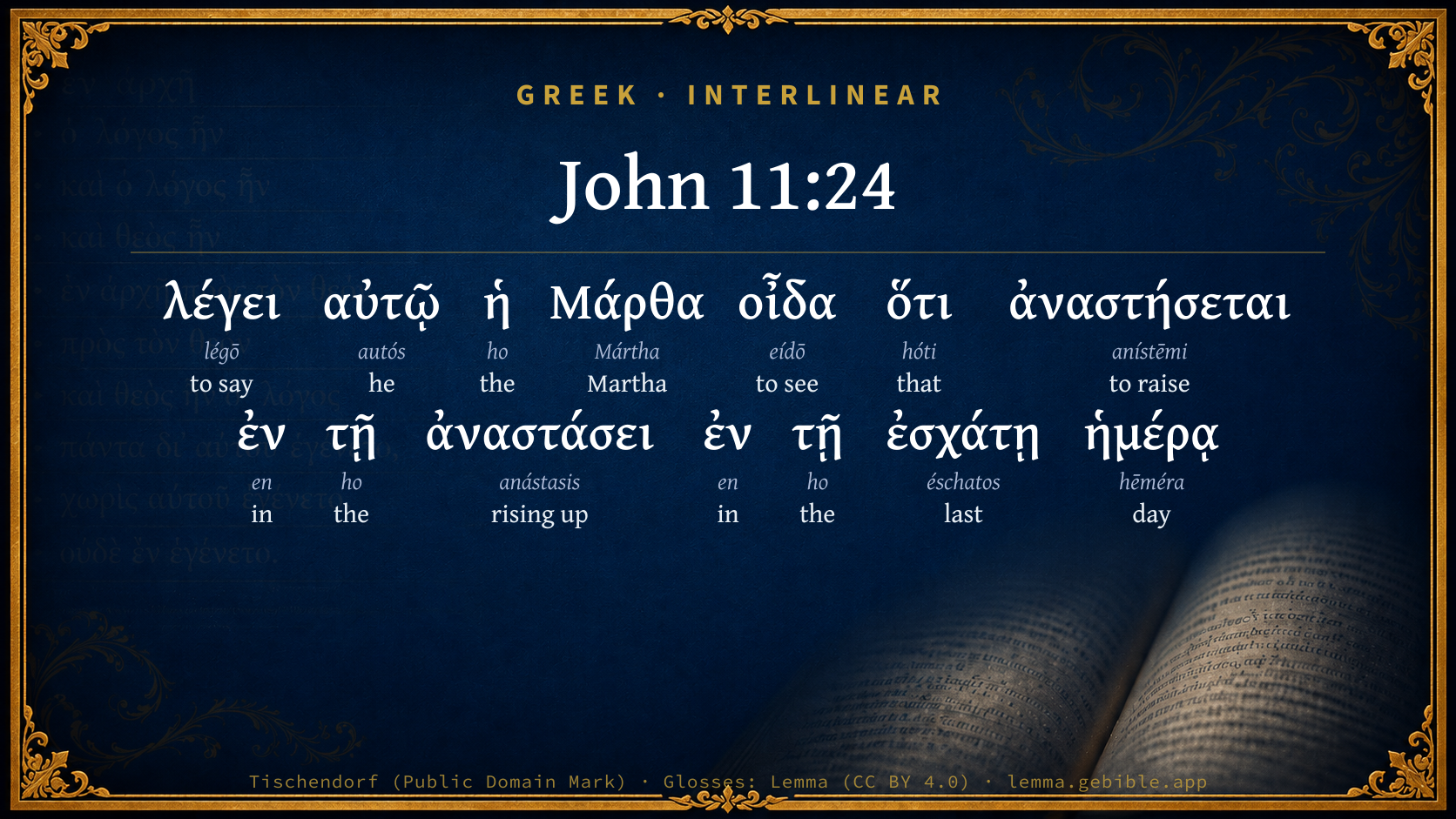
  1. λέγει légō G3004 “to say” Verb, Present, Active, Indicative, 3rd person, Singular
  2. αὐτῷ autós G846 “he” Personal pronoun, Dative, Singular, Masculine
  3. ἡ ho G3588 “the” Article, Nominative, Singular, Feminine
  4. οἶδα eídō G1492 “to see” Verb, Perfect, Active, Indicative, 1st person, Singular
  5. ὅτι hóti G3754 “that” Conjunction
  6. ἀναστήσεται anístēmi G450 “to raise” Verb, Future, Middle, Indicative, 3rd person, Singular
  7. ἐν en G1722 “in” Preposition
  8. τῇ ho G3588 “the” Article, Dative, Singular, Feminine
  9. ἀναστάσει anástasis G386 “rising up” Noun, Dative, Singular, Feminine
  10. ἐν en G1722 “in” Preposition
  11. τῇ ho G3588 “the” Article, Dative, Singular, Feminine
  12. ἐσχάτῃ éschatos G2078 “last” Adjective, Dative, Singular, Feminine, Superlative
  13. ἡμέρᾳ hēméra G2250 “day” Noun, Dative, Singular, Feminine

About this verse

These counts appear in no published source. They are computed here, from the morphology-tagged text and Lemma’s own curated glosses. What Lemma adds →

14
words
11
distinct lemmas
Gospels
section

Notable vocabulary

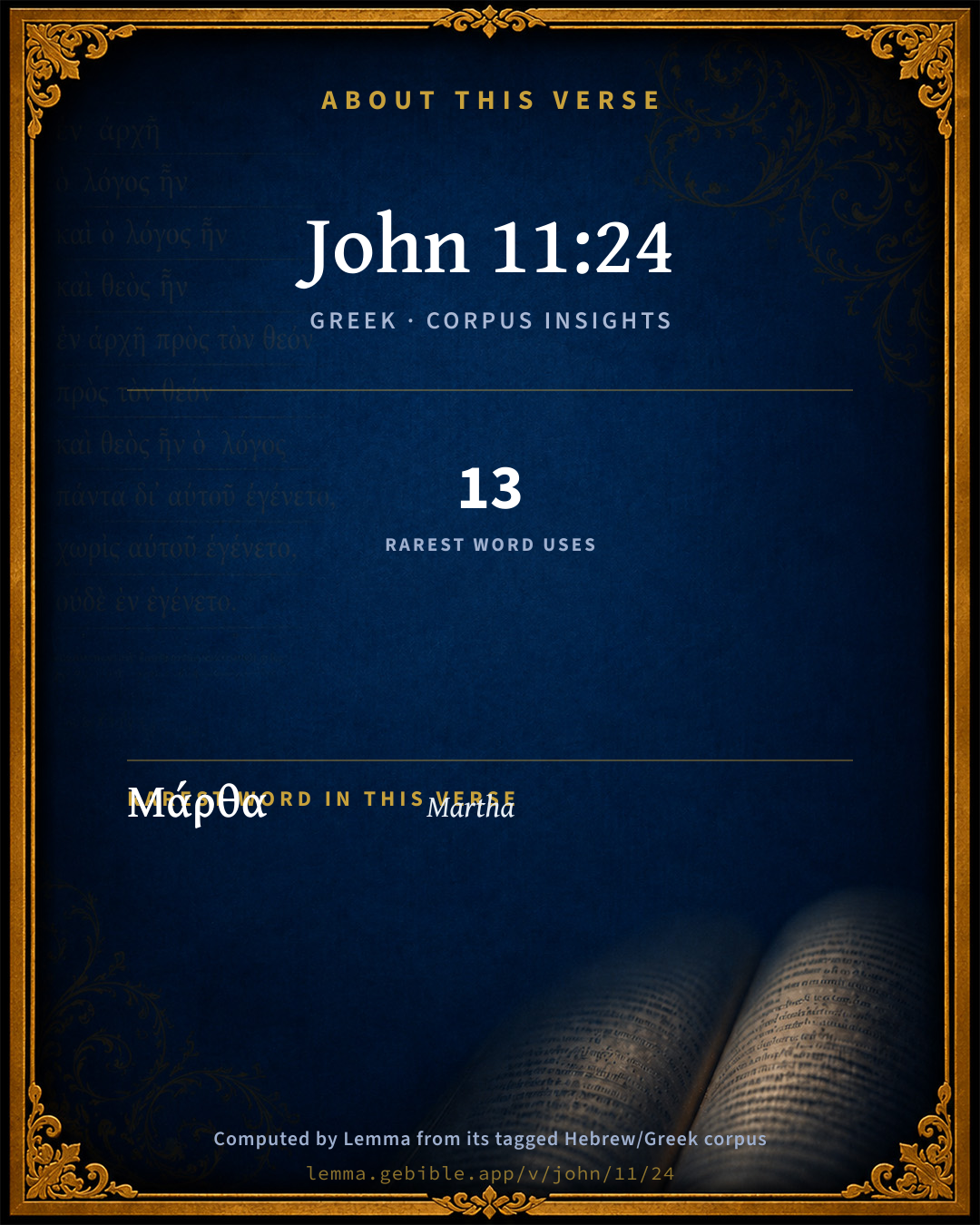
The rarest word here is Μάρθα Martha G3136 — appearing just 13 times in the whole Greek New Testament.

Shared distinctive vocabulary

Μάρθα Martha G3136 occurs in 12 verses of the Greek New Testament. Also found in:

Repetition

Words recur within this verse:

Cross-references

15

Topical passages linked to John 11:24 in the Treasury of Scripture Knowledge — connected by theme and wording, ordered by reader-vote popularity; previews shown in the World English Bible.

  • Daniel 12:2–3 Many of those who sleep in the dust of the earth shall awake, some to everlasting life, and some to shame and everlasting contempt.
  • Acts 24:15 having hope toward God, which these also themselves look for, that there will be a resurrection of the dead, both of the just and unjust.
  • John 5:28–29 Don't marvel at this, for the hour comes, in which all that are in the tombs will hear his voice,
  • Isaiah 26:19 Your dead shall live; my dead bodies shall arise. Awake and sing, you who dwell in the dust; for your dew is [as] the dew of herbs, and the earth shall cast forth the dead.
  • Acts 17:31–32 because he has appointed a day in which he will judge the world in righteousness by the man whom he has ordained; of which he has given assurance to all men, in that he has raised him from the dead."
  • Hosea 13:14 I will ransom them from the power of Sheol. I will redeem them from death! Death, where are your plagues? Sheol, where is your destruction? Compassion will be hidden from my eyes.
  • Psalms 17:15 As for me, I shall see your face in righteousness; I shall be satisfied, when I awake, with seeing your form.
  • Luke 14:14 and you will be blessed, because they don't have the resources to repay you. For you will be repaid in the resurrection of the righteous."
  • Hosea 6:2 After two days will he revive us. On the third day he will raise us up, And we will live before him.
  • Psalms 49:14–15 They are appointed as a flock for Sheol. Death shall be their shepherd. The upright shall have dominion over them in the morning. Their beauty shall decay in Sheol, Far from their mansion.
  • Isaiah 25:8 He has swallowed up death forever; and the Lord Yahweh will wipe away tears from off all faces; and the reproach of his people will he take away from off all the earth: for Yahweh has spoken it.
  • Ezekiel 37:1–10 The hand of Yahweh was on me, and he brought me out in the Spirit of Yahweh, and set me down in the midst of the valley; and it was full of bones.
  • Matthew 22:23–32 On that day Sadducees (those who say that there is no resurrection) came to him. They asked him,
  • Acts 23:6–9 But when Paul perceived that the one part were Sadducees and the other Pharisees, he cried out in the council, "Men and brothers, I am a Pharisee, a son of Pharisees. Concerning the hope and resurrection of the dead I am being judged!"
  • Hebrews 11:35 Women received their dead by resurrection. Others were tortured, not accepting their deliverance, that they might obtain a better resurrection.

Cross-references courtesy of OpenBible.info (CC BY 4.0).

Commentary

Notes on John 11:24 from classic Christian and Jewish commentators (each source and its license shown beneath its notes). The classic Christian expositions comment on the surrounding passage and are grouped to its opening verse, so a note may address several verses; the Jewish commentaries on the Tanakh (Rashi and others) are per-verse, so they appear only where the commentator wrote on this verse.

Lemma curates 59 commentaries, every one of them public domain or Creative Commons licensed, each selected and text-cleaned for this edition rather than reprinted as found. About our sources →

Tyndale Open Study Notes

Tyndale Open Resources

11:24 when everyone else rises, at the last day: Martha misunderstood (cp. 11:11-13), thinking that Jesus was referring to the general resurrection of the dead at the end of time.

Tyndale Open Study Notes — © Tyndale Open Resources, licensed CC BY-SA 4.0. Text via the HelloAO Bible API.

Bengel's Gnomon

Johann Albrecht Bengel

Joh 11:24. Ἐν τῇ ἀναστάσει, in the resurrection) Therefore the Jews were believers in the resurrection.—ἐσχάτῃ, last) Martha supposes that to be more distant, which the connection, Joh 11:22-23, was showing to be close at hand, “Whatsoever thou wilt ask, God will give. Thy brother shall rise again.”

Bengel's Gnomon of the New Testament — English translation (T&T Clark, Edinburgh, 1860) — public domain. Text from a community e-Sword module.

Expositor's Greek Testament

ed. W. Robertson Nicoll

Joh 11:24 . “I know,” she says, “that he will rise again, in the resurrection at the last day.” On the terms used see Joh 5:28 , Joh 6:39-40 ; Joh 6:54 . Belief in the resurrection had been promoted through Dan 12:2 , and, as Holtzmann remarks, Martha must have heard more than enough about it during the last four days, and fears perhaps that even Jesus is offering the merely conventional consolation. To one who yearns for immediate re-union the “last day” seems invisible. It was small consolation for Martha to know that her brother would lie for ages in the tomb, no more to exchange one word or look till the last day.

The Expositor's Greek Testament, edited by W. Robertson Nicoll (1897–1910) — public domain. Text from a community e-Sword module.

Jamieson, Fausset & Brown

Robert Jamieson, A. R. Fausset & David Brown

Martha said, . . . I know that he shall rise again . . . at the last day--"But are we never to see him in life till then?"

Jamieson, Fausset & Brown — Commentary Critical and Explanatory on the Whole Bible (1871) — public domain (CC PDM 1.0). Text via the HelloAO Bible API.

Adam Clarke's Commentary

Verse 24. I know that he shall rise again in the resurrection] The doctrine of the resurrection of the dead was then commonly received; and though it was our Lord who fully exemplified it by his own resurrection, yet the opinion was common, not only among God's people, but among all those who believed in the God of Israel. The Jewish writings after the captivity are full of this doctrine. See 2 Macc. 7:9, 14, 23, 36; 12:43; 14:46; Wisd. 5:1, 7, 17; 6:6, 7. See also Josephus and the Targums, passim.

Adam Clarke's Commentary on the Bible (1810–1826) — public domain. Text from a community e-Sword/MySword module.

John Calvin's Commentaries

24. I know that he shall rise again. We now see Martha’s excessive timidity in extenuating the meaning of Christ’s words. We have said that she went farther than she had a right to do, when she fabricated a hope for herself out of the feelings of her own mind. She now falls into an opposite fault; for when Christ stretches forth his hand, she stops short, as if she were alarmed. We ought, therefore to guard against both of these extremes. On the one hand, we must not, without the authority of God’s word, drink in empty hopes, which will prove to be nothing but wind; and, on the other hand, when God opens his mouth, it is not proper that he should find our hearts either blocked up, or too firmly closed. Again, by this reply, Martha intended to ascertain more than she ventured to expect from the words of Christ, as if she had said: “If you mean the last resurrection, I have no doubt that my brother will be raised again at the last day, and I comfort myself with this confident expectation, but I do not know if you direct my attention to something greater.”

John Calvin's Commentaries (1540-1563) — public domain. Text from the Calvin Translation Society English edition (1840s-50s) via the Christian Classics Ethereal Library (ccel.org). Calvin's coverage is partial (roughly two-thirds of the Bible); uncommented books and verses are honest gaps, never fabricated. The 19th-century editor's footnotes and remarks are omitted so the notes are faithfully Calvin's own voice.

Ellicott's Commentary for English Readers

(24) I know that he shall rise again in the resurrection . . .—Her answer expresses something of disappointment. Her whole heart had been fixed on one thought, and in all that had passed her hopes had found a support which seemed to warrant the hope for its accomplishment. She is now reminded of a general truth which she had rested in before, but this does not satisfy the expectation she had formed now. We have all felt something of her disappointment as we have stood beside the sepulchre. We have known, with a knowledge more full than hers, that “he shall rise again in the resurrection at the last day;” but this knowledge has often had little power to remove the deep sorrow of the heart. We conquer the pagan thought “lost for ever”; but we are often conquered by the thought “lost for the present.”

For the thought of the resurrection, comp. Notes on Joh_5:29 and Luk_14:14. The Pharisees expected the resurrection of the just to accompany the Messianic advent. (Comp. Dan_12:2 and 2Ma_7:9.) Still, the answer is in advance of that which we should expect, as compared with the dimness which rests upon even the fullest expression with regard to the resurrection in the Old Testament, and is to be traced to earlier lessons she had received from Him who is teaching her now.

A Bible Commentary for English Readers, edited by Charles John Ellicott (1878–1897) — public domain. Text from a community e-Sword module.

The Cambridge Bible for Schools and Colleges

gen. ed. J. J. S. Perowne

24. I know that he shall rise again] This conviction was probably in advance of average Jewish belief on the subject. The O.T. declarations as to a resurrection are so scanty and obscure, that the Sadducees could deny the doctrine, and the Pharisees had to resort to oral tradition to maintain it (see on Mar_12:18; Act_23:8).

the last day] See on Joh_6:39.

The Cambridge Bible for Schools and Colleges (gen. ed. J. J. S. Perowne; Cambridge University Press, 1878–1918) — public domain. Text from a community e-Sword module.

John Gill's Exposition

Jesus said unto her, I am the resurrection and the life,.... Signifying, that he was able of himself to raise men from death to life, without asking it of his Father; and that he could do it now, as well as at the general resurrection; at which time Christ will be the efficient cause of it; and which will display both his omniscience and his omnipotence; as his resurrection is the earnest and pledge, and will be the model and exemplar of it. This is true of Christ, with regard to a spiritual resurrection, from a death of sin, to a life of grace; he is concerned both in the life itself, and in the resurrection to it: he is the meritorious and procuring cause of it; he died for his people, that they, being dead to sin, might live unto God, and unto righteousness: he is the author of it; he says unto them, when dead in sin, live; he speaks life into them: he commands it in them, and by his Spirit breathes into them the breath of spiritual life, and implants the principle of it in their souls; and he supports and maintains it by giving himself to them as the bread of life to feed upon, and by supplying them with grace continually; yea, he himself is their life; he lives in them, and their life is hid with him. It is owing to his resurrection, that they are begotten again to a lively hope, or are quickened, that has a virtual influence upon it; and it is not only the cause, but the exemplar of it. Saints, as they are planted together in the likeness of his death, so in the likeness of his resurrection: to which may be added, that it is his voice in the Gospel, attended with an almighty power, which is the means of quickening them, which they hear, and so live; and it is his image that is stamped upon them; and by his Spirit they are made to live, and to walk in newness of life.

He that believeth in me, though he were dead, yet shall he live: believers in Christ die as well as others, though death is not a penal evil to them; its curse is removed, its sting is taken away, being satisfied for by Christ, and so becomes a blessing and privilege to them, and is desirable by them; but though they die, they shall live again; their dust is under the peculiar care of Christ; and they shall rise by virtue of union to him, and shall rise, first in the morning of the resurrection, and with peculiar privileges, or to the resurrection of life, and with the peculiar properties of incorruption, power, glory, and spirituality. So likewise such that have been dead in sin, and dead in law, under a sentence of condemnation, as all mankind are in Adam, and being in a natural and sinful estate, and as the chosen of God themselves are; yet being brought to believe in Christ, that is, to see the excellency and suitableness of him as a Saviour, and the necessity of salvation by him; to go out of themselves to him, disclaiming their own righteousness; venture their souls upon him, give up themselves to him, trust in him, and depend upon him for eternal life and salvation; these live spiritually; they appear to have a principle of life in them; they breathe after spiritual things; they see the Son of God, and behold his glory; they handle the word of life; they speak the language of Canaan, and walk by faith on Christ, as they have received him; they live a life of sanctification and justification; they are manifestly in Christ, and have him, an interest in him, and so must have life; they live comfortably; they live by faith on Christ, and his righteousness, and have communion with him here, and expect to have, and shall have eternal life hereafter.

John Gill's Exposition of the Whole Bible (1746–1763) — public domain (CC PDM 1.0). Text via the HelloAO Bible API.

Trapp's Complete Commentary

John Trapp

24 Martha saith unto him, I know that he shall rise again in the resurrection at the last day.

Ver. 24. In the resurrection] The Syriac hath it Benuchama, in the consolation. So the resurrection was ever to the disconsolate believers of both Testaments, Dan 12:2; Heb 11:35. In the primitive Church, when they repeated that article of the creed, "I believe the resurrection of the flesh," they would point to their bodies, and say, etiam huius carnis, even of this very flesh.

John Trapp, A Commentary or Exposition upon All the Books of the Old and New Testament (1647–1656) — public domain. Text from a community e-Sword module.

Albert Barnes' Notes on the Bible

At the last day - The day of judgment. Of this Martha was fully convinced; but this was not all which she desired. She in this manner delicately hinted what she did not presume expressly to declare her wish that Jesus might even now raise him up.

Albert Barnes' Notes on the Bible (1834–1885) — public domain. Text from a community e-Sword/MySword module.

Matthew Poole's English Annotations

From hence we learn, that the general resurrection of the dead is no novel doctrine. Job believed it, Job 19:26,27. Daniel published it, Dan 12:2. The Pharisees owned it, though the Sadducees denied it; and possibly the Pharisees had but a confused notion of it. Martha here makes it an article of her faith.

Matthew Poole's English Annotations on the Holy Bible (1683–1685) — public domain. Text from a community e-Sword/MySword module.

Whedon's Commentary on the Bible

Daniel D. Whedon

24. In the resurrection—The words of Martha indicate the common faith of the Jews of her day in the resurrection of the body.

Last day—The closing day of this world’s history, when the entire race shall stand before the Judge of quick and dead. Martha puts this unhoping construction upon the Lord’s words, as if to draw out a more explicit assurance of a present aid. Little did she anticipate in what a burst of grandeur the assurance would come forth.

Daniel D. Whedon (gen. ed.), Commentary on the Old and New Testaments (1874–1909) — public domain. Text from a community e-Sword module.

The Pulpit Commentary

Martha saith to him, I know that he will rise again at the resurrection in the last day. Some disappointment is revealed in this speech, such as we have all felt with the promise of an ultimate resurrection, when the grave has closed over some dear friend. We find small relief in the assurance. The old ties are snapped, the old ways are at an end. We shall go to the dead: he will not return to us. The last day is too far off to comfort us concerning our brother. That the answer of Martha is important as revealing belief in the resurrection at the last day; of which, however, it must be remembered those who had heard our Lord"s own assertions about it could no longer have doubted. (Joh_6:39, Joh_6:40, Joh_6:44, 54 12:48) The teachings of Jesus in this Gospel with reference to eternal life made the promise of resurrection, the transfiguration of the physical life of man, a necessity, not a contradiction. The reply of Martha shows that she does not as yet grasp the whole truth. "The last day" may be far nearer in her thought than we now know it to have been, or them it is to us; still, however near, it would imply a complete transformation of all these sweet human relationships. She longed to have the home as it was before Lazarus died. It is, however, of very great interest that we have, on the part of a Jew, this profound expectation of resurrection and immortality. Jews, or at least Pharisees, had derived from Old Testament thought from Genesis, and from Job, and from the Psalter, from the Books of Daniel and Ezekiel, and from the progress of human thought as evinced in "Wisdom of Solomon a great belief in both. Martha reveals incidentally the new light which had been cast on the mystery of the grave by the words and acts of Jesus.

The Pulpit Commentary (1880–1919), ed. H.D.M. Spence-Jones & Joseph S. Exell — public domain. Text from a community e-Sword module.

unfoldingWord translationNotes

Door43 World Missions Community

he will rise again

"he will become alive again"

even if he dies

Here "dies" refers to physical death.

will live

Here "live" refers to spiritual life.

whoever lives and believes in me will never die

"those who live and trust in me will never be separated eternally from God" or "those who live and trust in me will be spiritually alive with God forever"

will never die

Here "die" refers to spiritual death.

translationWords

raise

resurrection

last day

life

believe

die

unfoldingWord translationNotes — © Distant Shores Media and the Door43 World Missions Community, licensed CC BY-SA 4.0. Source: git.door43.org/Door43/en_tn.

Cambridge Greek Testament for Schools and Colleges

24. οἶδα ὅτι ἀναστ. This conviction was probably in advance of average Jewish belief on the subject. The O.T. declarations as to a resurrection are so scanty and obscure, that the Sadducees could deny the doctrine, and the Pharisees had to resort to oral tradition to maintain it (see on Mar 12:18; Act 23:8]. But from Dan 12:2 and 2Ma 7:9; 2Ma 7:14; 2Ma 7:23; 2Ma 7:36; 2Ma 12:43-44, a belief in a resurrection of the good as an inauguration of the Messiah’s kingdom was very general. For ἐν τ. ἐσχ. ἡμέρᾳ see on Joh 6:39.

Cambridge Greek Testament for Schools and Colleges (Cambridge University Press, 1896; 21 vols, various authors incl. Carr, Maclear, Plummer, Farrar, Lumby, Moule, M. R. James, Simcox) — public domain. Text from a community e-Sword module.

Alford’s Greek Testament

Henry Alford

24.] She understands the words rightly, but gently repels the insufficient comfort of his ultimate resurrection.

25,

Henry Alford, The Greek Testament (1849–1861) — public domain. Text from a community e-Sword module.

International Critical Commentary

24. Martha’s reply is not sceptical or querulous. She does not deny the tremendous doctrine of resurrection at the Last Day. She replies, wistfully enough, that she knows it and accepts it. But, like many another mourner, she fails to derive much immediate consolation from it. The Last Day seems very far off. Meanwhile, where is her brother? And what are the conditions of this Resurrection? What is the Resurrection?

The answer of Jesus is unexpected indeed. “I am the Resurrection”: the soul that has touched me has touched life; and the life of God is eternal. That is the whole answer. And Martha, not fully understanding it, recognises that He who spoke to her, spoke with an awful prescience, as befitted Him in whom she saw the Messiah.

λέγει αὐτῷ ἡ Μάρθα. The article, which is omitted by אAC3ΓΔW, must be retained with BC*DLΘ. Throughout the chapter (except at vv. 1, 39, which are not true exceptions), Jn. writes ἡ Μάρθα. See on vv. 2, 20.

For the doctrine of the Last Things in Jn., see Introd., p. clviii; and for the phrase ἡ ἐσχάτη ἡμέρα, which is peculiar to Jn., see on 6:39. For the word ἀνάστασις, used of a resurrection from death, see on 5:28.

International Critical Commentary — older volumes (1896–1929), various authors — public domain. Text from a community e-Sword module.

Vincent's Word Studies in the New Testament

Marvin R. Vincent

In the resurrection. Wyc., the again rising.

Marvin R. Vincent, Word Studies in the New Testament (1887–1900) — public domain. Text from a community e-Sword/MySword module.

Lesson kit

Teaching starters — assembled from the data on this page, not authored interpretation. Every prompt links to the verse data it draws on. Edit before teaching.

John, in the Gospels, opens this verse with 14 words (11 distinct Greek lemmas). Its most distinctive word is Mártha (“Martha”). A historical commentator’s framing appears above. Read the whole chapter for the surrounding context.

Discussion questions

  1. What does “Martha” (Mártha) contribute to the verse as a whole?
  2. How does Luke 10:38, which shares the word «Martha», read alongside this verse?
  3. What does the repetition of “the” (3× in this one verse) do in this verse?
  4. The translations on this page render this verse differently — a whole-verse word diff, not a word-by-word alignment. What might account for the different wordings?
  5. Compare how Tyndale Open Study Notes and Bengel's Gnomon read this verse. Where do they agree or differ?

Things to notice

Reading settings

Reading text

Shown beneath each verse's original-language words.

Old Testament
Old Testament edition

Read the OT as the Masoretic Hebrew (MT) or the Greek Septuagint (LXX).

English shown for the Greek Septuagint (in the Hebrew ↔ Greek comparison).

Comparing translations? Open the Compare panel on any verse page to stack up to four side by side.