
John 11:39

Greek (Tischendorf 8th ed.) John 11:39 appears in the Greek New Testament. The text above is from the Tischendorf 8th edition. Each word links to its Strong’s number and a concise gloss. Click any word for its full Thayer’s Greek Lexicon entry.
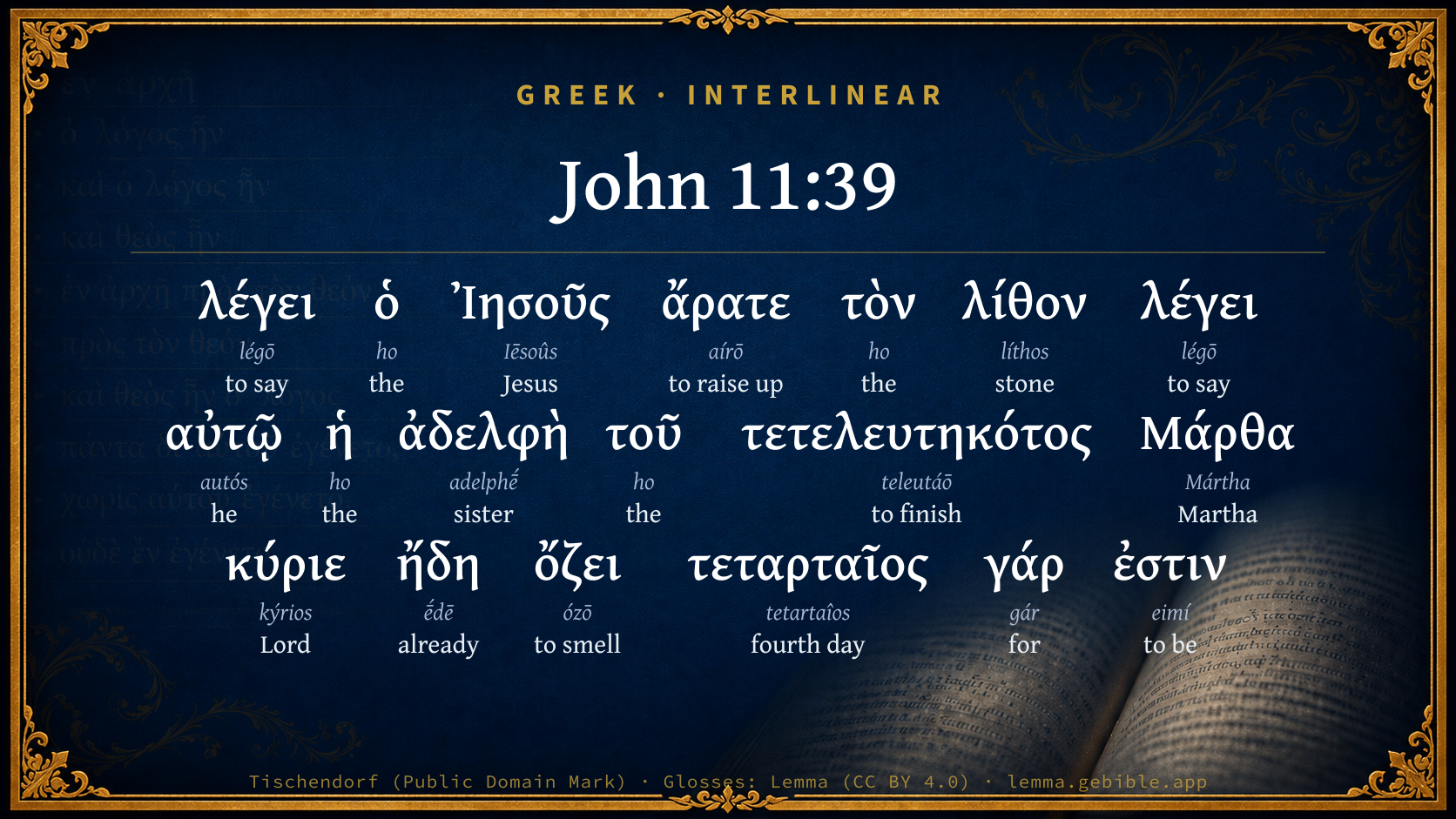
Download image
Cite this verse

John 11:39 (World English Bible). Public Domain. Lemma interlinear Bible study tool, https://lemma.gebible.app/v/john/11/39.

Show BibTeX & RIS
BibTeX
RIS
English Translation
Jesus said, "Take away the stone." Martha, the sister of him who was dead, said to him, "Lord, by this time there is a stench, for he has been dead four days."
World English Bible · Public Domain
Highlights
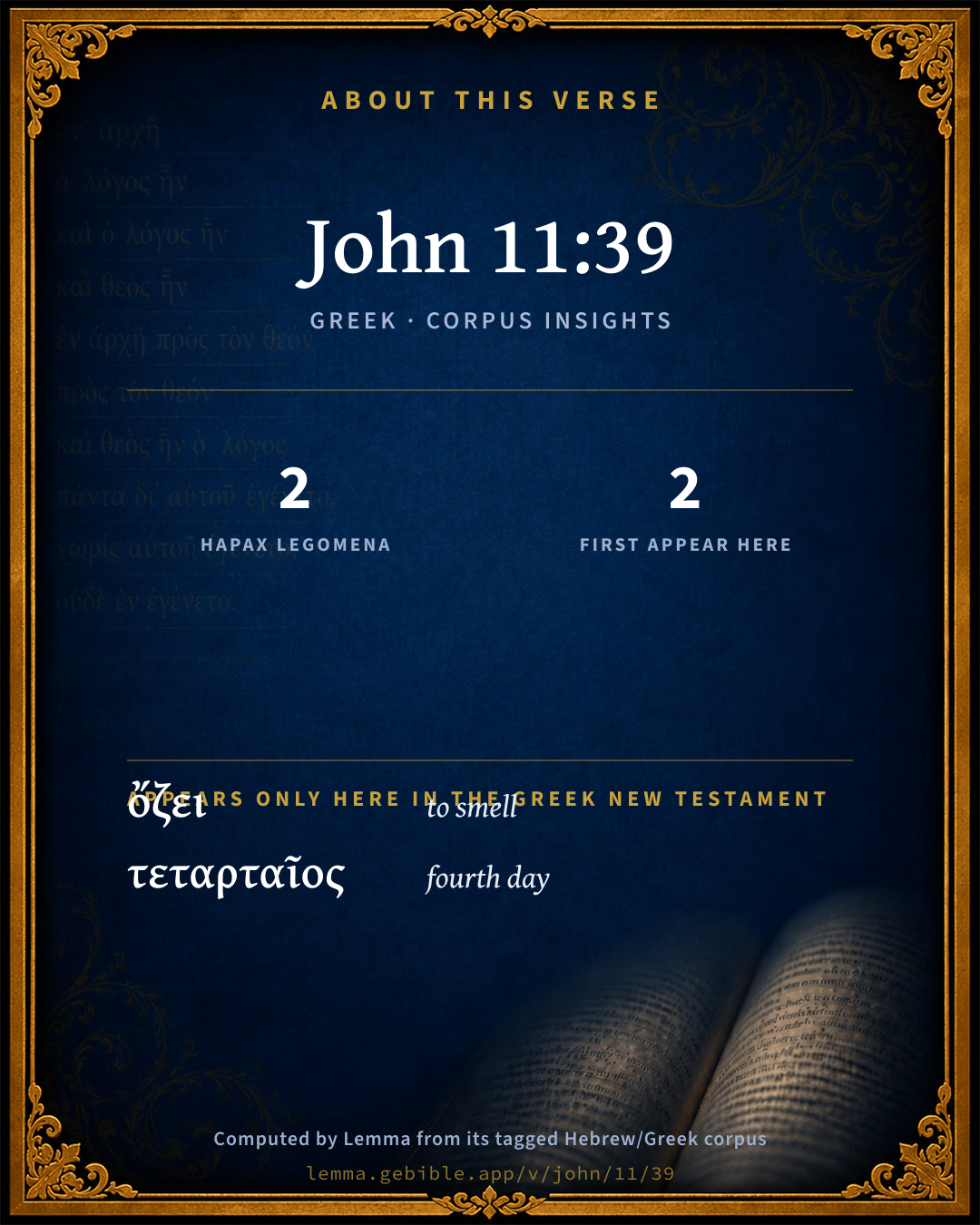
  • 2 hapax legomena — only here in the Greek New Testament
  • 2 first appearances in the Greek New Testament
Full analysis ↓
Download a study sheet

One document with this verse’s original text, its word-by-word gloss line, the meaning frame, cross-references with their text, attributed commentary, and full source and license credits — printable, and it pastes into notes with its structure intact.

This verse Autodidact and up

Study sheet (.html) Plain text (.txt)

A passage Seminary Student

Up to 50 verses in one chapter. A passage sheet keeps up to 6 commentary sources and 12 cross-references per verse, in the order this page ranks them, and says so on the sheet whenever that leaves anything out. Ask for a single verse and you get the Autodidact verse sheet above.

Everything on this page stays free to read, with no account — the sheet is a download of what is already on screen, not access to it.

Want to remove ads? Support Godless Engineer
Compare translations 3

The same verse in 3 English versions, stacked beneath the original-language interlinear above. Click any original word for its lexicon entry.

Each is an independent rendering of the whole verse — the interlinear is not word-aligned to these translations.

Highlighted words mark where these versions differ — a whole-verse word diff, not a word-by-word alignment.

  • World English Bible Public Domain
    Jesus said, "Take away the stone." Martha, the sister of him who was dead, said to him, "Lord, by this time there is a stench, for he has been dead four days."
  • King James Version Public Domain
    Jesus said, Take ye away the stone. Martha, the sister of him that was dead, saith unto him, Lord, by this time he stinketh: for he hath been dead four days.
  • unfoldingWord Literal Text CC BY-SA 4.0
    Jesus says, “Take away the stone.” Martha, the sister of the one that had died, says to him, “Lord, he will already stink, for it is four days.”

unfoldingWord Literal Text — © unfoldingWord, licensed CC BY-SA 4.0. Word-aligned USFM3 via Door43 (git.door43.org/unfoldingWord/en_ult).

Versions to compare (up to 4)

3 of 4 selected

Show all 19 translations

Every available English version of this verse, each an independent rendering of the whole verse.

  • World English Bible Public Domain
    Jesus said, "Take away the stone." Martha, the sister of him who was dead, said to him, "Lord, by this time there is a stench, for he has been dead four days."
  • Berean Standard Bible Public Domain
    “Take away the stone,” Jesus said. “Lord, by now he stinks,” said Martha, the sister of the dead man. “It has already been four days.”
  • Majority Standard Bible Public Domain
    “Take away the stone,” Jesus said. “Lord, by now he stinks,” said Martha, the sister of the dead man. “It has already been four days.”
  • King James Version Public Domain
    Jesus said, Take ye away the stone. Martha, the sister of him that was dead, saith unto him, Lord, by this time he stinketh: for he hath been dead four days.
  • American Standard Version (1901) Public Domain
    Jesus saith, Take ye away the stone. Martha, the sister of him that was dead, saith unto him, Lord, by this time the body decayeth; for he hath been `dead' four days.
  • Revised Version (1885) Public Domain
    Jesus saith, Take ye away the stone. Martha, the sister of him that was dead, saith unto him, Lord, by this time he stinketh: for he hath been dead four days.
  • Geneva Bible (1599) Public Domain
    Iesus saide, Take ye away the stone. Martha the sister of him that was dead, said vnto him, Lord, he stinketh alreadie: for he hath bene dead foure dayes.
  • Douay-Rheims (1899) Public Domain
    Jesus saith: Take away the stone. Martha, the sister of him that was dead, saith to him: Lord, by this time he stinketh, for he is now of four days.
  • Young's Literal Translation Public Domain
    Jesus saith, `Take ye away the stone;' the sister of him who hath died -- Martha -- saith to him, `Sir, already he stinketh, for he is four days dead;'
  • Literal Standard Version CC BY-SA 4.0
    Jesus says, “Take away the stone”; the sister of him who has died—Martha—says to Him, “Lord, he already stinks, for he is four days dead”;
  • Unlocked Literal Bible CC BY-SA 4.0
    Jesus said, “Take away the stone.” Martha, the sister of Lazarus, the one who had died, said to Jesus, “Lord, by this time the body will be decaying, for he has been dead for four days.”
  • unfoldingWord Literal Text CC BY-SA 4.0
    Jesus says, “Take away the stone.” Martha, the sister of the one that had died, says to him, “Lord, he will already stink, for it is four days.”
  • Darby Bible Public Domain
    Jesus says, Take away the stone. Martha, the sister of the dead, says to him, Lord, he stinks already, for he is four days [there].
  • World Messianic Bible Public Domain
    Yeshua said, “Take away the stone.” Martha, the sister of him who was dead, said to him, “Lord, by this time there is a stench, for he has been dead four days.”
  • Webster's Bible Public Domain
    Jesus said, Take ye away the stone. Martha, the sister of him that was dead, saith to him, Lord, by this time his body is offensive: for he hath been dead four days.
  • Free Bible Version CC BY-SA 4.0
    “Remove the stone,” Jesus told them. But Martha, the dead man's sister, said, “Lord, by now there will be a terrible smell, for he's been dead for four days.”
  • Bible in Basic English Public Domain
    Jesus said, Take away the stone. Martha, the sister of him who was dead, said, Lord, by this time the body will be smelling, for he has been dead four days.
  • Text-Critical English NT CC BY 4.0
    Jesus said, “Take away the stone.” Martha, the sister of the man who had died, said to him, “Lord, there is already a stench, for it is the fourth day.”
  • Tyndale New Testament (1534) Public Domain
    And Iesus sayd: take ye awaye the stone. Martha the sister of him that was deed sayd vnto him: Lorde by this tyme he stinketh. For he hath bene deed foure dayes:

Literal Standard Version (2020), Covenant Press — licensed CC BY-SA 4.0. Text via the HelloAO Bible API (eBible.org). Unlocked Literal Bible (unfoldingWord) — licensed CC BY-SA 4.0. Text via the HelloAO Bible API (eBible.org). unfoldingWord Literal Text — © unfoldingWord, licensed CC BY-SA 4.0. Word-aligned USFM3 via Door43 (git.door43.org/unfoldingWord/en_ult). Free Bible Version, Dr. Jonathan Gallagher — licensed CC BY-SA 4.0. Text via the HelloAO Bible API (eBible.org).

Word by word

More ways to search: Search by grammar → Find every occurrence → Compare this word →

Practice this passage: Drill this verse → Learn its vocabulary →

ὄζει
ózō
G3605
“to smell”
Verb, Present, Active, Indicative, 3rd person, Singular
Part of Speech
Verb
Tense
Present
Voice
Active
Mood
Indicative
Person
3rd person
Number
Singular
Full Thayer's Definition

Origin: a root word (in a strengthened form)

TDNT: None

1. to give out an odour (either good or bad), to smell, emit a smell a. of a decaying corpse
  1. λέγει légō G3004 “to say” Verb, Present, Active, Indicative, 3rd person, Singular
  2. ὁ ho G3588 “the” Article, Nominative, Singular, Masculine
  3. Ἰησοῦς Iēsoûs G2424 “Jesus” Noun, Nominative, Singular, Masculine
  4. ἄρατε aírō G142 “to raise up” Verb, Aorist, Active, Imperative, 2nd person, Plural
  5. τὸν ho G3588 “the” Article, Accusative, Singular, Masculine
  6. λίθον líthos G3037 “stone” Noun, Accusative, Singular, Masculine
  7. λέγει légō G3004 “to say” Verb, Present, Active, Indicative, 3rd person, Singular
  8. αὐτῷ autós G846 “he” Personal pronoun, Dative, Singular, Masculine
  9. ἡ ho G3588 “the” Article, Nominative, Singular, Feminine
  10. ἀδελφὴ adelphḗ G79 “sister” Noun, Nominative, Singular, Feminine
  11. τοῦ ho G3588 “the” Article, Genitive, Singular, Masculine
  12. τετελευτηκότος teleutáō G5053 “to finish” Verb, Perfect, Active, Participle, Genitive, Singular, Masculine
  13. Μάρθα Mártha G3136 “Martha” Noun, Nominative, Singular, Feminine
  14. κύριε kýrios G2962 “Lord” Noun, Vocative, Singular, Masculine
  15. ἤδη ḗdē G2235 “already” Adverb
  16. τεταρταῖος tetartaîos G5066 “fourth day” Adjective, Nominative, Singular, Masculine
  17. γάρ gár G1063 “for” Conjunction
  18. ἐστιν eimí G1510 “to be” Verb, Present, Active, Indicative, 3rd person, Singular

About this verse

These counts appear in no published source. They are computed here, from the morphology-tagged text and Lemma’s own curated glosses. What Lemma adds →

19
words
15
distinct lemmas
Gospels
section

Notable vocabulary

2 hapax legomena — words that appear only here in the entire Greek New Testament:

  • ὄζει to smell G3605
  • τεταρταῖος fourth day G5066

First appearance in Scripture

These words make their first canonical appearance in the Greek New Testament here:

  • ὄζει to smell G3605
  • τεταρταῖος fourth day G5066

Shared distinctive vocabulary

τετελευτηκότος to finish G5053 occurs in 11 verses of the Greek New Testament. Also found in:
Repetition

Words recur within this verse:

Cross-references

6

Topical passages linked to John 11:39 in the Treasury of Scripture Knowledge — connected by theme and wording, ordered by reader-vote popularity; previews shown in the World English Bible.

  • John 11:17 So when Jesus came, he found that he had been in the tomb four days already.
  • Psalms 49:7 None of them can by any means redeem his brother, Nor give God a ransom for him.
  • Mark 16:3 They were saying among themselves, "Who will roll away the stone from the door of the tomb for us?"
  • Genesis 3:19 By the sweat of your face will you eat bread until you return to the ground, for out of it you were taken. For you are dust, and to dust you shall return."
  • Philippians 3:21 who will change the body of our humiliation to be conformed to the body of his glory, according to the working by which he is able even to subject all things to himself.
  • Genesis 23:4 "I am a stranger and a foreigner living with you. Give me a possession of a burying-place with you, that I may bury my dead out of my sight."

Cross-references courtesy of OpenBible.info (CC BY 4.0).

Commentary

Notes on John 11:39 from classic Christian and Jewish commentators (each source and its license shown beneath its notes). The classic Christian expositions comment on the surrounding passage and are grouped to its opening verse, so a note may address several verses; the Jewish commentaries on the Tanakh (Rashi and others) are per-verse, so they appear only where the commentator wrote on this verse.

Lemma curates 59 commentaries, every one of them public domain or Creative Commons licensed, each selected and text-cleaned for this edition rather than reprinted as found. About our sources →

The Biblical Illustrator

Joseph S. Exell

Joh_11:39

Jesus said, Take ye away the stone

Taking the stone away

I. GOD NEVER PERFORMS AN UNNECESSARY ACT. We know most of God in Christ, and Christ never spoke an unnecessary word or did an unnecessary deed, although He had omnipotence at His command. Had this merely been delegated to Christ as a man it is inconceivable that He should not at some time have put forth His power to gratify the curiosity of friends, or to bind the hands of foes. But He never did; then God never does. It is the merest fanaticism to pray that God would give us a sign and set the universe agape.

II. GOD NEVER DOES DIRECTLY WHAT HE CAN DO THROUGH OTHERS. He has begotten children capable of knowing, feeling, and acting. He has made them free, He gives them the field, He allows them time; they must do the rest.

1. He will never do for the race what the race can do for itself. He could have stocked the world at the first with all the implements of agriculture, travel, and research. But He did not. He put man down among the quiet facts and laws of His universe, with physical, intellectual, and moral powers, and man was to produce the result. God made the garden because man could not, and then set man to dress it because God would not.

2. The same rule holds good spiritually. Mans agency precedes Gods working. In regeneration there is first the agency of man in Churches, preaching, books, etc., and then the power of God doing what man cannot do.

III. THE HELP WE CAN RENDER GOD IN THE ACCOMPLISHMENT OF HIS GREAT DESIGNS. We can remove the stones which hinder spiritual resurrections. What are they?

1. Indifference. This is produced by

(1) The engrossing work of life. Your friend is like the racer who does not notice whether the sun is shining or clouds gathering, all he thinks of is the goal. All he needs is to be arrested and made to feel that he is wasting his energies for a prize he may not gain, or if gained, nothing in comparison with what is lost.

(2) Ignorance. He does not know that there is gold in California, and so keeps at his potato patch. Not knowing the treasures of religion he satisfies himself with the best he knows--worldly pursuits and joys.

(3) The frigidity of the religious atmosphere he breathes. When people are at freezing point they would rather die than stir. It is no mercy in a fellow traveller to indulge a freezing man with a short nap. It may be the sleep of death.

2. Scepticism. There are two courses open to doubters. They may open their minds to their friends. Their friends may sympathetically enter into their questions and answer them, and thus remove the stone. Or their friends may do, as too many do, treat them as lepers, in which case they bury their doubts in their own hearts, and a stone is placed over them. Dont do that. Do as Christ did with Thomas.

3. The inconsistency of Christians. How many neighbours, employes, are kept away from Christ by the practical unbelief of the professors with whom they are in daily contact.

4. Vicious indulgence which can only be removed by personal influence and example. (C. F. Deems, D. D.)

The sphere of instrumentality

(text and Joh_11:44):--Although God alone is the Quickener there are many things which we can do for others.

I. BEFORE CONVERSION.

1. We can call in the Master, as the sisters did. We must earnestly pray for souls and get them in contact with the Saviour

2. We can believe as they did, that whatsoever Christ asks of God will be granted; that He is able and willing to raise the spiritually dead.

3. We can roll away the stone of

(1) Ignorance. Let not the people die for lack of knowledge.

(2) Error--that they will be saved by their good works, etc.

(3) Prejudice.

(a) That religion is gloomy, by being happy.

(b) That religion is effeminate, by being men.

(c) That religion is mere sentiment, by experimentally demonstrating its reality.

(d) That religion is not for such as us, i.e., the working classes, by showing that Jesus is the peoples Man.

(4) Solitariness. Let men feel that Christianity is social and fraternal.

(5) Degradation. Help men out of the mire of sin.

(6) Despair. Infuse hope into the most hopeless.

II. AFTER CONVERSION. Lazarus is alive, but he is encumbered with grave clothes; it is the business of his friends to loose him and let him go. New converts want loosing for the sake of their own

1. Comfort. Remove their doubts and fears.

2. Freedom. Gently lead them out of those habits which still bind the new man.

3. Fellowship. Just as Lazarus could not enjoy his sisters society till his swathing bands were off, so real Christians are kept back from fellowship by a sense of unfitness, etc. Encourage them: compel them to come in.

4. Testimony. Lazarus was unable to bear witness while the napkin was about his head, so young converts are deterred by nervousness, etc.

5. Service. Take them by the hand and teach them how to use their hands and feet for God.

6. Communion with Christ. After Lazarus was unbound he sat at the table with Jesus. Dont leave the new convert until he enjoys full fellowship with Christ. (C. H. Spurgeon.)

Man as a helper in Divine work

(text and Joh_11:44):--Gods power is all-sufficient. He does not need human help. The utmost that man can do is little. What little man is required or permitted to do is for his own welfare and improvement.

I. Is THE REALM OF NATURE.

1. Physical. God has given bodily life, and then continues to uphold its powers, so that man is capable of work within the appointed limits.

2. Natural. God has adapted the seed to the soil, and sunshine, rain, and seasons to harvests; but to man He has given the important work of combining the conditions. God will not plough and scatter the seed; neither will He cut and grind the grain. God stops His work where mans may begin, and begins His where mans must stop.

II. IN THE REALM OF THE SUPERNATURAL.

1. The miraculous. It was just as easy for Christ to do all, in the raising up of Lazarus, as only a part. But at the grave He said, Take ye away the stone; and after the working of the miracle, Jesus said unto them, Loose him, and let him go. This the friends of Lazarus might do, and in doing might either receive unmistakable proof of the life-giving power, or show their tender sympathy for the sisters and the risen man by ministering to them and him.

2. The spiritual. It is the Holy Spirit that gives life or renews the soul, and then the means of grace are to be faithfully used in building up a Christlike character.

3. The providential. Here the renewed are directed to offer prayer for the fulfilment of the promises as relate to nations and individuals, for the evangelization of the world, for the coming of Gods kingdom, and then faithfully to employ all necessary instrumentalities by which to secure these ends.

III. INFERENCES.

1. Take ye away the stone. This is preliminary. If the word is to enter a soul dead in trespasses and sins, the stone of prejudice, ignorance and unbelief must be taken away, and then the life-giving word will enter and do its work.

2. Loose him. Let us help others to a greater freedom and larger usefulness.

3. And let him go. Let us not chide others if they do not work in exactly our chosen methods, or in the same branches of moral and spiritual work. There is one Spirit, and to every man his work. (L. O. Thompson.)

The stone taken away

When Luther received the Divine call: Take away the stone! the body of the Church had already lain more than four hundred years in the Romish grave, and more than one faint-hearted Martha shrank from the smell of corruption which was being wafted by the stone-removing Reformation; but Luthers faith prospered unto the seeing of the glory of God. And we, if we would believe, should then know by real experience that the fragrance of incorruptible life, which goes forth from the Head of the Church, is powerful enough to overcome the corruption which Death is working in her members. Before every Lazarus grave of Jesus beloved Church the glory of the Lord stands ready to reveal itself. (R. Besser, D. D.)

Pity must be followed by active help

Suppose we had read, Jesus wept, and went about His daily business, I should have felt small comfort in the passage. If nothing had come of it but tears, it would have been a great falling off from the usual ways of our blessed Lord. Tears! what are they alone? Salt water! A cup of them would be of little worth to anybody. But, beloved, Jesus wept, and then He cried, Lazarus, come forth. (C. H.Spurgeon.)

The reticence of power

The Divine modesty, if we may so say, of the miracle which tells us that this setting aside for once of the stern law of death is the work of Him who is the Lord of law, and respects it in all His worlds--the Author not of confusion, but of peace. To have done these other things without means would not have rendered the true marvel greater, it would only have added something of prodigy to miracle, which Jesus never did. What is still more to the purpose, it would have been out of keeping with His working, who never wastes His power, who never confuses the natural and the supernatural, the human and the Divine. In His all-wise hand the two systems are one plan. The supernatural is never made to do the work of the natural, but the natural is the basis and preparation for the supernatural. The principle is a most important one, and most pointedly applicable to the kingdom of grace. You say, if God means to save my friend, or my child, his salvation will be of grace; and grace is wholly supernatural. The new heart is a Divine gift; nothing but an immediate act of Divine power will make him a new creature; just as nothing but the voice of Jesus could call Lazarus from the tomb. True! yet He bids you take away the stone. Remove ignorance, root up bad habits, implant good ones, rescue your neglected brother from degradation and misery. Give your children Christian education, prepare their minds to receive the truth in Jesus. Do these things, then may you pray and look for the raising of the morally lifeless. But if you do nothing; if you neglect to teach, to train, to strive and pray for them, wonder not if they sink into utter ungodliness and spiritual death. (J. Laidlaw, D. D.)

The Biblical Illustrator, edited by Joseph S. Exell (c. 1880s–1900s) — public domain. Text from a community e-Sword module.

Tyndale Open Study Notes

Tyndale Open Resources

11:39 Lazarus was buried in a tomb cut from the rocky hillside; such tombs were common. The tomb was closed and opened for further burials with a rolling stone that covered the entrance. A central door led to a cave room where burial benches were carved in stone along the inner wall. Horizontal burial chambers were cut along the top edge of the benches.

Tyndale Open Study Notes — © Tyndale Open Resources, licensed CC BY-SA 4.0. Text via the HelloAO Bible API.

Bengel's Gnomon

Johann Albrecht Bengel

Joh 11:39. Ἡ ἀδελφὴ τοῦ τεθνηκότος, sister of him that was dead) Herein is specified a cause of the greater feeling of instinctive shuddering, arising from nature and the tie of relationship.—ὄζει, he stinketh) The loathing of putrefaction [is instinctive with all], even with the nearest relatives. There is a contest between reason as well as natural affection on the one hand, and faith on the other.—τεταρταῖος, of four days’ continuance) Lazarus seems to have been committed to the tomb the same day on which he died, Joh 11:17, “When Jesus came, He found that he had lain in the grave four days already.” A similar phrase, τριταῖος, [thine asses that were lost] three days, 1Sa 9:20 [ἀπολωλυιῶν—τριταίων, in LXX.], 1Sa 30:13.

Bengel's Gnomon of the New Testament — English translation (T&T Clark, Edinburgh, 1860) — public domain. Text from a community e-Sword module.

Meyer's Critical & Exegetical Commentary

Heinrich August Wilhelm Meyer

Joh_11:39-40. While Jesus called upon those present to take away the stone (which was done, as related in Joh_11:41), Mary waited in silent resignation. On Martha, however, with her mobile practical tendency, the command of Jesus, which was equivalent to a wish to see Lazarus, produced a terrifying effect. Her sisterly heart (hence ἡ ἀδελφὴ τοῦ τετελ.) shudders at the thought, and rises up against it, and she will not see the corpse of her beloved brother, already passing over into a state of putrefaction, exposed to the gaze of those who were present;from the fact of his having already lain four days, she concludes, with good reason, that he must already have begun to stink. For her earlier idea of a possible resurrection (Joh_11:22), which, moreover, had been entertained only for a time, had passed over, owing to the expressions of the Lord in Joh_11:23-26, into the faith in Christ, as the Resurrection and the Life in general, through whom the dear departed one also liveth (Joh_11:26). Accordingly, it is incorrect to suppose that her wish was to call the attention of Jesus to the magnitude of the work to be performed by Him, with a view to calling forth a new confirmation of His promise (Hengstenberg); on the contrary, far removed from such reflections, she now no longer at all expects the reawakening of the corpse, and that, too, not from unbelief, but because the higher direction which her faith had received through Christs words had taught her resignation.

The embalming of the body (its fumigation, embrocation, and envelopment in spices, as also its anointing, Joh_12:7) can not have taken place; otherwise Martha could not have come to the conclusion which she expresses. This omission may have been due to some cause unknown to us; but the supposition that the sisters still intended carrying out the embalming is inadmissible owing to the ἤδη ὄζει.

τεταρταῖος] of the fourth day (comp. on Joh_11:17), that is, one buried for that time. See Wetstein. Comp. Xen. Anab. vi. 4. 9 : ἤδε γὰρ ἦσαν πεμπταῖοι (dead); Diog. Laert. 7. 184.

The gentle reproof contained in Joh_11:40 refers to Joh_11:23 ff., and is justified; for that which He had said regarding the glory of God in Joh_11:4 was to be realized by means of the ἀναστ. promised in Joh_11:23promised in the sense present to Christs mind. At the same time, the performance of the miracle was itself dependent on the fulfilment of the condition ἐὰν πιστευσ. (which had been required also in Joh_11:25 f.); to unbelieving sisters He could no more have restored the dead brother than to an unbelieving Jairus his child (Luk_8:50), or to the widow of Nain her son, if her attitude towards His compassion and His injunction μὴ κλαῖε (Luk_7:13) had been one of unbelief.

Meyer — Critical and Exegetical Commentary on the New Testament — English translation by Peter Christie, edited by Frederick Crombie (T&T Clark, 1880) — public domain. Text from a community e-Sword module.

Expositor's Greek Testament

ed. W. Robertson Nicoll

Joh 11:39 . The detail, that Jesus said, Ἄρατε τὸν λίθον , is mentioned because it was an unexpected step and quickened inquiry as to what was to follow, but also because it gave rise to practical Martha’s quick objection, ἤδη ὄζει . [“He employed natural means to remove natural obstructions, that His Divine power might come face to face with the supernatural element. He puts forth supernatural power to do just that which no less power could accomplish, but all the rest He bids men do in the ordinary way.” Laidlaw, Miracles , p. 360.] ἤδη ὄζει shows that Lazarus had not been embalmed or even wrapped in spiced grave-clothes; which, some suppose, sheds light on Joh 12:3 . The fact is mentioned, however, to show how little Martha expected what Jesus was going to do: evidently she supposed He wished to take a last look at His friend, and she [ ἡ ἀδελφὴ τοῦ τετελευτηκότος ] the sister of the deceased, and therefore jealous of any exposure, interposes, knowing what He would see. τεταρταῖος γὰρ ἐστι , “for he is four days [dead]”. Herodotus, ii. 89, tells us that the wives of men of rank were not at death given to the embalmers at once, ἀλλʼ ἐπεὰν τριταῖαι ἢ τεταρταῖαι γένωνται . Lightfoot quotes a remarkable tradition of Ben Kaphra: “Grief reaches its height on the third day. For three days the spirit hovers about the tomb, if perchance it may return to the body. But when it sees the fashion of the countenance changed, it retires and abandons the body.”

The Expositor's Greek Testament, edited by W. Robertson Nicoll (1897–1910) — public domain. Text from a community e-Sword module.

Jamieson, Fausset & Brown

Robert Jamieson, A. R. Fausset & David Brown

Jesus said, Take ye away the stone--spoken to the attendants of Martha and Mary; for it was a work of no little labor [GROTIUS]. According to the Talmudists, it was forbidden to open a grave after the stone was placed upon it. Besides other dangers, they were apprehensive of legal impurity by contact with the dead. Hence they avoided coming nearer a grave than four cubits [MAIMONIDES in LAMPE]. But He who touched the leper, and the bier of the widow of Nain's son, rises here also above these Judaic memorials of evils, every one of which He had come to roll away. Observe here what our Lord did Himself, and what He made others do. As Elijah himself repaired the altar on Carmel, arranged the wood, cut the victim, and placed the pieces on the fuel, but made the by-standers fill the surrounding trench with water, that no suspicion might arise of fire having been secretly applied to the pile (Kg1 18:30-35); so our Lord would let the most skeptical see that, without laying a hand on the stone that covered His friend, He could recall him to life. But what could be done by human hand He orders to be done, reserving only to Himself what transcended the ability of all creatures.

Martha, the sister of . . . the dead--and as such the proper guardian of the precious remains; the relationship being here mentioned to account for her venturing gently to remonstrate against their exposure, in a state of decomposition, to eyes that had loved him so tenderly in life.

Lord, by this time he stinketh, for he hath been dead four days--(See on Joh 11:17). It is wrong to suppose from this (as LAMPE and others do) that, like the by-standers, she had not thought of his restoration to life. But the glimmerings of hope which she cherished from the first (Joh 11:22), and which had been brightened by what Jesus said to her (Joh 11:23-27), had suffered a momentary eclipse on the proposal to expose the now sightless corpse. To such fluctuations all real faith is subject in dark hours. (See, for example, the case of Job).

Jamieson, Fausset & Brown — Commentary Critical and Explanatory on the Whole Bible (1871) — public domain (CC PDM 1.0). Text via the HelloAO Bible API.

Adam Clarke's Commentary

Verse 39. Take ye away the stone.] He desired to convince all those who were at the place, and especially those who took away the stone, that Lazarus was not only dead, but that putrescency had already taken place, that it might not be afterwards said that Lazarus had only fallen into a lethargy; but that the greatness of the miracle might be fully evinced.

He stinketh] The body is in a state of putrefaction. The Greek word οζω signifies simply to smell, whether the scent be good or bad; but the circumstances of the case sufficiently show that the latter is its meaning here. Our translators might have omitted the uncouth term in the common text; but they chose literally to follow the Anglo-Saxon, [A.S.], and it would be now useless to attempt any change, as the common reading would perpetually recur, and cause all attempts at mending to sound even worse than that in the text.

For he hath been dead four days.] τεταρταιος γαρ εστι, This is the fourth day, i.e. since his interment. Christ himself was buried on the same day on which he was crucified, see Joh 19:42, and it is likely that Lazarus was buried also on the same day on which he died. See Clarke on Joh 11:17.

Adam Clarke's Commentary on the Bible (1810–1826) — public domain. Text from a community e-Sword/MySword module.

John Calvin's Commentaries

39. Lord, he already stinketh. This is an indication of distrust, for she promises herself less from the power of Christ than she ought to have done. The root of the evil consists in measuring the infinite and incomprehensible power of God by the perception of her flesh. There being nothing more inconsistent with life than putrefaction and offensive smell, Martha infers that no remedy can be found. Thus, when our minds are preoccupied by foolish thoughts, we banish God from us, if we may be allowed the expression, so that he cannot accomplish in us his own work. Certainly, it was not owing to Martha, that her brother did not lie continually in the tomb, for she cuts off the expectation of life for him, and, at the same time, endeavors to hinder Christ from raising him; and yet nothing was farther from her intention. This arises from the weakness of faith. Distracted in various ways, we fight with ourselves, and while we stretch out the one hand to ask assistance from God, we repel, with the other hand, that very assistance, as soon as it is offered. True, Martha did not speak falsely, when she said, I know that whatsoever thou shalt ask from God he will give thee; but a confused faith is of little advantage, unless it be put in operation, when we come to a practical case.

We may also perceive in Martha how various are the effects of faith, even in the most excellent persons. She was the first that came to meet Christ; this was no ordinary proof of her piety; and yet she does not cease to throw difficulties in his way. That the grace of God may have access to us, let us learn to ascribe to it far greater power than our senses can comprehend; and, if the first and single promise of God has not sufficient weight with us, let us, at least, follow the example of Martha by giving our acquiescence, when he confirms us a second and third time.

John Calvin's Commentaries (1540-1563) — public domain. Text from the Calvin Translation Society English edition (1840s-50s) via the Christian Classics Ethereal Library (ccel.org). Calvin's coverage is partial (roughly two-thirds of the Bible); uncommented books and verses are honest gaps, never fabricated. The 19th-century editor's footnotes and remarks are omitted so the notes are faithfully Calvin's own voice.

Ellicott's Commentary for English Readers

(39) Martha, the sister of him that was dead.—This fact of close relationship is mentioned again to account for her remark. We know, from the whole narrative, that she was his sister; but this verse would say, not simply that Martha spoke, but that that in Martha which was sister to him who was dead spoke. She thinks that the form of him she loved has now passed to corruption; she cannot bear that her own eyes or the eyes of others should see it.

For he hath been dead four days.—The word “dead” is not expressed in the Greek, which says literally, for he hath been of the fourth day; and the thought is rather of the sepulchre than of death—“for he hath been in the sepulchre four days.” (Comp. Joh_11:17.) The body had been embalmed (Joh_11:44); but the manner of the Jews was to embalm only with spice, and to wrap in linen clothes (Joh_19:40-42), and there is no evidence that they at any time followed the Egyptian method of embalming. The only instance of Jewish embalming mentioned in the Old Testament is that of Asa (2Ch_16:14).

The fact that the body had been in the sepulcher four days is given by the sister as a proof that decomposition must have taken place, and expositors have generally assumed that it was so. This is, however, not stated in the text, and the assumption is opposed by the fact that there was an interval during which the sepulchre was open, and Jesus prayed to the Father (Joh_11:41-42).

A Bible Commentary for English Readers, edited by Charles John Ellicott (1878–1897) — public domain. Text from a community e-Sword module.

The Cambridge Bible for Schools and Colleges

gen. ed. J. J. S. Perowne

39. the sister of him that was dead] Not inserted gratuitously. It was because she was his sister that she could not bear to see him or allow him to be seen disfigured by corruption. The remark comes much more naturally from the practical Martha than from the reserved and retiring Mary. There is nothing to indicate that she was mistaken; though some would have it that the miracle had begun from Lazarus’ death, and that the corpse had been preserved from decomposition.

he hath been dead four days] Literally, he is of the fourth day.

The Cambridge Bible for Schools and Colleges (gen. ed. J. J. S. Perowne; Cambridge University Press, 1878–1918) — public domain. Text from a community e-Sword module.

John Gill's Exposition

Jesus said, take ye away the stone,.... This was said either to the Jews, or rather to the servants that came along with Martha and Mary; and this he ordered, not to facilitate the resurrection, or merely in order to make way for Lazarus: he that could command him to come forth, could have commanded away the stone, but he chose to have it removed this way, that the corpse might be seen, and even smelt; and that it might be manifest, there was no fallacy, nor any intrigue between him, and the sisters of the deceased in this matter: this order was contrary to a rule of the Jews, which forbid the opening of a grave after it was stopped up (h); but a greater than the fathers of the traditions was here, even he who has the keys of hell, or the grave, and can open, or order it to be opened, when he pleases:

Martha the sister of him that was dead: that is, of Lazarus, as the Persic version expresses it, calling him, "Gazarus",

saith unto him, Lord, by this time he stinketh; or smells; not that she perceived this upon their moving the stone, but she concluded it from the time he had been dead, and had lain in the grave, in which dead bodies usually putrefy and smell: whether she said this out of respect to her brother, being unwilling he should be exposed to the view of persons, in such a state of corruption, she knew he must now be; or whether out of respect to Christ, lest he should be disordered with the offensive smell, is not certain: however, it seems as if she had no notion that Christ was about to raise her brother from the dead; and that the stone was commanded to be removed for that purpose, not merely for a sight of the dead, but that the dead might be seen to come forth alive: she imagined that Christ only wanted to have the stone removed, that he might have a sight of his deceased friend, which she thought would be very disagreeable and nauseous; so soon had she forgot what Christ had said to her, and lost that little exercise she had of faith and hope, with respect to the resurrection of her brother. Frames of soul, and acts of grace, are very changeable, and uncertain things; and especially when carnal reasoning is indulged.

For he hath been dead four days; he had been so long in the grave, Joh 11:17. The word "dead" is not in the text; he might have been dead longer; though the Jews usually buried on the same day a person died: however, the sense is here, he had been so long in the grave; and so the Persic version renders it, "for it is the fourth day that he has been in the grave"; in the original text it is, "he is one of four days"; so many days he had been in the house appointed for all living; so long he had been removed from the sight of men, and had been in another world, and had begun another era, and four days had passed in it; he was so many days old according to that: so that his countenance was changed, he was not fit to be seen, nor approached unto; nor was there any hope of his returning to life. The Jews (i) say, that

"for three days the soul goes to the grave, thinking the body may return; but when it sees the figure of the face changed, it goes away, and leaves it, as it is said, Job 14:22.''

So of Jonah's being three days and three nights in the whale's belly, they say (k),

"these are the three days a man is in the grave, and his bowels burst; and after three days that defilement is turned upon his face.''

Hence, they do not allow anyone to bear witness of one that is dead or killed, that he is such an one, after three days, because then his countenance is changed (l), and he cannot be well known.

(h) Apud Buxtorf Lex. Rab. col. 437. (i) Bereshit Rabba, sect. 100. fol. 88. 2. & T. Hieros. Moed Katon, fol. 82. 2. (k) Zohar in Exod. fol. 78. 2. (l) Misn. Yebamot, c. 16. sect. 3. & Maimon. Jarchi, & Bartenora in ib. & Maimon. Hilchot Gerushim, c. 13. sect. 21. T. Bab. Yebamot, fol. 120. 1. & Gloss. in ib.

John Gill's Exposition of the Whole Bible (1746–1763) — public domain (CC PDM 1.0). Text via the HelloAO Bible API.

Trapp's Complete Commentary

John Trapp

39 Jesus said, Take ye away the stone. Martha, the sister of him that was dead, saith unto him, Lord, by this time he stinketh: for he hath been dead four days.

Ver. 39. By this time he stinketh] Ay, the better for that; Christ’s power will be the more manifested. As St Austin said of one that hit him in the teeth with the sins of his youth: The more desperate was the disease, the greater honour redounded to the physician that cured me. Beza’s answer to one that did the like to him, was, Hic homo invidet mihi gratiam Christi. This man envies Christ’s grace for me.

John Trapp, A Commentary or Exposition upon All the Books of the Old and New Testament (1647–1656) — public domain. Text from a community e-Sword module.

Albert Barnes' Notes on the Bible

Four days - This proves that there could be no deception, for it could not have been a case of suspended animation. All these circumstances are mentioned to show that there was no imposture. Impostors do not mention minute circumstances like these. They deal in generals only. Every part of this narrative bears the marks of truth.

Albert Barnes' Notes on the Bible (1834–1885) — public domain. Text from a community e-Sword/MySword module.

Haydock's Catholic Bible Commentary

Take away the stone. He could have done this by his word and command; or he could have made Lazarus come out without taking off the stone; he need not to pray, who could do and command every thing. (Witham)

George Leo Haydock (1774–1849), Haydock's Catholic Family Bible and Commentary, 1859 edition — public domain. Excludes Psalms (Douay-Rheims chapter numbering differs from Protestant) and Deuterocanonical books (Catholic canon only).

Matthew Poole's English Annotations

Our Lord commandeth the removal of the stone, which was at the mouth of the sepulchre, that the miracle might be evident; for Lazarus to have come forth, the door of the cave being shut, and a great stone making it fast, would have looked more like an apparition than a resurrection. It is very probable that Martha thought that our Saviour commanded the removal of the stone, not in order to a commanding him to life again, but out of a curiosity to view his dead body; and therefore she objects the putrefaction of his body, from which the soul was now departed four days, as that which our Saviour would not be able to endure the savour of.

Matthew Poole's English Annotations on the Holy Bible (1683–1685) — public domain. Text from a community e-Sword/MySword module.

Whedon's Commentary on the Bible

Daniel D. Whedon

39. Away the stone—The same power that could raise the dead could surely move the stone. Angels rolled the stone when Jesus rose. The same power that raised could also have unbound the body. But here let man do all that man can do. God will do what God alone can do.

By this time he stinketh—Supposing, perhaps, that Jesus exposes the corpse in order to take a last look, Martha reminds Jesus that the corpse will be offensive to the senses. Why insist on so repulsive an indulgence? Hereby Martha incidentally brings out the fact that renders the reality of the death of Lazarus to all but wilful scepticism unquestionable.

Daniel D. Whedon (gen. ed.), Commentary on the Old and New Testaments (1874–1909) — public domain. Text from a community e-Sword module.

The Pulpit Commentary

Jesus saith, Take ye away the stone. Arate has rather the idea of "lift" than "roll away;" it is used for "take," "take away," "carry as a burden." Martha, the sister of him that was dead, said unto him, Lord, by this time he stinketh: for he hath been four days here. Martha"s language is another singular illustration of the desire on her part to give a certain kind of advice and direction to our Lord, as though he might be the wiser and bettor for her monitions. The characterization of her as "the sister of the dead" man is not needed for identification, but rather to explain or justify her intrusion upon the solemn, stately direction of the Lord. She shrank from such an exposure of the body of her beloved brother, as an unnecessary act, since he was only to rise at the last day, or to be regarded by his faith in Christ before his death as having already passed from death and through death into a new life. She must have relinquished at that moment all hope of resurrection of the body of Lazarus there and then: hdh ozei , "he already stinketh." This is explained by many of the Fathers as proof that our Lord not only raised from death-swoon Jairus"s daughter, and the young man on his way to burial, but also a putrefying corpse; thus giving three symbols of the effects of sin:

(1) a young life blighted;

(2) a man"s energies dissipated and his condition apparently hopeless; and

(3) a type also of one dead in trespasses and sins (Trench on the Miracles)

one whose habits of trespass and bondage to evil seem to forbid all renewal. Godet thinks that Martha had special reasons for such a speech. Others, that all that we have here is the speculation or lanai of Martha, and that it must be so. She puts one more arrest, as it would seem, upon the free act and love of Jesus. This seems quite sufficient to account for the use of the word. It would seem that, for some reason, the body had not been fully embalmed, or she would not have used the expression. Still, all had been done with spices and perfumes that was intended. The T criticism eagerly lays hold on this point, as proof that the fourth evangelist intended by such a touch to exalt and exaggerate the wonder-working power of Christ. There is no need whatever to see in it more than Martha"s sisterly love getting the better of her submission to her Master"s order. Tetertaiov gar esti , "For he is of the fourth day (dead) (buried)." On the fourth day the countenance changes, and, as the Jewish proverb urged, the spirit takes its flight from the sepulcher, and no longer hovers over the departed form.

The Pulpit Commentary (1880–1919), ed. H.D.M. Spence-Jones & Joseph S. Exell — public domain. Text from a community e-Sword module.

John Wesley's Explanatory Notes

Lord, by this time he stinketh - Thus did reason and faith struggle together.

John Wesley, Explanatory Notes Upon the Whole Bible (1754–1765) — public domain. Text via the GEBible commentary corpus.

The People's New Testament

B. W. Johnson

39, 40. Take ye away the stone. The large stone that closed the entrance, and which several persons would be required to remove. The practical Martha suggests that decomposition has begun, not understanding his purpose.

B. W. Johnson's The People's New Testament with Notes (1889–1891) — public domain. Electronic text from the Christian Classics Ethereal Library (CCEL) ThML edition.

Cambridge Greek Testament for Schools and Colleges

39. τετελευτηκότος for τεθνηκότος with all the best MSS.

39. ἄρατε τ. λίθον. Comp. τ. λίθον ἠ ρμένον. (Joh 20:1) not ἀποκεκυλισμένον (Luk 24:2: comp. Mar 16:4, Mat 28:2). The command would cause great surprise and excitement.

ἡ ἀδελφὴ τ. τετελ. Not inserted gratuitously. It was because she was his sister that she could not bear to see him or allow him to be seen disfigured by corruption. The remark comes much more naturally from the practical Martha than from the reserved and retiring Mary. There is nothing to indicate that she was mistaken; though some would have it that the miracle had begun from Lazarus’ death, and that the corpse had been preserved from decomposition.

τεταρταῖος. Literally, of the fourth day; quadriduanus. Westcott quotes a striking Jewish tradition: “The very height of mourning is not till the third day. For three days the spirit wanders about the sepulchre, expecting if it may return into the body. But when it sees that the aspect of the face is changed, then it hovers no more, but leaves the body to itself.” And “after three days the countenance is changed.”

Cambridge Greek Testament for Schools and Colleges (Cambridge University Press, 1896; 21 vols, various authors incl. Carr, Maclear, Plummer, Farrar, Lumby, Moule, M. R. James, Simcox) — public domain. Text from a community e-Sword module.

Alford’s Greek Testament

Henry Alford

39.] The corpse had not been embalmed, but merely ‘wrapped in linen clothes with spices, as the manner of the Jews is to bury,’—see ch. 19:40, and ver. 44 below, ἡ ἀδελφὴ τοῦ τετελευτηκότος, as Meyer remarks, notes the natural horror of the sister’s heart at what was about to be done.

There is no reason to avoid the assumption of the plain fact (see below) stated in ἤδη ὄζει. I cannot see that any monstrous character (Olsh., Trench) is given to the miracle by it; any more than such a character can be predicated of restoring the withered hand. In fact, the very act of death is the beginning of decomposition. I have no hesitation, with almost all the ancient, and many of the best modern Commentators, in assuming ἤδη ὄζει as a fact, and indeed with Stier, believing it to be spoken not as a supposition, but as a (sensible) fact. The entrances to these vaults were not built up,—merely defended, by a stone being rolled to them, from the jackals and beasts of prey.

Henry Alford, The Greek Testament (1849–1861) — public domain. Text from a community e-Sword module.

International Critical Commentary

39. ἄρατε. The aorist imperative is the command of authority; see on 2:5. The same verb is used of the removal of the stone at the tomb of Jesus (cf. 20:1).

ἡ ἀδελφὴ τοῦ τετελευτηκότος, “the sister of the deceased.” τελευτάω occurs only here in Jn., and is infrequent in the N.T. (cf. Mar 9:48). The rec. substitutes the more usual τεθνηκότος.

Martha, although she had joined the party which was visiting the tomb, had no thought of the resuscitation of her brother, and, with her strong sense of decorum (Luk 10:40), was horrified to think of the exposure of the corpse, it being now the fourth day after death. She was sure that putrefaction had begun, which shows that the body had not been embalmed, but had only been bound with swathes (v. 44), spices being probably used, after the Jewish custom (cf. 19:40). It is not alleged by Jn. that Martha was stating a fact when she said ὄζει, “he stinketh.” That was merely what she thought must be the case.

ὄζειν is only used again in the Greek Bible at Exo 8:14, where it is used of the dead frogs.

τεταρταῖος does not occur again in the Greek Bible (except by mistake for τέταρτος in the A text of 2Sa 3:4); but in Herod. ii. 89 τεταρταῖος γενέσθαι is “to be four days dead,” as here. Lightfoot (Hor. Hebr. in loc.) cites a Jewish tradition to the effect that “for three days (after death) the spirit wanders about the sepulchre, expecting if it may return into the body. But when it sees that the form or aspect of the face is changed, then it hovers no more, but leaves the body to itself” (Beresh. Rabba, fol. 114. 3). The same tradition is found in The Rest of the Words of Baruch, § 9 (ed. Harris, p. 62).

For the three days of weeping, followed by four days of lamentation, see on v. 19; and cf. v. 17 for τεταρταῖος.

International Critical Commentary — older volumes (1896–1929), various authors — public domain. Text from a community e-Sword module.

Lesson kit

Teaching starters — assembled from the data on this page, not authored interpretation. Every prompt links to the verse data it draws on. Edit before teaching.

John, in the Gospels, opens this verse with 19 words (15 distinct Greek lemmas). Its most distinctive word is ózō (“to smell”). A historical commentator’s framing appears above. Read the whole chapter for the surrounding context.

Discussion questions

  1. What does “to smell” (ózō) contribute to the verse as a whole?
  2. 2 words here appear nowhere else in the Greek New Testament. Why might the author reach for such rare wording?
  3. 2 words make their first appearance in Scripture here. What does this debut establish?
  4. How does Matthew 2:19, which shares the word «to finish», read alongside this verse?
  5. What does the repetition of “to say” (2× in this one verse) do in this verse?
  6. The translations on this page render this verse differently — a whole-verse word diff, not a word-by-word alignment. What might account for the different wordings?
  7. Compare how The Biblical Illustrator and Tyndale Open Study Notes read this verse. Where do they agree or differ?

Things to notice

  • 2 words in this verse appear nowhere else in the Greek New Testament.
  • 2 words make their first canonical appearance in Scripture here.
  • These translations choose different wording for 16 words in this verse.
  • “to say” occurs 2× in this single verse.
  • 15 distinct Greek lemmas span 19 words in this verse.

Reading settings

Reading text

Shown beneath each verse's original-language words.

Old Testament
Old Testament edition

Read the OT as the Masoretic Hebrew (MT) or the Greek Septuagint (LXX).

English shown for the Greek Septuagint (in the Hebrew ↔ Greek comparison).

Comparing translations? Open the Compare panel on any verse page to stack up to four side by side.