John 10:8

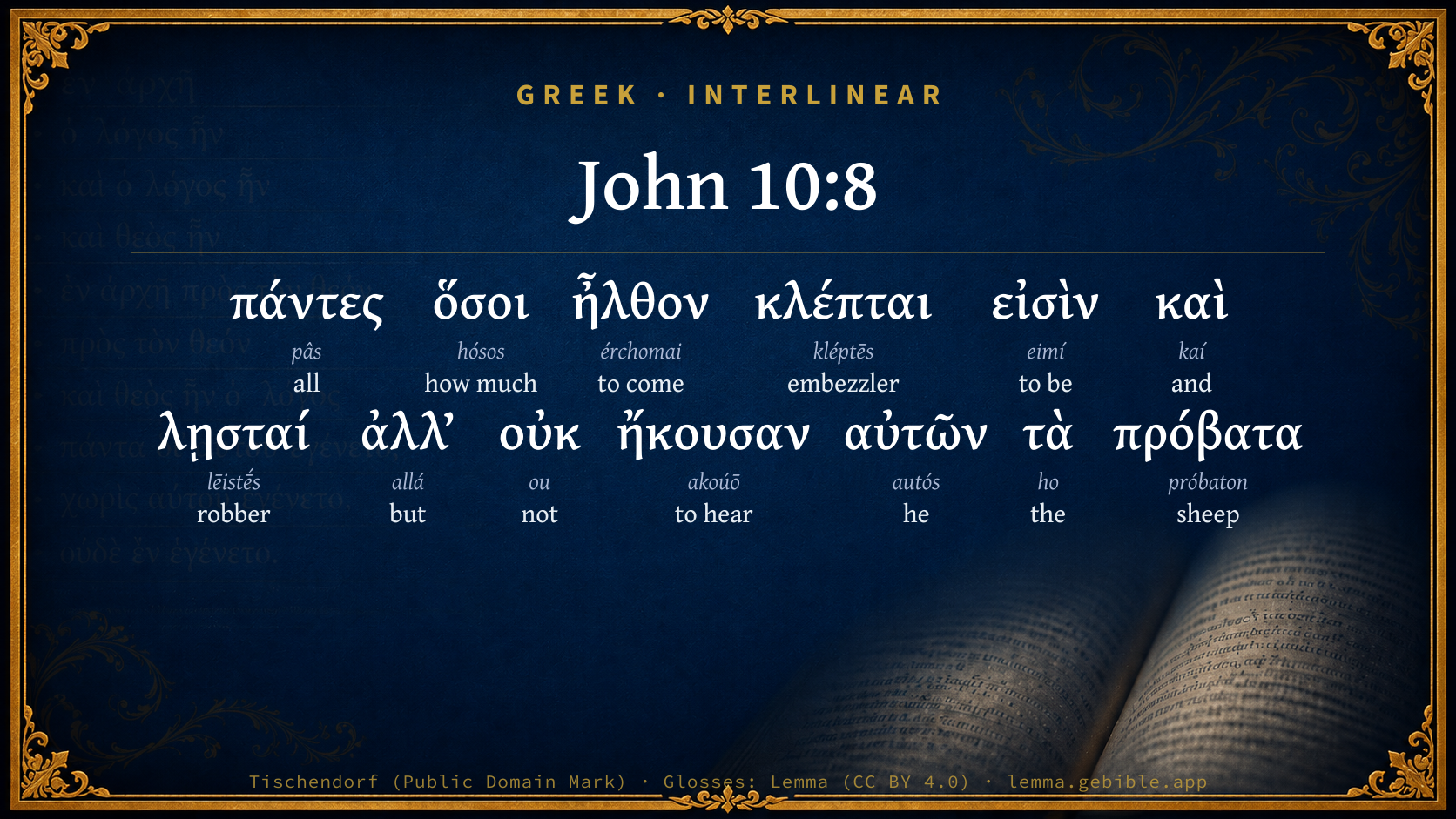
Greek (Tischendorf 8th ed.) John 10:8 appears in the Greek New Testament. The text above is from the Tischendorf 8th edition. Each word links to its Strong’s number and a concise gloss. Click any word for its full Thayer’s Greek Lexicon entry.
Download image
Cite this verse

John 10:8 (World English Bible). Public Domain. Lemma interlinear Bible study tool, https://lemma.gebible.app/v/john/10/8.

Show BibTeX & RIS
BibTeX
RIS
English Translation
All who came before me are thieves and robbers, but the sheep didn't listen to them.
World English Bible · Public Domain
Download a study sheet

One document with this verse’s original text, its word-by-word gloss line, the meaning frame, cross-references with their text, attributed commentary, and full source and license credits — printable, and it pastes into notes with its structure intact.

This verse Autodidact and up

Study sheet (.html) Plain text (.txt)

A passage Seminary Student

Up to 50 verses in one chapter. A passage sheet keeps up to 6 commentary sources and 12 cross-references per verse, in the order this page ranks them, and says so on the sheet whenever that leaves anything out. Ask for a single verse and you get the Autodidact verse sheet above.

Everything on this page stays free to read, with no account — the sheet is a download of what is already on screen, not access to it.

Want to remove ads? Support Godless Engineer
Compare translations 3

The same verse in 3 English versions, stacked beneath the original-language interlinear above. Click any original word for its lexicon entry.

Each is an independent rendering of the whole verse — the interlinear is not word-aligned to these translations.

Highlighted words mark where these versions differ — a whole-verse word diff, not a word-by-word alignment.

  • World English Bible Public Domain
    All who came before me are thieves and robbers, but the sheep didn't listen to them.
  • King James Version Public Domain
    All that ever came before me are thieves and robbers: but the sheep did not hear them.
  • unfoldingWord Literal Text CC BY-SA 4.0
    Everyone who came before me is a thief and a robber, but the sheep did not hear them.

unfoldingWord Literal Text — © unfoldingWord, licensed CC BY-SA 4.0. Word-aligned USFM3 via Door43 (git.door43.org/unfoldingWord/en_ult).

Versions to compare (up to 4)

3 of 4 selected

Show all 19 translations

Every available English version of this verse, each an independent rendering of the whole verse.

  • World English Bible Public Domain
    All who came before me are thieves and robbers, but the sheep didn't listen to them.
  • Berean Standard Bible Public Domain
    All who came before Me were thieves and robbers, but the sheep did not listen to them.
  • Majority Standard Bible Public Domain
    All who came were thieves and robbers, but the sheep did not listen to them.
  • King James Version Public Domain
    All that ever came before me are thieves and robbers: but the sheep did not hear them.
  • American Standard Version (1901) Public Domain
    All that came before me are thieves and robbers: but the sheep did not hear them.
  • Revised Version (1885) Public Domain
    All that came before me are thieves and robbers: but the sheep did not hear them.
  • Geneva Bible (1599) Public Domain
    All, that euer came before me, are theeues and robbers: but the sheepe did not heare them.
  • Douay-Rheims (1899) Public Domain
    All others, as many as have come, are thieves and robbers: and the sheep heard them not.
  • Young's Literal Translation Public Domain
    all, as many as came before me, are thieves and robbers, but the sheep did not hear them;
  • Literal Standard Version CC BY-SA 4.0
    all, as many as came before Me, are thieves and robbers, but the sheep did not hear them;
  • Unlocked Literal Bible CC BY-SA 4.0
    Everyone who came before me is a thief and a robber, but the sheep did not listen to them.
  • unfoldingWord Literal Text CC BY-SA 4.0
    Everyone who came before me is a thief and a robber, but the sheep did not hear them.
  • Darby Bible Public Domain
    All whoever came before me are thieves and robbers; but the sheep did not hear them.
  • World Messianic Bible Public Domain
    All who came before me are thieves and robbers, but the sheep didn’t listen to them.
  • Webster's Bible Public Domain
    All that ever came before me are thieves and robbers: but the sheep did not hear them.
  • Free Bible Version CC BY-SA 4.0
    All those who came before me were thieves and robbers, but the sheep didn't listen to them.
  • Bible in Basic English Public Domain
    All who came before me are thieves and outlaws: but the sheep did not give ear to them.
  • Text-Critical English NT CC BY 4.0
    All who came previously are thieves and robbers, but the sheep did not listen to them.
  • Tyndale New Testament (1534) Public Domain
    All even as many as came before me are theves and robbers: but the shepe dyd not heare them.

Literal Standard Version (2020), Covenant Press — licensed CC BY-SA 4.0. Text via the HelloAO Bible API (eBible.org). Unlocked Literal Bible (unfoldingWord) — licensed CC BY-SA 4.0. Text via the HelloAO Bible API (eBible.org). unfoldingWord Literal Text — © unfoldingWord, licensed CC BY-SA 4.0. Word-aligned USFM3 via Door43 (git.door43.org/unfoldingWord/en_ult). Free Bible Version, Dr. Jonathan Gallagher — licensed CC BY-SA 4.0. Text via the HelloAO Bible API (eBible.org).

Word by word

More ways to search: Search by grammar → Find every occurrence → Compare this word →

Practice this passage: Drill this verse → Learn its vocabulary →

About this verse

These counts appear in no published source. They are computed here, from the morphology-tagged text and Lemma’s own curated glosses. What Lemma adds →

13
words
13
distinct lemmas
Gospels
section

Notable vocabulary

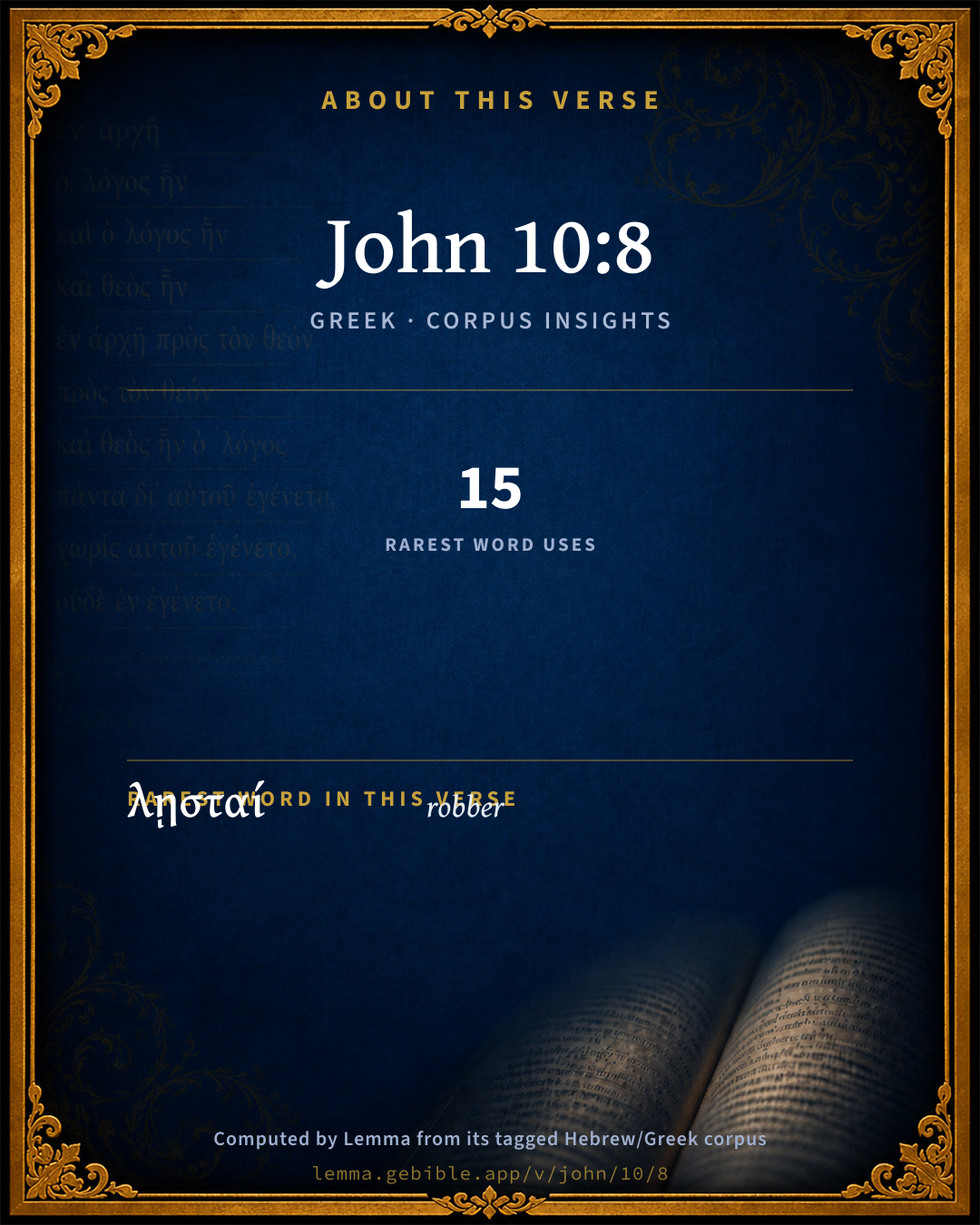
The rarest word here is λῃσταί robber G3027 — appearing just 15 times in the whole Greek New Testament.

Shared distinctive vocabulary

λῃσταί robber G3027 occurs in 15 verses of the Greek New Testament. Also found in:

Cross-references

11

Topical passages linked to John 10:8 in the Treasury of Scripture Knowledge — connected by theme and wording, ordered by reader-vote popularity; previews shown in the World English Bible.

  • Ezekiel 34:2 Son of man, prophesy against the shepherds of Israel, prophesy, and tell them, even to the shepherds, Thus says the Lord Yahweh: Woe to the shepherds of Israel who feed themselves! Shouldn't the shepherds feed the sheep?
  • Jeremiah 23:1 Woe to the shepherds who destroy and scatter the sheep of my pasture! says Yahweh.
  • John 10:1 "Most assuredly, I tell you, one who doesn't enter by the door into the sheep fold, but climbs up some other way, the same is a thief and a robber.
  • Isaiah 56:10–12 His watchmen are blind, they are all without knowledge; they are all mute dogs, they can't bark; dreaming, lying down, loving to slumber.
  • Ezekiel 22:25–28 There is a conspiracy of her prophets in the midst of it, like a roaring lion ravening the prey: they have devoured souls; they take treasure and precious things; they have made her widows many in the midst of it.
  • John 10:27 My sheep hear my voice, and I know them, and they follow me.
  • Acts 5:36 For before these days Theudas rose up, making himself out to be somebody; to whom a number of men, about four hundred, joined themselves: who was slain; and all, as many as obeyed him, were dispersed, and came to nothing.
  • Zechariah 11:4–9 Thus says Yahweh my God: "Feed the flock of slaughter.
  • Zechariah 11:16 For, behold, I will raise up a shepherd in the land, who will not visit those who are cut off, neither will seek those who are scattered, nor heal that which is broken, nor feed that which is sound; but he will eat the flesh of the fat sheep, and will tear their hoofs in pieces.
  • John 10:5 They will by no means follow a stranger, but will flee from him; for they don't know the voice of strangers."
  • Zephaniah 3:3 Her princes in the midst of her are roaring lions. Her judges are evening wolves. They leave nothing until the next day.

Cross-references courtesy of OpenBible.info (CC BY 4.0).

Commentary

Notes on John 10:8 from classic Christian and Jewish commentators (each source and its license shown beneath its notes). The classic Christian expositions comment on the surrounding passage and are grouped to its opening verse, so a note may address several verses; the Jewish commentaries on the Tanakh (Rashi and others) are per-verse, so they appear only where the commentator wrote on this verse.

Lemma curates 59 commentaries, every one of them public domain or Creative Commons licensed, each selected and text-cleaned for this edition rather than reprinted as found. About our sources →

Whedon's Commentary on the Bible

Daniel D. Whedon

8. All that ever came before me—Few texts have more perplexed commentators than this. It seems, at first sight, to say that all the previous religious teachers of mankind were impostors. The ancient Gnostics (a professedly Christian sect who rejected the Old Testament) quoted it to disprove the divine mission of Moses. There are three interpretations worthy of notice. The first supposes that the words condemn all who ever came as Messiahs before Christ. But, unfortunately, history shows that the false Messiahs did not precede but succeeded Jesus. There were, indeed, insurgent leaders in the times of Salinus and Varus, who assumed the title of king; but it is not said that they claimed to be the Messiah of ancient prophecy. Nor is it as political leaders that our Lord asserts that others are thieves and robbers, but as false guides and teachers of the people. The second would make the words mean, All who ever came with my pretensions so as to supersede or interfere with my claims or authority. Neither Moses, nor any other teacher, so far as he taught truth, would then be condemned; for all such, so far as they were true teachers, would be viewed as being like John the Baptist, the prophets, the true priests of Israel, and Moses himself, preparers and servants of the Messiah. We were inclined to adopt this as the true view; but, on the whole, prefer the third, proposed by Stier, as follows: The words before me are opposed to the words by me in Joh_10:9; and the me in both cases is equivalent to the door. To come before the door is to come into the fold before getting as far as to the door. The impetuous robber finds a leaping place previous to, or before, the door. The man who enters before the door, namely, Christ, rather than by the door, is a thief and a robber. A clear and proper contrast is then stated in Joh_10:8-9 between the interlopers and the true shepherds. And then Joh_10:8 stands as the parallel and explanation of Joh_10:1.

Ever—This is not properly a word of time. The phrase All that ever came, would be more accurately rendered All whoso come. The tense of came is aorist or indefinite, covering time present and future as well as past. Sheep did not hear them—Just as the simple blind-born did not hear the Pharisees, (Joh_9:33.) The honest firm inquirer for the truth attains to saving truth.

Daniel D. Whedon (gen. ed.), Commentary on the Old and New Testaments (1874–1909) — public domain. Text from a community e-Sword module.

Bengel's Gnomon

Johann Albrecht Bengel

Joh 10:8. Ὅσοι ἦλθον, as many as have come) The subsequent verb, εἰσί, are, in the present, indicates that ἦλθον, have come, is to be taken of time just past;[265] and of the peculiar course of others, to which is opposed the by Me [if any man enter in, he shall be saved], Joh 10:9. The expression, who have come, is used as at 2Co 11:4, whosoever cometh [lit. he who cometh, “If he that cometh preacheth another Jesus”]. Nor does He exclude those thieves and robbers, who also unquestionably had come after Jesus, not merely those who had come before Jesus: as many, namely, as between the beginning of His preaching and the time of this parabolic discourse, which was spoken a little before His passion, had arrogated to themselves the office of teaching among the Jews, after the example of their predecessors.—κλέπται, thieves) stealthily, appropriating others’ goods, to their own gain.—λῃσταί, robbers) openly, taking away life, to the ruin of the sheep.—ἀλλʼ οὐκ) but, although these robbers and thieves offered themselves, the sheep did not hear them: ch. Joh 7:46, [The officers and Nicodemus not suffering themselves to be led blindly by the Pharisees] “Never man spake like this Man;” Mat 7:29, “He taught them as one having authority, and not as the Scribes;” Joh 9:36, “He was moved with compassion on the multitude—because they fainted, and were scattered abroad, as sheep having no shepherd.”

[265] It is in conformity with this, that as well the margin of both Editions, declares the note of time, πρὸ ἐμοῦ, to be reading not well established, as also the Germ. Vers. altogether omits it.—E. B.

Bengel's Gnomon of the New Testament — English translation (T&T Clark, Edinburgh, 1860) — public domain. Text from a community e-Sword module.

Meyer's Critical & Exegetical Commentary

Heinrich August Wilhelm Meyer

Joh_10:8. See Ewald, Jahrb. ix. p. 40 ff. The actual antithesis to the ἐγώ εἰμι ἡ θύρα is formed by the many who had come forward to be the teachers and leaders of the people of God, without connecting their working with Christ. He describes them from the point of view of the time at which they came forward before me; they came forward before Christ had appeared as the door to the sheep; they had developed their power and activity since the time of the second temple, in a way that gradually grew more and more pernicious, and they formed now the party of hierarchical, specially Pharisaical, antagonists of Christ. The members of this hierarchical caste are intended; the expression used by Christ, however, is popular, and not to be pressed as hard and unhistorical (Hase); the use of the present εἰσί, moreover, gives it a living relation to the leaders of the people, as they then actually were before his eyes. On the other hand, passages like Joh_7:19, Joh_5:39; Joh_5:45, Joh_4:22, exclude even the possibility of a reference to Moses and the prophets; hence the inadmissibility of Hilgenfelds idea that the saying is very harshly anti-Judaistic, as also that it refers to the entire Old Testament past, i.e. to all the pre-Christian leaders of the people of God,an application which he tries to justify by bringing in the Gnostic dualism. It is also inadmissible to set aside in any way the temporal meaning of πρό, whether it be made to mean, with Calovius: in advance of me (antequam mitterentur); or, with Brückner (after Stier): before they have sought and found me as the door; or, with Wolf, to convert it into χωρίς,a view which comes substantially to that of Olshausen (without connection with the Logos); or, with Tittmann and Schleusner, to take it for ὑπέρ, loco, and with Lange to import into this view, instead of me, the further notion of absolute pre-eminence, as though the one who advances forward designed completely to set aside the one who was put in the background. πρό, in the sense of instead, is foreign to the New Testament, and rare also in Greek writers. But when ἦλθον, with a view to the removal of everything objectionable, is taken pregnantly, making it express an arbitrary or unauthorized[62] coming forward (Hieronymus, Augustine, Isidore, Heracleon, Euth. Zigabenus, Luther, Melancthon, Jansen, and several others; also Luthardt, Ebrard), a meaning is imported into the word, which in itself, indeed, may be regarded as a matter of course, but which, at the same time, must have been distinctly expressed (say, as in Joh_10:42), if it were to be emphatical.[63] This also against B. Crusius, who lays the stress on the intention expressed in ἦλθον (in order to give the people a new time). The explanation, finally, of false Messiahs (Chrysostom, Cyril, Theodore of Mopsuestia, Euth. Zigabenus, Theophylact, Grotius, Maldonatus, Hammond, Tittmann, Schleusner, Klee, Weizsäcker, and several others), is unhistorical, as they first began to come forward after Christs day; a circumstance on which B. Bauer, however, grounds a charge of anachronism against John. De Wette considers the discourse to be out of harmony with the wisdom and gentleness of Jesus. But the worthless men, to whose entire class He alludes, stood actually in His presence, and had surely done enough to call forth His severity and wrath.

κλέπται εἰσὶ κ. λῃσταί] namely, of the sheep, Joh_10:1. Comp. the wolves in sheeps clothing. Instead of ΠΆΝΤΕς ὍΣΟΙ, ἍΠΑΝΤΕς ὍΣΟΙ would have been still stronger, Strabo, p. 18, 1. 11, Isocr. Loch. 12.

ἀλλά]. The want of success which attends this predatory (soul-destroying) procedure.

ΟὐΚ ἬΚΟΥΣΑΝ] did not listen to them. For their adherents did not belong to the true people of God (τὰ πρόβατα).

[62] Nonnus takes it in the sense of creeping in secretly: πάντες ὅσοι πάρος ἦλθον ὑποκλέπτοντι πεδίλῳ.

[63] In ἦλθον by itself, so far as it precedes πρὸ ἐμοῦ, it is impossible to find, as Luthardt does, the thought on his own responsibility, or so that he places Christ after himself. ἦλθον denotes neither more nor less than the simple venerunt; as in ver. 10. ἐγὼ ἦλθον is equal to the simple ego veni; the emphasis rests primarily on πάντες ὅσοι, omnes quotquot, and then on πρὸ ἐμοῦ, which is placed at the end.

Meyer — Critical and Exegetical Commentary on the New Testament — English translation by Peter Christie, edited by Frederick Crombie (T&T Clark, 1880) — public domain. Text from a community e-Sword module.

Expositor's Greek Testament

ed. W. Robertson Nicoll

Joh 10:8 . In contrast to Jesus, πάντες … λῃσταί , “all who came before me,” i.e. , all who came before me, claiming to be what I am and to give to the sheep what I give. The prophets pointed forward to Him and did not arrogate themselves His functions. Only those could be called “thieves and robbers” who had come before the Shepherd came, as if in the night and without His authority. It must have been evident that the hierarchical party was meant.” [The inexactness of contrasting the “door” rather than the Shepherd with the “thieves and robbers” who came before Jesus, only emphasises the fact that the reality was more prominent than the figure in the mind of the speaker.] Those, however, who had tried to assume the functions of the Shepherd had failed; because οὐκ ἤκουσαν αὐτῶν τὰ πρόβατα , the people of God had not listened to them. They no doubt assumed authority over the people of God and compelled obedience, but the true children of God did not find in their voice that which attracted and led them to pasture.

The Expositor's Greek Testament, edited by W. Robertson Nicoll (1897–1910) — public domain. Text from a community e-Sword module.

Geneva Bible (1599)

Geneva Bible translators

It maketh no matter, how many, neither how old the false teachers there have been.

These large terms must be applied to the matter he speaketh of. And therefore when he calleth himself the door, he calleth all them thieves and robbers which take upon them this name of Door, which none of the Prophets can, for they showed the sheep, that Christ was the door.

Geneva Bible (1599) marginal notes — public domain. Text via Bolls.life.

Jamieson, Fausset & Brown

Robert Jamieson, A. R. Fausset & David Brown

All that ever came before me--the false prophets; not as claiming the prerogatives of Messiah, but as perverters of the people from the way of life, all pointing to Him [OLSHAUSEN].

the sheep did not hear them--the instinct of their divinely taught hearts preserving them from seducers, and attaching them to the heaven-sent prophets, of whom it is said that "the Spirit of Christ was in them" (Pe1 1:11).

Jamieson, Fausset & Brown — Commentary Critical and Explanatory on the Whole Bible (1871) — public domain (CC PDM 1.0). Text via the HelloAO Bible API.

Adam Clarke's Commentary

Verse 8. All that ever came before me] Or, as some translate, all that came instead of me, προ εμου, i.e. all that came as the Christ, or Messiah, such as Theudas, and Judas the Gaulonite, who are mentioned, Ac 5:36-37; and who were indeed no other than thieves, plundering the country wherever they came; and murderers, not only slaying the simple people who resisted them, but leading the multitudes of their followers to the slaughter.

But our Lord probably refers to the scribes and Pharisees, who pretended to show the way of salvation to the people-who in fact stole into the fold, and clothed themselves with the fleece, and devoured the sheep.

The words, προεμου, before me, are wanting in EGMS, Mt. BKV, seventy others; Syriac, Persic, Syriac Hieros., Gothic, Saxon, Vulgate, eleven copies of the Itala; Basil, Cyril, Chrysostom, Theophylact, Euthymius, Augustin, and some others. Griesbach has left them in the text with a note of doubtfulness. The reason thy these words are wanting in so many respectable MSS., versions, and fathers, is probably that given by Theophylact, who says that the Manicheans inferred from these words that all the Jewish prophets were impostors. But our Lord has borne sufficient testimony to their inspiration in a variety of places.

κλεπτης, and ληστης, the thief and the robber, should be properly distinguished; one takes by cunning and stealth; the other openly and by violence. It would not be difficult to find bad ministers who answer to both these characters. Tithes have been often enforced and collected in a most exceptionable manner, and in a most disgraceful spirit.

The reflection of pious Quesnel on this verse is well worth attention. A pastor ought to remember that whoever boasts of being the way of salvation, and the gate of heaven, shows himself to be a thief and an impostor; and though few are arrived at this degree of folly, yet there are many who rely too much upon their own talents, eloquence, and labours, as if the salvation of the sheep depended necessarily thereon: in which respect they are always robbers, since they rob the grace of Christ of the glory of saving the sheep. God often puts such pastors to shame, by not opening the hearts of the people to receive their word: while he blesses those who are humble, in causing them to be heard with attention, and accompanying their preaching with an unction which converts and saves souls. Let every man know that in this respect his sufficiency and success are of the Lord.

Adam Clarke's Commentary on the Bible (1810–1826) — public domain. Text from a community e-Sword/MySword module.

John Calvin's Commentaries

8. All who came before me. The words πάντες ὅσοι may be literally rendered, all as many as came before me They who restrict this expression to Judas the Galilean, and such persons, depart widely, in my opinion, from Christ’s meaning; for he contrasts all false doctrine, in general, with the Gospel, and all false prophets with faithful teachers. Nor would it even be unreasonable to extend this statement to the Gentiles, that all who, from the beginning of the world, have professed to be teachers, and have not labored to gather sheep to Christ, have abused this title for destroying souls. But this does not at all apply to Moses and the Prophets, who had no other object in view than to establish the kingdom of Christ. For it ought to be observed, that a contrast is here made between the words of Christ and those things which are opposed to them. But so far are we from discovering any contradiction between the Law and the doctrine of the Gospel, that the Law is nothing else than a preparation for the Gospel. In short, Christ testifies that all the doctrines, by which the world has been led away from him, are so many deadly plagues; because, apart from him, there is nothing but destruction and horrible confusion. Meanwhile, we see of what importance antiquity is with God, and in what estimation it ought to be held by us, when it enters, as it were, into a contest with Christ. That no man may be moved by the consideration, that there have been teachers, in all ages, who gave themselves no concern whatever about directing men to Christ, Christ expressly states that it is of no consequence how many there have been of this description, or how early they began to appear; for it ought to be considered that there is but one door, and that they who leave it, and make openings or breaches in the walls, are thieves

But the sheep did not hear them. He now confirms more clearly what he had already spoken more obscurely and in the figure of an allegory, that they who were led out of the way by impostors did not belong to the Church of God. This is said, first, that when we see a great multitude of persons going astray, we may not resolve to perish through their example; and, next, that we may not waver, when God permits impostors to deceive many. For it is no light consolation, and no small ground of confidence, when we know that Christ, by his faithful protection, has always guarded his sheep, amidst the various attacks and crafty devices of wolves and robbers, so that there never was one of them that deserted him.

But here a question arises, When does a person begin to belong to the flock of the Son of God? For we see many who stray and wander through deserts during the greater part of their life, and are at length brought into the fold of Christ. I reply, the word sheep is here used in two ways. When Christ says afterwards, that he has other sheep besides, he includes all the elect of God, who had at that time no resemblance to sheep At present, he means sheep which bore the shepherd’s mark. By nature, we are at the greatest possible distance from being sheep; but, on the contrary, are born lions, tigers, wolves, and bears, until the Spirit of Christ tames us, and from wild and savage beasts forms us to be mild sheep Thus, according to the secret election of God, we are already sheep in his heart, before we are born; but we begin to be sheep in ourselves by the calling, by which he gathers us into his fold. Christ declares that they who are called into the order of believers are so firmly bound together, that they cannot stray or wander, or be carried about by any wind of new doctrine.

It will perhaps be objected, that even those who had been devoted to Christ frequently go astray, and that this is proved by frequent experience, and that it is not without good reason that Ezekiel ascribes it to the good Shepherd, that he gathers the scattered sheep, (Ezekiel 34:12.) I readily acknowledge that it frequently happens, that they who had belonged to the household of faith are, for a time, estranged; but this is not at variance with Christ’s statement, for, so far as they go astray, they cease, in some respects, to be sheep What Christ means is simply this, that all the elect of God, though they were tempted to go astray in innumerable ways, were kept in obedience to the pure faith, so that they were not exposed as a prey to Satan, or to his ministers. But this work of God is not less astonishing, when he again gathers the sheep which had wandered for a little, than if they had all along continued to be shut up in the fold. It is always true, and without a single exception, that

they who go out from us were not of us, but that they who were of us remain with us to the end, (1 John 2:19.)

This passage ought to strike us with the deepest shame; first, because we are so ill accustomed to the voice of our Shepherd, that there are hardly any who do not listen to it with indifference; and, next, because we are so slow and indolent to follow him. I speak of the good, or of those who are at least passable; for the greater part of those who boast that they are Christ’s disciples kick fiercely against him. Lastly, as soon as the voice of any stranger has sounded in our ears, we are hurried to and fro; and this lightness and unsteadiness sufficiently shows how little progress we have hitherto made in the faith. But if the number of believers is smaller than might be desired, and if out of this small number a large proportion be continually dropping off, faithful teachers have this consolation to support them, that the elect of God, who are Christ’s sheep, listen to them. It is our duty, indeed, to labor diligently, and to strive by every possible method, that the whole world may be brought, if possible, into the unity of the faith; but let us, in the meantime, be well satisfied with belonging to the number.

John Calvin's Commentaries (1540-1563) — public domain. Text from the Calvin Translation Society English edition (1840s-50s) via the Christian Classics Ethereal Library (ccel.org). Calvin's coverage is partial (roughly two-thirds of the Bible); uncommented books and verses are honest gaps, never fabricated. The 19th-century editor's footnotes and remarks are omitted so the notes are faithfully Calvin's own voice.

Ellicott's Commentary for English Readers

(8) All that ever came before me are thieves and robbers.—Comp. Note on Joh_10:1. The Sinaitic MS. and several of the early versions read this verse without the words translated “before Me,” but the balance of authority is strongly in their favour; and the fact of their being hard to understand, or having been misunderstood, is the probable reason of their omission. Retaining them, as we seem bound to do, we are also bound to give them their ordinary temporal meaning. There can be but one rendering which suggests itself to the unbiassed mind, and that is the rendering of our version. The Greek words and the English words are equally plain, and other renderings are due to the exigencies of interpretation.

What, then, do the words mean? Their force seems to be all-inclusive; and yet they cannot contradict Christ’s own words, which have excluded Abraham, Moses, the prophets, John the Baptist, from any possibility of such thoughts. (See Joh_4:22; Joh_5:33; Joh_5:39; Joh_5:45; Joh_7:19.) They cannot, on the other hand, be limited to false Christs, who did not come before but after our Lord. (Comp. Note on Joh_5:43.) Here, as often, the true meaning seems for the most part to have been overlooked because men have sought it elsewhere than in the words themselves, and in their place among other words. The thought which precedes and which follows is that Jesus is Himself “the door.” “All that ever came before Me” is in immediate contrast to this thought, and the sense is, “all professing to be themselves the door, to be the means by which men enter the fold, to be the Mediator between man and God.” The Old Testament teachers cannot be meant, because they witnessed to the true door. But there had been growing up since the return from the Captivity, and the close of the Old Testament canon, a priestly caste in the place of the prophetic schools, and these men had been in practice, if not in word, claiming for themselves the position of door to the kingdom of God. There were Hillels and Shammais, heads of parties and of factions, whose word was to their followers as the word of God; there were Pharisees then standing round Him who had solemnly decreed that any one who should confess Him to be the Messiah should be shut out from Temple and from synagogue, and that they themselves would in God’s name pronounce a curse upon his head (Joh_9:22). As “thieves” were they, and as “robbers;” wolves in sheep’s clothing, stealing into the flock of Christ and rending those who were the true sheep. (Comp. the analogous language of Luk_11:52.) The lawyers closed the door and plundered and oppressed those whom they kept outside.

Attention should be paid to the present tense of the verb “are” in this sentence, which seems in itself to suggest that the words which follow find their application in the case of the persons then actually living.

But the sheep did not hear them.—Read again Joh_10:3-5. What is true of the sheep and the voice of the stranger is true also of man and of every voice which is not of God. The heart of the child answers to the voice of the Father; it trembles at any voice which is unknown. The conscience of mankind knows the voice of God; but it will not hear the voice of the devil, nor the unreal voice of man claiming to speak in God’s name. It will not call bitter, sweet; nor sweet, bitter; darkness, light; nor light, darkness. It will not accept the false, the impure, the wrong, for it is the God in man which ever is, and ever must be true and holy and right. So it was that the teaching of scribes and Pharisees never really influenced the masses of the people, for it was concerned with the externals of matter and form, and they wanted the living truth. So it has been that systems of error have had their day, but have had no principle of life, because they were not the voice of God speaking to the heart of man; and in so far as they have lived at all, it has been because the error has been but in the form, or has been in part only of the substance, which has also contained some germ of truth. So it has been in every age, and in every school of thought, that the men whom the sheep have heard have been men who have had in them the ring of the true, and have been as prophets uttering the voice of God. Witness Paul of Tarsus, and Francis of Assisi; Luther, and Savonarola; John Knox, and John Wesley; Charles Simeon, and John Keble.

A Bible Commentary for English Readers, edited by Charles John Ellicott (1878–1897) — public domain. Text from a community e-Sword module.

The Cambridge Bible for Schools and Colleges

gen. ed. J. J. S. Perowne

8. All that ever came before me are thieves and robbers] These words are difficult, and some copyists seem to have tried to avoid the difficulty by omitting either ‘all’ or ‘before Me.’ But the balance of authority leaves no doubt that both are genuine. Some commentators would translate ‘instead of Me’ for ‘before Me.’ But this meaning of the Greek preposition is not common, and perhaps occurs nowhere in N.T. Moreover ‘instead of Me’ ought to include the idea of ‘for My advantage;’ and that is impossible here. We must retain the natural and ordinary meaning of ‘before Me:’ and as ‘before Me in dignity’ would be obviously inappropriate, ‘before Me in time’ must be the meaning. But who are ‘all that came before Me?’ The patriarchs, prophets, Moses, the Baptist cannot be meant, either collectively or singly. ‘Salvation is of the Jews’ (Joh_4:22); ‘they are they which testify of Me’ (Joh_5:39); ‘if ye believed Moses, ye would believe Me’ (Joh_5:46); ‘John bare witness unto the truth’ (Joh_5:33): texts like this are quite conclusive against any such Gnostic interpretation. Nor can false Messiahs be meant: it is doubtful whether any had arisen at this time. Rather it refers to the ‘ravening wolves in sheep’s clothing’ who had been, and still were, the ruin of the nation, who ‘devoured widow’s houses,’ who were ‘full of ravening and wickedness,’ who had ‘taken away the key of knowledge,’ and were in very truth ‘thieves and robbers’ (Mat_7:15; Mat_23:14; Luk_11:39; Luk_11:52). Some of them were now present, thirsting to add bloodshed to robbery, and this denunciation of them is no stronger than several passages in the Synoptists: e.g. Mat_23:33; Luk_11:50-51. The tense also is in favour of this interpretation; not were, but ‘are thieves and robbers.’

but the sheep did not hear them] For they spoke with no authority (Mat_7:29); there was no living voice in their teaching. They had their hearers, but these were not ‘the sheep,’ but blind adherents, led by the blind.

The Cambridge Bible for Schools and Colleges (gen. ed. J. J. S. Perowne; Cambridge University Press, 1878–1918) — public domain. Text from a community e-Sword module.

John Gill's Exposition

All that ever came before me are thieves and robbers,.... This must be understood with some restrictions, not of every individual person, nor of every individual prophet or shepherd; not of Moses, nor of the prophets of the Lord, nor of John the Baptist, who came immediately before Christ, was his harbinger, and prepared his way; but of those prophets who came, and were not sent of God, and so did not come in by the door; of the shepherds of Israel, who fed themselves, and not the flock, but lorded it over God's heritage; and of such, as Theudas, and Judas the Galilean, who boasted that they were some great persons, but were only thieves and robbers; and particularly of the three shepherds cut off in one month, Zac 11:8, supposed to be the three sects among the Jews, and the leaders of them, the Pharisees, Sadducees, and Essenes, especially the former; who were wolves in sheep's clothing, usurped a power that did not belong to them, robbed God of his authority, and glory; and, in a literal sense, plundered men of their substance, and devoured widows' houses, as well as destroyed their souls. The phrase, "before me", is wanting in seven of Beza's exemplars, and in several others; and in the Vulgate Latin, Syriac, and Persic versions:

but the sheep did not hear them; the elect of God, some of which there were in all ages, though their number is comparatively few, did not attend to the false prophets, and false teachers, and idol shepherds; did not receive their doctrines, nor follow their practices; for it is not possible that these should be finally and totally deceived, or carried away with the error of the wicked.

John Gill's Exposition of the Whole Bible (1746–1763) — public domain (CC PDM 1.0). Text via the HelloAO Bible API.

Trapp's Complete Commentary

John Trapp

8 All that ever came before me are thieves and robbers: but the sheep did not hear them.

Ver. 8. All that ever came before me, &c.] Manes (that mad heretic) made an argument from this text against Moses and the prophets, as going before Christ. But Austin answereth, Moses and the prophets came not before Christ, but with Christ. Intruders, whether before or since our Saviour’s days, are these thieves and robbers. Ah, whoreson {a} thieves, rob God of his glory! said Dr Taylor, martyr, in a dream, of the scribes and Pharisees of his time.

{a} The son of a whore, a bastard son; but commonly used as a coarse term of reprobation, abuse, dislike, or contempt; sometimes even of jocular familiarity. ŒD

John Trapp, A Commentary or Exposition upon All the Books of the Old and New Testament (1647–1656) — public domain. Text from a community e-Sword module.

Albert Barnes' Notes on the Bible

All that ever came before me - This does not refer to the prophets, but to those who came pretending to be the pastors or guides of the people. Some have supposed that he referred to those who pretended to be the Messiah before him; but there is not evidence that any such person appeared before the coming of Jesus. It is probable that he rather refers to the scribes and Pharisees, who claimed to be instructors of the people, who claimed the right to regulate the affairs of religion, and whose only aim was to aggrandize themselves and to oppress the people. See the notes at Joh 1:18. When the Saviour says that “all” were thieves, he speaks in a popular sense, using the word “all” as it is often used in the New Testament, to denote the great mass or the majority.

Thieves and robbers - See Joh 10:1; also Jer 23:1; “Woe be unto the pastors that destroy and scatter the sheep of my pasture;” Eze 34:2-3; “Woe be to the shepherds of Israel that do feed themselves! Ye eat the fat, and ye clothe you with the wool, ye kill them that are fed; but ye feed not the flock.” This had been the general character of the Pharisees and scribes. They sought wealth, office, ease at the expense of the people, and thus deserved the character of thieves and robbers. They insinuated themselves slyly as a thief, and they oppressed and spared not, like a robber.

The sheep - The people of God - the pious and humble portion of the Jewish nation. Though the great mass of the people were corrupted, yet there were always some who were the humble and devoted people of God. Compare Rom 11:3-4. So it will be always. Though the great mass of teachers may be corrupt, yet the true friends of God will mourn in secret places, and refuse to “listen to the instruction that causeth to err.”

Albert Barnes' Notes on the Bible (1834–1885) — public domain. Text from a community e-Sword/MySword module.

Haydock's Catholic Bible Commentary

All they who come are thieves, meaning those who came of their own accord, without being sent: not so the prophets, who had their mission from God. (Witham)

George Leo Haydock (1774–1849), Haydock's Catholic Family Bible and Commentary, 1859 edition — public domain. Excludes Psalms (Douay-Rheims chapter numbering differs from Protestant) and Deuterocanonical books (Catholic canon only).

Matthew Poole's English Annotations

This must not be understood of the prophets, but of such only as came before Christ, not being sent by him: all those that taught people another way of life and salvation, than by believing in the Messiah, who was to be revealed for the salvation of the world; all such did but seek themselves, not the good of the people’s souls; and destroyed souls instead of profiting or doing them any good. But those that were mine by an eternal election, or by my special grace bestowed upon them, did not embrace them.

Matthew Poole's English Annotations on the Holy Bible (1683–1685) — public domain. Text from a community e-Sword/MySword module.

The Pulpit Commentary

All that came before meare thieves and robbers. Great difficulty has been felt by commentators in understanding "before me." The words clearly gave the early Gnostic heretics a text on which they established their dualistic rejection of the old dispensation. Their absence from certain texts led Augustine and others to emphasize the word "came." "All who came," i.e. in their own strength or wisdom, when not sent" or authorized by God. Other endeavors have been made (see Meyer and Lunge) to give it a non-temporal meaning, such as cwriv , "independently of me." Wolf and Olshausen make pro equivalent to uper , in the place" or "in the stead of me" (so Lunge, Lampe, Schleusner). De Wette and others accept the temporal meaning, "before," i.e. in point of time, and include under it the entire corpus of Old Testament saints and teachers, and therefore regard the saying as inconsistent with the gentleness of Christ. But with Joh_5:39, Joh_5:45-47, and many other passages in this Gospel, it is certain the words could not mean to denounce all who came as teachers or shepherds before him in mere point of time as "thieves and robbers," whom the sheep did not hear. Therefore the pro must be to some extent modified in meaning. We agree with Westcott and Godet in limiting pro emou , by throwing the emphasis on the "came," and by adding, moreover, to it the essential point, "came making themselves doors of the sheep claiming to have the "key of knowledge," professing vainly to open or shut the door of heaven. That is, no other has ever had the right or claim to be such "a door." The Baptist, the prophets, one by one, Abraham and Moses, in their day made no such profession. The dignity belongs to Christ alone. The language may receive accentuation from the pressing urgency of false Christs, as well as the hopeless system of Pharisaic pride. Theme sees here the mere dressing out of St. Paul"s language, condemnatory of false prophets and ravening wolves who would not spare the flock of Christ, (Act_20:29) and Christ"s own words in the synoptists. (Mat_7:15 Mat_23:13, etc.) Special reference is made to the ceremonial superstitions, to "the hedge about the Law," to the cruel slavery of modern Pharisaism, which had done what neither prophets nor priests of old had attempted. Archdeacon Watkins emphasizes the present tense, are thieves," etc., making Christ"s reference obvious to the lawyers and scribes of his own day, who were closing the door, and plundering those whom they kept out of the kingdom. But the sheep did not hear them. The true sheep have not been seduced by them. The teaching of these Pharisees has not prevailed over susceptible souls.

The Pulpit Commentary (1880–1919), ed. H.D.M. Spence-Jones & Joseph S. Exell — public domain. Text from a community e-Sword module.

John Wesley's Explanatory Notes

Whosoever are come - Independently of me, assuming any part of my character, pretending, like your elders and rabbis, to a power over the consciences of men, attempting to make laws in the Church, and to teach their own traditions as the way of salvation: all those prophets and expounders of God's word, that enter not by the door of the sheepfold, but run before I have sent them by my Spirit. Our Lord seems in particular to speak of those that had undertaken this office since he began his ministry, are thieves -Stealing temporal profit to themselves, and robbers - Plundering and murdering the sheep.

John Wesley, Explanatory Notes Upon the Whole Bible (1754–1765) — public domain. Text via the GEBible commentary corpus.

The People's New Testament

B. W. Johnson

8. All that ever came before me are thieves and robbers. Abbott holds that the idea is, “All who came, not entering through the door, but claiming to be before me, having the precedence, independent of me, are thieves and robbers.” This seems to harmonize with the context, and is probably the Savior's meaning. He included the Jewish rabbis, the Greek philosophers, the pretended prophets, and the “Infallible Pope.” These all refuse to bow to his authority. But the sheep did not hear them. The true sheep.

B. W. Johnson's The People's New Testament with Notes (1889–1891) — public domain. Electronic text from the Christian Classics Ethereal Library (CCEL) ThML edition.

Cambridge Greek Testament for Schools and Colleges

8. πάντες ὅσοι ἧλθον πρὸ ἐμοῦ. These words are difficult, and some copyists seem to have tried to avoid the difficulty by omitting either πάντες or πρὸ ἐμοῦ. But the balance of authority leaves no doubt that both are genuine. Some commentators would translate πρὸ ἐμοῦ ‘instead of Me.’ But this meaning of πρό is not common, and perhaps occurs nowhere in N.T. Moreover ‘instead of Me’ ought to include the idea of ‘for My advantage;’ and that is impossible here. We must retain the natural and ordinary meaning of ‘before Me:’ and as ‘before Me in dignity’ would be obviously inappropriate, ‘before Me in time’ must be the meaning. But who are ‘all that came before Me’? The patriarchs, prophets, Moses, the Baptist cannot be meant, either collectively or singly. ‘Salvation is of the Jews’ (Joh 4:22); ‘they are they which testify of Me’ (Joh 5:39); ‘if ye believed Moses, ye would believe Me’ (Joh 5:46); ‘John bare witness unto the truth’ (Joh 5:33): texts like this are quite conclusive against any such Gnostic interpretation. Nor can false Messiahs be meant: it is doubtful whether any had arisen at this time. Rather it refers to the ‘ravening wolves in sheep’s clothing’ who had been, and still were, the ruin of the nation, ‘who devoured widows’ houses,’ who were ‘full of ravening and wickedness,’ who had ‘taken away the key of knowledge,’ and were in very truth ‘thieves and robbers’ (Mat 7:15; Mat 23:14; Luk 11:39; Luk 11:52). These ‘came,’ but they were not sent. Some of them were now present, thirsting to add bloodshed to robbery, and this denunciation of them is no stronger than several passages in the Synoptists: e.g. Mat 23:33; Luk 11:50-51. The tense also is in favour of this interpretation; not were, but ‘are thieves, and robbers.’

οὐκ ἤκουσαν. For they found no authority, no living voice in their teaching (Mat 7:29). Comp. ‘To whom shall we go?’ (Joh 6:68). Hearers there were, but these were not the sheep, but blind followers, led by the blind. For the plural verb see Winer, p. 646.

Cambridge Greek Testament for Schools and Colleges (Cambridge University Press, 1896; 21 vols, various authors incl. Carr, Maclear, Plummer, Farrar, Lumby, Moule, M. R. James, Simcox) — public domain. Text from a community e-Sword module.

Alford’s Greek Testament

Henry Alford

8.] I believe that the right sense of these words, ὅσοι ἦλθον πρὸ ἐμοῦ, has not been apprehended by any of the Commentators.

First, they can only be honestly understood of time: all who came before me (not, “without regard to me,” Olsh. &c., nor “passing by me as the door,” Camer., nor “instead of me,” Lampe, &c.: nor “pressing before me,” ch. 5:7, which would have been ἔρχονται, not ἦλθ.: nor “before taking the trouble to find me, the door,” Stier, iv. 492, edn. 2: nor any other of the numerous shifts which have been adopted).

What pretended teachers then came before Christ? Remember the connexion of these discourses. He has taught the Jews that Abraham and the Prophets entered by Him (ch. 8:56): but He has set in strong opposition to Himself and His, them (these Jews) and their father, the Devil (ib. ver. 44). He was “the first thief who clomb into God’s fold;” and all his followers are here spoken of inclusively in the language of the allegory, as coming in by and with him. His was the first attempt to lead human nature, before Christ came; before the series of dispensations of grace began, in which pasture and life is offered to man by Him.

Meyer understands the Pharisees, &c. who taught the people before Christ appeared as the Door of the sheep: but this does not seem to reach the depth of the requirements of the saying.

εἰσίν, not ἦσαν, because their essential nature as belonging to and being of the evil one is set forth, and the inclusion of these present Pharisees in their ranks.

ἀλλʼ οὐκ …] This of course cannot be understood absolutely,—‘the sheep never for one moment listened to them;’ but, did not listen to them in the sense of becoming their disciples eventually. So that the fall of our first Parents would be no exception to this; whom of all men we must conclude, by the continuing grace and mercy of God to them after that fall, to have been of His real sheep. And since then, the same is true; however the sheep may for a while listen to these false shepherds, they do not hear them, so as to follow them. Those who do, belong not to the true flock.

Ver. 9 expands and fixes ver. 7. “Non est salutaris aditus in ecclesiam, nisi per me, sive pastor esse velis, sive ovis.” Erasmus, Paraphr. See Num 27:16, Num 27:17. The sequel of the verse shews that this combined meaning is the true one. Meyer, who understands it all of shepherds alone, finds great difficulty in the interpretation of the latter words: “shall go in and out before the sheep, and find pasture for them.”

Ver. 10 shews the gracious intent of the Saviour in this;—to give life, and in abundance. This verse forms the transition from Him as ἡ θύρα, to Him as ὁ ποιμήν. He is here set in opposition to ὁ κλέπτης (see on ver. 8), and thus insensibly passes into the place of a ποιμήν, who has been hitherto thus opposed. Then the ζωὴν ἔχωσιν binds on to νομὴν εὑρήσει—and καὶ περισ. ἔχ.: q. d. not merely as a door to pass through, but actively, abundantly, to bestow abundance of life. We are thus prepared for (ver. 11) the announcement of Himself as ὁ ποιμὴν ὁ καλός—the great antagonist of ὁ κλέπτης—the pattern and Head of all good shepherds, as he of all thieves and robbers: the Messiah, in His best known and most loving office: cf. Eze 34:11-16, Eze 34:23; Eze 37:24, and Isa 40:11. But He is ὁ π. ὁ κ. in this verse, as having most eminently the qualities of a good shepherd, one of which is to lay down His life for the sheep. These words here are not so much a prophecy, as a declaration, implying however that which ver. 15 asserts explicitly.

Henry Alford, The Greek Testament (1849–1861) — public domain. Text from a community e-Sword module.

International Critical Commentary

8. πάντες ὅσοι ἦλθον πρὸ ἐμοῦ κλέπται εἰσὶν καὶ λῃσταί. So אcABDLW but א* om. πρὸ ἐμοῦ, with most vss., including the Latin, Sahidic, and Syriac; and Westcott-Hort treat the words as a “Western and perhaps Syrian” gloss. On the other hand, they may have been omitted by scribes to lessen the risk of the passage being interpreted as if it applied to the O.T. prophets.2 πρὸ ἐμοῦ must relate to priority in time (cf., e.g., Neh 5:15). But even if the words be omitted, ἦλθον involves a “coming” in the past; and we must translate “all that came before me are thieves and robbers.”

The reference is, undoubtedly, to v. 1. He who enters the fold by any other way than the “door” is “a thief and a robber.” Now Jesus claims to be the Door of the Fold of the Flock of Israel, and hence it follows that all who sought a way of access to the sheep before He was manifested as the “Door” may be described as “thieves and robbers.” This, nakedly stated, is a harsh saying. But, if the sequence of the argument be followed from v. 23 onward (see on v. 26), it is not so intolerant as it sounds (see also on 14:6). The distinction that is being drawn out is not that between the ministrations of older prophets and teachers, and the perfect ministration of Jesus, but rather (as Chrysostom points out) between those who falsely claimed to be heaven-sent deliverers and the true Messiah Himself.

The methods, e.g., of Judas of Galilee, who instigated the people to revolt against Roman taxation about the year a.d. 6, were violent, and led to murder and robbery (so Josephus, Antt. XVIII. i. 6; cf. B.J. II. viii. 1 and Act 5:37). According to Act 5:36, Theudas was an earlier impostor of the same type, although Josephus (Antt. xx. v. 1) seems to put him later, if indeed he is describing the same person. And, apart from Judas and Theudas, we have the testimony of Josephus (Antt. XVII. x. 4, 18) that at the beginning of the first century Judæa was the scene of innumerable risings and disorders, which were caused, in part at any rate, by current misinterpretations of the Messianic idea, associated by the Zealots with militant activities. It is true that we have no knowledge of any Jew before Barcochba (a.d. 135) who claimed explicitly to be the Messiah. But there were many pretenders to the office of leadership of the nation, and to such the words of Jesus, “thieves and robbers,” were fitly applied. And the present tense εἰσίν confirms the view that His allusion was to leaders of revolt who belonged to the first century, some of whom were probably living at the time.

The convincing proof that none of these was the divinely appointed Shepherd of Israel was: οὐκ ἤκουσαν αὐτῶν τὰ πρόβατα, “the sheep,” sc. the true sheep of Israel, who are alone in view throughout this chapter, “did not listen to them” (cf. vv. 4, 5, where it was pointed out that sheep recognise their true shepherd’s voice, while they will not listen to one who is only an impostor). It was just because the Jews who were arguing were not the true sheep of Israel that they did not accept Jesus as their Shepherd (v. 26).

International Critical Commentary — older volumes (1896–1929), various authors — public domain. Text from a community e-Sword module.

Lesson kit

Teaching starters — assembled from the data on this page, not authored interpretation. Every prompt links to the verse data it draws on. Edit before teaching.

John, in the Gospels, opens this verse with 13 words (13 distinct Greek lemmas). Its most distinctive word is lēistḗs (“robber”). A historical commentator’s framing appears above. Read the whole chapter for the surrounding context.

Discussion questions

  1. How does “robber” (lēistḗs) shape what this verse is saying?
  2. Matthew 21:13 shares the word «robber» with this verse. How do the two illuminate each other?
  3. These translations render this verse differently. What is at stake in choosing one wording over another?
  4. Reading how Whedon's Commentary on the Bible and Bengel's Gnomon read this verse, where do the two commentators agree and where do they part?

Things to notice

Reading settings

Reading text

Shown beneath each verse's original-language words.

Old Testament
Old Testament edition

Read the OT as the Masoretic Hebrew (MT) or the Greek Septuagint (LXX).

English shown for the Greek Septuagint (in the Hebrew ↔ Greek comparison).

Comparing translations? Open the Compare panel on any verse page to stack up to four side by side.