John 11:8

Greek (Tischendorf 8th ed.) John 11:8 appears in the Greek New Testament. The text above is from the Tischendorf 8th edition. Each word links to its Strong’s number and a concise gloss. Click any word for its full Thayer’s Greek Lexicon entry.
Download image
Cite this verse

John 11:8 (World English Bible). Public Domain. Lemma interlinear Bible study tool, https://lemma.gebible.app/v/john/11/8.

Show BibTeX & RIS
BibTeX
RIS
English Translation
The disciples told him, "Rabbi, the Jews were just trying to stone you, and are you going there again?"
World English Bible · Public Domain
Download a study sheet

One document with this verse’s original text, its word-by-word gloss line, the meaning frame, cross-references with their text, attributed commentary, and full source and license credits — printable, and it pastes into notes with its structure intact.

This verse Autodidact and up

Study sheet (.html) Plain text (.txt)

A passage Seminary Student

Up to 50 verses in one chapter. A passage sheet keeps up to 6 commentary sources and 12 cross-references per verse, in the order this page ranks them, and says so on the sheet whenever that leaves anything out. Ask for a single verse and you get the Autodidact verse sheet above.

Everything on this page stays free to read, with no account — the sheet is a download of what is already on screen, not access to it.

Want to remove ads? Support Godless Engineer
Compare translations 3

The same verse in 3 English versions, stacked beneath the original-language interlinear above. Click any original word for its lexicon entry.

Each is an independent rendering of the whole verse — the interlinear is not word-aligned to these translations.

Highlighted words mark where these versions differ — a whole-verse word diff, not a word-by-word alignment.

  • World English Bible Public Domain
    The disciples told him, "Rabbi, the Jews were just trying to stone you, and are you going there again?"
  • King James Version Public Domain
    His disciples say unto him, Master, the Jews of late sought to stone thee; and goest thou thither again?
  • unfoldingWord Literal Text CC BY-SA 4.0
    The disciples say to him, “Rabbi, right now the Jews are seeking to stone you, and you are going back there again?”

unfoldingWord Literal Text — © unfoldingWord, licensed CC BY-SA 4.0. Word-aligned USFM3 via Door43 (git.door43.org/unfoldingWord/en_ult).

Versions to compare (up to 4)

3 of 4 selected

Show all 19 translations

Every available English version of this verse, each an independent rendering of the whole verse.

  • World English Bible Public Domain
    The disciples told him, "Rabbi, the Jews were just trying to stone you, and are you going there again?"
  • Berean Standard Bible Public Domain
    “Rabbi,” they replied, “the Jews just tried to stone You, and You are going back there?”
  • Majority Standard Bible Public Domain
    “Rabbi,” they replied, “the Jews just tried to stone You, and You are going back there?”
  • King James Version Public Domain
    His disciples say unto him, Master, the Jews of late sought to stone thee; and goest thou thither again?
  • American Standard Version (1901) Public Domain
    The disciples say unto him, Rabbi, the Jews were but now seeking to stone thee; and goest thou thither again?
  • Revised Version (1885) Public Domain
    The disciples say unto him, Rabbi, the Jews were but now seeking to stone thee; and goest thou thither again?
  • Geneva Bible (1599) Public Domain
    The disciples saide vnto him, Master, the Iewes lately sought to stone thee, and doest thou goe thither againe?
  • Douay-Rheims (1899) Public Domain
    The disciples say to him: Rabbi, the Jews but now sought to stone thee: and goest thou thither again?
  • Young's Literal Translation Public Domain
    the disciples say to him, `Rabbi, now were the Jews seeking to stone thee, and again thou dost go thither!'
  • Literal Standard Version CC BY-SA 4.0
    the disciples say to Him, “Rabbi, the Jews were just seeking to stone You, and again You go there?”
  • Unlocked Literal Bible CC BY-SA 4.0
    The disciples said to him, “Rabbi, right now the Jews are trying to stone you, and you are going back there again?”
  • unfoldingWord Literal Text CC BY-SA 4.0
    The disciples say to him, “Rabbi, right now the Jews are seeking to stone you, and you are going back there again?”
  • Darby Bible Public Domain
    The disciples say to him, Rabbi, [even but] now the Jews sought to stone thee, and goest thou thither again?
  • World Messianic Bible Public Domain
    The disciples asked him, “Rabbi, the Judeans were just trying to stone you. Are you going there again?”
  • Webster's Bible Public Domain
    His disciples say to him, Master, the Jews of late sought to stone thee; and goest thou thither again?
  • Free Bible Version CC BY-SA 4.0
    The disciples replied, “Rabbi, just a few days ago the Jews were trying to stone you. Do you really want to go back there now?”
  • Bible in Basic English Public Domain
    The disciples said to him, Master, the Jews were attempting only the other day to have you stoned, and are you going back there again?
  • Text-Critical English NT CC BY 4.0
    The disciples said to him, “Rabbi, the Jews were just recently seeking to stone yoʋ, and yet you are going there again?”
  • Tyndale New Testament (1534) Public Domain
    His disciples sayde vnto him. Master the Iewes lately sought meanes to stone the and wilt thou goo thyther agayne?

Literal Standard Version (2020), Covenant Press — licensed CC BY-SA 4.0. Text via the HelloAO Bible API (eBible.org). Unlocked Literal Bible (unfoldingWord) — licensed CC BY-SA 4.0. Text via the HelloAO Bible API (eBible.org). unfoldingWord Literal Text — © unfoldingWord, licensed CC BY-SA 4.0. Word-aligned USFM3 via Door43 (git.door43.org/unfoldingWord/en_ult). Free Bible Version, Dr. Jonathan Gallagher — licensed CC BY-SA 4.0. Text via the HelloAO Bible API (eBible.org).

Word by word

More ways to search: Search by grammar → Find every occurrence → Compare this word →

Practice this passage: Drill this verse → Learn its vocabulary →

λιθάσαι
litházō
G3034
“to stone”
Verb, Aorist, Active, Infinitive
Part of Speech
Verb
Tense
Aorist
Voice
Active
Mood
Infinitive
Full Thayer's Definition

Origin: from G3037

TDNT: 08:27,5

1. to overwhelm or pelt with stones a. of stoning, a Jewish mode of punishment 2. to pelt one with stones, in order either to wound or kill him
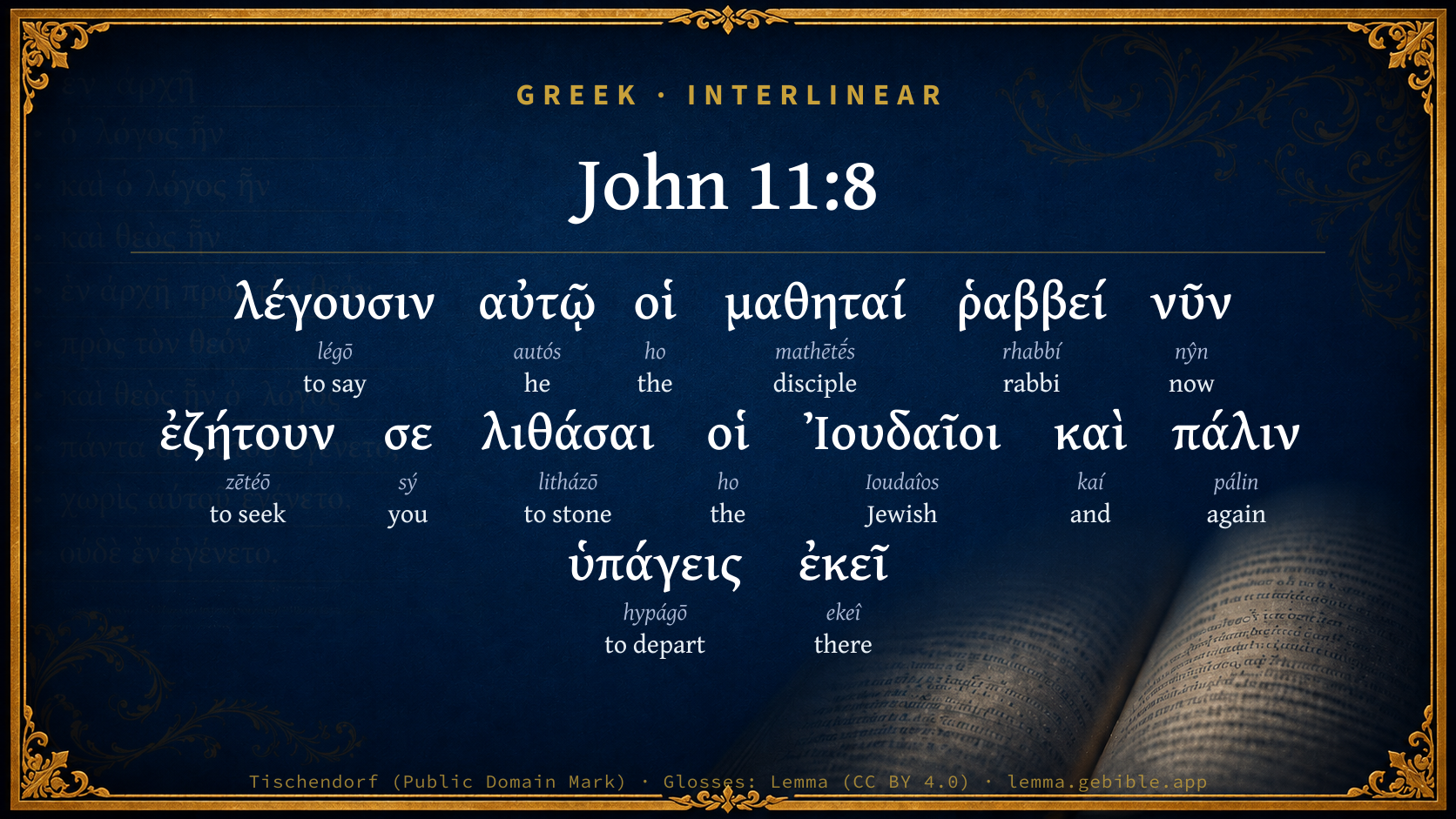
  1. λέγουσιν légō G3004 “to say” Verb, Present, Active, Indicative, 3rd person, Plural
  2. αὐτῷ autós G846 “he” Personal pronoun, Dative, Singular, Masculine
  3. οἱ ho G3588 “the” Article, Nominative, Plural, Masculine
  4. μαθηταί mathētḗs G3101 “disciple” Noun, Nominative, Plural, Masculine
  5. ῥαββεί rhabbí G4461 “rabbi” Hebrew transliteration
  6. νῦν nŷn G3568 “now” Adverb
  7. ἐζήτουν zētéō G2212 “to seek” Verb, Imperfect, Active, Indicative, 3rd person, Plural
  8. σε sý G4771 “you” Personal pronoun, 2nd person, Accusative, Singular
  9. οἱ ho G3588 “the” Article, Nominative, Plural, Masculine
  10. Ἰουδαῖοι Ioudaîos G2453 “Jewish” Adjective, Nominative, Plural, Masculine
  11. καὶ kaí G2532 “and” Conjunction
  12. πάλιν pálin G3825 “again” Adverb
  13. ὑπάγεις hypágō G5217 “to depart” Verb, Present, Active, Indicative, 2nd person, Singular
  14. ἐκεῖ ekeî G1563 “there” Adverb

About this verse

These counts appear in no published source. They are computed here, from the morphology-tagged text and Lemma’s own curated glosses. What Lemma adds →

15
words
14
distinct lemmas
Gospels
section

Notable vocabulary

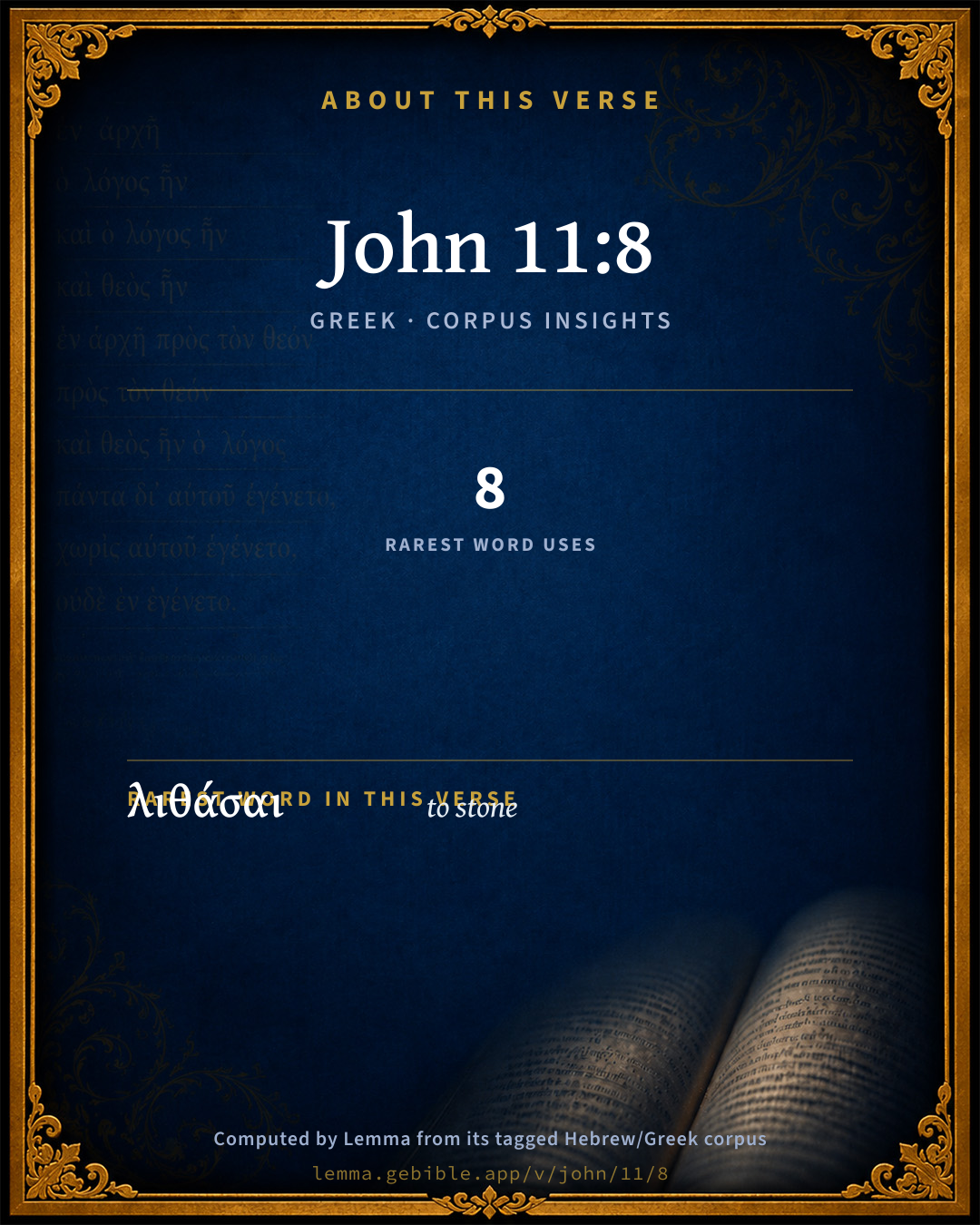
The rarest word here is λιθάσαι to stone G3034 — appearing just 8 times in the whole Greek New Testament.

Shared distinctive vocabulary

λιθάσαι to stone G3034 occurs in 8 verses of the Greek New Testament. Also found in:

Repetition

A word recurs within this verse:

Cross-references

8

Topical passages linked to John 11:8 in the Treasury of Scripture Knowledge — connected by theme and wording, ordered by reader-vote popularity; previews shown in the World English Bible.

  • John 8:59 Therefore they took up stones to throw at him, but Jesus was hidden, and went out of the temple, having gone through the midst of them, and so passed by.
  • John 10:31 Therefore Jews took up stones again to stone him.
  • Acts 21:12–13 When we heard these things, both we and they of that place begged him not to go up to Jerusalem.
  • Matthew 16:21–23 From that time, Jesus began to show his disciples that he must go to Jerusalem and suffer many things from the elders, chief priests, and scribes, and be killed, and the third day be raised up.
  • John 10:39 They sought again to seize him, and he went out of their hand.
  • Psalms 11:1–3 In Yahweh, I take refuge. How can you say to my soul, "Flee as a bird to your mountain!"
  • Acts 20:24 But these things don't count; nor do I hold my life dear to myself, so that I may finish my race with joy, and the ministry which I received from the Lord Jesus, to fully testify to the Gospel of the grace of God.
  • Matthew 23:7 the salutations in the marketplaces, and to be called 'Rabbi, Rabbi' by men.

Cross-references courtesy of OpenBible.info (CC BY 4.0).

Commentary

Notes on John 11:8 from classic Christian and Jewish commentators (each source and its license shown beneath its notes). The classic Christian expositions comment on the surrounding passage and are grouped to its opening verse, so a note may address several verses; the Jewish commentaries on the Tanakh (Rashi and others) are per-verse, so they appear only where the commentator wrote on this verse.

Lemma curates 59 commentaries, every one of them public domain or Creative Commons licensed, each selected and text-cleaned for this edition rather than reprinted as found. About our sources →

Tyndale Open Study Notes

Tyndale Open Resources

11:8 The disciples were rightly worried about the risk (see 7:25; 8:37, 44, 59; 10:31, 39).

Tyndale Open Study Notes — © Tyndale Open Resources, licensed CC BY-SA 4.0. Text via the HelloAO Bible API.

Bengel's Gnomon

Johann Albrecht Bengel

Joh 11:8. Νῦν ἐζήτουν) They now seek; for they lately were seeking.—λιθάσαι, to stone) Ch. Joh 10:31, [when He had said] “I and My Father are one.”

Bengel's Gnomon of the New Testament — English translation (T&T Clark, Edinburgh, 1860) — public domain. Text from a community e-Sword module.

Meyer's Critical & Exegetical Commentary

Heinrich August Wilhelm Meyer

Joh_11:8. The question breathes solicitude for the safety and life of the beloved Master.

νῦν] just now, refers to the recent events which, though past, seemed still to form part of the present, Joh_10:31. Hence the use of the imperfect; see Kühner, II. p. 385.

πάλιν] emphatically at the beginning.

ὑπάγεις] Present, as in Joh_10:32.

Meyer — Critical and Exegetical Commentary on the New Testament — English translation by Peter Christie, edited by Frederick Crombie (T&T Clark, 1880) — public domain. Text from a community e-Sword module.

Expositor's Greek Testament

ed. W. Robertson Nicoll

Joh 11:8 . The announcement of His intention is received with astonishment: Ῥαββὶ … ἐκεῖ . “Rabbi, the men of Judaea were but now seeking to stone Thee, and goest Thou thither again?” “They think of the danger to Him, and are not without thought of the danger to themselves (Joh 11:16 ).” Watkins. The νῦν shows that they had not been long in Peraea. To this remonstrance Jesus replies, as in Joh 9:4 , that while His day, appointed to Him by the Father, continued, He must work, and nothing could hinder Him.

The Expositor's Greek Testament, edited by W. Robertson Nicoll (1897–1910) — public domain. Text from a community e-Sword module.

Geneva Bible (1599)

Geneva Bible translators

This only is the sure and right way to life, to follow God boldly without fear, who calleth us and shineth before us in the darkness of this world.

Geneva Bible (1599) marginal notes — public domain. Text via Bolls.life.

Jamieson, Fausset & Brown

Robert Jamieson, A. R. Fausset & David Brown

His disciples say unto him, Master, the Jews of late sought, &c.--literally, "were (just) now seeking" "to stone thee" (Joh 10:31).

goest thou thither again?--to certain death, as Joh 11:16 shows they thought.

Jamieson, Fausset & Brown — Commentary Critical and Explanatory on the Whole Bible (1871) — public domain (CC PDM 1.0). Text via the HelloAO Bible API.

Adam Clarke's Commentary

Verse 8. The Jews of late sought to stone thee] It was but a few weeks before that they were going to stone him in the temple, on the day of the feast of the dedication, Joh 10:31.

Adam Clarke's Commentary on the Bible (1810–1826) — public domain. Text from a community e-Sword/MySword module.

John Calvin's Commentaries

8. Rabbi, the Jews but lately sought to stone thee. When the disciples dissuade him from going, they do so, not so much perhaps on his account as on their own, for each of them is alarmed about himself, as the danger was common to all. Avoiding the cross, and being ashamed to own it, they allege — what is more plausible — that they are anxious about their Master. The same thing happens every day with many. For they who, through a dread of the cross, shrink from the performance of their duty, eagerly seek excuses to conceal their indolence, that they may not be thought to rob God of the obedience due to him, when they have no good cause to do so.

John Calvin's Commentaries (1540-1563) — public domain. Text from the Calvin Translation Society English edition (1840s-50s) via the Christian Classics Ethereal Library (ccel.org). Calvin's coverage is partial (roughly two-thirds of the Bible); uncommented books and verses are honest gaps, never fabricated. The 19th-century editor's footnotes and remarks are omitted so the notes are faithfully Calvin's own voice.

Ellicott's Commentary for English Readers

(8) Master, the Jews of late sought to stone thee.—Better, Rabbi, the Jews were just now seeking to stone Thee. (Comp. Notes on Joh_1:39; Joh_10:31.) They think of the danger to Him, and are not without thought of the danger to themselves (Joh_11:16). It shows that the hatred of the Jews had now made it unsafe for our Lord and His disciples to be within their reach. The impression we derive from this verse is that the retirement into Gaulonitis had been of no long duration, when the message from Bethany came to interrupt it.

A Bible Commentary for English Readers, edited by Charles John Ellicott (1878–1897) — public domain. Text from a community e-Sword module.

The Cambridge Bible for Schools and Colleges

gen. ed. J. J. S. Perowne

8. Master, the Jews of late sought to stone thee] Better, Rabbi (see on Joh_4:31) just now the Jews were seeking to stone Thee (Joh_10:31) and art Thou going thither again? ‘Again’ is emphatic.

The Cambridge Bible for Schools and Colleges (gen. ed. J. J. S. Perowne; Cambridge University Press, 1878–1918) — public domain. Text from a community e-Sword module.

John Gill's Exposition

His disciples said unto him, master,.... Addressing him very reverently, and with great concern for his safety, as well as their own:

the Jews of late, or but now,

sought to stone thee; as they had attempted to do twice in a very little time; see Joh 8:59;

and goest thou thither again? where there are so many enemies; and so much danger, and but little hope of doing much good; whereas here he was among his friends, and in safety, and very useful.

John Gill's Exposition of the Whole Bible (1746–1763) — public domain (CC PDM 1.0). Text via the HelloAO Bible API.

Trapp's Complete Commentary

John Trapp

8 His disciples say unto him, Master, the Jews of late sought to stone thee; and goest thou thither again?

Ver. 8. And goest thou thither again?] Yea, with the hazard of his life, to the help of his friend. The ancients painted friendship, a fair young man bareheaded, in a poor garment, at the bottom whereof was written, Death and Life, in the upper part, Summer and Winter; his bosom was open, so that his heart might be seen, whereupon was written, Longe, prope, a friend at hand and afar off. (Wilkins’ Com. in Muter. orat. 1. de laud. lit.)

John Trapp, A Commentary or Exposition upon All the Books of the Old and New Testament (1647–1656) — public domain. Text from a community e-Sword module.

Albert Barnes' Notes on the Bible

Of late - About four months before, Joh 10:31.

Albert Barnes' Notes on the Bible (1834–1885) — public domain. Text from a community e-Sword/MySword module.

Matthew Poole's English Annotations

See Poole on "Joh 10:31". There were not three months elapsed since the Jews had so sought to have stoned him, and there was no reason for him to think that their fury was in any whit abated. We read in the other evangelists of other words they used (Peter especially, Mat 16:22), to dissuade our Saviour from this journey to Jerusalem. They were afraid for their Master, and they were afraid also for themselves.

Matthew Poole's English Annotations on the Holy Bible (1683–1685) — public domain. Text from a community e-Sword/MySword module.

Whedon's Commentary on the Bible

Daniel D. Whedon

8. Jews… stone thee—At both his last two visits to Jerusalem; namely, at the Feast of Tabernacles (Joh_8:59) and at the Feast of Dedication, (Joh_10:31.) Whether he should tempt a third assault was a matter of reasonable query. (See note on Joh_11:16.)

Daniel D. Whedon (gen. ed.), Commentary on the Old and New Testaments (1874–1909) — public domain. Text from a community e-Sword module.

The Pulpit Commentary

The Aramaic word "Rabbi" is frequently used by John, as the term of respect applied to both the Baptist and our Lord. The extraordinary dignity which the Jews accorded to their rabbis may throw some light upon the honorific title when yielded or conceded to Christ.

The disciples say unto him, Rabbi, the Jews were but now seeking to stone thee; and goest thou thither again? The nun exhtoun imply the continuous.process of their antagonism only just now arrested by a timely flight. Here in Peraea Jesus found appreciative listeners. The disciples are more in fear for their Master than for themselves. The residence beyond Jordan had been brief, and they are amazed that the Lord will so soon put himself in the power of that seething and hostile crowd. How different this language from that of his own brothers! (Joh_7:3-5)

The Pulpit Commentary (1880–1919), ed. H.D.M. Spence-Jones & Joseph S. Exell — public domain. Text from a community e-Sword module.

unfoldingWord translationNotes

Door43 World Missions Community

Rabbi, right now the Jews are trying to stone you, and you are going back there again?

This remark appears in the form of a question to emphasize that the disciples do not want Jesus to go to Jerusalem. AT: "Teacher, you surely do not want to go back there! The Jews were trying to stone you the last time you were there!" (See: Rhetorical Question)

the Jews

This is a synecdoche for the Jewish leaders who opposed Jesus. AT: "the Jewish leaders" (See: Synecdoche)

Are there not twelve hours of light in a day?

This remark appears in the form of a question to add emphasis. AT: "You know that the day has twelve hours of light!" (See: Rhetorical Question)

If someone walks in the daytime, he will not stumble, because he sees by the light of this world

People who walk in the light of the day can see well and do not stumble. "Light" is a metaphor for "truth." Jesus is implying that people who live according to truth will be able to successfully do the things that God wants them to do" (See: Metaphor)

translationWords

Rabbi

Jew

stone

light

walk

unfoldingWord translationNotes — © Distant Shores Media and the Door43 World Missions Community, licensed CC BY-SA 4.0. Source: git.door43.org/Door43/en_tn.

Cambridge Greek Testament for Schools and Colleges

8. Ῥαββί, νῦν κ.τ.λ. Rabbi (see on Joh 4:31) just now the Jews were seeking to stone Thee (Joh 10:31) and art Thou going thither again? ‘Again’ is emphatic. For νῦν comp. Joh 21:10.

Cambridge Greek Testament for Schools and Colleges (Cambridge University Press, 1896; 21 vols, various authors incl. Carr, Maclear, Plummer, Farrar, Lumby, Moule, M. R. James, Simcox) — public domain. Text from a community e-Sword module.

Alford’s Greek Testament

Henry Alford

8.] νῦν = ἀρτίως—but now. ἐζήτουν, were seeking: ὑπάγεις, art thou going?

9,

Henry Alford, The Greek Testament (1849–1861) — public domain. Text from a community e-Sword module.

International Critical Commentary

8. Ῥαββεί. So the disciples called Him. See on 1:38 for the use of this title in Jn.

νῦν κτλ., sc. “quite recently (10:31, 39), the Jews (see on 1:19) were seeking to stone Thee”: cf. 7:1, 8:59.

καὶ πάλιν ὑπάγεις ἐκεῖ; “and are you going back there?” For the Johannine use of ὑπάγειν, see on 7:33. Probably their apprehension of danger was on their own account, as well as on that of their Master.

International Critical Commentary — older volumes (1896–1929), various authors — public domain. Text from a community e-Sword module.

Vincent's Word Studies in the New Testament

Marvin R. Vincent

Of late sought [νυν εζητουν] . Rev., much better, giving the true force of nun, now, and of the imperfect : were but now seeking.

Goest [υπαγεις] . Dost thou withdraw from this safe retreat? See on Joh 6:21; Joh 8:21.

Marvin R. Vincent, Word Studies in the New Testament (1887–1900) — public domain. Text from a community e-Sword/MySword module.

Godet's Commentaries

Frédéric Louis Godet

Vv. 8-10. “The disciples say to him; Master, the Jews were but now seeking to stone thee, and dost thou return thither? 9. Jesus answered, Are there not twelve hours in the day? If any one walk during the day, he does not stumble, because he sees the light of this world; 10 but if any one walk in the night, he stumbles, because the light is not in him.”

At the word Judea, as Jesus expected, the disciples uttered a protest. He took advantage of their objection to give them an excellent teaching with respect to their future ministry. The answer of Jesus (Joh 11:9-10) has naturally a double meaning. The first meaning is clear: He who accomplishes the journey to which he is called during the twelve hours of the day, does not stumble; the light of the sun enlightens him and makes him discern the obstacles in his path; while he who wishes to continue his journey even after the night has come, is in danger of perishing. In the application, some give to the idea of day a purely moral sense. According to Chrysostom, de Wette, Bruckner the day designates a virtuous life, a life passed in communion with God, and the sense is: On the line of duty marked out, one has no serious danger to fear; but as soon as one turns aside from it, he exposes himself to the danger of perishing.

The sense is good; but the figure of the twelve hours is not explained. This last expression leads naturally to the temporal application of the idea of day. Bengel, Meyer, Hengstenberg, Weiss andReuss have felt this. They understand by the twelve hours of day the divinely measured time of the earthly life: “The time which was granted me has not yet elapsed; so long as it continues, no one can injure me; but when it shall have elapsed, I shall fall into the hands of my enemies.” So already Apollinaris, “The Lord declares that before the time of His Passion, the Jews could do nothing to Him: the day is the time until the Passion; the night, the time after the Passion.” This sense seems to me incompatible with Joh 11:10, in which the term προσκόπτειν, to stumble, cannot designate a purely passive state, like that of Jesus falling into the hands of the Jews, and in which the expression:There is no light in him, cannot apply to Jesus. Meyer answers: “This is a point which pertains to the figure and which has no significance.” But Joh 11:10, which forms half of the picture, cannot be treated in this way.

I think (partly) with Tholuck, Lange and Luthardt, that the day here designates at once the time of life and the task assigned for this time; it is the day of the workman’s labor, as in Joh 9:4. Only here the figure is borrowed from the situation in which Jesus finds Himself with His disciples. It is the morning; the sun rises; they have before them a good day’s journey, twelve hours of daylight. During all this time, they will journey without danger. Before it is night, they will have reached the end of the journey, Bethany. In the moral sense this means: “I can go without fear to Judea, whither duty calls me. The twelve hours which are granted me for the accomplishment of my task will remain intact. The sun of the divine will, in assigning me my task, enlightens my path; I shall not stumble. The danger of stumbling and falling would begin for me only at the moment when, fleeing in a cowardly way from a foreseen danger, I should wish arbitrarily to prolong the time of my life, and to add a thirteenth hour of walking to the twelve which legitimately belong to me. From that moment I could only stumble, sin, perish. For the hour of life which God had not given me, would be an hour without duty or mission; the sun of the divine will would no more enlighten my course.” In other terms: “The Jews cannot take away from me one moment of the time which is accorded me, so long as I am in the accomplishment of my task; a real danger will assail me only if, as you would have me do, I seek arbitrarily to prolong my career, by refusing to go whither duty calls me.” This word applies to the believer who, in the time of persecution, would prolong his life by denying his faith, to the physician who would flee from the approach of a contagious malady, etc.

The man, after being placed in such a situation, can only sin and perish. Meyer objects to this sense, that the disciples asked Jesus only not to shorten His life, and did not ask Him to prolong it. But this amounts to precisely the same thing. To desert duty for fear of shortening one’s life, is not this to strive to prolong it beyond due measure? The expression: the light is not in him, signifies that the divine will, no longer presiding over that life, cannot serve to direct it; such a man lives only on a venture, because he ought not to live any longer. The parallel 1Jn 2:10-11, confirms this meaning. The analogy of the expressions and ideas between the two passages is remarkable. John there applies to the believer who loves or does not love his brother what Jesus here says of the man who is obedient or not obedient to the will of God. This saying is, both in matter and form, the counterpart of that in which Jesus gave the reason, Joh 9:4, of the act of healing the man who was born blind. Only, according to the fine remark of Lange, there it was evening; He saw the sun descending to the horizon: “I must not lose a moment of the time which remains for me to enlighten the world.” Here it is morning: “The time which is assigned me is sufficient for accomplishing my whole task; I must not through cowardice seek to add an hour to the day of work which is divinely assured to me.” In these two words: to lose nothing, to add nothing, is certainly summed up the duty of man in relation to the time of his earthly work.

Frédéric Louis Godet — Commentaries on Luke, John, Romans, and 1 Corinthians — English translation (T&T Clark, Edinburgh, 1870s–1890s) — public domain. Text from a community e-Sword module.

Lesson kit

Teaching starters — assembled from the data on this page, not authored interpretation. Every prompt links to the verse data it draws on. Edit before teaching.

John, in the Gospels, opens this verse with 15 words (14 distinct Greek lemmas). Its most distinctive word is litházō (“to stone”). A historical commentator’s framing appears above. Read the whole chapter for the surrounding context.

Discussion questions

  1. The word litházō carries the sense “to stone.” How does it shape the verse?
  2. How does John 10:31, which shares the word «to stone», read alongside this verse?
  3. What does the repetition of “the” (2× in this one verse) do in this verse?
  4. The translations on this page render this verse differently — a whole-verse word diff, not a word-by-word alignment. What might account for the different wordings?
  5. Compare how Tyndale Open Study Notes and Bengel's Gnomon read this verse. Where do they agree or differ?

Things to notice

Reading settings

Reading text

Shown beneath each verse's original-language words.

Old Testament
Old Testament edition

Read the OT as the Masoretic Hebrew (MT) or the Greek Septuagint (LXX).

English shown for the Greek Septuagint (in the Hebrew ↔ Greek comparison).

Comparing translations? Open the Compare panel on any verse page to stack up to four side by side.