
John 12:14

Greek (Tischendorf 8th ed.) John 12:14 appears in the Greek New Testament. The text above is from the Tischendorf 8th edition. Each word links to its Strong’s number and a concise gloss. Click any word for its full Thayer’s Greek Lexicon entry.
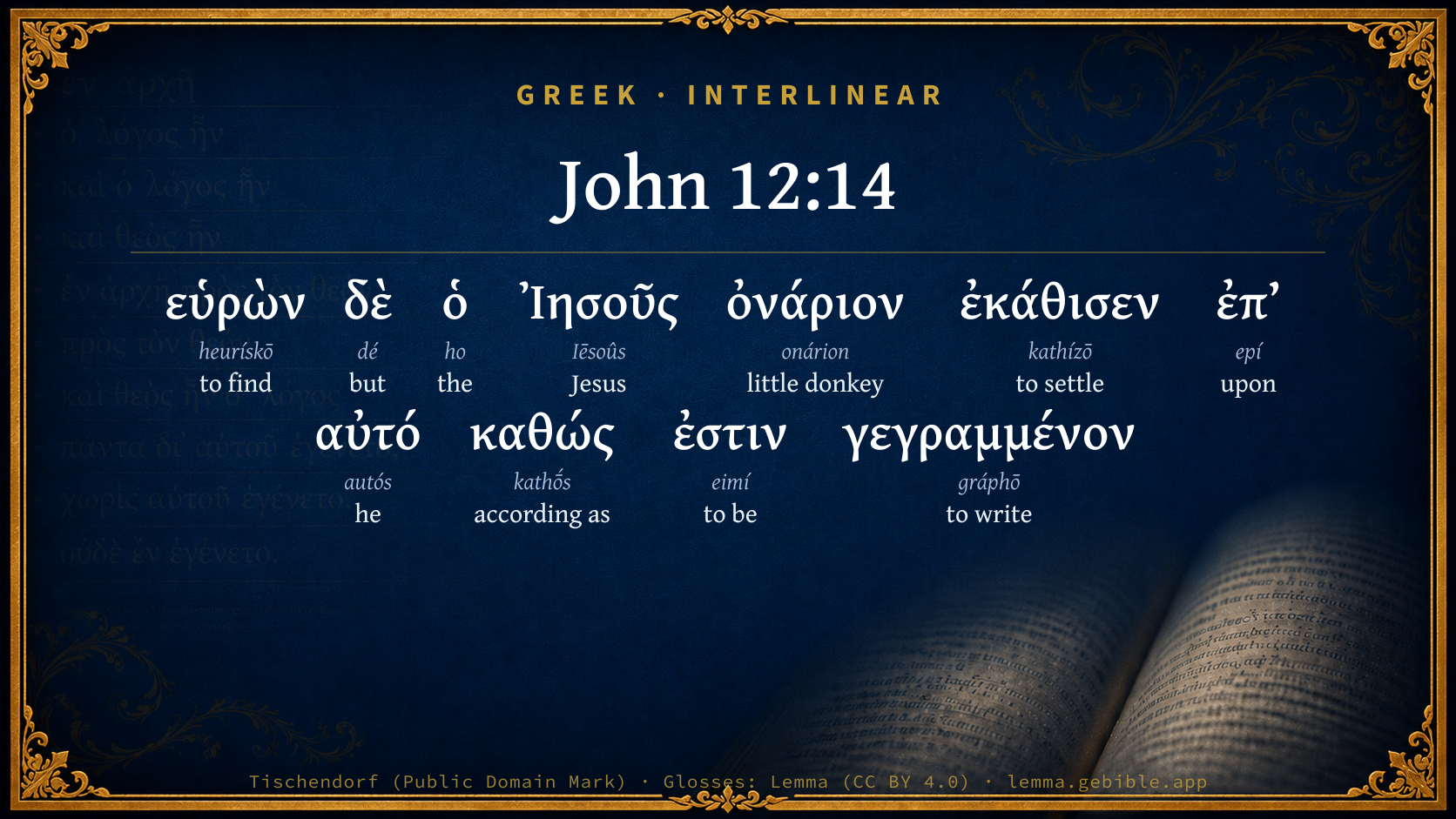
Download image
Cite this verse

John 12:14 (World English Bible). Public Domain. Lemma interlinear Bible study tool, https://lemma.gebible.app/v/john/12/14.

Show BibTeX & RIS
BibTeX
RIS
English Translation
Jesus, having found a young donkey, sat on it. As it is written,
World English Bible · Public Domain
Highlights
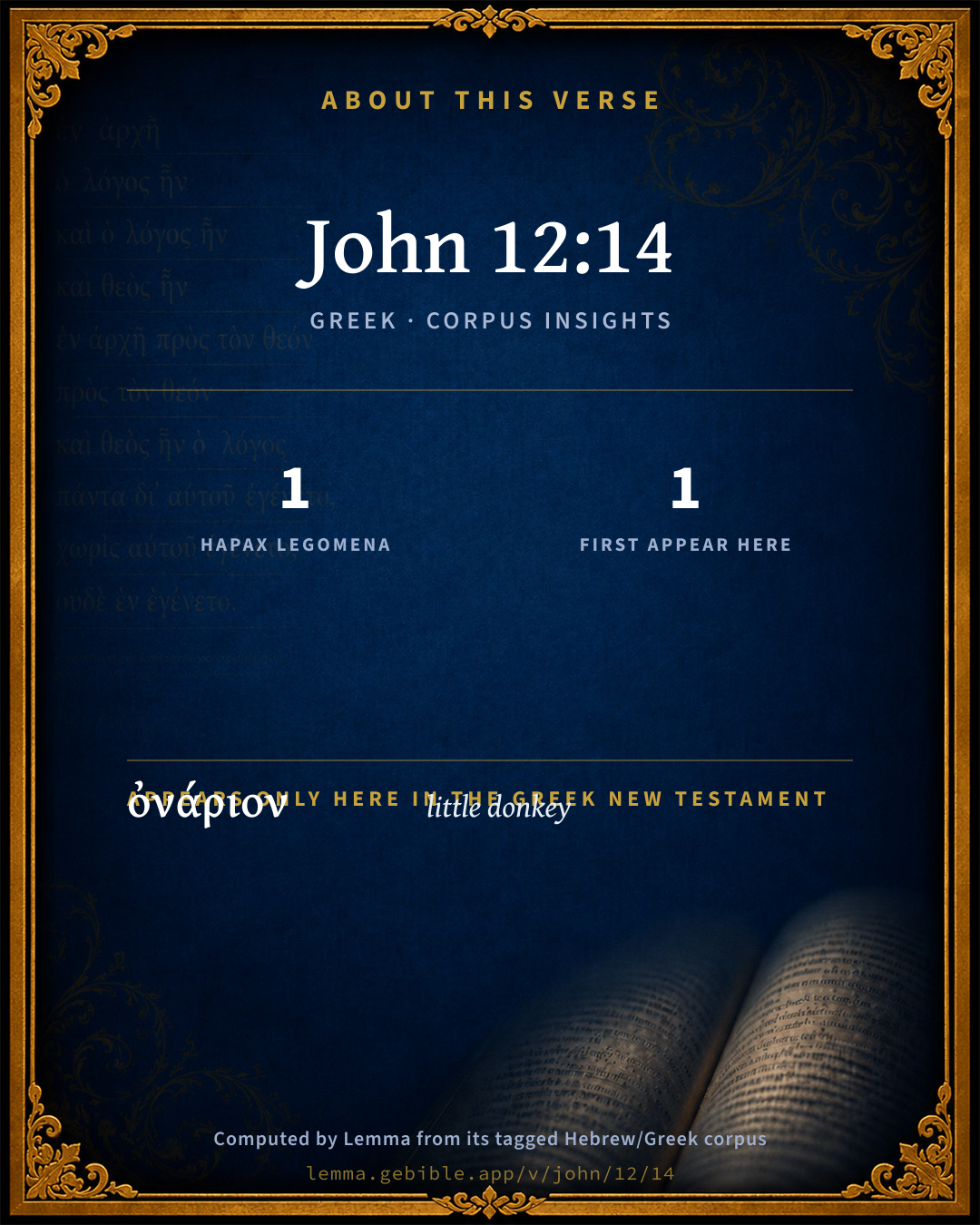
  • 1 hapax legomenon — only here in the Greek New Testament
  • 1 first appearance in the Greek New Testament
Full analysis ↓
Download a study sheet

One document with this verse’s original text, its word-by-word gloss line, the meaning frame, cross-references with their text, attributed commentary, and full source and license credits — printable, and it pastes into notes with its structure intact.

This verse Autodidact and up

Study sheet (.html) Plain text (.txt)

A passage Seminary Student

Up to 50 verses in one chapter. A passage sheet keeps up to 6 commentary sources and 12 cross-references per verse, in the order this page ranks them, and says so on the sheet whenever that leaves anything out. Ask for a single verse and you get the Autodidact verse sheet above.

Everything on this page stays free to read, with no account — the sheet is a download of what is already on screen, not access to it.

Want to remove ads? Support Godless Engineer
Compare translations 3

The same verse in 3 English versions, stacked beneath the original-language interlinear above. Click any original word for its lexicon entry.

Each is an independent rendering of the whole verse — the interlinear is not word-aligned to these translations.

Highlighted words mark where these versions differ — a whole-verse word diff, not a word-by-word alignment.

  • World English Bible Public Domain
    Jesus, having found a young donkey, sat on it. As it is written,
  • King James Version Public Domain
    And Jesus, when he had found a young ass, sat thereon; as it is written,
  • unfoldingWord Literal Text CC BY-SA 4.0
    Now Jesus, having found a young donkey, sat on it, just as it is written,

unfoldingWord Literal Text — © unfoldingWord, licensed CC BY-SA 4.0. Word-aligned USFM3 via Door43 (git.door43.org/unfoldingWord/en_ult).

Versions to compare (up to 4)

3 of 4 selected

Show all 19 translations

Every available English version of this verse, each an independent rendering of the whole verse.

  • World English Bible Public Domain
    Jesus, having found a young donkey, sat on it. As it is written,
  • Berean Standard Bible Public Domain
    Finding a young donkey, Jesus sat on it, as it is written:
  • Majority Standard Bible Public Domain
    Finding a young donkey, Jesus sat on it, as it is written:
  • King James Version Public Domain
    And Jesus, when he had found a young ass, sat thereon; as it is written,
  • American Standard Version (1901) Public Domain
    And Jesus, having found a young ass, sat thereon; as it is written,
  • Revised Version (1885) Public Domain
    And Jesus, having found a young ass, sat thereon; as it is written,
  • Geneva Bible (1599) Public Domain
    And Iesus found a yong asse, and sate thereon, as it is written,
  • Douay-Rheims (1899) Public Domain
    And Jesus found a young ass, and sat upon it, as it is written:
  • Young's Literal Translation Public Domain
    and Jesus having found a young ass did sit upon it, according as it is written,
  • Literal Standard Version CC BY-SA 4.0
    and Jesus having found a young donkey sat on it, according as it is written,
  • Unlocked Literal Bible CC BY-SA 4.0
    Jesus found a young donkey and sat on it; as it was written,
  • unfoldingWord Literal Text CC BY-SA 4.0
    Now Jesus, having found a young donkey, sat on it, just as it is written,
  • Darby Bible Public Domain
    And Jesus, having found a young ass, sat upon it; as it is written,
  • World Messianic Bible Public Domain
    Yeshua, having found a young donkey, sat on it. As it is written,
  • Webster's Bible Public Domain
    And Jesus, when he had found a young ass, sat thereon; as it is written,
  • Free Bible Version CC BY-SA 4.0
    Jesus found a young donkey and rode on it, as Scripture says:
  • Bible in Basic English Public Domain
    And Jesus saw a young ass and took his seat on it; as the Writings say,
  • Text-Critical English NT CC BY 4.0
    Finding a young donkey, Jesus sat on it, just as it is written,
  • Tyndale New Testament (1534) Public Domain
    And Iesus got a yonge asse and sate theron accordinge to that which was writte:

Literal Standard Version (2020), Covenant Press — licensed CC BY-SA 4.0. Text via the HelloAO Bible API (eBible.org). Unlocked Literal Bible (unfoldingWord) — licensed CC BY-SA 4.0. Text via the HelloAO Bible API (eBible.org). unfoldingWord Literal Text — © unfoldingWord, licensed CC BY-SA 4.0. Word-aligned USFM3 via Door43 (git.door43.org/unfoldingWord/en_ult). Free Bible Version, Dr. Jonathan Gallagher — licensed CC BY-SA 4.0. Text via the HelloAO Bible API (eBible.org).

Word by word

More ways to search: Search by grammar → Find every occurrence → Compare this word →

Practice this passage: Drill this verse → Learn its vocabulary →

About this verse

These counts appear in no published source. They are computed here, from the morphology-tagged text and Lemma’s own curated glosses. What Lemma adds →

11
words
11
distinct lemmas
Gospels
section

Notable vocabulary

1 hapax legomenon — a word that appears only here in the entire Greek New Testament:

  • ὀνάριον little donkey G3678

First appearance in Scripture

This word makes its first canonical appearance in the Greek New Testament here:

  • ὀνάριον little donkey G3678

Shared distinctive vocabulary

ἐκάθισεν to settle G2523 occurs in 45 verses of the Greek New Testament. Also found in:
Cross-references

4

Topical passages linked to John 12:14 in the Treasury of Scripture Knowledge — connected by theme and wording, ordered by reader-vote popularity; previews shown in the World English Bible.

  • Zechariah 9:9 Rejoice greatly, daughter of Zion! Shout, daughter of Jerusalem! Behold, your king comes to you! He is righteous, and having salvation; Lowly, and riding on a donkey, Even on a colt, the foal of a donkey.
  • Matthew 21:1–7 When they drew near to Jerusalem, and came to Bethsphage, to the Mount of Olives, then Jesus sent two disciples,
  • Mark 11:1–7 When they drew near to Jerusalem, to Bethsphage and Bethany, at the Mount of Olives, he sent two of his disciples,
  • Luke 19:29–35 It happened, when he drew near to Bethsphage and Bethany, at the mountain that is called Olivet, he sent two of his disciples,

Cross-references courtesy of OpenBible.info (CC BY 4.0).

Commentary

Notes on John 12:14 from classic Christian and Jewish commentators (each source and its license shown beneath its notes). The classic Christian expositions comment on the surrounding passage and are grouped to its opening verse, so a note may address several verses; the Jewish commentaries on the Tanakh (Rashi and others) are per-verse, so they appear only where the commentator wrote on this verse.

Lemma curates 59 commentaries, every one of them public domain or Creative Commons licensed, each selected and text-cleaned for this edition rather than reprinted as found. About our sources →

Tyndale Open Study Notes

Tyndale Open Resources

12:14 By choosing a young donkey rather than a warhorse, Jesus calmed the frenzied crowd that was passionate for his kingship. He also fulfilled Old Testament predictions regarding the Messiah (see Zech 9:9) and showed that his kingship was not that of a warrior. His gift is life, not conquest.

Tyndale Open Study Notes — © Tyndale Open Resources, licensed CC BY-SA 4.0. Text via the HelloAO Bible API.

Bengel's Gnomon

Johann Albrecht Bengel

Joh 12:14. Εὑρών, having obtained [when He had found]) He was poor [and therefore had not one of His own].—ὀνάριον) ὀνάριον, a young or little ass [asellus], a diminutive, is not so much opposed in this passage to the ass [of ordinary size], as to the fiery horse, which our Lord did not use.

Bengel's Gnomon of the New Testament — English translation (T&T Clark, Edinburgh, 1860) — public domain. Text from a community e-Sword module.

Meyer's Critical & Exegetical Commentary

Heinrich August Wilhelm Meyer

Joh_12:14-15. Εὑρὼν, δὲ κ.τ.λ.] The more detailed circumstances, how He had obtained the young ass (ὀνάριον), are passed over by John; hence he is not in contradiction with the Synoptics (Mat_21:2 ff. parall.).

καθώς ἐστι γεγρ.] Zec_9:9. See on Mat_21:5. John cites very freely from memory; hence the omission of the other prophetic predicates (even of the πραΐς in Matt.), because he has in his eye simply the point of the riding in upon the young ass, as a Messianic σημεῖον excluding all doubt. All the more fitted to tranquillize, then (μὴ φοβοῦ), in ever more peaceful array, without horse and chariot, is the coming of the King of Zion. Instead of μὴ φοβοῦ, John might also have said χαῖρε σφόδρα (LXX.); but there floated before him, in his citation from memory, simply the opposition to that terror by which otherwise a royal entrance may be accompanied. The Churchs figure of the cross (Hengstenberg) did not yet lie on this asss foal, otherwise John would not have passed over the עָנִי of the passage, nor have found the emphasis in μὴ φοβοῦ.

Meyer — Critical and Exegetical Commentary on the New Testament — English translation by Peter Christie, edited by Frederick Crombie (T&T Clark, 1880) — public domain. Text from a community e-Sword module.

Expositor's Greek Testament

ed. W. Robertson Nicoll

Joh 12:14 . Jesus being thus hailed as king by the people, εὑρὼν ὀνάριον … ὄνου , i.e. , He accepted the homage and declared Himself king by adopting the prediction of Zec 9:9 (Joh 12:15 ), “Rejoice greatly, O daughter of Zion ( χαῖρε σφόδρα instead of μὴ φοβοῦ ), proclaim it aloud, O daughter of Jerusalem; behold the king is coming to thee, just and saving, He is meek and riding on a beast of burden and a young foal”. The significance of the “ass” is shown in what follows: “He shall destroy the chariots out of Ephraim and the horse out of Jerusalem, and the war-bow shall be utterly destroyed: and there shall be abundance and peace”. By riding into Jerusalem as king but on an ass, not on a war horse, He continued to claim to be Messiah but ruling by spiritual force for spiritual, ends.

The Expositor's Greek Testament, edited by W. Robertson Nicoll (1897–1910) — public domain. Text from a community e-Sword module.

John Calvin's Commentaries

14. And Jesus having found a young ass. This part of the history is more minutely related by the other Evangelists, who tell us, that Christ sent two of his disciples to bring an ass, (Matthew 21:1; Mark 11:1; Luke 19:29.) John, who was the latest writer of all the Evangelists, reckoned it enough to notice briefly the substance of what had been stated by the rest; and, on this account, he leaves out many circumstances. An apparent contradiction, by which many persons are perplexed, is very easily removed. When Matthew says, that Christ sat upon a she-ass and her colt, we ought to view it as a synecdoche. Some imagine that he sat first on the she-ass, and afterwards on her colt; and out of this conjecture they frame an allegory, that he first sat on the Jewish people, who had been long accustomed to bear the yoke of the Law, and afterwards. subdued the Gentiles, like an untrained young ass which had never carried a rider. But the plain truth is, that Christ rode on an ass which had been brought along with its mother; and to this agree the words of the Prophet, who, by a repetition very frequent among the Hebrews, expresses the same thing twice by different words. On an ass, he says, and on the colt of an ass which was under the yoke, (ὑποζυγίου) Our Evangelist, who studies brevity, leaves out the former clause, and quotes only the latter.

The Jews themselves are constrained to expound the prediction of Zechariah 9:9, which was at that time fulfilled, as referring to the Messiah; but, at the same time, they ridiculed us for being led astray by the shadow of an ass, a so as to give the honor of the Messiah to the son of Mary. But far different are the testimonies on which our faith rests. And, indeed, when we say that Jesus is the Messiah, we do not begin by saying, that he entered into Jerusalem sitting on an ass; for there was displayed in him a glory, such as belonged to the Son of God, as we have seen under the first chapter of this Gospel; and it was chiefly in his resurrection that his Divine power was illustriously displayed. But we ought not to despise this confirmation, that God, by his wonderful Providence, exhibited on that entrance, as on a public stage, the fulfillment of that which Zechariah had foretold.

Fear not. In these words of the Prophet, as the Evangelist quotes them, we ought to observe, first, that never is tranquillity restored to our minds, or fear and trembling banished from them, except by knowing that Christ reigns amongst us. The words of the Prophet, indeed, are different; for he exhorts believers to gladness and rejoicing. But the Evangelist has here described the manner in which our hearts exult with true joy. It is, when that fear is removed, with which all must be tormented, until, being reconciled to God, they obtain that peace which springs from faith, (Romans 5:1.) This benefit, therefore, comes to us through Christ, that, freed from the tyranny of Satan, the yoke of sin being broken, guilt canceled, and death abolished, we freely boast, relying on the protection of our King, since they who are placed under his guardianship ought not to fear any danger. Not that we are free From fear, so long as we live in the world, but because confidence, founded on Christ, rises superior to all than. Though Christ was still at a distance, yet the Prophet exhorted the godly men of that age to be glad and joyful, because Christ was to come. Behold, said he, thy King will come; therefore fear not. Now that he is come, in order that we may enjoy his presence, we ought more vigorously to contend with fear, that, freed from our enemies, we may peacefully and joyfully honor our King.

Daughter of Zion. The Prophet addressed Zion in his own time, because that was the habitation and abode of the Church. God has now, indeed, collected a Church for himself out of the whole world; but this promise is peculiarly addressed to believers, who submit to Christ, that he may reign in them. When he describes Christ as riding on an ass, the meaning is, that his kingdom will have nothing in common with the pomp, splendor, wealth, and power of the world; and it was proper that this should be made known by an outward manifestation, that all might be fully assured that it is spiritual.

John Calvin's Commentaries (1540-1563) — public domain. Text from the Calvin Translation Society English edition (1840s-50s) via the Christian Classics Ethereal Library (ccel.org). Calvin's coverage is partial (roughly two-thirds of the Bible); uncommented books and verses are honest gaps, never fabricated. The 19th-century editor's footnotes and remarks are omitted so the notes are faithfully Calvin's own voice.

Ellicott's Commentary for English Readers

(14) And Jesus, when he had found a young ass, sat thereon.—St. John simply mentions this to introduce the prophecy. The others all give the incidents in detail. “Having found,” does not imply that the colt was found without the search which the other Evangelists record. (Comp. the same word in Joh_9:35.) It has been noted, as illustrating the fact, that the word “found” includes the sending the disciples to look for the colt, that it is the same Greek word which Archimedes used when he found the object of his search, and cried, Eureka! Eureka!

A Bible Commentary for English Readers, edited by Charles John Ellicott (1878–1897) — public domain. Text from a community e-Sword module.

The Cambridge Bible for Schools and Colleges

gen. ed. J. J. S. Perowne

14. It is written] See on Joh_2:17.

The Cambridge Bible for Schools and Colleges (gen. ed. J. J. S. Perowne; Cambridge University Press, 1878–1918) — public domain. Text from a community e-Sword module.

John Gill's Exposition

And Jesus, when he had found a young ass,.... Which he sent his disciples for, to a neighbouring village, and they brought to him:

sat thereon, as it is written; in Zac 9:9 though some part of the words seems to be taken out of Isa 62:11; See Gill on Mat 21:5; and so Nonnus paraphrases it here, "that it might be fulfilled which Esaias said".

John Gill's Exposition of the Whole Bible (1746–1763) — public domain (CC PDM 1.0). Text via the HelloAO Bible API.

Trapp's Complete Commentary

John Trapp

14 And Jesus, when he had found a young ass, sat thereon; as it is written,

Ver. 14. When he had found a young ass] To make religion dance attendance upon policy (saith one) is to set the ass upon Christ, and not Christ upon the ass. These three things, saith Luther, will be the ruin of religion, unthankfulness, security, and carnal policy. Sapientia mundi, quae vult omnia, redigere in ordinem. (Melch. Adam.)

John Trapp, A Commentary or Exposition upon All the Books of the Old and New Testament (1647–1656) — public domain. Text from a community e-Sword module.

The Pulpit Commentary

And Jesus, having found a young ass, sat thereon; as it is written. The whole account of the process by which our Lord secured this onarion is described at great length by the synoptists. (see Mar_11:12 Luk_19:30) The foal implies that the animal had never borne another burden. The account of Matthew refers to the mother and the foal, as though they were inseparable, and together bore the sacred burden. Mr. Holman Hunt, in his picture of the "Triumph of the Innocents," has represented the beast bearing Mary and her Child as accompanied by the colt. The entire process of securing both must have taken time, and augmented the excitement. Christ at length, on the eve of his Passion which he so distinctly foreshadowed, allowed the enthusiasm of the people to prevail, and accepted the homage. The Galilee pilgrims take up the demonstration, which was commenced, as we see from John"s Gospel, by "the Jews" and those Jerusalemites who had been profoundly moved by the significance of the resurrection of Lazarus. The circumstances thus elucidated from the four narratives, reveal undesigned coincidences. The entry into Jerusalem did not take place till the afternoon, and so we find that all that our Lord did on arrival was to "go to the temple, look round on all things, and, now that the even was come, to revisit Bethany with the twelve". (Mar_11:11)

The Pulpit Commentary (1880–1919), ed. H.D.M. Spence-Jones & Joseph S. Exell — public domain. Text from a community e-Sword module.

unfoldingWord translationNotes

Door43 World Missions Community

Jesus found a young donkey and sat on it

Here John gives background information that Jesus secures a donkey. He implies that Jesus will ride the donkey into Jerusalem. AT: "he found a young donkey and sat on it, riding into the city" (See: Background Information and Assumed Knowledge and Implicit Information)

as it was written

You can translate this in an active form. AT: "as the prophets wrote in the Scripture" (See: Active or Passive)

daughter of Zion

"Daughter of Zion" here is a metonym that refers to the people of Jerusalem. AT: "you people of Jerusalem" (See: Metonymy)

translationWords

donkey

written

daughter of Zion

unfoldingWord translationNotes — © Distant Shores Media and the Door43 World Missions Community, licensed CC BY-SA 4.0. Source: git.door43.org/Door43/en_tn.

Cambridge Greek Testament for Schools and Colleges

14. εὑρών. S. John does not repeat the well-known story of the finding: see on Joh 9:35. On ἐστιν γεγραμμένον see on Joh 2:17.

Cambridge Greek Testament for Schools and Colleges (Cambridge University Press, 1896; 21 vols, various authors incl. Carr, Maclear, Plummer, Farrar, Lumby, Moule, M. R. James, Simcox) — public domain. Text from a community e-Sword module.

Alford’s Greek Testament

Henry Alford

14-16.] The Evangelist seems to suppose his readers already acquainted with the circumstances of the triumphal entry, and therefore relates it thus compendiously.

εὑρών does not involve any discrepancy with the three Evangelists, but is a compendious term implying their details.

Henry Alford, The Greek Testament (1849–1861) — public domain. Text from a community e-Sword module.

International Critical Commentary

14. εὑρὼν δὲ ὁ Ἰησοῦς ὀνάριον κτλ. This is not verbally consistent with the Synoptists, who tell that it was the disciples who had found the ass, in accordance with the directions given them by Jesus (Mar 11:2-6). Chrysostom is at unnecessary pains to reconcile the various statements; see v. 16 below.

ἐκάθισεν ἐπʼ αὐτό So Mar 11:7; Luk 19:35 says ἐπεβίβασαν τὸν Ἰησοῦν.

καθώς ἐστιν γεγραμμένον. See on 2:17 for this formula of citation.

International Critical Commentary — older volumes (1896–1929), various authors — public domain. Text from a community e-Sword module.

Vincent's Word Studies in the New Testament

Marvin R. Vincent

A young ass [οναριον] . Only here in the New Testament. Matthew mentions an ass and a colt; Mark and Luke a colt only.

Marvin R. Vincent, Word Studies in the New Testament (1887–1900) — public domain. Text from a community e-Sword/MySword module.

Godet's Commentaries

Frédéric Louis Godet

Vv. 14, 15. “Jesus, having found a young ass, sat thereon, according as it is written, 15. Fear not, daughter of Zion; behold, thy king cometh seated on an ass’s colt.”

The conduct of Jesus is ordered by the nature of things. Since He wishes to-day to accept this homage, He cannot remain mingled with the multitude. On the one hand, He must in some sort put Himself on the scene; but, on the other, He wishes to do it only in the most humble way and in the way most appropriate to the spiritual nature of His royalty. In the ancient times, the ass does not seem to have been in Israel a despised animal; comp. Jdg 5:9-10; Jdg 10:4; 2Sa 17:23. Later, the horse and the mule were preferred to it; comp. Sirach, xxxiii. (xxxvi.) 25 (24). The prophet Zechariah himself indicates the meaning which he here attaches to this symbol, when he says (Joh 9:9): “Behold thy king cometh unto thee just, having salvation and humble.” The young ass represents for him the humility of the Messiah and consequently the peaceful nature of His kingdom: “I will cut off the chariots of war...and the king shall speak peace unto the nations” (Zec 9:10).

The two ideas of humility and of peace are closely connected, as, on the other hand, are those of wealth and military power. The expression εὑρών, having found, seems at the first glance incompatible with the narrative of the Synoptics, according to which Jesus sends two of His disciples with the express order to bring Him the young ass. But εὑρώνdoes not signify: having found without seeking; witness the εὕρηκα of Archimedes! This word may be translated by:having procured for Himself, as in the expressions εὑρίσκων δόξαν, κέρδος, βίον, to procure glory, gain, subsistence for oneself (see Passow). Nothing, therefore, can be inferred from this term as to the how of this finding, and it is natural to suppose that John, in this summary expression, sums up the narrative of the Synoptics, which was sufficiently well-known in the Church. He also abridges the quotation of Zechariah; for it concerns him only to establish the general relation between the prophecy and its accomplishment. The expression daughter of Ziondesignates the population of the city personified. John substitutes: Fear not, for the Rejoice of the prophecy; it is the same sentiment, but somewhat less strongly expressed: “Fear not; a king who comes thus cannot be a tyrant.” If Jesus had never entered into Jerusalem in this way, this prophecy would nevertheless have been realized. His entire ministry in Israel was the fulfillment of it. But, by realizing to the very letter the figure employed by the prophet, Jesus desired to render more sensible the spiritual and true accomplishment of the prophecy. Everything, however, occurred so simply, so naturally, that, at the moment, the disciples did not think of the prophecy and did not grasp its relation to that which had just taken place.

Frédéric Louis Godet — Commentaries on Luke, John, Romans, and 1 Corinthians — English translation (T&T Clark, Edinburgh, 1870s–1890s) — public domain. Text from a community e-Sword module.

Lesson kit

Teaching starters — assembled from the data on this page, not authored interpretation. Every prompt links to the verse data it draws on. Edit before teaching.

John, in the Gospels, opens this verse with 11 words (11 distinct Greek lemmas). Its most distinctive word is onárion (“little donkey”). A historical commentator’s framing appears above. Read the whole chapter for the surrounding context.

Discussion questions

  1. What does “little donkey” (onárion) contribute to the verse as a whole?
  2. 1 word here appears nowhere else in the Greek New Testament. Why might the author reach for such rare wording?
  3. This is the first place “little donkey” appears in Scripture (first appears here). What does its debut here establish?
  4. How does Matthew 5:1, which shares the word «to settle», read alongside this verse?
  5. The translations on this page render this verse differently — a whole-verse word diff, not a word-by-word alignment. What might account for the different wordings?
  6. Compare how Tyndale Open Study Notes and Bengel's Gnomon read this verse. Where do they agree or differ?

Things to notice

  • 1 word in this verse appears nowhere else in the Greek New Testament.
  • 1 word makes its first canonical appearance in Scripture here.
  • These translations choose different wording for 8 words in this verse.
  • 11 distinct Greek lemmas span 11 words in this verse.

Reading settings

Reading text

Shown beneath each verse's original-language words.

Old Testament
Old Testament edition

Read the OT as the Masoretic Hebrew (MT) or the Greek Septuagint (LXX).

English shown for the Greek Septuagint (in the Hebrew ↔ Greek comparison).

Comparing translations? Open the Compare panel on any verse page to stack up to four side by side.