John 11:12

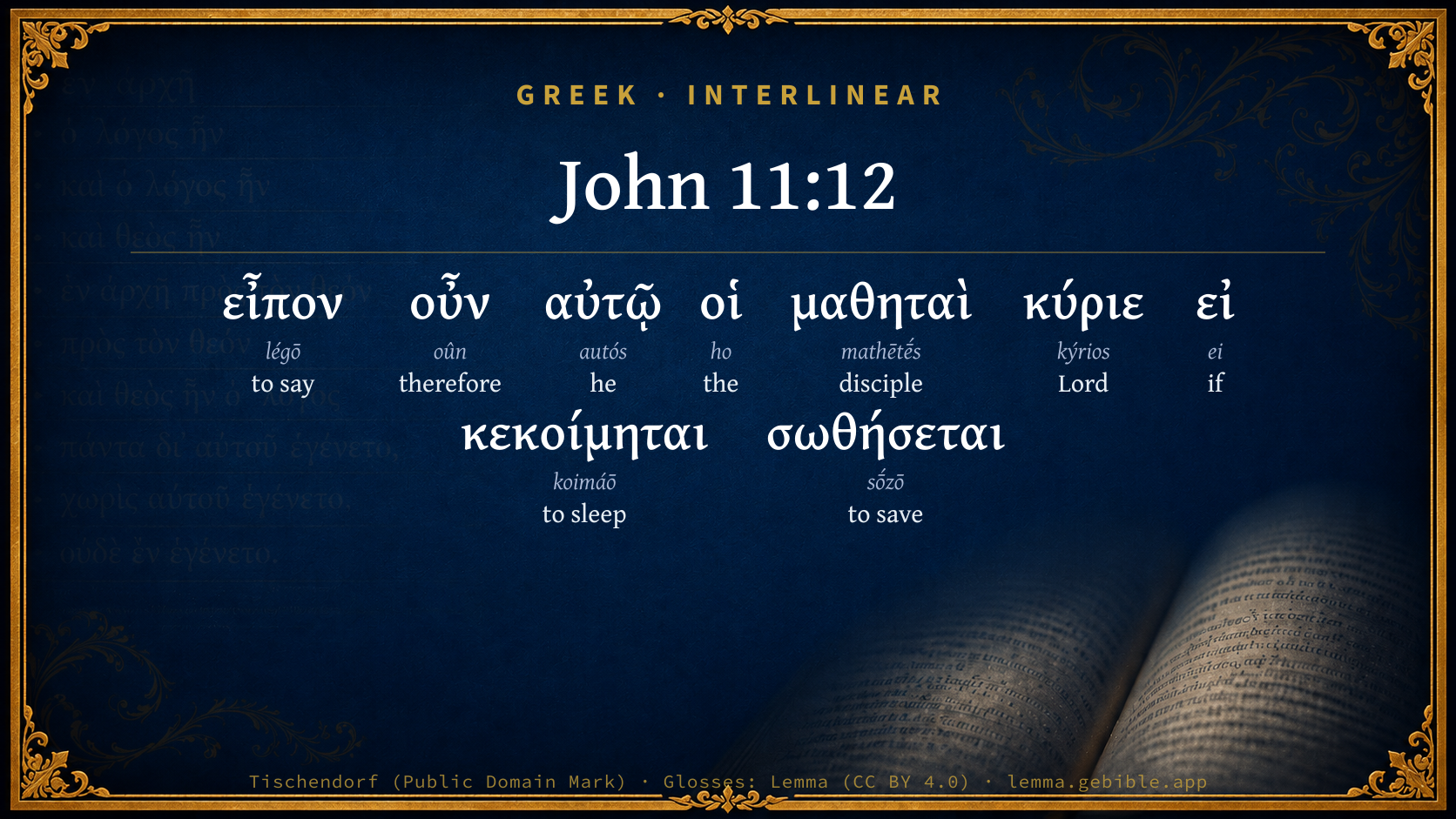
Greek (Tischendorf 8th ed.) John 11:12 appears in the Greek New Testament. The text above is from the Tischendorf 8th edition. Each word links to its Strong’s number and a concise gloss. Click any word for its full Thayer’s Greek Lexicon entry.
Download image
Cite this verse

John 11:12 (World English Bible). Public Domain. Lemma interlinear Bible study tool, https://lemma.gebible.app/v/john/11/12.

Show BibTeX & RIS
BibTeX
RIS
English Translation
The disciples therefore said, "Lord, if he has fallen asleep, he will recover."
World English Bible · Public Domain
Download a study sheet

One document with this verse’s original text, its word-by-word gloss line, the meaning frame, cross-references with their text, attributed commentary, and full source and license credits — printable, and it pastes into notes with its structure intact.

This verse Autodidact and up

Study sheet (.html) Plain text (.txt)

A passage Seminary Student

Up to 50 verses in one chapter. A passage sheet keeps up to 6 commentary sources and 12 cross-references per verse, in the order this page ranks them, and says so on the sheet whenever that leaves anything out. Ask for a single verse and you get the Autodidact verse sheet above.

Everything on this page stays free to read, with no account — the sheet is a download of what is already on screen, not access to it.

Want to remove ads? Support Godless Engineer
Compare translations 3

The same verse in 3 English versions, stacked beneath the original-language interlinear above. Click any original word for its lexicon entry.

Each is an independent rendering of the whole verse — the interlinear is not word-aligned to these translations.

Highlighted words mark where these versions differ — a whole-verse word diff, not a word-by-word alignment.

  • World English Bible Public Domain
    The disciples therefore said, "Lord, if he has fallen asleep, he will recover."
  • King James Version Public Domain
    Then said his disciples, Lord, if he sleep, he shall do well.
  • unfoldingWord Literal Text CC BY-SA 4.0
    Therefore, the disciples said to him, “Lord, if he has fallen asleep, he will recover.”

unfoldingWord Literal Text — © unfoldingWord, licensed CC BY-SA 4.0. Word-aligned USFM3 via Door43 (git.door43.org/unfoldingWord/en_ult).

Versions to compare (up to 4)

3 of 4 selected

Show all 19 translations

Every available English version of this verse, each an independent rendering of the whole verse.

  • World English Bible Public Domain
    The disciples therefore said, "Lord, if he has fallen asleep, he will recover."
  • Berean Standard Bible Public Domain
    His disciples replied, “Lord, if he is sleeping, he will get better.”
  • Majority Standard Bible Public Domain
    His disciples replied, “Lord, if he is sleeping, he will get better.”
  • King James Version Public Domain
    Then said his disciples, Lord, if he sleep, he shall do well.
  • American Standard Version (1901) Public Domain
    The disciples therefore said unto him, Lord, if he is fallen asleep, he will recover.
  • Revised Version (1885) Public Domain
    The disciples therefore said unto him, Lord, if he is fallen asleep, he will recover.
  • Geneva Bible (1599) Public Domain
    Then said his disciples, Lord, if he sleepe, he shalbe safe.
  • Douay-Rheims (1899) Public Domain
    His disciples therefore said: Lord, if he sleep, he shall do well.
  • Young's Literal Translation Public Domain
    therefore said his disciples, `Sir, if he hath fallen asleep, he will be saved;'
  • Literal Standard Version CC BY-SA 4.0
    therefore His disciples said, “Lord, if he has fallen asleep, he will be saved”;
  • Unlocked Literal Bible CC BY-SA 4.0
    The disciples therefore said to him, “Lord, if he has fallen asleep, he will recover.”
  • unfoldingWord Literal Text CC BY-SA 4.0
    Therefore, the disciples said to him, “Lord, if he has fallen asleep, he will recover.”
  • Darby Bible Public Domain
    The disciples therefore said to him, Lord, if he be fallen asleep, he will get well.
  • World Messianic Bible Public Domain
    The disciples therefore said, “Lord, if he has fallen asleep, he will recover.”
  • Webster's Bible Public Domain
    Then said his disciples, Lord, if he sleepeth he will do well.
  • Free Bible Version CC BY-SA 4.0
    The disciples said, “Lord, if he's sleeping then he'll get better.”
  • Bible in Basic English Public Domain
    Then his disciples said to him, Lord, if he is resting he will get well.
  • Text-Critical English NT CC BY 4.0
    His disciples said, “Lord, if he has fallen asleep, he will recover.”
  • Tyndale New Testament (1534) Public Domain
    Then sayde his disciples: Lorde yf he slepe he shall do well ynough.

Literal Standard Version (2020), Covenant Press — licensed CC BY-SA 4.0. Text via the HelloAO Bible API (eBible.org). Unlocked Literal Bible (unfoldingWord) — licensed CC BY-SA 4.0. Text via the HelloAO Bible API (eBible.org). unfoldingWord Literal Text — © unfoldingWord, licensed CC BY-SA 4.0. Word-aligned USFM3 via Door43 (git.door43.org/unfoldingWord/en_ult). Free Bible Version, Dr. Jonathan Gallagher — licensed CC BY-SA 4.0. Text via the HelloAO Bible API (eBible.org).

Word by word

More ways to search: Search by grammar → Find every occurrence → Compare this word →

Practice this passage: Drill this verse → Learn its vocabulary →

About this verse

These counts appear in no published source. They are computed here, from the morphology-tagged text and Lemma’s own curated glosses. What Lemma adds →

9
words
9
distinct lemmas
Gospels
section

Notable vocabulary

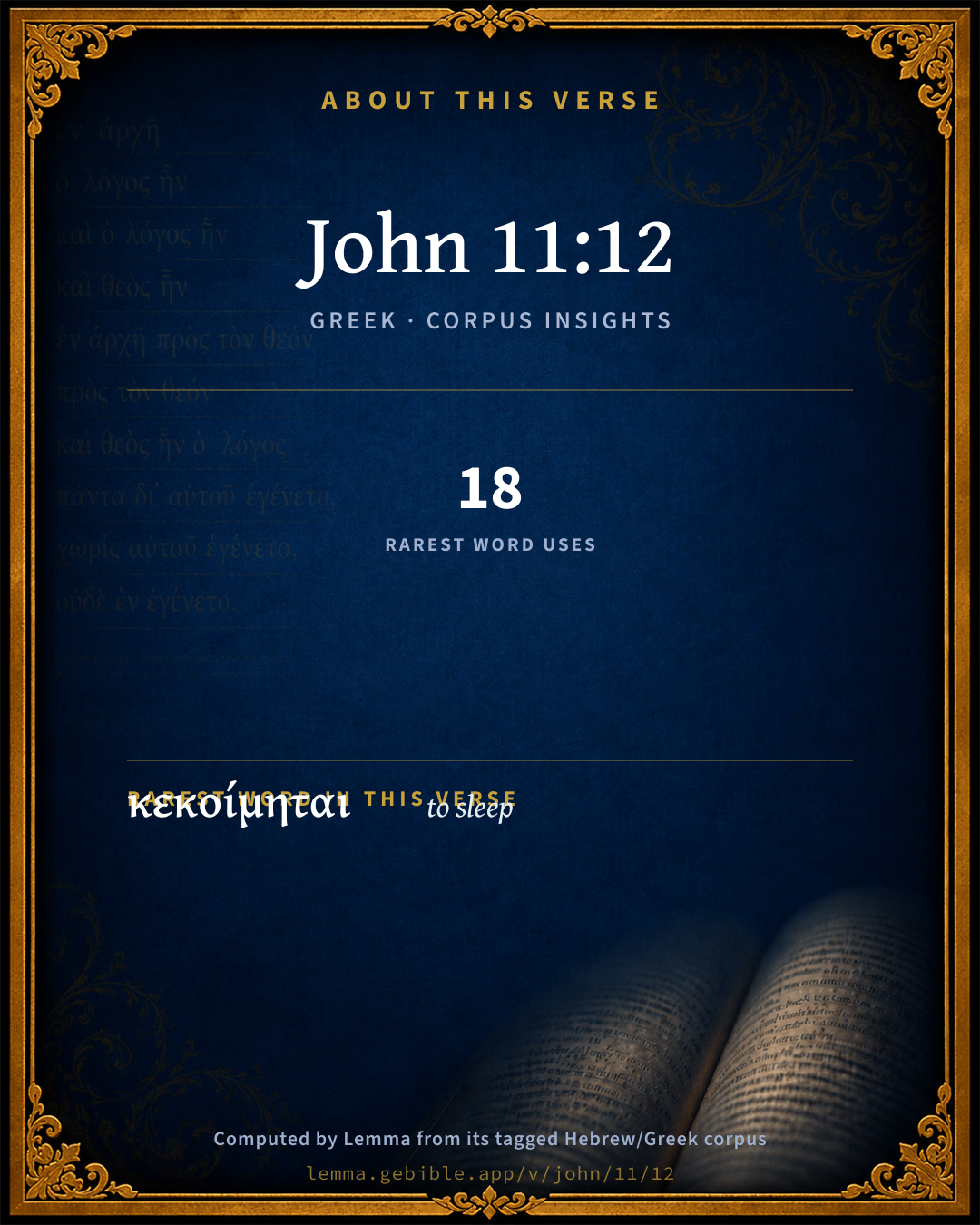
The rarest word here is κεκοίμηται to sleep G2837 — appearing just 18 times in the whole Greek New Testament.

Shared distinctive vocabulary

κεκοίμηται to sleep G2837 occurs in 18 verses of the Greek New Testament. Also found in:

Where the printed editions differ

1 variant

Places in this verse where the major printed Greek editions disagree on the wording in a way that affects the translation — a comparison of editions, not a manuscript-by-manuscript collation. The editions are the modern critical texts (Nestlé-Aland 28/27, SBL, Westcott-Hort, Tregelles, Tyndale House) and the traditional texts behind the KJV (the Textus Receptus and the Byzantine/Majority text). It is not a claim about which reading is original.

  1. Different wording
    αὐτῷ·

    “to Him;”

    In NA28NA27TynSBLWHTreg Not in TRByz

    αὐτοῦ (autou) 'of him' occurs in traditional manuscripts (TR+Byz) instead of αὐτῷ· (autō) 'to Him;' in older manuscripts (NA28+NA27+Tyn+SBL+WH+Treg)

Textual data: Translators Amalgamated Greek New Testament (STEPBible TAGNT) · CC BY 4.0.

Commentary

Notes on John 11:12 from classic Christian and Jewish commentators (each source and its license shown beneath its notes). The classic Christian expositions comment on the surrounding passage and are grouped to its opening verse, so a note may address several verses; the Jewish commentaries on the Tanakh (Rashi and others) are per-verse, so they appear only where the commentator wrote on this verse.

Lemma curates 59 commentaries, every one of them public domain or Creative Commons licensed, each selected and text-cleaned for this edition rather than reprinted as found. About our sources →

Bengel's Gnomon

Johann Albrecht Bengel

Joh 11:12. Εἰ κεκοίμηται, if he sleep) Often a long sleep is a means of restoration to health. The disciples were supposing that the sleep was sent to Lazarus by Jesus, in order that what He had Himself foretold might come to pass: Joh 11:4, “This sickness is not unto death, but, etc., that the Son of God might be glorified thereby.”

Bengel's Gnomon of the New Testament — English translation (T&T Clark, Edinburgh, 1860) — public domain. Text from a community e-Sword module.

Jamieson, Fausset & Brown

Robert Jamieson, A. R. Fausset & David Brown

if he sleep, he shall do well--literally, "be preserved"; that is, recover. "Why then go to Judea?"

Jamieson, Fausset & Brown — Commentary Critical and Explanatory on the Whole Bible (1871) — public domain (CC PDM 1.0). Text via the HelloAO Bible API.

Adam Clarke's Commentary

Verse 12. If he sleep, he shall do well.] That is, if he sleep only, c. Though the word sleep frequently meant death, (see Ac 7:60; 1Co 11:30; 1Co 15:18, 1Co 15:20), yet, as it was an ambiguous term, the disciples appear here to have mistaken its meaning. Because, in certain acute disorders, the composing the patient to rest was a favourable sign; therefore the words, If he sleep, he shall do well, or recover, became a proverbial forth of speech among the Jews. In most diseases, sleep is a very favourable prognostic: hence that saying of Menander: -

Ὑπνος δε πασης εϚιν ὑγιεια νοσου.

Sleep is a remedy for every disease.

See Grotius here. The meaning of the disciples seems to have been this: There can be no need for thee to go into Judea to awake our friend Lazarus; he will awake time enough, and his very sleep is a presage of his recovery: therefore do not hazard thy life by going.

Adam Clarke's Commentary on the Bible (1810–1826) — public domain. Text from a community e-Sword/MySword module.

John Calvin's Commentaries

12. If he sleepeth, he will recover. Replying that sleep will have a salutary effect on Lazarus, they thus endeavor indirectly to dissuade Christ from going thither. And yet they do not craftily or deceitfully turn aside Christ’s words to suit their own purpose, on the pretense of not understanding what he said; but, thinking that he spoke about sleep, they gladly seize this opportunity of avoiding danger. Augustine, and many writers since his time, speculate about the word sleep, alleging that the reason why it is applied to death is, because it is as easy for God to raise the dead to life, as it is for us to perform the customary act of awaking those who are asleep. But that nothing of this sort came into the mind of Christ, may be inferred from the constant use of the term in Scripture; and since even profane writers usually apply this word Sleep to Death, there was unquestionably no other reason why it came into use, but because a lifeless corpse lies without feeling, just as the body of a man who is in a profound sleep. Hence, also, sleep is not inappropriately called the image of death, and Homer calls it the brother of death, (κασίγνητος θανάτουυ.) Since this word denotes only the sleep of the body, it is prodigiously absurd to apply it — as some fanatics have done — to souls, as if, by being deprived of understanding, they were subject to death.

But I go to awake him. Christ asserts his own power, when he says that he will come to awake Lazarus; for, though, as we have said, the word sleep does not express the facility of the resurrection, yet Christ shows that he is Lord of death, when he says, that he awakes those whom he restores to life.

John Calvin's Commentaries (1540-1563) — public domain. Text from the Calvin Translation Society English edition (1840s-50s) via the Christian Classics Ethereal Library (ccel.org). Calvin's coverage is partial (roughly two-thirds of the Bible); uncommented books and verses are honest gaps, never fabricated. The 19th-century editor's footnotes and remarks are omitted so the notes are faithfully Calvin's own voice.

Ellicott's Commentary for English Readers

(12) Then said his disciples.—Better, Therefore . . . Their remark immediately arises out of what our Lord has said. They are glad to catch at any reason for not going to Judæa.

If he sleep, he shall do well.—More exactly, If he be fallen asleep, he shall be saved. There could be, therefore, no reason for His going, as the disease had passed the crisis. Sleep is given by the Rabbis as one of six favourable symptoms, and that it is so is a common-place in authors of all periods. From the apparent suddenness of the attack, and rapidity of the progress of the disease, it would seem to have been the “great fever” which was common in Palestine (comp. Joh_4:52, and especially Note on Luk_4:38), and in which sleep would be the sign that the fever had ceased.

A Bible Commentary for English Readers, edited by Charles John Ellicott (1878–1897) — public domain. Text from a community e-Sword module.

The Cambridge Bible for Schools and Colleges

gen. ed. J. J. S. Perowne

12. Then said his disciples] Better, Therefore said the disciples to Him. They catch at any chance of escape from the dreaded journey.

if he sleeps he shall do well] Better, if he be fallen asleep, he shall be saved, will be cured. Probably they thought that Christ meant to go and cure Lazarus (Joh_11:37, comp. Joh_9:3); and here they infer from his sleeping that he will recover without Christ’s aid: consequently Christ need not go. They are too full of anxiety to notice Christ’s significant words ‘I go, that I may awake him,’ whereas the rendering in our Bible reads like an expostulation against waking him, as if it meant ‘a sick man should not be disturbed.’ For other instances in which the disciples grossly misunderstand Christ, see Joh_4:33, Joh_14:5; Joh_14:8; Joh_14:22; Mat_16:7; and comp. Joh_3:4; Joh_3:9, Joh_4:11; Joh_4:15, Joh_6:34; Joh_6:52, Joh_7:35, Joh_8:22; Joh_8:33; Joh_8:52. This candour in declaring their own failings adds to our confidence in the veracity of the Evangelists. It is urged that the misunderstanding here is too gross to be probable: but they had not unnaturally understood Christ Himself to nave declared that Lazarus would not die (Joh_11:4); this being so, they could not easily suppose that by sleep He meant death. Moreover, when men’s minds are on the stretch the strangest misapprehensions become possible.

The Cambridge Bible for Schools and Colleges (gen. ed. J. J. S. Perowne; Cambridge University Press, 1878–1918) — public domain. Text from a community e-Sword module.

John Gill's Exposition

Then said his disciples, Lord, if he sleep,.... Soundly, quietly, and comfortably, and takes rest in it:

he shall do well; or "be saved" from the disease; he will be delivered from it; he will recover out of it; it is a sign the distemper is leaving him, and he is growing better, and will be restored to his health again: the Ethiopic version renders it by many words, "he will be well", and "will awake", and "will live". Sound sleep is a sign of health. This they said to, put off their master from going into Judea, fearing the danger he would be exposed unto.

John Gill's Exposition of the Whole Bible (1746–1763) — public domain (CC PDM 1.0). Text via the HelloAO Bible API.

Trapp's Complete Commentary

John Trapp

12 Then said his disciples, Lord, if he sleep, he shall do well.

Ver. 12. If he sleep, he shall do well] Sleep (saith one) is the nurse of nature, the sweet parenthesis of all thy griefs and cares.

John Trapp, A Commentary or Exposition upon All the Books of the Old and New Testament (1647–1656) — public domain. Text from a community e-Sword module.

Albert Barnes' Notes on the Bible

If the sleep, he shall do well - Sleep was regarded by the Jews, in sickness, as a favorable symptom; hence it was said among them, “Sleep in sickness is a sign of recovery, because it shows that the violence of the disease has abated” (Lightfoot). This seems to have been the meaning of the disciples. They intimated that if he had this symptom, there was no need of his going into Judea to restore him.

Albert Barnes' Notes on the Bible (1834–1885) — public domain. Text from a community e-Sword/MySword module.

Haydock's Catholic Bible Commentary

To men indeed he was dead, but to God he slept. For the Almighty as easily raised him from his grave, as man can raise the slumberer from his bead. (St. Augustine, tract. 49. in Joan.)

George Leo Haydock (1774–1849), Haydock's Catholic Family Bible and Commentary, 1859 edition — public domain. Excludes Psalms (Douay-Rheims chapter numbering differs from Protestant) and Deuterocanonical books (Catholic canon only).

Matthew Poole's English Annotations

Sleeping moderately is a good sign, we know, in most diseases; this makes the disciples say, that if Lazarus slept he should do well.

Matthew Poole's English Annotations on the Holy Bible (1683–1685) — public domain. Text from a community e-Sword/MySword module.

Whedon's Commentary on the Bible

Daniel D. Whedon

12. If he sleep—Our Lord’s words were intentionally ambiguous; and the disciples avail themselves of the ambiguity of the language to hint that Lazarus is well enough without him, and so show the needlessness of the hazardous journey. Refreshing sleep is an encouraging symptom, and often the best of medicines.

Daniel D. Whedon (gen. ed.), Commentary on the Old and New Testaments (1874–1909) — public domain. Text from a community e-Sword module.

The Pulpit Commentary

The disciples therefore say unto him, Lord, if he have fallen asleep, he will recover. Wunsche quotes "Berach," fol. 57, b, "Sleep is a good sign for the sick." The language of the disciples is somewhat remarkable; at least their misunderstanding is puzzling (Reuss and Strauss think it is a sign of the unhistorical); but it probably arose out of the statement, made two days before, that "the sickness was not unto death," and from their eager and affectionate desire to prevent their Lord"s retraining to Judaea. If he have fallen asleep, he well recover (be saved). The whole narrative is throbbing with deeper meanings than lie on the surface of it. The theory of the sanitary effects of sleep in fever are well known, and the rousing from such sleep might seem hazardous; but the disciples were catching at straws to save their Master.

The Pulpit Commentary (1880–1919), ed. H.D.M. Spence-Jones & Joseph S. Exell — public domain. Text from a community e-Sword module.

Burkitt's Expository Notes on the New Testament

William Burkitt

Observe here, 1. How desirous the disciples were that Christ should not go to Bethany where Lazarus was, Bethany being within two miles of Jerusalem, where the seat of our Saviour’s enemies was. But our Lord, knowing his call to be clear, resolves to go; Nevertheless, says Christ, let us go unto him.

O love, stronger than death! the grave cannot separate betwixt Christ and his friends: other friends accompany us to the brink of the grave, and there they leave us to worms and dust; for death hath both horror and noisomeness to attend it: but for thee, O Saviour, the grave-stone, the earth, the coffin, are no bounders of thy dear respects.

Blessed be God, that neither life nor death can separate from the love of Christ: but even after death and burial he is graciously affected to those he loves. Christ has a gracious regard to the dust of his saints: though his holy ones see corruption, they not always lie under the power of corruption; their dead bodies are a part of the undoubted members of Christ’s mystical body.

Blessed be God, the time is coming, when Christ shall knock at the door of his children’s graves, and call them up out of their bed of dust, and they shall hear the voice of he Son of God, and live.

Observe, 2. The wise and holy design of Christ in delaying to go to Bethany till Lazarus was dead; namely, that he might at once raise Lazarus’s dead body, and his disciples faith, confirming them in the belief, that he was the Son of God, and the true Messias.

But could the faith of the apostles want confirmation, who had seen so many miracle wrought by our Saviour, and had lived under his minstry all the time of it?

Yes; the faith of the most eminent saint, even of the apostles themselves, want confirmation in this state of weakness and imperfection, and is capable of growth. I am glad for your sakes, that I was not there, to the intent ye may believe.

Observe, 3. The great passion which Thomas expresses upon the notice given by Christ of Lazarus’s death: plainly, Lazarus is dead, says Christ; Let us go, and die with him, says Thomas.

Oh what passionate and impatient expressions do sometimes drop from our mouths, on occasion of the death of our dear relations! we are ready to be so affected with the death of our friends, as to wish ourselves out of the world, that we might be with them. But we must remember, that it is God that appoints us our several posts, and particular stations, which we must keep, till the wisdom of God sees fit to remove us.

William Burkitt's Expository Notes on the New Testament (1700–1703) — public domain. Text from a community e-Sword module.

unfoldingWord translationNotes

Door43 World Missions Community

General Information:

In verse 13 there is a break in the story line as John comments on the disciples' misunderstanding about what Jesus meant when he said Lazarus was asleep. (See: Background Information)

if he has fallen asleep

The disciples misunderstand Jesus to mean that Lazarus is resting and will recover.

Then Jesus said to them plainly

"So Jesus told them in words that they could understand"

translationWords

disciple

lord

asleep

Lazarus

die

rest

unfoldingWord translationNotes — © Distant Shores Media and the Door43 World Missions Community, licensed CC BY-SA 4.0. Source: git.door43.org/Door43/en_tn.

Cambridge Greek Testament for Schools and Colleges

12. εἶπον οὖν αὐ. οἱ μ. The disciples therefore said to Him;—catching at any chance of escape from the dreaded journey. They accept it as quite natural that Jesus should know that Lazarus sleeps, and perhaps they think that He has caused the sleep. This slight touch is strong proof of their belief in His power.

εἰ κεκ., σωθήσεται. If he is fallen asleep, he shall be saved. The word σωθήσεται is perhaps purposely chosen as being capable of a spiritual meaning. The whole narrative is symbolical of spiritual death and resurrection; and S. John perhaps intimates that the disciples, like Caiaphas (Joh 11:50), spoke more truth than they themselves knew. Of course they mean, ‘He will recover.’ Comp. Ajax, 263.

ἀλλ’ εἰ πέπαυται, κάρτ’ ἄν εὐτυχεῖν δοκῶ.

Their first thought probably was that Jesus meant to go and cure Lazarus; and now they think that he will recover without His going, and that therefore He need not go. The A.V. reads like an expostulation against waking Lazarus, as if it meant ‘a sick man should not be disturbed’: but they are too full of anxiety about πορεύομαι to notice ἵνα ἐξυπνίσω αὐτόν. It is the going, not the wakening, that perturbs them. For other instances in which the disciples grossly misunderstand Christ, see Joh 4:33, Joh 14:5; Joh 14:8; Joh 14:22; Mat 16:7; and comp. Joh 3:4; Joh 3:9, Joh 4:11; Joh 4:15, Joh 6:34; Joh 6:52, Joh 7:35, Joh 8:22; Joh 8:33; Joh 8:52. This candour in declaring their own failings adds to our confidence in the veracity of the Evangelists. It is urged that the misunderstanding here is too gross to be probable: but they had not unnaturally understood Christ Himself to have declared that Lazarus would not die (Joh 11:4); this being so, they could not easily suppose that by sleep He meant death. Moreover, when men’s minds are on the stretch the strangest misapprehensions become possible.

Cambridge Greek Testament for Schools and Colleges (Cambridge University Press, 1896; 21 vols, various authors incl. Carr, Maclear, Plummer, Farrar, Lumby, Moule, M. R. James, Simcox) — public domain. Text from a community e-Sword module.

Alford’s Greek Testament

Henry Alford

12.] Jesus, delivered to death, the Resurrection, and the Life, and the Judgment.

12.] They evidently understand the sleep announced to them by Jesus as a physical fact,—if he has fallen asleep,—and a token of a favourable crisis, and σωθήσεται (as in E. V. he shall do well), = his recovery,—will probably be the result.

Henry Alford, The Greek Testament (1849–1861) — public domain. Text from a community e-Sword module.

International Critical Commentary

12. εἶπαν οὖν οἱ μαθηταὶ αὐτῷ. So BC*Θ against the rec. οἱ μαθηταὶ αὐτοῦ: אDW have αὐτῷ οἱ μαθηταί.

κύριε. For this mode of address, see on 1:28 and 13:13.

εἰ κεκοίμηται, σωθήσεται, “if he has fallen asleep, he will recover.” They understood Jesus to mean that the sick man had fallen into a natural sleep—not the sleep of death. This was a favourable symptom, and suggested that Lazarus would get well. It puzzled them to think that Jesus would wish to wake him from health-giving sleep. No doubt, they were glad of another argument by which they might dissuade their Master from facing the dangers of Judæa. The journey would be to no good purpose.

σωθήσεται, “he will get well.” For this use of σώζειν, see on 3:17.

International Critical Commentary — older volumes (1896–1929), various authors — public domain. Text from a community e-Sword module.

Vincent's Word Studies in the New Testament

Marvin R. Vincent

Shall do well [σωθησεται] . Literally, shall be saved. Rev., he will recover. Wyc., shall be safe. Tyndale's Version of the New Testament, shall he do well enough.

Marvin R. Vincent, Word Studies in the New Testament (1887–1900) — public domain. Text from a community e-Sword/MySword module.

Lesson kit

Teaching starters — assembled from the data on this page, not authored interpretation. Every prompt links to the verse data it draws on. Edit before teaching.

John, in the Gospels, opens this verse with 9 words (9 distinct Greek lemmas). Its most distinctive word is koimáō (“to sleep”). A historical commentator’s framing appears above. Read the whole chapter for the surrounding context.

Discussion questions

  1. What does “to sleep” (koimáō) contribute to the verse as a whole?
  2. Matthew 27:52 shares the word «to sleep» with this verse. How do the two illuminate each other?
  3. These translations render this verse differently; the difference is in the English rendering, not the original. What questions does that raise?
  4. Reading how Bengel's Gnomon and Jamieson, Fausset & Brown read this verse, where do the two commentators agree and where do they part?

Things to notice

Reading settings

Reading text

Shown beneath each verse's original-language words.

Old Testament
Old Testament edition

Read the OT as the Masoretic Hebrew (MT) or the Greek Septuagint (LXX).

English shown for the Greek Septuagint (in the Hebrew ↔ Greek comparison).

Comparing translations? Open the Compare panel on any verse page to stack up to four side by side.