John 7:11

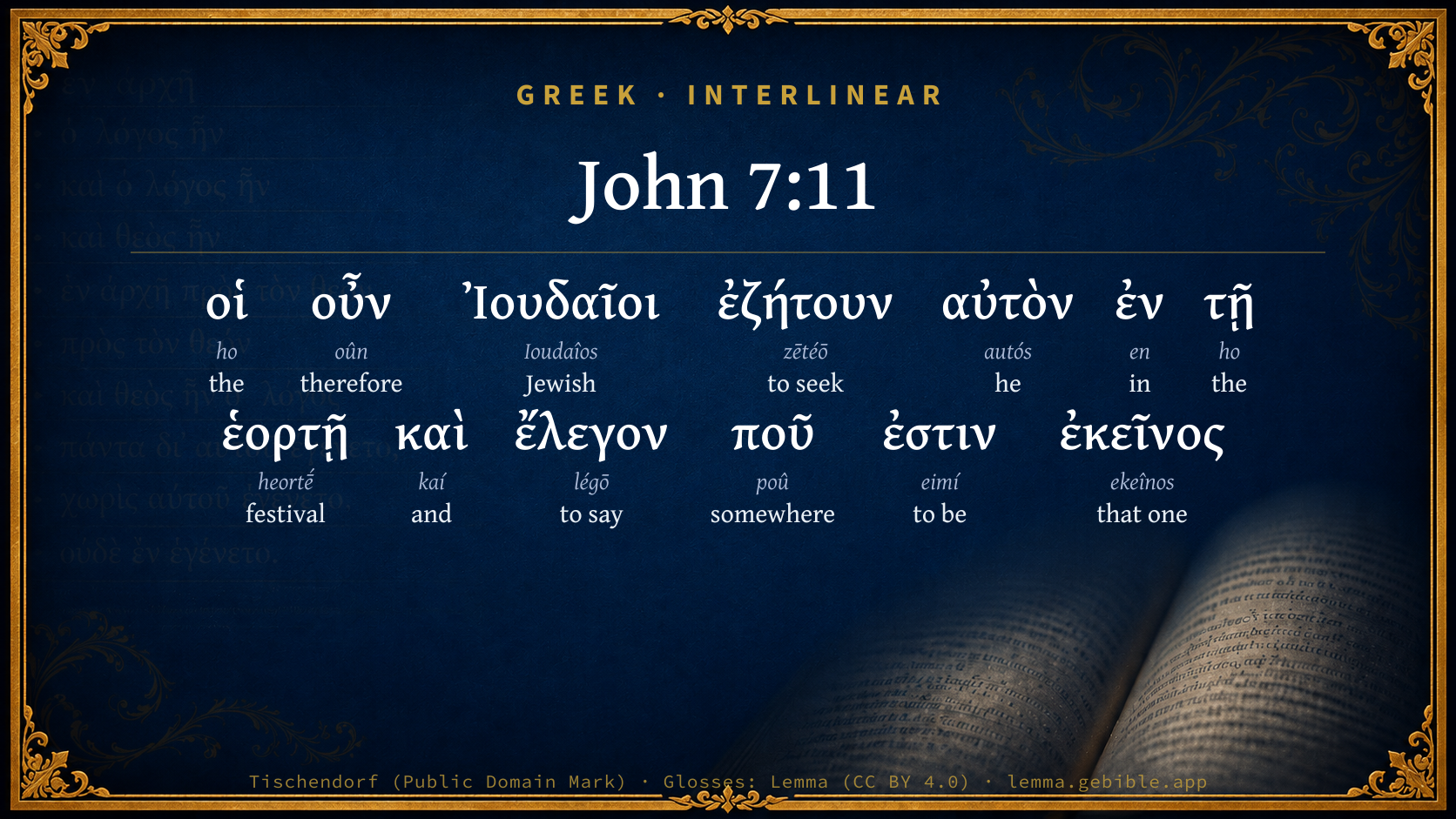
Greek (Tischendorf 8th ed.) John 7:11 appears in the Greek New Testament. The text above is from the Tischendorf 8th edition. Each word links to its Strong’s number and a concise gloss. Click any word for its full Thayer’s Greek Lexicon entry.
Download image
Cite this verse

John 7:11 (World English Bible). Public Domain. Lemma interlinear Bible study tool, https://lemma.gebible.app/v/john/7/11.

Show BibTeX & RIS
BibTeX
RIS
English Translation
The Jews therefore sought him at the feast, and said, "Where is he?"
World English Bible · Public Domain
Download a study sheet

One document with this verse’s original text, its word-by-word gloss line, the meaning frame, cross-references with their text, attributed commentary, and full source and license credits — printable, and it pastes into notes with its structure intact.

This verse Autodidact and up

Study sheet (.html) Plain text (.txt)

A passage Seminary Student

Up to 50 verses in one chapter. A passage sheet keeps up to 6 commentary sources and 12 cross-references per verse, in the order this page ranks them, and says so on the sheet whenever that leaves anything out. Ask for a single verse and you get the Autodidact verse sheet above.

Everything on this page stays free to read, with no account — the sheet is a download of what is already on screen, not access to it.

Want to remove ads? Support Godless Engineer
Compare translations 3

The same verse in 3 English versions, stacked beneath the original-language interlinear above. Click any original word for its lexicon entry.

Each is an independent rendering of the whole verse — the interlinear is not word-aligned to these translations.

Highlighted words mark where these versions differ — a whole-verse word diff, not a word-by-word alignment.

  • World English Bible Public Domain
    The Jews therefore sought him at the feast, and said, "Where is he?"
  • King James Version Public Domain
    Then the Jews sought him at the feast, and said, Where is he?
  • unfoldingWord Literal Text CC BY-SA 4.0
    Therefore, the Jews were looking for him at the festival and saying, “Where is that one?”

unfoldingWord Literal Text — © unfoldingWord, licensed CC BY-SA 4.0. Word-aligned USFM3 via Door43 (git.door43.org/unfoldingWord/en_ult).

Versions to compare (up to 4)

3 of 4 selected

Show all 19 translations

Every available English version of this verse, each an independent rendering of the whole verse.

  • World English Bible Public Domain
    The Jews therefore sought him at the feast, and said, "Where is he?"
  • Berean Standard Bible Public Domain
    So the Jews were looking for Him at the feast and asking, “Where is He?”
  • Majority Standard Bible Public Domain
    So the Jews were looking for Him at the feast and asking, “Where is He?”
  • King James Version Public Domain
    Then the Jews sought him at the feast, and said, Where is he?
  • American Standard Version (1901) Public Domain
    The Jews therefore sought him at the feast, and said, Where is he?
  • Revised Version (1885) Public Domain
    The Jews therefore sought him at the feast, and said, Where is he?
  • Geneva Bible (1599) Public Domain
    Then the Iewes sought him at the feast, and saide, Where is hee?
  • Douay-Rheims (1899) Public Domain
    The Jews therefore sought him on the festival day, and said: Where is he?
  • Young's Literal Translation Public Domain
    the Jews, therefore, were seeking him, in the feast, and said, `Where is that one?'
  • Literal Standard Version CC BY-SA 4.0
    the Jews, therefore, were seeking Him in the celebration, and said, “Where is that One?”
  • Unlocked Literal Bible CC BY-SA 4.0
    The Jews were looking for him at the festival and said, “Where is he?”
  • unfoldingWord Literal Text CC BY-SA 4.0
    Therefore, the Jews were looking for him at the festival and saying, “Where is that one?”
  • Darby Bible Public Domain
    The Jews therefore sought him at the feast, and said, Where is he?
  • World Messianic Bible Public Domain
    The Judeans therefore sought him at the feast, and said, “Where is he?”
  • Webster's Bible Public Domain
    Then the Jews sought him at the feast, and said, Where is he?
  • Free Bible Version CC BY-SA 4.0
    Now at the festival the Jewish leaders were searching for him and kept on asking, “Where is he?”
  • Bible in Basic English Public Domain
    At the feast the Jews were looking for him and saying, Where is he?
  • Text-Critical English NT CC BY 4.0
    Now the Jews were looking for him at the feast, saying, “Where is that man?”
  • Tyndale New Testament (1534) Public Domain
    Then sought him the Iewes at the feast and sayde: Where is he?

Literal Standard Version (2020), Covenant Press — licensed CC BY-SA 4.0. Text via the HelloAO Bible API (eBible.org). Unlocked Literal Bible (unfoldingWord) — licensed CC BY-SA 4.0. Text via the HelloAO Bible API (eBible.org). unfoldingWord Literal Text — © unfoldingWord, licensed CC BY-SA 4.0. Word-aligned USFM3 via Door43 (git.door43.org/unfoldingWord/en_ult). Free Bible Version, Dr. Jonathan Gallagher — licensed CC BY-SA 4.0. Text via the HelloAO Bible API (eBible.org).

Word by word

More ways to search: Search by grammar → Find every occurrence → Compare this word →

Practice this passage: Drill this verse → Learn its vocabulary →

About this verse

These counts appear in no published source. They are computed here, from the morphology-tagged text and Lemma’s own curated glosses. What Lemma adds →

13
words
12
distinct lemmas
Gospels
section

Notable vocabulary

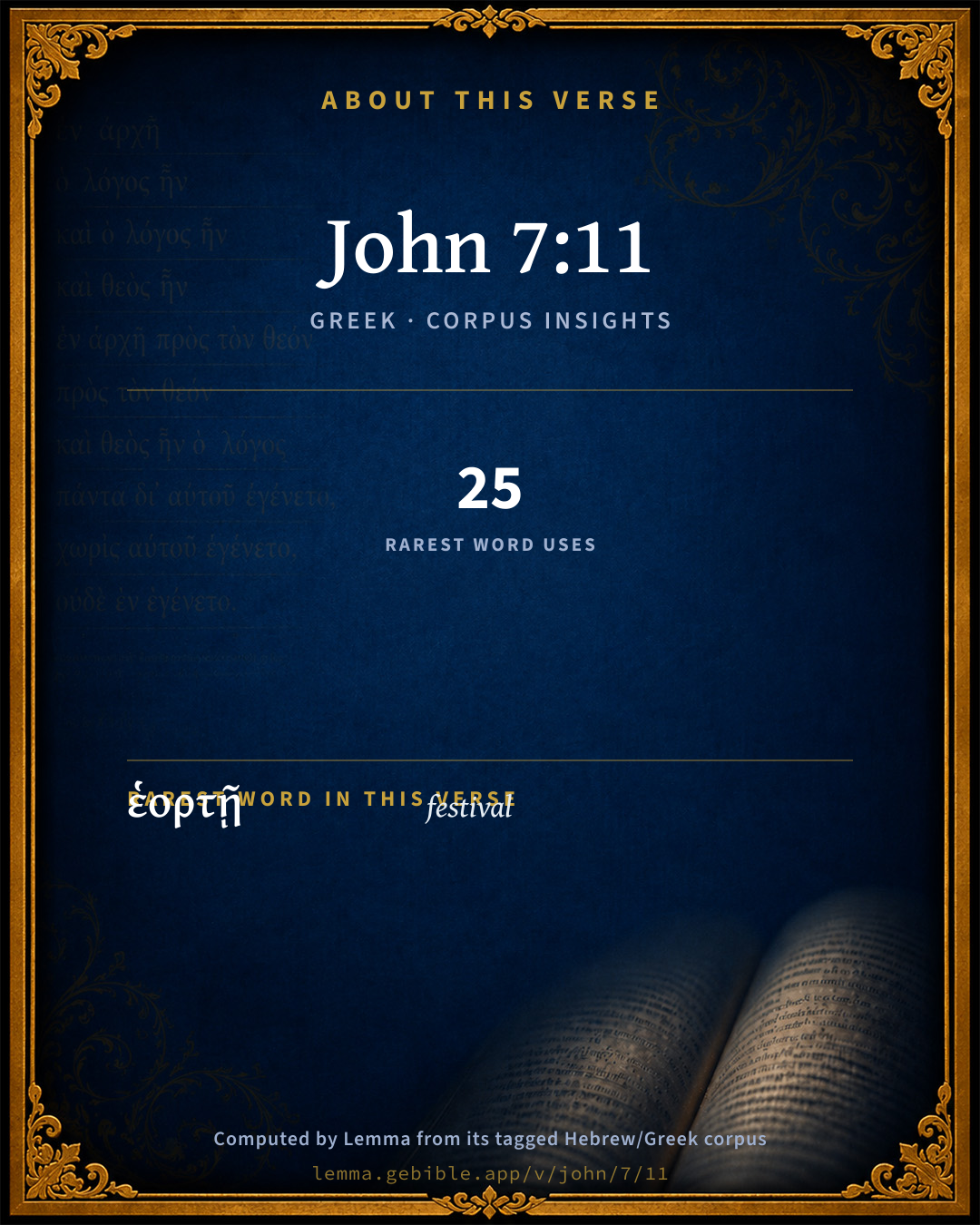
The rarest word here is ἑορτῇ festival G1859 — appearing just 25 times in the whole Greek New Testament.

Shared distinctive vocabulary

ἑορτῇ festival G1859 occurs in 23 verses of the Greek New Testament. Also found in:

Repetition

A word recurs within this verse:

Cross-references

1

Topical passages linked to John 7:11 in the Treasury of Scripture Knowledge — connected by theme and wording, ordered by reader-vote popularity; previews shown in the World English Bible.

  • John 11:56 Then they sought for Jesus and spoke one with another, as they stood in the temple, "What do you think--that he isn't coming to the feast at all?"

Cross-references courtesy of OpenBible.info (CC BY 4.0).

Commentary

Notes on John 7:11 from classic Christian and Jewish commentators (each source and its license shown beneath its notes). The classic Christian expositions comment on the surrounding passage and are grouped to its opening verse, so a note may address several verses; the Jewish commentaries on the Tanakh (Rashi and others) are per-verse, so they appear only where the commentator wrote on this verse.

Lemma curates 59 commentaries, every one of them public domain or Creative Commons licensed, each selected and text-cleaned for this edition rather than reprinted as found. About our sources →

Joseph Benson's Commentary

Joh 7:11-13. Then the Jews — The men of Judea, particularly of Jerusalem, not seeing him appear as usual; sought him at the feast — Namely, at the beginning of it; and said, Where is he? — What is become of Jesus? What can have prevented his coming to the feast? As he had formerly attended the principal feasts, and signalized himself by the miracles which he wrought, he had made himself the subject of much discourse and observation. And there was much murmuring among the people — Γογγυσμος πολυς, much whispering: many private debates, especially among those who were come from distant parts. The word murmuring is not proper in this place, as it conveys the notion of discontent and grumbling, which does not appear to be suggested by the original term. It expresses solely the secrecy and caution which the people found it convenient to use in speaking on this subject, being prompted not by their resentments but by their fears. And it stands opposed to παρρησια, openly, which occurs in the next verse. For some said, He is a good man — Eminently pious and benevolent; others — Being under the force of strong prejudices, and suspecting the worst; said, Nay, but he deceiveth the people — Seduces and misleads the ignorant populace, and the wiser part of the nation must see that he will undoubtedly at last draw his followers into ruin, as some other impostors have lately done. See Act 5:36-37. Howbeit — Though they thus privately debated the matter among themselves; no man spake openly of him — Namely, in his favour; for fear of the Jews — Of those that were in authority, these being jealous of his growing fame, and looking with a very malignant eye on all who took any peculiar notice of him, or manifested any regard for him. In the mean time, those that thought contemptibly of him, might doubtless have spoken their minds as freely as they pleased, being in no danger of punishment from the rulers or higher classes of the people.

Joseph Benson's Commentary on the Old and New Testaments (1811–1818) — public domain. Text from a community e-Sword module.

Whedon's Commentary on the Bible

Daniel D. Whedon

Jesus overmasters the commotions at the Feast of Tabernacles, Joh_7:11-53.

His first Feast-of-Tabernacles discourse, Joh_7:11-36.

In the following striking narrative of the fermentation on his account at Jerusalem, we must first note the different parties engaged. There are, first, the Jews, (Joh_7:11,) or hostile Judaists, who embrace the special partisans of the rulers. Second, there are the people, (Joh_7:12,) who consist of the miscellaneous crowd who have come to the feast; including friends, enemies, and indifferentists towards Jesus. Third, there are Jerusalemites, (Joh_7:25,) the permanent residents of the metropolis. The chief priests and rulers, being Pharisees, not being generally present, are the real conspirators against his life, who would set the people on, or would apprehend him by their officers.

11. Where is he?—While he is in secret, engaged in his sacred mission, the Jews of the capital are on the alert for his coming, ready, doubtless, to make an end of his life.

Daniel D. Whedon (gen. ed.), Commentary on the Old and New Testaments (1874–1909) — public domain. Text from a community e-Sword module.

Godbey's Commentary on the New Testament

William B. Godbey

CHAPTER 2

JESUS AT THE FESTIVAL OF TABERNACLES

Joh 7:11-16. “Therefore the Jews continued to seek Him at the feast, and say, Where is He? And there was much murmuring concerning Him among the multitude; some said that He is good; others said, No, but He deceiveth the multitude.”

V. 13. “No one, indeed, spoke openly concerning Him, on account of the fear of the Jews. And the festival already being midway, Jesus came up into the temple, and was teaching. Then the Jews were astonished, saying, How does this One know letters, having never been taught? And Jesus responded to them, and said, My teaching is not Mine, but of Him that sent Me.” Jesus began His ministry, according to the prophecies, by coming into the temple and purifying it, casting out the buyers and sellers. Remaining but a few days after the Passover in Judea, He returned to Galilee, His native land, where He remained, preaching, healing the sick, and casting out demons, till the next Passover, which He also attended, returning to Galilee very soon after its adjournment. Remaining in Galilee the ensuing year, He did not go up to Jerusalem to the next Passover, which was the third in His ministry, evidently because the multitude, going from the cities around the Galilean Sea, were determined to crown Him King; consequently remaining in Galilee six months longer, with two little exceptions — the one when he went into Syria to Caesarea-Philippi, and the other when He went into Phenicia, the land of Tyre and Sidon. Now the Feast of Tabernacles, coming off in September, has rolled round. Having declined to go in the crowd, with His brothers and friends, in time for the opening, He goes on later, accompanied by His apostles, preaching and working miracles in Samaria as He passed along, arriving in Jerusalem about Wednesday, the festival, commemorative of Israel’s wilderness peregrinations, having opened on Sunday, and, as it says here, went immediately into the temple and began to teach. The critics even deny that He was ever in the temple proper, that being reserved for the priests alone; but this word “temple” was really applied to the Holy Campus, which is said to contain thirty-five acres, having very many elegant buildings on it at that time, and quite a number now, in several of which — e. g., Solomon’s Porch and the Treasury — He taught the people; but as the vast multitudes during the festivals occupied the open air, it is more than likely that the most of His preaching in the temple was out on the pavement of that vast area, and over- canopied by naught save the blue, arching skies. During this eighteen months’ absence from Jerusalem and Judea, constant reports were coming from His fields of labor in Galilee, thrilling the people with wonder, curiosity, and amazement, all revolving in their minds what kind of a man can He be. Meanwhile, the high priests and Pharisees are most cunningly maneuvering to break the force of these thrilling reports and prejudice the people against Him, frequently sending their sharpest critics all the way to Galilee to hound Him wherever He went, hanging with diabolical chicanery on His lips, watching and criticizing every word, twisting and perverting all His utterances, laboring night and day to catch up something which they can pervert and magnify into an accusation against Him, so, if possible, to have Him arrested and turned over to the Sanhedrin or the proconsul. They charge Him with deceiving the multitude. How? Why, impressing them that He is the Messiah, when they claim that He is not. By the statement that He had never been taught, is simply meant that He had never gone to school to a rabbi that they knew of, there being no common schools in that day. During this long interval of His absence from the South, the scribes and Pharisees have done their utmost to obliterate His influence in Jerusalem and Judea. Now, thirty months of His ministry having passed away, and not perhaps more than one month, all told, spent in the metropolis, but nearly all of His time having been appropriated in Galilee, an obscure country compared with Jerusalem and Judea, after the vociferous clamors of the clergy all this time, telling the people that He would never come back there, and if He did they would arrest Him, His sudden and bold appearing and preaching amid the vast multitudes on the Temple Campus produces a tremendous sensation, raising popular inquiry, and exciting curiosity to the very acme, and at the same time arousing all the clergy and official laity to unite against Him, determined if possible to so implicate Him as to secure His arrest, feeling chagrined before the multitude, who had so often heard them boasting that He would never come back, and certifying that if He did they would arrest Him and put Him to death, as they claimed that He richly deserved, as a false prophet.

William B. Godbey, Commentary on the New Testament (1896–1900) — public domain. Text from a community e-Sword module.

Bengel's Gnomon

Johann Albrecht Bengel

Joh 7:11. Ἐκεῖνος, He [emphatic]) Truly no feast is a feast without Christ.

Bengel's Gnomon of the New Testament — English translation (T&T Clark, Edinburgh, 1860) — public domain. Text from a community e-Sword module.

Meyer's Critical & Exegetical Commentary

Heinrich August Wilhelm Meyer

Joh_7:11-12. Οὖν] For He did not come with the Galilean travellers.

οἱ Ἰουδαῖοι] not all the people (Hengstenberg, Baeumlein), but the opposing hierarchy; Joh_6:41; Joh_6:52, Joh_7:13; Joh_7:15. Their search is prompted by malice, not by aimless curiosity (Luthardt); see Joh_7:1; Joh_7:13. On ἐκεῖνος, which means the well-known absent one, Luther well remarks: Thus contemptuously can they speak of the man, that they cannot almost name Him. The peoples judgment of Him was a divided one, not frank and free, but timid, and uttered half in a whisper (γογγυσμός, murmuring, Joh_7:32).

Observe the change of number: ἐν τοῖς ὄχλοις: among the multitudes (the plural here only in John); τὸν ὄχλον: the people.

ἀγαθός] upright, a man of honour, no demagogue, seeking to make the people believe falsely that He was the Messiah. Comp. Mat_27:63.

Meyer — Critical and Exegetical Commentary on the New Testament — English translation by Peter Christie, edited by Frederick Crombie (T&T Clark, 1880) — public domain. Text from a community e-Sword module.

Expositor's Greek Testament

ed. W. Robertson Nicoll

Joh 7:11-13 . Disappointment at Jesus’ non-appearance .

Joh 7:11 . Οἱ οὖν Ἰουδαῖοι … ἐκεῖνος ; “the Jews,” possibly, as usual in John, the authorities (so Meyer, Weiss, etc.), and thus in contrast to the ὄχλοι of Joh 7:12 ; but Joh 7:15 rather indicates that the term is used more generally. They looked for Him, expecting that He would appear at least at this third feast. They asked ποῦ ἐστὶν ἐκεῖνος ; which Luther, Meyer, etc., think contemptuous; but ἐκεῖνος cannot thus be pressed. Cf. 1 John passim .

The Expositor's Greek Testament, edited by W. Robertson Nicoll (1897–1910) — public domain. Text from a community e-Sword module.

Godet's Commentaries

Frédéric Louis Godet

Vv. 11-13. “The Jews therefore sought him at the feast, and said, where is He? 12. And there was much murmuring concerning him among the multitudes.Some said, He is a good man. Others said, No, but he leads the multitude astray. However, no one spoke openly of him for fear of the Jews.”

This narrative justifies the circumspect action of Jesus. This popular agitation proves the immense sensation which had been produced by His appearance and the impression which His last sojourn in Jerusalem had left (chap. 5). We find again in this representation, Joh 7:11-13, the contrast which appears continually in our Gospel between those whom the light attracts and those whom it repels. The term γογγυσμός, murmuring, denotes the rumors in both senses, friendly and hostile. The ὄχλοι are the groups of pilgrims. ῎Αγαθός, good man, signifies here an upright man, in contrast with an impostor (“He leads the people astray”). Τὸν ὅχλον, the multitude (Joh 7:12), designates the common people who allowed themselves to be easily deluded by every demagogue. The words: No one spoke openly, must not be referred to those only who, though well disposed, did not dare to manifest aloud their sympathy. The rest also, those who said: “He is an impostor,” did not speak freely, in the sense that through servility they went in their expressions beyond what they really thought. Weiss thinks, on the contrary, that they would have said yet more that was evil of Him, if they had not feared the change on the part of the leaders to a more favorable judgment. This explanation seems to me scarcely natural. However it may be, a pressure coming from above was exerted upon all, upon those who were well-disposed towards Jesus, as upon those who were ill-disposed.

Frédéric Louis Godet — Commentaries on Luke, John, Romans, and 1 Corinthians — English translation (T&T Clark, Edinburgh, 1870s–1890s) — public domain. Text from a community e-Sword module.

Jamieson, Fausset & Brown

Robert Jamieson, A. R. Fausset & David Brown

Jews--the rulers.

sought him--for no good end.

Where is He?--He had not been at Jerusalem for probably a year and a half.

Jamieson, Fausset & Brown — Commentary Critical and Explanatory on the Whole Bible (1871) — public domain (CC PDM 1.0). Text via the HelloAO Bible API.

Adam Clarke's Commentary

Verse 11. Then the Jews sought him] By Jews here are to be understood the scribes, Pharisees, and rulers of the people, and not the inhabitants of the province of Judea. It appears, from the following verses, that many of the people were prejudiced in his favour, but they dared not to own it publicly for fear of the Jews, i.e. for fear of the rulers of the people.

Adam Clarke's Commentary on the Bible (1810–1826) — public domain. Text from a community e-Sword/MySword module.

John Calvin's Commentaries

11. The Jews therefore sought him. Here we ought to consider what was the condition of the Church. For the Jews, at that time, gaped for the promised redemption like hungry men; yet, when Christ appears to them, they remain in suspense. Hence arose that murmuring and that variety of opinions. That they whisper secretly is an indication of the tyranny which the priests and scribes exercised over them. It is a shocking exhibition, indeed, that this Church, which was at that time the only Church on earth, is here represented to us as a confused and shapeless chaos. They who rule, instead of pastors, hold the people oppressed by fear and terror, and throughout the whole body there is shameful desolation and lamentable disorder. By the Jews he means the common people, who, having been accustomed for two years to hear Christ, inquire about him, because he does not appear according to his custom. For when they say, Where is he? they describe a man whom they knew, and yet that word shows that they had not yet been earnestly moved, and that they always remained in doubt and suspense.

John Calvin's Commentaries (1540-1563) — public domain. Text from the Calvin Translation Society English edition (1840s-50s) via the Christian Classics Ethereal Library (ccel.org). Calvin's coverage is partial (roughly two-thirds of the Bible); uncommented books and verses are honest gaps, never fabricated. The 19th-century editor's footnotes and remarks are omitted so the notes are faithfully Calvin's own voice.

Ellicott's Commentary for English Readers

(11) The Jews—i.e., as before, and as in Joh_7:13; Joh_7:15, the official representatives of the nation. They kept seeking Him at the feast, where they naturally expected that He would be, and kept asking, without naming Him, Where is He? which is almost equivalent to Where is this fellow? Their question points out that their hostility had gone as far as a definite plot against Him, and that the knowledge of this was widely spread.

A Bible Commentary for English Readers, edited by Charles John Ellicott (1878–1897) — public domain. Text from a community e-Sword module.

The Cambridge Bible for Schools and Colleges

gen. ed. J. J. S. Perowne

11. the Jews] The hostile party, as usual: comp. Joh_7:1. Both here and in Joh_7:6 ‘then’ should rather be therefore: comp. Joh_6:53; Joh_6:67-68. The force of the ‘therefore’ here is ‘because they did not find Him in the caravan of pilgrims from Galilee.’

sought … and said] Both verbs are imperfects of continued action. They do not mention His name,—perhaps in contempt; ‘Where is that man?’ Comp. Joh_9:28.

The Cambridge Bible for Schools and Colleges (gen. ed. J. J. S. Perowne; Cambridge University Press, 1878–1918) — public domain. Text from a community e-Sword module.

John Gill's Exposition

And there was much murmuring among the people concerning him,.... There was a general whisper, and a private controversy and contention among the people about him, upon inquiry being made after him:

for some said he is a good man; a man of a good principle, of a good life and conversation; and who is good, kind, and beneficent, both to the bodies and souls of men; preaches good doctrine, and does many good things:

others said: nay, or denied him to be a good man:

but he deceiveth the people; drawing them off from the law of Moses, teaching them to break the sabbath, setting himself up for the Messiah, and asserting himself to be the son of God.

John Gill's Exposition of the Whole Bible (1746–1763) — public domain (CC PDM 1.0). Text via the HelloAO Bible API.

Trapp's Complete Commentary

John Trapp

11 Then the Jews sought him at the feast, and said, Where is he?

Ver. 11. Where is he?] Not, "where is Jesus?" They could not find in their hearts to call him by his name, they were so full of malice against him. So Joseph’s brethren called him not Joseph, but the Dreamer: Saul asked not for David, but the son of Jesse. After Stephen Brune the martyr was put to death, his adversaries commanded it to be cried, That none should make any more mention of him, under pain of heresy. And ubicunque invenitur nomen Calvini, deleatur, whereever, the name of Calvin is found, let it be removed, saith the Index expurgatorius. But what saith our Saviour, "Blessed are ye, when men shall hate you, and cast out your name as evil, for the Son of man’s sake," Luk 6:22. The wise historian observed, that the statues of Brutus and Cassias, Eo praefulgebant, quod non visebantur. They shine forth there because they were not visited. (Tacit. Annal.) And Cato said, he had rather men should question why he had no statue or monument erected to him than why he had.

John Trapp, A Commentary or Exposition upon All the Books of the Old and New Testament (1647–1656) — public domain. Text from a community e-Sword module.

Matthew Poole's English Annotations

Our Saviour’s constant going up to the Jewish feasts, made the rulers of the Jews, who sought to slay him at the feast of the passover, Joh 5:18, (which was but six months before this), because he had violated the sabbath, (as they interpreted his healing the impotent man on that day, and bidding him take up his bed and walk), and because he had made himself equal with God his Father; seek him the first days of the feast, speaking of him with great contempt and slight.

Matthew Poole's English Annotations on the Holy Bible (1683–1685) — public domain. Text from a community e-Sword/MySword module.

The Pulpit Commentary

Vers. 11-19. (2) The controversy among Jews" concerning Christ his first discussion with them.

The Jews therefore sought him at the feast. The ruling and hostile powers, the unbelieving hierarchy, Caiaphas and his party, (Joh_6:41, Joh_6:52; vers. 13, 15) because of his non-appearance in the Galilaean caravan, went hither and thither, saying, Where is he? ekeinov , "that notorious Person," whose claims maddened us some months agone, and whose deeds are being talked of throughout the city, whom the Galilaeans would have constrained to take up arms and crown: where is he? Luther said that their malice was so great that they forbore to name him. But we can hardly press the ekeinov so far as that.

"Where is he?

This question may indicate different thoughts and sentiments with regard to Jesus as asked by different persons. It may be looked upon

I AS THE QUESTION OF GENERAL INTEREST. There is no doubt that Jesus was the most interesting person of that age. His mighty works and his wonderful teaching had excited the interest of the general public, and had stirred society to its utmost depth. How many persons there were concerning whom no question was asked! They might come and go almost unnoticed. But not so Jesus. The general question with regard to him was, "Where is he?" His movements were keenly watched, and his presence or absence was keenly noticed.

II AS THE QUESTION OF WONDER. Although he was not at the last Passover, still he was in the habit of attending the national feasts at Jerusalem; and this being one of the chief, and probably rumours had reached the city of his intention to be present and being now late, wonder would naturally express itself by the question, "Where is he?

III AS THE QUESTION OF CURIOSITY. There was a large class to whom Jesus was only a curiosity. In them he excited no other sentiment. They stood in the rear, watching with avidity the actions of those in front. They had neither love nor hatred, but still were busy and interested in the strange phenomenon of his life, and perhaps no sentiment with regard to him would ask the question more often and flippantly, "Where is he?

IV AS THE QUESTION OF DOUBT. Doubt with regard to Jesus at this time was very prevalent. The multitude who represented the national idea of the Messiah were doubtful of him. Many of them had recently left him, and had apparently given up the hope of his consenting to be crowned the temporal King of the Jews. Still many of them even were doubtful as to this, and the disciples were not quite free from doubt on this matter. They still clung to the hope, but his absence from the feast, from such a public gathering and an advantageous occasion, would make the most sanguine doubtful, and they would impatiently ask, "Where is he?

V AS THE QUESTION OF HATRED. No feeling could be more present in the question than this, especially when we consider that it was asked by the Jews; for the dominant party were bitter, confirmed, and almost unanimous in their hatred to him and his ministry. And in the question as coming from them there was scarcely a spark of any other feeling but confirmed and seething hatred. They were in a region far below that of curiosity and doubt; they were in that of hatred and bloodshed.

VI AS THE QUESTION OF SINCERE AFFECTION. Those who entertained this feeling were in a small minority, still it is not too much to think that in that vast and generally antagonistic crowd there was many a one who would re-echo the question even from the lips of malice and hatred, and send it forth filled with gratitude and love. "Where is he? he who healed my son or my daughter, he who is kind and so full of grace and truth? We know of one, at least, among the members of the Jewish Sanhedrin who would ask it as a question of love Nicodemus. Genuine love and faith were not quite unrepresented in the inquiries concerning Jesus at the Feast of Tabernacles.

CONCLUSIONS.

1. The wonderful power of language as the instrument of thought and sentiments. The same words may convey different feelings. Murder and love may travel in the same vehicle. "Where is he?

2. People in all ages make inquiries concerning Jesus Christ from different motives and with different intentions. Their language may be almost the same is he?" but the motive s and intentions are different and various.

3. It is of paramount importance with what motives and intentions we inquire for Christ. No motive nor intention is worthy of him but faith and the salvation of the soul.

4. Blessed are those who ask with living faith, Where is he?" He will soon appear and satisfy all their wants. B.T.

Vers. 11-13. Inquiries and speculations concerning Christ.

His entry was so private as to be almost unnoticed.

I THE ANXIETY OF THE HOSTILE JEWS TO DISCOVER HIM. "Then the Jews sought him at the feast, and said, Where is he?

1. The question may have beer, asked partly through curiosity and Tartly from hostility, for it implies that a plot already existed for his destruction.

2. Mark the contemptuous form of the question. "Where is he?" His name is not mentioned, as if to say, "Where is this fellow?" But the very form of the question implies that he was widely known, and present to all minds at Jerusalem.

II THE DIVERGENCE OF OPINION CONCERNING HIM AMONG THE WORSHIPPERS AT THE FEAST. "And there was much murmuring among the multitudes concerning him." As if men were afraid to speak out their inward thoughts. Mark the contrast here as elsewhere between those who are drawn to him and those who are repelled from him.

1. Mark the form of the favourable judgment upon him. "Some said, He is a good Man." They tested his principles by his deeds. As one who "went about every day doing good," he appeared as the Author of deeds that spoke of goodness and kindness and love.

2. Mark the form of the unfavourable judgment upon him. "Others said, Nay; but he deceiveth the people." He rejected Moses" Law, despised the sabbath, made himself equal with God. This judgment sets at nought the argument from Christ"s personal life. It is a judgment against the facts.

3. Mark the pressure of official opinion upon the whole people. Howbeit no man spake openly of him for fear of the Jews.

(1) Authority had not yet formally determined the question of Christ"s claims.

(2) The fear of man, "that bringeth a snare," has a strong hold upon people with undecided convictions.

The Pulpit Commentary (1880–1919), ed. H.D.M. Spence-Jones & Joseph S. Exell — public domain. Text from a community e-Sword module.

John Wesley's Explanatory Notes

The Jews - The men of Judea, particularly of Jerusalem.

John Wesley, Explanatory Notes Upon the Whole Bible (1754–1765) — public domain. Text via the GEBible commentary corpus.

McGarvey & Pendleton's Commentaries

J. W. McGarvey

J. W. McGarvey's The Fourfold Gospel [LXXVIII. At the Feast of Tabernacles].

LXXVIII. IN THE TEMPLE AT THE FEAST OF TABERNACLES. (October, A. D. 29.) dJOHN VII. 11-52.

d11 The Jews therefore sought him at the feast, and said, Where is he? [It was now eighteen months since Jesus had visited Jerusalem, at which time he had healed the impotent man at Bethesda. His fame and prolonged obscurity made his enemies anxious for him to again expose himself in their midst. John here used the word "Jews" as a designation for the Jerusalemites, who, as enemies of Christ, were to be distinguished from the multitudes who were in doubt about him, and who are mentioned in the Joh_7:12.] 12 And there was much murmuring [443] among the multitudes concerning him: some said, He is a good man; others said, Not so; but he leadeth the multitude astray. [The use of the plural, "multitudes," suggests that the vast crowd disputed as groups rather than individuals. The inhabitants of some towns were disposed to unite in his defense, while those from other towns would concur in condemning him.] 13 Yet no man spake openly of him for fear of the Jews. [They would not commit themselves upon a question so important until the Sanhedrin had given its decision.] 14 But when it was now the midst of the feast Jesus went up into the temple, and taught. [As the feast lasted eight days, the middle of it would be from the third to the fifth day. Though Jesus had come up quietly to prevent public demonstrations in his favor, he now taught boldly and openly in the very stronghold of his enemies. His sudden appearance suggests the fulfillment of Mal_3:1.] 15 The Jews therefore marvelled, saying, How knoweth this man letters, having never learned? [The enemies of Christ were content to know but little about him, and now when they heard him they could not restrain their astonishment at his wisdom. By letters was meant the written law and the unwritten traditions which were taught in the great theological schools at Jerusalem. The same word is translated "learning" at Act_26:24. No one was expected to teach without having passed through such a course. Skeptics of our day assert that Jesus derived his knowledge from the schools, but the schoolteachers who are supposed to have taught him complained of him that he was not their scholar, and surely they ought to have known.] 16 Jesus therefore answered them, and said, My teaching is not mine, but his that sent me. [Seeing the Jews inquiring as to the source of his wisdom, Jesus explains that it was given him of God, and was therefore not derived from any school.] 17 If any man willeth to do his will, he shall know of the teaching, whether it is of God, or i whether I speak from myself. [Those who would test the divinity of the doctrine of Christ can not do so by rendering a [444] mere mechanical obedience to his teaching. A willing, heartfelt obedience is essential to a true knowledge of his doctrine. Such a disposition makes a good and honest heart in which the seeds of his kingdom must inevitably grow. But a spirit of disobedience is the general source of all skepticism.] 18 He that speaketh from himself seeketh his own glory: but he that seeketh the glory of him that sent him, the same is true, and no unrighteousness is in him. [Those who bear their own message seek their own glory. Those who bear God's message seek God's glory, and such seeking destroys egotism.] 19 Did not Moses give you the law, and i yet none of you doeth the law? Why seek ye to kill me? [The point he makes here is, that their seeking to kill him was proof that they were not keeping the law.] 20 The multitude answered and said, Thou hast a demon: who seeketh to kill thee? [The multitude had sought to kill him at his last visit, and it now affects to deny it. Wild notions and extraordinary conduct indicated insanity, and insanity was usually attributed to demoniacal possession. Comp. Mat_11:18. Their meaning therefore was that the words of Jesus were insanely preposterous, and their words savored more of roughness and irreverence than of malignant unkindness.] 21 Jesus answered and said unto them, I did one work, and ye all marvel because thereof. [Jesus forbears to speak further as to the plot to murder him, knowing that time would reveal it; but refers to the miracle performed on the Sabbath day at Bethesda eighteen months before, which gave rise to the plot to murder him. A reference to the excitement at that time would recall to the thoughtful the evidence and bitter hostility which the Jerusalemites had then manifested.] 22 Moses hath given you circumcision (not that it is of Moses, but of the fathers); and on the sabbath ye circumcise a man. 23 If a man receiveth circumcision on the sabbath, that the law of Moses may not be broken; are ye wroth with me, because I made a man every whit whole on the sabbath? 24 Judge not [445] according to appearance, but judge righteous judgment. [The law which said that no work must be done on the Sabbath day was in conflict with the law which said that a child must be circumcised on the eighth day, whenever that eighth day happened to fall on the Sabbath. It was a case of a specific command making exception to the general law. Circumcision was great because it purified legally a portion of the body. But the healing worked by Jesus was greater, for it renewed the whole man. If the act of Christ in healing a man were judged as a mere act, it might be considered a breach of the Sabbath. But if the nature of the act be taken into account and all the laws relative to it be considered--in short, if it be judged righteously in all bearings--it would be amply justified.] 25 Some therefore of them of Jerusalem, Is not this he whom they seek to kill? 26 And lo, he speaketh openly, and they say nothing unto him. Can it be that the rulers indeed know that this is the Christ? [Thus, by referring to the miracle at Bethesda, Jesus not only brought to mind the former opposition of the Jewish rulers, but he started the people of Jerusalem (who were acquainted with the present tempter of the hierarchy) to talking about the intention to kill him, thus warning the people beforehand that they would be called upon to assist in his crucifixion. The men of Jerusalem spoke more freely because the present boldness of Jesus led them to think that maybe the rulers were changing their attitude toward him.] 27 Howbeit we know this man whence he is: but when the Christ cometh, no one knoweth whence he is. [Jerusalem shared the prejudice of its rulers: its citizens felt sure that the rulers could not accept Jesus as Christ because his manner of coming did not comply with accepted theories. Prophecy fixed upon Bethlehem as the birthplace and the line of David as the family of the Christ, but the Jews, probably influenced by Isa_53:8, appear to have held that there would be a mystery attached to the immediate and actual parentage of the Messiah. Surely there could have been no greater mystery than the real origin [446] of Jesus as he here outlines it to them, and as they might have fully known it to be had they chosen to investigate the meaning of his words.] 28 Then cried Jesus in the temple as he taught, saying, Ye both know me, and ye know whence I am; and I am not come of myself, but he that sent me is true, whom ye know not. 29 I know him; because I am from him, and he sent me. [Our Lord here asserts their ignorance as to his divine origin. Since he came from God, and they did not know God, they consequently did not know whence he came. As they expected a Messiah who would be supernaturally sent, they ought to have been satisfied with Jesus. But they had no eyes with which to discern the supernatural.] 30 They sought therefore to take him [because they understood his language as referring to God and were incensed that he should so openly declare them ignorant of God]; and no man laid his hand on him, because his hour was not yet come. [Because it was not the will of God that he should be arrested at this time.] 31 But of the multitude believed on him; and they said, When the Christ shall come, will he do more signs than those which this man hath done? [Their question was an argument in favor of the Messiahship of Jesus.] 32 The Pharisees heard the multitude murmuring these things concerning him; and the chief priests and the Pharisees [that is, the Sanhedrin, described by its constituent classes] sent officers to take him. [When the Sanhedrin heard the people expressing their faith in Jesus they felt that it was time to take action.] 33 Jesus therefore said, Yet a little while am I with you, and I go unto him that sent me. [Knowing their attempt to arrest him, Jesus tells them that it is not quite time for them to accomplish this purpose.] 34 Ye shall seek me, and shall not find me: and where I am, ye cannot come. [They would soon destroy Jesus; after which they would seek him in vain. Their violence would result in his return to his Father. In the dark days which were about to come, the Jews would [447] long for a Messiah, for the Christ whom they had failed to recognize in Jesus. They, too, would desire the heavenly rest and security of a better world, but their lack of faith would debar them from entering it.] 35 The Jews therefore said among themselves, Whither will this man go that we shall not find him? Will he go unto the Dispersion among the Greeks, and teach the Greeks? 36 What is this word that he said, Ye shall seek me, and shall not find me: and where I am, ye cannot come? [The words of Jesus were plain enough, but the assertion that he would return to God, and that such a return would be denied to them was, in their ears, too preposterous to be entertained. They therefore made light of it by construing it nonsensically. They asked if he would go among the Jews who had been dispersed or scattered by the captivity and who had never returned to Palestine, and if, when so doing, he would teach the heathen among whom these dispersed were scattered, assuming that such teaching would certainly frustrate and render absurd his claims to be a Jewish Messiah. They little suspected that Jesus, through his apostles, would do this very thing and thereby vindicate his claim as the true Messiah of God.] 37 Now on the last day [the eighth day], the great i day of the feast, Jesus stood and cried, saying, If any man thirst, let him come unto me and drink. [If we may trust the later Jewish accounts, it was the custom during the first seven days for the priests and people in joyful procession to go to the pool of Siloam with a golden pitcher and bring water thence to pour out before the altar, in commemoration of the water which Moses brought from the rock and which typified the Christ ( 1Co_10:4). If this is so, it is likely that the words of Jesus have some reference to this libation, and are designed to draw a contrast between the earthly water which ceases and the spiritual water which abides, similar to the contrast which he presented to the Samaritan woman at Jacob's well.] 38 He that believeth on me, as the scripture hath said. [in such passages as Isa_58:11, Zec_14:8, [448] etc.] from within him shall flow rivers of living water. [For comment on similar expressions see Deu_18:15), which prophet was thought by some to be the Messiah himself, and by others to be no more than the Messiah's forerunner. Still others of the multitude went further and asserted that he was the Christ. These latter were confronted by those who contended that Jesus was not born in the right place nor of the right family. These did not know that he had satisfied the very objections which they named.] 44 And some of them would have taken him; but no man laid hands on him. [We note here that the enmity of the rulers which had been taken up by the men of Jerusalem (see Joh_7:30) had now reached a faction even of the multitude, so that it desired his arrest, but was restrained from acting.] 45 The officers therefore came to the chief priests and Pharisees [i. e., to those that had sent them]; and they said unto them, Why did ye not bring him? [These officers were temple police or Levites, under direction of the chief priests. The words suggest [449] that the Sanhedrin was assembled and waiting for the return of the officers. An extraordinary proceeding for so great a day, but no more extraordinary than that assembly at the feast of the Passover which met and condemned Jesus six months later.] 46 The officers answered, Never man so spake. [Their report has passed into a saying, which is as true now as when first spoken.] 47 The Pharisees therefore answered them, Are ye also led astray? 48 Hath any of the rulers believed on him, or of the Pharisees? 49 But this multitude that knoweth not the law are accursed. [This rebuke to the officers may be paraphrased thus: You are to respect the authority of the officers and the judgment of the Pharisees, but you have permitted yourselves to be influenced by a multitude which rests under a curse because of its ignorance.] 50 Nicodemus said unto them (he that came to him before, being one of them) [therefore able to speak from a position of equality], 51 Doth our law judge a man, except it first hear from himself and know what he doeth? [Nicodemus bids these proud rulers note that they were breaking the very law which they extolled-- Deu_1:16, Exo_23:1.] 52 They answered and said unto him, Art thou also of Galilee? Search, and see that out of Galilee ariseth no prophet. [They laid the lash to the pride of Nicodemus by classing him with the Galilæans who formed the main body of Jesus' disciples, thus separating him from the true Jews. There is no clear evidence that any of the prophets save Jonah was from the district at this time called Galilee, and this fact would justify the hasty demand of the objectors, who were not very scrupulous as to accuracy.] [450]

[FFG 443-450]

J. W. McGarvey (with Philip Y. Pendleton), Commentaries on the New Testament (The Fourfold Gospel, 1914; Acts; and the epistles) — public domain. Text from a community e-Sword/MySword module.

The People's New Testament

B. W. Johnson

11–13. The Jews sought him. “The Jews” in John almost always means the ruling class at Jerusalem.

The people means the masses of the Jewish nation. The people were divided in opinion, but dared not express themselves openly until they saw what course the Jews would take.

B. W. Johnson's The People's New Testament with Notes (1889–1891) — public domain. Electronic text from the Christian Classics Ethereal Library (CCEL) ThML edition.

Cambridge Greek Testament for Schools and Colleges

11. οἱ οὖν Ἰ. The hostile party therefore; because they did not find Him in the caravan of pilgrims from Galilee. Note the imperfects, implying continued action.

ἐκεῖνος. That man of whom we have heard so much; Joh 9:12; Joh 9:28.

Cambridge Greek Testament for Schools and Colleges (Cambridge University Press, 1896; 21 vols, various authors incl. Carr, Maclear, Plummer, Farrar, Lumby, Moule, M. R. James, Simcox) — public domain. Text from a community e-Sword module.

Alford’s Greek Testament

Henry Alford

11.] These Ἰουδ. are, as usual, the ἄρχοντες, as distinguished from the multitudes. Their question itself (ἐκεῖνος) shews a hostile spirit.

Henry Alford, The Greek Testament (1849–1861) — public domain. Text from a community e-Sword module.

International Critical Commentary

11. οἱ οὖν Ἰουδαῖοι ἐζήτουν αὐτόν κτλ., “So the Jews (i.e. the hostile leaders; see on 1:19) were looking for Him at the feast”; οὖν perhaps being not merely conjunctival, but having reference to the fact that Jesus, having gone up to Jerusalem privately, was not in public view.

ποῦ ἐστιν ἐκεῖνος; “Where is He?” So at 9:12. ἐκεῖνος, ille, does not carry with it any suggestion of rudeness or hatred, as Chrysostom supposed. It occurs very often in Jn. (see on 1:8).

International Critical Commentary — older volumes (1896–1929), various authors — public domain. Text from a community e-Sword module.

Vincent's Word Studies in the New Testament

Marvin R. Vincent

Then [ουν] . Better, therefore; because He did not come up with the Galilaeans.

Sought [εζητουν] . The imperfect : kept seeking; persistently sought for Him.

He [εκεινος] . Emphatic : that one of whom we have heard, and whom we once saw.

Marvin R. Vincent, Word Studies in the New Testament (1887–1900) — public domain. Text from a community e-Sword/MySword module.

Lesson kit

Teaching starters — assembled from the data on this page, not authored interpretation. Every prompt links to the verse data it draws on. Edit before teaching.

John, in the Gospels, opens this verse with 13 words (12 distinct Greek lemmas). Its most distinctive word is heortḗ (“festival”). A historical commentator’s framing appears above. Read the whole chapter for the surrounding context.

Discussion questions

  1. How does “festival” (heortḗ) shape what this verse is saying?
  2. Matthew 26:5 shares the word «festival» with this verse. How do the two illuminate each other?
  3. “the” occurs 2× in this one verse. What is the effect of the repetition?
  4. These translations render this verse differently. What is at stake in choosing one wording over another?
  5. Reading how Joseph Benson's Commentary and Whedon's Commentary on the Bible read this verse, where do the two commentators agree and where do they part?

Things to notice

Reading settings

Reading text

Shown beneath each verse's original-language words.

Old Testament
Old Testament edition

Read the OT as the Masoretic Hebrew (MT) or the Greek Septuagint (LXX).

English shown for the Greek Septuagint (in the Hebrew ↔ Greek comparison).

Comparing translations? Open the Compare panel on any verse page to stack up to four side by side.