John 12:2

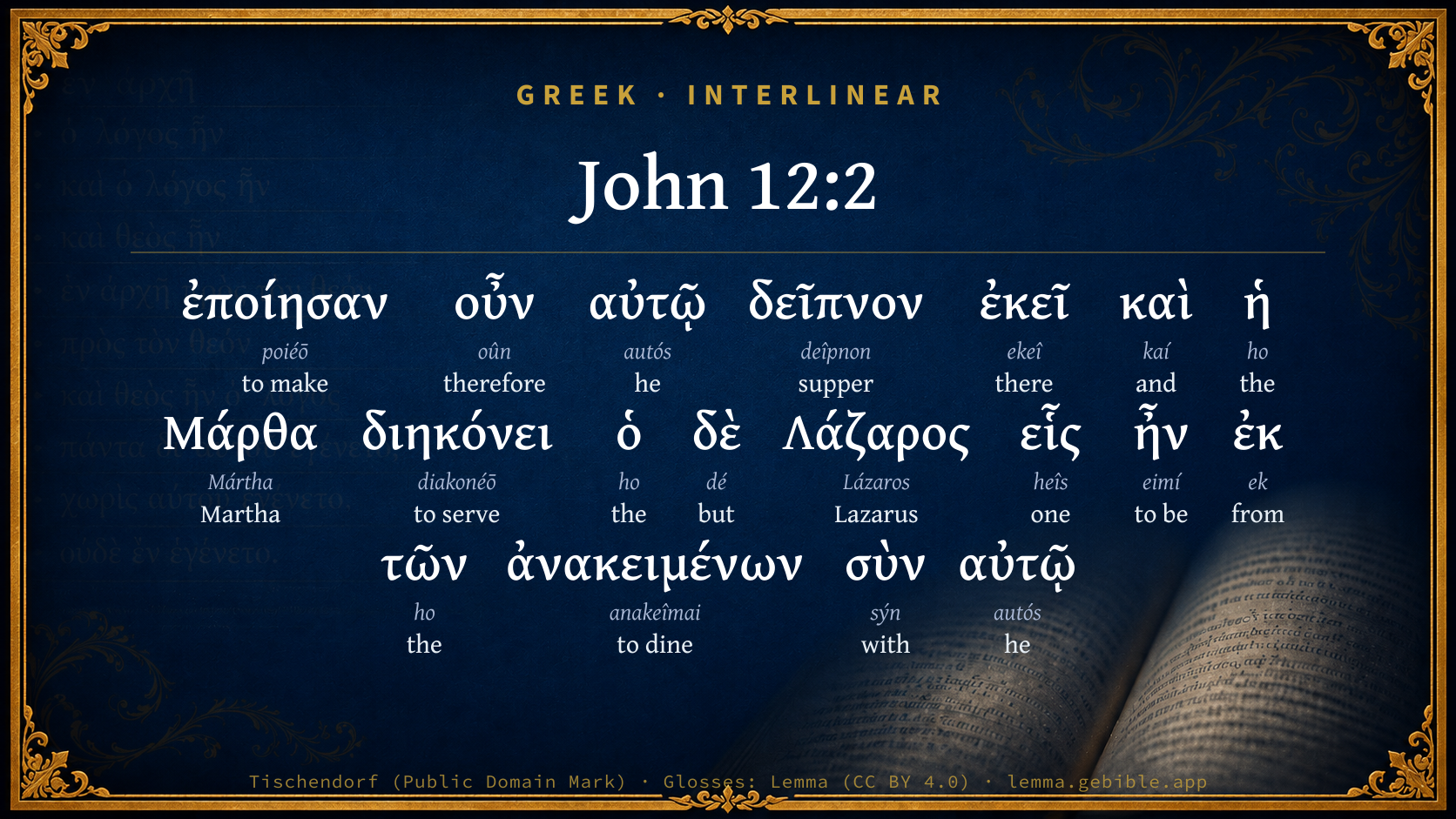
Greek (Tischendorf 8th ed.) John 12:2 appears in the Greek New Testament. The text above is from the Tischendorf 8th edition. Each word links to its Strong’s number and a concise gloss. Click any word for its full Thayer’s Greek Lexicon entry.
Download image
Cite this verse

John 12:2 (World English Bible). Public Domain. Lemma interlinear Bible study tool, https://lemma.gebible.app/v/john/12/2.

Show BibTeX & RIS
BibTeX
RIS
English Translation
So they made him a supper there. Martha served, but Lazarus was one of those who sat at the table with him.
World English Bible · Public Domain
Download a study sheet

One document with this verse’s original text, its word-by-word gloss line, the meaning frame, cross-references with their text, attributed commentary, and full source and license credits — printable, and it pastes into notes with its structure intact.

This verse Autodidact and up

Study sheet (.html) Plain text (.txt)

A passage Seminary Student

Up to 50 verses in one chapter. A passage sheet keeps up to 6 commentary sources and 12 cross-references per verse, in the order this page ranks them, and says so on the sheet whenever that leaves anything out. Ask for a single verse and you get the Autodidact verse sheet above.

Everything on this page stays free to read, with no account — the sheet is a download of what is already on screen, not access to it.

Want to remove ads? Support Godless Engineer
Compare translations 3

The same verse in 3 English versions, stacked beneath the original-language interlinear above. Click any original word for its lexicon entry.

Each is an independent rendering of the whole verse — the interlinear is not word-aligned to these translations.

Highlighted words mark where these versions differ — a whole-verse word diff, not a word-by-word alignment.

  • World English Bible Public Domain
    So they made him a supper there. Martha served, but Lazarus was one of those who sat at the table with him.
  • King James Version Public Domain
    There they made him a supper; and Martha served: but Lazarus was one of them that sat at the table with him.
  • unfoldingWord Literal Text CC BY-SA 4.0
    So they made him a dinner there, and Martha was serving, but Lazarus was one of the ones reclining to eat with him.

unfoldingWord Literal Text — © unfoldingWord, licensed CC BY-SA 4.0. Word-aligned USFM3 via Door43 (git.door43.org/unfoldingWord/en_ult).

Versions to compare (up to 4)

3 of 4 selected

Show all 19 translations

Every available English version of this verse, each an independent rendering of the whole verse.

  • World English Bible Public Domain
    So they made him a supper there. Martha served, but Lazarus was one of those who sat at the table with him.
  • Berean Standard Bible Public Domain
    So they hosted a dinner for Jesus there. Martha served, and Lazarus was among those reclining at the table with Him.
  • Majority Standard Bible Public Domain
    So they hosted a dinner for Jesus there. Martha served, and Lazarus was among those reclining at the table with Him.
  • King James Version Public Domain
    There they made him a supper; and Martha served: but Lazarus was one of them that sat at the table with him.
  • American Standard Version (1901) Public Domain
    So they made him a supper there: and Martha served; but Lazarus was one of them that sat at meat with him.
  • Revised Version (1885) Public Domain
    So they made him a supper there: and Martha served; but Lazarus was one of them that sat at meat with him.
  • Geneva Bible (1599) Public Domain
    There they made him a supper, and Martha serued: but Lazarus was one of them that sate at the table with him.
  • Douay-Rheims (1899) Public Domain
    And they made him a supper there: and Martha served: but Lazarus was one of them that were at table with him.
  • Young's Literal Translation Public Domain
    they made, therefore, to him a supper there, and Martha was ministering, and Lazarus was one of those reclining together (at meat) with him;
  • Literal Standard Version CC BY-SA 4.0
    they made, therefore, a dinner to Him there, and Martha was ministering, and Lazarus was one of those reclining together with Him;
  • Unlocked Literal Bible CC BY-SA 4.0
    So they made him a dinner there, and Martha was serving, but Lazarus was one of those who was lying down at the table with Jesus.
  • unfoldingWord Literal Text CC BY-SA 4.0
    So they made him a dinner there, and Martha was serving, but Lazarus was one of the ones reclining to eat with him.
  • Darby Bible Public Domain
    There therefore they made him a supper, and Martha served, but Lazarus was one of those at table with him.
  • World Messianic Bible Public Domain
    So they made him a supper there. Martha served, but Lazarus was one of those who sat at the table with him.
  • Webster's Bible Public Domain
    There they made him a supper; and Martha served: but Lazarus was one of them that sat at the table with him.
  • Free Bible Version CC BY-SA 4.0
    There a dinner was arranged in his honor. Martha helped serve the food while Lazarus sat at the table with Jesus and the other guests.
  • Bible in Basic English Public Domain
    So they made him a meal there, and he was waited on by Martha, and Lazarus was among those who were seated with him at table.
  • Text-Critical English NT CC BY 4.0
    They prepared a supper for Jesus there. Martha was serving, and Lazarus was one of the people reclining at the table with him.
  • Tyndale New Testament (1534) Public Domain
    There they made him a supper and Martha served: But Lazarus was one of them that sate at the table with him.

Literal Standard Version (2020), Covenant Press — licensed CC BY-SA 4.0. Text via the HelloAO Bible API (eBible.org). Unlocked Literal Bible (unfoldingWord) — licensed CC BY-SA 4.0. Text via the HelloAO Bible API (eBible.org). unfoldingWord Literal Text — © unfoldingWord, licensed CC BY-SA 4.0. Word-aligned USFM3 via Door43 (git.door43.org/unfoldingWord/en_ult). Free Bible Version, Dr. Jonathan Gallagher — licensed CC BY-SA 4.0. Text via the HelloAO Bible API (eBible.org).

Word by word

More ways to search: Search by grammar → Find every occurrence → Compare this word →

Practice this passage: Drill this verse → Learn its vocabulary →

Μάρθα
Mártha
G3136
“Martha”
Noun, Nominative, Singular, Feminine
Part of Speech
Noun
Case
Nominative
Number
Singular
Gender
Feminine
Full Thayer's Definition

Origin: probably of Aramaic origin (meaning mistress)

TDNT: None

Martha = "she was rebellious" 1. was the sister of Lazarus and Mary of Bethany
  1. ἐποίησαν poiéō G4160 “to make” Verb, Aorist, Active, Indicative, 3rd person, Plural
  2. οὖν oûn G3767 “therefore” Conjunction
  3. αὐτῷ autós G846 “he” Personal pronoun, Dative, Singular, Masculine
  4. δεῖπνον deîpnon G1173 “supper” Noun, Accusative, Singular, Neuter
  5. ἐκεῖ ekeî G1563 “there” Adverb
  6. καὶ kaí G2532 “and” Conjunction
  7. ἡ ho G3588 “the” Article, Nominative, Singular, Feminine
  8. διηκόνει diakonéō G1247 “to serve” Verb, Imperfect, Active, Indicative, 3rd person, Singular
  9. ὁ ho G3588 “the” Article, Nominative, Singular, Masculine
  10. δὲ dé G1161 “but” Conjunction
  11. Λάζαρος Lázaros G2976 “Lazarus” Noun, Nominative, Singular, Masculine
  12. εἷς heîs G1520 “one” Adjective, Nominative, Singular, Masculine
  13. ἦν eimí G1510 “to be” Verb, Imperfect, Active, Indicative, 3rd person, Singular
  14. ἐκ ek G1537 “from” Preposition
  15. τῶν ho G3588 “the” Article, Genitive, Plural, Masculine
  16. ἀνακειμένων anakeîmai G345 “to dine” Verb, Present, Middle or Passive deponent, Participle, Genitive, Plural, Masculine
  17. σὺν sýn G4862 “with” Preposition
  18. αὐτῷ autós G846 “he” Personal pronoun, Dative, Singular, Masculine

About this verse

These counts appear in no published source. They are computed here, from the morphology-tagged text and Lemma’s own curated glosses. What Lemma adds →

19
words
16
distinct lemmas
Gospels
section

Notable vocabulary

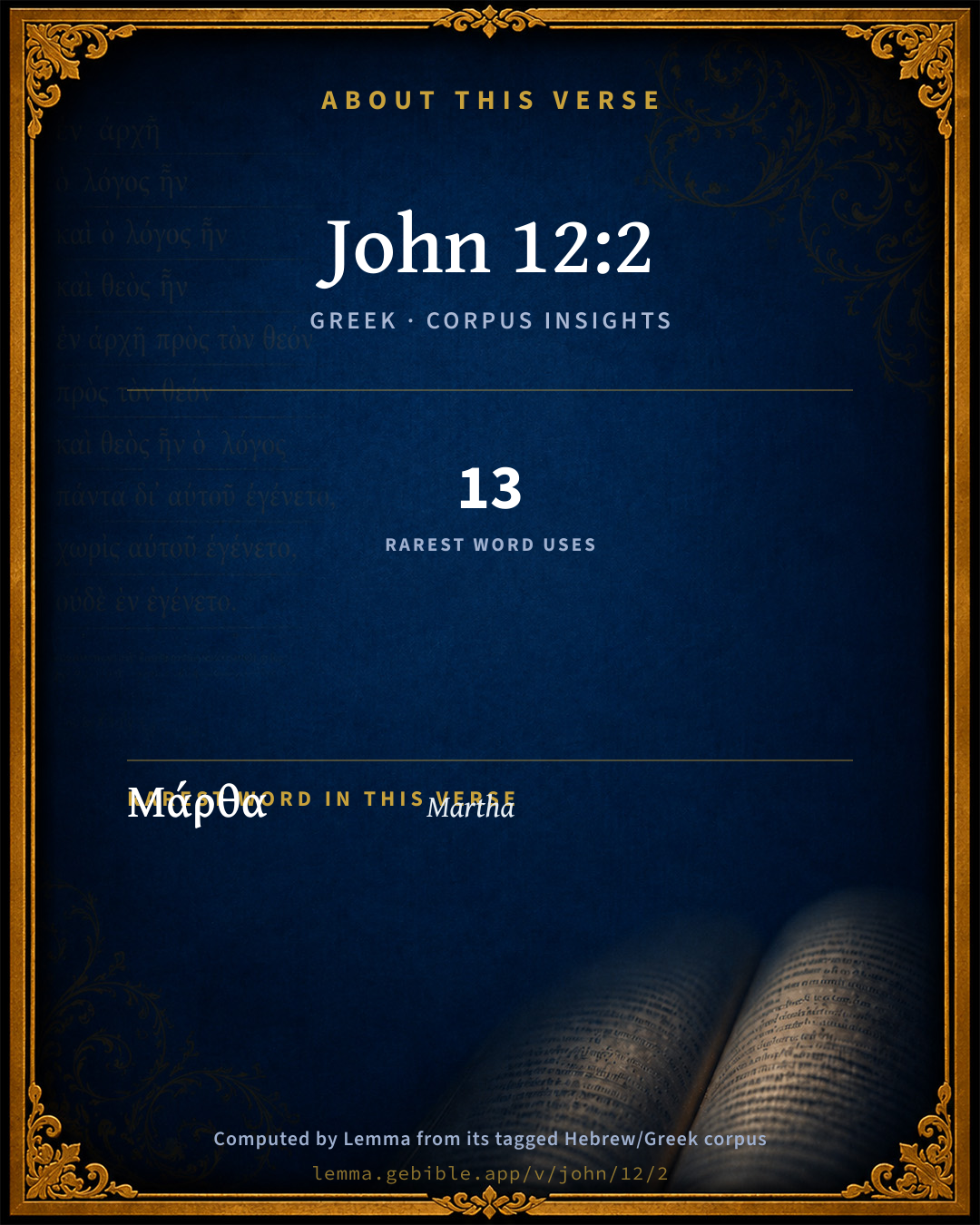
The rarest word here is Μάρθα Martha G3136 — appearing just 13 times in the whole Greek New Testament.

Shared distinctive vocabulary

Μάρθα Martha G3136 occurs in 12 verses of the Greek New Testament. Also found in:

Repetition

Words recur within this verse:

Cross-references

10

Topical passages linked to John 12:2 in the Treasury of Scripture Knowledge — connected by theme and wording, ordered by reader-vote popularity; previews shown in the World English Bible.

  • Luke 22:27 For who is greater, one who sits at the table, or one who serves? Isn't it he who sits at the table? But I am in the midst of you as one who serves.
  • Revelation 3:20 Behold, I stand at the door and knock. If anyone hears my voice and opens the door, then I will come in to him, and will dine with him, and he with me.
  • Luke 10:38–42 It happened as they went on their way, he entered into a certain village, and a certain woman named Martha received him into her house.
  • Mark 14:3 While he was at Bethany, in the house of Simon the leper, as he sat at the table, a woman came having an alabaster jar of ointment of pure nard-- very costly. She broke the jar, and poured it over his head.
  • John 12:9–10 A large crowd therefore of the Jews learned that he was there, and they came, not for Jesus' sake only, but that they might see Lazarus also, whom he had raised from the dead.
  • Matthew 26:6 Now when Jesus was in Bethany, in the house of Simon the leper,
  • Luke 12:37 Blessed are those servants, whom the lord will find watching when he comes. Most assuredly I tell you, that he will dress himself, and make them recline, and will come and serve them.
  • John 11:43–44 When he had said this, he cried with a loud voice, "Lazarus, come out!"
  • Luke 5:29 Levi made a great feast for him in his house. There was a great crowd of tax collectors and others who were reclining with them.
  • Luke 14:12 He also said to the one who had invited him, "When you make a dinner or a supper, don't call your friends, nor your brothers, nor your kinsmen, nor rich neighbors, or perhaps they might also return the favor, and pay you back.

Cross-references courtesy of OpenBible.info (CC BY 4.0).

Where the printed editions differ

1 variant

Places in this verse where the major printed Greek editions disagree on the wording in a way that affects the translation — a comparison of editions, not a manuscript-by-manuscript collation. The editions are the modern critical texts (Nestlé-Aland 28/27, SBL, Westcott-Hort, Tregelles, Tyndale House) and the traditional texts behind the KJV (the Textus Receptus and the Byzantine/Majority text). It is not a claim about which reading is original.

  1. Editions differ
    ἀνακειμένων

    “reclining”

    In NA28NA27TynSBLWHTregTR»1Byz Not in TR

Textual data: Translators Amalgamated Greek New Testament (STEPBible TAGNT) · CC BY 4.0.

Commentary

Notes on John 12:2 from classic Christian and Jewish commentators (each source and its license shown beneath its notes). The classic Christian expositions comment on the surrounding passage and are grouped to its opening verse, so a note may address several verses; the Jewish commentaries on the Tanakh (Rashi and others) are per-verse, so they appear only where the commentator wrote on this verse.

Lemma curates 59 commentaries, every one of them public domain or Creative Commons licensed, each selected and text-cleaned for this edition rather than reprinted as found. About our sources →

Albert Barnes' Notes on the Bible

See this passage explained in the notes at Mat 26:3-16.

Joh 12:2

A supper - At the house of Simon the leper, Mat 26:6.

Lazarus was ... - The names of Martha and Lazarus are mentioned because it was not in their own house, but in that of Simon. Lazarus is particularly mentioned, since it was so remarkable that one who had been once dead should be enjoying again the endearments of friendship. This shows, also, that his resurrection was no illusion - that he was really restored to the blessings of life and friendship. Calmet thinks that this was about two months after his resurrection, and it is the last that we hear of him. How long he lived is unknown, nor is it recorded that he made any communication about the world of spirits. It is remarkable that none who have been restored to life from the dead have made any communications respecting that world. See Luk 16:31, and the notes at 2Co 12:4.

Joh 12:4

Which should betray him - Greek, “who was to betray him” - that is, who would do it.

Joh 12:5

Three hundred pence - About 40,00, or 8 British pounds, 10 shillings (circa 1880’s).

And given to the poor - The avails or value of it given to the poor.

Joh 12:6

Had the bag - The word translated “bag” is compounded of two words, meaning “tongue,” and “to keep or preserve.” It was used to denote the bag in which musicians used to keep the tongues or reeds of their pipes when traveling. Hence, it came to mean any bag or purse in which travelers put their money or their most precious articles. The disciples appear to have had such a bag or purse in common, in which they put whatever money they had, and which was designed especially for the poor, Luk 8:3; Joh 13:29; Act 2:44. The keeping of this, it seems, was intrusted to Judas; and it is remarkable that the only one among them who appears to have been naturally avaricious should have received this appointment. It shows us that every man is tried according to his native propensity. This is the object of trial - to bring out man’s native character; and every man will find opportunity to do evil according to his native disposition, if he is inclined, to it.

And bare ... - The word translated “bare” means literally “to carry as a burden.” Then it means “to carry away,” as in Joh 20:15; “If thou hast borne him hence.” Hence, it means to carry away as a thief does, and this is evidently its meaning here. It has this sense often in classic writers. Judas was a thief and stole what was put into the bag. The money he desired to be entrusted to him, that he might secretly enrich himself. It is clear, however, that the disciples did not at this time know that this was his character, or they would have remonstrated against him. They learned it afterward. We may learn here:

1.That it is not a new thing for members of the church to be covetous. Judas was so before them.

2.That such members will be those who complain of the great waste in spreading the gospel.

3.That this deadly, mean, and grovelling passion will work all evil in a church. It brought down the curse of God on the children of Israel in the case of Achan Josh. 7, and it betrayed our Lord to death. It has often since brought blighting on the church; and many a time it has betrayed the cause of Christ, and drowned men in destruction and perdition, 1Ti 6:9.

Albert Barnes' Notes on the Bible (1834–1885) — public domain. Text from a community e-Sword/MySword module.

Whedon's Commentary on the Bible

Daniel D. Whedon

§ 120.—SUPPER AND ANOINTING AT BETHANY, Joh_12:2-11.

See notes on Mat_26:6-16; Mar_14:3-9.

Daniel D. Whedon (gen. ed.), Commentary on the Old and New Testaments (1874–1909) — public domain. Text from a community e-Sword module.

Godbey's Commentary on the New Testament

William B. Godbey

THE SUPPER AT BETHANY

Mat 26:6-13; Mar 14:3-9; Joh 12:2-8. “Then they made for Him a supper there, and Martha served; and Lazarus was one of those sitting along with Him.” Matthew and Mark say that this supper was in the house of Simon the leper, at Bethany. I was in that house four months ago. It is still in quite a state of preservation, like so many houses in Palestine, being located in a cave at the base of Mount Olivet, which is utilized in the construction of the edifice, whose walls are adjusted to the dimensions and capacity of the cavern. We know nothing about Simon the leper, but he is believed to be one of the numerous lepers healed and saved by the blessed Benefactor.

Joh 12:3. “Then, Mary, taking a pound of ointment of pure spikenard, very valuable, anointed, the feet of Jesus, and wiped His feet with her hair; and the house was filled with the odor of the ointment. Then one of His disciples, Judas Iscariot, the son of Simon, the one about to betray Him, says, Wherefore was not this ointment sold for three hundred denaria, and given to the poor?” The English word “penny,” E. V., is misleading in this passage, as our penny is only one cent. The denarion was a Roman coin, worth fifteen cents in our money. Hence the estimate of this ointment, which is here said to be very valuable, was forty-five dollars. The spikenard, from which this valuable myrrh was manufactured, was not indigenous in Palestine, but in Arabia Felix, where the ointment was made and exported.

“He said this, not because there was a care to him concerning the poor, but because he was a thief, and had the purse, and was accustomed to carry the contributions.” Why was Judas a thief at that time? Because he had already made up his mind to sell Jesus for money. How was that stealing? Because he had no idea that they could take Him, as he had seen them try it over and over, and never could put their hands on Him. Frequently He suddenly disappeared, passing unseen through the great wall of the temple, and recognized on the other side. Unfortunately for Judas, he held the most dangerous office ever conferred on mortal man — i. e., that of treasurer — which proved his ruin, because he gradually yielded to the love of money till he finally concluded to sell Jesus for filthy lucre, in that respect being guilty of stealing the fifteen dollars for which he sold Him, as he had no idea that they could take Him; but believing them to be a set of scoundrels, he concluded that he would just as well get their money when he had a chance.

“Then Jesus said, Let her alone; she hath kept it unto the day of My burial; for the poor you have always with you, and Me you have not always.” In less than two days from that supper, He was in the sepulcher and numbered with the dead. Hence the idea is that this anointing is really for His burial, which is now at hand.

Mar 14:8. “She hath done what she could.” O what a deep significance in this terse statement! Are you doing what you can for Jesus? If you can not go to Greenland, Ethiopia, or China, you can do some small part in the support and encouragement of those who can go. If you cannot preach like Paul, nor exhort like Apollos, you can go into the slums, pray for the dying, and tell the broken-hearted of Jesus. If you can not be a flaming evangelist, you can be an humble altar-worker. “She came beforehand to anoint My body for the burial. Truly I say unto you, that wherever this gospel may be preached in all the world, that which she did shall be told for a memorial of her.” Notoriety is a powerful incentive. Actuated by it, men have led armies, besieged cities, and desolated great countries. Erostratus burned down the great Temple of Diana at Ephesus, one of the seven wonders of the world, which was two hundred years in building, as he confessed under the gallows, for sheer notoriety. By this little, simple act of loving appreciation, thus manifested to the Prince of life, Mary immortalized her name, securing a commendatory mention in the pulpit throughout the whole earth, as the gospel moves on, peregrinating every land and brightening every sky.

William B. Godbey, Commentary on the New Testament (1896–1900) — public domain. Text from a community e-Sword module.

Tyndale Open Study Notes

Tyndale Open Resources

12:2 who ate: Or who reclined. The typical posture for eating was to recline at a low table.

Tyndale Open Study Notes — © Tyndale Open Resources, licensed CC BY-SA 4.0. Text via the HelloAO Bible API.

Bengel's Gnomon

Johann Albrecht Bengel

Joh 12:2. Ἐποίησαν, they made) the people of Bethany.—αὐτῷ, for Him) in His honour.—δεῖπνον, a supper) a solemn [festive] one. The banquet, at which Lazarus was present after his being raised to life, may be compared with the heavenly banquet, at which hereafter there shall be present the dead saints, when they shall have risen again.—ἡ Μάρθα, Martha) Martha manifested her zealous affection in one way, Mary in another, Joh 12:3, [Martha served; Mary anointed Jesus’ feet with the costly ointment, etc.]

Bengel's Gnomon of the New Testament — English translation (T&T Clark, Edinburgh, 1860) — public domain. Text from a community e-Sword module.

Expositor's Greek Testament

ed. W. Robertson Nicoll

Joh 12:2 . ἐποίησαν … αὐτῷ . ἐποίησαν is the indefinite plural: “they made Him” a supper; δεῖπνον , originally any meal, came to be used invariably of the evening meal. καὶ ἡ Μάρθα διηκόνει , “and Martha waited at table,” which was her peculiar province (Luk 10:40 ). ὁ δὲ Λάζαρος … αὐτῷ . This is mentioned, not to show that Lazarus was still alive and well, but because the feast was not in his house but in that of Simon the leper (Mar 14:3 , Mat 26:6 ). That this was the same feast as that mentioned by the Synoptists is apparent; the only discrepancy of any consequence being that the Synoptists seem to place the feast only two days before the Passover. But they introduce the feast parenthetically to present the immediate motive of Judas’ action, and accordingly disregard strict chronology.

The Expositor's Greek Testament, edited by W. Robertson Nicoll (1897–1910) — public domain. Text from a community e-Sword module.

Godet's Commentaries

Frédéric Louis Godet

Vv. 2, 3. “Therefore they made him a feast there, and Martha served; but Lazarus was one of those who were at table with him. 3. Mary therefore, having taken a pound of ointment of pure nard, which was of great price, anointed the feet of Jesus with it and wiped his feet with her hair; and the whole house was filled with the odor of the ointment.”

When did this supper take place? Of course, according to our hypothesis, on Sunday evening, the day of Jesus’ arrival. The subject of ἐποίησαν, they made, is indefinite; this form answers in Greek to the Frenchon. Hence it already follows that this subject cannot be, as is ordinarily represented: the members of the family of Lazarus. Moreover, this appears from the express mention of the presence of Lazarus and of the activity of service on Martha’s part, all of them circumstances which would be self-evident if the supper had taken place in their own house. As the undetermined subject of the verb can only be the persons named afterwards, it follows that they are, much rather, the people of the place. A part of the inhabitants of Bethany feel the desire of testifying their thankfulness to Him who by a glorious miracle had honored their obscure village. It is this connection of ideas which seems to be expressed by the therefore at the beginning of Joh 12:2, and, immediately afterwards, by this detail: “Lazarus, whom he had raised from the dead.” That which, no doubt, very specially impelled them to render to Jesus, at this moment, this public homage, was the hatred to which they saw Him exposed on the part of the rulers. This feast was a courageous response to the edict of the Sanhedrim (Joh 11:57); it was the proscribed one whom they honored.

The text does not tell us in what house the supper took place. Lazarus being there as a guest, not as host (Joh 12:2), it follows that the scene occurred in another house than his own. Thus is the harmony very naturally established with the narrative of Matthew and Mark, who state positively that the supper took place in the house of Simon the leper, a sick man, no doubt, whom Jesus had healed and who has claimed the privilege of receiving him in the name of all. It is inconceivable that this very simple reconciliation should appear to Meyer a mere process of false harmonistics. Weiss himself says: “The form of expression used excludes the idea that Lazarus was the one who gave the supper.” Every one could not receive Jesus: but every one had desired to contribute, according to his means, to the homage which was rendered to Him: the people of Bethany, by the banquet offered in their name; Martha, by giving her personal service, even in the house of another person; Lazarus, by his presence, which in itself alone glorified the Master more than all that the others could do; finally, Mary, by a royal prodigality, which was alone capable of expressing the sentiment which inspired her.

The general custom among the ancient nations was to anoint with perfume the heads of guests on feast-days. “Thou preparedst the table before me; thou anointest my head with oil; my cup overflows,” says David to Jehovah, when describing under the figure of a feast which his God gives to him the delights of communion with Him (Psa 23:5). The forgetting of this ceremony is noticed by Jesus (Luk 7:46), as an offensive omission. At Bethany such a mistake was not committed; it was Mary who charged herself with this office, reserving to herself the accomplishment of it in her own way. Μύρον is the generic term which comprehends all the liquid perfumes, and νάρδος, nard, the name of the most precious kind. This word, of Sanskrit origin (in Persian nard, in Sanskrit nalada), denotes a plant which grows in India, and of which some less celebrated varieties are found in Syria. The juice was enclosed in flasks of alabaster (nardi ampullae), and it was used not only to anoint the body, but also to perfume wine. (See Riehm, Handworterb .)

We have translated πιστικός by pure. This word, which is unknown in classic Greek, is not again found in the entire New Testament, except in the corresponding passage in Mark. Among the later Greeks, it serves to designate a person worthy of confidence; thus the one to whom the care of a vessel or a flock is committed. It signifies, therefore, nard on which one can rely, not adulterated. This meaning is the more suitable, since nard was subjected to all sorts of adulterations. Pliny enumerates nine plants by means of which it could be counterfeited, and Tibullus uses the expression nardus pura, which almost gives to our πιστικῆς, in Mark and John, the character of a technical epithet. The meaning drinkable (from πίνω, πιπίσκω) is much less probable, not only because the natural form would be πιστός, or ποτιμός, but especially because the notion of potableness has no relation to the context. The attempt has also been made to derive this word from the name of a Persian city,Pisteira, a name which was sometimes abridged to Pista (comp. Meyer on Mar 14:2). This is a worthless expedient (comp. Hengstenberg and especially Lucke and Wichelhaus). The epithet, πολυτίμου, very costly, can only refer to the first of the two substantives (in opposition to Luthardt, Weiss, etc.); for it was not the plant which had been purchased (νάρδου), but the perfume (μύρου). Αίτρα, a pound, answers to the Latin libra, and denotes a weight of twelve ounces; it was an enormous quantity for a perfume of this price. But nothing must be wanting to the homage of Mary, neither the quality nor the quantity.

These flasks of nard hermetically sealed were probably received from the East; to use the contents of them, the neck must be broken; this is what Mary did, according to Mark (Mar 14:3). This act having a somewhat striking character, she must have performed it in the sight of all the guests, consequently over the head of Jesus already seated at the table. His head thus received the first fruits of the perfume (comp. Matt. and Mark: “she poured it on his head”). Only after this, as no ordinary guest was here in question, and as Mary wished to give to her guest not merely a testimony of love and respect, but a mark of adoration, she joined with the ordinary anointing of the head (which was self evident; comp. Psa 23:5; Luk 7:46) an altogether exceptional homage. As if this precious liquid were only common water, she pours it over His feet, and in such abundance that it was as if she were bathing them with it; so she is obliged to wipe them. For this purpose she uses her own hair. This last fact carries the homage to a climax. It was among the Jews, according to Lightfoot (II., p. 633), “a disgrace for a woman to loosen the fillets which bound up her hair and to appear with disheveled hair.” Mary bears witness, therefore, by this means that, as no sacrifice is too costly for her purse, so no service is too mean for her person. All that she is belongs to Him, as well as all that shehas. We may understand thus the ground of the repetition, certainly not accidental, of the words τοὺς ποδὰς αὐτοῦ,his feet. To this, the least noble part of His body it is, that she renders this extraordinary homage. Every detail in this narrative breathes adoration, the soul of the act. Perhaps the report of the homage rendered to Jesus by the sinful woman of Galilee had reached Mary. She was unwilling that the friends of Jesus should do less for Him than a stranger.

The identity of this event with that which is related in Mat 26:6-13, and Mar 14:3-9, is indisputable. It is said, no doubt, in the latter passages, that the perfume was poured on the head, in John, on the feet; but, as we have just seen, this slight difference is easily explained. After the anointing in the ordinary form (that of the head), this bathing of the feet with perfume began, which here takes the place of the ordinary bathing of the feet (Luk 7:44). John alone has preserved the recollection of this fact which gives to the scene its unique character. It cannot be supposed that Mary poured on the head of Jesus a whole pound of liquid. As to the place which this story occupies in the two narratives, it constitutes no more serious objection against the identity of the event. For in the Synoptics the place is evidently determined by the moral relation of this act to the fact related immediately afterwards, the treachery of Judas (Matthew vv14-16; Mark vv10, 11).

This association of ideas had determined the uniting of the two facts in the oral tradition, and from this it had passed into the written redaction. John has restored the fact to its own place. The relation of the anointing of Jesus at Bethany with the event related in Luke 7 is entirely different. We have already mentioned the points which do not allow us to identify the two narratives (p. 171). Keim declares that a homage of this kind cannot have occurred twice. But the anointing belonged necessarily, as well as the bathing of the feet, to every meal to which there was an invitation (Luk 7:44). The details in which the two scenes resemble each other are purely accidental. Simon the leper of Bethany, of whom Matthew and Mark speak, has nothing in common withSimon the Pharisee, of whom Luke speaks, except the name. Now, among the small number of persons with whom we are acquainted in the Gospel history taken alone, we can count twelve or thirteen Simons; and can there not have been two men, bearing this so common name, in whose houses these two similar scenes may have taken place? The one lived in Judea, the other in Galilee; the one receives Jesus into his house in the course of His Galilean ministry; the other, a few days before the Passion. The discussion in Galilee has reference to the pardon of sins; in Judea, to the prodigality of Mary. And if the two women wiped the feet of Jesus with their hair, in the case of the one, it is the tears which she gathers up, in that of the other, it is a perfume with which she has embalmed her Master. This difference sufficiently marks the two women and the two scenes. Christian feeling, moreover, will always protest against the identification of Mary of Bethany with a woman of bad morals.

Frédéric Louis Godet — Commentaries on Luke, John, Romans, and 1 Corinthians — English translation (T&T Clark, Edinburgh, 1870s–1890s) — public domain. Text from a community e-Sword module.

Jamieson, Fausset & Brown

Robert Jamieson, A. R. Fausset & David Brown

Martha served--This, with what is afterwards said of Mary's way of honoring her Lord, is so true to the character in which those two women appear in Luk 10:38-42, as to constitute one of the strongest and most delightful confirmations of the truth of both narratives. (See also on Joh 11:20).

Lazarus . . . sat at the table--"Between the raised Lazarus and the healed leper (Simon, Mar 14:3), the Lord probably sits as between two trophies of His glory" [STIER].

Jamieson, Fausset & Brown — Commentary Critical and Explanatory on the Whole Bible (1871) — public domain (CC PDM 1.0). Text via the HelloAO Bible API.

John Calvin's Commentaries

2. There therefore they made him a banquet. Matthew (Matthew 26:7) and Mark, (Mark 14:3) say that he then supped at the house of Simon the leper. John does not mention the house, but shows plainly enough, that it was in some other place than the house of Lazarus and Martha that he supped; for he says that Lazarus was one of those who sat at table with him, that is, one who had been invited along with Christ. Nor does it involve any contradiction, that Matthew and Mark relate that the head of Christ was anointed, while John relates that his feet were anointed. The usual practice was the anointing of the head, and on this account Pliny reckons it an instance of excessive luxury, that some anointed the ankles. The three Evangelists agree in this; that Mary did not anoint Christ sparingly, but poured on him a large quantity of ointment. What John speaks, about the feet, amounts to this, that the whole body of Christ, down to the feet, was anointed. There is an amplification in the word feet, which appears more fully from what follows, when he adds, that Mary wiped his feet with her hair

John Calvin's Commentaries (1540-1563) — public domain. Text from the Calvin Translation Society English edition (1840s-50s) via the Christian Classics Ethereal Library (ccel.org). Calvin's coverage is partial (roughly two-thirds of the Bible); uncommented books and verses are honest gaps, never fabricated. The 19th-century editor's footnotes and remarks are omitted so the notes are faithfully Calvin's own voice.

Ellicott's Commentary for English Readers

(2) There they made him a supper.—Comp. Notes on Mat_26:6 et seq., and Mar_14:3 et seq., which are clearly accounts of the same supper. Here the details peculiar to St. John, who was an eyewitness, will be noted. St. Matthew gives no indication of the day. St. Mark seems to place it two days before the Passover; but comp. Notes on Mar_16:1-2. Both the other accounts tell us that the supper was in the house of Simon the leper. St. John docs not define the place more definitely than to say that it was in Bethany; but he alone adds the facts that Martha was still serving, and that Lazarus was present as a guest.

And Martha served.—The tense of this verb differs from that of the others in the verse, and implies the continued act of serving, whilst “made a feast” is the statement of the fact as a whole. (Comp. Luk_10:40.)

Lazarus was one of them that sat at the table with him.—This is a natural touch answering to the impression that the fact made. It is closely connected with the statement of the preceding verse, “Lazarus had been dead, whom he raised from the dead.” Here was one sitting at meat with them who had lain in the sepulchre four days. The meal is in his case, as afterwards in that of our Lord Himself (Luk_24:41-43), a physical proof of the Resurrection; and his presence by the side of our Lord calls forth from Mary the anointing, which testifies to her gratitude and love.

A Bible Commentary for English Readers, edited by Charles John Ellicott (1878–1897) — public domain. Text from a community e-Sword module.

The Cambridge Bible for Schools and Colleges

gen. ed. J. J. S. Perowne

2–8. The Devotion of Mary

2. they made him a supper] ‘They’ is indefinite: if we had only this account we should suppose that the supper was in the house of Martha, Mary, and Lazarus; but S. Mark (Mar_14:3) and S. Matthew (Mat_26:6) tell us that it was in the house of Simon the leper, who had possibly been healed by Christ and probably was a friend or relation of Lazarus and his sisters. Martha’s serving (comp. Luk_10:40) in his house is evidence of the latter point (see the notes on the accounts of S. Matthew and S. Mark).

Lazarus was one of them] This is probably introduced to prove the reality and completeness of his restoration to life: but it also confirms the Synoptic accounts by indicating that Lazarus was a guest rather than a host.

sat at the table] Literally, reclined, as was the custom.

The Cambridge Bible for Schools and Colleges (gen. ed. J. J. S. Perowne; Cambridge University Press, 1878–1918) — public domain. Text from a community e-Sword module.

John Gill's Exposition

There they made him a supper,.... At Bethany, in the house of Lazarus, Martha, and Mary; by whose order, and at whose charge it was prepared for him; and not in the house of Simon the leper, which was four days after this, Mat 26:2.

And Martha served; who was always a busy, active, and stirring woman; and this she did, to testify her love to Christ, and great respect for him; otherwise, as she was a person of substance, she had servants enough to wait at table:

but Lazarus was one of them that sat at the table with him; and ate, and drank, and conversed; by which it appeared, that he was really risen from the dead, and was in a good state of health.

John Gill's Exposition of the Whole Bible (1746–1763) — public domain (CC PDM 1.0). Text via the HelloAO Bible API.

Trapp's Complete Commentary

John Trapp

2 There they made him a supper; and Martha served: but Lazarus was one of them that sat at the table with him.

Ver. 2. That sat at table] Being invited by Simon the leper at whose house this feast was kept, as some will have it.

John Trapp, A Commentary or Exposition upon All the Books of the Old and New Testament (1647–1656) — public domain. Text from a community e-Sword module.

Matthew Poole's English Annotations

That this supper was made in Bethany is no question; but at whose house there it is questioned. Some think that it was at the house of Simon the leper. We read indeed of a supper made for our Saviour at his house, both Mat 26:6,7, and Mar 14:3, and that Simon is said to have been of Bethany: only the supper here mentioned is said to have been six days before the passover, and that mentioned by Matthew and Mark seems to have been but two days before, Mat 26:2; Mar 14:1. That which is probably said to solve that difficulty is, the circumstances of the supper, and history about it, seem the very same, both in Matthew, Mark, and John; but it seems in Matthew and Mark to be a little put out of order; they do not say that this supper was two days before the passover, (that indeed had been a contradiction to what John doth here relate), but both Matthew and Mark first tell us, that Christ told his disciples that the passover was to be within two days, and of the counsel taken by the chief priests and elders against Christ, and then relates the story of this supper: John first gives us an account of this supper, which was six days before the passover; so John seems to have related it in its proper time and order.

Matthew Poole's English Annotations on the Holy Bible (1683–1685) — public domain. Text from a community e-Sword/MySword module.

The Pulpit Commentary

There, therefore, they made him a supper, and Martha served: but Lazarus was one of them that sat at the table with him. John does not tell us in whose house "they made the dinner" or supper, and unless Simon the leper (Mat_26:6 and Mar_14:3) is a member of the family (or, as some suggest, the husband of Martha), we cannot suppose that it was in the quiet home of Bethany that this feast in honor of Jesus was held, but that it took place, as the synoptists positively declare, "in the house of Simon the leper." Simon may easily have been one of the many lepers whom our Lord had healed, and whose soul was filled with accordant gratitude. At that table there would be seated two transcendent; proofs of the power of Jesus to save, not only from the semblance but from the reality of death. (see Meyer; Mat_26:6) We wonder, with Godet, that Meyer should reject this simple supposition as "spurious harmony." All that is here stated is in agreement with it:

(1) that Martha should have shown her reverence by serving her Lord, according to her wont, not necessarily as hostess (Hengstenberg and Lange), but as the expression of her devoted thankfulness;

(2) that Lazarus should have been one of those who sat at meat, reclined at table, with him, i.e. took a position as a guest, like himself; and

(3) that Mary should have poured forth her costly spikenard, in royal self-forgetting love. The conduct of all the three thus mentioned is compatible with the fact stated in the synoptic narrative, that the festival was celebrated in the house of Simon the leper. Our Lord had commented, in the house of Simon the Pharisee, (Luk_7:44, etc.) on the absence of the customary anointing with oil. Mary knew of this, and resolved that, whatever the woman who was a sinner had done, no similar act of neglect should occur on that memorable evening. A chronological discrepancy renders an identification of the synoptic narrative of Matthew with this story perplexing. In Mat_26:2 we are brought to within two days of the Passover, whereas here we cannot well be less than five days before it. However, there is nothing in Mat_26:6-13 which indubitably declares the date of the supper The "two days" may refer to the date of Judas"s treachery, after mentioning which he goes back to an event which furnished occasion and temptation to the avaricious mind of Judas.

Mary therefore took a pound (the synoptists Matthew and Mark say "an alabaster," i.e. a flask made of the costly spar, which was peculiarly adapted to the preservation of liquid perfume, hermetically sealed before it was broken for immediate use. The fact, as stated by Matthew and Mark, is inconsistent with her reserving any of the precious fluid for another occasion) of ointment ("liquid perfume," sometimes added to the more ordinary oil), of pure (or possibly; pistie) nard. Mark uses this unusual word pistikov , which belongs to later Greek. The derivation of pistktikov from pinw , equivalent to "potable," is not appropriate in meaning, though this "nard" was used for perfuming wine. Mar_14:3 also the Authorized Version translates it "spikenard," as it does here (cf. also Son_1:12 and Son_4:13, Son_4:14, where Hebrew Drne corresponds with nardov). But the one place where the word was supposed to be found in Aristotle is now seen not to be pisttikov , but peistikov , trustworthy, or unadulterated. It is possible that the word may have had a local geographical value, belonging to some proper name, and is untranslatable. Very precious. Mark (Mar_14:3) uses the word polutelouv , and Matthew (Mat_26:7) barutimou . John appears to combine the idea of both words in his polutimon . Each of the synoptists severally mentions a fact which John omits that Mary broke the alabaster box, and poured the costly unguent on his head in rich abundance, as though hers had been the royal or high-priestly anointing; (cf. Ps 133) but John shows that this at least was not all she did. She anointed the feet of Jesus, and wiped his feet with her hair: and the house was filled with the odor of the ointment. Thoma thinks that, conformably with John"s idea, the anointing of the head of the true High Priest was the work of God alone, quoting Philo"s comment on Lev_21:10, etc., "The head of the Loges, as High Priest, is anointed with oil, i.e. his innermost essence gleams with dazzling light;" and adds, that as the feet of the high priest were washed with water from recent defilement of the world"s dust, so God"s anointed Lamb and Priest was anointed on his feet with the spikenard of faith, the best and costliest thing that man could offer. So profound an analogy seems to us contrary to the simplicity of the narrative, which is perfectly natural in its form. The perfumed nard ran down to the Savior"s feet and the skirts of his garments, and there accumulating, the significant act is further recounted how Mary wiped off the superfluous perfume from his feet with the tresses of her loosened hair. This simple act proclaimed the self-humiliation and adoration of her unbounded love, seeing that the loosening of a woman"s hair was a mark of unusual self-abandonment, Many most unnecessary inferences have been drawn from this. John adds an interesting feature, revealing the sensitive eye-witness of the scene, "and the house was filled with the odor of the ointment; " and the whole house of God ever since has been fragrant with her immortal and prophetic act.

The Pulpit Commentary (1880–1919), ed. H.D.M. Spence-Jones & Joseph S. Exell — public domain. Text from a community e-Sword module.

John Wesley's Explanatory Notes

It seems Martha was a person of some figure, from the great respect which was paid to her and her sister, in visits and condolences on Lazarus' death, as well as from the costly ointment mentioned in the next verse. And probably it was at their house our Lord and his disciples lodged, when he returned from Jerusalem to Bethany, every evening of the last week of his life, upon which he was now entered.

John Wesley, Explanatory Notes Upon the Whole Bible (1754–1765) — public domain. Text via the GEBible commentary corpus.

Burkitt's Expository Notes on the New Testament

William Burkitt

In these verses, an account is given of our Saviour’s entertainment at Bethany after he had raised Lazarus. A supper is made for him, at which Martha served, and Lazarus sat with him, but Mary anoints Christ with precious ointment.

Where note, 1. The action which this holy woman performed, she pours a box of precious ointment upon our Saviour’s head, as he sat at meat, according the the custom of the eastern countries at their feasts. I do not find that any of the apostles were at thus much charge and cost to put honour upon our Saviour as this poor woman was.

From whence learn, 1. That where strong love prevails in the heart, nothing is adjudged too dear for Christ, neither will it suffer itself to be out-shined by any examples. The weakest woman that strongly loves her Saviour will vie with the greatest apostle, and piously strive to express the fervour of her affection towards him.

Observe, 2. How this action was resented and reflected upon by murmuring Judas, who valued this ointment at three hundred pence, and grudged the bestowing of it upon Christ. He accused this holy woman of needless prodigality.

Lord! how doth a covetous heart think every thing too good for thee? He that sees a pious action performed, and seeks to lessen or undervalue it, shews himself possessed with a spirit of envy. Judas, his invidious spirit makes him censure an action, which Christ highly approved.

Hence learn, That men, who know not our hearts, may through ignorance or prejudice, censure and condemn those actions which God doth commend, and will graciously reward. Happy was it for this poor woman, that she had a more righteous judge to pass sentence upon her action than wicked Judas.

Observe, 3. How readily our holy Lord vindicates this poor woman: she says nothing for herself, nor needs she, having such an advocate who gives the reason for her action; she did it for my burial. As kings and great persons were in wont in those eastern countries, at their funerals, to be embalmed with odours and sweet perfumes, so, saith our Saviour, this woman, to declare her faith in me, as her King and Lord, doth with this box of ointment, as it were beforehand, embalm my body for its burial. True faith will put honour upon a crucified, as a glorified Saviour. This holy woman accounts Christ worthy of all honour in his death, believing it would be a sweet smelling sacrifice unto God, and savour of life unto his people.

William Burkitt's Expository Notes on the New Testament (1700–1703) — public domain. Text from a community e-Sword module.

The People's New Testament

B. W. Johnson

2–9. There they made him a supper. For notes on this supper and the anointing, see Matt. 26:6–16. Compare Mark 14:3–11 and Luke 7:36–50.

Then saith one of his disciples. Judas Iscariot.

Three hundred pence. Silver to the amount of $45, equivalent to about $300 now, owing to the change of values.

Against the day of my burying hath she kept this. Before a week he was to be in the tomb. It was customary to anoint dead bodies for burial.

Much people … came. From Jerusalem to Bethany.

B. W. Johnson's The People's New Testament with Notes (1889–1891) — public domain. Electronic text from the Christian Classics Ethereal Library (CCEL) ThML edition.

Cambridge Greek Testament for Schools and Colleges

2–8. THE DEVOTION OF MARY

2. ἀνακειμένων σύν (אABD) for συνανακειμένων (frequent in the Synoptists, not found in S. John).

2. ἐποίησαν οὖν. They made therefore; because of His great miracle just mentioned (Joh 12:1) and its consequences. The banquet is a generous protest against the decree of the Sanhedrin (Joh 11:57). The nominative to ἐποίησαν is indefinite: if we had only this account we should suppose that the supper was in the house of Martha, Mary, and Lazarus; but S. Mark (Mar 14:3) and S. Matthew (Mat 26:6) tell us that it was in the house of Simon the leper, who had possibly been healed by Christ and probably was a friend or relation of Lazarus and his sisters. Martha’s serving (comp. Luk 10:40) in his house is evidence of the latter point (see the notes on S. Matthew and S. Mark).

ὁ δὲ Λάζ. κ.τ.λ. This is probably introduced to prove the reality and completeness of his restoration to life: it confirms the Synoptic accounts by indicating that Lazarus was guest rather than host.

Cambridge Greek Testament for Schools and Colleges (Cambridge University Press, 1896; 21 vols, various authors incl. Carr, Maclear, Plummer, Farrar, Lumby, Moule, M. R. James, Simcox) — public domain. Text from a community e-Sword module.

Alford’s Greek Testament

Henry Alford

2. ἐποίησαν] It is not said who. It was (Matt., Mark) in the house of Simon the leper. From Lazarus being there, and Martha serving, he may have been a near relative of theirs. See notes on Matt.

Lazarus is mentioned throughout the incident, ns forming an clement in the unfolding of the hatred of the Jews which issued in the Lord’s death: notice the climax, from mere connecting mention in ver. 1, then nearer connexion in ver. 2,—to his being the cause of the Jews flocking to Bethany in ver. 9,—and the joint object with Jesus of the enmity of the chief priests, in ver. 10.

Henry Alford, The Greek Testament (1849–1861) — public domain. Text from a community e-Sword module.

International Critical Commentary

2. ἐποίησαν οὖν αὐτῷ δεῖπνον ἐκεῖ. The subject of ἐποίησαν is undefined. Probably we should understand that the villagers of Bethany prepared a supper for Jesus, having still in vivid recollection the fame of His recent miracle. Mk. says that the entertainment was in “the house of Simon the Leper,” and this may be an accurate report, although of Simon we know nothing (see p. 410). From the way in which the presence of Lazarus as one of the company is mentioned by Jn., it would seem probable that at any rate the supper was not in his house. On the other hand, ἐποίησαν οὖν αὐτῷ δεῖπνον might mean that it was the well-known household of Bethany, Martha and Mary and Lazarus, who gave the feast, and the Sinai Syriac (quoted on v. 1) understands the text thus. Lazarus would in any case be a figure to attract attention and curiosity, which may account for the words ὁ δὲ Λάζαρος εἷς ἦν ἐκ τῶν ἀνακειμένων σὺν αὐτῷ. That Martha was serving (διηκόνει) would be more natural if she were in her own house, as at Luk 10:40, where it is said of her περιεσπᾶτο περὶ πολλὴν διακονίαν.

The rec. text omits ἐκ before τῶν ἀνακειμ., with ADWΓΔΘ; but ἐκ is inserted by אBL, and this is consonant with Jn.’s style (see on 1:40).

For ἀνακειμένων σὺν αὐτῷ אABDLΘ, the rec. (W) reads συνανακειμένων αὐτῷ. The better-attested reading is interesting because of the preposition σύν, which is used again by Jn. only at 18:1, 21:3 (it does not occur in Rev.). Abbott (Diat. 2799, ii.) remarks that Jn. agrees with Demosthenes and Epictetus in hardly ever using σύν, the reason being that σύν belongs to literary, as distinct from spoken, Greek. Thus Lk. (Gospel and Acts) employs σύν more frequently than all the other N.T. writers put together.

International Critical Commentary — older volumes (1896–1929), various authors — public domain. Text from a community e-Sword module.

Lesson kit

Teaching starters — assembled from the data on this page, not authored interpretation. Every prompt links to the verse data it draws on. Edit before teaching.

John, in the Gospels, opens this verse with 19 words (16 distinct Greek lemmas). Its most distinctive word is Mártha (“Martha”). A historical commentator’s framing appears above. Read the whole chapter for the surrounding context.

Discussion questions

  1. What does “Martha” (Mártha) contribute to the verse as a whole?
  2. Luke 10:38 shares the word «Martha» with this verse. How do the two illuminate each other?
  3. “the” occurs 3× in this one verse. What is the effect of the repetition?
  4. These translations render this verse differently. What is at stake in choosing one wording over another?
  5. Reading how Albert Barnes' Notes on the Bible and Whedon's Commentary on the Bible read this verse, where do the two commentators agree and where do they part?

Things to notice

Reading settings

Reading text

Shown beneath each verse's original-language words.

Old Testament
Old Testament edition

Read the OT as the Masoretic Hebrew (MT) or the Greek Septuagint (LXX).

English shown for the Greek Septuagint (in the Hebrew ↔ Greek comparison).

Comparing translations? Open the Compare panel on any verse page to stack up to four side by side.