
John 8:25

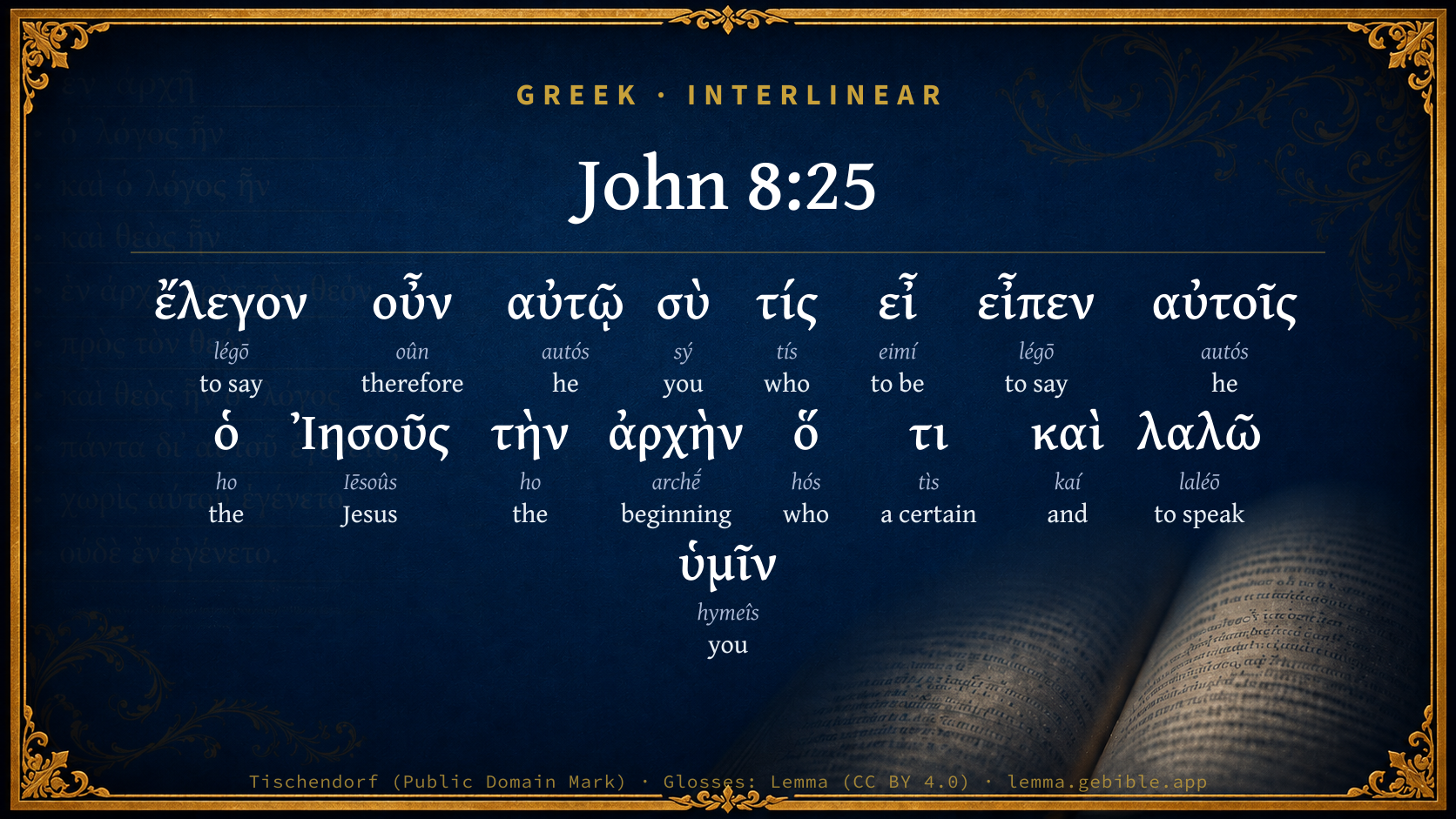
Greek (Tischendorf 8th ed.) John 8:25 appears in the Greek New Testament. The text above is from the Tischendorf 8th edition. Each word links to its Strong’s number and a concise gloss. Click any word for its full Thayer’s Greek Lexicon entry.
Download image
Cite this verse

John 8:25 (World English Bible). Public Domain. Lemma interlinear Bible study tool, https://lemma.gebible.app/v/john/8/25.

Show BibTeX & RIS
BibTeX
RIS
English Translation
They said therefore to him, "Who are you?" Jesus said to them, "Just what I have been saying to you from the beginning.
World English Bible · Public Domain
Download a study sheet

One document with this verse’s original text, its word-by-word gloss line, the meaning frame, cross-references with their text, attributed commentary, and full source and license credits — printable, and it pastes into notes with its structure intact.

This verse Autodidact and up

Study sheet (.html) Plain text (.txt)

A passage Seminary Student

Up to 50 verses in one chapter. A passage sheet keeps up to 6 commentary sources and 12 cross-references per verse, in the order this page ranks them, and says so on the sheet whenever that leaves anything out. Ask for a single verse and you get the Autodidact verse sheet above.

Everything on this page stays free to read, with no account — the sheet is a download of what is already on screen, not access to it.

Want to remove ads? Support Godless Engineer
Compare translations 3

The same verse in 3 English versions, stacked beneath the original-language interlinear above. Click any original word for its lexicon entry.

Each is an independent rendering of the whole verse — the interlinear is not word-aligned to these translations.

Highlighted words mark where these versions differ — a whole-verse word diff, not a word-by-word alignment.

  • World English Bible Public Domain
    They said therefore to him, "Who are you?" Jesus said to them, "Just what I have been saying to you from the beginning.
  • King James Version Public Domain
    Then said they unto him, Who art thou? And Jesus saith unto them, Even the same that I said unto you from the beginning.
  • unfoldingWord Literal Text CC BY-SA 4.0
    Therefore, they said to him, “Who are you?” Jesus said to them, “What have I even been saying to you from the beginning?

unfoldingWord Literal Text — © unfoldingWord, licensed CC BY-SA 4.0. Word-aligned USFM3 via Door43 (git.door43.org/unfoldingWord/en_ult).

Versions to compare (up to 4)

3 of 4 selected

Show all 19 translations

Every available English version of this verse, each an independent rendering of the whole verse.

  • World English Bible Public Domain
    They said therefore to him, "Who are you?" Jesus said to them, "Just what I have been saying to you from the beginning.
  • Berean Standard Bible Public Domain
    “Who are You?” they asked. “Just what I have been telling you from the beginning,” Jesus replied.
  • Majority Standard Bible Public Domain
    “Who are You?” they asked. “Just what I have been telling you from the beginning,” Jesus replied.
  • King James Version Public Domain
    Then said they unto him, Who art thou? And Jesus saith unto them, Even the same that I said unto you from the beginning.
  • American Standard Version (1901) Public Domain
    They said therefore unto him, Who art thou? Jesus said unto them, Even that which I have also spoken unto you from the beginning.
  • Revised Version (1885) Public Domain
    They said therefore unto him, Who art thou? Jesus said unto them, Even that which I have also spoken unto you from the beginning.
  • Geneva Bible (1599) Public Domain
    Then saide they vnto him, Who art thou? And Iesus saide vnto them, Euen the same thing that I said vnto you from the beginning.
  • Douay-Rheims (1899) Public Domain
    They said therefore to him: Who art thou Jesus said to them: The beginning, who also speak unto you.
  • Young's Literal Translation Public Domain
    They said, therefore, to him, `Thou -- who art thou?' and Jesus said to them, `Even what I did speak of to you at the beginning;
  • Literal Standard Version CC BY-SA 4.0
    They said, therefore, to Him, “You—who are You?” And Jesus said to them, “Even what I spoke of to you at the beginning;
  • Unlocked Literal Bible CC BY-SA 4.0
    They said therefore to him, “Who are you?” Jesus said to them, “What I have said to you from the beginning.
  • unfoldingWord Literal Text CC BY-SA 4.0
    Therefore, they said to him, “Who are you?” Jesus said to them, “What have I even been saying to you from the beginning?
  • Darby Bible Public Domain
    They said therefore to him, Who art thou? [And] Jesus said to them, Altogether that which I also say to you.
  • World Messianic Bible Public Domain
    They said therefore to him, “Who are you?” Yeshua said to them, “Just what I have been saying to you from the beginning.
  • Webster's Bible Public Domain
    Then said they to him, Who art thou? And Jesus saith to them, Even the same that I said to you from the beginning.
  • Free Bible Version CC BY-SA 4.0
    Then they asked him, “Who are you?” “Exactly who I told you I was from the beginning,” Jesus replied.
  • Bible in Basic English Public Domain
    Then they said to him, Who are you? Jesus said, What I said to you from the first.
  • Text-Critical English NT CC BY 4.0
    They said to him, “Who are yoʋ?” Jesus said to them, “Exactly what I have been saying to you from the beginning.
  • Tyndale New Testament (1534) Public Domain
    I have many thinges to saye and to iudge of you. But he that sent me is true. And I speake in the worlde those thinges which I have hearde of him.

Literal Standard Version (2020), Covenant Press — licensed CC BY-SA 4.0. Text via the HelloAO Bible API (eBible.org). Unlocked Literal Bible (unfoldingWord) — licensed CC BY-SA 4.0. Text via the HelloAO Bible API (eBible.org). unfoldingWord Literal Text — © unfoldingWord, licensed CC BY-SA 4.0. Word-aligned USFM3 via Door43 (git.door43.org/unfoldingWord/en_ult). Free Bible Version, Dr. Jonathan Gallagher — licensed CC BY-SA 4.0. Text via the HelloAO Bible API (eBible.org).

Word by word

More ways to search: Search by grammar → Find every occurrence → Compare this word →

Practice this passage: Drill this verse → Learn its vocabulary →

ἀρχὴν
archḗ
G746
“beginning”
Noun, Accusative, Singular, Feminine
Part of Speech
Noun
Case
Accusative
Number
Singular
Gender
Feminine
Full Thayer's Definition

Origin: from G756

TDNT: 08:59,8

1. beginning, origin 2. the person or thing that commences, the first person or thing in a series, the leader 3. that by which anything begins to be, the origin, the active cause 4. the extremity of a thing a. of the corners of a sail 5. the first place, principality, rule, magistracy a. of angels and demons
  1. ἔλεγον légō G3004 “to say” Verb, Imperfect, Active, Indicative, 3rd person, Plural
  2. οὖν oûn G3767 “therefore” Conjunction
  3. αὐτῷ autós G846 “he” Personal pronoun, Dative, Singular, Masculine
  4. σὺ sý G4771 “you” Personal pronoun, 2nd person, Nominative, Singular
  5. τίς tís G5101 “who” Interrogative pronoun, Nominative, Singular, Masculine
  6. εἶ eimí G1510 “to be” Verb, Present, Active, Indicative, 2nd person, Singular
  7. εἶπεν légō G3004 “to say” Verb, Aorist, Active, Indicative, 3rd person, Singular
  8. αὐτοῖς autós G846 “he” Personal pronoun, Dative, Plural, Masculine
  9. ὁ ho G3588 “the” Article, Nominative, Singular, Masculine
  10. Ἰησοῦς Iēsoûs G2424 “Jesus” Noun, Nominative, Singular, Masculine
  11. τὴν ho G3588 “the” Article, Accusative, Singular, Feminine
  12. ὅ hós G3739 “who” Relative pronoun, Accusative, Singular, Neuter
  13. τι tìs G5100 “a certain” Indefinite pronoun, Accusative, Singular, Neuter
  14. καὶ kaí G2532 “and” Conjunction
  15. λαλῶ laléō G2980 “to speak” Verb, Present, Active, Indicative, 1st person, Singular
  16. ὑμῖν hymeîs G5210 “you” Personal pronoun, 2nd person, Dative, Plural

About this verse

These counts appear in no published source. They are computed here, from the morphology-tagged text and Lemma’s own curated glosses. What Lemma adds →

17
words
14
distinct lemmas
Gospels
section

Shared distinctive vocabulary

ἀρχὴν beginning G746 occurs in 55 verses of the Greek New Testament. Also found in:
Repetition

Words recur within this verse:

  • ἔλεγον to say G3004 ×2
  • αὐτῷ he G846 ×2
  • ὁ the G3588 ×2

Cross-references

7

Topical passages linked to John 8:25 in the Treasury of Scripture Knowledge — connected by theme and wording, ordered by reader-vote popularity; previews shown in the World English Bible.

  • John 5:17–29 But Jesus answered them, "My Father is still working, so I am working, too."
  • Luke 22:67 "If you are the Christ, tell us." But he said to them, "If I tell you, you won't believe,
  • John 1:22 They said therefore to him, "Who are you? Give us an answer to take back to those who sent us. What do you say about yourself?"
  • John 8:12 Again, therefore, Jesus spoke to them, saying, "I am the light of the world. He who follows me will not walk in the darkness, but will have the light of life."
  • John 19:9 He entered into the Praetorium again, and said to Jesus, "Where are you from?" But Jesus gave him no answer.
  • John 1:19 This is John's testimony, when the Jews sent priests and Levites from Jerusalem to ask him, "Who are you?"
  • John 10:24 The Jews therefore came around him and said to him, "How long will you hold us in suspense? If you are the Christ, tell us plainly."

Cross-references courtesy of OpenBible.info (CC BY 4.0).

Commentary

Notes on John 8:25 from classic Christian and Jewish commentators (each source and its license shown beneath its notes). The classic Christian expositions comment on the surrounding passage and are grouped to its opening verse, so a note may address several verses; the Jewish commentaries on the Tanakh (Rashi and others) are per-verse, so they appear only where the commentator wrote on this verse.

Lemma curates 59 commentaries, every one of them public domain or Creative Commons licensed, each selected and text-cleaned for this edition rather than reprinted as found. About our sources →

The Biblical Illustrator

Joseph S. Exell

Joh_8:25-27

Then said they unto Him, Who art Thou?

…Even the same that I said unto you from the beginning.

By thus expressing Himself, Jesus evidently declared Himself to be the expected One. He avoided, however, the term Messiah, as subject to too much misunderstanding among the Jews. It was, however, just this term which His hearers desired to extort from Him, and it was with this object that they asked the question: Who art Thou? In other words: Have at least the courage to speak out plainly. In fact, an express declaration on this point might have furnished them matter for a capital accusation. The answer of Jesus is: Absolutely what I also declared unto you--neither more nor less than My words imply. He appeals to His own testimony as the adequate expression of His nature. They have only to fathom the series of statements He has made concerning Himself, and they will find therein a complete analysis of His mission and essence. The application of this reply of Jesus was that, to discover His true nature and the position He filled towards Israel and the world, it was sufficient to weigh the testimony which He had for some time borne to Himself. Neither more nor less was to be expected from Him than He Himself stated. In this manner He would be successively recognized as the true Temple (chap. 2); the Living Water (chap. 4); the true Son of God (chap. 5); the Bread of heaven (chap. 6); etc. And thus His name of Christ would be spelt out in some sort, letter by letter, in the heart of the believer, would there take the form of a spontaneous discovery, which would be infinitely more advantageous than if learnt by rote under external teaching. In fact, the confession Thou art the Christ, to be a saving one, must be as with St. Peter (chap. 6:66-69), the fruit of the experience of faith (Mat_16:17). Jesus never sought or accepted an adherence arising from any other principle. This reply is one of the most characteristic traits of our Lords wisdom, and perfectly explains why He so frequently forbade the twelve to say that He was the Christ. (F. Godet, D. D.)

Christs teaching is

I. CONSISTENT (Joh_8:25). Probably it was desired that He should make a proclamation of Himself inconsistent with His former utterances; if so it was disappointed. All His utterances meet in Him as rays meet in the sun. This is remarkable if we consider

1. The various and trying circumstances under which He spoke. It was often under intense suffering and great provocation, and often in answer to men who did their utmost to make Him contradict Himself.

2. The diversity in the minds and circumstances of those who reported His speeches. How different in faculties, taste, culture, habits, and angles of observation were His four biographers; and yet their reports agree.

II. PROGRESSIVE (Joh_8:26). Christ suited His teaching to the capacities and characters of His hearers. In His mind there was an infinite treasury of truth; but His administration of it was gradual. Indeed no finite intelligence could take in all that was in the mind of Christ; it would take Eternity to unfold all His wonderful thoughts. This progressiveness

1. Supplies a motive to stimulate human inquiry. Christ will teach you according to your capacity. The more you learn of Him, the more He will teach you.

2. Shows His suitability as a Teacher for mankind. Men have naturally a craving for knowledge; and the more they know, the more intense their craving becomes. They therefore want a teacher of boundless resources.

III. DIVINE. He that sent Me, etc. (Joh_8:26). He taught not human things, but the things of God--absolute realities--concerning the Divine nature, government, claims, etc.

IV. NOT ALWAYS UNDERSTOOD (Joh_8:27). In this they represent an enormous class in every age, who understand not Christ, but misinterpret Him. Conclusion--Have we put to Christ in earnest the question, Who art Thou? and have we received in docility, faith, and love back into our own hearts an answer from Him? (D. Thomas, D. D.)

The Biblical Illustrator, edited by Joseph S. Exell (c. 1880s–1900s) — public domain. Text from a community e-Sword module.

Joseph Benson's Commentary

Joh 8:25-27. Then said they, Who art thou? — This question they ask in derision, and not with any desire to be instructed. And Jesus saith, Even the same that I said unto you from the beginning — Namely, of my public ministry, or from the time I first spake to you. Or, as Whitby renders it, I am what I before told you I was; a sense of the expression, την αρχην, (here rendered, from the beginning,) which he justifies by several passages of the Septuagint, particularly Gen 13:4; Gen 41:21; Gen 42:18; Gen 42:20; that is, I am one sent of God to reveal his will to you. I have many things to say and to judge of you — That is, you say and judge many things of me, which from my words and deeds will appear to be false; but I have many things to say of you, what you are as to your spirit and conduct, and what you will be through the just judgment of God, which, though you will not believe, will be found true; for he that sent me to say them is true, and I speak those things which I have heard of him — I deliver truly what he hath given me in charge, and he will finally verify my words. They understood not — So exceeding stupid were they, and so blinded by the prejudices of their minds; that he spake to them of the Father — Of God, as the person who sent him.

Joseph Benson's Commentary on the Old and New Testaments (1811–1818) — public domain. Text from a community e-Sword module.

Tyndale Open Study Notes

Tyndale Open Resources

8:25 Who are you? Later they understood and tried to stone Jesus for blasphemy (8:59).

Tyndale Open Study Notes — © Tyndale Open Resources, licensed CC BY-SA 4.0. Text via the HelloAO Bible API.

Bengel's Gnomon

Johann Albrecht Bengel

Joh 8:25, etc. Σὺ τὶς εἶ; who art Thou?) They are referring to that expression of His, ἐγώ εἰμι, I am He [Joh 8:24]. They ask the question, but in such a perverse frame of mind, that they have no real intention to believe on Him, when He tells them.—εἶπεν, He said) It is not said, He replied. The Lord addresses Himself less directly to meet the Jews’ interrogatory; but He addresses Himself to the fact itself plainly, and in such a way as to make a further progress in His own discourse. A similar question and reply occur at ch. Joh 10:24, etc., “If Thou be the Christ, tell us plainly. Jesus answered—I told you, and ye believed not; the works that I do in My Father’s name, they bear witness of Me.”—τὴν ἀρχὴν, ὅτι καὶ λαλῶ ὑμῖν, πολλὰ ἔχω περὶ ὑμῶν λαλεῖν καὶ κρίνειν· ἀλλʼ ὁ πέμψας με ἀληθής ἐστι, κἀγὼ ἃ ἤκουσα παρʼ αὐτοῦ, ταῦτα λέγω εἰς τὸν κόσμον) All these words form one complete paragraph, of which both the Protasis and the Apodosis are each double-membered, so as that they most aptly correspond with one another, in this way:

In the beginning, since I also speak to you, [inasmuch as I am even speaking to, or, for you],

I have many things to speak and to judge concerning you: But He, who sent Me, is true;

and what things I have heard from Him, these I speak to the world.

Every word in this passage both ought and can be taken in its own proper signification. I. Τὴν ἀρχήν is not here equivalent in meaning to ὅλως, altogether, but in the strict sense, in the beginning. I have shown it to be so at Chrysost. de Sacerdot, p. 425, etc.: also at 1Co 5:1. Also the Herodotea Raphelii, p. 293, etc., deserve to be well weighed. Nonnus, when he might have retained τὴν ἀρχήν (saith Joach. Camerarius), as the numbers of his verse were no obstacle, yet has changed the words into Ἐξ ἀρχῆς ὅττι περ ὑμμῖν Ἐξ ἀρχῆς ὀάριζον. II. Ὅτι is because, since, inasmuch as; so Joh 8:45, but because, ὅτι, I speak the truth, ye do not believe Me. Let the force of the same particle be weighed at Joh 8:22; Joh 8:43; Joh 2:18, “What sign showest Thou, seeing that Thou doest these things?” Joh 11:47, “What do we? for—inasmuch as—this Man doeth many miracles;” Joh 8:56, “What think ye, that He will not come to the feast?” etc. III. Καὶ about the beginning, and not the very beginning of a clause, has the force of even, also; and in this passage it intensifies the force of the present tense and indicative mood in the verb λαλῶ; Comp. with it καί, even, 1Co 15:29, “What shall they do, that are baptized for the dead, if the dead rise not at all? Why are they then [Engl. Vers. καί; rather, even] baptized for the dead?” Php 3:8, “Yea doubtless, and I [Engl. Vers. καί; rather, I even] count all things loss for the excellency of the knowledge of Christ.” IV. Λαλῶ, I am speaking, not merely I have to speak, not merely I have spoken, but even yet I am speaking [I speak]. V. Ὑμῖν, to you [for you], is the dative of the advantage, i.e. I speak concerning Myself, who I am, in order that ye may believe and be saved. Hardly any point has caused more difficulty to expositors than the stopping after this ὑμῖν. The Codices MSS. quoted in the Apparatus Crit. p. 589, defend the comma; and so also, in addition to Chrysostom, Nonnus, and Scaliger, who are mentioned in the same place, Knatchbull, Raphelius, also James Faber, Corn. Jansenius, and Franc. Lucas. [Engl. Vers. “Even the same that I said unto you from the beginning. I have many things to say,” etc. Vulg. “Principium quia (or, as other copies, qui) et loquor vobis;” [223] [224], ‘quod;’ [225], ‘quoniam;’ Ὁ, τι in Rec. Text. So Lachmann, reading the sentence with an interrogation, making ὅ, τι = διὰ τι, resembling the εἰ interrogative. So Mar 9:11, “They asked, saying, Ὅ, τι λέγουσιν οἱ γραμματεῖς, ὅ, τι Ἡλίαν δεῖ ἐλθεῖν. Alford translates ἀρχήν, etc., I am essentially that same which I SPEAK unto you. Appropriate to Him, as the λόγος revealed. Just as to Moses I am that I am was appropriate of One as yet unrevealed.] VI. Πολλὰ περὶ ὑμῶν, much [multa] concerning you, on account of your much [multam] incredulity. This was the chief point of Jesus Christ’s complaint concerning the Jews everywhere, and especially here, where He begins to make mention as to His departure. VII. Ἔχω λαλεῖν καὶ κρίνειν, I have to speak and to judge. To this appertains the τὴν ἀρχήν, and it has thus somewhat more force than πρῶτον. Now for the first time there was given by the Jews to the Lord by far the greatest reason for His speaking and judging concerning themselves, after that they had heard so many testimonies, and yet had not believed. Similarly νο͂ν, now, is employed, Luk 11:39, in an argument, for which a great handle had been given, “Now do ye Pharisees make clean the outside of the cup,” etc. Comp. the ἤρξατο, began, Mat 11:20, “Then began He to upbraid the cities,” etc. Here the Protasis ceases, in the whole of which the same thing is said, as at ch. Joh 6:36, I said to you that ye both [also, Engl. Vers.] have seen Me, and do not believe; and at ch. Joh 10:25, etc., where to the same question the same reply is repeated, only in other words. VIII. There follows the Apodosis, beginning with ἀλλʼ, in which He plainly enough intimates, who He is. IX. Ὁ πέμψας με ἀληθής ἐστι· i.e. although you to such a degree refuse to believe, that your incredulity furnishes the strongest reason why I might have judged you; yet He, who hath sent Me into the world, is true. Your unbelief does not set aside His own faithfulness. X. Κἀγὼ, ἃ ἤκουσα παρʼ αὐτοῦ, ταῦτα λέγω· i.e. These things I speak, which He that is true hath committed to Me, for the purpose of saving you, not for the purpose of judging you; the sum and substance of which is, that I have been sent by Him: I speak these things, and these alone, not other things, which would appertain to the judging of you; ch. Joh 3:17, “God sent not His Son into the world to condemn the world, but that the world through Him might be saved;” ch. Joh 5:45, “Do not think that I will accuse you to the Father;” ch. Joh 12:47, “If any man hear My words and believe not, I judge him not; for I came not to judge the world, but to save the world.” XI. Εἰς τὸν κόσμον. An abbreviated form of expression, i.e. These things, which were before unknown to the world, I have brought into the world, and I speak in the world, in order that they may be distributed by My witnesses throughout the whole world, now a stranger to [alien from] the faith, but, whether you will believe or not, hereafter about to believe. I do not pay any regard to your obstinacy. Out of the four members of this portion, as marked out at the beginning of this note, the first and fourth, the second and third, cohere together in a most suitable χιασμός. In the Protasis, both the first clause, I even speak to you, and the second, I have many things to speak and to judge concerning you, and the connection of both, ought to be regarded. For the words in antithesis are, I even speak, and the expression, to you: corresponding respectively to, I have to speak and to judge, and the expression, concerning you. The Apodosis is easy to perceive, when regarded by itself; but how it stands in relation to the Protasis, they who look less to the sense than to the words, are not likely forthwith to perceive. These will observe, that the unbelief of the Jews is marked in the Protasis; but, that the unshaken perseverance of Jesus in setting forth the truth unto salvation is rather made manifest in the Apodosis, and at the same time the truth itself concerning Jesus, who He is, is summarily brought in by implication. Comp. by all means the whole of Joh 8:28, “When ye have lifted up the Son of man, then shall ye know that I am He, and that I do nothing of Myself; but as My Father hath taught Me, I speak these things.” I might justly make the beginning of My speech, saith He, now even more than heretofore, by a judgment pronounced on your unbelief before that I bring forth the other subjects: but I perseveringly speak not so much severe things of you, as saving things of Myself [tidings of salvation to you in Myself]. Very many take separately these words, τὴν ἀρχὴν ὅ, τι καὶ λαλῶ ὑμῖν: and indeed H. B. Starkius has thus explained the words, In the beginning, to wit, I said, what even still I say to you: which had been previously the explanation of Nic. Hemmingius, from whom John Brentius in his Homilies does not much differ. Others generally in this way: ὃν τινα εἶναί με τὴν ἀρχὴν ἔλεγον, εἰμί, i.e. I am He, whom in the beginning I said to you I was; an interpretation which, however easy a sense it introduces, yet will be found to make many departures from the words of the text, if you compare them together.

[223] Vercellensis of the old ‘Itala,’ or Latin Version before Jerome’s, probably made in Africa, in the second century: the Gospels.

[224] Colbertinus, do.

[225] Cantabrigiensis, do.: the Gospels, Acts , , 3 d Ep. John.

Bengel's Gnomon of the New Testament — English translation (T&T Clark, Edinburgh, 1860) — public domain. Text from a community e-Sword module.

Meyer's Critical & Exegetical Commentary

Heinrich August Wilhelm Meyer

Joh_8:25. The Jews understand the ὅτι ἐγώ εἰμι well enough, but refuse to recognise it, and therefore ask pertly and contemptuously: σὺ τίς εἶ; tu quis es? σύ being emphasized for the purpose of expressing disdain; comp. Act_19:15. Jesus replies with a counter-question of surprise at so great obduracy on their part; but then at once after Joh_8:26 discontinues any further utterance regarding them, His opponents. His counter-question is: τὴν ἀρχὴν ὅ, τι καὶ λαλῶ ὑμῖν? What I from the very beginning also say to you? namely, do you ask that? Who I am (to wit, the Messiah, Joh_8:24; Joh_8:29), that is the very thing which, from the very beginning, since I have been among you, and have spoken to you, has formed the matter of my discourse;[14] and can you still ask about that, as though you had not yet heard it from me? They ought to have known long ago, and to have recognised, what they just now asked with their wicked question σὺ τίς εἶ. This view is not complicated, as Winer objects, but corresponds simply to the words and to the situation. On ἀρχήν as used frequently in an adverbial sense, both among the Greeks and by the LXX., with and without the article, to denote time, ab initio, from the very beginning, see Schweighaüser, Lex. Herod. I. p. 104 f.; Lennep ad Phalar. p. 82 ff. It precedes the relative, because it is the point which makes the obduracy of the Jews so very perceptible; comp. Joh_4:18; Buttmann, Neut. Gram. p. 333 d. [E. T. p. 389].

ὅ, τι] interrogatively, in relation to a question with τίς immediately preceding,as is frequently the case even in the Classics, so that some such words as thou askest must be supplied in thought. See Kühner, II. § 837, note 1; Bernhardy, p. 443; Krüger, § 51. 17. 3.

καί] also, expresses the corresponding relation (Baeumlein, Partik. p. 152), in this case, of speech to being: what from the very beginning, as I am it, so also, I say it to you.

λαλῶ] speak, not: say. Comp. on Joh_8:26; Joh_8:43; and see on Rom_3:19. Nor does He use λελάληκα, because it is a continuous speaking; the sound of it is, in fact, still ringing in their ears from. Joh_8:23-24.

The passage is also taken interrogatively by Matthaei, Lachmann, Tischendorf, and Lücke. The latter[15] renders: Why, indeed, do I still speak to you at all? With this view, it is true, τὴν ἀρχήν is quite compatible; for it is confessedly often used in the Classics for ab initio, in the sense of omnino (Raphel, Herod. in loc.; Hermann, ad Viger. p. 723; Ellendt, Lex. Soph. I. p. 237; Breitenbach, ad Xen. Oec. ii. 12), though only in negative propositions, or such whose signification really amounts to a negation,[16] which latter, however, might be the case here (as in Plat. Demod. p. 381 D; Philo, de Abr. p. 366 C); it is also allowable to take ὅ, τι in the sense of why (see on Mar_9:11; Buttmann, neut. Gram. p. 218 [E. T. p. 253]). But the thought itself has so little meaning in it, and is so little natural, expressing, besides, a reflection, which is at the bottom so empty, and, at the same time, through τὴν ἀρχήν, so expanded and destitute of feeling, that we should scarcely expect it at the lips of the Johannean Jesus, especially in circumstances so lively and significant as the present. Further thus understood, the saying would have no connection whatever with what follows, and the logical connection assumed by Lücke would require the insertion of some such words as ΠΕΡῚ ἘΜΟῦ. The words would thus likewise stand in no relation to the question ΣῪ ΤΊς ΕἾ, whereas Johns general manner would lead us to expect an answer which had reference in some significant way or other to the question which had been put. The following are non-interrogative views:(1) What I have already said to you at the beginning, that am I! So Tholuck after Castalio, Beza, Vatablus, Maldonatus, Clericus, Heumann, and several others; also B. Crusius. Jesus would thus be announcing that He had already, from the very beginning in His discourses, made known His higher personality. The Praes. λαλῶ, as expressing that which still continues to be in the present, would not be opposed to this view; but it does not harmonize with the arrangement of the words; and logically, at all events, ΚΑΊ ought to stand before ΤῊΝ ἈΡΧΉΝ (comp. Syriac). (2) From the very first (before all things), I am what I also speak to you. So De Wette; comp. Luther (I am your preacher; if you first believe that, you will then learn what I am, and not otherwise), Melancthon, Aretius, and several; also Maier, who, however, takes τὴν ἀρχὴν incorrectly as thoroughly (nothing else).[17] On this view Jesus, instead of answering directly: I am the Messiah, would have said that He was to be known above all things from His discourses.[18] But τὴν ἀρχὴν does not mean above all things, not even in Xen. Cyr. i. 2, 3, where we read: τὴν ἀρχὴν μὴ τοιοῦτοι, at the very outset not such, i.e. not such at all, omnino non tales; just as little too in Herod. i. 9, where also, as frequently in Herodotus, it denotes omnino; comp. Wolf, Dem. Lept. p. 278. And how entirely without any reference would be the words ante omnia (surely some sort of posterius would need to be supplied in thought). Brückner has rightly, therefore, rejected the above all things in De Wettes rendering, though regarding it as the only correct one, and keeping to the interpretation from the very first in its temporal sense. One cannot, however, see what is really intended by the words from the very first, I am, etc., especially as placed in such an emphatic position at the commencement of the clause. For Jesus had neither occasion nor ground for giving the assurance that He had been from the beginning of His appearance, and still was, such as He had declared Himself to be in His discourses, and therefore had not since become different. (3) Undoubtedly (nothing else) am I what I also say to you. So Kuinoel;a view which assigns an incorrect meaning to τὴν ἀρχήν, and confounds λαλῶ with λέγω; objections which affect also the similar interpretation of Ebrard: I am altogether that which I also say to you (that I am He). (4) At the very outset I declared of myself what I also explain to you, or what I also now say. So Starck, Not. sel. p. 106; Bretschneider. But the supplying of λελάληκα from the following λαλῶ (comp. Dissen, Dem. de Cor. p. 359) would only be suggested if we read ὅ, τι καὶ νῦν λαλῶ ὑμῖν. (5) Fritzsche (Lit. Bl. z. allg. Kirchenz. 1843, p. 513, and de conform. Lachmann, p. 53), whom Hengstenberg follows, takes the view: Sum a rerum primordiis (Joh_1:1) ea natura, quam me esse vobis etiam profiteor. Jesus would thus have designated Himself as the primal Logos. Quite unintelligibly for His hearers, who had no occasion for taking τὴν ἀρχήν in the absolute sense, as though reminded of the angel of the Lord in Malachi 3 and Zechariah 11, nor for understanding ὅ, τι κ. λ. ὑμ. as Fritzsche does; at all events, as far as the latter is concerned, λέγω ought to have been used instead of λαλῶ. (6) Some connect τὴν ἀρχήν with πολλὰ ἔχω, etc., Joh_8:26, and after λαλῶ ὑμῖν place merely a comma. So already Codd., Nonnus, Scaliger, Clarius, Knatchbull, Raphel, Bengel, and, more recently, Olshausen, Hofmann, Schriftbew. I. p. 65, II. p. 178, and Baeumlein. In taking the words thus, ὅ, τι is either written ὅτι, because, with Scaliger and Raphel (so also Bengel: principio, quum etiam loquor vobis [Dativus commodi: ut credatis et salvemini] multa habeo de vobis loqui, etc.[19]), or is taken as a pronoun, id quod. In the latter way, Olshausen explains it, following Clarius: In the first place, as I also plainly say to you, I have much to blame and punish in you; I am therefore your serious admonisher. Baeumlein, however, renders: I have undoubtedlyas I also domuch to speak and to judge concerning you. But on this view of the words Jesus would have given no answer at all to the question σὺ τίς εἶ; according to Olshausen, ΤῊΝ ἈΡΧΉΝ would have to be transformed into ΠΡῶΤΟΝ, in the first place; and the middle clause, according to Olshausen and Baeumlein, would give a quite superfluous sense; while, according to the view of Bengel and Hofmann, it would be forced and unnatural. (7) Exegetically impossible is the interpretation of Augustine: Principium (the very beginning of all things) me credite, quia (ὅτι) et loquor vobis, i.e. quia humilis propter vos factus ad ista verba descendi; comp. Gothic, Ambrose, Bede, Ruperti, and several others. Calvin rightly rejects this interpretation, but himself gives one that is impossible. (8) Obscure, and an importation, is Luthardts view (ὅτι, that: from the beginning am I, that I may also speak to you), that Jesus describes the act of His speaking, the existence of His word, as His presence for the Jews; that from His first appearance onwards, He who was then present as the Word of God on the earth had been always used to give Himself a presence for men in the Word. If, according to this view, as it would seem, τὴν ἀρχὴν ὅτι denotes: from the beginning it is my manner, that, this cannot possibly be in the simple εἰμί, which has to be supplied in thought; besides, how much is forced into the mere ΛΑΛῶ ὙΜῖΝ!

[14] According to John, at His very first appearance in the temple, Joh_2:19.

[15] So, without doubt, Chrysostom also, who gives as the meaning: τοῦ ὅλως ἀκούειν τῶν λόγων τῶν παρʼ ἐμοῦ ἀνάξιοί ἐστε, μήτι γε καὶ μαθεῖν ὅστις ἐγώ εἰμι. Comp. Cyril and Theophylact, also Euth. Zigabenus. Matthaei explains the words in exact accordance with Lücke: Cur vero omnino vobiscum loquor? cur frustra vobiscum disputo? See ed. min. I. p. 575. With this also is in substantial agreement the view of Ewald, who, however, regards the words rather as the expression of righteous indignation than as a question: That I should, indeed, speak to you at all! It would be more correct to say: That I should at all even (still) speak to you! But how greatly is the at all thus in the way! Οτι, too, would then need a supplement, which is not furnished by the text. Besides, the following words, especially if introduced without an ἀλλά or μέντει (indicating that Jesus had collected Himself again, and suppressed His indignation), would not be appropriate. In the Theol. QuartalsChr. 1855, p. 592 ff., Nirschl renders: To what purpose shall I speak further to you of the origin, i.e. of God, and my own derivation from Him? But on this view Christ ought, at the very least, to have said τὴν ἀρχήν μου.

[16] See especially Lennep, l.c. and p. 94; Brückner on the passage.

[17] Comp. Winer, p. 432 [E. T. p. 581], who gives as the meaning: I am entirely that which I represent myself as being in my discourses. So also Godet: Absolument ce que je vous dis; ni plus ni moins que ce que renferme ma parole. But τ. ἀρχήν is used in the sense of completely, entirely, only in connection with negations (usually, too, without the article): not at all, not in the least; cum negatione praefracte negando servit, Ellendt, Lex. Soph. l.c.

[18] Under this head belongs also the view taken by Grotius (which is substantially adopted by Lange): Primum (in the first instance) hoc sum, quod et dico vobis, hoc ipsum quod me hoc ipso tempore esse dixi, i.e. lux mundi. As though we read: πρῶτον μὲν ὅ, τι καὶ λέγω ὑμῖν. In the same way as Grotius, has Calov. also explained it, taking, however, τὴν ἀρχήν in the sense of omnino, plane (consequently like Winer).

[19] Comp. Hofmann: At first, namely for the present, because this is the time, when He speaks to them, He has much to speak and to judge about them in words. Τὴν ἀρχήν is alleged, to be used in opposition to a τὸ τέλος, i.e. to a time when that which He now speaks will be proved by deeds, ver. 28. In this way meaning and connection are imported into the passage, and yet the καί (with an appeal to Hartung, Partik. I. p. 129) is completely neglected, or rather transferred from the relative to the principal clause. How the passages adduced by Hartung may be explained without any transference, see in Klotz, ad Devar. p. 635 ff. In particular, there is no ground for supposing the existence of a trajection of the καί in the N. T. Hofmann explains, as though John had written: τὴν ἀρχήν, ὅτι νῦν λαλῶ ὑμῖν, καὶ πολλὰ ἔχω, etc.

Meyer — Critical and Exegetical Commentary on the New Testament — English translation by Peter Christie, edited by Frederick Crombie (T&T Clark, 1880) — public domain. Text from a community e-Sword module.

Expositor's Greek Testament

ed. W. Robertson Nicoll

Joh 8:25 . This only adds bewilderment to their mind, and they, not “pertly and contemptuously” (Meyer, Weiss, Holtzmann), but with some shade of impatience, ask: Σὺ τίς εἶ ; “Who art Thou?” To this Jesus replies: τὴν ἀρχὴν ὅ τι καὶ λαλῶ ὑμῖν . These words are rendered in A.V [65] “Even the same that I said unto you from the beginning”; and in R.V [66] “Even that which I have also spoken unto you from the beginning”. The Greek Fathers understood τὴν ἀρχὴν as equivalent to ὅλως , a meaning it frequently bears; and they interpret the clause as an exclamation, “That I should even speak to you at all!” [ ὅλως , ὅτι καὶ λαλῶ ὑμῖν , περιττόν ἐστιν . ἀνάξιοι γάρ ἐστε παντὸς λόγου , ὡς πειρασταί , Euthymius.] With this Field compares Achilles Tatius, vi. 20, οὐκ ἀγαπᾷς ὅτι σοι καὶ λαλῶ ; Art thou not content that I even condescend to speak to thee? In support of this rendering Holtzmann quotes from Clem., Hom. vi. 11, εἰ μὴ παρακολουθεῖς οἷς λέγω , τί καὶ τὴν ἀρχὴν διαλέγομαι ; He even supposes that this is an echo of John, so that we have here an indication of the earliest interpretation of the words. This meaning does no violence to the words, but it is slightly at discord with the spirit of the next clause and of Jesus generally (although cf. Mar 9:19 ). Another rendering, advocated at great length by Raphel ( Annot. , i. 637), puts a comma after τὴν ἀρχὴν and another after ὑμῖν , and connects τὴν ἀρχὴν with πολλὰ ἔχω ; “omnino, quia et loquor vobis, multa habeo de vobis loqui”. Raphel’s note is chiefly valuable for the collection of instances of the use of τὴν ἀρχήν . A third interpretation is that suggested by the A.V [67] , and which finds a remarkable analogue in Plautus, Captivi , III. iv. 91, “Quis igitur ille est? Quem dudum dixi a principio tibi” (Elsner). But this would require λέγω , not λαλῶ . There remains a fourth possible interpretation, that of Melanchthon, who renders “plane illud ipsum verbum sum quod loquor vobiscum”. So Luther (see Meyer); and Winer translates “(I am) altogether that which in my words I represent myself as being”. To this Meyer and Moulton (see his note on Winer) object that τὴν ἀρχὴν only means “omnino” “prorsus” when the sentence is negative. Elsner, however, admitting that the use is rare, gives several examples where it is used “sine addita negativa”. The words, then, may be taken as meaning “I am nothing else than what I am saying to you: I am a Voice; my Person is my teaching”.

[65] Authorised Version.

[66] Revised Version.

[67] Authorised Version.

The Expositor's Greek Testament, edited by W. Robertson Nicoll (1897–1910) — public domain. Text from a community e-Sword module.

Geneva Bible (1599)

Geneva Bible translators

He shall at length know who Christ is, which will diligently hear, what he saith.

That is, I am Christ, and the savior, for so I told you from the beginning that I was.

Geneva Bible (1599) marginal notes — public domain. Text via Bolls.life.

Jamieson, Fausset & Brown

Robert Jamieson, A. R. Fausset & David Brown

Who art thou?--hoping thus to extort an explicit answer; but they are disappointed.

Jamieson, Fausset & Brown — Commentary Critical and Explanatory on the Whole Bible (1871) — public domain (CC PDM 1.0). Text via the HelloAO Bible API.

Adam Clarke's Commentary

Verse 25. Who art thou?] This marks the indignation of the Pharisees-as if they had said: Who art thou that takest upon thee to deal out threatenings in this manner against us?

Jesus saith unto them, Even the same that I said unto you from the beginning.] Rather, Just what I have already told you, i.e. that I am the light of the world - the Christ-the Saviour of mankind. There are a variety of renderings for this verse among the critics. Some consider την αρχην (which makes the principal difficulty in the text) as the answer of our Lord. Who art thou? I am την αρχην, the chief, the supreme; and have therefore a right to judge, and to execute judgment. But if our Lord had intended to convey this meaning, he would doubtless have said η αρχη, or ο αρχων, and not την αρχην, in the accusative case. This mode of reading appears to have been followed by the Vulgate, some copies of the Itala, and some of the fathers; but this construction can never be reconciled to the Greek text. Others take την αρχην as an adverb, in which sense it is repeatedly used by the best Greek writers; and, connecting the 25th with the 26th verse, they translate thus: I have indeed, as I ASSURE ye, many things to say of you, and to condemn in you. See Wakefield. Raphelius takes up the words nearly in the same way, and defends his mode of exposition with much critical learning; and to him I refer the reader. I have given it that meaning which I thought the most simple and plain, should any departure from our own version be thought necessary: both convey a good and consistent sense.

Adam Clarke's Commentary on the Bible (1810–1826) — public domain. Text from a community e-Sword/MySword module.

John Calvin's Commentaries

25. From the beginning. They who translate the words τὴν ἀρχὴν, as if they had been in the nominative case, I am the beginning, and as if Christ were here asserting his eternal Divinity, are greatly mistaken. There is no ambiguity of this sort in the Greek, but still the Greek commentators also differ as to the meaning. All of them, indeed, are agreed that a preposition must be understood; but many give to it the force of an adverb, as if Christ had said, “This ought first (τὴν ἀρχὴν) to be observed.” Some too — among whom is Chrysostom — render it continuously thus: The beginning, who also speak to you, I have many things to say and judge of you This meaning has been put into verse by Nonnus. But a different reading is more generally adopted, and appears to be the true one. I interpret τὴν ἀρχὴν, from the beginning; so that the meaning, in my opinion, is this: “I did not arise suddenly, but as I was formerly promised, so now I come forth publicly.” He adds,

Because I also speak to you; by which he means that he testifies plainly enough who he is, provided that they had ears. This word, ὄτι because, is not employed merely to assign a reason, as if Christ intended to prove that he was from the beginning, because he now speaks; but he asserts that there is such an agreement between his doctrine and the eternity which he has spoken of, that it ought to be reckoned an undoubted confirmation of it. It may be explained thus: “According to the beginning, that is, what I have formerly said, I now, as it were, confirm anew;” or, “And truly what I now also speak, is in accordance with the conditions made in all ages, so as to be a strong confirmation of it.”

In short, this reply consists of two clauses; for, under the word beginning, he includes an uninterrupted succession of ages, during which God had made a covenant with their fathers. When he says that he also speaks, he joins his doctrine with the ancient predictions, and shows that it depends on them. Hence it follows that the Jews had no other reason for their ignorance, than that they did not believe either the Prophets or the Gospel; for it is the same Christ that is exhibited in all of them. They pretended to be disciples of the Prophets, and to look to the eternal covenant of God; but still they rejected Christ, who had been promised from the beginning, and presented himself before them.

John Calvin's Commentaries (1540-1563) — public domain. Text from the Calvin Translation Society English edition (1840s-50s) via the Christian Classics Ethereal Library (ccel.org). Calvin's coverage is partial (roughly two-thirds of the Bible); uncommented books and verses are honest gaps, never fabricated. The 19th-century editor's footnotes and remarks are omitted so the notes are faithfully Calvin's own voice.

Ellicott's Commentary for English Readers

(25) Then said they unto him, Who art thou?—They ask the question in the tone of scorn which they have already expressed in Joh_8:22. The pronoun is the emphatic word: “Thou, who art thou?” and the phrase was in frequent use to express contempt. He had said, “I am;” but they do not understand the words to be a divine name. Long before this time the name formed from these words, and which is now usually, but wrongly, read “Jehovah,” had been regarded as too sacred to be uttered. They appear to take the sentence as though it was incomplete, “I am . . .;” “Well, who art thou?” We have again, as in Joh_8:19, to note the attempt to draw from Him some definite statement which may be made the ground of a technical charge; but this He again avoids.

And Jesus saith unto them, Even the same that I said unto you from the beginning.—Almost every word of this answer is in the Greek capable of more than one meaning, and the true interpretation of the whole sentence cannot be decided with certainty. To discuss it with any fulness would be to encumber the page with details which would be unintelligible to the general reader; to discuss it with anything but fulness would be unsatisfactory to the student. There is little room for addition to the investigations which are now accessible. The full notes of Meyer and Stier and Tholuck may be read in English; and Dr. Moulton’s addition to his Translation of Winer’s Grammar (eighth edition, 1877, pp. 581-2), gives in a few words nearly all that can be said on the grammatical difficulty. After a careful consideration of the whole matter, it is believed, though not without hesitation, that the rendering, which is least liable to objection on any ground, is that which regards the answer as itself a question—“What I from the beginning am also speaking to you?” “You ask who I am. This has formed the substance of My teaching from the beginning, and is the substance of My teaching still.” (Comp. Joh_8:58.) “Can it be that you ask this?”

A Bible Commentary for English Readers, edited by Charles John Ellicott (1878–1897) — public domain. Text from a community e-Sword module.

The Cambridge Bible for Schools and Colleges

gen. ed. J. J. S. Perowne

25. Then said they] They said therefore.

Who art thou?] It is incredible that the Jews can have failed to understand. Christ had just declared that He was from above, and not of this world. Even if the words ‘I am’ were ambiguous in themselves, in this context they are plain enough. As in Joh_8:19, they pretend not to understand, and contemptuously ask, Thou, who art Thou? The pronoun is scornfully emphatic. Comp. Act_19:15. Possibly both in Joh_8:19 and here they wish to draw from Him something more definite, more capable of being stated in a formal charge against Him.

Even the same that I said unto you from the beginning] This is a passage of well-known difficulty, and the meaning will probably always remain uncertain. (1) It is doubtful whether it is a question or not. (2) Of the six or seven Greek words all excepting the word meaning ‘unto you’ can have more than one meaning. (3) There is a doubt whether we have six or seven Greek words. To discuss all the possible renderings would go beyond the scope of this volume. What I from the beginning am also speaking to you of is perhaps as likely as any translation to be right. And it matters little whether it be made interrogative or not. Either, ‘Do you ask that of which I have been speaking to you from the first?’, in which case it is not unlike Christ’s reply to Philip (Joh_14:9); or, ‘I am that of which I have been speaking to you all along.’

The Cambridge Bible for Schools and Colleges (gen. ed. J. J. S. Perowne; Cambridge University Press, 1878–1918) — public domain. Text from a community e-Sword module.

John Gill's Exposition

They understood not that he spake to them of the Father. That sent him, and who was true and faithful to all he had said, whether in a way of promise, or threatening; such was their stupidity, that they did not know that he meant God the Father by him that sent him, so deriving his mission and doctrine from him; their hearts were made fat, and hardened, and their eyes were blinded. The Vulgate Latin version reads, "they did not know that he said, God was his Father"; and so Beza's most ancient copy, and another exemplar of his.

They understood not that he spake to them of the Father. That sent him, and who was true and faithful to all he had said, whether in a way of promise, or threatening; such was their stupidity, that they did not know that he meant God the Father by him that sent him, so deriving his mission and doctrine from him; their hearts were made fat, and hardened, and their eyes were blinded. The Vulgate Latin version reads, "they did not know that he said, God was his Father"; and so Beza's most ancient copy, and another exemplar of his.

John 8:28

joh 8:28

joh 8:28

joh 8:28Then said Jesus unto them,.... Upbraiding them with their ignorance, and giving them a sign, as well as pointing out the time when they either, by good or sad experience, should have knowledge of him:

when ye have lift up the son of man; meaning himself, who was to be lifted up upon the cross, as the serpent was upon the pole, in the wilderness; and which signified the manner of death he should die, the death of the cross; and suggested, that what the Jews designed for his reproach, shame, and abasement, would be the way and means of his rise and exaltation; and this lifting him up, or crucifying him, he ascribes to them, because they would deliver him to Pontius Pilate to be condemned, and stir up the people to ask, and be importunate themselves for his crucifixion:

then shall ye know that I am he; the Son of God, and true Messiah, as the centurion, and those that were with him, did, when they observed the earthquake; and the things that were done at his death; and after the death, resurrection, and ascension of Christ, and the pouring forth of his Spirit, many of the Jews had not only a notional, but a true and spiritual knowledge of Jesus, as the Messiah; and upon the destruction of their temple, city, and nation, and their disappointment by false Christs, they doubtless many of them must, and did know, that the true Messiah was come, and that Jesus of Nazareth was he:

and that I do nothing of myself; See Gill on Joh 5:19;

but as my Father hath taught me, I speak these things; this he says not as lessening himself, or making himself inferior to the Father, but to show the excellency of his doctrine, and to assert the original, authority, and divinity of it; suggesting that it was not an human doctrine, or a device of man's, or his own, as man, but was divine, and from God; see Joh 7:16.

John Gill's Exposition of the Whole Bible (1746–1763) — public domain (CC PDM 1.0). Text via the HelloAO Bible API.

Trapp's Complete Commentary

John Trapp

25 Then said they unto him, Who art thou? And Jesus saith unto them, Even the same that I said unto you from the beginning.

Ver. 25. Even the same that I said, &c.] To wit, "the way, the truth, and the life." Some render it thus: Prorsus id quod loguor vobiscum, I am the very same Word that I speak with you.

John Trapp, A Commentary or Exposition upon All the Books of the Old and New Testament (1647–1656) — public domain. Text from a community e-Sword module.

Albert Barnes' Notes on the Bible

Who art thou? - As Jesus did not expressly say in the previous verse that he was the Messiah, they professed still not to understand him. In great contempt, therefore, they asked him who he was. As if they had said, “Who art thou that undertakest to threaten us in this manner!” When we remember that they regarded him as a mere pretender from Galilee; that he was poor and without friends; and that he was persecuted by those in authority, we cannot but admire the patience with which all this was borne, and the coolness with which he answered them.

Even the same ... - What he had professed to them was that he was the light of the world; that he was the bread that came down from heaven; that he was sent by his Father, etc. From all this they might easily gather that he claimed to be the Messiah. He assumed no new character; he made no change in his professions; he is the same yesterday, today, and forever; and as he had once professed to be the light of the world, so, in the face of contempt, persecution, and death, he adhered to the profession.

The beginning - From his first discourse with them, or uniformly.

Albert Barnes' Notes on the Bible (1834–1885) — public domain. Text from a community e-Sword/MySword module.

Haydock's Catholic Bible Commentary

Who art thou? Jesus said to them: The beginning,[3] who also speak to you. This text and the construction of it is obscure, both in the Latin and in the Greek. St. Augustine and some of the Latin Fathers, expound it in this manner: I am the beginning of all things, who now being made man, speak to you. But this does not seem the construction, if we consult the Greek text; (where the beginning is not in the nominative, but in the accusative case) and therefore St. Augustine having considered more attentively the Greek, thinks that something must be understood, as believe me to be the beginning: he looks upon this to be the sense and the construction, as being connected with what was said two verses before; to wit, if you believe not that I am he, the true Messias, you shall die in you sins. "That they might," says St. Augustine (tract. 38, num. 11, p. 560) "know what they were to believe," he made them this answer, as if he had said: believe me to be the beginning, the cause, the author of all things, who am now become man, and speak to you. Other later interpreters are of opinion that the beginning is here a Grecism, and signifies that same as at first, or from the beginning. The sense therefore and construction may be, I am, what I said and told you at first, and from the beginning; that is, I am your Messias, the true Son of God, sent into the world, &c. (Witham) --- The Pharisees, indignant at the liberty with which Jesus spoke to them, demand of him in a rage, Who art thou, to speak to us in this imperious manner, to say that we shall die in our sins? Jesus answered them, that he was the Beginning, Author, Creator, and Ruler of all things. This is the more orthodox and more becoming interpretation. Or, I am, in the first place, what I have already told you; viz. (ver. 12.) I am the light of the world; he that followeth me, walketh not in darkness, but shall have the light of life. Or, it may mean, I am what I have always from the beginning told you. I am the Son of God, the Messias, &c. (Calmet)

===============================

[BIBLIOGRAPHY]

Principium qui et loquor vobis. St. Augustine reads, quia loquor vobis, as we find in some Greek manuscripts and in St. Cyril, p. 511. In the common copies wer read, Greek: ten archen, oti kai lalo umin. And as Greek: ten archen is in the accusative case, so we may take principium; and to be taken adverbially, to signify the same as primum, a principio, imprimis. Maldonatus is of the same opinion, as well as many others, and brings examples to shew that Greek: ten archen (i.e. Greek: kata ten archen) is often taken for primum: and so the sense will be, I am what I told you from the beginning, i.e. the Messias, and this I now tell you again. We may also take notice, that the Greek construction is hard to be accounted for, Greek: ten archen oti, not Greek: os, qui, nor Greek: e, to agree with Greek: arche.

George Leo Haydock (1774–1849), Haydock's Catholic Family Bible and Commentary, 1859 edition — public domain. Excludes Psalms (Douay-Rheims chapter numbering differs from Protestant) and Deuterocanonical books (Catholic canon only).

Matthew Poole's English Annotations

What good Christian will not learn to contemn the slights and reproaches of sinful men, when he readeth of a company of miscreants thus using their Lord and Master, saying to him,

Who art thou? It is no wonder if the world, which knew him not, doth not know us. The latter part of the verse, as it lies in the Greek, is exceedingly difficult; word for word it is, The beginning, because also I speak unto you. Some think that our Saviour calleth himself

The beginning. Others think the noun is in this place put for an adverb: of which we have many instances in Scripture, though none as to this noun. But I shall leave those who desire satisfaction as to what is said by critics about this verse, to what Mr. Pool hath collected in his Synopsis Criticorum, and only consider it as our interpreters understood it; in which form it seemeth to be a mere slighting of them, as much as if he had said, I have often enough, even from the beginning, told you who I am; I can say no more to you upon that head than I have said. I am the same, and no other, than I at first told you I was.

Matthew Poole's English Annotations on the Holy Bible (1683–1685) — public domain. Text from a community e-Sword/MySword module.

Whedon's Commentary on the Bible

Daniel D. Whedon

25. Who art thou?—Since you declare I am, and require our faith, declare who you are. How gladly would they have had him declare,

I am your leader to universal supremacy. The same that I said—Tholuck’s rendering of this much disputed passage seems to us the true one: What I told you already in the beginning, that am I. He refuses to add the word Messiah, hero, liberator. Just what all his discourses to them have described him to be, just that he is; and with that, were their hearts unperverted, they would be most joyously satisfied.

Daniel D. Whedon (gen. ed.), Commentary on the Old and New Testaments (1874–1909) — public domain. Text from a community e-Sword module.

The Pulpit Commentary

Then said they to him the hostile Jerusalem party in scornful mockery, Su tiv ei ; Who art thou? "Define thyself more closely; make thy claims clear and categorical. Give now a direct answer to a plain question." It is very remarkable that the Lord often refuses to respond in the precise form in which his interlocutors demand an answer. He sees the multitudinous sides of every truth, and frequently gives to his questioners the means of answering their question from the ground of deep spiritual conviction, rather than furnishes them with a formula which might easily be abused. Who art thou? How profoundly pathetic! How confirmatory of his own words, "Ye have not known me, nor my Father"! The reply which our Lord gave to the question has occasioned greater variety of interpretation than, perhaps, any other sentence in the Gospel: Th (or oti ,) kai lalwumin . The meaning of the words taken separately is disputable; the relation to the context has been very variously understood.

(1) The sentence may be taken interrogatively: thn regarded adverbially in the sense of "at all," and oti in the sense of "why?" which is perhaps justified by Mar_9:11, 28. So that it might mean, Why do I even speak with you at all? This is the interpretation of the ancient Greek Fathers, Cyril and Chrysostom; is preferred by Lucke ("Comm.," 2:301-313); and with slight modifications is adopted by Ewald (who gives it more the form of an exclamation, "How is it that I should have to speak to you at all!" this rendering is put in the margin of R.T. , Westcott and Moulton (see note to Winer, "Grammar of New Testament," pp. 581, 582), Matthai, and others. Meyer has differed somewhat in successive editions, but (4th edit.) translates, "What I from the beginning am also speaking to you (do ye ask)?" Can you still be asking concerning that which I have been from the beginning saying to you, viz. "Who I am"? This interpretation is singularly obscure. It turns on the fact that, except in some virtually negative sentences, archn cannot have the force of "at all," and falls back on the conclusion that it must, when used adverbially, have the force of "from the first." Lucke devotes great space to the proof from classical Greek that archn never means olwv , or omnino, except in association with a negative sentence, and he discusses the four exceptions to this supposed rule which some grammarians have discovered in secular Greek (Lennep. "Ap. Phalarid.," pp. 82, 55, and 92), and thereupon, in a different way from Meyer, endeavours to supply the negative conception. In reply to Meyer, it is fair to say that Christ had not been constantly announcing in categorical terms who he was and is; and further, that the rendering practically introduces a clause, "do ye ask," which is not in the text; moreover, its rendering transforms lalw into lelalhka .

(2) Many have advocated an affirmative rendering. Augustine (with Lampe and Fritzsche) takes thn as the Arch of the universe, the principium, (as Rev_21:6) and translates," Believe that I am the Principium (the Logos), because I am also speaking with you (because, humbled on your account, I have descended to such words as these).

Chrysostom and Nonnus (who turned the Gospel into Greek hexameters) associate the sentence with what follows; thus: "I, the Arch , who also speak to you, have many things to say and judge of you." The accusative form is thus set at nought. Calvin takes thn as equal to ex archv , "from the beginning" (so that the meaning would be, "I did not arise suddenly, but as I was formerly promised, so now I come forth publicly"), because I also speak with you. " In other words, "What I now speak is in accordance with the conditions made in all ages "from the beginning." So Delitzsch, Hebrew version of New Testament. Luthardt seems to approach this view, which he makes more difficult by insisting that th does not mean "from" but "at the beginning." The view of Winer, Grimm, Alford, Stier, Godet, Thoma, and Plummer, is substantially the same, giving to th the sense of omnino. Essentially , wholly, altogether (I am) that which even I am saying to you. The grammatical objection that this use of thn demands a negative sentence in classic Greek, is not conclusive. This is the only place in the New Testament where the word is used adverbially, and it is in reply to a mocking question which has much virtual negative in it. Green ("Critical Notes") urges that the sense of "altogether" (omnino) was preserved in all kinds of sentences without distinction. He does not prove it, but it is entirely probable that it might have this force in New Testament Greek. The great advantage of the rendering is that it brings the answer into relation with the entire previous discourse, in which Christ"s testimony to himself had been disputed because (in the opinion of those who were debating with him) that testimony had not been adequately supported. "I am the Revelation of the Father, the Messenger from heaven, the Bread of God, the Light of the world essentially that which I am saying to you." Believe my own testimony thus far, and that will answer the query, "Who art thou?" There is no great distinction between this view and that of De Wette: "Von vorne herein (vor allen Dingen) bin ich was ich auch zu euch rede," as Bruckner put it the beginning, from the first, (I am) what I am also saying to you." Winer"s view seems to me the best. Grimm thus translates: "Omnino, hoc est sine ulla exceptione sum, quod etiam vobis eloquor, non solum sum, sed etiam vobis, praedico id quod sum.

"Who art thou?

The startling and authoritative language in which the Lord Jesus, in conversation and discussion with the unfriendly Jews of Jerusalem, spoke both of himself and of them, not unnaturally prompted this blunt yet pertinent inquiry.

I THE QUESTION. The spirit in which this inquiry is urged makes all the difference as to the light in which it must be regarded.

1. It may be a spirit of mere idle curiosity.

2. It may be a spirit of historical inquiry, such as on the part of one for the first time brought into contact with Jesus would be becoming.

3. It may be prompted by perplexity and doubt. Many in our own day have listened first to one and then to another explanation of our Lord"s nature and mission, until their minds have been utterly bewildered, and they know not what to think of him. It is welt that such disturbed souls should repair to the Lord himself, and, neglecting all that men say of him, should seriously and earnestly put to him the question, "Who art thou?

4. Some put this question for the satisfaction of their spiritual needs. Quickened from spiritual deadness, and alive to their own inability to save themselves, such earnest inquirers repair to Christ in the hope of finding in him a Divine Saviour and Friend. From their burdened, anxious heart comes the entreaty for a gracious revelation. Not so much to solve a speculative doubt, as to satisfy a practical necessity and inner craving, they come to Jesus with the imploring cry, "Who art thou?

II THE REPLY OF THE REFLECTING OBSERVER. Inattention, prejudice, malice, may in various ways answer the question proposed; but none of these answers can be deemed worthy of our consideration. But the candid student of Christ"s character and life comes to conclusions which, though in themselves incomplete and insufficient, are, as far as they go, credible and reasonable.

1. Jesus is the faultless, blameless Man, the holiest and the meekest of whom human history bears record. He alone could in conscious innocence make the appeal, "Who of you convicteth me of sin?

2. Jesus is the perfect Model of benevolence and devotedness to the welfare of others. He "went about doing good;" and his ministry was not only a rebuke to human selfishness, it was an inspiration to self-denying beneficence. Thus much even the student of Jesus" character, who does not acknowledge his Divinity, will be prepared to concede, and will perhaps be forward to maintain. But the Christian goes further than this.

III THE REPLY OF THE BELIEVING DISCIPLE. Such a one takes the answers which Jesus gave in the course of his ministry, as they are recorded by the evangelists, and deems our Lord"s witness to himself worthy of all acceptation. Thus his reply is that of Christ himself. Proceeding upon this principle, the Christian believes Jesus to be:

1. The Son of God, who, according to his own statements, stood in a relation to the Father altogether unique.

2. The Saviour and Friend of man, who gave his life a ransom for many, dying that men might live in God forever.

3. The Lord and Judge of the moral universe, empowered and commissioned to reign until all foes shall be beneath his feet. T.

The Pulpit Commentary (1880–1919), ed. H.D.M. Spence-Jones & Joseph S. Exell — public domain. Text from a community e-Sword module.

John Wesley's Explanatory Notes

Even what I say to you from the beginning - The same which I say to you, as it were in one discourse, with one even tenor from the time I first spake to you.

John Wesley, Explanatory Notes Upon the Whole Bible (1754–1765) — public domain. Text via the GEBible commentary corpus.

Burkitt's Expository Notes on the New Testament

William Burkitt

The Jews hearing our Saviour denouncing such a terrible threatening against them, because they believed not on him in the foregoing verses; here they perversely ask him, Who he was? Our Saviour replies, That he was the same that he was from the beginning, even the very Christ; and that they were the very same, they were also the mortal enemies and opposers of the truth. But that the time was hastening, when they should be fully convinced who he was; namely, when they had lifted him up upon his cross, when he was risen again, and ascended into heaven, and brought that destruction upon them, which he had so often threatened.

Learn hence, That the sufferings of Christ were clear and convincing demonstrations, both who he was, and what he was. The darkening of the sun, the quaking of the earth, the rending of the rocks, the opening of the graves, were such convincing proofs of his deity, that they could not but say, Verily, this was the Son of God.

William Burkitt's Expository Notes on the New Testament (1700–1703) — public domain. Text from a community e-Sword module.

The People's New Testament

B. W. Johnson

25. Who art thou? No doubt asked with a sneer; hence, he only refers them to his past words.

B. W. Johnson's The People's New Testament with Notes (1889–1891) — public domain. Electronic text from the Christian Classics Ethereal Library (CCEL) ThML edition.

unfoldingWord translationNotes

Door43 World Missions Community

They said

The word "They" refers to the Jewish leaders. (See: John 8:22)

these things I say to the world

Here the "world" is a metonym for the people who live in the world. AT: "these things I say to all the people" (See: Metonymy)

the Father

This is a special title for God. Some languages may require the use of a possessive before the noun. AT: "his Father" (See: Translating Son and Father)

translationWords

judge

send

true

God the Father

world

unfoldingWord translationNotes — © Distant Shores Media and the Door43 World Missions Community, licensed CC BY-SA 4.0. Source: git.door43.org/Door43/en_tn.

Cambridge Greek Testament for Schools and Colleges

25. σὺ τίς εῖ; It is incredible that the Jews can have failed to understand. Christ had just declared that He was from above, and not of this world. Even if the words ‘I am’ were ambiguous in themselves, in this context they are plain enough. As in Joh 8:19, they pretend not to understand, and contemptuously ask, Thou, who art Thou? The pronoun is scornfully emphatic. Comp. Act 19:15. Possibly both in Joh 8:19 and here they wish to draw from Him something more definite, more capable of being stated in a formal charge against Him. The tone of their question must be considered in determining the meaning of Christ’s reply.

τὴν ἀρχὴν ὅ τι καὶ λαλῶ ὑμῖν. The meaning of this obscure passage (comp. Joh 8:44) cannot be determined with certainty. There is doubt as to (1) whether it is a question or not; (2) whether we should read ὅ τι or ὅτι; (3) the meaning of every word except ὑμῖν. Under (3) the chief doubt is whether τὴν ἀρχήν is to be taken as an adverb (‘altogether, absolutely,’ or ‘first of all,’ or possibly ‘from the first’), or as a substantive (‘the Beginning’). The chief renderings of the whole sentence will be found in Godet, Meyer, or Westcott. Three may be noticed here. (i) How is it that I even speak to you at all? Τὴν ἀρχήν has the meaning of ‘at all’ in negative sentences, and the question or exclamation makes the sentence virtually negative. The Greek Fathers, whose authority in interpreting Greek dialogue is very great, seem almost to have taken this rendering for granted as the only one that occurred to them. It may remind us of Mat 17:17, ‘O faithless and perverse generation! How long shall I be with you? How long shall I suffer you?’ Comp. οὐκ ἀγαπᾷς ὅτι σοι καὶ λαλῶ; Art thou not content that I condescend to speak to thee? Ach. Tat. vi. 20. (ii) What I from the beginning am even speaking to you of, or even that which I have spoken to you all along; i.e. My words from the first have been and are a revelation of My Person. This may be made interrogative by understanding ‘Do ye ask?’ before ‘what.’ Comp. Quis igitur ille est? Quem dudum dixi a principio tibi. Plaut. Captiv. III. 4:91. (iii) The Beginning (Rev 21:6), that which I am even saying to you, which seems to be the interpretation of the early Latin Fathers; Initium quod et loquor vobis. But this would require λέγω; λαλῶ means ‘I speak,’ never ‘I say.’ Moreover, the attraction of τὴν ἀρχήν from the nominative (‘I am the Beginning’) to the accusative is awkward. The later Latin rendering of S. Augustine and others, Principium, quia et loquor vobis, ‘The Beginning, because I even (humble Myself to) speak with you,’ ignores the Greek.

Cambridge Greek Testament for Schools and Colleges (Cambridge University Press, 1896; 21 vols, various authors incl. Carr, Maclear, Plummer, Farrar, Lumby, Moule, M. R. James, Simcox) — public domain. Text from a community e-Sword module.

Alford’s Greek Testament

Henry Alford

25.] Their question follows on ἐγὼ ἐκ τῶν ἄνω εἰμί, ver. 23, and the dubious elliptical expression ἐγώ εἰμι of the last verse. It is intended to bring out a plain answer on which their enmity might fasten.

Our Lord’s reply has been found difficult, principally from the ambiguity of ὅτι and ὅ τι. No sense can however be given by ὅτι which will at all harmonize with the context, notwithstanding Luthardt’s defence of it. Lücke’s interpretation (edn. 3) after Euthym., “Why do I speak with you at all?” is not only ungrammatical, but most alien from the whole character of our Lord’s discourses. I assume then that ὅ τι is to be read. Then comes another question: what does λαλῶ mean? It has been usually rendered ‘say,’ or ‘tell;’ ‘even the same that I said unto you from the beginning,’ E. V. But as De Wette has observed, λαλῶ will not bear this. It is never ‘to say’ simply, but ‘to discourse,’ or ‘to hold converse,’ ‘to speak.’ Again, what is τὴν ἀρχήν? not to be taken substantively (as Aug., , Vulg. principium), so as to mean ‘The beginning, as I, &c.’ (so recently, Bp. Wordsw.): but adverbially, with all Greek interpreters (see reff.). And adverbially it may mean (1) ‘in the beginning,’ ‘from the beginning,’ but not ‘firstly:’ (2) ‘generally,’ ‘at all,’ ‘omnino,’ usually with a negative clause, but sometimes with an affirmative. Thus Soph. Antig. 92, ἀρχὴν δὲ θηρᾶν οὐ πρέπει τἀμήχανα: Herod. i. 9, ἀρχὴν γὰρ ἐγὼ μηχανήσομαι οὕτω: iv. 25, τοῦτο οὐκ ἐνδέκομαι τὴν ἀρχήν: Plato, Lysis, p. 265, πῶς οὖν οἱ ἀγαθοὶ τοῖς ἀγαθοῖς ἡμῖν φίλοι ἔσονται τὴν ἀρχήν; See many more examples in Hermann on Viger, p. 722. The common rendering takes the first of these meanings;—but the above remarks on λαλῶ will set that rendering aside;—and together with the assumption of λαλῶ = ἔλεξα, the meaning, ‘in the beginning,’ or ‘at first,’ or ‘from the beginning,’ falls to the ground. We have then the second meaning of τὴν ἀρχήν, generally, or ‘traced up to its principle,’—for such is the account to be given of this meaning of the word.

The rendering of καί, ‘even,’ and placing it before τὴν ἀρχ., as done in E. V., is ungrammatical. It must be taken with λαλῶ, being inseparable from it by its position between the relative ὅ τι and the verb: as in the clause, ὃς καὶ παρέδωκεν αὐτόν.

This being premised, the sentence must be rendered (literally) thus: Essentially, that which I also discourse unto you: or In very deed, that same which I speak unto you. He is the λόγος—His discourses are the revelation of Himself. And there is especial propriety in this:—When Moses asked the name of God, “I am that which I am,” was the mysterious answer; the hidden essence of the yet unrevealed One could only be expressed by self-comprehension; but when God manifest in the flesh is asked the same question, it is ‘I am that which I speak:’ what He reveals Himself to be, that He is (see on next verse). The above sense is maintained by De Wette, and strikingly expanded and illustrated by Stier, iv. 378 ff., edn. 2. The meaning maintained by Meyer, “Do ye ask, what I have been long telling you?” is ingenious, but seems to be by implication refuted by what has been said above. He gives a good résume of the interpretations.

Henry Alford, The Greek Testament (1849–1861) — public domain. Text from a community e-Sword module.

International Critical Commentary

25. ἔλεγον οὖν αὐτῷ Σὺ τίς εἶ; The Jews are puzzled by the last words of Jesus. They sounded like the Divine proclamations in the prophetical books. Who is this, that says I AM ? And they ask Him, “Who art Thou?” (cf. 1:19). But He gives no direct or simple answer (cf. 19:9). Cf. 10:24 for a similar question, and a similar indirectness of reply.

τὴν ἀρχὴν ὃ τι καὶ λαλῶ ὑμῖν, “Primarily (in essence), what I am telling you,” i.e. “I am what my words reveal.” We have already noted (see on 3:11; and cf. 10:6, 12:49, 14:10, 16:18) that λαλεῖν cannot always be sharply distinguished from λέγειν; and the constr. ὃ τι λαλῶ is similar to ὁ λόγος ὃν ἐλάλησα of 12:48, or ταῦτα λαλῶ of v. 28.

τὴν ἀρχήν is never used in Jn. for “from the beginning,” which is expressed by ἐξ ἀρχῆς (16:4), or more frequently by ἀρʼ ἀρχῆς (15:27, 1Jn 1:1 and passim). In the LXX τὴν ἀρχήν often stands for “at the beginning,” “at the first”—e.g. Gen 43:20, Dan 9:21 (LXX), and Dan 8:1 (Theod.)—which is a sound classical construction. (Cf. Herod. viii. 132 ἐόντες ἀρχὴν ἑπτά, “being originally seven in number.”) But in the present passage the rendering “I have spoken at the beginning” is inadmissible, inasmuch as the verb is in the present (λαλῶ) and not in the aorist (ἐλάλησα). These considerations seem to rule out the R.V. “Even that which I have also spoken unto you from the beginning.”

The R.V. margin treats the sentence as a question, and for the relative ὃ τι substitutes ὃτι. Thus τὴν ἀρχὴν ὃτι καὶ λαλῶ ὑμῖν; is translated “How is it that I even speak to you at all?” This rendering has the support of Chrysostom, and there is no doubt that τὴν ἀρχήν may stand for ὃλως, omnino, especially in negative sentences. An apposite parallel to such a use is found in Clem. Hom. vi. II, εἰ μὴ παρακολουθεῖς οἷς λέγω, τί καὶ τὴν ἀρχὴν διαλέγομαι; (a sentence in which some have found an echo of v. 25). The answer of Jesus, according to this view, is a severe rebuke, which has a note of impatience, comparable to Mar 9:19, “O faithless generation, how long shall I be with you!” But it is difficult to connect a rebuke of this kind with the words which immediately follow in v. 26, πολλὰ ἔχω περὶ ὑμῶν λαλεῖν.

The Latin and Syriac vss. take the sentence as affirmative, not as interrogative; and herein they are probably right. But neither can be followed in detail. Syr. sin. gives “The chief is that I should speak myself with you, seeing that I have much that I should speak concerning you and judge”; but this provides no answer to the question “Who art thou?” Some O.L. texts give “initium quod et loquor uobis,” i.e. “I am the Beginning (cf. Rev 21:6), that which I am saying to you”; but τὴν ἀρχήν could not be attracted to ὃ τι in this way. The Vulgate has “principium quia et loquor uobis,” which is still farther from the Greek.

We come back to the rendering, “Primarily, I am what I am telling you,” as the least open to objection of the many renderings that have been offered of this difficult passage. τὴν ἀρχήν means fundamentally or originally, or, in colloquial English, “at bottom.” In reply to the question “Who art thou?” Jesus declares to the Jews that He is essentially what His words reveal, in particular such words as ἐγὼ ἐκ τῶν ἄνω εἰμί (v. 23), and (above all) ἐγώ εἰμι (v. 24).

International Critical Commentary — older volumes (1896–1929), various authors — public domain. Text from a community e-Sword module.

Vincent's Word Studies in the New Testament

Marvin R. Vincent

Even the same that I said unto you from the beginning [την αρχην ο τι και λαλω υμιν] . A very difficult passage, on which the commentators are almost hopelessly divided. There are two main classes of interpretations, according to one of which it is to be read interrogatively, and according to the other, affirmatively. The two principal representatives of the former class are Meyer, who renders "Do you ask that which all along [την αρχην] I am even saying to you?" and Westcott, "How is it that I even speak to you at all [την αρχην] " ? So also Milligan and Moulton. This latter rendering requires the change of o ti, the relative, that which, into the conjunction oti, that.

The second class of interpreters, who construe the passage affirmatively, vary in their explanations of thn archn, which they render severally, altogether, essentially, first of all, in the beginning. There is also a third class, who take thn archn as a noun, and explain according to Revelation 21 6, "I am the beginning, that which I am even saying unto you." This view is represented mostly by the older commentators, Augustine, Bede, Lampe, and later by Wordsworth.

I adopt the view of Alford, who renders essentially, explaining by generally, or traced up to its principle [αρχη] . Shading off from this are Godet, absolutely; Winer, throughout; Thayer, wholly or precisely. I render, I am essentially that which I even speak to you. If we accept the explanation of I am, in ver. 24, as a declaration of Jesus ' absolute divine being, that thought prepares the way for this interpretation of His answer to the question, Who art thou? His words are the revelation of Himself. "He appeals to His own testimony as the adequate expression of His nature. They have only to fathom the series of statements He has made concerning Himself, and they will find therein a complete analysis of His mission and essence" (Godet). 32

Marvin R. Vincent, Word Studies in the New Testament (1887–1900) — public domain. Text from a community e-Sword/MySword module.

Lesson kit

Teaching starters — assembled from the data on this page, not authored interpretation. Every prompt links to the verse data it draws on. Edit before teaching.

John, in the Gospels, opens this verse with 17 words (14 distinct Greek lemmas). Its most distinctive word is archḗ (“beginning”). A historical commentator’s framing appears above. Read the whole chapter for the surrounding context.

Discussion questions

  1. The word archḗ carries the sense “beginning.” How does it shape the verse?
  2. Matthew 19:4 shares the word «beginning» with this verse. How do the two illuminate each other?
  3. “to say” occurs 2× in this one verse. What is the effect of the repetition?
  4. These translations render this verse differently. What is at stake in choosing one wording over another?
  5. Reading how The Biblical Illustrator and Joseph Benson's Commentary read this verse, where do the two commentators agree and where do they part?

Things to notice

  • These translations choose different wording for 8 words in this verse.
  • “to say” occurs 2× in this single verse.
  • 14 distinct Greek lemmas span 17 words in this verse.

Reading settings

Reading text

Shown beneath each verse's original-language words.

Old Testament
Old Testament edition

Read the OT as the Masoretic Hebrew (MT) or the Greek Septuagint (LXX).

English shown for the Greek Septuagint (in the Hebrew ↔ Greek comparison).

Comparing translations? Open the Compare panel on any verse page to stack up to four side by side.