John 7:45

Greek (Tischendorf 8th ed.) John 7:45 appears in the Greek New Testament. The text above is from the Tischendorf 8th edition. Each word links to its Strong’s number and a concise gloss. Click any word for its full Thayer’s Greek Lexicon entry.
Download image
Cite this verse

John 7:45 (World English Bible). Public Domain. Lemma interlinear Bible study tool, https://lemma.gebible.app/v/john/7/45.

Show BibTeX & RIS
BibTeX
RIS
English Translation
The officers therefore came to the chief priests and Pharisees, and they said to them, "Why didn't you bring him?"
World English Bible · Public Domain
Download a study sheet

One document with this verse’s original text, its word-by-word gloss line, the meaning frame, cross-references with their text, attributed commentary, and full source and license credits — printable, and it pastes into notes with its structure intact.

This verse Autodidact and up

Study sheet (.html) Plain text (.txt)

A passage Seminary Student

Up to 50 verses in one chapter. A passage sheet keeps up to 6 commentary sources and 12 cross-references per verse, in the order this page ranks them, and says so on the sheet whenever that leaves anything out. Ask for a single verse and you get the Autodidact verse sheet above.

Everything on this page stays free to read, with no account — the sheet is a download of what is already on screen, not access to it.

Want to remove ads? Support Godless Engineer
Compare translations 3

The same verse in 3 English versions, stacked beneath the original-language interlinear above. Click any original word for its lexicon entry.

Each is an independent rendering of the whole verse — the interlinear is not word-aligned to these translations.

Highlighted words mark where these versions differ — a whole-verse word diff, not a word-by-word alignment.

  • World English Bible Public Domain
    The officers therefore came to the chief priests and Pharisees, and they said to them, "Why didn't you bring him?"
  • King James Version Public Domain
    Then came the officers to the chief priests and Pharisees; and they said unto them, Why have ye not brought him?
  • unfoldingWord Literal Text CC BY-SA 4.0
    Then the officers came back to the chief priests and Pharisees, and those ones said to them, “Why did you not bring him?”

unfoldingWord Literal Text — © unfoldingWord, licensed CC BY-SA 4.0. Word-aligned USFM3 via Door43 (git.door43.org/unfoldingWord/en_ult).

Versions to compare (up to 4)

3 of 4 selected

Show all 19 translations

Every available English version of this verse, each an independent rendering of the whole verse.

  • World English Bible Public Domain
    The officers therefore came to the chief priests and Pharisees, and they said to them, "Why didn't you bring him?"
  • Berean Standard Bible Public Domain
    Then the officers returned to the chief priests and Pharisees, who asked them, “Why didn’t you bring Him in?”
  • Majority Standard Bible Public Domain
    Then the officers returned to the chief priests and Pharisees, who asked them, “Why didn’t you bring Him in?”
  • King James Version Public Domain
    Then came the officers to the chief priests and Pharisees; and they said unto them, Why have ye not brought him?
  • American Standard Version (1901) Public Domain
    The officers therefore came to the chief priests and Pharisees; and they said unto them, Why did ye not bring him?
  • Revised Version (1885) Public Domain
    The officers therefore came to the chief priests and Pharisees; and they said unto them, Why did ye not bring him?
  • Geneva Bible (1599) Public Domain
    Then came the officers to the hie Priests and Pharises, and they said vnto them, Why haue ye not brought him?
  • Douay-Rheims (1899) Public Domain
    The ministers therefore came to the chief priests and the Pharisees. And they said to them: Why have you not brought him?
  • Young's Literal Translation Public Domain
    the officers came, therefore, unto the chief priests and Pharisees, and they said to them, `Wherefore did ye not bring him?'
  • Literal Standard Version CC BY-SA 4.0
    the officers came, therefore, to the chief priests and Pharisees, and they said to them, “Why did you not bring Him?”
  • Unlocked Literal Bible CC BY-SA 4.0
    Then the officers came back to the chief priests and Pharisees, who said to them, “Why did you not bring him?”
  • unfoldingWord Literal Text CC BY-SA 4.0
    Then the officers came back to the chief priests and Pharisees, and those ones said to them, “Why did you not bring him?”
  • Darby Bible Public Domain
    The officers therefore came to the chief priests and Pharisees, and they said to them, Why have ye not brought him?
  • World Messianic Bible Public Domain
    The officers therefore came to the chief priests and Pharisees; and they said to them, “Why didn’t you bring him?”
  • Webster's Bible Public Domain
    Then came the officers to the chief priests and Pharisees; and they said to them, Why have ye not brought him?
  • Free Bible Version CC BY-SA 4.0
    Then the guards returned to the chief priests and the Pharisees who asked them, “Why didn't you bring him in?”
  • Bible in Basic English Public Domain
    Then the servants went back to the chief priests and Pharisees, who said to them, Why have you not got him with you?
  • Text-Critical English NT CC BY 4.0
    Then the officers came to the chief priests and Pharisees, who said to them, “Why did you not bring him in?”
  • Tyndale New Testament (1534) Public Domain
    Then came the ministres to the hye prestes and pharises. And they sayde vnto the: why have ye not brought him?

Literal Standard Version (2020), Covenant Press — licensed CC BY-SA 4.0. Text via the HelloAO Bible API (eBible.org). Unlocked Literal Bible (unfoldingWord) — licensed CC BY-SA 4.0. Text via the HelloAO Bible API (eBible.org). unfoldingWord Literal Text — © unfoldingWord, licensed CC BY-SA 4.0. Word-aligned USFM3 via Door43 (git.door43.org/unfoldingWord/en_ult). Free Bible Version, Dr. Jonathan Gallagher — licensed CC BY-SA 4.0. Text via the HelloAO Bible API (eBible.org).

Word by word

More ways to search: Search by grammar → Find every occurrence → Compare this word →

Practice this passage: Drill this verse → Learn its vocabulary →

ὑπηρέται
hypērétēs
G5257
“servant”
Noun, Nominative, Plural, Masculine
Part of Speech
Noun
Case
Nominative
Number
Plural
Gender
Masculine
Full Thayer's Definition

Origin: from G5259 and a derivative of eresso (to row)

TDNT: 16:50,1

1. servant a. an underrower, subordinate rower b. any one who serves with hands: a servant 1. in the NT of the officers and attendants of magistrates as -- of the officer who executes penalties 2. of the attendants of a king, servants, retinue, the soldiers of a king, of the attendant of a synagogue 3. of any one ministering or rendering service c. any one who aids another in any work 1. an assistant 2. of the preacher of the gospel
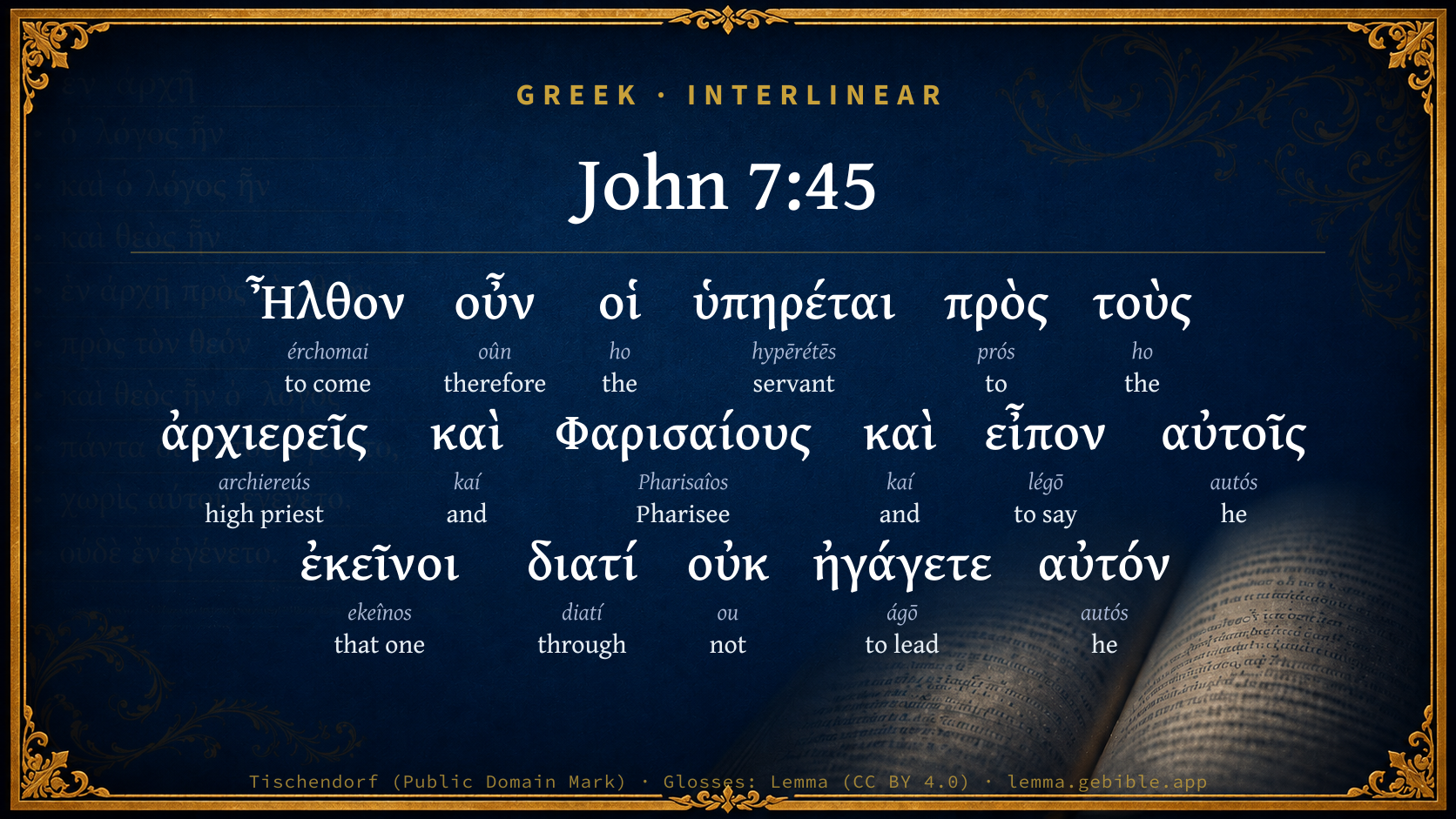
  1. Ἦλθον érchomai G2064 “to come” Verb, Aorist, Active, Indicative, 3rd person, Plural
  2. οὖν oûn G3767 “therefore” Conjunction
  3. οἱ ho G3588 “the” Article, Nominative, Plural, Masculine
  4. πρὸς prós G4314 “to” Preposition
  5. τοὺς ho G3588 “the” Article, Accusative, Plural, Masculine
  6. ἀρχιερεῖς archiereús G749 “high priest” Noun, Accusative, Plural, Masculine
  7. καὶ kaí G2532 “and” Conjunction
  8. Φαρισαίους Pharisaîos G5330 “Pharisee” Noun, Accusative, Plural, Masculine
  9. καὶ kaí G2532 “and” Conjunction
  10. εἶπον légō G3004 “to say” Verb, Aorist, Active, Indicative, 3rd person, Plural
  11. αὐτοῖς autós G846 “he” Personal pronoun, Dative, Plural, Masculine
  12. ἐκεῖνοι ekeînos G1565 “that one” Demonstrative pronoun, Nominative, Plural, Masculine
  13. διατί diatí G1302 “through” Particle, Interrogative
  14. οὐκ ou G3756 “not” Particle, Negative
  15. ἠγάγετε ágō G71 “to lead” Verb, Aorist, Active, Indicative, 2nd person, Plural
  16. αὐτόν autós G846 “he” Personal pronoun, Accusative, Singular, Masculine

About this verse

These counts appear in no published source. They are computed here, from the morphology-tagged text and Lemma’s own curated glosses. What Lemma adds →

17
words
14
distinct lemmas
Gospels
section

Notable vocabulary

The rarest word here is ὑπηρέται servant G5257 — appearing just 20 times in the whole Greek New Testament.

Shared distinctive vocabulary

ὑπηρέται servant G5257 occurs in 20 verses of the Greek New Testament. Also found in:

Repetition

Words recur within this verse:

  • οἱ the G3588 ×2
  • καὶ and G2532 ×2
  • αὐτοῖς he G846 ×2

Cross-references

2

Topical passages linked to John 7:45 in the Treasury of Scripture Knowledge — connected by theme and wording, ordered by reader-vote popularity; previews shown in the World English Bible.

  • John 7:32 The Pharisees heard the multitude murmuring these things concerning him, and the chief priests and the Pharisees sent officers to arrest him.
  • Acts 5:21–27 When they heard this, they entered into the temple about daybreak, and taught. But the high priest came, and those who were with him, and called the council together, and all the senate of the children of Israel, and sent to the prison to have them brought.

Cross-references courtesy of OpenBible.info (CC BY 4.0).

Commentary

Notes on John 7:45 from classic Christian and Jewish commentators (each source and its license shown beneath its notes). The classic Christian expositions comment on the surrounding passage and are grouped to its opening verse, so a note may address several verses; the Jewish commentaries on the Tanakh (Rashi and others) are per-verse, so they appear only where the commentator wrote on this verse.

Lemma curates 59 commentaries, every one of them public domain or Creative Commons licensed, each selected and text-cleaned for this edition rather than reprinted as found. About our sources →

Joseph Benson's Commentary

Joh 7:45-49. Then came the officers to the chief priests, &c. — Namely, without accomplishing the purpose for which they were sent; and they — The chief priests and other members of the sanhedrim, perceiving the officers had not executed their commission; said, Why have ye not brought him — According to the orders you received from us? The officers answered, Never man spake like this man — Surely no man living ever addressed his hearers in so engaging and irresistible a manner. They seem to have intended to intimate, that, had the chief priests and Pharisees heard him themselves, his discourse must have disarmed their resentment against him. Then answered the Pharisees — Far from being softened by the account the officers gave; Are ye also deceived — Ye, who have the advantage of knowing our sentiments concerning this man? Have any of the rulers — Men of rank or eminence; or of the Pharisees — Men of learning or religion; believed on him? But this people — Οχλος ουτος, this populace; who knoweth not the law — This ignorant rabble; so they affected to call Christ’s friends; are cursed — Are, by that ignorance, exposed to the curse of being thus seduced.

Joseph Benson's Commentary on the Old and New Testaments (1811–1818) — public domain. Text from a community e-Sword module.

Whedon's Commentary on the Bible

Daniel D. Whedon

Disappointment of the authorities that Jesus is not taken, Joh_7:45-53.

45. Then came the officers—Who were dispatched, as narrated in Joh_7:32, by the rulers sitting in Gazith.

Brought him—He was clearly to be arraigned for trial. These men would, if possible, have anticipated the hour of his death.

Daniel D. Whedon (gen. ed.), Commentary on the Old and New Testaments (1874–1909) — public domain. Text from a community e-Sword module.

Lange's Commentary on the Holy Scriptures

II

Fermentation And Pmarties In The High Council

Joh_7:45-53

45Then came the officers [The officers therefore came] to the chief priests and Pharisees; and they said unto them, Why have ye not brought [did ye not bring] 46, 47him? The officers answered, Never man spake [spoke] like this man.55 Then56 answered them the Pharisees, Are ye also deceived [led astray]? 48Have any of the rulers, or of the Pharisees believed on [in] him?57 49But this people [this multitude, rabble]58 who knoweth not the law59 are cursed.60

50Nicodemus saith unto them (he that [formerly]61 came to Jesus by night [omit by night],62 being one of them,) 51Doth our law judge any [a] man before it hear him [unless it first hear from him], and know [learn] what he doeth? 52They answered and said unto him, Art thou also of [from] Galilee? Search, and look [see]: for out of Galilee ariseth63 no prophet.

53And every man went64 unto his own house.65

EXEGETICAL AND CRITICAL

Joh_7:45. Then came the officers, [οἱὑπηρέται].—The inference is: As, in general, no one ventured to lay hands on Jesus, so, in particular, the officers did not.

To the chief priests and Pharisees.—The latter without the article. The two are here viewed in the Sanhedrin as a unit.

Joh_7:46. Like this man.—A well-founded addition, expressive of surprise and astonishment. Augustine: “Cujus vita est fulgur, ejus verba tonitrua.”

Joh_7:47. Are ye also deceived?—Even ye officers of the supreme spiritual college?

Joh_7:48. In this view the continuation is characteristic: Have any of the rulers, etc.—For them the authority and example of the rulers must be everything. We should not fail to notice that the testimony of the officers makes not the slightest wholesome impression upon the rulers; or rather, it extremely disturbs and excites them.

Or of the Pharisees.—As if they added this out of an evil conscience. Lest ye should not trust your governors alone, see how the whole great orthodox, aristocratic Jewish party is against Him! How inaccurate they are in both points, is immediately afterwards proved by the example of Nicodemus.

Joh_7:49. But this multitude.—As heroes let themselves out before their valets, so the hierarchical rulers with their ecclesiastical servants. The venerable fathers give themselves up to a fit of rage, and curse. They curse the people intrusted to them; they curse the devout among the people. But their curse is at the same time a threat of excommunication. This is, however, a cunning means of intimidating the officers, and of seducing them to exalt themselves likewise in hierarchical haughtiness above the people.

Who knoweth not the law.—What genuine hierarchs always think, judge, and in fact expect of the people in all cases—a laic ignorance—that in special cases they cast up against them as a reproach. These are here on the way to put Christ to death, as they pretend according to law, as a false prophet, while the people are on the way to acknowledge Christ as the Messiah.

Are cursed.—Not a formula of excommunication (Kuinoel), but an intimation that the ban is impending, which in Joh_9:22 is hypothetically decreed against the followers of Jesus. The threat is intentionally equivocal. The emphasis assists in this: The people who know nothing, i.e., so far as they know nothing, of the law; or, what is the same, who acknowledge Jesus to be the Messiah. To put the people in general under the ban, could not enter the mind of the chief priests. “The hierarchical insolence and theological self-conceit here bears a genuine historical character (comp. Gförer, Das Jahrhundert des Heils, 1 Abthlg. p. 240). The Sanhedrists and the bigoted party of the Pharisees would pass for the supreme authority as to the truth. The common people were called even עַם הָאָרֶץ, even שֶׁקֶץ, vermin; even among the nobler sentences in Pirke Aboth, 2, 5, it is said. ‘The illiterate man is not godly.’ ” Tholuck. The Talmudists went so far in their folly as to assert that none but the learned would rise from the dead. See Lücke II. p. 339.

[The aristocratic contempt of the people is found everywhere in Church and State. The pride of priestcraft, kingcraft, and schoolcraft is deeply seated in the human heart. The rabies theologorum also reappears in all Christian churches and sects in times of heated controversy (e.g., the trinitarian, Christological, and sacramentarian controversies in the fourth, fifth, sixteenth and seventeenth centuries). Theological passions are the deepest and strongest, as religious wars (think of the Thirty Years’ War) are the fiercest.—P. S.]

Joh_7:50-51. Nicodemus saith unto them.—The ground seems more and more to sway under their feet. First the officers spoke in favor of Jesus. Now a colleague does so. It is noted that he had come to Jesus, though he was a member of their Christ-hating body. His words are the first public utterance of his courage to testify, though couched only in an impartial admonition from a judicial point of view. Yet they are not without an edge. The other members had cast up to the people their want of knowledge of the law; Nicodemus reminds their fanatical zeal, that it is conducting itself illegally in condemning the accused under passionate prejudice without a hearing. This was contrary to the law, Exo_23:1 (against false accusation); Deu_1:16; Deu_19:15 (the insufficiency of a single witness). They have assured the officers that no one of the rulers or Pharisees believes in Jesus; he intimates the possibility of this being untrue, at least as concerns himself.—Doth our law judge a man, unless, etc.—Does the law do as ye do? This is an ordinance of the law: First hearing, then judgment. The law itself is here designated as the authority which is to hear the case; and probably with a purpose. Nicodemus wishes to bring out the objective nature of a pure judgment.

Joh_7:52. Art thou also from Galilee?—A contemptuous designation of the followers of Jesus; for most of them were from Galilee.66 The angry humor of the council is not calmed but only further inflamed. A striking picture of fanaticism. Calmness and gentleness, admonition of truth and righteousness, admonition of the word of God itself,—all inflame it, because its zeal (being carnal) includes just the suppression of the sense of truth, the sense of justice, and reverence for the word of God, and is on the path of a wilful diabolical blindness and hardness.—From Galilee.—Mockery and threat combined: We should take thee for a countryman and follower of the Galilean, and not for our honorable colleague. “Galilee was despised for its remoteness from the centre of Jewish culture—‘The Galilean is a blockhead,’ says the Talmud authority—and for its mixture of heathen population.”

Search, and see: for out of Galilee ariseth no prophet.—These words again are characteristic of the blind, rushing unconscionable zeal, which despises everything divine and human [and does violence to history]. Not only Jonah, but Elijah of This be also, and [perhaps] Hosea and Nahum were of Galilee. Tholuck: “It is possible, however, that they followed a divergent tradition respecting the origin of the former two prophets.” [Comp. Winer, Herzog, Smith, etc. sub Elias and Jonas.] Heubner: “According to the tradition Elijah and Elisha, Hosea and Amos were Galileans; it is certain that Nahum and Jonah were. In Tiberias even a seminary was (afterwards) founded, in which were renowned Rabbins like Hakkadosh, etc. The Talmud also came from that quarter, so that the Jews now are ashamed of this proverb (see Olearius: Jesus the true Messiah, p. 223).”

This gross error, the modern skeptical criticism (since the time of Bretschneider) has absurdly endeavored to use as a mark of the spuriousness of the fourth Gospel. How could the Sanhedrists, with their Scriptural learning, blunder in such fashion? But how often has this criticism held the Gospels responsible for the violent blindness of fanaticism, for the mistakes of Herod, for the stupidity of the devil himself. We must not fail to notice, besides this feature of unconscious or intentional falsification of history in the mouth of the Sanhedrists, the other fact that they make an utterly irreligious point when they say: “Out of Galilee ariseth no prophet.” They deny, in the first place, the Galilean Israel, and in the second place, the freedom of God; and in particular the promise in Isa_9:1-2. To these add the third reproach, that they take not the slightest pains to ascertain the real origin of Jesus.

Joh_7:53. And every man went, etc.—This is usually connected with the first section of John 8. But it is a closing word, of great significance, intended to say that the Sanhedrin, after an unsuccessful attempt against the life of Jesus, found themselves compelled to separate and go home, without having accomplished their purpose. For the idea that the words refer to the return of the festal pilgrims, is unworthy of notice. Probably the Sanhedrists were in full session, expecting that Jesus would be brought before them for their condemnation. If this was so, this breaking up of their session was the more mortifying.

DOCTRINAL AND ETHICAL

1. The two methods which the members of the council adopted with their officers and with their colleague Nicodemus, a type of obdurate hierarchical fanaticism in its fundamental features: (1) Perfect insensibility to the voice of truth and the dictates of conscience, and a corresponding perfectly fixed prejudice. (2) Haughtiness, rising even to crazy contempt of the people and of an entire division of the country, joined with crafty fawning upon subordinates. (3) Abusive vulgarity, arraying itself in the robe of sacerdotal and judicial dignity in execution of the judgment of God (cursing excommunicators). (4) Browbeating rejection and derision of impartial judgment, joined with impudent, intentional, or half-intentional perversion and falsification of historical fact. Bringing the voice of justice under suspicion of being a prejudiced partisan voice inflamed by partisan hatred. (5) Perpetual frustrations alternating with orders of arrogance.

2. Even in a circle so degenerate as this the Lord has His witnesses. The officers shame their superiors. The minority of one or two voices (Nicodemus, Joseph of Arimathea) outweighs the large majority of fanatical prejudice, and yet a while delays the judgment of God over the high council.

3. Nicodemus. The voice of impartiality and justice in defence of Christ, a prelude of the act and confession of faith.

4. As the Sanhedrin appeals to the Pharisean party as an authority, so the officers refer to their experience, and Nicodemus appeals to the law.

5. “Never man spake like this man:” the testimony of the bailiffs to the superhuman power of the word of Jesus. The victory of His word over the official order of His enemies.67

6. After victoriously withstanding the Jewish taunt, that the Christians were Galileans, and Christ was a Nazarene, Christianity afterwards again triumphs over the heathen taunt (of Celsus), that it was a vulgar religion.

7. The falsification of fact by the chief priests, continued in Mat_28:13. The Talmudic imitation of this example. Similar frauds of the mediæval hierarchy [e.g. the Pseudo-Isidorian Decretals].

HOMILETICAL AND PRACTICAL

An hour of helplessness, as an hour of visitation: 1. In itself considered: (a) The helplessness. Unmanageable officers. Opposing colleagues. Impotent adjournment, (b) The call to repentance in this situation. The officers: “Never man spake,” etc. Even ye yourselves and the Pharisees speak not like Him. His word is mightier than your order over us. Nicodemus: Ye condemn the people as not knowing the law, and ye yourselves despise the precepts of the law. (c) The impenitency in the helplessness: in the utterance to the officers, in the utterance to Nicodemus. By these their helplessness becomes a deeper inquisition and advising with hell. 2. As a historical type. Similar occurrences in the history of Christian martyrdom, and in the persecution of the Reformation.—The portrait of fanaticism. Contemptuous and fawning towards men. Hypocritical and cursing. Casting suspicion and lying. Threatening and taking cowardly refuge. Helpless and obstinate to the last.—Carnal zeal degenerates. It sinks gradually from intentional ignoring and falsification into actual ignorance. It condemns itself with every word: “Are ye also deceived?” etc.—They went home to their houses, but Christ went to the Mount of Olives. They went, to recover themselves in the selfish comfort of their estates; He prepared Himself for self-sacrifice.—Witnesses of the truth in the camp of Christ’s enemies.—The testimony of the officers concerning the words of Christ: 1. As their own excuse. 2. As an accusation against their superiors. 3. As a glorification of the superhuman innocence of Jesus.—According to the divine appointment, spiritual and temporal despots in the end fail of instruments.—The passive resistance of the officers.—The double measure of the Jewish rulers: 1. To the sound popular judgment of the officers they oppose the authority of their party faith. 2. To the sound regard of Nicodemus for authority, appealing to law, they oppose the grossest popular judgment.—“Have any of the Pharisees believed on Him?” A despotic ecclesiastical government supports itself upon a despotic party.—“Out of Galilee ariseth no prophet.” Falsifications of sacred history: (a) The Talmud. (b) The mediæval tradition (Pseudo-Isidorian Decretals, etc.).

Nicodemus: the silent, sure advances of a true disciple of Jesus: 1. A timid but honest inquirer after truth (John 3). 2. A calm but decided advocate of justice (John 7). 3. A heroic confessor of the Lord, bringing his grateful offerings (John 19).—How Nicodemus meets their boastful bluster with the words of calmness and justice: (1) The boast, that no ruler believes in Jesus. (2) The beast, that they were zealous for the law.—Carnal zeal runs deeper and deeper into blindness and obduracy: 1. To shameless reviling of the justice it professes to administer. (2) To shameless denial of the truth and history, for which it imagines itself contending.—“And every man went unto his own house.” Most of them went from a wandering assembly to a wandering house and a wandering heart, not to commune with the Lord upon their beds.—How differently they went home: 1. The enemies. 2. Nicodemus.—They went home, but Christ went unto the Mount of Olives.

Starke: Canstein: So the wise God deals with His enemies in the dispensation of grace: He often makes friends among their own people, children, households and servants; and therein the masters may see and should see the finger of God.—Zeisius: No man, however great he may be in the world, is to be obeyed contrary to the word of God and a good conscience.—Quesnel: Those who issue unjust commands from the necessity and demand of their office, without knowing the unrighteousness which pervades them, are not so far from the kingdom of God as those who issue the same from envy, hatred, or other wicked affections.—Zeisius: Unlettered, honest simplicity is much better fitted to know the truth of God, than the swelling, conceited wisdom of the schools.—Hedinger: O wonderful power of a word, which can stop deluded hearts in the current of their wickedness, and convert them. Act_9:5-6.—Even the means which are intended for an utterly base end, God can turn to the wholesome use of souls.—Bibl. Wirt.: How strangely God works with His enemies; how He makes their schemes miscarry, and confuses the game so curiously that often those who are commissioned to do evil, are compelled to do well to a good man. Num_23:11; Pro_16:7.—Masters ought to set their servants a good example for imitation, but they are often so ungodly that they rather lead them astray than aright. O what will become of them!—Majus: True conversion and confession of the truth the world calls delusion. Mat_27:63; 2Co_6:8.—Quesnel: The world is so corrupt that it even hates those who will not join with it in persecuting the good.—Hedinger: Diabolical pride! Fear of men is less than nothing in matters of faith. Poor souls, which have no other rule of faith than the decrees of blind bishops, etc. The worst is when the state policy prescribes rules of faith.—Shame on the teachers of the law that they have left the people in such ignorance.—Lampe: It is a very small thing to be cursed by men who are themselves under the curse, when God blesses.—Majus: One man may set himself against a whole wicked assembly if only he is equipped with the whole word and Spirit of God.—Zeisius: God still always has His own even among apostate masses.

Braune: Have any of the rulers believed on Him? In the haughty exaltation of their own persons there lies a frightful contempt of others.—This is Pharisaism, which holds the external knowledge of the letter and the law of the Scripture, or theology, above religion.—Art thou also of Galilee? As a disgrace they add the falsehood: Search, and look, etc.—The fiendish joy that no ruler or Pharisee had believed in Jesus, here comes to nought.

Heubner: The humblest servants shame their masters. Those who are sent to take Jesus are themselves taken. The rulers could here see the finger of God. The Lord reigned in the midst of His enemies. To be deceived here means, to give honor to the truth. So living, simple Christians are always considered deceived.—The judgment of men is set up as the rule of faith: Courts, colleges are to decide concerning the truth. But the truth has not always been laid down by them, as we have seen in the councils.—The first trace of the gentle and timid announcement of adhesion to Jesus. Nicodemus merely insists on fair dealing with Jesus: It is unjust to begin the Processus ab exsecutione.—The opponents of revelation act substantially like these Pharisees. They begin with this: There is no revelation, and can be none; whereas they ought to suppose and investigate at least the possibility of a true revelation.—No tribunals have proceeded more unrighteously than spiritual tribunals.

Gossner: They freely confess against their masters, in whose pay they were and whose song therefore (according to the way of the world) they should have sung—it was not the sound which so struck the people, as if He spoke vehemently, thundered and lightened; but a divine authority always lay in His gentle address. His word, in fact His very presence, struck as lightning to the heart. In this no man could speak like Him.

Schleiermacher (the officers): This is the first beginning. The ground must first be laid in the soul in a holy awe before the doctrine and the person of the Lord.

[The preaching of the gospel sometimes restrains the violence of the hand when it works no change in the heart.—When Christ appeared, the great ones of the world not only refused to believe in Him, but boasted of their unbelief as an argument of their wisdom.—Great in honor and wise in understanding, are a sweet couple, but seldom seen together.—There is no wisdom, nor understanding, nor counsel against the Lord. (From Burkitt.)—Nicodemus an example of the slow but sure work of grace, from the timid seeking of the Lord by night to this manly confession, Different ways to the same Christ, short and long direct and circuitous—Even in high places Christ may have friends of whom we know nothing.—Majorities in counsel may be wrong as well as minorities.—One man with God on his side is stronger than any majority.—One little word spoken in season may avert a persecution.—P. S.]

Footnotes:

[55]Joh_7:46.—[Codd. א.3 a B. L. T., etc., Origen, etc., Lachmann, Tischendorf (in former edd.), Westcott and Hort. read only: ἐλάλ. οὕτως ἅνθρωπος, never man spoke thus, omitting ὡς οὖτος ὁ ἀνθρ., like this man. Tregelles and Alford retain the last words, but in brackets. Tischendorf, in his eighth ed., adopts the reading of א.* in this form: ὡς οὖτος λαλεῖὁ ἅνθρωπος. Omission is more easily accounted for (by homœotel.) than insertion. Meyer and Lange retain the clause.—P. S.]

[56]Joh_7:47.—[The οὖν of the text. rec. after ἀπεκρίθησαν is sustained by B. T. Vulg., but omitted by א.D. Alf. Tischend.—P. S]

[57]Joh_7:48.—[According to the more lively order of the Greek: Hath any of the rulers believed in Him, or of the Pharisees ?—P. S.]

[58]Joh_7:49.—[Ὄχλος, multitude (Pöbelhaufe), is here used evidently with great contempt, not only to designate the persons, but to indicate their character.—P. S.]

[59]Ibid.—[Some put a comma after νόμον, some a semicolon, the English V. has no stop. Dr. Lange, in his rendering of the text, adopts the semicolon, and construes thus: “But only this rabble who know nothing of the law (believe in Him); cursed are they!]” Meyer also makes ἐπάρατοί είσι ! an exclamation. The whole sentence is certainly a passionate outburst of the rabbinical rabies theologica, but no decree of excommunication (Kuinoel) which was inapplicable to the mass of the people.—P. S.]

[60]Ibid.—Instead of ἐπικατάρατοι, Lachmann and Tischendorf, after [א.] B. T., Origen, etc., read ἐπάρατοι.

[61]Joh_7:50.—[ΙΙρότερον, according to B. L. T. and others, Lachmann, Alford. But Tischendorf, ed. 8., with Cod. Sin.* (prima manu) omits the clause ὁ ἐλθὼν νυκτὸς πρὸς αὐτὸν πρότερον, and reads simply: Αέγει Νικόδημος πρὸς αὑτοὐς. Lachm., Alf., Mey. retain the clause with the exception of νυκτό ς; comp. Joh_19:39.—P. S.]

[62]Ibid.—Νυκτός is only in minuscules [and in א.*]; supplied from John 3.

[63]Joh_7:52.—Codd. B. D. K. S. [א. Vulg.] read ἐγεί ρεται. So Lachmann, Tischendorf [Alford]. The Coptic and Sahidic Versions have even the future. Meyer: “An inverted attempt to correct a historical error.” Yet ἐγήγερται [text. reel.] seems not sufficiently accredited. It makes no material difference in the sense of the passage; because the word “search” points to the past.

[64]Joh_7:53.—The reading ἐπορεύθη is preferable to the reading ἐπορεύθησαν in D. M. S.

[65]Joh_7:53.—[This verse is usually connected with the following section, Joh_8:1-11, and subject to the same critical doubts (see Text. and Gram. in John 8); hence I have italicized it.—P. S]

[66][Julian the Apostate, in the fourth century, contemptuously called Christ “the Galilean,” and the Christian “Galileans.”—P. S.]

[67][Involuntary witnesses of the innocence or even divinity of Christ, and the truth of the Gospel: Pontius Pilate and his wife, the centurion under the cross, Judas the traitor, Tacitus (in his account of the Neronian persecution), Celsus, Lucian, Porphyry, J. J. Rousseau, Napoleon, Strauss, Renan, etc. A collection of such testimonies to the character of Christ from the mouth or pen of enemies or skeptics see in the Appendix to my book on the Person of Christ, Boston and New York, 1865.—P. S.]

Lange's Commentary on the Holy Scriptures (Critical, Doctrinal, and Homiletical), ed. John Peter Lange, English translation edited by Philip Schaff (1864–1880) — public domain. Text from a community e-Sword module.

Godbey's Commentary on the New Testament

William B. Godbey

REPORT OF THE OFFICERS SENT TO ARREST HIM

Joh 7:45-49. “Then the officers came to the chief priests and Pharisees, and they said to them, Why did you not lead Him along? The officers responded, Never did a man speak as this Man is speaking.” The Sanhedrin were in session in the Hall of Caiaphas on Mount Zion, in the west end of the city, while Jesus was preaching on the Temple Campus in the east end. These officers came for the express purpose of arresting and leading Him away to the Sanhedrin for trial. You see their excuse is utterly silly, no plausibility in it whatever. The simple solution of the matter was, they could not put their hands on Him; an unseen Power simply disqualifying them to touch Him. When they did their utmost, they signally failed to lay a solitary hand on His person. Hence, after much delay and endeavor to arrest Him, they are forced to give up in despair, and go back without Him. He was intangible and immortal till His work was done — a grand consolation, substantially true in case of His faithful followers.

HUMAN LEADERSHIP

“The Pharisees responded to them, Whether are you also deceived?” They now turn the tantalizing reproach on the officers, doing their utmost to intimidate everybody from following Him. “Whether has any one of the rulers of the Pharisees believed on Him? But this rabble, not knowing the law, are accursed.” Here you see they pertinaciously condemn everybody who does not follow their leaders. This has always been the case with fallen Churches. Nothing but the full sanctification of the Holy Ghost ever does save people from human leadership, which is all wrong, as no really godly person wants to lead; but all such do their utmost, by instruction, exhortation, and prayer, to prevail on the people to follow Jesus only. Human leadership is a trick of the devil, by which he has populated hell with millions; as the leader, getting out of kilter by Satanic maneuver or human intrigue, he and all his followers will plunge headlong into hell. God’s leaders don’t want any following; but all do their utmost to get the people to follow the Lord. You are in awful danger of perdition when following a human leader, as none are infallible, and the best are liable to make mistakes which would prove fatal. I have been presiding elder and pastor frequently, yet I never wanted any human following.

William B. Godbey, Commentary on the New Testament (1896–1900) — public domain. Text from a community e-Sword module.

Tyndale Open Study Notes

Tyndale Open Resources

7:45-52 The story concludes with the Jewish leaders frustrated and the world divided over Jesus (cp. 7:25-27, 31-32). • guards returned: See 7:32.

Tyndale Open Study Notes — © Tyndale Open Resources, licensed CC BY-SA 4.0. Text via the HelloAO Bible API.

Bengel's Gnomon

Johann Albrecht Bengel

Joh 7:45. Ἐκεῖνοι, they the [former]) the chief priests, whom at Joh 7:47 the Pharisees interrupt.

Bengel's Gnomon of the New Testament — English translation (T&T Clark, Edinburgh, 1860) — public domain. Text from a community e-Sword module.

Meyer's Critical & Exegetical Commentary

Heinrich August Wilhelm Meyer

Joh_7:45-46. Οὖν] therefore, seeing that no one, not even they themselves, had ventured to lay hands on Jesus.

οἱ ὑπηρέται] In accordance with the orders they had received (Joh_7:32), they had kept close to Jesus, in order to apprehend Him. But the divine power and majesty of His words, which doubtless hindered the τινὲς in Joh_7:44 from laying hands on Him, made it morally impossible for the officers of justice to carry out their orders, or even to find any pretext or justification for so doing; they were overpowered. Schleiermacher, therefore, was wrong in inferring that they had received no official orders to take Him.

τοὺς ἀρχιερ. κ. Φαρ.] by the non-repetition of the article, construed as one category, i.e. as the Sanhedrim, who must be supposed to have been assembled in session. When first mentioned, Joh_7:32, both divisions are distinguished with logical emphasis. See Dissen, ad Dem. de cor. p. 373 f.

ἐκεῖνοι] the ἀρχιερ. κ. Φαρισ.; of the nearest subject, though remote to the writer. Winer, p. 148 [E. T. p. 196], and Ast, ad Plat. Polit. p. 417; Lex Plat. pp. 658, 659.

Joh_7:46. There is a solemnity in the words ὡς οὗτος ὁ ἄνθρ., in themselves unnecessary. It is a weighty statement, a strong word, that they thus meekly use, Luther. Character veritatis etiam idiotas convincentis prae dominis eorum, Bengel. It is self-evident that Jesus must have said more after Joh_7:32 than John has recorded.

Meyer — Critical and Exegetical Commentary on the New Testament — English translation by Peter Christie, edited by Frederick Crombie (T&T Clark, 1880) — public domain. Text from a community e-Sword module.

Expositor's Greek Testament

ed. W. Robertson Nicoll

Joh 7:45-52 . Anger of the Sanhedrim on receiving the report of their officers .

Joh 7:45 . ἦλθον οὖν … αὐτόν . It now appears that the οὐδεὶς of the preceding clause applies even to the officers sent by the Sanhedrim. They returned empty-handed πρὸς τοὺς ἀρχιερεῖς καὶ φαρισαίους , that is, as the single article shows, to the Sanhedrim, or at any rate to these parties acting together and officially. What follows indicates rather that they were met as a court. They [ ἐκεῖνοι regularly refers to the more remote noun; but here, although in the order of the sentence the ὑπηρέται are more remote, they are nearer in the writer’s mind, and he uses ἐκεῖνοι of the priests and Pharisees] at once demand the reason of the failure, Διατί οὐκ ἠγάγετε αὐτόν ; “Why have ye not brought Him?” Apparently they were sitting in expectation of immediately questioning Him.

The Expositor's Greek Testament, edited by W. Robertson Nicoll (1897–1910) — public domain. Text from a community e-Sword module.

Geneva Bible (1599)

Geneva Bible translators

God from heaven scorneth such as are his son’s enemies.

Geneva Bible (1599) marginal notes — public domain. Text via Bolls.life.

Matthew Henry's Commentary

The chief priests and Pharisees are here in a close cabal, contriving how to suppress Christ; though this was the great day of the feast, they attended not the religious services of the day, but left them to the vulgar, to whom it was common for those great ecclesiastics to consign and turn over the business of devotion, while they thought themselves better employed in the affairs of church-policy. They sat in the council-chamber, expecting Christ to be brought a prisoner to them, as they had issued out warrants for apprehending him, Joh 7:32. Now here we are told,

I. What passed between them and their own officers, who returned without him, re infecta - having done nothing. Observe,

1. The reproof they gave the officers for not executing the warrant they gave them: Why have you not brought him? He appeared publicly; the people were many of them disgusted, and would have assisted them in taking him; this was the last day of the feast, and they would not have such another opportunity; "why then did you neglect your duty?" It vexed them that those who were their own creatures, who depended on them, and on whom they depended, into whose minds they had instilled prejudices against Christ, should thus disappoint them. Note, Mischievous men fret that they cannot do the mischief they would, Psa 112:10; Neh 6:16.

2. The reason which the officers gave for the non-execution of their warrant: Never man spoke like this man, Joh 7:46. Now, (1.) This was a very great truth, that never any man spoke with that wisdom, and power, and grace, that convincing clearness, and that charming sweetness, wherewith Christ spoke; none of the prophets, no, not Moses himself. (2.) The very officers that were sent to take him were taken with him, and acknowledged this. Though they were probably men who had no quick sense of reason or eloquence, and certainly had no inclination to think well of Jesus, yet so much self-evidence was there in what Christ said that they could not but prefer him before all those that sat in Moses's seat. Thus Christ was preserved by the power God has upon the consciences even of bad men. (3.) They said this to their lords and masters, who could not endure to hear any thing that tended to the honour of Christ and yet could not avoid hearing this. Providence ordered it so that this should be said to them, that it might be a vexation in their sin and an aggravation of their sin. Their own officers, who could not be suspected to be biassed in favour of Christ, are witnesses against them. This testimony of theirs should have made them reflect upon themselves, with this thought, "Do we know what we are doing, when we are hating and persecuting one that speaks so admirably well?"

3. The Pharisees endeavour to secure their officers to their interest, and to beget in them prejudices against Christ, to whom they saw them begin to be well affected. They suggest two things: -

(1.) That if they embrace the gospel of Christ they will deceive themselves (Joh 7:47): Are you also deceived? Christianity has, from its first rise, been represented to the world as a great cheat upon it, and they that embraced it as men deceived, then when they began to be undeceived. Those that looked for a Messiah in external pomp thought those deceived who believed in a Messiah that appeared in poverty and disgrace; but the event declares that none were ever more shamefully deceived, nor put a greater cheat upon themselves, than those who promised themselves worldly wealth and secular dominion with the Messiah. Observe what a compliment the Pharisees paid to these officers: "Are you also deceived? What! men of your sense, and thought, and figure; men that know better than to be imposed upon by every pretender and upstart teacher?" They endeavour to prejudice them against Christ by persuading them to think well of themselves.

(2.) That they will disparage themselves. Most men, even in their religion, are willing to be governed by the example of those of the first rank; these officers therefore, whose preferments, such as they were, gave them a sense of honour, are desired to consider,

[1.] That, if they become disciples of Christ, they go contrary to those who were persons of quality and reputation: "Have any of the rulers, or of the Pharisees, believed on him? You know they have not, and you ought to be bound up by their judgment, and to believe and do in religion according to the will of your superiors; will you be wiser than they?" Some of the rulers did embrace Christ (Mat 9:18; Joh 4:53), and more believed in him, but wanted courage to confess him (Joh 12:42); but, when the interest of Christ runs low in the world, it is common for its adversaries to represent it as lower than really it is. But it was too true that few, very few, of them did. Note, First, The cause of Christ has seldom had rulers and Pharisees on its side. It needs not secular supports, nor proposes secular advantages, and therefore neither courts nor is courted by the great men of this world. Self-denial and the cross are hard lessons to rulers and Pharisees. Secondly, This has confirmed many in their prejudices against Christ and his gospel, that the rulers and Pharisees have been no friends to them. Shall secular men pretend to be more concerned about spiritual things than spiritual men themselves, or to see further into religion than those who make its study their profession? If rulers and Pharisees do not believe in Christ, they that do believe in him will be the most singular, unfashionable, ungenteel people in the world, and quite out of the way of preferment; thus are people foolishly swayed by external motives in matters of eternal moment, are willing to be damned for fashion-sake, and to go to hell in compliment to the rulers and Pharisees.

[2.] That they will link themselves with the despicable vulgar sort of people (Joh 7:43): But this people, who know not the law, are cursed, meaning especially those that were well-affected to the doctrine of Christ. Observe, First, How scornfully and disdainfully they speak of them: This people. It is not laos, this lay-people, distinguished from them that were the clergy, but ochlos outos, this rabble-people, this pitiful, scandalous, scoundrel people, whom they disdained to set with the dogs of their flock though God had set them with the lambs of his. If they meant the commonalty of the Jewish nation, they were the seed of Abraham, and in covenant with God, and not to be spoken of with such contempt. The church's common interests are betrayed when any one part of it studies to render the other mean and despicable. If they meant the followers of Christ, though they were generally persons of small figure and fortune, yet by owning Christ they discovered such a sagacity, integrity, and interest in the favours of Heaven, as made them truly great and considerable. Note, As the wisdom of God has often chosen base things, and things which are despised, so the folly of men has commonly debased and despised those whom God has chosen. Secondly, How unjustly they reproach them as ignorant of the word of God: They know not the law; as if none knew the law but those that knew it from them, and no scripture-knowledge were current but what came out of their mint; and as if none knew the law but such as were observant of their canons and traditions. Perhaps many of those whom they thus despised knew the law, and the prophets too, better than they did. Many a plain, honest, unlearned disciple of Christ, by meditation, experience, prayers, and especially obedience, attains to a more clear, sound, and useful knowledge of the word of God, than some great scholars with all their wit and learning. Thus David came to understand more than the ancients and all his teachers, Psa 119:99, Psa 119:100. If the common people did not know the law, yet the chief priests and Pharisees, of all men, should not have upbraided them with this; for whose fault was it but theirs, who should have taught them better, but, instead of that, took away the key of knowledge? Luk 11:52. Thirdly, How magisterially they pronounce sentence upon them: they are cursed, hateful to God, and all wise men; epikatartoi - an execrable people. It is well that their saying they were cursed did not make them so, for the curse causeless shall not come. It is a usurpation of God's prerogative, as well as great uncharitableness, to say of any particular persons, much more of any body of people, that they are reprobates. We are unable to try, and therefore unfit to condemn, and our rule is, Bless, and curse not. Some think they meant no more than that the people were apt to be deceived and made fools of; but they use this odious word, They are cursed, to express their own indignation, and to frighten their officers from having any thing to do with them; thus the language of hell, in our profane age, calls every thing that is displeasing cursed, and damned, and confounded. Now, for aught that appears, these officers had their convictions baffled and stifled by these suggestions, and they never enquire further after Christ; one word from a ruler or Pharisee will sway more with many than the true reason of things, and the great interests of their souls.

II. What passed between them and Nicodemus, a member of their own body, Joh 7:50, etc. Observe,

1. The just and rational objection which Nicodemus made against their proceedings. Even in their corrupt and wicked sanhedrim God left not himself quite without witness against their enmity; nor was the vote against Christ carried nemine contradicente - unanimously. Observe,

(1.) Who it was that appeared against them; it was Nicodemus, he that came to Jesus by night, being one of them, Joh 7:50. Observe, concerning him, [1.] That, though he had been with Jesus, and taken him for his teacher, yet he retained his place in the council, and his vote among them. Some impute this to his weakness and cowardice, and think it was his fault that he did not quit his place, but Christ had never said to him, Follow me, else he would have done as others that left all to follow him; therefore it seems rather to have been his wisdom not immediately to throw up his place, because there he might have opportunity of serving Christ and his interest, and stemming the tide of the Jewish rage, which perhaps he did more than we are aware of. He might there be as Hushai among Absalom's counsellors, instrumental to turn their counsels into foolishness. Though we must in no case deny our Master, yet we may wait for an opportunity of confessing him to the best advantage. God has his remnant among all sorts, and many times finds, or puts, or makes, some good in the worst places and societies. There was Daniel in Nebuchadnezzar's court, and Nehemiah in Artaxerxes's. [2.] That though at first he came to Jesus by night, for fear of being known, and still continued in his post; yet, when there was occasion, he boldly appeared in defence of Christ, and opposed the whole council that were set against him. Thus many believers who at first were timorous, and ready to flee at the shaking of a leaf, have at length, by divine grace, grown courageous, and able to laugh at the shaking of a spear. Let none justify the disguising of their faith by the example of Nicodemus, unless, like him, they be ready upon the first occasion openly to appear in the cause of Christ, though they stand alone in it; for so Nicodemus did here, and Joh 19:39.

(2.) What he alleged against their proceedings (Joh 7:51): Doth our law judge any man before it hear him (akousē par' autou - hear from himself) and know what he doeth? By no means, nor doth the law of any civilized nation allow it. Observe, [1.] He prudently argues from the principles of their own law, and an incontestable rule of justice, that no man is to be condemned unheard. Had he urged the excellency of Christ's doctrine or the evidence of his miracles, or repeated to them his divine discourse with him (ch. 3), it had been but to cast pearls before swine, who would trample them under their feet, and would turn again and rend him; therefore he waives them. [2.] Whereas they had reproached the people, especially the followers of Christ, as ignorant of the law, he here tacitly retorts the charge upon themselves, and shows how ignorant they were of some of the first principles of the law, so unfit were they to give law to others. [3.] The law is here said to judge, and hear, and know, when magistrates that govern and are governed by it judge, and hear, and know; for they are the mouth of the law, and whatsoever they bind and loose according to the law is justly said to be bound and loosed by the law. [4.] It is highly fit that none should come under the sentence of the law, till they have first by a fair trial undergone the scrutiny of it. Judges, when they receive the complaints of the accuser, must always reserve in their minds room for the defence of the accused, for they have two ears, to remind them to hear both sides; this is said to be the manner of the Romans, Act 25:18. The method of our law is Oyer and Terminer, first to hear and then to determine. [5.] Persons are to be judged, not by what is said of them, but by what they do. Our law will not ask what men's opinions are of them, or out-cries against them, but, What have they done? What overt-acts can they be convicted of? Sentence must be given, secundum allegata et probata - according to what is alleged and proved. Facts, and not faces, must be known in judgment; and the scale of justice must be used before the sword of justice.

Now we may suppose that the motion Nicodemus made in the house upon this was, That Jesus should be desired to come and give them an account of himself and his doctrine, and that they should favour him with an impartial and unprejudiced hearing; but, though none of them could gainsay his maxim, none of them would second his motion.

2. What was said to this objection. Here is no direct reply given to it; but, when they could not resist the force of his argument, they fell foul upon him, and what was to seek in reason they made up in railing and reproach. Note, It is a sign of a bad cause when men cannot bear to hear reason, and take it as an affront to be reminded of its maxims. Whoever are against reason give cause to suspect that reason is against them. See how they taunt him: Art thou also of Galilee? Joh 7:52. Some think he was well enough served for continuing among those whom he knew to be enemies to Christ, and for his speaking no more on the behalf of Christ than what he might have said on behalf of the greatest criminal - that he should not be condemned unheard. Had he said, "As for this Jesus, I have heard him myself, and know he is a teacher come from God, and you in opposing him fight against God," as he ought to have said, he could not have been more abused than he was for this feeble effort of his tenderness for Christ. As to what they said to Nicodemus, we may observe,

(1.) How false the grounds of their arguing were, for, [1.] They suppose that Christ was of Galilee, and this was false, and if they would have been at the pains of an impartial enquiry they would have found it so. [2.] They suppose that because most of his disciples were Galileans they were all such, whereas he had abundance of disciples in Judea. [3.] They suppose that out of Galilee no prophet had risen, and for this appeal to Nicodemus's search; yet this was false too: Jonah was of Gath-hepher, Nahum an Elkoshite, both of Galilee. Thus do they make lies their refuge.

(2.) How absurd their arguings were upon these grounds, such as were a shame to rulers and Pharisees. [1.] Is any man of worth and virtue ever the worse for the poverty and obscurity of his country? The Galileans were the seed of Abraham; barbarians and Scythians are the seed of Adam; and have we not all one Father? [2.] Supposing no prophet had risen out of Galilee, yet it is not impossible that any should arise thence. If Elijah was the first prophet of Gilead (as perhaps he was), and if the Gileadites were called fugitives, must it therefore be questioned whether he was a prophet or no?

3. The hasty adjournment of the court hereupon. They broke up the assembly in confusion, and with precipitation, and every man went to his own house. They met to take counsel together against the Lord and his Anointed, but they imagined a vain think; and not only he that sits in heaven laughed at them, but we may sit on earth and laugh at them too, to see all the policy of the close cabal broken to pieces with one plain honest word. They were not willing to hear Nicodemus, because they could not answer him. As soon as they perceived they had one such among them, they saw it was to no purpose to go on with their design, and therefore put off the debate to a more convenient season, when he was absent. Thus the counsel of the Lord is made to stand, in spite of the devices in the hearts of men.

Matthew Henry's Commentary on the Whole Bible (1708–1710) — public domain (CC PDM 1.0). Text via the HelloAO Bible API.

Jamieson, Fausset & Brown

Robert Jamieson, A. R. Fausset & David Brown

Then came the officers--"sent to take him" (Joh 7:32).

Why . . . not brought him?--already thirsting for their Victim, and thinking it an easy matter to seize and bring Him.

Jamieson, Fausset & Brown — Commentary Critical and Explanatory on the Whole Bible (1871) — public domain (CC PDM 1.0). Text via the HelloAO Bible API.

Adam Clarke's Commentary

Verse 45. Then came the officers] They had followed him for several days, seeking for a proper opportunity to seize on him, when they might fix some charge of sedition, c., upon him but the more they listened, the more they were convinced of his innocence, purity, and consummate wisdom.

Adam Clarke's Commentary on the Bible (1810–1826) — public domain. Text from a community e-Sword/MySword module.

John Calvin's Commentaries

45. So the officers came. Here we may see how blind is the arrogance of men. To such an extent do they admire and adore the greatness which renders them eminent, that they have no hesitation in trampling under foot morality and religion. If any thing happen contrary to their wish, they would willingly mingle heaven and earth; for when these haughty and wicked priests ask, why Christ was not brought, they magnify their power so greatly as if nothing ought to oppose their command.

John Calvin's Commentaries (1540-1563) — public domain. Text from the Calvin Translation Society English edition (1840s-50s) via the Christian Classics Ethereal Library (ccel.org). Calvin's coverage is partial (roughly two-thirds of the Bible); uncommented books and verses are honest gaps, never fabricated. The 19th-century editor's footnotes and remarks are omitted so the notes are faithfully Calvin's own voice.

Ellicott's Commentary for English Readers

(45) Then came the officers to the chief priests and Pharisees.—(Comp. Note on Joh_18:3.) They had been sent (Joh_7:32), not with a definite warrant to bring Him by force, but to watch their opportunity, and seize any pretext for doing so which may arise. “The chief priests and Pharisees” are the Sanhedrin who met (Joh_7:32), and, though it was a festival, seemed to have continued in session, expecting the return of their servants.

Why have ye not brought him?—Their question shows the object of the mission. It is asked in the bitterness of disappointed craft. In the presence of the multitude they dared not proceed by open force, and the influence they feared was every hour gaining ground. If their officers could have brought Him on some technical charge away from the people and into their own chamber, all would then have been in their own hands.

A Bible Commentary for English Readers, edited by Charles John Ellicott (1878–1897) — public domain. Text from a community e-Sword module.

The Cambridge Bible for Schools and Colleges

gen. ed. J. J. S. Perowne

45. Then came the officers] Better, Therefore came the officers, i.e. because neither they nor any of the multitude had ventured to arrest Him. Under the control of God’s providence (Joh_7:30), they had been unable to find any good opportunity for taking Him, and had been over-awed by the majesty of His words (Joh_7:46).

to the chief priests and Pharisees] See on Joh_7:32. It would seem as if the Sanhedrin had continued sitting, waiting for the return of its officers; an extraordinary proceeding on so great a day (see on Joh_7:37), shewing the intensity of their hostility. Their question is quite in harmony with this.

they said] The pronoun used (ekeinoi) indicates that they are regarded as alien or hostile to the narrator.

Why have ye not brought] Why did ye not bring?

The Cambridge Bible for Schools and Colleges (gen. ed. J. J. S. Perowne; Cambridge University Press, 1878–1918) — public domain. Text from a community e-Sword module.

John Gill's Exposition

Then answered them the Pharisees, are ye also deceived? As well as the common people; you that have been so long in our service, and should know better; or who, at least, should have taken the sense of your superiors, and should have waited to have had their opinion and judgment of him, and been determined by that, and not so hastily have joined with a deluded set of people. It was the common character of Christ, and his apostles, and so of all his faithful ministers in all succeeding ages, that they were deceivers, and the people that followed them deceived, a parcel of poor deluded creatures, carried aside by their teachers; when, on the other hand, they are the deceived ones, who live in sin, and indulge themselves in it; or who trust in themselves that they are righteous; who think they are something, when they are nothing; who imagine, that touching the righteousness of the law, they are blameless, are free from sin, and need no repentance; who follow the traditions and commandments of men: whereas these cannot be deceived, who follow Christ, the way, the truth, and the life, and his faithful ministers, who show unto men the way of salvation.

Then answered them the Pharisees, are ye also deceived? As well as the common people; you that have been so long in our service, and should know better; or who, at least, should have taken the sense of your superiors, and should have waited to have had their opinion and judgment of him, and been determined by that, and not so hastily have joined with a deluded set of people. It was the common character of Christ, and his apostles, and so of all his faithful ministers in all succeeding ages, that they were deceivers, and the people that followed them deceived, a parcel of poor deluded creatures, carried aside by their teachers; when, on the other hand, they are the deceived ones, who live in sin, and indulge themselves in it; or who trust in themselves that they are righteous; who think they are something, when they are nothing; who imagine, that touching the righteousness of the law, they are blameless, are free from sin, and need no repentance; who follow the traditions and commandments of men: whereas these cannot be deceived, who follow Christ, the way, the truth, and the life, and his faithful ministers, who show unto men the way of salvation.

John 7:48

joh 7:48

joh 7:48

joh 7:48Have any of the rulers,.... In the sanhedrim, or of the synagogues; or the civil magistrates, the noble, rich, and wealthy:

or of the Pharisees, believed on him; men famous for wisdom, learning, and holiness. It must be owned, there were but very few of this sort, and perhaps not an instance of this kind had as yet occurred to them; there was Nicodemus, who is mentioned in the context, who was both a ruler and a Pharisee; and Joseph of Arimathea, a rich counsellor; but they neither of them openly showed themselves to be the disciples of Christ till his death: and besides these, there were some women, as Joanna, the wife of Chuza, Herod's steward, Susanna, and some other women, who ministered to him of their substance; but the far greater part of his followers were poor and illiterate: and this has been the common case of those that have believed in Jesus, for the most part, ever since, and therefore should not be a stumbling to any. God is pleased to hide the great things of the Gospel from the wise and prudent, the rich and noble, and preach and reveal them to the poor and foolish: nor is a doctrine a whit the truer for being espoused by the rich, and wise men of this world, but rather to be suspected on that account.

John Gill's Exposition of the Whole Bible (1746–1763) — public domain (CC PDM 1.0). Text via the HelloAO Bible API.

Trapp's Complete Commentary

John Trapp

45 Then came the officers to the chief priests and Pharisees; and they said unto them, Why have ye not brought him?

Ver. 45. Why have you not brought him?] Out of the pride of their power they wonder what should hinder. But the Lord knoweth how to deliver his, 2Pe 2:9; and wherein the enemies deal proudly, he is above them, Exo 18:11.

John Trapp, A Commentary or Exposition upon All the Books of the Old and New Testament (1647–1656) — public domain. Text from a community e-Sword module.

Albert Barnes' Notes on the Bible

The officers - Those who had been appointed Joh 7:32 to take him. It seems that Jesus was in the midst of the people addressing them, and that they happened to come at the very time when he was speaking. They were so impressed and awed with what he said that they dared not take him. There have been few instances of eloquence like this. His speaking had so much evidence of truth, so much proof that he was from God, and was so impressive and persuasive, that they were convinced of his innocence, and they dared not touch him to execute their commission. We have here:

A remarkable testimony to the commanding eloquence of Jesus. Wicked men may be awed and restrained by the presence of a good man, and by the evidence that he speaks that which is true. God can preserve his friends. Here were men sent for a particular purpose. They were armed with power. They were commissioned by the highest authority of the nation. On the other hand, Jesus was without arms or armies, and without external protection. Yet, in a manner which the officers and the high priests would have little expected, he was preserved. So, in ways which we little expect, God will defend and deliver us when in the midst of danger. No prophet, apostle, or minister has ever spoken the truth with as much power, grace, and beauty as Jesus. It should be ours, therefore, to listen to his words, and to sit at his feet and learn heavenly wisdom.

Albert Barnes' Notes on the Bible (1834–1885) — public domain. Text from a community e-Sword/MySword module.

Matthew Poole's English Annotations

Probably the officers, Christ being amongst a multitude of the people that had a high opinion of him, durst not adventure to apprehend him. Some of them, as appeareth from what follows, were astonished at his doctrine; all of them agreed to return to their masters without him; at which they are angry, and ask them how it came to pass that they did not execute their commands, in bringing Christ before them as a malefactor, to answer what they should lay to his charge.

Matthew Poole's English Annotations on the Holy Bible (1683–1685) — public domain. Text from a community e-Sword/MySword module.

The Pulpit Commentary

Vers. 45, 46. In ver. 32 we learn that Pharisees and chief priests had sent "officers" to lay hands on him, to seize their opportunity for an arrest; but, sharing somewhat the outburst of enthusiasm which wavered between his claims to be the Prophet or the Christ, and only subsided for a moment on a miserable and unveracious plea, they did not dare to execute the command of their masters. The officers therefore came to the chief priests and Pharisees (the absence of the article touv before Farisaiouv shows that they were regarded as one body, who had charged these officers to undertake the duty in which they signally failed); and they (ekeinoi , the latter) said to them, Why did ye not bring him? Foiled in their intention to carry out the order of the committee of the council, they return empty handed, and to some extent baffled and chagrined. They had fallen into the dominant enthusiasm of the crowd for a moment. They had heard the shouts which hailed him as the great Prophet, nay, as Messiah himself, and their reply, according to the curtailed text, was, Never man so spake. It matters little whether the additional clause, "as this Man speaks," was in the original text or not, the idea is the same; and it confirms the supposition to which we have often referred that John only gives us the great sentences which the Divine Lord made the text of a discourse. An overwhelming impression was produced that the Speaker had a deep secret to disclose, vast treasure to bestow, unlimited power to meet the thirst of man, and even to make those who utterly yield to his influence the fountains of benedictions to others. An awe as of unseen things fell on the officers and the people. They could not resist the sense of benediction which, like some sacred perfume, some supernatural glamour, fell upon them in his reval words. Never man thus spake." The whole experience is new and wonderful. "These sayings of the Prophet of Nazareth are more than words; they have living powers; they have confounded and disarmed us.

Vers. 45-52. The meeting of the Sanhedrin.

The position of the official guides of the people was becoming every hour more gravely compromised by the movement in favour of Jesus.

I THE EXTRAORDINARY REPORT OF THE OFFICERS TO THE SANHEDRIN. "Then came the officers to the chief priests and Pharisees; and they said unto them, Why have ye not brought him? The officers answered, Never man spake like this Man.

1. This report was delivered on the holy sabbath. The exigency of the moment may have seemed to justify the Sanhedrin in sitting on that day.

2. The leaders" indignant question marks their disappointment that Jesus is not a prisoner in their hands.

3. The officers" answer is singularly frank and decisive.

(1) They use no evasions to excuse themselves, such as that they could not find Jesus, or that they feared the multitude.

(2) They proclaim without fear or misgiving the profound impression made upon themselves by our Lord"s address. "Never man spake like this Man

(a) with such authority;

(b) with such a grasp of Divine truth;

(c) with such practical force and persuasiveness;

(d) with such a disregard for the traditional ideas of the Jewish teachers.

II THE CONTEMPTUOUS REJOINDER OF THE PHARISEES. "Are you also deceived? Have any of the rulers or of the Pharisees believed in him? But this multitude that knoweth not the Law is cursed.

1. The evil was growing fast when their very officers, despatched to execute the law, returned with such a tribute to the power of Jesus.

2. The Pharisees see in the words of their officers the evidences of nothing but deception. "Are ye also deceived?" They had already stigmatized Jesus as one who "deceiveth the people." They were all the while ignorant of the deception which shut their own eyes to the truth.

(1) They "trusted in themselves that they were righteous.

(2) They thought they were something when they were nothing.

(3) They followed the traditions and commandments of men, which could only lead them into deeper deception. They were deceived, yet they knew it not.

3. They contrast their own hardy unbelief with the too-ready faith of the multitude.

(1) The Pharisees had not believed in him, except Nicodemus, Joseph of Arimathaea, and a few female disciples; but the discipleship in these cases was rather secret.

(2) The multitude seemed ready to accept Jesus.

(a) The Pharisees regard them as "ignorant of the Law." Whose fault was that? Was it not the fault of the rulers themselves?

(b) They regard them as "cursed." The multitude was never so near to blessing.

III THE EFFORT MADE ON CHRIST"S BEHALF BY ONE OF HIS SECRET DISCIPLES. "Nicodemus saith unto them, Doth our Law then judge a man, before it hear him, and know what he doeth?

1. Nicodemus appears first in history as a secret inquirer. "He that came to him by night, being one of them.

2. It is a sign of progress that he makes an effort, however indirect, to turn aside the blow aimed at Jesus.

(1) He might have taken a bolder course and professed his faith openly,

(2) Yet his cautious strategy was effective.

(3) It does not at the same time exempt him from suspicion of secret sympathy with Galilaean views. "Art thou, then, also of Galilee?

3. The delusion of the Sanhedrin respecting the real origin of Jesus. "Search, and look: for no prophet has arisen from Galilee.

(1) Jesus was a Prophet of Judaea, not of Galilee.

(2) Mark the contempt expressed for Galilee. It was in their eyes "the refuse of the theocracy." Were they right in saying that no prophets had risen in Galilee? Elijah was of Gilead; Nahum, of Elkosh, a place unknown; and Hoses, of Samaria; and if Jonah is an exception, their passion might have led them to disregard the circumstance in the thought that Judaea was essentially the home of the prophets.

4. The danger to Jesus was averted. "And every man went to his own house." The Sanhedrin broke up without making any fresh effort to check the progress of Jesus.

Vers. 45, 46. Captivity led captive.

Notice

I THE COUNCIL"S QUESTION. "Why did ye not bring him?" There are several feelings and sentiments implied in this question.

1. Great hatred. They hated Jesus to such an extent that they wished to put him to death. For this purpose they sent the officers to take him, and the hatred which inspired this contemplated deed was implied in this question. Human hatred cannot go further than this. Murder is the last cowardly argument of bigotry and weakness. They had no reason. Hatred does not require a valid reason; it will coin one for itself. It was seething in the question, "Why," etc.?

2. Great surprise. They would not be more surprised to see Jesus there without the officers than to see the officers without Jesus. They were not some men sent at random, but picked officers, furnished with authority and strictly commanded to bring him. But they are returned without their Victim and why? They are lost in surprise.

3. Great disappointment. They had calculated upon a feast more enjoyable to them than that of Tabernacles. They had stayed away from the latter in anticipation of a greater luxury to have the Victim of their hatred in their power. But, behold the officers without him! It is thought that the best opportunity is lost. By the next time the attempt is made to take him, he will perhaps have so grown in power and popularity that it will be in vain. A good opportunity is lost; the feast of hatred and malice is missed. "Why," etc.? The question trembles with disappointment. Hatred is terribly disappointed when it cannot obtain what it wishes.

4. A great insult. In this question we can hear the quivering notes of insulted pride. "Why," etc.? There is a suspicion that their authority was disobeyed and their command set at naught, and that by their inferiors, their dependents, their menials; and they demand the reason.

5. A severe reproof. We can well imagine their voices thunders, their words lightnings, and their visage as the angry sky just before a storm, as they asked the question, "Why did ye," etc.? If their power and authority were equal to their hatred and pride, these officials would soon have to feel the terrible weight of their revenge.

II THE OFFICERS" REPLY. "Never man," etc.

1. This is a remarkable testimony of unbiased witnesses to Jesus. If they had any prejudice at all, it would certainly be against him. It is almost the general rule that servants are inspired with the spirit and sentiments of their masters. If so, we can well imagine how these officers felt and spoke as they went forth to take Jesus. But they returned in a different spirit and with a different tale. "Never man," etc. No one can suspect them of undue partiality to Jesus, but rather the contrary; therefore their testimony is remarkable and of special value.

2. It is the testimony of personal experience, as well as that of popular opinion. It is not the result of hearsay or a second hand report, but they had heard Jesus with their own ears, and seen with their own eyes the wonderful effect he had on the multitudes, and this was the testimony of their own personal experience and observation: "Never man," etc.

3. It is a great but a natural testimony to Jesus as a Teacher. "Never man," etc. There had been in the world great men among Jews and Gentiles mighty orators, eloquent prophets, and sage philosophers; but "never man," etc., not even Moses. "Never man," etc. As much as to say that he must be more than a mere man; if not, the fact is still more extraordinary that a poor, uneducated Galilaean should eclipse all his illustrious predecessors in wisdom and Divine eloquence as a Teacher. Grant him to be the Messiah the Son of God incarnate then this testimony, though great, is most natural. What else could be expected?

4. The substantial truth of this testimony is amply corroborated by the teaching of Jesus. Although we have not the fascinating voice, the effective utterance, and the charming presence, yet sufficient is recorded to prove the unquestionable truth of the testimony. The testimony of these officers must have been inspired, for they could not fully comprehend it; still its truth has been confirmed by the most intelligent, learned, and competent judges of all succeeding ages. "Never man," etc.

(1) Never man spake such Divine and sublime truths truths concerning man and God, concerning this world and the other. Never man spake as he to reason, to conscience, to the will and heart.

(2) Never man spake with such authority, ease, naturalness, transparency, and conviction.

(3) Never man spake with such Divine effect. To various objects to nature, to diseases, to demons, to death, to man in all conditions, to the guilty, to the penitent, to the weary and heavy laden, etc.

5. The genuineness of their testimony is attested by the fact that they returned without him. His influence over them is patent to all. The strictness of the command and the fear of the consequences of failure to carry it out would naturally cause them to strain every nerve to take him. But they failed, and they could assign no other reason for their failure than the superhuman influence of his speech and doctrine. It is recorded as a proof of the eloquence of Marcus Antonius the orator, that when Marius sent soldiers to kill him, he pleaded with such eloquence for his life that they could not touch him, and they left him in tears. But here is an instance of a more captivating eloquence. Christ did not appeal to the pity of his captors, neither did he plead for his life; but he appealed to the conscience and heart, and pleaded for the life of the condemned world with such power as to disarm them. They returned without him, amazed and spellbound with his magic eloquence, and could give no account of their failure but in the simple but touching story, "Never man," etc.

CONCLUSIONS.

1. We have here a singular instance of the wrath of man being made to praise the Lord. Instead of these officers bringing Jesus before the council to be tried and condemned, he sends them back to the council to bear witness to his excellence and preach his glory, even to his bitterest enemies.

2. Servants and dependents are often more open to conviction than their masters and superiors. Those who have had but few, if any, privileges are often touched by Divine truths before those who have been highly favoured. Thus the last shall be first, and the first shall be last.

3. Jesus has often taken those who would take him. These officers went to take him, but he took them. Saul of Tarsus is another instance, and the history of conversions through the ages is full of instances of Christ leading captivity captive.

4. The testimony of these officers has been the testimony of all who have given Jesus a fair hearing. Scholarship and common sense have joined the believer"s experience in saying, "Never man," etc.

5. It is not enough to admire Christ as a Teacher, but we must believe and obey him. B.T.

The Pulpit Commentary (1880–1919), ed. H.D.M. Spence-Jones & Joseph S. Exell — public domain. Text from a community e-Sword module.

Kretzmann's Popular Commentary

Paul E. Kretzmann

The report of the guard:

v. 45. Then came the officers to the chief priests and Pharisees; and they said unto them, Why have ye not brought Him?

v. 46. The officers answered, Never man spake like this man.

v. 47. Then answered them the Pharisees, Are ye also deceived?

v. 48. Have any of the rulers or of the Pharisees believed on Him?

v. 49. But this people, who knoweth not the Law, are cursed.

v. 50. Nicodemus saith unto them, (he that came to Jesus by night, being one of them,)

v. 51. Doth our Law judge any man before it hear him and know what he doeth?

v. 52. They answered and said unto him, Art thou also of Galilee? Search and look; for out of Galilee ariseth no prophet.

v. 53. And every man went unto his own house.

The Temple-guards that had been commissioned with the arrest of the Lord had been willing enough to perform their task. They had kept a close watch upon Jesus these four days. But the very fact that they were in the neighborhood of Jesus and thus heard much of His teaching had a powerful effect upon them. They returned to their masters without having carried out their commission. They were received with the reproachful question: Why brought ye Him not! The guards gave no direct answer, but tried to evade the question with the excuse that no mere man had ever spoken like this man Jesus. It was, in a way, a confession of His divinity. They were not yet openly won for His cause, but they also could no longer take the part of His adversaries. The Word of God is mighty in the midst of its enemies. They had felt the force, the divine power of His words. But their apology only rouses the wrath of the Jewish rulers. Was it possible, they ask, that even these trusted henchmen were deluded and deceived? What right have these subordinates to have a mind of their own? They should simply accept what their leaders tell them and not be influenced by the opinion of the masses. For that low crowd, in the opinion of the Pharisees, that did not know the Law and all the traditions as they themselves did, were a cursed lot, an execrable rabble. Note: The arguments here advanced by the Jewish leaders sound exactly like those of the so-called fashionable Christians in our days that have thrown the Bible overboard as the inspired Word of God and have only pity for the poor deluded, unlearned Lutherans and their like that insist upon accepting Jesus as the Savior of the world, through the atonement made by His blood.

It was at this point that Nicodemus, who had gotten his information concerning heavenly things directly from Jesus and knew what he was talking about, interfered. Though he was a member of the Pharisees, he did not share their views in this matter. He demanded whether it was in accordance with the Law of which they were continually boasting to condemn a man without giving him a fair hearing. It is characteristic of the hypocrites in high places that they refuse to accept any opinion but their own. Their conceit is equaled only by their denseness. But the objection of Nicodemus took them aback somewhat. They had not expected opposition in their own midst. Angrily they tell him that he himself seems to be becoming a Galilean, a follower of this hated Nazarene. They meant to say that despised Galilee was not the true country of the prophets, that most of them were from Judea and Jerusalem. But their assertion was too strong. There were one or two exceptions to the rule which they state so arbitrarily. The Prophet Jonah came from Galilee. And there was a prophecy stating that the light of the Messiah would shine upon that northern country in a most marvelous manner, Isa 9:1-2. And so the meeting of the Sanhedrin ended in a deadlock; it broke up without further action against Jesus. The guiding hand of God is plainly seen in all the circumstances of this incident.

Summary.Jesus reproves the unbelief of His brothers, journeys to the Feast of Tabernacles at Jerusalem, and testifies concerning His person and office, gaining some adherents and confounding even the servants of the Sanhedrin.

Paul E. Kretzmann, Popular Commentary of the Bible (1921–1924) — public domain. Text from a community e-Sword module.

Burkitt's Expository Notes on the New Testament

William Burkitt

Observe here, 1. How God restrained the rage and malice of Christ’s enemies, till his hour was come: the officers of the chief priests, who were sent forth with a commission to apprehend him, returned without him: but with this honourable mention of him in their mouths, Never man spake like this man. Such is the power of Christ’s doctrine, that even those that come unto it with prejudice and with a persecuting purpose, may be surprized by it, and though not converted, yet bridled and restrained: the preaching of the gospel doth sometimes restrain the violence of the hand, when it works no change in or upon the heart. Thus it was with these poor officers.

Observe, 2. That the Pharisees being more enraged at the reason which the officers gave for neglecting their office, than for the neglect itself, upbraid them, that they should suffer themselves to be so deceived, whereas none of the grandees, or learned rabbies, had owned him: only an accursed crew of ignorant people followed him, and doated on him.

Here note, That when Christ came into the world, the great ones of the world not only refused to believe on him, but boasted of their unbelief, as an argument of their wisdom. Have any of the rulers believed on him? Oh no, they were too wise to believe! Faith is left to fools, and accounted folly by those wise men. Nay, farther, they count the common people cursed, who did believe on Christ. Oh prodigious stupidity! to account them accursed who receive Jesus Christ, the chiefest blessing: great men have not always the wisdom of a man, but more seldom have they the wisdom of a real Christian. Great in honour, and wise in understanding, are a sweet couple, but seldom seen together.

William Burkitt's Expository Notes on the New Testament (1700–1703) — public domain. Text from a community e-Sword module.

The People's New Testament

B. W. Johnson

45. Then came the officers to the chief priests and Pharisees. These were the temple police, Levites under the direction of the chief priests. In verse 32 we are told that the chief priests, instigated by the Pharisees, had sent the officers to arrest him.

B. W. Johnson's The People's New Testament with Notes (1889–1891) — public domain. Electronic text from the Christian Classics Ethereal Library (CCEL) ThML edition.

unfoldingWord translationNotes

Door43 World Missions Community

the officers

"the temple guards"

Never has anyone spoken like this

The officers exaggerate to show how impressed they are by what Jesus said. You may need to make explicit that the officer were not claiming to know everything that every person in all times and places had ever said. "We have never heard anyone say such amazing things as this man!" (See: Assumed Knowledge and Implicit Information and Hyperbole and Generalization)

translationWords

chief priests

Pharisee

unfoldingWord translationNotes — © Distant Shores Media and the Door43 World Missions Community, licensed CC BY-SA 4.0. Source: git.door43.org/Door43/en_tn.

Cambridge Greek Testament for Schools and Colleges

45. ἦλθ. οὖν οἱ ὑπ. Therefore came the officers, i.e. because neither they nor any of the multitude had ventured to arrest Him. Under the control of God’s providence (Joh 7:30), they had been unable to find any good opportunity for taking Him, and had been overawed by the majesty of His words (Joh 7:46). The influence which Christ exercised over His enemies shews again and again that they had no power over Him until He and His Father willed to allow it; comp. Joh 13:27, Joh 18:6, Joh 19:11. It would seem as if the Sanhedrin had continued sitting, waiting for the return of its officers; an extraordinary proceeding on so great a day (see on Joh 7:37), shewing the intensity of their hostility. Their question is quite in harmony with this. See on Joh 7:32. The omission of τούς before Φαρ. shews that the chief priests and Pharisees are now regarded as one body.

ἐκεῖνοι. The pronoun marks the Evangelist’s aversion: comp. Joh 10:6.

Cambridge Greek Testament for Schools and Colleges (Cambridge University Press, 1896; 21 vols, various authors incl. Carr, Maclear, Plummer, Farrar, Lumby, Moule, M. R. James, Simcox) — public domain. Text from a community e-Sword module.

Alford’s Greek Testament

Henry Alford

45-52.] Return of the officers to the Sanhedrim; consultation on their report.

Either these officers had been watching Jesus for some days, or the present section goes back a little from what has preceded. The latter is more probable.

Henry Alford, The Greek Testament (1849–1861) — public domain. Text from a community e-Sword module.

International Critical Commentary

45. The report of the Temple police, who had been ordered (v. 32) to arrest Jesus, now follows, with a notice of the protest made by Nicodemus.

No arrest had been made, evidently because the differences of opinion about Jesus and His claims were obvious, and it might not have been safe. So the police officers (ὑπηρέται) report to the Sanhedrim (πρὸς τοὺς ἀρχιερεῖς καὶ φαρισαίους) that they had done nothing. But they (ἐκεῖνοι, i.e. the Sanhedrim) ask why their orders were not obeyed, διὰ τί οὐκ ἠγάγετε αὐτόν;

It should be observed that the section, vv. 45-52, narrating the anger of the Sanhedrim at the failure to arrest Jesus does not necessarily belong to this particular point in the narrative; although it suits the context, it would suit other contexts equally well. See on 8:12.

International Critical Commentary — older volumes (1896–1929), various authors — public domain. Text from a community e-Sword module.

Godet's Commentaries

Frédéric Louis Godet

Vv. 45-49. “The officers therefore returned to the chief-priests and Pharisees. And they said to them, Why have you not brought him? 46. The officers answered, Never man spake like this man. 47. The Pharisees answered them, Are you also led astray? 48. Has any one of the rulers or of the Pharisees believed on him? 49. But this multitude, who know not the law, are accursed!”

Although this was a holy day, the Sanhedrim or at least a part of this body held a meeting, no doubt awaiting the result of the mission of the officers (Joh 7:42). The union of the two substantives under the force of one and the same article indicates strongly community of action (comp. Joh 7:32). The pronoun ἐκεῖνοι, properly those there, is surprising, since it refers to the nearest persons.

Weiss and Westcott try to explain it by saying that the priests and Pharisees were morally farther removed from the author than were the officers, as if the moral distance could take the place of grammatical remoteness. We find here again, more evidently than elsewhere, the pregnant sense of this pronoun in John; not:those there (in contrast to these here), but: those and not others; those, always the same, the eternal enemies of Jesus. By their frank reply (Joh 7:46) the officers, unintentionally, pay a strange compliment to these doctors whom they were accustomed every day to hear. Tischendorf has rightly restored, in his later editions, the last words of Joh 7:46; the omission of these words in the Alexandrian authorities arises from the confounding of the two ἄνθρωπος.

By the you also (Joh 7:47), the rulers appeal to the vanity of their servants. John takes pleasure, in Joh 7:48, in again maliciously recalling one of these sayings of the adversaries of Jesus on which the contradiction made by facts impressed the stamp of ridicule (comp. the conduct of Nicodemus in Joh 7:50). The commentators recall, on the suggestion of Joh 7:49, the contemptuous expressions contained in the Rabbinical writings with reference to those who are uneducated. “The ignorant man is not pious; the learned only will be raised from the dead.” We must also recall the expressions: “people of the earth,” “vermin,” etc., applied by the learned Jews to the common people. By the words: who know not the law, the rulers insinuate that for themselves they have unanswerable reasons derived from the law for rejecting Jesus. Sacerdotal wrath willingly assumes an esoteric mien. The reading ἐπάρατοι belongs to the classical style; the LXX. and the New Testament (Gal 3:10-13) use the form ἐπικατάρατος .

But there is one present who calls them to order in the name of that very law which they claim alone to know:

Frédéric Louis Godet — Commentaries on Luke, John, Romans, and 1 Corinthians — English translation (T&T Clark, Edinburgh, 1870s–1890s) — public domain. Text from a community e-Sword module.

Lesson kit

Teaching starters — assembled from the data on this page, not authored interpretation. Every prompt links to the verse data it draws on. Edit before teaching.

John, in the Gospels, opens this verse with 17 words (14 distinct Greek lemmas). Its most distinctive word is hypērétēs (“servant”). A historical commentator’s framing appears above. Read the whole chapter for the surrounding context.

Discussion questions

  1. What does “servant” (hypērétēs) contribute to the verse as a whole?
  2. How does Matthew 5:25, which shares the word «servant», read alongside this verse?
  3. What does the repetition of “the” (2× in this one verse) do in this verse?
  4. The translations on this page render this verse differently — a whole-verse word diff, not a word-by-word alignment. What might account for the different wordings?
  5. Compare how Joseph Benson's Commentary and Whedon's Commentary on the Bible read this verse. Where do they agree or differ?

Things to notice

Reading settings

Reading text

Shown beneath each verse's original-language words.

Old Testament
Old Testament edition

Read the OT as the Masoretic Hebrew (MT) or the Greek Septuagint (LXX).

English shown for the Greek Septuagint (in the Hebrew ↔ Greek comparison).

Comparing translations? Open the Compare panel on any verse page to stack up to four side by side.