John 8:34

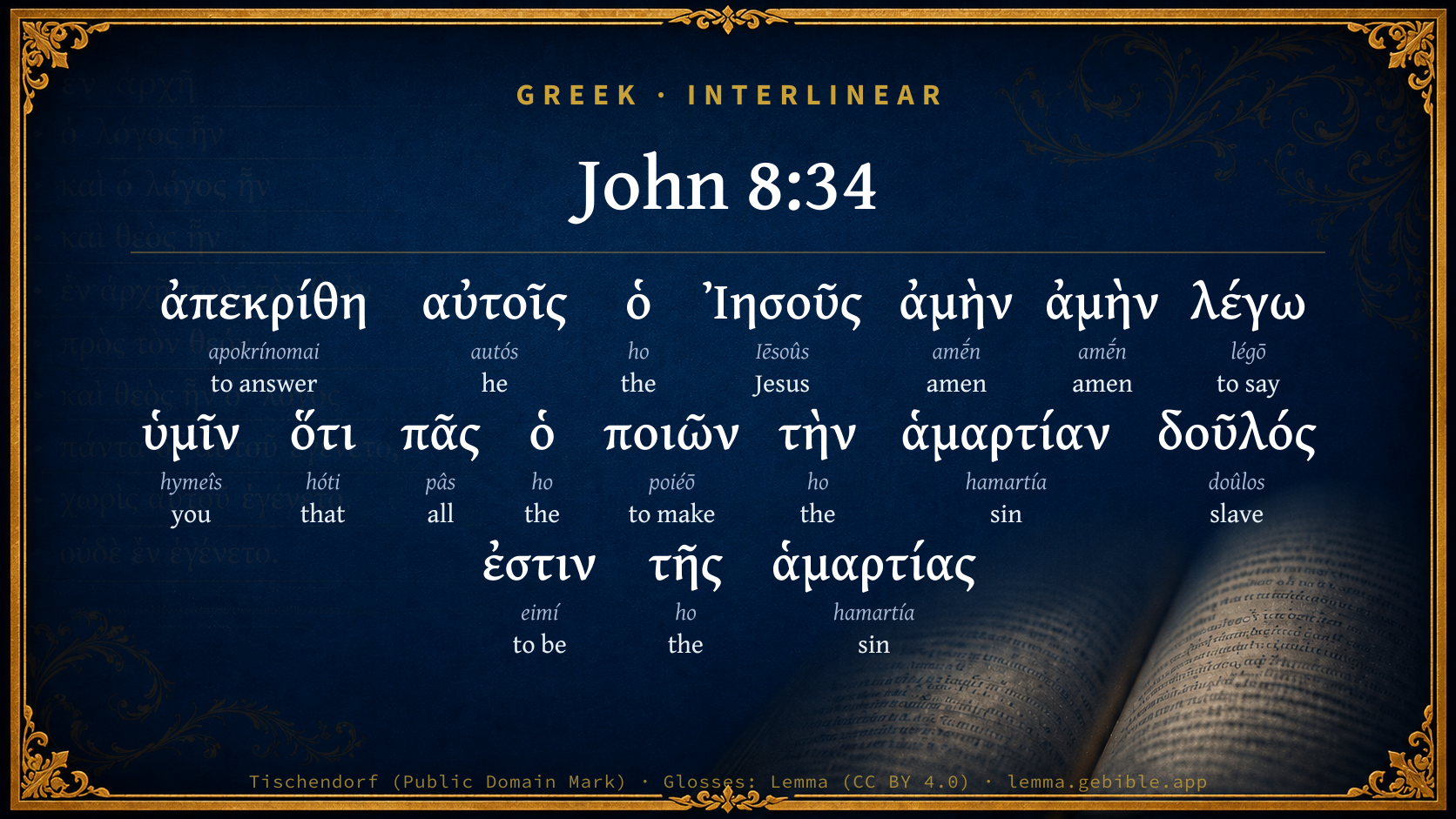
Greek (Tischendorf 8th ed.) John 8:34 appears in the Greek New Testament. The text above is from the Tischendorf 8th edition. Each word links to its Strong’s number and a concise gloss. Click any word for its full Thayer’s Greek Lexicon entry.
Download image
Cite this verse

John 8:34 (World English Bible). Public Domain. Lemma interlinear Bible study tool, https://lemma.gebible.app/v/john/8/34.

Show BibTeX & RIS
BibTeX
RIS
English Translation
Jesus answered them, "Most assuredly I tell you, everyone who commits sin is the bondservant of sin.
World English Bible · Public Domain
Download a study sheet

One document with this verse’s original text, its word-by-word gloss line, the meaning frame, cross-references with their text, attributed commentary, and full source and license credits — printable, and it pastes into notes with its structure intact.

This verse Autodidact and up

Study sheet (.html) Plain text (.txt)

A passage Seminary Student

Up to 50 verses in one chapter. A passage sheet keeps up to 6 commentary sources and 12 cross-references per verse, in the order this page ranks them, and says so on the sheet whenever that leaves anything out. Ask for a single verse and you get the Autodidact verse sheet above.

Everything on this page stays free to read, with no account — the sheet is a download of what is already on screen, not access to it.

Want to remove ads? Support Godless Engineer
Compare translations 3

The same verse in 3 English versions, stacked beneath the original-language interlinear above. Click any original word for its lexicon entry.

Each is an independent rendering of the whole verse — the interlinear is not word-aligned to these translations.

Highlighted words mark where these versions differ — a whole-verse word diff, not a word-by-word alignment.

  • World English Bible Public Domain
    Jesus answered them, "Most assuredly I tell you, everyone who commits sin is the bondservant of sin.
  • King James Version Public Domain
    Jesus answered them, Verily, verily, I say unto you, Whosoever committeth sin is the servant of sin.
  • unfoldingWord Literal Text CC BY-SA 4.0
    Jesus answered them, “Truly, truly, I say to you, that everyone committing sin is a slave of sin.

unfoldingWord Literal Text — © unfoldingWord, licensed CC BY-SA 4.0. Word-aligned USFM3 via Door43 (git.door43.org/unfoldingWord/en_ult).

Versions to compare (up to 4)

3 of 4 selected

Show all 19 translations

Every available English version of this verse, each an independent rendering of the whole verse.

  • World English Bible Public Domain
    Jesus answered them, "Most assuredly I tell you, everyone who commits sin is the bondservant of sin.
  • Berean Standard Bible Public Domain
    Jesus replied, “Truly, truly, I tell you, everyone who sins is a slave to sin.
  • Majority Standard Bible Public Domain
    Jesus replied, “Truly, truly, I tell you, everyone who sins is a slave to sin.
  • King James Version Public Domain
    Jesus answered them, Verily, verily, I say unto you, Whosoever committeth sin is the servant of sin.
  • American Standard Version (1901) Public Domain
    Jesus answered them, Verily, verily, I say unto you, Every one that committeth sin is the bondservant of sin.
  • Revised Version (1885) Public Domain
    Jesus answered them, Verily, verily, I say unto you, Every one that committeth sin is the bondservant of sin.
  • Geneva Bible (1599) Public Domain
    Iesus answered them, Verely, verely I say vnto you, that whosoeuer committeth sinne, is the seruant of sinne.
  • Douay-Rheims (1899) Public Domain
    Jesus answered them: Amen, amen I say unto you: that whosoever committeth sin, is the servant of sin.
  • Young's Literal Translation Public Domain
    Jesus answered them, `Verily, verily, I say to you -- Every one who is committing sin, is a servant of the sin,
  • Literal Standard Version CC BY-SA 4.0
    Jesus answered them, “Truly, truly, I say to you, everyone who is committing sin, is a servant of sin,
  • Unlocked Literal Bible CC BY-SA 4.0
    Jesus answered them, “Truly, truly, I say to you, everyone who commits sin is the slave of sin.
  • unfoldingWord Literal Text CC BY-SA 4.0
    Jesus answered them, “Truly, truly, I say to you, that everyone committing sin is a slave of sin.
  • Darby Bible Public Domain
    Jesus answered them, Verily, verily, I say to you, Every one that practises sin is the bondman of sin.
  • World Messianic Bible Public Domain
    Yeshua answered them, “Most certainly I tell you, everyone who commits sin is the bondservant of sin.
  • Webster's Bible Public Domain
    Jesus answered them, Verily, verily, I say to you, Whoever committeth sin, is the servant of sin.
  • Free Bible Version CC BY-SA 4.0
    Jesus replied, “I tell you the truth, everyone who sins is a slave of sin.
  • Bible in Basic English Public Domain
    And this was the answer Jesus gave them: Truly I say to you, Everyone who does evil is the servant of sin.
  • Text-Critical English NT CC BY 4.0
    Jesus answered them, “Truly, truly, I say to you, everyone who commits sin is a slave of sin.
  • Tyndale New Testament (1534) Public Domain
    And the servaunt abydeth not in the housse for ever: But the sonne abydeth ever.

Literal Standard Version (2020), Covenant Press — licensed CC BY-SA 4.0. Text via the HelloAO Bible API (eBible.org). Unlocked Literal Bible (unfoldingWord) — licensed CC BY-SA 4.0. Text via the HelloAO Bible API (eBible.org). unfoldingWord Literal Text — © unfoldingWord, licensed CC BY-SA 4.0. Word-aligned USFM3 via Door43 (git.door43.org/unfoldingWord/en_ult). Free Bible Version, Dr. Jonathan Gallagher — licensed CC BY-SA 4.0. Text via the HelloAO Bible API (eBible.org).

Word by word

More ways to search: Search by grammar → Find every occurrence → Compare this word →

Practice this passage: Drill this verse → Learn its vocabulary →

δοῦλός
doûlos
G1401
“slave”
Noun, Nominative, Singular, Masculine
Part of Speech
Noun
Case
Nominative
Number
Singular
Gender
Masculine
Full Thayer's Definition

Origin: from G1210

TDNT: 06:21,2

1. a slave, bondman, man of servile condition a. a slave b. metaph., one who gives himself up to another's will those whose service is used by Christ in extending and advancing his cause among men c. devoted to another to the disregard of one's own interests 2. a servant, attendant
  1. ἀπεκρίθη apokrínomai G611 “to answer” Verb, Aorist, Middle deponent, Indicative, 3rd person, Singular
  2. αὐτοῖς autós G846 “he” Personal pronoun, Dative, Plural, Masculine
  3. ὁ ho G3588 “the” Article, Nominative, Singular, Masculine
  4. Ἰησοῦς Iēsoûs G2424 “Jesus” Noun, Nominative, Singular, Masculine
  5. ἀμὴν amḗn G281 “amen” Hebrew transliteration
  6. ἀμὴν amḗn G281 “amen” Hebrew transliteration
  7. λέγω légō G3004 “to say” Verb, Present, Active, Indicative, 1st person, Singular
  8. ὑμῖν hymeîs G5210 “you” Personal pronoun, 2nd person, Dative, Plural
  9. ὅτι hóti G3754 “that” Conjunction
  10. πᾶς pâs G3956 “all” Adjective, Nominative, Singular, Masculine
  11. ὁ ho G3588 “the” Article, Nominative, Singular, Masculine
  12. ποιῶν poiéō G4160 “to make” Verb, Present, Active, Participle, Nominative, Singular, Masculine
  13. τὴν ho G3588 “the” Article, Accusative, Singular, Feminine
  14. ἁμαρτίαν hamartía G266 “sin” Noun, Accusative, Singular, Feminine
  15. ἐστιν eimí G1510 “to be” Verb, Present, Active, Indicative, 3rd person, Singular
  16. τῆς ho G3588 “the” Article, Genitive, Singular, Feminine
  17. ἁμαρτίας hamartía G266 “sin” Noun, Genitive, Singular, Feminine

About this verse

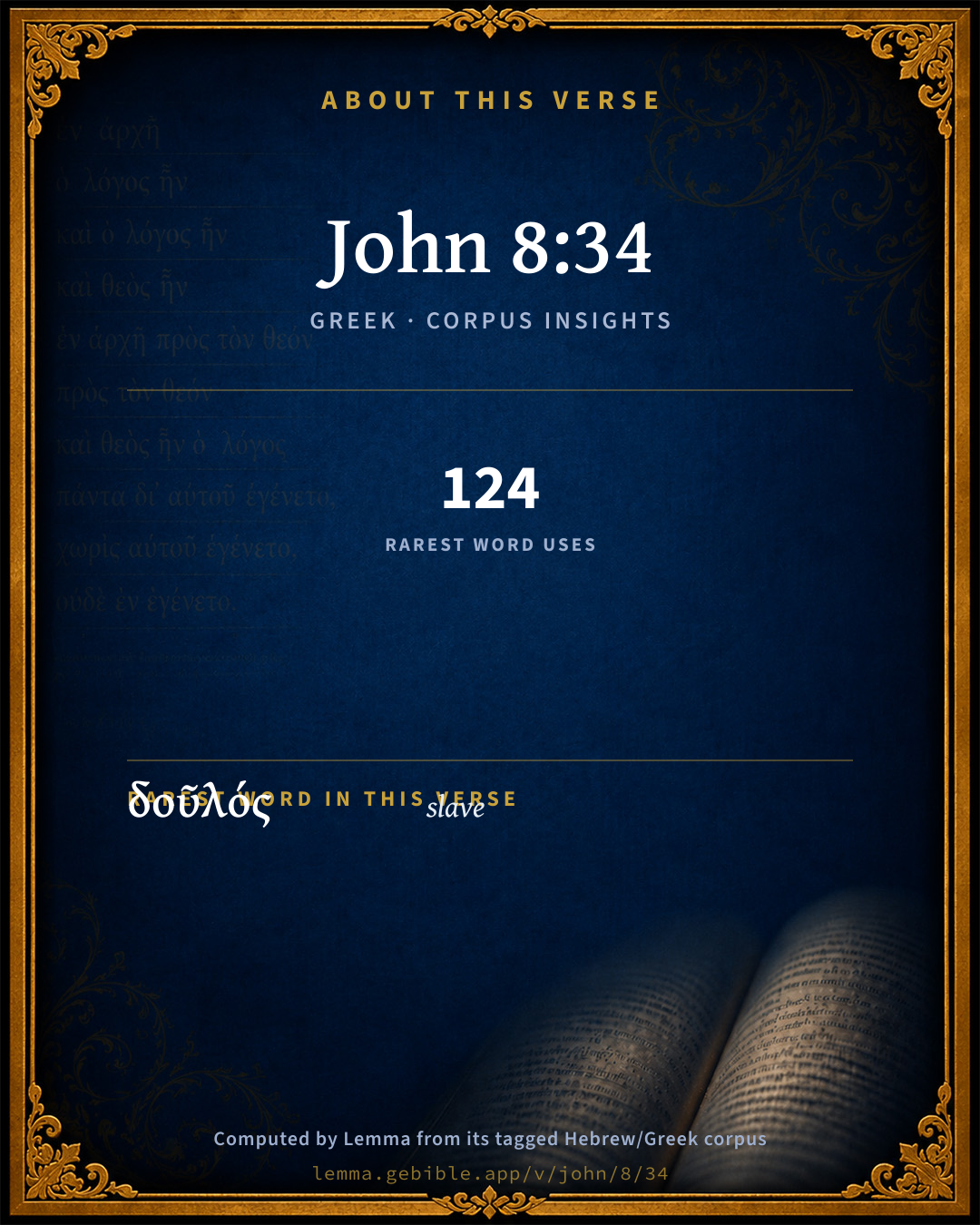
These counts appear in no published source. They are computed here, from the morphology-tagged text and Lemma’s own curated glosses. What Lemma adds →

18
words
13
distinct lemmas
Gospels
section

Repetition

Words recur within this verse:

  • ἀμὴν amen G281 ×2
  • ἁμαρτίαν sin G266 ×2
  • ὁ the G3588 ×4

Cross-references

16

Topical passages linked to John 8:34 in the Treasury of Scripture Knowledge — connected by theme and wording, ordered by reader-vote popularity; previews shown in the World English Bible.

  • Romans 6:16 Don't you know that to whom you present yourselves as servants to obedience, his servants you are whom you obey; whether of sin to death, or of obedience to righteousness?
  • 2 Peter 2:19 promising them liberty, while they themselves are bondservants of corruption; for by whom a man is overcome, by the same is he also brought into bondage.
  • Proverbs 5:22 The evil deeds of the wicked ensnare him. The cords of his sin hold him firmly.
  • 1 John 3:8–10 He who sins is of the devil, for the devil has been sinning from the beginning. To this end the Son of God was revealed, that he might destroy the works of the devil.
  • Romans 6:12 Therefore don't let sin reign in your mortal body, that you should obey it in its lusts.
  • Romans 6:6 knowing this, that our old man was crucified with him, that the body of sin might be done away with, so that we would no longer be in bondage to sin.
  • Titus 3:3 For we were also once foolish, disobedient, deceived, serving various lusts and pleasures, living in malice and envy, hateful, and hating one another.
  • Romans 6:19–20 I speak in human terms because of the weakness of your flesh, for as you presented your members as servants to uncleanness and to wickedness upon wickedness, even so now present your members as servants to righteousness for sanctification.
  • Ephesians 2:2 in which you once walked according to the course of this world, according to the prince of the powers of the air, the spirit who now works in the children of disobedience;
  • 1 Kings 21:25 (But there was none like Ahab, who did sell himself to do that which was evil in the sight of Yahweh, whom Jezebel his wife stirred up.
  • Romans 7:25 I thank God through Jesus Christ, our Lord! So then with the mind, I myself serve God's law, but with the flesh, the sin's law.
  • Acts 8:23 For I see that you are in the gall of bitterness and in the bondage of iniquity."
  • Romans 7:14 For we know that the law is spiritual, but I am fleshly, sold under sin.
  • Romans 8:21 that the creation itself also will be delivered from the bondage of decay into the liberty of the glory of the children of God.
  • Matthew 5:18 For most assuredly, I tell you, until heaven and earth pass away, not even one smallest letter or one tiny pen stroke shall in any way pass away from the law, until all things are accomplished.
  • John 3:3 Jesus answered him, "Most assuredly, I tell you, unless one is born anew, he can't see the Kingdom of God."

Cross-references courtesy of OpenBible.info (CC BY 4.0).

Commentary

Notes on John 8:34 from classic Christian and Jewish commentators (each source and its license shown beneath its notes). The classic Christian expositions comment on the surrounding passage and are grouped to its opening verse, so a note may address several verses; the Jewish commentaries on the Tanakh (Rashi and others) are per-verse, so they appear only where the commentator wrote on this verse.

Lemma curates 59 commentaries, every one of them public domain or Creative Commons licensed, each selected and text-cleaned for this edition rather than reprinted as found. About our sources →

Godbey's Commentary on the New Testament

William B. Godbey

THE SLAVE OF SIN

Joh 8:34. “Jesus responded to them, Truly, truly, I say unto you, That every one doing sin is the slave of sin.” The devil’s people all night long wheeling in the mazy gyrations of the giddy, lustful dance, quaffing the inebriating bowl till they kindle hell-fire in their blood and transform their cranium into rattlesnake dens, wasting their vitality in brutal debaucheries and diabolical sensualities, vainly dream in their drunken revelries that they are the freest people in all the world because they can do such things, while at the same time they are the most miserable slaves, demons from the bottomless pit lashing them with the firebrands of inflamed appetites and abnormal passions, actually precipitating them into suicide, and forcing them, in the black foundries of an earthly pandemonium, to forge the adamantine chains that shall bind them in penal fires through the flight of eternal cycles.

William B. Godbey, Commentary on the New Testament (1896–1900) — public domain. Text from a community e-Sword module.

Bengel's Gnomon

Johann Albrecht Bengel

Joh 8:34. Ἀπεκρίθη, answered) Jesus replies in inverse order to the twofold objection of the Jews, and first goes on with the portion of the discourse concerning freedom, then discusses the portion concerning the children of Abraham, from Joh 8:37.—ὁ ποιῶν) he who habitually committeth sin, as opposed to the truth.—δοῦλός ἐστι, is the slave) by the very fact, 2Pe 2:19, “While they promise them liberty, they themselves are the servants of corruption; for of whom a man is overcome, of the same is he brought into bondage;” Rom 6:16, “Know ye not, that to whom ye yield yourselves servants to obey, his servants ye are to whom ye obey, whether of sin unto death, or of obedience unto righteousness.”

Bengel's Gnomon of the New Testament — English translation (T&T Clark, Edinburgh, 1860) — public domain. Text from a community e-Sword module.

Meyer's Critical & Exegetical Commentary

Heinrich August Wilhelm Meyer

Joh_8:34. Δείκνυσιν (and that with solemn asseveration), ὅτι δουλείαν ἐνέγηνεν ἀνωτέρω τὴν ἐξ ἁμαρτίας, οὐ τὴν ἐκ δυναστείας ἀνθρώπου, Euth. Zigabenus.

ὁ ποιῶν] instead of keeping himself free from it.

δοῦλος] as to His moral personality or Ego, comp. as to the figure and subject-matter, Rom_6:17 ff; Rom_7:14 ff. Analogous examples from the Classics in Wetstein; from Philo in Loesner, p. 149.

Meyer — Critical and Exegetical Commentary on the New Testament — English translation by Peter Christie, edited by Frederick Crombie (T&T Clark, 1880) — public domain. Text from a community e-Sword module.

Expositor's Greek Testament

ed. W. Robertson Nicoll

Joh 8:34 . The answer is: ἀμὴν … ἁμαρτίας [ τῆς ἁμαρτίας is bracketed by W.H [68] ]. The liberty meant is inward, radical, and individual. “Every one who lives a life of sin is a slave.” Cf. Rom 6:16 ; Rom 6:20 ; 2Pe 2:19 ; Xen., Mem. , iv. 5, 3; Philo’s tract “Quod omnis probus sit liber,” and the Stoic saying “solus sapiens est liber”. The relations subsisting ἐν τῇ οἰκίᾳ in the house of God, the Theocracy to which they boasted to belong, must be determined by what is spiritual, by likeness to the Head of the house; “this servitude would lead to national rejection,” Edersheim. It behoves them therefore to remember this result of the generally recognised principle that sin masters the sinner and makes him a slave (Joh 8:35 ), viz. , “that the slave does not abide in the house,” does not permanently inherit the promises to Abraham, and the blessedness of fellowship with God; it is the Son who abide for ever. Cf. Heb 3:6 . The slave has no permanent footing in the house: he may be dismissed or sold. The transition which Paul himself had made from the servile to the filial position coloured his view of the Gospel, Gal 4:1-7 ; but here it is not the servile attitude towards God but slavery to sin that is in view. From this slavery only the Son emancipates, ἐὰν οὖν … ἔσεσθε . This implies that they were all born slaves and needed emancipation, and that only One, Himself the Son, could give them true liberty. ὄντως ἐλεύθεροι in contrast to the liberty they boasted of in Joh 8:33 . How the Son emancipates is shown in Gal 4:1-7 . The superficial character of the liberty they enjoyed by their birth as Jews is further emphasised in Joh 8:37 .

[68] Westcott and Hort.

The Expositor's Greek Testament, edited by W. Robertson Nicoll (1897–1910) — public domain. Text from a community e-Sword module.

Jamieson, Fausset & Brown

Robert Jamieson, A. R. Fausset & David Brown

Whosoever committeth sin--that is, liveth in the commission of it--(Compare Jo1 3:8; Mat 7:23).

is the servant of sin--that is, the bond-servant, or slave of it; for the question is not about free service, but who are in bondage. (Compare Pe2 2:19; Rev 6:16). The great truth here expressed was not unknown to heathen moralists; but it was applied only to vice, for they were total strangers to what in revealed religion is called sin. The thought of slaves and freemen in the house suggests to our Lord a wider idea.

Jamieson, Fausset & Brown — Commentary Critical and Explanatory on the Whole Bible (1871) — public domain (CC PDM 1.0). Text via the HelloAO Bible API.

Adam Clarke's Commentary

Verse 34. Whosoever committeth sin is the servant of sin.] Or, δουλος εστι, c., is the slave of sin. This was the slavery of which Christ spoke and deliverance from it, was the liberty which he promised.

Adam Clarke's Commentary on the Bible (1810–1826) — public domain. Text from a community e-Sword/MySword module.

John Calvin's Commentaries

34. Every man who committeth sin is the slave of sin. This is an argument drawn from contrary things. They boasted that they were free. He proves that they are the slaves of sin, because, being enslaved by the desires of the flesh, they continually sin. It is astonishing that men are not convinced by their own experience, so that, laying aside their pride, they may learn to be humble. And it is a very frequent occurrence in the present day, that, the greater the load of vices by which a man is weighed down, the more fiercely does he utter unmeaning words in extolling free-will.

Christ appears to say nothing more here than what was formerly said by philosophers, that they who are devoted to their lusts are subject to the most degrading slavery. But there is a deeper and more hidden meaning; for he does not argue what evil men bring on themselves, but what is the condition of human nature. The philosophers thought that any man is a slave by his own choice, and that by the same choice he returns to freedom. But here Christ maintains, that all who are not delivered by him are in a state of slavery, and that all who derive the contagion of sin from corrupted nature are slaves from their birth. We must attend to the comparison between grace and nature, on which Christ here dwells; from which it may be easily seen that men are destitute of freedom, unless they regain it from some other quarter. Yet this slavery is voluntary, so that they who necessarily sin are not compelled to sin.

John Calvin's Commentaries (1540-1563) — public domain. Text from the Calvin Translation Society English edition (1840s-50s) via the Christian Classics Ethereal Library (ccel.org). Calvin's coverage is partial (roughly two-thirds of the Bible); uncommented books and verses are honest gaps, never fabricated. The 19th-century editor's footnotes and remarks are omitted so the notes are faithfully Calvin's own voice.

Ellicott's Commentary for English Readers

(34) Whosoever committeth sin is the servant of sin.—The Cambridge MS. and some of the Fathers omit the words “of sin”; but this is clearly to avoid the difficulty of the connection of thought, and they must be regarded as an integral part of the text.

Committeth sin.—The Greek word is a present participle, expressing the continuance of the deeds of sin. It means, not simply the committing individual sins, from which no man is free, but the state of the life which is sinful; the state which is opposed to doing the will of the Father, and is expressed in other words as “working iniquity” (Mat_7:21; Mat_7:23.) The truth is taught in the generality of a well-known maxim, but it has for them a special application. They claimed to be Abraham’s seed, and therefore free. Let their lives decide the question of their freedom. He could appeal (Joh_8:28-29) to a perfect harmony with the divine will, and therefore had a perfect freedom. For many of them the voice of conscience must have spoken in terrible words, and must have revealed the chain which had bound them, hand and foot, in the slavery of sin.

Is the servant of sin.—The word means bondservant, or slave. It has been rendered by “bondman,” and this brings out the connection of the word with that for “was in bondage,” in the last verse.

It is striking that we have this same thought in the letters of both St. Paul and St. Peter. (See margin.)

A Bible Commentary for English Readers, edited by Charles John Ellicott (1878–1897) — public domain. Text from a community e-Sword module.

The Cambridge Bible for Schools and Colleges

gen. ed. J. J. S. Perowne

34. Whosoever committeth sin is the servant of sin] Better, Everyone who continues to commit sin is the bond-servant of sin. ‘Committeth sin’ is too weak for the Greek: Christ does not say that a single act of sin enslaves. ‘To commit (poiein) sin’ is the opposite of ‘to do the Truth’ (Joh_3:21). Again, ‘servant,’ though often a good translation where nothing degrading is implied, is not strong enough, where, as here, the degradation is the main point. Moreover, the connexion with Joh_8:33 must be kept up. The words for ‘bondage’ and ‘servant’ are cognate; therefore either ‘bondage’ and ‘bond-servant,’ or ‘slavery’ and ‘slave,’ must be our renderings.

Some have thought that we have here an echo of Rom_6:16, which of course S. John may have seen. But why may not both passages be original? The idea that vice is slavery is common in all literature: frequent in the classics. 2Pe_2:19 is probably an echo either of this passage or of Rom_6:16. Comp. Mat_6:24.

The Cambridge Bible for Schools and Colleges (gen. ed. J. J. S. Perowne; Cambridge University Press, 1878–1918) — public domain. Text from a community e-Sword module.

John Gill's Exposition

I know that ye are Abraham's seed,.... In answer to the other part of the Jews' objection to Christ, and in favour of themselves, Christ owns that they were the natural seed of Abraham; for truth must be allowed to an adversary. But then this hindered not but they might be, as they were, in moral bondage to sin, and a generation of vipers, as those of them who came to John's baptism were; and might not be the sons of God, for not because they were the natural seed of Abraham, were they all the adopted sons of God; and might be cast out of the house of God, as Ishmael was cast out of Abraham's, though he was his natural seed. And what follows proves them to be under the power, and in the servitude of sin, and that they were the seed of the serpent that was to bruise the heel of the woman's seed, or put the Messiah to death, though they were the natural seed of Abraham:

but ye seek to kill me; which none but such who are under the governing power of sin, are slaves unto it, and the vassals of the devil, would ever do: the reason of which is,

because my word hath no place in you; their hearts were barred and bolted against it, with ignorance, enmity, and unbelief; it had no entrance into them; it did not come with power to their hearts, nor work effectually in them; it had no place at all in them, much less a dwelling; had it had one, it would have produced another effect in them, even love to Christ; which the doctrine of Christ, wherever it comes with power, and takes place in the soul, brings along with it; but where it does not, as here, hatred and indignation, envy and malice, more or less, show themselves. This clause is differently rendered, and so admits of different senses. The Vulgate Latin renders it, "my word does not take in you"; it did not take place in them, nor did it take with them; they could not receive it; in which sense the word is used in Mat 19:11; for the natural man cannot receive the doctrines of Christ; they are not suited to his taste: they are disagreeable to him. The Syriac version renders it, "ye are not sufficient for my word", to take it in; they were not capable of it; they could not understand it; it requires divine illumination, and a spiritual discerning, which they had not: the Persic version is, "ye are not worthy of my words"; of having the Gospel preached to them, and continued with them; they contradicting and blaspheming it, and rejecting the author of it; see Act 13:45. The Ethiopic version renders it, "my word does not remain with you"; and to the same purpose the Arabic version, "my word is not firm in you"; as soon as it was heard by them, it was caught away from them by Satan, whose children they were; it made no lasting impressions on them, but was like water spilt upon the ground: it may be rendered, "my word does not enter into you"; it did not make its way and penetrate into their hearts; for though, when attended with the demonstration of the Spirit, and of power, it is quick and powerful, and sharper than a twoedged sword, and enters into the conscience, and penetrates to the dividing asunder of soul and spirit, and lays open the secret thoughts and intents of the heart; yet of itself is an insufficient means of conversion; it cannot make its own way; there must be an exertion of powerful and efficacious grace; which shows the hardness and obstinacy of the heart of man.

John Gill's Exposition of the Whole Bible (1746–1763) — public domain (CC PDM 1.0). Text via the HelloAO Bible API.

Trapp's Complete Commentary

John Trapp

34 Jesus answered them, Verily, verily, I say unto you, Whosoever committeth sin is the servant of sin.

Ver. 34. Is the servant of sin] Hath as many lords as lusts: {a} that as Augustine said of Rome in her pride, she conquered countries, but was vanquished by vices; {b} and as the Persian kings commanded the whole world, but were commanded by their wives and concubines; so is it with sin’s slaves. This slavery they may easily shake off, saith Seneca; wherein the wise man was utterly out, heavenly wide, as Sir Philip Sidney translateth toto errat caelo.

{a} Servitus gravissima est sibi ipsi servire. Sen.

{b} Victrix Gentium, captiva vitiorum. Aug. Captivarum suarum captiva. Plutarch.

John Trapp, A Commentary or Exposition upon All the Books of the Old and New Testament (1647–1656) — public domain. Text from a community e-Sword module.

Albert Barnes' Notes on the Bible

Whosoever committeth sin ... - In this passage Jesus shows them that he did not refer to political bondage, but to the slavery of the soul to evil passions and desires.

Is the servant - Is the slave of sin. He is bound to it as a slave is to his master.

Albert Barnes' Notes on the Bible (1834–1885) — public domain. Text from a community e-Sword/MySword module.

Matthew Poole's English Annotations

Our Saviour here correcteth their mistake, letting them know, that he was not speaking about any corporal, but spiritual servitude; not of the freedom of men’s bodies from the power of enemies, but of the freedom of men’s souls from the slavery and dominion of lusts and corruptions. He that doth sin (saith he) is the servant of sin. The committing or doing of sin here intended, is not to be understood of single acts of sin, for in that sense who lives and sinneth not? (the righteous man sinning seven times in a day); so as all men would be concluded the servants of sin; but of living indulgently and habitually in a course of sin, and in the practice of gross sins; in which sense workers of iniquity is to be taken, Mat 7:23; and this very phrase, 1Jo 3:4. And indeed, the very heathen could see, that there was no such slavery as a servitude to lusts and passions: men are the servants of corruption, 2Pe 2:19; under the dominion of sin, Rom 6:20.

Matthew Poole's English Annotations on the Holy Bible (1683–1685) — public domain. Text from a community e-Sword/MySword module.

Whedon's Commentary on the Bible

Daniel D. Whedon

34. Committeth sin—Doeth or practiseth sin. The verb is in the continuous present, expressing what is persistently done.

Servant—Slave. Sin, like a slaveholder, blinds his understanding, inflames his passions, and hems in his will. He is circumscribed within the territory of evil.

Daniel D. Whedon (gen. ed.), Commentary on the Old and New Testaments (1874–1909) — public domain. Text from a community e-Sword module.

The Pulpit Commentary

Jesus answered them; i.e. those "Jews who believed him," but whose retort showed their faith to be of the most feeble and imperfect kind, and which, if it were momentarily assumed, was ready to disappear at the first touch of trial. A promise of Divine love had been treated by them as an insult, not so much to their national history, as to their religious triumph over their civil and political disasters. There is no reason to believe that in these, or in the following words, the unbelieving Jews had once more become the interlocutors, as Tholuck and Hengstenberg have done on different grounds. Meyer, Ellicott, Lange, and many others agree with the view here advanced. The answer to them (autoiv , those who were the subjects of apekriyhsan) is introduced with peculiar solemnity: Verily, verily I say unto you, every one (pav) that doeth sin o poiwn amartian is different from prasswn faula of Joh_3:20; it is the precise opposite of poiwn alhyeian of Joh_3:21, and does not mean "everyone who committeth separate acts of transgression," but it means "everyone who is living a life of sinis the bond slave (of sin). Godet is strongly disposed, on the ground of the exceedingly small authority of D and b alone (and certain quotations of Origen), to believe that the thv amartiav is a gloss. Certainly the whole passage would be easier to interpret if our Lord had simply said that the man under the habitual power of sin is a slave, and had then, in vers. 35 and 36, advanced to the contrast between the slave and the Son. But there is great unanimity among all the authorities as to the accuracy of the Received and Revised Texts, though Westcott and Hort place it in brackets. The interpretation, consequently, is simply this, that Christ did "pass from the idea of bondage under sin to that of bondage generally, and from the idea of sonship to the Son" (Westcott). The notion of personal transgression producing a bondage, and enfettering the soul and the will, and separating it from the glorious liberty of true sonship, lay outside of their notion of discipleship. They were not requiring deliverance from sin or its bondage; what they wanted was the full realization of the national hope. The language of this verse can be paralleled from the writings of the classics and rabbis, and is largely handled by St. Paul (Romans 6 and Ro 7). The relation between sin as a principle and sins as acts of the will is a great New Testament revelation. The personal commission of sin augments the force of the corrupt tendency which leads to and facilitates fresh transgression. Every compliance with evil forges a new fetter, and imposes it on the will of the transgressor. "The strong man guards his house, and his goods are in peace". (Luk_11:21)

The Pulpit Commentary (1880–1919), ed. H.D.M. Spence-Jones & Joseph S. Exell — public domain. Text from a community e-Sword module.

John Wesley's Explanatory Notes

Jesus answered - Each branch of their objection, first concerning freedom, then concerning their being Abraham's offspring, ver. 37, &c. He that committeth sin, is, in fact, the slave of sin.

John Wesley, Explanatory Notes Upon the Whole Bible (1754–1765) — public domain. Text via the GEBible commentary corpus.

Scofield Reference Notes

C. I. Scofield

sin

Sin. (See Scofield "Rom 3:23").

The Scofield Reference Bible (1917 edition), notes by C. I. Scofield — public domain. Text from a community e-Sword module.

Kretzmann's Popular Commentary

Paul E. Kretzmann

True liberty:

v. 34. Jesus answered them, Verily, verily, I say unto you, Whosoever committeth sin is the servant of sin.

v. 35. And the servant abideth not in the house forever; but the Son abideth ever.

v. 36. If the Son, therefore, shall make you free, ye shall be free indeed

v. 37. I know that ye are Abraham’s seed; but ye seek to kill Me because My Word hath no place in you.

v. 38. I speak that which I have seen with, My Father; and ye do that which ye have seen with your father.

In a very solemn manner, Jesus here proceeds to explain His statement regarding slavery or bondage. Every doer of sin is a slave of sin. He that commits a sin thereby places himself in its power, is bound and held captive absolutely. And therefore these Jews are servants, slaves, in the spiritual sense. But such a slave has no part and right in the house, he has only duties to perform; he is not his own master and cannot speak of freedom. The servants of sin may now be outward members of the Kingdom, of the Church, but they will in the end be obliged to leave, they will be thrust out from the place where they have usurped the rights of children. It is only the Son of God that is able to bring freedom, emancipation from sin and its service. He has earned freedom from sin for all men by paying the price, the redemption for their sin, His holy blood. That is the only true freedom, which the Son has thus earned and is offering to the whole world, which He wants also these Jews to accept. Jesus was very well aware that they were descendants of Abraham according to the flesh, that they could trace their ancestry back to the great patriarch. But they had little of their ancestor’s manner in them, for they were even now seeking to kill Him, because His Word would not enter into their hearts and minds. The unbelievers are filled with spiteful anger against the true believers, but incidentally shut up their hearts tightly against every form of Gospel influence. While Jesus was making it a practice to speak what He had seen in the bosom of His Father from eternity, all the wonderful things which pertained to the salvation of mankind, the Jews were getting ready and setting their hearts to do what they learned from him who was their father in truth, in a spiritual sense, the devil. They were acting in a perfectly consistent manner. It was a bit of impressive irony which should have opened the eyes of the Jews.

Paul E. Kretzmann, Popular Commentary of the Bible (1921–1924) — public domain. Text from a community e-Sword module.

The People's New Testament

B. W. Johnson

34. Whosoever committeth sin is the servant of sin. According to his custom, Christ makes no direct argument in reply, but states a truth and leaves them to apply it. The sinner is the slave of sin. See Rom. 7:9–24.

B. W. Johnson's The People's New Testament with Notes (1889–1891) — public domain. Electronic text from the Christian Classics Ethereal Library (CCEL) ThML edition.

unfoldingWord translationNotes

Door43 World Missions Community

Truly, truly

See how you translated this in John 1:51.

is the slave of sin

Here the word "slave" is a metaphor. This implies that "sin" is like a master for the one who sins. AT: "is like a slave to sin" (See: Metaphor)

in the house

Here "house" is a metonym for "family." AT: "as a permanent member of a family" (See: Metonymy)

the son remains forever

This is an ellipsis. You may translate it by including the implied words. AT: "the son is a member of the family forever" (See: Ellipsis)

if the Son sets you free, you will be truly free

It is implied that Jesus is talking about freedom from sin, which is a metaphor for being able not to sin. AT: "if the Son msets you free, you will truly be able to refrain from sin" (See: Assumed Knowledge and Implicit Information and Metaphor)

if the Son sets you free

"Son" is an important title for Jesus, the Son of God. Jesus was speaking about himself. AT: "If I, the Son, set you free" (See: Translating Son and Father and First, Second, or Third Person)

translationWords

amen

sin

servant

house

eternity

Son of God

unfoldingWord translationNotes — © Distant Shores Media and the Door43 World Missions Community, licensed CC BY-SA 4.0. Source: git.door43.org/Door43/en_tn.

Cambridge Greek Testament for Schools and Colleges

34. Ἀμὴν ἀμήν. With great solemnity He points them to a bondage far worse than political servitude. see on Joh 1:51.

πᾶς ὁ ποιῶν τ. ἁμ. Everyone who continueth to do sin is the bond-servant of sin. Christ does not say that a single act (ὁ ποιήσας) of sin enslaves; it is a life of sin that makes a man a slave and the child of the devil (1Jn 3:8). Ποιεῖν τὴν ἁμαρτ. is the opposite of ποιεῖν τὴν ἀλήθειαν (Joh 3:21) and of π. τὴν δικαιοσύνην (1Jn 2:29; 1Jn 3:7). ‘Servant’ is a good rendering of δοῦλος where nothing degrading is implied (Rom 1:1; Php 1:1; Tit 1:1, &c.), but is too weak, where, as here, the degradation is the main point. Moreover, the connexion with δεδουλεύκαμεν must be preserved; ‘have been in bondage’ or ‘in slavery,’ and ‘bond-servants’ or ‘slaves,’ must be our renderings.

Some have thought that we have here an echo of Rom 6:16, which S. John may have seen. But may not both passages be original? The idea that vice is slavery—tot dominorum quot vitiorum—is common in all literature: frequent in the classics. 2Pe 2:19 is probably an echo of this passage or of Rom 6:16. Comp. Mat 6:24.

Cambridge Greek Testament for Schools and Colleges (Cambridge University Press, 1896; 21 vols, various authors incl. Carr, Maclear, Plummer, Farrar, Lumby, Moule, M. R. James, Simcox) — public domain. Text from a community e-Sword module.

Alford’s Greek Testament

Henry Alford

34.] ποιῶν τὴν ἁμαρτ., not = ἁμαρτάνων, for that all do; but = ἐργαζόμενος τὴν ἀνομίαν, Mat 7:23. It implies living in the practice of sin,—doing sin, as a habit: see reff. The mere moral sentiment of which this is the spiritual expression, was common among the Greek and Roman philosophers. See Wetstein: also Rom 6:12: 2Pe 2:19.

Henry Alford, The Greek Testament (1849–1861) — public domain. Text from a community e-Sword module.

International Critical Commentary

34. ἀπεκρ. αὐτοῖς ὁ Ἰησοῦς. B omits the art. before Ἰησοῦς here (see on 1:29, 50). αὐτοῖς refers to the hostile Jews who are in view throughout the rest of the chapter.

ἀμὴν ἀμὴν λέγω ὑμῖν, calling attention to a solemn pronouncement summing up what He has just said. Cf. vv. 51, 58; and see on 1:51.

πᾶς … δοῦλός ἐστιν τῆς ἁμαρτίας. D b and Syr. sin., with Clem. Alex. (Strom. ii. 5), omit τῆς ἀμαρτίας. The omission would not, however, alter the sense, which must in any case be that the sinner is the slave of sin (or of the devil).

πᾶς ὁ ποιῶν τὴν ἁμαρτίαν means (as it does 1Jn 3:4, 1Jn 3:8) “every one who lives in the practice of sin,” just as ὁ ποιῶν τὴν ἀλήθειαν (3:21) means “he who lives in the practice of truth.” It is habitual, rather than occasional, sin that is here in view when it is said that a man mastered by it is a slave.

The Hebrews regarded sin in the light of violation of God’s law, rather than as a state of slavery. This latter doctrine is Greek rather than Hebrew; it is not often expressed by Greek writers so clearly as by Xenophon: ὅστις οὖν ἄρχεται ὑπὸ τῶν διὰ τοῦ σώματος ἡδονῶν, καὶ διὰ ταύτας μὴ δύναται πράττειν τὰ βέλτιστα, νομίζεις τοῦτον ἐλεύθερον εἶναι; Ἥκιστα, ἔφη (Memorab. iv. 5. 3). Cf. Œconom. i. § 22. Paul has the same idea when he speaks of sinners as δοῦλοι τῆς ἁμαρτἴας (Rom 6:17, Rom 6:20), but it does not appear elsewhere in his epistles. He dwells often on the freedom of the Christian from the yoke of the Jewish law (Gal 5:1, Gal 5:13), but that is a different conception. In 2Pe 2:19 we have the phrase δοῦλοι τῆς φθορᾶς, which is parallel to δοῦλοι τῆς ἁμαρτίας. But it is remarkable that the idea of sin as a master which makes slaves of men is found in the N.T. only here, and at Rom 6:17, Rom 6:20, 2Pe 2:19. It is not quite apposite to cite Jas 1:25, Jas 1:2:12, 2Co 3:17, which express the principle that the Christian law is a law of liberty.

Jesus Tells the Jews that They are Only Slaves Without Tenure in the Household of God: They are Not True Sons of Abraham, for They Try to Kill Him: Their Father is the Devil. It is Just Because They Have Not God for Their Father that They Will Not Believe Jesus, Who Offers Them Eternal Life (vv. 35-51)

International Critical Commentary — older volumes (1896–1929), various authors — public domain. Text from a community e-Sword module.

Vincent's Word Studies in the New Testament

Marvin R. Vincent

Whosoever committeth [πας ο ποιων] . Rev., more correctly, every one that committeth.

Sin [την αμαρτιαν] . The definite article, the sin, shows that Jesus does not mean merely a simple act, but a life of sin. Compare 1Jo 3:4 - 8, and doeth the truth (Joh 3:21); doeth the righteousness (1Jo 2:29). The servant [δουλος] . Or, a servant. Properly, a bond - servant or slave. See on Mt 20:26.

Of sin. A few authorities omit, and read whosoever committeth sin is a bond - servant. Compare Rom 6:17, 20.

Marvin R. Vincent, Word Studies in the New Testament (1887–1900) — public domain. Text from a community e-Sword/MySword module.

Godet's Commentaries

Frédéric Louis Godet

Ver. 34. The genitive τῆς ἁμαρτίας of sin, is omitted by the Cambridge MS., and an important document ofthe Itala; without this complement, the sense is: “He is a slave, truly a slave, while believing himself a free man;” a sense which is perfectly suitable. If, however, with all the other documents, the complement: of sin is sustained, it must be understood: “He is a slave, I mean a slave of sin.” The sin to which the man at first freely surrenders himself becomes a master, then a tyrant. It ends by entirely confiscating his will. The passage Rom 6:16-18 presents an idea analogous to that of these words. The present participle ὁ ποιῶν, who commits (sin) unites the two notions of act and condition; the act proceeds from the condition, then it establishes it. It is a slavery for which the individual is responsible, because he has himself cooperated in creating it. The genitive of sin brings out the degrading character of this dependence; the following clause shows the terrible consequence of it:

Frédéric Louis Godet — Commentaries on Luke, John, Romans, and 1 Corinthians — English translation (T&T Clark, Edinburgh, 1870s–1890s) — public domain. Text from a community e-Sword module.

Lesson kit

Teaching starters — assembled from the data on this page, not authored interpretation. Every prompt links to the verse data it draws on. Edit before teaching.

John, in the Gospels, opens this verse with 18 words (13 distinct Greek lemmas). Its most distinctive word is doûlos (“slave”). A historical commentator’s framing appears above. Read the whole chapter for the surrounding context.

Discussion questions

  1. What does “slave” (doûlos) contribute to the verse as a whole?
  2. Romans 6:16 shares this passage’s theme. How do the two illuminate each other?
  3. “amen” occurs 2× in this one verse. What is the effect of the repetition?
  4. The translations on this page render this verse differently — a whole-verse word diff, not a word-by-word alignment. What might account for the different wordings?
  5. Reading how Godbey's Commentary on the New Testament and Bengel's Gnomon read this verse, where do the two commentators agree and where do they part?

Things to notice

Reading settings

Reading text

Shown beneath each verse's original-language words.

Old Testament
Old Testament edition

Read the OT as the Masoretic Hebrew (MT) or the Greek Septuagint (LXX).

English shown for the Greek Septuagint (in the Hebrew ↔ Greek comparison).

Comparing translations? Open the Compare panel on any verse page to stack up to four side by side.