
John 9:38

Greek (Tischendorf 8th ed.) John 9:38 appears in the Greek New Testament. The text above is from the Tischendorf 8th edition. Each word links to its Strong’s number and a concise gloss. Click any word for its full Thayer’s Greek Lexicon entry.
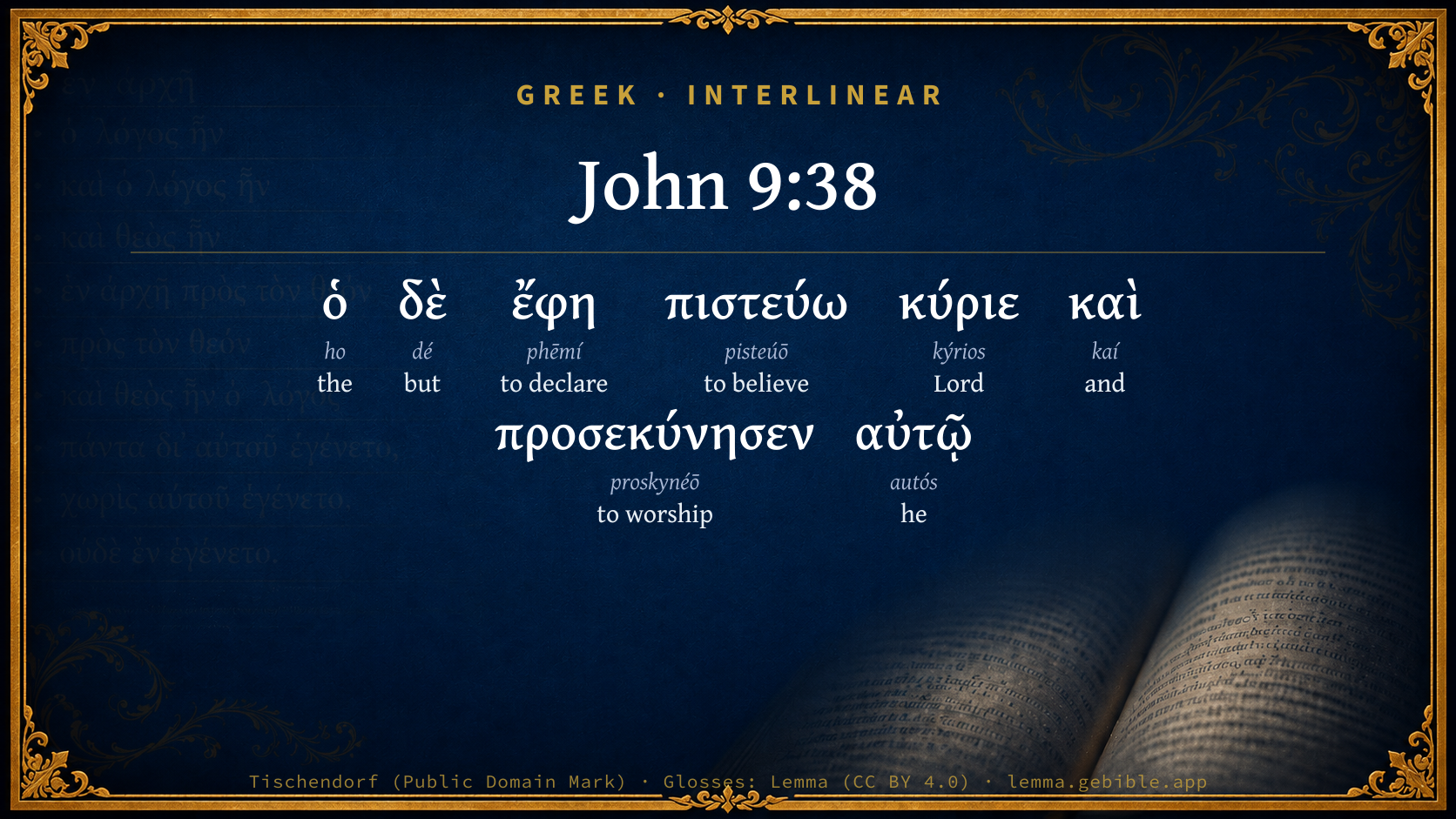
Download image
Cite this verse

John 9:38 (World English Bible). Public Domain. Lemma interlinear Bible study tool, https://lemma.gebible.app/v/john/9/38.

Show BibTeX & RIS
BibTeX
RIS
English Translation
He said, "Lord, I believe!" and he worshiped him.
World English Bible · Public Domain
Download a study sheet

One document with this verse’s original text, its word-by-word gloss line, the meaning frame, cross-references with their text, attributed commentary, and full source and license credits — printable, and it pastes into notes with its structure intact.

This verse Autodidact and up

Study sheet (.html) Plain text (.txt)

A passage Seminary Student

Up to 50 verses in one chapter. A passage sheet keeps up to 6 commentary sources and 12 cross-references per verse, in the order this page ranks them, and says so on the sheet whenever that leaves anything out. Ask for a single verse and you get the Autodidact verse sheet above.

Everything on this page stays free to read, with no account — the sheet is a download of what is already on screen, not access to it.

Want to remove ads? Support Godless Engineer
Compare translations 3

The same verse in 3 English versions, stacked beneath the original-language interlinear above. Click any original word for its lexicon entry.

Each is an independent rendering of the whole verse — the interlinear is not word-aligned to these translations.

Highlighted words mark where these versions differ — a whole-verse word diff, not a word-by-word alignment.

  • World English Bible Public Domain
    He said, "Lord, I believe!" and he worshiped him.
  • King James Version Public Domain
    And he said, Lord, I believe. And he worshipped him.
  • unfoldingWord Literal Text CC BY-SA 4.0
    Now he said, “Lord, I believe” and he worshiped him.

unfoldingWord Literal Text — © unfoldingWord, licensed CC BY-SA 4.0. Word-aligned USFM3 via Door43 (git.door43.org/unfoldingWord/en_ult).

Versions to compare (up to 4)

3 of 4 selected

Show all 19 translations

Every available English version of this verse, each an independent rendering of the whole verse.

  • World English Bible Public Domain
    He said, "Lord, I believe!" and he worshiped him.
  • Berean Standard Bible Public Domain
    “Lord, I believe,” he said. And he worshiped Jesus.
  • Majority Standard Bible Public Domain
    “Lord, I believe,” he said. And he worshiped Jesus.
  • King James Version Public Domain
    And he said, Lord, I believe. And he worshipped him.
  • American Standard Version (1901) Public Domain
    And he said, Lord, I believe. And he worshipped him.
  • Revised Version (1885) Public Domain
    And he said, Lord, I believe. And he worshipped him.
  • Geneva Bible (1599) Public Domain
    Then he sayd, Lord, I beleeue, and worshipped him.
  • Douay-Rheims (1899) Public Domain
    And he said: I believe, Lord. And falling down, he adored him.
  • Young's Literal Translation Public Domain
    and he said, `I believe, sir,' and bowed before him.
  • Literal Standard Version CC BY-SA 4.0
    and he said, “I believe, Lord,” and worshiped Him.
  • Unlocked Literal Bible CC BY-SA 4.0
    The man said, “Lord, I believe” and he worshiped him.
  • unfoldingWord Literal Text CC BY-SA 4.0
    Now he said, “Lord, I believe” and he worshiped him.
  • Darby Bible Public Domain
    And he said, I believe, Lord: and he did him homage.
  • World Messianic Bible Public Domain
    He said, “Lord, I believe!” and he worshiped him.
  • Webster's Bible Public Domain
    And he said, Lord, I believe. And he worshiped him.
  • Free Bible Version CC BY-SA 4.0
    “I trust you, Lord!” he said, and he kneeled in worship before Jesus.
  • Bible in Basic English Public Domain
    And he said, Lord, I have faith. And he gave him worship.
  • Text-Critical English NT CC BY 4.0
    The man said, “I believe, Lord.” And he worshiped him.
  • Tyndale New Testament (1534) Public Domain
    And he sayde: Lorde I beleve: and worshipped him.

Literal Standard Version (2020), Covenant Press — licensed CC BY-SA 4.0. Text via the HelloAO Bible API (eBible.org). Unlocked Literal Bible (unfoldingWord) — licensed CC BY-SA 4.0. Text via the HelloAO Bible API (eBible.org). unfoldingWord Literal Text — © unfoldingWord, licensed CC BY-SA 4.0. Word-aligned USFM3 via Door43 (git.door43.org/unfoldingWord/en_ult). Free Bible Version, Dr. Jonathan Gallagher — licensed CC BY-SA 4.0. Text via the HelloAO Bible API (eBible.org).

Word by word

More ways to search: Search by grammar → Find every occurrence → Compare this word →

Practice this passage: Drill this verse → Learn its vocabulary →

προσεκύνησεν
proskynéō
G4352
“to worship”
Verb, Aorist, Active, Indicative, 3rd person, Singular
Part of Speech
Verb
Tense
Aorist
Voice
Active
Mood
Indicative
Person
3rd person
Number
Singular
Full Thayer's Definition

Origin: from G4314 and a probable derivative of G2965 (meaning to kiss, like a dog licking his master's hand)

TDNT: 18:38,9

1. to kiss the hand to (towards) one, in token of reverence 2. among the Orientals, esp. the Persians, to fall upon the knees and touch the ground with the forehead as an expression of profound reverence 3. in the NT by kneeling or prostration to do homage (to one) or make obeisance, whether in order to express respect or to make supplication a. used of homage shown to men and beings of superior rank 1. to the Jewish high priests 2. to God 3. to Christ 4. to heavenly beings 5. to demons
  1. ὁ ho G3588 “the” Article, Nominative, Singular, Masculine
  2. δὲ dé G1161 “but” Conjunction
  3. ἔφη phēmí G5346 “to declare” Verb, Imperfect, Active, Indicative, 3rd person, Singular
  4. πιστεύω pisteúō G4100 “to believe” Verb, Present, Active, Indicative, 1st person, Singular
  5. κύριε kýrios G2962 “Lord” Noun, Vocative, Singular, Masculine
  6. καὶ kaí G2532 “and” Conjunction
  7. αὐτῷ autós G846 “he” Personal pronoun, Dative, Singular, Masculine

About this verse

These counts appear in no published source. They are computed here, from the morphology-tagged text and Lemma’s own curated glosses. What Lemma adds →

8
words
8
distinct lemmas
Gospels
section

Shared distinctive vocabulary

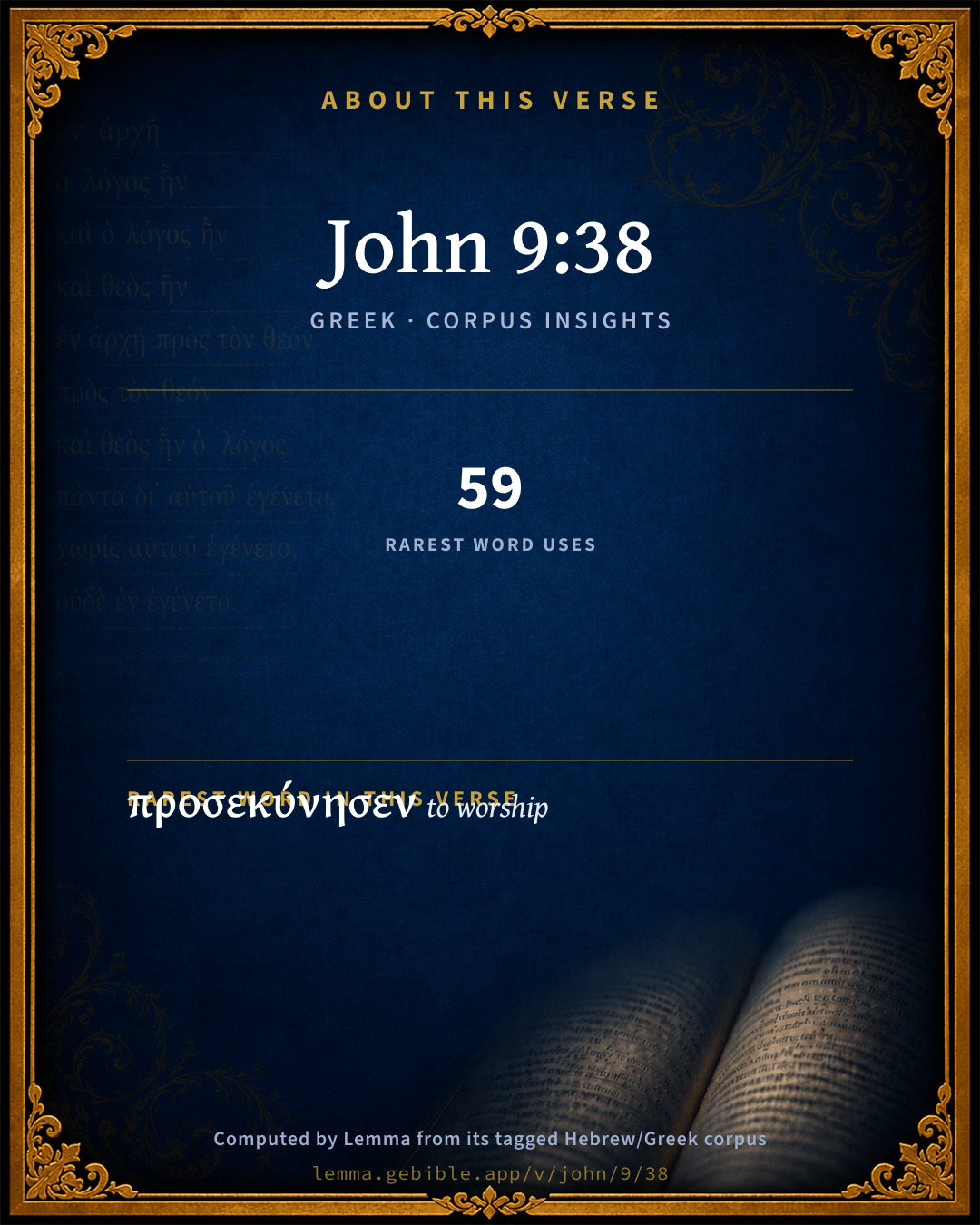
προσεκύνησεν to worship G4352 occurs in 53 verses of the Greek New Testament. Also found in:
Cross-references

8

Topical passages linked to John 9:38 in the Treasury of Scripture Knowledge — connected by theme and wording, ordered by reader-vote popularity; previews shown in the World English Bible.

  • Matthew 14:33 Those who were in the boat came and worshiped him, saying, "You are truly the Son of God!"
  • Matthew 28:9 As they went to tell his disciples, behold, Jesus met them, saying, "Rejoice!" They came and took hold of his feet, and worshiped him.
  • Psalms 2:12 Kiss the son, lest he be angry, and you perish in the way, For his wrath will soon be kindled. Blessed are all those who take refuge in him.
  • Psalms 45:11 So the king will desire your beauty, Honor him, for he is your lord.
  • Matthew 28:17 When they saw him, they bowed down to him, but some doubted.
  • Luke 24:52 They worshiped him, and returned to Jerusalem with great joy,
  • John 20:28 Thomas answered him, "My Lord and my God!"
  • Revelation 5:9–14 They sang a new song, saying, "You are worthy to take the book, And to open its seals: For you were killed, And bought us for God with your blood, Out of every tribe, language, people, and nation,

Cross-references courtesy of OpenBible.info (CC BY 4.0).

Commentary

Notes on John 9:38 from classic Christian and Jewish commentators (each source and its license shown beneath its notes). The classic Christian expositions comment on the surrounding passage and are grouped to its opening verse, so a note may address several verses; the Jewish commentaries on the Tanakh (Rashi and others) are per-verse, so they appear only where the commentator wrote on this verse.

Lemma curates 59 commentaries, every one of them public domain or Creative Commons licensed, each selected and text-cleaned for this edition rather than reprinted as found. About our sources →

Bengel's Gnomon

Johann Albrecht Bengel

Joh 9:38. Κύριε, Lord) He now uses this term in a more strict sense than he had used it at verse 36.[264]—προσεκύνησεν, he worshipped) The worship follows spontaneously the recognition of His Divinity. [Jesus nowhere required this worship of any one; it was the spirit of faith that instructed believers to render it.—V. g.]

[264] There simply, Sir; here, Lord.—E. and T.

Bengel's Gnomon of the New Testament — English translation (T&T Clark, Edinburgh, 1860) — public domain. Text from a community e-Sword module.

Expositor's Greek Testament

ed. W. Robertson Nicoll

Joh 9:38 . Ὁδὲ … αὐτῷ . He promptly uttered his belief and “worshipped” Jesus. In this Gospel προσκυνεῖν is used of the worship of God: the word is, however, susceptible of a somewhat lower degree of adoration (Mat 18:26 ); but it includes the acknowledgment of supremacy and a complete submission.

The Expositor's Greek Testament, edited by W. Robertson Nicoll (1897–1910) — public domain. Text from a community e-Sword module.

Jamieson, Fausset & Brown

Robert Jamieson, A. R. Fausset & David Brown

he said, Lord, I believe: and he worshipped him--a faith and a worship, beyond doubt, meant to express far more than he would think proper to any human "prophet" (Joh 9:17) --the unstudied, resistless expression, probably of SUPREME faith and adoration, though without the full understanding of what that implied.

Jamieson, Fausset & Brown — Commentary Critical and Explanatory on the Whole Bible (1871) — public domain (CC PDM 1.0). Text via the HelloAO Bible API.

Adam Clarke's Commentary

Verse 38. And he said, Lord, I believe.] That is, I believe thou art the Messiah; and, to give the fullest proof of the sincerity of his faith, he fell down before and adored him. Never having seen Jesus before, but simply knowing that a person of that name had opened his eyes, he had only considered him as a holy man and a prophet; but now that he sees and hears him he is convinced of his divinity, and glorifies him as his Saviour. We may hear much of Jesus, but can never know his glories and excellencies till he has discovered himself to our hearts by his own Spirit; then we believe on him, trust him with our souls, and trust in him for our salvation. The word κυριε has two meanings: it signifies Lord, or Sovereign Ruler, and Sir, a title of civil respect. In the latter sense it seems evidently used in the 36th verse, Joh 9:36 because the poor man did not then know that Jesus was the Messiah; in the former sense it is used in this verse - now the healed man knew the quality of his benefactor.

Adam Clarke's Commentary on the Bible (1810–1826) — public domain. Text from a community e-Sword/MySword module.

John Calvin's Commentaries

38. And he worshipped him. It may be asked, Did the blind man honor or worship Christ as God? The word which the Evangelist employs (προσέκυνησει) means nothing more than to express respect and homage by bending the knee, or by other signs. For my own part, certainly, I think that it denotes something rare and uncommon; namely, that the blind man gave far more honor to Christ than to an ordinary man, or even to a prophet. And yet I do not think that at that time he had made such progress as to know that Christ was God manifested in the flesh. What then is meant by worship? The blind man, convinced that Jesus was the Son of God, nearly lost the command of himself, and, in rapturous admiration, bowed down before him.

John Calvin's Commentaries (1540-1563) — public domain. Text from the Calvin Translation Society English edition (1840s-50s) via the Christian Classics Ethereal Library (ccel.org). Calvin's coverage is partial (roughly two-thirds of the Bible); uncommented books and verses are honest gaps, never fabricated. The 19th-century editor's footnotes and remarks are omitted so the notes are faithfully Calvin's own voice.

Ellicott's Commentary for English Readers

(38) And he said, Lord, I believe.—The title is repeated, but now with the deeper meaning. His half-faith has passed into full conviction. The spiritual education has led him step by step from “the Man that is called Jesus” (Joh_9:11) to the confession that He is “a prophet” (Joh_9:17), and that He is “of God” (Joh_9:33), to the belief that He is the Messiah. It is. the course of a plain man in the honesty of his heart daring to think for himself, and to act upon his convictions. He declines to be silenced by authority, or ensnared in the mazes of argument. The ultimate facts of his own consciousness supply him with a definite foundation of truth, and this is immoveable. The steps by which he advances in knowledge are a striking comment on the promise (Joh_7:17).

And he worshipped him.—The act of adoration is the necessary expression of his faith in the Son of God. We may not think that he has yet learnt all that this term includes; but he has at least learnt that the Son of God has the attribute of the divine glory, and is the object of human worship. It should be noted that St. John uses the word here rendered “worshipped” only when speaking of the worship of God. (Comp. also Joh_4:20-24; Joh_12:20.)

A Bible Commentary for English Readers, edited by Charles John Ellicott (1878–1897) — public domain. Text from a community e-Sword module.

The Cambridge Bible for Schools and Colleges

gen. ed. J. J. S. Perowne

38. Lord, I believe] Or, I believe, Lord: the order is worth keeping. Comp. the centurion’s confession (Mat_27:54). There is no need to suppose that in either case the man making the confession knew anything like the full meaning of belief in the Son of God: even Apostles were slow at learning that. The blind man had had his own uninformed idea of the Messiah, and he believed that the realisation of that idea stood before him. His faith was necessarily imperfect, a poor ‘two mites;’ but it was ‘all that he had,’ and he gave it readily, while the learned Rabbis of their abundance gave nothing. It is quite gratuitous to suppose that a special revelation was granted to him. There is no hint of this in the narrative, nor can one see why so great an exception to God’s usual dealings with man should have been made.

he worshipped him] This shews that his idea of the Son of God includes attributes of Divinity. The word for ‘worship’ occurs elsewhere in this Gospel only in Joh_4:20-24 and Joh_12:20, always of the worship of God.

The Cambridge Bible for Schools and Colleges (gen. ed. J. J. S. Perowne; Cambridge University Press, 1878–1918) — public domain. Text from a community e-Sword module.

John Gill's Exposition

And Jesus said, for judgment I am come into this world,.... The Syriac version reads, "for the judgment of this world I am come"; and with which agrees the Ethiopic version, "for the judgment of the world I am come into the world"; and the Arabic and Persic versions still more expressly, "to judge this world", or "the world, am I come"; which seems contrary to what Christ elsewhere says, Joh 3:17. Nor is the sense of the words that Christ came by the judgment of God, or the order of divine providence, or to administer justice in the government of the world, in a providential way, or to distinguish his own people from others, though all these are true; but either to fulfil the purpose and decree of God in revealing truth to some, and hiding it from others; or in a way of judgment to inflict judicial blindness on some, whilst in a way of mercy he illuminated others. So Nonnus interprets it of , a twofold "judgment", which is different the one from the other.

That they which see not, might see; meaning, not so much corporeally as spiritually, since in the opposite clause corporeal blindness can have no place; for though Christ restored bodily sight to many, he never took it away from any person. The sense is, that Christ came as a light into the world, that those who are in the darkness of sin, ignorance, and unbelief, and who are sensible of the same, and desire spiritual illuminations, as this man did, might see what they are by nature, what need they stand in of him, and what fulness of grace, life, righteousness, and salvation, there is in him for them.

And that they which see might be made blind; that such who are wise and knowing in their own conceit, who fancy themselves to have great light and knowledge, to have the key of knowledge, and to have the true understanding of divine things, and to be guides of the blind, such as the Scribes and Pharisees, might be given up to judicial blindness and hardness of heart, so as to shut their eyes, and harden their hearts against the Gospel, and the truths of it, and which was in judgment to them: such different effects Christ and his Gospel have, as to illuminate and soften some, and blind and harden others; just as some creatures, as bats and owls, are blinded by the sun, whilst others see clearly by the light of it; and as that also has these different effects to soften the wax, and harden the clay; see Isa 6:9.

John Gill's Exposition of the Whole Bible (1746–1763) — public domain (CC PDM 1.0). Text via the HelloAO Bible API.

Trapp's Complete Commentary

John Trapp

38 And he said, Lord, I believe. And he worshipped him.

Ver. 38. And he worshipped him] sc. as the Son of God, with divine adoration. This our Saviour would not have suffered had he not been of God. And being so, and to us so good a God, we must not only adorare Christum, sed et adulari, as Tertullian hath it, do him all the honour we can devise.

John Trapp, A Commentary or Exposition upon All the Books of the Old and New Testament (1647–1656) — public domain. Text from a community e-Sword module.

Albert Barnes' Notes on the Bible

I believe - This was the overflowing expression of gratitude and faith.

And he worshipped him - He did homage to him as the Messiah and as his gracious benefactor. See the notes at Mat 2:2. This shows:

That it is right and natural to express thanks and praise for mercies. All blessings should lead us to pour out our gratitude to Jesus, for it is from him that we receive them. Especially is this true when the mind has been enlightened, when our spiritual eyes have been opened, and we are permitted to see the glories of the heavenly world. It is right to pay homage or worship to Jesus. He forbade it not. He received it on earth, and for all mercies of providence and redemption we should pay to him the tribute of humble and grateful hearts. The Syriac renders the phrase, “he worshipped him,” thus:” and, casting himself down, he adored him.” The Persian, “and he bowed down and adored Christ.” The Arabic, “and he adored him.” The Latin Vulgate, “and, falling down, he adored him.”

Albert Barnes' Notes on the Bible (1834–1885) — public domain. Text from a community e-Sword/MySword module.

Matthew Poole's English Annotations

Now is the work of faith with power wrought in his soul: he saith, Lord, I do acknowledge and receive thee as the Son of God; I am fully persuaded that thou art more than what thou art in thy external form and appearance, more than a mere man, and I give up myself to thee, to be ruled and guided by thee. And as a testimony of this, he performed some act of external adoration to him. The word signifies prostration; he kneeled down to him, or he fell upon his face before him: we are not able to determine what particular act or posture of adoration he used; but there is nothing plainer, than that it is to be understood of such a Divine adoration and homage as is due unto God alone, for it was such as testified his faith in him as the Son of God, whom he had professed that he believed him to be, in the words immediately preceding: although therefore the word in the Greek be a word used sometimes to signify that civil respect which men show to their superiors, yet it cannot be so interpreted in this place, considering what went before.

Matthew Poole's English Annotations on the Holy Bible (1683–1685) — public domain. Text from a community e-Sword/MySword module.

Whedon's Commentary on the Bible

Daniel D. Whedon

38. Lord, I believe—So faith is the consent of the will, the accord of the heart, and the assent of the understanding.

Daniel D. Whedon (gen. ed.), Commentary on the Old and New Testaments (1874–1909) — public domain. Text from a community e-Sword module.

The Pulpit Commentary

And he said, Lord, I believe the Kyrie means more than in ver. 36and he worshipped him. The verb proskunein is used by John for homage paid to God. (Joh_4:20 Joh_12:20; and twenty-three times in the Revelation, always in the sense of "worship This prostration, when no prayer was offered, no forgiveness asked, but a simple act of faith exercised, was nothing less than the highest homage the man could pay. The adoration of this man is a fitting climax to the scene, (Joh_8:59) and anticipates that of Thomas. (Joh_20:28) The higher significance of the Sonship dawned upon him in the unearthly tone and manner of the Lord. These scenes, and the offer of Divine homage unrebuked by Jesus and uncommented upon by the evangelist, are among the most potent arguments for the belief of the Church in the Divine nature of the Lord.

The Pulpit Commentary (1880–1919), ed. H.D.M. Spence-Jones & Joseph S. Exell — public domain. Text from a community e-Sword module.

Cambridge Greek Testament for Schools and Colleges

38. πιστ. κύριε. I believe, Lord: the order is worth keeping. Comp. the centurion’s confession (Mat 27:54). There is no need to suppose that in either case the man making the confession knew anything like the full meaning of belief in the Son of God: even Apostles were slow at learning that. The blind man had had his own uninformed idea of the Messiah, and he believed that the realisation of that idea stood before him. His faith was necessarily imperfect, a poor ‘two mites;’ but it was ‘all that he had,’ and he gave it readily, while the learned Rabbis of their abundance gave nothing. It is quite gratuitous to suppose that a special revelation was granted to him. There is no hint of this, nor can one see why so great an exception to God’s usual dealings with man should have been made.

προσεκύνησεν. This shews that his idea of the Son of God includes attributes of Divinity. Προσκυνεῖν occurs elsewhere in this Gospel only in Joh 4:20-24 and Joh 12:20, always of the worship of God.

Cambridge Greek Testament for Schools and Colleges (Cambridge University Press, 1896; 21 vols, various authors incl. Carr, Maclear, Plummer, Farrar, Lumby, Moule, M. R. James, Simcox) — public domain. Text from a community e-Sword module.

International Critical Commentary

38. The man’s response is unhesitating: πιστεύω, κύριε, “I believe, Lord”; κύριε being now used with a respect which has passed into reverence (see on 1:38, 4:1), for the narrator adds καὶ προσεκύνησεν αὐτῷ “and he worshipped Him.” προσκυνεῖν (see on 4:20) is always used in Jn. to express divine worship.

The man who has been cured of his blindness now passes out of the story.

The whole of v. 38 and the words καὶ εἶπεν ὁ Ἰησοῦς in v. 39 are omitted in א*W, the O.L. b, and the fourth-century Coptic MS. described as Q. The O.L. l also omits the clause, with the exception of καὶ προσεκύνησεν αὐτῷ. Such a consensus of Greek, Coptic, and Latin authorities for this omission is remarkable, as a textual phenomenon; but the omission cannot be original.

The Inner Meaning of the Healing, and the Condemnation of the Pharisees (vv. 39-41)

International Critical Commentary — older volumes (1896–1929), various authors — public domain. Text from a community e-Sword module.

Vincent's Word Studies in the New Testament

Marvin R. Vincent

Worshipped [προσεκυνησεν] . See on Act 10:25.

Marvin R. Vincent, Word Studies in the New Testament (1887–1900) — public domain. Text from a community e-Sword/MySword module.

Lesson kit

Teaching starters — assembled from the data on this page, not authored interpretation. Every prompt links to the verse data it draws on. Edit before teaching.

John, in the Gospels, opens this verse with 8 words (8 distinct Greek lemmas). Its most distinctive word is proskynéō (“to worship”). A historical commentator’s framing appears above. Read the whole chapter for the surrounding context.

Discussion questions

  1. What does “to worship” (proskynéō) contribute to the verse as a whole?
  2. How does Matthew 2:2, which shares the word «to worship», read alongside this verse?
  3. These translations render this verse differently; the difference is in the English rendering, not the original. What questions does that raise?
  4. Compare how Bengel's Gnomon and Expositor's Greek Testament read this verse. Where do they agree or differ?

Things to notice

Reading settings

Reading text

Shown beneath each verse's original-language words.

Old Testament
Old Testament edition

Read the OT as the Masoretic Hebrew (MT) or the Greek Septuagint (LXX).

English shown for the Greek Septuagint (in the Hebrew ↔ Greek comparison).

Comparing translations? Open the Compare panel on any verse page to stack up to four side by side.