John 10:33

Greek (Tischendorf 8th ed.) John 10:33 appears in the Greek New Testament. The text above is from the Tischendorf 8th edition. Each word links to its Strong’s number and a concise gloss. Click any word for its full Thayer’s Greek Lexicon entry.
Download image
Cite this verse

John 10:33 (World English Bible). Public Domain. Lemma interlinear Bible study tool, https://lemma.gebible.app/v/john/10/33.

Show BibTeX & RIS
BibTeX
RIS
English Translation
The Jews answered him, "We don't stone you for a good work, but for blasphemy: because you, being a man, make yourself God."
World English Bible · Public Domain
Download a study sheet

One document with this verse’s original text, its word-by-word gloss line, the meaning frame, cross-references with their text, attributed commentary, and full source and license credits — printable, and it pastes into notes with its structure intact.

This verse Autodidact and up

Study sheet (.html) Plain text (.txt)

A passage Seminary Student

Up to 50 verses in one chapter. A passage sheet keeps up to 6 commentary sources and 12 cross-references per verse, in the order this page ranks them, and says so on the sheet whenever that leaves anything out. Ask for a single verse and you get the Autodidact verse sheet above.

Everything on this page stays free to read, with no account — the sheet is a download of what is already on screen, not access to it.

Want to remove ads? Support Godless Engineer
Compare translations 3

The same verse in 3 English versions, stacked beneath the original-language interlinear above. Click any original word for its lexicon entry.

Each is an independent rendering of the whole verse — the interlinear is not word-aligned to these translations.

Highlighted words mark where these versions differ — a whole-verse word diff, not a word-by-word alignment.

  • World English Bible Public Domain
    The Jews answered him, "We don't stone you for a good work, but for blasphemy: because you, being a man, make yourself God."
  • King James Version Public Domain
    The Jews answered him, saying, For a good work we stone thee not; but for blasphemy; and because that thou, being a man, makest thyself God.
  • unfoldingWord Literal Text CC BY-SA 4.0
    The Jews answered him, “We are not stoning you for a good work, but for blasphemy, and because you, a man, are making yourself God.”

unfoldingWord Literal Text — © unfoldingWord, licensed CC BY-SA 4.0. Word-aligned USFM3 via Door43 (git.door43.org/unfoldingWord/en_ult).

Versions to compare (up to 4)

3 of 4 selected

Show all 19 translations

Every available English version of this verse, each an independent rendering of the whole verse.

  • World English Bible Public Domain
    The Jews answered him, "We don't stone you for a good work, but for blasphemy: because you, being a man, make yourself God."
  • Berean Standard Bible Public Domain
    “We are not stoning You for any good work,” said the Jews, “but for blasphemy, because You, who are a man, declare Yourself to be God.”
  • Majority Standard Bible Public Domain
    “We are not stoning You for any good work,” said the Jews, “but for blasphemy, because You, who are a man, declare Yourself to be God.”
  • King James Version Public Domain
    The Jews answered him, saying, For a good work we stone thee not; but for blasphemy; and because that thou, being a man, makest thyself God.
  • American Standard Version (1901) Public Domain
    The Jews answered him, For a good work we stone thee not, but for blasphemy; and because that thou, being a man, makest thyself God.
  • Revised Version (1885) Public Domain
    The Jews answered him, For a good work we stone thee not, but for blasphemy; and because that thou, being a man, makest thyself God.
  • Geneva Bible (1599) Public Domain
    The Iewes answered him, saying, For the good worke we stone thee not, but for blasphemie, and that thou being a man, makest thy selfe God.
  • Douay-Rheims (1899) Public Domain
    The Jews answered him: For a good work we stone thee not, but for blasphemy; and because that thou, being a man, maketh thyself God.
  • Young's Literal Translation Public Domain
    The Jews answered him, saying, `For a good work we do not stone thee, but for evil speaking, and because thou, being a man, dost make thyself God.'
  • Literal Standard Version CC BY-SA 4.0
    The Jews answered Him, saying, “We do not stone You for a good work, but for slander, and because You, being a man, make Yourself God.”
  • Unlocked Literal Bible CC BY-SA 4.0
    The Jews answered him, “We are not stoning you for any good work, but for blasphemy, because you, a man, are making yourself God.”
  • unfoldingWord Literal Text CC BY-SA 4.0
    The Jews answered him, “We are not stoning you for a good work, but for blasphemy, and because you, a man, are making yourself God.”
  • Darby Bible Public Domain
    The Jews answered him, For a good work we stone thee not, but for blasphemy, and because thou, being a man, makest thyself God.
  • World Messianic Bible Public Domain
    The Judeans answered him, “We don’t stone you for a good work, but for blasphemy, because you, being a man, make yourself God.”
  • Webster's Bible Public Domain
    The Jews answered him, saying, For a good work we stone thee not; but for blasphemy, and because that thou, being a man, makest thyself God.
  • Free Bible Version CC BY-SA 4.0
    The Jews replied, “We're not stoning you for a good deed, but for blasphemy because you are just a man but you're claiming to be God.”
  • Bible in Basic English Public Domain
    This was their answer: We are not stoning you for a good work but for evil words; because being a man you make yourself God.
  • Text-Critical English NT CC BY 4.0
    The Jews answered him, “We are not going to stone yoʋ for any good work, but for blasphemy, because yoʋ, who are just a man, make yoʋrself out to be God.”
  • Tyndale New Testament (1534) Public Domain
    The Iewes answered him sayinge. For thy good workes sake we stone ye not: but for thy blasphemy and because that thou beinge a man makest thy selfe God.

Literal Standard Version (2020), Covenant Press — licensed CC BY-SA 4.0. Text via the HelloAO Bible API (eBible.org). Unlocked Literal Bible (unfoldingWord) — licensed CC BY-SA 4.0. Text via the HelloAO Bible API (eBible.org). unfoldingWord Literal Text — © unfoldingWord, licensed CC BY-SA 4.0. Word-aligned USFM3 via Door43 (git.door43.org/unfoldingWord/en_ult). Free Bible Version, Dr. Jonathan Gallagher — licensed CC BY-SA 4.0. Text via the HelloAO Bible API (eBible.org).

Word by word

More ways to search: Search by grammar → Find every occurrence → Compare this word →

Practice this passage: Drill this verse → Learn its vocabulary →

λιθάζομέν
litházō
G3034
“to stone”
Verb, Present, Active, Indicative, 1st person, Plural
Part of Speech
Verb
Tense
Present
Voice
Active
Mood
Indicative
Person
1st person
Number
Plural
Full Thayer's Definition

Origin: from G3037

TDNT: 08:27,5

1. to overwhelm or pelt with stones a. of stoning, a Jewish mode of punishment 2. to pelt one with stones, in order either to wound or kill him
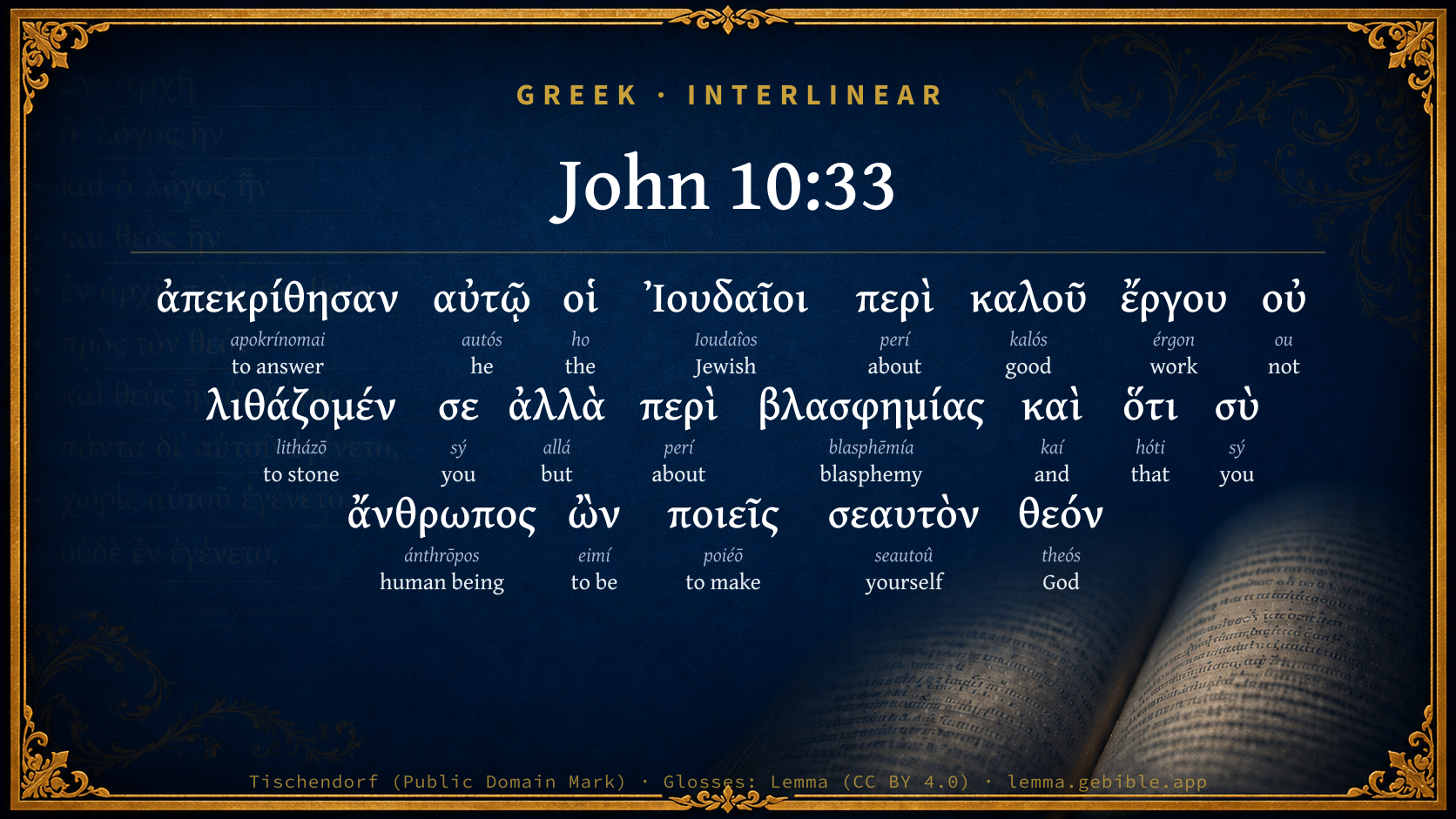
  1. ἀπεκρίθησαν apokrínomai G611 “to answer” Verb, Aorist, Middle deponent, Indicative, 3rd person, Plural
  2. αὐτῷ autós G846 “he” Personal pronoun, Dative, Singular, Masculine
  3. οἱ ho G3588 “the” Article, Nominative, Plural, Masculine
  4. Ἰουδαῖοι Ioudaîos G2453 “Jewish” Adjective, Nominative, Plural, Masculine
  5. περὶ perí G4012 “about” Preposition
  6. καλοῦ kalós G2570 “good” Adjective, Genitive, Singular, Neuter
  7. ἔργου érgon G2041 “work” Noun, Genitive, Singular, Neuter
  8. οὐ ou G3756 “not” Particle, Negative
  9. σε sý G4771 “you” Personal pronoun, 2nd person, Accusative, Singular
  10. ἀλλὰ allá G235 “but” Conjunction
  11. περὶ perí G4012 “about” Preposition
  12. βλασφημίας blasphēmía G988 “blasphemy” Noun, Genitive, Singular, Feminine
  13. καὶ kaí G2532 “and” Conjunction
  14. ὅτι hóti G3754 “that” Conjunction
  15. σὺ sý G4771 “you” Personal pronoun, 2nd person, Nominative, Singular
  16. ἄνθρωπος ánthrōpos G444 “human being” Noun, Nominative, Singular, Masculine
  17. ὢν eimí G1510 “to be” Verb, Present, Active, Participle, Nominative, Singular, Masculine
  18. ποιεῖς poiéō G4160 “to make” Verb, Present, Active, Indicative, 2nd person, Singular
  19. σεαυτὸν seautoû G4572 “yourself” Reflexive pronoun, 2nd person, Accusative, Singular, Masculine
  20. θεόν theós G2316 “God” Noun, Accusative, Singular, Masculine

About this verse

These counts appear in no published source. They are computed here, from the morphology-tagged text and Lemma’s own curated glosses. What Lemma adds →

21
words
19
distinct lemmas
Gospels
section

Notable vocabulary

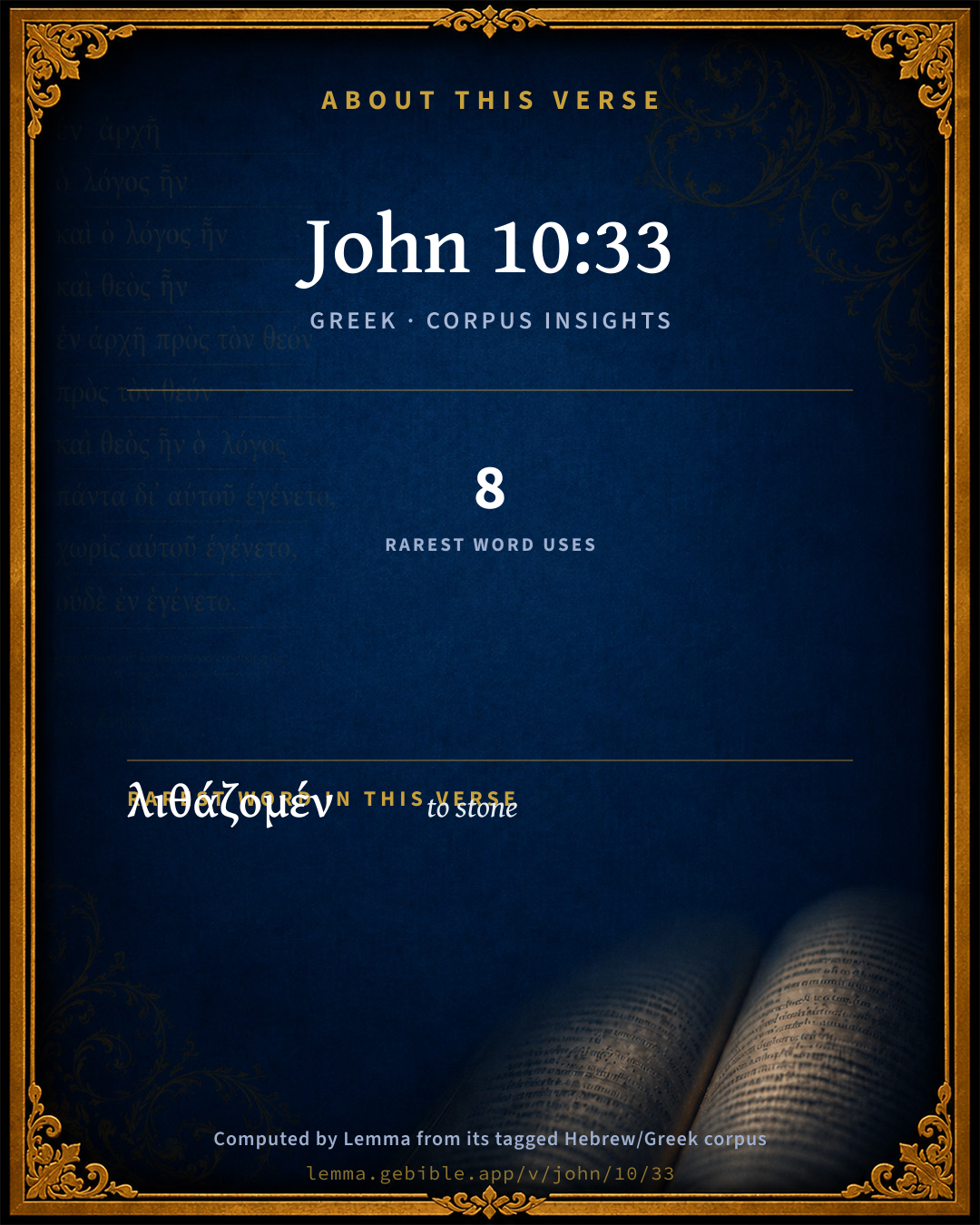
The rarest word here is λιθάζομέν to stone G3034 — appearing just 8 times in the whole Greek New Testament.

Shared distinctive vocabulary

λιθάζομέν to stone G3034 occurs in 8 verses of the Greek New Testament. Also found in:

Repetition

Words recur within this verse:

Cross-references

8

Topical passages linked to John 10:33 in the Treasury of Scripture Knowledge — connected by theme and wording, ordered by reader-vote popularity; previews shown in the World English Bible.

  • John 5:18 For this cause therefore the Jews sought all the more to kill him, because he not only broke the Sabbath, but also called God his own Father, making himself equal with God.
  • Leviticus 24:16 He who blasphemes the name of Yahweh, he shall surely be put to death; all the congregation shall certainly stone him: the foreigner as well as the native-born, when he blasphemes the Name, shall be put to death.
  • John 10:30 I and the Father are one."
  • Psalms 82:6 I said, "You are gods, All of you are sons of the Most High.
  • Romans 13:1 Let every soul be in subjection to the higher authorities, for there is no authority except from God, and those who exist are ordained by God.
  • Philippians 2:6 who, existing in the form of God, didn't consider it robbery to be equal with God,
  • 1 Kings 21:10 and set two men, base fellows, before him, and let them testify against him, saying, You did curse God and the king. Then carry him out, and stone him to death.
  • Leviticus 24:14 "Bring out of the camp him who cursed; and let all who heard him lay their hands on his head, and let all the congregation stone him.

Cross-references courtesy of OpenBible.info (CC BY 4.0).

Commentary

Notes on John 10:33 from classic Christian and Jewish commentators (each source and its license shown beneath its notes). The classic Christian expositions comment on the surrounding passage and are grouped to its opening verse, so a note may address several verses; the Jewish commentaries on the Tanakh (Rashi and others) are per-verse, so they appear only where the commentator wrote on this verse.

Lemma curates 59 commentaries, every one of them public domain or Creative Commons licensed, each selected and text-cleaned for this edition rather than reprinted as found. About our sources →

Bengel's Gnomon

Johann Albrecht Bengel

Joh 10:33. Περί, for [‘concerning,’ lit.]) As the Latins say, quâ de causâ. So διά [ποῖον ἔργον], Joh 10:32.

Bengel's Gnomon of the New Testament — English translation (T&T Clark, Edinburgh, 1860) — public domain. Text from a community e-Sword module.

Expositor's Greek Testament

ed. W. Robertson Nicoll

Joh 10:33 . The irony is as much in the situation as in the words. The answer is honest enough, blind as it is: Περὶ … Θεόν . “For a praiseworthy work we do not stone Thee, but for blasphemy, and because Thou being a man makest Thyself God.” For περί in this sense cf. Act 26:7 . The καὶ ὅτι does not introduce a second charge, but more specifically defines the blasphemy. On the question whether it was blasphemy to claim to be the Christ see Deu 18:20 , Lev 24:10-17 , and Treffry’s Eternal Sonship . It was blasphemy for a man to claim to be God. And it is noteworthy that Jesus never manifests indignation when charged with making Himself God; yet were He a mere man no one could view this sin with stronger abhorrence.

The Expositor's Greek Testament, edited by W. Robertson Nicoll (1897–1910) — public domain. Text from a community e-Sword module.

Godet's Commentaries

Frédéric Louis Godet

ADDITIONAL NOTES BY THE AMERICAN EDITOR.

Vv. 33-42. 1. There can be no doubt that the Jews understood Jesus as claiming to be God. Joh 10:33 clearly proves this. The words of the following verses are to be explained, accordingly, in view of this fact.

2. There are two parts in the answer of Jesus: Joh 10:34-36, and Joh 10:37-38. For the appreciation of the meaning, it must be borne in mind that Jesus enters upon an argument, and does not merely make a new assertion. It is natural, therefore, that what He says should have a progressive character, and should present the claim which He makes through the evidences for it. The claim is that of Joh 10:30, with what it suggests—which they had interpreted in the sense of Joh 10:33 b. In such a progressive argument we might easily expect Him to begin, as He does, with a sort of argumentum ad hominem, founded upon the Old Testament, which they could not reject, and to say, If the O. T. addresses magistrates as gods, in their capacity as God’s ministers in the world, surely there is no blasphemy in the appropriation of this title by one who, in a far more exalted sense, is God’s ambassador—the one whom He has sent into the world to reveal Himself. His position is therefore, He says, exalted enough, even from the point of view of the Divine messenger and teacher revealing the truth—in which capacity they might easily recognize Him—to justify the title. But now He moves forward to the more positive side. What His real position is, they may know by the evidence of the works. If they will not be convinced by His words, let these latter teach them. These will show that there is something more in Him than the highest Divine messenger, that He is even the one who is consecrated and sent into the world to make known the truth—that there is a vital and essential union between Him and the Father (the Father in me and I in the Father), that union which is implied in, and the necessary condition of, unity of power (I and the Father are one, Joh 10:30).

3. In Joh 10:40 Jesus is represented as going again into the region where He is first brought before the reader, in Joh 1:28. The public ministry of Jesus, in a certain sense, closes at this point, and, in accordance with the carefully-arranged plan of the book, it seems not unnatural that the writer should thus bring the narrative again to its starting-point. The introduction of John the Baptist again, at the close, is characteristic of the author. The testimony which John had given before his death produces its fruit when Jesus is drawing near to the time of His own death, and that which had led the writer himself to Jesus, at the beginning, is now represented as bringing many others to a like faith. They believed, as he had done, because of the confirmation which the sight and hearing of Jesus gave to what John had told them. The placing of this testimony and its results at the end of these most striking declarations of Jesus respecting Himself is worthy of notice, as connected with the development of the proof of the truth which the author desires to establish. The insertion of these three verses can hardly be explained, except as they are regarded as having relation to such a plan of the Gospel as has been indicated in these notes—the plan of setting forth progressive testimony and a growing faith which moves along with it; and their presence here, accordingly, gives a new evidence that the author wrote his Gospel under the guiding influence of this plan.

4. The statement here made respecting John corresponds with the declaration of the Prologue with reference to him and with his statements respecting himself in chs. 1 and 3. The σημεῖα of this Gospel are, all of them, σημεῖα in the sense of Joh 20:30-31. John was not the light, but his mission was to bear testimony to the light. The object of his mission and testimony was “that all might believe through him.” This object was realized in the case of the persons here mentioned. The prominence given to John’s testimony in this Gospel is thus easily explained.

Frédéric Louis Godet — Commentaries on Luke, John, Romans, and 1 Corinthians — English translation (T&T Clark, Edinburgh, 1870s–1890s) — public domain. Text from a community e-Sword module.

Jamieson, Fausset & Brown

Robert Jamieson, A. R. Fausset & David Brown

for a blasphemy--whose legal punishment was stoning (Lev 24:11-16).

thou, being a man--that is, a man only.

makest thyself God--Twice before they understood Him to advance the same claim, and both times they prepared themselves to avenge what they took to be the insulted honor of God, as here, in the way directed by their law (Joh 5:18; Joh 8:59).

Jamieson, Fausset & Brown — Commentary Critical and Explanatory on the Whole Bible (1871) — public domain (CC PDM 1.0). Text via the HelloAO Bible API.

Adam Clarke's Commentary

Verse 33. But for blasphemy] I have elsewhere shown that the original word, βλασφημειν, when applied to men, signifies to speak injuriously of their persons, character, connections, c. but when applied to God it signifies to speak impiously, i.e. contrary to his nature, perfections, the wisdom of his providence, or goodness of his works.

Thou, being a man] That is, only a man - makest thyself God. When Christ said before, Joh 10:30, I and the Father are one, had the Jews understood him (as many called Christians profess to do) as only saying he had a unity of sentiments with the Father, they would not have attempted to treat him for this as a blasphemer; because in this sense Abraham, Isaac, Moses, David, and all the prophets, were one with God. But what irritated them so much was that they understood him as speaking of a unity of nature. Therefore they say here, thou makest thyself God; which word they understood, not in a figurative, metaphorical, or improper sense, but in the most literal meaning of the term.

Adam Clarke's Commentary on the Bible (1810–1826) — public domain. Text from a community e-Sword/MySword module.

John Calvin's Commentaries

33. We stone thee not for a good work. Though wicked men carry on open war with God, yet they never wish to sin without some plausible pretense. The consequence is, that when they rage against the Son of God, they are not content with this cruelty, but bring an unprovoked accusation against him, and constitute themselves advocates and defenders of the glory of God. A good conscience must therefore be to us a wall of brass, by which we boldly repel the reproaches and calumnies with which we are assailed. For whatever plausibility may adorn their malice, and whatever reproach they may bring on us for a time, if we fight for the cause of God, he will not refuse to uphold his truth. But as the wicked never want pretences for oppressing the servants of God, and as they have also hardened impudence, so that, even when vanquished, they do not cease to slander, we have need of patience and meekness, to support us to the end.

But for blasphemy. The word blasphemy, which among profane authors denotes generally every kind of reproach, Scripture refers to God, when his majesty is offended and insulted.

Because thou, being a man, makest thyself God. There are two kinds of blasphemy, either when God is deprived of the honor which belongs to him, or when anything unsuitable to his nature, or contrary to his nature, is ascribed to him. They argue therefore that Christ is a blasphemer and a sacrilegious person, because, being a mortal man, he lays claim to Divine honor. And this would be a just definition of blasphemy, if Christ were nothing more than a man. They only err in this, that they do not design to contemplate his Divinity, which was conspicuous in his miracles.

John Calvin's Commentaries (1540-1563) — public domain. Text from the Calvin Translation Society English edition (1840s-50s) via the Christian Classics Ethereal Library (ccel.org). Calvin's coverage is partial (roughly two-thirds of the Bible); uncommented books and verses are honest gaps, never fabricated. The 19th-century editor's footnotes and remarks are omitted so the notes are faithfully Calvin's own voice.

Ellicott's Commentary for English Readers

(33) The Jews answered him.—Comp for the thoughts of this verse Notes on Joh_10:30 and on Joh_5:18.

For a good work . . . but for blasphemy.—The word rendered “for” is not the causal “on account of,” which we have in the last verse, but “concerning,” the technical form for an indictment. For the Mosaic law concerning blasphemy, see Lev_24:10-16.

A Bible Commentary for English Readers, edited by Charles John Ellicott (1878–1897) — public domain. Text from a community e-Sword module.

The Cambridge Bible for Schools and Colleges

gen. ed. J. J. S. Perowne

33. For a good work] The preposition is changed in the Greek; concerning a good work. ‘That is not the subject-matter of our charge?’

and because] ‘And’ is explanatory, shewing wherein the blasphemy consisted: it does not introduce a separate charge.

The Cambridge Bible for Schools and Colleges (gen. ed. J. J. S. Perowne; Cambridge University Press, 1878–1918) — public domain. Text from a community e-Sword module.

John Gill's Exposition

Jesus answered them, is it not written in your law,.... In the law which was given unto them, of which they boasted, and pretended to understand, and interpret, even in Psa 82:6; for the law includes not only the Pentateuch, but all the books of the Old Testament: it is an observation of one of the Jewish doctors (t), that

"with the wise men of blessed memory, it is found in many places that the word law comprehends the Prophets and the Hagiographa.''

Among which last stands the book of Psalms; and this may be confirmed by a passage out of the Talmud (u); it is asked,

"from whence does the resurrection of the dead appear, , "out of the law?"''

It is answered,

"as it is said in Psa 84:4, "Blessed are they that dwell in thy house, they will still praise thee, Selah; they do praise thee", it is not said, but "they will praise thee"; from hence is a proof of the resurrection of the dead, "out of the law".''

The same question is again put, and then Isa 52:8 is cited, and the like observation made upon it. Moreover, this is a way of speaking used by the Jews, when they introduce another citing a passage of Scripture thus (w), , "is it not written in your law", Deu 4:9, "only take heed to thyself", &c. so here the Scripture follows,

I said, ye are gods? which is spoken to civil magistrates, so called, because of their authority and power; and because they do, in some sort, represent the divine majesty, in the government of nations and kingdoms. Many of the Jewish writers, by "gods", understand "the angels". The Targum paraphrases the words thus:

"I said ye are accounted as angels, as the angels on high, all of you;''

and to this sense some of their commentators interpret it. Jarchi's gloss is, ye are gods; that is, angels; for when I gave the law to you, it was on this account, that the angel of death might not any more rule over you: the note of Aben Ezra is, "and the children of the Most High": as angels; and the sense is, your soul is as the soul of angels: hence the (x) Jew charges Christ with seeking refuge in words, that will not profit, or be any help to him, when he cites these words, showing that magistrates are called gods, when the sense is only, that they are like to the angels in respect of their souls: but let it be observed, that it is not said, "ye are as gods", as in Gen 3:5, but "ye are gods"; not like unto them only, but are in some sense gods; and besides, to say that they are like to angels, with respect to their souls, which come from above, is to say no more of the judges of the earth, than what may be said of every man: to which may be added, that this objector himself owns, that judges are called "gods", as in Exo 22:9; the cause of both parties shall come before "the judges"; and that even the word is used in this sense in this very psalm, from whence these words are cited, Psa 82:1, "he judgeth among" "the gods"; and both Kimchi and Ben Melech interpret this text itself in the same way, and observe, that judges are called gods, when they judge truly and aright: all which is sufficient to justify our Lord in the citation of this passage, and the use he makes of it.

(t) R. Azarias in Meor Enayim, c. 7. fol. 47. 1. (u) T. Bab. Sanhedrin, fol. 91. 2. (w) T. Bab. Beracot, fol. 32. 2. (x) R. Isaac Chizzuk Emuna, par. 2. c. 51. p. 440, 441.

John Gill's Exposition of the Whole Bible (1746–1763) — public domain (CC PDM 1.0). Text via the HelloAO Bible API.

Trapp's Complete Commentary

John Trapp

33 The Jews answered him, saying, For a good work we stone thee not; but for blasphemy; and because that thou, being a man, makest thyself God.

Ver. 33. But for blasphemy] These were holy persecutors, in pretence at least. So Maximinian thought the blood of Christians would be an acceptable sacrifice to his gods. Christianum sanguinem Diis victimam esse gravissimam. (Tertul.) So Francis II of France and Philip II of Spain held the same opinion of the Lutherans in their dominions. Zeal without knowledge is like mettle in a blind horse.

John Trapp, A Commentary or Exposition upon All the Books of the Old and New Testament (1647–1656) — public domain. Text from a community e-Sword module.

Albert Barnes' Notes on the Bible

For blasphemy - See the notes at Mat 9:3.

Makest thyself God - See the notes at Joh 5:18. This shows how they understood what he had said.

Makest thyself - Dost claim to be God, or thy language implies this.

Albert Barnes' Notes on the Bible (1834–1885) — public domain. Text from a community e-Sword/MySword module.

Matthew Poole's English Annotations

The Jews answered him, These are not the things we are incensed against thee for; we grant that thou hast done many good works amongst us; these we gratefully acknowledge. But this is that which we are not able to bear, that whereas thou art but a mere man, by thy discourses thou makest thyself equal with God, and so art guilty of

blasphemy; which is committed as well by arrogating to ourselves what is proper to God, as by imputing to God the natural or moral imperfections of the creature; and the blasphemer deserveth to be stoned, according to the law of God. By this it is manifest, that the Jews understood our Saviour, affirming that he and his Father were one, as asserting himself one in essence with his Father, not in will only.

Matthew Poole's English Annotations on the Holy Bible (1683–1685) — public domain. Text from a community e-Sword/MySword module.

Whedon's Commentary on the Bible

Daniel D. Whedon

33. Being a man—As he truly was.

Makest thyself God—As he truly did. The Jews, says an ancient writer, understood him better than the Arians.

Daniel D. Whedon (gen. ed.), Commentary on the Old and New Testaments (1874–1909) — public domain. Text from a community e-Sword module.

The Pulpit Commentary

The Jews answered him (saying), For a good (excellent, obviously, radiantly so) work we do not stone thee; but for blasphemy; and because thou, being man, makest thyself God. (Peri kalou ergou and peri blasfhmiav contrast with the causal dia poion of the previous verse. This preposition was used for formal indictments of offence before the tribunals.) The Jews felt the force of this indignant reproach, and would not admit that his Divine and goodly work was without meaning to them. It was, however, a melancholy reality that his beneficent work had roused their malice into fiercer activity, but they credit themselves with a higher and a doctrinal motive and with a jealousy for the honor of God. They charge him with blasphemy, and the charge is reiterated before Pilate. (Joh_19:7) The Jews were in one sense right. He had de-dared his essential unity with the Father; he had "made himself, represented himself, (Joh_8:53 Joh_19:7) as equal with God." In the opinion of his hearers, he conveyed the idea that he possessed and was wielding Divine powers. He was making himself to be God. "Good works" by the score were no vindication of one who dishonored the Name of God by claiming equality with him.

The Pulpit Commentary (1880–1919), ed. H.D.M. Spence-Jones & Joseph S. Exell — public domain. Text from a community e-Sword module.

The People's New Testament

B. W. Johnson

33. For blasphemy. Because he said he and the Father were one.

B. W. Johnson's The People's New Testament with Notes (1889–1891) — public domain. Electronic text from the Christian Classics Ethereal Library (CCEL) ThML edition.

Cambridge Greek Testament for Schools and Colleges

33. περὶ κ. ἔρ. Concerning a good work: ‘That is not the subject-matter of our charge.’ Comp. Joh 8:46, Joh 16:8; 1Jn 2:2.

καὶ ὃτι. Καί is epexegetic, explaining wherein the blasphemy consisted: it does not introduce a second charge. see on Joh 8:53.

Cambridge Greek Testament for Schools and Colleges (Cambridge University Press, 1896; 21 vols, various authors incl. Carr, Maclear, Plummer, Farrar, Lumby, Moule, M. R. James, Simcox) — public domain. Text from a community e-Sword module.

Alford’s Greek Testament

Henry Alford

33.] θεόν = ἴσον τῷ θ., ch. 5:18.

Henry Alford, The Greek Testament (1849–1861) — public domain. Text from a community e-Sword module.

International Critical Commentary

33. ἀπεκρίθησαν αὐτῷ οἱ Ἰουδαῖοι. The rec. adds λέγοντες, but this is rightly omitted by אABLWΘ ἀπεκρίθη followed by the pres. part. λέγων is very rare in Jn. (see on 1:26), who prefers to use two co-ordinate verbs, ἀπεκρ. καὶ εἶπεν (see on 1:50).

The Jewish opponents of Jesus give Him the answer that He anticipated. They had set about stoning Him, because death by stoning was the appointed penalty for blasphemy (Lev 24:16; cf. 1Ki 21:10, 1Ki 21:13), and His language was, in their ears, blasphemous, “making Himself God,” as they said. Cf. 5:18, and 19:7 below, where the charge against Him was more accurately formulated, ἑαυτὸν υἱὸν θεοῦ ἐποίησεν.

περὶ βλασφημίας, “because of blasphemy”; cf. Act 26:7 περὶ ἧς ἐλπίδος ἐγκαλοῦμαι, where περί is used in the same way. The word βλασφημία occurs in Jn. only in this passage.

International Critical Commentary — older volumes (1896–1929), various authors — public domain. Text from a community e-Sword module.

Vincent's Word Studies in the New Testament

Marvin R. Vincent

Saying. Omit.

Marvin R. Vincent, Word Studies in the New Testament (1887–1900) — public domain. Text from a community e-Sword/MySword module.

Lesson kit

Teaching starters — assembled from the data on this page, not authored interpretation. Every prompt links to the verse data it draws on. Edit before teaching.

John, in the Gospels, opens this verse with 21 words (19 distinct Greek lemmas). Its most distinctive word is litházō (“to stone”). A historical commentator’s framing appears above. Read the whole chapter for the surrounding context.

Discussion questions

  1. How does “to stone” (litházō) shape what this verse is saying?
  2. John 10:31 shares the word «to stone» with this verse. How do the two illuminate each other?
  3. “about” occurs 2× in this one verse. What is the effect of the repetition?
  4. The translations on this page render this verse differently — a whole-verse word diff, not a word-by-word alignment. What might account for the different wordings?
  5. Reading how Bengel's Gnomon and Expositor's Greek Testament read this verse, where do the two commentators agree and where do they part?

Things to notice

Reading settings

Reading text

Shown beneath each verse's original-language words.

Old Testament
Old Testament edition

Read the OT as the Masoretic Hebrew (MT) or the Greek Septuagint (LXX).

English shown for the Greek Septuagint (in the Hebrew ↔ Greek comparison).

Comparing translations? Open the Compare panel on any verse page to stack up to four side by side.