John 8:36

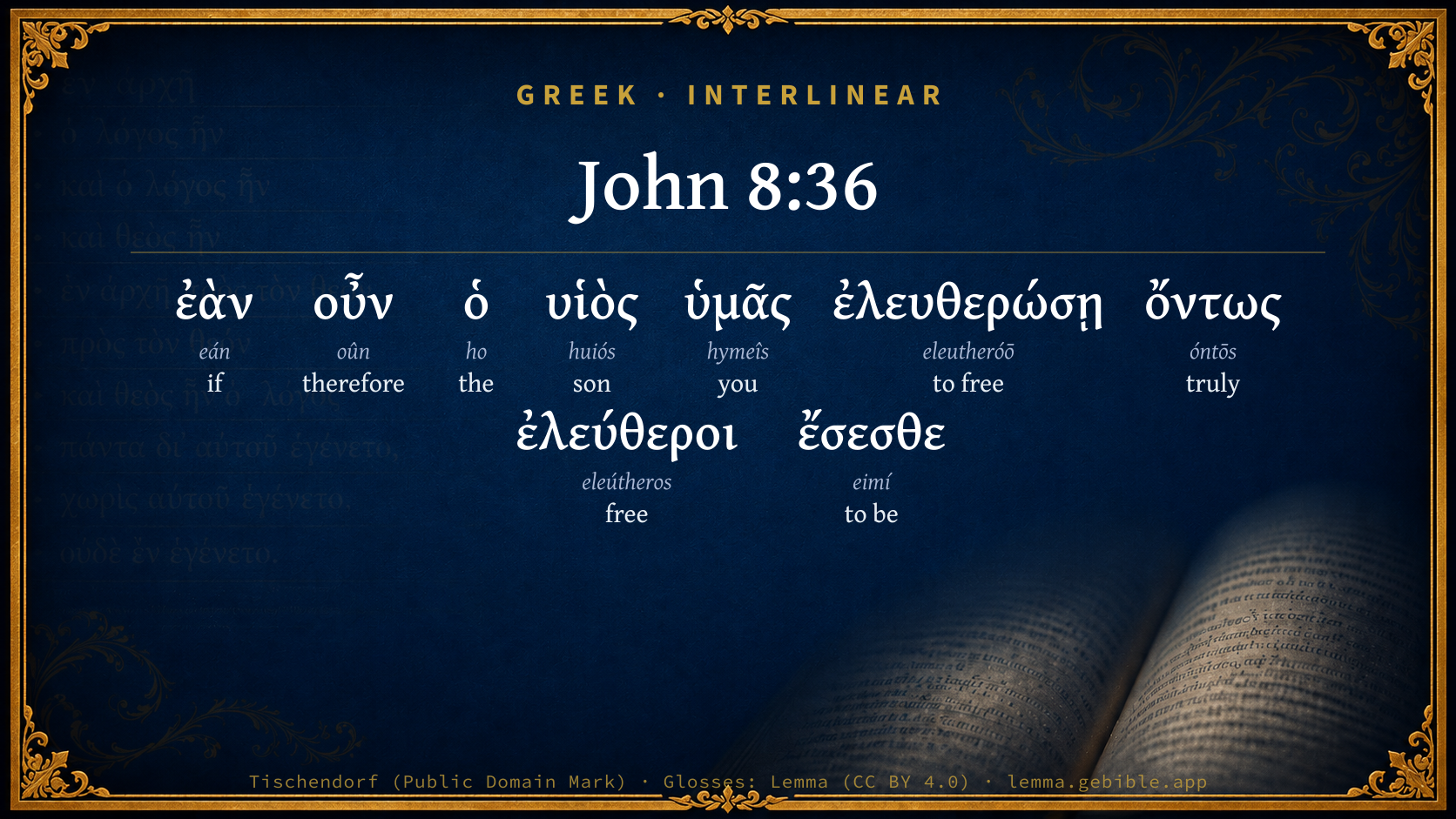
Greek (Tischendorf 8th ed.) John 8:36 appears in the Greek New Testament. The text above is from the Tischendorf 8th edition. Each word links to its Strong’s number and a concise gloss. Click any word for its full Thayer’s Greek Lexicon entry.
Download image
Cite this verse

John 8:36 (World English Bible). Public Domain. Lemma interlinear Bible study tool, https://lemma.gebible.app/v/john/8/36.

Show BibTeX & RIS
BibTeX
RIS
English Translation
If therefore the Son makes you free, you will be free indeed.
World English Bible · Public Domain
Download a study sheet

One document with this verse’s original text, its word-by-word gloss line, the meaning frame, cross-references with their text, attributed commentary, and full source and license credits — printable, and it pastes into notes with its structure intact.

This verse Autodidact and up

Study sheet (.html) Plain text (.txt)

A passage Seminary Student

Up to 50 verses in one chapter. A passage sheet keeps up to 6 commentary sources and 12 cross-references per verse, in the order this page ranks them, and says so on the sheet whenever that leaves anything out. Ask for a single verse and you get the Autodidact verse sheet above.

Everything on this page stays free to read, with no account — the sheet is a download of what is already on screen, not access to it.

Want to remove ads? Support Godless Engineer
Compare translations 3

The same verse in 3 English versions, stacked beneath the original-language interlinear above. Click any original word for its lexicon entry.

Each is an independent rendering of the whole verse — the interlinear is not word-aligned to these translations.

Highlighted words mark where these versions differ — a whole-verse word diff, not a word-by-word alignment.

  • World English Bible Public Domain
    If therefore the Son makes you free, you will be free indeed.
  • King James Version Public Domain
    If the Son therefore shall make you free, ye shall be free indeed.
  • unfoldingWord Literal Text CC BY-SA 4.0
    Therefore, if the Son frees you, you will be truly free.

unfoldingWord Literal Text — © unfoldingWord, licensed CC BY-SA 4.0. Word-aligned USFM3 via Door43 (git.door43.org/unfoldingWord/en_ult).

Versions to compare (up to 4)

3 of 4 selected

Show all 19 translations

Every available English version of this verse, each an independent rendering of the whole verse.

  • World English Bible Public Domain
    If therefore the Son makes you free, you will be free indeed.
  • Berean Standard Bible Public Domain
    So if the Son sets you free, you will be free indeed.
  • Majority Standard Bible Public Domain
    So if the Son sets you free, you will be free indeed.
  • King James Version Public Domain
    If the Son therefore shall make you free, ye shall be free indeed.
  • American Standard Version (1901) Public Domain
    If therefore the Son shall make you free, ye shall be free indeed.
  • Revised Version (1885) Public Domain
    If therefore the Son shall make you free, ye shall be free indeed.
  • Geneva Bible (1599) Public Domain
    If that Sonne therefore shall make you free, ye shalbe free in deede.
  • Douay-Rheims (1899) Public Domain
    If therefore the son shall make you free, you shall be free indeed.
  • Young's Literal Translation Public Domain
    if then the son may make you free, in reality ye shall be free.
  • Literal Standard Version CC BY-SA 4.0
    if then the Son may make you free, in reality you will be free.
  • Unlocked Literal Bible CC BY-SA 4.0
    Therefore, if the Son sets you free, you will be truly free.
  • unfoldingWord Literal Text CC BY-SA 4.0
    Therefore, if the Son frees you, you will be truly free.
  • Darby Bible Public Domain
    If therefore the Son shall set you free, ye shall be really free.
  • World Messianic Bible Public Domain
    If therefore the Son makes you free, you will be free indeed.
  • Webster's Bible Public Domain
    If the Son therefore shall make you free, ye shall be free indeed.
  • Free Bible Version CC BY-SA 4.0
    If the Son sets you free, then you're truly free.
  • Bible in Basic English Public Domain
    If then the son makes you free, you will be truly free.
  • Text-Critical English NT CC BY 4.0
    So if the son sets you free, you will be free indeed.
  • Tyndale New Testament (1534) Public Domain
    I knowe that ye are Abrahams seed: But ye seke meanes to kyll me because my sayinges have no place in you.

Literal Standard Version (2020), Covenant Press — licensed CC BY-SA 4.0. Text via the HelloAO Bible API (eBible.org). Unlocked Literal Bible (unfoldingWord) — licensed CC BY-SA 4.0. Text via the HelloAO Bible API (eBible.org). unfoldingWord Literal Text — © unfoldingWord, licensed CC BY-SA 4.0. Word-aligned USFM3 via Door43 (git.door43.org/unfoldingWord/en_ult). Free Bible Version, Dr. Jonathan Gallagher — licensed CC BY-SA 4.0. Text via the HelloAO Bible API (eBible.org).

Word by word

More ways to search: Search by grammar → Find every occurrence → Compare this word →

Practice this passage: Drill this verse → Learn its vocabulary →

About this verse

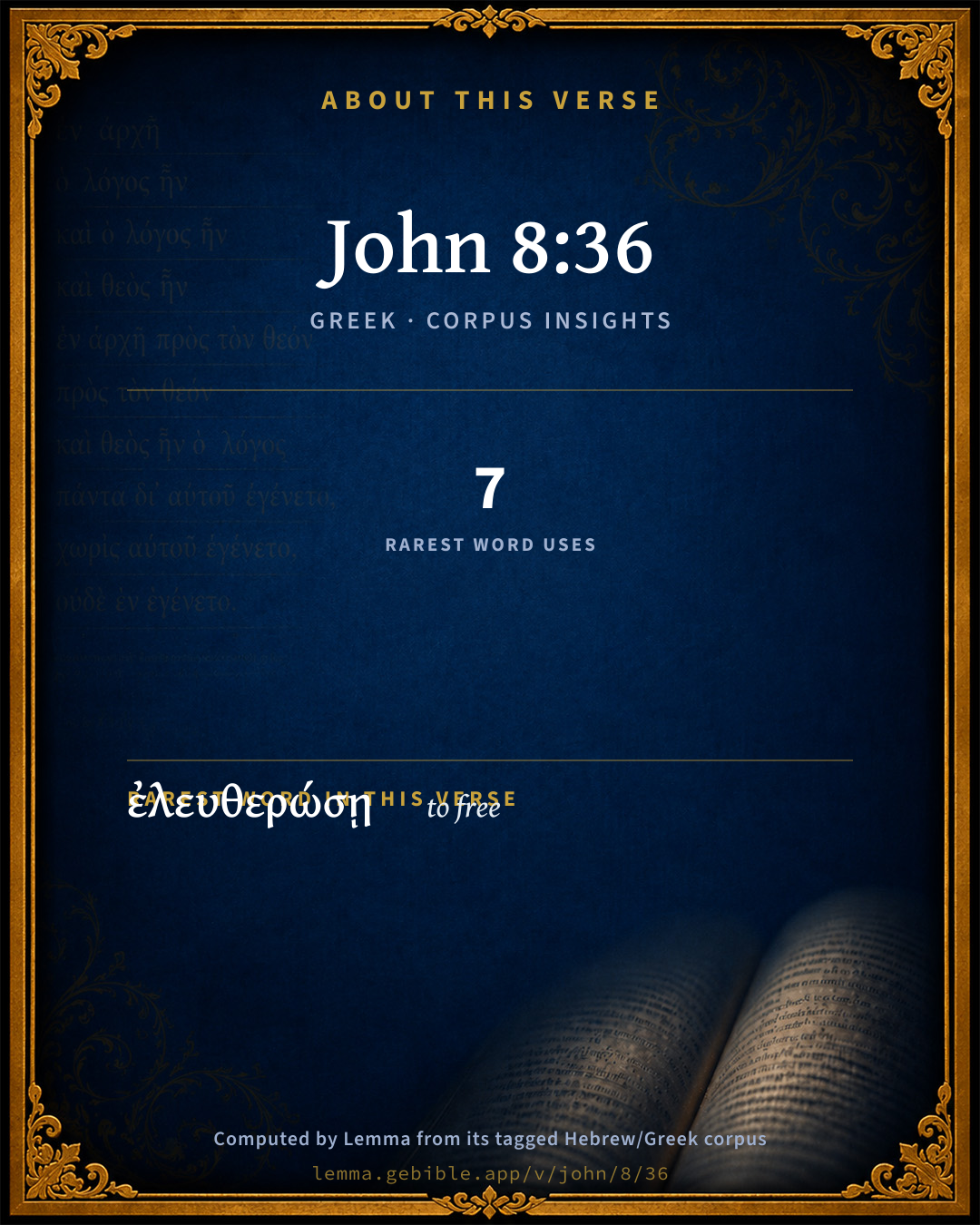
These counts appear in no published source. They are computed here, from the morphology-tagged text and Lemma’s own curated glosses. What Lemma adds →

9
words
9
distinct lemmas
Gospels
section

Notable vocabulary

The rarest word here is ἐλευθερώσῃ to free G1659 — appearing just 7 times in the whole Greek New Testament.

Shared distinctive vocabulary

ἐλευθερώσῃ to free G1659 occurs in 7 verses of the Greek New Testament. Also found in:

Cross-references

11

Topical passages linked to John 8:36 in the Treasury of Scripture Knowledge — connected by theme and wording, ordered by reader-vote popularity; previews shown in the World English Bible.

  • 2 Corinthians 3:17 Now the Lord is the Spirit and where the Spirit of the Lord is, there is liberty.
  • Galatians 5:1 Stand firm therefore in the liberty by which Christ has made us free, and don't be entangled again with a yoke of bondage.
  • Romans 8:2 For the law of the Spirit of life in Christ Jesus made me free from the law of sin and of death.
  • John 8:31–32 Jesus therefore said to those Jews who had believed him, "If you remain in my word, then you are truly my disciples.
  • Luke 4:18 "The Spirit of the Lord is on me, Because he has anointed me to preach good news to the poor. He has sent me to heal the brokenhearted, To proclaim release to the captives, Recovering of sight to the blind, To deliver those who are crushed,
  • Zechariah 9:11–12 As for you also, Because of the blood of your covenant, I have set free your prisoners from the pit in which is no water.
  • Isaiah 61:1 The Spirit of the Lord Yahweh is on me; because Yahweh has anointed me to preach good news to the humble; he has sent me to bind up the broken-hearted, to proclaim liberty to the captives, and the opening [of the prison] to those who are bound;
  • Isaiah 49:24–25 Shall the prey be taken from the mighty, or the lawful captives be delivered?
  • Psalms 119:133 Establish my footsteps in your word. Don't let any iniquity have dominion over me.
  • Psalms 119:32 I run in the path of your commandments, For you have set my heart free.
  • Psalms 19:13 Keep back your servant also from presumptuous sins. Let them not have dominion over me. Then I will be upright, I will be blameless and innocent of great transgression.

Cross-references courtesy of OpenBible.info (CC BY 4.0).

Commentary

Notes on John 8:36 from classic Christian and Jewish commentators (each source and its license shown beneath its notes). The classic Christian expositions comment on the surrounding passage and are grouped to its opening verse, so a note may address several verses; the Jewish commentaries on the Tanakh (Rashi and others) are per-verse, so they appear only where the commentator wrote on this verse.

Lemma curates 59 commentaries, every one of them public domain or Creative Commons licensed, each selected and text-cleaned for this edition rather than reprinted as found. About our sources →

Bengel's Gnomon

Johann Albrecht Bengel

Joh 8:36. Ὁ ὑιός) the Son, the only-begotten.

Bengel's Gnomon of the New Testament — English translation (T&T Clark, Edinburgh, 1860) — public domain. Text from a community e-Sword module.

John Calvin's Commentaries

36. If then the Son shall make you free. By these words he means that the right of freedom belongs to himself alone, and that all others, being born slaves, cannot be delivered but by his grace. For what he possesses as his own by nature he imparts to us by adoption, when we are ingrafted by faith into his body, and become his members. Thus we ought to remember what I said formerly, that the Gospel is the instrument by which we obtain our freedom So then our freedom is a benefit conferred by Christ, but we obtain it by faith, in consequence of which also Christ regenerates us by his Spirit. When he says that they shall be truly free, there is an emphasis on the word truly; for we must supply the contrast with the foolish persuasion by which the Jews were swelled with pride, in like manner as the greater part of the world imagine that they possess a kingdom, while they are in the most wretched bondage.

John Calvin's Commentaries (1540-1563) — public domain. Text from the Calvin Translation Society English edition (1840s-50s) via the Christian Classics Ethereal Library (ccel.org). Calvin's coverage is partial (roughly two-thirds of the Bible); uncommented books and verses are honest gaps, never fabricated. The 19th-century editor's footnotes and remarks are omitted so the notes are faithfully Calvin's own voice.

Ellicott's Commentary for English Readers

(36) If the Son therefore shall make you free.—Now the thought of Joh_8:31-32 is repeated in special reference to the position they had claimed for themselves. There is need for the emancipation of which He has spoken, and His mission in the world is to proclaim it. If they will enter into spiritual union with Him, and abide in this new spiritual relation, it will make them new creatures, freed from sin by the power of truth. In the language of St. Paul, as quoted above, “Christ will be formed in them.” They will become “members of Christ” and “children of God.” The Son of the divine household will make them free, and in Him they will become members of the great family of God Himself. (Comp. the same thought of the divine household as addressed by St. Paul specially to Gentiles, in Eph_2:11-22. See also in this Gospel, Joh_14:2-3.)

Ye shall be free indeed.—Or, ye shall be free in reality.—The word is not the same as that rendered “indeed,” in Joh_8:31. They claimed political freedom, but they were in reality the subjects of Rome. They claimed religious freedom, but they were in reality the slaves to the letter. They claimed moral freedom, but they were in reality the bondmen of sin. The freedom which the Son proclaimed was in reality freedom, for it was the freedom of their true life delivered from the thraldom of sin and brought into union with God. For the spirit of man, that in knowledge of the truth revealed through the Son can contemplate the Father and the eternal home, there is a real freedom that no power can restrain. All through this context the thoughts pass unbidden to the teaching of St. Paul, the great apostle of freedom. There could be no fuller illustration of the words than is furnished in his life. He, like St. Peter and St. John (Rom_1:1, e.g.; 2Pe_1:1; Rev_1:1), had learnt to regard himself as a “bondservant,” but it was of Christ, “whose service is perfect freedom.” We feel, as we think of him in bonds before Agrippa, or a prisoner at Rome, that he is more truly free than governor or Cæsar before whom he stands, and more truly free than he himself was when he was armed with authority to bind men and women because they were Christians. The chains that bind the body cannot bind the spirit, whose chains have been loosed. He is free indeed, for the Son has made him free.

A Bible Commentary for English Readers, edited by Charles John Ellicott (1878–1897) — public domain. Text from a community e-Sword module.

The Cambridge Bible for Schools and Colleges

gen. ed. J. J. S. Perowne

36. If the Son therefore, &c.] As before, any son is meant. ‘If the son emancipates you, your freedom is secured; for he is always on the spot to see that his emancipation is carried out.’ The statement is general, but of course with special reference to the Son of God. If they will abide in His word (Joh_8:31), He will abide in them (Joh_6:56), and will take care that the bondage from which His word has freed them is not thrust upon them again.

shall be free indeed] Not the same word as is translated ‘indeed’ in Joh_8:31. ‘Indeed’ or ‘in reality’ may do here; ‘in truth’ or ‘truly’ in Joh_8:31. Both words are opposed to mere appearance.

The Cambridge Bible for Schools and Colleges (gen. ed. J. J. S. Perowne; Cambridge University Press, 1878–1918) — public domain. Text from a community e-Sword module.

John Gill's Exposition

They answered and said unto him,.... On account of his making mention of a father, whose works they did, and whom they imitated:

Abraham is our father; meaning their only one, nor had they any other:

Jesus saith unto them, if ye were Abraham's children, ye would do the works of Abraham; for who should children imitate but their parents? Abraham was a merciful, charitable, and hospitable man, as well as a man of strict justice and integrity; he feared God, believed in him, and was ready to receive every message and revelation which came from him; and they are his genuine children and offspring, who walk in the steps of his faith, charity, justice, and piety: and this is a rule which the Jews themselves give (m), whereby the seed of Abraham may be known:

"whoever is merciful to the creature (man), it is evident that he is of the seed of Abraham, our father; but whoever has not mercy on the creature, it is a clear case that he is not of the seed of Abraham our father.''

And if this is a sure rule of judging, these men could not be the seed of Abraham, who were a merciless, barbarous, and cruel generation. Another of their writers (n) has this observation, agreeably to the way of reasoning Christ uses;

"a disciple is to be judged of according to his manners; he that walks in the ways of the Lord, he is of the disciples of Abraham, our father, seeing he is used to his manners, and learns of his works; but the disciple who is corrupt in his manners, though he is of the children of Israel, lo, he is not of the "disciples of Abraham", seeing he is not accustomed to his manners.''

Whence it appears, that they say these things not to distinguish themselves from other people who claimed a descent from Abraham, as the Ishmaelites or Saracens did; as did also the Spartans or Lacedemonians; for so writes Areus their king, to Onias the high priest of the Jews,

"it is found in writing, that the Lacedemonians and Jews are brethren, and that they are of the stock of Abraham,'' (1 Maccab. 12:20,21)

But to distinguish those who were religious and virtuous among the Jews themselves, from those that were not; and so our Lord means not to deny, that the Jews, though they were evil men, were the seed of Abraham, according to the flesh; but that they were not so in a spiritual sense, they did not tread in his steps, or do the works he did. The Persic version reads in the singular number, "ye would do the work of Abraham"; and if any particular work is designed, it is most likely to be the work of faith, since it was that which Abraham was famous for; and the doing of which denominated men, even Gentiles, the children of Abraham, and which the Jews were wanting in, they disbelieving and rejecting the Messiah.

(m) T. Bab. Betza, fol. 82. 2. (n) Abarbinel Naehaleth Abot, fol. 183. 1.

John Gill's Exposition of the Whole Bible (1746–1763) — public domain (CC PDM 1.0). Text via the HelloAO Bible API.

Trapp's Complete Commentary

John Trapp

36 If the Son therefore shall make you free, ye shall be free indeed.

Ver. 36. Free indeed] Not seemingly so, or in conceit only, as those lost libertines, 2Pe 2:1; 2Pe 2:19. Ahaz thought himself helped or hurt by the gods of Syria; but he only thought so, 2Ch 28:23, and all such fond thoughts perish, Psa 146:4.

John Trapp, A Commentary or Exposition upon All the Books of the Old and New Testament (1647–1656) — public domain. Text from a community e-Sword module.

Albert Barnes' Notes on the Bible

If the Son ... - The Son of God - heir of all things - who is forever with God, and who has therefore the right and power to liberate men from their thraldom.

Shall make you free - Shall deliver you from the bondage and dominion of sin.

Free indeed - Truly and really free. You shall be blessed with the most valuable freedom; not from the chains and oppressions of earthly masters and monarchs, but from the bondage of sin.

Albert Barnes' Notes on the Bible (1834–1885) — public domain. Text from a community e-Sword/MySword module.

Haydock's Catholic Bible Commentary

Many never was without free-will; but, having the grace of Christ, his will is truly made free from the servitude of sin. (St. Augustine, tract. 41. in Joan.)

George Leo Haydock (1774–1849), Haydock's Catholic Family Bible and Commentary, 1859 edition — public domain. Excludes Psalms (Douay-Rheims chapter numbering differs from Protestant) and Deuterocanonical books (Catholic canon only).

Matthew Poole's English Annotations

If that term the Son in this verse be the same with the Son mentioned in the former verse, they must both be understood of Christ: for it is most certain, that here the Son can signify no more than Christ, to whom alone it belongeth to make souls free from the slavery of the law, sin, death, hell, &c. Now, saith our Saviour, this is the true freedom. Alas! What is the freedom you boast of and glory in? It is not the freedom of your inward man, if you were in the fullest actual possession of it; many a one in that sense free, hath a base, servile, slavish mind, and is a servant to corruption and lusts. It is only the freedom which I give unto souls, that is a true and perfect liberty, and is alone worthy the name of it.

Matthew Poole's English Annotations on the Holy Bible (1683–1685) — public domain. Text from a community e-Sword/MySword module.

Whedon's Commentary on the Bible

Daniel D. Whedon

36. Son… shall make you free—Break the bond, and transform the slave to a freeman.

Free indeed—There is none can question his emancipation act.

The remainder of this discourse may be thus analyzed.

I. Character of these Jews, in implied contrast with Jesus, Joh_8:37-47.

II. Character of Jesus, in comparison with Israel, Joh_8:48-58.

I. They are Abraham’s seed, (corporeally,) but not his children, (morally,) as shown by their murderous intent, Joh_8:37-40. They are not children of God but of Satan, (in contrast with him, the Son of God,) Joh_8:41-47.

II. Against their calumnies Jesus maintains that he speaks, not from a demon, but from God, the life-giving word, 4vv. 8-51. Against their cavils (Joh_8:52-53) he maintains he honours God supremely, (Joh_8:54-55,) and is prior to, and Lord of, even Abraham!

I. Abraham’s corporeal seed are not his spiritual children, Joh_8:37-40.

Daniel D. Whedon (gen. ed.), Commentary on the Old and New Testaments (1874–1909) — public domain. Text from a community e-Sword module.

The Pulpit Commentary

Therefore if the Son who abideth ever in the Father"s bosom, and fills the house with his glory, and is the Heir of all thingsmake you free, ye shall be free indeed (ontwv , "essentially," only here used by St. John, who elsewhere uses the word alhywv , ver. 31; Joh_1:48 Joh_4:42 Joh 7:40 Joh_6:14) The Son is he who gives power to become the sons of God. "The law of the Spirit of life in Christ Jesus frees from the law of sin and death". (Rom_8:2) Only by acquiring the true spirit and regenerated life of a son can any man be delivered from the bondage induced by ignorance of the actual truth about God, about man, and about the relation between God and man. This knowledge is produced by the Son of God, who is the Truth. A full and believing apprehension of the Son of God, a realization of what he is, confers a new life and reveals the wonderful possibilities and relations of human nature. The incarnation of the Son of God as a veritable Son of man emancipates the soul fettered by the tyranny of nature and baffled by the mastery of time and sense, inasmuch as it discloses the august majesty of its own origin. Essential freedom accrues to him who knows that sin is pardoned, that death is vanquished, that the prince of this world is cast out. The eager Jew might look through the battered walls of Zion and the charred fragments of its gorgeous temple, and still see the adamantine structure and its agelong triumph. But the disciples of Jesus, with John as their leader, when these words were recorded by him as they fell from the Lord in their true connection, saw the new Jerusalem coming down out of heaven as a bride adorned for her husband, with its open gates, its crystal stream, and the Lord God Almighty and the Lamb as the Light of it. The freedom of a perfect service and the glorious liberty of the sons of God was theirs, in proportion as they accepted their emancipation from the Son himself. (1Co_7:22 Rom_8:35, 36 2Co_3:18) The sons are "free indeed," whatever the world, or the Hebrew Christians, or the philosophers might think or say.

Spiritual freedom.

Our Lord Christ, who brings truth to the understanding and love to the heart, brings also the highest freedom to the active nature and life of man, and thus secures the prevalence of holiness, of willing and cheerful obedience to God.

I THE BONDAGE IS PRESUMED WHICH RENDERS NECESSARY THE ADVENT OF THE DIVINE LIBERATOR. Man is by nature, whilst in this fallen state, under bondage to law, to sin, to condemnation.

II PRETENDED FREEDOM, OF WHICH SINFUL MEN ARE FOUND TO BOAST, IS EXPOSED. The Jewish leaders, our Lord"s contemporaries, asserted a certain liberty. Relying upon their descent from Abraham, and their consequent privileges in connection with the old covenant, the Jews claimed to be free men. The worst cases of bondage are those where there is the pretence of liberty, and nothing but the pretence. Free-thinkers, free-livers, are names given to classes who are utter strangers to real liberty, who are in the most degrading bondage to error and to lust.

III TRUE FREEDOM IS EXPLAINED.

1. It is deliverance from spiritual chains and bondage.

2. It is liberty which reveals itself in the willing choice of the highest and noblest service. They are spiritually free who recognize the supreme claims of the Divine Law, who evince a preference for the will of God above their own pleasure or the example of their fellow men.

IV THE SON OF GOD DECLARES HIMSELF THE DIVINE LIBERATOR. As such be has all the requisite authority, and all the requisite wisdom and grace. Political freedom may be secured by a human deliverer; but in order to enfranchise the soul a Divine interposition is necessary. Christ has the mastery of all spiritual forces, and can accordingly set free the bound and trammelled soul. He smites the tyrant who lords it over the spiritual captives; he cancels our sentence of slavery; he breaks our fetters; he calls us freemen, and treats us as such; he animates us with the spirit of liberty.

V THE BLESSED RESULTS OF FREEDOM ARE PROMISED. The enfranchised from Satan"s service become God"s willing bondmen. Then, from being God"s servants, they become his sons. As his sons, they are his heirs, and being such, they in due time enjoy the inheritance. This is liberty indeed to pass from thraldom unto Satan into the "glorious liberty of the sons of God. T.

The Pulpit Commentary (1880–1919), ed. H.D.M. Spence-Jones & Joseph S. Exell — public domain. Text from a community e-Sword module.

John Wesley's Explanatory Notes

If I therefore make you free, ye - shall partake of the same privilege: being made free from all guilt and sin, ye shall abide in the house of God forever.

John Wesley, Explanatory Notes Upon the Whole Bible (1754–1765) — public domain. Text via the GEBible commentary corpus.

The People's New Testament

B. W. Johnson

36. If the Son therefore shall make you free, ye shall be free indeed. If you would be free indeed you must have the freedom that the Son bestows, and become children. In order to fully comprehend the figure, read Gal. 4:19–21.

B. W. Johnson's The People's New Testament with Notes (1889–1891) — public domain. Electronic text from the Christian Classics Ethereal Library (CCEL) ThML edition.

Cambridge Greek Testament for Schools and Colleges

36. ἐὰν οὖν ὁ υἱός. As before, any son is meant. ‘If the son emancipates you, your freedom is secured; for he is always on the spot to see that the emancipation is carried out.’ The statement is general, but with special reference to the Son of God, who frees men by granting them a share in His Sonship. If they will abide in His word (Joh 8:31), He will abide in them (Joh 6:56), and will take care that the bondage from which He has freed them is not thrust upon them again.

ὄντως. Here only in S. John: comp. Luk 23:47; Luk 24:34; 1Ti 5:3; 1Ti 5:5; 1Ti 5:16. It expresses reality as opposed to appearance; ἀληθῶς (Joh 8:31, Joh 4:42, Joh 6:14, Joh 7:40) implies that this reality is known.

Cambridge Greek Testament for Schools and Colleges (Cambridge University Press, 1896; 21 vols, various authors incl. Carr, Maclear, Plummer, Farrar, Lumby, Moule, M. R. James, Simcox) — public domain. Text from a community e-Sword module.

Alford’s Greek Testament

Henry Alford

36.] Ye then, being in sin, are carnal: the sons of the bondwoman, and therefore need liberation. Now comes in the spiritual reality, into which the discourse passes from the figure. This liberation can only take place by means of Him of whom Isaac was the type—the Seed according to promise; those only who of His Spirit are born again, and after His image, are ὄντως ἐλεύθεροι—truly sons of God, and no longer children of the bondwoman, but of the free. See by all means Gal 4:19 (where the subject really begins, not at ver. 21) to end, which is the best commentary on this verse. There neither is, nor can be here, any allusion either to the liberation of the sabbatical year (Œcolampadius); or to the subject of Heb 3:5, Heb 3:6 (Euthym., after Chrys.).

Henry Alford, The Greek Testament (1849–1861) — public domain. Text from a community e-Sword module.

International Critical Commentary

36. ἐὰν οὖν ὁ υἱὸς ὑμᾶς ἐλευθερώσῃ κτλ. If v. 35 is part of the original text, then this sentence has in view the fact that the son and heir had a special privilege in the emancipation of his father’s slaves. Cf. Gal 5:1. But if v. 35 may be treated as a gloss, then v. 36 relates itself naturally to v. 34: “You are the slaves of sin; but if the Son (ὁ υἱός used absolutely, as at 3:35) make you free (cf. v. 32), you will be free indeed.” What the Son does will be ratified by the Father.

ἐλεύθερος, ἐλευθεροῦν, do not occur elsewhere in Jn., and in the Synoptists only at Mat 17:26 do we find ἐλεύθερος. ὄντως is not used elsewhere by Jn.

International Critical Commentary — older volumes (1896–1929), various authors — public domain. Text from a community e-Sword module.

Vincent's Word Studies in the New Testament

Marvin R. Vincent

Indeed [οντως] . Used by John only here. It means essentially.

Marvin R. Vincent, Word Studies in the New Testament (1887–1900) — public domain. Text from a community e-Sword/MySword module.

Lesson kit

Teaching starters — assembled from the data on this page, not authored interpretation. Every prompt links to the verse data it draws on. Edit before teaching.

John, in the Gospels, opens this verse with 9 words (9 distinct Greek lemmas). Its most distinctive word is eleutheróō (“to free”). A historical commentator’s framing appears above. Read the whole chapter for the surrounding context.

Discussion questions

  1. The word eleutheróō carries the sense “to free.” How does it shape the verse?
  2. John 8:32 shares the word «to free» with this verse. How do the two illuminate each other?
  3. These translations render this verse differently; the difference is in the English rendering, not the original. What questions does that raise?
  4. Reading how Bengel's Gnomon and John Calvin's Commentaries read this verse, where do the two commentators agree and where do they part?

Things to notice

Reading settings

Reading text

Shown beneath each verse's original-language words.

Old Testament
Old Testament edition

Read the OT as the Masoretic Hebrew (MT) or the Greek Septuagint (LXX).

English shown for the Greek Septuagint (in the Hebrew ↔ Greek comparison).

Comparing translations? Open the Compare panel on any verse page to stack up to four side by side.