John 8:48

Greek (Tischendorf 8th ed.) John 8:48 appears in the Greek New Testament. The text above is from the Tischendorf 8th edition. Each word links to its Strong’s number and a concise gloss. Click any word for its full Thayer’s Greek Lexicon entry.
Download image
Cite this verse

John 8:48 (World English Bible). Public Domain. Lemma interlinear Bible study tool, https://lemma.gebible.app/v/john/8/48.

Show BibTeX & RIS
BibTeX
RIS
English Translation
Then the Jews answered him, "Don't we say well that you are a Samaritan, and have a demon?"
World English Bible · Public Domain
Download a study sheet

One document with this verse’s original text, its word-by-word gloss line, the meaning frame, cross-references with their text, attributed commentary, and full source and license credits — printable, and it pastes into notes with its structure intact.

This verse Autodidact and up

Study sheet (.html) Plain text (.txt)

A passage Seminary Student

Up to 50 verses in one chapter. A passage sheet keeps up to 6 commentary sources and 12 cross-references per verse, in the order this page ranks them, and says so on the sheet whenever that leaves anything out. Ask for a single verse and you get the Autodidact verse sheet above.

Everything on this page stays free to read, with no account — the sheet is a download of what is already on screen, not access to it.

Want to remove ads? Support Godless Engineer
Compare translations 3

The same verse in 3 English versions, stacked beneath the original-language interlinear above. Click any original word for its lexicon entry.

Each is an independent rendering of the whole verse — the interlinear is not word-aligned to these translations.

Highlighted words mark where these versions differ — a whole-verse word diff, not a word-by-word alignment.

  • World English Bible Public Domain
    Then the Jews answered him, "Don't we say well that you are a Samaritan, and have a demon?"
  • King James Version Public Domain
    Then answered the Jews, and said unto him, Say we not well that thou art a Samaritan, and hast a devil?
  • unfoldingWord Literal Text CC BY-SA 4.0
    The Jews answered and said to him, “Do we not rightly say that you are a Samaritan and have a demon?”

unfoldingWord Literal Text — © unfoldingWord, licensed CC BY-SA 4.0. Word-aligned USFM3 via Door43 (git.door43.org/unfoldingWord/en_ult).

Versions to compare (up to 4)

3 of 4 selected

Show all 19 translations

Every available English version of this verse, each an independent rendering of the whole verse.

  • World English Bible Public Domain
    Then the Jews answered him, "Don't we say well that you are a Samaritan, and have a demon?"
  • Berean Standard Bible Public Domain
    The Jews answered Him, “Are we not right to say that You are a Samaritan and You have a demon?”
  • Majority Standard Bible Public Domain
    The Jews answered Him, “Are we not right to say that You are a Samaritan and You have a demon?”
  • King James Version Public Domain
    Then answered the Jews, and said unto him, Say we not well that thou art a Samaritan, and hast a devil?
  • American Standard Version (1901) Public Domain
    The Jews answered and said unto him, Say we not well that thou art a Samaritan, and hast a demon?
  • Revised Version (1885) Public Domain
    The Jews answered and said unto him, Say we not well that thou art a Samaritan, and hast a devil?
  • Geneva Bible (1599) Public Domain
    Then answered the Iewes, and said vnto him, Say we not well that thou art a Samaritane, and hast a deuil?
  • Douay-Rheims (1899) Public Domain
    The Jews therefore answered, and said to him: Do not we say well that thou art a Samaritan, and hast a devil?
  • Young's Literal Translation Public Domain
    The Jews, therefore, answered and said to him, `Do we not say well, that thou art a Samaritan, and hast a demon?'
  • Literal Standard Version CC BY-SA 4.0
    The Jews, therefore, answered and said to Him, “Do we not say well, that You are a Samaritan, and have a demon?”
  • Unlocked Literal Bible CC BY-SA 4.0
    The Jews answered and said to him, “Do we not truly say that you are a Samaritan and have a demon?”
  • unfoldingWord Literal Text CC BY-SA 4.0
    The Jews answered and said to him, “Do we not rightly say that you are a Samaritan and have a demon?”
  • Darby Bible Public Domain
    The Jews answered and said to him, Say we not well that thou art a Samaritan and hast a demon?
  • World Messianic Bible Public Domain
    Then the Judeans answered him, “Don’t we say well that you are a Samaritan, and have a demon?”
  • Webster's Bible Public Domain
    Then answered the Jews, and said to him, Say we not well that thou art a Samaritan, and hast a demon?
  • Free Bible Version CC BY-SA 4.0
    “Aren't we right to call you a Samaritan who is demon-possessed?” said the Jews.
  • Bible in Basic English Public Domain
    The Jews said to him in answer, Are we not right in saying that you are of Samaria and have an evil spirit?
  • Text-Critical English NT CC BY 4.0
    The Jews answered him, “Do we not rightly say that yoʋ are a Samaritan and have a demon?”
  • Tyndale New Testament (1534) Public Domain
    Then answered the Iewes and sayde vnto him: Saye we not well that thou arte a Samaritane and hast the devyll?

Literal Standard Version (2020), Covenant Press — licensed CC BY-SA 4.0. Text via the HelloAO Bible API (eBible.org). Unlocked Literal Bible (unfoldingWord) — licensed CC BY-SA 4.0. Text via the HelloAO Bible API (eBible.org). unfoldingWord Literal Text — © unfoldingWord, licensed CC BY-SA 4.0. Word-aligned USFM3 via Door43 (git.door43.org/unfoldingWord/en_ult). Free Bible Version, Dr. Jonathan Gallagher — licensed CC BY-SA 4.0. Text via the HelloAO Bible API (eBible.org).

Word by word

More ways to search: Search by grammar → Find every occurrence → Compare this word →

Practice this passage: Drill this verse → Learn its vocabulary →

Σαμαρίτης
Samareítēs
G4541
“Samaritan”
Noun, Nominative, Singular, Masculine
Part of Speech
Noun
Case
Nominative
Number
Singular
Gender
Masculine
Full Thayer's Definition

Origin: from G4540

TDNT: 08:29,0

1. a Samaritan, a. an inhabitant of the city of Samaria b. an inhabitant of the region of Samaria
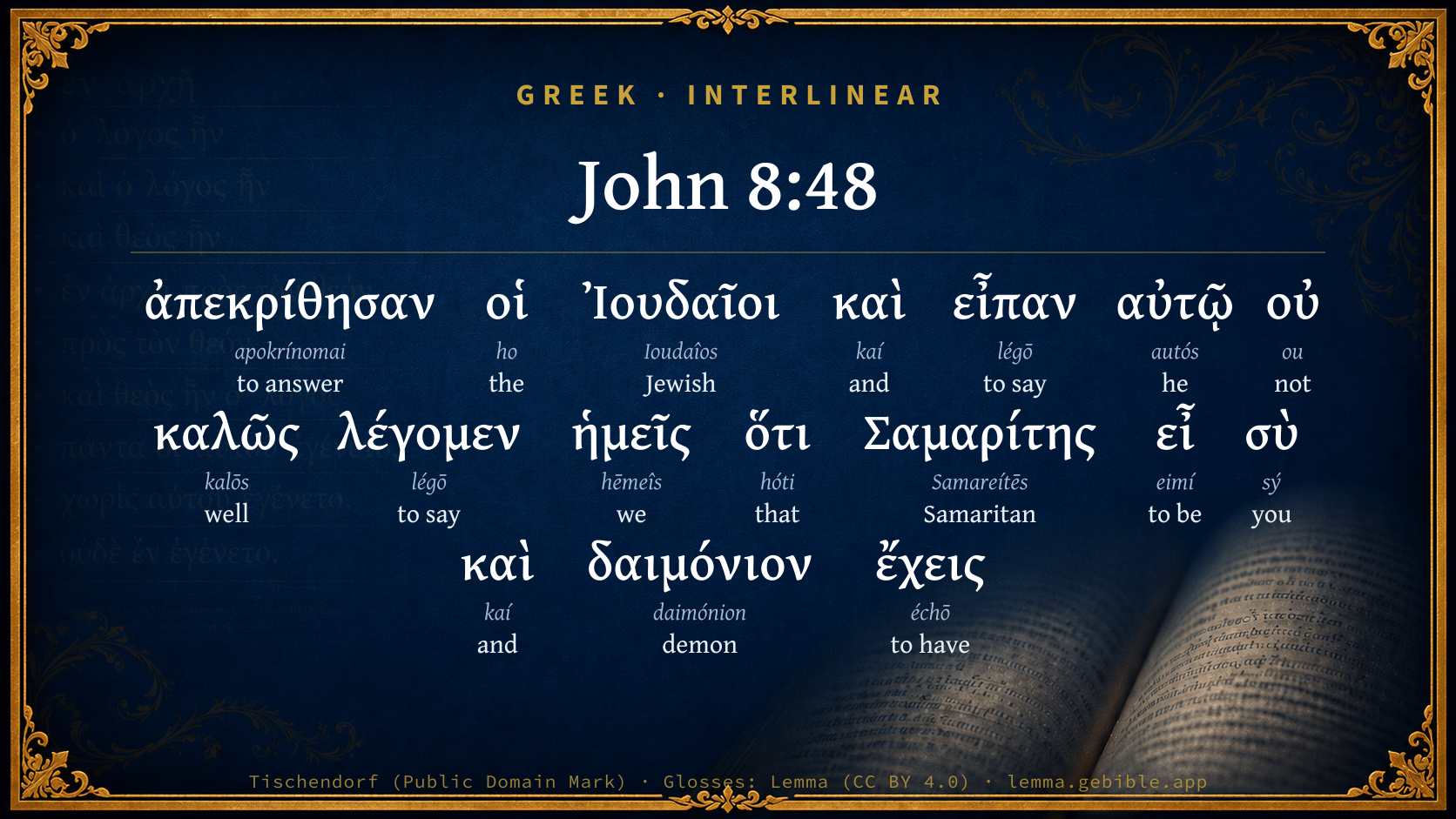
  1. ἀπεκρίθησαν apokrínomai G611 “to answer” Verb, Aorist, Middle deponent, Indicative, 3rd person, Plural
  2. οἱ ho G3588 “the” Article, Nominative, Plural, Masculine
  3. Ἰουδαῖοι Ioudaîos G2453 “Jewish” Adjective, Nominative, Plural, Masculine
  4. καὶ kaí G2532 “and” Conjunction
  5. εἶπαν légō G3004 “to say” Verb, Aorist, Active, Indicative, 3rd person, Plural
  6. αὐτῷ autós G846 “he” Personal pronoun, Dative, Singular, Masculine
  7. οὐ ou G3756 “not” Particle, Negative
  8. καλῶς kalōs G2573 “well” Adverb
  9. λέγομεν légō G3004 “to say” Verb, Present, Active, Indicative, 1st person, Plural
  10. ἡμεῖς hēmeîs G2249 “we” Personal pronoun, 1st person, Nominative, Plural
  11. ὅτι hóti G3754 “that” Conjunction
  12. εἶ eimí G1510 “to be” Verb, Present, Active, Indicative, 2nd person, Singular
  13. σὺ sý G4771 “you” Personal pronoun, 2nd person, Nominative, Singular
  14. καὶ kaí G2532 “and” Conjunction
  15. δαιμόνιον daimónion G1140 “demon” Noun, Accusative, Singular, Neuter
  16. ἔχεις échō G2192 “to have” Verb, Present, Active, Indicative, 2nd person, Singular

About this verse

These counts appear in no published source. They are computed here, from the morphology-tagged text and Lemma’s own curated glosses. What Lemma adds →

17
words
15
distinct lemmas
Gospels
section

Notable vocabulary

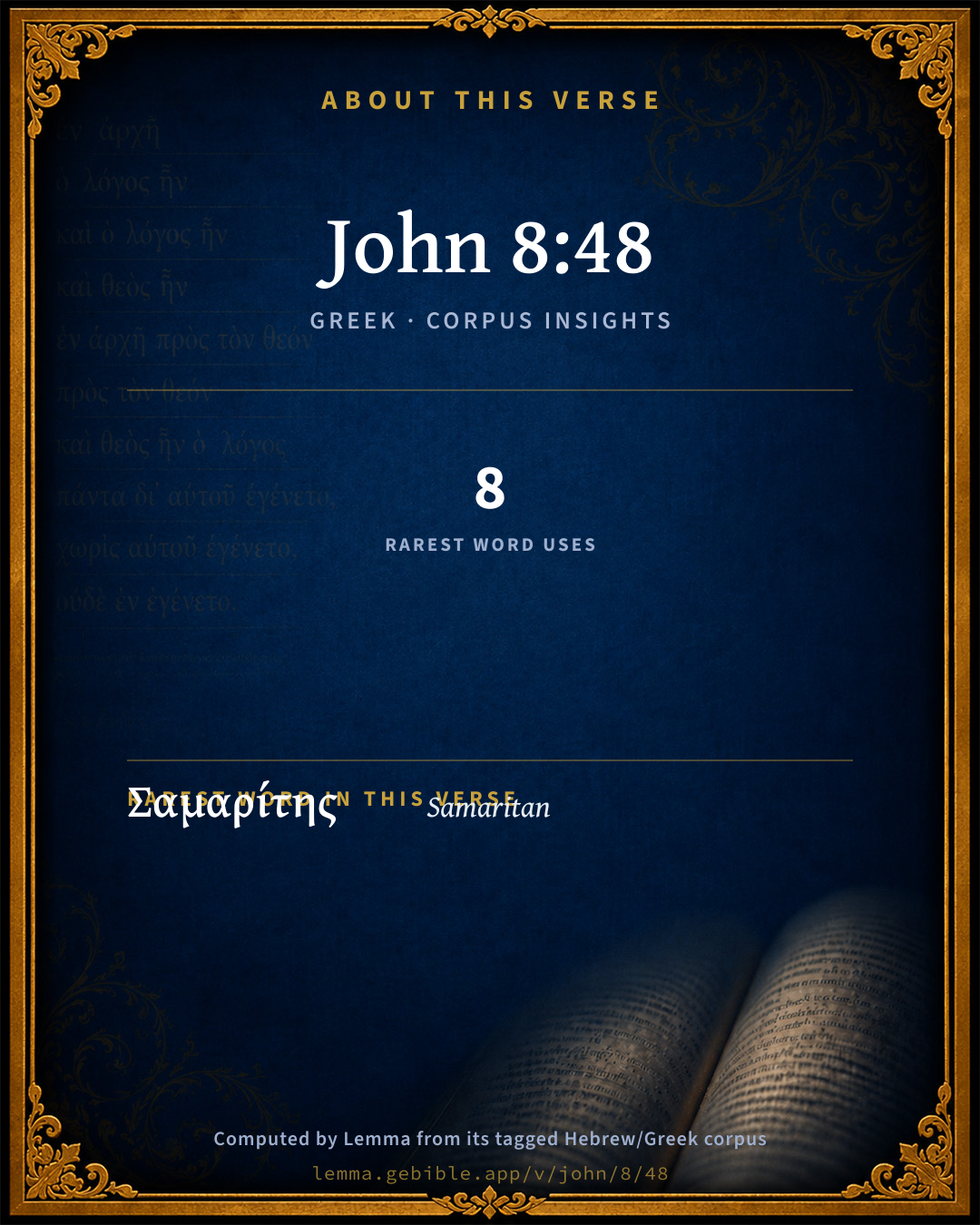
The rarest word here is Σαμαρίτης Samaritan G4541 — appearing just 8 times in the whole Greek New Testament.

Shared distinctive vocabulary

Σαμαρίτης Samaritan G4541 occurs in 8 verses of the Greek New Testament. Also found in:

Repetition

Words recur within this verse:

  • εἶπαν to say G3004 ×2
  • καὶ and G2532 ×2

Cross-references

15

Topical passages linked to John 8:48 in the Treasury of Scripture Knowledge — connected by theme and wording, ordered by reader-vote popularity; previews shown in the World English Bible.

  • John 7:20 The multitude answered, "You have a demon! Who seeks to kill you?"
  • John 8:52 Then the Jews said to him, "Now we know that you have a demon. Abraham died, and the prophets; and you say, 'If a man keeps my word, he will never taste of death.'
  • Matthew 10:5 Jesus sent these twelve out, and charged them, saying, "Don't go among the Gentiles, and don't enter into any city of the Samaritans.
  • Matthew 10:25 It is enough for the disciple that he be like his teacher, and the servant like his lord. If they have called the master of the house Beelzebul, how much more those of his household!
  • Matthew 12:24 But when the Pharisees heard it, they said, "This man does not cast out demons, except by Beelzebul, the prince of the demons."
  • Matthew 15:7 You hypocrites! Well did Isaiah prophesy of you, saying,
  • John 4:9 The Samaritan woman therefore said to him, "How is it that you, being a Jew, ask for a drink from me, a Samaritan woman?" (For Jews have no dealings with Samaritans.)
  • John 10:20 Many of them said, "He has a demon, and is insane! Why do you listen to him?"
  • James 2:19 You believe that God is one. You do well. The demons also believe, and shudder.
  • Isaiah 49:7 Thus says Yahweh, the Redeemer of Israel, [and] his Holy One, to him whom man despises, to him whom the nation abhors, to a servant of rulers: Kings shall see and arise; princes, and they shall worship; because of Yahweh who is faithful, [even] the Holy One of Israel, who has chosen you.
  • Isaiah 53:3 He was despised, and rejected by men; a man of suffering, and acquainted with disease: and as one from whom men hide their face he was despised; and we didn't respect him.
  • John 13:13 You call me, 'Teacher' and 'Lord.' You say so correctly, for so I am.
  • Romans 15:3 For even Christ didn't please himself. But, as it is written, "The reproaches of those who reproached you fell on me."
  • Matthew 12:31 Therefore I tell you, every sin and blasphemy will be forgiven men, but the blasphemy against the Spirit will not be forgiven men.
  • Hebrews 13:13 Let us therefore go forth to him outside of the camp, bearing his reproach.

Cross-references courtesy of OpenBible.info (CC BY 4.0).

Where the printed editions differ

1 variant

Places in this verse where the major printed Greek editions disagree on the wording in a way that affects the translation — a comparison of editions, not a manuscript-by-manuscript collation. The editions are the modern critical texts (Nestlé-Aland 28/27, SBL, Westcott-Hort, Tregelles, Tyndale House) and the traditional texts behind the KJV (the Textus Receptus and the Byzantine/Majority text). It is not a claim about which reading is original.

  1. Extra text
    οὖν

    “therefore”

    In TRByz Not in NA28NA27TynSBLWHTreg

    οὖν (oun) 'therefore' is only in traditional manuscripts (TR+Byz)

Textual data: Translators Amalgamated Greek New Testament (STEPBible TAGNT) · CC BY 4.0.

Commentary

Notes on John 8:48 from classic Christian and Jewish commentators (each source and its license shown beneath its notes). The classic Christian expositions comment on the surrounding passage and are grouped to its opening verse, so a note may address several verses; the Jewish commentaries on the Tanakh (Rashi and others) are per-verse, so they appear only where the commentator wrote on this verse.

Lemma curates 59 commentaries, every one of them public domain or Creative Commons licensed, each selected and text-cleaned for this edition rather than reprinted as found. About our sources →

Matthew Henry's Commentary

Here is, I. The malice of hell breaking out in the base language which the unbelieving Jews gave to our Lord Jesus. Hitherto they had cavilled at his doctrine, and had made invidious remarks upon it; but, having shown themselves uneasy when he complained (Joh 8:43, Joh 8:47) that they would not hear him, now at length they fall to downright railing, Joh 8:48. They were not the common people, but, as it should seem, the scribes and Pharisees, the men of consequence, who, when they saw themselves convicted of an obstinate infidelity, scornfully turned off the conviction with this: Say we not well that thou art a Samaritan, and hast a devil? See here, see it and wonder, see it and tremble,

1. What was the blasphemous character commonly given of our Lord Jesus among the wicked Jews, to which they refer. (1.) That he was a Samaritan, that is, that he was an enemy to their church and nation, one that they hated and could not endure. Thus they exposed him to the ill will of the people, with whom you could not put a man into a worse name than to call him a Samaritan. If he had been a Samaritan, he had been punishable, by the beating of the rebels (as they called it), for coming into the temple. They had often enough called him a Galilean - a mean man; but as if that were not enough, though it contradicted the other, they will have him a Samaritan - a bad man. The Jews to this day call the Christians, in reproach, Cuthaei-Samaritans. Note, Great endeavours have in all ages been used to make good people odious by putting them under black characters, and it is easy to run that down with a crowd and a cry which is once put into an ill name. Perhaps because Christ justly inveighed against the pride and tyranny of the priests and elders, they hereby suggest that he aimed at the ruin of their church, in aiming at its reformation, and was falling away to the Samaritans. (2.) That he had a devil. Either, [1.] That he was in league with the devil. Having reproached his doctrine as tending to Samaritanism, here they reflect upon his miracles as done in combination with Beelzebub. Or, rather [2.] That he was possessed with a devil, that he was a melancholy man, whose brain was clouded, or a mad man, whose brain was heated, and that which he said was no more to be believed than the extravagant rambles of a distracted man, or one in a delirium. Thus the divine revelation of those things which are above the discovery of reason have been often branded with the charge of enthusiasm, and the prophet was called a mad fellow, Kg2 9:11; Hos 9:7. The inspiration of the Pagan oracles and prophets was indeed a frenzy, and those that had it were for the time beside themselves; but that which was truly divine was not so. Wisdom is justified of her children, as wisdom indeed.

2. How they undertook to justify this character, and applied it to the present occasion: Say we not well that thou art so? One would think that his excellent discourses should have altered their opinion of him, and have made them recant; but, instead of this, their hearts were more hardened and their prejudices confirmed. They value themselves on their enmity to Christ, as if they had never spoken better than when they spoke the worst they could of Jesus Christ. Those have arrived at the highest pitch of wickedness who avow their impiety, repeat what they should retract, and justify themselves in that for which they ought to condemn themselves. It is bad to say and do ill, but it is worse to stand to it; I do well to be angry. When Christ spoke with so much boldness against the sins of the great men, and thereby incensed them against him, those who were sensible of no interest but what is secular and sensual concluded him beside himself, for they thought none but a madman would lose his preferment, and hazard his life, for his religion and conscience.

II. The meekness and mercifulness of Heaven shining in Christ's reply to this vile calumny, Joh 8:49, Joh 8:50.

1. He denies their charge against him: I have not a devil; as Paul (Act 26:25), I am not mad. The imputation is unjust; "I am neither actuated by a devil, nor in compact with one;" and this he evidenced by what he did against the devil's kingdom. He takes no notice of their calling him a Samaritan, because it was a calumny that disproved itself, it was a personal reflection, and not worth taking notice of: but saying he had a devil reflected on his commission, and therefore he answered that. St. Augustine gives this gloss upon his not saying any thing to their calling him a Samaritan - that he was indeed that good Samaritan spoken of in the parable, Luk 10:33.

2. He asserts the sincerity of his own intentions: But I honour my Father. They suggested that he took undue honours to himself, and derogated from the honour due to God only, both which he denies here, in saying that he made it his business to honour his Father, and him only. It also proves that he had not a devil; for, if he had, he would not honour God. Note, Those who can truly way that they make it their constant care to honour God are sufficiently armed against the censures and reproaches of men.

3. He complains of the wrong they did him by their calumnies: You do dishonour me. By this it appears that, as man, he had a tender sense of the disgrace and indignity done him; reproach was a sword in his bones, and yet he underwent it for our salvation. It is the will of God that all men should honour the Son, yet there are many that dishonour him; such a contradiction is there in the carnal mind to the will of God. Christ honoured his Father so as never man did, and yet was himself dishonoured so as never man was; for, though God has promised that those who honour him he will honour, he never promised that men should honour them.

4. He clears himself from the imputation of vain glory, in saying this concerning himself, Joh 8:50. See here, (1.) His contempt of worldly honour: I seek not mine own glory. He did not aim at this in what he had said of himself or against his persecutors; he did not court the applause of men, nor covet preferment in the world, but industriously declined both. He did not seek his own glory distinct from his Father's, nor had any separate interest of his own. For men to search their own glory is not glory indeed (Pro 25:27), but rather their shame to be so much out in their aim. This comes in here as a reason why Christ made so light of their reproaches: "You do dishonour me, but cannot disturb me, shall not disquiet me, for I seek not my own glory." Note, Those who are dead to men's praise can safely bear their contempt. (2.) His comfort under worldly dishonour: There is one that seeketh and judgeth. In two things Christ made it appear that he sought not his own glory; and here he tells us what satisfied him as to both. [1.] He did not court men's respect, but was indifferent to it, and in reference to this he saith, "There is one that seeketh, that will secure and advance, my interest in the esteem and affections of the people, while I am in no care about it." Note, God will seek their honour that do not seek their own; for before honour is humility. [2.] He did not revenge men's affronts, but was unconcerned at them, and in reference to this he saith, "There is one that judgeth, that will vindicate my honour, and severely reckon with those that trample upon it." Probably he refers here to the judgments that were coming upon the nation of the Jews for the indignities they did to the Lord Jesus. See Psa 37:13-15. I heard not, for thou wilt hear. If we undertake to judge for ourselves, whatever damage we sustain, our recompence is in our own hands; but if we be, as we ought to be, humble appellants and patient expectants, we shall find, to our comfort, there is one that judgeth.

Matthew Henry's Commentary on the Whole Bible (1708–1710) — public domain (CC PDM 1.0). Text via the HelloAO Bible API.

The Biblical Illustrator

Joseph S. Exell

Joh_8:48-51

Say we not well that Thou art a Samaritan and hast a devil

The Anti-diabolism of Christ

I.

CHRIST HONOURS THE FATHER; THE DEVIL DOES NOT (Joh_8:49).

1. How does Christ honour the Father?

(1) By a faithful representation of the Fathers character. The revelation of the Infinite in the material creation is dim compared with His who is the faithful and true witness and the express image of the Fathers Person.

(2) By supreme devotion to the Fathers will. He came to this world to work out the Divine will in relation to humanity, to substitute truth for error, purity for pollution, benevolence for selfishness, God for the devil--in one word, to put away sin by the sacrifice of Himself.

2. Now this is what the devil does not do. He seeks to dishonour God

(1) By misrepresenting Him, calumniating Him.

(2) By opposing His will.

II. CHRIST SEEKS NOT HIS OWN GLORY; THE DEVIL DOES (Joh_8:50).

1. Ambition and self-seeking had no place in Christ. He made Himself of no reputation, etc. Love to the Infinite Father seemed to swallow up His ego-ism. He was self-oblivious. Often does He say, I seek not my own will. Had He sought His own glory, He would have been the Leader of all armies, the Emperor of all nations, instead of which, He was born in a stable, lived without a home, and died upon a cross.

2. All this is Anti-diabolic. Ambition is the inspiration of Satan. His motto is, Better reign in hell than serve in heaven. He cares for no one else, and would kindle hells for a thousand generations in order to maintain his own dominion and gratify his own ambition.

3. Just so far as a man loses his own ego-ism in love for the Infinite, He is Christlike. Just so far as he is self-conscious and aiming at his own personal ends, he is devil-like.

III. CHRIST DELIVERS FROM DEATH; THE DEVIL CANNOT (Joh_8:51). What does He mean by death here?

1. Not the dissolution of soul and body, for all the millions that kept His sayings have gone down to the grave.

2. Does He mean extinction of existence? If so, it is true, All genuine disciples of Christ will inherit perpetual existence. This He Himself has taught (Joh_6:40).

3. Does He mean the destruction of that which makes death repugnant to mans nature? If so, the dying experience of millions demonstrates its truth. The sting of death is sin. Take sin away, and the dissolution of soul and body becomes the brightest prospect in the pilgrimage of souls. It is a mere step over a river from a wilderness into a Canaan; the mere opening of the door from a cell into a palace. Now the devil cannot deliver from death; and if he could he would not. Destruction is the gratification of his malignant nature. He goes about seeking whom he may devour. (D. Thomas, D. D.)

Christs controversy with the Jews

I. THE ACCUSATIONS.

1. Thou art a Samaritan, and not only worthy of the contempt of a Jew, but one whose declaration on a matter of faith was unworthy of regard, inasmuch as He was a heretic. The charge has reference

(1) To the fact that He followed not the rigid traditions of the elders, which constituted in the minds of the people, the very essence of their religion.

(2) Because He had held intercourse with the Samaritans, had preached to them, and had been received by them.

(3) Because in one of His recorded parables, as doubtless in others not recorded, He had commended one of this nation for his charity, and had held him up as an example to His Jewish hearers.

(4) Because, as the Samaritans had mingled their own Gentile traditions with the law of Moses, so our Blessed Lord, in expounding the law, had drawn out its spiritual meaning, which was as alien to the teaching of the Scribes and Pharisees as the traditions of the Samaritans.

(5) There may have been also a special reference to the circumstance, that Nazareth, where He had been brought up, was nigh to the country of the Samaritans. By this first term of reproach they declared that He had no interest in the promises made by God to Israel.

2. Thou hast a devil. They denied that He had any fellowship with the God of Israel. He had a devil

(1) Because, as they said, He did His miracles by the power of Beelzebub, the chief of the devils.

(2) Because, as the devil attempted to make himself equal with God, so did Christ declare Himself to be equal to and one with the Father.

(3) The seeming folly of His words and pretensions was another reason for attributing His actions to the inspiration of the Evil Spirit. He hath a devil, and is mad, why hear ye Him?

II. THE DEFENCE.

1. To the first accusation He made no reply.

(1) It was personal, and did not concern His life and doctrine, and so He passes it by. One mark of His sinlessness is the absence of all anger at personal slights. It is the mark of a mind enfeebled by sin not to be able to bear personal affronts, as it is the mark of a diseased body to shrink from touch.

(2) Since He came to break down the wall of separation between Jew and Gentile, He would not, by replying to this charge, sanction the contempt of the Jews for the Samaritans, a people called to salvation equally with themselves.

(3) He passes over this charge, it may be also, in tenderness to the Samaritans, amongst whom were many who believed on Him. When Christ would abate the pride of those who flocked around Him, which was the cause of so much of their blindness of heart, He at times used roughness; now, when He had to suffer rebuke, He answers with the greatest mildness, leaving us a lesson to be strict and uncompromising in everything that really concerns God, whilst we are indifferent to all things that merely regard ourselves.

2. I have not a devil, He says. None of us are free from having a devil, for all sin in some measure comes from him; so that here again we have a declaration of the perfect sinlessness of the Son of Man. He, and He only, never had a devil. Again, His words reach beyond this; I cannot, He says, do these things by the power and assistance of Satan, for I at the same time honour My Father, who is the enemy of Satan

(1) By the holiness of My life; for which of you convinceth Me of sin?

(2) By condemning the works of the devil--murder, and lying, and all those other sins which are his special works.

(3) By not attempting to do what Satan is always striving to do in seeking to usurp to himself the glory which belongs to the Father. Our Blessed Lords argument to those who blasphemed Him is this: No one who has a devil honours God or can honour Him, but on the other hand he dishonours Him; but I honour my Father--God: therefore I have not a devil. (W. Denton, M. A.)

The force of the accusation

The rendering devil cannot now be improved. Wiclifs word is fiend, which in this sense is obsolete. But every reader of the Greek must feel how little our English word can represent the two distinct ideas represented by two distinct words, here and in Joh_8:44. Demon, used originally for the lower divinities, and not unfrequently for the gods, passed in the Scriptures, which taught the knowledge of the true God, into the sense of an evil spirit. Thus the word which could represent the attendant genius of Socrates came to express what we speak of as demoniacal possession, and the supposed power of witchcraft and sorcery. Socrates is made to say: For this reason, therefore, rather than for any other, he calls them demons, because they were prudent and knowing. The history of Simon Magus reminds us that the people of Samaria, from the least to the greatest, had been for a long time under the influence of his sorceries (Act_8:9, etc.), and it is probable that there is a special connection in the words note, Samaritan and devil. (Archdeacon Watkins.)

A hard name easy

A hard name is easier than a hard argument. (Van Doren.)

The Biblical Illustrator, edited by Joseph S. Exell (c. 1880s–1900s) — public domain. Text from a community e-Sword module.

Joseph Benson's Commentary

Joh 8:48-53. Then answered the Jews, Say we not well — Have we not just cause to say; Thou art a Samaritan — An enemy to our church and nation; and hast a devil? — Art possessed by a proud and lying spirit? The Jews and Samaritans bearing a mortal hatred to one another on account of religion, it happened, that in common language, Couthi, or Samaritan, was used to signify, not merely a Samaritan by country, but one by principle and disposition; and so denoted oft-times an inveterate enemy to the Jewish nation and religion, and a man of wicked morals. Thus, in our own language, a Turk signifies one of a barbarous disposition; and a Jew, one who is covetous and rich. Jesus to this insolent charge answered with great meekness, I have not a devil — As the whole series of my discourses and actions shows; nor can any of you produce any thing, in all that I have said or done, which looks like lunacy or impiety: but, the truth is, I honour my Father — By bearing a steady and consistent testimony to the doctrine he hath sent me to reveal to the world: and because this doctrine is contrary to your corrupt prejudices and passions, you dishonour me — By these and such like opprobrious reflections, in hope of discrediting my message. But as to what personally relates to me, I am little affected with it; for I seek not my own glory: there is one, however, that seeketh — And will secure it; and who now judgeth — Of all that passes, and will at length evidently show the exact notice he has taken of it, to my honour and to your confusion. For God will not only finally glorify me, but will confer the highest honours and rewards on all my faithful servants: and therefore, Verily, I say unto you — I assert it as an indisputable truth; If a man — Εαν τις, if any one; keep my saying — Firmly believe, and steadily obey my word; he shall never see death — He shall never see spiritual and eternal death; and temporal death, the dissolution of his mortal nature, shall, with respect to him, hardly deserve the name of death; his soul, the real and true man, not dying at all, but passing into the paradise of God, and his body only falling asleep for a short season. Hereby our Lord proves that he was not a Samaritan, for the Samaritans, in general, were Sadducees. Then the Jews — Understanding him as asserting that his disciples should be exempted from the common lot of mortality; said, Now we know that thou hast a devil — Now we have full proof that thou art possessed by a demon, which hurries thee on to this madness and pride, otherwise thou couldest never talk at this extravagant rate. Abraham, the great friend of God, and the founder of our nation, is dead, and the prophets, holy and divinely inspired as they were, whom God raised up in succeeding ages, were so far from being able to bestow immortality on their followers, that even they themselves are long since dead; and thou sayest — In great presumption and pride; If a man, if any one, keep my saying, (see on Joh 8:51,) he shall never taste of death — Not only he shall not die eternally, (in which sense the Jews did not understand our Lord’s words,) but he shall not die at all. See on Joh 6:50. Art thou greater than our father Abraham, &c. — Art thou more in favour with God than Abraham and the prophets were? who, though strict observers of all the divine precepts, were not able to procure an immunity from death for themselves, far less for their followers.

Joseph Benson's Commentary on the Old and New Testaments (1811–1818) — public domain. Text from a community e-Sword module.

Godbey's Commentary on the New Testament

William B. Godbey

SIMPLICITY AND CANDOR OF JESUS

Joh 8:48-52. “The Jews responded, and said to Him, Do we not truly say that Thou art a Samaritan, and hast a demon?” The Jews hated the Samaritans so inveterately that they doubtless thus stigmatized Him because He had preached in Samaria, not only in the beginning of His ministry, but a few days previously on His journey to Jerusalem. The charge of demoniacal possession was old and trite, and they still perpetuated it, because His preaching dug them up and burnt them so horrifically, exposing so lucidly the dead formality and hollow hypocrisy with which Satan had them blindfolded, fast leading them to the pandemonium. “Jesus responded, I have no demon but I honor My Father, and you dishonor Me.” The most acute philosophy fails to recognize the slightest manifestation of resentment in this simple, direct answer to that awful accusation of demoniacal possession. How meekly and perspicuously does He speak a simple negation to the opprobrious allegation! Lord, help us to follow Thy example, and when accused of the blackest sins and vilest crimes, simply, dispassionately, and unostentatiously answer in the negative! “I do not seek My own glory; there is One who seeketh and judgeth.” The Father who sent Him vindicates Him in all of His mediatorial work, and administers righteous retribution to contemptuous despisers. “Truly, truly, I say unto you, If any one may keep My Word, he can never see death.”

William B. Godbey, Commentary on the New Testament (1896–1900) — public domain. Text from a community e-Sword module.

Tyndale Open Study Notes

Tyndale Open Resources

8:48-49 By calling Jesus a Samaritan devil, his opponents turned his charges back on him with a racial slur (see study note on 4:4-6). Their statement that Jesus was demon-possessed (also 7:20; 8:52; 10:20) countered his claim that they were linked to Satan (8:44). Jesus rightly replied that these words were a profound dishonor. In fact, it was a serious and unforgivable offense (Mark 3:22-29).

Tyndale Open Study Notes — © Tyndale Open Resources, licensed CC BY-SA 4.0. Text via the HelloAO Bible API.

Bengel's Gnomon

Johann Albrecht Bengel

Joh 8:48. Ἀπεκρίθησαν, they answered) with a most unjust retort, in the forms of cavil which they had so frequently used.—οὐ καλῶς λέγομεν ἡμεῖς, do not we well say?) They utter this awful insult with some degree of fear as yet.—Σαμαρείτης, a Samaritan) an alien from the true God of the true Israel. Jesus replies at the close of the 54th verse and in the following verses, “It is My Father that honoureth Me, of whom ye say, that He is your God: Yet ye have not known Him, but I know Him.”—συ) thou, they say, no we.—δαιμόνιον, a demon) So they said, who supposed, that the words of Jesus flowed from a foolish pride and assumption. Thus is made clear the reference of those things which Jesus replies in Joh 8:49, etc., “I have not a devil, but I honour My Father,” etc., “and I seek not Mine own glory.”

Bengel's Gnomon of the New Testament — English translation (T&T Clark, Edinburgh, 1860) — public domain. Text from a community e-Sword module.

Meyer's Critical & Exegetical Commentary

Heinrich August Wilhelm Meyer

Joh_8:48-49. In Joh_8:42 ff. Jesus had denied that His opponents were sons of God, and had stamped them as children of the devil. This procedure they regard only as a confirmation of the accusation which they bring against Him (λέγομεν) of being a Samaritan, i.e. an heretical antagonist of the pure people of God (for in this light did they view that despised people of mixed race), and possessed with a devil (Joh_7:20). So paradoxical, not merely presumptuous (as Luthardt explains Σαμαρ.), and so crazed did the discourse of Jesus appear to them. No reference whatever was intended to Joh_4:5 ff. (Brückner, Ewald). On καλῶς, aptly, comp. Joh_4:17, Joh_12:13.

Joh_8:49. ἐγὼ δαιμόν. οὐκ ἔχω, etc.] The emphatic ἐγώ does not contain a retort by which the demoniacal element would be ascribed to His opponents (Cyril., Lücke),a reference which would require to be indicated by arranging the words οὐκ ἐγὼ δαιμ. ἔχω,but stands simply in opposition to the following καὶ ὑμεῖς. With quiet earnestness, leaving unnoticed the reproach of being a Samaritan, Jesus replies: I for my part am not possessed, but honour (by discourses which you consider demoniacal, but by which I in reality preserve and promote the glory of God) my Father; and you, on your part, what is it that you do? You dishonour me! Thus does He unveil to them the unrighteousness of their abusive language.

Meyer — Critical and Exegetical Commentary on the New Testament — English translation by Peter Christie, edited by Frederick Crombie (T&T Clark, 1880) — public domain. Text from a community e-Sword module.

Geneva Bible (1599)

Geneva Bible translators

The enemies of Christ make their bravery for a while, but the Father will appear at his time to revenge the reproach that is done unto him in the person of his son.

Geneva Bible (1599) marginal notes — public domain. Text via Bolls.life.

Jamieson, Fausset & Brown

Robert Jamieson, A. R. Fausset & David Brown

Say we not well that thou art a Samaritan, and hast a devil?--What intense and virulent scorn! (See Heb 12:3). The "say we not well" refers to Joh 7:20. "A Samaritan" means more than "no Israelite at all"; it means one who pretended, but had no manner of claim to the title--retorting perhaps, this denial of their true descent from Abraham.

Jamieson, Fausset & Brown — Commentary Critical and Explanatory on the Whole Bible (1871) — public domain (CC PDM 1.0). Text via the HelloAO Bible API.

Adam Clarke's Commentary

Verse 48. Thou art a Samaritan] This was the same, among them, as heretic, or schismatic, among us. This is the only time in which the Jews gave our Lord this title of reproach; and they probably grounded it on his having preached among them, and lodged in their villages. See the account in Joh 4:39-40; but Samaritan, among them, meant a person unworthy of any credit.

Hast a devil?] Art possessed by an evil spirit; and art, in consequence, deranged.

Adam Clarke's Commentary on the Bible (1810–1826) — public domain. Text from a community e-Sword/MySword module.

John Calvin's Commentaries

48. Do we not say well? They show more and more how greatly they are stupified by Satan; for, though they are fully convicted, still they are enraged, and are not ashamed to show that they are utterly desperate. Besides, though they bring a double reproach against Christ, still they wish to do nothing more than to say in a few words, that he is a detestable man, and that he is actuated by a wicked spirit. The Jews reckoned the Samaritans to be apostates and corrupters of the Law; and therefore, whenever they wished to stamp a man with infamy, they called him a Samaritan. Having no crime more heinous, therefore, to reproach Christ with, they seize at random, and without judgment, this vulgar taunt. To express it in a few words, we see that with effrontery they curse him, as men are wont to do when, infuriated like enraged dogs, they cannot find any thing to say.

John Calvin's Commentaries (1540-1563) — public domain. Text from the Calvin Translation Society English edition (1840s-50s) via the Christian Classics Ethereal Library (ccel.org). Calvin's coverage is partial (roughly two-thirds of the Bible); uncommented books and verses are honest gaps, never fabricated. The 19th-century editor's footnotes and remarks are omitted so the notes are faithfully Calvin's own voice.

Ellicott's Commentary for English Readers

(48) Say we not well that thou art a Samaritan, and hast a devil?—The words imply that the saying was customary among the Pharisees. The knowledge of this, and the simple way in which the fact is told, is one of many instances of the writer’s minute acquaintance with what was said and done by the leaders of the Jerusalem party. There is no instance given of the term “Samaritan” being applied to our Lord, but the term itself is frequently used by the Rabbis as one of opprobrium. The history of the fourth chapter is at once suggested to our minds, and was probably not absent from theirs. (Comp. Note on Joh_7:35.) There may have been facts more immediately connected with this very Feast of Tabernacles present to their minds, which are unknown to us. The going up secretly of Joh_7:10, must almost certainly have been through Samaria. He had kept the last Passover in the despised Galilee (Joh_6:4). Had He kept Tabernacles in the hated Samaria? It is worth noting that the word Samaritan, in the singular, as applied to an individual, occurs but twice, except here and in John 4. One instance is in the parable spoken at no long interval after the present discourse (Luk_10:25-37). The other tells us that the only one of the ten lepers who turned back to glorify God “was a Samaritan” (Luk_17:16).

The rendering, “and hast a devil,” is one which, probably, cannot now be improved. Wiclif’s word here is “fiend,” which in this sense is obsolete. But every reader of the Greek must feel how little our English word can represent the two distinct ideas, represented by two distinct words here and in Joh_8:44. “Demon,” used originally for the lower divinities, and not unfrequently for the gods, passed in the Scriptures, which taught the knowledge of the true God, into the sense of an evil spirit. Thus the word which could represent the attendant genius of Socrates came to express what we speak of as demoniacal possession, and the supposed power of witchcraft and sorcery. Socrates is made to say, “For this reason, therefore, rather than for any other, he calls them demons, because they were prudent and knowing” (daçmones, Plato, Cratylus, xxiii.). The history of Simon Magus reminds us that the people of Samaria, from the least to the greatest, had been for a long time under the influence of his sorceries (Act_8:9 et seq.), and it is probable that there is a special connection in the words here, “Thou art a Samaritan, and hast a demon.” (Comp. Excursus III. on Notes to St. Matthew’s Gospel, p. 185.)

A Bible Commentary for English Readers, edited by Charles John Ellicott (1878–1897) — public domain. Text from a community e-Sword module.

The Cambridge Bible for Schools and Colleges

gen. ed. J. J. S. Perowne

48. Then answered the Jews] The best MSS. omit the particle, which if it were genuine should be rendered ‘therefore,’ not ‘then:’ The Jews answered. This denial of their national prerogative of being sons of God seems to them malicious frenzy. He must be an enemy of the peculiar people and be possessed.

Say we not well] i.e. rightly: comp. Joh_4:17, Joh_13:13, Joh_18:23. ‘We’ is emphatic; ‘we at any rate are right.’

that thou art a Samaritan] “Nowhere else do we find the designation ‘a Samaritan;’ yet it might naturally—we might say inevitably—be given to one who seemed to attack the exclusive privileges of the Jewish people.” S. pp. 159, 160. It is therefore a striking touch of reality, and another instance of the Evangelist’s complete familiarity with the ideas and expressions current in Palestine at this time. Possibly this term of reproach contains a sneer at His visit to Samaria in chap. 4, and at His having chosen the unusual route through Samaria, as He probably did (see on Joh_7:10), in coming up to the Feast of Tabernacles. The parable of the Good Samaritan was probably not yet spoken.

and hast a devil] It is unfortunate that we have not two words in our Bible to distinguish diabolos, ‘the Devil’ (Joh_8:44, Joh_13:2; Mat_4:1; Luk_8:12; &c., &c.), from daimonion or daimôn, ‘a devil,’ or ‘unclean spirit.’ ‘Fiend,’ which Wiclif sometimes employs (Mat_12:24; Mat_12:28; Mar_1:34; Mar_1:39, &c.), might have been used, had Tyndale and Cranmer adopted it: demon would have been better still. But here Tyndale, Cranmer, and the Geneva Version make the confusion complete by rendering ‘and hast the devil,’ a mistake which they make also in Joh_7:20 and Joh_10:20. The charge here is more bitter than either Joh_7:20 or Joh_10:20, where it simply means that His conduct is so extraordinary that He must be demented. We have instances more similar to this in the Synoptists; Mat_9:34; Mat_12:24; Mar_3:22; Luk_11:15.

The Cambridge Bible for Schools and Colleges (gen. ed. J. J. S. Perowne; Cambridge University Press, 1878–1918) — public domain. Text from a community e-Sword module.

John Gill's Exposition

Verily, verily, I say unto you,.... This is truth, and may be depended upon, as coming from the "Amen", and faithful witness:

if a man keep my saying; or doctrine, receives the Gospel in the love of it, obeys it from his heart, and cordially embraces and firmly believes it; and retains and holds it fast, having a spiritual and comfortable experience of the doctrines of Christ, and yielding a cheerful and ready obedience to his commands and ordinances, in faith and love:

he shall never see death; the second death, eternal death, which is an everlasting separation of a man, body and soul, from God: this death shall have no power on such a person, he shall never be hurt by it; and though he dies a corporeal death, that shall not be a curse, a penal evil to him; nor shall he always lie under the power of it, but shall rise again, and live in soul and body, for ever with the Lord: seeing and tasting death, as in Joh 8:52, are Hebraisms expressive of dying.

John Gill's Exposition of the Whole Bible (1746–1763) — public domain (CC PDM 1.0). Text via the HelloAO Bible API.

Trapp's Complete Commentary

John Trapp

48 Then answered the Jews, and said unto him, Say we not well that thou art a Samaritan, and hast a devil?

Ver. 48. That thou art a Samaritan] And why a Samaritan, think, but that they thought the worst word in their bellies good enough for him? Malice cares not what it saith, so it may kill or gall; and these dead dogs (as he calleth Shimei, 2Sa 16:9) will be barking. The primitive persecutors used to put Christians into bears’ and dogs’ skins, or other ugly creatures, and then bait them; so do the wicked put the saints into ugly conceits, and then speak against them.

John Trapp, A Commentary or Exposition upon All the Books of the Old and New Testament (1647–1656) — public domain. Text from a community e-Sword module.

Albert Barnes' Notes on the Bible

Say we not well - Say we not truly.

Thou art a Samaritan - This was a term of contempt and reproach. See the notes at Joh 4:9. It had the force of charging him with being a heretic or a schismatic, because the Samaritans were regarded as such.

And hast a devil - See Joh 7:20. This charge they brought against him because he had said that they were not of God or were not the friends of God. This they regarded as the same as taking sides with the Samaritans, for the question between the Jews and Samaritans was, which of them worshipped God aright, Joh 4:20. As Jesus affirmed that the Jews were not of God, and as he, contrary to all their views, had gone and preached to the Samaritans John 4, they regarded it as a proof that he was disposed to take part with them. They also regarded it as evidence that he had a devil. The devil was an accuser or calumniator and as Jesus charged them with being opposed to God, they considered it as proof that he was influenced by such an evil spirit.

devil - In the original, demon. Not the prince or chief of the devils, but an evil spirit.

Albert Barnes' Notes on the Bible (1834–1885) — public domain. Text from a community e-Sword/MySword module.

Matthew Poole's English Annotations

A Samaritan signified to the Jews as much as an impostor, or seducer; for the Jews looked upon the Samaritans as a detestable sort of men, who had corrupted the worship of God with their horrible superstitions in Mount Gerizim.

And hast a devil; that is, art mad: See Poole on "Joh 7:20".

Matthew Poole's English Annotations on the Holy Bible (1683–1685) — public domain. Text from a community e-Sword/MySword module.

Whedon's Commentary on the Bible

Daniel D. Whedon

48. Answered the Jews—They seem for a while silenced by the terrible words of Joh_8:44, in which Jesus assigns them their true dark satanic character. They now rally to assault, and reduce him to the defensive by making himself the topic of debate.

Say we not well— Joh_7:20. Daring as we felt our words to be, were they not about true? The same misgiving as to their own fierce blasphemy appears again in Now we know, etc. Between the underlying consciousness of their own wicked falsity and their upper tone of depraved bravado, there is a struggle.

A Samaritan—As a favourer of Samaritans, (see notes on Mat_10:5;) as a reviler of us Jews, (Joh_8:44;) as worse than a Gentile. For Samaritan was the worst human epithet their vocabulary furnished,

Hast a devil—Rather, a demon. The supernatural in him (and something supernatural they are forced to confess) is not divine but diabolical. The superhuman power of his denunciation they are glad to attribute to a devil within him. John narrates no casting out of demons; but all recognize the fact of demoniac possession.

Daniel D. Whedon (gen. ed.), Commentary on the Old and New Testaments (1874–1909) — public domain. Text from a community e-Sword module.

The Pulpit Commentary

But it brought from them a shout of derision and a burst of scornful mockery. The Jews answered and said unto him, Say we not well that thou art a Samaritan, and hast a daemon? They imagine that the bare charge that they, the leaders of Israel, are "not of God," and that they reveal the fact by their inability to hear the words of God then sounding in their ears, was flat heresy, a gross lack of patriotism, and proved that, in his lofty self-assertion, he was no better than a Samaritan the most hated of their neighbours. They return a harsh tu-quoque to our Lord"s refusal to admit their Abrahamic descent, and his condemnation of their utter moral dissimilarity from their putative father. The sentence, "a Samaritan art thou!" is singularly insulting in its tone and form. We cannot measure the exact amount of insult they condensed into this word, whether it be of heresy, or alienation from Israel, or accusation of impure descent. It is remarkable that our Lord had shown special kindness to Samaritans, (Joh 4) and had made in his parable "the good Samaritan" the type of neighbourly love; but these very Jews had, in the height of this controversy, accused him of being a "Galilaean," and it is not probable that they used the term otherwise than as a soubriquet of scorn. Edersheim (loc. cit., 2:174, 175) would translate into Aramaic the language here cited, and finds in its form Shomroni the real interpretation of its meaning. Shomron is, according to him, used in rabbinical writing for Ashmedai, and in the cabbalists is used for Sammael or Satan. Arabian traditions are brought in to confirm this interpretation of the speech, which he regards as equivalent to "Thou art a child of the devil," thus retorting upon Jesus the charge that they were doing the works of their father, the devil. The one expression is thought by Edersheim equivalent to that which follows, thou hast a daemon; and his explanation is thought to cover our Lord"s silence respecting it. In our opinion this is far-fetched and unnatural. Christ"s silence is better justified by his refusal to regard such a term as conveying opprobrium, tic had risen above the distinction of race, and could afford to despise the taunt. In Joh_7:20 (see note) a similar charge had been made by the angry Jews. The Lord is accused of being mastered by some daemon, who is perverting his mind and confusing his speech. Some further force is added to the charge from the language of the Talmud, "Jebamoth," fol. 47, a: "R. Nachman, son of Isaac, said to a Samaritan, "Thou art a Cuthite, and testimony from thy mouth has no validity.

Vers. 48-50. The indignant retort of the Jews.

Our Lord"s last words inflamed their spirits beyond endurance.

I THEIR INSOLENT RETORT. "Say we not well that thou art a Samaritan, and hast a devil?

1. The words suggest that they regarded Jesus as their national enemy, estranged from the hopes of Israel, and withal a rejecter of the full revelation made by God. The term "Samaritan" was always used by the Jews in an insulting sense.

2. The imputation that he had a devil implied that he was a fanatic and misguided enthusiast, influenced by essentially evil principles.

II OUR LORD"S REPLY TO THE RETORT. "I have not a devil; but I honour my Father, and ye do dishonour me.

1. Jesus takes no notice of the imputation of his Samaritanism. That was pure insult, for the Jews knew that he was a Galilaean. "He, when he was reviled, reviled not again, but committed himself to him that judgeth righteously". (1Pe_2:23) He teaches soon after that a Samaritan may be more truly a child of God than either priest or Levite. He thus makes light of the distinction of race which breathed so largely in Jewish conceptions.

2. He denies the imputation that he has a devil, because it was important to assure them that his words were those, not of wild or dark fanaticism, but of truth and soberness.

3. The true motive of his mission is not hatred to the Jews, but the honour due to his Father.

4. The union of Father and Son involved, through their faithless attitude, a deep dishonour to himself; for by refusing to honour the Father, they withheld the honour due to him, who is the Son and the Sent of the Father.

5. Yet the insults offered to himself would be divinely judged. "And I seek not mine own glory: there is One that seeketh and judgeth.

(1) The affronts were of no account to himself.

(2) They were God"s concern, who would in due time punish the calumniators of his Son. The allusion may be primarily to the destruction of Jerusalem, which would subvert the whole external framework of Judaism and inflict unparalleled sufferings and indignities upon the Jews, and, ultimately, to the day of final judgment.

The Pulpit Commentary (1880–1919), ed. H.D.M. Spence-Jones & Joseph S. Exell — public domain. Text from a community e-Sword module.

John Wesley's Explanatory Notes

Say we not well - Have we not just cause to say, Thou art, a Samaritan - An enemy to our Church and nation; and hast a devil? -Art possessed by a proud and lying spirit?

John Wesley, Explanatory Notes Upon the Whole Bible (1754–1765) — public domain. Text via the GEBible commentary corpus.

Scofield Reference Notes

C. I. Scofield

devil

demon. (See Scofield "Mat 7:22").

The Scofield Reference Bible (1917 edition), notes by C. I. Scofield — public domain. Text from a community e-Sword module.

Kretzmann's Popular Commentary

Paul E. Kretzmann

The Jews take refuge in abuse:

v. 48. Then answered the Jews and said unto Him, Say we not well that Thou art a Samaritan and hast a devil?

v. 49. Jesus answered, I have not a devil; but I honor My Father, and ye do dishonor Me.

v. 50. And I seek not Mine own glory; there is One that seeketh and judgeth.

v. 51. Verily, verily, I say unto you, If a man keep My saying, he shall never see death.

The frank argument of Jesus struck deeply, it cut the proud Jews to the quick. And they could not gainsay His words, their conscience was forced to admit their truth. And so they took recourse to jeering and abuse. They called Him a Samaritan, an adherent of the people that had retained only a part of the truth, whose members were considered heretics by the Jews and therefore believed to be possessed of evil spirits. That is the manner and style of the unbelievers of all times; when they find that they have no arguments against the truth, then they resort to calumny and blasphemy. But Jesus does not permit the manner of the enemies to disturb Him. He most emphatically, but altogether quietly, spurns the charge, declaring that He was honoring His Father in all His works and words. In speaking as He did, He gave all honor to His Father. But the Jews, by their blasphemy, dishonored Him, and therefore also, by implication, His Father. Their foolish manner of acting does not stir Him to resentment, for the idea of seeking and furthering His own glory was absolutely foreign to Him. But from this they should not infer that their abuse of Him was a matter of indifference, which would not find its punishment. There is One above, who is very much concerned about His Son’s glory and. honor; He seeks it, and He will pass judgment upon those that esteem the abuse of the Lord lightly. The sentence of condemnation which the blasphemers of Christ will ring down upon themselves is terrible beyond human comprehension. The Jews should therefore remember, as Jesus solemnly declares to them, that a man that keeps His saying, that diligently attends to His words, His Gospel, and accepts them for use in His life without remonstrance and unbelief, shall not see death unto all eternity. Temporal death will have no terrors for Him, being merely the gate and entrance to eternal life. Here was the sweetest, the most wonderful Gospel-news, calculated to strengthen and comfort all believers of that and the present time.

Paul E. Kretzmann, Popular Commentary of the Bible (1921–1924) — public domain. Text from a community e-Sword module.

The People's New Testament

B. W. Johnson

48. Thou art a Samaritan, and hast a devil? They resort to the language of passion and vituperation. Of all men they hated the Samaritans most, and hence this charge. They next accuse him, not of having a devil, but of being possessed with a demon, or evil spirit.

B. W. Johnson's The People's New Testament with Notes (1889–1891) — public domain. Electronic text from the Christian Classics Ethereal Library (CCEL) ThML edition.

unfoldingWord translationNotes

Door43 World Missions Community

The Jews

The "Jews" is a synecdoche that represents the "Jewish leaders" who opposed Jesus. AT: "The Jewish leaders" (See: Synecdoche)

Do we not truly say that you are a Samaritan and have a demon?

The Jewish leaders use this question to accuse Jesus and to dishonor him. AT: "We are certainly right in saying that you are a Samaritan and that a demon lives in you!" (See: Rhetorical Question)

translationWords

Jew

Samaria

demon

honor

dishonor

unfoldingWord translationNotes — © Distant Shores Media and the Door43 World Missions Community, licensed CC BY-SA 4.0. Source: git.door43.org/Door43/en_tn.

Cambridge Greek Testament for Schools and Colleges

48. οἱ Ἰουδαῖοι. Not those who for the moment believed on Him (Joh 8:31), but the hostile party as a whole. This denial of their national prerogative of being sons of God seems to them malicious frenzy. He must be an enemy of the Chosen People and be possessed. καλῶς = ‘rightly;’ comp. Joh 4:17, Joh 13:13, Joh 18:23: ἡμεῖς is emphatic; ‘we at any rate are right.’ For the position of ἡμεῖς comp. 1Jn 1:4.

Σαμαρ. εἶ σύ. Σύ last, with contemptuous emphasis. The passage implies that this was a common reproach, but it is stated nowhere else. Yet it was most natural that one whose teaching so often contradicted Jewish traditions and Jewish exclusiveness should be called a Samaritan. It is therefore a striking touch of reality, and another instance of the Evangelist’s complete familiarity with the ideas and expressions current in Palestine at this time. Possibly this term of reproach contains a sneer at His visit to Samaria in chap. 4, and at His having chosen the unusual route through Samaria, as He probably did (see on Joh 7:10), in coming up to the Feast of Tabernacles. The parable of the Good Samaritan was probably not yet spoken. The two reproaches possibly refer to what He had said against them. He had said that they were no true children of Abraham; they say that He is a Samaritan. He had said that they were not of God: they say that He has a demon.

δαιμόνιον. It is unfortunate that we have not two words in our Bible to distinguish ὁ διάβολος, ‘the Devil’ (Joh 8:44, Joh 13:2; Mat 4:1; Luk 8:12, &c.), from δαιμόνιον (Joh 7:20, Joh 10:20, Mat 7:22, &c.) and δαίμων (Mat 8:31; Mar 5:12; Luk 8:29; Rev 18:2), ‘a devil,’ or ‘unclean spirit.’ ‘Fiend,’ which Wiclif sometimes employs (Mat 12:24; Mat 12:28; Mar 1:34; Mar 1:39, &c.), might have been used, had Tyndale and Cranmer adopted it: demon would have been better still. But here Tyndale, Cranmer, and the Geneva Version make the confusion complete by rendering ‘and hast the devil,’ a mistake which they make also in Joh 7:20 and Joh 10:20. The charge here is more bitter than either Joh 7:20 or Joh 10:20, where it simply means that His conduct is so extraordinary that He must be demented. We have instances more similar to this in the Synoptists; Mat 9:34; Mat 12:24; Mar 3:22; Luk 11:15.

Cambridge Greek Testament for Schools and Colleges (Cambridge University Press, 1896; 21 vols, various authors incl. Carr, Maclear, Plummer, Farrar, Lumby, Moule, M. R. James, Simcox) — public domain. Text from a community e-Sword module.

Alford’s Greek Testament

Henry Alford

48.] The Jews attempt no answer, but commence reviling Him. These are now properly οἱ Ἰουδ.,—the principal among the Jews.

Σαμ.] So they called ‘outcasts from the commonwealth of Israel:’ and so afterwards they called the Christians בותיים, from כּוּתָה (2Ki 17:24). They imply, that He differed from their interpretation of the law,—or perhaps, as He had convicted them of not being the genuine children of Abraham, they cast back the charge with a senseless ‘Tu quoque.’ There may perhaps be a reference to the occurrence related in ch. 4:5 ff.; but Schöttgen (p. 371) has shewn that “Samaritanus es” is found in the Rabbis as addressed to one whose word is not to be believed.

κ. δαιμ. ἔχ.] “As in the first clause they sundered Him from the communion of Israel, so now from that of Israel’s God.” Stier. Or perhaps they mean the reproach more as expressing aggravated madness owing to dæmoniacal possession. The καλῶς λέγομεν connects with the charge twice brought against Him by the Pharisees, ‘of casting out devils by the prince of the devils.’

Henry Alford, The Greek Testament (1849–1861) — public domain. Text from a community e-Sword module.

International Critical Commentary

48. οὐ καλῶς λέγομεν ἡμεῖς κτλ., the emphasis resting on ἡμεῖς: “We are right, after all.” For καλῶς λέγειν, cf. 4:17, 13:13.

Σαμαρείτης εἶ σύ. For Σαμαρείτης, cf. 4:9, 39. Jesus had been combating their claim to be the true children of Abraham (vv. 39, 40), and had thus challenged their boasted spiritual privileges. This was a principal point with the Samaritans, who would never allow that the Jews had any exclusive right to the promises made to Abraham and his seed. And so, observing, as they thought, that Jesus agreed with their despised Samaritan neighbours, they said contemptuously, “You, after all, are only a Samaritan.” The position of σύ at the end of the sentence is emphatic.

καὶ δαιμόνιον ἕχεις. This had been said before (7:20, where see note) by the people, and it was said again (10:20). The Jewish disputants say it here, with a touch of contempt: “You must be mad, or you would not talk in this way.” There may be an allusion to the charge recorded by the Synoptists (Mar 3:22) as having been made against Jesus by scribes from Jerusalem, that “He casts out demons by the prince of demons”; but the emphasis laid in Jn. on demoniac possession is always in connexion with the dementia which was supposed to be its consequence (see Introd., p. clxxvii). It is not put forward in Jn. (either at 7:20 or 10:20) as a sign of wickedness, which is implied in Mar 3:22.

International Critical Commentary — older volumes (1896–1929), various authors — public domain. Text from a community e-Sword module.

Vincent's Word Studies in the New Testament

Marvin R. Vincent

Say we not well. Indicating a current reproach. Well [καλως] is literally, finely, beautifully. Sometimes ironical, as Mr 7:6.

Thou art a Samaritan [σαμαρειτης ει συ] . Literally, a Samaritan art thou : the su, thou, terminating the sentence with a bitter emphasis : thou who professest such reverence for God and His law, art only a Samaritan, hostile to the true law and kingdom of God.

Marvin R. Vincent, Word Studies in the New Testament (1887–1900) — public domain. Text from a community e-Sword/MySword module.

Godet's Commentaries

Frédéric Louis Godet

Vv. 48-50. “The Jews therefore answered and said to him, Say we not rightly that thou art a Samaritan and art possessed by a demon? 49. Jesus answered: I am not possessed by a demon, but I honor my Father, and you dishonor me. Joh 8:50. But I seek not my own glory; there is one who seeks it and who judges.”

Some, as Hengstenberg and Astie, think that by calling Jesus a Samaritan, they wish to charge Him with heresy, as making Himself equal with God. But the term Samaritan can scarcely be regarded as a synonym of blasphemer. The Samaritans passed for national enemies of the Jews; now Jesus seemed to commit an act of hostility against His people by accusing all the Jews of being children of the devil. The madness of insanity, as it seemed to them, could alone give an explanation of such language; and this is what they express by the words: Thou art possessed of a demon, which are, as it were, the counterpart of the charge of Jesus. The meaning of this assault comes to this: Thou art as wicked as thou art foolish.

“Who when he was reviled,” says St. Peter, “reviled not again, but committed himself to him who judges righteously” (1Pe 2:23). These words seem to have been suggested to the apostle by the recollection of the following reply in our Joh 8:49-50. To the insult, Jesus opposes a simple denial. ᾿Εγώ, I, placed first, is pronounced with the profound feeling of the contrast between the character of His person and the manner in which He is treated. To the false explanation which the Jews give of His preceding discourse, jesus substitutes the true one: “I do not speak of you as I do, under the impulse of hatred; but I speak thus to honor my Father The testimony which I bear against you is a homage which I must pay to the divine holiness. But, instead of bowing the head to the voice of Him who tells you the truth from God, you insult Him—Him who glorifies the one whom you claim to be your Father.” The conclusion is this: You cannot be children of God, since you insult me who speak to you only to honor God!

Nevertheless (Joh 8:50), Jesus declares that the affronts with which they loaded Him were to Him of little importance. It is God who looks to this; He commits to God the care of His glory; for He knows His solicitude for Him. He wishes to be honored only in the measure in which His Father Himself gives Him glory in the hearts of men. The two participles: seeking and judging give a presentiment of the divine acts by which the Father will glorify the Son and will chastise His calumniators: on one side, the sending of the Holy Spirit and the founding of the new Israel; on the other, the fall of Jerusalem and the final judgment. It is thus that “he commits himself to him who judges righteously.” Besides, all do not dishonor Him; there are some who already honor Him by their faith.

Frédéric Louis Godet — Commentaries on Luke, John, Romans, and 1 Corinthians — English translation (T&T Clark, Edinburgh, 1870s–1890s) — public domain. Text from a community e-Sword module.

Lesson kit

Teaching starters — assembled from the data on this page, not authored interpretation. Every prompt links to the verse data it draws on. Edit before teaching.

John, in the Gospels, opens this verse with 17 words (15 distinct Greek lemmas). Its most distinctive word is Samareítēs (“Samaritan”). A historical commentator’s framing appears above. Read the whole chapter for the surrounding context.

Discussion questions

  1. The word Samareítēs carries the sense “Samaritan.” How does it shape the verse?
  2. How does Matthew 10:5, which shares the word «Samaritan», read alongside this verse?
  3. What does the repetition of “to say” (2× in this one verse) do in this verse?
  4. The translations on this page render this verse differently — a whole-verse word diff, not a word-by-word alignment. What might account for the different wordings?
  5. Compare how Matthew Henry's Commentary and The Biblical Illustrator read this verse. Where do they agree or differ?

Things to notice

  • These translations choose different wording for 9 words in this verse.
  • “to say” occurs 2× in this single verse.
  • 15 distinct Greek lemmas span 17 words in this verse.

Reading settings

Reading text

Shown beneath each verse's original-language words.

Old Testament
Old Testament edition

Read the OT as the Masoretic Hebrew (MT) or the Greek Septuagint (LXX).

English shown for the Greek Septuagint (in the Hebrew ↔ Greek comparison).

Comparing translations? Open the Compare panel on any verse page to stack up to four side by side.