John 11:30

Greek (Tischendorf 8th ed.) John 11:30 appears in the Greek New Testament. The text above is from the Tischendorf 8th edition. Each word links to its Strong’s number and a concise gloss. Click any word for its full Thayer’s Greek Lexicon entry.
Download image
Cite this verse

John 11:30 (World English Bible). Public Domain. Lemma interlinear Bible study tool, https://lemma.gebible.app/v/john/11/30.

Show BibTeX & RIS
BibTeX
RIS
English Translation
Now Jesus had not yet come into the village, but was in the place where Martha met him.
World English Bible · Public Domain
Download a study sheet

One document with this verse’s original text, its word-by-word gloss line, the meaning frame, cross-references with their text, attributed commentary, and full source and license credits — printable, and it pastes into notes with its structure intact.

This verse Autodidact and up

Study sheet (.html) Plain text (.txt)

A passage Seminary Student

Up to 50 verses in one chapter. A passage sheet keeps up to 6 commentary sources and 12 cross-references per verse, in the order this page ranks them, and says so on the sheet whenever that leaves anything out. Ask for a single verse and you get the Autodidact verse sheet above.

Everything on this page stays free to read, with no account — the sheet is a download of what is already on screen, not access to it.

Want to remove ads? Support Godless Engineer
Compare translations 3

The same verse in 3 English versions, stacked beneath the original-language interlinear above. Click any original word for its lexicon entry.

Each is an independent rendering of the whole verse — the interlinear is not word-aligned to these translations.

Highlighted words mark where these versions differ — a whole-verse word diff, not a word-by-word alignment.

  • World English Bible Public Domain
    Now Jesus had not yet come into the village, but was in the place where Martha met him.
  • King James Version Public Domain
    Now Jesus was not yet come into the town, but was in that place where Martha met him.
  • unfoldingWord Literal Text CC BY-SA 4.0
    (Now Jesus had not yet come into the village but was still in the place where Martha had met him.)

unfoldingWord Literal Text — © unfoldingWord, licensed CC BY-SA 4.0. Word-aligned USFM3 via Door43 (git.door43.org/unfoldingWord/en_ult).

Versions to compare (up to 4)

3 of 4 selected

Show all 19 translations

Every available English version of this verse, each an independent rendering of the whole verse.

  • World English Bible Public Domain
    Now Jesus had not yet come into the village, but was in the place where Martha met him.
  • Berean Standard Bible Public Domain
    Now Jesus had not yet entered the village, but was still at the place where Martha had met Him.
  • Majority Standard Bible Public Domain
    Now Jesus had not yet entered the village, but was at the place where Martha had met Him.
  • King James Version Public Domain
    Now Jesus was not yet come into the town, but was in that place where Martha met him.
  • American Standard Version (1901) Public Domain
    (Now Jesus was not yet come into the village, but was still in the place where Martha met him.)
  • Revised Version (1885) Public Domain
    (Now Jesus was not yet come into the village, but was still in the place where Martha met him.)
  • Geneva Bible (1599) Public Domain
    For Iesus was not yet come into the towne, but was in the place where Martha met him.
  • Douay-Rheims (1899) Public Domain
    For Jesus was not yet come into the town: but he was still in that place where Martha had met him.
  • Young's Literal Translation Public Domain
    and Jesus had not yet come to the village, but was in the place where Martha met him;
  • Literal Standard Version CC BY-SA 4.0
    and Jesus had not yet come into the village, but was in the place where Martha met Him;
  • Unlocked Literal Bible CC BY-SA 4.0
    Now Jesus had not yet come into the village but was still in the place where Martha had met him.
  • unfoldingWord Literal Text CC BY-SA 4.0
    (Now Jesus had not yet come into the village but was still in the place where Martha had met him.)
  • Darby Bible Public Domain
    Now Jesus had not yet come into the village, but was in the place where Martha came to meet him.
  • World Messianic Bible Public Domain
    Now Yeshua had not yet come into the village, but was in the place where Martha met him.
  • Webster's Bible Public Domain
    Now Jesus had not yet come into the town, but was in that place where Martha met him.
  • Free Bible Version CC BY-SA 4.0
    Jesus hadn't arrived in the village yet. He was still at the place where Martha had met him.
  • Bible in Basic English Public Domain
    Now Jesus had not at this time come into the town, but was still in the place where Martha had seen him.
  • Text-Critical English NT CC BY 4.0
    (Now Jesus had not yet come into the village, but was in the place where Martha had met him.)
  • Tyndale New Testament (1534) Public Domain
    Iesus was not yet come into the toune: but was in the place where Martha met him.

Literal Standard Version (2020), Covenant Press — licensed CC BY-SA 4.0. Text via the HelloAO Bible API (eBible.org). Unlocked Literal Bible (unfoldingWord) — licensed CC BY-SA 4.0. Text via the HelloAO Bible API (eBible.org). unfoldingWord Literal Text — © unfoldingWord, licensed CC BY-SA 4.0. Word-aligned USFM3 via Door43 (git.door43.org/unfoldingWord/en_ult). Free Bible Version, Dr. Jonathan Gallagher — licensed CC BY-SA 4.0. Text via the HelloAO Bible API (eBible.org).

Word by word

More ways to search: Search by grammar → Find every occurrence → Compare this word →

Practice this passage: Drill this verse → Learn its vocabulary →

ὑπήντησεν
hypantáō
G5221
“to meet”
Verb, Aorist, Active, Indicative, 3rd person, Singular
Part of Speech
Verb
Tense
Aorist
Voice
Active
Mood
Indicative
Person
3rd person
Number
Singular
Full Thayer's Definition

Origin: from G5259 and a derivative of G473

TDNT: 13:25,4

1. to go to meet, to meet 2. in military reference a. of a hostile meeting
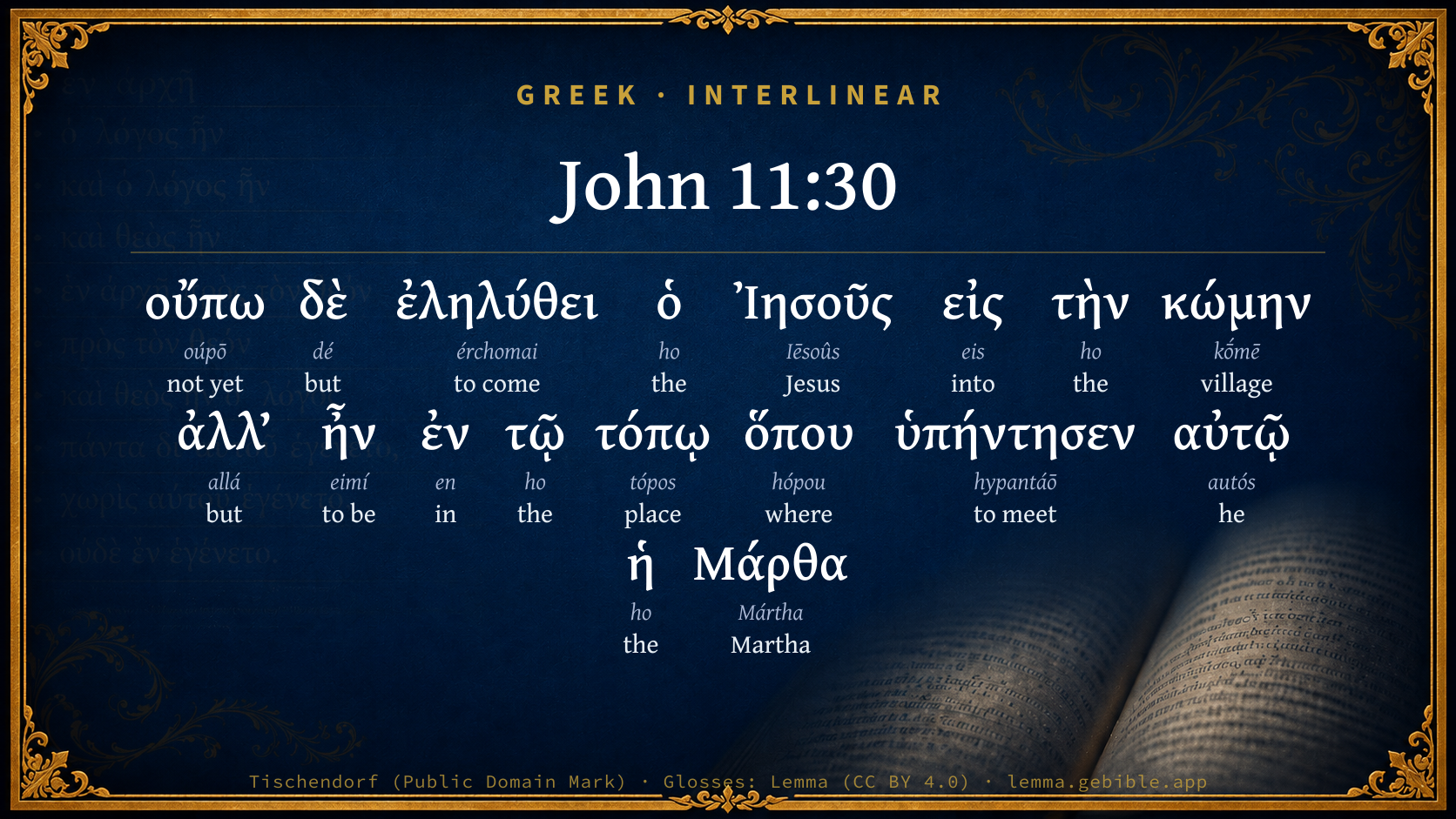
  1. οὔπω oúpō G3768 “not yet” Adverb, Negative
  2. δὲ dé G1161 “but” Conjunction
  3. ἐληλύθει érchomai G2064 “to come” Verb, Pluperfect, Active, Indicative, 3rd person, Singular
  4. ὁ ho G3588 “the” Article, Nominative, Singular, Masculine
  5. Ἰησοῦς Iēsoûs G2424 “Jesus” Noun, Nominative, Singular, Masculine
  6. εἰς eis G1519 “into” Preposition
  7. τὴν ho G3588 “the” Article, Accusative, Singular, Feminine
  8. κώμην kṓmē G2968 “village” Noun, Accusative, Singular, Feminine
  9. ἀλλ’ allá G235 “but” Conjunction
  10. ἦν eimí G1510 “to be” Verb, Imperfect, Active, Indicative, 3rd person, Singular
  11. ἐν en G1722 “in” Preposition
  12. τῷ ho G3588 “the” Article, Dative, Singular, Masculine
  13. τόπῳ tópos G5117 “place” Noun, Dative, Singular, Masculine
  14. ὅπου hópou G3699 “where” Adverb
  15. αὐτῷ autós G846 “he” Personal pronoun, Dative, Singular, Masculine
  16. ἡ ho G3588 “the” Article, Nominative, Singular, Feminine
  17. Μάρθα Mártha G3136 “Martha” Noun, Nominative, Singular, Feminine

About this verse

These counts appear in no published source. They are computed here, from the morphology-tagged text and Lemma’s own curated glosses. What Lemma adds →

18
words
15
distinct lemmas
Gospels
section

Notable vocabulary

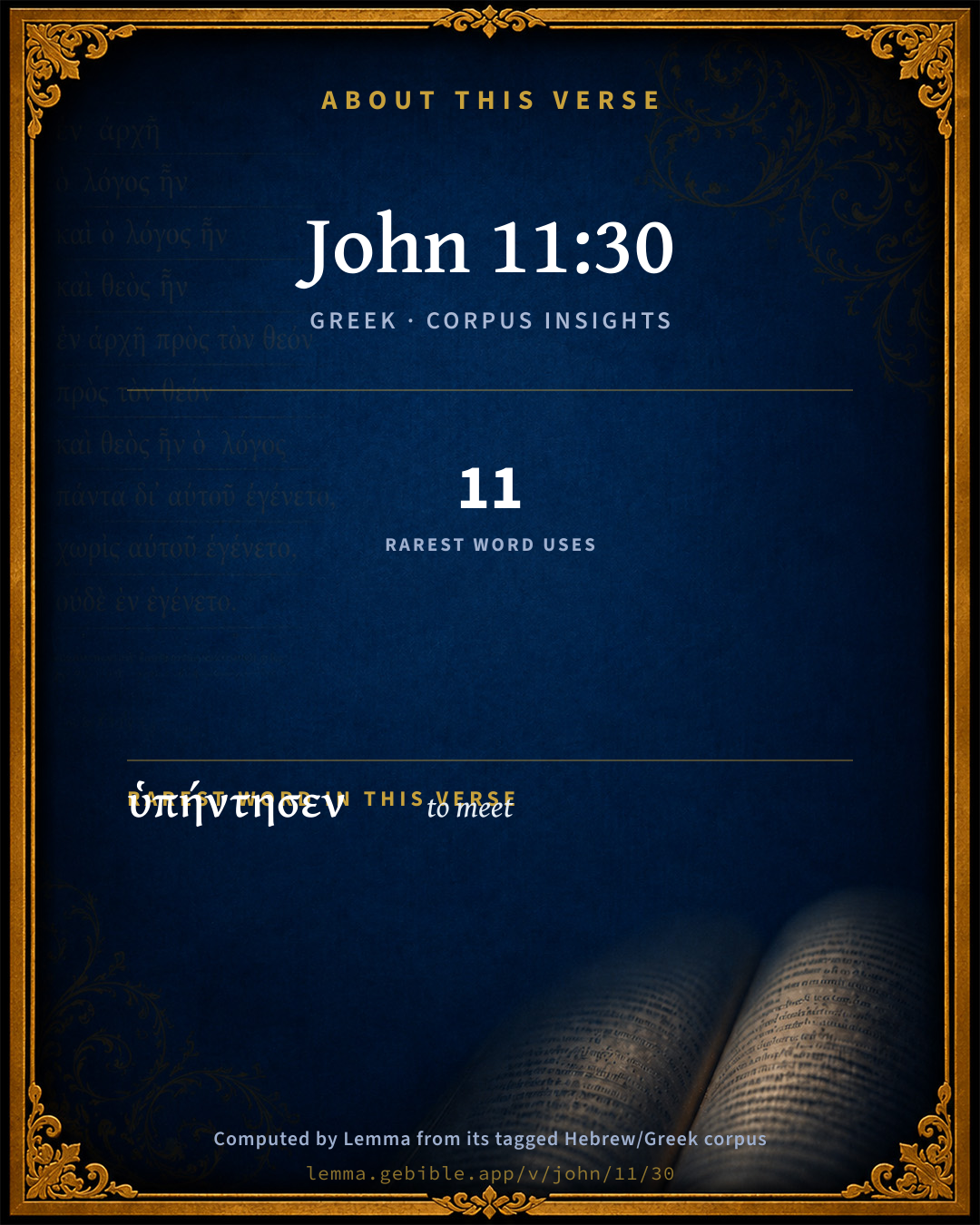
The rarest word here is ὑπήντησεν to meet G5221 — appearing just 11 times in the whole Greek New Testament.

Shared distinctive vocabulary

ὑπήντησεν to meet G5221 occurs in 11 verses of the Greek New Testament. Also found in:

Repetition

A word recurs within this verse:

Cross-references

1

Topical passages linked to John 11:30 in the Treasury of Scripture Knowledge — connected by theme and wording, ordered by reader-vote popularity; previews shown in the World English Bible.

  • John 11:20 Then when Martha heard that Jesus was coming, she went and met him, but Mary stayed in the house.

Cross-references courtesy of OpenBible.info (CC BY 4.0).

Commentary

Notes on John 11:30 from classic Christian and Jewish commentators (each source and its license shown beneath its notes). The classic Christian expositions comment on the surrounding passage and are grouped to its opening verse, so a note may address several verses; the Jewish commentaries on the Tanakh (Rashi and others) are per-verse, so they appear only where the commentator wrote on this verse.

Lemma curates 59 commentaries, every one of them public domain or Creative Commons licensed, each selected and text-cleaned for this edition rather than reprinted as found. About our sources →

MacLaren's Expositions of Holy Scripture

Alexander MacLaren

John

THE OPEN GRAVE AT BETHANY

Joh 11:30 - Joh 11:45.

Why did Jesus stay outside Bethany and summon Martha and Mary to come to Him? Apparently that He might keep Himself apart from the noisy crowd of conventional mourners whose presence affronted the majesty and sanctity of sorrow, and that He might speak to the hearts of the two real mourners. A divine decorum forbade Him to go to the house. The Life-bringer keeps apart. His comforts are spoken in solitude. He reverenced grief. How beautifully His sympathetic delicacy contrasts with the heartless rush of those who ‘were comforting’ Mary when they thought that she was driven to go suddenly to the grave by a fresh burst of sorrow! If they had had any real sympathy or perception, they would have stayed where they were, and let the poor burdened heart find ease in lonely weeping. But, like all vulgar souls, they had one idea-never to leave mourners alone or let them weep.

Three stages seem discernible in the self-revelation of Jesus in this crowning miracle: His agitation and tears, His majestic confidence in His life-giving power now to be manifested, and His actual exercise of that power.

I. The repetition by Mary of Martha’s words, as her first salutation, tells a pathetic story of the one thought that had filled both sisters’ hearts in these four dreary days.

Why had He not come? How easily He could have come! How surely He could have prevented all this misery! Confidence in His power blends strangely with doubt as to His care. A hint of reproach is in the words, but more than a hint of faith in His might. He does not rebuke the rash judgment implied, for He knew the true love underlying it; but He does not directly answer Mary, as He had done Martha, for the two sisters needed different treatment.

We note that Mary has no such hope as Martha had expressed. Her more passive, meditative disposition had bowed itself, and let the grief overwhelm her. So in her we see a specimen of the excess of sorrow which indulges in the monotonous repetition of what would have happened if something else that did not happen had happened, and which is too deeply dark to let a gleam of hope shine in. Words will do little to comfort such grief. Silent sharing of its weeping and helpful deeds will do most.

So a great wave of emotion swept across the usually calm soul of Jesus, which John bids us trace to its cause by ‘therefore’ {Joh 11:33}. The sight of Mary’s real, and the mourners’ half-real, tears, and the sound of their loud ‘keening,’ shook His spirit, and He yielded to, and even encouraged, the rush of feeling {‘troubled Himself’} . But not only sympathy and sorrow ruffled the clear mirror of His spirit; another disturbing element was present. He ‘was moved with indignation’ {Rev. Ver. marg.}. Anger at Providence often mingles with our grief, but that was not Christ’s indignation. The only worthy explanation of that strange ingredient in Christ’s agitation is that it was directed against the source of death,-namely, sin. He saw the cause manifested in the effects. He wept for the one, He was wroth at the other. The tears witnessed to the perfect love of the man, and of the God revealed in the man; the indignation witnessed to the recoil and aversion from sin of the perfectly righteous Man, and of the holy God manifested in Him. We get one glimpse into His heart, as on to some ocean heaving and mist-covered. The momentary sight proclaims the union in Him, as the Incarnate Word, of pity for our woes and of aversion from our sins.

His question as to the place of the tomb is not what we should have expected; but its very abruptness indicates effort to suppress emotion, and resolve to lose no time in redressing the grief. Most sweetly human are the tears that start afresh after the moment’s repression, as the little company begin to move towards the grave. And most sadly human are the unsympathetic criticisms of His sacred sorrow. Even the best affected of the bystanders are cool enough to note them as tokens of His love, at which perhaps there is a trace of wonder; while others snarl out a sarcasm which is double-barrelled, as casting doubt on the reality either of the love or of the power. ‘It is easy to weep, but if He had cared for him, and could work miracles, He might surely have kept him alive.’ How blind men are! ‘Jesus wept,’ and all that the lookers-on felt was astonishment that He should have cared so much for a dead man of no importance, or carping doubt as to the genuineness of His grief and the reality of His power. He shows us His pity and sorrow still-to no more effect with many.

II. The passage to the tomb was marked by his continued agitation.

But his arrival there brought calm and majesty. Now the time has come which He had in view when He left his refuge beyond Jordan; and, as is often the case with ourselves, suddenly tremor and tumult leave the spirit when face to face with a moment of crisis. There is nothing more remarkable in this narrative than the contrast between Jesus weeping and indignant, and Jesus serene and authoritative as He stands fronting the cave-sepulchre. The sudden transformation must have awed the gazers.

He points to the stone, which, probably like that of many a grave discovered in Palestine, rolled in a groove cut in the rocky floor in front of the tomb. The command accords with His continual habit of confining the miraculous within the narrowest limits. He will do nothing by miracle which can be done without it. Lazarus could have heard and emerged, though the stone had remained. If the story had been a myth, he very likely would have done so. Like ‘loose him, and let him go,’ this is a little touch that cannot have been invented, and helps to confirm the simple, historical character of the account.

Not less natural, though certainly as unlikely to have been told unless it had happened, is Martha’s interruption. She must have heard what was going on, and, with her usual activity, have joined the procession, though we left her in the house. She thinks that Jesus is going into the grave; and a certain reverence for the poor remains, as well as for Him, makes her shrink from the thought of even His loving eyes seeing them now. Clearly she has forgotten the dim hopes which had begun in her when she talked with Jesus. Therefore He gently reminds her of these; for His words {Joh 11:40} can scarcely refer to anything but that interview, though the precise form of expression now used is not found in the report of it {Joh 11:25 - Joh 11:27}.

We mark Christ’s calm confidence in His own power. His identification of its effect with the outflashing of the glory of God, and His encouragement to her to exercise faith by suspending her sight of that glory upon her faith. Does that mean that He would not raise her brother unless she believed? No; for He had determined to ‘awake him out of sleep’ before He left Peraea. But Martha’s faith was the condition of her seeing the glory of God in the miracle. We may see a thousand emanations of that glory, and see none of it. We shall see it if we exercise faith. In the natural world, ‘seeing is believing’; in the spiritual, believing is seeing.

Equally remarkable, as breathing serenest confidence, is the wonderful filial prayer. Our Lord speaks as if the miracle were already accomplished, so sure is He: ‘Thou heardest Me.’ Does this thanksgiving bring Him down to the level of other servants of God who have wrought miracles by divine power granted them? Certainly not; for it is in full accord with the teaching of all this Gospel, according to which ‘the Son can do nothing of Himself,’ but yet, whatsoever things the Father doeth, ‘these also doeth the Son likewise.’ Both sides of the truth must be kept in view. The Son is not independent of the Father, but the Son is so constantly and perfectly one with the Father that He is conscious of unbroken communion, of continual wielding of the whole divine power.

But the practical purpose of the thanksgiving is to be specially noted. It suspends His whole claims on the single issue about to be decided. It summons the people to mark the event. Never before had He thus heralded a miracle. Never had He deigned to say thus solemnly, ‘If God does not work through Me now, reject Me as an impostor; if He does, yield to Me as Messiah.’ The moment stands alone in His life. What a scene! There is the open tomb, with its dead occupant; there are the eager, sceptical crowd, the sisters pausing in their weeping to gaze, with some strange hopes beginning to creep into their hearts, the silent disciples, and, in front of them all, Jesus, with the radiance of power in the eyes that had just been swimming in tears, and a new elevation in His tones. How all would be hushed in expectance of the next moment’s act!

III. The miracle itself is told in the fewest words. What more was there to tell?

The two ends, as it were, of a buried chain, appear above ground. Cause and effect were brought together. Rather, here was no chain of many links, as in physical phenomena, but here was the life-giving word, and there was the dead man living again. The ‘loud voice’ was as needless as the rolling away of the stone. It was but the sign of Christ’s will acting. And the acting of His will, without any other cause, produces physical effects.

Lazarus was far away from that rock cave. But, wherever he was, he could hear, and he must obey. So, with graveclothes entangling his feet, and a napkin about his livid face, he came stumbling out into the light that dazed his eyes, closed for four dark days, and stood silent and motionless in that awestruck crowd. One Person there was not awestruck. Christ’s calm voice, that had just reverberated through the regions of the dead, spoke the simple command, ‘Loose him, and let him go.’ To Him it was no wonder that He should give back a life. For the Christ who wept is the Christ whose voice all that are in the graves shall hear, and shall come forth.

Alexander MacLaren, Expositions of Holy Scripture (1904–1910) — public domain. Text from a community e-Sword module.

Bengel's Gnomon

Johann Albrecht Bengel

Joh 11:30. Οὔπω, not yet) Jesus did all things with the exact amount of delay required.—δέ) γάρ is the reading of the Copt. [= Memphitic] and Lat. versions; also Augustin. Cant. The reading of the Lat. codex Reutlingensis, which has neither autem nor enim, is a middle one between the two.[301]

[301] AB and Rec. Text read οὔπω δέ. Dabc Vulg. read γάρ: and D, οὐ for οὔπω.—E. and T.

Bengel's Gnomon of the New Testament — English translation (T&T Clark, Edinburgh, 1860) — public domain. Text from a community e-Sword module.

Meyer's Critical & Exegetical Commentary

Heinrich August Wilhelm Meyer

Joh_11:30-31. He had remained outside the place, not, however, because of the proximity of the grave (He did not even know where it was, Joh_11:34, against Hengstenberg and others), but doubtless because Martha had informed Him of the presence of the many Ἰουδαῖοι,which it was so natural for Martha to do, that Luthardt should not have called it in question. He did not desire their presence whilst He said to Mary what He intended to say, for which reason also He had her called secretly. His intention, however, was not realized, for the Jews thought that when Mary went away so hastily she had gone to the grave (on this custom see Geier, de Luctu Hebr. VII. 26, and Wetstein), and followed after her, in order not to leave her alone in her sorrow without words of sympathy and consolation. On εἰς τ. μνημ. comp. Joh_11:38; Joh_20:1.

Meyer — Critical and Exegetical Commentary on the New Testament — English translation by Peter Christie, edited by Frederick Crombie (T&T Clark, 1880) — public domain. Text from a community e-Sword module.

Adam Clarke's Commentary

Verse 30. Jesus was not yet come into the town] As the Jewish burying places were without their cities and villages, it appears that the place where our Saviour was, when Martha met him, was not far from the place where Lazarus was buried. See Clarke on Lu 7:12.

Adam Clarke's Commentary on the Bible (1810–1826) — public domain. Text from a community e-Sword/MySword module.

Ellicott's Commentary for English Readers

(30) Now Jesus was not yet come into the town.—Better, as before, into the village (Joh_11:1).

Where Martha met him.—Comp. Joh_11:20.

A Bible Commentary for English Readers, edited by Charles John Ellicott (1878–1897) — public domain. Text from a community e-Sword module.

The Cambridge Bible for Schools and Colleges

gen. ed. J. J. S. Perowne

30. into the town] Or, into the village; see on Joh_11:1. By remaining outside He would be able to say what He wished to say to the sisters without fear of interruption.

was in that place] was still in that place.

The Cambridge Bible for Schools and Colleges (gen. ed. J. J. S. Perowne; Cambridge University Press, 1878–1918) — public domain. Text from a community e-Sword module.

John Gill's Exposition

The Jews then which were with her in the house,.... Who came from Jerusalem to visit this afflicted family, and continued in the house with them

and comforted her; which was the end of their coming, Joh 11:19. This they endeavoured to do, though they did not succeed:

when they saw Mary, that she rose up hastily, and went out, followed her; they did not know what Martha whispered to her, but observed that she rose off her seat in great haste, and went out of the house at once; and therefore they went after to see where she went, and to persuade her to return;

saying, within themselves; "thinking", as all the Oriental versions seem to read,

she goeth unto the grave to weep there: the Jews were wont to go to the graves on different accounts; one was to see whether the persons were dead or not: for so it is said (p),

"they go to the graves and visit until three days.''

It happened that they visited one, and he lived five and twenty years, and after that died: and another was on a religious account; such went to the graves of the prophets, wise men, and righteous, and prostrated themselves upon them, to pray with weeping and supplication, and seek mercy for themselves, and for their brethren, expressing their faith in the resurrection (q). Dr. Pocock (r) has given a large form of prayer used by them at such times, from Solomon bar Nathan; and is as follows:

"let it be the will of the Lord our God, our Creator, our Holy One, the Holy One of Jacob, who hath created all the children of his covenant in judgment, and causes them to die in judgment, and will raise them again to the life of the world to come, who knows the number of them all; that he would hasten to awake our master and doctor, (such an one,) that holy, (or that righteous, or that wise doctor,) whose body dwells in this sepulchre, whose bones rest in the midst of these stones; and that he would quicken him with that eternal life which no death follows; with that life which swallows up all death, and which wipes away all tears, and takes away all reproach; together with all those who are written unto life in Jerusalem; with the seven shepherds, and eight principal men, who are spoken of in Mic 5:5, and give him a part with them that understand, and with them that justify many, who will be like the stars for ever and ever; and the whole residue of the people of the Lord, the house of Israel, who keep the covenant of our God, and do his pleasure, may the Lord our God shake all these out of their dust, and let their lot, and our lot, be in life, in everlasting life, that in it he may establish all, both great and small, according to what is written, Psa 72:16, "there shall be an handful of corn", &c. and confirm the assurance he gave by Isaiah the prophet, the son of Amos, Isa 26:19, "thy dead men shall live", &c. and as he promised to Daniel, a man of desires, Dan 12:13, "but go thou thy way till the end be", &c. and as he promised to all the congregations of Israel, by his servant Ezekiel, the son of Buzi the priest, Eze 37:12, "therefore prophesy and say to them", &c. that the saints may rejoice with glory, and sing upon their beds, and that the righteous may rejoice, and exult before God, and be glad in his salvation, and say in that day, "behold this is our God, we have waited for him", &c. Isa 25:9; and we will bless the Lord from this time forth, and for ever, Hallelujah.''

A shorter one, which is in their liturgies, and is used as they pass by the sepulchres of the Israelites, is this:

"blessed art thou, O Lord our God, who has formed you in judgment, and has quickened you in judgment, and has fed you in judgment, and knows the number of all of you, and he will quicken you, and restore you; blessed art thou, O Lord, that quickens the dead.''

But sometimes they went only to vent their grief, and lament the loss of their deceased friends, which the Jews imagined was the case of Mary. And such a custom as this is used by the Turks, whose women on Friday, which is their day of worship, go before sun rising to the graves of the deceased, which are without the city, where they mourn over the death of their friends, and sprinkle their monuments with water and flowers; and even such as are not at the funeral or interment of the dead, after some days, will go to the graves, and make their lamentations there, and inquire of the dead the reason of their departure, and, as it were, expostulate with them, and to their lamentations add oblations of loaves, cheeses, eggs, and flesh (s). The Persians also visit the sepulchres of their principal "Imams", or prelates (t); and the Jews were wont to visit the graves of their great men, in honour to them; yea, the disciples of the wise men used to meet there to study the law, thereby showing respect, and doing honour to the deceased. It is said of Hezekiah, Ch2 32:33, "that all Judah, and the inhabitants of Jerusalem, did him honour at his death"; from whence say the Talmudists (u) we learn, that they fixed a sitting or a school at his grave; the gloss is, a session (or school) of the wise men to study in the law there. So says Maimonides (w), when a king dies they make a sitting at his grave seven days, as it is said, Ch2 32:33, "they did him honour at his death"; that is, they made a sitting at his grave.

(p) Massech. Semachot, c. 8. fol. 15. 1. (q) Cippi Heb. p. 3, 4. (r) Misc. not. in port. Maimon. p. 224. (s) Gejer de Ebraeor. Luctu, c. 6. sect. 26. (t) Reland de Relig. Mohammed. l. 1. p. 72. (u) T. Bab. Bava Kama, fol. 16. 2. (w) Hilchot Ebel. c. 14. sect. 25.

John Gill's Exposition of the Whole Bible (1746–1763) — public domain (CC PDM 1.0). Text via the HelloAO Bible API.

Trapp's Complete Commentary

John Trapp

30 Now Jesus was not yet come into the town, but was in that place where Martha met him.

Ver. 30. Was not yet come into the town] To eat and refresh himself after his long journey; he would do his work first, as Abraham’s servant, Gen 24:33.

John Trapp, A Commentary or Exposition upon All the Books of the Old and New Testament (1647–1656) — public domain. Text from a community e-Sword module.

Matthew Poole's English Annotations

Coming, she falls down at his feet, which was a posture (as we have heard before) very usual in those countries, by which they testified both their civil respects to princes and great persons, and also which they used in the worship of God, Mat 2:11. Whether Mary did it upon the one account or the other, depends upon what we cannot know; viz. whether she at this time was fully persuaded of his Divine nature; of which the best of the disciples, till Christ’s resurrection, had but a faint and uncertain persuasion. The words which she useth to him are the same which Martha used, See Poole on "Joh 11:21".

Matthew Poole's English Annotations on the Holy Bible (1683–1685) — public domain. Text from a community e-Sword/MySword module.

The Pulpit Commentary

Now Jesus was not yet come into the village, but was stillin that place where Martha met him. At no great distance from the grave or from the village. The Lord probably sought to comfort the sisters apart from the crowd. Thus say most commentators. This is not in the text. If it were his purpose, it was frustrated. Hengstenberg thinks our Lord did not object to the crowds witnessing the miracle, but if so, it would be without any arrangement on his part.

The Pulpit Commentary (1880–1919), ed. H.D.M. Spence-Jones & Joseph S. Exell — public domain. Text from a community e-Sword module.

unfoldingWord translationNotes

Door43 World Missions Community

Now Jesus had not yet come into the village

Here John provides a brief break in the story to give background information regarding the location of Jesus. (See: Background Information)

fell down at his feet

Mary lay down or knelt at the feet of Jesus to show respect.

my brother would not have died

Lazarus was Mary's younger brother. See how you translated this in John 11:21. AT: "my younger brother would still be alive" (See: Assumed Knowledge and Implicit Information)

translationWords

Jesus

Martha

Jew

Mary (sister of Martha)

grave

lord

brother

die

unfoldingWord translationNotes — © Distant Shores Media and the Door43 World Missions Community, licensed CC BY-SA 4.0. Source: git.door43.org/Door43/en_tn.

Cambridge Greek Testament for Schools and Colleges

30. ἦν ἔτι. Was still in the place. By remaining outside He could converse with the sisters with less fear of interruption: but the Jews, by following her, interfere with the privacy. See Winer, p. 705.

Cambridge Greek Testament for Schools and Colleges (Cambridge University Press, 1896; 21 vols, various authors incl. Carr, Maclear, Plummer, Farrar, Lumby, Moule, M. R. James, Simcox) — public domain. Text from a community e-Sword module.

International Critical Commentary

30. οὔπω δέ κτλ. It is useless to make guesses as to why Jesus had not yet come into the village. He may have been resting at the spot where Martha met Him first.

ἔτι is om. by ADLΓΔ, but ins. אBCW. Θ has ἐπὶ τῷ τόπῳ.

At this point Moffatt places vv. 18, 19. See on v. 18 above.

International Critical Commentary — older volumes (1896–1929), various authors — public domain. Text from a community e-Sword module.

Lesson kit

Teaching starters — assembled from the data on this page, not authored interpretation. Every prompt links to the verse data it draws on. Edit before teaching.

John, in the Gospels, opens this verse with 18 words (15 distinct Greek lemmas). Its most distinctive word is hypantáō (“to meet”). A historical commentator’s framing appears above. Read the whole chapter for the surrounding context.

Discussion questions

  1. What does “to meet” (hypantáō) contribute to the verse as a whole?
  2. Matthew 8:28 shares the word «to meet» with this verse. How do the two illuminate each other?
  3. “the” occurs 4× in this one verse. What is the effect of the repetition?
  4. These translations render this verse differently. What is at stake in choosing one wording over another?
  5. Reading how MacLaren's Expositions of Holy Scripture and Bengel's Gnomon read this verse, where do the two commentators agree and where do they part?

Things to notice

Reading settings

Reading text

Shown beneath each verse's original-language words.

Old Testament
Old Testament edition

Read the OT as the Masoretic Hebrew (MT) or the Greek Septuagint (LXX).

English shown for the Greek Septuagint (in the Hebrew ↔ Greek comparison).

Comparing translations? Open the Compare panel on any verse page to stack up to four side by side.