
John 9:41

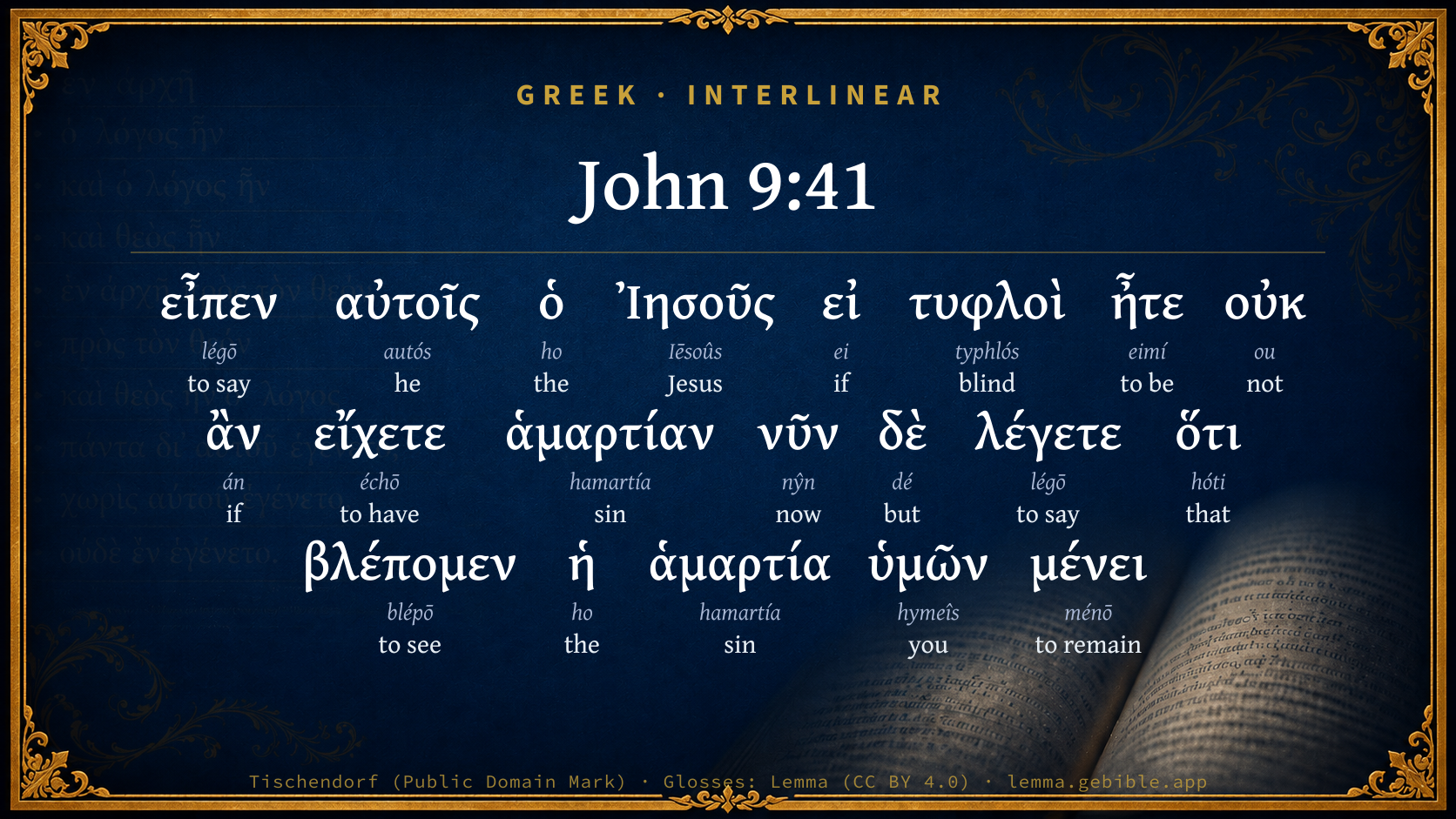
Greek (Tischendorf 8th ed.) John 9:41 appears in the Greek New Testament. The text above is from the Tischendorf 8th edition. Each word links to its Strong’s number and a concise gloss. Click any word for its full Thayer’s Greek Lexicon entry.
Download image
Cite this verse

John 9:41 (World English Bible). Public Domain. Lemma interlinear Bible study tool, https://lemma.gebible.app/v/john/9/41.

Show BibTeX & RIS
BibTeX
RIS
English Translation
Jesus said to them, "If you were blind, you would have no sin; but now you say, 'We see.' Therefore your sin remains.
World English Bible · Public Domain
Download a study sheet

One document with this verse’s original text, its word-by-word gloss line, the meaning frame, cross-references with their text, attributed commentary, and full source and license credits — printable, and it pastes into notes with its structure intact.

This verse Autodidact and up

Study sheet (.html) Plain text (.txt)

A passage Seminary Student

Up to 50 verses in one chapter. A passage sheet keeps up to 6 commentary sources and 12 cross-references per verse, in the order this page ranks them, and says so on the sheet whenever that leaves anything out. Ask for a single verse and you get the Autodidact verse sheet above.

Everything on this page stays free to read, with no account — the sheet is a download of what is already on screen, not access to it.

Want to remove ads? Support Godless Engineer
Compare translations 3

The same verse in 3 English versions, stacked beneath the original-language interlinear above. Click any original word for its lexicon entry.

Each is an independent rendering of the whole verse — the interlinear is not word-aligned to these translations.

Highlighted words mark where these versions differ — a whole-verse word diff, not a word-by-word alignment.

  • World English Bible Public Domain
    Jesus said to them, "If you were blind, you would have no sin; but now you say, 'We see.' Therefore your sin remains.
  • King James Version Public Domain
    Jesus said unto them, If ye were blind, ye should have no sin: but now ye say, We see; therefore your sin remaineth.
  • unfoldingWord Literal Text CC BY-SA 4.0
    Jesus said to them, “If you were blind, you would have no sin, but now you say, ‘We see.’ Your sin remains.”

unfoldingWord Literal Text — © unfoldingWord, licensed CC BY-SA 4.0. Word-aligned USFM3 via Door43 (git.door43.org/unfoldingWord/en_ult).

Versions to compare (up to 4)

3 of 4 selected

Show all 19 translations

Every available English version of this verse, each an independent rendering of the whole verse.

  • World English Bible Public Domain
    Jesus said to them, "If you were blind, you would have no sin; but now you say, 'We see.' Therefore your sin remains.
  • Berean Standard Bible Public Domain
    “If you were blind,” Jesus replied, “you would not be guilty of sin. But since you claim you can see, your guilt remains.”
  • Majority Standard Bible Public Domain
    “If you were blind,” Jesus replied, “you would not be guilty of sin. But since you say, ‘We see,’ your guilt remains.”
  • King James Version Public Domain
    Jesus said unto them, If ye were blind, ye should have no sin: but now ye say, We see; therefore your sin remaineth.
  • American Standard Version (1901) Public Domain
    Jesus said unto them, If ye were blind, ye would have no sin: but now ye say, We see: your sin remaineth.
  • Revised Version (1885) Public Domain
    Jesus said unto them, If ye were blind, ye would have no sin: but now ye say, We see: your sin remaineth.
  • Geneva Bible (1599) Public Domain
    Iesus sayd vnto them, If ye were blinde, ye should not haue sinne: but nowe ye say, We see: therefore your sinne remaineth.
  • Douay-Rheims (1899) Public Domain
    Jesus said to them: If you were blind, you should not have sin: but now you say: We see. Your sin remaineth.
  • Young's Literal Translation Public Domain
    Jesus said to them, `If ye were blind, ye were not having had sin, but now ye say -- We see, therefore doth your sin remain.
  • Literal Standard Version CC BY-SA 4.0
    Jesus said to them, “If you were blind, you were not having had sin, but now you say—We see, therefore your sin remains.”
  • Unlocked Literal Bible CC BY-SA 4.0
    Jesus said to them, “If you were blind, you would have no sin, but now you say, 'We see,' so your sin remains.”
  • unfoldingWord Literal Text CC BY-SA 4.0
    Jesus said to them, “If you were blind, you would have no sin, but now you say, ‘We see.’ Your sin remains.”
  • Darby Bible Public Domain
    Jesus said to them, If ye were blind ye would not have sin; but now ye say, We see, your sin remains.
  • World Messianic Bible Public Domain
    Yeshua said to them, “If you were blind, you would have no sin; but now you say, ‘We see.’ Therefore your sin remains.
  • Webster's Bible Public Domain
    Jesus said to them, If ye were blind, ye would have no sin: but now ye say, We see; therefore your sin remaineth.
  • Free Bible Version CC BY-SA 4.0
    Jesus answered, “If you were blind, you wouldn't be guilty. But now that you say you see, your guilt remains.”
  • Bible in Basic English Public Domain
    Jesus said to them, If you were blind you would have no sin: but now that you say, We see; your sin is there still.
  • Text-Critical English NT CC BY 4.0
    Jesus said to them, “If you were blind, you would have no sin, but now you say, ‘We see.’ Therefore your sin remains.
  • Tyndale New Testament (1534) Public Domain
    Iesus sayde vnto them: yf ye were blynde ye shuld have no synne. But now ye saye we se therfore youre synne remayneth.

Literal Standard Version (2020), Covenant Press — licensed CC BY-SA 4.0. Text via the HelloAO Bible API (eBible.org). Unlocked Literal Bible (unfoldingWord) — licensed CC BY-SA 4.0. Text via the HelloAO Bible API (eBible.org). unfoldingWord Literal Text — © unfoldingWord, licensed CC BY-SA 4.0. Word-aligned USFM3 via Door43 (git.door43.org/unfoldingWord/en_ult). Free Bible Version, Dr. Jonathan Gallagher — licensed CC BY-SA 4.0. Text via the HelloAO Bible API (eBible.org).

Word by word

More ways to search: Search by grammar → Find every occurrence → Compare this word →

Practice this passage: Drill this verse → Learn its vocabulary →

τυφλοὶ
typhlós
G5185
“blind”
Adjective, Nominative, Plural, Masculine
Part of Speech
Adjective
Case
Nominative
Number
Plural
Gender
Masculine
Full Thayer's Definition

Origin: from G5187

TDNT: 12:30,1

1. blind 2. mentally blind
  1. εἶπεν légō G3004 “to say” Verb, Aorist, Active, Indicative, 3rd person, Singular
  2. αὐτοῖς autós G846 “he” Personal pronoun, Dative, Plural, Masculine
  3. ὁ ho G3588 “the” Article, Nominative, Singular, Masculine
  4. Ἰησοῦς Iēsoûs G2424 “Jesus” Noun, Nominative, Singular, Masculine
  5. εἰ ei G1487 “if” Conditional
  6. ἦτε eimí G1510 “to be” Verb, Imperfect, Active, Indicative, 2nd person, Plural
  7. οὐκ ou G3756 “not” Particle, Negative
  8. ἂν án G302 “if” Particle
  9. εἴχετε échō G2192 “to have” Verb, Imperfect, Active, Indicative, 2nd person, Plural
  10. ἁμαρτίαν hamartía G266 “sin” Noun, Accusative, Singular, Feminine
  11. νῦν nŷn G3568 “now” Adverb
  12. δὲ dé G1161 “but” Conjunction
  13. λέγετε légō G3004 “to say” Verb, Present, Active, Indicative, 2nd person, Plural
  14. ὅτι hóti G3754 “that” Conjunction
  15. βλέπομεν blépō G991 “to see” Verb, Present, Active, Indicative, 1st person, Plural
  16. ἡ ho G3588 “the” Article, Nominative, Singular, Feminine
  17. ἁμαρτία hamartía G266 “sin” Noun, Nominative, Singular, Feminine
  18. ὑμῶν hymeîs G5210 “you” Personal pronoun, 2nd person, Genitive, Plural
  19. μένει ménō G3306 “to remain” Verb, Present, Active, Indicative, 3rd person, Singular

About this verse

These counts appear in no published source. They are computed here, from the morphology-tagged text and Lemma’s own curated glosses. What Lemma adds →

20
words
17
distinct lemmas
Gospels
section

Shared distinctive vocabulary

τυφλοὶ blind G5185 occurs in 46 verses of the Greek New Testament. Also found in:
Repetition

Words recur within this verse:

  • εἶπεν to say G3004 ×2
  • ἁμαρτίαν sin G266 ×2
  • ὁ the G3588 ×2

Cross-references

8

Topical passages linked to John 9:41 in the Treasury of Scripture Knowledge — connected by theme and wording, ordered by reader-vote popularity; previews shown in the World English Bible.

  • Isaiah 5:21 Woe to those who are wise in their own eyes, And prudent in their own sight!
  • John 15:22–24 If I had not come and spoken to them, they would not have had sin; but now they have no excuse for their sin.
  • Luke 18:14 I tell you, this man went down to his house justified rather than the other; for everyone who exalts himself will be humbled, but he who humbles himself will be exalted."
  • 1 John 1:8–10 If we say that we have no sin, we deceive ourselves, and the truth is not in us.
  • Proverbs 26:12 Do you see a man wise in his own eyes? There is more hope for a fool than for him.
  • Hebrews 10:26 For if we sin willfully after we have received the knowledge of the truth, there remains no more a sacrifice for sins,
  • Jeremiah 2:35 Yet you said, I am innocent; surely his anger is turned away from me. Behold, I will enter into judgment with you, because you say, I have not sinned.
  • Luke 12:47 That servant, who knew his lord's will, and didn't prepare, nor do what he wanted, will be beaten with many stripes,

Cross-references courtesy of OpenBible.info (CC BY 4.0).

Where the printed editions differ

1 variant

Places in this verse where the major printed Greek editions disagree on the wording in a way that affects the translation — a comparison of editions, not a manuscript-by-manuscript collation. The editions are the modern critical texts (Nestlé-Aland 28/27, SBL, Westcott-Hort, Tregelles, Tyndale House) and the traditional texts behind the KJV (the Textus Receptus and the Byzantine/Majority text). It is not a claim about which reading is original.

  1. Extra text
    οὖν

    “therefore”

    In TRByz Not in NA28NA27TynSBLWHTreg

    οὖν (oun) 'therefore' is only in traditional manuscripts (TR+Byz)

Textual data: Translators Amalgamated Greek New Testament (STEPBible TAGNT) · CC BY 4.0.

Commentary

Notes on John 9:41 from classic Christian and Jewish commentators (each source and its license shown beneath its notes). The classic Christian expositions comment on the surrounding passage and are grouped to its opening verse, so a note may address several verses; the Jewish commentaries on the Tanakh (Rashi and others) are per-verse, so they appear only where the commentator wrote on this verse.

Lemma curates 59 commentaries, every one of them public domain or Creative Commons licensed, each selected and text-cleaned for this edition rather than reprinted as found. About our sources →

Bengel's Gnomon

Johann Albrecht Bengel

Joh 9:41. Ἁμαρτίαν sin) If ye would say, we are blind, ye would seek sight, and your sin would have already ceased. Sin exists even in the intellect; for blindness affects the sight, and is synonymous with sin.

Bengel's Gnomon of the New Testament — English translation (T&T Clark, Edinburgh, 1860) — public domain. Text from a community e-Sword module.

Meyer's Critical & Exegetical Commentary

Heinrich August Wilhelm Meyer

Joh_9:41. Alas! Jesus intends to say, Ye are not blind. Were ye blind (as I intended the μὴ βλέποντες in Joh_9:39), that is, people who are conscious of being destitute of the true knowledge,[55] then ye would be without sin, i.e. your unbelief in me would not be sinful, just because it would involve no resistance to divine truth, but would simply imply that ye had not yet attained thereunto, a result for which ye were not to blame. But now ye assert we see (profess to be possessors of divine truth); the consequence whereof is, that your sin remaineth (is not removed),[56] i.e. that your unbelief in me not only is sinful, but also this, your sin continues to exist, remains undestroyed (ἀνεξάλειπτος μένει, Theodoret, Heracleon), because your conceit is a perpetual ground for rejecting me, so that you cannot attain to faith and the forgiveness of sin. Dicendo videmus, medicum non quaeritis, Augustine. Si diceretis: caeci sumus, visum peteretis et peccatum jam desiisset, Bengel. According to Lücke (so also substantially Baeumlein), whom J. Müller follows (Lehre v. d. Sünde, I. p. 286, ed. 5), the meaning is: Were you blind, i.e. without the capability of knowledge, there would be no sin (guilt) in your unbelief; you would then be unable to believe with knowledge. But so long as you say, notwithstanding all your blindness, We see, and therefore do not put away your conceited self-deception, so long your unbelief cannot depart, but must remain. Against this view are the following objections: 1. Τυφλοί, because answering to ΜῊ ΒΛΈΠΟΝΤΕς in Joh_9:39, cannot denote incapacity for knowledge; 2. The antithesis λέγετε ὅτι βλέπ. suggests for ΤΥΦΛΟΊ, not the objective, but the subjective meaning; 3. ἉΜΑΡΤΊΑ is thus taken in different senses in the two halves. Other imported meanings are: Were you blind, like the multitude which you regard as blind, perhaps you would have no sin, etc. (Ewald, as though besides ἄν John had written also ΤΆΧΑ or ἼΣΩς); or (Hengstenberg), if ye suffered merely from the simple blindness of the human race, which is blind from birth, ye would have no sin of decisive significance, no unpardonable sin; as though there were the slightest reference to anything of the kind! Substantially correct are Erasmus, Beza, Grotius, and several others; comp. Luthardt and Ebrard; still ΟὐΚ ἊΝ ΕἼΧ. ἉΜ. ought not to be transposed into, then would your sin forgive you. The explanation of Godet is a natural consequence of his interpretation of Joh_9:39, but founders on the words λέγετε ὅτι βλέπομεν.[57]

[55] Not, physically blind, as Nonnus, Theophylact, Euth. Zigabenus, and several others here, as well as in ver. 40, after the example of Chrysostom, wrongly understand.

[56] Not, The sin remains yours (Ewald). Comp. Joh_15:16.

[57] Sils appartenaient à la multitude ignorante, leur incrédulité à légard de Jésus pourrait nêtre quune affaire dentraînement (it would be merely a sin against the Son of man); mais éclairés, comme ils le sont, par la connaissance de la parole de Dieu, cest sciemment, quils rejettent le Messie (this is a sin against the Holy Ghost). In this case, however, Jesus must have said: νῦν δὲ βλέπετε, not νῦν δὲ λέγετε ὁτι βλέπομεν, which Godet, it is true, regards merely as an allusion to the question in ver. 40; whilst in reality it is the key to the correct understanding of the entire passage.

OBSERVATION.

The absence from the Synoptics of the miracle performed on the man born blind ought to have found its explanation simply in the circumstance that it did not take place in the (Galilean) sphere of the synoptic narrative, and ought not to have been made the ground of an attack on its historical credibility, as was done by Strauss (who compares the healing of Naaman in 2Ki_5:10); by Weisse (who derives the narrative, by means of a misunderstanding, from Joh_9:39); and by Baur (who regards this story as the intensified expression of the healings of the blind recorded by the synoptists, p. 245 f.); whilst Gfrörer, on the contrary, content with asserting the presence of unhistorical additions, comes to a conclusion disadvantageous to the synoptists.

According to Baur (p. 176 ff.), the narrative of the miracle was definitely and intentionally shaped, so as to set forth faith in its pure objectivity, the susceptibility to the divine as it is affected by the pure impression of the divine element in the ἔργα θεοῦ, even when it is not yet aware who is the subject of these ἔργα. It clings to the thing itself; and the thing itself is so immediately divine, that in the thing, without knowing it, one has also the person. In such wise are arbitrary, and not even relevant (see Brückner), abstractions from history converted into the ground of history. Ammon makes the occurrence a natural healing of an inflammation of the eyes! a counterpart to the converse travesty of some of the Fathers, who express the opinion that the blind man lacked eyes altogether, and that Jesus formed them out of the πηλός, as God at first formed man from the earth (see especially Irenaeus, Theodore of Mopsuestia, and Nonnus); comp. on Joh_9:6 f.

Meyer — Critical and Exegetical Commentary on the New Testament — English translation by Peter Christie, edited by Frederick Crombie (T&T Clark, 1880) — public domain. Text from a community e-Sword module.

Jamieson, Fausset & Brown

Robert Jamieson, A. R. Fausset & David Brown

If ye were blind--wanted light to discern My claims, and only waited to receive it.

ye should have no sin--none of the guilt of shutting out the light.

ye say, We see; therefore your sin remaineth--Your claim to possess light, while rejecting Me, is that which seals you up in the guilt of unbelief.

Next: John Chapter 10

Jamieson, Fausset & Brown — Commentary Critical and Explanatory on the Whole Bible (1871) — public domain (CC PDM 1.0). Text via the HelloAO Bible API.

Adam Clarke's Commentary

Verse 41. If ye were blind] If ye had not had sufficient opportunities to have acquainted yourselves with my Divine nature, by the unparalleled miracles which I have wrought before you? and the holy doctrine which I have preached, then your rejecting me could not be imputed to you as sin; but because ye say, we see-we are perfectly capable of judging between a true and false prophet, and can from the Scriptures point out the Messiah by his works-on this account you are guilty, and your sin is of no common nature, it remaineth, i.e. it shall not be expiated: as ye have rejected the Lord from being your deliverer, so the Lord has rejected you from being his people. When the Scripture speaks of sin remaining, it is always put in opposition to pardon; for pardon is termed the taking away of sin, Joh 1:29; Ps 32:5. And this is the proper import of the phrase, αφεσις των αμαρτιως, which occurs so frequently in the sacred writings.

1. THE history of the man who was born blind and cured by our Lord is, in every point of view, instructive. His simplicity, his courage, his constancy, and his gratitude are all so many subjects worthy of attention and emulation. He certainly confessed the truth at the most imminent risk of his life; and therefore, as Stephen was the first martyr for Christianity, this man was the first confessor. The power and influence of TRUTH, in supporting its friends and confounding its adversaries, are well exemplified in him; and not less so, that providence of God by which he was preserved from the malice of these bad men. The whole story is related with inimitable simplicity, and cannot be read by the most cold-hearted without extorting the exclamation, How forcible are right words?

2. It has already been remarked that, since the world began, there is no evidence that any man born blind was ever restored to sight by surgical means, till the days of Mr. Cheselden, who was a celebrated surgeon at St. Thomas's Hospital, London. For though, even before the Christian aera, there is reason to believe that both the Greek and Roman physicians performed operations to remove blindness occasioned by the cataract, yet we know of none of these ever attempted on the eyes of those who had been born blind, much less of any such persons being restored to sight. The cure before us must have been wholly miraculous-no appropriate means were used to effect it. What was done had rather a tendency to prevent and destroy sight than to help or restore it. The blindness in question was probably occasioned by a morbid structure of the organs of sight; and our Lord, by his sovereign power, instantaneously restored them to perfect soundness, without the intervention of any healing process. In this case there could be neither deception nor collusion.

Adam Clarke's Commentary on the Bible (1810–1826) — public domain. Text from a community e-Sword/MySword module.

John Calvin's Commentaries

41. If you were blind. These words may be explained in two ways; either, that ignorance would, in some degree, alleviate their guilt, if they were not fully convinced, and did not deliberately fight against the truth; or, that there was reason to hope that their disease of ignorance might be cured, if they would only acknowledge it. The former view is supported by the words of Christ,

If I had not come and spoken to them, they would have no sin, (John 15:22.)

But as it is added in this passage, but now you say you see, in order that the points of contrast may correspond to each other, it appears to be more consistent to explain them to mean, that he is blind who, aware of his own blindness, seeks a remedy to cure his disease. In this way the meaning will be, “If you would acknowledge your disease, it would not be altogether incurable; but now because you think that you are in perfect health, you continue in a desperate state.” When he says that they who are blind have no sin, this does not excuse ignorance, as if it were harmless, and were placed beyond the reach of condemnation. He only means that the disease may easily be cured, when it is truly felt; because, when a blind man is desirous to obtain deliverance, God is ready to assist him; but they who, insensible to their diseases, despise the grace of God, are incurable.

John Calvin's Commentaries (1540-1563) — public domain. Text from the Calvin Translation Society English edition (1840s-50s) via the Christian Classics Ethereal Library (ccel.org). Calvin's coverage is partial (roughly two-thirds of the Bible); uncommented books and verses are honest gaps, never fabricated. The 19th-century editor's footnotes and remarks are omitted so the notes are faithfully Calvin's own voice.

Ellicott's Commentary for English Readers

(41) If ye were blind, ye should have no sin.—His answer is that He does not place them among those who are in this second sense blind. If they were among those “which see not” they would be conscious of their blindness, and would seek for spiritual light. They would ask, “Who is He, Lord, that we may believe on Him?” and would not ask in vain. In that case their present rejection of Him would arise from ignorance willing to be overcome, and this ignorance, not being wilful, would not be sin. Conscious ignorance would be the first step towards knowledge.

But now ye say, We see.—Their true place is among those who were spiritually blind, and were unconscious of it, “they which see,” they which think they see.” For them the first step towards true spiritual light must be a consciousness of blindness. As it is, as long as they think that they see, there is no ground for hope. (Comp. Mat_9:12-13.)

Therefore your sin remaineth.—The word “therefore” should probably be omitted. The words “Your sin remaineth,” or better, Your sin abideth (comp. Note on Joh_3:36), stand alone in their awful solemnity. They stand side by side with “Ye say, We see.” The two states are one. The assertion of spiritual knowledge and independence was the original cause of sin (Gen_3:4), and while spiritual pride exists sin cannot cease.

A Bible Commentary for English Readers, edited by Charles John Ellicott (1878–1897) — public domain. Text from a community e-Sword module.

The Cambridge Bible for Schools and Colleges

gen. ed. J. J. S. Perowne

41. If ye were blind] Christ returns to His own meaning of ‘blind’ or ‘they which see not’ in Joh_9:39. ‘If ye were conscious of your own spiritual darkness, if ye yearned and strove to reach the light, ye would not have sin (see on Joh_15:22); for either ye would find the light, or, if ye failed, the failure would not lie at your door.’ For the construction comp. Joh_5:46; Joh_8:19; Joh_8:42; Joh_15:19; Joh_18:36.

therefore your sin remaineth] Better, your sin abideth (see on Joh_1:33): ‘therefore’ is an insertion, and must be omitted. ‘Ye profess to see: your sin in this false profession and in your consequent rejection of Me abideth.’ It was a hopeless case. They rejected Him because they did not know the truth about Him; and they would never learn the truth because they were fully persuaded that they were in possession of it. Those who confess their ignorance and contend against it, (1) cease to be responsible for it, (2) have a good prospect of being freed from it. Those who deny their ignorance and contend against instruction, (1) remain responsible for their ignorance, (2) have no prospect of ever being freed from it. Comp. Joh_3:36.

The Cambridge Bible for Schools and Colleges (gen. ed. J. J. S. Perowne; Cambridge University Press, 1878–1918) — public domain. Text from a community e-Sword module.

Trapp's Complete Commentary

John Trapp

41 Jesus said unto them, If ye were blind, ye should have no sin: but now ye say, We see; therefore your sin remaineth.

Ver. 41. But now ye say, We see] If, after conviction, men run away with the bit in their mouths, the sin is the greater; but their case is deplorable, qui quod verum sit neque sciunt, neque sustinent dicere, as Basil complains of the Western Church in his time.

John Trapp, A Commentary or Exposition upon All the Books of the Old and New Testament (1647–1656) — public domain. Text from a community e-Sword module.

Albert Barnes' Notes on the Bible

If ye were blind - If you were really blind had had no opportunities of learning the truth. If you were truly ignorant, and were willing to confess it, and to come to me for instruction.

No sin - You would not be guilty. Sin is measured by the capacities or ability of people, and by their opportunities of knowing the truth. If people had no ability to do the will of God, they could incur no blame. If they have all proper ability, and no disposition, God holds them to be guilty. This passage teaches conclusively:

1.That people are not condemned for what they cannot do.

2.That the reason why they are condemned is that they are not disposed to receive the truth.

3.That pride and self-confidence are the sources of condemnation.

4.That if people are condemned, they, and not God, will be to blame.

We see - We have knowledge of the law of God. This they had pretended when they professed to understand the law respecting the Sabbath better than Jesus, and had condemned him for healing on that day.

Your sin remaineth - You are guilty, and your sin is unpardoned. People’s sins will always be unpardoned while they are proud, and self-sufficient, and confident of their own wisdom. If they will come with humble hearts and confess their ignorance, God will forgive, enlighten, and guide them in the path to heaven.

Albert Barnes' Notes on the Bible (1834–1885) — public domain. Text from a community e-Sword/MySword module.

Matthew Poole's English Annotations

If ye were blind; if your ignorance were simple, and not affected, and you were sensible that your blindness were not incurable, and your sin might be pardoned. This appeareth to be the sense from the opposition of it, now ye say, We see, in the latter part of the verse. They were indeed blind, as to any true and saving sight of Christ, and of the true way of salvation by believing in him; seeing (as they apprehended) a way of salvation without Christ, by the works of the law, and wilfully shutting their eyes against the glorious light of the gospel shining on them.

Ye should have no sin; you should not have so much sin, so much guilt upon your souls, as you now have: though your ignorance had been sin, yet it had not been so great a sin as a wilful shutting your eyes against the light.

But now ye say, We see; now that you have an opinion that you see, and boast in your knowledge of the law, as if you were the only men that saw; and upon this presumption reject the doctrine of salvation; therefore your sin remaineth, by it you not only conclude yourselves under the guilt of sin, but your sin remaineth upon you, not pardoned to you: which teacheth us, that without a true and saving sight of sin, and such a one as carrieth the soul out of itself to Christ for pardon and remedy, there is no hope of pardon and forgiveness from all the mercy that is in God.

Matthew Poole's English Annotations on the Holy Bible (1683–1685) — public domain. Text from a community e-Sword/MySword module.

Whedon's Commentary on the Bible

Daniel D. Whedon

41. If ye were blind—If, like this man, you were utterly and innocently without the power to see.

Ye should have no sin—Ye would be perfectly blameless for not seeing. Just as blameless as this man for not seeing the sun without the power. No man is required to use a power he never could possess. If a man never could possess the power for right, he could never be condemned for wrong. If, indeed, he brings his powerlessness upon himself, he cannot plead it in excuse.

But now ye say, We see—By your own confession, which is true, you are able to see the truth; and yet, wilfully, ye see falsely; your judgment shall be that ye shall lose the opportunity to see truth, and ye shall be abandoned to that false seeing which is a real blindness. As both their not seeing truth and their untruthful seeing were willful, there was no excuse; their sin stood permanent, recorded, unpardoned, eternal.

Daniel D. Whedon (gen. ed.), Commentary on the Old and New Testaments (1874–1909) — public domain. Text from a community e-Sword module.

The Pulpit Commentary

The reply of our Lord is not meant to be a crushing and final retort, condemning them to hopeless night, but was obviously intended to show them that they are not yet free from sin, that they are only partially appreciating the light which shines upon them. If ye were blind incapable of sight; if ye had all along been deprived of the faculty of perceiving the true Light that shineth in the darkness (a condition of things which would have emancipated them from responsibility, and which Christ would not admit to be the case); perhaps more, if ye had been utterly blind to the light which is shining upon you now, which, however, is not trueye would not have sin. This is akin to the solemn language of Joh_15:22-24. They did not themselves admit that there was any congenital blindness about them. They did not pretend or expect to ride off on such a profasiv , such an excuse. Could they be, judicially or naturally, blind?

The very idea was an absurdity, and so Jesus added, But now ye say, We see. You even boast that you are "instructors of the ignorant, and leaders of the blind; a light to those who sit in darkness, having the form of knowledge and truth in the Law". (Rom_2:17-21) You are the very opposite of the "not-seeing" (mh blepontev); you are self-satisfied; you will not come to the Light. What is the issue? The Lord seems to pause before his answer (the oun , "therefore," is rejected by the best manuscripts and critics): Your sin abideth; or, remaineth. It will remain until you fully admit the great principle and reason, the motive and characteristics, of my mission. The very facility you profess, the intimacy you claim with the Law and its founder, and your partial knowledge of my claim, take away your excuse. The discourse which follows shows how entire must be the submission to Christ, how complete the union with him, of those who say, "We see."

The Pulpit Commentary (1880–1919), ed. H.D.M. Spence-Jones & Joseph S. Exell — public domain. Text from a community e-Sword module.

John Wesley's Explanatory Notes

If ye had been blind - Invincibly ignorant; if ye had not had so many means of knowing: ye would have had no sin - Comparatively to what ye have now. But now ye say - Ye yourselves acknowledge, Ye see, therefore your sin remaineth - Without excuse, without remedy.

John Wesley, Explanatory Notes Upon the Whole Bible (1754–1765) — public domain. Text via the GEBible commentary corpus.

Scofield Reference Notes

C. I. Scofield

sin

Sin. (See Scofield "Rom 3:23").

The Scofield Reference Bible (1917 edition), notes by C. I. Scofield — public domain. Text from a community e-Sword module.

Cambridge Greek Testament for Schools and Colleges

41. εἰ τ. ἧτε. ‘If ye were blind, i.e. if ye were conscious of your spiritual darkness and yearned for the light, ye would not have sin (Joh 15:22); for either ye would find the light, or, if ye failed, the failure would not lie at your door.’ Others interpret, ‘If ye were really blind, and had never known the light, ye would not be responsible for rejecting it. But by your own confession ye see, and the sin of rejection abideth.’ For the construction comp. Joh 5:46, Joh 8:19; Joh 8:42, Joh 15:19, Joh 18:36; for ἔχειν ἁμαρτίαν see on Joh 15:22. Perhaps there is a pause after βλέπομεν.

ἡ ἁμαρτία ὑμ. μ. Your sin abideth (see on Joh 1:33). ‘Ye profess to see: your sin in this false profession and in your consequent rejection of Me abideth.’ It was a hopeless case. They rejected Him because they did not know the truth about Him; and they would never learn the truth because they were fully persuaded that they were in possession of it. Those who confess their ignorance and contend against it (1) cease to be responsible for it, (2) have a good prospect of being freed from it. Those who deny their ignorance and contend against instruction, (1) remain responsible for their ignorance, (2) have no prospect of ever being freed from it. Comp. Joh 3:36.

Cambridge Greek Testament for Schools and Colleges (Cambridge University Press, 1896; 21 vols, various authors incl. Carr, Maclear, Plummer, Farrar, Lumby, Moule, M. R. James, Simcox) — public domain. Text from a community e-Sword module.

Alford’s Greek Testament

Henry Alford

41.] The distinction in expression between the two clauses must be carefully borne in mind. Our Lord is referring primarily to the unbelief of the Pharisees and their rejection of Him. And He says, ‘If ye were really blind (not, ‘confessed yourselves blind:’ Kuinoel, Stier, De Wette), ye would not have incurred guilt; but now ye say, “We see;” ye believe ye have the light, and boast that ye know and use the light; and therefore your guilt abideth, remaineth on you.’ Observe there is a middle clause understood, between ‘ye would never have incurred guilt,’ and ‘your guilt remaineth;’ and that is, ‘ye have incurred guilt;’ which makes it necessary to take the λέγετε ὅτι βλέπομεν as in a certain sense implying βλέπετε: viz. ‘by the Scriptures being committed to you, by God’s grace, which ought to have led you to faith in me.’

Henry Alford, The Greek Testament (1849–1861) — public domain. Text from a community e-Sword module.

International Critical Commentary

41. The answer of Jesus is as overwhelming as it was unforeseen. The Pharisees had expected that He would say, “Yes, you are blind, despite your authoritative position as religious guides” (cf. Mat 23:16). But instead of that, He said, “No, you are not wholly blind; that is the worst feature of your case.”

εἰ τυφλοὶ ἦτε, οὐκ ἂν εἴχετε ἁμαρτίαν. If they were wholly and involuntarily blind to the presentation of the Divine which Jesus embodied, they would not be blameworthy for refusing to acknowledge it. Cf. εἰ μὴ ἦλθον καὶ ἐλάλησα αὐτοῖς ἁμαρτίαν οὐκ εἴχοσαν (15:22). But this was not their situation. The perpetual reproach with which Jesus challenged them (cf., e.g., 8:47) was that their failure to accept Him was a moral failure. Their self-satisfaction prevented them from seeing what they ought to have seen in Him (see on v. 39 above). Their claim to “see,” βλέπομεν, was arrogant, and shut them out from the larger vision which had offered itself (cf. Pro 26:12). So “your sin abides,” i.e. is not removed.

For the Johannine constr. ἔχειν ἁμαρτίαν, cf. 15:22, 19:11 and 1Jn 1:8.

ἡ ἁμαρτία ὑμῶν μένει. There is a sin against light which is eternal in its consequences. Cf. Mar 3:29 for the Synoptic form of this tremendous judgment.

1 For the ellipse in ἀλλʼ ἵνα, cf. 13:18, 15:25, 1Jn 2:19.

אԠSinaiticus (δ 2). Leningrad. iv.

A Alexandrinus (δ 4). British Museum. v. Cc. 6:50-8:52 are missing.

C Ephræmi (δ 3). Paris. v. Palimpsest. Contains considerable fragments of Jn.

N Purpureus Petropolitanus (ε 19). Dispersed through the libraries of Leningrad, Patmos, Rome, Vienna, and British Museum. vi. Some pages are missing. Edited by H. S. Cronin in Cambridge Texts and Studies (1899).

Γ̠(ε 70) Oxford and Leningrad. ix-x. Contains Son 1:1-13 8:3-15:24 19:6 to end.

Δ̠Sangallensis (ε 76). St. Gall. ix-x. Græco-Latin.

Θ̠Koridethi (ε 050). Tiflis. vii-ix. Discovered at Koridethi, in Russian territory, and edited by Beermann & Gregory (Leipzig, 1913). The text is akin to that of fam. 13, fam. 1, and the cursives 28, 565, 700 See Lake and Blake in Harvard Theol. Review (July 1923) and Streeter, The Four Gospels. Cf. also J.T.S. Oct. 1915, April and July 1925.

B Vaticanus (δ 1). Rome. Cent. iv.

D Bezæ (δ 5). Cambridge. v-vi. Græco-Latin. Cc. 18:14-20:13 are missing in the Greek text, and the gap has been filled by a ninth-century scribe (Dsupp).

L Regius (ε 56). Paris. viii. Cc. 15:2-20 21:15-25 are missing.

W Freer (ε 014). Washington. iv-vi. Discovered in Egypt in 1906. The Gospels are in the order Mt., Jn., Lk., Mk. Collation in The Washington MS. of the Four Gospels, by H. A. Sanders (1912).

1 See ERE xi. 102, s.v. “Saliva.”

2 See, for other illustrations, Trench, Miracles, p. 294.

3 See Moulton-Milligan, s.v. ἐπιχρίω.

1 The paratactic style of this inscription, καί … καί, is very like that of vv. 5-8, and shows that a redundance of καί conjunctions does not always point to a Semitic original (cf. Introd., p. lxvii).

1 See G. A. Smith, Jerusalem, i. 102 ff.

2 Grotius tried to identify Siloam with Shiloh, and noted that the Vulgate of Gen 49:10 renders Shiloh by “qui mittendus est.”

1 Shabb. c. 21, cited by Lightfoot, Hor. Hebr. on 9:6.

Diat. E. A. Abbott’s Diatessarica, including his Johannine Vocabulary and Johannine Grammar, Parts I.-X. (1900-1915).

1 See, for Jewish excommunications, Schürer, History of Jewish People, 11. ii. 61.

International Critical Commentary — older volumes (1896–1929), various authors — public domain. Text from a community e-Sword module.

Vincent's Word Studies in the New Testament

Marvin R. Vincent

Ye should have no sin [ουκ αν ειχετε αμαρτιαν] . Or, ye would have had. The phrase aJmartian ecein, to have sin, occurs only in John, in the Gospel and First Epistle.

Marvin R. Vincent, Word Studies in the New Testament (1887–1900) — public domain. Text from a community e-Sword/MySword module.

Lesson kit

Teaching starters — assembled from the data on this page, not authored interpretation. Every prompt links to the verse data it draws on. Edit before teaching.

John, in the Gospels, opens this verse with 20 words (17 distinct Greek lemmas). Its most distinctive word is typhlós (“blind”). A historical commentator’s framing appears above. Read the whole chapter for the surrounding context.

Discussion questions

  1. How does “blind” (typhlós) shape what this verse is saying?
  2. How does Matthew 9:27, which shares the word «blind», read alongside this verse?
  3. What does the repetition of “to say” (2× in this one verse) do in this verse?
  4. The translations on this page render this verse differently — a whole-verse word diff, not a word-by-word alignment. What might account for the different wordings?
  5. Compare how Bengel's Gnomon and Meyer's Critical & Exegetical Commentary read this verse. Where do they agree or differ?

Things to notice

  • These translations choose different wording for 6 words in this verse.
  • “to say” occurs 2× in this single verse.
  • 17 distinct Greek lemmas span 20 words in this verse.

Reading settings

Reading text

Shown beneath each verse's original-language words.

Old Testament
Old Testament edition

Read the OT as the Masoretic Hebrew (MT) or the Greek Septuagint (LXX).

English shown for the Greek Septuagint (in the Hebrew ↔ Greek comparison).

Comparing translations? Open the Compare panel on any verse page to stack up to four side by side.