
John 10:9

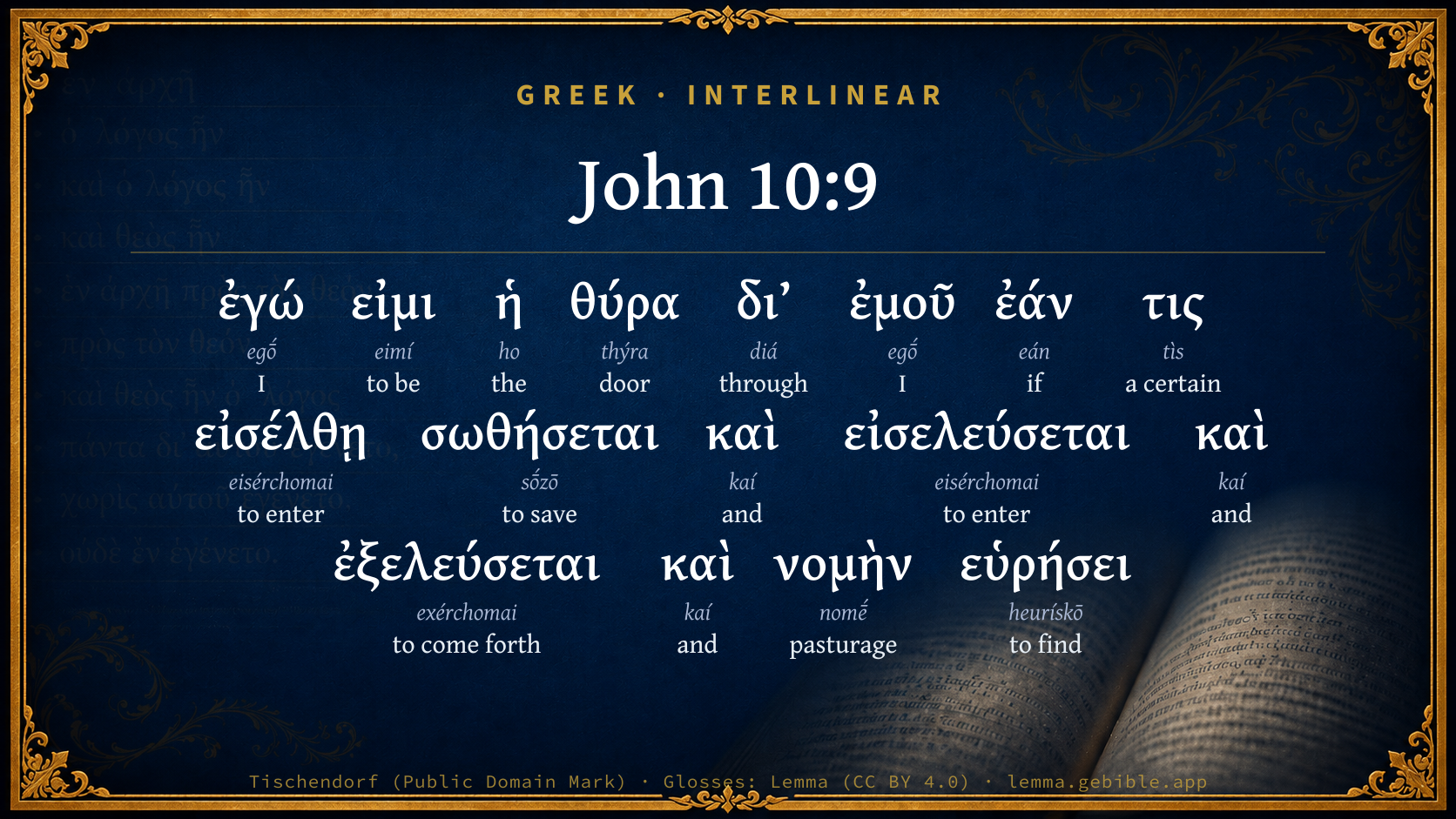
Greek (Tischendorf 8th ed.) John 10:9 appears in the Greek New Testament. The text above is from the Tischendorf 8th edition. Each word links to its Strong’s number and a concise gloss. Click any word for its full Thayer’s Greek Lexicon entry.
Download image
Cite this verse

John 10:9 (World English Bible). Public Domain. Lemma interlinear Bible study tool, https://lemma.gebible.app/v/john/10/9.

Show BibTeX & RIS
BibTeX
RIS
English Translation
I am the door. If anyone enters in by me, he will be saved, and will go in and go out, and will find pasture.
World English Bible · Public Domain
Highlights
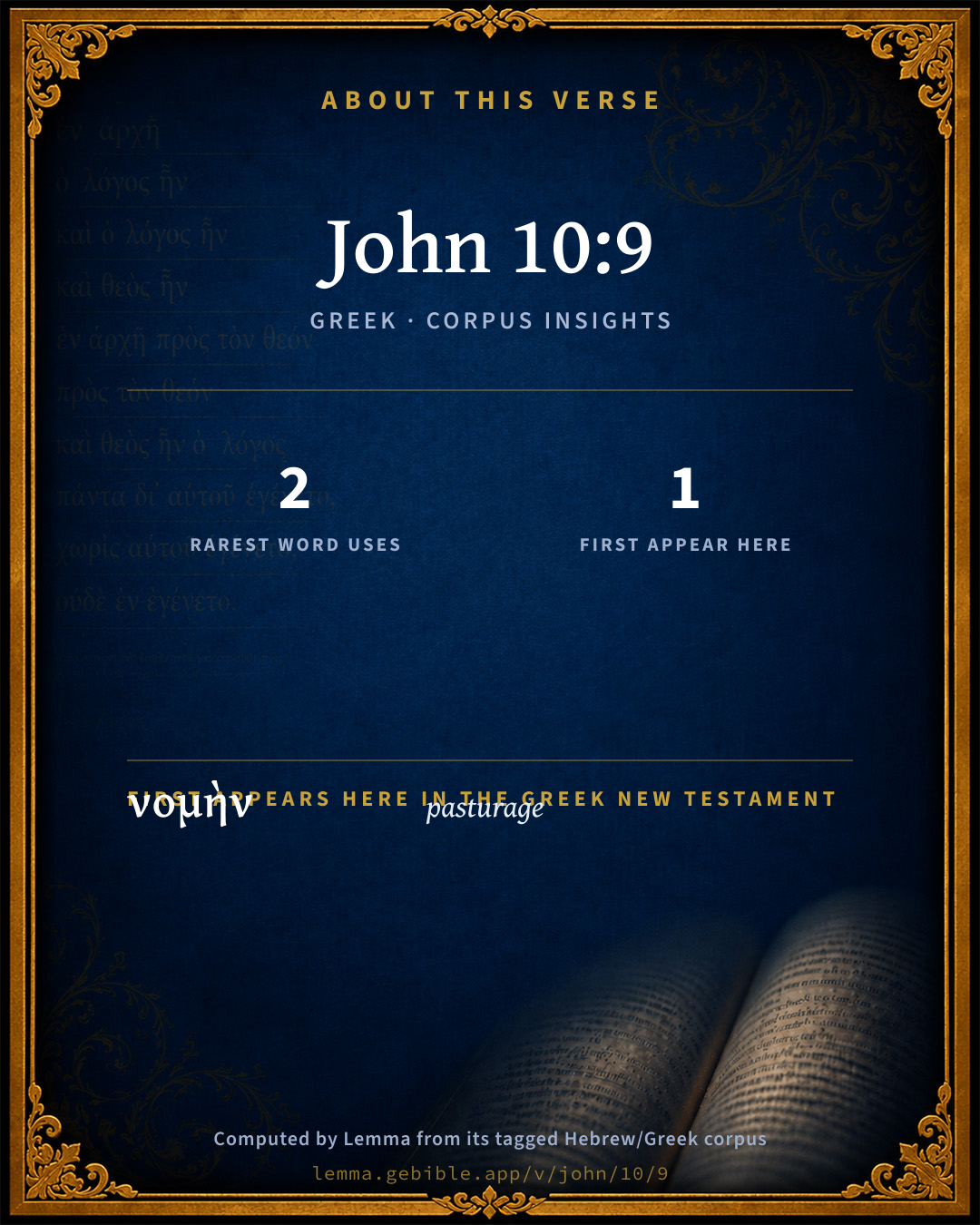
  • 1 first appearance in the Greek New Testament
Full analysis ↓
Download a study sheet

One document with this verse’s original text, its word-by-word gloss line, the meaning frame, cross-references with their text, attributed commentary, and full source and license credits — printable, and it pastes into notes with its structure intact.

This verse Autodidact and up

Study sheet (.html) Plain text (.txt)

A passage Seminary Student

Up to 50 verses in one chapter. A passage sheet keeps up to 6 commentary sources and 12 cross-references per verse, in the order this page ranks them, and says so on the sheet whenever that leaves anything out. Ask for a single verse and you get the Autodidact verse sheet above.

Everything on this page stays free to read, with no account — the sheet is a download of what is already on screen, not access to it.

Want to remove ads? Support Godless Engineer
Compare translations 3

The same verse in 3 English versions, stacked beneath the original-language interlinear above. Click any original word for its lexicon entry.

Each is an independent rendering of the whole verse — the interlinear is not word-aligned to these translations.

Highlighted words mark where these versions differ — a whole-verse word diff, not a word-by-word alignment.

  • World English Bible Public Domain
    I am the door. If anyone enters in by me, he will be saved, and will go in and go out, and will find pasture.
  • King James Version Public Domain
    I am the door: by me if any man enter in, he shall be saved, and shall go in and out, and find pasture.
  • unfoldingWord Literal Text CC BY-SA 4.0
    I am the gate. If anyone enters through me, he will be saved, and he will go in and go out and will find pasture.

unfoldingWord Literal Text — © unfoldingWord, licensed CC BY-SA 4.0. Word-aligned USFM3 via Door43 (git.door43.org/unfoldingWord/en_ult).

Versions to compare (up to 4)

3 of 4 selected

Show all 19 translations

Every available English version of this verse, each an independent rendering of the whole verse.

  • World English Bible Public Domain
    I am the door. If anyone enters in by me, he will be saved, and will go in and go out, and will find pasture.
  • Berean Standard Bible Public Domain
    I am the gate. If anyone enters through Me, he will be saved. He will come in and go out and find pasture.
  • Majority Standard Bible Public Domain
    I am the gate. If anyone enters through Me, he will be saved. He will come in and go out and find pasture.
  • King James Version Public Domain
    I am the door: by me if any man enter in, he shall be saved, and shall go in and out, and find pasture.
  • American Standard Version (1901) Public Domain
    I am the door; by me if any man enter in, he shall be saved, and shall go in and go out, and shall find pasture.
  • Revised Version (1885) Public Domain
    I am the door: by me if any man enter in, he shall be saved, and shall go in and go out, and shall find pasture.
  • Geneva Bible (1599) Public Domain
    I am that doore: by me if any man enter in, he shall be saued, and shall go in, and go out, and finde pasture.
  • Douay-Rheims (1899) Public Domain
    I am the door. By me, if any man enter in, he shall be saved: and he shall go in, and go out, and shall find pastures.
  • Young's Literal Translation Public Domain
    I am the door, through me if any one may come in, he shall be saved, and he shall come in, and go out, and find pasture.
  • Literal Standard Version CC BY-SA 4.0
    I AM the door, if anyone may come in through Me, he will be saved, and he will come in, and go out, and find pasture.
  • Unlocked Literal Bible CC BY-SA 4.0
    I am the gate. If anyone enters in through me, he will be saved; he will go in and out and will find pasture.
  • unfoldingWord Literal Text CC BY-SA 4.0
    I am the gate. If anyone enters through me, he will be saved, and he will go in and go out and will find pasture.
  • Darby Bible Public Domain
    I am the door: if any one enter in by me, he shall be saved, and shall go in and shall go out and shall find pasture.
  • World Messianic Bible Public Domain
    I am the door. If anyone enters in by me, he will be saved, and will go in and go out and will find pasture.
  • Webster's Bible Public Domain
    I am the door: by me if any man shall enter he shall be saved, and shall go in and out, and find pasture.
  • Free Bible Version CC BY-SA 4.0
    I am the gate. Anyone who comes in through me will be healed. They will be able to come and go, and find the food they need.
  • Bible in Basic English Public Domain
    I am the door: if any man goes in through me he will have salvation, and will go in and go out, and will get food.
  • Text-Critical English NT CC BY 4.0
    I am the gate; if anyone enters through me, he will be saved and will come in and go out and find pasture.
  • Tyndale New Testament (1534) Public Domain
    I am the dore: by me yf eny man enter in he shalbe safe and shall goo in and out and fynde pasture.

Literal Standard Version (2020), Covenant Press — licensed CC BY-SA 4.0. Text via the HelloAO Bible API (eBible.org). Unlocked Literal Bible (unfoldingWord) — licensed CC BY-SA 4.0. Text via the HelloAO Bible API (eBible.org). unfoldingWord Literal Text — © unfoldingWord, licensed CC BY-SA 4.0. Word-aligned USFM3 via Door43 (git.door43.org/unfoldingWord/en_ult). Free Bible Version, Dr. Jonathan Gallagher — licensed CC BY-SA 4.0. Text via the HelloAO Bible API (eBible.org).

Word by word

More ways to search: Search by grammar → Find every occurrence → Compare this word →

Practice this passage: Drill this verse → Learn its vocabulary →

νομὴν
nomḗ
G3542
“pasturage”
Noun, Accusative, Singular, Feminine
Part of Speech
Noun
Case
Accusative
Number
Singular
Gender
Feminine
Full Thayer's Definition

Origin: from the same as G3551

TDNT: None

1. pasturage, fodder, food a. fig. he shall not want the needful supplies for the true life 2. growth, increase a. of evils spreading like a gangrene b. of ulcers c. of a conflagration
  1. ἐγώ egṓ G1473 “I” Personal pronoun, 1st person, Nominative, Singular
  2. εἰμι eimí G1510 “to be” Verb, Present, Active, Indicative, 1st person, Singular
  3. ἡ ho G3588 “the” Article, Nominative, Singular, Feminine
  4. θύρα thýra G2374 “door” Noun, Nominative, Singular, Feminine
  5. δι’ diá G1223 “through” Preposition
  6. ἐμοῦ egṓ G1473 “I” Personal pronoun, 1st person, Genitive, Singular
  7. ἐάν eán G1437 “if” Conditional
  8. τις tìs G5100 “a certain” Indefinite pronoun, Nominative, Singular, Masculine
  9. εἰσέλθῃ eisérchomai G1525 “to enter” Verb, Aorist, Active, Subjunctive, 3rd person, Singular
  10. σωθήσεται sṓzō G4982 “to save” Verb, Future, Passive, Indicative, 3rd person, Singular
  11. καὶ kaí G2532 “and” Conjunction
  12. εἰσελεύσεται eisérchomai G1525 “to enter” Verb, Future, Middle deponent, Indicative, 3rd person, Singular
  13. καὶ kaí G2532 “and” Conjunction
  14. ἐξελεύσεται exérchomai G1831 “to come forth” Verb, Future, Middle deponent, Indicative, 3rd person, Singular
  15. καὶ kaí G2532 “and” Conjunction
  16. εὑρήσει heurískō G2147 “to find” Verb, Future, Active, Indicative, 3rd person, Singular

About this verse

These counts appear in no published source. They are computed here, from the morphology-tagged text and Lemma’s own curated glosses. What Lemma adds →

17
words
13
distinct lemmas
Gospels
section

Notable vocabulary

The rarest word here is νομὴν pasturage G3542 — appearing just 2 times in the whole Greek New Testament.

First appearance in Scripture

This word makes its first canonical appearance in the Greek New Testament here:

  • νομὴν pasturage G3542

Shared distinctive vocabulary

νομὴν pasturage G3542 occurs in 2 verses of the Greek New Testament. Also found in:
Repetition

Words recur within this verse:

  • εἰσέλθῃ to enter G1525 ×2
  • καὶ and G2532 ×3
  • ἐγώ I G1473 ×2

Cross-references

14

Topical passages linked to John 10:9 in the Treasury of Scripture Knowledge — connected by theme and wording, ordered by reader-vote popularity; previews shown in the World English Bible.

  • John 14:6 Jesus said to him, "I am the way, the truth, and the life. No one comes to the Father, except through me.
  • Ephesians 2:18 For through him we both have our access in one Spirit to the Father.
  • John 10:7 Jesus therefore said to them again, "Most assuredly, I tell you, I am the sheep's door.
  • John 10:1 "Most assuredly, I tell you, one who doesn't enter by the door into the sheep fold, but climbs up some other way, the same is a thief and a robber.
  • Romans 5:1–2 Being therefore justified by faith, we have peace with God through our Lord Jesus Christ;
  • Psalms 100:3–4 Know that Yahweh, he is God. It is he who has made us, and we are his. We are his people, and the sheep of his pasture.
  • Psalms 95:7 For he is our God. We are the people of his pasture, And the sheep in his care. Today, oh that you would hear his voice!
  • Psalms 23:1–6 Yahweh is my shepherd: I shall lack nothing.
  • Isaiah 40:11 He will feed his flock like a shepherd, he will gather the lambs in his arm, and carry them in his bosom, [and] will gently lead those who have their young.
  • Isaiah 49:9–10 saying to those who are bound, Go forth; to those who are in darkness, Show yourselves. They shall feed in the ways, and on all bare heights shall be their pasture.
  • Ezekiel 34:12–16 As a shepherd seeks out his flock in the day that he is among his sheep that are scattered abroad, so will I seek out my sheep; and I will deliver them out of all places where they have been scattered in the cloudy and dark day.
  • Hebrews 10:19–22 Having therefore, brothers, boldness to enter into the holy place by the blood of Jesus,
  • Zechariah 10:12 I will strengthen them in Yahweh; And they will walk up and down in his name," says Yahweh.
  • Psalms 80:1–3 Hear us, Shepherd of Israel, You who lead Joseph like a flock, You who sit above the cherubim, shine forth.

Cross-references courtesy of OpenBible.info (CC BY 4.0).

Commentary

Notes on John 10:9 from classic Christian and Jewish commentators (each source and its license shown beneath its notes). The classic Christian expositions comment on the surrounding passage and are grouped to its opening verse, so a note may address several verses; the Jewish commentaries on the Tanakh (Rashi and others) are per-verse, so they appear only where the commentator wrote on this verse.

Lemma curates 59 commentaries, every one of them public domain or Creative Commons licensed, each selected and text-cleaned for this edition rather than reprinted as found. About our sources →

Joseph Benson's Commentary

Joh 10:9-10. I am the door — I therefore repeat it again, as a most important truth, that I myself am the only right door of entrance into the church of God; if any one, as a sheep, enter in — By me, through faith; he shall be saved — Now and hereafter; or rather, he shall be safe, like a sheep in its fold, safe from the wolf, and from those murdering shepherds; and shall go in and out — Under my care and guidance, and that of the shepherds whom I have sent, whose instructive voice he shall hear, and whose holy example he shall follow; and shall find pasture — Food for his soul in all circumstances: in consequence of his regard to me, his waiting upon me in mine ordinances, and his attendance on the ministry of those whom I appoint to dispense to him the word of life, he shall be fed and nourished with true doctrine, and shall obtain substantial happiness. The thief cometh not but for to kill, &c. — That is, nothing else can be the consequence of a shepherd’s coming, who does not enter in by me. Such assume the character of teachers divinely commissioned, for no other reason but to promote their own interest at the expense of men’s salvation; I am come that they might have life — Life spiritual and eternal; the life of grace and the life of glory. Christ came to quicken his church in general, which was rather like a valley filled with dry bones, than a pasture filled with grazing flocks. He came to vindicate divine truths, to purify divine ordinances, to correct men’s errors, to renew their hearts, to reform their lives, to redress their grievances, to sanctify and support them under their trials and troubles, to seek that which was lost, bind up that which was broken, strengthen that which was weak; and this, to his church, was as life from the dead. He came, that men might have life, as a criminal has when he is pardoned; a sick man when he is cured; a dead man when he is raised; that we might be justified, sanctified, and at last glorified. And that they might have it more abundantly — A life more abundant than that which was lost and forfeited by sin; more abundant than that which was promised by the law of Moses; more abundant than could have been reasonably expected, or than we are able to ask or think; that whatever measure of spiritual life in union with God, through Christ, of conformity to his image, or participation of his nature, we may have received, we may still desire and expect larger measures thereof; or to whatever degrees of holiness and usefulness we may have attained and manifested, we may still proceed to higher degrees, preparing and qualifying us for still higher degrees of future glory.

Joseph Benson's Commentary on the Old and New Testaments (1811–1818) — public domain. Text from a community e-Sword module.

MacLaren's Expositions of Holy Scripture

Alexander MacLaren

John

THE GIFTS TO THE FLOCK

Joh 10:9.

One does not know whether the width or the depth of this marvellous promise is the more noteworthy. Jesus Christ presents Himself before the whole race of man, and declares Himself able to deal with the needs of every individual in the tremendous whole. ‘If any man’-no matter who, where, when.

For all noble and happy life there are at least three things needed: security, sustenance, and a field for the exercise of activity. To provide these is the end of all human society and government. Jesus Christ here says that He can give all these to every one.

The imagery of the sheep and the fold is still, of course, in His mind, and colours the form of the representation. But the substance is the declaration that, to any and every soul, no matter how ringed about with danger, no matter how hampered and hindered in work, no matter how barren of all supply earth may be, He will give these, the primal requisites of life. ‘He shall be saved, and shall go in and out, and find pasture.’

Now I only wish to deal with these three aspects of the blessedness of a true Christian life which our Lord holds forth here as accessible to us all: security, the unhindered exercise of activity, and sustenance or provision.

I. First, then, in and through Christ any man may be saved.

I take it that the word ‘saved’ here is rather used with reference to the imagery of the parable than in its full Christian sense of ultimate and everlasting salvation, and that its meaning in its present connection might perhaps better be set forth by the rendering ‘safe’ than ‘saved.’ At the same time, the two ideas pass into one another; and the declaration of my text is that because, step by step, conflict by conflict, in passing danger after danger, external and internal, Jesus Christ, through our union with Him, will keep us safe, at the last we shall reach eternal and everlasting salvation. ‘He will save us’ by the continual exercise of His protecting power, ‘into His everlasting kingdom.’ There is none other shelter for men’s defenceless heads and naked, soft, unarmed bodies except only the shelter that is found in Him. There are creatures of low grade in the animal world which have the instinct, because their own bodies are so undefended and impotent to resist contact with sharp and penetrating substances, that they take refuge in the abandoned shells of other creatures. You and I have to betake ourselves behind the defences of that strong love and mighty Hand if ever we are to pass through life without fatal harm.

For consider that, even in regard to outward dangers, union with Jesus Christ defends and delivers us. Suppose two men, two Manchester merchants, made bankrupt by the same commercial crisis; or two shipwrecked sailors lashed upon a raft; or two men sitting side by side in a railway carriage and smashed by the same collision. One is a Christian and the other is not. The same blow is altogether different in aspect and actual effect upon the two men. They endure the same thing externally, in body or in fortune. The outward man is similarly affected, but the man is differently affected. The one is crushed, or embittered, or driven to despair, or to drink, or to something or other to soothe the bitterness; the other bows himself with ‘It is the Lord! Let Him do what seemeth Him good.’

So the two disasters are utterly different, though in form they may be the same, and he that has entered into the fold by Jesus Christ is safe, not from outward disaster-that would be but a poor thing-but in it. For to the true heart that lives in fellowship with Jesus Christ, Sorrow, though it be dark-robed, is bright-faced, soft-handed, gentle-hearted, an angel of God. ‘By Me if any man enter in, he shall be safe.’

And further, in our union with Jesus Christ, by simple faith in Him and loyal submission and obedience, we do receive an impenetrable defence against the true evils, and the only things worth calling dangers. For the only real evil is the peril that we shall lose our confidence and be untrue to our best selves, and depart from the living God. Nothing is evil except that which tempts, and succeeds in tempting, us away from Him. And in regard to all such danger, to cleave to Christ, to realise His presence, to think of Him, to wear His name as an amulet on our hearts, to put the thought of Him between us and temptation as a filter through which the poisonous air shall pass, and be deprived of its virus, is the one secret of safety and victory.

Real gift of power from Jesus Christ, the influx of His strength into our weakness, of some portion of the Spirit of life that was in Him into our deadness, is promised, and the promise is abundantly fulfilled to all men who trust Him when their hour of temptation comes. As the dying martyr, when he looked up into heaven, saw Jesus Christ ‘standing at the right hand of God’ ready to help, and, as it were, having started from His eternal seat on the Throne in the eagerness of His desire to succour His servant, so we may all see, if we will, that dear Lord ready to succour us, and close by our sides to deliver us from the evil in the evil, its power to tempt. If we could carry that vision into our daily life, and walk in its light, when temptation rings us round, how poor all the inducements to go away from Him would look!

There is a power in the remembrance of Jesus to slay every wicked thought; and the things that tempt us most, that most directly appeal to our worst sides, to our sense, our ambition, our pride, our distrust, our self-will, all these lose their power upon us, and are discovered in their emptiness and insignificance, when once this thought flashes across the mind-Jesus Christ is my Defence, and Jesus Christ is my Pattern and my Companion.

Oh, brother! do not trust yourself out amongst the pitfalls and snares of life without Him. If you do, the real evil of all evils will seize you for its own; but keep close to that dear Lord, and then ‘there shall no evil befall thee, neither shall any plague come nigh thy dwelling.’ The hidden temptation thou wilt pass by without being harmed; the manifest temptation thou wilt trample under foot. ‘Thou shalt not be afraid for the pestilence that walketh in darkness, nor for the destruction that wasteth at noonday.’ Hidden known temptations will be equally powerless; and in the fold into which all pass by faith in Christ thou shalt be safe. And so, kept safe from each danger and in each moment of temptation, the aggregate and sum of the several deliverances will amount to the everlasting salvation which shall be perfected in the heavens.

Only remember the condition, ‘By Me if any man enter in.’ That is not a thing to be done once for all, but needs perpetual repetition. When we clasp anything in our hands, however tight the initial grasp, unless there is a continual effort of renewed tightening, the muscles become lax, and we have to renew the tension, if we are to keep the grasp. So in our Christian life it is only the continual repetition of the act which our Lord here calls ‘entering in by Him’ that will bring to us this continual exemption from, and immunity in, the dangers that beset us.

Keep Christ between you and the storm. Keep on the lee side of the Rock of Ages. Keep behind the breakwater, for there is a wild sea running outside; and your little boat, undecked and with a feeble hand at the helm, will soon be swamped. Keep within the fold, for wolves and lions lie in every bush. Or, in plain English, live moment by moment in the realising of Christ’s presence, power, and grace. So, and only so, shall you be safe.

II. Now, secondly, note, in Jesus Christ any man may find a field for the unrestricted exercise of his activity.

That metaphor of ‘going in and out’ is partly explained to us by the image of the flock, which passes into the fold for peaceful repose, and out again, without danger, for exercise and food; and is partly explained by the frequent use, in the Old Testament and in common conversation, of the expression ‘going out and in’ as the designation of the two-sided activity of human life. The one side is the contemplative life of interior union with God by faith and love; the other, the active life of practical obedience in the field of work which God provides for us. These two are both capable of being raised to their highest power, and of being discharged with the most unrestricted and joyous activity, on condition of our keeping close to Christ, and living by the faith of Him.

Note, then, ‘He shall go in.’ That comes first, though it interferes with the propriety of the metaphor, since the previous words already contemplate an initial ‘entering in by Me, the Door.’ That is to say, that, given the union with Jesus Christ by faith, there must then, as the basis of all activity, follow very frequent and deep inward acts of contemplation, of faith, and aspiration, and desire. You must go into the depths of God through Christ. You must go into the depths of your own souls through Him. You must become accustomed to withdraw yourselves from spreading yourselves out over the distractions of any external activity, howsoever imperative, charitable, or necessary, and live alone with Jesus, ‘in the secret place of the Most High.’ It is through Him that we have access to the mysteries and innermost shrine of the Temple. It is through Him that we draw near to the depths of Deity. It is through Him that we learn the length and breadth and height and depth of the largest and loftiest and noblest truths that concern the spirit. It is through Him that we become familiar with the inmost secrets of our own selves. And only they who habitually live this hidden and sunken life of solitary and secret communion will ever do much in the field of outward work. Christians of this generation are far too much accustomed to live only in the front rooms of the house, that look out upon the street; and they know very little-far too little for their soul’s health, and far too little for the freshness of their work and its prosperity-of that inward life of silent contemplation and expectant adoration, by which all strength is fed. Do not keep all your goods in the shop windows, and have nothing on your shelves but dummies, as is the case with far too many of us to-day. Remember that the Lord said first, ‘He shall go in,’ and unless you do you will not be ‘saved.’

But then, further, if there have been, and continue to be, this unrestricted exercise through Christ of that sweet and silent life of solitary communion with Him, then there will follow upon that an enlargement of opportunity, and power for outward service such as nothing but emancipation by faith in Him can ever bring. Howsoever, by external circumstances, you and I may be hampered and hindered, however often we may feel that if something outside of us were different, the development of our active powers would be far more satisfactory, and we could do a great deal more in Christ’s cause, the true hindrance lies never without, but within; and it is only to be overcome by that plunging into the depths of fellowship with Him. And then, if we carry with us into the field of work, whether it be the commonplace, dusty, tedious, and often repulsive duties of our monotonous business; or whether it be the field of more distinctly unselfish and Christian service-if we carry with us into all places where we go to labour, the sweet thought of His presence, of His example, of His love, and of the smile that may come on His face as the reward of faithful service, then we shall find that external labour, drawing its pattern, its motive, its law, and the power for its discharge, from communion with Him, is no more task-work nor slavery; and even ‘the rough places will be made smooth, and the crooked things will be made straight,’ and distasteful work will be made at least tolerable, and hard burdens will be lightened, and the things that are ‘seen and temporal’ will shimmer into transparency, through which will shine out the things that are ‘unseen and eternal.’

Some of us are constitutionally made to prefer the one of these forms of Christian activity; some of us to prefer the other. The tendencies of this generation are far too much to the latter, to the exclusion of the former. It is hard to reconcile the conflicting claims, and I know of no better way to hit the just medium than by trying to keep ourselves always in touch with Jesus Christ, and then outward labour of any sort, whether for the bread that perishes or for His kingdom and righteousness, will never become so absorbing but that in it we may have our hearts in heaven, and the silent hour of communion with Him will never be so prolonged as to neglect outward duties. There was a demoniac boy in the plain, and therefore it was impossible to build tabernacles on the Mount of Transfiguration. But the disciples that had not climbed the Mount were all impotent to cast out the demoniac boy. We, if we keep near to Jesus Christ, will find that through Him we can ‘go in and out,’ and in both be pursuing the one uniform purpose of serving and pleasing Him. So shall be fulfilled in our cases the Psalmist’s prayer, that ‘I may dwell in the house of the Lord all the days of ray life, to behold His beauty, and to inquire in His Temple.’

III. Lastly, in Jesus Christ any man may receive sustenance. ‘They shall find pasture.’

The imagery of the sheep and the fold is still, of course, present to the Master’s mind, and shapes the form in which this great promise is set forth.

I need only remind you, in illustration of it, of two facts, one, that in Jesus Christ Himself all the true needs of humanity are met and satisfied. He is ‘the Bread of God that came down from heaven to give life to the world.’ Do I want an outward object for my intellect? I have it in Him. Does my heart feel with its tendrils, which have no eyes at the ends of them, after something round which it may twine, and not fear that the prop shall ever rot or be cut down or pulled up? Jesus Christ is the home of love in which the dove may fold its wings and be at rest. Do I want {and I do if I am not a fool} an absolute and authoritative command to be laid upon my will; some one ‘whose looks enjoin, whose lightest words are spells’? I find absolute authority, with no taint of tyranny, and no degradation to the subject, in that Infinite Will of His. Does my conscience need some strong detergent to be laid upon it which shall take out the stains that are most indurated, inveterate, and ingrained? I find it only in the ‘blood that cleanseth from all sin.’ Do my aspirations and desires seek for some solid and substantial and unquestionable and imperishable good to which, reaching out, they may be sure that they are not anchoring on cloudland? Christ is our hope. For all this complicated and craving commonwealth that I carry within my soul, there is but one satisfaction, even Jesus Christ Himself. Nothing else nourishes the whole man at once, but in Him are all the constituents that the human system requires for its nutriment and its growth in every part. So in and through Christ we find ‘pasture.’

But beyond that, if we are knit to Him by simple and continual faith, love, and obedience, then what is else barrenness becomes full of nourishment, and the unsatisfying gifts of the world become rich and precious. They are nought when they are put first, they are much when they are put second.

I remember when I was in Australia seeing some wretched cattle trying to find grass on a yellow pasture where there was nothing but here and there a brown stalk that crumbled to dust in their mouths as they tried to eat it. That is the world without Jesus Christ. And I saw the same pasture six weeks after, when the rains had come, and the grass was high, rich, juicy, satisfying. That is what the world may be to you, if you will put it second, and seek first that your souls shall be fed on Jesus Christ. Then, and only then, will what is else water be turned by His touch and blessing into wine that shall fill the great jars to the brim, and be pronounced by skilled palates to be the good wine. ‘I will feed them in a good pasture, and upon the high mountains of Israel shall their fold be. There shall they lie in a good fold, and in a fat pasture shall they feed upon the mountains of Israel.’

Alexander MacLaren, Expositions of Holy Scripture (1904–1910) — public domain. Text from a community e-Sword module.

Tyndale Open Study Notes

Tyndale Open Resources

10:9 will be saved (or will find safety): As gatekeeper, Jesus keeps away those who might harm his sheep, keeping his sheep inside the pen where they are safe.

Tyndale Open Study Notes — © Tyndale Open Resources, licensed CC BY-SA 4.0. Text via the HelloAO Bible API.

Bengel's Gnomon

Johann Albrecht Bengel

Joh 10:9. Δἰ ἐμοῦ, through Me) the Christ known by the sheep, and calling them,—who am the Door. Comp. after thee [“I have not hastened from being a pastor to follow Thee.” Hebr. after Thee], Jer 17:16.—τίς, any man) as a sheep [and a shepherd.—V. g.]—σωθήσεται, he shall be saved) Secure from the wolf. Salvation and pasture are joined, as presently after life and abundance, Joh 10:10, “That they might have life, and have it abundantly.”—εἰσελεύσεται καὶ ἐξελεύσεται, shall go in and go out) By this Hebraic phrase, there is denoted a continual intimacy with the Shepherd and Master. Comp. Act 1:21, “These men which have companied with us all the time that the Lord Jesus went in and out among us.” Septuag. Num 27:17; Num 27:21 [ὄστις ἐξελεύσεται καὶ ὄστις εἰσελεύσεται,—καὶ ὅστις ἐξάξει—καὶ εἰσάξει αὐτούς: ἐξελεύσονται—καὶ εἰσελεύσονται, Engl. Vers. “Which may go out before them, and which may go in, and lead them out and bring them in;—At his word shall they go out, and at his word they shall come in”].—εὑρήσει, shall find) whether he enters in, or goes out: whereas the pasture is unknown to all others. Comp. Exo 16:25, etc., “Eat that to-day: for to-day is a Sabbath unto the Lord; to-day ye shall not find it in the field.”

Bengel's Gnomon of the New Testament — English translation (T&T Clark, Edinburgh, 1860) — public domain. Text from a community e-Sword module.

Meyer's Critical & Exegetical Commentary

Heinrich August Wilhelm Meyer

Joh_10:9. Ἐγώ εἰμι ἡ θύρα] τῷ διπλασιασμῷ τοῦ ῥητοῦ βεβαιοῖ τὸν λόγον, Euth. Zigabenus.

διʼ ἐμοῦ] emphatically occupying the front place, excluding every other mediation.

εἰσέλθῃ] namely, to the sheep in the fold. Comp. Joh_10:1; Joh_10:7. The subject is therefore a shepherd (τὶς), who goes in to the sheep through the door. Others, on the contrary (Chrysostom, Euth. Zigabenus, Maldonatus, Bengel, and several others; also Fritzsche, Tholuck, De Wette, B. Crusius, Maier, Baeumlein, Hengstenberg, Godet, and several others), regard the sheep as the subject, and the θύρα as the gate for the sheep. But there is no ground for such a change of figure, seeing that both the word εἰσέρχεσθαι in itself after Joh_10:1-2, and also the singular and masculine τὶς, can only refer to the shepherd; besides, another mode of entrance than through the door is for the sheep quite inconceivable; consequently the emphatic words διʼ ἐμοῦ, so far as the ἐγώ is the door, would be without any possible antithesis.

σωθήσεται] is not to be understood directly of the attainment of the Messianic redemption (compare especially 1Co_3:15), as Luthardt and older commentators suppose, after 1Ti_4:16, for that would be foreign to the context (see what follows); but means: he will be delivered, i.e. he will be set free from all dangers by the protecting door;the interpretation of the figure intended by Jesus does undoubtedly signify safety from the Messianic ἀπώλεια, and the guarantee of future eternal redemption. This happy σωθήσεται is then followed by unrestrained and blessed service, which is graphically set forth by means of the words εἰσελ. κ. ἐξελ., as in Num_27:17, as an unhindered entering in and going out of the fold, at the head of the flock, whilst engaged in the daily duty of tending it; and by νομὴν εὑρήσει, as the finding of pasture for the flock (ποιμνίων νομάς, Soph. O. R. 760; compare Plat. Legg. iii. p. 679 A: νομῆς γὰρ οὐκ ἦν σπάνις). That this νομή in the interpretation of the allegory is ψυχῆς νομή (Plat. Phaedr. p. 248 B), which works for the eternal life of those who are fed through the evangelical grace and truth which they appropriate (comp. Joh_10:10), does not need further urging.

Meyer — Critical and Exegetical Commentary on the New Testament — English translation by Peter Christie, edited by Frederick Crombie (T&T Clark, 1880) — public domain. Text from a community e-Sword module.

Expositor's Greek Testament

ed. W. Robertson Nicoll

Joh 10:9 ἐγώ … εὑρήσει . With emphasis He reiterates: “I am the door: through me, and none else, if a man enter he shall be saved, and shall go in and out find pasture”. Meyer and others supply “any shepherd” as the nominative to εἰσέλθῃ , which may agree better with the form of the parabolic saying, but not so well with the substance. Jesus is the Door of the sheep, not of the shepherd; and the blessings promised, σωθήσεται , κ . τ . λ ., are proper to the sheep. These blessings are three: deliverance from peril, liberty, and sustenance. For the phraseology see the remarkable passage Num 27:15-21 , which Holtzmann misapplies, neglecting the twenty-first verse. To “go out and in” is the common O.T. expression to denote the free activity of daily life, Jer 37:4 , Psa 121:8 , Deu 28:6 .

The Expositor's Greek Testament, edited by W. Robertson Nicoll (1897–1910) — public domain. Text from a community e-Sword module.

International Critical Commentary

9. ἐγώ εἰμι ἡ θύρα. This is repeated from v. 7, a repetition in the Johannine manner (see on 3:16), a slight change being made in the form of the saying. In v. 7 the stress is laid on Jesus being the Door through which a lawful shepherd would enter. But here the thought is simpler. He is the Door through which the sheep must enter the fold, a saying which is not relevant to the allegory of this chapter, but is consonant with the teaching of Jesus as presented by Jn. elsewhere. He is the Door into the spiritual fold, as He is the Way (and the only Way) of access to the Father (14:6; cf. Eph 2:18, Heb 10:20). The αὐλή (see v. 1) to which He is the Door is the fold of the house of Israel, the Jewish fold; nor has anything been said up to this point which suggests any wider fold (cf. v. 16, where the Gentile fold is indicated for the first time). But the saying I am the Door has always been quoted, from the first century onward, as having as wide an application as the parallel saying I am the Way.

Clement of Rome, commenting on Psa 118:19, Psa 118:20, speaks of “that gate (πύλη) which is in righteousness, even in Christ” (§ 48). Ignatius (Philad. 9) speaks of Christ as being θύρα τοῦ πατρός, “through whom Abraham and Isaac and Jacob enter in, and the prophets and the apostles, and the Church.” Both these passages seem to carry an allusion to ἐγώ εἰμι ἡ θύρα. So also Hermas (Sim. ix. 12) has: ἡ πέτρα αὕτη καὶ ἡ πύλη ὁ υἱὸς τοῦ θεοῦ, the explanation being added that the Rock is ancient, but the Gate recent (καινή), because “He was made manifest in the last days of the consummation,” … ἵνα οἱ μέλλοντες σώζεσθαι διʼ αὐτῆς εἰς τὴν βασιλείαν εἰσέλθωσι τοῦ θεοῦ, words which recall the teaching of v. 9. According to Hegesippus (Eus. H.E. II. xxiii. 8), James, the Lord’s brother, was asked by inquirers τίς ἡ θύρα τοῦ Ἰησοῦ; which carries an allusion either to this passage or to a Synoptic precept such as Luk 13:24 ἀγωνίζεσθε εἰσελθεῖν διὰ τῆς στενῆς θύρας (Mat 7:13 has πύλης).

Two reminiscences of the Johannine “I am the Door” may be quoted from Gnostic sources. In the hymn in the second-century Acts of John (§ 95), we find the phrases θύρα εἰμί σοι [τῷ] κρούοντί με, ὁδός εἰμί σοι παροδίτῃ. The image of one knocking at a door is not identical with that of one entering by it; but it probably goes back to Joh 10:9. Again, Hippolytus cites Joh 10:9 from a Naassene writer in the form ἐγώ εἰμι ἡ πύλη ἡ ἀληθινή, and he represents the Naassene as adding οὐ δύναται σωθῆναι ὁ τέλειος ἄνθρωπος, ἐὰν μὴ ἀναγεννηθῇ διὰ ταύτης εἰσελθὼν τῆς πύλης (Ref. v. viii. 21), a passage which recalls Joh 3:5 as well as 10:9.1

Probably the proclamation “I am the Door” should be taken in connexion with the Synoptic saying about the Narrow Door (Mat 7:13, Luk 13:24). Jn., however, is careful not to suggest that the Door is narrow, while he implies that there is only one Door. The comparison with the Synoptists suggests that the αὐλή or fold of the spiritual Israel represents the kingdom of God.

διʼ ἐμοῦ ἐάν τις εἰσέλθῃ, σωθήσεται κτλ. διʼ ἐμοῦ comes first for emphasis. The form ἐάν τις expresses the catholicity of the implied appeal (cf. 7:17); any one may enter by this Door. And the sheep which enters the fold thus shall, first of all, be safe (σωθήσεται; see on 3:17). As Jesus had said already, none can snatch His sheep from the Shepherd’s hand (v. 28).

καί εἰσελεύσεται καὶ ἐξελεύσεται. The “going out and coming in” suggests being at home (Deu 28:6, Psa 121:8), the daily routine of the sheltered flock (cf. Act 1:21). Num 27:17, which speaks of the shepherd leading the sheep out and bringing them in again, is hardly apposite, for at this point the thought is of the sheep rather than of the shepherd. We must take the words in connexion with καὶ νομὴν εὑρήσει. The sheep which has entered the fold by the door is then safe, and he shall find pasture for his needs. Cf. 1Ch 4:40, where the same phrase εὑρίσκειν νομήν is found. The shepherd leads the sheep to pasture (v. 3 above; and cf. Psa 23:1, Psa 74:1, Psa 95:7, Psa 100:3, Eze 34:14); but here the thought is of the happiness of the sheep rather than of the duty of the shepherd.

International Critical Commentary — older volumes (1896–1929), various authors — public domain. Text from a community e-Sword module.

Geneva Bible (1599)

Geneva Bible translators

Only Christ is the true Pastor, and that only is the true Church, which acknowledgeth him to be properly their only Pastor: To him are opposite thieves which feed not the sheep, but kill them: and hirelings also, which forsake the flock in time of danger, because they feed it only for their own profit and gains.

That is, shall live safely: so use the Jews to speak, as Deut. 26:6, and yet there is a peculiar alluding to the shepherd’s office.

Geneva Bible (1599) marginal notes — public domain. Text via Bolls.life.

Jamieson, Fausset & Brown

Robert Jamieson, A. R. Fausset & David Brown

by me if any man enter in--whether shepherd or sheep.

shall be saved--the great object of the pastoral office, as of all the divine arrangements towards mankind.

and shall go in and out and find pasture--in, as to a place of safety and repose; out, as to "green pastures and still waters" (Psa 23:2) for nourishment and refreshing, and all this only transferred to another clime, and enjoyed in another manner, at the close of this earthly scene (Rev 7:17).

Jamieson, Fausset & Brown — Commentary Critical and Explanatory on the Whole Bible (1871) — public domain (CC PDM 1.0). Text via the HelloAO Bible API.

Adam Clarke's Commentary

Verse 9. I am the door: by me if any man enter, c.] Those who come for salvation to God, through Christ, shall obtain it: he shall be saved-he shall have his sins blotted out, his soul purified, and himself preserved unto eternal life. This the scribes and Pharisees could neither promise nor impart.

Go in and out] This phrase, in the style of the Hebrews, points out all the actions of a man's life, and the liberty he has of acting, or not acting. A good shepherd conducts his flock to the fields where good pasturage is to be found watches over them while there, and brings them back again and secures them in the fold. So he that is taught and called of God feeds the flock of Christ with those truths of his word of grace which nourish them unto eternal life; and God blesses together both the shepherd and the sheep, so that going out and coming in they find pasture: every occurrence is made useful to them; and all things work together for their good.

Adam Clarke's Commentary on the Bible (1810–1826) — public domain. Text from a community e-Sword/MySword module.

John Calvin's Commentaries

9. If any man enter by me. The highest consolation of believers is, that when they have once embraced Christ, they learn that they are out of danger; for Christ promises to them salvation and happiness. He afterwards divides it into two parts.

He shall go in and out, and find pasture. First, they shall go safely wherever they find necessary; and, next, they shall be fed to the full. By going in and out, Scripture often denotes all the actions of the life, as we say in French, aller et venir, (to go and come,) which means, to dwell These words, therefore, present to us a twofold advantage of the Gospel, that our souls shall find pasture in it, which otherwise become faint and famished, and are fed with nothing but wind; and, next, because he will faithfully protect and guard us against the attacks of wolves and robbers.

John Calvin's Commentaries (1540-1563) — public domain. Text from the Calvin Translation Society English edition (1840s-50s) via the Christian Classics Ethereal Library (ccel.org). Calvin's coverage is partial (roughly two-thirds of the Bible); uncommented books and verses are honest gaps, never fabricated. The 19th-century editor's footnotes and remarks are omitted so the notes are faithfully Calvin's own voice.

Ellicott's Commentary for English Readers

(9) By me if any man enter in.—He returns to the thought of the door, through which every true shepherd must himself enter the fold. The thought is parallel to that of the “strait gate” and “narrow way,” in Mat_7:13-14, and with St. Paul’s thought in Rom_5:2, and Eph_2:18. No one can really enter the fold and become a shepherd of the flock who does not seek to do so through the character and life and death of Christ—i.e., to devote himself in entire self-sacrifice to the sheep whom he seeks to lead; to live in unfailing prayer to and communion with God, whose the sheep are; to find for himself as for them “the access through Christ Jesus by one Spirit unto the Father.” We may not narrow the door to the fold, nor yet may we widen it. He is the Door. No shepherd may enter unless through Him.

He shall be saved.—The words refer primarily to the dangers without the fold from which he shall be delivered. (See the striking parallel in 1Co_3:15, and Note there.) But in the wider thought they include the salvation from sin which is in this life to be realised, and is a necessary qualification for the pastor’s work.

And shall go in and out, and find pasture.—The fold will ever be open to him who enters by the Door. He will have perfect freedom to enter, whenever storm or danger or night approaches. He will lead out and find pasture for his flock. In the devotion of his service, and in communion with God, he will daily have an increasing knowledge of truths new and old, and the truths which he learns he will give as food for the souls of men.

A Bible Commentary for English Readers, edited by Charles John Ellicott (1878–1897) — public domain. Text from a community e-Sword module.

The Cambridge Bible for Schools and Colleges

gen. ed. J. J. S. Perowne

9. by me] Placed first for emphasis; ‘through Me and in no other way.’ The main point is iterated again and again, each time with great simplicity, and yet most emphatically. “The simplicity, the directness, the particularity, the emphasis of S. John’s style give his writings a marvellous power, which is not perhaps felt at first. Yet his words seem to hang about the reader till he is forced to remember them. Each great truth sounds like the burden of a strain, ever falling upon the ear with a calm persistency which secures attention.” Westcott, Introduction to the Study of the Gospels, p. 250.

he shall be saved] These words and ‘shall find pasture’ seem to shew that this verse does not refer to the shepherds only, but to the sheep also. Although ‘find pasture’ may refer to the shepherd’s work for the flock, yet one is inclined to think that if the words do not refer to both, they refer to the sheep only.

With the verse as a whole should be compared ‘the strait gate and narrow way which leadeth unto life’ (Mat_7:14). In the Clementine Homilies (iii. lii.) we have ‘He, being a true prophet, said, I am the gate of life; he that entereth in through Me entereth into life.’ See on Joh_9:3.

The Cambridge Bible for Schools and Colleges (gen. ed. J. J. S. Perowne; Cambridge University Press, 1878–1918) — public domain. Text from a community e-Sword module.

John Gill's Exposition

I am the door,.... Of the sheep, as before, see Joh 10:7. The Ethiopic version reads, "I am the true door of the sheep"; which is repeated for further confirmation, and for the sake of introducing what follows:

by me if any man enter in; into the sheepfold, the church,

he shall be saved; not that being in a church, and having submitted to ordinances, will save any, but entering into these, at the right door, or through faith in Christ, such will be saved, according to Mar 16:16; such shall be saved from sin, the dominion of it, the guilt and condemning power of it, and at last from the being of it; and from the law, its curse and condemnation, and from wrath to come, and from every evil, and every enemy; such are, and for ever shall be, in a safe state, being in Christ, and in his hands, out of which none can pluck them:

and shall go in and out; in allusion to the sheep going in and out of the fold: not that those who come in at the right door, shall go out of the church, or from among the saints again; but this phrase rather denotes the exercises of faith in going unto Christ, and acting upon him, and in coming forth in the outward confession of him, and the performance of good works; or in going unto him, and dealing with his blood, righteousness, and sacrifice, and coming out of themselves, and all dependence on their own righteousness; or it may regard the conversation of the saints in the church, their attendance on ordinances, their safety there, their free and open communion one with another, and with Christ, in whose name and strength they do all they do, coming in and out at this door:

and find pasture; green and good pasture; pasture for their souls; the words of faith, and good doctrine; the wholesome words of Christ Jesus; the ordinances, the breasts of consolation; yea, Christ himself, whose flesh is meat indeed, and whose blood is drink indeed: the Persic version renders it, "and shall a pastor", or "shepherd"; see Jer 3:15.

John Gill's Exposition of the Whole Bible (1746–1763) — public domain (CC PDM 1.0). Text via the HelloAO Bible API.

Trapp's Complete Commentary

John Trapp

9 I am the door: by me if any man enter in, he shall be saved, and shall go in and out, and find pasture.

Ver. 9. And shall go in and out, &c.] That is, shall live securely, and be fed daily and daintily, as David shows, Psa 23:1-6, where he sweetly strikes upon the whole string through the whole hymn.

John Trapp, A Commentary or Exposition upon All the Books of the Old and New Testament (1647–1656) — public domain. Text from a community e-Sword module.

Albert Barnes' Notes on the Bible

By me - By my instruction and merits.

Shall be saved - See Joh 5:24.

Shall go in and out ... - This is language applied, commonly to flocks. It meant that he shall be well supplied, and defended, and led “beside the still waters of salvation.”

Albert Barnes' Notes on the Bible (1834–1885) — public domain. Text from a community e-Sword/MySword module.

Matthew Poole's English Annotations

Our Saviour here lets us know, that he meant by the door, in the former verse, the door of salvation; the way by which every man must enter into life that findeth life; not the door only by which every true pastor must enter into the church, but by which every soul that shall be saved must enter into heaven; which is the doctrine which he before taught, Joh 3:16,18,36. And he, who so believeth in me, shall be so guided, and governed, and taught, that he shall be secure, and want nothing for the management of his whole conversation in the world. Under the notion of pasture here, are signified all good things that the soul can stand in need of: it is much the same promise with that Joh 6:35, He that cometh to me shall never hunger; and he that believeth on me shall never thirst; and with that Psa 84:11; as also with the Psa 23:1-6; to which Psalm our Saviour is thought in this parable to have a special reference.

Matthew Poole's English Annotations on the Holy Bible (1683–1685) — public domain. Text from a community e-Sword/MySword module.

Whedon's Commentary on the Bible

Daniel D. Whedon

9. The door—The way of access to the fold of the justified; and so the way, access, or mediator between man and God. The Pharisees rejected this way; and yet, undertaking to play the shepherd by a false route, became interlopers, usurpers, persecutors, and destroyers. If any man…saved—For even the under shepherds are, under another view, sheep of the great Shepherd, and need to enter in and be saved.

Pasture—See note on Joh_10:3.

Daniel D. Whedon (gen. ed.), Commentary on the Old and New Testaments (1874–1909) — public domain. Text from a community e-Sword module.

The Pulpit Commentary

I am the Door: by me by living relation to meif any man; i.e. either shepherd or sheep, for in this part of the interpretation they are not distinguished, and they alike need "salvation" and "pasture." By me if any man enter, he shall be saved, and shall go in and out, and find pasture. "Salvation" here spoken of refers primarily to deliverance from dangers, protection from the ravenous wolves without the fold, and from false shepherds within. "Go in and out" is a phrase frequently used "to denote the free use of an abode by one who is at home in the honey". (Deu_28:6 Deu_31:2 Act_1:21) The believer who enters into fellowship with God, and is "saved," does not "go in and out" of that state, but can as a child share by turns the Divine repose of the home, and the high privilege of his sonship in the world. "He claims his share in the inheritance of the world, secure of his home" (Westcott).

Christ the Door.

A homely and simple metaphor; yet how full of meaning, how precious, how suggestive, to every hearer of the gospel! There may be a door to a sheepfold, to a house, to a palace, to a fortress. There may be a door to a dungeon, to a church, to a torture-chamber, to a royal treasury. A door may be of material as weak as wicker, or as strong as oak, iron, or brass. The door may be opened by a latch which a child may lift, or it may be secured by bolts and bars that may resist the blow of a battering-ram. It may stand always open, so that every passer-by may enter by it; or it may be locked, so that only such as have the key or the password can gain entrance.

I MAN"S SPIRITUAL CONDITION IS SUCH AS TO MAKE A DOOR LIKE THIS MOST DESIRABLE, A door presumes a "within" and a "without." If those on the outside are exposed to want, to danger, to misery; and if those within enjoy all the advantages which the excluded wanderers lack in such a case, the interest attaching to the door of ingress is manifest. Now, the spiritual state of sinful men is pitiable and distressing. In God is all good; apart from God no true good is accessible to man. The way to God is, then, to us a matter of vital importance. Christ declares himself to be such a Way. He is the Door; by which, translating the language from that of poetry to that of theology, we understand he is the "one Mediator between God and man.

II CHRIST IS THE DOOR BY WHICH MEN MAY ENTER IN AND ENJOY THE GREATEST BLESSINGS PROVIDED BY GOD.

1. The door of the fold admits the sheep to Divine pasture; and they who accept Christ"s mediation find at their disposal all the provision of God"s spiritual bounty. That the soul as well as the body needs food, is plain. The knowledge of God, the favor of God, the gracious help of God, without such provision the soul is starved. The way by which these blessings may be attained is that pointed out in the text. Christ is the Door, by which if any man enter in he shall find pasture.

2. The door of the fold admits the sheep to Divine security; and they who shelter themselves in Christ are safe from every harm and every foe. If the flock are left unprotected, they are exposed to dangers of two kinds; they are likely to wander among the precipices of the dark mountains, and they are liable to be attacked by ravening wolves and other beasts of prey, or to become the spoil of robbers and marauders. Similarly, it should be impressed upon the minds, especially of the inexperienced, that this life is full of perils to all the children of men, that temptations and spiritual enemies abound. There is no security out of Christ. But whilst those without the door are exposed to death, Christ secures to his flock the blessing of life, and that in abundance.

3. The door of the fold admits the sheep to Divine society; and through Christ his people partake the hallowed and happy fellowship of all who are his. Without are the enemies; within are the friends. The fellowship of the flock is among the choicest privileges to which Christians are introduced; but it is Christ himself who introduces them. Only through the door can this society be reached and enjoyed. Those who gather within the fold are together partakers of the love and care of the Shepherd. Theirs is the congenial companionship of God"s blessed home.

III CHRIST, AS A DOOR, HAS CERTAIN QUALITIES WHICH MAY AWAKEN OUR GRATITUDE.

1. He is a strong Door. His strength is used to resist the incursion of any invader or foe, and thus to protect the members of the fold. Christ is to his people a bulwark against every, evil.

2. He is to those who wish to enter into the enjoyment of spiritual blessings an open Door. Sometimes a door is used for excluding those without, in a spirit of churlishness. There is nothing like this in the posture, the bearing, of the Lord Jesus. This door is indeed shut to unbelief and hardness of heart, but is ever open to the lowly, faithful, and contrite.

3. He is the only Door. Those who seek another entrance are like such as climb over the wall. There is none other Name whereby we can be saved.

IV FOR WHOSE ADMISSION CHRIST, THE DOOR, IS INTENDED. Two classes are mentioned in the context, as contemplated in the benefits of this Door.

1. The under-shepherds, or those who are engaged in the spiritual tuition and guidance of their fellow-men. These are bound to enter in by the Door into the sheepfold. Spiritual pastors must find Christ before they can truly feed the sheep.

2. The sheep themselves enter by this Door, and by this only, into the fold of God. These are they whom the good Shepherd came to seek and find, when they were lost in the wilderness. These are they for whom the Shepherd laid down his precious life.

APPLICATION. Those who have entered by the Door, and are within the fold, should rejoice with gratitude. Those who are without should seek at once to enter by this Door. T.

HOMILIES BY GEORGE BROWN Ver. 9. The Portal of safety and promise.

"I am the Door: by me if any man enter in, he shall be saved, and shall go in and out, and find pasture." During long ages Israel was God"s flock; her system of life and worship, fenced round with laws and ordinances, was his fold; her prophets and righteous rulers were his shepherds. It was in many respects a strange and unique spectacle. "A people that dwelt alone, and was not reckoned among the nations." What was the key to this historic problem? One key to it at least was the hope of a Messiah. To see and in some measure grasp this hope was essential to every true Israelite. Whether such a one was a shepherd or a sheep of the flock, his faith in a present God embraced at the same time the promise of a Redeemer to come. Hence our Lord says (vers. 7, 8), "I am the Door of the sheep. All that ever came before me irrespective of me were thieves and robbers: but the sheep did not hear them." But now that the Messiah had come, his mission was not to destroy, but to fulfill; not to disappoint, but to expand, to exceed the hopes of God"s ancient people. And so, lifting up his eyes, Jesus sees before him a wider horizon, a richer pasture, and room for a larger flock than any Israelite had thought of. He even drops the image of a fold for the moment, or rather widens it out indefinitely, and speaks of himself as the Door the one way of entrance into the blessings of his own kingdom. "I am the Door," etc. Thus, by means of a simple image, Christ places himself between the whole human race and true blessedness. This is one of his world-wide, universal claims which at once distinguish him from all other prophets and teachers whom God has ever sent. They could point out to their fellows more or less clearly the path of life; Christ alone said, "I am the Way." In moments of rapture they could sing themselves, or teach others to sing," Open to me the gates of righteousness, and I will enter into them." Christ said, "I am the Door: let every man enter in by me." He said this calmly at the first, amid the captious Pharisees who surrounded him; and wherever his gospel is preached or his Name made known, he says it still. To the happy and to the miserable, to the virtuous and to the vicious, to young and old, to the great ones of the earth and to men of low estate, to every class of character and to each isolated individual, he says, "If you would know what true life is, if you would escape from imminent peril into a land of peace, "I am the Door. The text divides itself. In the first part of it

I CHRIST CLAIMS TO BE THE PORTAL OF SAFETY, THE DOOR OF DELIVERANCE FROM SPIRITUAL DEATH. "By me if any man enter in, he shall be saved." And he says this with perfect insight into our condition here. He knows what is in man; if some of us under a calm exterior are carrying about with us a bad conscience, or if, reckless and gay to outward appearance, we are afraid to be alone with ourselves or with God. He knows what is around man the evil examples, the strong temptations that enslave so many wills, the false lights and the delusive hopes that blind so many understandings. And he knows what is before man; for the veil that hides the future from our view is perfectly transparent to his eyes; and he spoke more solemnly of human destiny than any of the ancient prophets or of his own apostles ever spoke. So that no man, however profoundly dissatisfied with himself, remorseful for the past, despondent or anxious about the future, can complain that this word of Christ is not for him. He knows you, brother, better than you know yourself as thoroughly as if there was no other wanderer in this wide wilderness but you. He has followed you step by step; has witnessed your most secret sins, however little you thought of his piercing eye; has seen through every excuse you have made for yourself, and beneath every mask you have worn so bravely before the world; and now that you are weary in the greatness of your way, instead of despising you, or upbraiding you with your folly, he gives you a personal invitation, definite and distinct, to a blessedness that you have never known; and instead of tantalizing you with vague or impracticable counsels, such as bidding you first save yourselves and then look up for his blessing, first undo the bitter past and then consult him about the future, he bids you come to him just as you are, with your burden on your back. "I am the Door," etc. Ah! many a prodigal has trembled to enter the door of his old home; but surely when Christ, the sinner"s Friend, condescends to call himself the Door of his Father"s house, none need fear to approach through him. Yet to many Christ"s claim to be the Portal of safety seems superfluous so far as they themselves are concerned. They admit that his glowing offers of life and salvation are well suited to outcasts and prodigals, or to poor despondent creatures who are afraid to repent; but only to such. In their own case they surely possess the germs at least of a good and worthy character, and while they are willing that these germs should be nourished and fostered by the teaching of Jesus Christ, they can ask from him nothing more, nothing at least that can be called salvation. But how did our Lord himself speak to men in such a state of mind as this? Early in his ministry one of them came to him by night, calling him a Teacher sent from God, and asking for instruction. To this man, this master in Israel, Jesus replied, "Ye must be born again." You need a change of mind and heart which I came down from heaven to give. Yes, and to all who are like Nicodemus he gives the same counsel still. He says, "You need more than some general helps to moral improvement, more than the quickening of your consciences, or the strengthening of your better motives and impulses. Supernatural help, even Divine forgiveness and Divine strength, are essential to you nay, they are waiting for you; and in order to realize them and make them your own, there is one direction in all the wide horizon to which you must look, one definite step you must take. "I am the Door.

II In the second part of the text CHRIST CLAIMS TO BE THE PORTAL OF PROMISE TO ALL WHO OBEY HIM. Each one of these, he says, "shall go in and out, and find pasture." For here, as we have said, the image of a fold widens out into that of a kingdom-, a land of promise better than that which Moses saw from the top of Pisgah; a goodly country where there is room for all the flock of God to dwell, and where its wants shall be satisfied. This good land is, in one word, the Christian calling. It is the life to which Christ admits his disciples. Realizing that life and making it their own, they shall lie down and rise up in the Divine favor, and "the Lord shall preserve their going out and their coming in , from henceforth even forever." But what is the pasture they shall find there? What is the nourishment provided for them? In answer to this we have only to think what are the great wants of our being, essential to us as creatures made in the image of God, for assuredly it is these that fall within the scope of Christ"s promises.

1. First of all there is truth. I mean the assured knowledge of God and of his will practical certainty with regard to our position here, and the great realities which surround us. Well has this been called the first necessity of man"s moral nature. The understanding craves for it. The renewed heart would sicken and faint without it. But this priceless nourishment is Christ"s to bestow. At the great crisis of his life, when he stood before Pilate"s judgment-seat, he claimed to be both the Witness and the King of truth. "To this end," he said, "was I born, and for this cause came I into the world." And though his claims were set at naught by the world, they were gloriously vindicated by his rising from the dead, and by the mission of the Holy Ghost, by the outward and the inward seal of the Eternal. Heaven and earth shall pass away, but his words concerning God and man, and the broad way and the narrow way, and the cross of true discipleship and the beatitudes of the kingdom, shall not pass away. Evermore they shall feed and strengthen the souls of his faithful followers. And as in a very deep sense it is the Spirit of Christ that breathes throughout the Scriptures from beginning to end both in those of the ancient prophets and of the holy men who came after, so the flock of the good Shepherd shall ever find green pastures and still waters as they meditate upon them. Even now, as in the beginning of the gospel, Christ opens their understanding that they may understand the Scriptures.

2. Another great need of our souls is sympathy, and we may surely say that abundant food has been provided for this craving in the new life of Christ"s disciples, which is our gospel land of promise. There is such a thing as the communion of saints. Precious is the fellowship which they have with one another as they sing God"s praises together, and as they bow before the same mercy-seat, and as in their assemblies the same thoughts of things which are unseen and eternal fill all their minds. It is well for them when they speak heart to heart of the things which concern their peace, and encourage one another in the good way. But the life and soul of this fellowship is the secret communion which each of them enjoys with God in Christ. To him they can lay open all their hearts. From him they receive help of which they cannot well speak to others. "He is touched with a feeling of their infirmities." Some sorrow may be too deep, some difficulty too delicate, for the ears of their fellow-men; but before him they need have no reserve, and assuredly his Divine sympathy is like nothing else in human experience. "Eye hath not seen, nor ear heard, neither have entered into the heart of man, the things which God hath prepared for them that love him." They "taste and see that God is good" when they enter into the secret of his presence through the open door of Christ"s mediatorship, and thus our Lord"s great promise is fulfilled, "He that cometh to me shall never hunger, and he that believeth on me shall never thirst." Such are Christ"s claims, such his offers in the words before us. He does not speak to his disciples of raptures and ecstasies, or promise to transport them to some dreamland where they shall enjoy a charmed or enchanted life. But he says they shall be saved, and shall go in and out and find pasture. Their earthly lot may not be such as they would choose for themselves. The outward aspect of Providence may sometimes be stern, circumstances trying and hostile; but he who presides over all the events of life, and sees the end from the beginning, has promised to keep them in the hollow of his hand. He is their Shepherd, and they shall not want. Throughout the years of their pilgrimage here he will feed them with the bread of life, and refresh them with the water of life, and with these experiences and with his own promises he will inspire their minds with nothing less than the hope of glory. "Blessed are the people that are in such a case" as this! G.B.

The Pulpit Commentary (1880–1919), ed. H.D.M. Spence-Jones & Joseph S. Exell — public domain. Text from a community e-Sword module.

John Wesley's Explanatory Notes

If any one - As a sheep, enter in by me - Through faith, he shall be safe - From the wolf, and from those murdering shepherds. And shall go in and out - Shall continually attend on the shepherds whom I have sent; and shall find pasture - Food for his soul in all circumstances.

John Wesley, Explanatory Notes Upon the Whole Bible (1754–1765) — public domain. Text via the GEBible commentary corpus.

Scofield Reference Notes

C. I. Scofield

saved

(See Scofield "Rom 1:16").

The Scofield Reference Bible (1917 edition), notes by C. I. Scofield — public domain. Text from a community e-Sword module.

The People's New Testament

B. W. Johnson

9. By me if any man enter in, he shall be saved. Christ is at once the door, the shepherd and the pasture. His pasture is the bread of life and the water of life.

B. W. Johnson's The People's New Testament with Notes (1889–1891) — public domain. Electronic text from the Christian Classics Ethereal Library (CCEL) ThML edition.

unfoldingWord translationNotes

Door43 World Missions Community

I am the gate

Here "gate" is a metaphor. By referring to himself as "the gate," Jesus is showing that he offers a true way to enter the kingdom of God. AT: "I myself am like that gate" (See: Metaphor)

pasture

The word "pasture" means a grassy area where sheep eat.

does not come if he would not steal

This is a double negative. In some languages it is more natural to use a positive statement. AT: "comes only to steal" (See: Double Negatives)

steal and kill and destroy

Here the implied metaphor is "sheep," which represents God's people. AT: "steal and kill and destroy the sheep" (See: Assumed Knowledge and Implicit Information and Metaphor)

so that they will have life

The word "they" refers to the sheep. "Life" refers to eternal life. AT: "so that they will really live, lacking nothing"

translationWords

gate

save

life

unfoldingWord translationNotes — © Distant Shores Media and the Door43 World Missions Community, licensed CC BY-SA 4.0. Source: git.door43.org/Door43/en_tn.

Cambridge Greek Testament for Schools and Colleges

9. There is a very clear reference to this verse in the Ignatian Epistles, Philad. 9: αὐτὸς ὢν θύρα τοῦ πατρός, δι’ ἧς εἰσέρχονται Ἀβραὸμ κ. Ἰσαὰκ κ. Ἰακὼβ κ. οἱ προφῆται κ. οἱ ἀπόστολοι κ. ἡ ἐκκλησία. In the message to the Philadelphian Church (Rev 3:8) we find ἰδοὺ δέδωκα ἐνώπιόν σου θύραν ἀνεῳγμένην. For other early adaptations of this image comp. Hegesippus (Eus. H. E. II. xxiii. 8), τίς ἡ θύρα τοῦ Ἰησοῦ, Hermas III. Sim. ix. 12, ἡ πύλη ὁ υἱὸς τοῦ θεοῦ ἐστί, and Clem. Rom. I. xlviii. see on Joh 3:8, Joh 4:10, Joh 6:33, Joh 8:28-29.

δι’ ἐμοῦ. Placed first for emphasis; ‘through Me and in no other way.’ The main point is iterated again and again, each time with great simplicity and yet most emphatically. “The simplicity, the directness, the particularity, the emphasis of S. John’s style give his writings a marvellous power, which is not perhaps felt at first. Let his words seem to hang about the reader till he is forced to remember them. Each great truth sounds like the burden of a strain, ever falling upon the ear with a calm persistency which secures attention.” Westcott, Introduction to the Study of the Gospels, p. 250.

ἐάν τις. If anyone: there is no limit of sex or nationality. Comp. Joh 6:51, Joh 8:51, Joh 3:15, Joh 11:25, Joh 12:46.

σωθήσεται. It is interesting to see how this has been expanded in the Clementine Homilies (III. lii.); Ἐγώ εἰμι ἡ πύλη τῆς ζωῆς· ὁ δι’ ἐμοῦ εἰσερχόμενος εἰσέρχεται εἰς τὴν ζωήν. ὡς οὐκ οὔσης ἑτέρας τῆς σώζειν δυναμένης διδασκαλίας. See on Joh 10:27 and Joh 9:1. These passages place the reference to the Fourth Gospel beyond a doubt. Σωθήσεται and νομὴν εὑρήσει seem to shew that this verse does not refer to the shepherds only, but to the sheep also. Although ‘find pasture’ may refer to the shepherd’s work for the flock, yet one is inclined to think that if the words do not refer to both, they refer to the sheep only.

εἰσελεύσεται κ. ἐξ. These words also are more appropriate to the sheep than to the shepherds; but comp. Num 27:17; 1Sa 18:13; 2Ch 1:10. ‘To go in and out’ includes the ideas of security and liberty (Jer 37:4). The phrase is a Hebraism, expressing the free activity of life, like versari (Deu 28:6; Deu 28:19; Deu 31:2; Psa 121:8; Act 1:21; Act 9:28).

Cambridge Greek Testament for Schools and Colleges (Cambridge University Press, 1896; 21 vols, various authors incl. Carr, Maclear, Plummer, Farrar, Lumby, Moule, M. R. James, Simcox) — public domain. Text from a community e-Sword module.

Lesson kit

Teaching starters — assembled from the data on this page, not authored interpretation. Every prompt links to the verse data it draws on. Edit before teaching.

John, in the Gospels, opens this verse with 17 words (13 distinct Greek lemmas). Its most distinctive word is nomḗ (“pasturage”). A historical commentator’s framing appears above. Read the whole chapter for the surrounding context.

Discussion questions

  1. The word nomḗ carries the sense “pasturage.” How does it shape the verse?
  2. This is the first place “pasturage” appears in Scripture (first appears here). What does its debut here establish?
  3. How does 2 Timothy 2:17, which shares the word «pasturage», read alongside this verse?
  4. What does the repetition of “to enter” (2× in this one verse) do in this verse?
  5. These translations render this verse differently; the difference is in the English rendering, not the original. What questions does that raise?
  6. Compare how Joseph Benson's Commentary and MacLaren's Expositions of Holy Scripture read this verse. Where do they agree or differ?

Things to notice

  • 1 word makes its first canonical appearance in Scripture here.
  • These translations choose different wording for 10 words in this verse.
  • “to enter” occurs 2× in this single verse.
  • 13 distinct Greek lemmas span 17 words in this verse.

Reading settings

Reading text

Shown beneath each verse's original-language words.

Old Testament
Old Testament edition

Read the OT as the Masoretic Hebrew (MT) or the Greek Septuagint (LXX).

English shown for the Greek Septuagint (in the Hebrew ↔ Greek comparison).

Comparing translations? Open the Compare panel on any verse page to stack up to four side by side.