
John 9:17

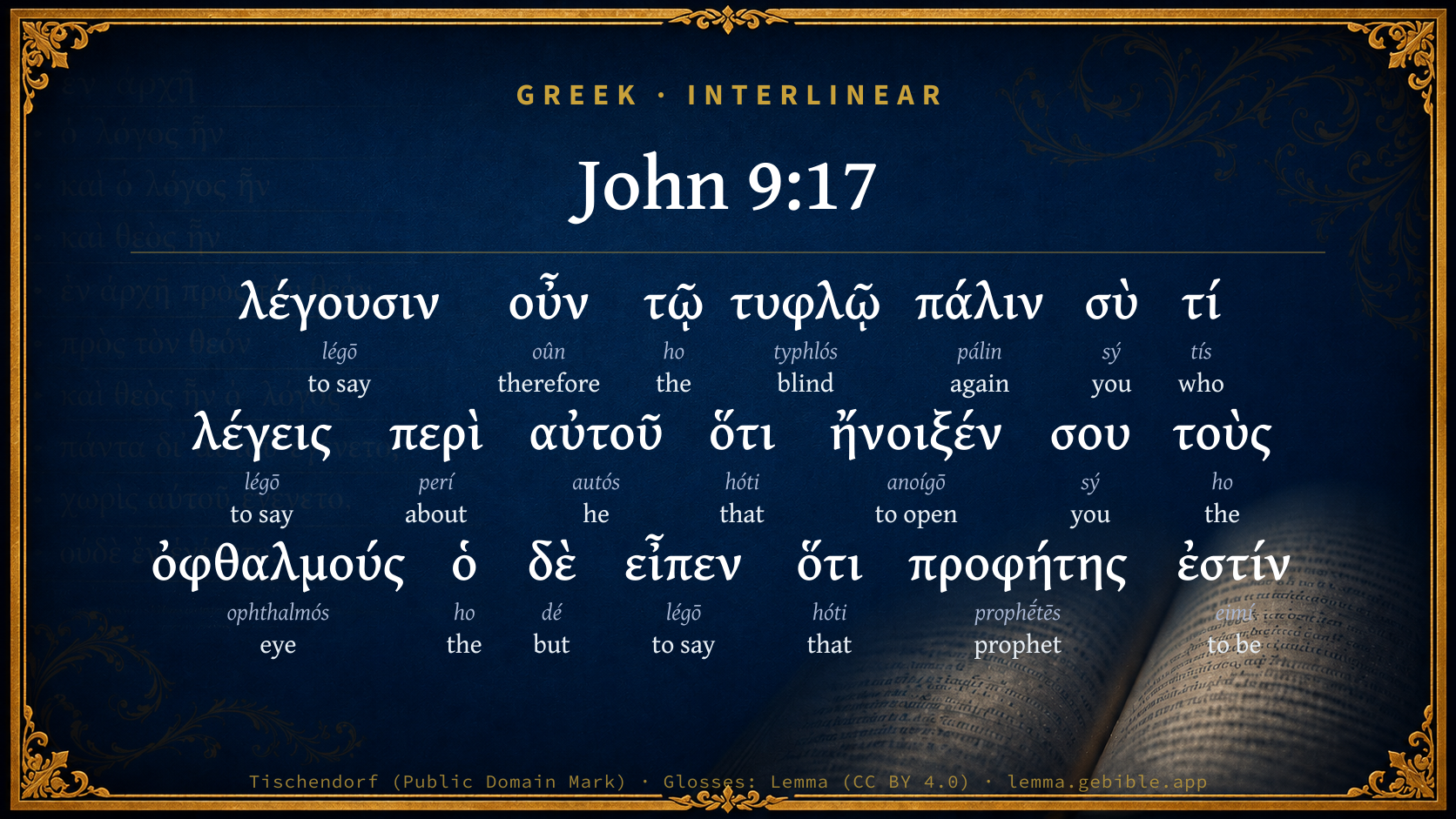
Greek (Tischendorf 8th ed.) John 9:17 appears in the Greek New Testament. The text above is from the Tischendorf 8th edition. Each word links to its Strong’s number and a concise gloss. Click any word for its full Thayer’s Greek Lexicon entry.
Download image
Cite this verse

John 9:17 (World English Bible). Public Domain. Lemma interlinear Bible study tool, https://lemma.gebible.app/v/john/9/17.

Show BibTeX & RIS
BibTeX
RIS
English Translation
Therefore they asked the blind man again, "What do you say about him, because he opened your eyes?" He said, "He is a prophet."
World English Bible · Public Domain
Download a study sheet

One document with this verse’s original text, its word-by-word gloss line, the meaning frame, cross-references with their text, attributed commentary, and full source and license credits — printable, and it pastes into notes with its structure intact.

This verse Autodidact and up

Study sheet (.html) Plain text (.txt)

A passage Seminary Student

Up to 50 verses in one chapter. A passage sheet keeps up to 6 commentary sources and 12 cross-references per verse, in the order this page ranks them, and says so on the sheet whenever that leaves anything out. Ask for a single verse and you get the Autodidact verse sheet above.

Everything on this page stays free to read, with no account — the sheet is a download of what is already on screen, not access to it.

Want to remove ads? Support Godless Engineer
Compare translations 3

The same verse in 3 English versions, stacked beneath the original-language interlinear above. Click any original word for its lexicon entry.

Each is an independent rendering of the whole verse — the interlinear is not word-aligned to these translations.

Highlighted words mark where these versions differ — a whole-verse word diff, not a word-by-word alignment.

  • World English Bible Public Domain
    Therefore they asked the blind man again, "What do you say about him, because he opened your eyes?" He said, "He is a prophet."
  • King James Version Public Domain
    They say unto the blind man again, What sayest thou of him, that he hath opened thine eyes? He said, He is a prophet.
  • unfoldingWord Literal Text CC BY-SA 4.0
    Therefore, they ask the blind man again, “What do you say about him, since he opened your eyes?” And he said, “He is a prophet.”

unfoldingWord Literal Text — © unfoldingWord, licensed CC BY-SA 4.0. Word-aligned USFM3 via Door43 (git.door43.org/unfoldingWord/en_ult).

Versions to compare (up to 4)

3 of 4 selected

Show all 19 translations

Every available English version of this verse, each an independent rendering of the whole verse.

  • World English Bible Public Domain
    Therefore they asked the blind man again, "What do you say about him, because he opened your eyes?" He said, "He is a prophet."
  • Berean Standard Bible Public Domain
    So once again they asked the man who had been blind, “What do you say about Him, since it was your eyes He opened?” “He is a prophet,” the man replied.
  • Majority Standard Bible Public Domain
    So once again they asked the man who had been blind, “What do you say about Him, since it was your eyes He opened?” “He is a prophet,” the man replied.
  • King James Version Public Domain
    They say unto the blind man again, What sayest thou of him, that he hath opened thine eyes? He said, He is a prophet.
  • American Standard Version (1901) Public Domain
    They say therefore unto the blind man again, What sayest thou of him, in that he opened thine eyes? And he said, He is a prophet.
  • Revised Version (1885) Public Domain
    They say therefore unto the blind man again, What sayest thou of him, in that he opened thine eyes? And he said, He is a prophet.
  • Geneva Bible (1599) Public Domain
    Then spake they vnto the blinde againe, What sayest thou of him, because he hath opened thine eyes? And he sayd, He is a Prophet.
  • Douay-Rheims (1899) Public Domain
    They say therefore to the blind man again: What sayest thou of him that hath opened they eyes? And he said: He is a prophet.
  • Young's Literal Translation Public Domain
    They said to the blind man again, `Thou -- what dost thou say of him -- that he opened thine eyes?'
  • Literal Standard Version CC BY-SA 4.0
    They said to the blind man again, “You—what do you say of Him—that He opened your eyes?”
  • Unlocked Literal Bible CC BY-SA 4.0
    So they asked the blind man again, “What do you say about him, since he opened your eyes?” The blind man said, “He is a prophet.”
  • unfoldingWord Literal Text CC BY-SA 4.0
    Therefore, they ask the blind man again, “What do you say about him, since he opened your eyes?” And he said, “He is a prophet.”
  • Darby Bible Public Domain
    They say therefore again to the blind [man], What dost thou say of him, that he has opened thine eyes? And he said, He is a prophet.
  • World Messianic Bible Public Domain
    Therefore they asked the blind man again, “What do you say about him, because he opened your eyes?” He said, “He is a prophet.”
  • Webster's Bible Public Domain
    They say to the blind man again, What sayest thou of him, that he hath opened thy eyes? He said, He is a prophet.
  • Free Bible Version CC BY-SA 4.0
    So they went on questioning the man. “What's your opinion about him, then, since it's your eyes he opened,” they asked. “He's surely a prophet,” the man replied.
  • Bible in Basic English Public Domain
    Again they said to the blind man, What have you to say about him for opening your eyes? And he said, He is a prophet.
  • Text-Critical English NT CC BY 4.0
    So they said to the blind man again, “What do yoʋ say about him, since he opened yoʋr eyes?” The man said, “He is a prophet.”
  • Tyndale New Testament (1534) Public Domain
    Then spake they vnto the blynde agayne: What sayst thou of him because he hath openned thyne eyes? And he sayd: He is a Prophet.

Literal Standard Version (2020), Covenant Press — licensed CC BY-SA 4.0. Text via the HelloAO Bible API (eBible.org). Unlocked Literal Bible (unfoldingWord) — licensed CC BY-SA 4.0. Text via the HelloAO Bible API (eBible.org). unfoldingWord Literal Text — © unfoldingWord, licensed CC BY-SA 4.0. Word-aligned USFM3 via Door43 (git.door43.org/unfoldingWord/en_ult). Free Bible Version, Dr. Jonathan Gallagher — licensed CC BY-SA 4.0. Text via the HelloAO Bible API (eBible.org).

Word by word

More ways to search: Search by grammar → Find every occurrence → Compare this word →

Practice this passage: Drill this verse → Learn its vocabulary →

τυφλῷ
typhlós
G5185
“blind”
Adjective, Dative, Singular, Masculine
Part of Speech
Adjective
Case
Dative
Number
Singular
Gender
Masculine
Full Thayer's Definition

Origin: from G5187

TDNT: 12:30,1

1. blind 2. mentally blind
  1. λέγουσιν légō G3004 “to say” Verb, Present, Active, Indicative, 3rd person, Plural
  2. οὖν oûn G3767 “therefore” Conjunction
  3. τῷ ho G3588 “the” Article, Dative, Singular, Masculine
  4. πάλιν pálin G3825 “again” Adverb
  5. σὺ sý G4771 “you” Personal pronoun, 2nd person, Nominative, Singular
  6. τί tís G5101 “who” Interrogative pronoun, Accusative, Singular, Neuter
  7. λέγεις légō G3004 “to say” Verb, Present, Active, Indicative, 2nd person, Singular
  8. περὶ perí G4012 “about” Preposition
  9. αὐτοῦ autós G846 “he” Personal pronoun, Genitive, Singular, Masculine
  10. ὅτι hóti G3754 “that” Conjunction
  11. ἤνοιξέν anoígō G455 “to open” Verb, Aorist, Active, Indicative, 3rd person, Singular
  12. σου sý G4771 “you” Personal pronoun, 2nd person, Genitive, Singular
  13. τοὺς ho G3588 “the” Article, Accusative, Plural, Masculine
  14. ὀφθαλμούς ophthalmós G3788 “eye” Noun, Accusative, Plural, Masculine
  15. ὁ ho G3588 “the” Article, Nominative, Singular, Masculine
  16. δὲ dé G1161 “but” Conjunction
  17. εἶπεν légō G3004 “to say” Verb, Aorist, Active, Indicative, 3rd person, Singular
  18. ὅτι hóti G3754 “that” Conjunction
  19. προφήτης prophḗtēs G4396 “prophet” Noun, Nominative, Singular, Masculine
  20. ἐστίν eimí G1510 “to be” Verb, Present, Active, Indicative, 3rd person, Singular

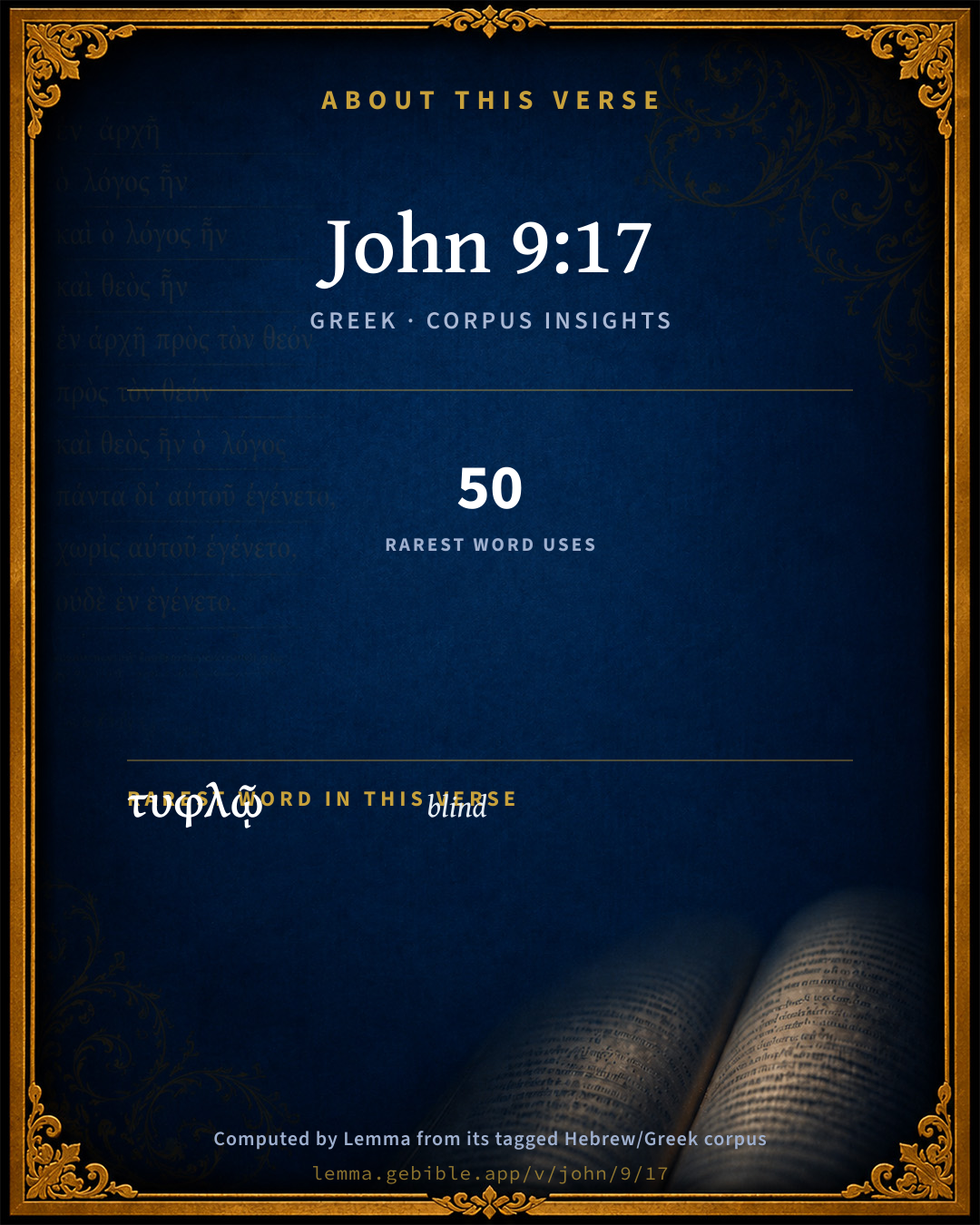
About this verse

These counts appear in no published source. They are computed here, from the morphology-tagged text and Lemma’s own curated glosses. What Lemma adds →

21
words
15
distinct lemmas
Gospels
section

Shared distinctive vocabulary

τυφλῷ blind G5185 occurs in 46 verses of the Greek New Testament. Also found in:
Repetition

Words recur within this verse:

Cross-references

7

Topical passages linked to John 9:17 in the Treasury of Scripture Knowledge — connected by theme and wording, ordered by reader-vote popularity; previews shown in the World English Bible.

  • John 4:19 The woman said to him, "Sir, I perceive that you are a prophet.
  • John 6:14 When therefore the people saw the sign which Jesus did, they said, "This is truly the prophet who comes into the world."
  • Acts 3:22–26 For Moses indeed said to the fathers, 'The Lord God will raise up a prophet for you from among your brothers, like me. You shall listen to him in all things whatever he says to you.
  • Matthew 21:11 The multitudes said, "This is the prophet, Jesus, from Nazareth of Galilee."
  • Luke 24:19 He said to them, "What things?" They said to him, "The things concerning Jesus, the Nazarene, who was a prophet mighty in deed and word before God and all the people;
  • Acts 2:22 "Men of Israel, hear these words! Jesus of Nazareth, a man approved by God to you by mighty works and wonders and signs which God did by him in the midst of you, even as you yourselves know,
  • Acts 10:38 even Jesus of Nazareth, how God anointed him with the Holy Spirit and with power, who went about doing good and healing all who were oppressed by the devil, for God was with him.

Cross-references courtesy of OpenBible.info (CC BY 4.0).

Where the printed editions differ

1 variant

Places in this verse where the major printed Greek editions disagree on the wording in a way that affects the translation — a comparison of editions, not a manuscript-by-manuscript collation. The editions are the modern critical texts (Nestlé-Aland 28/27, SBL, Westcott-Hort, Tregelles, Tyndale House) and the traditional texts behind the KJV (the Textus Receptus and the Byzantine/Majority text). It is not a claim about which reading is original.

  1. Extra text
    οὖν

    “therefore”

    In NA28NA27TynSBLWHTreg Not in TRByz

    οὖν (oun) 'therefore' is only in older manuscripts (NA28+NA27+Tyn+SBL+WH+Treg)

Textual data: Translators Amalgamated Greek New Testament (STEPBible TAGNT) · CC BY 4.0.

Commentary

Notes on John 9:17 from classic Christian and Jewish commentators (each source and its license shown beneath its notes). The classic Christian expositions comment on the surrounding passage and are grouped to its opening verse, so a note may address several verses; the Jewish commentaries on the Tanakh (Rashi and others) are per-verse, so they appear only where the commentator wrote on this verse.

Lemma curates 59 commentaries, every one of them public domain or Creative Commons licensed, each selected and text-cleaned for this edition rather than reprinted as found. About our sources →

Joseph Benson's Commentary

Joh 9:17-23. They say unto the blind man, What sayest thou of him — What inference dost thou draw from what thou sayest he hath done for thee? He said, He is a prophet — For surely otherwise he would have been unable to perform so great a miracle. But the Jews did not believe that he had been blind — The Jews, hoping to make the whole turn out a cheat, would not believe that the beggar had been blind, although all his neighbours had testified the truth of it, pretending, no doubt, that it was a common trick of beggars to feign themselves blind; and that this one in particular was in a combination with Jesus to advance his reputation; (see Joh 9:28;) a circumstance which they urged from the favourable opinion he had expressed of him. Until they called the parents of him that had received his sight — Having called his parents, they inquired of them, first, whether he was their son; next, if he had been born blind; and then, by what means he had obtained his sight. They answered, that most certainly he was their son, and had been born blind; but, with respect to the manner in which he had received his sight, and the person who had conferred it upon him, they could give no information; but that their son, being of age, would answer for himself. These words spake his parents, because they feared the Jews — “As the man who had been blind knew who had opened his eyes, without doubt he had given his parents an account, both of the name of his benefactor, and of the manner in which he had conferred the great blessing upon him; besides, having repeated these particulars frequently to his neighbours and acquaintance, who were all curious to hear him relate the miracle, (Joh 9:11,) we can conceive no reason why he should conceal them from his parents. The truth is, they lied grossly, and were ungrateful to Jesus in concealing his name on this occasion. But they were afraid to utter the least word which might seem to favour him.” For the Jews had agreed already — That is, it was resolved by an act of the court; that if any man did confess that he was the Christ, he should be put out of the synagogue — That is, should be excommunicated. They refused, therefore, to bear testimony unto Jesus, for fear of being excommunicated. “The Jews had two sorts of excommunication: one was what they called niddai, which separated the person under it four cubits from the society of others, so that it hindered him from conversing familiarly with them, but left him free, at that distance, either to expound the law, or hear it expounded in the synagogue. There was another kind, called shematta, from shem, which signifies a name in general, but, by way of eminence, was appropriated to God, whose awful name denotes all possible perfection. This kind of excommunication is said to have excluded the person under it from the synagogue for ever. We have the form of it, Ezr 10:7; Neh 13:25; being that which was inflicted on those Jews who refused to repudiate their strange wives. It seems to have been the censure also which the council threatened against those who should acknowledge Jesus to be the Messiah, and which they actually inflicted on this beggar; for the words, εξεβαλον αυτον, they cast him out, (Joh 9:34-35,) agree better to this kind than to the other. Probably, also, it was this that our Lord speaks of, when he says to his disciples, (Joh 16:2,) αποσυναγωγους ποιησουσιν υμας, they shall put you out of the synagogues. According to Selden, the synagogue from which persons under this censure were excluded, was every assembly whatever, whether religious or civil; the excommunicated person not being allowed to converse familiarly with his brethren, although he was not excluded either from public prayers or sacrifices. But in this opinion he has not many followers. The excommunications of the primitive Christians seem to have resembled those of the Jews in several particulars, for they excluded excommunicated persons from their religious assemblies, and from all communion in sacred things; and when they restored them to the privileges of the faithful, it was with much difficulty, and after a severe and long penance.” See Buxtorf, on the word Niddai; and Macknight.

Joseph Benson's Commentary on the Old and New Testaments (1811–1818) — public domain. Text from a community e-Sword module.

Tyndale Open Study Notes

Tyndale Open Resources

9:17 The man had already identified his healer (9:11, 16). Now he made his own spiritual judgment, calling Jesus a prophet.

Tyndale Open Study Notes — © Tyndale Open Resources, licensed CC BY-SA 4.0. Text via the HelloAO Bible API.

Bengel's Gnomon

Johann Albrecht Bengel

Joh 9:17. Προφήτης, a prophet) i.e. from God, Joh 9:16, “This man is not from God,” 33; ch. Joh 1:6, “There was a man sent from God,” etc.; Joh 3:2, “We know that Thou art a teacher come from God” [Jesus had prayed in undertaking the cure, Joh 9:31: and from that circumstance the blind man had come to know the close intimacy subsisting between Jesus and God.—V. g.] It is delightful to observe how faith gradually arises in this man, whilst the Pharisees are contradicting [Teased with the repeated questionings of the men, at last he unlearned the lesson of being bound by mere authority. Thus advantage may be derived even from the perverse ways and humours of others.—V. g.]

Bengel's Gnomon of the New Testament — English translation (T&T Clark, Edinburgh, 1860) — public domain. Text from a community e-Sword module.

Meyer's Critical & Exegetical Commentary

Heinrich August Wilhelm Meyer

Joh_9:17. As there was such a difference of views among those who were assembled, they feel it to be of importance to ascertain the opinion of the man who had been healed. It might lead to further light being thrown on the affair. The subject of λέγουσιν is οἱ Φαρισ., neither the hostile among them merely (Apollinarius and many others), nor the well-wishers alone (Chrysostom and his followers).

πάλιν] a repetition of the question after Joh_9:15.

ὅτι] εἰς ἐκεῖνο, ὅτι; see on Joh_2:18. Theodore of Mopsuestia well remarks: ὑπὲρ ὧν.

προφήτης] who had shown Himself to be such by this miracle. Comp. Joh_3:2, Joh_4:19, Joh_6:14, al. Thus the faith of the man became clear and confirmed by the controversy of the Pharisees. And he makes confession of what he up to this time believes.

Meyer — Critical and Exegetical Commentary on the New Testament — English translation by Peter Christie, edited by Frederick Crombie (T&T Clark, 1880) — public domain. Text from a community e-Sword module.

Expositor's Greek Testament

ed. W. Robertson Nicoll

Joh 9:17 . Differing among themselves, they refer the question to the man, Σὺ τί λέγεις … “You, what do you say about Him, on account of His opening your eyes?” The question is not one of fact, but of inference from the fact; the ὅτι means “in that,” “inasmuch as,” and the Vulgate simply renders “Tu quid dicis de illo, qui aperuit oculos tuos?” Promptly the man replies, προφήτης ἐστίν .

The Expositor's Greek Testament, edited by W. Robertson Nicoll (1897–1910) — public domain. Text from a community e-Sword module.

Jamieson, Fausset & Brown

Robert Jamieson, A. R. Fausset & David Brown

the blind man . . . said, He is a prophet--rightly viewing the miracle as but a "sign" of His prophetic commission.

Jamieson, Fausset & Brown — Commentary Critical and Explanatory on the Whole Bible (1871) — public domain (CC PDM 1.0). Text via the HelloAO Bible API.

Adam Clarke's Commentary

Verse 17. He is a prophet.] They had intended to lay snares for the poor man, that, getting him to acknowledge Christ for the Messiah, they might put him out of the synagogue, Joh 9:22, or put him to death, that such a witness to the Divine power of Christ might not appear against them. But, as the mercy of God had given him his sight, so the wisdom of God taught him how to escape the snares laid for his ruin. On all thy glory there shall be a defense, says the prophet, Isa 4:5. When God gives any particular mercy or grace, he sends power to preserve it, and wisdom to improve it. The man said, He is a prophet. Now, according to a Jewish maxim, a prophet might dispense with the observation of the Sabbath. See Grotius. If they allow that Jesus was a prophet, then, even in their sense, he might break the law of the Sabbath, and be guiltless: or, if they did not allow him to be a prophet, they must account for the miracle some other way than by the power of God; as from Satan or his agents no good can proceed - to do this it was impossible. So the wisdom of God taught the poor man to give them such an answer as put them into a complete dilemma, from which they could not possibly extricate themselves.

Adam Clarke's Commentary on the Bible (1810–1826) — public domain. Text from a community e-Sword/MySword module.

John Calvin's Commentaries

17. They say to him who had been blind. The more diligently they inquire, the more impressively does the truth of God appear; for they act as if one were endeavoring to extinguish a strong flame by his breath. Thus, when we see wicked men contrive all that they can to crush the truth of God, we have no reason to be afraid, or to be excessively anxious about the result, for all that they can gain in this way will be to cause its light to burn with greater brightness.

What sayest thou of him? When they ask the blind man what is his opinion, they do so, not because they wish to abide by his judgment, or set any value on it, but because they hope that the man, struck with fear, will reply according to their wish. In this respect the Lord disappoints them; for when a poor man disregards their threatenings, and boldly maintains that Christ is a Prophet, we ought justly to ascribe it to the grace of God; so that this boldness is another miracle. And if he so boldly and freely acknowledged Christ to be a Prophet, though he did not as yet know that the Lord Jesus was the Son of God, how shameful is the treachery of those who, subdued by fear, either deny him, or are silent respecting him, though they know that he sitteth at the right hand of the Father, and that he will come thence to be the Judge of the whole world! Since this blind man did not quench a small spark of knowledge, we ought to endeavor that an open and full confession may blaze forth from the full brightness which has shone into our hearts.

John Calvin's Commentaries (1540-1563) — public domain. Text from the Calvin Translation Society English edition (1840s-50s) via the Christian Classics Ethereal Library (ccel.org). Calvin's coverage is partial (roughly two-thirds of the Bible); uncommented books and verses are honest gaps, never fabricated. The 19th-century editor's footnotes and remarks are omitted so the notes are faithfully Calvin's own voice.

Ellicott's Commentary for English Readers

(17) They say unto the blind man again.—The question is not asked by either of the parties, for this must have been noted, but by the assembly generally. They who questioned him in Joh_9:15, question him again now. They have differed among themselves, and they ask what impression the fact of the miracle had left upon him who was the object of it, with regard to the person of Him who had performed it.

What sayest thou of him, that he hath opened thine eyes?—Stress is laid on the pronoun. What sayest thou? He ought to know better than any one, seeing that his eyes had been opened and this they admit, while the nature of his witness is uncertain; but immediately that is given they disbelieve the fact of the miracle, and soon reject with scorn him they question now (Joh_9:34).

The English reader should observe the punctuation here, which rightly makes the question one. It is sometimes read as though it were, “What sayest thou of Him? that He hath opened thine eyes?” It is not, however, the fact which is here questioned, but the opinion of the man, based upon the fact, for the present assumed as true, which is called for.

He is a prophet.—The education of the man has been doing its work, and he is convinced that the power which has healed him is direct from God, and that the person who has exercised it is a messenger from God. His words are uttered in the brevity and calmness of clear conviction, and they are the direct negative to the statement of the Pharisees, “This man is not from God.” (Comp Joh_3:2; Joh_4:19; Joh_6:14.) It is important to note, that even in the language of the ordinary people, the word “prophet” did not mean simply a predictor of events in the future, but one who was as the representative of God. He was not only or chiefly a “fore-teller,” but a “forth-teller,” declaring God’s truth, revealing His will and character, bearing the witness of divine works; but as the future is ever present to the divine counsels, prophecy, in the narrower sense, may be part of the work of the true prophet.

A Bible Commentary for English Readers, edited by Charles John Ellicott (1878–1897) — public domain. Text from a community e-Sword module.

The Cambridge Bible for Schools and Colleges

gen. ed. J. J. S. Perowne

17. There being a division among them they appeal to the man himself, each side wishing to gain him. ‘They’ includes both sides, the whole body of Pharisees present. Their question is not twofold, but single; not, ‘What sayest thou of Him? that He hath opened thine eyes?’ but What sayest thou of Him, because He opened thine eyes? ‘Thou’ is emphatic; ‘thou shouldest know something of Him.’ They do not raise the question of fact; the miracle as yet is not in dispute. His answer shews that only one question is asked, and that it is not the question of fact.

He is a prophet] i.e. one sent by God to declare His will; a man with a special and Divine mission; not necessarily predicting the future. Comp. Joh_4:19, Joh_3:2.

The Cambridge Bible for Schools and Colleges (gen. ed. J. J. S. Perowne; Cambridge University Press, 1878–1918) — public domain. Text from a community e-Sword module.

John Gill's Exposition

They say unto the blind man again,.... After they had discoursed among themselves, and could not agree about the author of the miracle, they turn to him that had been blind, who is called the blind man, because he had been so, and ask him his sentiments of him:

what sayest thou of him, that he hath opened thine eyes? the question seems, at first sight, as if it was, whether Jesus had opened his eyes or not; but by the answer it appears, that it required his thoughts of him, "who hath opened thine eyes", as the Vulgate Latin and Persic versions read; or "seeing", or "because he hath opened thine eyes", as the Arabic and Ethiopic versions:

he said, he is a prophet; the Syriac and Persic versions read, "I say he is a prophet"; or, "he is certainly a prophet", as the Arabic version. The Jews were wont to conclude a man's being a prophet from miracles wrought by him; see Joh 6:14; though it does not appear that he believed him, as yet, to be that prophet, or the Messiah, that was to come; see Joh 9:36.

John Gill's Exposition of the Whole Bible (1746–1763) — public domain (CC PDM 1.0). Text via the HelloAO Bible API.

Trapp's Complete Commentary

John Trapp

17 They say unto the blind man again, What sayest thou of him, that he hath opened thine eyes? He said, He is a prophet.

Ver. 17. He is a prophet] The more the Pharisees opposed the truth, the more it appeared. Veritas abscondi erubeseit, saith Tertullian. The Reformation was much furthered in Germany by the Papists’ opposition. Among many others two kings wrote against Luther, viz. Henry VIII of England and Ludovicus of Hungary. This kingly title being entered into the controversy, made men more curious. And as it happeneth in combats that the onlookers are ready to favour the weaker and to extol his actions, though they be but mean; so here it stirred up a general inclination toward Luther, saith the author of the Hist. of the Council of Trent. Luther also in an epistle to the Elector of Saxony, triumpheth and derideth the foolish wisdom of the Papists in causing him and the other Protestant princes to rehearse the confession of their faith in a public assembly of the States of Germany, and in sending copies thereof to all the courts of Christendom for advice; whereby the Gospel was more propagated, and the cause of Christ more advanced, than if many preachers had been sent out and licensed.

John Trapp, A Commentary or Exposition upon All the Books of the Old and New Testament (1647–1656) — public domain. Text from a community e-Sword module.

Albert Barnes' Notes on the Bible

What sayest thou of him? ... - The translation here expresses the sense obscurely. The meaning is, “What sayest thou of him for giving thee sight?” (Campbell); or, “What opinion of him hath this work of power and mercy to thee wrought in thee?” (Hammond).

He is a prophet - That is “I think that the power to work such a miracle proves that he is sent from God. And though this has been done on the Sabbath, yet it proves that he must have been sent by God, for such a power could never have proceeded from man.” We see here:

A noble confession made by the man who was healed, in the face of the rulers of the people, and when he doubtless knew that they were opposed to Jesus. We should never be ashamed, before any class of men, to acknowledge the favors which we have received from Christ, and to express our belief of his power and of the truth of his doctrine. The works of Jesus were such as to prove that he came from God, however much he may have appeared to oppose the previous notions of men, the interpretation of the law by the Pharisees, or the deductions of reason. People should yield their own views of religion to the teachings of God, and believe that he that could open the eyes of the blind and raise the dead was fitted to declare his will.

Albert Barnes' Notes on the Bible (1834–1885) — public domain. Text from a community e-Sword/MySword module.

Haydock's Catholic Bible Commentary

The Hebrews gave the name of prophet to all those who were honoured by the Almighty in a particular manner. And it was a maxim amongst them, that a prophet could dispense with the law of the sabbath. (Calmet) --- Do you wish to know what he believed Jesus to be? asks St. Augustine. And falling down, he adored him. Before, he regarded him as a holy man, as a prophet; but he did not adore him until he understood him to be the Son of God; whereas no sooner did he know this, than, falling down, he paid him that sovereign worship which is due to God alone. (Calmet)

George Leo Haydock (1774–1849), Haydock's Catholic Family Bible and Commentary, 1859 edition — public domain. Excludes Psalms (Douay-Rheims chapter numbering differs from Protestant) and Deuterocanonical books (Catholic canon only).

Matthew Poole's English Annotations

What sayest thou of him, that he hath opened thine eyes? What opinion hast thou of this man, who hath opened thine eyes? To make the question perfect, interpreters think, there ought to be this supplement, on the sabbath day. What dost thou think of such a man as this, who would make clay, and apply it to thy cure upon the sabbath day? How can such a act be defended?

The blind man answered,

He is a prophet. It was taken for granted by the Jews, according to their traditions, that at the command of a prophet it was lawful to violate the sabbath; which indeed is no more than, that God hath not, in giving us a law, bound up himself, but he may dispense with his own law. Their prophets had an extraordinary mission from God, and immediately revealed the will of God; so as they looked upon what they said as spoken by God himself. The blind man declareth, that he believed that Christ was a prophet; and being so, his words and actions had an extraordinary warrant, and therefore were not to be judged by ordinary rules.

Matthew Poole's English Annotations on the Holy Bible (1683–1685) — public domain. Text from a community e-Sword/MySword module.

Whedon's Commentary on the Bible

Daniel D. Whedon

17. What sayest thou of him, [in view of the matter,] that he hath opened— This shows that there is but one question. And the crooked question brings a straight answer.

A prophet—The man had heard from the readings of the Old Testament (though his own eyes had never seen a letter) that there were prophets of old, who did works by the power of God, and whose words, as from God, were thus divinely authenticated. Nothing less than such a one, even before this spiritual court, he avers, could this restorer of his sight have been. And this firm confessor shows himself prepared for that humble reception of Jesus’s words which he exhibited in Joh_9:36-38. He is a predestined sheep of Christ; predestined, that is, by predisposition and free volitional purpose before he is by full regeneration. And this confession disconcerts these lords spiritual for the moment. But they fall back upon a pretext; perhaps his parents will admit that he was not born blind.

Daniel D. Whedon (gen. ed.), Commentary on the Old and New Testaments (1874–1909) — public domain. Text from a community e-Sword module.

The Pulpit Commentary

They; i.e. the Pharisees, divided in opinion, though probably united in their interrogation. Those, on the one hand, who believed in the miracle, and held that it carried Divine approbation of the conduct of Jesus, and, on the other hand, those who were so satisfied of the moral fault involved in the transaction, that they held that the miracle itself, if not a piece of deception or collusion, might even indicate some demonic source, rather than a Divine one, say therefore unto the blind man again the palin points to the virtual repetition of inquiries already made (ver. 15)What dost thou say concerning him, seeing that he opened thine eyes? "What explanation hast thou to offer? What view dost thou entertain of the Man himself? Some of us think that his trifling with the sabbatic law puts out of court the idea of any Divine aid having enabled him to work this marvel. Other some, as you see, declare that the fact which has occurred is proof that Jesus must have had God"s approval, and be sustained by Divine grace. But what dost thou, the healed man, say? What conclusion hast thou adopted? Seeing that he has opened thine eyes, what sayest thou of Jesus?" There is a bare chance that the man might give a vague answer, or one which would minimize the miracle. It is obvious that, while the Pharisees were contradicting each other and in danger of open collision, the faith of the blind man who had received his sight became stronger. The light was dawning on him. The answer, so far as it went, boldly took the side of Jesus, and perhaps its cue from the language of those who had said, "How can a bad man do such signs as these?" And he said, He is a Prophet. (cf. Joh_4:19 Joh_6:14) Prophets, as divinely sent men, are even more authoritative than learned rabbis. If Jesus has broken through some of these restrictions by which they have "placed a hedge about the Law," surely he had a prophetic right to do it. The healing marks a Divine commission, and the healed man owned and freely confessed to so much as this: "He is a Prophet." Maimonides (quoted by Dr. Farrar) shows that the idea was current that a prophet might, on his own ipse dixit, alter or relax even the sabbath law, and that then the people were at liberty to obey him.

The Pulpit Commentary (1880–1919), ed. H.D.M. Spence-Jones & Joseph S. Exell — public domain. Text from a community e-Sword module.

John Wesley's Explanatory Notes

What sayest thou of him, for that he hath opened thine eyes? - What inference dost thou draw herefrom?

John Wesley, Explanatory Notes Upon the Whole Bible (1754–1765) — public domain. Text via the GEBible commentary corpus.

Burkitt's Expository Notes on the New Testament

William Burkitt

Observe here, 1. How desirous the Pharisees were to obscure the glory of this famous miracle which Christ had wrought: in order to which,

1. They re-examine the man, to know what his thoughts were of the person who had done this for him: they judged him to be an impostor and a great sinner: the man declares freely, That he believed him to be a great prophet.

Hence we learn, That there may be, and sometimes is, more true knowledge of Jesus Christ in one poor man, than in a general counsel of learned rabbies. This blind man saw Christ to be a prophet, when the Jewish sanhedrin saw nothing in him but imposture. This man is not of God, says the council: Verily, he is a prophet, says the blind man.

2. They next examine his parents (being unwilling to believe the man himself) Whether he was their son, or not? If so, whether he were born blind? Lord! what obstinate and willful blindness was found in these Pharisees! How do they close their eyes and say, We will not see; What endeavours are here used to smother a miracle, which undeniably proved Christ to be the expected Messias! They examine first the man, then his parents, then the man again; hoping, that being over-awed with fear, they would either deny, or at least conceal, the truth; but the more they strove to darken and obscure the truth; the more conspicuous and evident they made it. Great is truth, and will prevail, how many soever oppose it, and set themselves against it.

Observe next, The wisdom and cautiousness of his parents answer: they expressly own, the blind man was their son; that he was born blind; but for the way of his cure they wave that, possibly because they did not see this cure wrought, and fearing the sentence of excommunication, a decree being passed among the rulers, That whoso confesseth Christ, shall be put out of the synagogue.

Hence learn, 1. That excommunication or separation from the society of the people of God, is an ancient and honourable ordinance in the church of God, and as such to be revered and esteemed.

2. That this ordinance of God has been, and may be, abused by wicked men, and the edge of it turned against Christ himself, and his sincerest members.

3. That the fear of unjust excommunication must not discourage persons from confessing the truth, when called to it. The parents of the blind man durst not confess Christ, for fear that they should be put out of the synagogue.

William Burkitt's Expository Notes on the New Testament (1700–1703) — public domain. Text from a community e-Sword module.

The People's New Testament

B. W. Johnson

17. He said, He is a prophet. A little while before he had said that “a man called Jesus” healed him; now he declares that “he is a prophet;” a little later he is prepared to receive him as the Son of God. His convictions constantly deepened.

B. W. Johnson's The People's New Testament with Notes (1889–1891) — public domain. Electronic text from the Christian Classics Ethereal Library (CCEL) ThML edition.

Cambridge Greek Testament for Schools and Colleges

17. There being a division among them they appeal to the man himself, each side wishing to gain him. ‘They’ includes both sides, the whole body of Pharisees present. Their question is not twofold, but single; not ‘What sayest thou of Him? that He hath opened thine eyes?’ but What sayest thou of Him, because He opened thine eyes? Comp. Joh 2:18. ‘Thou’ is emphatic: ‘thou shouldest know something of Him.’ They do not raise the question of fact; the miracle is still undisputed. His answer shews that only one question is asked, and that it is not the question of fact.

προφήτης. i.e. one sent by God to declare His will; a man with a special and Divine mission; not necessarily predicting the future. Comp. Joh 4:19, Joh 3:2. His answer is short and decided.

Cambridge Greek Testament for Schools and Colleges (Cambridge University Press, 1896; 21 vols, various authors incl. Carr, Maclear, Plummer, Farrar, Lumby, Moule, M. R. James, Simcox) — public domain. Text from a community e-Sword module.

Alford’s Greek Testament

Henry Alford

17.] The question is but one, as in E. V., What sayest thou of him, that he hath opened (i.e. for having opened) thine eyes? The stress is on σύ—‘What hast thou to say to it, seeing we are divided on the matter?’ Both parties are anxious to have the man’s own view to corroborate theirs.

προφ., and therefore παρὰ τοῦ θεοῦ.

Henry Alford, The Greek Testament (1849–1861) — public domain. Text from a community e-Sword module.

International Critical Commentary

17. λέγουσιν οὖν τῷ τυφλῷ πάλιν, “they,” sc. the Pharisees collectively who were present, “say again to the blind man,” i.e. they resume their inquiry, to get more details.

τί σὺ λέγεις περὶ αὐτοῦ; “What do you say about Him?”

ὅτι ἠνέῳξέν implies that as Jesus had opened his eyes, the man’s opinion was worth having. “What do you say, inasmuch as it was your eyes that He opened?” conveys the sense. For the constr., cf. 2:18. Burney suggested that ὅτι is here a mistranslation of the Aramaic relative דְּ, and points to the Vulgate qui aperuit. But it is not necessary to appeal to an Aramaic original here. See Abbott, Diat. 2183.

The man’s answer was προφήτης ἐστίν. He did not say that Jesus was “the prophet,” as the multitude said after the miracle of the loaves (6:14), but only that He was “a prophet,” a simple answer like that of the Samaritan woman (4:19), i.e. that He was an extraordinary person who could do extra-ordinary things.

International Critical Commentary — older volumes (1896–1929), various authors — public domain. Text from a community e-Sword module.

Lesson kit

Teaching starters — assembled from the data on this page, not authored interpretation. Every prompt links to the verse data it draws on. Edit before teaching.

John, in the Gospels, opens this verse with 21 words (15 distinct Greek lemmas). Its most distinctive word is typhlós (“blind”). A historical commentator’s framing appears above. Read the whole chapter for the surrounding context.

Discussion questions

  1. The word typhlós carries the sense “blind.” How does it shape the verse?
  2. Matthew 9:27 shares the word «blind» with this verse. How do the two illuminate each other?
  3. “to say” occurs 3× in this one verse. What is the effect of the repetition?
  4. These translations render this verse differently; the difference is in the English rendering, not the original. What questions does that raise?
  5. Reading how Joseph Benson's Commentary and Tyndale Open Study Notes read this verse, where do the two commentators agree and where do they part?

Things to notice

  • These translations choose different wording for 9 words in this verse.
  • “to say” occurs 3× in this single verse.
  • 15 distinct Greek lemmas span 21 words in this verse.

Reading settings

Reading text

Shown beneath each verse's original-language words.

Old Testament
Old Testament edition

Read the OT as the Masoretic Hebrew (MT) or the Greek Septuagint (LXX).

English shown for the Greek Septuagint (in the Hebrew ↔ Greek comparison).

Comparing translations? Open the Compare panel on any verse page to stack up to four side by side.