John 11:57

Greek (Tischendorf 8th ed.) John 11:57 appears in the Greek New Testament. The text above is from the Tischendorf 8th edition. Each word links to its Strong’s number and a concise gloss. Click any word for its full Thayer’s Greek Lexicon entry.
Download image
Cite this verse

John 11:57 (World English Bible). Public Domain. Lemma interlinear Bible study tool, https://lemma.gebible.app/v/john/11/57.

Show BibTeX & RIS
BibTeX
RIS
English Translation
Now the chief priests and the Pharisees had commanded that if anyone knew where he was, he should report it, that they might seize him.
World English Bible · Public Domain
Download a study sheet

One document with this verse’s original text, its word-by-word gloss line, the meaning frame, cross-references with their text, attributed commentary, and full source and license credits — printable, and it pastes into notes with its structure intact.

This verse Autodidact and up

Study sheet (.html) Plain text (.txt)

A passage Seminary Student

Up to 50 verses in one chapter. A passage sheet keeps up to 6 commentary sources and 12 cross-references per verse, in the order this page ranks them, and says so on the sheet whenever that leaves anything out. Ask for a single verse and you get the Autodidact verse sheet above.

Everything on this page stays free to read, with no account — the sheet is a download of what is already on screen, not access to it.

Want to remove ads? Support Godless Engineer
Compare translations 3

The same verse in 3 English versions, stacked beneath the original-language interlinear above. Click any original word for its lexicon entry.

Each is an independent rendering of the whole verse — the interlinear is not word-aligned to these translations.

Highlighted words mark where these versions differ — a whole-verse word diff, not a word-by-word alignment.

  • World English Bible Public Domain
    Now the chief priests and the Pharisees had commanded that if anyone knew where he was, he should report it, that they might seize him.
  • King James Version Public Domain
    Now both the chief priests and the Pharisees had given a commandment, that, if any man knew where he were, he should shew it, that they might take him.
  • unfoldingWord Literal Text CC BY-SA 4.0
    Now the chief priests and the Pharisees had given an order so that if anyone might know where he was, he should report it so that they might seize him.

unfoldingWord Literal Text — © unfoldingWord, licensed CC BY-SA 4.0. Word-aligned USFM3 via Door43 (git.door43.org/unfoldingWord/en_ult).

Versions to compare (up to 4)

3 of 4 selected

Show all 18 translations

Every available English version of this verse, each an independent rendering of the whole verse.

  • World English Bible Public Domain
    Now the chief priests and the Pharisees had commanded that if anyone knew where he was, he should report it, that they might seize him.
  • Berean Standard Bible Public Domain
    But the chief priests and Pharisees had given orders that anyone who knew where He was must report it, so that they could arrest Him.
  • Majority Standard Bible Public Domain
    But the chief priests and Pharisees had given an order that anyone who knew where He was must report it, so that they could arrest Him.
  • King James Version Public Domain
    Now both the chief priests and the Pharisees had given a commandment, that, if any man knew where he were, he should shew it, that they might take him.
  • American Standard Version (1901) Public Domain
    Now the chief priests and the Pharisees had given commandment, that, if any man knew where he was, he should show it, that they might take him.
  • Revised Version (1885) Public Domain
    Now the chief priests and the Pharisees had given commandment, that, if any man knew where he was, he should shew it, that they might take him.
  • Geneva Bible (1599) Public Domain
    Now both the high Priestes and the Pharises had giuen a commandement, that if any man knew where he were, he should shew it, that they might take him.
  • Young's Literal Translation Public Domain
    and both the chief priests and the Pharisees had given a command, that if any one may know where he is, he may shew `it', so that they may seize him.
  • Literal Standard Version CC BY-SA 4.0
    And both the chief priests and the Pharisees had given a command, that if anyone may know where He is, he may show [it], so that they may seize Him.
  • Unlocked Literal Bible CC BY-SA 4.0
    Now the chief priests and the Pharisees had given an order that if anyone knew where Jesus was, he should report it so that they might seize him.
  • unfoldingWord Literal Text CC BY-SA 4.0
    Now the chief priests and the Pharisees had given an order so that if anyone might know where he was, he should report it so that they might seize him.
  • Darby Bible Public Domain
    Now the chief priests and the Pharisees had given commandment that if any one knew where he was, he should make it known, that they might take him.
  • World Messianic Bible Public Domain
    Now the chief priests and the Pharisees had commanded that if anyone knew where he was, he should report it, that they might seize him.
  • Webster's Bible Public Domain
    Now both the chief priests and the Pharisees had given a commandment, that, if any man knew where he was, he should show it, that they might take him.
  • Free Bible Version CC BY-SA 4.0
    The chief priests and the Pharisees had given orders that anyone who knew where Jesus was should report it so they could arrest him.
  • Bible in Basic English Public Domain
    Now the chief priests and the Pharisees had given orders that if anyone had knowledge where he was, he was to give them word, so that they might take him.
  • Text-Critical English NT CC BY 4.0
    (Now the chief priests and the Pharisees had given an order that if anyone knew where Jesus was, he should report it, so that they could arrest him.)
  • Tyndale New Testament (1534) Public Domain
    The hye prestes and Pharises had geven a commaundement that yf eny man knew where he were he shuld shewe it that they myght take him.

Literal Standard Version (2020), Covenant Press — licensed CC BY-SA 4.0. Text via the HelloAO Bible API (eBible.org). Unlocked Literal Bible (unfoldingWord) — licensed CC BY-SA 4.0. Text via the HelloAO Bible API (eBible.org). unfoldingWord Literal Text — © unfoldingWord, licensed CC BY-SA 4.0. Word-aligned USFM3 via Door43 (git.door43.org/unfoldingWord/en_ult). Free Bible Version, Dr. Jonathan Gallagher — licensed CC BY-SA 4.0. Text via the HelloAO Bible API (eBible.org).

Word by word

More ways to search: Search by grammar → Find every occurrence → Compare this word →

Practice this passage: Drill this verse → Learn its vocabulary →

μηνύσῃ
mēnýō
G3377
“to disclose”
Verb, Aorist, Active, Subjunctive, 3rd person, Singular
Part of Speech
Verb
Tense
Aorist
Voice
Active
Mood
Subjunctive
Person
3rd person
Number
Singular
Full Thayer's Definition

Origin: probably from the same base as G3145 and G3415 (i.e. mao, to strive)

TDNT: None

1. to disclose or make known something secret a. in a forensic sense, to inform, report 2. to declare, tell, make known 3. to indicate, intimate a. of a teacher
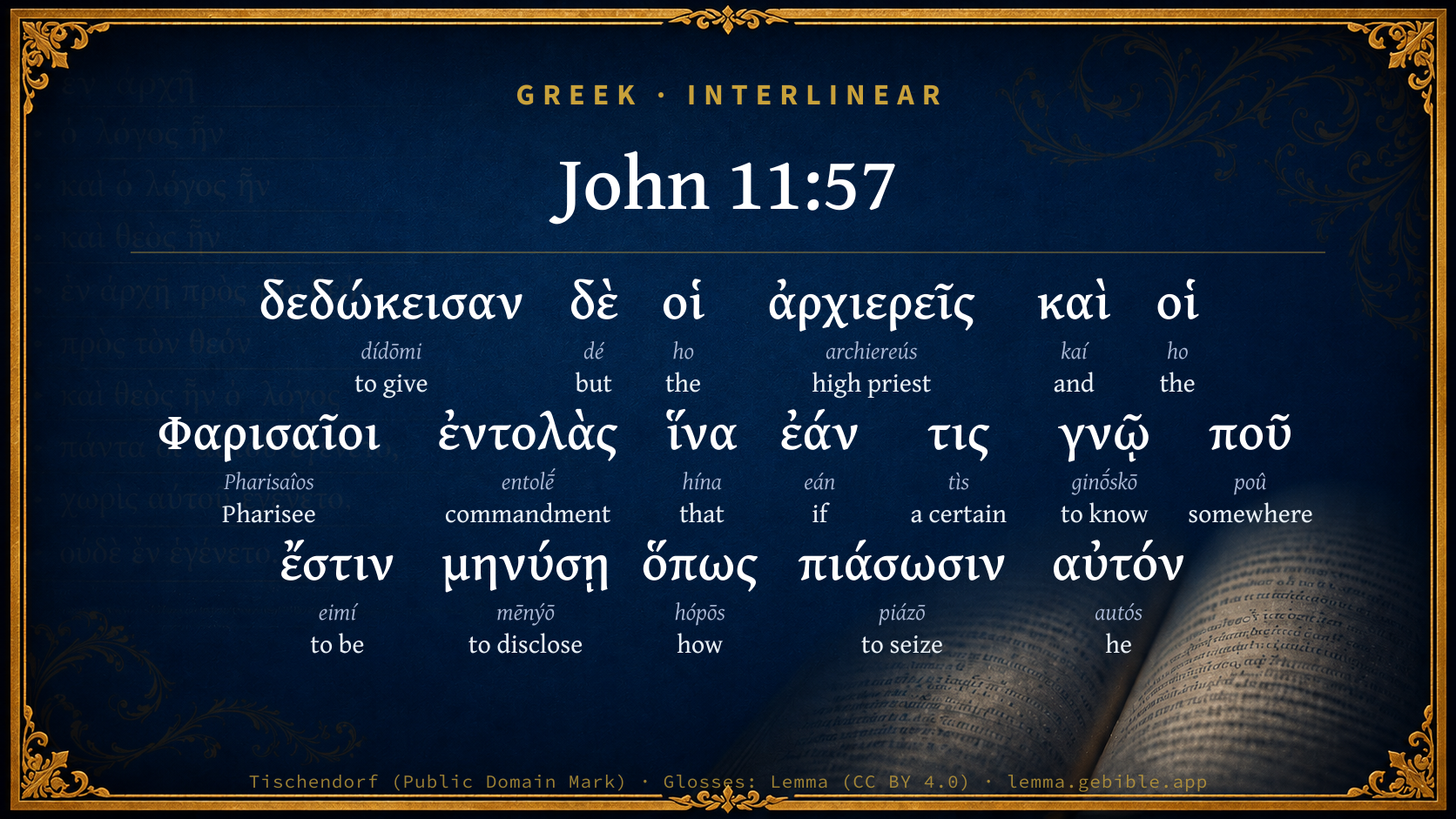
  1. δεδώκεισαν dídōmi G1325 “to give” Verb, Pluperfect, Active, Indicative, 3rd person, Plural, Attic form
  2. δὲ dé G1161 “but” Conjunction
  3. οἱ ho G3588 “the” Article, Nominative, Plural, Masculine
  4. ἀρχιερεῖς archiereús G749 “high priest” Noun, Nominative, Plural, Masculine
  5. καὶ kaí G2532 “and” Conjunction
  6. οἱ ho G3588 “the” Article, Nominative, Plural, Masculine
  7. Φαρισαῖοι Pharisaîos G5330 “Pharisee” Noun, Nominative, Plural, Masculine
  8. ἐντολὰς entolḗ G1785 “commandment” Noun, Accusative, Plural, Feminine
  9. ἵνα hína G2443 “that” Conjunction
  10. ἐάν eán G1437 “if” Conditional
  11. τις tìs G5100 “a certain” Indefinite pronoun, Nominative, Singular, Masculine
  12. γνῷ ginṓskō G1097 “to know” Verb, Aorist, Active, Subjunctive, 3rd person, Singular
  13. ποῦ poû G4226 “somewhere” Particle, Interrogative
  14. ἔστιν eimí G1510 “to be” Verb, Present, Active, Indicative, 3rd person, Singular
  15. ὅπως hópōs G3704 “how” Adverb
  16. πιάσωσιν piázō G4084 “to seize” Verb, Aorist, Active, Subjunctive, 3rd person, Plural
  17. αὐτόν autós G846 “he” Personal pronoun, Accusative, Singular, Masculine

About this verse

These counts appear in no published source. They are computed here, from the morphology-tagged text and Lemma’s own curated glosses. What Lemma adds →

18
words
17
distinct lemmas
Gospels
section

Notable vocabulary

The rarest word here is μηνύσῃ to disclose G3377 — appearing just 4 times in the whole Greek New Testament.

Shared distinctive vocabulary

μηνύσῃ to disclose G3377 occurs in 4 verses of the Greek New Testament. Also found in:

Repetition

A word recurs within this verse:

Cross-references

5

Topical passages linked to John 11:57 in the Treasury of Scripture Knowledge — connected by theme and wording, ordered by reader-vote popularity; previews shown in the World English Bible.

  • Psalms 109:4 In return for my love, they are my adversaries; But I am in prayer.
  • John 5:16–18 For this cause the Jews persecuted Jesus, and sought to kill him, because he did these things on the Sabbath.
  • John 8:59 Therefore they took up stones to throw at him, but Jesus was hidden, and went out of the temple, having gone through the midst of them, and so passed by.
  • John 9:22 His parents said these things because they feared the Jews; for the Jews had already agreed that if any man would confess him as Christ, he would be put out of the synagogue.
  • John 10:39 They sought again to seize him, and he went out of their hand.

Cross-references courtesy of OpenBible.info (CC BY 4.0).

Where the printed editions differ

1 variant

Places in this verse where the major printed Greek editions disagree on the wording in a way that affects the translation — a comparison of editions, not a manuscript-by-manuscript collation. The editions are the modern critical texts (Nestlé-Aland 28/27, SBL, Westcott-Hort, Tregelles, Tyndale House) and the traditional texts behind the KJV (the Textus Receptus and the Byzantine/Majority text). It is not a claim about which reading is original.

  1. Different wording
    ἐντολὰς

    “commands”

    In NA28NA27TynSBLWHTreg Not in TRByz

    ἐντολήν (entolēn) 'a command' occurs in traditional manuscripts (TR+Byz) instead of ἐντολὰς (entolas) 'commands' in older manuscripts (NA28+NA27+Tyn+SBL+WH+Treg)

Textual data: Translators Amalgamated Greek New Testament (STEPBible TAGNT) · CC BY 4.0.

Commentary

Notes on John 11:57 from classic Christian and Jewish commentators (each source and its license shown beneath its notes). The classic Christian expositions comment on the surrounding passage and are grouped to its opening verse, so a note may address several verses; the Jewish commentaries on the Tanakh (Rashi and others) are per-verse, so they appear only where the commentator wrote on this verse.

Lemma curates 59 commentaries, every one of them public domain or Creative Commons licensed, each selected and text-cleaned for this edition rather than reprinted as found. About our sources →

Bengel's Gnomon

Johann Albrecht Bengel

Joh 11:57. Δέ, but [now]) They had not been content with that which is mentioned, Joh 11:53 [i.e. with merely taking counsel to put Him to death].

Bengel's Gnomon of the New Testament — English translation (T&T Clark, Edinburgh, 1860) — public domain. Text from a community e-Sword module.

Meyer's Critical & Exegetical Commentary

Heinrich August Wilhelm Meyer

Joh_11:57. With the explanatory δέ (καί is spurious) the particular circumstance is now added, on account of which men so greatly doubted of His coming.

δεδώκεισαν] comes first with emphasis. Already had the directions of the rulers in question been given.

ἵνα object, and therewith contents of the ἐντολαί, the issuing of which we are to think of as the fruit of the sitting, Joh_11:47 ff., and of the further deliberations, Joh_11:53.

Meyer — Critical and Exegetical Commentary on the New Testament — English translation by Peter Christie, edited by Frederick Crombie (T&T Clark, 1880) — public domain. Text from a community e-Sword module.

Expositor's Greek Testament

ed. W. Robertson Nicoll

Joh 11:57 . There was room for difference of opinion, for Δεδώκεισαν … αὐτόν , “the Sanhedrim had issued instructions that if any knew where He was he should intimate this that they might arrest Him”.

The Expositor's Greek Testament, edited by W. Robertson Nicoll (1897–1910) — public domain. Text from a community e-Sword module.

Jamieson, Fausset & Brown

Robert Jamieson, A. R. Fausset & David Brown

chief priests and the Pharisees had given a commandment that if any knew where he were, he should show it, that they might take him--This is mentioned to account for the conjectures whether He would come, in spite of this determination to seize Him.

Next: John Chapter 12

Jamieson, Fausset & Brown — Commentary Critical and Explanatory on the Whole Bible (1871) — public domain (CC PDM 1.0). Text via the HelloAO Bible API.

Adam Clarke's Commentary

Verse 57. Had given a commandment] Had given order; εντολην, positive order, or injunction, and perhaps with a grievous penalty, that no one should keep the place of his residence a secret. This was their hour, and the power of darkness; and now they are fully determined to take away his life. The order here spoken of was given in consequence of the determination of the council, mentioned Joh 11:48-53.

CHRIST'S sympathy and tenderness, one of the principal subjects in this chapter, have already been particularly noted on Joh 11:33. His eternal power and Godhead are sufficiently manifested in the resurrection of Lazarus. The whole chapter abounds with great and important truths, delivered in language the most impressive and edifying. In the whole of our Lord's conduct in the affair of Lazarus and his sisters, we find majesty, humanity, friendship, and sublime devotion, blended in the most intimate manner, and illustrating each other by their respective splendour and excellence. In every act, in every word, we see GOD manifested in the FLESH: - Man in all the amiableness and charities of his nature; GOD in the plenitude of his power and goodness. How sublime is the lesson of instruction conveyed by the words, Jesus wept! The heart that feels them not must be in the gall of bitterness, and bond of iniquity, and consequently lost to every generous feeling.

On the quotation from Virgil, on the 50th verse, a learned friend has sent me the following lines.

My dear Sir, - I have observed that in one part of your Commentary you quote these words of Virgil, Unum pro multis dabitur caput; and you are of opinion that Virgil here recognizes the doctrine of atonement. There is a passage in Lucan where this doctrine is exhibited more clearly and fully. It is in the second book, v. 306. Cato, in a speech to Brutus, declares his intention of fighting under the standard of Pompey, and then expresses the following sentiment:-

O utinam, coelique Deis Erebique liberet,

Hoc caput in cunctas damnatum exponere poenas!

Devotum hostiles Decium pressere catervae:

Me geminae figant acies, me barbara telis

Rheni turba petat: cunctis ego pervius hastis

Excipiam medius totius vulnera belli.

Hic redimat sanguis populos: hac caede luatur,

Quidquid Romani meruerunt pendere mores.

O, were the gods contented with my fall,

If Cato's life could answer for you all,

Like the devoted Decius would I go,

To force from either side the mortal blow,

And for my country's sake wish to be thought her foe.

To me, ye Romans, all your rage confine,

To me, ye nations from the barbarous Rhine,

Let all the wounds this war shall make be mine.

Open my vital streams, and let them run;

O, let the purple sacrifice atone,

For all the ills offending Rome hath done!

ROWE.

A little after, v. 377, Lucan portrays the character of Cato with a very masterly hand; but he applies expressions to a mortal which are applicable to Christ alone.

Uni quippe vacat, studiisque odiisque carenti,

Humanum lugere genus.

The golden mean unchanging to pursue;

Constant to keep the purposed end in view;

Religiously to follow nature's laws;

And die with pleasure in his country's cause,

To think he was not for himself design'd,

But born to be of use to all mankind.

ROWE.

Adam Clarke's Commentary on the Bible (1810–1826) — public domain. Text from a community e-Sword/MySword module.

Ellicott's Commentary for English Readers

(57) Now both the chief priests and the Pharisees.—If the word rendered “both” is regarded as part of the text, it would connect this verse with the fact that the people sought for Jesus—“They on the one hand sought and asked questions about Him; but besides this, the chief priests and the Pharisees had given commandment . . .” But the great majority of the best MSS. omit the word, and we must therefore read, Now the chief priests and the Pharisees had given commandment . . . The words are an explanation of their question—“Will He come in the face of this commandment? “Their resolve to take Him has been arrived at as the result of their counsel (Joh_11:53).

A Bible Commentary for English Readers, edited by Charles John Ellicott (1878–1897) — public domain. Text from a community e-Sword module.

The Cambridge Bible for Schools and Colleges

gen. ed. J. J. S. Perowne

57. Now both the chief priests, &c.] Omit ‘both.’ The word is wanting in authority, and even if it were genuine it would not mean ‘both’ but ‘moreover.’ The verse explains why the people doubted His coming to the feast. Note that once more the Sadducaean hierarchy takes the lead. Comp. Joh_11:47, Joh_12:10, Joh_18:3; Joh_18:35, Joh_19:6; Joh_19:15; Joh_19:21. In the history of the Passion the Pharisees are mentioned only once (Mat_27:62), and then, as here, after the chief priests.

a commandment] The better reading is, commands, which has been made singular because only one command is mentioned. Comp. our phrase ‘to give orders.’

that] Literally, in order that (see on Joh_11:50).

“We are not told how long our Lord stayed at Ephraim. If we are to put faith in the tradition in the Talmud, and in the inferences which Dr Caspari draws from it, an actual verdict of death was passed at the recent meeting of the Sanhedrin, and was only waiting for its execution until an opportunity offered, and the legal period for the production of witnesses in the defence had expired. This would make the interval between the retreat to Ephraim and the Passover coincide more or less nearly with the forty days allowed. The data, however, are not such as we can build on confidently.” S. p. 191. So that once more we have an interval of uncertain amount. See the introductory note to chapter 6 and the note on Joh_6:1.

The Cambridge Bible for Schools and Colleges (gen. ed. J. J. S. Perowne; Cambridge University Press, 1878–1918) — public domain. Text from a community e-Sword module.

John Gill's Exposition

Now both the chief priests and the Pharisees,.... Who were of the sanhedrim:

had given a commandment; or published an edict, a decree of the senate:

that if any man knew where he were, he should show it, that they might take him; and this made it a doubtful point with some, whether he would come to the feast or not; and was the reason why others sought for him, and inquired after him, that they might discover him to the chief priests and Pharisees, and have the promised reward.

John Gill's Exposition of the Whole Bible (1746–1763) — public domain (CC PDM 1.0). Text via the HelloAO Bible API.

Trapp's Complete Commentary

John Trapp

57 Now both the chief priests and the Pharisees had given a commandment, that, if any man knew where he were, he should shew it, that they might take him.

Ver. 57. Had given a commandment] So dillgent were they, and earnest to execute that cruel decree of the council. This is check to our indolence in the best things. What a shame is it, that they should outwork the children of light in a thorough despatch of their deeds of darkness, and be at more pains to go to hell than we will be to go to heaven.

John Trapp, A Commentary or Exposition upon All the Books of the Old and New Testament (1647–1656) — public domain. Text from a community e-Sword module.

Matthew Poole's English Annotations

For their great court had issued out orders for the discovery and apprehending of our Saviour, if they could any way learn where he was. This was in pursuance of that wicked counsel of which we read before, Joh 11:53; there they decreed; now they cannot rest until they bring their bloody devices to pass, for which we shall soon find God giving them an opportunity.

Matthew Poole's English Annotations on the Holy Bible (1683–1685) — public domain. Text from a community e-Sword/MySword module.

Whedon's Commentary on the Bible

Daniel D. Whedon

57. Commandment… take him—They do not lay a price upon his head, but they enjoin all good citizens to be informers against him. Where he is they know not; but he was lately heard of at Bethany, and must still be lurking somewhere near the capital. Alas for them! This hunted refugee will yet enter the capital in triumph; will face them down in the temple; and even in yielding to be their victim, will give them abundant evidence of being their Lord.

Daniel D. Whedon (gen. ed.), Commentary on the Old and New Testaments (1874–1909) — public domain. Text from a community e-Sword module.

The Pulpit Commentary

Now the chief priests and Pharisees had given commandment, that, if any one knew where he was, he should indicate it, that they might take him. This would not have been a difficult task. Jesus and twelve men could hardly have been hidden from their spies. The country people must have been faithful to him, and the edicts were issued rather to intimidate the people than to secure the immediate end; but they were quite sufficient to excite the inquiries of Galilaeans and others who had gone to Jerusalem for the main purpose of seeing him. The interdict had been aimed probably at the family of Bethany, which was clearly one of some consequence, or against any household in Jerusalem which should harbor him. It may have been the occasion which stirred the devilish spirit in the mind of Judas. So long as Jesus was surrounded with an enthusiastic crowd, they dared not seize his person. They resolved on secrecy, but were bent on public humiliation.

The Pulpit Commentary (1880–1919), ed. H.D.M. Spence-Jones & Joseph S. Exell — public domain. Text from a community e-Sword module.

The People's New Testament

B. W. Johnson

57. The chief priests and the Pharisees. The Sanhedrim had commanded that any man who could direct them to Jesus should bring word. The hostility that began three years before, on the Lord's first visit after his ministry began, had now fully ripened, and the “hour was at hand.”

B. W. Johnson's The People's New Testament with Notes (1889–1891) — public domain. Electronic text from the Christian Classics Ethereal Library (CCEL) ThML edition.

Cambridge Greek Testament for Schools and Colleges

57. ἐντολάς for ἐντολήν, with אBIaM against AD.

57. οἱ ἀρχιερεῖς κ. οἱ Φ. see on Joh 7:32. The verse explains why the people doubted His coming to the Feast. Note that once more the Sadducean hierarchy takes the lead. Comp. Joh 11:47, Joh 12:10, Joh 18:3; Joh 18:35, Joh 19:6; Joh 19:15; Joh 19:21. In the history of the Passion the Pharisees are mentioned only once (Mat 27:62), and then, as here, after the chief priests.

ἐντολάς. This is the better reading, which has been altered to ἐντολήν because only one command was given: comp. our phrase ‘to give orders.’ We have a similar use of ἐντολάς in Col 4:10, if ἐντολὰς refers to ἐὰν ἕλθῃ δέξασθε αὐτόν. Here the plural may indicate repetition of the order.

ἵνα … πιάσωσιν. see on Joh 4:47, Joh 7:30. The decree for His arrest had been published; the sentence of death was probably kept secret. But the Babylonian Gemara preserves a tradition that “an officer for 40 days publicly proclaimed that this man, who had seduced the people by his imposture, ought to be stoned, and that any one who could say aught in his defence was to come forward and speak. But no one doing so he was hanged on the eve of the Passover.”

Cambridge Greek Testament for Schools and Colleges (Cambridge University Press, 1896; 21 vols, various authors incl. Carr, Maclear, Plummer, Farrar, Lumby, Moule, M. R. James, Simcox) — public domain. Text from a community e-Sword module.

Alford’s Greek Testament

Henry Alford

57.] The import of this verse depends on the insertion or omission of the καί before οἱ ἀρχιερεῖς. Without it, it is merely an explanation of the people’s question: For the chief priests &c.: with it, it would mean, ‘And besides, the chief priests’ &c.; i.e. ‘not only did the people question, but’ &c. The former is in my view most probable; for the command, having been given, would satisfactorily account for the questioning, and not be stated merely as co-ordinate with it.

Henry Alford, The Greek Testament (1849–1861) — public domain. Text from a community e-Sword module.

International Critical Commentary

57. δεδώκεισαν δέ. The rec. text, with D, adds καί, the effect of which is to disconnect v. 57 from v. 56. But καί must be omitted with אABLWΔΘ. It spoils the sense, which clearly is that the people thought it improbable that Jesus would come up to Jerusalem, for the Sanhedrim had given orders (δεδώκεισαν δέ) for His arrest.

For οἱ ἀρχιερεῖς καὶ οἱ φαρισαῖοι, cf. v. 47; and see on 7:32.

ἐντολάς (אBW) seems to be preferable to ἐντολήν of the rec. text (ADLΓΔΘ): they gave “directions,” that if any one knew where Jesus was, he should give information (μηνύσῃ, only here in Jn., but cf. Act 23:30), in order that they might arrest Him.

ὅπως πιάσωσιν αὐτόν. This is the only place where Jn. has ὅπως, it being used here (as Blass suggests, Gram., p. 211) for variety, as ἵνα has occurred immediately before.

אԠSinaiticus (δ 2). Leningrad. iv.

D Bezæ (δ 5). Cambridge. v-vi. Græco-Latin. Cc. 18:14-20:13 are missing in the Greek text, and the gap has been filled by a ninth-century scribe (Dsupp).

Diat. E. A. Abbott’s Diatessarica, including his Johannine Vocabulary and Johannine Grammar, Parts I.-X. (1900-1915).

1 Cf. Introductory Note on the Anointing at Bethany (12:1-8).

A Alexandrinus (δ 4). British Museum. v. Cc. 6:50-8:52 are missing.

L Regius (ε 56). Paris. viii. Cc. 15:2-20 21:15-25 are missing.

W Freer (ε 014). Washington. iv-vi. Discovered in Egypt in 1906. The Gospels are in the order Mt., Jn., Lk., Mk. Collation in The Washington MS. of the Four Gospels, by H. A. Sanders (1912).

Θ̠Koridethi (ε 050). Tiflis. vii-ix. Discovered at Koridethi, in Russian territory, and edited by Beermann & Gregory (Leipzig, 1913). The text is akin to that of fam. 13, fam. 1, and the cursives 28, 565, 700 See Lake and Blake in Harvard Theol. Review (July 1923) and Streeter, The Four Gospels. Cf. also J.T.S. Oct. 1915, April and July 1925.

B Vaticanus (δ 1). Rome. Cent. iv.

2 See Westcott-Hort, Appendix, 156, for details as to the spelling.

1 This is the true reading, but Θ fam. 13 give in v. 5 τὴν Μαριὰμ καὶ τὴν ἀδελφὴν αὐτῆς Μάρθαν, being influenced by v. 1.

Γ̠(ε 70) Oxford and Leningrad. ix-x. Contains Son 1:1-13 8:3-15:24 19:6 to end.

Δ̠Sangallensis (ε 76). St. Gall. ix-x. Græco-Latin.

Moulton-Milligan Vocabulary of the Greek Testament, illustrated from the papyri, by J. H. Moulton and G.Milligan (1914-). This is being completed by Dr. Milligan; it is indispensable.

C Ephræmi (δ 3). Paris. v. Palimpsest. Contains considerable fragments of Jn.

1 The extraordinary statement in the Greek Acta Thomœ (§ 31) that he was the twin brother of Jesus seems to be due to a misunderstanding of the original Syriac.

2 Cf. Introd., p. clxxxiii.

1 See Lightfoot, Biblical Essays, p. 38.

1 Abbott (Diat. 1915) prefers to take καὶ νῦν as at 14:29, 17:5, indicating as it were a last word on the subject; cf. Deu 10:12, Psa 39:7.

1 Cf. Introductory Note on 12:1-8.

1 See on 1:14 for Jn.’s emphasis on the true humanity of Jesus.

2 See also, for ἐμβριμάομαι, Abbott, Diat. x. iii. 254 f. I am indebted to Dr. Purser for valuable help in connexion with this word.

1 Cf. Abbott, Diat. 2545.

1 See Garvie, The Beloved Disciple, pp. 19, 198, for a similar explanation.

1 See Dr. J. A. Robinson’s Appendix to Hamlyn Hill’s Earliest Life of Christ, etc., p. 367, to which he has kindly directed me.

2 See Pitra, Analecta Sacra, ii. pp. 226-230, or Achelis’s edition of Hippolytus, Kleinere Schriften, p. 224.

3 See Streeter, The Four Gospels, p. 86 f.

4 See Blake, Harvard Theological Review for July 1923.

5 By J. A. Robinson, Euthaliana, p. 73 f.

6 Streeter, loc. cit. p. 89.

1 Cf. Abbott, Diat. 1752b.

1 Cf. Abbott, Diat. 2493, 2766.

1 1 Cf. Lightfoot, Biblical Essays, p. 29.

1 Lightfoot, Biblical Essays, p. 177; cf. G. A. Smith, Hist. Geogr., p. 352.

1 Rendel Harris, Codex Bezœ, p. 184.

International Critical Commentary — older volumes (1896–1929), various authors — public domain. Text from a community e-Sword module.

Lesson kit

Teaching starters — assembled from the data on this page, not authored interpretation. Every prompt links to the verse data it draws on. Edit before teaching.

John, in the Gospels, opens this verse with 18 words (17 distinct Greek lemmas). Its most distinctive word is mēnýō (“to disclose”). A historical commentator’s framing appears above. Read the whole chapter for the surrounding context.

Discussion questions

  1. The word mēnýō carries the sense “to disclose.” How does it shape the verse?
  2. How does Luke 20:37, which shares the word «to disclose», read alongside this verse?
  3. What does the repetition of “the” (2× in this one verse) do in this verse?
  4. The translations on this page render this verse differently — a whole-verse word diff, not a word-by-word alignment. What might account for the different wordings?
  5. Compare how Bengel's Gnomon and Meyer's Critical & Exegetical Commentary read this verse. Where do they agree or differ?

Things to notice

Reading settings

Reading text

Shown beneath each verse's original-language words.

Old Testament
Old Testament edition

Read the OT as the Masoretic Hebrew (MT) or the Greek Septuagint (LXX).

English shown for the Greek Septuagint (in the Hebrew ↔ Greek comparison).

Comparing translations? Open the Compare panel on any verse page to stack up to four side by side.