John 8:17

Greek (Tischendorf 8th ed.) John 8:17 appears in the Greek New Testament. The text above is from the Tischendorf 8th edition. Each word links to its Strong’s number and a concise gloss. Click any word for its full Thayer’s Greek Lexicon entry.
Download image
Cite this verse

John 8:17 (World English Bible). Public Domain. Lemma interlinear Bible study tool, https://lemma.gebible.app/v/john/8/17.

Show BibTeX & RIS
BibTeX
RIS
English Translation
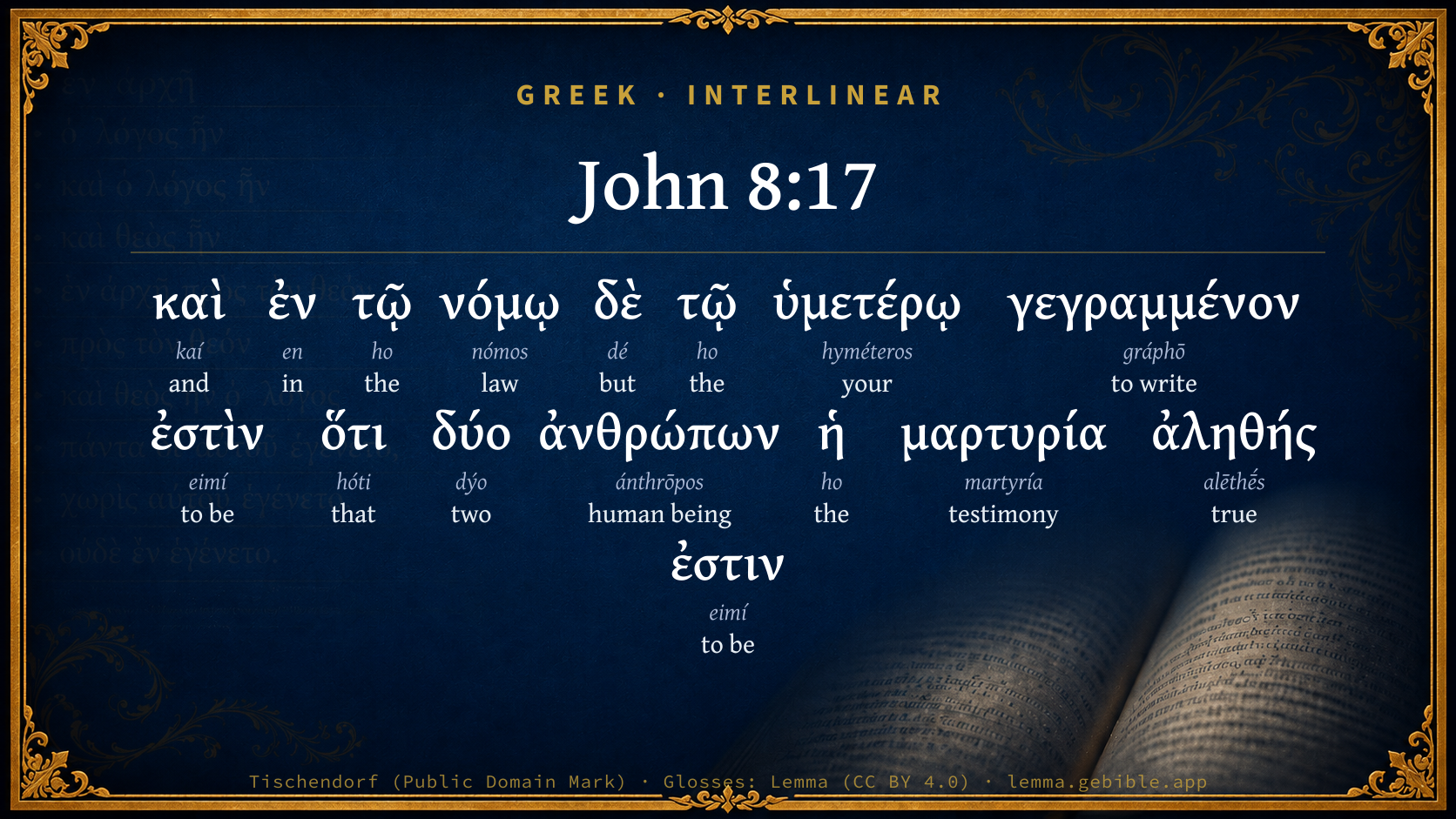
It's also written in your law that the testimony of two people is valid.
World English Bible · Public Domain
Download a study sheet

One document with this verse’s original text, its word-by-word gloss line, the meaning frame, cross-references with their text, attributed commentary, and full source and license credits — printable, and it pastes into notes with its structure intact.

This verse Autodidact and up

Study sheet (.html) Plain text (.txt)

A passage Seminary Student

Up to 50 verses in one chapter. A passage sheet keeps up to 6 commentary sources and 12 cross-references per verse, in the order this page ranks them, and says so on the sheet whenever that leaves anything out. Ask for a single verse and you get the Autodidact verse sheet above.

Everything on this page stays free to read, with no account — the sheet is a download of what is already on screen, not access to it.

Want to remove ads? Support Godless Engineer
Compare translations 3

The same verse in 3 English versions, stacked beneath the original-language interlinear above. Click any original word for its lexicon entry.

Each is an independent rendering of the whole verse — the interlinear is not word-aligned to these translations.

Highlighted words mark where these versions differ — a whole-verse word diff, not a word-by-word alignment.

  • World English Bible Public Domain
    It's also written in your law that the testimony of two people is valid.
  • King James Version Public Domain
    It is also written in your law, that the testimony of two men is true.
  • unfoldingWord Literal Text CC BY-SA 4.0
    But even in your law it is written that the testimony of two men is true.

unfoldingWord Literal Text — © unfoldingWord, licensed CC BY-SA 4.0. Word-aligned USFM3 via Door43 (git.door43.org/unfoldingWord/en_ult).

Versions to compare (up to 4)

3 of 4 selected

Show all 19 translations

Every available English version of this verse, each an independent rendering of the whole verse.

  • World English Bible Public Domain
    It's also written in your law that the testimony of two people is valid.
  • Berean Standard Bible Public Domain
    Even in your own Law it is written that the testimony of two men is valid.
  • Majority Standard Bible Public Domain
    Even in your own Law it is written that the testimony of two men is valid.
  • King James Version Public Domain
    It is also written in your law, that the testimony of two men is true.
  • American Standard Version (1901) Public Domain
    Yea and in your law it is written, that the witness of two men is true.
  • Revised Version (1885) Public Domain
    Yea and in your law it is written, that the witness of two men is true.
  • Geneva Bible (1599) Public Domain
    And it is also written in your Lawe, that the testimonie of two men is true.
  • Douay-Rheims (1899) Public Domain
    And in your law it is written, that the testimony of two men is true.
  • Young's Literal Translation Public Domain
    and also in your law it hath been written, that the testimony of two men are true;
  • Literal Standard Version CC BY-SA 4.0
    and also in your law it has been written that the testimony of two men is true;
  • Unlocked Literal Bible CC BY-SA 4.0
    Yes, and in your law it is written that the testimony of two men is true.
  • unfoldingWord Literal Text CC BY-SA 4.0
    But even in your law it is written that the testimony of two men is true.
  • Darby Bible Public Domain
    And in your law too it is written that the testimony of two men is true:
  • World Messianic Bible Public Domain
    It’s also written in your Torah that the testimony of two people is valid.
  • Webster's Bible Public Domain
    It is also written in your law, that the testimony of two men is true.
  • Free Bible Version CC BY-SA 4.0
    Your own law states that the testimony of two witnesses is valid.
  • Bible in Basic English Public Domain
    Even in your law it is said that the witness of two men is true.
  • Text-Critical English NT CC BY 4.0
    In your own law it is written that the testimony of two men is valid.
  • Tyndale New Testament (1534) Public Domain
    I am one that beare witnes of my selfe and the father that sent me beareth witnes of me.

Literal Standard Version (2020), Covenant Press — licensed CC BY-SA 4.0. Text via the HelloAO Bible API (eBible.org). Unlocked Literal Bible (unfoldingWord) — licensed CC BY-SA 4.0. Text via the HelloAO Bible API (eBible.org). unfoldingWord Literal Text — © unfoldingWord, licensed CC BY-SA 4.0. Word-aligned USFM3 via Door43 (git.door43.org/unfoldingWord/en_ult). Free Bible Version, Dr. Jonathan Gallagher — licensed CC BY-SA 4.0. Text via the HelloAO Bible API (eBible.org).

Word by word

More ways to search: Search by grammar → Find every occurrence → Compare this word →

Practice this passage: Drill this verse → Learn its vocabulary →

ὑμετέρῳ
hyméteros
G5212
“your”
Possessive pronoun, 2nd person, Dative, Plural, Masculine
Part of Speech
Possessive pronoun
Person
2nd person
Case
Dative
Number
Plural
Gender
Masculine
Full Thayer's Definition

Origin: from G5210

TDNT: None

1. you, yours a. to be possessed by you b. to be allocated by you c. proceeding from you
  1. καὶ kaí G2532 “and” Conjunction
  2. ἐν en G1722 “in” Preposition
  3. τῷ ho G3588 “the” Article, Dative, Singular, Masculine
  4. νόμῳ nómos G3551 “law” Noun, Dative, Singular, Masculine
  5. δὲ dé G1161 “but” Conjunction
  6. τῷ ho G3588 “the” Article, Dative, Singular, Masculine
  7. γεγραμμένον gráphō G1125 “to write” Verb, Perfect, Passive, Participle, Nominative, Singular, Neuter
  8. ἐστὶν eimí G1510 “to be” Verb, Present, Active, Indicative, 3rd person, Singular
  9. ὅτι hóti G3754 “that” Conjunction
  10. δύο dýo G1417 “two” Adjective, Numeral (indeclinable)
  11. ἀνθρώπων ánthrōpos G444 “human being” Noun, Genitive, Plural, Masculine
  12. ἡ ho G3588 “the” Article, Nominative, Singular, Feminine
  13. μαρτυρία martyría G3141 “testimony” Noun, Nominative, Singular, Feminine
  14. ἀληθής alēthḗs G227 “true” Adjective, Nominative, Singular, Feminine
  15. ἐστιν eimí G1510 “to be” Verb, Present, Active, Indicative, 3rd person, Singular

About this verse

These counts appear in no published source. They are computed here, from the morphology-tagged text and Lemma’s own curated glosses. What Lemma adds →

16
words
13
distinct lemmas
Gospels
section

Notable vocabulary

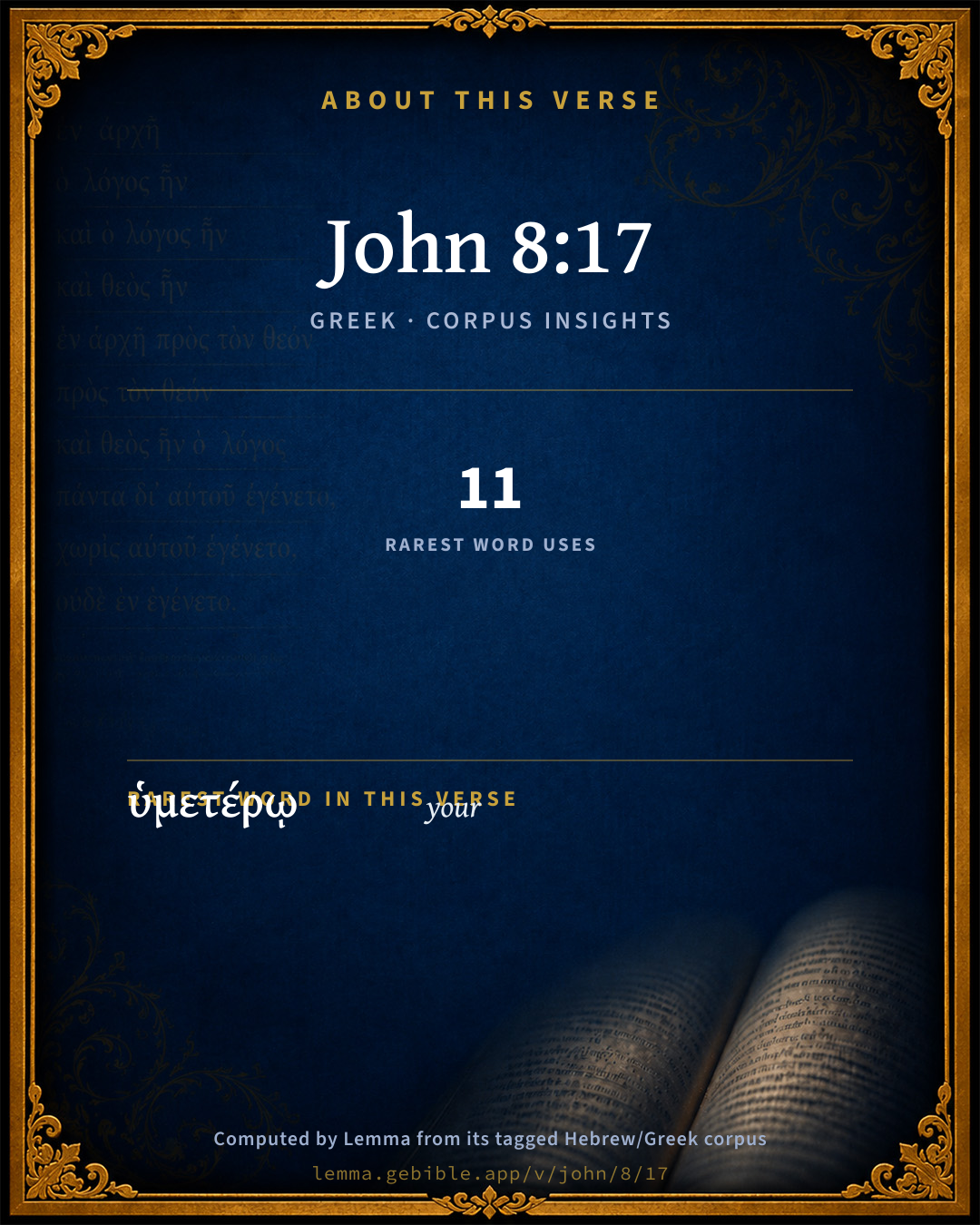
The rarest word here is ὑμετέρῳ your G5212 — appearing just 11 times in the whole Greek New Testament.

Shared distinctive vocabulary

ὑμετέρῳ your G5212 occurs in 11 verses of the Greek New Testament. Also found in:

Repetition

Words recur within this verse:

  • ἐστὶν to be G1510 ×2
  • τῷ the G3588 ×3

Cross-references

12

Topical passages linked to John 8:17 in the Treasury of Scripture Knowledge — connected by theme and wording, ordered by reader-vote popularity; previews shown in the World English Bible.

  • Deuteronomy 19:15 One witness shall not rise up against a man for any iniquity, or for any sin, in any sin that he sins: at the mouth of two witnesses, or at the mouth of three witnesses, shall a matter be established.
  • Deuteronomy 17:6 At the mouth of two witnesses, or three witnesses, shall he who is to die be put to death; at the mouth of one witness he shall not be put to death.
  • Hebrews 10:28 A man who disregards Moses' law dies without compassion on the word of two or three witnesses.
  • Matthew 18:16 But if he doesn't listen, take one or two more with you, that at the mouth of two or three witnesses every word may be established.
  • Galatians 3:24 So that the law has become our tutor to bring us to Christ, that we might be justified by faith.
  • 2 Corinthians 13:1 This is the third time I am coming to you. "At the mouth of two or three witnesses shall every word established."
  • Galatians 4:21 Tell me, you that desire to be under the law, don't you listen to the law?
  • Revelation 11:3 I will give power to my two witnesses, and they will prophesy one thousand two hundred sixty days, clothed in sackcloth."
  • 1 Kings 21:10 and set two men, base fellows, before him, and let them testify against him, saying, You did curse God and the king. Then carry him out, and stone him to death.
  • 1 John 5:9 If we receive the witness of men, the witness of God is greater; for this is God's testimony which he has testified concerning his Son.
  • John 10:34 Jesus answered them, "Isn't it written in your law, 'I said, you are gods?'
  • John 15:25 But this happened so that the word may be fulfilled which was written in their law, 'They hated me without a cause.'

Cross-references courtesy of OpenBible.info (CC BY 4.0).

Commentary

Notes on John 8:17 from classic Christian and Jewish commentators (each source and its license shown beneath its notes). The classic Christian expositions comment on the surrounding passage and are grouped to its opening verse, so a note may address several verses; the Jewish commentaries on the Tanakh (Rashi and others) are per-verse, so they appear only where the commentator wrote on this verse.

Lemma curates 59 commentaries, every one of them public domain or Creative Commons licensed, each selected and text-cleaned for this edition rather than reprinted as found. About our sources →

Godbey's Commentary on the New Testament

William B. Godbey

WITNESS OF THE SPIRIT

Joh 8:17-20. “And it has been written in your law, That the testimony of two people is true. [Deu 19:15] I am the one testifying concerning Myself, and the One who sent Me testifies concerning Me.” Here is the experimental consolation of every true Christian, the Holy Spirit witnessing along with his own spirit that he is born of God, and that his heart is clean, thus bringing all Christian testimony into harmony with the Divine law, by which every affirmation is made valid. “Then they said to Him, Where is Thy Father? Jesus responded, You do not know Me nor the Father; if you had known Me, you would also have known the Father. He spoke these words, teaching in the treasury in the temple, and no one arrested Him, because His hour had not yet come.” There were many magnificent buildings on the Temple Campus, all indiscriminately denominated “the temple.” We have here quite a significant statement of our Savior, while looking those preachers and official laymen in the face, and notifying them that they did not know God, involving the conclusion that they were sinners on their way to perdition. Doubtless they were as honest as the clergy, and ecclesiastical rulers of the present day. What an awful inference is deducible! Lord, help us all to examine ourselves, and see whether we truly know God!

William B. Godbey, Commentary on the New Testament (1896–1900) — public domain. Text from a community e-Sword module.

Bengel's Gnomon

Johann Albrecht Bengel

Joh 8:17. Καί) also.—ἐν τῷ νόαῳ τῷ ὑμετέρῳ) in your law, to which ye refer, Joh 8:5, “Now Moses in the law commanded us, that,” etc.—δύο ἀνθρώπων, of two men) how much more that of God and of the Son of God? Since these witnesses are said to be two, the argument [proof] is one of the same nature. See as regards these two, Zec 6:13, at the end, “He shall build the temple of the Lord; and He shall bear His glory, and shall sit and rule upon His throne; and He shall be a Priest upon His throne; and the counsel of peace shall be between them both.”—ἀληθής, true) irrefragable.

Bengel's Gnomon of the New Testament — English translation (T&T Clark, Edinburgh, 1860) — public domain. Text from a community e-Sword module.

Meyer's Critical & Exegetical Commentary

Heinrich August Wilhelm Meyer

Joh_8:17-18. After the first reason in answer to the Pharisaic rejection of His self-witness (namely, that He gave it in the consciousness of His divine mission, Joh_8:14), and after administering a reproof to His antagonists, in connection therewith, for their judging (Joh_8:15-16), there follows a second reason, namely, that His witness to Himself is no violation of the Jewish law, but has more than the amount of truth thereby required.

καὶ … δέ] atque etiam, as above in Joh_8:16.

τῷ ὑμετ.] emphatically, from the point of view of His opponents (comp. Joh_10:34, Joh_15:25), who took their stand thereon, and regarded Jesus as a παράνομον, and even in Joh_8:13 had had in view a well-known prescription of the law. The words of Christ are therefore no doubt anti-Judaic, but not in themselves antinomian (Schweizer, Baur, Reuss), or belonging to a later Christian point of view (De Wette, B. Crusius, Tholuck); nor must they be taken to mean: for Christ and believers the law exists no longer (Messner, Lehre der Apostel. p. 345); though, no doubt, they expressed His consciousness of being exalted above the Jewish law as it then was, and in the strange and hostile form in which it met Him. Accordingly, Keim[12] is mistaken in saying: In this way neither could Jesus speak nor John writenot even Paul. See Joh_5:45-47, Joh_7:19; Joh_7:22 f., Joh_5:39, Joh_10:35, Joh_19:36.

The passage itself from the law is quoted with considerable freedom (Deu_17:6; Deu_19:15), ἀνθρώπων being uttered with intentional emphasis, as Jesus draws a conclusion a minori ad majus. If the law demands two human witnesses, in my witness there is still more; for the witnesses whose declaration is contained therein are (1) my own individuality; and (2) the Father who has sent me; as His representative and interpreter, therefore, I testify, so that my witness is also His. That which took place, as to substance, in the living and inseparable unity of the divine-human consciousness, to wit, His witnessing, and Gods witnessing, Jesus discriminates here only formally, for the sake of being able to apply the passage of the law in question, from which He argues κατʼ ἄνθρωπον; but not incorrectly (Schenkel): hence, also, there is no need for supplying in thought to ἘΓΏ: As a human knower of myself, as an honest man (Paulus), and the like; or even, as the Son of God (Olshausen, who also brings in the Holy Ghost).

[12] See his Geschichtlich. Christ. p. 14, ed. 3. Note, on the contrary, that it is John himself who stands higher than Paul. But not even the Johannean Jesus has broken with the law, or treated it as antiquated. See especially vv. 4547. His relation to the law is also that of πλήρωσις.

Meyer — Critical and Exegetical Commentary on the New Testament — English translation by Peter Christie, edited by Frederick Crombie (T&T Clark, 1880) — public domain. Text from a community e-Sword module.

Expositor's Greek Testament

ed. W. Robertson Nicoll

Joh 8:17 . καὶ ἐν τῷ νόμῳ … πατήρ . He returns from “judging” to “witnessing,” and He maintains that His witness (Joh 8:18 ) satisfies the Mosaic law (Deu 17:6 ; Deu 19:15 ) because what He witnesses of Himself is confirmed by the Father that sent Him. The nature of this witness was given fully at Joh 5:37-47 . ἐγώ εἰμι ὁ μαρτυρῶν … Field maintains the A.V [63] “I am one that beareth witness,” against the R.V [64] “I am He that beareth witness”; ἐγώ εἰμι being equivalent to “There is I” or “It is I”. Misled perhaps by the Lord’s use of ἀνθρώπων (Joh 8:17 ), the Pharisees ask (Joh 8:19 ): Ποῦ ἐστὶν ὁ πατήρ σου ; “Patrem Christi carnaliter acceperunt” (Augustine), therefore they ask where He is that they may ascertain what He has to say regarding Jesus; as if they said: “It is all very well alleging that you have a second witness in your Father; but where is He?” The idea of Cyril that it was a coarse allusion to His birth is out of the question, and Cyril himself does not press it. Jesus replies: Οὔτε … ᾔδειτε ἄν [or ἂν ᾔδειτε ]. They ought to have known who He meant by His Father and where He was; and their hopeless ignorance Jesus can only deplore. They professed to know Jesus, but had they known Him they would necessarily have known the Father in whom He lived and whom He represented. Their ignorance of the Father proves their ignorance of Jesus. Ταῦτα … ἱερῷ . On γαζοφ ., see Joh 8:12 . Euthymius, as usual, hits the nail on the head: “ Ταῦτα ” τὰ παῤῥησιαστικά . ἐπεσημήνατο γὰρ τὸν τόπον , δεικνύων τὴν παῤῥησίαν τοῦ διδασκάλου . “But no one apprehended Him, because not yet was His hour come.” His immunity was all the more remarkable on account of the proximity to the chamber where the Sanhedrim held its sittings, in the southeast corner of the Court of the Priests. See Edersheim’s Life of Christ , ii. 165, note.

[63] Authorised Version.

[64] Revised Version.

The Expositor's Greek Testament, edited by W. Robertson Nicoll (1897–1910) — public domain. Text from a community e-Sword module.

International Critical Commentary

17. γέγραπται. Jn. generally has γεγραμμένον ἐστίν where the Synoptists would have γέγραπται (see on 2:17). But γεγραμμένον ἐστίν here is attested by א only; all other authorities give γέγραπται, which must therefore be regarded as the true reading. Abbott (Diat. 2588a) suggests that γέγραπται ὅτι is used here to introduce a quotation not given exactly.

ἐν τῷ νόμῳ κτλ. This is a free reference to the maxim of evidence in Deu 19:15 (cf. Num 35:30, Deu 17:6; and see 2Co 13:1, 1Ti 5:19). For another reference by Jesus to this legal maxim, cf. Mat 18:16.

The phrase “your law” challenges scrutiny. Jesus accepted the “law,” i.e. the Old Testament scriptures, very explicitly (see Introd., pp. cxlvii, clv); and it is unlike the way in which He was accustomed to speak of it, that he should say “your law, ” thus dissociating Himself, as it were, from any recognition of its authority. He is represented in 10:34 as again using this expression, and in 15:25 as speaking to His disciples of Scripture as “their law,” i.e. the law of the Jews. It is true that in 8:17 and 10:34 the phrase appears in controversy with the Jews, and it might be thought that it supplied an argumentum ad hominem. Those who disputed with Jesus were shown to be in the wrong, on their own principles. But in the equally argumentative passage 7:19, 23, He speaks of “the law” and “the law of Moses”; and no such explanation can be given of the phrase “their law” in 15:25, which would definitely dissociate Him from the people of Israel, by suggesting that their Scriptures were not His Scriptures. In every place where ὁ νόμος is mentioned by Him in the Synoptists, whether it refers to the law which He came “not to destroy, but to fulfil,” or in a wider sense to the O.T. books, He always says “the Law” (cf. Mat 5:17, Mat 5:18, Mat 5:7:12, Mat 5:11:13, Mat 5:12:5, Mat 5:22:40, Mat 5:23:23, Luk 2:22, Luk 2:24, Luk 2:27, Luk 2:39, Luk 2:10:26, Luk 2:16:16; the word νόμος does not occur in Mk.).

It is difficult to think that in these Johannine texts (8:17, 10:34, 15:25) the words of Jesus have been exactly reproduced.1

International Critical Commentary — older volumes (1896–1929), various authors — public domain. Text from a community e-Sword module.

John Calvin's Commentaries

17. Even in your law it is written. The argument might, at first sight, appear to be weak, because no man is received as a witness in his own cause. But we ought to remember what I have already said, that the Son of God ought to be excluded from the ordinary number of other men, because he neither is a private individual, nor transacts his own private business. As to his distinguishing himself from his Father, by doing so he accommodates himself to the capacity of his hearers, and that on account of his office, because he was at that time a servant of the Father, from whom, therefore, he asserts that all his doctrine has proceeded.

John Calvin's Commentaries (1540-1563) — public domain. Text from the Calvin Translation Society English edition (1840s-50s) via the Christian Classics Ethereal Library (ccel.org). Calvin's coverage is partial (roughly two-thirds of the Bible); uncommented books and verses are honest gaps, never fabricated. The 19th-century editor's footnotes and remarks are omitted so the notes are faithfully Calvin's own voice.

Ellicott's Commentary for English Readers

(17) It is also written in your law.—He now proceeds to show again that the technical requirement of the Law was satisfied by His witness. The term “your law” is material, as addressed to those who were professed expounders of it and accused Him of being a transgressor of it. (Comp. the parallel reference to the Law in Joh_10:34; Joh_15:25.) To assert that Jesus placed Himself in a position of antagonism to the Mosaic law, is to forget the teaching of the Sermon on the Mount (Mat_5:17); and to assert that the Jesus of the Fourth Gospel differs in this respect from the character as portrayed by the earlier Evangelists, is to forget the teaching of the last verse of John 5, and, indeed, to miss the whole force of these very passages. He does not, indeed, say “our law,” as it was for them what it could not be for Him; but He mentions it to show in each case that He fulfilled it.

That the testimony of two men is true.—See Deu_17:6; Deu_19:15, and comp. Notes on Mat_18:16 and Mar_14:55-56. The words are here quoted freely, and “two men” is substituted for “two or three witnesses,” which we find in both the passages in Deuteronomy. This prepares the way for the full thought of the “witness,” in the next verse. The requirement of the Law would be satisfied with the evidence of two men: He has the witness of two Persons, but each is divine.

A Bible Commentary for English Readers, edited by Charles John Ellicott (1878–1897) — public domain. Text from a community e-Sword module.

The Cambridge Bible for Schools and Colleges

gen. ed. J. J. S. Perowne

17. It is also written in your law] Literally, But in the law also, your law, it is written. ‘Your’ is very emphatic; ‘the Law about which you profess to be so jealous.’ Comp. ‘Thou art called a Jew, and restest on the Law’ (Rom_2:17).

the testimony of two men is true] Better, the witness of two, &c. Not so much a quotation as a reference to Deu_19:15; Deu_17:6. Note that the Law speaks of ‘two or three witnesses:’ here we have ‘two men.’ The change is not accidental, but introduces an argument à fortiori: if the testimony of two men is true, how much more the testimony of two Divine Witnesses. Comp. ‘If we receive the witness of men, the witness of God is greater; for this is the witness of God which He hath testified of His Son’ (1Jn_5:9).

The Cambridge Bible for Schools and Colleges (gen. ed. J. J. S. Perowne; Cambridge University Press, 1878–1918) — public domain. Text from a community e-Sword module.

John Gill's Exposition

Then said they unto him, where is thy Father?.... The Persic version adds, "show him unto us": produce this witness boasted of, let us see him; this they said in a sneering, taunting, and insulting manner; where is thy Father? what! he is in Galilee; fetch him from thence; it is Joseph the carpenter you mean; a goodly witness indeed!

Jesus answered, ye neither know me nor my Father; if ye had known me, ye should have known my Father also; they did not know the divine original of Christ, that he was the Son of God, and that God was his Father; they greatly boasted of their knowledge of God, but they knew him not; their ignorance of Christ showed it: the knowledge of both go together, and which is life eternal; nor can any truly know the one, without the other: and where the one is known, the other will be also; Christ is the brightness of his Father's glory, and the express image of his person: so that he that has seen the one, must know the other; and indeed, no one can know the Father, but he to whom the Son reveals him: this was a severe mortification to these men of knowledge.

John Gill's Exposition of the Whole Bible (1746–1763) — public domain (CC PDM 1.0). Text via the HelloAO Bible API.

Trapp's Complete Commentary

John Trapp

17 It is also written in your law, that the testimony of two men is true.

Ver. 17. It is also written in your law] He calleth it their law, because he was above law; and needed not (but for their weaknass) to have confirmed thus his doctrine by Scripture; as being to be believed upon his bare word, αυτοπιστος.

John Trapp, A Commentary or Exposition upon All the Books of the Old and New Testament (1647–1656) — public domain. Text from a community e-Sword module.

Albert Barnes' Notes on the Bible

In your law - Deu 17:6; Deu 19:15. Compare Mat 18:16. This related to cases in which the life of an individual was involved. Jesus says that if, in such a case, the testimony of two men were sufficient to establish a fact, his own testimony and that of his Father ought to be esteemed ample evidence in the case of religious doctrine.

Two men - If two men could confirm a case, the evidence of Jesus and of God ought not to be deemed insufficient.

Is true - In Deuteronomy, “established.” This means the same thing. It is confirmed; is worthy of belief.

Albert Barnes' Notes on the Bible (1834–1885) — public domain. Text from a community e-Sword/MySword module.

Matthew Poole's English Annotations

It is written, Deu 17:6; 19:15. God so ordered it by his Divine law, that every thing should be established by the testimony of two witnesses.

Matthew Poole's English Annotations on the Holy Bible (1683–1685) — public domain. Text from a community e-Sword/MySword module.

Whedon's Commentary on the Bible

Daniel D. Whedon

17, 18. Jesus, after having asserted his superiority to the requirement of other witness, now graciously condescends to furnish it—that of the Father.

Daniel D. Whedon (gen. ed.), Commentary on the Old and New Testaments (1874–1909) — public domain. Text from a community e-Sword module.

The Pulpit Commentary

Having laid down the principle on which he was justified in maintaining the truthfulness of the assumption which the Pharisees impugned, he proceeded to vindicate, for these Jewish legalists, its agreement with the very letter of the Law. He adopted here the identical ground which was taken by him when first of all he claimed this fellowship with the Father. Yea, and in your Law it has been written, that the witness of two men is true. Many have said that here Jesus puts himself on one side as in hostility to the Law; Baur and some others plead, from the very phrase "your Law," that Jesus could not have used such an expression, and that John could not have recorded it; and Reuss urges that this expression agrees with the "standpoint of the gospel, which aims at lowering and degrading the old dispensation." Nothing could be less in harmony with the facts (see Introduction, 2). Even Meyer says, "The words are anti-Judaic... though not antinomian." Surely our Lord was simply appealing to his bitter enemies to recognize the application of the principle found in their own Law, of which they were continually making a proud boast. He simply goes to common ground of argument, and is ready to show that even the letter of the Law sustains his claim for the sufficient reason that he is not alone, but the Father is manifestly with him. Just as he never said "our Father" when addressing his disciples, but either "my Father" or "your Father", (Joh_20:17) because God is not the Father of men in the full sense in which he was Father to the only begotten Son; so he could not say "our Law" or "Moses gave us the Law" without derogating from the unique relation he sustained to the Law. (compare Paul"s language, Rom_2:17, Rom_2:21, Rom_2:23) The quotation from Deuteronomy is not verbally exact; it even carries the statement of Scripture to a broader generalization, and is so worded that it applies to the case in point, by carrying the position to a legitimate consequence witness of two men is true. " By using the word "men," Christ suggests the contrast between two men on one side and the God-Man and the Father on the other. Lightfoot ("Horae Hebraicae") quotes "Rosh-Shanah," 1:2, 3, "that two persons well known must testify to the supreme court that they had seen the new moon! If these were unknown persons, they must bring proof that they were credible witnesses." Upon these common principles of jurisprudence the Lord was willing, in purely Jewish fashion, to rest his claim.

The Pulpit Commentary (1880–1919), ed. H.D.M. Spence-Jones & Joseph S. Exell — public domain. Text from a community e-Sword module.

John Wesley's Explanatory Notes

Deut. xix, 15.

John Wesley, Explanatory Notes Upon the Whole Bible (1754–1765) — public domain. Text via the GEBible commentary corpus.

Kretzmann's Popular Commentary

Paul E. Kretzmann

An appeal to the Law of the Jews:

v. 17. It is also written in your Law that the testimony of two men is.

v. 18. I am one that bear witness of Myself, and the Father that sent Me beareth witness of Me.

v. 19. Then said they unto Him, Where is Thy Father? Jesus answered, Ye neither know Me nor My Father; if ye had known Me, ye should have known My Father also.

v. 20. These words spake Jesus in the treasury, as He taught in the Temple; and no man laid hands on Him, for His hour was not yet come.

The Jews questioned the validity of Christ’s testimony concerning Himself. But Jesus would have them consider that their own Law, upon which they were always harping, came to His assistance. If the testimony of two witnesses to a certain matter agreed, the Law held the testimony to be valid, Deu 17:6; Deu 19:15. Now the Lord applies the passage to Himself. He Himself is His own first witness, and His second witness is the Father, of whom Jesus repeats that He has sent Him. Christ’s own consciousness and the power of God proclaiming itself in and through Him fully sufficed for the demands of the Law respecting exact testimony. But the Jews were still skeptical. They maintain that it is all very well for Him to allege that His Father is His second witness, and to hint at His super natural existence, but the question is: Where is He? The Jews wanted some special manifestation and proof that God acknowledged Jesus as His Son, See chap. 12:28. Jesus does not give them a direct answer. They ought to have known whom He meant when He spoke of His Father and been reminded of the many miracles which established His relation to God beyond a doubt. Theirs was a willful, malignant ignorance. The knowledge and acceptance of God and His whereabouts depends upon the knowledge and acceptance of Jesus. They professed to know this man Jesus who was bearing witness before them, but had they really known Him, they would necessarily have known the Father with whom He was inseparably connected. Belief in and knowledge of Jesus implies knowledge of and belief in the Father. When unbelievers speak of God, of the dispensations of Providence, etc. , they do not understand and realize of what they are speaking. The words are hollow, meaningless phrases in their mouths. Only the true believers, that are united with Christ by the bonds of true faith, can have a true knowledge and idea of God. In Christ the Father is revealed. This saying of the Lord, which again seemed boastful to the Jews, so angered them that they were ready to apprehend Him, as He sat there in the Court of the Women, in the section where the treasury chests were placed. But no one could touch Him, since the hour which was set in the counsel of God was not yet come. Though all the enemies of Christ combine in a deliberate effort to harm the Gospel and to hinder its proclamation, they are powerless before His almighty will.

Paul E. Kretzmann, Popular Commentary of the Bible (1921–1924) — public domain. Text from a community e-Sword module.

The People's New Testament

B. W. Johnson

17. It is written in your law. Deut. 19:15. Observe Jesus says not our, but your law.

B. W. Johnson's The People's New Testament with Notes (1889–1891) — public domain. Electronic text from the Christian Classics Ethereal Library (CCEL) ThML edition.

unfoldingWord translationNotes

Door43 World Missions Community

Connecting Statement:

Jesus continues speaking to the Pharisees and other people about himself.

Yes, and in your law

The word "Yes" shows that Jesus is adding to what he was saying before.

it is written

This is a passive phrase. You may translate it in an active form with a personal subject. AT: "Moses wrote" (See: Active or Passive)

the testimony of two men is true

The logic implied here is that one person can verify the words of another. AT: "if two men say the same thing, then people know it is true" (See: Assumed Knowledge and Implicit Information)

I am he who bears witness about myself

Jesus bears witness about himself. AT: "I give evidence to you about myself"

the Father who sent me bears witness about me

The Father also bears witness about Jesus. You could make it explicit that this means Jesus' testimony is true. AT: "my Father who sent me also brings evidence about me. So you should believe that what we tell you is true" (See: Assumed Knowledge and Implicit Information)

the Father

This is an important title for God. If your language must state whose Father this is, you could say "my Father" since Jesus switches to that in the following verses. (See: Translating Son and Father)

translationWords

law

testimony

true

testimony

God the Father

unfoldingWord translationNotes — © Distant Shores Media and the Door43 World Missions Community, licensed CC BY-SA 4.0. Source: git.door43.org/Door43/en_tn.

Cambridge Greek Testament for Schools and Colleges

17. καὶ ἐν τ. ν. δέ. But in the law also, your law (about which you profess to be so jealous), it is written. Comp. ‘Thou art called a Jew and restest on the Law’ (Rom 2:17). The Sinaiticus here gives S. John’s usual γεγραμμένον ἐστίν (see on Joh 2:17), instead of γέγραπται, which he uses nowhere else of O.T. quotations; comp. Joh 20:31.

δύο ἀνθρώπων. Not so much a quotation as a reference to Deu 19:15; Deu 17:6. Note that the Law speaks of ‘two or three witnesses:’ here we have ‘two men.’ The change is not accidental, but introduces an argument à fortiori: if the testimony of two men is valid, how much more the testimony of two Divine Witnesses. Comp. ‘If we receive the witness of men, the witness of God is greater; for this is the witness of God which He hath testified of His Son’ (1Jn 5:9).

Cambridge Greek Testament for Schools and Colleges (Cambridge University Press, 1896; 21 vols, various authors incl. Carr, Maclear, Plummer, Farrar, Lumby, Moule, M. R. James, Simcox) — public domain. Text from a community e-Sword module.

Alford’s Greek Testament

Henry Alford

17.] The ὑμετέρῳ seems to give this sense to the clause:—‘So that if you will have the mere letter of the law, and judge my testimony by it, I will even thus satisfy you:’ ὑμετ. thus implying, ‘The law which you have made so completely your own by your kind of adherence to it.’

Henry Alford, The Greek Testament (1849–1861) — public domain. Text from a community e-Sword module.

Vincent's Word Studies in the New Testament

Marvin R. Vincent

In your law [εν τω νομω τω υμετερω] . Literally, in the law, that which is yours. Yours has an emphatic force : of which you claim a monopoly. See Joh 7:49.

It is written [γεγραπται] . The perfect tense : it has been written, and stands written. The common form of citation elsewhere, but used by John of the Old Testament scriptures only here. His usual form is gegrammenon ejstin, the participle with the finite verb, literally, it is having been written.

The witness of two men. See Deu 19:15.

The Father - beareth witness of me. Thus there are two witnesses, and the letter of the law is fulfilled.

Marvin R. Vincent, Word Studies in the New Testament (1887–1900) — public domain. Text from a community e-Sword/MySword module.

Godet's Commentaries

Frédéric Louis Godet

Vv. 17, 18. “And besides it is written in your law that the testimony of two men is worthy of belief. 18. I bear witness of myself, and the Father who sent me bears witness of me.”

Jesus enters, at least in form, into the thought of His adversaries (as in Joh 7:16; Joh 7:28). The Mosaic law required two witnesses, for testimony to be valid (Deu 17:6; Deu 19:15). Jesus shows that in the judgments which He pronounces on the world (Joh 8:16), as well as in the testimonies which He bears to Himself (Joh 8:18), He satisfies this rule; for the Father joins His testimony to His own. Where the eye of the flesh can see only one witness, there are really two. This testimony of the Father is generally referred to the miracles, according to Joh 8:36. But the connection with Joh 8:16 leads us to a much more profound explanation. Jesus describes here a fact of His inner life, as in Joh 5:30. The knowledge which He has of Himself and of His mission (Joh 8:12) differs essentially from the psychological phenomenon which is called in philosophy the fact of consciousness; it is in the light of God that He contemplates and knows Himself. Herein is the reason why His testimony bears, in the view of every one who has a sense for perceiving God, the stamp of this divine authority.

In the expression: your law, the adversaries of the authenticity have found a proof of the Gentile origin of the author (Baur). Reuss formerly explained it by the spirit of our Gospel, which has as its end in view nothing less than “a lowering and almost a degradation of the old dispensation.” We have been able to judge from the close of chap. 5 as to what is the value of these assertions. Weiss, Keil, Reuss himself (now) see in this your an accommodation: “This law on which you rest at this moment for condemning me.” I think rather, notwithstanding what Weiss and Keil say, that Jesus, in expressing Himself thus, is inspired by the feeling of the exceptional position which He is claiming in all this section. As He nowhere says, our Father (not even in the address of the Lord’s Prayer), but: your Father, Mat 5:16; Mat 5:45; Mat 5:48; Mat 6:8; Mat 6:15; Mat 6:32, etc.), or, when He wished to express the divine fatherhood at once with reference to Himself and to us: “My Father and your Father” (Joh 20:17), because God is not His Father in the sense in which He is ours, so no more can He say: our law, uniting under one and the same epithet His own relation and that of the Jews to the Mosaic institution.

Who does not feel that He could not, without derogation, have said in Joh 7:19 : “Has not Moses given us the law?” Jesus was conscious of being infinitely elevated above the entire Jewish system. His submission to the law was undoubtedly complete, but it was free; for His moral life was not dependent on the relation to an external ordinance. The word men is not found in the Hebrew text; this term, whatever Weiss may say, must have been added intentionally; it was suggested by the contrast between the human witnesses whom the law demanded, and the divine witness whom Jesus here introduces (the Father who sent me). In this judicial form Jesus expresses at the foundation the same thought as when He spoke in Joh 8:16 of the inner certainty of His own testimony. The idea of this entire passage is the following: “You demand a guaranty of that which I am saying of myself and of you; behold it: It is in God that I know myself and that I assert myself, as it is in Him that I know you and judge you.” And it is in virtue of this divine light which shines within Him and by means of which He also knows others, that He is present as the light of the world (Joh 8:12). A fact so spiritual could hardly be understoood by every one; hence the following:

Frédéric Louis Godet — Commentaries on Luke, John, Romans, and 1 Corinthians — English translation (T&T Clark, Edinburgh, 1870s–1890s) — public domain. Text from a community e-Sword module.

Lesson kit

Teaching starters — assembled from the data on this page, not authored interpretation. Every prompt links to the verse data it draws on. Edit before teaching.

John, in the Gospels, opens this verse with 16 words (13 distinct Greek lemmas). Its most distinctive word is hyméteros (“your”). A historical commentator’s framing appears above. Read the whole chapter for the surrounding context.

Discussion questions

  1. How does “your” (hyméteros) shape what this verse is saying?
  2. How does Luke 6:20, which shares the word «your», read alongside this verse?
  3. What does the repetition of “to be” (2× in this one verse) do in this verse?
  4. These translations render this verse differently. What is at stake in choosing one wording over another?
  5. Compare how Godbey's Commentary on the New Testament and Bengel's Gnomon read this verse. Where do they agree or differ?

Things to notice

  • These translations choose different wording for 7 words in this verse.
  • “to be” occurs 2× in this single verse.
  • 13 distinct Greek lemmas span 16 words in this verse.

Reading settings

Reading text

Shown beneath each verse's original-language words.

Old Testament
Old Testament edition

Read the OT as the Masoretic Hebrew (MT) or the Greek Septuagint (LXX).

English shown for the Greek Septuagint (in the Hebrew ↔ Greek comparison).

Comparing translations? Open the Compare panel on any verse page to stack up to four side by side.