John 11:14

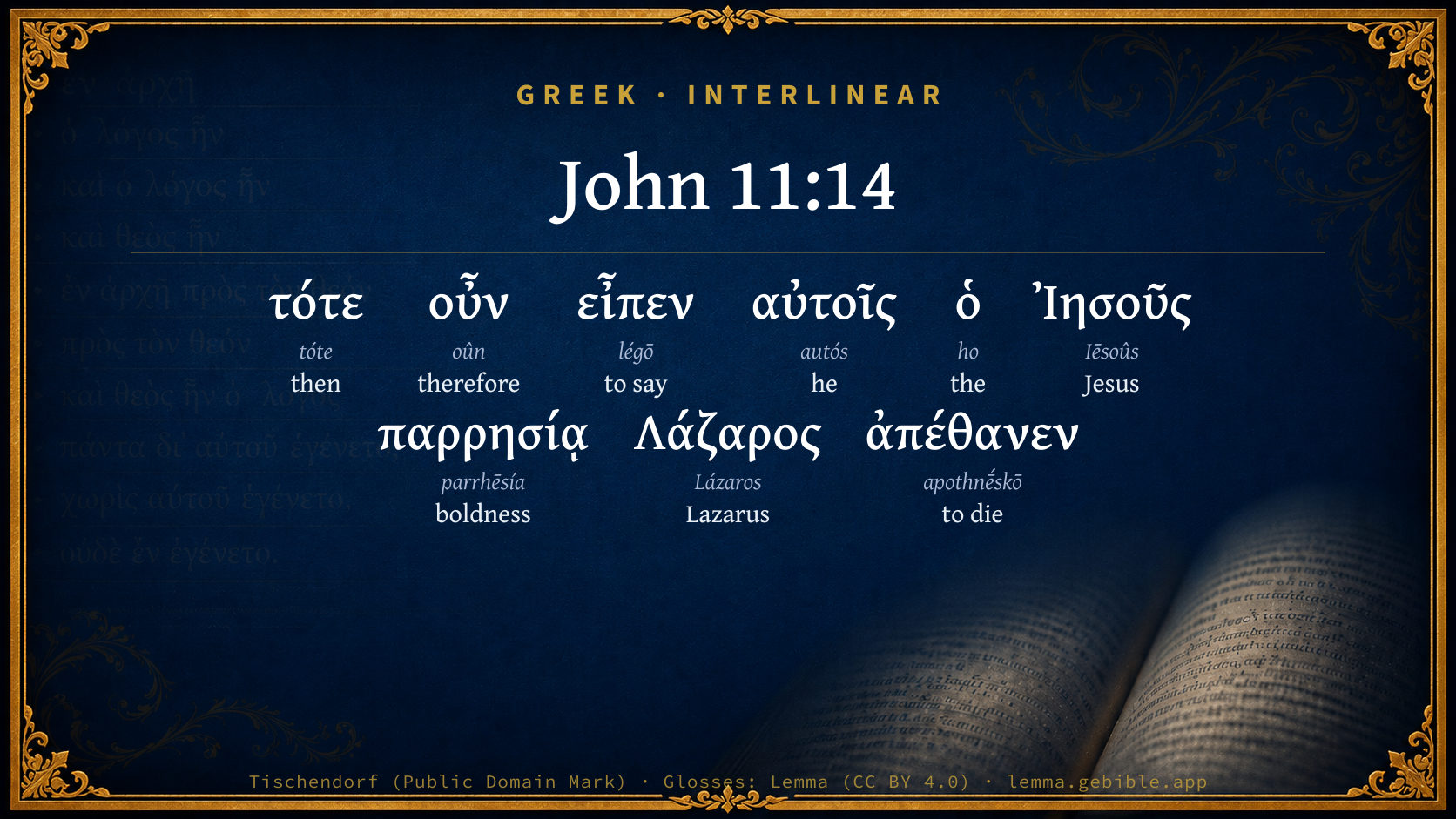
Greek (Tischendorf 8th ed.) John 11:14 appears in the Greek New Testament. The text above is from the Tischendorf 8th edition. Each word links to its Strong’s number and a concise gloss. Click any word for its full Thayer’s Greek Lexicon entry.
Download image
Cite this verse

John 11:14 (World English Bible). Public Domain. Lemma interlinear Bible study tool, https://lemma.gebible.app/v/john/11/14.

Show BibTeX & RIS
BibTeX
RIS
English Translation
So Jesus said to them plainly then, "Lazarus is dead.
World English Bible · Public Domain
Download a study sheet

One document with this verse’s original text, its word-by-word gloss line, the meaning frame, cross-references with their text, attributed commentary, and full source and license credits — printable, and it pastes into notes with its structure intact.

This verse Autodidact and up

Study sheet (.html) Plain text (.txt)

A passage Seminary Student

Up to 50 verses in one chapter. A passage sheet keeps up to 6 commentary sources and 12 cross-references per verse, in the order this page ranks them, and says so on the sheet whenever that leaves anything out. Ask for a single verse and you get the Autodidact verse sheet above.

Everything on this page stays free to read, with no account — the sheet is a download of what is already on screen, not access to it.

Want to remove ads? Support Godless Engineer
Compare translations 3

The same verse in 3 English versions, stacked beneath the original-language interlinear above. Click any original word for its lexicon entry.

Each is an independent rendering of the whole verse — the interlinear is not word-aligned to these translations.

Highlighted words mark where these versions differ — a whole-verse word diff, not a word-by-word alignment.

  • World English Bible Public Domain
    So Jesus said to them plainly then, "Lazarus is dead.
  • King James Version Public Domain
    Then said Jesus unto them plainly, Lazarus is dead.
  • unfoldingWord Literal Text CC BY-SA 4.0
    Therefore, Jesus then said to them plainly, “Lazarus died.

unfoldingWord Literal Text — © unfoldingWord, licensed CC BY-SA 4.0. Word-aligned USFM3 via Door43 (git.door43.org/unfoldingWord/en_ult).

Versions to compare (up to 4)

3 of 4 selected

Show all 19 translations

Every available English version of this verse, each an independent rendering of the whole verse.

  • World English Bible Public Domain
    So Jesus said to them plainly then, "Lazarus is dead.
  • Berean Standard Bible Public Domain
    So Jesus told them plainly, “Lazarus is dead,
  • Majority Standard Bible Public Domain
    So Jesus told them plainly, “Lazarus is dead,
  • King James Version Public Domain
    Then said Jesus unto them plainly, Lazarus is dead.
  • American Standard Version (1901) Public Domain
    Then Jesus therefore said unto them plainly, Lazarus is dead.
  • Revised Version (1885) Public Domain
    Then Jesus therefore said unto them plainly, Lazarus is dead.
  • Geneva Bible (1599) Public Domain
    Then saide Iesus vnto them plainely, Lazarus is dead.
  • Douay-Rheims (1899) Public Domain
    Then therefore Jesus said to them plainly: Lazarus is dead.
  • Young's Literal Translation Public Domain
    Then, therefore, Jesus said to them freely, `Lazarus hath died;
  • Literal Standard Version CC BY-SA 4.0
    Then, therefore, Jesus said to them freely, “Lazarus has died;
  • Unlocked Literal Bible CC BY-SA 4.0
    Then Jesus said to them plainly, “Lazarus is dead.
  • unfoldingWord Literal Text CC BY-SA 4.0
    Therefore, Jesus then said to them plainly, “Lazarus died.
  • Darby Bible Public Domain
    Jesus therefore then said to them plainly, Lazarus has died.
  • World Messianic Bible Public Domain
    So Yeshua said to them plainly then, “Lazarus is dead.
  • Webster's Bible Public Domain
    Then said Jesus to them plainly, Lazarus is dead.
  • Free Bible Version CC BY-SA 4.0
    So Jesus told them plainly, “Lazarus is dead.
  • Bible in Basic English Public Domain
    Then Jesus said to them clearly, Lazarus is dead.
  • Text-Critical English NT CC BY 4.0
    Then Jesus told them plainly, “Lazarus has died,
  • Tyndale New Testament (1534) Public Domain
    Then sayde Iesus vnto the playnly Lazarus is deed

Literal Standard Version (2020), Covenant Press — licensed CC BY-SA 4.0. Text via the HelloAO Bible API (eBible.org). Unlocked Literal Bible (unfoldingWord) — licensed CC BY-SA 4.0. Text via the HelloAO Bible API (eBible.org). unfoldingWord Literal Text — © unfoldingWord, licensed CC BY-SA 4.0. Word-aligned USFM3 via Door43 (git.door43.org/unfoldingWord/en_ult). Free Bible Version, Dr. Jonathan Gallagher — licensed CC BY-SA 4.0. Text via the HelloAO Bible API (eBible.org).

Word by word

More ways to search: Search by grammar → Find every occurrence → Compare this word →

Practice this passage: Drill this verse → Learn its vocabulary →

About this verse

These counts appear in no published source. They are computed here, from the morphology-tagged text and Lemma’s own curated glosses. What Lemma adds →

9
words
9
distinct lemmas
Gospels
section

Notable vocabulary

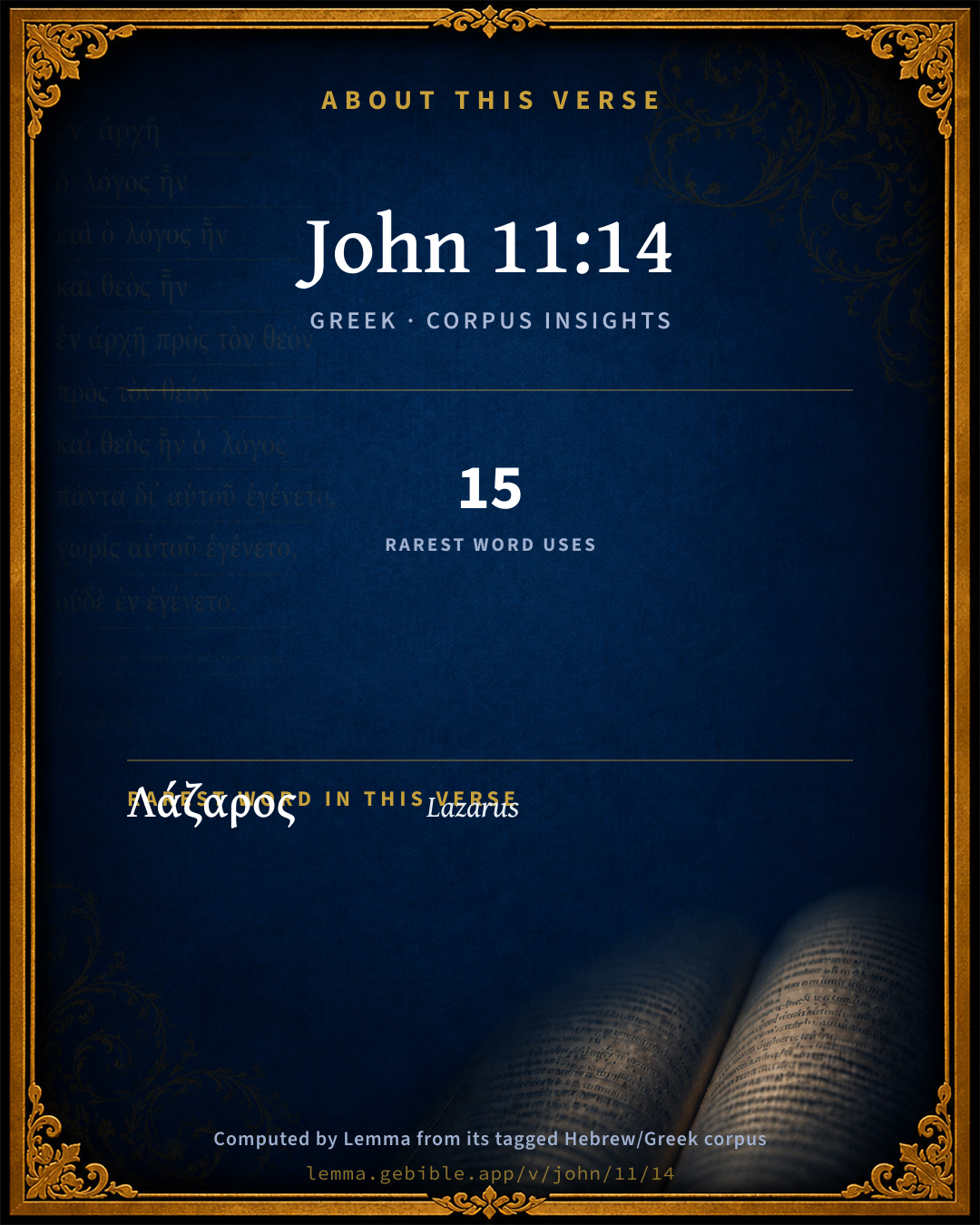
The rarest word here is Λάζαρος Lazarus G2976 — appearing just 15 times in the whole Greek New Testament.

Shared distinctive vocabulary

Λάζαρος Lazarus G2976 occurs in 15 verses of the Greek New Testament. Also found in:

Cross-references

3

Topical passages linked to John 11:14 in the Treasury of Scripture Knowledge — connected by theme and wording, ordered by reader-vote popularity; previews shown in the World English Bible.

  • John 16:25 I have spoken these things to you in figures of speech. But the time is coming when I will no more speak to you in figures of speech, but will tell you plainly about the Father.
  • John 10:24 The Jews therefore came around him and said to him, "How long will you hold us in suspense? If you are the Christ, tell us plainly."
  • John 16:29 His disciples said to him, "Behold, now you speak plainly, and speak no figures of speech.

Cross-references courtesy of OpenBible.info (CC BY 4.0).

Commentary

Notes on John 11:14 from classic Christian and Jewish commentators (each source and its license shown beneath its notes). The classic Christian expositions comment on the surrounding passage and are grouped to its opening verse, so a note may address several verses; the Jewish commentaries on the Tanakh (Rashi and others) are per-verse, so they appear only where the commentator wrote on this verse.

Lemma curates 59 commentaries, every one of them public domain or Creative Commons licensed, each selected and text-cleaned for this edition rather than reprinted as found. About our sources →

The Biblical Illustrator

Joseph S. Exell

Joh_11:14-15

Lazarus is dead, and I am glad for your sakes that! was not there

I.

THE SAVIOUR IS ALWAYS ALIVE TO THE WELFARE OF HIS PEOPLE--for your sakes. Here is love beyond compare. Is He abased? For our sakes He became poor. Does He suffer? He bears our sorrows, and for us He dies. Does He go away? It is expedient for us. Does He appear in heaven? Still it is for us. Other people are the subjects of His providence; but His people are the end of it.

II. THERE IS NOTHING HE IS SO CONCERNED TO PROMOTE AS THEIR FAITH--that ye may believe. From this learn

1. That faith is no easy matter. Where is the Christian that has not often cried, Help Thou mine unbelief. The difficulty of believing may be seen by the means here employed to promote it, and from the persons for whom He wishes it--those who had been with Him and seen His miracles.

2. That faith admits of increase. The disciples believed, or they would not have followed Him, but they did not believe enough. Faith at one time is like a mustard seed, at another like a mustard tree. The blade may do very well in March, but we expect the full corn in August.

3. The importance of faith. Some persons are afraid to say much about faith, as if it were prejudicial to morality, whereas it is the tree which bears all the fruits of holiness. Everything in the Christian life has to do with faith. God is glorified by faith, we are filled with joy and peace, sanctified, purified, by faith; we stand, walk, live, and have access to God by faith, and that this may not fail Christ prays. Hence its importance here.

III. HE CAN ACCOMPLISH THE PURPOSES OF HIS LOVE BY WAYS PECULIAR TO HIMSELF. They would have said He ought to have been there. The sisters expected this. But His absence was to show that His ways were superior to theirs. The case of Joseph, Job, and the Three Children seemed very hard, but what advantage the world has derived from them! When, therefore, your views and His do not seem to harmonize, remember that He acts sovereignly, not arbitrarily; but He gives no account of His matters. Suspend your opinions. Never set His sun by your dial, but the reverse. You can see His heart if you cannot see His hand. Where? At Calvary. He that spared not His own Son, etc. Alphonsus, of Castile, thought that if the Maker of the world had applied to him he could have given Him good advice. But do you not think the same about the God of Providence? Blind unbelief is sure to err. If you see not now you will see hereafter. Ought you to judge of a building while all the materials are scattered about, especially if you had never seen the plan? Judge nothing before the time. The saints above shout, He hath done all things well.

IV. THE SUFFERINGS OF SOME ARE DESIGNED FOR THE GOOD OF OTHERS. Sometimes persons are afflicted by way of

1. Correction. If His children forsake My law, etc.

2. Prevention. Paul was buffeted not because he was proud, but lest he should be exalted.

3. Probation. Hence afflictions are called trials.

4. Usefulness to themselves and others. Ezekiel was forbidden to weep when the desire of his eyes was taken from him; not on his own account, but that he might be a sign. So Lazarus dies and the sisters weep for the disciples sake.

V. THE SAVIOUR IS NEVER TOO LATE IN HIS MOVEMENTS OR TOO CONFIDENT IN HIS RESOURCES. We often begin what we are not able to finish. Then there are different degrees of weakness and strength amongst us, but God has all power, Nevertheless, let us go to Him, not them. Why? It is too late, he is dead. It may be too late for you, but not for Me. Your extremity is My opportunity. I love not only to do what is needful for My people, but to surprise them; to do above all they can ask or think. It were much to have comforted the sisters, how much more to raise the brother! Let us learn to confide in Him

1. With regard to ourselves. Sinner, your case is desperate as to all relief from men or angels, yet that is no reason why you should despair. He is nigh.

2. With regard to others. Our work is hard, but we can do all things if the Raiser of Lazarus strengthens us. (W. Jay.)

The dark enigma of death

The man Jesus loved lay there on his bed dying. Now, I emphasize that, because there used to be a great deal of thinking about Gods relation to those that love Him and whom He loves--a great deal of teaching in the Christian Church that counted itself mostorthodox, and which was, indeed, deadly heresy, coarse, materialistic, despicable, misunderstanding the ideal grandeur of the Bible promises. Some of you know the sort of thing that used to prevail--the idea that Gods saints should be exceptionally favoured, the sun would shine on their plot of corn, and it would not shine on the plot of corn of the bad man; their ships would not sink at sea, their children would not catch infectious diseases, God would pamper them, exempt them from bearing their part in the worlds great battle, with hardness and toil of labour, with struggle and attainment and achievement. It came of a very despicable conception of what a father can do for a child, as if the best thing for a father to do for his son was to pet and indulge him, and save him all bodily struggle and all difficulties, instead of giving him a life of discipline. As if a general in the army would, because of his faltering heart, refuse to let his son take the post of danger, as if he would not rather wish for that son--ay, with a great pang in his own soul--that he should be the bravest, the most daring, the one most exposed to the deadliest hazard. Ah, we have got to recognize that we whom God loves may be sick and dying, and yet God does love us. Lazarus was loved by Jesus, yet he whom Jesus loved was sick and dying. Ah, and there is a still more poisonous difficulty in that materialistic, that worldly way of looking at Gods love; that horrible, revolting misjudgment that Christ condemned, crushed with indignation when it confronted Him. The men on whom the tower of Siloam fell must have been sinners worse than us on whom it did not fall. Never, never! The great government of the world is not made up of patches and strokes of anger and outbursts of weak indulgence. The world is Gods great workshop, Gods great battlefield. These have their places. Here a storm of bullets fall, and brave and good men as well as cowards fall before it. You mistake if you try to forestall Gods judgments, Gods verdict on the last great day of reckoning. Still we have got the fact that Christ does not interpose to prevent death, that Christ does not hinder those dearest to Him from bearing their share of lifes sicknesses and sufferings, that God Himself suffers death to go on, apparently wielding an undisputed sway over human existence. Is not that true of our world today? The best of you Christians, when death comes to your own homes, do you manage to sing the songs of triumph right away? Well, you are very wonderful saints if you do. If you do not, perhaps you say, If God is in this world, how comes that dark enigma of death? And others of you grip hold of your faith, but yet your heart cries out against it. You believe that God is good, but has He been quite good to you? Like Martha, you feel as if you had some doubt; you feel bound in your prayers; you say, O God, I do not mean to reproach Thee; weak, sinful, if you will, yet the sign of a true follower of the Christ. And then the enemies of Christ, the worldlings all about in this earth of ours, as they look upon deaths ravages, they are saying: If there were a God, if there were a Father, if there were a great heart that could love, why does not He show it? Now, I said to you that at first it looks as if nothing but evil came of Gods delay to interpose against death; but when you look a little deeper, I think you begin to discover an infinitely greater good and benefit come out of that evil. I must very briefly, very rapidly, trace to you in the story, and you can parallel it in the life of yourselves, that discipline of goodness there is in Gods refraining from checking sickness and death. Christ said the end of it is first of all death, but that is not the termination. Through death this sickness, this struggle of doubt and faith, should end in the glory of God. That tremendous miracle compelled the rulers of Jerusalem to resolve on and carry out His death. That miracle of Lazaruss resurrection gave to the faith of the disciples and of Christs followers a strength of clinging attachment that carried them through the eclipse of their belief when they saw Him die on Calvary. Now, what would you say? Was it cruel of Christ to allow His friend Lazarus, His dear friends Mary and Martha, to go through that period of suspense, of anxiety, of sickness, of death, and of the grave, that they might do one of the great deeds in bringing in the worlds Redeemer Ah you say you have still got to show Gods goodness and kindness to me individually. My death may be for Gods glory, it may be for the good of others; but how about me and those who mourn? Well, now, look at it. You must get to the end of the story before you venture to judge the measure, the worth of Gods goodness. After all, was that period of sickness and death unmitigated gloom, and horror, and agony? Oh, I put it to you, men and women, who have passed through it, watching by the death of dear father or mother that loved the Lord and loved you, and whom you loved--dark, and sore, and painful enough at the time; but oh, if I called you to speak out, would you not say it was one of the most sacred periods of your life--the unspeakable tenderness, the sweet, clinging love, the untiring service, the grateful responses, the sacredness that came into life? Ay, and when the tie was snapped, the new tenderness that you gave to the friends that are left, the new pledge binding you to heaven, and to hope for it, and long for it--death is not all an evil to our eyes. Death cannot ultimately be an evil, since it is universal--the consummation, climax, crown, of every human life. It is going home to ones Father. Yes, but you want the guarantee that death is not the end, and that day it was right and lawful for Christ to give it to anticipate the last great day, when in one unbroken army, radiant and resplendent, shining like jewels in a crown, He shall bring from the dark grave all that loved Him, fought for Him, and were loyal to Him on the road, and went down into the dark waters singly one by one, in circumstances of ignominy often, and yet dying with Christ within them, the Resurrection and the Life. Ah, that great grand vindication of God and interpretation of this worlds enigma was made clear that day when Christ called Lazarus back and gave him alive to his sisters in the sight of His doubting disciples, in the sight of those sneering enemies. (W. G.Elmslie, D. D.)

Lazarus dead and Jesus glad

What strange paradox is here. There was room in Christs heart for both emotions. The grief belonged to the Brother born for our adversity; the gladness to the omniscient God who sees the end from the be ginning, Note

I. THE SYMPATHY OF CHRIST WITH HIS PEOPLE. Somewhat analogous to the sympathy of the several organs of a living frame. Such is the vital union that every wound inflicted on the members pierces with pain the Head. He knew the sorrows of Israel in Egypt, and now He felt the grief which was rending the household at Bethany. By a message, Jesus and His disciples had learned that Lazarus was sick; but the Head, being in closer communion with the member, had secret and better intelligence. The dying throb of Lazarus beat also in the heart of Jesus. Lo, I am with you alway, in the dark days of pain as in the bright days of joy.

II. CHRIST HEARS THE CRY OF HIS PEOPLE AND SENDS THEM HELP. They were right in saying, If Thou hadst been here. He cannot endure to hear the prayer of His people and permanently to deny their request. Hence He could not remain in visible presence with His followers. It became expedient for Him to go away, permitting multitudes of His friends to sicken and die preparatory to a glorious resurrection.

III. ALIKE CHRISTS ACTIONS AND EMOTIONS CONTEMPLATE THE PROFIT OF HIS PEOPLE. If He remained distant while Lazarus was battling with death it was for your sakes. If He rejoiced in the immediate issue of that unequal conflict, it was for your sakes. All things are for your sakes. In this case it was that they might believe. The death of Lazarus afforded opportunity for the display of omnipotence, thereby to confirm the disciples faith. But other benefits followed. The discipline the bereaved family endured was a means of purging away their dross. Application: The lesson bears on

1. The ordinary affairs of life. You try to obtain a lawful object in a lawful way, but your plans miscarry. This, however, does not prove that Christ lacks the will or power to help. Had He been in visible presence He would have put forth His power, but He is glad for your sake He was not. From the height of His throne He sees that the world on your side at this point would not be profitable for you.

2. Bereavements. if Christ were standing weeping by the bed your child would not die, but for your sake He is not there. A mother who had lost all her children but the youngest said, Every bereavement has knit me closer to Christ, and every child I have in heaven is another cord to hold me up:--(W. Arnot, D. D.)

A mystery! Saints sorrowing and Jesus glad

Jesus was glad that the trial had come.

I. FOR THE STRENGTHENING OF THE FAITH OF THE APOSTLES.

1. The trial itself would do this. Faith untried may be true faith, but it is sure to be little faith. It never prospers so much as when all things are against it. No flowers wear so lovely a blue as those which grow at the feet of the frozen glacier; no water so sweet as that which springs amid the desert sand.

(1) Tried faith brings experience, and experience makes religion more real. You never know your weakness nor Gods strength till you have been in the deep waters.

(2) Trial removes many of the impediments of faith. Carnal security is the worst foe to confidence in God, and blessed is the axe that removes it. The balloon never rises until the cords are cut.

(3) Affliction helps faith when it exposes the weakness of the creature. This trial would show the apostles not to depend on the bounty of any one man, for though Lazarus entertained them, Lazarus had died. We are in danger of making idols of our mercies.

(4) Trial drives faith to God. When the worlds wells are full of sweet but poisonous water we pitch our tents at the wells mouth; but when earths water becomes bitter we turn away sick and faint and cry for the water of life.

(5) Trial has a hardening effect on faith. As the Spartan boys were prepared for fighting by the sharp discipline of their boyish days, so are Gods servants trained for war by the affliction which He sends upon them. We must be thrown into the water to learn to swim. If you want to ruin your child, let him never know a hardship.

2. The deliverance of Lazarus would do this.

(1) At the worst Christ can work; in the very worst He is not brought to a nonplus. The physician, Herod, Caesar, and all their power can do nothing here; and Death sits smiling as he says, I have Lazarus. Yet Christ wins the day.

(2) Divine sympathy became most manifest--Jesus wept.

(3) Divine power was put forth--Lazarus, come forth. All this was the best education the disciples could have for their future ministry. When in prison they would remember how Lazarus was brought out. When preaching to dead sinners they would remember the power of the word which brought Lazarus to life.

II. FOR THE GOOD OF THE FAMILY. The sisters had faith, but it was not very strong, for they doubted both Christs love and His power. Because He specially loved these people:

1. He sent them a special trial. The lapidary will not spend much time on an ordinary stone, but a diamond of the first water he will cut and cut again. So the gardener will a choice tree.

2. Special trial was attended with a special visit. Perhaps Christ would not have come to Bethany had not Lazarus died. If you are in trouble Christ will go out of His way to see you.

3. The special visit was attended with special fellowship. Jesus wept with those who wept. You may be well and strong, and have but little fellowship with Christ, but He shall make all your bed in your sickness.

4. And soon you shall have special deliverance.

III. FOR GIVING FAITH TO OTHERS. Afflictions often lead men to faith in Christ because

1. They give space for thought.

2. They prevent sin. A lad had resolved against advice to climb a mountain. A mist soon surrounded him, and compelled him to return. His father was glad because, had he gone a little further, he would have perished.

3. They compel them to stand face to face with stern realities. How often has Gods Spirit wrought in illnesses that have seemed hopeless.

4. They are sometimes followed by great deliverances. (C. H. Spurgeon.)

Five paradoxes

I. IN THE LIFE OF AN INTELLIGENT BELIEVER GLADNESS SOMETIMES GROWS OUT OF GRIEF. Jesus wept at the death of Lazarus, for it was a personal bereavement, but He was glad because it was a fine opportunity for glorifying God. This is the lowest form of Christian experience. Our light affliction works out an eternal weight of glory, This, understood as a means of exalting God, will enable the believer to glory in tribulations.

II. ONES ADVANTAGE IS SOMETIMES HID UNDERNEATH ANOTHERS TRIALS. It was a surprising thing to announce that He had not intended to prevent Lazaruss death; but it was still more surprising that it was for their sakes. What had they to do with it? Now, while all believers are independent of each other, and each stands or falls to his own master, yet the trials of one are often intended to benefit another. The law of vicarious suffering holds the race. A parent suffers for a child, a child for a parent. Joseph was sold into Egypt that Israel might go into Palestine. Peters imprisonment may have been needed to discipline Rhodas faith, and Pauls confinement may have been ordered for the jailors conversion. Let us be resigned, then, when we suffer for others, and attentive when others suffer for us.

III. INCREASE OF A CHRISTIANS SORROW SOMETIMES ALLEVIATES IT. In the opinion of the disciples the sickness of Lazarus was a disaster, but the most unfortunate circumstance was the absence of Jesus. But a strange comfort now entered their hearts. They were worse off than they supposed, but they were better off, too. Up to this disclosure the event was a hard calamity of domestic life, and Jesus absence a melancholy accident. But now they perceived that Divine knowledge embraced this also, Divine wisdom was dealing with it, and Divine mercy was going to turn it to fine advantage. A great sorrow with a purpose in it is easier to bear than a smaller one which seems to have no aim now and no benefit hereafter.

IV. IN THE TRUE BELIEVERS EXPERIENCE DOUBT IS SOMETIMES EMPLOYED TO DEEPEN TRUST. The one simple intention of this bereavement was to increase the faith of those who felt it. This was accomplished by permitting them to imagine for a while that they were forgotten of God. Just as a mother hides herself from a child who has grown careless of her presence that the child may run impulsively into her embrace and love her all the more, so God says, In a little wrath I hid My face, etc. The way to render faith confident is to make large demands upon it by onsets of trying doubt.

V. ABSOLUTE HOPELESSNESS AND HELPLESSNESS ARE THE CONDITIONS OF HOPE AND HELP. The turning point of the story is in the nevertheless let us go, and He goes to work His most stupendous miracle to remedy what His delay had permitted. By this time the sisters had given up all hope; but Hope was on the way. So one after another of our props must drop away, till at last we are shut up to God. (C. S. Robinson, D. D.)

Death knocking away our props

See, father! said a lad who was walking with his father, they are knocking away the props from under the bridge. What are they doing that for? Wont the bridge fall? They are knocking them away, said the father, that the timbers may rest more firmly upon the stone piers, which are now finished. God only takes away our earthly props that we may rest more firmly upon Him.

The uses of bereavement

When engineers would bridge a stream, they often carry over at first but a single cord; with that, next they stretch a wire across; then strand is added to strand, until a foundation is laid for planks; and now the bold engineer finds safe footway, and walks from side to side. So God takes from us some golden-threaded pleasure, and stretches it hence into heaven; then He takes a child, and then a friend: thus He bridges death, and teaches the thoughts of the most timid to find their way hither and thither between the shores. (H. W. Beecher.)

Build beyond the reach of death

Build your nest upon no tree here, for ye see God hath sold the forest to Death; and every tree whereupon we would rest is ready to be cut down, to the end that we might flee and mount up, and build upon the Rock, and dwell in the holes of the Rock. (S. Rutherford.)

Relief under bereavement

1. There are reliefs arising from our constitution. There is a self-healing principle in nature. Break a branch from a tree, etc., wound the body, cut the flesh, or break a limb, and you see the self-healing power exude and work. It is so in the soul. Thought succeeds thought like the waves of the ocean, and each tends to wear out the impression its predecessor had made.

2. There are incidental reliefs. New events, new engagements, new relationships, tend to heal the wound.

3. There are Christian reliefs, the assurance of after life, the hope of a future reunion, etc. Such are the reliefs. These, like the flowers and shrubs of a lovely garden, spring up around our hearts and cover the grave of our sorrows and trials with the shadow of their foliage. Yes; though we have our trials, we have still our blessings.

The Biblical Illustrator, edited by Joseph S. Exell (c. 1880s–1900s) — public domain. Text from a community e-Sword module.

Joseph Benson's Commentary

Joh 11:14-16. Then said Jesus plainly — That he might not hold them any longer in suspense, or permit them to remain under a mistake; Lazarus is indeed dead: and — As I could not have permitted this to have happened in my presence, I am glad for your sakes — That your faith may be more fully confirmed, by a further remarkable display of my divine power; that I was not there — That I was not in Judea before he died; for had I been there, and recovered him, your faith in me, as the Messiah, must have wanted that great confirmation which it shall soon receive. Nevertheless — Although he be dead, or, therefore, as the particle αλλα is used, Act 10:20; and Act 26:16; let us go unto him — To Bethany, where he lies dead. Then said Thomas, which is called Didymus — Thomas in Hebrew, as Didymus in Greek, signifies a twin; Let us also go, that we may die with him — With Jesus, whom he supposed the Jews would kill. It seems to be the language of despair. “Thus,” as Dr. Lardner has remarked, “Jesus, who could have raised Lazarus from the dead without opening his lips, or rising from his seat, leaves the place of his retirement beyond Jordan, and takes a long journey into Judea, where the Jews lately attempted to kill him. The reason was, his being present in person, and raising Lazarus to life again, before so many witnesses at Bethany, where he died, and was well known, would be the means of bringing the men of that and future ages to believe in him and his doctrine, which is so well fitted to prepare mankind for a resurrection to eternal life, an admirable proof and emblem of which he gave them in this great miracle.”

Joseph Benson's Commentary on the Old and New Testaments (1811–1818) — public domain. Text from a community e-Sword module.

Meyer's Critical & Exegetical Commentary

Heinrich August Wilhelm Meyer

Joh_11:14 f. Παῤῥησία] i.e. without the help of figurative hints as in Joh_11:11. Comp. Joh_10:24, Joh_16:25.

Λάζ. ἀπέθ.] Now a declaration of the simple occurrence; hence there is no addition to the word Λάζ. as in Joh_11:11.

διʼ ὑμᾶς] is immediately explained by the words ἵνα πιστεύσ.; for every new flight of faith is in its degree a progress towards belief, comp. Joh_2:11. The words ὅτι οὐκ ἤμ. ἐκεῖ are to be taken together with χαίρω. If Jesus had been there, He would not have permitted His friend to die (against Paulus), but have saved him even on the sickbed; in this case the far greater σημεῖον of His δόξα, the raising him from the dead, would not have taken place, and the faith of the disciples would therefore not have had the benefit of it, though, just on the eve of the death of their Lord, it stood greatly in need of being increased. Bengel aptly remarks: cum decoro divino pulchre congruit, quod praesente vitae duce nemo unquam legitur mortuus.

ἵνα] indicates the telic direction, or intention of the emotion (not merely hope, De Wette). Comp. Joh_8:56. Remark that Jesus rejoices not at the sorrowful event in itself, but at the circumstance that He was not there, in consequence whereof it assumed a salutary relation to the disciples.

ἀλλʼ] Breaking off; Herm. ad Vig. p. 812; Baeuml. Partic. p. 15. And the summons is now brief and measured.

Meyer — Critical and Exegetical Commentary on the New Testament — English translation by Peter Christie, edited by Frederick Crombie (T&T Clark, 1880) — public domain. Text from a community e-Sword module.

Expositor's Greek Testament

ed. W. Robertson Nicoll

Joh 11:14 . τότε οὖν . “At this point, accordingly, Jesus told them plainly,” παρρησίᾳ “without figure or ambiguity,” “expressly in so many words,” cf. Joh 10:24 , removing all possibility of misunderstanding, “Lazarus is dead,” but instead of grieving (Joh 11:15 ) καὶ χαίρω διʼ ὑμᾶς , “I am glad for your sakes,” although grudging the pain to Lazarus and his sisters, ὅτι οὐκ ἤμην ἐκεῖ , “that I was not there,” implying that had He been there Lazarus would not have died. This gives us a glimpse into the habitual and absolute confidence of Jesus in the presence with Him of an almighty power, ἵνα πιστεύσητε “that ye may believe,” go on to firmer faith. “Faith can neither be stationary nor complete. ‘He who is a Christian is no Christian,’ Luther,” Westcott.

The Expositor's Greek Testament, edited by W. Robertson Nicoll (1897–1910) — public domain. Text from a community e-Sword module.

Jamieson, Fausset & Brown

Robert Jamieson, A. R. Fausset & David Brown

Then said Jesus unto them plainly, Lazarus is dead--Says BENGEL beautifully, "Sleep is the death of the saints, in the language of heaven; but this language the disciples here understood not; incomparable is the generosity of the divine manner of discoursing, but such is the slowness of men's apprehension that Scripture often has to descend to the more miserable style of human discourse; compare Mat 16:11."

Jamieson, Fausset & Brown — Commentary Critical and Explanatory on the Whole Bible (1871) — public domain (CC PDM 1.0). Text via the HelloAO Bible API.

John Calvin's Commentaries

14. Then Jesus told them plainly, Lazarus is dead. The goodness of Christ was astonishing, in being able to bear with such gross ignorance in the disciples. And indeed the reason why he delayed, for a time, to bestow upon them the grace of the Spirit in larger measure, was, that the miracle of renewing them in a moment might be the greater.

John Calvin's Commentaries (1540-1563) — public domain. Text from the Calvin Translation Society English edition (1840s-50s) via the Christian Classics Ethereal Library (ccel.org). Calvin's coverage is partial (roughly two-thirds of the Bible); uncommented books and verses are honest gaps, never fabricated. The 19th-century editor's footnotes and remarks are omitted so the notes are faithfully Calvin's own voice.

Ellicott's Commentary for English Readers

(14) Lazarus is dead.—The words of deeper truth, “Our friend Lazarus is fallen asleep,” have conveyed no true meaning to their minds. He uses words, therefore, which fall short of that truth, but are the only words which they can understand.

A Bible Commentary for English Readers, edited by Charles John Ellicott (1878–1897) — public domain. Text from a community e-Sword module.

The Cambridge Bible for Schools and Colleges

gen. ed. J. J. S. Perowne

14. Then said Jesus] ‘Then’ here, as in Rom_6:21, is made to cover two Greek words, ‘then’ of time, and ‘then’ of consequence: translate, Then therefore said Jesus.

plainly] Without metaphor: see on Joh_7:4 and Joh_10:24.

The Cambridge Bible for Schools and Colleges (gen. ed. J. J. S. Perowne; Cambridge University Press, 1878–1918) — public domain. Text from a community e-Sword module.

John Gill's Exposition

Then said Jesus unto them plainly,.... Without a figure, when he perceived they did not understand him, and yet it was a very easy and usual metaphor which he had made use of; but such was the present stupidity of their minds, that they did not take in his meaning: wherefore, without reproaching them with it, he said to them in so many words,

Lazarus is dead. The Persic version reads, "Lazarus is dead indeed", as he really was.

John Gill's Exposition of the Whole Bible (1746–1763) — public domain (CC PDM 1.0). Text via the HelloAO Bible API.

Trapp's Complete Commentary

John Trapp

14 Then said Jesus unto them plainly, Lazarus is dead.

Ver. 14. Then said Jesus unto them plainly] Because they understood him not. Ministers must be "gentle to all men, apt to teach, patient, in meekness instructing the ignorant," yea, the insolent, 2Ti 2:24-25. Augustine confesseth he was glad to use some words, sometimes, to his hearers that were not Latin, to the end that they might understand him.

John Trapp, A Commentary or Exposition upon All the Books of the Old and New Testament (1647–1656) — public domain. Text from a community e-Sword module.

Matthew Poole's English Annotations

You will mistake me; my meaning was, not that Lazarus was fallen to rest upon the abatement of his distemper, but his soul is parted from his body.

Matthew Poole's English Annotations on the Holy Bible (1683–1685) — public domain. Text from a community e-Sword/MySword module.

Whedon's Commentary on the Bible

Daniel D. Whedon

14. Plainly… dead—Jesus has suggested the lesson that he can waken alike the apathy of sleep and of death; he now, to shut off their hint, passes from the figure, and pronounces the solemn word, dead. Olshausen remarks that the reality of Lazarus’s death, instead of swoon or syncope, cannot be proved except by Jesus’s own assertion. It would, then, doubtless follow that the event could be no proof of Jesus’s divine mission. To prove the miracle by Christ, and then prove Christ by the miracle, would be reasoning in a circle. But the credibility of no one miracle depends on its own single proof. An isolated, disconnected miracle would be, without very powerful evidence indeed, unworthy of examination. See note on Luk_15:31.

Daniel D. Whedon (gen. ed.), Commentary on the Old and New Testaments (1874–1909) — public domain. Text from a community e-Sword module.

The Pulpit Commentary

Then Jesus therefore said to them plainly. Jesus spake at length (parrhsia) without metaphor (cf. ver. 11, note). Lazarus died; died, i.e. when he told them two days ago that this sickness would not have death as its end died in the sense in which they ordinarily used the word. When Jesus described the condition of Lazarus in figurative language, he made use of a metaphor which would have peculiar application in his ease. The grace of Christ will turn the death of his beloved throughout all time into restful sleep. Lazarus was part of the method by which this transformation would be effected. The Christian idea soon found far richer expression than classical poetry or rabbinism could supply. (Act_7:60 Mat_27:52 1Co_15:6 1Th_4:13 Rev_14:13)

The Pulpit Commentary (1880–1919), ed. H.D.M. Spence-Jones & Joseph S. Exell — public domain. Text from a community e-Sword module.

Cambridge Greek Testament for Schools and Colleges

14. τότε οὖν. Then therefore said Jesus. Here, as in Rom 6:21, A.V. makes ‘then’ cover both τότε and οὖν, ‘then’ of time, and then’ of consequence.

παρρησίᾳ. Without metaphor: see on Joh 7:13.

Λαζ. ἀπέθανεν. The abruptness is startling. Contrast the aorist ἀπέθανεν, which indicates the moment of transition from life to death, with the perfect κεκοίμηται, which indicates the state of rest which has begun and continues.

Cambridge Greek Testament for Schools and Colleges (Cambridge University Press, 1896; 21 vols, various authors incl. Carr, Maclear, Plummer, Farrar, Lumby, Moule, M. R. James, Simcox) — public domain. Text from a community e-Sword module.

International Critical Commentary

14. τότε οὖν κτλ. “At this point, Jesus said plainly, Lazarus died”; He no longer spoke enigmatically to the disciples. For παρρησίᾳ, see on 7:4.

International Critical Commentary — older volumes (1896–1929), various authors — public domain. Text from a community e-Sword module.

Godet's Commentaries

Frédéric Louis Godet

Vv. 14-16. “Then Jesus therefore said to them openly, Lazarus is dead; 15 and I rejoice for your sakes that I was not there, to the end that you may believe; but let us go to him. 16. Whereupon Thomas, who is called Didymus, said to his fellow-disciples, Let us also go, that we may die with him.”

After having set aside (Joh 11:9-10), the motive alleged by the disciples against this journey, and indicated the reason (Joh 11:11-12) which obliges Him to undertake it, Jesus concludes by explaining Himself and gives the order for departing. Παρρησίᾳ, as in Joh 16:25 : in strict terms, without figure. There would have been, as we have already seen, a manifest falseness in our Lord’s expressing Himself, as He does in Joh 11:15, if this death had been the intentional effect of His own mode of action. The words: to the end that you may believe are the commentary on the limiting words: for your sakes. Undoubtedly the disciples were already believers; but, as Hengstenberg says, by growing, faith comes into being. At each new stage which it reaches, the preceding stage seems to it in itself nothing more than unbelief. Jesus knows how the increase of faith which is about to be produced in them around this tomb will be necessary for them, in a little time, when they shall find themselves before that of their Master. There is something abrupt in the last words: But let us go to him. It is a matter of constraining them and of overcoming in them the last remnant of resistance. They yield, but not without making manifest the unbelief hidden in the depths of the hearts of some of them.

The words of Thomas to the other disciples betrays indeed more of love for the person of Jesus than of faith in the wisdom of His course of action. Their meaning is this: “If He actually desires to have Himself killed, let us go and perish with Him.” The Thomas who speaks thus is indeed the same whom we shall meet again in Joh 14:5, Joh 20:25; much of frankness and resolution, but little of disposition to subordinate the visible to the invisible. This quite undesigned consistency in the role of the secondary personages, is, as has been admirably brought out by Luthardt, one of the striking features of John’s narrative and one of the best proofs of the historical truth of this work. The name Thomas (in the Aramaic האמא, Hebrew האם) signifies twin. The name Didymus, which has in Greek the same meaning, was undoubtedly that by which this apostle was most commonly designated in the churches of Asia Minor, in the midst of which John wrote. Thus is the repetition of this translation in Joh 20:24 and Joh 21:2 explained.Hengstenberg, Luthardt, and Keil see in this name of twin an allusion to the fact that Thomas carried in himself two men, a believer and an unbeliever, a Jacob and an Esau! He was a δίψυχος man (Keil)!

What wisdom and what love in the manner in which Jesus prepares His disciples for this journey which was so repugnant to their feeling! What elevation in the thoughts which He suggests to their hearts on this occasion!

What grace and appropriateness in the images by which He endeavors to make these thoughts intelligible to them!

Frédéric Louis Godet — Commentaries on Luke, John, Romans, and 1 Corinthians — English translation (T&T Clark, Edinburgh, 1870s–1890s) — public domain. Text from a community e-Sword module.

Lesson kit

Teaching starters — assembled from the data on this page, not authored interpretation. Every prompt links to the verse data it draws on. Edit before teaching.

John, in the Gospels, opens this verse with 9 words (9 distinct Greek lemmas). Its most distinctive word is Lázaros (“Lazarus”). A historical commentator’s framing appears above. Read the whole chapter for the surrounding context.

Discussion questions

  1. How does “Lazarus” (Lázaros) shape what this verse is saying?
  2. Luke 16:20 shares the word «Lazarus» with this verse. How do the two illuminate each other?
  3. These translations render this verse differently. What is at stake in choosing one wording over another?
  4. Reading how The Biblical Illustrator and Joseph Benson's Commentary read this verse, where do the two commentators agree and where do they part?

Things to notice

Reading settings

Reading text

Shown beneath each verse's original-language words.

Old Testament
Old Testament edition

Read the OT as the Masoretic Hebrew (MT) or the Greek Septuagint (LXX).

English shown for the Greek Septuagint (in the Hebrew ↔ Greek comparison).

Comparing translations? Open the Compare panel on any verse page to stack up to four side by side.