
John 10:7

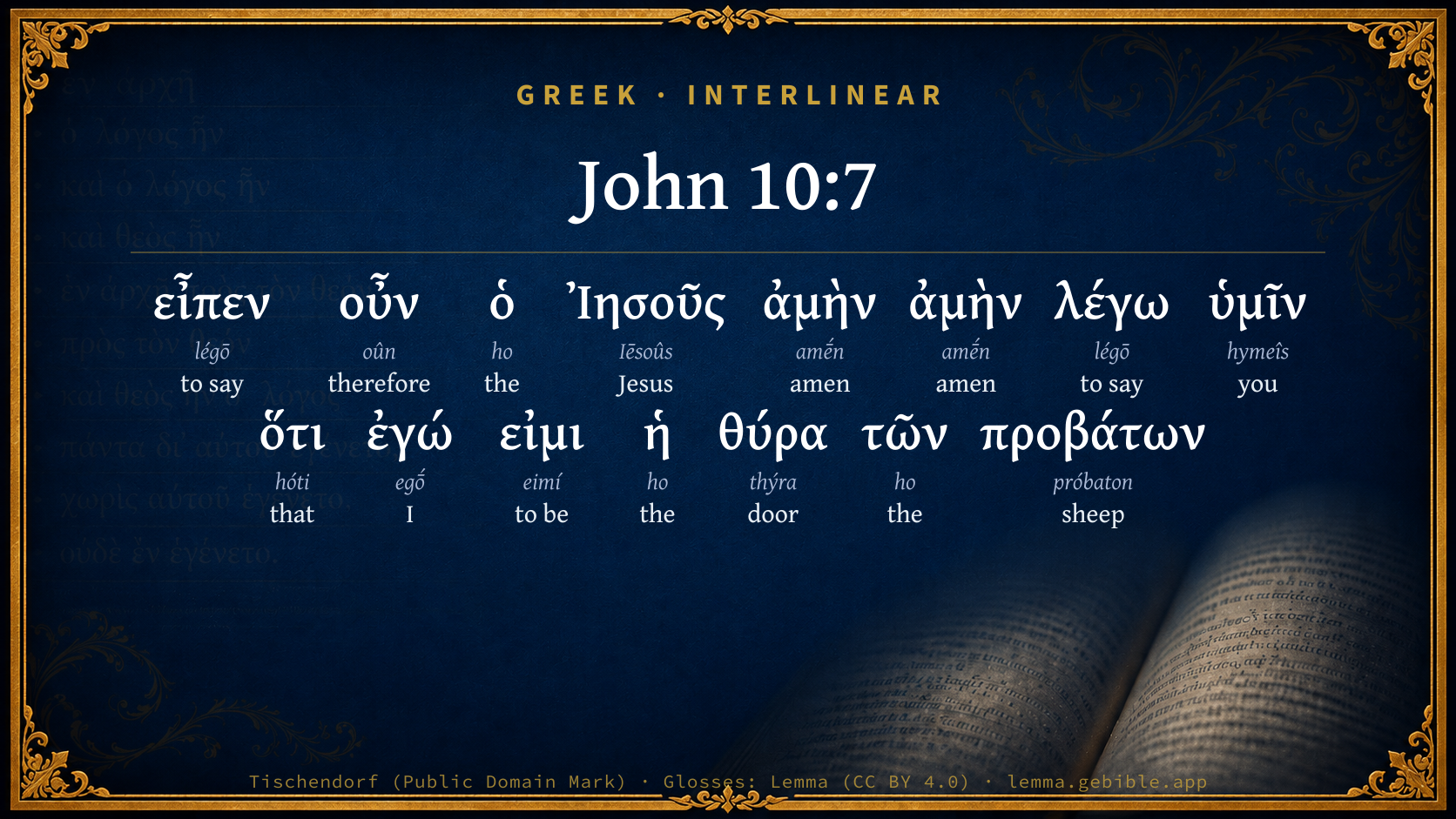
Greek (Tischendorf 8th ed.) John 10:7 appears in the Greek New Testament. The text above is from the Tischendorf 8th edition. Each word links to its Strong’s number and a concise gloss. Click any word for its full Thayer’s Greek Lexicon entry.
Download image
Cite this verse

John 10:7 (World English Bible). Public Domain. Lemma interlinear Bible study tool, https://lemma.gebible.app/v/john/10/7.

Show BibTeX & RIS
BibTeX
RIS
English Translation
Jesus therefore said to them again, "Most assuredly, I tell you, I am the sheep's door.
World English Bible · Public Domain
Download a study sheet

One document with this verse’s original text, its word-by-word gloss line, the meaning frame, cross-references with their text, attributed commentary, and full source and license credits — printable, and it pastes into notes with its structure intact.

This verse Autodidact and up

Study sheet (.html) Plain text (.txt)

A passage Seminary Student

Up to 50 verses in one chapter. A passage sheet keeps up to 6 commentary sources and 12 cross-references per verse, in the order this page ranks them, and says so on the sheet whenever that leaves anything out. Ask for a single verse and you get the Autodidact verse sheet above.

Everything on this page stays free to read, with no account — the sheet is a download of what is already on screen, not access to it.

Want to remove ads? Support Godless Engineer
Compare translations 3

The same verse in 3 English versions, stacked beneath the original-language interlinear above. Click any original word for its lexicon entry.

Each is an independent rendering of the whole verse — the interlinear is not word-aligned to these translations.

Highlighted words mark where these versions differ — a whole-verse word diff, not a word-by-word alignment.

  • World English Bible Public Domain
    Jesus therefore said to them again, "Most assuredly, I tell you, I am the sheep's door.
  • King James Version Public Domain
    Then said Jesus unto them again, Verily, verily, I say unto you, I am the door of the sheep.
  • unfoldingWord Literal Text CC BY-SA 4.0
    Therefore, Jesus said to them again, “Truly, truly, I say to you, I am the gate of the sheep.

unfoldingWord Literal Text — © unfoldingWord, licensed CC BY-SA 4.0. Word-aligned USFM3 via Door43 (git.door43.org/unfoldingWord/en_ult).

Versions to compare (up to 4)

3 of 4 selected

Show all 19 translations

Every available English version of this verse, each an independent rendering of the whole verse.

  • World English Bible Public Domain
    Jesus therefore said to them again, "Most assuredly, I tell you, I am the sheep's door.
  • Berean Standard Bible Public Domain
    So He said to them again, “Truly, truly, I tell you, I am the gate for the sheep.
  • Majority Standard Bible Public Domain
    So He said to them again, “Truly, truly, I tell you, I am the gate for the sheep.
  • King James Version Public Domain
    Then said Jesus unto them again, Verily, verily, I say unto you, I am the door of the sheep.
  • American Standard Version (1901) Public Domain
    Jesus therefore said unto them again, Verily, verily, I say unto you, I am the door of the sheep.
  • Revised Version (1885) Public Domain
    Jesus therefore said unto them again, Verily, verily, I say unto you, I am the door of the sheep.
  • Geneva Bible (1599) Public Domain
    Then sayd Iesus vnto them againe, Verely, verely I say vnto you, I am that doore of the sheepe.
  • Douay-Rheims (1899) Public Domain
    Jesus therefore said to them again: Amen, amen I say to you, I am the door of the sheep.
  • Young's Literal Translation Public Domain
    Jesus said therefore again to them, `Verily, verily, I say to you -- I am the door of the sheep;
  • Literal Standard Version CC BY-SA 4.0
    Jesus therefore said again to them, “Truly, truly, I say to you, I AM the door of the sheep;
  • Unlocked Literal Bible CC BY-SA 4.0
    Then Jesus said to them again, “Truly, truly, I say to you, I am the gate of the sheep.
  • unfoldingWord Literal Text CC BY-SA 4.0
    Therefore, Jesus said to them again, “Truly, truly, I say to you, I am the gate of the sheep.
  • Darby Bible Public Domain
    Jesus therefore said again to them, Verily, verily, I say to you, I am the door of the sheep.
  • World Messianic Bible Public Domain
    Yeshua therefore said to them again, “Most certainly, I tell you, I am the sheep’s door.
  • Webster's Bible Public Domain
    Then said Jesus to them again, Verily, verily, I say to you, I am the door of the sheep.
  • Free Bible Version CC BY-SA 4.0
    So Jesus explained again, “I tell you the truth: I am the gate of the sheep.
  • Bible in Basic English Public Domain
    So Jesus said again, Truly I say to you, I am the door of the sheep.
  • Text-Critical English NT CC BY 4.0
    So Jesus said to them again, “Truly, truly, I say to you, I am the gate for the sheep.
  • Tyndale New Testament (1534) Public Domain
    Then sayde Iesus vnto them agayne. Verely verely I saye vnto you: I am the dore of the shepe.

Literal Standard Version (2020), Covenant Press — licensed CC BY-SA 4.0. Text via the HelloAO Bible API (eBible.org). Unlocked Literal Bible (unfoldingWord) — licensed CC BY-SA 4.0. Text via the HelloAO Bible API (eBible.org). unfoldingWord Literal Text — © unfoldingWord, licensed CC BY-SA 4.0. Word-aligned USFM3 via Door43 (git.door43.org/unfoldingWord/en_ult). Free Bible Version, Dr. Jonathan Gallagher — licensed CC BY-SA 4.0. Text via the HelloAO Bible API (eBible.org).

Word by word

More ways to search: Search by grammar → Find every occurrence → Compare this word →

Practice this passage: Drill this verse → Learn its vocabulary →

θύρα
thýra
G2374
“door”
Noun, Nominative, Singular, Feminine
Part of Speech
Noun
Case
Nominative
Number
Singular
Gender
Feminine
Full Thayer's Definition

Origin: "apparently a root word [cf "door"]"

TDNT: 05:53,3

1. a door a. the vestibule b. used of any opening like a door, an entrance, way or passage into c. in a parable or metaphor 1. the door through which sheep go in and out, the name of him who brings salvation to those who follow his guidance 2. "an open door" is used of the opportunity of doing something 3. the door of the kingdom of heaven (likened to a palace) denotes the conditions which must be complied with in order to be received into the kingdom of God
  1. εἶπεν légō G3004 “to say” Verb, Aorist, Active, Indicative, 3rd person, Singular
  2. οὖν oûn G3767 “therefore” Conjunction
  3. ὁ ho G3588 “the” Article, Nominative, Singular, Masculine
  4. Ἰησοῦς Iēsoûs G2424 “Jesus” Noun, Nominative, Singular, Masculine
  5. ἀμὴν amḗn G281 “amen” Hebrew transliteration
  6. ἀμὴν amḗn G281 “amen” Hebrew transliteration
  7. λέγω légō G3004 “to say” Verb, Present, Active, Indicative, 1st person, Singular
  8. ὑμῖν hymeîs G5210 “you” Personal pronoun, 2nd person, Dative, Plural
  9. ὅτι hóti G3754 “that” Conjunction
  10. ἐγώ egṓ G1473 “I” Personal pronoun, 1st person, Nominative, Singular
  11. εἰμι eimí G1510 “to be” Verb, Present, Active, Indicative, 1st person, Singular
  12. ἡ ho G3588 “the” Article, Nominative, Singular, Feminine
  13. τῶν ho G3588 “the” Article, Genitive, Plural, Neuter
  14. προβάτων próbaton G4263 “sheep” Noun, Genitive, Plural, Neuter

About this verse

These counts appear in no published source. They are computed here, from the morphology-tagged text and Lemma’s own curated glosses. What Lemma adds →

15
words
11
distinct lemmas
Gospels
section

Shared distinctive vocabulary

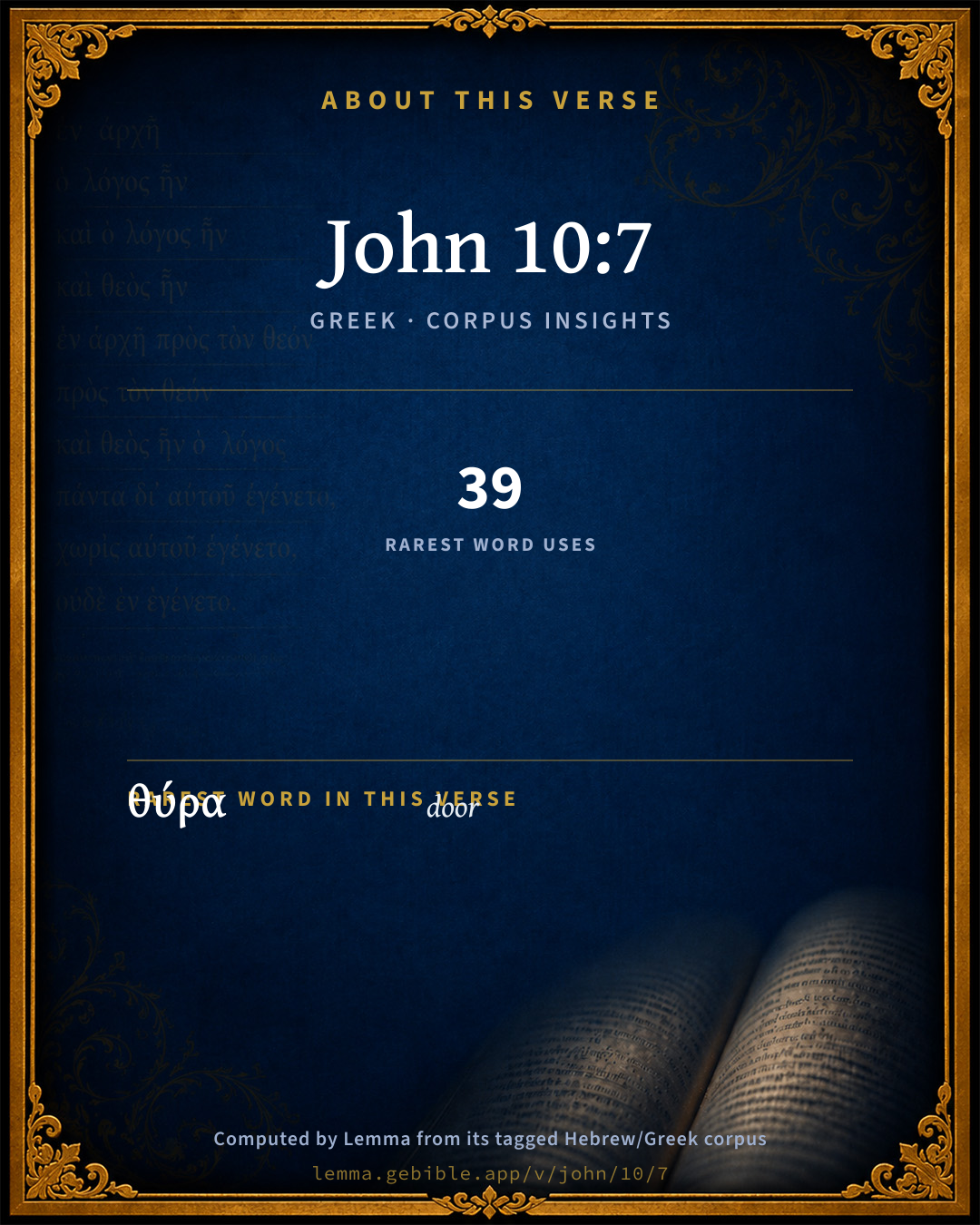
θύρα door G2374 occurs in 37 verses of the Greek New Testament. Also found in:
Repetition

Words recur within this verse:

  • εἶπεν to say G3004 ×2
  • ἀμὴν amen G281 ×2
  • ὁ the G3588 ×3

Cross-references

11

Topical passages linked to John 10:7 in the Treasury of Scripture Knowledge — connected by theme and wording, ordered by reader-vote popularity; previews shown in the World English Bible.

  • John 14:6 Jesus said to him, "I am the way, the truth, and the life. No one comes to the Father, except through me.
  • Ephesians 2:18 For through him we both have our access in one Spirit to the Father.
  • John 10:1 "Most assuredly, I tell you, one who doesn't enter by the door into the sheep fold, but climbs up some other way, the same is a thief and a robber.
  • John 10:9 I am the door. If anyone enters in by me, he will be saved, and will go in and go out, and will find pasture.
  • Ezekiel 34:31 You my sheep, the sheep of my pasture, are men, and I am your God, says the Lord Yahweh.
  • Psalms 79:13 So we, your people and sheep of your pasture, Will give you thanks forever. We will praise you forever, to all generations.
  • Hebrews 10:19–22 Having therefore, brothers, boldness to enter into the holy place by the blood of Jesus,
  • Psalms 100:3 Know that Yahweh, he is God. It is he who has made us, and we are his. We are his people, and the sheep of his pasture.
  • Psalms 95:7 For he is our God. We are the people of his pasture, And the sheep in his care. Today, oh that you would hear his voice!
  • Luke 15:4–6 "Which of you men, if you had one hundred sheep, and lost one of them, wouldn't leave the ninety-nine in the wilderness, and go after the one that was lost, until he found it?
  • Isaiah 53:6 All we like sheep have gone astray; everyone has turned to his own way; and Yahweh has laid on him the iniquity of us all.

Cross-references courtesy of OpenBible.info (CC BY 4.0).

Commentary

Notes on John 10:7 from classic Christian and Jewish commentators (each source and its license shown beneath its notes). The classic Christian expositions comment on the surrounding passage and are grouped to its opening verse, so a note may address several verses; the Jewish commentaries on the Tanakh (Rashi and others) are per-verse, so they appear only where the commentator wrote on this verse.

Lemma curates 59 commentaries, every one of them public domain or Creative Commons licensed, each selected and text-cleaned for this edition rather than reprinted as found. About our sources →

Tyndale Open Study Notes

Tyndale Open Resources

10:7 I am: See study note on 6:35. A good shepherd is known for guarding the sheep at the gate as a sentry.

Tyndale Open Study Notes — © Tyndale Open Resources, licensed CC BY-SA 4.0. Text via the HelloAO Bible API.

Bengel's Gnomon

Johann Albrecht Bengel

Joh 10:7. Ἡ θύρα, the door) Christ is both the Door, and the Shepherd, and our All: there is none else.—τῶν προβάτων, of the sheep) to the sheep.

Bengel's Gnomon of the New Testament — English translation (T&T Clark, Edinburgh, 1860) — public domain. Text from a community e-Sword module.

Godet's Commentaries

Frédéric Louis Godet

Vv. 7-10. “Jesus therefore spoke to them again, saying, Verily, verily I say unto you, I am the door of the sheep. 8. All those who came before me are thieves and robbers; but the sheep did not listen to them. 9. I am the door: if any one enters in by me, he shall be saved; and he shall go in and go out, and shall find pasture. 10. The thief comes not but to steal and to kill and to destroy; I am come that they may have life, and that they may have it abundantly.”

Jesus has described the simple and easy way in which the Messiah forms His flock, in contrast with the arbitrary and tyrannical measures by which the Pharisees had succeeded in getting possession of the theocracy; He now depicts, in a new allegory, which has only a remote relation in form to the preceding (comp. the two parables which follow each other in Mark; that of the sower and that of the ear of corn, Joh 4:3 ff.,Joh 5:26 ff.) what He will be to His flock when once formed and gathered, the abundance of the salvation which He will cause them to enjoy, as opposed to the advantage taken of the old flock by those intruders and the destruction to which they are leading them. The word πάλιν, again (Joh 10:7), was wrongly rejected by the Sinaitic MS.; the copyist thought that this picture was only a continuation of the preceding (because of the analogy of the figures). This is likewise held by some modern interpreters, but, as we shall see, is untenable. Πάλιν indicates therefore, as in Luk 13:20 (where it is placed between the parables of the grain of mustard seed and of the leaven; comp. Mat 13:44-45; Mat 13:47), that Jesus adds still another parable to the preceding.

The picture Joh 10:1-5, which described the formation of the Messianic flock and its going forth from the theocratic inclosure, was borrowed from a morning scene; the second similitude, Joh 10:7-10, which describes the life full of sweetness of the flock when once formed and everything which it enjoys through the intermediation of the Messiah, places us at mid-day. In the pasturage is an inclosure where the sheep enter and whence they go out at will. If they seek for shelter, they retire to it freely. If hunger impels them, they go forth—for the gate is constantly open for them—and they find themselves in full pasturage. They have thus at their pleasure security and food, the two blessings essential to the prosperity of the flock. In this new figure, the person of the shepherd entirely disappears. It is the door which plays the principal part. The inclosure here no longer represents the old covenant; it is the emblem of the perfectly safe shelter of salvation. Lucke, Meyer, Luthardt, Weiss, Keil explain the words: I am the door of the sheep, in this way: I am the door for coming to the sheep, the door by which the true shepherds enter into the midst of the flock. But in this sense the words refer either to the shepherds of the old covenant or to those of the new. In the former case, we must suppose that the ἐγώ, I, designates the I of the Logos as a spirit governing the theocracy. Who can admit a sense like this? In the second, it has no fitness of any kind. Moreover, this sense is very forced. The term: door of the sheep, naturally means; the door which the sheep use for their own going in and going out (Joh 10:9).

The privilege, represented by the use which the sheep make of the door, is that which Jesus gives the believing Israelites to enjoy, by furnishing them, like the one born blind, everything which can assure their rest and salvation. Reuss himself, abandoning the relation established by him (Joh 10:1-2) between the two parables, says: “Yet once more Jesus calls Himself the door, but this time He is so for the flock itself” (thus: no longer for the shepherd, as in the first parable).

The persons designated in Joh 10:8 as thieves and robbers can only be the Pharisees (Joh 10:1). They are characterized here from the point of view, no longer of the manner in which they have established their power in the theocracy, but of the end in view of which they exercised it and of the result which they will obtain thereby. Not only had this audacious caste unlawfully taken possession, in the midst of the people of God, of the most despotic authority, but they were still using it only in a way to satisfy their egoism, their ambition and their cupidity. Hence follows the explanation of the expression, so variously interpreted: All those who are come before me. Whatever certain Gnostic writers may have said in former times or Hilgenfeld may even now say in his desire to make our Gospel a semi-Gnostic writing, Jesus certainly could not thus speak of Moses and the prophets, and of any legitimate theocratic authority. The constant language of the evangelist protests against such an explanation (Joh 5:39; Joh 5:45-47; Joh 6:45; Joh 10:34-35, etc.). The verb εἰσί (are), in the present tense, shows clearly that He has in view persons who were now living. If He says ἦλθον, came, and πρὸ ἐμοῦ, before me, it is because He found them already at work when He began His own working in Israel. The term come indicates with relation to them, as with relation to Jesus, the appearance with the purpose of exercising the government of souls among the people of God. The parable of the vine-dressers in the Synoptics is the explanation of this saying of Jesus.

This interpretation of the first words of Joh 10:8 follows from the context and enables us to set aside, without any long discussion, the numerous, more or less divergent, interpretations which have been proposed; that ofCamerarius, who took πρὸ ἐμοῦ in a local sense: “passing before and outside the door,” that of Wolf andOlshausen, who gave to πρό the sense of χωρίς : “separating themselves from me, the true door;” those of Langewho understands πρό in the sense of ἀντί : “in my place,” and Calov, who makes the expression before me signify: “before I had sent them;” that of Gerlach: “before the door was opened in my person;” as well as that of Jerome, Augustine, Melanchthon, Luthardt: “came of themselves, without having received a mission;” finally, that ofChrysostom and many others even to Weizsacker : “came as false Messiahs.” History does not mention any case of a false Messiah before the coming of Jesus. There is no need of renouncing, with Tholuck and de Wette, the possibility of any satisfactory solution, and declaring, with the latter, that this saying does not answer to the habitual gentleness and moderation of Jesus. As to the variant which rejects the words πρὸ ἐμοῦ, before me (א and others), it is only an attempt to do away with the difficulty.

The present εἰσί, are, indicates with sufficient clearness that we need not go far to find these persons. The last words: The sheep did not hear, remind us of the profound dissatisfaction which was left in the hearts of a multitude of Israelites by the Pharisaic teaching. Joh 6:68 : “To whom shall we go?” Mat 11:28-30 : “Come unto me, all ye who labor and are heavy laden, learn of me, for I am meek and lowly in heart; my yoke is easy, and my burden is light.” The man who was born blind was a striking example of these souls whom the Pharisaic despotism roused to indignation in Israel.

In opposition to these pretended saviours who will be found to be in reality only murderers, Jesus renews in Joh 10:9 His affirmation: I am the door; then He develops it. Meyer and Luthardt maintain here their explanation of Joh 10:7, according to which Jesus is the door by which the true shepherd enters into the presence of the flock. They do not allow themselves to be held back either by the σωθήσεται, shall be saved, which they understand in the sense of 1Ti 4:16 : “Thou shalt both save thyself and them with thyself,” nor by the νομὴν εὑρήσει, shall find pasture, which they apply to the discovery by the shepherd of good pasturage for the flock! Weiss and Keil acknowledge the impossibility of such interpretations and, resting upon the omission in Joh 10:9 of the complement τῶν προβάτων, of the sheep (comp. Joh 10:7), they adopt a modification in the meaning of the word θύρα, door, and think that it is now the door by which the sheep themselves can go in and go out. But the repetition of this declaration: I am the door, is simply introduced by the antithesis presented in Joh 10:8, absolutely as the second declaration: I am the good shepherd, Joh 10:14 (comp. Joh 10:11) will be by the antithesis presented in Joh 10:13. This is shown by the two ἐγώ at the beginning of Joh 10:9; Joh 10:14.

There is here then no new idea. There is a more energetic reaffirmation of the same thought; and the omission of the complement of the sheep results quite naturally from the uselessness of such a repetition. By saying: If any one enters in by me, Jesus means to speak of the entrance into the state of reconciliation, of participation in the Messianic salvation by faith. Reuss: “Jesus is come to open to His own the door of refuge, by receiving them into His arms. The expression go in and go out does not mean that the sheep will go out of salvation to enter into it again. This is what Reuss would be obliged to hold, however, if he were consistent with the objection which he makes to the interpretation which we have given of Joh 10:3. These two verbs only develop the contents of the word σωθήσεται, shall be saved. To go in and go out is an expression frequently employed in the Scriptures to designate the free use of a house, into which one goes or from which one departs unceremoniously, because one belongs to the family of the house, because one is at home in it (Deu 28:6; Jer 37:4; Act 1:21). To go in expresses the free satisfaction of the need of rest, the possession of a safe retreat; to go out, the free satisfaction of the need of nourishment, the easy enjoyment of a rich pasturage (Psalms 23). This is the reason why the word shall go out is immediately followed by the words which explain it: and shall find pasture.

Frédéric Louis Godet — Commentaries on Luke, John, Romans, and 1 Corinthians — English translation (T&T Clark, Edinburgh, 1870s–1890s) — public domain. Text from a community e-Sword module.

Jamieson, Fausset & Brown

Robert Jamieson, A. R. Fausset & David Brown

I am the door of the sheep--that is, the way in to the fold, with all blessed privileges, both for shepherds and sheep (compare Joh 14:6; Eph 2:18).

Jamieson, Fausset & Brown — Commentary Critical and Explanatory on the Whole Bible (1871) — public domain (CC PDM 1.0). Text via the HelloAO Bible API.

Adam Clarke's Commentary

Verse 7. I am the door of the sheep.] It is through me only that a man can have a lawful entrance into the ministry; and it is through me alone that mankind can be saved. Instead of, I am the door, the Sahidic version reads, I am the shepherd; but this reading is found in no other version, nor in any MS. It is evidently a mistake of the scribe.

Adam Clarke's Commentary on the Bible (1810–1826) — public domain. Text from a community e-Sword/MySword module.

John Calvin's Commentaries

7. I am the door. If this explanation had not been added, the whole discourse would have been allegorical. He now explains more clearly what was the chief part of the parable when he declares that he is the door The amount of what is stated is, that the principal point of all spiritual doctrine, on which souls are fed, consists in Christ. Hence also Paul, one of the shepherds, says:

I reckon nothing to be worth knowing but Jesus Christ, (1 Corinthians 2:2.)

And this mode of expression conveys the same meaning as if Christ had testified that to him alone we must all be gathered together. Therefore, he invokes and exhorts all who desire salvation to come to him. By these words, he means that in vain do they wander about who leave him to go to God, because there is but one open door, and all approach in any other way is prohibited.

John Calvin's Commentaries (1540-1563) — public domain. Text from the Calvin Translation Society English edition (1840s-50s) via the Christian Classics Ethereal Library (ccel.org). Calvin's coverage is partial (roughly two-thirds of the Bible); uncommented books and verses are honest gaps, never fabricated. The 19th-century editor's footnotes and remarks are omitted so the notes are faithfully Calvin's own voice.

Ellicott's Commentary for English Readers

(7) Then said Jesus unto them again.—Better, Therefore said Jesus again, the words “unto them” being of uncertain authority. He says what follows because they did not understand what He had said before. It is not that a new allegory begins at this place. He spake in the beginning of the door and of the shepherd (Joh_10:1-2). He now proceeds to unfold the meaning of both.

Verily, verily, I say unto you.—Comp. Note on Joh_10:1.

I am the door of the sheep.—Taking these words in connection with Joh_10:1-2, they seem to mean not “the door for the sheep,” but “the door to the sheep,” “the door into the sheep-fold.” Our Lord returns to the words, and explains them more fully, in Joh_10:9.

A Bible Commentary for English Readers, edited by Charles John Ellicott (1878–1897) — public domain. Text from a community e-Sword module.

The Cambridge Bible for Schools and Colleges

gen. ed. J. J. S. Perowne

7. Then said Jesus unto them again] Better, Therefore said Jesus again. They did not understand; therefore He went through the allegory again more explicitly, interpreting the main features. ‘Unto them’ is of doubtful authority.

Verily, verily] This is the important point, to recognise that the one door of the fold, through which the sheep and the shepherds enter, is Christ. I (with great emphasis) am the Door. Comp. ‘I am the Way’ (Joh_14:6).

the door of the sheep] Better, ‘the Door to the sheep’ (Joh_10:1-2), and also ‘the Door for the sheep’ (Joh_10:9). Sheep and shepherds alike have one and the same door. The elect enter the Church through Christ; the ministers who would visit the flocks must receive their commission from Christ. Note that Christ does not say, ‘the Door of the fold,’ but ‘the Door of the sheep.’ The fold has no meaning apart from the sheep.

The Cambridge Bible for Schools and Colleges (gen. ed. J. J. S. Perowne; Cambridge University Press, 1878–1918) — public domain. Text from a community e-Sword module.

John Gill's Exposition

Then said Jesus unto them again,.... By way of explanation of the above parable, since they did not understand it:

verily, verily, I say unto you; this is certainly truth, and what may be depended on as such, whether it will be believed or not:

I am the door of the sheep; and of none but them; not of goats, dogs, or swine; none but sheep enter at this door; and all the sheep do sooner or later: Christ is the door to them, by which they enter into a visible church state, and are let into a participation of the ordinances of it, as baptism and the Lord's supper: no man comes into a church, at the right door, or in a right way, or has a right to partake of Gospel ordinances, but he that truly believes in Christ, and makes a profession of faith in him: Christ is the door of the under shepherds of the sheep; none are fit to be pastors of churches, but who first enter into a Gospel church at this door, and are qualified, and called, and sent forth by Christ: he is the door of the sheep, by which they are let into the presence of his Father, and have communion with him, and partake of all the blessings of grace; it is through him that sanctifying, justifying, pardoning, and adopting grace, are conveyed unto them, and they brought into the enjoyment of them; it is through him they have all their peace, joy, and comfort, and deliverance from, and victory over all their enemies; through him they have heirship, and a right unto eternal life, and that itself; for he is the door into heaven itself, through which they shall have an abundant entrance into it: and he is the only door into each of these; there is no coming to God the Father but by, and through him; nor to a participation of the blessings of the covenant, nor rightly into a Gospel church state, and to the ordinances of it, nor into heaven at last, but in at this door: and this is a door of faith and hope, and an open one, for all sensible sinners, for all the sheep of Christ, to enter in at; though it is a strait gate, the number being few that enter in at it; and those that do, though they are certainly, yet but scarcely saved; for it is through many tribulations and afflictions that they enter.

John Gill's Exposition of the Whole Bible (1746–1763) — public domain (CC PDM 1.0). Text via the HelloAO Bible API.

Trapp's Complete Commentary

John Trapp

7 Then said Jesus unto them again, Verily, verily, I say unto you, I am the door of the sheep.

Ver. 7. I am the door] Heaven door, so Christ is pleased to call himself, because "through him we have an access by one Spirit unto the Father," Eph 2:18; and, "in him we have boldness and access with confidence by the faith of him," Eph 3:12. Why our Saviour compares himself to these ordinary and obvious objects of our senses. {See Trapp on "Joh 15:1"}

John Trapp, A Commentary or Exposition upon All the Books of the Old and New Testament (1647–1656) — public domain. Text from a community e-Sword module.

Albert Barnes' Notes on the Bible

I am the door - I am the way by which ministers and people enter the true church. It is by his merits, his intercession, his aid, and his appointment that they enter.

Of the sheep - Of the church.

Albert Barnes' Notes on the Bible (1834–1885) — public domain. Text from a community e-Sword/MySword module.

Matthew Poole's English Annotations

Our Saviour had before been speaking of the door in another notion; there he spake of the door of the shepherd; here, of the door of the sheep: there, of the door, that is, the true and regular way of entrance into the care, conduct, and government of the church; here, of the true way of entrance, not into the church militant only, but into the church triumphant. It may be also understood of the door, or way of entrance and admission, into the church visible here upon the earth. Circumcision, baptism, external profession, are the doors into the visible Church; but none, unless by Christ, that is, by a true and lively faith wrought by the Spirit of Christ in the soul, can be a true member of Christ’s invisible church here upon the earth, much less a member of his glorious church in heaven.

Matthew Poole's English Annotations on the Holy Bible (1683–1685) — public domain. Text from a community e-Sword/MySword module.

The Pulpit Commentary

Vers. 7-10. (2) Allegory of the door and the fold, in which Christ claims to be "the Door of the sheep.

Jesus therefore (oun , with its resumptive force, introduces the effect upon Christ of the unsusceptible character of the Pharisees). Some pause may have occurred, during which these men displayed their bitter feeling and utter lack of appreciation, and he proceeds first to give them an explanation of the words, which should leave them in no doubt as to one emphatic meaning which they contained; Said again unto them, I am the Door of the sheep, This exposition of the allegory is introduced by the solemn Amen, amen. Christ first calls attention to the "door" into the sacred fellowship of men with God. On a subsequent occasion, (Joh_14:6) he said, "I am the Way" to the Father; "no man cometh unto the Father, but by me." The parable as it stands refers to true and false teachers of the people, and to just and unjust claims to confer upon the sheep of God"s pasture safe and sure access to God, and all privileges of Divine life. In interpreting it, he declares first that he is the one Door, not of "the fold" so much as of the sheep, in their individual capacity. This corresponds with every claim made by him and made in his Name, that he, in all the fullness of his Personality, had always been the one Medium by which, in the theocracy or beyond it, men have drawn near to the Father. The Loges is the Angel of the covenant, the Rock in the wilderness, the great High Priest, the Yell over the holy place, the propitiatory Sacrifice, the Prophet, the King. He it is who ever and always has given consolation and peace to his people. He is the one method, agency, reality, by which not only the shepherds, but the sheep, enter into the fold, and go forth thence to pasture.

Vers. 7-10. Allegory of the door.

The Jews could not understand the previous allegory. Our Lord utters another, which carries the truth to a higher point.

I CHRIST IS THE WAY OF SALVATION TO THE BELIEVER. "I am the Door of the sheep.

1. He is the Door of access to the Father. (Eph_2:18)

2. He is the Door to heaven itself. (Joh_14:2)

3. The Door is ever open.

4. It may be strait, but those who enter will assuredly be saved.

II CHRIST WARNS AGAINST ALL FALSE SAVIORS. "All that ever came before me are thieves and robbers.

1. He does not refer to the prophets, who only clearly foretold his office and work.

2. But to such as assume the office of mediatorship, as made themselves the door. There is but one Mediator between God and man. (1Ti_2:5)

3. Believers were, by a spiritual instinct, preserved from the wiles of such false teachers. "And the sheep did not hear them.

III THE SAFETY AND THE PRIVILEGES OF THE SHEEP. "By me if any man enter in, he shall be saved, and shall go in and out, and find pasture.

1. The sheep will have safely.

a. They are saved from sin through Christ. (1Jn_1:7)

b. They are so sat in his hands that no man can pluck them out of his grasp (ver. 29).

2. The sheep will have liberty. "They shall go in and out," either for food or for rest. They enjoy the liberty of the sons of God.

3. The sheep will have food. "And find pasture." They find the fullest satisfaction in Christ and in his salvation words of faith and good doctrine, the wholesome words of Christ Jesus.

IV THE CONTRAST BETWEEN CHRIST AND THE FALSE GUIDES OF THE JEWS.

1. The Pharisees pursued a course that involved the spiritual ruin of the Jews. "The thief cometh not, but for to steal, and to kill, and to destroy.

(1) They insidiously obtained and dexterously upheld a monopoly of influence over the Jewish mind.

(2) They corrupted the hearts of the people so as to bring moral death.

(3) They effected their total perdition.

2. Christ pursued a course that guaranteed life in its abounding greatness. "I am come that they might have life, and that they might have it more abundantly.

(1) Christ gives life to dead souls. (Eph_2:1-5)

(2) He makes provision for the expansion of this life, in all grace, blessing, joy, glory, and happiness hereafter.

HOMILIES BY B. THOMAS Vers. 7-9. Christ as the Door.

Notice

I THE POSITION OF CHRIST IN RELATION TO SPIRITUAL BLESSINGS. "I am the Door.

1. He is the Medium of admission to these blessings.

(1) He effected an entrance to them. "He is the Way." When man sinned, the door of heaven was closed to him; and when he looked up thither, there was no opened door there. But Christ opened it and established communication between heaven and earth; and as man gazed up, he saw a door opened in heaven. When Christ left heaven for earth he left the door ajar, and opened a new and a living way for man to enter.

(2) He is the absolute Provider and Proprietor of these blessings. By sin, man contracted new wants; by suffering, Jesus provided for them, and purchased for man all the spiritual blessings he requires. Thus he is their absolute Provider and Proprietor.

(3) As such he is naturally the Guardian of these blessings. He has an absolute right and power to admit or reject. He is the Door. He has made a fold for the sheep, his visible Church, and fenced it round with his commandments and directions, where his faithful followers enjoy fellowship with each other and with him during their pilgrimage here. He is the Door of this visible fold, as well as that of the invisible and vaster realm of all spiritual blessings. He is the Door, not arbitrarily but naturally, in virtue of what he is in himself, the Son of God; and in virtue of what he is to the sheep, their Purchaser, Provider, and sole Proprietor.

2. He is the only Medium of admission to spiritual blessings.

(1) There is but one medium of admission. This is Christ, and he is one. He here is but "one Lord, one faith," etc. There is but one Door, "one Mediator between God and man, Christ Jesus.

(2) Others may assume the position. And, as a fact, this was the case, and our Lord refers to it. Some had come before him, professing to be Messiahs, assuming his titles, prerogatives, and position as the doors and shepherds of the sheep. As before Christ, so after him, many assume his position as the mediums of admission to God and the blessings of his love and mercy.

(3) Their assumption of his position at once fixed their character in the spiritual world. They are thieves and robbers, lacking the right to and adaptation for the position they assume. In our world there is evil as welt as good, the false as well as the true, the counterfeit as welt as the genuine coin. There is spiritual wickedness in high places, and one of its most cunning and villainous forms is to assume the position of Christ as the door of spiritual privileges, as they stand between sinners and the Savior, between the world and the light, and is pronounced by our Lord as the most daring usurpation, and the vilest spiritual theft and robbery.

(4) Their claims to this position were resisted by the true and faithful. "But the sheep did not hear their voice." Christ has had sheep in every age, and they instinctively distinguish between the true and the false. The instincts of truth are against falsehood, and those of right are against wrong. Those who have truth will be on its side. Spiritual thieves anti robbers are betrayed by their voice, their principles, doctrines, and practices, and the ear of truth and faith will not listen to them; their voice is repelling, and not attractive. So that the position of Christ as the Door is defended not only by his absolute right and fitness, but by the sheep.

II THE CONDITION ON WHICH THESE BLESSINGS ARE TO BE ENJOYED. "By me if any man enter in." This involves:

1. Full recognition of Christs authority as the medium of admission, lie is the Door, and must be acknowledged as such.

2. Genuine faith in his fitness and resources as the spiritual Provider of the soul.

3. Implicit submission and obedience to his will and commands. Entrance must be made, and that by him.

4. There is but one condition for all. "By me if any man enter," let him be rich or poor, Jew or Gentile. There is but one door. There is not one door for the rich and another for the poor, etc.; but only one. And as there is only one door, there is but one condition of enjoyment, viz. entrance by it.

III THE PRECIOUS BLESSINGS ENJOYED ON THIS CONDITION. Sonic of them are pointed out here. "By me if any man enter," etc.

1. Perfect safety.

(1) Safety from inward damagers. We are in great danger from our inward foes, the corruption of our nature, our evil passions, our inordinate appetites, our secret and besetting sins, the treachery and deceptiveness of our hearts. And often we are in greater danger from treachery within than from open hostility without (Gordon at Khartoum). But in the fold of Christ we are safe from all this.

(2) Safety from outward dangers. Believers have a host of outward and open foes, headed by the arch-enemy of the soul, the devil, who is as a "roaring lion," etc. But in the custody of Christ they shall be safe from these.

2. Perfect freedom. The Christian while in this world cannot be always in the holy of holies of devotion; he must go out into his daily occupation. It is a Divine and general law that "man goeth forth unto his work and to his labor until the evening.

(1) This freedom is perfect. It is the freedom of the highest law, the proper law of the soul, the law of filial obedience, reverence, and love. The safety of the soul in Christ is not that of bondage, but of perfect freedom freedom which is compatible with and productive of the most perfect order, harmony, and happiness. "He shall go in and out." He goes out, but comes in again.

(2) There is freedom of movement. "Shall go in and out," at home or abroad. The believer is free to go to any part of this world; it is his Father"s house and his own inheritance.

(3) There is freedom of action. Within the law of his new life, the Christian may do whatever he likes, and be engaged in any trade or business which is legitimate, from wielding a shovel to wielding a scepter. He is the very man for this; he sanctifies every labor and service.

(4) There is freedom of thought. The only real free thinker in the world is he who has been made free by the truth, tic who thinks without Divine guidance is a slave and a libertine; but the custody of Christ is safe freedom and free safety,

1. Intimate fellowship with Christ. How intimate we are with the doors of our houses! We can neither come in nor go out but by the door a faint symbol of believers" intimate fellowship with Christ. He is the Door.

2. Ample provisions. "And find pasture.

(1) It is sought. Finding implies seeking. The sheep go in and out in search of pasture. The soul, by faith in all its movements, seeks spiritual food and support. It is to be found in connection with intense desire, effort, and search.

(2) By seeking it is certainly found. "And shall find pasture." In Christ there are spiritual provisions for the soul, in abundance, suitability, and variety; they are as various and abundant as the soul"s wants. Supporting grace, Divine forgiveness and peace, etc.

(3) It is found without, in the occupations of life. If the Christian is an agriculturist, in the garden the flowers will naturally remind him of the "Rose of Sharon," etc. When following the flock, naturally wilt he think of the "Lamb of God." The beautiful landscape around will bring to faith visions of a more beautiful land the fair land of promise; and even the failure of his crops will often give him a rich feast of joy in the Lord. If he is a mariner, the storms of the voyage will make him strive and sigh for the desired haven, where every storm will be forever hushed. If he is a merchant, this will bring his mind in closer contact with treasures more to be desired than gold, and more precious than rubies. If he is a man of science, he can hear the heavens declare the glory of God, and see the works of his fingers everywhere; and should the Christian happen to wander into the land of doubt and sin, he will find there the bitter herb of godly sorrow, which will act as a tonic to his soul. And even the valley of the shadow of death to him will not be barren, for even there he will find the comfort of his Shepherd"s staff and rod; yea, the Shepherd himself.

(4) It is found withies. In God"s Word; in private devotion; in quiet meditations; in Christ"s fold; in the fellowship of saints; in the services of the sanctuary, which is the house of God and the very gate of heaven; and often in thought and faith he steals away to the happy land, and revels in the green pastures beside the still waters. He spends many a happy moment beyond the stars, among the redeemed throng, gazing upon the throne, and on him who sits upon it. Whether in or out, in Christ he shall find pasture, until at last, by Divine invitation, he shall enter into the joy of his Lord, to go out no more forever.

LESSONS.

1. The revelation of Christ as the Door of spiritual blessings was now very natural and timely. He saw the multitudes like sheep without a shepherd. Judaism had become barren and persecuting, and incapable of supplying the spiritual wants of the people. Souls were hungry for food, and longing for shelter. The healed blind man was among the first to knock for admittance, and, as Christ was the Door, it was now time for him to say so openly.

2. Christ as the Door is a befitting introduction to the blessings within. You can form a fair opinion by the door of what to expect inside. Sometimes we are not inclined to go further than the door. But Christ, as the Door to God and all spiritual blessings, is most attractive and worthy, and when you enter there is no disappointment in it.

3. The great thing in order to enjoy the riches of Divine grace is to find the door. Christ as the Door is most conspicuous and convenient. Where the gospel is fully known, the difficulty almost is not to find it. It publishes itself. "I am the Door.

4. There are thousands in search for the door and cannot find it. And, alas! there are thousands in gospel lands dying at the door, and will not enter. There is only a door between them and life eternal. B.T.

The Pulpit Commentary (1880–1919), ed. H.D.M. Spence-Jones & Joseph S. Exell — public domain. Text from a community e-Sword module.

John Wesley's Explanatory Notes

I am the door - Christ is both the Door and the Shepherd, and all things.

John Wesley, Explanatory Notes Upon the Whole Bible (1754–1765) — public domain. Text via the GEBible commentary corpus.

Scofield Reference Notes

C. I. Scofield

I am the door of the sheep

The shepherd work of our Lord has three aspects:

(1) As the "Good" Shepherd He gives His life for the sheep Joh 10:11 and is, therefore, "the door" by which "if any man enter in he shall be saved." Joh 10:9. This answers to Psalms 22.

(2) He is the "Great" Shepherd, "brought again from the dead" Heb 13:20 to care for and make perfect the sheep. This answers to Psalms 23.

(3) He is the "Chief" Shepherd, who is coming in glory to give crowns of reward to the faithful shepherds 1Pe 5:4. This answers to Psalms 24.

The Scofield Reference Bible (1917 edition), notes by C. I. Scofield — public domain. Text from a community e-Sword module.

Kretzmann's Popular Commentary

Paul E. Kretzmann

Jesus the Door to the sheepfold:

v. 7. Then said Jesus unto them again, Verily, verily, I say unto you, I am the Door of the sheep.

v. 8. All that ever came before Me are thieves and robbers; but the sheep did not hear them.

v. 9. I am the Door; by Me if any man enter in, he shall be saved, and shall go in and out, and find pasture.

v. 10. The thief cometh not but for to steal, and to kill, and to destroy; I am come that they might have life, and that they might have it more abundantly.

Jesus makes an application of His parable for the sake of His hearers. In the sheepfold of His Church He is the Door. Only through Him, by reference to Him and His work of salvation, shall any man have access to the sheep, only through Him can the sheep find access to the fold. By faith in Him admittance to the fold is gained; it is the only way in which this wonderful result may be obtained. All real pastors will preach only of this one Door, of this one Way to heaven, through faith in Jesus and the redemption through His blood. There were such among the ruling party of the Jews at that time, and had been even before this, as had arrogated to themselves the function of bringing people into communion with God and into heaven in a different manner, unlike the prophets of old that had always pointed forward to Jesus only. But all those that claimed to be what Christ was in truth, that promised to give to men the certainty of salvation, were thieves and robbers; they came without His authority. Luckily, the real sheep, the true people of God among the children of Israel, had given no heed to their words. For Christ is the Door; through Him if a person enter, and through none else, he will be rendered safe. The only way of salvation leads through Christ; He Himself is that Way, and every man that knows Jesus as such may enter into the fold of the Church and go out on the pasture of the Gospel, and always have fullness and plenty, the mercy and goodness of the Lord, Psa 72:16. Three great blessings fall to the lot of those that accept Jesus as their Savior. They have deliverance from dangers, from all enemies; they are safe in the Master’s fold. They have liberty, the glorious liberty of the children of God, the right to go out and in; they are slaves neither of sin nor of the Law. And they have sustenance; the riches of God’s bounty are poured out upon them anew every day in: the Gospel. That is the great contrast between Christ and all those that come as thieves. The thief, and especially the thief in spiritual matters, comes for the purpose of taking away, of destroying life. That is the only object he can have according to his nature. But Jesus has come for the purpose of giving life, true, lasting, eternal life, and not in small measure, but in a fullness far exceeding all needs. Every Christian receives the full measure of everlasting life with all the glories and satisfying beauties that are included therein. Here is an offering of sustaining comfort which is without equal in all religions without Christ, of which no unbeliever can have the faintest conception.

Paul E. Kretzmann, Popular Commentary of the Bible (1921–1924) — public domain. Text from a community e-Sword module.

Burkitt's Expository Notes on the New Testament

William Burkitt

Observe here, 1. The character which Christ gives of himself, I am the door of the sheep; that is, the only way and means by which sinners have access to God, and can obtain salvation: the only door by which sinners are entered into the kingdom of grace, and admitted into the kingdom of glory.

Learn hence, That there is no possible way of access to God for fallen man, but by Jesus Christ. As there is no way of entering the house but by the door, and those that so enter are safe: in like manner, such as come unto God through Jesus Christ, in the way of faith and holy obedience, shall be put into a secure condition, and at last obtain eternal salvation.

Observe, 2. The end and design of Christ in coming into the world, asserted and declared by himself; I am come that they might have life, and that they might have it more abundantly.

But had not his people spiritual life before he came into the world?

Yes, he gave life to his people before his coming, in a measure sufficient to supply their necessity; but since his coming, he gives it in such a super-abounding measure, as may testify his divine bounty: they shall not barely live, but live abundantly, that is, their spiritual life shall abound through the upholding, strengthening, quickening, and comforting presence of his holy spirit; for having conveyed spiritual life unto his people, in their regeneration and conversion, he will cause it to increase more and more in their sanctification, until it arrives to a complete perfection in their glorification.

Observe lastly, The character which our Saviour gives of the scribes and pharisees in general, and those false Christs and false prophets, which went before him, in particular; he stiles them thieves and robbers; All that ever come before me, were thieves and robbers.

Observe, He doth not say, All that were sent before me, but all that came before me, were thieves and robbers. So that Christ doth not speak this of the true prophets, who were sent by God before him, but of the false Christ, and false prophets, that came of themselves without an commission from God.

The meaning is, all persons that came before me, pretending to be what I am, the true Messias, as did Theudas and Judas of Galilee, &c. they were thieves and robbers: that is, they only sought their own advantage, while they deceived and ruined you.

Learn hence, That whoever took upon them the office and person of the Messias before Christ, or whosoever have since usurped a lawful calling in his church, without his commission, they are in Christ’s account no better than murderers, thieves and robbers, and they ought to be so in the people’s esteem. The sheep did not hear them.

William Burkitt's Expository Notes on the New Testament (1700–1703) — public domain. Text from a community e-Sword module.

The People's New Testament

B. W. Johnson

7. I am the door of the sheep. Verses 1–5 speak of shepherds in general. These shepherds enter into the fold and go out by the same door as the sheep. Christ is that door; the Door of the sheep, the one door for all, both sheep and shepherds. There is no other way in, for “there is no other name, under heaven, given among men, whereby we must be saved.”

B. W. Johnson's The People's New Testament with Notes (1889–1891) — public domain. Electronic text from the Christian Classics Ethereal Library (CCEL) ThML edition.

unfoldingWord translationNotes

Door43 World Missions Community

Connecting Statement:

Jesus begins to explain the meaning of the parables he had spoken.

Truly, truly

See how you translated this in John 1:51.

I am the gate of the sheep

Here "gate" is a metaphor that means Jesus provides access into the sheepfold where God's people dwell in his presence. AT: "I am like the gate that the sheep use to enter into the sheepfold" (See: Metaphor)

Everyone who came before me

This refers to other teachers who have taught the people, including the Pharisees and other Jewish leaders. AT: "All of the teachers who came without my authority" (See: Assumed Knowledge and Implicit Information)

a thief and a robber

These words are metaphors. Jesus calls those teachers "a thief and a robber" because their teachings were false, and they were trying to lead God's people while not understanding the truth. As a result, they deceived the people. (See: Metaphor)

translationWords

Jesus

amen

ewe

unfoldingWord translationNotes — © Distant Shores Media and the Door43 World Missions Community, licensed CC BY-SA 4.0. Source: git.door43.org/Door43/en_tn.

Cambridge Greek Testament for Schools and Colleges

7. εἶπεν οὖν. Jesus therefore said again. Because they did not understand He went through it again, explaining the main features.

ἀμὴν ἀμ. This is the important point: the one Door, through which both sheep and shepherds enter, is Christ. Ἐγώ is very emphatic; I (and no other) am the Door: comp. ‘I am the Way’ (Joh 14:6). For ἐγώ εἰμι see on Joh 6:35.

ἡ θ. τ. προβάτων. The Door for the sheep (Joh 10:9) and also the Door to the sheep (Joh 10:1-2). Sheep and shepherds have one and the same Door. The elect enter the Church through Christ; the ministers who would visit them must receive their commission from Christ. Jesus does not say ἡ θ. τ. αὐλῆς, but ἡ θ. τ. προβάτων. The fold has no meaning apart from the sheep.

Cambridge Greek Testament for Schools and Colleges (Cambridge University Press, 1896; 21 vols, various authors incl. Carr, Maclear, Plummer, Farrar, Lumby, Moule, M. R. James, Simcox) — public domain. Text from a community e-Sword module.

Alford’s Greek Testament

Henry Alford

7.] What follows is not so much an exposition, as an expansion of the allegory.

The key to this verse is the right understanding of what went before. Bear in mind, that vv. 1-5 were of shepherds in general. But these shepherds themselves go into and out of the fold by the same door as the sheep: and Christ is that door; the Door of the sheep: the one door both for sheep and shepherds, into the fold (see ἡ θύρα, absol. ver. 9), into God’s Church, to the Father.

Henry Alford, The Greek Testament (1849–1861) — public domain. Text from a community e-Sword module.

International Critical Commentary

7. εἶπεν οὖν πάλιν ὁ Ἰησοῦς. οὖν is here more than a mere conjunction; it was because they did not understand that the explanation which follows was given. “Accordingly, Jesus said to them again”; πάλιν also being emphatic (cf. 8:12, 21).

The rec. adds αὐτοῖς after πάλιν, but om. א*B.

ἀμὴν ἀμὴν λέγω ὑμῖν. Cf. v. 1; and see on 1:51.

ὅτι (recitantis) is omitted by BL, but is found in אADWΘ.

ἐγώ εἰμι ἡ θύρα τῶν προβάτων. For the use in Jn. of the dignified prelude ἐγώ εἰμι, which marks the style of deity, see Introd., p. cxviii.

ἡ θύρα τῶν προβάτων must mean primarily the gate by which the sheep enter and leave the αὐλή, and this would also be the gate used by the shepherd. The phrase cannot be translated, however, “the gate to the sheep,” although that is involved. Cf. ἡ πύλη τῶν ἱππέων, “the horse gate” (2Ch 23:15), meaning the gate by which the horses enter. “The sheep gate” (cf. 5:2) in Neh 3:1 is ἡ πύλη ἡ προβατική. Jn. never uses πύλη, while θύρα occurs again 18:16, 20:19, 26.

When Jesus announces here that He is ἡ θύρα τῶν προβάτων, the primary meaning is that He is the legitimate door of access to the spiritual αὐλή, the Fold of the House of Israel, the door by which a true shepherd must enter. In v. 9 the thought is rather that He is the door which must be used by the sheep.

For ἡ θύρα, the Sahidic supports ὁ ποιμήν, which is adopted by Moffatt as the true reading here. But, apart from the fact that ἡ θύρα τῶν προβάτων has the weight of MS. authority overwhelmingly in its favour, ὁ ποιμήν would not fit the argument at this point. The Jewish inquirers could not have failed to understand that Jesus claimed to be the Shepherd (see v. 26); their difficulty was as to the interpretation of the Door which was so important in the allegory of vv. 1-5. Verses 7-10 are taken up with the explanation of this: “I am the Door,” a figure verbally inconsistent indeed with the image of the Shepherd entering by the door, but being quite intelligible when taken by itself. See further on v. 9.1

International Critical Commentary — older volumes (1896–1929), various authors — public domain. Text from a community e-Sword module.

Vincent's Word Studies in the New Testament

Marvin R. Vincent

The door of the sheep. Meaning the door for the sheep; not the door of the fold. "The thought is connected with the life, and not simply with the organization."

Marvin R. Vincent, Word Studies in the New Testament (1887–1900) — public domain. Text from a community e-Sword/MySword module.

Lesson kit

Teaching starters — assembled from the data on this page, not authored interpretation. Every prompt links to the verse data it draws on. Edit before teaching.

John, in the Gospels, opens this verse with 15 words (11 distinct Greek lemmas). Its most distinctive word is thýra (“door”). A historical commentator’s framing appears above. Read the whole chapter for the surrounding context.

Discussion questions

  1. What does “door” (thýra) contribute to the verse as a whole?
  2. How does Matthew 6:6, which shares the word «door», read alongside this verse?
  3. What does the repetition of “to say” (2× in this one verse) do in this verse?
  4. The translations on this page render this verse differently — a whole-verse word diff, not a word-by-word alignment. What might account for the different wordings?
  5. Compare how Tyndale Open Study Notes and Bengel's Gnomon read this verse. Where do they agree or differ?

Things to notice

Reading settings

Reading text

Shown beneath each verse's original-language words.

Old Testament
Old Testament edition

Read the OT as the Masoretic Hebrew (MT) or the Greek Septuagint (LXX).

English shown for the Greek Septuagint (in the Hebrew ↔ Greek comparison).

Comparing translations? Open the Compare panel on any verse page to stack up to four side by side.