John 12:29

Greek (Tischendorf 8th ed.) John 12:29 appears in the Greek New Testament. The text above is from the Tischendorf 8th edition. Each word links to its Strong’s number and a concise gloss. Click any word for its full Thayer’s Greek Lexicon entry.
Download image
Cite this verse

John 12:29 (World English Bible). Public Domain. Lemma interlinear Bible study tool, https://lemma.gebible.app/v/john/12/29.

Show BibTeX & RIS
BibTeX
RIS
English Translation
The multitude therefore, who stood by and heard it, said that it had thundered. Others said, "An angel has spoken to him."
World English Bible · Public Domain
Download a study sheet

One document with this verse’s original text, its word-by-word gloss line, the meaning frame, cross-references with their text, attributed commentary, and full source and license credits — printable, and it pastes into notes with its structure intact.

This verse Autodidact and up

Study sheet (.html) Plain text (.txt)

A passage Seminary Student

Up to 50 verses in one chapter. A passage sheet keeps up to 6 commentary sources and 12 cross-references per verse, in the order this page ranks them, and says so on the sheet whenever that leaves anything out. Ask for a single verse and you get the Autodidact verse sheet above.

Everything on this page stays free to read, with no account — the sheet is a download of what is already on screen, not access to it.

Want to remove ads? Support Godless Engineer
Compare translations 3

The same verse in 3 English versions, stacked beneath the original-language interlinear above. Click any original word for its lexicon entry.

Each is an independent rendering of the whole verse — the interlinear is not word-aligned to these translations.

Highlighted words mark where these versions differ — a whole-verse word diff, not a word-by-word alignment.

  • World English Bible Public Domain
    The multitude therefore, who stood by and heard it, said that it had thundered. Others said, "An angel has spoken to him."
  • King James Version Public Domain
    The people therefore, that stood by, and heard it, said that it thundered: others said, An angel spake to him.
  • unfoldingWord Literal Text CC BY-SA 4.0
    Then the crowd that had stood by, also having heard it, were saying that thunder had occurred. Others were saying, “An angel has spoken to him.”

unfoldingWord Literal Text — © unfoldingWord, licensed CC BY-SA 4.0. Word-aligned USFM3 via Door43 (git.door43.org/unfoldingWord/en_ult).

Versions to compare (up to 4)

3 of 4 selected

Show all 19 translations

Every available English version of this verse, each an independent rendering of the whole verse.

  • World English Bible Public Domain
    The multitude therefore, who stood by and heard it, said that it had thundered. Others said, "An angel has spoken to him."
  • Berean Standard Bible Public Domain
    The crowd standing there heard it and said that it had thundered. Others said that an angel had spoken to Him.
  • Majority Standard Bible Public Domain
    The crowd standing there heard it and said that it had thundered. Others said that an angel had spoken to Him.
  • King James Version Public Domain
    The people therefore, that stood by, and heard it, said that it thundered: others said, An angel spake to him.
  • American Standard Version (1901) Public Domain
    The multitude therefore, that stood by, and heard it, said that it had thundered: others said, An angel hath spoken to him.
  • Revised Version (1885) Public Domain
    The multitude therefore, that stood by, and heard it, said that it had thundered: others said, An angel hath spoken to him.
  • Geneva Bible (1599) Public Domain
    Then saide the people that stoode by, and heard, that it was a thunder: other said, An Angel spake to him.
  • Douay-Rheims (1899) Public Domain
    The multitude therefore that stood and heard, said that it thundered. Others said: An angel spoke to him.
  • Young's Literal Translation Public Domain
    the multitude, therefore, having stood and heard, were saying that there hath been thunder; others said, `A messenger hath spoken to him.'
  • Literal Standard Version CC BY-SA 4.0
    the multitude, therefore, having stood and heard, were saying that there has been thunder; others said, “A messenger has spoken to Him.”
  • Unlocked Literal Bible CC BY-SA 4.0
    Then the crowd that stood by and heard it said that it had thundered. Others said, “An angel has spoken to him.”
  • unfoldingWord Literal Text CC BY-SA 4.0
    Then the crowd that had stood by, also having heard it, were saying that thunder had occurred. Others were saying, “An angel has spoken to him.”
  • Darby Bible Public Domain
    The crowd therefore, which stood [there] and heard [it], said that it had thundered. Others said, An angel has spoken to him.
  • World Messianic Bible Public Domain
    Therefore the multitude who stood by and heard it said that it had thundered. Others said, “An angel has spoken to him.”
  • Webster's Bible Public Domain
    The people therefore that stood by, and heard it, said that it thundered. Others said, An angel spoke to him.
  • Free Bible Version CC BY-SA 4.0
    The crowd that was standing there heard it. Some said it thundered; others said an angel had spoken to him.
  • Bible in Basic English Public Domain
    Hearing the sound, a number of people who were there said that it was thunder: others said, An angel was talking to him.
  • Text-Critical English NT CC BY 4.0
    When the crowd standing there heard the voice, they said it was thunder. Others said, “An angel has spoken to him.”
  • Tyndale New Testament (1534) Public Domain
    Then sayd the people that stode by and hearde: it thoundreth. Other sayde an angell spake to him.

Literal Standard Version (2020), Covenant Press — licensed CC BY-SA 4.0. Text via the HelloAO Bible API (eBible.org). Unlocked Literal Bible (unfoldingWord) — licensed CC BY-SA 4.0. Text via the HelloAO Bible API (eBible.org). unfoldingWord Literal Text — © unfoldingWord, licensed CC BY-SA 4.0. Word-aligned USFM3 via Door43 (git.door43.org/unfoldingWord/en_ult). Free Bible Version, Dr. Jonathan Gallagher — licensed CC BY-SA 4.0. Text via the HelloAO Bible API (eBible.org).

Word by word

More ways to search: Search by grammar → Find every occurrence → Compare this word →

Practice this passage: Drill this verse → Learn its vocabulary →

βροντὴν
brontḗ
G1027
“thunder”
Noun, Accusative, Singular, Feminine
Part of Speech
Noun
Case
Accusative
Number
Singular
Gender
Feminine
Full Thayer's Definition

Origin: akin to bremo (to roar)

TDNT: 11:40,1

1. thunder
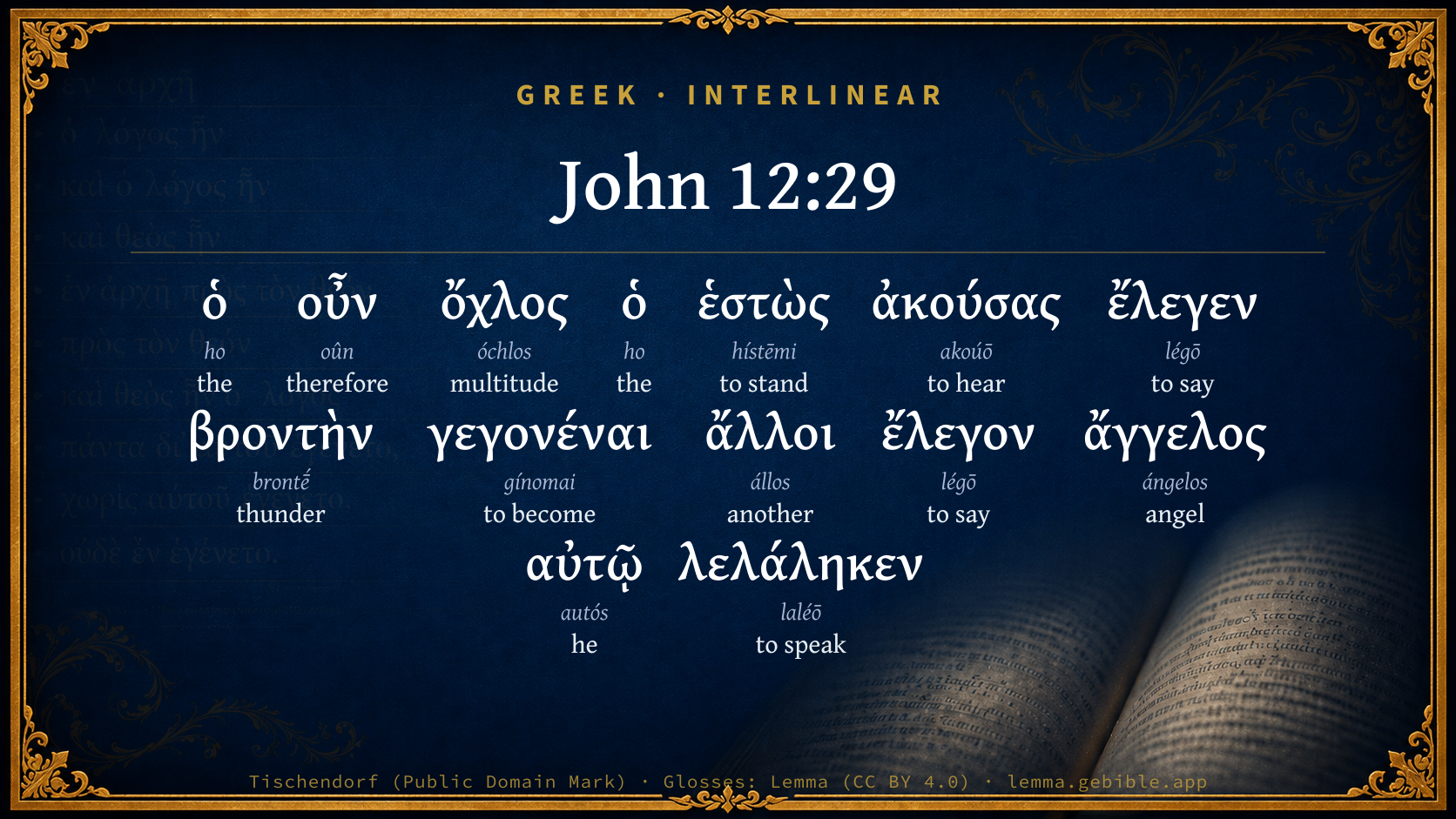
  1. ὁ ho G3588 “the” Article, Nominative, Singular, Masculine
  2. οὖν oûn G3767 “therefore” Conjunction
  3. ὄχλος óchlos G3793 “multitude” Noun, Nominative, Singular, Masculine
  4. ὁ ho G3588 “the” Article, Nominative, Singular, Masculine
  5. ἑστὼς hístēmi G2476 “to stand” Verb, Perfect, Active, Participle, Nominative, Singular, Masculine
  6. ἀκούσας akoúō G191 “to hear” Verb, Aorist, Active, Participle, Nominative, Singular, Masculine
  7. ἔλεγεν légō G3004 “to say” Verb, Imperfect, Active, Indicative, 3rd person, Singular
  8. γεγονέναι gínomai G1096 “to become” Verb, Perfect, Active, Infinitive
  9. ἄλλοι állos G243 “another” Adjective, Nominative, Plural, Masculine
  10. ἔλεγον légō G3004 “to say” Verb, Imperfect, Active, Indicative, 3rd person, Plural
  11. ἄγγελος ángelos G32 “angel” Noun, Nominative, Singular, Masculine
  12. αὐτῷ autós G846 “he” Personal pronoun, Dative, Singular, Masculine
  13. λελάληκεν laléō G2980 “to speak” Verb, Perfect, Active, Indicative, 3rd person, Singular

About this verse

These counts appear in no published source. They are computed here, from the morphology-tagged text and Lemma’s own curated glosses. What Lemma adds →

14
words
12
distinct lemmas
Gospels
section

Notable vocabulary

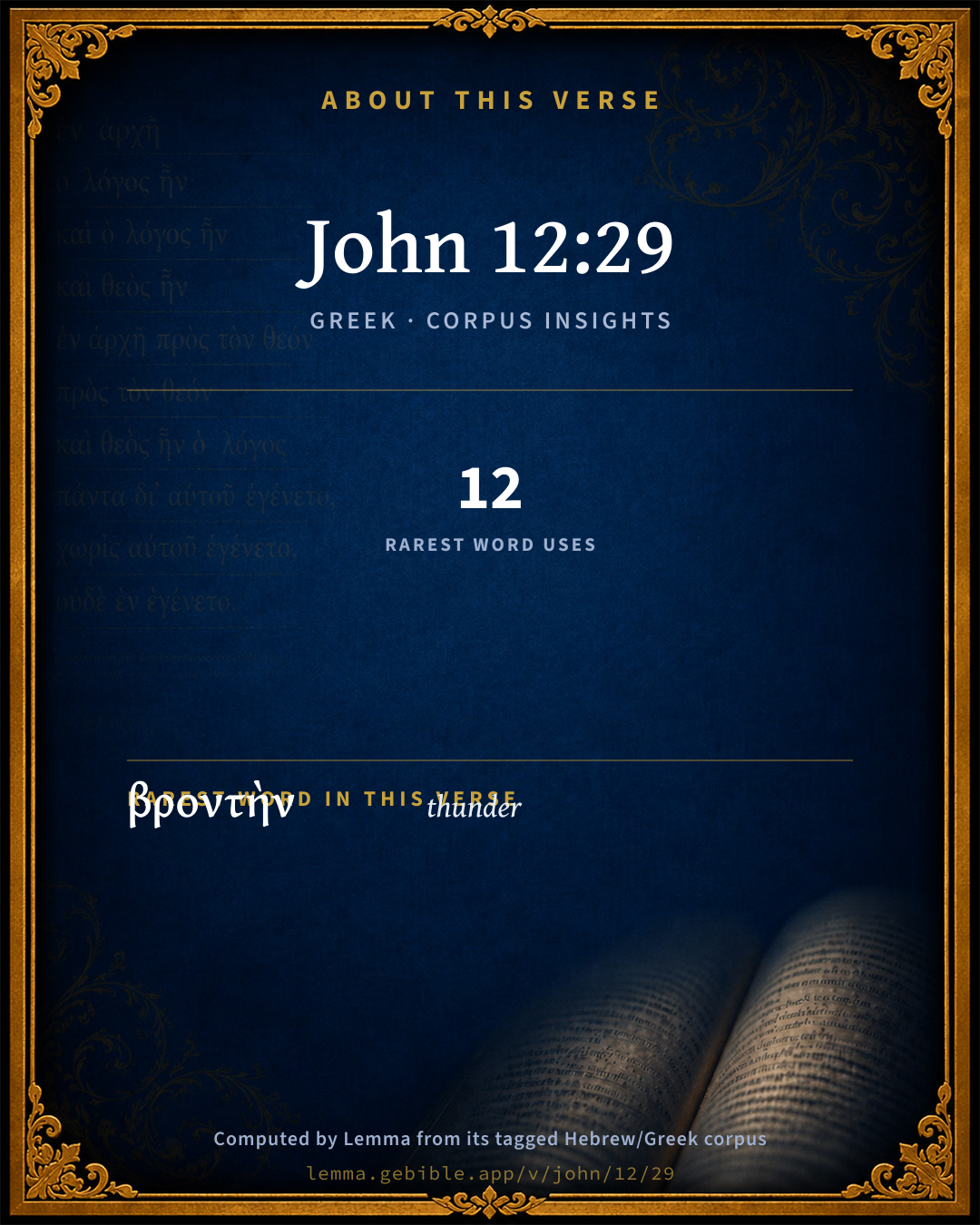
The rarest word here is βροντὴν thunder G1027 — appearing just 12 times in the whole Greek New Testament.

Shared distinctive vocabulary

βροντὴν thunder G1027 occurs in 11 verses of the Greek New Testament. Also found in:

Repetition

Words recur within this verse:

  • ἔλεγεν to say G3004 ×2
  • ὁ the G3588 ×2

Cross-references

11

Topical passages linked to John 12:29 in the Treasury of Scripture Knowledge — connected by theme and wording, ordered by reader-vote popularity; previews shown in the World English Bible.

  • Job 37:2–5 Hear, oh, hear the noise of his voice, The sound that goes out of his mouth.
  • Revelation 6:1 I saw that the Lamb opened one of the seven seals, and I heard one of the four living creatures saying, as with a voice of thunder, "Come and see!"
  • Revelation 14:2 I heard a sound from heaven, like the sound of many waters, and like the sound of a great thunder. The sound which I heard was like that of harpists playing on their harps.
  • Exodus 19:16 It happened on the third day, when it was morning, that there were thunders and lightnings, and a thick cloud on the mountain, and the sound of an exceedingly loud trumpet; and all the people who were in the camp trembled.
  • Exodus 20:18 All the people perceived the thunderings, the lightnings, the sound of the trumpet, and the mountain smoking. When the people saw it, they trembled, and stayed at a distance.
  • Job 40:9 Or have you an arm like God? Can you thunder with a voice like him?
  • Ezekiel 10:5 The sound of the wings of the cherubim was heard even to the outer court, as the voice of God Almighty when he speaks.
  • Acts 23:8–9 For the Sadducees say that there is no resurrection, nor angel, nor spirit; but the Pharisees confess all of these.
  • Revelation 8:5 The angel took the censer, and he filled it with the fire of the altar, and threw it on the earth. There followed thunders, sounds, lightnings, and an earthquake.
  • Revelation 11:19 God's temple that is in heaven was opened, and the ark of the Lord's covenant was seen in his temple. Lightnings, sounds, thunders, an earthquake, and great hail followed.
  • Revelation 18:1–2 After these things, I saw another angel coming down out of the sky, having great authority. The earth was illuminated with his glory.

Cross-references courtesy of OpenBible.info (CC BY 4.0).

Commentary

Notes on John 12:29 from classic Christian and Jewish commentators (each source and its license shown beneath its notes). The classic Christian expositions comment on the surrounding passage and are grouped to its opening verse, so a note may address several verses; the Jewish commentaries on the Tanakh (Rashi and others) are per-verse, so they appear only where the commentator wrote on this verse.

Lemma curates 59 commentaries, every one of them public domain or Creative Commons licensed, each selected and text-cleaned for this edition rather than reprinted as found. About our sources →

Tyndale Open Study Notes

Tyndale Open Resources

12:29 It was impossible for people to comprehend what was happening with Jesus, and many of his signs led to confusion and division in the crowd. Only later did his disciples understand (2:22; 12:16), when Jesus was glorified and the Spirit was given. Still, God’s voice symbolized his validation of his Son before the world.

Tyndale Open Study Notes — © Tyndale Open Resources, licensed CC BY-SA 4.0. Text via the HelloAO Bible API.

Bengel's Gnomon

Johann Albrecht Bengel

Joh 12:29. Ἀκούσας, having heard it) They had heard the sound, not the words. In the greatest revelations there remains something whereby faith may be exercised.—βροντήν, thunder) It was spring.[321]

[321] When thunder is frequent.—E. and T.

Bengel's Gnomon of the New Testament — English translation (T&T Clark, Edinburgh, 1860) — public domain. Text from a community e-Sword module.

Expositor's Greek Testament

ed. W. Robertson Nicoll

Joh 12:29 . Ὁ οὖν ὄχλος … λελάληκεν . The mass of the people which was standing by and heard the voice did not recognise it as a voice, but said it thundered. Others caught, if not the words, yet enough to perceive it was articulate speech, and said that an angel had spoken to Him.

The Expositor's Greek Testament, edited by W. Robertson Nicoll (1897–1910) — public domain. Text from a community e-Sword module.

Jamieson, Fausset & Brown

Robert Jamieson, A. R. Fausset & David Brown

The people therefore that stood by, said, It thundered; others, An angel spake to him--some hearing only a sound, others an articulate, but to them unintelligible voice.

Jamieson, Fausset & Brown — Commentary Critical and Explanatory on the Whole Bible (1871) — public domain (CC PDM 1.0). Text via the HelloAO Bible API.

Adam Clarke's Commentary

Verse 29. The people - said that it thundered: others - an angel spake to him.] Bishop Pearce says, Probably there was thunder as well as a voice, as in Ex 19:16-17, and some persons, who were at a small distance, might hear the thunder without hearing the voice; while others heard the voice too; and these last said, "An angel hath spoken to him."

Wetstein supposes that the voice was in the language then in use among the Jews; which the Greeks, not understanding, took for thunder; the others, the Jews, who did understand it, said it was the voice of an angel. In Re 6:1, the voice of one of the living creatures is compared to thunder; and in Re 10:3, the voice of an angel is compared to seven thunders. The voice mentioned was probably very loud, which some heard distinctly, others indistinctly; hence the variety of opinion.

Adam Clarke's Commentary on the Bible (1810–1826) — public domain. Text from a community e-Sword/MySword module.

John Calvin's Commentaries

29. That it thundered. It was truly monstrous, that the assembled multitude were unmoved by so evident a miracle. Some are so deaf, that they hear as a confused sound what God had distinctly pronounced. Others are less dull of caring, but yet take away much from the majesty of the Divine voice, by pretending that it was an angel who spoke. But the same thing is practiced every day; for God speaks plainly enough in the Gospel, in which is also displayed the power and energy of the Spirit, which ought to shake heaven and earth; but many are as little affected by the doctrine, as if it only proceeded from a mortal man, and others consider the word of God to be confused and barbarous, as if it were nothing else than thunder.

But a question arises: Did that voice sound from heaven without any profit or advantage? I reply, what the Evangelist here ascribes to the multitude belongs only to a part of them; for there were some besides the Apostles who did not interpret it so badly. But the Evangelist intended to point out briefly what is commonly done in the world; and that is, that the greater part of men, while they hear God, do not hear him though he speak plainly and distinctly.

John Calvin's Commentaries (1540-1563) — public domain. Text from the Calvin Translation Society English edition (1840s-50s) via the Christian Classics Ethereal Library (ccel.org). Calvin's coverage is partial (roughly two-thirds of the Bible); uncommented books and verses are honest gaps, never fabricated. The 19th-century editor's footnotes and remarks are omitted so the notes are faithfully Calvin's own voice.

Ellicott's Commentary for English Readers

(29) The people . . . . said that it thundered.—Better, the multitude. Nothing could be stronger testimony to the fact that this narrative was written by one who was present at the events of which he tells, than the way in which these thoughts of the people at the time are preserved to us. Their insertion by a later hand is all but impossible; and they are, moreover, opposed to what must be assumed as the object of a later writer. In a treatise to prove the divinity of Christ there could be no place for them. In a Gospel which assumes the truth that He is divine, and does not seek to prove it, but to bear witness to the life which carries its own proof (comp. Notes on Joh_1:7; Joh_20:30-31), they are evidence that the witness is true. The fact that St. John clearly means us to understand (Joh_12:28) that a distinct voice spake from heaven does not forbid our understanding also that this voice was heard more or less distinctly, or was as a voice not heard at all, in proportion as the hearts of the hearers were or were not receptive of the voice of God. To some it seemed but as natural thunder, but their own Scripture had taught again and again “God thundereth marvellously with His voice: great things doeth He which we cannot comprehend,” and the religious interpretation of nature hears everywhere the voice of God. Others, and these must have been Pharisees (comp. Act_23:8-9), recognise a voice which is more than that of nature or of man, and think that an angel hath spoken. (Comp. Note on Joh_5:4.)

A Bible Commentary for English Readers, edited by Charles John Ellicott (1878–1897) — public domain. Text from a community e-Sword module.

The Cambridge Bible for Schools and Colleges

gen. ed. J. J. S. Perowne

29. The people … thundered … spake] Better, The multitude … had thundered … hath spoken.

The Cambridge Bible for Schools and Colleges (gen. ed. J. J. S. Perowne; Cambridge University Press, 1878–1918) — public domain. Text from a community e-Sword module.

John Gill's Exposition

Jesus answered and said,.... To the people that stood by, and were disputing among themselves about what they heard, whether it was thunder, or the voice of an angel:

this voice came not because of me; at least not only and chiefly; it was not so much in answer to his prayer, or in order to comfort him under the apprehensions he had of his sufferings and death, or to assure him of his future glorification, though all this was true:

but for your sakes; to convince them that he was the Messiah, and engage them to believe in him, or to leave them without excuse; since not only miracles were wrought before their eyes, but with their ears they heard God speaking to him, and which is the rule that they themselves prescribe; for according to them, no man is to be hearkened to, though he should do as many signs and wonders as Moses, the son of Amram, unless they hear with their ears, that the Lord speaks to him as he did to Moses (c).

(c) R. Mosis Kotsensis praefat. ad Mitzvot Tora, pr. Affirm.

John Gill's Exposition of the Whole Bible (1746–1763) — public domain (CC PDM 1.0). Text via the HelloAO Bible API.

Trapp's Complete Commentary

John Trapp

29 The people therefore, that stood by, and heard it, said that it thundered: others said, An angel spake to him.

Ver. 29. That it thundered; others said, An angel, &c.] But the apostles and some few others understood that it was neither thunder nor an angel, but God that spake. Fuerunt praeter Apostolos etiam aliqui minus sinistri interpretes. (Calvin.) In like sort today God speaks by his word, but few hear him in it. The word of God (saith Forbes on Rev 14:1-20) hath three degrees of operation in the hearts of men. First, it falleth to men’s ears, as the sound of many waters; a confused sound, which commonly bringeth neither terror nor joy, but yet a wondering and acknowledgment of a strange force, and more than human power, Mar 1:22; Mar 1:27 Act 13:41. The second effect is, the voice of thunder; which brings not only wonder, but fear: these two may be in the reprobate, as Felix, and the multitude in our text. The third effect, proper to the elect, is the sound of harping; while the word not only ravisheth with admiration, and striketh the conscience with terror, but also filleth it with sweet peace and joy.

John Trapp, A Commentary or Exposition upon All the Books of the Old and New Testament (1647–1656) — public domain. Text from a community e-Sword module.

Albert Barnes' Notes on the Bible

The people - A part of the people.

It thundered - The unexpected sound of the voice would confound and amaze them; and though there is no reason to doubt that the words were spoken distinctly Mat 3:17, yet some of the people, either from amazement or envy, would suppose that this was a mere natural phenomenon.

An angel spake - It was the opinion of many of the Jews that God did not speak to men except by the ministry of angels, Heb 2:2; “The word spoken by angels;” Gal 3:19; “It was ordained by angels in the hand of a mediator.”

Albert Barnes' Notes on the Bible (1834–1885) — public domain. Text from a community e-Sword/MySword module.

Matthew Poole's English Annotations

The people said that it thundered; nor, it may be, were they mistaken, saving only in this, that they thought it was nothing else but thunder (being possibly at such a distance, as they could not distinctly hear the voice); for it was God’s way, when he spake unto his people by a voice, to have that voice, for the greater declaration of the Divine majesty, attended with thunderings and lightnings: thus it was at the giving of the law upon Mount Sinai; thus we read in John’s visions, Rev 4:5; 8:5, of lightnings, and thunderings, and voices, which proceeded from God’s throne.

Others said, An angel spake to him: it was the general opinion of the Jews, that God always, when by voice he revealed his mind to his people, made use of an angel to do it by; hence, probably, as those who were at such a distance that they heard no voice, thought it was nothing but thunder; so those who are so nigh as, besides the thunder, to hear a voice, said, It was an angel that spake with him.

Matthew Poole's English Annotations on the Holy Bible (1683–1685) — public domain. Text from a community e-Sword/MySword module.

Whedon's Commentary on the Bible

Daniel D. Whedon

29. People… said that it thundered—The deep majesty of the divine voice suggests to those who distinguished not the articulation, the idea of thunder. Others, who recognized the utterance, yet saw no speaker, said an angel spake to him.

Daniel D. Whedon (gen. ed.), Commentary on the Old and New Testaments (1874–1909) — public domain. Text from a community e-Sword module.

John Wesley's Explanatory Notes

The multitude who stood and heard - A sound, but not the distinct words - In the most glorious Revelations there may remain something obscure, to exercise our faith. Said, It thundered -Thunder did frequently attend a voice from heaven. Perhaps it did so now.

John Wesley, Explanatory Notes Upon the Whole Bible (1754–1765) — public domain. Text via the GEBible commentary corpus.

Scofield Reference Notes

C. I. Scofield

angel

(See Scofield "Heb 1:4").

The Scofield Reference Bible (1917 edition), notes by C. I. Scofield — public domain. Text from a community e-Sword module.

Burkitt's Expository Notes on the New Testament

William Burkitt

Observe here, 1. The way of God in speaking to his people by a voice in thunder for the greater declaration of his glory and majesty. Thunderings and lightnings usually attended the voice of God, even in consolations, and when he spake comfortably to his own servants.

Oh! how dreadful and terrible then must the voice of God be to his enemies, when he shall come in flaming fire, to render vengeance to them! If there was such dread and terror, such thunderings and lightnings at the giving of the law: Lord! what will there be another day, when thou comest to punish the violation of that law!

Observe, 2. The end why God the Father now spake with an audible voice to Christ his Son: it was for his consolation, and the people’s confirmation. His soul being troubled, he stood in need, as Mediator, of comfort from his Father: and the people had here a farther and fuller confirmation of his being the promised and true Messias, that so they might believe in him, This voice came not because of me: that is, not only or chiefly because of me, but to confirm your faith in the belief of this great truth, that I am the Son of God, by whom the Father hath glorified, and will further glorify, his name.

Observe, 3. Our Saviour declares a double effect and fruit of his death and passion.

1. The judgment of this world; Now is the judgment of this world; now shall the prince of this world be cast out.

That is, my death will be the devil’s overthrow; will bring down sin, and deliver the world from the tyranny and dominion of sin and Satan.

Thence learn, 1. That Satan is the prince and ruler of all those who live in sin; not a prince by legal right, but by tyrannical usurpation.

2. That this usurper, Satan, will not quit his possession, unless he be cast out.

3. That Christ by his death has cast out Satan, dethroned him, and deprived him of his tyrannical usurpation. Now is the prince of this world cast out; that is, I will shortly by my death deliver the world from the slavery of sin, and dominion of Satan, and particularly from that idolatry, which the greatest part of the world were then in slavery under.

The second effect and fruit of Christ’s death which is here declared, is his drawing all men unto him: When I am lifted up from the earth, I will draw all men unto me.

There is a twofold lifting up of Christ:

the first ignominious, when he was hung upon the cross;

the second glorious, in the preaching of the gospel:

by this he draws all men unto him; that is, by the preaching of the gospel, he calls and invites all persons to himself;

he offers the benefits of his death to all, and gathereth a church to himself out of the Gentile as well as the Jewish world.

Learn, 1. That all persons are naturally unwilling to come to Christ, they must be drawn.

2. That Christ meritoriously by his death, and instrumentally by the preaching of the gospel, draws sinners unto himself.

3. That it is not a few, or small number, but a very great number, consisting both of Jews and Gentiles, bond and free, persons of all nations, all are effectually drawn to Christ, so as savingly to believe in him: but, by the preaching of the gospel, they are called and invited to him, and the benefits of his death are offered to them.

Thus Christ being lifted up upon his cross, and on the pole of his gospel, draws all men unto him; that is, doth what is sufficient to prevail with all men to believe on him, and to render those that do not so, everlastingly inexcusable.

William Burkitt's Expository Notes on the New Testament (1700–1703) — public domain. Text from a community e-Sword module.

The People's New Testament

B. W. Johnson

29. An angel spake to him. All heard the sound of the divine voice, but it was not clear to all what it was.

B. W. Johnson's The People's New Testament with Notes (1889–1891) — public domain. Electronic text from the Christian Classics Ethereal Library (CCEL) ThML edition.

Alford’s Greek Testament

Henry Alford

29.] Some heard words, but did not apprehend their meaning; others a sound, but no words. I should rather believe this difference to have been proportioned to each man’s inner relation to Christ, than fortuitous.

Henry Alford, The Greek Testament (1849–1861) — public domain. Text from a community e-Sword module.

International Critical Commentary

29. ὁ οὖν ὄχλος ὁ ἑστὼς (ADWΘ have ἑστήκως; cf. 3:29) καὶ ἀκούσας κτλ., “the crowd (that is, most of the bystanders) that stood by and heard said that it had thundered.” That thunder is the Voice of God is a commonplace in the O.T. (cf. Exo 9:28, 2Sa 22:14, Psa 29:3, Job 37:5, Jer 10:13); and when the crowd said that it had thundered, they meant that the thunder was a Divine response to what Jesus had said, although they did not catch any articulate words. This is the only place in the N.T. where mention is made of a thunderclap.

ἄλλοι ἔλεγον, ἄγγελος αὐτῷ λελάληκεν, “others,” that is, a few of the crowd, discerned that Jesus had received a definite message of comfort, and that something more than a clap of thunder had been heard. But none of the bystanders heard any articulate words; and this Jn. is careful to make clear. In this particular, the narrative is like that of the Voice from heaven at the conversion of Paul, where his companions heard a sound (ἀκούοντες τῆς φωνῆς, Act 9:7) but did not distinguish the words (τὴν φωνὴν οὐκ ἤκουσαν τοῦ λαλοῦντός μοι, Act 22:9; see note above on 3:8).

Wetstein illustrates the passage by the prayer of Anchises, which has some verbal similarities (Virg. Æn. ii. 692):

“Da deinde augurium, pater, atque haec omina firma Vix ea fatus erat senior, subitoque fragore Intonuit laeuum.”

International Critical Commentary — older volumes (1896–1929), various authors — public domain. Text from a community e-Sword module.

Lesson kit

Teaching starters — assembled from the data on this page, not authored interpretation. Every prompt links to the verse data it draws on. Edit before teaching.

John, in the Gospels, opens this verse with 14 words (12 distinct Greek lemmas). Its most distinctive word is brontḗ (“thunder”). A historical commentator’s framing appears above. Read the whole chapter for the surrounding context.

Discussion questions

  1. What does “thunder” (brontḗ) contribute to the verse as a whole?
  2. How does Mark 3:17, which shares the word «thunder», read alongside this verse?
  3. What does the repetition of “to say” (2× in this one verse) do in this verse?
  4. These translations render this verse differently; the difference is in the English rendering, not the original. What questions does that raise?
  5. Compare how Tyndale Open Study Notes and Bengel's Gnomon read this verse. Where do they agree or differ?

Things to notice

Reading settings

Reading text

Shown beneath each verse's original-language words.

Old Testament
Old Testament edition

Read the OT as the Masoretic Hebrew (MT) or the Greek Septuagint (LXX).

English shown for the Greek Septuagint (in the Hebrew ↔ Greek comparison).

Comparing translations? Open the Compare panel on any verse page to stack up to four side by side.