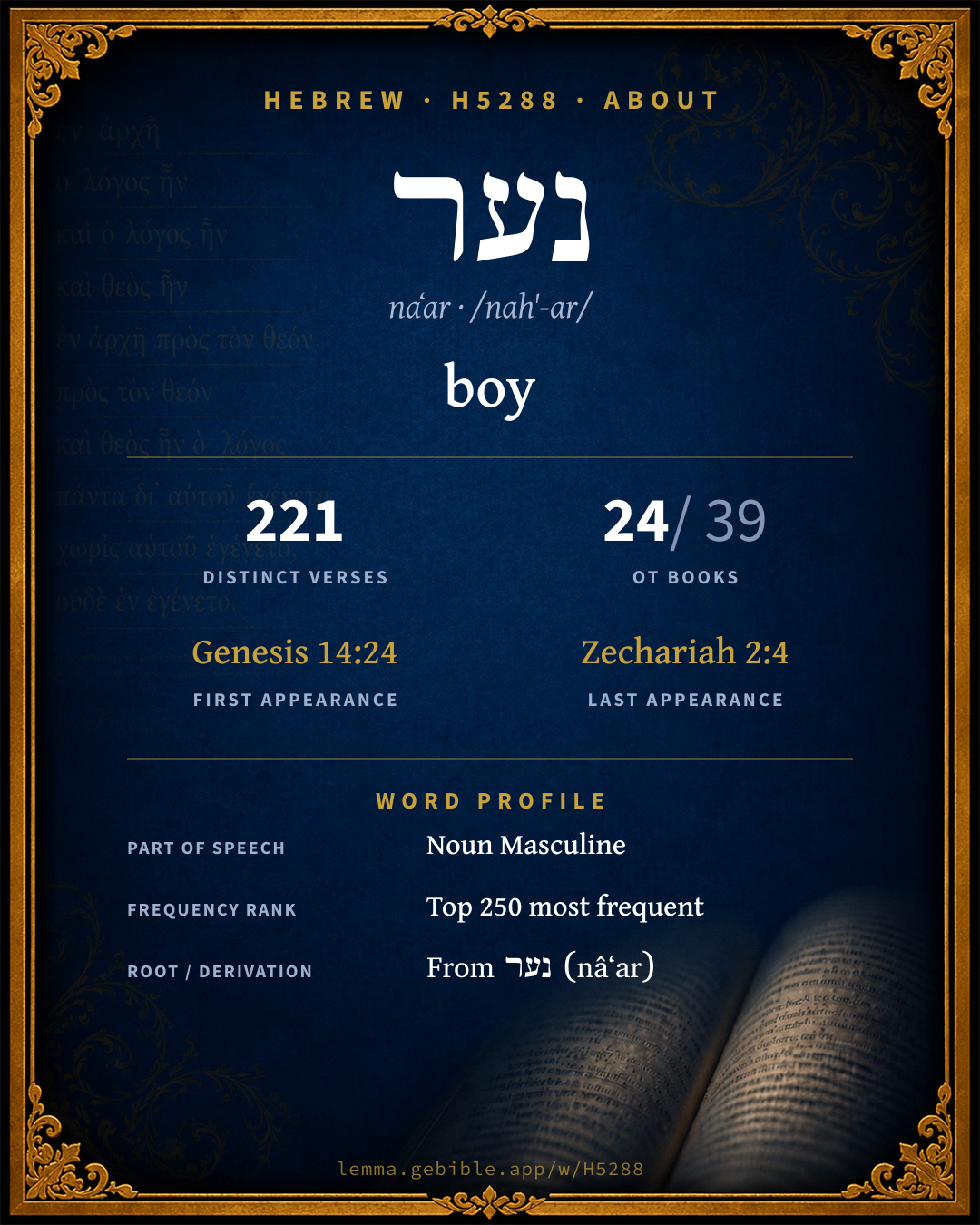
נַ֫עַר
boy
also: lad, servant, youth, retainer fuller range ↓
Full lexicon entry — Brown-Driver-Briggs (BDB)
From Brown-Driver-Briggs (BDB)
Where this word appears
See every Absolute-state word in the Hebrew Bible →
Grammar key — what these labels mean
Part of speech
- Noun
- A naming word — a person, place, thing, or idea.
Noun type
- Common
- A common noun — a general class of person, place, or thing (“king,” “city,” “water”), not a specific name.
State
- Absolute
- The independent form of a noun, not bound to a following word.
- Construct
- A noun bound to a following noun in a possessive / “of” relationship (the construct chain).
Gender
- Masculine
- Grammatically masculine.
Number
- Singular
- One.
- Plural
- More than one (in Hebrew, generally three or more).
Grammatical forms
- Noun, Common, Masculine, Singular, Absolute 134 times (56%)
- Noun, Common, Masculine, Plural, Absolute 42 times (18%)
- Noun, Common, Masculine, Plural, Construct 32 times (13%)
- Noun, Common, Masculine, Singular, Construct 31 times (13%)
Parsed forms decoded from the imported morphology (morphhb / Westminster Leningrad Codex — WLC text public domain, morphhb tagging CC BY 4.0), counted across 239 parsed occurrences — not distinct verses.
Page 1 of 2 — showing verses 1–200 of 221 distinct verses where H5288 appears, across 24 books. Click any verse to open its interlinear word-by-word view. Verse text shown in the World English Bible for context — . Each verse’s Hebrew form is shown with its reference; the English is not keyword-highlighted, since the data carries no word-level English alignment. Use “Compare translations” on any verse to read it across multiple English versions. This concordance covers the Hebrew Bible; Septuagint (Greek Old Testament) occurrences are not indexed here.
Genesis 24 verses
- Genesis 14:24 הַ/נְּעָרִ֔ים ptcl def.art + n c mp Except only that which the young men have eaten, and the portion of the men who went with me, Aner, Eshcol, and Mamre: let them take their portion."
- Genesis 18:7 הַ/נַּ֔עַר ptcl def.art + n c ms Abraham ran to the herd, and fetched a tender and good calf, and gave it to the servant. He hurried to dress it.
- Genesis 19:4 מִ/נַּ֖עַר prep + n c ms But before they lay down, the men of the city, the men of Sodom, surrounded the house, both young and old, all the people from every quarter.
- Genesis 21:12 הַ/נַּ֣עַר ptcl def.art + n c ms God said to Abraham, "Don't let it be grievous in your sight because of the boy, and because of your handmaid. In all that Sarah says to you, listen to her voice. For from Isaac will your seed be called.
- Genesis 21:17 הַ/נַּעַר֒ הַ/נַּ֖עַר ptcl def.art + n c ms ptcl def.art + n c ms God heard the voice of the boy. The angel of God called to Hagar out of the sky, and said to her, "What ails you, Hagar? Don't be afraid. For God has heard the voice of the boy where he is.
- Genesis 21:18 הַ/נַּ֔עַר ptcl def.art + n c ms Get up, lift up the boy, and hold him in your hand. For I will make him a great nation."
- Genesis 21:19 הַ/נָּֽעַר ptcl def.art + n c ms God opened her eyes, and she saw a well of water. She went, filled the bottle with water, and gave the boy drink.
- Genesis 21:20 הַ/נַּ֖עַר ptcl def.art + n c ms God was with the boy, and he grew. He lived in the wilderness, and became, as he grew up, an archer.
- Genesis 22:3 נְעָרָי/ו֙ n c mp cs + sfx pers 3ms Abraham rose early in the morning, and saddled his donkey, and took two of his young men with him, and Isaac his son. He split the wood for the burnt offering, and rose up, and went to the place of which God had told him.
- Genesis 22:5 נְעָרָ֗י/ו וְ/הַ/נַּ֔עַר n c mp cs + sfx pers 3ms conj + ptcl def.art + n c ms Abraham said to his young men, "Stay here with the donkey. The boy and I will go yonder. We will worship, and come back to you.
- Genesis 22:12 הַ/נַּ֔עַר ptcl def.art + n c ms He said, "Don't lay your hand on the boy, neither do anything to him. For now I know that you fear God, seeing you have not withheld your son, your only son, from me."
- Genesis 22:19 נְעָרָ֔י/ו n c mp cs + sfx pers 3ms So Abraham returned to his young men, and they rose up and went together to Beersheba. Abraham lived at Beersheba.
- Genesis 25:27 הַ/נְּעָרִ֔ים ptcl def.art + n c mp The boys grew. Esau was a skillful hunter, a man of the field. Jacob was a quiet man, living in tents.
- Genesis 34:19 הַ/נַּ֨עַר֙ ptcl def.art + n c ms The young man didn't wait to do this thing, because he had delight in Jacob's daughter, and he was honored above all the house of his father.
- Genesis 37:2 נַ֗עַר n c ms This is the history of the generations of Jacob. Joseph, being seventeen years old, was feeding the flock with his brothers. He was a boy with the sons of Bilhah and Zilpah, his father's wives. Joseph brought an evil report of them to their father.
- Genesis 41:12 נַ֣עַר n c ms There was with us there a young man, a Hebrew, servant to the captain of the guard, and we told him, and he interpreted to us our dreams. To each man according to his dream he interpreted.
- Genesis 43:8 הַ/נַּ֛עַר ptcl def.art + n c ms Judah said to Israel, his father, "Send the boy with me, and we will arise and go, so that we may live, and not die, both we, and you, and also our little ones.
- Genesis 44:22 הַ/נַּ֖עַר ptcl def.art + n c ms We said to my lord, 'The boy can't leave his father: for if he should leave his father, his father would die.'
- Genesis 44:30 וְ/הַ/נַּ֖עַר conj + ptcl def.art + n c ms Now therefore when I come to your servant my father, and the boy is not with us; seeing that his life is bound up in the boy's life;
- Genesis 44:31 הַ/נַּ֖עַר ptcl def.art + n c ms it will happen, when he sees that the boy is no more, that he will die. Your servants will bring down the gray hairs of your servant, our father, with sorrow to Sheol.
- Genesis 44:32 הַ/נַּ֔עַר ptcl def.art + n c ms For your servant became collateral for the boy to my father, saying, 'If I don't bring him to you, then I will bear the blame to my father forever.'
- Genesis 44:33 הַ/נַּ֔עַר וְ/הַ/נַּ֖עַר ptcl def.art + n c ms conj + ptcl def.art + n c ms Now therefore, please let your servant stay instead of the boy, a bondservant to my lord; and let the boy go up with his brothers.
- Genesis 44:34 וְ/הַ/נַּ֖עַר conj + ptcl def.art + n c ms For how will I go up to my father, if the boy isn't with me? Lest I see the evil that will come on my father."
- Genesis 48:16 הַ/נְּעָרִים֒ ptcl def.art + n c mp the angel who has redeemed me from all evil, bless the lads, and let my name be named on them, and the name of my fathers Abraham and Isaac. Let them grow into a multitude in the midst of the earth."
Exodus 4 verses
- Exodus 2:6 נַ֖עַר n c ms She opened it, and saw the child, and, behold, the baby cried. She had compassion on him, and said, "This is one of the Hebrews' children."
- Exodus 10:9 בִּ/נְעָרֵ֥י/נוּ prep + n c mp cs + sfx pers 1cp Moses said, "We will go with our young and with our old; with our sons and with our daughters, with our flocks and with our herds will we go; for we must hold a feast to Yahweh."
- Exodus 24:5 נַעֲרֵי֙ n c mp cs He sent young men of the children of Israel, who offered burnt offerings and sacrificed peace-offerings of oxen to Yahweh.
- Exodus 33:11 נַ֔עַר n c ms Yahweh spoke to Moses face to face, as a man speaks to his friend. He turned again into the camp, but his servant Joshua, the son of Nun, a young man, didn't depart out of the Tent.
Numbers 2 verses
- Numbers 11:27 הַ/נַּ֔עַר ptcl def.art + n c ms There ran a young man, and told Moses, and said, Eldad and Medad do prophesy in the camp.
- Numbers 22:22 נְעָרָ֖י/ו n c mp cs + sfx pers 3ms God's anger was kindled because he went; and the angel of Yahweh placed himself in the way for an adversary against him. Now he was riding on his donkey, and his two servants were with him.
Deuteronomy 1 verse
Joshua 2 verses
- Joshua 6:21 מִ/נַּ֖עַר prep + n c ms They utterly destroyed all that was in the city, both man and woman, both young and old, and ox, and sheep, and donkey, with the edge of the sword.
- Joshua 6:23 הַ/נְּעָרִ֣ים ptcl def.art + n c mp The young men the spies went in, and brought out Rahab, and her father, and her mother, and her brothers, and all that she had; all her relatives also they brought out; and they set them outside of the camp of Israel.
Judges 21 verses
- Judges 7:10 נַעַרְ/ךָ֖ n c ms cs + sfx pers 2ms But if you fear to go down, go you with Purah your servant down to the camp:
- Judges 7:11 נַעֲר֔/וֹ n c ms cs + sfx pers 3ms and you shall hear what they say; and afterward shall your hands be strengthened to go down into the camp. Then went he down with Purah his servant to the outermost part of the armed men who were in the camp.
- Judges 8:14 נַ֛עַר n c ms He caught a young man of the men of Succoth, and inquired of him: and he described for him the princes of Succoth, and the elders of it, seventy-seven men.
- Judges 8:20 הַ/נַּ֤עַר נָֽעַר ptcl def.art + n c ms n c ms He said to Jether his firstborn, Up, and kill them. But the youth didn't draw his sword; for he feared, because he was yet a youth.
- Judges 9:54 הַ/נַּ֣עַר נַעֲר֖/וֹ ptcl def.art + n c ms n c ms cs + sfx pers 3ms Then he called hastily to the young man his armor bearer, and said to him, Draw your sword, and kill me, that men not say of me, A woman killed him. His young man thrust him through, and he died.
- Judges 13:5 הַ/נַּ֖עַר ptcl def.art + n c ms for, behold, you shall conceive, and bear a son; and no razor shall come on his head; for the child shall be a Nazirite to God from the womb: and he shall begin to save Israel out of the hand of the Philistines.
- Judges 13:7 הַ/נַּ֔עַר ptcl def.art + n c ms but he said to me, Behold, you shall conceive, and bear a son; and now drink no wine nor strong drink, and eat not any unclean thing; for the child shall be a Nazirite to God from the womb to the day of his death.
- Judges 13:8 לַ/נַּ֥עַר prep det + n c ms Then Manoah entreated Yahweh, and said, Oh, Lord, please let the man of God whom you did send come again to us, and teach us what we shall do to the child who shall be born.
- Judges 13:12 הַ/נַּ֖עַר ptcl def.art + n c ms Manoah said, Now let your words happen: what shall be the ordering of the child, and [how] shall we do to him?
- Judges 13:24 הַ/נַּ֔עַר ptcl def.art + n c ms The woman bore a son, and named him Samson: and the child grew, and Yahweh blessed him.
- Judges 16:26 הַ/נַּ֨עַר ptcl def.art + n c ms and Samson said to the boy who held him by the hand, Allow me that I may feel the pillars whereupon the house rests, that I may lean on them.
- Judges 17:7 נַ֗עַר n c ms There was a young man out of Bethlehem Judah, of the family of Judah, who was a Levite; and he sojourned there.
- Judges 17:11 הַ/נַּ֨עַר֙ ptcl def.art + n c ms The Levite was content to dwell with the man; and the young man was to him as one of his sons.
- Judges 17:12 הַ/נַּ֖עַר ptcl def.art + n c ms Micah consecrated the Levite, and the young man became his priest, and was in the house of Micah.
- Judges 18:3 הַ/נַּ֖עַר ptcl def.art + n c ms When they were by the house of Micah, they knew the voice of the young man the Levite; and they turned aside there, and said to him, Who brought you here? and what do you in this place? and what have you here?
- Judges 18:15 הַ/נַּ֥עַר ptcl def.art + n c ms They turned aside there, and came to the house of the young man the Levite, even to the house of Micah, and asked him of his welfare.
- Judges 19:3 וְ/נַעֲר֥/וֹ conj + n c ms cs + sfx pers 3ms Her husband arose, and went after her, to speak kindly to her, to bring her again, having his servant with him, and a couple of donkeys: and she brought him into her father's house; and when the father of the young lady saw him, he rejoiced to meet him.
- Judges 19:9 וְ/נַעֲר֑/וֹ conj + n c ms cs + sfx pers 3ms When the man rose up to depart, he, and his concubine, and his servant, his father-in-law, the young lady's father, said to him, Behold, now the day draws toward evening, please stay all night: behold, the day grows to an end, lodge here, that your heart may be merry; and tomorrow get you early on your way, that you may go home.
- Judges 19:11 הַ/נַּ֜עַר ptcl def.art + n c ms When they were by Jebus, the day was far spent; and the servant said to his master, Please come and let us turn aside into this city of the Jebusites, and lodge in it.
- Judges 19:13 לְ/נַעֲר֔/וֹ prep + n c ms cs + sfx pers 3ms He said to his servant, Come and let us draw near to one of these places; and we will lodge in Gibeah, or in Ramah.
- Judges 19:19 וְ/לַ/נַּ֖עַר conj + prep det + n c ms Yet there is both straw and provender for our donkeys; and there is bread and wine also for me, and for your handmaid, and for the young man who is with your servants: there is no want of anything.
Ruth 5 verses
- Ruth 2:5 לְ/נַעֲר֔/וֹ prep + n c ms cs + sfx pers 3ms Then said Boaz to his servant who was set over the reapers, Whose young lady is this?
- Ruth 2:6 הַ/נַּ֛עַר ptcl def.art + n c ms The servant who was set over the reapers answered, It is the Moabite lady who came back with Naomi out of the country of Moab:
- Ruth 2:9 הַ/נְּעָרִ֖ים הַ/נְּעָרִֽים ptcl def.art + n c mp ptcl def.art + n c mp Let your eyes be on the field that they reap, and go after them: haven't I charged the young men that they shall not touch you? and when you are thirsty, go to the vessels, and drink of that which the young men have drawn.
- Ruth 2:15 נְעָרָ֜י/ו n c mp cs + sfx pers 3ms When she was risen up to glean, Boaz commanded his young men, saying, Let her glean even among the sheaves, and don't reproach her.
- Ruth 2:21 הַ/נְּעָרִ֤ים ptcl def.art + n c mp Ruth the Moabitess said, Yes, he said to me, You shall keep fast by my young men, until they have ended all my harvest.
1 Samuel 52 verses
- 1 Samuel 1:22 הַ/נַּ֨עַר֙ ptcl def.art + n c ms But Hannah didn't go up; for she said to her husband, [I will not go up] until the child be weaned; and then I will bring him, that he may appear before Yahweh, and there abide forever.
- 1 Samuel 1:24 וְ/הַ/נַּ֖עַר נָֽעַר conj + ptcl def.art + n c ms n c ms When she had weaned him, she took him up with her, with three bulls, and one ephah of meal, and a bottle of wine, and brought him to the house of Yahweh in Shiloh: and the child was young.
- 1 Samuel 1:25 הַ/נַּ֖עַר ptcl def.art + n c ms They killed the bull, and brought the child to Eli.
- 1 Samuel 1:27 הַ/נַּ֥עַר ptcl def.art + n c ms For this child I prayed; and Yahweh has given me my petition which I asked of him:
- 1 Samuel 2:11 וְ/הַ/נַּ֗עַר conj + ptcl def.art + n c ms Elkanah went to Ramah to his house. The child did minister to Yahweh before Eli the priest.
- 1 Samuel 2:13 נַ֤עַר n c ms cs The custom of the priests with the people was that when any man offered sacrifice, the priest's servant came, while the flesh was boiling, with a flesh-hook of three teeth in his hand;
- 1 Samuel 2:15 נַ֣עַר n c ms cs Yes, before they burnt the fat, the priest's servant came, and said to the man who sacrificed, Give flesh to roast for the priest; for he will not have boiled flesh of you, but raw.
- 1 Samuel 2:17 הַ/נְּעָרִ֛ים ptcl def.art + n c mp The sin of the young men was very great before Yahweh; for the men despised the offering of Yahweh.
- 1 Samuel 2:18 נַ֕עַר n c ms But Samuel ministered before Yahweh, being a child, girded with a linen ephod.
- 1 Samuel 2:21 הַ/נַּ֥עַר ptcl def.art + n c ms Yahweh visited Hannah, and she conceived, and bore three sons and two daughters. The child Samuel grew before Yahweh.
- 1 Samuel 2:26 וְ/הַ/נַּ֣עַר conj + ptcl def.art + n c ms The child Samuel grew on, and increased in favor both with Yahweh, and also with men.
- 1 Samuel 3:1 וְ/הַ/נַּ֧עַר conj + ptcl def.art + n c ms The child Samuel ministered to Yahweh before Eli. The word of Yahweh was precious in those days; there was no frequent vision.
- 1 Samuel 3:8 לַ/נָּֽעַר prep det + n c ms Yahweh called Samuel again the third time. He arose and went to Eli, and said, Here am I; for you called me. Eli perceived that Yahweh had called the child.
- 1 Samuel 4:21 לַ/נַּ֗עַר prep det + n c ms She named the child Ichabod, saying, The glory is departed from Israel; because the ark of God was taken, and because of her father-in-law and her husband.
- 1 Samuel 9:3 מֵֽ/הַ/נְּעָרִ֔ים prep + ptcl def.art + n c mp The donkeys of Kish, Saul's father, were lost. Kish said to Saul his son, Take now one of the servants with you, and arise, go seek the donkeys.
- 1 Samuel 9:5 לְ/נַעֲר֥/וֹ prep + n c ms cs + sfx pers 3ms When they had come to the land of Zuph, Saul said to his servant who was with him, Come, and let us return, lest my father leave off caring for the donkeys, and be anxious for us.
- 1 Samuel 9:7 לְ/נַעֲר֗/וֹ prep + n c ms cs + sfx pers 3ms Then said Saul to his servant, But, behold, if we go, what shall we bring the man? for the bread is spent in our vessels, and there is not a present to bring to the man of God: what have we?
- 1 Samuel 9:8 הַ/נַּ֨עַר֙ ptcl def.art + n c ms The servant answered Saul again, and said, Behold, I have in my hand the fourth part of a shekel of silver: that will I give to the man of God, to tell us our way.
- 1 Samuel 9:10 לְ/נַעֲר֛/וֹ prep + n c ms cs + sfx pers 3ms Then said Saul to his servant, Well said; come, let us go. So they went to the city where the man of God was.
- 1 Samuel 9:22 נַעֲר֔/וֹ n c ms cs + sfx pers 3ms Samuel took Saul and his servant, and brought them into the guest-chamber, and made them sit in the best place among those who were invited, who were about thirty persons.
- 1 Samuel 9:27 לַ/נַּ֛עַר prep det + n c ms As they were going down at the end of the city, Samuel said to Saul, Bid the servant pass on before us (and he passed on), but stand you still first, that I may cause you to hear the word of God.
- 1 Samuel 10:14 נַעֲר֖/וֹ n c ms cs + sfx pers 3ms Saul's uncle said to him and to his servant, Where went you? He said, To seek the donkeys; and when we saw that they were not found, we came to Samuel.
- 1 Samuel 14:1 הַ/נַּ֨עַר֙ ptcl def.art + n c ms Now it fell on a day, that Jonathan the son of Saul said to the young man who bore his armor, Come, and let us go over to the Philistines' garrison, that is on yonder side. But he didn't tell his father.
- 1 Samuel 14:6 הַ/נַּ֣עַר ptcl def.art + n c ms Jonathan said to the young man who bore his armor, Come, and let us go over to the garrison of these uncircumcised: it may be that Yahweh will work for us; for there is no restraint to Yahweh to save by many or by few.
- 1 Samuel 16:11 הַ/נְּעָרִים֒ ptcl def.art + n c mp Samuel said to Jesse, Are here all your children? He said, There remains yet the youngest, and, behold, he is keeping the sheep. Samuel said to Jesse, Send and get him; for we will not sit down until he come here.
- 1 Samuel 16:18 מֵ/הַ/נְּעָרִ֜ים prep + ptcl def.art + n c mp Then answered one of the young men, and said, Behold, I have seen a son of Jesse the Bethlehemite, who is skillful in playing, and a mighty man of valor, and a man of war, and prudent in speech, and a comely person; and Yahweh is with him.
- 1 Samuel 17:33 נַ֣עַר n c ms Saul said to David, You are not able to go against this Philistine to fight with him; for you are but a youth, and he a man of war from his youth.
- 1 Samuel 17:42 נַ֔עַר n c ms When the Philistine looked about, and saw David, he disdained him; for he was but a youth, and ruddy, and withal of a fair face.
- 1 Samuel 17:55 הַ/נַּ֖עַר ptcl def.art + n c ms When Saul saw David go forth against the Philistine, he said to Abner, the captain of the host, Abner, whose son is this youth? Abner said, As your soul lives, O king, I can't tell.
- 1 Samuel 17:58 הַ/נָּ֑עַר ptcl def.art + n c ms Saul said to him, Whose son are you, you young man? David answered, I am the son of your servant Jesse the Bethlehemite.
- 1 Samuel 20:21 הַ/נַּ֔עַר לַ/נַּ֜עַר ptcl def.art + n c ms prep det + n c ms Behold, I will send the boy, [saying], Go, find the arrows. If I tell the boy, Behold, the arrows are on this side of you; take them, and come; for there is peace to you and no hurt, as Yahweh lives.
- 1 Samuel 20:35 וְ/נַ֥עַר conj + n c ms It happened in the morning, that Jonathan went out into the field at the time appointed with David, and a little boy with him.
- 1 Samuel 20:36 לְ/נַעֲר֔/וֹ הַ/נַּ֣עַר prep + n c ms cs + sfx pers 3ms ptcl def.art + n c ms He said to his boy, Run, find now the arrows which I shoot. As the boy ran, he shot an arrow beyond him.
- 1 Samuel 20:37 הַ/נַּ֨עַר֙ הַ/נַּ֨עַר֙ ptcl def.art + n c ms ptcl def.art + n c ms When the boy was come to the place of the arrow which Jonathan had shot, Jonathan cried after the boy, and said, Isn't the arrow beyond you?
- 1 Samuel 20:38 הַ/נַּ֔עַר נַ֤עַר ptcl def.art + n c ms n c ms cs Jonathan cried after the boy, Go fast! Hurry! Don't delay! Jonathan's boy gathered up the arrows, and came to his master.
- 1 Samuel 20:39 וְ/הַ/נַּ֖עַר conj + ptcl def.art + n c ms But the boy didn't know anything: only Jonathan and David knew the matter.
- 1 Samuel 20:40 הַ/נַּ֖עַר ptcl def.art + n c ms Jonathan gave his weapons to his boy, and said to him, Go, carry them to the city.
- 1 Samuel 20:41 הַ/נַּעַר֮ ptcl def.art + n c ms As soon as the boy was gone, David arose out of [a place] toward the South, and fell on his face to the ground, and bowed himself three times: and they kissed one another, and wept one with another, until David exceeded.
- 1 Samuel 21:2 הַ/נְּעָרִ֣ים ptcl def.art + n c mp David said to Ahimelech the priest, The king has commanded me a business, and has said to me, Let no man know anything of the business about which I send you, and what I have commanded you: and I have appointed the young men to such and such a place.
- 1 Samuel 21:4 הַ/נְּעָרִ֖ים ptcl def.art + n c mp The priest answered David, and said, There is no common bread under my hand, but there is holy bread; if only the young men have kept themselves from women.
- 1 Samuel 21:5 הַ/נְּעָרִ֖ים ptcl def.art + n c mp David answered the priest, and said to him, Of a truth women have been kept from us about these three days; when I came out, the vessels of the young men were holy, though it was but a common journey; how much more then today shall their vessels be holy?
- 1 Samuel 25:5 נְעָרִ֑ים לַ/נְּעָרִ֗ים n c mp prep det + n c mp David sent ten young men, and David said to the young men, Go up to Carmel, and go to Nabal, and greet him in my name:
- 1 Samuel 25:8 נְעָרֶ֜י/ךָ הַ/נְּעָרִ֥ים n c mp cs + sfx pers 2ms ptcl def.art + n c mp Ask your young men, and they will tell you: therefore let the young men find favor in your eyes; for we come in a good day. Please give whatever comes to your hand, to your servants, and to your son David.
- 1 Samuel 25:9 נַעֲרֵ֣י n c mp cs When David's young men came, they spoke to Nabal according to all those words in the name of David, and ceased.
- 1 Samuel 25:12 נַעֲרֵֽי n c mp cs So David's young men turned on their way, and went back, and came and told him according to all these words.
- 1 Samuel 25:14 נַֽעַר מֵ/הַ/נְּעָרִ֖ים n c ms prep + ptcl def.art + n c mp But one of the young men told Abigail, Nabal's wife, saying, Behold, David sent messengers out of the wilderness to Greet our master; and he railed at them.
- 1 Samuel 25:19 לִ/נְעָרֶ֨י/הָ֙ prep + n c mp cs + sfx pers 3fs She said to her young men, Go on before me; behold, I come after you. But she didn't tell her husband, Nabal.
- 1 Samuel 25:25 נַעֲרֵ֥י n c mp cs Please don't let my lord regard this worthless fellow, even Nabal; for as his name is, so is he; Nabal is his name, and folly is with him: but I your handmaid didn't see the young men of my lord, whom you did send.
- 1 Samuel 25:27 לַ/נְּעָרִ֔ים prep det + n c mp Now this present which your servant has brought to my lord, let it be given to the young men who follow my lord.
- 1 Samuel 26:22 מֵֽ/הַ/נְּעָרִ֖ים prep + ptcl def.art + n c mp David answered, Behold the spear, O king! let then one of the young men come over and get it.
- 1 Samuel 30:13 נַ֧עַר n c ms David said to him, To whom belong you? and whence are you? He said, I am a young man of Egypt, servant to an Amalekite; and my master left me, because three days ago I fell sick.
- 1 Samuel 30:17 נַ֛עַר n c ms David struck them from the twilight even to the evening of the next day: and there not a man of them escaped, except four hundred young men, who rode on camels and fled.
2 Samuel 25 verses
- 2 Samuel 1:5 הַ/נַּ֖עַר ptcl def.art + n c ms David said to the young man who told him, How know you that Saul and Jonathan his son are dead?
- 2 Samuel 1:6 הַ/נַּ֣עַר ptcl def.art + n c ms The young man who told him said, As I happened by chance on Mount Gilboa, behold, Saul was leaning on his spear; and, behold, the chariots and the horsemen followed hard after him.
- 2 Samuel 1:13 הַ/נַּ֨עַר֙ ptcl def.art + n c ms David said to the young man who told him, Whence are you? He answered, I am the son of a foreigner, an Amalekite.
- 2 Samuel 1:15 מֵֽ/הַ/נְּעָרִ֔ים prep + ptcl def.art + n c mp David called one of the young men, and said, Go near, and fall on him. He struck him, so that he died.
- 2 Samuel 2:14 הַ/נְּעָרִ֔ים ptcl def.art + n c mp Abner said to Joab, Please let the young men arise and play before us. Joab said, Let them arise.
- 2 Samuel 2:21 מֵֽ/הַ/נְּעָרִ֔ים prep + ptcl def.art + n c mp Abner said to him, Turn you aside to your right hand or to your left, and lay you hold on one of the young men, and take you his armor. But Asahel would not turn aside from following him.
- 2 Samuel 4:12 הַ/נְּעָרִ֜ים ptcl def.art + n c mp David commanded his young men, and they killed them, and cut off their hands and their feet, and hanged them up beside the pool in Hebron. But they took the head of Ish-bosheth, and buried it in the grave of Abner in Hebron.
- 2 Samuel 9:9 נַ֥עַר n c ms cs Then the king called to Ziba, Saul's servant, and said to him, "All that pertained to Saul and to all his house have I given to your master's son.
- 2 Samuel 12:16 הַ/נָּ֑עַר ptcl def.art + n c ms David therefore begged God for the child; and David fasted, and went in, and lay all night on the earth.
- 2 Samuel 13:17 נַעֲר/וֹ֙ n c ms cs + sfx pers 3ms Then he called his servant who ministered to him, and said, Put now this woman out from me, and bolt the door after her.
- 2 Samuel 13:28 נְעָרָ֜י/ו n c mp cs + sfx pers 3ms Absalom commanded his servants, saying, Mark you now, when Amnon's heart is merry with wine; and when I tell you, Smite Amnon, then kill him; don't be afraid; haven't I commanded you? be courageous, and be valiant.
- 2 Samuel 13:29 נַעֲרֵ֤י n c mp cs The servants of Absalom did to Amnon as Absalom had commanded. Then all the king's sons arose, and every man got him up on his mule, and fled.
- 2 Samuel 13:32 הַ/נְּעָרִ֤ים ptcl def.art + n c mp Jonadab, the son of Shimeah, David's brother, answered, Don't let my lord suppose that they have killed all the young men the king's sons; for Amnon only is dead; for by the appointment of Absalom this has been determined from the day that he forced his sister Tamar.
- 2 Samuel 13:34 הַ/נַּ֤עַר ptcl def.art + n c ms But Absalom fled. The young man who kept the watch lifted up his eyes, and looked, and, behold, there came much people by the way of the hill-side behind him.
- 2 Samuel 14:21 הַ/נַּ֖עַר ptcl def.art + n c ms The king said to Joab, Behold now, I have done this thing: go therefore, bring the young man Absalom back.
- 2 Samuel 16:1 נַ֥עַר n c ms cs When David was a little past the top [of the ascent], behold, Ziba the servant of Mephibosheth met him, with a couple of donkeys saddled, and on them two hundred loaves of bread, and one hundred clusters of raisins, and one hundred summer fruits, and a bottle of wine.
- 2 Samuel 16:2 הַ/נְּעָרִ֔ים ptcl def.art + n c mp The king said to Ziba, What do you mean by these? Ziba said, The donkeys are for the king's household to ride on; and the bread and summer fruit for the young men to eat; and the wine, that such as are faint in the wilderness may drink.
- 2 Samuel 17:18 נַ֔עַר n c ms But a boy saw them, and told Absalom: and they went both of them away quickly, and came to the house of a man in Bahurim, who had a well in his court; and they went down there.
- 2 Samuel 18:5 לַ/נַּ֣עַר prep det + n c ms The king commanded Joab and Abishai and Ittai, saying, Deal gently for my sake with the young man, even with Absalom. All the people heard when the king gave all the captains charge concerning Absalom.
- 2 Samuel 18:12 בַּ/נַּ֖עַר prep det + n c ms The man said to Joab, Though I should receive a thousand [pieces of] silver in my hand, I still wouldn't put forth my hand against the king's son; for in our hearing the king charged you and Abishai and Ittai, saying, Beware that none touch the young man Absalom.
- 2 Samuel 18:15 נְעָרִ֔ים n c mp Ten young men who bore Joab's armor compassed about and struck Absalom, and killed him.
- 2 Samuel 18:29 לַ/נַּ֖עַר prep det + n c ms The king said, Is it well with the young man Absalom? Ahimaaz answered, When Joab sent the king's servant, even me your servant, I saw a great tumult, but I don't know what it was.
- 2 Samuel 18:32 לַ/נַּ֖עַר כַ/נַּ֨עַר֙ prep det + n c ms prep det + n c ms The king said to the Cushite, Is it well with the young man Absalom? The Cushite answered, The enemies of my lord the king, and all who rise up against you to do you hurt, be as that young man is.
- 2 Samuel 19:17 נַ֚עַר n c ms cs There were a thousand men of Benjamin with him, and Ziba the servant of the house of Saul, and his fifteen sons and his twenty servants with him; and they went through the Jordan in the presence of the king.
- 2 Samuel 20:11 מִֽ/נַּעֲרֵ֖י prep + n c mp cs There stood by him one of Joab's young men, and said, He who favors Joab, and he who is for David, let him follow Joab.
1 Kings 11 verses
- 1 Kings 3:7 נַ֣עַר n c ms Now, Yahweh my God, you have made your servant king instead of David my father: and I am but a little child; I don't know how to go out or come in.
- 1 Kings 11:17 נַ֥עַר n c ms that Hadad fled, he and certain Edomites of his father's servants with him, to go into Egypt, Hadad being yet a little child.
- 1 Kings 11:28 הַ/נַּ֗עַר ptcl def.art + n c ms The man Jeroboam was a mighty man of valor; and Solomon saw the young man that he was industrious, and he gave him charge over all the labor of the house of Joseph.
- 1 Kings 14:3 לַ/נָּֽעַר prep det + n c ms Take with you ten loaves, and cakes, and a jar of honey, and go to him: he will tell you what shall become of the child.
- 1 Kings 14:17 וְ/הַ/נַּ֥עַר conj + ptcl def.art + n c ms Jeroboam's wife arose, and departed, and came to Tirzah: [and] as she came to the threshold of the house, the child died.
- 1 Kings 18:43 נַעֲר֗/וֹ n c ms cs + sfx pers 3ms He said to his servant, Go up now, look toward the sea. He went up, and looked, and said, There is nothing. He said, Go again seven times.
- 1 Kings 19:3 נַעֲר֖/וֹ n c ms cs + sfx pers 3ms When he saw that, he arose, and went for his life, and came to Beersheba, which belongs to Judah, and left his servant there.
- 1 Kings 20:14 בְּ/נַעֲרֵ֖י prep + n c mp cs Ahab said, By whom? He said, Thus says Yahweh, By the young men of the princes of the provinces. Then he said, Who shall begin the battle? He answered, You.
- 1 Kings 20:15 נַעֲרֵי֙ n c mp cs Then he mustered the young men of the princes of the provinces, and they were two hundred and thirty-two: and after them he mustered all the people, even all the children of Israel, being seven thousand.
- 1 Kings 20:17 נַעֲרֵ֛י n c mp cs The young men of the princes of the provinces went out first; and Ben Hadad sent out, and they told him, saying, There are men come out from Samaria.
- 1 Kings 20:19 נַעֲרֵ֖י n c mp cs So these went out of the city, the young men of the princes of the provinces, and the army which followed them.
2 Kings 21 verses
- 2 Kings 2:23 וּ/נְעָרִ֤ים conj + n c mp He went up from there to Bethel; and as he was going up by the way, there came forth young lads out of the city, and mocked him, and said to him, Go up, you baldy; go up, you baldhead.
- 2 Kings 4:12 נַעֲר֔/וֹ n c ms cs + sfx pers 3ms He said to Gehazi his servant, Call this Shunammite. When he had called her, she stood before him.
- 2 Kings 4:19 הַ/נַּ֔עַר ptcl def.art + n c ms He said to his father, My head, my head. He said to his servant, Carry him to his mother.
- 2 Kings 4:22 הַ/נְּעָרִ֔ים ptcl def.art + n c mp She called to her husband, and said, Please send me one of the servants, and one of the donkeys, that I may run to the man of God, and come again.
- 2 Kings 4:24 נַעֲרָ֖/הּ n c ms cs + sfx pers 3fs Then she saddled a donkey, and said to her servant, Drive, and go forward; don't slacken me the riding, except I bid you.
- 2 Kings 4:25 נַעֲר֔/וֹ n c ms cs + sfx pers 3ms So she went, and came to the man of God to Mount Carmel. It happened, when the man of God saw her afar off, that he said to Gehazi his servant, Behold, yonder is the Shunammite:
- 2 Kings 4:29 הַ/נָּֽעַר ptcl def.art + n c ms Then he said to Gehazi, Gird up your loins, and take my staff in your hand, and go your way: if you meet any man, Don't greet him; and if anyone greets you, don't answer him again: and lay my staff on the face of the child.
- 2 Kings 4:30 הַ/נַּ֔עַר ptcl def.art + n c ms The mother of the child said, As Yahweh lives, and as your soul lives, I will not leave you. He arose, and followed her.
- 2 Kings 4:31 הַ/נַּ֔עַר הַ/נָּֽעַר ptcl def.art + n c ms ptcl def.art + n c ms Gehazi passed on before them, and laid the staff on the face of the child; but there was neither voice, nor hearing. Therefore he returned to meet him, and told him, saying, The child has not awakened.
- 2 Kings 4:32 הַ/נַּ֨עַר֙ ptcl def.art + n c ms When Elisha was come into the house, behold, the child was dead, and laid on his bed.
- 2 Kings 4:35 הַ/נַּ֨עַר֙ הַ/נַּ֖עַר ptcl def.art + n c ms ptcl def.art + n c ms Then he returned, and walked in the house once back and forth; and went up, and stretched himself on him: and the child sneezed seven times, and the child opened his eyes.
- 2 Kings 4:38 לְ/נַעֲר֗/וֹ prep + n c ms cs + sfx pers 3ms Elisha came again to Gilgal. There was a dearth in the land; and the sons of the prophets were sitting before him; and he said to his servant, Set on the great pot, and boil stew for the sons of the prophets.
- 2 Kings 5:14 נַ֥עַר n c ms Then went he down, and dipped [himself] seven times in the Jordan, according to the saying of the man of God; and his flesh came again like the flesh of a little child, and he was clean.
- 2 Kings 5:20 נַעַר֮ n c ms cs But Gehazi the servant of Elisha the man of God, said, Behold, my master has spared this Naaman the Syrian, in not receiving at his hands that which he brought: as Yahweh lives, I will run after him, and take somewhat of him.
- 2 Kings 5:22 נְעָרִ֛ים n c mp He said, All is well. My master has sent me, saying, Behold, even now there are come to me from the hill-country of Ephraim two young men of the sons of the prophets; please give them a talent of silver, and two changes of clothing.
- 2 Kings 5:23 נְעָרָ֔י/ו n c mp cs + sfx pers 3ms Naaman said, Be pleased to take two talents. He urged him, and bound two talents of silver in two bags, with two changes of clothing, and laid them on two of his servants; and they bore them before him.
- 2 Kings 6:15 נַעֲר֥/וֹ n c ms cs + sfx pers 3ms When the servant of the man of God was risen early, and gone forth, behold, a host with horses and chariots was round about the city. His servant said to him, Alas, my master! how shall we do?
- 2 Kings 6:17 הַ/נַּ֔עַר ptcl def.art + n c ms Elisha prayed, and said, Yahweh, Please open his eyes, that he may see. Yahweh opened the eyes of the young man; and he saw: and, behold, the mountain was full of horses and chariots of fire round about Elisha.
- 2 Kings 8:4 נַ֥עַר n c ms cs Now the king was talking with Gehazi the servant of the man of God, saying, Please tell me all the great things that Elisha has done.
- 2 Kings 9:4 הַ/נַּ֛עַר הַ/נַּ֥עַר ptcl def.art + n c ms ptcl def.art + n c ms So the young man, even the young man the prophet, went to Ramoth-gilead.
- 2 Kings 19:6 נַעֲרֵ֥י n c mp cs Isaiah said to them, Thus shall you tell your master, Thus says Yahweh, Don't be afraid of the words that you have heard, with which the servants of the king of Assyria have blasphemed me.
1 Chronicles 3 verses
- 1 Chronicles 12:28 נַ֖עַר n c ms and Zadok, a young man mighty of valor, and of his father's house twenty-two captains.
- 1 Chronicles 22:5 נַ֣עַר n c ms David said, Solomon my son is young and tender, and the house that is to be built for Yahweh must be exceedingly magnificent, of fame and of glory throughout all countries: I will therefore make preparation for it. So David prepared abundantly before his death.
- 1 Chronicles 29:1 נַ֣עַר n c ms David the king said to all the assembly, Solomon my son, whom alone God has chosen, is yet young and tender, and the work is great; for the palace is not for man, but for Yahweh God.
2 Chronicles 2 verses
- 2 Chronicles 13:7 נַ֨עַר֙ n c ms There were gathered to him worthless men, base fellows, who strengthened themselves against Rehoboam the son of Solomon, when Rehoboam was young and tender-hearted, and could not withstand them.
- 2 Chronicles 34:3 נַ֔עַר n c ms For in the eighth year of his reign, while he was yet young, he began to seek after the God of David his father; and in the twelfth year he began to purge Judah and Jerusalem from the high places, and the Asherim, and the engraved images, and the molten images.
Nehemiah 8 verses
- Nehemiah 4:16 נְעָרַ/י֮ n c mp cs + sfx pers 1cs It happened from that time forth, that half of my servants worked in the work, and half of them held the spears, the shields, and the bows, and the coats of mail; and the rulers were behind all the house of Judah.
- Nehemiah 4:22 וְ/נַעֲר֔/וֹ conj + n c ms cs + sfx pers 3ms Likewise at the same time said I to the people, Let everyone with his servant lodge within Jerusalem, that in the night they may be a guard to us, and may labor in the day.
- Nehemiah 4:23 וּ/נְעָרַ֗/י conj + n c mp cs + sfx pers 1cs So neither I, nor my brothers, nor my servants, nor the men of the guard who followed me, none of us put off our clothes, everyone [went with] his weapon [to] the water.
- Nehemiah 5:10 וּ/נְעָרַ֔/י conj + n c mp cs + sfx pers 1cs I likewise, my brothers and my servants, do lend them money and grain. Please let us leave off this usury.
- Nehemiah 5:15 נַעֲרֵי/הֶ֖ם n c mp cs + sfx pers 3mp But the former governors who were before me were chargeable to the people, and took of them bread and wine, besides forty shekels of silver; yes, even their servants bore rule over the people: but I didn't do so, because of the fear of God.
- Nehemiah 5:16 נְעָרַ֔/י n c mp cs + sfx pers 1cs Yes, also I continued in the work of this wall, neither bought we any land: and all my servants were gathered there to the work.
- Nehemiah 6:5 נַעֲר֑/וֹ n c ms cs + sfx pers 3ms Then sent Sanballat his servant to me in like manner the fifth time with an open letter in his hand,
- Nehemiah 13:19 וּ/מִ/נְּעָרַ֗/י conj + prep + n c mp cs + sfx pers 1cs It came to pass that, when the gates of Jerusalem began to be dark before the Sabbath, I commanded that the doors should be shut, and commanded that they should not be opened until after the Sabbath: and some of my servants set I over the gates, that there should no burden be brought in on the Sabbath day.
Esther 4 verses
- Esther 2:2 נַעֲרֵֽי n c mp cs Then said the king's servants who ministered to him, Let there be beautiful young virgins sought for the king:
- Esther 3:13 מִ/נַּ֨עַר prep + n c ms Letters were sent by posts into all the king's provinces, to destroy, to kill, and to cause to perish, all Jews, both young and old, little children and women, in one day, even on the thirteenth [day] of the twelfth month, which is the month Adar, and to take the spoil of them for a prey.
- Esther 6:3 נַעֲרֵ֤י n c mp cs The king said, What honor and dignity has been bestowed on Mordecai for this? Then the king's servants who ministered to him said, "Nothing has been done for him."
- Esther 6:5 נַעֲרֵ֤י n c mp cs The king's servants said to him, Behold, Haman stands in the court. The king said, Let him come in.
Job 7 verses
- Job 1:15 הַ/נְּעָרִ֖ים ptcl def.art + n c mp and the Sabeans attacked, and took them away. Yes, they have killed the servants with the edge of the sword, and I alone have escaped to tell you."
- Job 1:16 וּ/בַ/נְּעָרִ֖ים conj + prep det + n c mp While he was still speaking, there also came another, and said, "The fire of God has fallen from the sky, and has burned up the sheep and the servants, and consumed them, and I alone have escaped to tell you."
- Job 1:17 הַ/נְּעָרִ֖ים ptcl def.art + n c mp While he was still speaking, there came also another, and said, "The Chaldeans made three bands, and swept down on the camels, and have taken them away, yes, and killed the servants with the edge of the sword; and I alone have escaped to tell you."
- Job 1:19 הַ/נְּעָרִ֖ים ptcl def.art + n c mp and, behold, there came a great wind from the wilderness, and struck the four corners of the house, and it fell on the young men, and they are dead. I alone have escaped to tell you."
- Job 24:5 לַ/נְּעָרִֽים prep det + n c mp Behold, as wild donkeys in the desert, They go forth to their work, seeking diligently for food; The wilderness yields them bread for their children.
- Job 29:5 נְעָרָֽ/י n c mp cs + sfx pers 1cs When the Almighty was yet with me, And my children were around me;
- Job 29:8 נְעָרִ֣ים n c mp The young men saw me and hid themselves, The aged rose up and stood;
Psalms 3 verses
- Psalms 37:25 נַ֤עַר n c ms I have been young, and now am old, Yet I have not seen the righteous forsaken, Nor his children begging for bread.
- Psalms 119:9 נַּ֭עַר n c ms How can a young man keep his way pure? By living according to your word.
- Psalms 148:12 נְעָרִֽים n c mp Both young men and maidens; Old men and children:
Proverbs 7 verses
- Proverbs 1:4 לְ֝/נַ֗עַר prep + n c ms To give prudence to the simple, Knowledge and discretion to the young man:
- Proverbs 7:7 נַ֣עַר n c ms I saw among the simple ones. I discerned among the youths a young man void of understanding,
- Proverbs 20:11 נָ֑עַר n c ms Even a child makes himself known by his doings, Whether his work is pure, and whether it is right.
- Proverbs 22:6 לַ֭/נַּעַר prep det + n c ms Train up a child in the way he should go, And when he is old he will not depart from it.
- Proverbs 22:15 נָ֑עַר n c ms Folly is bound up in the heart of a child: The rod of discipline drives it far from him.
About this entry
At a glance — auto-summarized from this page’s data, not written by a person. Every figure links to its source below. This summary describes the numbers; it doesn’t interpret them.
The Hebrew noun נער centers on the idea of “boy.” The King James Version usually renders it “young men,” while modern versions prefer “boy” (Berean Standard Bible) and “young man” (unfoldingWord Literal Text) — see the renderings breakdown. Spanning 221 verses in 24 books, it ranks among the common words of the Hebrew Bible. Debuting at Genesis 14:24, it then recurs through the corpus. Alongside “boy” the lexicon also lists “lad”, “servant”, and “youth” — part of its full sense range. For the data behind this summary, explore the sense tree and the renderings breakdown below.
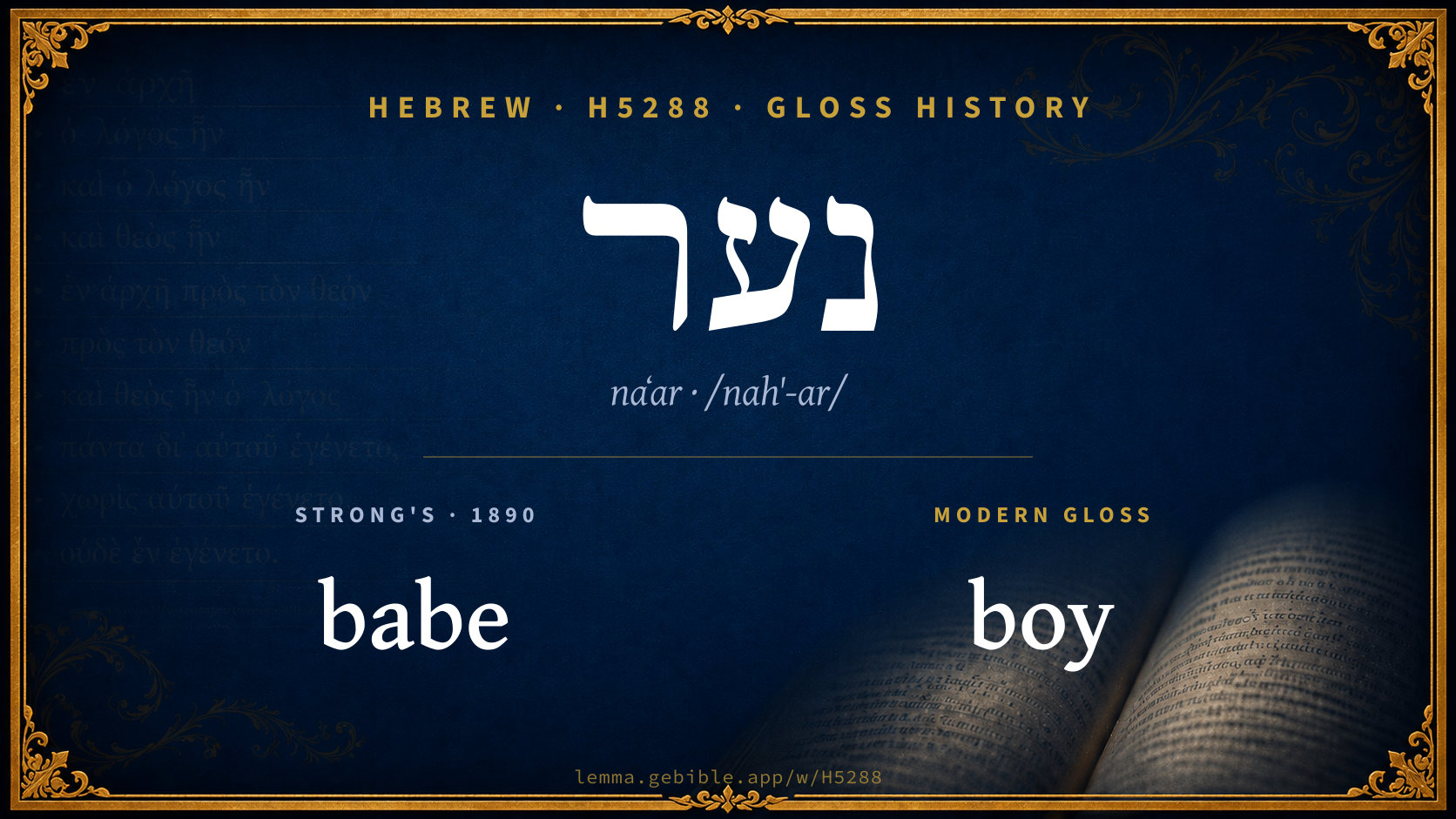
Gloss history
Strong's 1890 vs modern scholarship
About this word
Strong's H5288 catalogs a Hebrew word from the Hebrew Old Testament.
These counts are not copied from any lexicon or concordance. They are computed here, from the morphology-tagged Hebrew Old Testament. What Lemma adds →
- 221
- distinct verses
- The word appears in 221 distinct verses.
- 24 / 39
- OT books
- The word appears in 24 of 39 Old Testament books.
- #198
- by frequency
- Top 250 most frequent Hebrew words (rank 198 of 8,640 Hebrew words by occurrence).
View all 221 occurrences in the concordance →
By section of the Old Testament
By traditional corpus
Conventional, traditional groupings — biblical authorship is debated, so this is a traditional corpus grouping, not an authorship claim. Each share is this word’s portion of its verses in that division of the Hebrew canon. Each figure is a share of the word’s 221 distinct verses.
- Prophets (Nevi'im) 148 verses · 67%
- Writings (Ketuvim) 42 verses · 19%
- Torah (Pentateuch) 31 verses · 14%
How translations render this word
Counts come from each version’s own published word-to-Strong’s tagging or interlinear alignment — an approximate guide to how each version renders this word, not a word-level alignment the data otherwise carries. Because each total is that version’s own tagged count, the per-version totals vary from one another and need not match the appearance or distinct-verse counts above. These counts may also differ from a printed concordance because Lemma counts each distinctly tagged rendering and does not collapse phrase taggings into a single head-word total. This is a fixed set of word-tagged versions (KJV, ASV, BSB, ULT) and does not change with the reading translation you choose elsewhere. Each version’s license is shown beside its name below (and on Sources).
BDB lists this Strong’s number as 2 distinct words (homographs). Each count above pools all of them and is not split by sense — see the Senses section below. A low-frequency rendering may belong to a different one of those words, not the primary meaning.
- King James Version†: Young men 36×, Child 32×, Servant 31×
- American Standard Version†: Young men 32×, Child 31×, Servant 25×
- Berean Standard Bible†: Boy 45×, Servant 25×, Young men 25×
- unfoldingWord Literal Text†: Young man 57×, Boy 44×, Young men 38×
King James Version Public Domain
Renders H5288 across 238† tagged occurrences — most commonly:
Plus 45 renderings that appear only once — usually multi-word phrases or single function words the recovered tagging swept in, not distinct renderings.
American Standard Version Public Domain
Renders H5288 across 239† tagged occurrences — most commonly:
Plus other, less common renderings. Plus 69 renderings that appear only once — usually multi-word phrases or single function words the recovered tagging swept in, not distinct renderings.
Berean Standard Bible Public Domain
Renders H5288 across 226† tagged occurrences — most commonly:
Plus other, less common renderings. Plus 29 renderings that appear only once — usually multi-word phrases or single function words the recovered tagging swept in, not distinct renderings. Not rendered by a distinct English word in 13 further occurrences.
unfoldingWord Literal Text CC BY-SA 4.0
Renders H5288 across 253† tagged occurrences — most commonly:
Plus other, less common renderings. Plus 20 renderings that appear only once — usually multi-word phrases or single function words the recovered tagging swept in, not distinct renderings.
10 senses and sub-senses in the full BDB
What do BDB’s symbols mean?
BDB uses these scholarly abbreviations:
| Symbol | Meaning |
|---|---|
| 𝔊 | the Septuagint (the ancient Greek translation, LXX) |
| 𝔙 | the Vulgate (the Latin translation) |
| 𝔖 | the Syriac version (the Peshitta) |
| 𝔗 | the Targum (the Aramaic translation) |
| ψ | the Psalms |
| √ | root (the underlying root or stem) |
| ‖ | parallel passage (a synonymous or contrasted parallel) |
| † | the dagger: every passage where the word occurs is cited |
The 10 senses and sub-senses the full Brown-Driver-Briggs lexicon distinguishes for this word, in lexicon order (not ranked by frequency), with BDB’s own verbatim wording and sub-sense lettering. Shown in Hebrew script with BDB’s own scholarly abbreviations. The condensed entry is in the Lexicon Entry tab. See also the Forms in the corpus table below.
נער I [m.] usually interpr. as a shaking, scattering, abst. for concr. = scattered ones, only Zc 11
נער II 1. boy, lad, youth. 2. retainer (not in P) (NH as BH
- 1. boy, lad, youth (c. 133 times)
- a. of infant Ex 2:6 (E; 3 months old), to be born Ju 13:5, 7, 8, 12, just born 1 S 4:21, not weaned 1 S 1:22; also Is 8:4, cf. 7:16 +. e.g. Exodus 2:6
- b. of lad just weaned 1 S 1:24 (del. 2nd נער, cf. further Dr Bu HPS), v 25, 27, etc. e.g. 1 Samuel 1:24
- c. = youth: of young Ishmael Gn 21:12f. (E), Isaac 22:5, 12 (E), Joseph Gn 37:2 (E; 17 years old,), Benj. 43:8; 44:22f. (J), sons of Samuel 1 S 2:17, of Jesse 1 S 16:11; נ׳ קָטֹן little lad 1 S 20:35; 1 K 3:7; 2 K 5:14; Is 11:6, נ׳ קָטָן 1 K 11:17, pl. 2 K 2:23. e.g. Genesis 21:12
- d. נ׳ with special stress on youthfulness Ju 8:20; 1 S 17:33, 42; Ho 11:1 Is 3:4 cf. Ec 10:16; Is 3:5; 10:19; Je 1:6, 7; 1 Ch 22:5; 29:1; 2 Ch 13:7; 34:3; so in phr. מִנּ׳ וְעַד זָקֵן Gn 19:4 (J), Jos 6:21 (J), Est 3:13 cf. Ex 10:9 (E), Dt 28:50; Is 20:4; 65:20; Je 51:22; La 2:21 ψ 37:25; 148:12; Pr 22:6. e.g. Judges 8:20
- e. of marriageable age Gn 34:19 (J), warrior Absalom 2 S 18:5, 12 +, Zadok 1 Ch 12:29, etc. e.g. Genesis 34:19
- 2. servant, retainer (c. 105 times):
- a. = personal attendant, household servant, Nu 22:22 (J), Ju 7:10, 11; 19:3; 1 S 9:3f. 2 K 4:12, 25 + often e.g. Numbers 22:22
- b. = retainer, follower Gn 14:24; 1 S 25:5f.; 2 S 2:14f.; 1 K 20:14f.; 2 K 19:6 = Is 37:6, Jb 1:15, 16, 17; Ne 4:10, 17 + often—Zc 11:16 is corrupt, cf. We Now.— e.g. Genesis 14:24
- נער occurs in Pent. as Kt with Qr perpet. נַעֲרָה q.v.
Senses from the full Brown-Driver-Briggs lexicon (Brown, Driver, Briggs; Oxford 1906 — public domain), digitized via Sefaria, supplemented by the OpenScriptures HebrewLexicon (CC BY 4.0). Full attribution on Sources.
Word origin
I. n.[m.] usually interpr. as a shaking, scattering, abst. for concr. = scattered ones, only Zc 11:16, but text corrupt, v. We Now.
II. n.m. 1. boy, lad, youth. 2. retainer (not in P) (NH as BH; Ph. נער Lzb 324);—נ׳ abs. Gn 37:2 +; cstr. 1 S 2:13 +; sf. נַעֲרוֹ Ju 19:3 +, נַעֲרָהּ 2 K 4:24; pl. נְעָרִים 1 S 25:5 +, cstr. נַעֲרֵי Ex 24:5 +; sf. נְעָרַי Ne 4:10; 5:10, etc.;—
— Brown-Driver-Briggs (Oxford 1906, public domain), digitized via Sefaria, supplemented by the OpenScriptures HebrewLexicon (CC BY 4.0). See Sources.
Derived from נער (nâʻar) (H5287) — to shake.
Jastrow Dictionary
A second Hebrew/Aramaic lexicon for comparison, covering Aramaic and post-biblical (Talmudic, Targumic, Midrashic) usage that the biblical-Hebrew BDB does not. Matched by lemma rather than by Strong’s number, so a lemma may carry more than one Jastrow headword (shown separately below), and the entries cover usage well beyond the Bible.
נָעַר I
- cmp. next w.) [to be excited, noisy,] esp. (of the ass) to bray. Ber. 3ᵃ. Ib. 56ᵃ (in Chald. dict.) דקאי אאיסדן ונוֹעֵר standing at the head of the bed and braying. B. Kam. 18ᵇ; Kidd. 24ᵇ; a. e.—[Cant. R. to IV, 8 בתחלה הוא נוער, read: נֵעוֹר, v. עוּר.]
נָעַר II
- to shake, stir. Makhsh. I, 4 הנוֹעֵר אגודה וכ׳ he who shakes (the rain off) a bundle of vegetables. Ib. V, 7. Pesik. R. s. 26 לאיוב נָעַרְתִּי מן האשפה וכ׳ I shook Job (making him rise) from the dunghill, and concerning thee (Israel) it is written (Is. LII, 2), shake thyself &c.; a. e. e.g. Isaiah 52:2
- 1. to shake. Pesik. Shek., p. 17ᵃ נַעֲרָהּ קפלה shake it (the garment), fold it; Lev. R. s. 2. B. Mets. II, 8 מצא כסות מְנַעֲרָהּ וכ׳ if one found a garment (and holds it in charge waiting for the owner to claim it), he must shake it once in thirty days. Sabb. 147ᵃ top; a. fr.
- 2. to stir. Ḥull. VIII, 3 נ׳ את הקדרה if he stirred (the meat in) the pot. Y. Ab. Zar. I, 39ᵈ top שמא נ׳ הגוי בקדרה the gentile might have stirred the pot; a. fr.
- 3. to empty; to cause evacuation. Toh. II, 1 מְנָעֶרֶת את הקדרה she may empty (or stir) the dish. Kel. XXVIII, 2 לנָעֵר בו וכ׳ used for (lifting and) emptying the pot. Tosef. Kel. B. Mets. II, 10 שהחנוני מְנָעֵר וכ׳ which the shop-keeper uses when pouring out &c. (or through which he pours for straining), v. יַתִּיךְ; a. e.—נ׳ את הצאן to use means by which to expedite the discharge of excrements of the flock on the spot to be manured (v. דּוּר I, Pi.). Tosef. Shebi. II, 20; M. Kat. 12ᵃ; Y. Shebi. III, 34ᶜ bot. Ib. השוכר … לנַעֲרָהּ he who hires a flock (for manuring) is forbidden to use means &c.; expl. ib. מוליכה ממקום וכ׳ by driving it from place to place.—Part. pass. מְנוֹעָר; f. מְנוֹעֶרֶת; pl. מְנוֹעָרִים, מְנוֹעָרִין: מְנוֹעָרוֹת empty, vacant. Y. Ber. IV, 7ᵇ bot. (play on שִׁנְ֗עָ֗ר̇) שחם מנ׳ מן המצות וכ׳ they (the Babylonians) are vacant of (cannot perform) certain religious observances &c.; Koh. R. to XII, 7; Gen. R. s. 37 שהיא מנ׳ וכ׳ she (Babylonia) is deprived &c. Ḥag. 14ᵃ (play on נערים, Is. III, 4) אלו בני אדם שמנ׳ וכ׳ that means persons empty of good deeds, opp. ממולא; Yalk. Is. 261.—[B. Bath. 74ᵇ ור"י נוער some ed., v. עוּר I.—Ḥull. 51ᵇ ניערה, v. infra.] e.g. Isaiah 3:4
- 1. to be stirred up; to bestir one’s self. B. Bath. 74ᵇ וני׳ ר׳'א and R. El. was stirred up (awoke). Sot. 5ᵃ אין עפרו נ׳ his dust will not be stirred up (for resurrection). Ex. R. s. 1 (play on חלאה ונערה, I Chr. IV, 5) חלתה ונִנְעֲרָה מחליה וכ׳ she (Miriam) was sick, but she bestirred herself (arose) from her sickness, and the Lord restored her to youth. Y. Ber. III, 6ᵈ top (play on מנעריו, Gen. VIII, 21) משעה שהוא נ׳ ויוצא וכ׳ from the moment the embryo bestirs itself to come out into the world; Gen. R. s. 34; Yalk. ib. 61. Ḥull. 51ᵇ ננערה לעמוד וכ׳ Rashi (ed. נִיעֲרָה) if the animal made an effort to get up, although it did not succeed; a. e. e.g. 1 Chronicles 4:5
- 2. (of flax) to be hatcheled. Y. Sabb. II, beg. 4ᶜ (expl. חוסן, ib. II, 1) פשתן שלא ננערה flax which has not yet been hatcheled.
- 3. to be emptied, poured out. Y. Ber. l. c. (play on שנער) ששם נִנְעֲרוּ וכ׳ for into that valley the dead of the generation of the flood were dumped; Gen. R. s. 37; Koh. R. l. c.—Snh. 92ᵃ קשתו נִינְעֶרֶת his bow will be empty (his sexual vitality broken).
- to stir up, to keep awake. Erub. 53ᵇ (play on נערה &c., v. אַהֲרוֹנִית) והִנְעִירָתוֹ and she kept him awake.
- to be emptied; trnsf. to be displaced. Zeb. 116ᵃ (ref. to Cant. IV, 16) תִּתְנַעֵר אומה … ותבא וכ׳ (v. Rabb. D. S. a. l. note) removed be the (Roman) nation whose sacrifices are slaughtered northward (Lev. I, 11, which is entitled only to burnt-offerings), and let the nation enter &c. e.g. Song of Solomon 4:16
נְעַר
- , to shake, stir.—Part. pass. נְעִיר waking. Targ. Job XXI, 32 (Ms. נָעִיר; ed. Wil. יְעִיר, v. עוּר).
- to shake; to empty. Yalk. Zech. 570; Cant. R. to IV, 8 (ref. to Zech. II, 17) דמְנַעֲרָה וכ׳ (דמְנַעֲרָא), v. גֵּו ch.; Gen. R. s. 75. Sabb. 142ᵃ ולִינַעֲרִינְהוּ נַעוּרֵי let him shake the fruit out of the basket. e.g. Zechariah 2:17
נַעַר
- preced., tender, young; lad. Tanḥ. Ḥayé 1 שיתכבד הזקן בַּנַּ׳ that the old may be honored by the young. Ex. R. s. 1 ילד היה ומנהגו כנ׳ he was a child, but his behavior was like that of a lad; a. fr.—Pl. נְעָרִים. Yoma 75ᵇ לנ׳ לחם וכ׳ the manna was bread to the young, oil to the old &c. Tanḥ. Sh’mini 11 אם נ׳ הם וכ׳ if they (the elders) are young &c., v. קָפַץ. Ib. הבחורים והנ׳ the young men and the lads. Sot. 46ᵇ נ׳ היו ובזבזו וכ׳ they were young men, but behaved contemptibly like children; a. fr.—Fem. נַעֲרָה lass, maid, esp. (law) a girl between twelve and twelve and a half years of age, v. בַּגְרוּת. Esth. R. to V, 1; a. fr.—Keth. III, 8, contrad. to בוגרת a. קטנה. Ib. IV, 1; a. fr.—Pl. נְעָרוֹת, constr. נַעֲרוֹת. Ib. III, 1 (29ᵃ). Esth. R. l. c. שתי נַעֲרוֹתֶיהָ her two maids; a. fr.
A Dictionary of the Targumim, the Talmud Babli and Yerushalmi, and the Midrashic Literature (Marcus Jastrow; London, Luzac, 1903) — Public Domain. Digitized via Sefaria. Digitized via Sefaria. Full attribution on Sources.
Forms in the corpus
The 119 distinct written forms H5288 takes in the Hebrew Bible, most frequent first — each parse links to that state’s occurrences in the concordance. Hebrew forms include their vowel points and cantillation, so a single lemma takes many written forms.
The 60 most common forms are shown; 59 rarer forms follow in the full concordance.
Same root — word family
Other BDB entries built from the same root as H5288, grouped by Strong’s listed origin. These share a root / origin per the lexicon — not necessarily a shared meaning. Each links to that word’s own entry.
Derives from
Shares the same root
Derived from this word
Proper names from this root
People and places named from this root — a name, not an additional meaning of the word.
- נערי Naʻăray H5293 Naarai
- נעריה Nᵉʻaryâh H5294 Neariah
- נערן Naʻărân H5295 Naaran
- ענר ʻÂnêr H6063 Aner
Compare all same-root words → Showing 4 of 11 — not the complete family. 4 of the same-root words are proper names (people or places). They share a root, not necessarily a meaning.
Septuagint verse parallels
This word appears in 206 verses that also exist in the Greek Old Testament (Septuagint), out of the 221 Hebrew verses it occurs in. You can read those verses in Greek by switching the Old Testament edition to the Septuagint.
Read these verses in the Septuagint
- Genesis 14:24
- Exodus 2:6
- Numbers 11:27
- Deuteronomy 28:50
- Joshua 6:21
- Judges 7:10
- Ruth 2:5
- 1 Samuel 1:22
- 2 Samuel 1:5
- 1 Kings 3:7
- 2 Kings 2:23
- 1 Chronicles 12:28
This is a verse-level parallel only — the same verses exist in both the Hebrew and Greek Old Testaments. No word-level Hebrew↔Greek correspondence is claimed: the data carries no such alignment, so no Greek word is shown as this Hebrew word’s translation. Coverage is not total — the Septuagint omits the deuterocanon and renumbers the Psalms, so some Hebrew verses have no direct Greek parallel.