
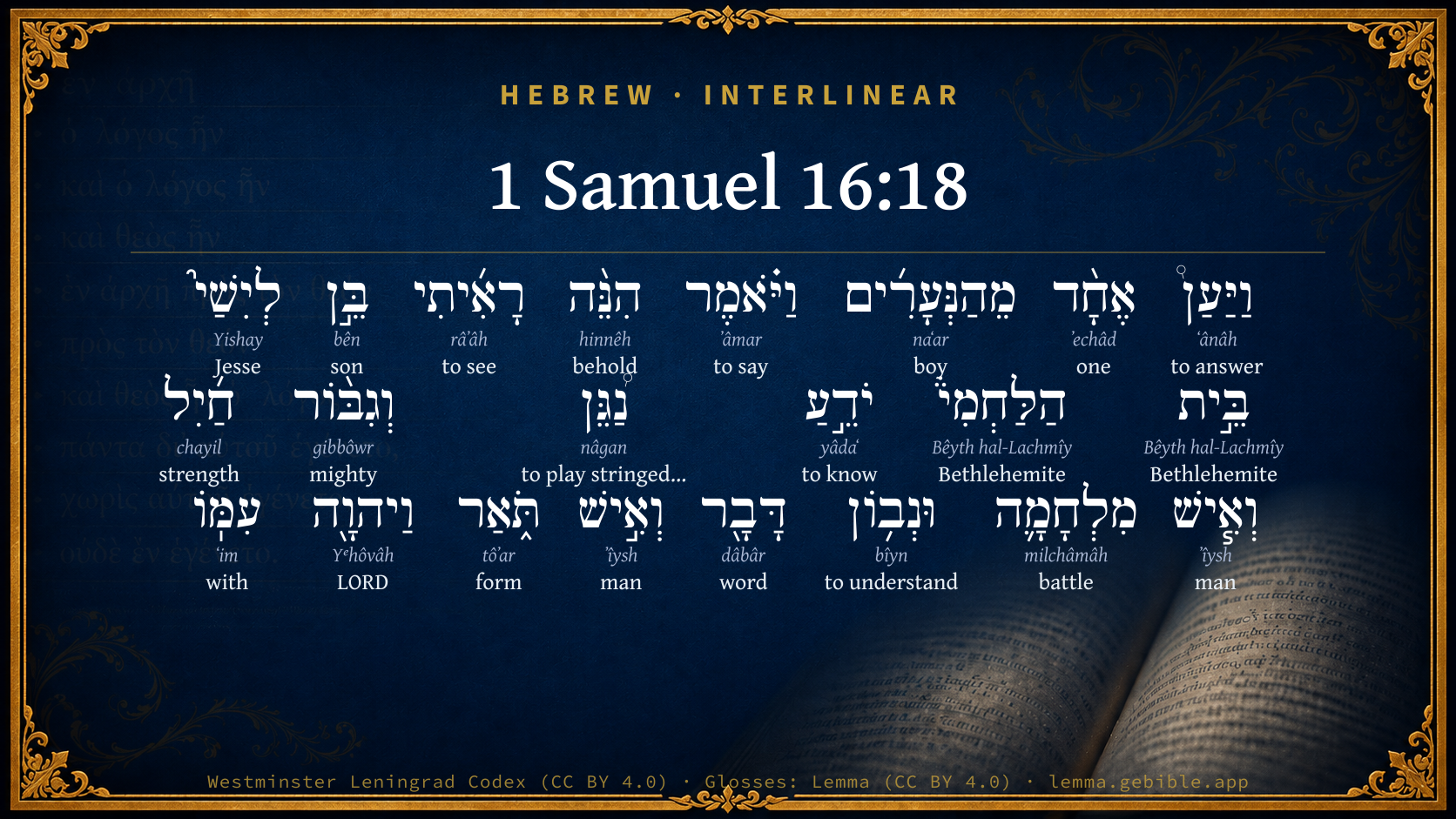
1 Samuel 16:18

Hebrew (Westminster Leningrad Codex) 1 Samuel 16:18 appears in the Hebrew Old Testament. The text above is from the Westminster Leningrad Codex. Each word links to its Strong’s number, a concise gloss, and parsing drawn from the Open Scriptures Hebrew Bible morphology. Click any word for its full Brown-Driver-Briggs (BDB) entry.
Download image
Cite this verse

1 Samuel 16:18 (World English Bible). Public Domain. Lemma interlinear Bible study tool, https://lemma.gebible.app/v/1-samuel/16/18.

Show BibTeX & RIS
BibTeX
RIS
English Translation
Then answered one of the young men, and said, Behold, I have seen a son of Jesse the Bethlehemite, who is skillful in playing, and a mighty man of valor, and a man of war, and prudent in speech, and a comely person; and Yahweh is with him.
World English Bible · Public Domain
Download a study sheet

One document with this verse’s original text, its word-by-word gloss line, the meaning frame, cross-references with their text, attributed commentary, and full source and license credits — printable, and it pastes into notes with its structure intact.

This verse Autodidact and up

Study sheet (.html) Plain text (.txt)

A passage Seminary Student

Up to 50 verses in one chapter. A passage sheet keeps up to 6 commentary sources and 12 cross-references per verse, in the order this page ranks them, and says so on the sheet whenever that leaves anything out. Ask for a single verse and you get the Autodidact verse sheet above.

Everything on this page stays free to read, with no account — the sheet is a download of what is already on screen, not access to it.

Want to remove ads? Support Godless Engineer
Compare translations 3

The same verse in 3 English versions, stacked beneath the original-language interlinear above. Click any original word for its lexicon entry.

Each is an independent rendering of the whole verse — the interlinear is not word-aligned to these translations.

Highlighted words mark where these versions differ — a whole-verse word diff, not a word-by-word alignment.

  • World English Bible Public Domain
    Then answered one of the young men, and said, Behold, I have seen a son of Jesse the Bethlehemite, who is skillful in playing, and a mighty man of valor, and a man of war, and prudent in speech, and a comely person; and Yahweh is with him.
  • King James Version Public Domain
    Then answered one of the servants, and said, Behold, I have seen a son of Jesse the Bethlehemite, that is cunning in playing, and a mighty valiant man, and a man of war, and prudent in matters, and a comely person, and the LORD is with him.
  • unfoldingWord Literal Text CC BY-SA 4.0
    And one from the young men answered and said, “Behold, I have seen a son of Jesse the Bethlehemite, knowing playing and mighty of valor and a man of war and discerning of word and a man of appearance. And Yahweh with him.”

unfoldingWord Literal Text — © unfoldingWord, licensed CC BY-SA 4.0. Word-aligned USFM3 via Door43 (git.door43.org/unfoldingWord/en_ult).

Versions to compare (up to 4)

3 of 4 selected

Show all 18 translations

Every available English version of this verse, each an independent rendering of the whole verse.

  • World English Bible Public Domain
    Then answered one of the young men, and said, Behold, I have seen a son of Jesse the Bethlehemite, who is skillful in playing, and a mighty man of valor, and a man of war, and prudent in speech, and a comely person; and Yahweh is with him.
  • Berean Standard Bible Public Domain
    One of the servants answered, “I have seen a son of Jesse of Bethlehem who knows how to play the harp. He is a mighty man of valor, a warrior, eloquent and handsome, and the LORD is with him.”
  • Majority Standard Bible Public Domain
    One of the servants answered, “I have seen a son of Jesse of Bethlehem who knows how to play the harp. He is a mighty man of valor, a warrior, eloquent and handsome, and the LORD is with him.”
  • King James Version Public Domain
    Then answered one of the servants, and said, Behold, I have seen a son of Jesse the Bethlehemite, that is cunning in playing, and a mighty valiant man, and a man of war, and prudent in matters, and a comely person, and the LORD is with him.
  • American Standard Version (1901) Public Domain
    Then answered one of the young men, and said, Behold, I have seen a son of Jesse the Beth-lehemite, that is skilful in playing, and a mighty man of valor, and a man of war, and prudent in speech, and a comely person; and Jehovah is with him.
  • Revised Version (1885) Public Domain
    Then answered one of the young men, and said, Behold, I have seen a son of Jesse the Beth-lehemite, that is cunning in playing, and a mighty man of valour, and a man of war, and prudent in speech, and a comely person, and the LORD is with him.
  • Geneva Bible (1599) Public Domain
    Then answered one of his seruauntes, and sayde, Beholde, I haue seene a sonne of Ishai, a Bethlehemite, that can plaie, and is strong, valiant and a man of warre and wise in matters, and a comely person, and the Lord is with him.
  • Douay-Rheims (1899) Public Domain
    And one of the servants answering, said: Behold I have seen a son of Isai the Bethlehemite, a skilful player, and one of great strength, and a man fit for war, and prudent in his words, and a comely person: and the Lord is with him.
  • Young's Literal Translation Public Domain
    And one of the servants answereth and saith, `Lo, I have seen a son of Jesse the Beth-Lehemite, skilful in playing, and a mighty virtuous man, and a man of battle, and intelligent in word, and a man of form, and Jehovah `is' with him.'
  • Literal Standard Version CC BY-SA 4.0
    And one of the servants answers and says, “Behold, I have seen a son of Jesse the Beth-Lehemite, skillful in playing, and a mighty, virtuous man, and a man of battle, and intelligent in word, and a man of form, and YHWH [is] with him.”
  • Unlocked Literal Bible CC BY-SA 4.0
    Then one of the young men answered, and said, “I have seen a son of Jesse the Bethlehemite, who is skillful in playing, a strong, courageous man, a man of war, one prudent in speech, a handsome man; and Yahweh is with him.”
  • unfoldingWord Literal Text CC BY-SA 4.0
    And one from the young men answered and said, “Behold, I have seen a son of Jesse the Bethlehemite, knowing playing and mighty of valor and a man of war and discerning of word and a man of appearance. And Yahweh with him.”
  • Darby Bible Public Domain
    And one of the young men answered and said, Behold, I have seen a son of Jesse the Bethlehemite, who is skilled in playing, and he is a valiant man and a man of war, and skilled in speech, and of good presence, and Jehovah is with him.
  • World Messianic Bible Public Domain
    Then one of the young men answered and said, “Behold, I have seen a son of Jesse the Bethlehemite who is skillful in playing, a mighty man of valor, a man of war, prudent in speech, and a handsome person; and the LORD is with him.”
  • Webster's Bible Public Domain
    Then answered one of the servants, and said, Behold, I have seen a son of Jesse the Beth-lehemite, that is skillful in playing, and a mighty valiant man, and a man of war, and prudent in matters, and a comely person, and the LORD is with him.
  • Free Bible Version CC BY-SA 4.0
    One of the servants replied, “I know a son of Jesse of Bethlehem who is good at playing the harp. He is a brave man, a good fighter, well-spoken and handsome, and the Lord is with him.”
  • Bible in Basic English Public Domain
    Then one of the servants in answer said, I have seen a son of Jesse, the Beth-lehemite, who is expert at playing, and a strong man and a man of war; and he is wise in his words, and pleasing in looks, and the Lord is with him.
  • JPS Tanakh (1917) Public Domain
    Then answered one of the young men, and said: 'Behold, I have seen a son of Jesse the Beth-lehemite, that is skilful in playing, and a mighty man of valour, and a man of war, and prudent in affairs, and a comely person, and the LORD is with him.'

Literal Standard Version (2020), Covenant Press — licensed CC BY-SA 4.0. Text via the HelloAO Bible API (eBible.org). Unlocked Literal Bible (unfoldingWord) — licensed CC BY-SA 4.0. Text via the HelloAO Bible API (eBible.org). unfoldingWord Literal Text — © unfoldingWord, licensed CC BY-SA 4.0. Word-aligned USFM3 via Door43 (git.door43.org/unfoldingWord/en_ult). Free Bible Version, Dr. Jonathan Gallagher — licensed CC BY-SA 4.0. Text via the HelloAO Bible API (eBible.org).

Word by word

More ways to search: Search by grammar → Find every occurrence → Compare this word →

Practice this passage: Drill this verse → Learn its vocabulary →

בֵּ֣ית
Bêyth hal-Lachmîy
H1022
“Bethlehemite”
Noun, Gentilic, Masculine, Singular, Absolute
Part of Speech
Noun
Type
Gentilic
Gender
Masculine
Number
Singular
State
Absolute
Full BDB Definition

Origin: patrial from H1035 with the article inserted

TWOT: None

Bethlehemite = "house of bread" - an inhabitant of Bethlehem
  1. וַיַּעַן֩ ʻânâh H6030 “and · to answer” Conjunction + Verb, Qal, Sequential Imperfect, 3rd Person, Masculine, Singular
  2. אֶחָ֨ד ʼechâd H259 “one” Adjective, Cardinal number, Masculine, Singular, Absolute
  3. מֵהַנְּעָרִ֜ים naʻar H5288 “from · the · boys” Preposition + Particle, Definite Article + Noun, Common, Masculine, Plural, Absolute
  4. וַיֹּ֗אמֶר ʼâmar H559 “and · to say” Conjunction + Verb, Qal, Sequential Imperfect, 3rd Person, Masculine, Singular
  5. הִנֵּ֨ה hinnêh H2009 “behold” Particle, Demonstrative
  6. רָאִ֜יתִי râʼâh H7200 “to see” Verb, Qal, Perfect, 1st Person, Common, Singular
  7. בֵּ֣ן bên H1121 “son” Noun, Common, Masculine, Singular, Absolute
  8. לְיִשַׁי֮ Yishay H3448 “to/for · Jesse” Preposition + Noun, Proper
  9. הַלַּחְמִי֒ Bêyth hal-Lachmîy H1022 “Bethlehemite” Noun, Gentilic, Masculine, Singular, Absolute
  10. יֹדֵ֣עַ yâdaʻ H3045 “knowing” Verb, Qal, Participle Active, Masculine, Singular, Absolute
  11. נַ֠גֵּן nâgan H5059 “to play stringed instrument” Verb, Piel, Infinitive Construct
  12. וְגִבּ֨וֹר gibbôwr H1368 “and · mighty of” Conjunction + Adjective, Adjective, Masculine, Singular, Construct
  13. חַ֜יִל chayil H2428 “strength” Noun, Common, Masculine, Singular, Absolute
  14. וְאִ֧ישׁ ʼîysh H376 “and · man of” Conjunction + Noun, Common, Masculine, Singular, Construct
  15. מִלְחָמָ֛ה milchâmâh H4421 “battle” Noun, Common, Feminine, Singular, Absolute
  16. וּנְב֥וֹן bîyn H995 “and · understanding” Conjunction + Verb, Niphal, Participle Active, Masculine, Singular, Construct
  17. דָּבָ֖ר dâbâr H1697 “word” Noun, Common, Masculine, Singular, Absolute
  18. וְאִ֣ישׁ ʼîysh H376 “and · man of” Conjunction + Noun, Common, Masculine, Singular, Construct
  19. תֹּ֑אַר tôʼar H8389 “form” Noun, Common, Masculine, Singular, Absolute
  20. וַיהוָ֖ה Yᵉhôvâh H3068 “and · LORD” Conjunction + Noun, Proper
  21. עִמּֽוֹ ʻim H5973 “with · him” Preposition + Suffix, Personal, 3rd Person, Masculine, Singular

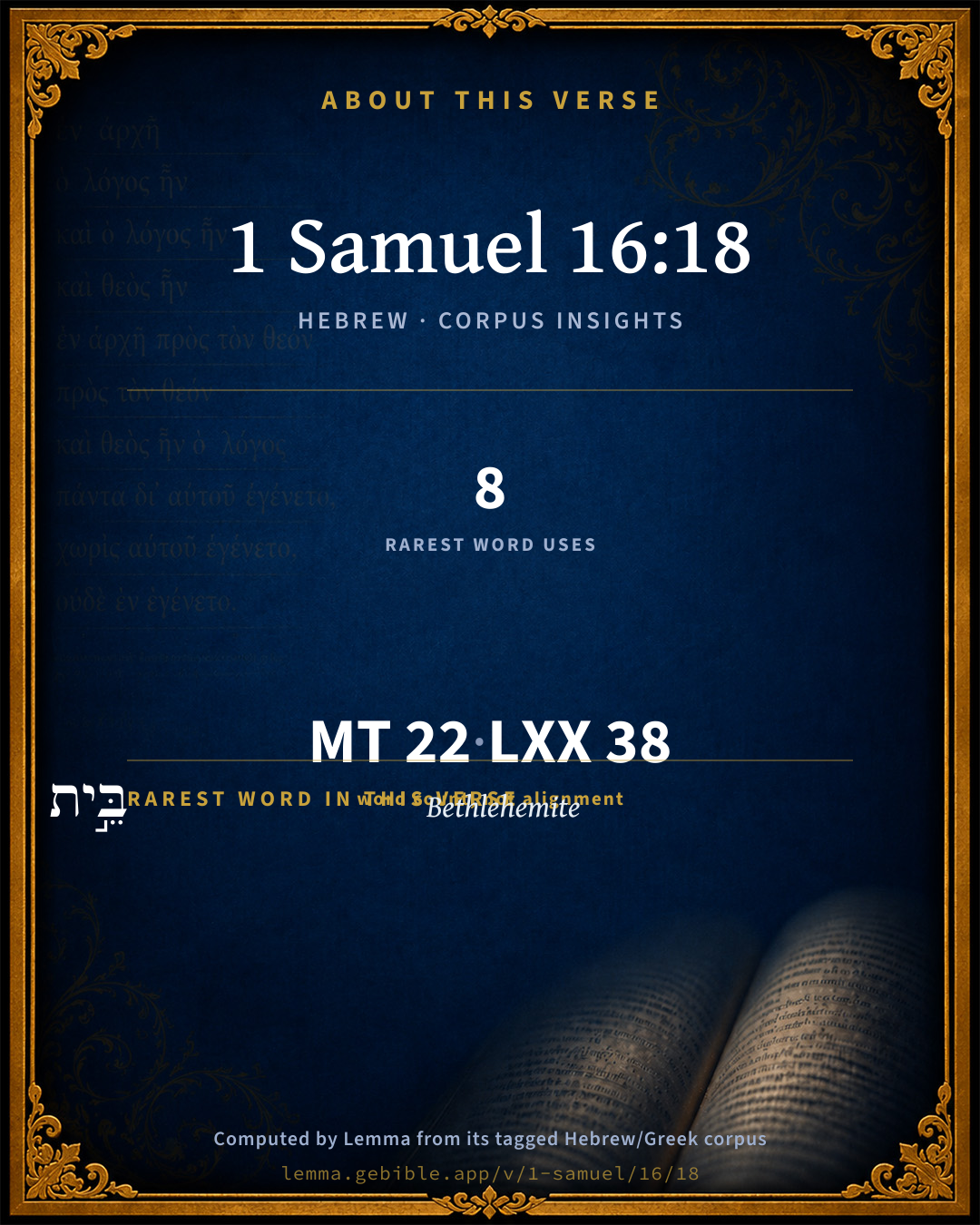
About this verse

These counts appear in no published source. They are computed here, from the morphology-tagged text and Lemma’s own curated glosses. What Lemma adds →

22
words
20
distinct lemmas
Historical
section

Notable vocabulary

The rarest word here is בֵּ֣ית Bethlehemite H1022 — appearing just 8 times in the whole Hebrew Bible.

Shared distinctive vocabulary

בֵּ֣ית Bethlehemite H1022 occurs in 4 verses of the Hebrew Bible. Also found in:

Grammatical profile

  • 6 verbs
  • 12 nouns
  • 2 adjectives
  • 1 preposition
  • 1 particle

Verb forms

  • וַיַּעַן֩ Qal · Sequential Imperfect
  • וַיֹּ֗אמֶר Qal · Sequential Imperfect
  • רָאִ֜יתִי Qal · Perfect
  • יֹדֵ֣עַ Qal · Participle Active
  • נַ֠גֵּן Piel · Infinitive Construct
  • וּנְב֥וֹן Niphal · Participle Active

Repetition

Words recur within this verse — often emphatic in Hebrew:

  • בֵּ֣ית Bethlehemite H1022 ×2
  • וְאִ֧ישׁ man H376 ×2

Hebrew & Septuagint length

In English translation the verse runs 48 words from the Hebrew and 48 from the Septuagint (LXX English) — the same length.

A rough comparison of the two English renderings, which tokenize alike — not a word-level alignment.

Word counts can differ between the Hebrew and the Greek without any difference in meaning — e.g. the Hebrew direct-object marker אֵת has no separate Greek word, and Greek often adds the article ὁ.

In the original languages it is 22 Hebrew tokens and 38 Greek tokens — but the two are counted differently (Hebrew bundles its prefixes and suffixes into one token; the Greek is in lemma form), so that isn’t a like-for-like length.

Cross-references

11

Topical passages linked to 1 Samuel 16:18 in the Treasury of Scripture Knowledge — connected by theme and wording, ordered by reader-vote popularity; previews shown in the World English Bible.

  • 1 Samuel 3:19 Samuel grew, and Yahweh was with him, and did let none of his words fall to the ground.
  • Genesis 39:23 The keeper of the prison didn't look after anything that was under his hand, because Yahweh was with him; and that which he did, Yahweh made it prosper.
  • Genesis 39:2 Yahweh was with Joseph, and he was a prosperous man. He was in the house of his master the Egyptian.
  • 1 Samuel 17:32–36 David said to Saul, Let no man's heart fail because of him; your servant will go and fight with this Philistine.
  • 1 Samuel 10:7 Let it be, when these signs are come to you, that you do as occasion shall serve you; for God is with you.
  • Matthew 1:23 "Behold, the virgin shall be with child, And shall bring forth a son. They shall call his name Immanuel;" Which is, being interpreted, "God with us."
  • Matthew 28:20 teaching them to observe all things that I commanded you. Behold, I am with you always, even to the end of the age." Amen.
  • 1 Samuel 18:12–14 Saul was afraid of David, because Yahweh was with him, and was departed from Saul.
  • 2 Samuel 14:20 to change the face of the matter has your servant Joab done this thing: and my lord is wise, according to the wisdom of an angel of God, to know all things that are in the earth.
  • 2 Samuel 17:8 Hushai said moreover, You know your father and his men, that they are mighty men, and they are fierce in their minds, as a bear robbed of her cubs in the field; and your father is a man of war, and will not lodge with the people.
  • 2 Samuel 17:10 Even he who is valiant, whose heart is as the heart of a lion, will utterly melt; for all Israel knows that your father is a mighty man, and those who are with him are valiant men.

Cross-references courtesy of OpenBible.info (CC BY 4.0).

Hebrew and Greek witnesses Masoretic Hebrew ↔ Greek Septuagint

The same verse in the two great witnesses to the Old Testament, shown verse-for-verse.

These are two independent witnesses, not word-aligned to each other, and the Septuagint is shown in lemma (dictionary) form.

Hebrew 1 Samuel 16:18 Masoretic · Westminster Leningrad Codex

וַיַּעַן֩ אֶחָ֨ד מֵהַנְּעָרִ֜ים וַיֹּ֗אמֶר הִנֵּ֨ה רָאִ֜יתִי בֵּ֣ן לְיִשַׁי֮ בֵּ֣ית הַלַּחְמִי֒ יֹדֵ֣עַ נַ֠גֵּן וְגִבּ֨וֹר חַ֜יִל וְאִ֧ישׁ מִלְחָמָ֛ה וּנְב֥וֹן דָּבָ֖ר וְאִ֣ישׁ תֹּ֑אַר וַיהוָ֖ה עִמּֽוֹ

Then answered one of the young men, and said, Behold, I have seen a son of Jesse the Bethlehemite, who is skillful in playing, and a mighty man of valor, and a man of war, and prudent in speech, and a comely person; and Yahweh is with him.

World English Bible · Public Domain

Greek LXX 1 Samuel 16:18 Septuagint · lemma form

καί ἀποκρίνω εἷς ὁ παιδάριον αὐτός καί εἶπον ἰδού ὁράω υἱός ὁ ιεσσαι βηθλεεμίτης καί αὐτός οἶδα ψαλμός καί ὁ ἀνήρ συνετός καί ὁ ἀνήρ πολεμιστής καί σοφός λόγος καί ἀνήρ ἀγαθός ὁ εἶδος καί κύριος μετά αὐτός

And one of his servants answered and said, Behold, I have seen a son of Jessae the Bethleemite, and he understands playing on the harp, and the man is prudent, and a warrior, and wise in speech, and the man is handsome, and the Lord is with him.

LXX2012 (modern English Septuagint) · Public Domain

Hebrew: Westminster Leningrad Codex (CC BY 4.0). Greek: Septuagint (public domain); English from LXX2012 (modern English Septuagint) (Public Domain). How the Septuagint differs from the Hebrew →

Targum (Aramaic paraphrase)

1

The Targum is the ancient Jewish Aramaic paraphrase of the Hebrew Scriptures — an interpretive translation, not the Hebrew text itself. Onkelos (literal) and Pseudo-Jonathan (expansive) render the Torah, and Jonathan the Prophets. Coverage is partial: where no permissively-licensed English translation exists for a verse, only the Aramaic is shown. This is verse-level text, not a word-by-word alignment to the Hebrew.

  1. Targum Jonathan Prophets (Joshua–Malachi)
    וְאָתֵיב חַד מֵעוּלֵימַיָא וַאֲמַר הָא חֲזֵתִי בַּר לְיִשַׁי דְמִבֵּית לֶחֶם יָדַע לְנַגָנָא וְגִבַּר חֵילָא וְגִבַּר עָבִיד קְרָבִין וְסוּכְלָתָן בְּעֵצָה וְגַבְרָא שַׁפִּיר בְּרֵיוָא וּמֵימְרָא דַייָ בְּסַעֲדֵיהּ:

    (no public-domain English translation for this verse)

    Targum Jonathan — Aramaic: “Mikraot Gedolot” (public domain). English: “Sefaria Community Translation” (CC0 1.0 (public-domain dedication)); “London "Chaldee Paraphrase," 1871” (public domain). Text via Sefaria.

Commentary

Notes on 1 Samuel 16:18 from classic Christian and Jewish commentators (each source and its license shown beneath its notes). The classic Christian expositions comment on the surrounding passage and are grouped to its opening verse, so a note may address several verses; the Jewish commentaries on the Tanakh (Rashi and others) are per-verse, so they appear only where the commentator wrote on this verse.

Lemma curates 59 commentaries, every one of them public domain or Creative Commons licensed, each selected and text-cleaned for this edition rather than reprinted as found. About our sources →

Trapp's Complete Commentary

John Trapp

1Sa 16:18 Then answered one of the servants, and said, Behold, I have seen a son of Jesse the Bethlehemite, [that is] cunning in playing, and a mighty valiant man, and a man of war, and prudent in matters, and a comely person, and the LORD [is] with him.

Ver. 18. Then answered one of the servants.] Junius thinketh this might be Jonathan; Lyra, that it might be Doeg. But it is not likely that it was either, but another who had heard of David’s great acts and worth, since the Spirit of God came upon him. {1Sa 16:13}

John Trapp, A Commentary or Exposition upon All the Books of the Old and New Testament (1647–1656) — public domain. Text from a community e-Sword module.

Joseph Benson's Commentary

1Sa 16:18. Then answered one of the servants, &c. — It is likely this was some friend or acquaintance of David, who here gives him a very high character, which he did not disgrace, but fully verified, insomuch that Saul for a time highly esteemed him, finding him amiable in his spirit, and prudent in matters, and therefore useful to him in many other ways, as well as by his skill in music. We need not wonder that David was so suddenly advanced from a poor shepherd to so great a reputation; for this was the effect of those graces and gifts of the Divine Spirit which he had received when he was anointed. The Lord is with him — Said the servant; that is, directs and prospers all his undertakings.

Joseph Benson's Commentary on the Old and New Testaments (1811–1818) — public domain. Text from a community e-Sword module.

Tyndale Open Study Notes

Tyndale Open Resources

16:18 harp: The instrument was probably a lyre (as in 10:5). • the Lord is with him: People recognized that God’s Spirit was upon David (16:13).

Tyndale Open Study Notes — © Tyndale Open Resources, licensed CC BY-SA 4.0. Text via the HelloAO Bible API.

Geneva Bible (1599)

Geneva Bible translators

Though David was now anointed King by the Prophet, yet God would exercise him in sundry sorts before he had the use of his kingdom.

Geneva Bible (1599) marginal notes — public domain. Text via Bolls.life.

Adam Clarke's Commentary

Verse 18. I have seen a son of Jesse] Dr. Warburton supposes the story is anticipated from 1Sa 16:14-23, and that the true chronology of this part of David's life is the following: -

1. David is anointed by Samuel;

2. Carries provisions to his brethren in the army;

3. Fights with and kills Goliath;

4. Is received into the king's court,

5. Contracts a friendship with Jonathan;

6. Incurs Saul's jealousy;

7. Retires to his father's house;

8. Is after some time sent for by Saul to sooth his melancholy with his harp;

9. Again excites Saul's jealousy, who endeavours to smite him with his javelin. This anticipation between the 14th and 23d verse comes in, in the order of time, between verses 9 and 10, 1Sa 18:9; 1Sa 18:10, where the breach is apparent.

Adam Clarke's Commentary on the Bible (1810–1826) — public domain. Text from a community e-Sword/MySword module.

Ellicott's Commentary for English Readers

(18) Then answered one of the servants.—The Dean of Canterbury calls attention to the fact that the word in the original here rendered “servants” is not the same as was translated by “servants” in 1Sa_16:15-17. In each of these passages the Hebrew word rendered “servant,” no doubt signifies officers connected with the royal court. Here the different word hann’-ârim lays stress on the royal attendant in question being a young man. Probably, the one spoken of in this place was a contemporary of David, very likely a youth trained with David in Samuel’s prophetic school at Naioth in Ramah, and consequently able to speak thus in detail about the young shepherd pupil of the great seer.

Cunning in playing.—As a boy, it is certain that David possessed rare gifts of poetry, and, no doubt, of music. It is probable that some of his early Psalms were originally composed while watching his father’s sheep among those hills and vales round the village of Bethlehem, where “in later centuries shepherds were still watching over their flocks by night, when the angel host appeared to them to tell them of the birth of a child in Bethlehem.”

These gifts of poetry and music were further cultivated and developed in the prophets’ school of Samuel, and there the young pupil of the seer no doubt quickly acquired among his companions that reputation and skill which induced the “young man” of the court of Saul to tell his afflicted master of the shepherd son of Jesse, famous for his “cunning in playing.”

And a mighty valiant man, and a man of war.—The description of the Bethlehemite David at a mighty valiant man can well be explained from what is related in 1Sa_17:34-35, about the young shepherd’s prowess in the conflicts with the lions and the bears. A question has, however, been raised respecting the expression “a man of war,” as it would seem from the narrative of 1 Samuel 17 that the combat with the giant Philistine was David’s first great military exploit. It has, however, been suggested that, in addition to the combat with those wild beasts, which we know in those days frequented the thickets of the Jordan, and were a terror to the Israelitish shepherds, David had most likely been engaged in repelling one or more of the Philistine marauding expeditions so common in those wild days. Bethlehem, we know, was a strong place or garrison of these hereditary foes of Israel. (See 2Sa_23:14; 1Ch_11:16.)

A Bible Commentary for English Readers, edited by Charles John Ellicott (1878–1897) — public domain. Text from a community e-Sword module.

The Cambridge Bible for Schools and Colleges

gen. ed. J. J. S. Perowne

18. one of the servants] The word here used for “servants” literally means “young men” (Vulg. pueri), as it is rendered in 1Sa_14:1, and probably refers to military attendants: that used in 1Sa_16:15-17 literally means “slaves” (Vulg. servi), and includes the servants in general.

a mighty valiant man, &c.] David had proved his courage while still tending his sheep. See 1Sa_17:32-36. “A man of war” describes his capacity and promise rather than actual warlike experience.

prudent in matters] Rather, “skilled in word,” eloquent. Possibly he had already composed psalms, but of those which have come down to us only Psalms 8 can be referred to this period, and even that is probably somewhat later. Psalms 19, 23, , 29, describing the phenomena of nature, doubtless contain recollections of his shepherd life.

the Lord is with him] See note on 1Sa_3:19.

The Cambridge Bible for Schools and Colleges (gen. ed. J. J. S. Perowne; Cambridge University Press, 1878–1918) — public domain. Text from a community e-Sword module.

John Gill's Exposition

Then answered one of the servants,.... Which the Jews say (m) was Doeg the Edomite, who out of envy and ill will to David spake of him, that Saul might have an opportunity of slaying him; but this is not at all likely; rather it was one of David's friends and acquaintance, that was desirous of promoting him at court, and no doubt was directed to that motion by the overruling providence of God:

and said, behold, I have seen a son of Jesse the Bethlehemite; he does not mention the name of his son, but so describes him, that he might be easily known by those who knew anything of the family of Jesse; besides it was sufficient that he was one of Jesse's sons, to find him out:

that is cunning in playing; that is, on the harp; has good skill in music, and is expert in it:

and a mighty valiant man; as appeared by his encountering with and slaying the lion and the bear; an event now past, as very probable:

and a man of war some think this character of him was given after the affair of his fighting with Goliath and killing him, but here put by a prolepsis or anticipation; and indeed if David had been taken into Saul's court before that affair, it is difficult to account for Saul's ignorance of him, since he must be so near him, and so often with him, as his musician and armourbearer; though that difficulty may be removed, as may be observed in its proper place:

and prudent in matters; in his talk and conversation, and conduct and behaviour; knew how to carry himself, even in a prince's court: and a comely person; which always recommended to the courts of the eastern nations; See Gill on Dan 1:4.

and the Lord is with him; prospering and succeeding him in whatsoever he is engaged; and seeing the Lord was with him, it might be expected the evil spirit would depart from Saul, when this person, with whom the Lord was, was in his presence. The Targum is,"the Word of the Lord is for his help;''all that is said of him showed that he was fit to be in the palace of a king, and a proper person to be with Saul in his present circumstances.

(m) T. Bab. Sanhedrin, fol. 93. 2. So in Hieron. Trad. Heb in lib. Reg. fol. 76. C.

John Gill's Exposition of the Whole Bible (1746–1763) — public domain (CC PDM 1.0). Text via the HelloAO Bible API.

Albert Barnes' Notes on the Bible

A mighty valiant man ... - David’s reputation for courage, skill, discretion, and manly beauty, was already great. Since “the Spirit of the Lord came upon him,” his natural qualities and powers had been greatly enhanced. His feat of killing the lion and the bear (see the marginal references) had been performed, like Samson’s feats of strength Jdg 14:6, Jdg 14:19; Jdg 15:14, under the same supernatural influence, and was probably more or less known.

Albert Barnes' Notes on the Bible (1834–1885) — public domain. Text from a community e-Sword/MySword module.

Haydock's Catholic Bible Commentary

Him. Some think that this took place before David’s victory over Goliath; others believe, that David was only made armour-bearer to Saul, after that event. We must not disturb the order of the sacred historian without some cogent reason: and the courtiers might already have heard of David’s prowess and virtue, of which he gave such evident proofs, after he was confirmed by the Holy Spirit, ver. 13. (Calmet)

George Leo Haydock (1774–1849), Haydock's Catholic Family Bible and Commentary, 1859 edition — public domain. Excludes Psalms (Douay-Rheims chapter numbering differs from Protestant) and Deuterocanonical books (Catholic canon only).

Matthew Poole's English Annotations

Wonder not that David was so suddenly advanced, from a poor contemptible shepherd, to so great reputation; for these were the effects of that Spirit of the Lord, which he received when he was anointed; though some would hence infer, that the things related in this chapter happened after the history of 1Sa 17, though it be placed before, such transpositions being not unusual in historical relations.

The Lord is with him, i.e. directs and prospers all his undertakings.

Matthew Poole's English Annotations on the Holy Bible (1683–1685) — public domain. Text from a community e-Sword/MySword module.

Whedon's Commentary on the Bible

Daniel D. Whedon

18. A mighty valiant man, and a man of war — From what we learn in 1Sa_17:34-35, of David’s early conflicts with wild beasts, we may readily infer that long before his warlike abilities became patent to the public eye there were individuals who knew of these his early conflicts, and discerned in the youthful hero the beginnings of a mighty warrior.

Prudent in matters — Hebrew, knowing of speech; skilled in the use of language. The words and psalms of David show him to have been eloquent.

Daniel D. Whedon (gen. ed.), Commentary on the Old and New Testaments (1874–1909) — public domain. Text from a community e-Sword module.

John Wesley's Explanatory Notes

Prudent - Wonder not, that David was so suddenly advanced, from a poor shepherd, to so great a reputation; for these were the effects of that Spirit of the Lord which he received when he was anointed. The Lord, &c. - That is, directs and prospers all his undertakings.

John Wesley, Explanatory Notes Upon the Whole Bible (1754–1765) — public domain. Text via the GEBible commentary corpus.

Rashi

Rabbi Shlomo Yitzchaki (Rashi)

One of the youths. The special one, [i.e.,] Do'eg, the Edomite.

Knows how to play. His entire intention was to induce Shaul's evil eye into Dovid, that he envy him.

Rashi on the Tanakh — English translations: “The Judaica Press complete Tanach with Rashi, translated by A. J. Rosenberg” (CC BY 4.0); “Pentateuch with Rashi's commentary by M. Rosenbaum and A.M. Silbermann, 1929-1934” (public domain); “The Metsudah Tanach series, Lakewood, N.J” (CC BY 4.0); and “The Book of Joshua, Metsudah Publications, 1997” (CC BY 4.0). Text via Sefaria.

Lesson kit

Teaching starters — assembled from the data on this page, not authored interpretation. Every prompt links to the verse data it draws on. Edit before teaching.

1 Samuel, in the Historical, opens this verse with 22 words (20 distinct Hebrew lemmas). Its most distinctive word is Bêyth hal-Lachmîy (“Bethlehemite”). A historical commentator’s framing appears above. Read the whole chapter for the surrounding context.

Discussion questions

  1. The word Bêyth hal-Lachmîy carries the sense “Bethlehemite.” How does it shape the verse?
  2. 1 Samuel 16:1 shares the word «Bethlehemite» with this verse. How do the two illuminate each other?
  3. “Bethlehemite” occurs 2× in this one verse. What is the effect of the repetition?
  4. These translations render this verse differently. What is at stake in choosing one wording over another?
  5. The verb «וַיַּעַן֩» is Qal Sequential Imperfect. How does its form color the action?
  6. Reading how Trapp's Complete Commentary and Joseph Benson's Commentary read this verse, where do the two commentators agree and where do they part?

Things to notice

Reading settings

Reading text

Shown beneath each verse's original-language words.

Old Testament
Old Testament edition

Read the OT as the Masoretic Hebrew (MT) or the Greek Septuagint (LXX).

English shown for the Greek Septuagint (in the Hebrew ↔ Greek comparison).

Comparing translations? Open the Compare panel on any verse page to stack up to four side by side.