
1 Samuel 17:55

Hebrew (Westminster Leningrad Codex) 1 Samuel 17:55 appears in the Hebrew Old Testament. The text above is from the Westminster Leningrad Codex. Each word links to its Strong’s number, a concise gloss, and parsing drawn from the Open Scriptures Hebrew Bible morphology. Click any word for its full Brown-Driver-Briggs (BDB) entry.
Download image
Cite this verse

1 Samuel 17:55 (World English Bible). Public Domain. Lemma interlinear Bible study tool, https://lemma.gebible.app/v/1-samuel/17/55.

Show BibTeX & RIS
BibTeX
RIS
English Translation
When Saul saw David go forth against the Philistine, he said to Abner, the captain of the host, Abner, whose son is this youth? Abner said, As your soul lives, O king, I can't tell.
World English Bible · Public Domain
Download a study sheet

One document with this verse’s original text, its word-by-word gloss line, the meaning frame, cross-references with their text, attributed commentary, and full source and license credits — printable, and it pastes into notes with its structure intact.

This verse Autodidact and up

Study sheet (.html) Plain text (.txt)

A passage Seminary Student

Up to 50 verses in one chapter. A passage sheet keeps up to 6 commentary sources and 12 cross-references per verse, in the order this page ranks them, and says so on the sheet whenever that leaves anything out. Ask for a single verse and you get the Autodidact verse sheet above.

Everything on this page stays free to read, with no account — the sheet is a download of what is already on screen, not access to it.

Want to remove ads? Support Godless Engineer
Compare translations 3

The same verse in 3 English versions, stacked beneath the original-language interlinear above. Click any original word for its lexicon entry.

Each is an independent rendering of the whole verse — the interlinear is not word-aligned to these translations.

Highlighted words mark where these versions differ — a whole-verse word diff, not a word-by-word alignment.

  • World English Bible Public Domain
    When Saul saw David go forth against the Philistine, he said to Abner, the captain of the host, Abner, whose son is this youth? Abner said, As your soul lives, O king, I can't tell.
  • King James Version Public Domain
    And when Saul saw David go forth against the Philistine, he said unto Abner, the captain of the host, Abner, whose son is this youth? And Abner said, As thy soul liveth, O king, I cannot tell.
  • unfoldingWord Literal Text CC BY-SA 4.0
    Now as Saul saw David going out to meet the Philistine, he said to Abner, the commander of the army, “Of whom this youth the son, Abner?” And Abner said, “The life of your soul, O king, if I know!”

unfoldingWord Literal Text — © unfoldingWord, licensed CC BY-SA 4.0. Word-aligned USFM3 via Door43 (git.door43.org/unfoldingWord/en_ult).

Versions to compare (up to 4)

3 of 4 selected

Show all 18 translations

Every available English version of this verse, each an independent rendering of the whole verse.

  • World English Bible Public Domain
    When Saul saw David go forth against the Philistine, he said to Abner, the captain of the host, Abner, whose son is this youth? Abner said, As your soul lives, O king, I can't tell.
  • Berean Standard Bible Public Domain
    As Saul had watched David going out to confront the Philistine, he said to Abner the commander of the army, “Abner, whose son is this young man?” “As surely as you live, O king,” Abner replied, “I do not know.”
  • Majority Standard Bible Public Domain
    As Saul had watched David going out to confront the Philistine, he said to Abner the commander of the army, “Abner, whose son is this young man?” “As surely as you live, O king,” Abner replied, “I do not know.”
  • King James Version Public Domain
    And when Saul saw David go forth against the Philistine, he said unto Abner, the captain of the host, Abner, whose son is this youth? And Abner said, As thy soul liveth, O king, I cannot tell.
  • American Standard Version (1901) Public Domain
    And when Saul saw David go forth against the Philistine, he said unto Abner, the captain of the host, Abner, whose son is this youth? And Abner said, As thy soul liveth, O king, I cannot tell.
  • Revised Version (1885) Public Domain
    And when Saul saw David go forth against the Philistine, he said unto Abner, the captain of the host, Abner, whose son is this youth? And Abner said, As thy soul liveth, O king, I cannot tell.
  • Geneva Bible (1599) Public Domain
    When Saul sawe Dauid go forth against the Philistim, he sayd vnto Abner the captaine of his hoste, Abner, whose sonne is this yong man? and Abner answered, As thy soule liueth, O King, I can not tell.
  • Douay-Rheims (1899) Public Domain
    Now at the time that Saul saw David going out against the Philistines, he said to Abner the captain of the army: Of what family is this young man descended, Abner? And Abner said: As thy soul liveth, O king, I know not.
  • Young's Literal Translation Public Domain
    And when Saul seeth David going out to meet the Philistine, he hath said unto Abner, head of the host, `Whose son `is' this -- the youth, Abner?' and Abner saith, `Thy soul liveth, O king, I have not known.'
  • Literal Standard Version CC BY-SA 4.0
    And when Saul sees David going out to meet the Philistine, he has said to Abner, head of the host, “Whose son [is] this—the youth, Abner?” And Abner says, “Your soul lives, O king, I have not known.”
  • Unlocked Literal Bible CC BY-SA 4.0
    When Saul saw David go out against the Philistine, he said to Abner, the captain of the army, “Abner, whose son is this youth?” Abner said, “As you live, king, I do not know.”
  • unfoldingWord Literal Text CC BY-SA 4.0
    Now as Saul saw David going out to meet the Philistine, he said to Abner, the commander of the army, “Of whom this youth the son, Abner?” And Abner said, “The life of your soul, O king, if I know!”
  • Darby Bible Public Domain
    And when Saul saw David go forth against the Philistine, he said to Abner, the captain of the host, Abner, whose son is this young man? And Abner said, As thy soul liveth, O king, I cannot tell.
  • World Messianic Bible Public Domain
    When Saul saw David go out against the Philistine, he said to Abner, the captain of the army, “Abner, whose son is this youth?” Abner said, “As your soul lives, O king, I can’t tell.”
  • Webster's Bible Public Domain
    And when Saul saw David go forth against the Philistine, he said to Abner the captain of the host, Abner, whose son is this youth? And Abner said, As thy soul liveth, O king, I cannot tell.
  • Free Bible Version CC BY-SA 4.0
    When Saul had watched David going out to fight the Philistine, he'd asked Abner the army commander, “Abner, whose son is that young man?” “On your life, Your Majesty, I do not know,” Abner replied.
  • Bible in Basic English Public Domain
    And when Saul saw David going out against the Philistine, he said to Abner, the captain of the army, Abner, whose son is this young man? And Abner said, On your life, O king, I have no idea.
  • JPS Tanakh (1917) Public Domain
    And when Saul saw David go forth against the Philistine, he said unto Abner, the captain of the host: 'Abner, whose son is this youth?' And Abner said: 'As thy soul liveth, O king, I cannot tell.'

Literal Standard Version (2020), Covenant Press — licensed CC BY-SA 4.0. Text via the HelloAO Bible API (eBible.org). Unlocked Literal Bible (unfoldingWord) — licensed CC BY-SA 4.0. Text via the HelloAO Bible API (eBible.org). unfoldingWord Literal Text — © unfoldingWord, licensed CC BY-SA 4.0. Word-aligned USFM3 via Door43 (git.door43.org/unfoldingWord/en_ult). Free Bible Version, Dr. Jonathan Gallagher — licensed CC BY-SA 4.0. Text via the HelloAO Bible API (eBible.org).

Word by word

More ways to search: Search by grammar → Find every occurrence → Compare this word →

Practice this passage: Drill this verse → Learn its vocabulary →

לִקְרַ֣את
qârâʼ
H7122
“to meet”
Preposition + Verb, Qal, Infinitive Construct
Part of Speech
Preposition + Verb
Stem
Qal
Form
Infinitive Construct
Full BDB Definition

Origin: a primitive root, to encounter, whether accidentally or in a hostile manner

TWOT: 2064

to encounter, befall, meet - (Qal) - to meet, encounter - to befall (figuratively) - (Niphal) to meet, meet unexpectedly - (Hiphil) to cause to meet
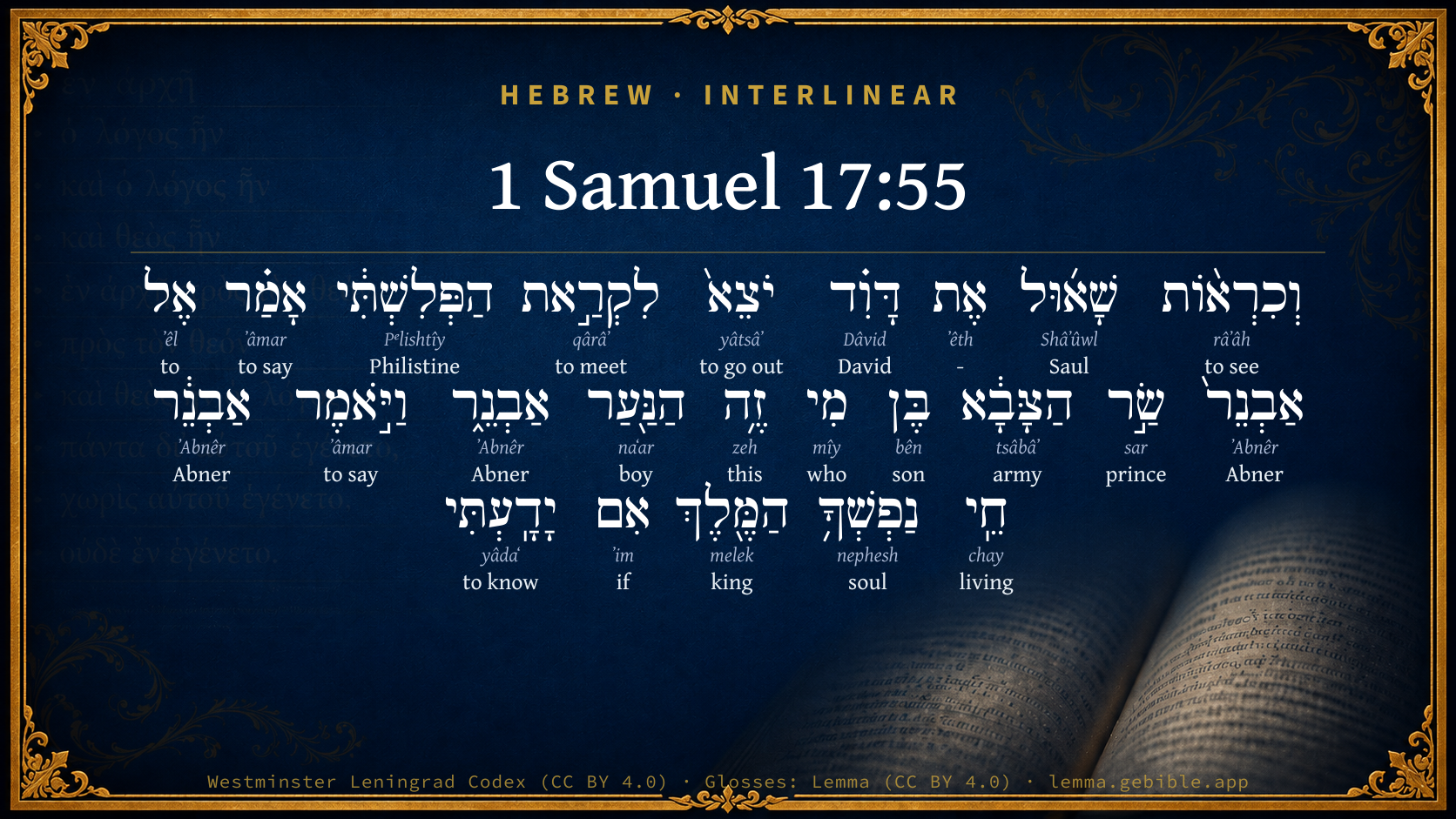
  1. וְכִרְא֨וֹת râʼâh H7200 “and · like/as · to see” Conjunction + Preposition + Verb, Qal, Infinitive Construct
  2. שָׁא֜וּל Shâʼûwl H7586 “Saul” Noun, Proper
  3. אֶת ʼêth H853 “-” Particle, Direct Object
  4. דָּוִ֗ד Dâvid H1732 “David” Noun, Proper
  5. יֹצֵא֙ yâtsâʼ H3318 “going out” Verb, Qal, Participle Active, Masculine, Singular, Absolute
  6. הַפְּלִשְׁתִּ֔י Pᵉlishtîy H6430 “the · Philistine” Particle, Definite Article + Noun, Gentilic, Masculine, Singular, Absolute
  7. אָמַ֗ר ʼâmar H559 “to say” Verb, Qal, Perfect, 3rd Person, Masculine, Singular
  8. אֶל ʼêl H413 “to” Preposition
  9. אַבְנֵר֙ ʼAbnêr H74 “Abner” Noun, Proper
  10. שַׂ֣ר sar H8269 “prince of” Noun, Common, Masculine, Singular, Construct
  11. הַצָּבָ֔א tsâbâʼ H6635 “the · army” Particle, Definite Article + Noun, Common, Both, Singular, Absolute
  12. בֶּן bên H1121 “son of” Noun, Common, Masculine, Singular, Construct
  13. מִי mîy H4310 “who” Particle, Interrogative
  14. זֶ֥ה zeh H2088 “this” Pronoun, Demonstrative, Masculine, Singular
  15. הַנַּ֖עַר naʻar H5288 “the · boy” Particle, Definite Article + Noun, Common, Masculine, Singular, Absolute
  16. אַבְנֵ֑ר ʼAbnêr H74 “Abner” Noun, Proper
  17. וַיֹּ֣אמֶר ʼâmar H559 “and · to say” Conjunction + Verb, Qal, Sequential Imperfect, 3rd Person, Masculine, Singular
  18. אַבְנֵ֔ר ʼAbnêr H74 “Abner” Noun, Proper
  19. חֵֽי chay H2416 “living” Adjective, Adjective, Masculine, Singular, Absolute
  20. נַפְשְׁךָ֥ nephesh H5315 “soul · your” Noun, Common, Both, Singular, Construct + Suffix, Personal, 2nd Person, Masculine, Singular
  21. הַמֶּ֖לֶךְ melek H4428 “the · king” Particle, Definite Article + Noun, Common, Masculine, Singular, Absolute
  22. אִם ʼim H518 “if” Conjunction
  23. יָדָֽעְתִּי yâdaʻ H3045 “to know” Verb, Qal, Perfect, 1st Person, Common, Singular

About this verse

These counts appear in no published source. They are computed here, from the morphology-tagged text and Lemma’s own curated glosses. What Lemma adds →

24
words
21
distinct lemmas
Historical
section

Shared distinctive vocabulary

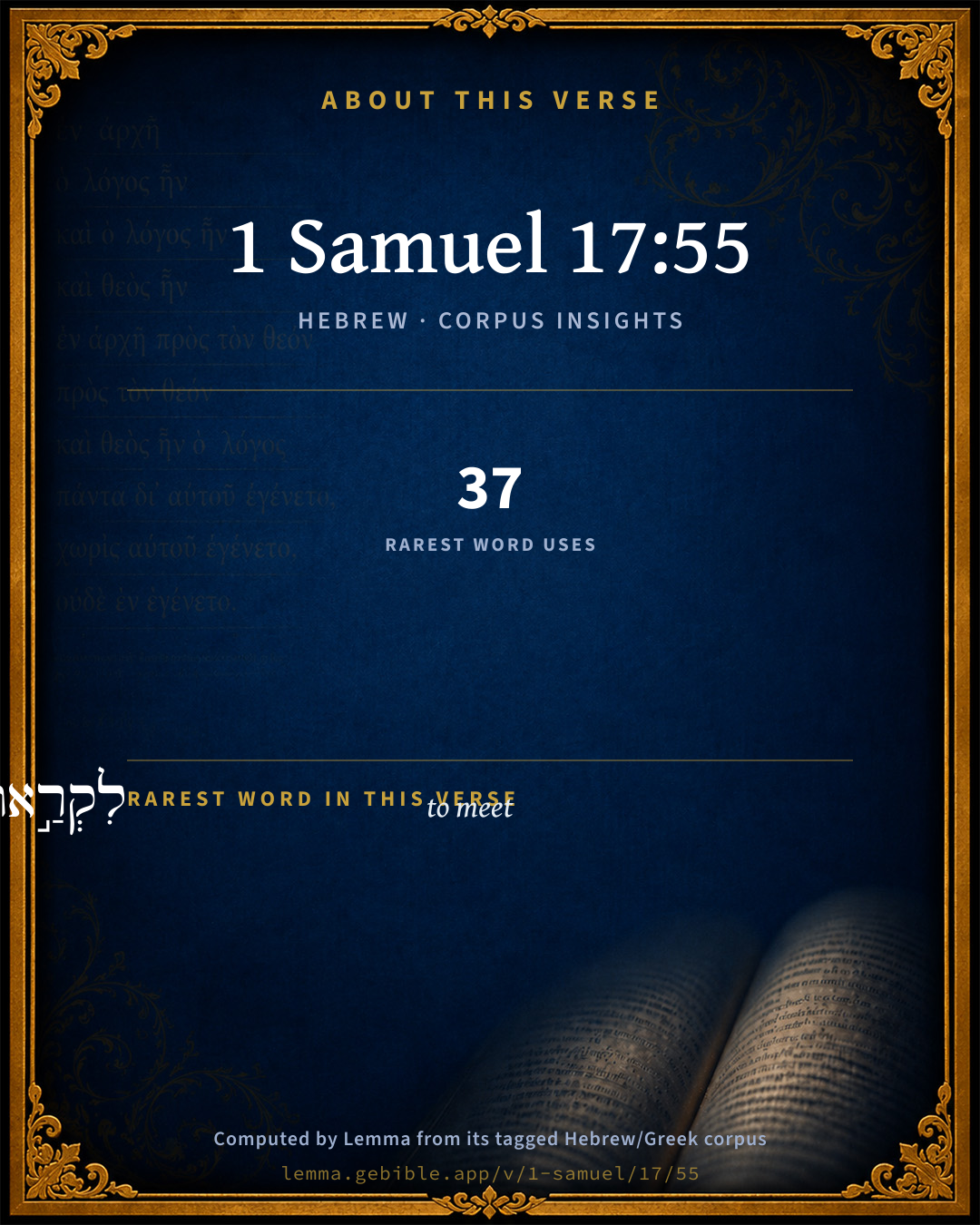
לִקְרַ֣את to meet H7122 occurs in 35 verses of the Hebrew Bible. Also found in:

Grammatical profile

  • 6 verbs
  • 12 nouns
  • 1 adjective
  • 1 pronoun
  • 1 preposition
  • 1 conjunction
  • 2 particles

Verb forms

  • וְכִרְא֨וֹת Qal · Infinitive Construct
  • יֹצֵא֙ Qal · Participle Active
  • לִקְרַ֣את Qal · Infinitive Construct
  • אָמַ֗ר Qal · Perfect
  • וַיֹּ֣אמֶר Qal · Sequential Imperfect
  • יָדָֽעְתִּי Qal · Perfect

Repetition

Words recur within this verse — often emphatic in Hebrew:

  • אַבְנֵר֙ Abner H74 ×3
  • אָמַ֗ר to say H559 ×2

Hebrew & Septuagint length

In English translation the verse runs 35 words from the Hebrew and 37 from the Septuagint (LXX English) — closely comparable.

A rough comparison of the two English renderings, which tokenize alike — not a word-level alignment.

Word counts can differ between the Hebrew and the Greek without any difference in meaning — e.g. the Hebrew direct-object marker אֵת has no separate Greek word, and Greek often adds the article ὁ.

Cross-references

2

Topical passages linked to 1 Samuel 17:55 in the Treasury of Scripture Knowledge — connected by theme and wording, ordered by reader-vote popularity; previews shown in the World English Bible.

  • 1 Samuel 16:21–22 David came to Saul, and stood before him: and he loved him greatly; and he became his armor bearer.
  • 1 Samuel 17:58 Saul said to him, Whose son are you, you young man? David answered, I am the son of your servant Jesse the Bethlehemite.

Cross-references courtesy of OpenBible.info (CC BY 4.0).

Hebrew and Greek witnesses Masoretic Hebrew ↔ Greek Septuagint

The same verse in the two great witnesses to the Old Testament, shown verse-for-verse.

These are two independent witnesses, not word-aligned to each other, and the Septuagint is shown in lemma (dictionary) form.

Hebrew 1 Samuel 17:55 Masoretic · Westminster Leningrad Codex

וְכִרְא֨וֹת שָׁא֜וּל אֶת דָּוִ֗ד יֹצֵא֙ לִקְרַ֣את הַפְּלִשְׁתִּ֔י אָמַ֗ר אֶל אַבְנֵר֙ שַׂ֣ר הַצָּבָ֔א בֶּן מִי זֶ֥ה הַנַּ֖עַר אַבְנֵ֑ר וַיֹּ֣אמֶר אַבְנֵ֔ר חֵֽי נַפְשְׁךָ֥ הַמֶּ֖לֶךְ אִם יָדָֽעְתִּי

When Saul saw David go forth against the Philistine, he said to Abner, the captain of the host, Abner, whose son is this youth? Abner said, As your soul lives, O king, I can't tell.

World English Bible · Public Domain

Greek LXX 1 Samuel 17:55 Septuagint · lemma form
And when Saul saw David going out to meet the Philistine, he said to Abener the captain of the host, Whose son is this youth? and Abener said, As your soul lives, O King, I know not.

LXX2012 (modern English Septuagint) · Public Domain

On this verse, Keil & Delitzsch discusses the Septuagint’s reading. Read the note in Commentary ↓

Hebrew: Westminster Leningrad Codex (CC BY 4.0). Greek: Septuagint (public domain); English from LXX2012 (modern English Septuagint) (Public Domain). How the Septuagint differs from the Hebrew →

Targum (Aramaic paraphrase)

1

The Targum is the ancient Jewish Aramaic paraphrase of the Hebrew Scriptures — an interpretive translation, not the Hebrew text itself. Onkelos (literal) and Pseudo-Jonathan (expansive) render the Torah, and Jonathan the Prophets. Coverage is partial: where no permissively-licensed English translation exists for a verse, only the Aramaic is shown. This is verse-level text, not a word-by-word alignment to the Hebrew.

  1. Targum Jonathan Prophets (Joshua–Malachi)
    וְכַד חֲזָא שָׁאוּל יַת דָוִד נָפִיק לָקֳדָמוּת פְּלִשְׁתָּאֵי אֲמַר לְאַבְנֵר רַב חֵילָא בַּר מַן דֵין עוּלֵימָא אַבְנֵר וַאֲמַר אַבְנֵר חַיֵי נַפְשָׁךְ מַלְכָּא אִם יְדַע אֲנָא:

    (no public-domain English translation for this verse)

    Targum Jonathan — Aramaic: “Mikraot Gedolot” (public domain). English: “Sefaria Community Translation” (CC0 1.0 (public-domain dedication)); “London "Chaldee Paraphrase," 1871” (public domain). Text via Sefaria.

Commentary

Notes on 1 Samuel 17:55 from classic Christian and Jewish commentators (each source and its license shown beneath its notes). The classic Christian expositions comment on the surrounding passage and are grouped to its opening verse, so a note may address several verses; the Jewish commentaries on the Tanakh (Rashi and others) are per-verse, so they appear only where the commentator wrote on this verse.

Lemma curates 59 commentaries, every one of them public domain or Creative Commons licensed, each selected and text-cleaned for this edition rather than reprinted as found. About our sources →

Trapp's Complete Commentary

John Trapp

1Sa 17:55 And when Saul saw David go forth against the Philistine, he said unto Abner, the captain of the host, Abner, whose son [is] this youth? And Abner said, [As] thy soul liveth, O king, I cannot tell.

Ver. 55. Whose son is this?] Saul being of a weak brain by reason of his frantic fits, and withal full of business, had, belike, forgotten David, who might be now much altered in his visage and habit, and never haply otherwise taken notice of by Saul than as princes use to do of musicians or servants.

John Trapp, A Commentary or Exposition upon All the Books of the Old and New Testament (1647–1656) — public domain. Text from a community e-Sword module.

Joseph Benson's Commentary

1Sa 17:55. Whose son is this youth? — It may, at first sight, appear strange that Saul should be represented here as not knowing who David was, when we have a relation in the foregoing chapter of his sending for him to court, being highly pleased with his behaviour, and much delighted with his music, making him his armour-bearer, and sending to his father Jesse to ask his leave for his continuance at court. But it may be observed that Saul, in this place, does not express an entire ignorance of David, but only inquires whose son he was — A question of the more consequence to him, as he had promised his daughter in marriage to the conqueror of Goliath. Either Saul had never before made any inquiry about his parentage, or both he and Abner had forgotten whence he was. And this might very easily happen to a king and a general of an army, who daily see and have to do with so many different faces, and who pay so little regard to things of this sort. Nay, if Saul had entirely forgotten David, it would not have been strange, considering that he had been but little with him, had some time ago been dismissed from the court, and was returned home, where he had remained at least a year or two, during which time Saul had not seen him. Besides, the distemper of Saul’s mind might make him forgetful, and David might now be much changed, both in his countenance and in his habit. Abner said, I cannot tell — Abner’s employment was generally in the camp, when David was at the court; and when Abner was there he probably took little notice of a youth so much inferior to him as David was.

“We may learn from the whole of this pleasing chapter,” says Dr. Dodd, “how ready God is to help those who trust in him; for whose defence and protection he makes use of means apparently the most weak, to humble the pride of the wicked, and to destroy the powers which seem most formidable. Some writers have considered this destruction of Goliath by David as a type of the victory of Jesus Christ, in his state of weakness and humiliation, over the strong and gigantic powers of hell and the grave.”

Joseph Benson's Commentary on the Old and New Testaments (1811–1818) — public domain. Text from a community e-Sword module.

Keil & Delitzsch

C. F. Keil & F. Delitzsch

A war between the Philistines and the Israelites furnished David with the opportunity of displaying before Saul and all Israel, and greatly to the terror of the enemies of his people, that heroic power which was firmly based upon his bold and pious trust in the omnipotence of the faithful covenant God (Sa1 17:1-3). A powerful giant, named Goliath, came forward from the ranks of the Philistines, and scornfully challenged the Israelites to produce a man who would decide the war by a single combat with him (Sa1 17:4-11). David, who had returned home for a time from the court of Saul, and had just been sent into the camp by his father with provisions for his elder brothers who were serving in the army, as soon as he heard the challenge and the scornful words of the Philistine, offered to fight with him (vv. 15-37), and killed the giant with a stone from a sling; whereupon the Philistines took to flight, and were pursued by the Israelites to Gath and Ekron (vv. 38-54).

Sa1 17:1-11

Some time after David first came to Saul for the purpose of playing, and when he had gone back to his father to Bethlehem, probably because Saul's condition had improved, the Philistines made a fresh attempt to subjugate the Israelites. They collected their army together (machaneh, as in Exo 14:24; Jdg 4:16) to war at Shochoh, the present Shuweikeh, in the Wady Sumt, three hours and a half to the south-west of Jerusalem, in the hilly region between the mountains of Judah and the plain of Philistia (see at Jos 15:35), and encamped between Shochoh and Azekah, at Ephes-dammim, which has been preserved in the ruins of Damm, about an hour and a half east by north of Shuweikeh; so that Azekah, which has not yet been certainly traced, must be sought for to the east or north-east of Damm (see at Jos 10:10).

Sa1 17:2-3

Saul and the Israelites encamped opposite to them in the terebinth valley (Emek ha-Elah), i.e., a plain by the Wady Musur, and stood in battle array opposite to the Philistines, in such order that the latter stood on that side against the mountain (on the slope of the mountain), and the Israelites on this side against the mountain; and the valley (הגּיא, the deeper cutting made by the brook in the plain) was between them.

Sa1 17:4-5

And the (well-known) champion came out of the camps of the Philistines (הבּנים אישׁ, the middle-man, who decides a war between two armies by a single combat; Luther, "the giant," according to the ἀνὴρ δυνατὸς of the lxx, although in Sa1 17:23 the Septuagint translators have rendered the word correctly ἀνὴρ ὁ ἀμεσσαῖος, which is probably only another form of ὁ μεσαῖος), named Goliath of Gath, one of the chief cities of the Philistines, where there were Anakim still left, according to Jos 11:22. His height was six cubits and a span (6 1/4 cubits), i.e., according to the calculation made by Thenius, about nine feet two inches Parisian measure, - a great height no doubt, though not altogether unparalleled, and hardly greater than that of the great uncle of Iren, who came to Berlin in the year 1857 (see Pentateuch, p. 869, note).

(Note: According to Pliny (h. n. vii. 16), the giant Pusio and the giantess Secundilla, who lived in the time of Augustus, were ten feet three inches (Roman) in height; and a Jew is mentioned by Josephus (Ant. xviii. 4, 5), who was seven cubits in height, i.e., ten Parisian feet, or if the cubits are Roman, nine and a half.)

The armour of Goliath corresponded to his gigantic stature: "a helmet of brass upon his head, and clothes in scale armour, the weight of which was five thousand shekels of brass." The meaning scales is sustained by the words קשׂקשׂת in Lev 11:9-10, and Deu 14:9-10, and קשׂקשׂות in Eze 29:4. קשׂקשּׂים שׁריון, therefore, is not θώραξ ἁλυσιδωτός (lxx), a coat of mail made of rings worked together like chains, such as were used in the army of the Seleucidae (1 Macc. 6:35), but according to Aquila's φολιδωτόν (scaled), a coat made of plates of brass lying one upon another like scales, such as we find upon the old Assyrian sculptures, where the warriors fighting in chariots, and in attendance upon the king, wear coats of scale armour, descending either to the knees or ankles, and consisting of scales of iron or brass, which were probably fastened to a shirt of felt or coarse linen (see Layard, Nineveh and its Remains, vol. ii. p. 335). The account of the weight, 5000 shekels, i.e., according to Thenius, 148 Dresden pounds, is hardly founded upon the actual weighing of the coat of mail, but probably rested upon a general estimate, which may have been somewhat too high, although we must bear in mind that the coat of mail not only covered the chest and back, but, as in the case of the Assyrian warriors, the lower part of the body also, and therefore must have been very large and very heavy.

(Note: According to Thenius, the cuirass of Augustus the Strong, which has been preserved in the historical museum at Dresden, weighted fifty-five pounds; and from that he infers, that the weight given as that of Goliath's coat of mail is by no means too great. Ewald, on the other hand, seems to have no idea of the nature of the Hebrew eights, or of the bodily strength of a man, since he gives 5000 lbs. of brass as the weight of Goliath's coat of mail (Gesch. iii. p. 90), and merely observes that the pounds were of course much smaller than ours. But the shekel did not even weight so much as our full ounce. With such statements as these you may easily turn the historical character of the scriptural narrative into incredible myths; but they cannot lay any claim to the name of science.)

Sa1 17:6

And "greaves of brass upon his feet, and a brazen lance (hung) between his shoulders," i.e., upon his back. כּידון signifies a lance, or small spear. The lxx and Vulgate, however, adopt the rendering ἀσπὶς χαλκῆ, clypeus aeneus; and Luther has followed them, and translates it a brazen shield. Thenius therefore proposes to alter כּידון into מגן, because the expression "between his shoulders" does not appear applicable to a spear or javelin, which Goliath must have suspended by a strap, but only to a small shield slung over his back, whilst his armour-bearer carried the larger צנּה in front of him. But the difficulty founded upon the expression "between his shoulders" has been fully met by Bochart (Hieroz. i. 2, c. 8), in the examples which he cites from Homer, Virgil, etc., to prove that the ancients carried their own swords slung over their shoulders (ἀμφὶ δ ̓ ὤμοισιν: Il. ii. 45, etc.). And Josephus understood the expression in this way (Ant. vi. 9, 1). Goliath had no need of any shield to cover his back, as this was sufficiently protected by the coat of mail. Moreover, the allusion to the כּידון in Sa1 17:45 points to an offensive weapon, and not to a shield.

Sa1 17:7

"And the shaft of his spear was like a weaver's beam, and the point of it six hundred shekels of iron" (about seventeen pounds). For חץ, according to the Keri and the parallel passages, Sa2 21:19; Ch1 20:5, we should read עץ, wood, i.e., shaft. Before him went the bearer of the zinnah, i.e., the great shield.

Sa1 17:8

This giant stood and cried to the ranks of the Israelites, "Why come ye out to place yourselves in battle array? Am I not the Philistine, and ye the servants of Saul? Choose ye out a man who may come down to me" (into the valley where Goliath was standing). The meaning is: "Why would you engage in battle with us? I am the man who represents the strength of the Philistines, and ye are only servants of Saul. If ye have heroes, choose one out, that we may decide the matter in a single combat."

Sa1 17:9-10

"If he can fight with me, and kill me, we will be your servants; if I overcome him, and slay him, ye shall be our servants, and serve us." He then said still further (Sa1 17:10), "I have mocked the ranks of Israel this day (the mockery consisted in his designating the Israelites as servants of Saul, and generally in the triumphant tone in which he issued the challenge to single combat); give me a man, that we may fight together!"

Sa1 17:11

At these words Saul and all Israel were dismayed and greatly afraid, because not one of them dared to accept the challenge to fight with such a giant.

1 Samuel 17:12-31

David's arrival in the camp, and wish to fight with Goliath. - David had been dismissed by Saul at that time, and having returned home, he was feeding his father's sheep once more (Sa1 17:12-15). Now, when the Israelites were standing opposite to the Philistines, and Goliath was repeating his challenge every day, David was sent by his father into the camp to bring provisions to his three eldest brothers, who were serving in Saul's army, and to inquire as to their welfare (Sa1 17:16-19). He arrived when the Israelites had placed themselves in battle array; and running to his brethren in the ranks, he saw Goliath come out from the ranks of the Philistines, and heard his words, and also learned from the mouth of an Israelite what reward Saul would give to any one who would defeat this Philistine (Sa1 17:20-25). He then inquired more minutely into the matter; and having thereby betrayed his own intention of trying to fight with him (Sa1 17:26, Sa1 17:27), he was sharply reproved by his eldest brother in consequence (Sa1 17:28, Sa1 17:29). He did not allow this to deter him, however, but turned to another with the same question, and received a similar reply (Sa1 17:30); whereupon his words were told to the king, who ordered David to come before him (Sa1 17:31).

This is, in a condensed form, the substance of the section, which introduces the conquest of Goliath by David in the character of an episode. This first heroic deed was of the greatest importance to David and all Israel, for it was David's first step on the way to the throne, to which Jehovah had resolved to raise him. This explains the fulness and circumstantiality of the narrative, in which the intention is very apparent to set forth most distinctly the marvellous overruling of all the circumstances by God himself. And this circumstantiality of the account is closely connected with the form of the narrative, which abounds in repetitions, that appear to us tautological in many instances, but which belong to the characteristic peculiarities of the early Hebrew style of historical composition.

(Note: On account of these repetitions and certain apparent differences, the lxx (Cod. Vat.) have omitted the section from Sa1 17:12 to Sa1 17:31, and also that from Sa1 17:55 to Sa1 18:5; and on the ground of this omission, Houbigant, Kennicott, Michaelis, Eichhorn, Dathe, Bertheau, and many others, have pronounced both these sections later interpolations; whereas the more recent critics, such as De Wette, Thenius, Ewald, Bleek, Sthelin, and others, reject the hypothesis that they are interpolations, and infer from the supposed discrepancies that 1 Samuel 17 and 18 were written by some one who was ignorant of the facts mentioned in 1 Samuel 16, and was altogether a different person from the author of this chapter. According to Sa1 16:21., they say, David was Saul's armour-bearer already, and his family connections were well known to the king, whereas, according to Sa1 17:15, David was absent just at the time when he ought as armour-bearer to have been in attendance upon Saul; whilst in Sa1 17:33 he is represented as a shepherd boy who was unaccustomed to handle weapons, and as being an unauthorized spectator of the war, and, what is still more striking, even his lineage is represented in Sa1 17:55. as unknown both to Abner and the king. Moreover, in Sa1 17:12 the writer introduces a notice concerning David with which the reader must be already well acquainted from Sa1 16:5., and which is therefore, to say the least, superfluous; and in Sa1 17:54 Jerusalem is mentioned in a manner which does not quite harmonize with the history, whilst the account of the manner in which he disposed of Goliath's armour is apparently at variance with Sa1 21:9. But the notion, that the sections in question are interpolations that have crept into the text, cannot be sustained on the mere authority of the Septuagint version; since the arbitrary manner in which the translators of this version made omissions or additions at pleasure is obvious to any one. Again, the assertion that these sections cannot well be reconciled with 1 Samuel 16, and emanated from an author who was unacquainted with the history in 1 Samuel 16, is overthrown by the unquestionable reference to 1 Samuel 16 which we find in Sa1 16:12, "David the son of that Ephratite," - where Jerome has correctly paraphrased הזּה, de quo supra dictum est, - and also by the remark in Sa1 16:15, that David went backwards and forwards from Saul to feed his father's sheep in Bethlehem. Neither of these can be pronounced interpolations of the compiler, unless the fact can be established that the supposed discrepancies are really well founded. But it by no means follows, that because Saul loved David on account of the beneficial effect which is playing upon the harp produced upon his mind, and appointed him his armour-bearer, therefore David had really to carry the king's armour in time of war. The appointment of armour-bearer was nothing more than conferring upon him the title of aide-de-camp, from which it cannot be inferred that David had already become well known to the king through the performance of warlike deeds. If Joab, the commander-in-chief, had ten armour-bearers (Sa2 18:15, compare 1 Samuel 23:37), king Saul would certainly have other armour-bearers besides David, and such as were well used to war. Moreover, it is not stated anywhere in 1 Samuel 16 that Saul took David at the very outset into his regular and permanent service, but, according to Sa1 16:22, he merely asked his father Jesse that David might stand before him, i.e., might serve him; and there is no contradiction in the supposition, that when his melancholy left him for a time, he sent David back to his father to Bethlehem, so that on the breaking out of the war with the Philistines he was living at home and keeping sheep, whilst his three eldest brothers had gone to the war. The circumstance, however, that when David went to fight with Goliath, Saul asked Abner his captain, "Whose son is this youth?" and Abner could give no explanation to the king, so that after the defeat of Goliath, Saul himself asked David, "Whose son art thou?" (Sa1 17:55-58), can hardly be comprehended, if all that Saul wanted to ascertain was the name of David's father. For even if Abner had not troubled himself about the lineage of Saul's harpist, Saul himself could not well have forgotten that David was a son of the Bethlehemite Jesse. But there was much more implied in Saul's question. It was not the name of David's father alone that he wanted to discover, but what kind of man the father of a youth who possessed the courage to accomplish so marvellous a heroic deed really was; and the question was put not merely in order that he might grant him an exemption of his house from taxes as the reward promised for the conquest of Goliath (Sa1 17:25), but also in all probability that he might attach such a man to his court, since he inferred from the courage and bravery of the son the existence of similar qualities in the father. It is true that David merely replied, "The son of thy servant Jesse of Bethlehem;" but it is very evident from the expression in Sa1 18:1, "when he had made an end of speaking unto Saul," that Saul conversed with him still further about his family affairs, since the very words imply a lengthened conversation. The other difficulties are very trivial, and will be answered in connection with the exposition of the passages in question.)

Sa1 17:12-15

Sa1 17:12-15 are closely connected with the preceding words, "All Israel was alarmed at the challenge of the Philistine; but David the son of that Ephratite (Ephratite, as in Rut 1:1-2) of Bethlehem in Judah, whose name was Jesse," etc. The verb and predicate do not follow till Sa1 17:15; so that the words occur here in the form of an anacolouthon. The traditional introduction of the verb היה between ודוד and בּן־אישׁ (David was the son of that Ephratite) is both erroneous and misleading. If the words were to be understood in this way, היה could no more be omitted here than היתה in Ch2 22:3, Ch2 22:11. The true explanation is rather, that Sa1 17:12-15 form one period expanded by parentheses, and that the historian lost sight of the construction with which he commenced in the intermediate clauses; so that he started afresh with the subject ודוד in Sa1 17:15, and proceeded with what he had to say concerning David, doing this at the same time in such a form that what he writes is attached, so far as the sense if concerned, to the parenthetical remarks concerning Jesse's eldest sons. To bring out distinctly the remarkable chain of circumstances by which David was led to undertake the conflict with Goliath, he links on to the reference to his father certain further notices respecting David's family and his position at that time. Jesse had eight sons and was an old man in the time of Saul. באנשׁים בּא, "come among the weak." אנשׁים generally means, no doubt, people or men. But this meaning does not give any appropriate sense here; and the supposition that the word has crept in through a slip of the pen for בּשּׁנים, is opposed not only by the authority of the early translators, all of whom read אנשׁים, but also by the circumstance that the expression בּשּׁנים בּוא does not occur in the whole of the Old Testament, and that ביּמים בּוא alone is used with this signification.

Sa1 17:13-14

"The three great (i.e., eldest) sons of Jesse had gone behind Saul into the war." הלכוּ, which appears superfluous after the foregoing ויּלכוּ, has been defended by Bttcher, as necessary to express the pluperfect, which the thought requires, since the imperfect consec. ויּלכוּ, when attached to a substantive and participial clause, merely expresses the force of the aorist. Properly, therefore, it reads thus: "And then (in Jesse's old age) the three eldest sons followed, had followed, Saul;" a very ponderous construction indeed, but quite correct, and even necessary, with the great deficiency of forms, to express the pluperfect. The names of these three sons agree with Sa1 16:6-9, whilst the third, Shammah, is called Shimeah (שׁמעה) in Sa2 13:3, Sa2 13:32, שׁמעי in Sa2 21:21, and שׁמעא in Ch1 2:13; Ch1 20:7.

Sa1 17:15

"But David was going and returning away from Saul:" i.e., he went backwards and forwards from Saul to feed his father's sheep in Bethlehem; so that he was not in the permanent service of Saul, but at that very time was with his father. The latter is to be supplied from the context.

Sa1 17:16-17

The Philistine drew near (to the Israelitish ranks) morning and evening, and stationed himself for forty days (in front of them). This remark continues the description of Goliath's appearance, and introduces the account which follows. Whilst the Philistine was coming out every day for forty days long with his challenge to single combat, Jesse sent his son David into the camp. "Take now for thy brethren this ephah of parched grains (see Lev 23:13), and these ten loaves, and bring them quickly into the camp to thy brethren."

Sa1 17:18

"And these ten slices of soft cheese (so the ancient versions render it) bring to the chief captain over thousand, and visit thy brethren to inquire after their welfare, and bring with you a pledge from them" - a pledge that they are alive and well. This seems the simplest explanation of the word ערבּתם, of which very different renderings were given by the early translators.

Sa1 17:19

"But Saul and they (the brothers), and the whole of the men of Israel, are in the terebinth valley," etc. This statement forms part of Jesse's words.

Sa1 17:20-21

In pursuance of this commission, David went in the morning to the waggon-rampart, when the army, which was going out (of the camp) into battle array, raised the war-cry, and Israel and the Philistines placed themselves battle-array against battle-array. וגו והחיל is a circumstantial clause, and the predicate is introduced with והרעוּ, as וגו והחיל is placed at the head absolutely: "and as for the army which, etc., it raised a shout." בּמּלחמה הרע, lit. to make a noise in war, i.e., to raise a war-cry.

Sa1 17:22

David left the vessels with the provisions in the charge of the keeper of the vessels, and ran into the ranks to inquire as to the health of his brethren.

Sa1 17:23

Whilst he was talking with them, the champion (middle-man) Goliath drew near, and spoke according to those words (the words contained in Sa1 17:8.), and David heard it. פל ממּערות is probably an error for פל ממּערכות (Keri, lxx, Vulg.; cf. Sa1 17:26). If the Chethibh were the proper reading, it would suggest an Arabic word signifying a crowd of men (Dietrich on Ges. Lex.).

Sa1 17:24-25

Keil & Delitzsch — Biblical Commentary on the Old Testament (1861–1891) — public domain (CC PDM 1.0). Text via the HelloAO Bible API. (Old Testament only.)

Tyndale Open Study Notes

Tyndale Open Resources

17:55-58 In light of 16:14-23, it is surprising that neither Saul nor Abner knew who David was. It is possible that the events of ch 17 happened either before or long after David’s tenure of intermittent service mentioned in ch 16 (Saul probably served as king for forty-two years, 13:1).

Tyndale Open Study Notes — © Tyndale Open Resources, licensed CC BY-SA 4.0. Text via the HelloAO Bible API.

unfoldingWord translationNotes

Door43 World Missions Community

When Saul saw David

The conversation in 1Sa 17:55-56 happened before David killed Goliath. AT: "When Saul had seen David" or "Earlier when Saul saw David" (See: Order of Events)

go out against the Philistine

"go to fight against the Philistine"

whose son is this youth

"who is this youth's father"

As you live

This was a way of swearing that what he was about to say was true.

whose son the boy is

"who the boy's father is"

translationWords

Saul (OT)

David

Philistines

Abner

king

unfoldingWord translationNotes — © Distant Shores Media and the Door43 World Missions Community, licensed CC BY-SA 4.0. Source: git.door43.org/Door43/en_tn.

Geneva Bible (1599)

Geneva Bible translators

That is, of what family and tribe is he? or else he had forgotten David, albeit he had received so great a benefit by him.

Geneva Bible (1599) marginal notes — public domain. Text via Bolls.life.

Jamieson, Fausset & Brown

Robert Jamieson, A. R. Fausset & David Brown

Saul . . . said unto Abner . . . whose son is this youth?--A young man is more spoken of in many Eastern countries by his father's name than his own. The growth of the beard, and other changes on a now full-grown youth, prevented the king from recognizing his former favorite minstrel [Sa1 16:23].

Next: 1 Samuel Chapter 18

Jamieson, Fausset & Brown — Commentary Critical and Explanatory on the Whole Bible (1871) — public domain (CC PDM 1.0). Text via the HelloAO Bible API.

Ellicott's Commentary for English Readers

(55) Whose son is this youth?—A grave difficulty, at first sight, indisputably exists here. It is briefly this. In the preceding chapter (1Sa_17:18-23), David, the son of Jesse, is chosen to play before the mentally sick king; his playing relieved the sufferer, who became attached to the young musician, and in consequence appointed him to a position about his person that certainly would have involved a lengthened, if not a continuous, residence at the court. In this and the following verses we read how this same David, at the time of his great exploit, was apparently unknown to the king and to Abner, the captain of the host. The LXX., fully conscious of the difficulty, determined to solve it by boldly, if not wisely, cutting the knot. They literally expunged from their version all the later passages which they could not easily bring into harmony with the earlier. The Greek Version, then, simply omits these four last verses of 1 Samuel 17, together with the first five verses of 1 Samuel 18, and the whole of the section 1Sa_17:12-31.

Various ingenious explanations have been suggested by scholars.

(a) The mental state of Saul when David played before him was such that the king failed to recognise him on the present occasion, and Abner probably had never seen him before.

(b) Some length of time had elapsed since his last visit to the court, and as he was then in very early manhood, he had, so to speak, grown, in a comparatively speaking short space of time, out of Saul’s memory.

(c) The purpose of Saul’s inquiry was not to find out who David was—that he knew well already—but to ascertain the position and general circumstances of the young hero’s father, as, according to the promise (in 1Sa_17:25), in the event of his success (which evidently the king confidently looked for), the father of the champion and his family would receive extraordinary honours.

The real solution of the difficulty probably lies in the fact that, as has been before stated, this and the other historical books of the Old Testament were made up by the inspired compiler from well-authenticated traditions current in Israel, and most probably preserved in the archives of the great prophetic schools. (See Notes on 1Sa_17:1; 1Sa_17:15.) There were, no doubt, many of these traditions connected with the principal events of David’s early career. Two here were selected which, to a certain extent, covered the same ground. The first—preserved, no doubt, in some prophetic school where music and poetry were especially cultivated—narrates the influence which David acquired over Saul through his great gift of music. The power of music and poetry in Saul’s mental disease was evidently the great point of interest to the original writer of 1Sa_16:14-23. Now, in the narrative contained in these ten verses no note of time occurs. The events related evidently were spread over a considerable, possibly over a very long, period. The afflicted king might have seen the young musician perhaps in a darkened tent once or twice before the Goliath combat, but the great intimacy described in 1Sa_16:21-23, we may well assume, belonged to a period subsequent to the memorable combat with the giant.

Following out this hypothesis, we may with some confidence assume that King Saul failed entirely to recognise the young player whom he had only seen (possibly only heard in his darkened tent) on one or two sad occasions; and Abner probably had never seen him.

As for the great love on the part of the king, and position of royal armour-bearer these things we have little doubt came to David after the victory over the giant Philistine, and very likely indeed in consequence of it.

In the later of the two sections of the Goliath history, the compiler cared little for the musical detail; his work was to show that the foundation stone of David’s brilliant and successful life was intense faith in the Jehovah of Israel, a perfect child-like trust in the power of the Invisible King.

In the former of the two sections the relater—no doubt in his day a famous teacher in some school of prophetic music—was, only concerned to show the mighty influence of his Divine art upon the souls and the lives of men, as exemplified in the story of the early days of the sweet Psalmist-King of Israel.

The musical details connected with the early life of David, the composer of so many of the famous hymns sung in the Tempie Service and also in the public gatherings of the people, would be—in the eyes of this writer—of the deepest interest to coming generations.

A Bible Commentary for English Readers, edited by Charles John Ellicott (1878–1897) — public domain. Text from a community e-Sword module.

The Cambridge Bible for Schools and Colleges

gen. ed. J. J. S. Perowne

55–58. Saul’s inquiry concerning David’s parentage

55. he said unto Abner] This section is not found in the Septuagint (B). On the difficulty of reconciling it with ch. 16 see Note VI. P. 241.

The Cambridge Bible for Schools and Colleges (gen. ed. J. J. S. Perowne; Cambridge University Press, 1878–1918) — public domain. Text from a community e-Sword module.

John Gill's Exposition

And when Saul saw David go forth against the Philistine,.... Set out to meet him, and engage with him, as he might from the side of the mountain, where he was encamped:

he said unto Abner, the captain of the host; his own cousin, whom he had raised to this high post in the army, Sa1 14:50,

Abner, whose son is this youth? it is thought strange by many that Saul should not know who he was, when he had been often at his court, and served him as a musician, and had been very useful to him, and he loved him, and made him his armourbearer, and even had just now conversed with him about encountering with the Philistine, and had clothed him with his own armour: to get rid of the former part of the objection, some have supposed that this event happened before David was his musician and armourbearer, and is by anticipation spoken of in Sa1 16:14, but that the connection with this and the following chapter will not admit of; and besides, before this event, David is said to return home from Saul, Sa1 17:15; so that it is certain he had been at Saul's court, and in his presence before: but to remove this seeming difficulty it may be observed, that Saul, having laboured under a disorder of body and mind, might easily forget David, and his serving him in the above capacity; and to which the multiplicity of business, and of persons in a court, might greatly contribute; and what with the distance of time, and the different habits in which David appeared, sometimes as a musician, and sometimes as a shepherd, and at other times as a soldier, and always as a servant, it is no wonder the king should not know him again; though after all it is not about his person that he inquires, but whose son he was, what was his father's name, and from what family he sprung; for though Saul was made acquainted with this in the time of his disorder, and therefore sent to his father Jesse for him, and afterwards desired leave for his continuance; yet this might slip out of his memory in a course of time, he having had no personal knowledge of Jesse, nor any correspondence with him, but just at that time; and it behoved him to know the pedigree of David, since, if he was victorious, he was not only to be enriched by him, but to have his daughter for wife, and his family ennobled:

and Abner said, as thy soul liveth, O king, I cannot tell; he swore by the life of Saul, as Joseph by the life of Pharaoh, that he knew nothing of him; which need not at all seem strange, that a general of an army, always employed in military affairs, and often abroad, should know nothing of a domestic servant of Saul's, under the character of a musician, and not always at court either; and still less that he should be ignorant of his family, and know nothing of his father, who lived in obscurity in Bethlehem, and was an old man in those days.

John Gill's Exposition of the Whole Bible (1746–1763) — public domain (CC PDM 1.0). Text via the HelloAO Bible API.

Albert Barnes' Notes on the Bible

Whose son ... - See the marginal reference note.

Albert Barnes' Notes on the Bible (1834–1885) — public domain. Text from a community e-Sword/MySword module.

Matthew Poole's English Annotations

Whose son is this youth?

Quest. How could David be unknown to Saul, with whom he had lived? 1Sa 16:21.

Answ. That might well be, for divers reasons, because David was not constantly with him, nor, as it seems, used by him, but upon extraordinary occasions, and desperate fits of melancholy; from which possibly he had been free for a good while, by God’s special providence and care for his people Israel, that so he might be capable of governing and protecting them against the Philistines, who watched all opportunities against them, and at last broke forth into an open war. Thus David had been for some considerable time dismissed from Saul’s court, and was returned home; and therefore it is not strange, if Saul had for the present forgotten David; for kings, because of the encumbrance of public business, and the multitude of persons who come to them on several occasions, may easily forget some persons; yea, such as have frequently been with them, especially their servants, whom they do not use to observe with so much attention and care as they do others. Add to this, that the distemper of Saul’s mind might make him forgetful; and that David might now be much changed, both in his countenance and in his habit, from what he had before; and it is apparent, that the change of habits makes so great a difference, that it oft keeps us from the knowledge of those persons whom in other habits we very well know. Some give this answer, That this was the first time that Saul had seen David; and that David’s exploit here recorded was performed before that which is recorded 1Sa 17:15, though it be placed after it; but that is confuted by comparing 1Sa 18:1-3.

I cannot tell; which is not strange, because Abner’s conversation and employment was generally in the camp, when David was at the court; and when Abner was there, he took little notice of a person so much inferior to him as David was.

Matthew Poole's English Annotations on the Holy Bible (1683–1685) — public domain. Text from a community e-Sword/MySword module.

Whedon's Commentary on the Bible

Daniel D. Whedon

55. Whose son is this youth — But did not Saul remember David, whose services on the harp had been of so much advantage to him in his madness?

1Sa_16:20-23. Perhaps not, for probably some time had elapsed since the youth had left his court, and Saul’s memory may have suffered somewhat from his disease. A man of Saul’s varying moods would be quite likely to forget even a benefactor; or if he remembered David’s musical service, he may have forgotten his looks, so as not to have recognised him on this occasion. But now, having promised to reward not only him who slew Goliath, but his father also, (1Sa_17:25,) and seeing the youth go forth against the giant confident of victory, he begins to inquire after the tribe and position of his father’s house.

Daniel D. Whedon (gen. ed.), Commentary on the Old and New Testaments (1874–1909) — public domain. Text from a community e-Sword module.

The Pulpit Commentary

SAUL"S INQUIRY CONCERNING DAVID"S PARENTAGE (vers. 55-58).

Vers. 55-58. Abner, whose son is this youth? Hebrew, "lad," na"ar. We have seen that the narrative in 1Sa_16:21-23 carries the history of David"s relations with Saul down to a much later period, and that in ver. 15 of this chapter David is represented as not dwelling continuously at Saul"s court, but as having returned to Bethlehem and resumed his pastoral occupations there, whence he would be summoned back in case of the recurrence of Saul"s malady. It is plain from what is stated here that David had not thus far spent time enough at Gibeah to be personally well known either to Saul or his officers (see note on ver. 15). Stripling. Not na"ar, but "alem, the masculine of the word "almah, used in Isa_7:14. It means a young man fully grown, and arrived at the age to marry, and so is more definite than na"ar, which Saul uses in ver. 58. As David returned, etc. Abner, as captain of the host, would naturally watch the combat, and as soon as it was possible would bring the young warrior into the king"s presence. But what is recorded here could have taken place only after the pursuit of the Philistines was over, and really these five verses should be united with ch. 17., as their object is to introduce the account of the love. of Jonathan for David. Starting then with the inquiry made by the king of Abner, asking for fuller information as to the young man"s parentage, the historian then tells how after the chase he was brought before Saul, and then, in 1Sa_18:1, that the result of their conversation was the warm love that henceforward knit together these two kindred souls.

The Pulpit Commentary (1880–1919), ed. H.D.M. Spence-Jones & Joseph S. Exell — public domain. Text from a community e-Sword module.

John Wesley's Explanatory Notes

Whose son - David had been some considerable time dismissed from Saul's court, and was returned home. And therefore it is not strange, if Saul for the present had forgot David. Besides the distemper of Saul's mind might make him forgetful; and that David might be now much changed, both in his countenance and in his habit. I cannot tell - Abner's employment was generally in the camp, when David was at the court; and when Abner was there, he took little notice of a person so much inferior to him as David was.

John Wesley, Explanatory Notes Upon the Whole Bible (1754–1765) — public domain. Text via the GEBible commentary corpus.

Rashi

Rabbi Shlomo Yitzchaki (Rashi)

Whose son is this youth. Our Rabbis said, "Did he not recognize him? Is it not stated, "He loved him very much and he became his arms bearer"? But, he saw him behaving in a kingly manner. Shaul said, 'If he comes from the family of Peretz, he will become king, for the king may break fences to make way for himself, and no one may object. If, however, he comes from the family of Zerach, he will become an important person. Do'eg said to him, 'Before you ask whether or not he is descended from a family which qualifies him for the throne, ask whether or not he is qualified to enter [by marriage] into the congregation [of Yisroel], because he is descended from Rus the Mo'avite.' Avneir responded to him, 'We have learned that an Ammonite [is forbidden] but not a female Ammonite [the same holding true for a female Moavite].' So Doeg said to him, 'If so, only a male momzer and not a momzeres [=female momzer] should be foridden.' He replied, 'It is stated here, "because they did not meet you with bread and water, and it is not customary for a woman to do so."' He said to him, 'Men should have met men, and women should have met women [with bread and water].' Avneir became silent. Then Shaul said to him": Ask whose son this young man is. Above it is written 'הַנַּעַר' and here it is written 'הָעָלֶם'. He said to him, "This law has escaped your memory [נִתְעַלְּמָה]. Go out and ask in the house of study," as it is stated in [Maseches] Yevomos.

Rashi on the Tanakh — English translations: “The Judaica Press complete Tanach with Rashi, translated by A. J. Rosenberg” (CC BY 4.0); “Pentateuch with Rashi's commentary by M. Rosenbaum and A.M. Silbermann, 1929-1934” (public domain); “The Metsudah Tanach series, Lakewood, N.J” (CC BY 4.0); and “The Book of Joshua, Metsudah Publications, 1997” (CC BY 4.0). Text via Sefaria.

Lesson kit

Teaching starters — assembled from the data on this page, not authored interpretation. Every prompt links to the verse data it draws on. Edit before teaching.

1 Samuel, in the Historical, opens this verse with 24 words (21 distinct Hebrew lemmas). Its most distinctive word is qârâʼ (“to meet”). A historical commentator’s framing appears above. Read the whole chapter for the surrounding context.

Discussion questions

  1. What does “to meet” (qârâʼ) contribute to the verse as a whole?
  2. Genesis 42:4 shares the word «to meet» with this verse. How do the two illuminate each other?
  3. “Abner” occurs 3× in this one verse. What is the effect of the repetition?
  4. The translations on this page render this verse differently — a whole-verse word diff, not a word-by-word alignment. What might account for the different wordings?
  5. The verb «וְכִרְא֨וֹת» is Qal Infinitive Construct. How does its form color the action?
  6. Reading how Trapp's Complete Commentary and Joseph Benson's Commentary read this verse, where do the two commentators agree and where do they part?

Things to notice

Reading settings

Reading text

Shown beneath each verse's original-language words.

Old Testament
Old Testament edition

Read the OT as the Masoretic Hebrew (MT) or the Greek Septuagint (LXX).

English shown for the Greek Septuagint (in the Hebrew ↔ Greek comparison).

Comparing translations? Open the Compare panel on any verse page to stack up to four side by side.