1 Samuel 20:36

Hebrew (Westminster Leningrad Codex) 1 Samuel 20:36 appears in the Hebrew Old Testament. The text above is from the Westminster Leningrad Codex. Each word links to its Strong’s number, a concise gloss, and parsing drawn from the Open Scriptures Hebrew Bible morphology. Click any word for its full Brown-Driver-Briggs (BDB) entry.
Download image
Cite this verse

1 Samuel 20:36 (World English Bible). Public Domain. Lemma interlinear Bible study tool, https://lemma.gebible.app/v/1-samuel/20/36.

Show BibTeX & RIS
BibTeX
RIS
English Translation
He said to his boy, Run, find now the arrows which I shoot. As the boy ran, he shot an arrow beyond him.
World English Bible · Public Domain
Download a study sheet

One document with this verse’s original text, its word-by-word gloss line, the meaning frame, cross-references with their text, attributed commentary, and full source and license credits — printable, and it pastes into notes with its structure intact.

This verse Autodidact and up

Study sheet (.html) Plain text (.txt)

A passage Seminary Student

Up to 50 verses in one chapter. A passage sheet keeps up to 6 commentary sources and 12 cross-references per verse, in the order this page ranks them, and says so on the sheet whenever that leaves anything out. Ask for a single verse and you get the Autodidact verse sheet above.

Everything on this page stays free to read, with no account — the sheet is a download of what is already on screen, not access to it.

Want to remove ads? Support Godless Engineer
Compare translations 3

The same verse in 3 English versions, stacked beneath the original-language interlinear above. Click any original word for its lexicon entry.

Each is an independent rendering of the whole verse — the interlinear is not word-aligned to these translations.

Highlighted words mark where these versions differ — a whole-verse word diff, not a word-by-word alignment.

  • World English Bible Public Domain
    He said to his boy, Run, find now the arrows which I shoot. As the boy ran, he shot an arrow beyond him.
  • King James Version Public Domain
    And he said unto his lad, Run, find out now the arrows which I shoot. And as the lad ran, he shot an arrow beyond him.
  • unfoldingWord Literal Text CC BY-SA 4.0
    And he said to his boy, “Run, please find the arrows that I am shooting.” The boy ran, and he shot the arrow to pass over him.

unfoldingWord Literal Text — © unfoldingWord, licensed CC BY-SA 4.0. Word-aligned USFM3 via Door43 (git.door43.org/unfoldingWord/en_ult).

Versions to compare (up to 4)

3 of 4 selected

Show all 18 translations

Every available English version of this verse, each an independent rendering of the whole verse.

  • World English Bible Public Domain
    He said to his boy, Run, find now the arrows which I shoot. As the boy ran, he shot an arrow beyond him.
  • Berean Standard Bible Public Domain
    He said to the boy, “Run and find the arrows I shoot.” And as the boy ran, Jonathan shot an arrow beyond him.
  • Majority Standard Bible Public Domain
    He said to the boy, “Run and find the arrows I shoot.” And as the boy ran, Jonathan shot an arrow beyond him.
  • King James Version Public Domain
    And he said unto his lad, Run, find out now the arrows which I shoot. And as the lad ran, he shot an arrow beyond him.
  • American Standard Version (1901) Public Domain
    And he said unto his lad, Run, find now the arrows which I shoot. And as the lad ran, he shot an arrow beyond him.
  • Revised Version (1885) Public Domain
    And he said unto his lad, Run, find now the arrows which I shoot. And as the lad ran, he shot an arrow beyond him.
  • Geneva Bible (1599) Public Domain
    And he saide vnto his boy, Runne now, seeke the arrowes which I shoote, and as the boy ran, he shot an arrowe beyond him.
  • Douay-Rheims (1899) Public Domain
    And he said to his boy: Go, and fetch me the arrows which I shoot. And when the boy ran, he shot another arrow beyond the boy.
  • Young's Literal Translation Public Domain
    And he saith to his youth, `Run, find, I pray thee, the arrows which I am shooting;' the youth is running, and he hath shot the arrow, causing `it' to pass over him.
  • Literal Standard Version CC BY-SA 4.0
    And he says to his youth, “Now run, find the arrows which I am shooting”; the youth is running, and he has shot the arrow, causing [it] to pass over him.
  • Unlocked Literal Bible CC BY-SA 4.0
    He said to his young man, “Run and find the arrows that I shoot.” As the young man ran, he shot an arrow beyond him.
  • unfoldingWord Literal Text CC BY-SA 4.0
    And he said to his boy, “Run, please find the arrows that I am shooting.” The boy ran, and he shot the arrow to pass over him.
  • Darby Bible Public Domain
    And he said to his lad, Run, find now the arrows which I shoot. The lad ran, and he shot the arrow beyond him.
  • World Messianic Bible Public Domain
    He said to his boy, “Run, find now the arrows which I shoot.” As the boy ran, he shot an arrow beyond him.
  • Webster's Bible Public Domain
    And he said to his lad, Run, find now the arrows which I shoot. And as the lad ran, he shot an arrow, beyond him.
  • Free Bible Version CC BY-SA 4.0
    He told the boy, “Run and find the arrows that I shoot.” The boy started running and Jonathan shot an arrow past him.
  • Bible in Basic English Public Domain
    And he said to the boy, Go and get the arrow I let loose from my bow. And while the boy was running, he sent an arrow past him.
  • JPS Tanakh (1917) Public Domain
    And he said unto his lad: 'Run, find now the arrows which I shoot.' And as the lad ran, he shot an arrow beyond him.

Literal Standard Version (2020), Covenant Press — licensed CC BY-SA 4.0. Text via the HelloAO Bible API (eBible.org). Unlocked Literal Bible (unfoldingWord) — licensed CC BY-SA 4.0. Text via the HelloAO Bible API (eBible.org). unfoldingWord Literal Text — © unfoldingWord, licensed CC BY-SA 4.0. Word-aligned USFM3 via Door43 (git.door43.org/unfoldingWord/en_ult). Free Bible Version, Dr. Jonathan Gallagher — licensed CC BY-SA 4.0. Text via the HelloAO Bible API (eBible.org).

Word by word

More ways to search: Search by grammar → Find every occurrence → Compare this word →

Practice this passage: Drill this verse → Learn its vocabulary →

הַ֣חִצִּ֔ים
chitstsîy
H2678
“the · arrows”
Particle, Definite Article + Noun, Common, Masculine, Plural, Absolute
Part of Speech
Particle + Noun
Type
Common
Gender
Masculine
Number
Plural
State
Absolute
Full BDB Definition

Origin: prolongation from H2671

TWOT: 719c , 721b

arrow
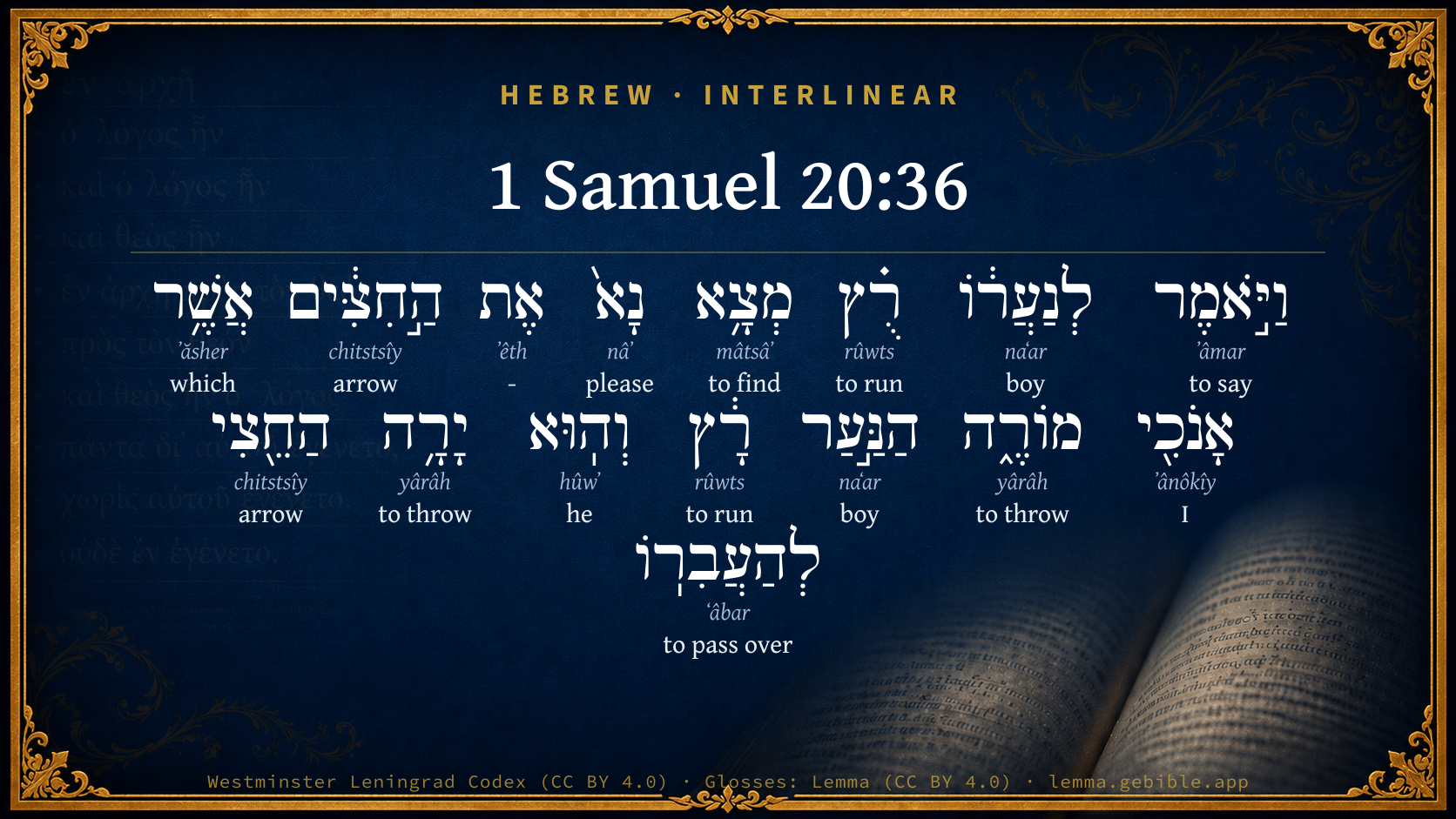
  1. וַיֹּ֣אמֶר ʼâmar H559 “and · to say” Conjunction + Verb, Qal, Sequential Imperfect, 3rd Person, Masculine, Singular
  2. לְנַעֲר֔וֹ naʻar H5288 “to/for · boy · his” Preposition + Noun, Common, Masculine, Singular, Construct + Suffix, Personal, 3rd Person, Masculine, Singular
  3. רֻ֗ץ rûwts H7323 “run” Verb, Qal, Imperative, 2nd Person, Masculine, Singular
  4. מְצָ֥א mâtsâʼ H4672 “find” Verb, Qal, Imperative, 2nd Person, Masculine, Singular
  5. נָא֙ nâʼ H4994 “please” Particle, Exhortation
  6. אֶת ʼêth H853 “-” Particle, Direct Object
  7. אֲשֶׁ֥ר ʼăsher H834 “which” Particle, Relative
  8. אָנֹכִ֖י ʼânôkîy H595 “I” Pronoun, Personal, 1st Person, Common, Singular
  9. מוֹרֶ֑ה yârâh H3384 “throwing” Verb, Hiphil, Participle Active, Masculine, Singular, Absolute
  10. הַנַּ֣עַר naʻar H5288 “the · boy” Particle, Definite Article + Noun, Common, Masculine, Singular, Absolute
  11. רָ֔ץ rûwts H7323 “to run” Verb, Qal, Perfect, 3rd Person, Masculine, Singular
  12. וְהֽוּא hûwʼ H1931 “and · he” Conjunction + Pronoun, Personal, 3rd Person, Masculine, Singular
  13. יָרָ֥ה yârâh H3384 “to throw” Verb, Qal, Perfect, 3rd Person, Masculine, Singular
  14. הַחֵ֖צִי chitstsîy H2678 “the · arrow” Particle, Definite Article + Noun, Common, Masculine, Singular, Absolute
  15. לְהַעֲבִרֽוֹ ʻâbar H5674 “to pass over · him” Preposition + Verb, Hiphil, Infinitive Construct + Suffix, Personal, 3rd Person, Masculine, Singular

About this verse

These counts appear in no published source. They are computed here, from the morphology-tagged text and Lemma’s own curated glosses. What Lemma adds →

16
words
12
distinct lemmas
Historical
section

Notable vocabulary

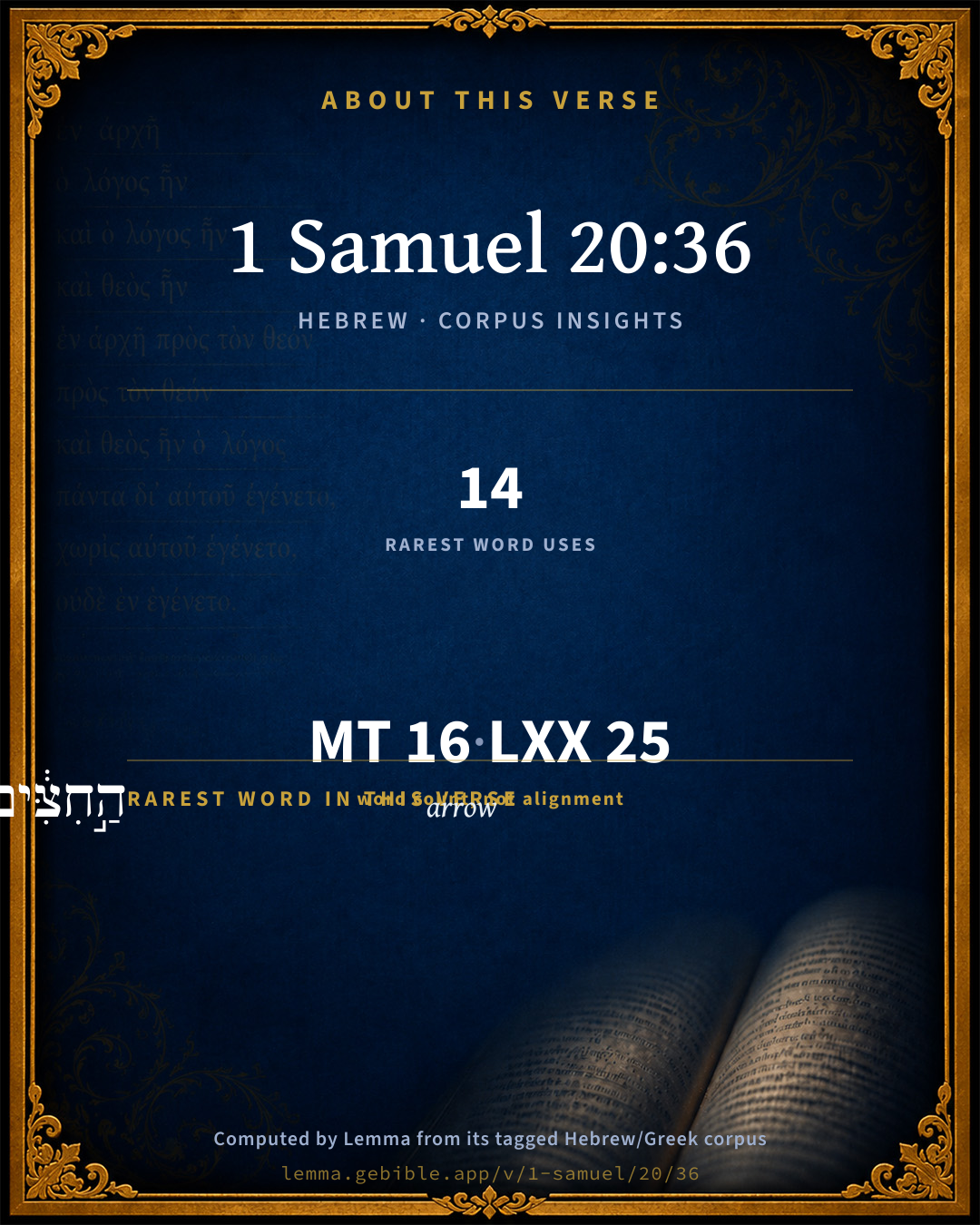
The rarest word here is הַ֣חִצִּ֔ים arrow H2678 — appearing just 14 times in the whole Hebrew Bible.

Shared distinctive vocabulary

הַ֣חִצִּ֔ים arrow H2678 occurs in 10 verses of the Hebrew Bible. Also found in:

Grammatical profile

  • 7 verbs
  • 4 nouns
  • 2 pronouns
  • 3 particles

Verb forms

  • וַיֹּ֣אמֶר Qal · Sequential Imperfect
  • רֻ֗ץ Qal · Imperative
  • מְצָ֥א Qal · Imperative
  • מוֹרֶ֑ה Hiphil · Participle Active
  • רָ֔ץ Qal · Perfect
  • יָרָ֥ה Qal · Perfect
  • לְהַעֲבִרֽוֹ Hiphil · Infinitive Construct

Repetition

Words recur within this verse — often emphatic in Hebrew:

  • לְנַעֲר֔וֹ boy H5288 ×2
  • רֻ֗ץ to run H7323 ×2
  • הַ֣חִצִּ֔ים arrow H2678 ×2
  • מוֹרֶ֑ה to throw H3384 ×2

Hebrew & Septuagint length

In English translation the verse runs 23 words from the Hebrew and 28 from the Septuagint (LXX English) — closely comparable.

A rough comparison of the two English renderings, which tokenize alike — not a word-level alignment.

Word counts can differ between the Hebrew and the Greek without any difference in meaning — e.g. the Hebrew direct-object marker אֵת has no separate Greek word, and Greek often adds the article ὁ.

In the original languages it is 16 Hebrew tokens and 25 Greek tokens — but the two are counted differently (Hebrew bundles its prefixes and suffixes into one token; the Greek is in lemma form), so that isn’t a like-for-like length.

Cross-references

1

Topical passages linked to 1 Samuel 20:36 in the Treasury of Scripture Knowledge — connected by theme and wording, ordered by reader-vote popularity; previews shown in the World English Bible.

Cross-references courtesy of OpenBible.info (CC BY 4.0).

Hebrew and Greek witnesses Masoretic Hebrew ↔ Greek Septuagint

The same verse in the two great witnesses to the Old Testament, shown verse-for-verse.

These are two independent witnesses, not word-aligned to each other, and the Septuagint is shown in lemma (dictionary) form.

Hebrew 1 Samuel 20:36 Masoretic · Westminster Leningrad Codex

וַיֹּ֣אמֶר לְנַעֲר֔וֹ רֻ֗ץ מְצָ֥א נָא֙ אֶת הַ֣חִצִּ֔ים אֲשֶׁ֥ר אָנֹכִ֖י מוֹרֶ֑ה הַנַּ֣עַר רָ֔ץ וְהֽוּא יָרָ֥ה הַחֵ֖צִי לְהַעֲבִרֽוֹ

He said to his boy, Run, find now the arrows which I shoot. As the boy ran, he shot an arrow beyond him.

World English Bible · Public Domain

Greek LXX 1 Samuel 20:36 Septuagint · lemma form

καί εἶπον ὁ παιδάριον τρέχω εὑρίσκω ἐγώ ὁ σχίζα ἐν ὅς ἐγώ ἀκοντίζω καί ὁ παιδάριον τρέχω καί αὐτός ἀκοντίζω ὁ σχίζα καί παραἄγω αὐτός

And he said to the boy, Run, find me the arrows which I shoot: and the boy ran, and Jonathan shot an arrow, and sent it beyond him.

LXX2012 (modern English Septuagint) · Public Domain

Hebrew: Westminster Leningrad Codex (CC BY 4.0). Greek: Septuagint (public domain); English from LXX2012 (modern English Septuagint) (Public Domain). How the Septuagint differs from the Hebrew →

Targum (Aramaic paraphrase)

1

The Targum is the ancient Jewish Aramaic paraphrase of the Hebrew Scriptures — an interpretive translation, not the Hebrew text itself. Onkelos (literal) and Pseudo-Jonathan (expansive) render the Torah, and Jonathan the Prophets. Coverage is partial: where no permissively-licensed English translation exists for a verse, only the Aramaic is shown. This is verse-level text, not a word-by-word alignment to the Hebrew.

  1. Targum Jonathan Prophets (Joshua–Malachi)
    וַאֲמַר לְעוּלֵימֵיהּ רְהַט אַיְתָא כְעַן יַת גִירַיָא דַאֲנָא שְׁדִי וְעוּלֵמָא רְהַט וְהוּא שְׁדָא גִירָא לְאַעְבָּרוּתֵיהּ:

    (no public-domain English translation for this verse)

    Targum Jonathan — Aramaic: “Mikraot Gedolot” (public domain). English: “Sefaria Community Translation” (CC0 1.0 (public-domain dedication)); “London "Chaldee Paraphrase," 1871” (public domain). Text via Sefaria.

Commentary

Notes on 1 Samuel 20:36 from classic Christian and Jewish commentators (each source and its license shown beneath its notes). The classic Christian expositions comment on the surrounding passage and are grouped to its opening verse, so a note may address several verses; the Jewish commentaries on the Tanakh (Rashi and others) are per-verse, so they appear only where the commentator wrote on this verse.

Lemma curates 59 commentaries, every one of them public domain or Creative Commons licensed, each selected and text-cleaned for this edition rather than reprinted as found. About our sources →

Trapp's Complete Commentary

John Trapp

1Sa 20:36 And he said unto his lad, Run, find out now the arrows which I shoot. [And] as the lad ran, he shot an arrow beyond him.

Ver. 36. He shot an arrow beyond him.] God also shoots sometimes sharp arrows at his children, yet not to wound them, but to warn them that the will of Saul - the devil - is their utter destruction.

John Trapp, A Commentary or Exposition upon All the Books of the Old and New Testament (1647–1656) — public domain. Text from a community e-Sword module.

Jamieson, Fausset & Brown

Robert Jamieson, A. R. Fausset & David Brown

he said unto his lad, Run, find out now the arrows which I shoot--The direction given aloud to the attendant was the signal preconcerted with David. It implied danger.

Jamieson, Fausset & Brown — Commentary Critical and Explanatory on the Whole Bible (1871) — public domain (CC PDM 1.0). Text via the HelloAO Bible API.

Ellicott's Commentary for English Readers

(36) He shot an arrow beyond him.—This was the sign agreed on if all was over for David at the court of Saul. Expositors are in a little difficulty, though, here, as only one arrow is mentioned, whereas “three” had to be shot according to the terms of the understanding. We cannot imagine, as some have suggested, that “Jonathan shortened the affair, and shot only once, considering that there was danger in delay,” and that every moment was of consequence; had there been such need of haste, the parting scene would have been cut even shorter. It is better, with Keil, to assume that the “singular” here stands in an indefinite general way, the author not thinking it needful, after what he had before said, to state that Jonathan shot three arrows one after another.

A Bible Commentary for English Readers, edited by Charles John Ellicott (1878–1897) — public domain. Text from a community e-Sword module.

John Gill's Exposition

And he said unto his lad, run, find out now the arrows which I shoot,.... He no doubt told him the mark which he should shoot at, the stone Ezel, and bid him look out about that for them:

and as the lad ran; before he had got to the mark:

he shot an arrow beyond him: or it; beyond the lad, or beyond the mark he shot at; purposely shooting with great strength, that he might exceed, and thereby give notice to David how things stood, which was the sign agreed on.

John Gill's Exposition of the Whole Bible (1746–1763) — public domain (CC PDM 1.0). Text via the HelloAO Bible API.

Haydock's Catholic Bible Commentary

Another. The Hebrew, &c., do not express this distinctly; (Calmet) but we find, ver. 38, "the lad gathered up the arrows."

George Leo Haydock (1774–1849), Haydock's Catholic Family Bible and Commentary, 1859 edition — public domain. Excludes Psalms (Douay-Rheims chapter numbering differs from Protestant) and Deuterocanonical books (Catholic canon only).

Rashi

Rabbi Shlomo Yitzchaki (Rashi)

Beyond him. The arrow went beyond the lad.

Rashi on the Tanakh — English translations: “The Judaica Press complete Tanach with Rashi, translated by A. J. Rosenberg” (CC BY 4.0); “Pentateuch with Rashi's commentary by M. Rosenbaum and A.M. Silbermann, 1929-1934” (public domain); “The Metsudah Tanach series, Lakewood, N.J” (CC BY 4.0); and “The Book of Joshua, Metsudah Publications, 1997” (CC BY 4.0). Text via Sefaria.

Lesson kit

Teaching starters — assembled from the data on this page, not authored interpretation. Every prompt links to the verse data it draws on. Edit before teaching.

1 Samuel, in the Historical, opens this verse with 16 words (12 distinct Hebrew lemmas). Its most distinctive word is chitstsîy (“arrow”). A historical commentator’s framing appears above. Read the whole chapter for the surrounding context.

Discussion questions

  1. How does “arrow” (chitstsîy) shape what this verse is saying?
  2. How does 1 Samuel 20:20, which shares the word «arrow», read alongside this verse?
  3. What does the repetition of “boy” (2× in this one verse) do in this verse?
  4. These translations render this verse differently; the difference is in the English rendering, not the original. What questions does that raise?
  5. «וַיֹּ֣אמֶר» is a Qal Sequential Imperfect verb. How does that grammatical form shape the action described?
  6. Compare how Trapp's Complete Commentary and Jamieson, Fausset & Brown read this verse. Where do they agree or differ?

Things to notice

Reading settings

Reading text

Shown beneath each verse's original-language words.

Old Testament
Old Testament edition

Read the OT as the Masoretic Hebrew (MT) or the Greek Septuagint (LXX).

English shown for the Greek Septuagint (in the Hebrew ↔ Greek comparison).

Comparing translations? Open the Compare panel on any verse page to stack up to four side by side.