2 Samuel 2:14

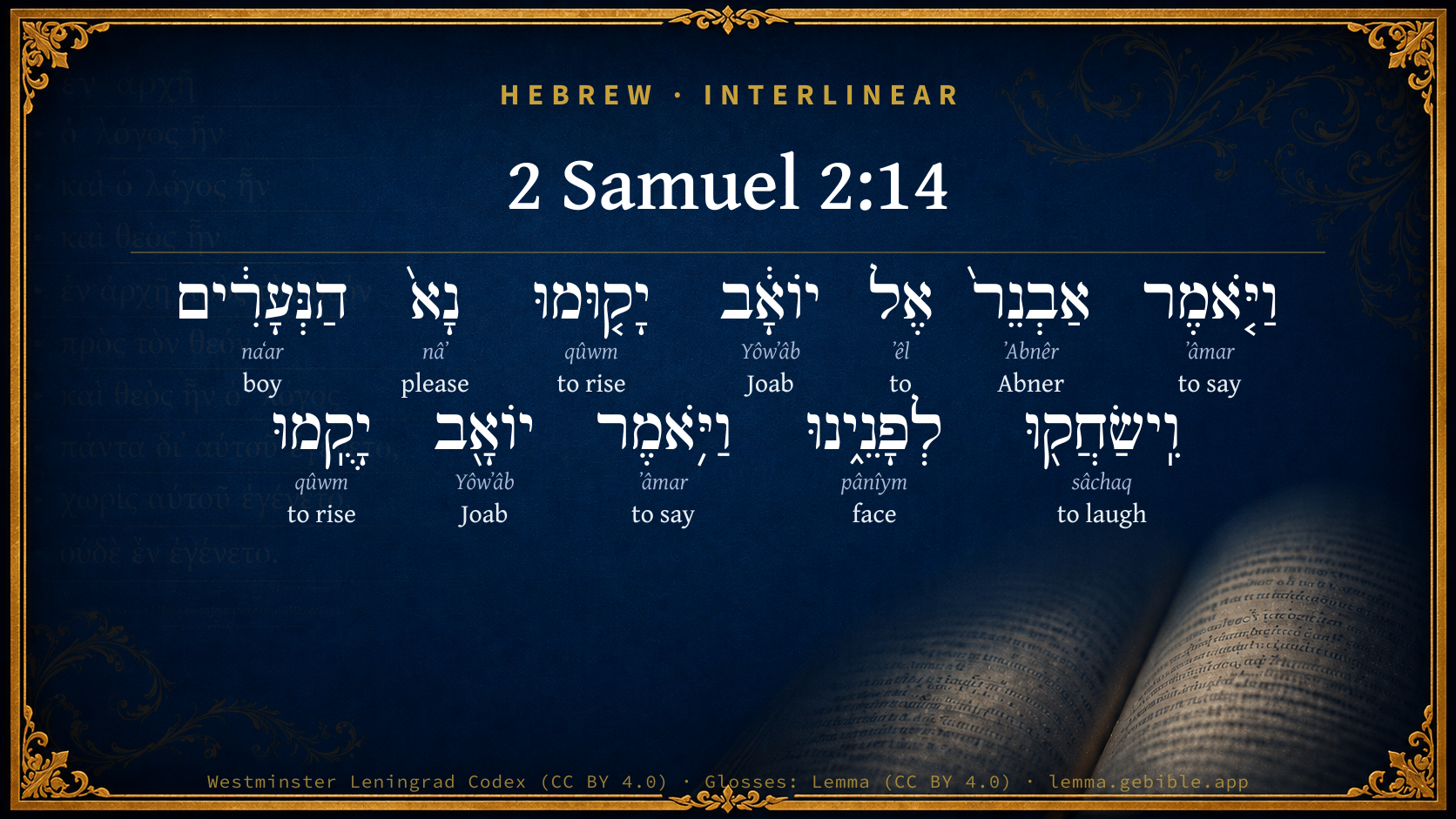
Hebrew (Westminster Leningrad Codex) 2 Samuel 2:14 appears in the Hebrew Old Testament. The text above is from the Westminster Leningrad Codex. Each word links to its Strong’s number, a concise gloss, and parsing drawn from the Open Scriptures Hebrew Bible morphology. Click any word for its full Brown-Driver-Briggs (BDB) entry.
Download image
Cite this verse

2 Samuel 2:14 (World English Bible). Public Domain. Lemma interlinear Bible study tool, https://lemma.gebible.app/v/2-samuel/2/14.

Show BibTeX & RIS
BibTeX
RIS
English Translation
Abner said to Joab, Please let the young men arise and play before us. Joab said, Let them arise.
World English Bible · Public Domain
Download a study sheet

One document with this verse’s original text, its word-by-word gloss line, the meaning frame, cross-references with their text, attributed commentary, and full source and license credits — printable, and it pastes into notes with its structure intact.

This verse Autodidact and up

Study sheet (.html) Plain text (.txt)

A passage Seminary Student

Up to 50 verses in one chapter. A passage sheet keeps up to 6 commentary sources and 12 cross-references per verse, in the order this page ranks them, and says so on the sheet whenever that leaves anything out. Ask for a single verse and you get the Autodidact verse sheet above.

Everything on this page stays free to read, with no account — the sheet is a download of what is already on screen, not access to it.

Want to remove ads? Support Godless Engineer
Compare translations 3

The same verse in 3 English versions, stacked beneath the original-language interlinear above. Click any original word for its lexicon entry.

Each is an independent rendering of the whole verse — the interlinear is not word-aligned to these translations.

Highlighted words mark where these versions differ — a whole-verse word diff, not a word-by-word alignment.

  • World English Bible Public Domain
    Abner said to Joab, Please let the young men arise and play before us. Joab said, Let them arise.
  • King James Version Public Domain
    And Abner said to Joab, Let the young men now arise, and play before us. And Joab said, Let them arise.
  • unfoldingWord Literal Text CC BY-SA 4.0
    Then Abner said to Joab, “May the young men now arise and play to our faces.” And Joab said, “May they arise.”

unfoldingWord Literal Text — © unfoldingWord, licensed CC BY-SA 4.0. Word-aligned USFM3 via Door43 (git.door43.org/unfoldingWord/en_ult).

Versions to compare (up to 4)

3 of 4 selected

Show all 18 translations

Every available English version of this verse, each an independent rendering of the whole verse.

  • World English Bible Public Domain
    Abner said to Joab, Please let the young men arise and play before us. Joab said, Let them arise.
  • Berean Standard Bible Public Domain
    Then Abner said to Joab, “Let us have the young men get up and compete before us.” “Let them get up,” Joab replied.
  • Majority Standard Bible Public Domain
    Then Abner said to Joab, “Let us have the young men get up and compete before us.” “Let them get up,” Joab replied.
  • King James Version Public Domain
    And Abner said to Joab, Let the young men now arise, and play before us. And Joab said, Let them arise.
  • American Standard Version (1901) Public Domain
    And Abner said to Joab, Let the young men, I pray thee, arise and play before us. And Joab said, Let them arise.
  • Revised Version (1885) Public Domain
    And Abner said to Joab, Let the young men, I pray thee, arise and play before us. And Joab said, Let them arise.
  • Geneva Bible (1599) Public Domain
    Then Abner saide to Ioab, Let the yong men nowe arise, and play before vs. And Ioab said, Let them arise.
  • Douay-Rheims (1899) Public Domain
    And Abner said to Joab: Let the young men rise, and play before us. And Joab answered: Let them rise.
  • Young's Literal Translation Public Domain
    And Abner saith unto Joab, `Let the youths rise, I pray thee, and they play before us;' and Joab saith, `Let them rise.'
  • Literal Standard Version CC BY-SA 4.0
    And Abner says to Joab, “Now let the youths rise and they play before us”; and Joab says, “Let them rise.”
  • Unlocked Literal Bible CC BY-SA 4.0
    Abner said to Joab, “Let the young men arise and compete before us.” Then Joab said, “Let them arise.”
  • unfoldingWord Literal Text CC BY-SA 4.0
    Then Abner said to Joab, “May the young men now arise and play to our faces.” And Joab said, “May they arise.”
  • Darby Bible Public Domain
    And Abner said to Joab, Let the young men now arise and make sport before us. And Joab said, Let them arise.
  • World Messianic Bible Public Domain
    Abner said to Joab, “Please let the young men arise and compete before us!” Joab said, “Let them arise!”
  • Webster's Bible Public Domain
    And Abner said to Joab, Let the young men now arise, and play before us. And Joab said, Let them arise.
  • Free Bible Version CC BY-SA 4.0
    Abner said to Joab, “Let's have some of the men fight in hand-to-hand combat before us.” “Fine,” Joab agreed.
  • Bible in Basic English Public Domain
    And Abner said to Joab, Let the young men give a test of their strength before us. And Joab said, Let them do so.
  • JPS Tanakh (1917) Public Domain
    And Abner said to Joab: 'Let the young men, I pray thee, arise and play before us.' And Joab said: 'Let them arise.'

Literal Standard Version (2020), Covenant Press — licensed CC BY-SA 4.0. Text via the HelloAO Bible API (eBible.org). Unlocked Literal Bible (unfoldingWord) — licensed CC BY-SA 4.0. Text via the HelloAO Bible API (eBible.org). unfoldingWord Literal Text — © unfoldingWord, licensed CC BY-SA 4.0. Word-aligned USFM3 via Door43 (git.door43.org/unfoldingWord/en_ult). Free Bible Version, Dr. Jonathan Gallagher — licensed CC BY-SA 4.0. Text via the HelloAO Bible API (eBible.org).

Word by word

More ways to search: Search by grammar → Find every occurrence → Compare this word →

Practice this passage: Drill this verse → Learn its vocabulary →

וִֽישַׂחֲק֖וּ
sâchaq
H7832
“and · to laugh”
Conjunction + Verb, Piel, Imperfect, 3rd Person, Masculine, Plural
Part of Speech
Conjunction + Verb
Stem
Piel
Form
Imperfect
Person
3rd Person
Gender
Masculine
Number
Plural
Full BDB Definition

Origin: a primitive root

TWOT: 1905c

to laugh, play, mock - (Qal) - to laugh (usually in contempt or derision) - to sport, play - (Piel) - to make sport - to jest - to play (including instrumental music, singing, dancing) - (Hiphil) to laugh mockingly
  1. וַיֹּ֤אמֶר ʼâmar H559 “and · to say” Conjunction + Verb, Qal, Sequential Imperfect, 3rd Person, Masculine, Singular
  2. אַבְנֵר֙ ʼAbnêr H74 “Abner” Noun, Proper
  3. אֶל ʼêl H413 “to” Preposition
  4. יוֹאָ֔ב Yôwʼâb H3097 “Joab” Noun, Proper
  5. יָק֤וּמוּ qûwm H6965 “to rise” Verb, Qal, Jussive, 3rd Person, Masculine, Plural
  6. נָא֙ nâʼ H4994 “please” Particle, Exhortation
  7. הַנְּעָרִ֔ים naʻar H5288 “the · boys” Particle, Definite Article + Noun, Common, Masculine, Plural, Absolute
  8. לְפָנֵ֑ינוּ pânîym H6440 “to/for · face(s) · our” Preposition + Noun, Common, Both, Plural, Construct + Suffix, Personal, 1st Person, Common, Plural
  9. וַיֹּ֥אמֶר ʼâmar H559 “and · to say” Conjunction + Verb, Qal, Sequential Imperfect, 3rd Person, Masculine, Singular
  10. יוֹאָ֖ב Yôwʼâb H3097 “Joab” Noun, Proper
  11. יָקֻֽמוּ qûwm H6965 “to rise” Verb, Qal, Jussive, 3rd Person, Masculine, Plural

About this verse

These counts appear in no published source. They are computed here, from the morphology-tagged text and Lemma’s own curated glosses. What Lemma adds →

12
words
9
distinct lemmas
Historical
section

Shared distinctive vocabulary

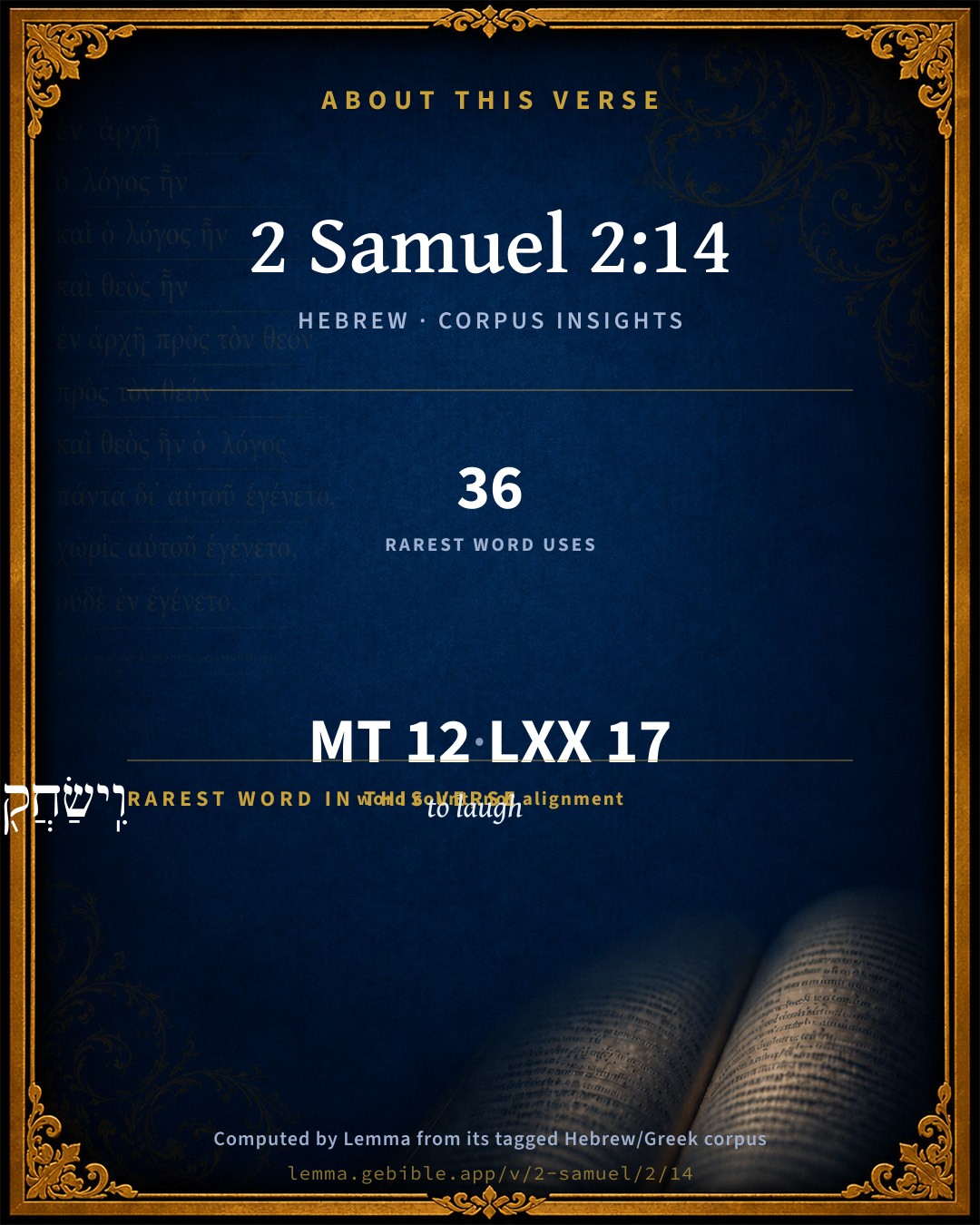
וִֽישַׂחֲק֖וּ to laugh H7832 occurs in 36 verses of the Hebrew Bible. Also found in:

Grammatical profile

  • 5 verbs
  • 5 nouns
  • 1 preposition
  • 1 particle

Verb forms

  • וַיֹּ֤אמֶר Qal · Sequential Imperfect
  • יָק֤וּמוּ Qal · Jussive
  • וִֽישַׂחֲק֖וּ Piel · Imperfect
  • וַיֹּ֥אמֶר Qal · Sequential Imperfect
  • יָקֻֽמוּ Qal · Jussive

Repetition

Words recur within this verse — often emphatic in Hebrew:

  • וַיֹּ֤אמֶר to say H559 ×2
  • יוֹאָ֔ב Joab H3097 ×2
  • יָק֤וּמוּ to rise H6965 ×2

Hebrew & Septuagint length

In English translation the verse runs 19 words from the Hebrew and 21 from the Septuagint (LXX English) — closely comparable.

A rough comparison of the two English renderings, which tokenize alike — not a word-level alignment.

Word counts can differ between the Hebrew and the Greek without any difference in meaning — e.g. the Hebrew direct-object marker אֵת has no separate Greek word, and Greek often adds the article ὁ.

In the original languages it is 12 Hebrew tokens and 17 Greek tokens — but the two are counted differently (Hebrew bundles its prefixes and suffixes into one token; the Greek is in lemma form), so that isn’t a like-for-like length.

Cross-references

7

Topical passages linked to 2 Samuel 2:14 in the Treasury of Scripture Knowledge — connected by theme and wording, ordered by reader-vote popularity; previews shown in the World English Bible.

  • 2 Samuel 2:17 The battle was very severe that day: and Abner was beaten, and the men of Israel, before the servants of David.
  • 2 Samuel 2:26–27 Then Abner called to Joab, and said, "Shall the sword devour forever? Don't you know that it will be bitterness in the latter end? How long shall it be then, before you bid the people return from following their brothers?"
  • Proverbs 10:23 It is a fool's pleasure to do wickedness, But wisdom is a man of understanding's pleasure.
  • Proverbs 17:14 The beginning of strife is like breaching a dam, Therefore stop contention before quarreling breaks out.
  • Proverbs 20:18 Plans are established by advice; By wise guidance you wage war!
  • Proverbs 25:8 Don't be hasty in bringing charges to court. What will you do in the end when your neighbor shames you?
  • Proverbs 26:18–19 Like a madman who shoots firebrands, arrows, and death,

Cross-references courtesy of OpenBible.info (CC BY 4.0).

Hebrew and Greek witnesses Masoretic Hebrew ↔ Greek Septuagint

The same verse in the two great witnesses to the Old Testament, shown verse-for-verse.

These are two independent witnesses, not word-aligned to each other, and the Septuagint is shown in lemma (dictionary) form.

Hebrew 2 Samuel 2:14 Masoretic · Westminster Leningrad Codex

וַיֹּ֤אמֶר אַבְנֵר֙ אֶל יוֹאָ֔ב יָק֤וּמוּ נָא֙ הַנְּעָרִ֔ים וִֽישַׂחֲק֖וּ לְפָנֵ֑ינוּ וַיֹּ֥אמֶר יוֹאָ֖ב יָקֻֽמוּ

Abner said to Joab, Please let the young men arise and play before us. Joab said, Let them arise.

World English Bible · Public Domain

Greek LXX 2 Samuel 2:14 Septuagint · lemma form

καί εἶπον αβεννερ πρός ιωαβ ἀναἵστημι δή ὁ παιδάριον καί παίζω ἐνώπιον ἐγώ καί εἶπον ιωαβ ἀναἵστημι

And Abenner said to Joab, Let now the young men arise, and play before us. And Joab said, Let them arise.

LXX2012 (modern English Septuagint) · Public Domain

On this verse, Keil & Delitzsch discusses the Septuagint’s reading. Read the note in Commentary ↓

Hebrew: Westminster Leningrad Codex (CC BY 4.0). Greek: Septuagint (public domain); English from LXX2012 (modern English Septuagint) (Public Domain). How the Septuagint differs from the Hebrew →

Targum (Aramaic paraphrase)

1

The Targum is the ancient Jewish Aramaic paraphrase of the Hebrew Scriptures — an interpretive translation, not the Hebrew text itself. Onkelos (literal) and Pseudo-Jonathan (expansive) render the Torah, and Jonathan the Prophets. Coverage is partial: where no permissively-licensed English translation exists for a verse, only the Aramaic is shown. This is verse-level text, not a word-by-word alignment to the Hebrew.

  1. Targum Jonathan Prophets (Joshua–Malachi)
    וַאֲמַר אַבְנֵר לְיוֹאָב יְקוּמוּן כְּעַן עוּלֵימַיָא וִיחַיְיכוּן קֳדָמָנָא וַאֲמַר יוֹאָב יְקוּמוּן:

    (no public-domain English translation for this verse)

    Targum Jonathan — Aramaic: “Mikraot Gedolot” (public domain). English: “Sefaria Community Translation” (CC0 1.0 (public-domain dedication)); “London "Chaldee Paraphrase," 1871” (public domain). Text via Sefaria.

Commentary

Notes on 2 Samuel 2:14 from classic Christian and Jewish commentators (each source and its license shown beneath its notes). The classic Christian expositions comment on the surrounding passage and are grouped to its opening verse, so a note may address several verses; the Jewish commentaries on the Tanakh (Rashi and others) are per-verse, so they appear only where the commentator wrote on this verse.

Lemma curates 59 commentaries, every one of them public domain or Creative Commons licensed, each selected and text-cleaned for this edition rather than reprinted as found. About our sources →

Trapp's Complete Commentary

John Trapp

2Sa 2:14 And Abner said to Joab, Let the young men now arise, and play before us. And Joab said, Let them arise.

Ver. 14. Let the young men now arise, and play before us,] i.e., Spectaculi causa pugnent, let them hack and hew one another, to make us sport; as the sword players did among the Romans, till good Theodosius forbade that bloody pastime, as hateful to God, and abhorred of all good men. At the taking of Tripolis in Barbary, the Turks, having in their hands one John de Chabis, a Frenchman, brought him into the town, and when they had cut off his hands and his nose, put him quick into the ground to the waist, and there, for their pleasure, shot at him with their arrows; and afterwards cut his throat. {a} The Spaniards day by day, for their pleasure, whip the poor Indians with cords, and drop their naked bodies with burning bacon; this being one of the least cruelties they exercise upon those wretches, to make themselves merry in the others’ misery.

Let them arise.] Joab was true touch, as they call it, and soon accepted the challenge: but better he had not; for the issue was bloody. Many martialists, fleshed with such horrid acts and aspects, make little reckoning of bloodshed. O formosum spectaculum! Oh, brave sight! said Hannibal, when he saw a pit full of men’s blood. O rem regiam! Oh, kingly act! said Valesus, when he had slain three hundred men.

{a} Turk. Hist., p. 756.

John Trapp, A Commentary or Exposition upon All the Books of the Old and New Testament (1647–1656) — public domain. Text from a community e-Sword module.

Joseph Benson's Commentary

2Sa 2:14. Abner said, Let the young men now arise, and play before us — That is, show their prowess and dexterity in fighting together, or make trial of their courage and strength, that we may see which of us has the braver soldiers. He speaks like a vain-glorious and cruel man, and a soldier of fortune, that esteemed it a sport to see men wounding and killing one another. So this he designed, partly for their mutual recreation, and trial of skill; and partly, that by this occasion they might be engaged in a battle. But he is unworthy the name of a man who is thus prodigal of human blood.

Joseph Benson's Commentary on the Old and New Testaments (1811–1818) — public domain. Text from a community e-Sword module.

Tyndale Open Study Notes

Tyndale Open Resources

2:14 a few of our warriors: In the ancient world, enemy armies would sometimes choose individuals or small groups to fight each other as representative gladiators—a custom often referred to as champion warfare (see also 1 Sam 17). • fight hand to hand: The Hebrew term usually includes a component of play. A contest of champions might have been seen as a type of high-stakes game. In this instance, it settled nothing; the fighting expanded into a much wider confrontation with heavier casualties (2 Sam 2:17-32).

Tyndale Open Study Notes — © Tyndale Open Resources, licensed CC BY-SA 4.0. Text via the HelloAO Bible API.

Geneva Bible (1599)

Geneva Bible translators

Let us see how they can handle their Weapons.

Geneva Bible (1599) marginal notes — public domain. Text via Bolls.life.

Jamieson, Fausset & Brown

Robert Jamieson, A. R. Fausset & David Brown

Abner said to Joab, Let the young men now arise, and play before us--Some think that the proposal was only for an exhibition of a little tilting match for diversion. Others suppose that, both parties being reluctant to commence a civil war, Abner proposed to leave the contest to the decision of twelve picked men on either side. This fight by championship instead of terminating the matter, inflamed the fiercest passions of the two rival parties; a general engagement ensued, in which Abner and his forces were defeated and put to flight.

Jamieson, Fausset & Brown — Commentary Critical and Explanatory on the Whole Bible (1871) — public domain (CC PDM 1.0). Text via the HelloAO Bible API.

Adam Clarke's Commentary

Verse 14. Let the young men - play before us.] This was diabolical play, where each man thrust his sword into the body of the other, so that the twenty-four (twelve on each side) fell down dead together! But this was the signal for that sanguinary skirmish which immediately took place.

Adam Clarke's Commentary on the Bible (1810–1826) — public domain. Text from a community e-Sword/MySword module.

Ellicott's Commentary for English Readers

(14) Let the young men.—To avoid unnecessary bloodshed between the tribes of a common parentage, and also, perhaps, to prevent the weakening of the nation in the face of their common Philistine foe, Abner proposes that the struggle should be decided by a combat between a few champions chosen on either side, and Joab immediately accepts the proposal. Hervey (Speaker’s Commentary) aptly compares this combat to that of the Horatii and Curiatii, under strikingly similar circumstances and with similar results, as described by Livy (I., 100 10:25).

A Bible Commentary for English Readers, edited by Charles John Ellicott (1878–1897) — public domain. Text from a community e-Sword module.

The Cambridge Bible for Schools and Colleges

gen. ed. J. J. S. Perowne

14. Let the young men now arise] “Young men” here means “servants” or “soldiers.” Cp. ch. 2Sa_4:12. Desirous to avoid the horrors of a civil war, which would weaken the whole nation in the face of its common enemy the Philistines, perhaps also prompted by friendly relations with Joab, Abner proposes to decide the day by a combat between two bodies of picked men. The combat of the Horatii and Curiatii, which decided the war between Alba and Rome, affords a parallel in classical story. Livy represents the Alban dictator, Mettius Fuffetius, as urging this plan of ending the war, lest both nations, weakened by the losses of a general battle, should fall into the hands of their common enemy the Etruscans. See Livy I. 23–25.

and play before us] The word “play” is used euphemistically in reference to fighting. There is no indication that a bloodless tournament was intended. Livy calls the combat above referred to “minime gratum spectaculum,” “an exhibition which was by no means an amusement.”

The Cambridge Bible for Schools and Colleges (gen. ed. J. J. S. Perowne; Cambridge University Press, 1878–1918) — public domain. Text from a community e-Sword module.

John Gill's Exposition

And Abner said to Joab,.... Perceiving he made no motion towards an engagement with him, his orders from David being only to act on the defensive, and avoid as much as possible the effusion of blood:

let the young men now arise, and play before us; with their swords after the manner of gladiators or duellers; that it might appear who were best skilled in the use of the sword, and who were the bravest, stoutest, and most courageous; and this he proposed in a way of bravado, and in order to bring on a battle, or to decide the quarrel between them; and this bloody barbarous exercise Abner calls play, as if it was a diversion and pastime to see men wounding and killing one another:

and Joab said, let them arise; he accepted the challenge, not caring to be hectored and bullied by Abner.

John Gill's Exposition of the Whole Bible (1746–1763) — public domain (CC PDM 1.0). Text via the HelloAO Bible API.

Albert Barnes' Notes on the Bible

Play - (Compare Jdg 16:25; 1Sa 18:7). Here, the word is applied to the serious game of war, to be played by twelve combatants on each side, with the two armies for spectators.

Albert Barnes' Notes on the Bible (1834–1885) — public domain. Text from a community e-Sword/MySword module.

Haydock's Catholic Bible Commentary

Play, like the gladiators with drawn swords, which formed one of the principal diversions at Rome, (Calmet) while it was pagan. This might be considered as a prelude to the ensuing engagement; or like a detachment of twelve on each side, fighting to shew the prowess of their respective armies; as the three Horatii and Curiatii did afterwards, to spare the effusion of blood. But there is no mention that Abner and Joab had authority to agree that these champions should decide the fate of the two kingdoms, (Haydock) whence they are generally accused of ostentation; though the soldiers, not being acquainted with their motives, were obliged to obey. (Tirinus; Menochius)

George Leo Haydock (1774–1849), Haydock's Catholic Family Bible and Commentary, 1859 edition — public domain. Excludes Psalms (Douay-Rheims chapter numbering differs from Protestant) and Deuterocanonical books (Catholic canon only).

Matthew Poole's English Annotations

Abner trusting to his greater numbers, offers battle.

Play before us, i.e. show their prowess and dexterity in managing their weapons, and fighting together. He speaks like a vain-glorious and cruel man, and a soldier of fortune, that esteemed it a sport to see men wounding and killing one another. So this he designed, partly for their mutual recreation, and trial of skill and valour; and partly that by this occasion they might be engaged in a battle.

Matthew Poole's English Annotations on the Holy Bible (1683–1685) — public domain. Text from a community e-Sword/MySword module.

Whedon's Commentary on the Bible

Daniel D. Whedon

14. Let the young men now arise, and play before us — Implying that the contest between the house of Saul and the house of David should be decided by this action of the young warriors. This would save a needless effusion of blood, and Joab accepted the challenge. שׂחק, to play, would thus mean the war play of single combat, and the bloody consequences showed that this was the understanding of the contending parties.

Daniel D. Whedon (gen. ed.), Commentary on the Old and New Testaments (1874–1909) — public domain. Text from a community e-Sword module.

The Pulpit Commentary

Let the young men now arise. "Now" is not an adverb of time, but is hortative, and therefore rightly translated in the Revised Version, "I pray thee." It is by no means certain that Abner meant that this single combat should decide the war; for similar preludes before a battle are not uncommon among the Arabians, and serve, as this did, to put an end to the mutual unwillingness to begin the onslaught. So, too, games often preceded outbreaks of Scandinavian blood feuds. And this was probably Abner"s object. He was the assailant, but now found that his men shrank from mortal combat with their brethren. There is thus no comparison between this combat and that of the Curiatii and Horatii described in Livy, 1. 10:25. Let them play. The word is grim enough, though intended to gloss over the cruel reality. On each side twelve of the most skilful champions were to be selected, who were to fight in stern earnest with one another, while the rest gazed upon the fierce spectacle. The sight of the conflict would whet their appetite for blood, and their reluctance would give place to thirst for revenge. The request was too thoroughly in accordance with Joab"s temper for him to refuse, and his immediate answer was, Let them arise.

The Pulpit Commentary (1880–1919), ed. H.D.M. Spence-Jones & Joseph S. Exell — public domain. Text from a community e-Sword module.

John Wesley's Explanatory Notes

And play - That is, shew their prowess and dexterity in fighting together. He speaks like a vain-glorious and cruel man, and a soldier of fortune, that esteemed it a sport to see men wounding and killing one another. So this he designed, partly for their mutual recreation and trial of skill; and partly, that by this occasion they might be engaged in a battle. But he is unworthy the name of a man, who is thus prodigal of human blood.

John Wesley, Explanatory Notes Upon the Whole Bible (1754–1765) — public domain. Text via the GEBible commentary corpus.

Keil & Delitzsch

C. F. Keil & F. Delitzsch

Abner then proposed to Joab that the contest should be decided by a single combat, probably for the purpose of avoiding an actual civil war. "Let the young men arise and wrestle before us." שׂחק, to joke or play, is used here to denote the war-play of single combat. As Joab accepted this proposal, twelve young warriors for Benjamin and Ishbosheth, and twelve from David's men, went over, i.e., went out of the two camps to the appointed scene of conflict; "and one seized the other's head, and his sword was (immediately) in the side of the other (his antagonist), so that they fell together." The clause רעהוּ בּצד וחרבּו is a circumstantial clause: and his sword (every one's sword) was in the side of the other, i.e., thrust into it. Sending the sword into the opponent's side is thus described as simultaneous with the seizure of his head. The ancient translators expressed the meaning by supplying a verb (ἐνέπηξαν, defixit: lxx, Vulg.). This was a sign that the young men on both sides fought with great ferocity, and also with great courage. The place itself received the name of Helkath-hazzurim, "field of the sharp edges," in consequence (for this use of zur, see Psa 89:44).

Keil & Delitzsch — Biblical Commentary on the Old Testament (1861–1891) — public domain (CC PDM 1.0). Text via the HelloAO Bible API. (Old Testament only.)

unfoldingWord translationNotes

Door43 World Missions Community

translationWords

Abner

raise

Benjamin

unfoldingWord translationNotes — © Distant Shores Media and the Door43 World Missions Community, licensed CC BY-SA 4.0. Source: git.door43.org/Door43/en_tn.

Lesson kit

Teaching starters — assembled from the data on this page, not authored interpretation. Every prompt links to the verse data it draws on. Edit before teaching.

2 Samuel, in the Historical, opens this verse with 12 words (9 distinct Hebrew lemmas). Its most distinctive word is sâchaq (“to laugh”). A historical commentator’s framing appears above. Read the whole chapter for the surrounding context.

Discussion questions

  1. What does “to laugh” (sâchaq) contribute to the verse as a whole?
  2. Judges 16:25 shares the word «to laugh» with this verse. How do the two illuminate each other?
  3. “to say” occurs 2× in this one verse. What is the effect of the repetition?
  4. The translations on this page render this verse differently — a whole-verse word diff, not a word-by-word alignment. What might account for the different wordings?
  5. The verb «וַיֹּ֤אמֶר» is Qal Sequential Imperfect. How does its form color the action?
  6. Reading how Trapp's Complete Commentary and Joseph Benson's Commentary read this verse, where do the two commentators agree and where do they part?

Things to notice

Reading settings

Reading text

Shown beneath each verse's original-language words.

Old Testament
Old Testament edition

Read the OT as the Masoretic Hebrew (MT) or the Greek Septuagint (LXX).

English shown for the Greek Septuagint (in the Hebrew ↔ Greek comparison).

Comparing translations? Open the Compare panel on any verse page to stack up to four side by side.