
2 Kings 4:22

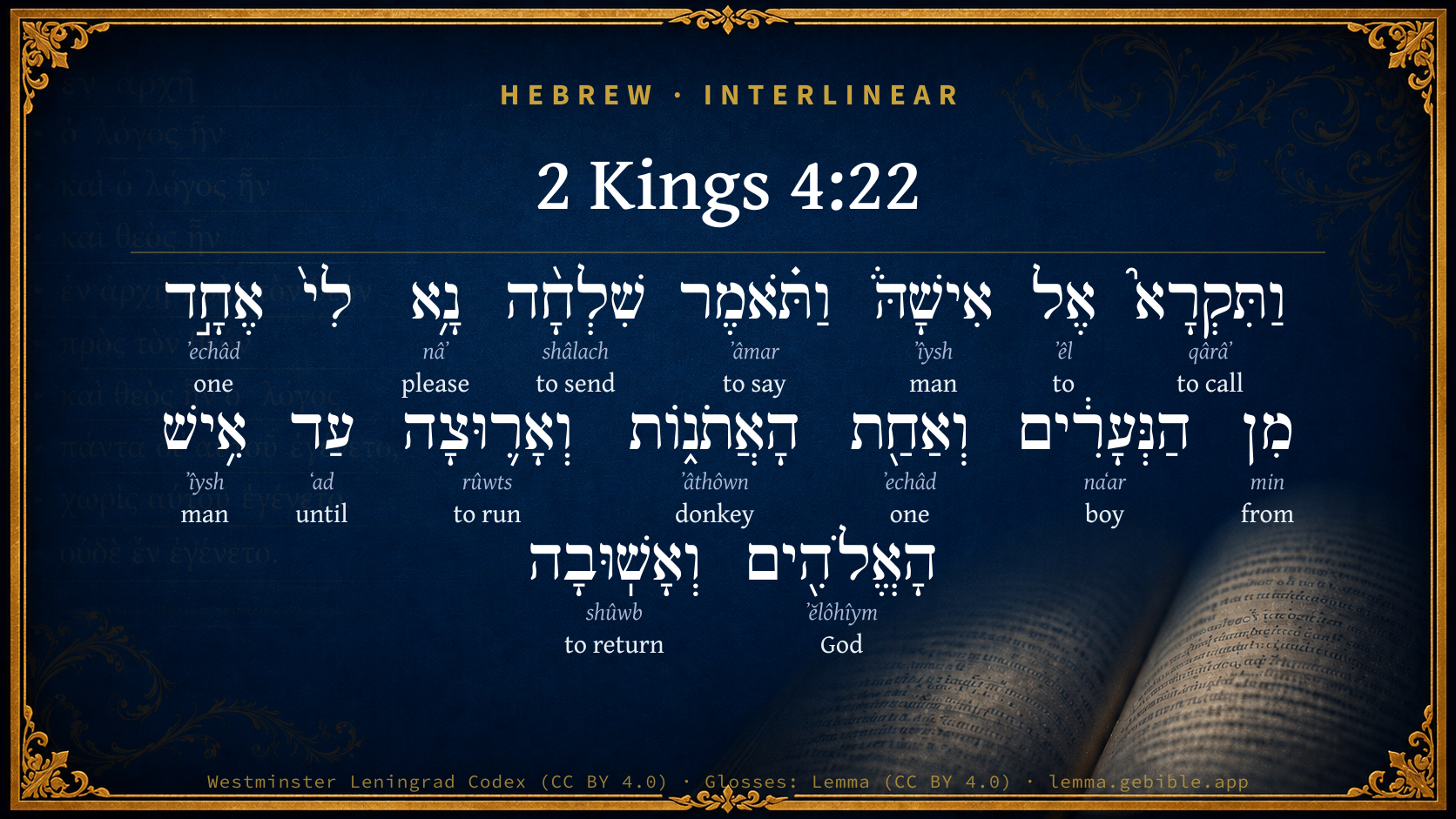
Hebrew (Westminster Leningrad Codex) 2 Kings 4:22 appears in the Hebrew Old Testament. The text above is from the Westminster Leningrad Codex. Each word links to its Strong’s number, a concise gloss, and parsing drawn from the Open Scriptures Hebrew Bible morphology. Click any word for its full Brown-Driver-Briggs (BDB) entry.
Download image
Cite this verse

2 Kings 4:22 (World English Bible). Public Domain. Lemma interlinear Bible study tool, https://lemma.gebible.app/v/2-kings/4/22.

Show BibTeX & RIS
BibTeX
RIS
English Translation
She called to her husband, and said, Please send me one of the servants, and one of the donkeys, that I may run to the man of God, and come again.
World English Bible · Public Domain
Download a study sheet

One document with this verse’s original text, its word-by-word gloss line, the meaning frame, cross-references with their text, attributed commentary, and full source and license credits — printable, and it pastes into notes with its structure intact.

This verse Autodidact and up

Study sheet (.html) Plain text (.txt)

A passage Seminary Student

Up to 50 verses in one chapter. A passage sheet keeps up to 6 commentary sources and 12 cross-references per verse, in the order this page ranks them, and says so on the sheet whenever that leaves anything out. Ask for a single verse and you get the Autodidact verse sheet above.

Everything on this page stays free to read, with no account — the sheet is a download of what is already on screen, not access to it.

Want to remove ads? Support Godless Engineer
Compare translations 3

The same verse in 3 English versions, stacked beneath the original-language interlinear above. Click any original word for its lexicon entry.

Each is an independent rendering of the whole verse — the interlinear is not word-aligned to these translations.

Highlighted words mark where these versions differ — a whole-verse word diff, not a word-by-word alignment.

  • World English Bible Public Domain
    She called to her husband, and said, Please send me one of the servants, and one of the donkeys, that I may run to the man of God, and come again.
  • King James Version Public Domain
    And she called unto her husband, and said, Send me, I pray thee, one of the young men, and one of the asses, that I may run to the man of God, and come again.
  • unfoldingWord Literal Text CC BY-SA 4.0
    And she called to her husband and said, “Please send to me one of the servants and one of the donkeys, and let me run to the man of God, and let me return.”

unfoldingWord Literal Text — © unfoldingWord, licensed CC BY-SA 4.0. Word-aligned USFM3 via Door43 (git.door43.org/unfoldingWord/en_ult).

Versions to compare (up to 4)

3 of 4 selected

Show all 18 translations

Every available English version of this verse, each an independent rendering of the whole verse.

  • World English Bible Public Domain
    She called to her husband, and said, Please send me one of the servants, and one of the donkeys, that I may run to the man of God, and come again.
  • Berean Standard Bible Public Domain
    And the woman called her husband and said, “Please send me one of the servants and one of the donkeys, that I may go quickly to the man of God and return.”
  • Majority Standard Bible Public Domain
    And the woman called her husband and said, “Please send me one of the servants and one of the donkeys, that I may go quickly to the man of God and return.”
  • King James Version Public Domain
    And she called unto her husband, and said, Send me, I pray thee, one of the young men, and one of the asses, that I may run to the man of God, and come again.
  • American Standard Version (1901) Public Domain
    And she called unto her husband, and said, Send me, I pray thee, one of the servants, and one of the asses, that I may run to the man of God, and come again.
  • Revised Version (1885) Public Domain
    And she called unto her husband, and said, Send me, I pray thee, one of the servants, and one of the asses, that I may run to the man of God, and come again.
  • Geneva Bible (1599) Public Domain
    Then she called to her husband, and sayd, Send with me, I pray thee, one of the yong men and one of the asses: for I will haste to the man of God, and come againe.
  • Douay-Rheims (1899) Public Domain
    She called her husband, and said: Send with me, I beseech thee, one of thy servants, and an ass that I may run to the man of God, and come again.
  • Young's Literal Translation Public Domain
    and calleth unto her husband, and saith, `Send, I pray thee, to me, one of the young men, and one of the asses, and I run unto the man of God, and return.'
  • Literal Standard Version CC BY-SA 4.0
    and calls to her husband and says, “Please send one of the young men and one of the donkeys to me, and I run to the man of God, and return.”
  • Unlocked Literal Bible CC BY-SA 4.0
    She called to her husband, and said, “Please send me one of the servants and one of the donkeys so that I may hurry to the man of God and then come back.”
  • unfoldingWord Literal Text CC BY-SA 4.0
    And she called to her husband and said, “Please send to me one of the servants and one of the donkeys, and let me run to the man of God, and let me return.”
  • Darby Bible Public Domain
    And she called to her husband, and said, Send me, I pray thee, one of the young men, and one of the asses, and I will run to the man of God, and come again.
  • World Messianic Bible Public Domain
    She called to her husband and said, “Please send me one of the servants, and one of the donkeys, that I may run to the man of God and come again.”
  • Webster's Bible Public Domain
    And she called to her husband, and said, Send me, I pray thee, one of the young men, and one of the asses, that I may run to the man of God, and come again.
  • Free Bible Version CC BY-SA 4.0
    She called her husband and said, “Please send me one of the servants and a donkey so I can run to the man of God and come back.”
  • Bible in Basic English Public Domain
    And she said to her husband, Send me one of the servants and one of the asses so that I may go quickly to the man of God and come back again.
  • JPS Tanakh (1917) Public Domain
    And she called unto her husband, and said: 'Send me, I pray thee, one of the servants, and one of the asses, that I may run to the man of God, and come back.'

Literal Standard Version (2020), Covenant Press — licensed CC BY-SA 4.0. Text via the HelloAO Bible API (eBible.org). Unlocked Literal Bible (unfoldingWord) — licensed CC BY-SA 4.0. Text via the HelloAO Bible API (eBible.org). unfoldingWord Literal Text — © unfoldingWord, licensed CC BY-SA 4.0. Word-aligned USFM3 via Door43 (git.door43.org/unfoldingWord/en_ult). Free Bible Version, Dr. Jonathan Gallagher — licensed CC BY-SA 4.0. Text via the HelloAO Bible API (eBible.org).

Word by word

More ways to search: Search by grammar → Find every occurrence → Compare this word →

Practice this passage: Drill this verse → Learn its vocabulary →

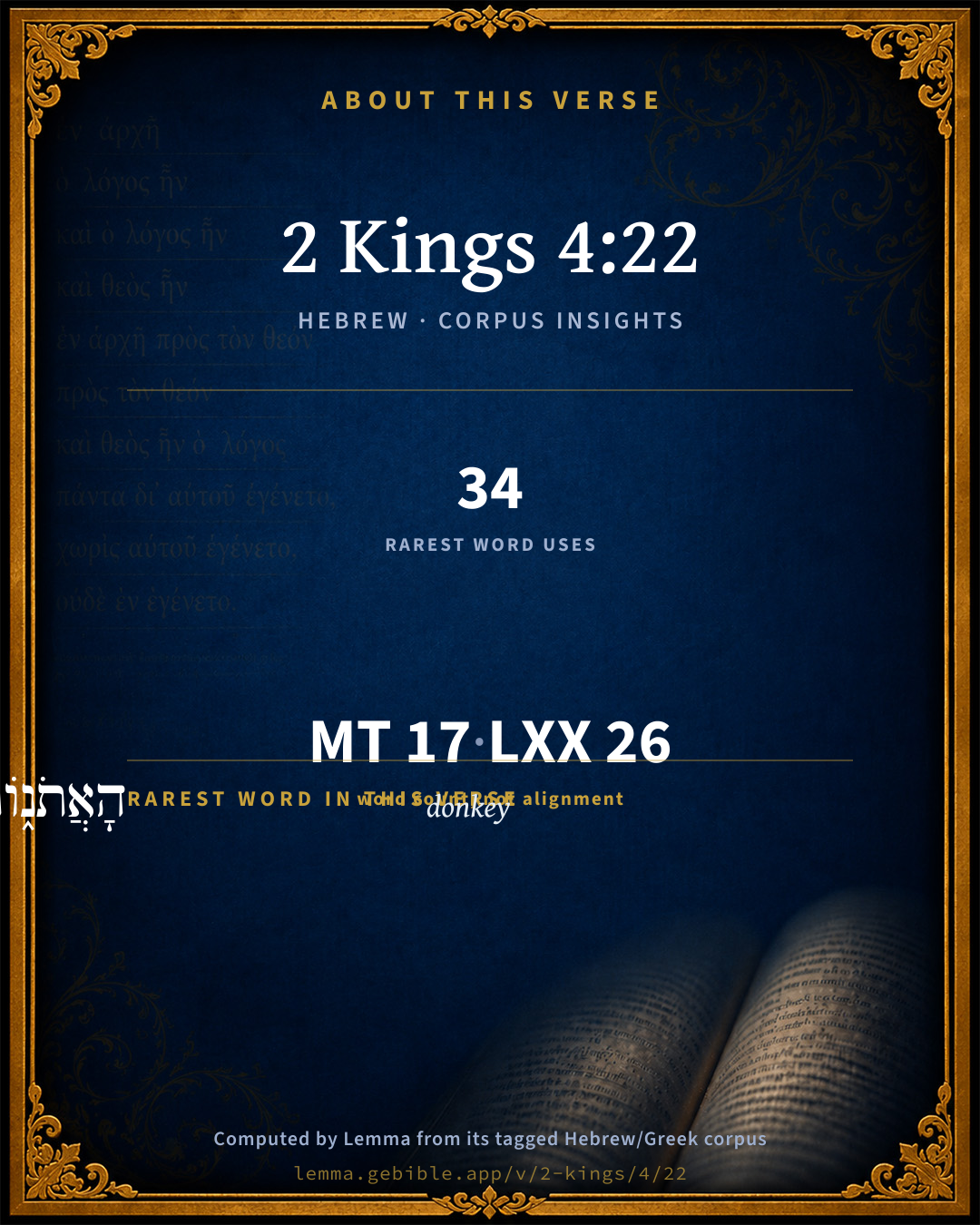
הָאֲתֹנ֑וֹת
ʼâthôwn
H860
“the · donkeys”
Particle, Definite Article + Noun, Common, Feminine, Plural, Absolute
Part of Speech
Particle + Noun
Type
Common
Gender
Feminine
Number
Plural
State
Absolute
Full BDB Definition

Origin: probably from the same as H386 (sense of patience)

TWOT: 190a

she-ass, she-donkey
  1. וַתִּקְרָא֮ qârâʼ H7121 “and · to call” Conjunction + Verb, Qal, Sequential Imperfect, 3rd Person, Feminine, Singular
  2. אֶל ʼêl H413 “to” Preposition
  3. אִישָׁהּ֒ ʼîysh H376 “man · her” Noun, Common, Masculine, Singular, Construct + Suffix, Personal, 3rd Person, Feminine, Singular
  4. וַתֹּ֗אמֶר ʼâmar H559 “and · to say” Conjunction + Verb, Qal, Sequential Imperfect, 3rd Person, Feminine, Singular
  5. שִׁלְחָ֨ה shâlach H7971 “send” Verb, Qal, Imperative, 2nd Person, Masculine, Singular + Suffix, h
  6. נָ֥א nâʼ H4994 “please” Particle, Exhortation
  7. אֶחָ֣ד ʼechâd H259 “one” Adjective, Cardinal number, Masculine, Singular, Absolute
  8. מִן min H4480 “from” Preposition
  9. הַנְּעָרִ֔ים naʻar H5288 “the · boys” Particle, Definite Article + Noun, Common, Masculine, Plural, Absolute
  10. וְאַחַ֖ת ʼechâd H259 “and · one” Conjunction + Adjective, Cardinal number, Feminine, Singular, Absolute
  11. וְאָר֛וּצָה rûwts H7323 “and · to run” Conjunction + Verb, Qal, Imperfect, 1st Person, Common, Singular
  12. עַד ʻad H5704 “until” Preposition
  13. אִ֥ישׁ ʼîysh H376 “man of” Noun, Common, Masculine, Singular, Construct
  14. הָאֱלֹהִ֖ים ʼĕlôhîym H430 “the · God(s)” Particle, Definite Article + Noun, Common, Masculine, Plural, Absolute
  15. וְאָשֽׁוּבָה shûwb H7725 “and · to return” Conjunction + Verb, Qal, Imperfect, 1st Person, Common, Singular

About this verse

These counts appear in no published source. They are computed here, from the morphology-tagged text and Lemma’s own curated glosses. What Lemma adds →

17
words
14
distinct lemmas
Historical
section

Shared distinctive vocabulary

הָאֲתֹנ֑וֹת donkey H860 occurs in 28 verses of the Hebrew Bible. Also found in:

Grammatical profile

  • 5 verbs
  • 5 nouns
  • 2 adjectives
  • 4 prepositions
  • 1 particle

Verb forms

  • וַתִּקְרָא֮ Qal · Sequential Imperfect
  • וַתֹּ֗אמֶר Qal · Sequential Imperfect
  • שִׁלְחָ֨ה Qal · Imperative
  • וְאָר֛וּצָה Qal · Imperfect
  • וְאָשֽׁוּבָה Qal · Imperfect

Repetition

Words recur within this verse — often emphatic in Hebrew:

  • אִישָׁהּ֒ man H376 ×2
  • אֶחָ֣ד one H259 ×2

Hebrew & Septuagint length

In English translation the verse runs 31 words from the Hebrew and 33 from the Septuagint (LXX English) — closely comparable.

A rough comparison of the two English renderings, which tokenize alike — not a word-level alignment.

Word counts can differ between the Hebrew and the Greek without any difference in meaning — e.g. the Hebrew direct-object marker אֵת has no separate Greek word, and Greek often adds the article ὁ.

In the original languages it is 17 Hebrew tokens and 26 Greek tokens — but the two are counted differently (Hebrew bundles its prefixes and suffixes into one token; the Greek is in lemma form), so that isn’t a like-for-like length.

Cross-references

4

Topical passages linked to 2 Kings 4:22 in the Treasury of Scripture Knowledge — connected by theme and wording, ordered by reader-vote popularity; previews shown in the World English Bible.

  • 2 Kings 4:24 Then she saddled a donkey, and said to her servant, Drive, and go forward; don't slacken me the riding, except I bid you.
  • 2 Kings 4:26 please run now to meet her, and ask her, Is it well with you? is it well with your husband? is it well with the child? She answered, It is well.
  • John 11:3 The sisters therefore sent to him, saying, "Lord, behold, he for whom you have great affection is sick."
  • Acts 9:38 As Lydda was near Joppa, the disciples, hearing that Peter was there, sent two men to him, imploring him not to delay in coming to them.

Cross-references courtesy of OpenBible.info (CC BY 4.0).

Hebrew and Greek witnesses Masoretic Hebrew ↔ Greek Septuagint

The same verse in the two great witnesses to the Old Testament, shown verse-for-verse.

These are two independent witnesses, not word-aligned to each other, and the Septuagint is shown in lemma (dictionary) form.

Hebrew 2 Kings 4:22 Masoretic · Westminster Leningrad Codex

וַתִּקְרָא֮ אֶל אִישָׁהּ֒ וַתֹּ֗אמֶר שִׁלְחָ֨ה נָ֥א לִי֙ אֶחָ֣ד מִן הַנְּעָרִ֔ים וְאַחַ֖ת הָאֲתֹנ֑וֹת וְאָר֛וּצָה עַד אִ֥ישׁ הָאֱלֹהִ֖ים וְאָשֽׁוּבָה

She called to her husband, and said, Please send me one of the servants, and one of the donkeys, that I may run to the man of God, and come again.

World English Bible · Public Domain

Greek LXX 2 Kings 4:22 Septuagint · lemma form

καί καλέω ὁ ἀνήρ αὐτός καί εἶπον ἀποστέλλω δή ἐγώ εἷς ὁ παιδάριον καί εἷς ὁ ὄνος καί τρέχω ἕως ὁ ἄνθρωπος ὁ θεός καί ἐπιστρέφω

And she called her husband, and said, Send now for me one of the young men, and one of the asses, and I will ride quickly to the man of God, and return.

LXX2012 (modern English Septuagint) · Public Domain

Hebrew: Westminster Leningrad Codex (CC BY 4.0). Greek: Septuagint (public domain); English from LXX2012 (modern English Septuagint) (Public Domain). How the Septuagint differs from the Hebrew →

Targum (Aramaic paraphrase)

1

The Targum is the ancient Jewish Aramaic paraphrase of the Hebrew Scriptures — an interpretive translation, not the Hebrew text itself. Onkelos (literal) and Pseudo-Jonathan (expansive) render the Torah, and Jonathan the Prophets. Coverage is partial: where no permissively-licensed English translation exists for a verse, only the Aramaic is shown. This is verse-level text, not a word-by-word alignment to the Hebrew.

  1. Targum Jonathan Prophets (Joshua–Malachi)
    וּקְרַת לְבַעֲלָהּ וַאֲמַרַת שַׁדַר כְּעַן לִי חַד מִן עוּלֵימַיָא וַחֲדָא מִן אָתְנַיָא וְאִתְמְטֵי לְוַת נְבִיָא דַייָ וְאָתוּב:

    (no public-domain English translation for this verse)

    Targum Jonathan — Aramaic: “Mikraot Gedolot” (public domain). English: “Sefaria Community Translation” (CC0 1.0 (public-domain dedication)); “London "Chaldee Paraphrase," 1871” (public domain). Text via Sefaria.

Commentary

Notes on 2 Kings 4:22 from classic Christian and Jewish commentators (each source and its license shown beneath its notes). The classic Christian expositions comment on the surrounding passage and are grouped to its opening verse, so a note may address several verses; the Jewish commentaries on the Tanakh (Rashi and others) are per-verse, so they appear only where the commentator wrote on this verse.

Lemma curates 59 commentaries, every one of them public domain or Creative Commons licensed, each selected and text-cleaned for this edition rather than reprinted as found. About our sources →

Trapp's Complete Commentary

John Trapp

2Ki 4:22 And she called unto her husband, and said, Send me, I pray thee, one of the young men, and one of the asses, that I may run to the man of God, and come again.

Ver. 22. Send me, I pray thee.] As a pious and a prudent matron, though she might do much with her husband, whose heart safely trusted in her, yet she would do nothing of moment without his consent.

John Trapp, A Commentary or Exposition upon All the Books of the Old and New Testament (1647–1656) — public domain. Text from a community e-Sword module.

Joseph Benson's Commentary

2Ki 4:22-23. She called to her husband, and said — By a messenger whom she sent into the field to him. She seems not to have acquainted him with the child’s death; probably she feared, if he knew on what errand she wished to go to the prophet, lest he should not have faith enough to let her go. Wherefore wilt thou go to-day? it is neither new moon nor sabbath — It appears by this that the prophets acted as public instructers of the people; and that their houses were a kind of schools, or synagogues, unto which they resorted, upon the days here mentioned, to be taught their duty out of the law of God, and to have their doubts resolved. And she said, It shall be well — My going will not be troublesome to him, nor prejudicial to thee or me.

Joseph Benson's Commentary on the Old and New Testaments (1811–1818) — public domain. Text from a community e-Sword module.

Jamieson, Fausset & Brown

Robert Jamieson, A. R. Fausset & David Brown

she called unto her husband--Her heroic concealment of the death from her husband is not the least interesting feature of the story.

Jamieson, Fausset & Brown — Commentary Critical and Explanatory on the Whole Bible (1871) — public domain (CC PDM 1.0). Text via the HelloAO Bible API.

Ellicott's Commentary for English Readers

(22) One of the young men.—To lead and drive the ass.

Asses.—She-asses.

That I may run.—Notice the striking naturalness of the language, in which she promises to be back soon.

A Bible Commentary for English Readers, edited by Charles John Ellicott (1878–1897) — public domain. Text from a community e-Sword module.

The Cambridge Bible for Schools and Colleges

gen. ed. J. J. S. Perowne

22. And she called unto her husband] He appears to have been at no great distance; though the verb is used at times of a message sent by a servant. Thus Num_24:10 Balak says to Balaam, ‘I called thee to curse mine enemies’. Cf. also Jdg_12:1; 1Ki_1:10; 1Ki_1:19; 1Ki_1:26.

one of the young men] R.V. servants. The same word which in verse 19 was rendered ‘lad’. There were servants who could be spared though the harvest was in hand.

one of the asses] The ass was the usual beast for riding on a journey. In such a country as Palestine the surefootedness of the animal is invaluable.

that I may run to the man of God] The request causes her husband little astonishment. We may therefore conclude that for religious purposes such visits had not been uncommon in the Shunammite’s life.

The Cambridge Bible for Schools and Colleges (gen. ed. J. J. S. Perowne; Cambridge University Press, 1878–1918) — public domain. Text from a community e-Sword module.

John Gill's Exposition

And she called unto her husband,.... In the field, who might be within call, or by a messenger she sent to him:

and said, send me, I pray thee, one of the young men, and one of the asses, that I may run to the man of God, and come again; intimating that she should not be long gone, but should return again presently; saying not a word of the death of the child, or of the occasion of her going.

John Gill's Exposition of the Whole Bible (1746–1763) — public domain (CC PDM 1.0). Text via the HelloAO Bible API.

Albert Barnes' Notes on the Bible

Send me, I pray thee, one of the young men and one of the asses - All the “young men” and all the “asses” were in the harvest field, the young men cutting and binding the sheaves, and placing them upon carts or wains, the donkeys drawing these vehicles fully laden, to the threshing-floor. Compare Amo 2:13.

Albert Barnes' Notes on the Bible (1834–1885) — public domain. Text from a community e-Sword/MySword module.

Whedon's Commentary on the Bible

Daniel D. Whedon

22. She called unto her husband — He seems to have stayed in the harvest field, not supposing any thing so serious in the case; and she seems to have concealed from him the death of the child.

Daniel D. Whedon (gen. ed.), Commentary on the Old and New Testaments (1874–1909) — public domain. Text from a community e-Sword module.

The Pulpit Commentary

And she culled unto her husband, and said, Send me, I pray thee, one of the young men, and one of the asses. She "called to her husband" from the house, without calling him into the house, expressing her desire to visit Elisha, without stating the object of her visit, and asked for the necessary riding-animal and escort. The nearest part of Carmel was at least fourteen or fifteen miles from Shunem, so that she could not walk, That I may runi.e. , hasten to the man of God. "Man of God" was evidently the designation by which Elisha was known in the house (vers. 16, 21, 25). And some again; i.e. return home before nightfall.

The Pulpit Commentary (1880–1919), ed. H.D.M. Spence-Jones & Joseph S. Exell — public domain. Text from a community e-Sword module.

Lesson kit

Teaching starters — assembled from the data on this page, not authored interpretation. Every prompt links to the verse data it draws on. Edit before teaching.

2 Kings, in the Historical, opens this verse with 17 words (14 distinct Hebrew lemmas). Its most distinctive word is ʼâthôwn (“donkey”). A historical commentator’s framing appears above. Read the whole chapter for the surrounding context.

Discussion questions

  1. What does “donkey” (ʼâthôwn) contribute to the verse as a whole?
  2. Genesis 12:16 shares the word «donkey» with this verse. How do the two illuminate each other?
  3. “man” occurs 2× in this one verse. What is the effect of the repetition?
  4. These translations render this verse differently; the difference is in the English rendering, not the original. What questions does that raise?
  5. The verb «וַתִּקְרָא֮» is Qal Sequential Imperfect. How does its form color the action?
  6. Reading how Trapp's Complete Commentary and Joseph Benson's Commentary read this verse, where do the two commentators agree and where do they part?

Things to notice

Reading settings

Reading text

Shown beneath each verse's original-language words.

Old Testament
Old Testament edition

Read the OT as the Masoretic Hebrew (MT) or the Greek Septuagint (LXX).

English shown for the Greek Septuagint (in the Hebrew ↔ Greek comparison).

Comparing translations? Open the Compare panel on any verse page to stack up to four side by side.