
1 Kings 11:28

Hebrew (Westminster Leningrad Codex) 1 Kings 11:28 appears in the Hebrew Old Testament. The text above is from the Westminster Leningrad Codex. Each word links to its Strong’s number, a concise gloss, and parsing drawn from the Open Scriptures Hebrew Bible morphology. Click any word for its full Brown-Driver-Briggs (BDB) entry.
Download image
Cite this verse

1 Kings 11:28 (World English Bible). Public Domain. Lemma interlinear Bible study tool, https://lemma.gebible.app/v/1-kings/11/28.

Show BibTeX & RIS
BibTeX
RIS
English Translation
The man Jeroboam was a mighty man of valor; and Solomon saw the young man that he was industrious, and he gave him charge over all the labor of the house of Joseph.
World English Bible · Public Domain
Highlights
  • 1 first appearance in the Hebrew Bible
Full analysis ↓
Download a study sheet

One document with this verse’s original text, its word-by-word gloss line, the meaning frame, cross-references with their text, attributed commentary, and full source and license credits — printable, and it pastes into notes with its structure intact.

This verse Autodidact and up

Study sheet (.html) Plain text (.txt)

A passage Seminary Student

Up to 50 verses in one chapter. A passage sheet keeps up to 6 commentary sources and 12 cross-references per verse, in the order this page ranks them, and says so on the sheet whenever that leaves anything out. Ask for a single verse and you get the Autodidact verse sheet above.

Everything on this page stays free to read, with no account — the sheet is a download of what is already on screen, not access to it.

Want to remove ads? Support Godless Engineer
Compare translations 3

The same verse in 3 English versions, stacked beneath the original-language interlinear above. Click any original word for its lexicon entry.

Each is an independent rendering of the whole verse — the interlinear is not word-aligned to these translations.

Highlighted words mark where these versions differ — a whole-verse word diff, not a word-by-word alignment.

  • World English Bible Public Domain
    The man Jeroboam was a mighty man of valor; and Solomon saw the young man that he was industrious, and he gave him charge over all the labor of the house of Joseph.
  • King James Version Public Domain
    And the man Jeroboam was a mighty man of valor: and Solomon seeing the young man that he was industrious, he made him ruler over all the charge of the house of Joseph.
  • unfoldingWord Literal Text CC BY-SA 4.0
    And the man Jeroboam mighty of strength. And Solomon had seen the young man, that he was a doer of work, so he had appointed him over all of the forced labor of the house of Joseph.

unfoldingWord Literal Text — © unfoldingWord, licensed CC BY-SA 4.0. Word-aligned USFM3 via Door43 (git.door43.org/unfoldingWord/en_ult).

Versions to compare (up to 4)

3 of 4 selected

Show all 18 translations

Every available English version of this verse, each an independent rendering of the whole verse.

  • World English Bible Public Domain
    The man Jeroboam was a mighty man of valor; and Solomon saw the young man that he was industrious, and he gave him charge over all the labor of the house of Joseph.
  • Berean Standard Bible Public Domain
    Now Jeroboam was a mighty man of valor. So when Solomon noticed that the young man was industrious, he put him in charge of the whole labor force of the house of Joseph.
  • Majority Standard Bible Public Domain
    Now Jeroboam was a mighty man of valor. So when Solomon noticed that the young man was industrious, he put him in charge of the whole labor force of the house of Joseph.
  • King James Version Public Domain
    And the man Jeroboam was a mighty man of valor: and Solomon seeing the young man that he was industrious, he made him ruler over all the charge of the house of Joseph.
  • American Standard Version (1901) Public Domain
    And the man Jeroboam was a mighty man of valor; and Solomon saw the young man that he was industrious, and he gave him charge over all the labor of the house of Joseph.
  • Revised Version (1885) Public Domain
    And the man Jeroboam was a mighty man of valour: and Solomon saw the young man that he was industrious, and he gave him charge over all the labour of the house of Joseph.
  • Geneva Bible (1599) Public Domain
    And this man Ieroboam was a man of strength and courage, and Salomon seeing that the yong man was meete for the worke, he made him ouerseer of all the labour of the house of Ioseph.
  • Douay-Rheims (1899) Public Domain
    And Jeroboam was a valiant and mighty man: and Solomon seeing him a young man ingenious and industrious, made him chief over the tributes of all the house of Joseph.
  • Young's Literal Translation Public Domain
    and the man Jeroboam `is' mighty in valour, and Solomon seeth the young man that he is doing business, and appointeth him over all the burden of the house of Joseph.
  • Literal Standard Version CC BY-SA 4.0
    and the man Jeroboam [is] mighty in valor, and Solomon sees that the young man is doing business, and appoints him over all the burden of the house of Joseph.
  • Unlocked Literal Bible CC BY-SA 4.0
    Jeroboam was a mighty man of valor. Solomon saw that the young man was industrious, so he gave him command over all the labor of the house of Joseph.
  • unfoldingWord Literal Text CC BY-SA 4.0
    And the man Jeroboam mighty of strength. And Solomon had seen the young man, that he was a doer of work, so he had appointed him over all of the forced labor of the house of Joseph.
  • Darby Bible Public Domain
    and the man Jeroboam was strong and valiant; and Solomon saw the young man that he was industrious, and he made him ruler over all the charge of the house of Joseph.
  • World Messianic Bible Public Domain
    The man Jeroboam was a mighty man of valor; and Solomon saw the young man that he was industrious, and he put him in charge of all the labor of the house of Joseph.
  • Webster's Bible Public Domain
    And the man Jeroboam was a mighty man of valor: and Solomon, seeing the young man that he was industrious, he made him ruler over all the charge of the house of Joseph.
  • Free Bible Version CC BY-SA 4.0
    Jeroboam was a man of ability, and when Solomon realized how successful he was in what he did, he placed him in command of all the forced labor of the tribes of Joseph.
  • Bible in Basic English Public Domain
    And Jeroboam was an able and responsible man; and Solomon saw that he was a good worker and made him overseer of all the work given to the sons of Joseph.
  • JPS Tanakh (1917) Public Domain
    And the man Jeroboam was a mighty man of valour; and Solomon saw the young man that he was industrious, and he gave him charge over all the labour of the house of Joseph.

Literal Standard Version (2020), Covenant Press — licensed CC BY-SA 4.0. Text via the HelloAO Bible API (eBible.org). Unlocked Literal Bible (unfoldingWord) — licensed CC BY-SA 4.0. Text via the HelloAO Bible API (eBible.org). unfoldingWord Literal Text — © unfoldingWord, licensed CC BY-SA 4.0. Word-aligned USFM3 via Door43 (git.door43.org/unfoldingWord/en_ult). Free Bible Version, Dr. Jonathan Gallagher — licensed CC BY-SA 4.0. Text via the HelloAO Bible API (eBible.org).

Word by word

More ways to search: Search by grammar → Find every occurrence → Compare this word →

Practice this passage: Drill this verse → Learn its vocabulary →

סֵ֖בֶל
çêbel
H5447
“load of”
Noun, Common, Masculine, Singular, Construct
Part of Speech
Noun
Type
Common
Gender
Masculine
Number
Singular
State
Construct
Full BDB Definition

Origin: from H5445

TWOT: 1458a

load, burden
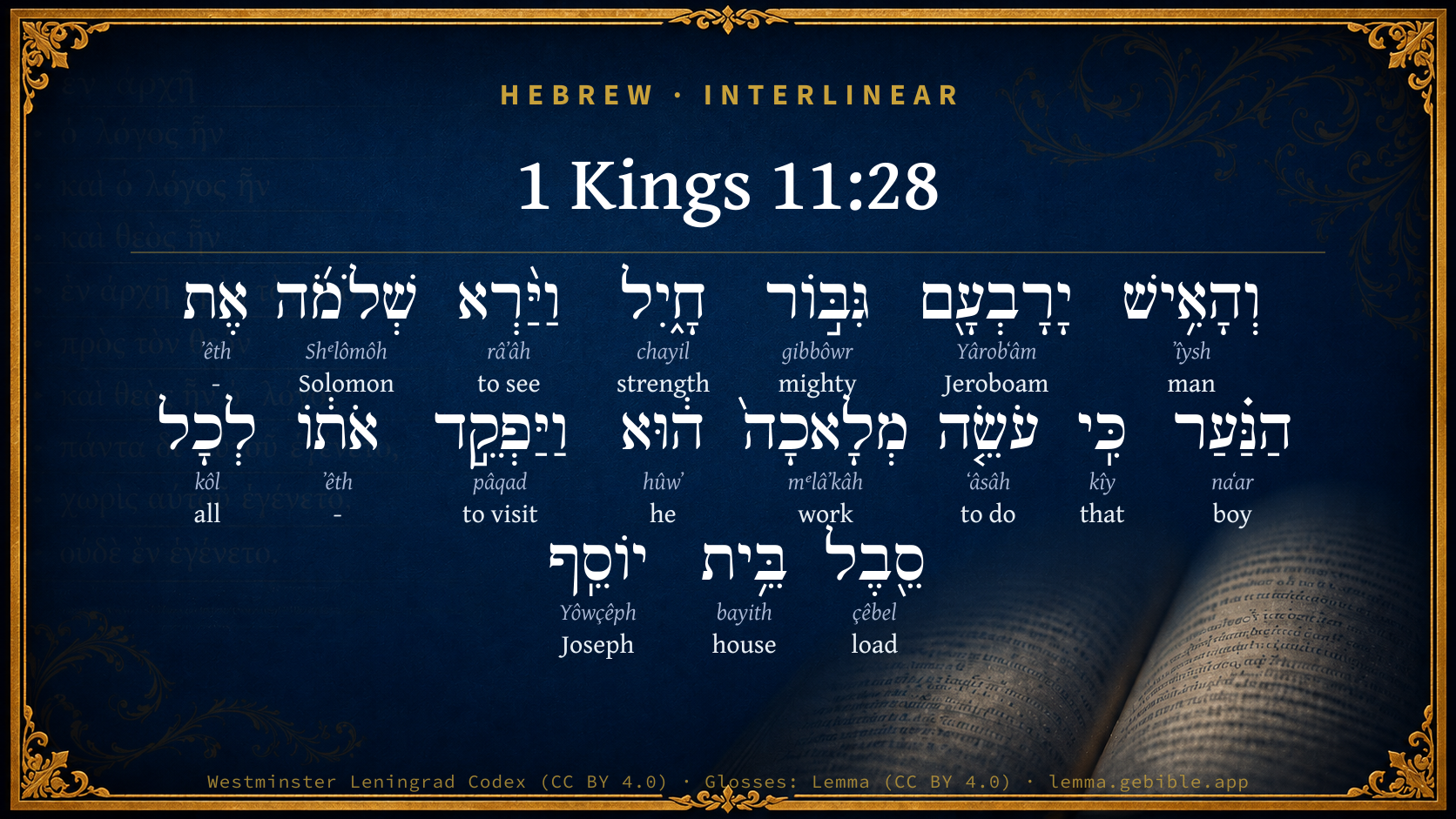
  1. וְהָאִ֥ישׁ ʼîysh H376 “and · the · man” Conjunction + Particle, Definite Article + Noun, Common, Masculine, Singular, Absolute
  2. יָרָבְעָ֖ם Yârobʻâm H3379 “Jeroboam” Noun, Proper
  3. גִּבּ֣וֹר gibbôwr H1368 “mighty of” Adjective, Adjective, Masculine, Singular, Construct
  4. חָ֑יִל chayil H2428 “strength” Noun, Common, Masculine, Singular, Absolute
  5. וַיַּ֨רְא râʼâh H7200 “and · to see” Conjunction + Verb, Qal, Sequential Imperfect, 3rd Person, Masculine, Singular
  6. שְׁלֹמֹ֜ה Shᵉlômôh H8010 “Solomon” Noun, Proper
  7. אֶת ʼêth H853 “-” Particle, Direct Object
  8. הַנַּ֗עַר naʻar H5288 “the · boy” Particle, Definite Article + Noun, Common, Masculine, Singular, Absolute
  9. כִּֽי kîy H3588 “that” Conjunction
  10. עֹשֵׂ֤ה ʻâsâh H6213 “doing” Verb, Qal, Participle Active, Masculine, Singular, Construct
  11. מְלָאכָה֙ mᵉlâʼkâh H4399 “work” Noun, Common, Feminine, Singular, Absolute
  12. ה֔וּא hûwʼ H1931 “he” Pronoun, Personal, 3rd Person, Masculine, Singular
  13. וַיַּפְקֵ֣ד pâqad H6485 “and · to visit” Conjunction + Verb, Hiphil, Sequential Imperfect, 3rd Person, Masculine, Singular
  14. אֹת֔וֹ ʼêth H853 “- · him” Particle, Direct Object + Suffix, Personal, 3rd Person, Masculine, Singular
  15. לְכָל kôl H3605 “to/for · all of” Preposition + Noun, Common, Masculine, Singular, Construct
  16. בֵּ֥ית bayith H1004 “house of” Noun, Common, Masculine, Singular, Construct
  17. יוֹסֵֽף Yôwçêph H3130 “Joseph” Noun, Proper

About this verse

These counts appear in no published source. They are computed here, from the morphology-tagged text and Lemma’s own curated glosses. What Lemma adds →

18
words
17
distinct lemmas
Historical
section

Notable vocabulary

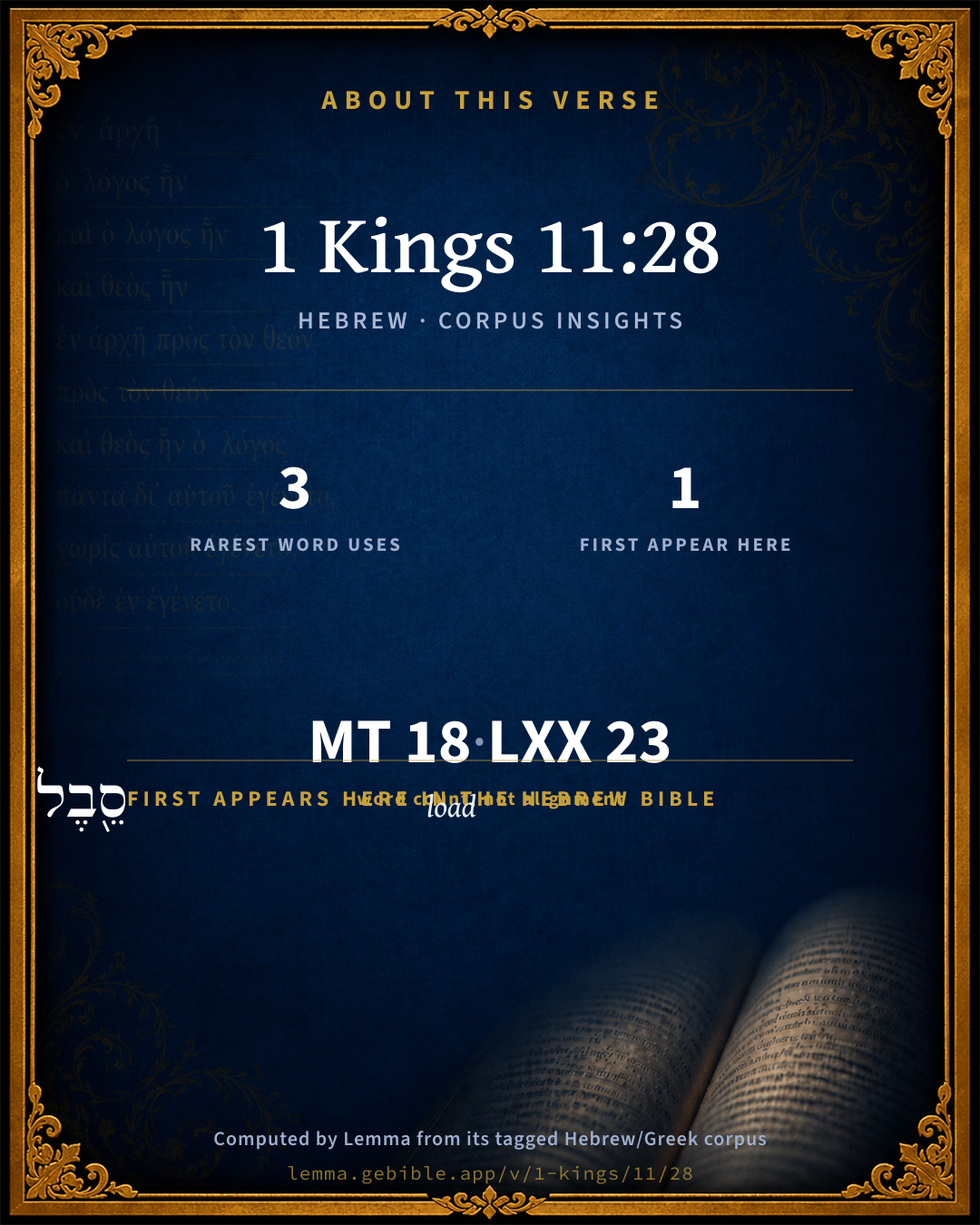
The rarest word here is סֵ֖בֶל load H5447 — appearing just 3 times in the whole Hebrew Bible.

First appearance in Scripture

This word makes its first canonical appearance in the Hebrew Bible here:

  • סֵ֖בֶל load H5447

Shared distinctive vocabulary

סֵ֖בֶל load H5447 occurs in 3 verses of the Hebrew Bible. Also found in:

Grammatical profile

  • 3 verbs
  • 10 nouns
  • 1 adjective
  • 1 pronoun
  • 1 conjunction
  • 2 particles

Verb forms

  • וַיַּ֨רְא Qal · Sequential Imperfect
  • עֹשֵׂ֤ה Qal · Participle Active
  • וַיַּפְקֵ֣ד Hiphil · Sequential Imperfect

Hebrew & Septuagint length

In English translation the verse runs 33 words from the Hebrew and 29 from the Septuagint (LXX English) — closely comparable.

A rough comparison of the two English renderings, which tokenize alike — not a word-level alignment.

Word counts can differ between the Hebrew and the Greek without any difference in meaning — e.g. the Hebrew direct-object marker אֵת has no separate Greek word, and Greek often adds the article ὁ.

In the original languages it is 18 Hebrew tokens and 23 Greek tokens — but the two are counted differently (Hebrew bundles its prefixes and suffixes into one token; the Greek is in lemma form), so that isn’t a like-for-like length.

Cross-references

10

Topical passages linked to 1 Kings 11:28 in the Treasury of Scripture Knowledge — connected by theme and wording, ordered by reader-vote popularity; previews shown in the World English Bible.

  • Proverbs 22:29 Do you see a man skilled in his work? He will serve kings; He won't serve obscure men.
  • Deuteronomy 1:12 How can I myself alone bear your encumbrance, and your burden, and your strife?
  • Joshua 18:5 They shall divide it into seven portions: Judah shall abide in his border on the south, and the house of Joseph shall abide in their border on the north.
  • Judges 1:22–23 The house of Joseph, they also went up against Bethel; and Yahweh was with them.
  • 2 Samuel 19:20 For your servant does know that I have sinned: therefore, behold, I am come this day the first of all the house of Joseph to go down to meet my lord the king.
  • 1 Kings 5:16 besides Solomon's chief officers who were over the work, three thousand and three hundred, who bore rule over the people who labored in the work.
  • Isaiah 14:25 that I will break the Assyrian in my land, and on my mountains tread him under foot: then shall his yoke depart from off them, and his burden depart from off their shoulder.
  • Amos 5:6 Seek Yahweh, and you will live; Lest he break out like fire in the house of Joseph, And it devour, and there be no one to quench it in Bethel.
  • Zechariah 10:6 "I will strengthen the house of Judah, And I will save the house of Joseph, And I will bring them back; For I have mercy on them; And they will be as though I had not cast them off: For I am Yahweh their God, and I will hear them.
  • Matthew 11:30 For my yoke is easy, and my burden is light."

Cross-references courtesy of OpenBible.info (CC BY 4.0).

Hebrew and Greek witnesses Masoretic Hebrew ↔ Greek Septuagint

The same verse in the two great witnesses to the Old Testament, shown verse-for-verse.

These are two independent witnesses, not word-aligned to each other, and the Septuagint is shown in lemma (dictionary) form.

Hebrew 1 Kings 11:28 Masoretic · Westminster Leningrad Codex

וְהָאִ֥ישׁ יָרָבְעָ֖ם גִּבּ֣וֹר חָ֑יִל וַיַּ֨רְא שְׁלֹמֹ֜ה אֶת הַנַּ֗עַר כִּֽי עֹשֵׂ֤ה מְלָאכָה֙ ה֔וּא וַיַּפְקֵ֣ד אֹת֔וֹ לְכָל סֵ֖בֶל בֵּ֥ית יוֹסֵֽף

The man Jeroboam was a mighty man of valor; and Solomon saw the young man that he was industrious, and he gave him charge over all the labor of the house of Joseph.

World English Bible · Public Domain

Greek LXX 1 Kings 11:28 Septuagint · lemma form

καί ὁ ἄνθρωπος ιεροβοαμ ἰσχυρός δύναμις καί ὁράω σαλωμών ὁ παιδάριον ὅτι ἀνήρ ἔργον εἰμί καί καταἵστημι αὐτός ἐπί ὁ ἄρσις οἶκος ιωσηφ

And the man Jeroboam was very strong; and Solomon saw the young man that he was active, and he set him over the levies of the house of Joseph.

LXX2012 (modern English Septuagint) · Public Domain

On this verse, Ellicott's Commentary for English Readers discusses the Septuagint’s reading. Read the note in Commentary ↓

Hebrew: Westminster Leningrad Codex (CC BY 4.0). Greek: Septuagint (public domain); English from LXX2012 (modern English Septuagint) (Public Domain). How the Septuagint differs from the Hebrew →

Targum (Aramaic paraphrase)

1

The Targum is the ancient Jewish Aramaic paraphrase of the Hebrew Scriptures — an interpretive translation, not the Hebrew text itself. Onkelos (literal) and Pseudo-Jonathan (expansive) render the Torah, and Jonathan the Prophets. Coverage is partial: where no permissively-licensed English translation exists for a verse, only the Aramaic is shown. This is verse-level text, not a word-by-word alignment to the Hebrew.

  1. Targum Jonathan Prophets (Joshua–Malachi)
    וְגַבְרָא יָרָבְעָם גִבַּר חֵילָא וַחֲזָא שְׁלֹמֹה יַת עוּלֵימָא אֲרֵי עֲבִיד עַבִידְתָּא הוּא וּמַנֵי יָתֵיהּ לְכָל מַסְקֵי מִסִין דְבֵית יוֹסֵף:

    (no public-domain English translation for this verse)

    Targum Jonathan — Aramaic: “Mikraot Gedolot” (public domain). English: “Sefaria Community Translation” (CC0 1.0 (public-domain dedication)); “London "Chaldee Paraphrase," 1871” (public domain). Text via Sefaria.

Commentary

Notes on 1 Kings 11:28 from classic Christian and Jewish commentators (each source and its license shown beneath its notes). The classic Christian expositions comment on the surrounding passage and are grouped to its opening verse, so a note may address several verses; the Jewish commentaries on the Tanakh (Rashi and others) are per-verse, so they appear only where the commentator wrote on this verse.

Lemma curates 59 commentaries, every one of them public domain or Creative Commons licensed, each selected and text-cleaned for this edition rather than reprinted as found. About our sources →

Trapp's Complete Commentary

John Trapp

1Ki 11:28 And the man Jeroboam [was] a mighty man of valour: and Solomon seeing the young man that he was industrious, he made him ruler over all the charge of the house of Joseph.

Ver. 28. A mighty man of valour.] Able and also active, and so the fitter to be the head of a faction.

And Solomon seeing the young man that he was industrious.] This is all that most masters look at in the choice of their servants, that they be meet for their work; though otherwise their religion be either a Popish puppet and calf worship, as one tightly complaineth, or a flat irreligion. But it had been happy for Solomon’s house that a man of more conscience, though of less skill, had been retained.

John Trapp, A Commentary or Exposition upon All the Books of the Old and New Testament (1647–1656) — public domain. Text from a community e-Sword module.

Geneva Bible (1599)

Geneva Bible translators

He was overseer of Solomon’s works, for the tribe of Ephraim and Manasseh.

Geneva Bible (1599) marginal notes — public domain. Text via Bolls.life.

Ellicott's Commentary for English Readers

(28) A mighty man of valour.—The phrase, like the “mighty valiant man,” applied to the young David (1Sa_16:18), has nothing to do with war, but simply signifies “strong and capable.”

The charge (or in margin “the burden”), is, of course, the taskwork assigned to the levy from the tribe of Ephraim (and possibly Manasseh with it). It is clear from this that the levy for the Temple—perhaps originally exceptional—had served as a precedent for future burdens, not on the subject races only, as at first (1Ki_9:21-22), but on the Israelites also. The LXX. addition makes Jeroboam build for Solomon “Sarira in Mount Ephraim” also.

Ahijah the Shilonite.—In the person of Ahijah, prophecy emerges from the abeyance, which seems to overshadow it during the greatness of the monarchy. Even in David’s old age, the prophet Nathan himself appears chiefly as a mere counsellor and servant of the king (see 1 Kings 1), and from the day of his coronation of Solomon we hear nothing of any prophetic action. Solomon himself receives the visions of the Lord (1Ki_3:5; 1Ki_3:2); upon him, as the Wise Man, rests the special inspiration of God; at the consecration of the Temple he alone is prominent, as the representative and the teacher of the people. Now, however, we find in Ahijah the first of the line of prophets, who resumed a paramount influence like that of Samuel or Nathan, protecting the spirituality of the land and the worship of God, and demanding both from king and people submission to the authority of the Lord Jehovah.

A Bible Commentary for English Readers, edited by Charles John Ellicott (1878–1897) — public domain. Text from a community e-Sword module.

The Cambridge Bible for Schools and Colleges

gen. ed. J. J. S. Perowne

28. and Solomon seeing] The verb is finite, therefore render (with R.V.) saw.

was industrious] Literally ‘did work.’

he made him ruler over all the charge of, &c.] Better (with R.V., and he gave him charge over all the labour (Heb. burden) of the house of Joseph, i.e. the tribe of Ephraim. The labour here spoken of is that compulsory work, which the Israelites did by turns for parts of the year, and which the tributary subject-population were constantly employed upon. It is not difficult to conceive circumstances under which such duty might become very distasteful to the northern section of the kingdom. For between them and the people of Judah there was a pronounced opposition even in David’s time. And the compulsory labour on the walls of Jerusalem was just the sort of occupation to aggravate this old enmity. Jeroboam saw this and took advantage of it.

The Cambridge Bible for Schools and Colleges (gen. ed. J. J. S. Perowne; Cambridge University Press, 1878–1918) — public domain. Text from a community e-Sword module.

John Gill's Exposition

And it came to pass at that time, when Jeroboam went out of Jerusalem,.... Either to enter upon his new office: or having been with Solomon to pay in the revenues, and to make up his accounts with him was going back to the country to do the duty of his office:

that the prophet Ahijah the Shilonite found him in the way; not accidentally, but purposely was in the way to meet him, and converse with him; this prophet was of the city of Shiloh, and where was now his abode, see Kg1 14:2.

and he had clad himself with a new garment; not Jeroboam, but the prophet, and that by the direction of the Lord, for the following purpose:

and they two were alone in the field: it is possible Jeroboam might have some servants with him; but Ahijah desiring some private conversation with him, he sent them onwards, or bid them stay at some distance; who yet might be capable of observing what was done, though not of hearing what was said; or otherwise how should Solomon come to the knowledge of it? Kg1 11:40.

John Gill's Exposition of the Whole Bible (1746–1763) — public domain (CC PDM 1.0). Text via the HelloAO Bible API.

Albert Barnes' Notes on the Bible

A mighty man of valor - Here “a man of strength and activity.” It is a vague term of commendation, the exact force of which must be fixed by the context. See Rth 2:1; 1Sa 9:1, etc.

Solomon made Jeroboam superintendent of all the forced labor (“the charge”) exacted from his tribe - the tribe of Ephraim - during the time that he was building Millo and fortifying the city of Jerusalem 1Ki 9:15.

Albert Barnes' Notes on the Bible (1834–1885) — public domain. Text from a community e-Sword/MySword module.

Haydock's Catholic Bible Commentary

Joseph, Ephraim and Manasses. (Menochius) --- He was of the former tribe. (Salien) --- At first Solomon employed none of the Israelites to work, chap. ix. 22. But he afterwards oppressed them grievously. The king’s right was to make his subjects cultivate his lands, &c., 1 Kings vii. 11. They did not pay money, (Matthew xvii. 24,) but wrought for the king. Hebrew, "he made him ruler over all the charge," (or levy.) (Haydock) --- The Vulgate often uses the word tribute (Calmet) for sebel. Josephus believes that Jeroboam had the command over the forces of the house of Joseph: but he had rather the superintendency over the workmen. (Haydock)

George Leo Haydock (1774–1849), Haydock's Catholic Family Bible and Commentary, 1859 edition — public domain. Excludes Psalms (Douay-Rheims chapter numbering differs from Protestant) and Deuterocanonical books (Catholic canon only).

Matthew Poole's English Annotations

A mighty man of valour, or, a man of great strength of body, or courage of mind, or both.

Industrious; ingenious, and diligent, and active, and every way fit for business and for command.

Over all the charge, i.e. the taxes and tributes which were to be gathered of the people by his power and authority.

Of the house of Joseph; either of Ephraim and Manasseh, who were jointly comprehended under this name, Jos 17:17; or of Ephraim only, who elsewhere comes under that name, as 1Ch 5:1; Psa 78:67; Eze 37:6. And it seems most probable that each tribe had a several ruler.

Matthew Poole's English Annotations on the Holy Bible (1683–1685) — public domain. Text from a community e-Sword/MySword module.

The Pulpit Commentary

And the man Jeroboam was a mighty man of valour same expression Jud_1:6:12 11:1; 1Sa_9:1; 2Ki_15:20. In Ruth if. 1 it hardly seems to imply valour so much as wealth (as A.V): and Solomon seeing the young man that he was industrious Heb. doing fwork, he made him ruler over all the charge Heb. appointed him to all the burden of the house of Joseph. The tribe of Ephraim, with its constant envy of Judah, must have been mortified to find themselves employed though it was but in the modified service of Israelites on the fortifications of Jerusalem. Their murmurings revealed to Jeroboam the unpopularity of Solomon, and perhaps suggested thoughts of overt rebellion to his mind.

HOMILIES BY A. ROWLAND Ver. 28.

The Successful Man.

Among the "adversaries" of Solomon, Jeroboam was the most active. He raised sedition, or, in the words of Scripture, "lifted up his hand," against the king. He was of humble birth, but belonged to the most powerful tribe Ephraim. His rise is described here. The fortifications of Millo underneath the citadel of Zion were being erected. Amongst those employed Jeroboam was noticed by the king as strong, skilful, and industrious. Ever on the outlook for talent, and with wisdom to discern it, Solomon made him superintendent of the tribute required in money and service of the tribe of Ephraim; a place of trust and profit. Jeroboam is a good example of WORLDLY SUCCESS, the subject for our consideration.

I THE ELEMENTS OF WORLDLY SUCCESS.

1. Natural ability. This belonged to the son of Nebat in large measure, as his subsequent history shows. Shrewdness, courage, self-reliance were his. These, and similar gifts, are unevenly distributed amongst men. Children at school are by no means equal in powers of attainment. In business, one man will make a fortune where another would not suspect a chance. Amongst the advantages of such inequality are these: that the higher and lower grades of work required by the world are alike done; and that room is given for the exercise of generosity, self-conquest, etc., in our social relations.

1. Personal diligence. With all Jeroboam"s faults he was not idle. He did thoroughly and well what came to hand. This is the secret of success, both in student and business life. It rectifies the balance sometimes between men of unequal ability. The tortoise wins the race against the hare. The student conquers the genius. Where it is added to ability, success in life is certain.

2. "Seest thou a man diligent in his business? he shall stand before kings: he shall not stand before mean men". (Pro_22:29) "The hand of the diligent shall bear rule". (Pro_12:24) Examples: Abraham"s servant; Joseph in Egypt, etc. Show how this is true in the higher sphere of the Christian life. "To him that hath to him shall be given," etc. He that is faithful with few things will become ruler over many.

3. Kindly interest. "Solomon saw the young man." This added an element of uncertainty to his prospects. It seemed a chance, but was under the rule of God, as the history shows. Diligence and fidelity should be ours, whether or no we have the notice of the earthly master, for the unseen King is ever watching us. We are to work with singleness of heart, as unto the Lord; to serve others "not with eye service as men pleasers," etc. Show the responsibility which rests on employers to develop, and encourage, and put to the best use the gifts of their employes. Promotion should follow merit.

II THE POSSIBILITIES OF WORLDLY SUCCESS.

1. It is possible to defend others. Jeroboam was known in future times of danger as the man who "enclosed the city of David." Higher possibilities than that belong to successful men. How they can guard those employed by them from disease, from moral contamination, from ignorance, etc. The responsibilities of landowners, manufacturers, etc.

2. It is possible to lighten the burdens of others. As ruler over the tribute, Jeroboam could alleviate or aggravate the burdens of the tribe. Point out what could be done by far-seeing, right-hearted statesmen to lessen the troubles of the poor, the miseries of subject races, the burdens of taxation, etc.

3. It is possible to become ready for loftier rule. He who was the overseer of one tribe became the king of Israel. The discharge of the duties of the former office made those of the latter less arduous. Apply this to the preparation of men for the nobler rule of heaven, by the exercise of powers for God in the earthly sphere.

III THE PERILS OF WORLDLY SUCCESS.

1. Ingratitude. Jeroboam fostered ill feeling against Solomon in Ephraim till he was expelled the kingdom. Men often kick away the ladder by which they rose to fortune. Give examples. The wish to forget the past in which they wanted help, and to attribute to their own skill what came from the

2. kindness of others, tempts to this. Even poor parents have been left uncared for by prosperous children.

3. Impatience. Jeroboam was to have the kingdom, as Ahijah told him, but he could not wait for Solomon"s death. His first exaltation and the words of the prophet aroused greed and ambition which would not be stayed. A man who has known nothing but success is more impatient than are others at a disappointment or difficulty. It is harder for him than for one trained in the school of adversity to say, "Not my will, but Thine be done." His is seldom the "meek and quiet spirit" which is, in the sight of God, of great price.

1. Rebellion against God. He heard from Ahijah"s lips these words of God about Solomon will make him prince all the days of his life;" yet during his life Jeroboam tried to dethrone him. Compare this conduct with that of David towards Saul. The contrast is the more remarkable because of the provocation David received, and because the son of Jesse, unlike the son of Nebat, had been actually anointed king. He had no right to seize what God had promised to give. Jacob learnt this lesson in the house of Laban. In this disregard, or defiance, of God was the germ of Jeroboam"s ruin. His rule was (like Solomon"s) conditional on obedience to the Divine will (compare ver. 38 with 9:4-6). Stability depends on God; the seen on the unseen. No cleverness, no diligence, no human help can bring lasting prosperity to a soul, or to a nation, which forsakes righteousness and forgets God. A.R.

The Pulpit Commentary (1880–1919), ed. H.D.M. Spence-Jones & Joseph S. Exell — public domain. Text from a community e-Sword module.

John Wesley's Explanatory Notes

Charge - The taxes and tributes.

John Wesley, Explanatory Notes Upon the Whole Bible (1754–1765) — public domain. Text via the GEBible commentary corpus.

unfoldingWord translationNotes

Door43 World Missions Community

a mighty man of valor

Possible meanings are 1) "a great warrior" or 2) "a very capable man" or 3) "a wealthy and influential man."

he gave him command

"he made him commander"

all the labor

The word "labor" refers to the work that Solomon commanded the people to do for his government. This is a metonym. (See: Metonymy)

the house of Joseph

This refers to the descendants of Joseph who were the people groups of Ephraim and Manasseh. This is a metonym. (See: Metonymy)

Ahijah

This is the name of a man. (See: How to Translate Names)

Shilonite

The Shilonites are a people group. (See: How to Translate Names)

translationWords

might

commander

labor

house

Joseph (OT)

Jerusalem

prophet

Ahijah

Shiloh

unfoldingWord translationNotes — © Distant Shores Media and the Door43 World Missions Community, licensed CC BY-SA 4.0. Source: git.door43.org/Door43/en_tn.

Rashi

Rabbi Shlomo Yitzchaki (Rashi)

And Shlomo had seen that this young man. Prior to this.

Did his work with diligence. Quick in his work and diligent.

Over all the [tax] burdens of the House of Yosef. [Targum Yonoson rendered,] “over all the taxpayers of the House of Yosef,” [i.e.,] Menashe and Ephrayim, because he was from the tribe of Ephrayim.

Rashi on the Tanakh — English translations: “The Judaica Press complete Tanach with Rashi, translated by A. J. Rosenberg” (CC BY 4.0); “Pentateuch with Rashi's commentary by M. Rosenbaum and A.M. Silbermann, 1929-1934” (public domain); “The Metsudah Tanach series, Lakewood, N.J” (CC BY 4.0); and “The Book of Joshua, Metsudah Publications, 1997” (CC BY 4.0). Text via Sefaria.

Lesson kit

Teaching starters — assembled from the data on this page, not authored interpretation. Every prompt links to the verse data it draws on. Edit before teaching.

1 Kings, in the Historical, opens this verse with 18 words (17 distinct Hebrew lemmas). Its most distinctive word is çêbel (“load”). A historical commentator’s framing appears above. Read the whole chapter for the surrounding context.

Discussion questions

  1. How does “load” (çêbel) shape what this verse is saying?
  2. This is the first place “load” appears in Scripture (first appears here). What does its debut here establish?
  3. How does Nehemiah 4:17, which shares the word «load», read alongside this verse?
  4. These translations render this verse differently. What is at stake in choosing one wording over another?
  5. «וַיַּ֨רְא» is a Qal Sequential Imperfect verb. How does that grammatical form shape the action described?
  6. Compare how Trapp's Complete Commentary and Geneva Bible (1599) read this verse. Where do they agree or differ?

Things to notice

Reading settings

Reading text

Shown beneath each verse's original-language words.

Old Testament
Old Testament edition

Read the OT as the Masoretic Hebrew (MT) or the Greek Septuagint (LXX).

English shown for the Greek Septuagint (in the Hebrew ↔ Greek comparison).

Comparing translations? Open the Compare panel on any verse page to stack up to four side by side.