1 Kings 3:7

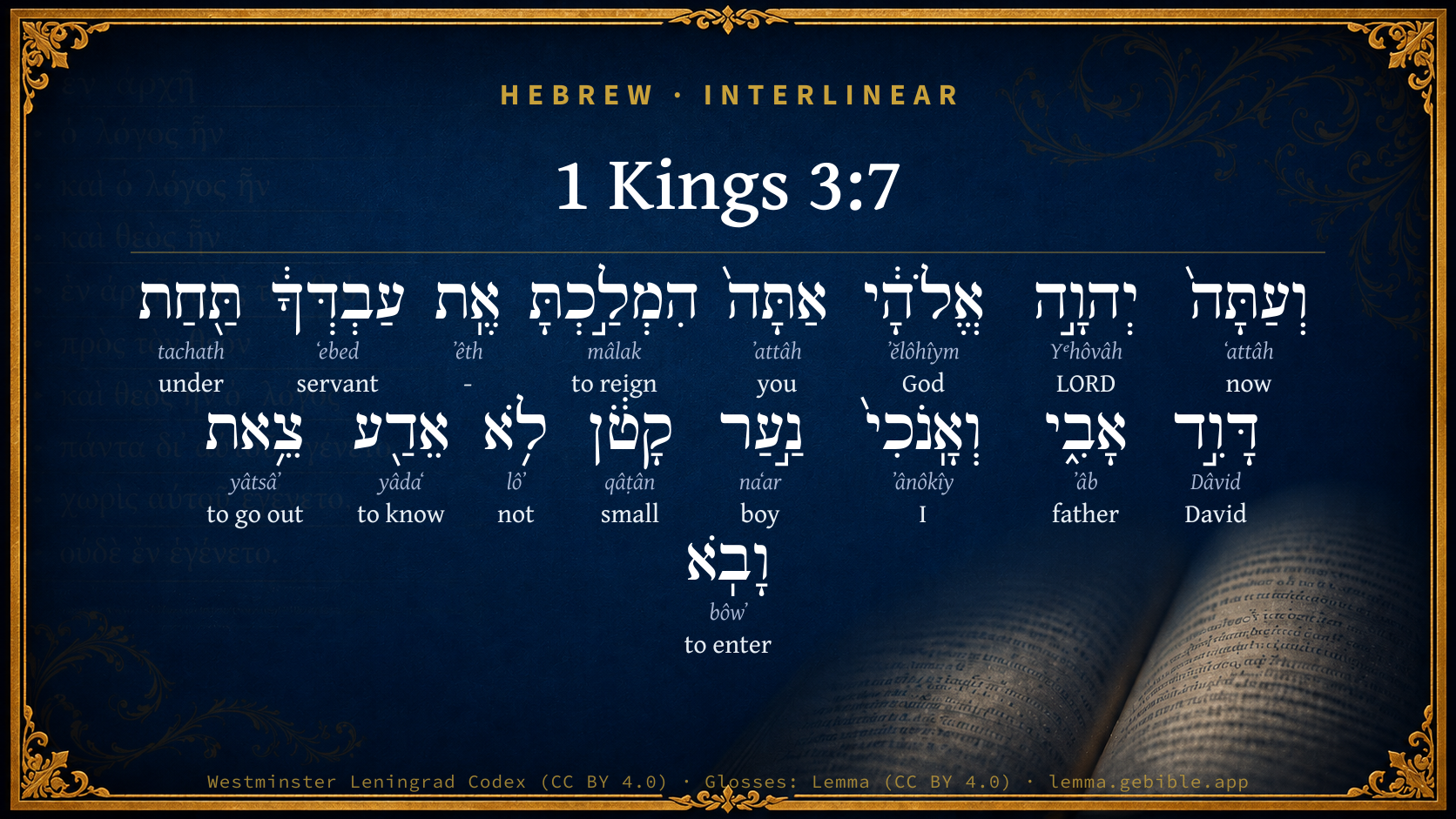
Hebrew (Westminster Leningrad Codex) 1 Kings 3:7 appears in the Hebrew Old Testament. The text above is from the Westminster Leningrad Codex. Each word links to its Strong’s number, a concise gloss, and parsing drawn from the Open Scriptures Hebrew Bible morphology. Click any word for its full Brown-Driver-Briggs (BDB) entry.
Download image
Cite this verse

1 Kings 3:7 (World English Bible). Public Domain. Lemma interlinear Bible study tool, https://lemma.gebible.app/v/1-kings/3/7.

Show BibTeX & RIS
BibTeX
RIS
English Translation
Now, Yahweh my God, you have made your servant king instead of David my father: and I am but a little child; I don't know how to go out or come in.
World English Bible · Public Domain
Download a study sheet

One document with this verse’s original text, its word-by-word gloss line, the meaning frame, cross-references with their text, attributed commentary, and full source and license credits — printable, and it pastes into notes with its structure intact.

This verse Autodidact and up

Study sheet (.html) Plain text (.txt)

A passage Seminary Student

Up to 50 verses in one chapter. A passage sheet keeps up to 6 commentary sources and 12 cross-references per verse, in the order this page ranks them, and says so on the sheet whenever that leaves anything out. Ask for a single verse and you get the Autodidact verse sheet above.

Everything on this page stays free to read, with no account — the sheet is a download of what is already on screen, not access to it.

Want to remove ads? Support Godless Engineer
Compare translations 3

The same verse in 3 English versions, stacked beneath the original-language interlinear above. Click any original word for its lexicon entry.

Each is an independent rendering of the whole verse — the interlinear is not word-aligned to these translations.

Highlighted words mark where these versions differ — a whole-verse word diff, not a word-by-word alignment.

  • World English Bible Public Domain
    Now, Yahweh my God, you have made your servant king instead of David my father: and I am but a little child; I don't know how to go out or come in.
  • King James Version Public Domain
    And now, O LORD my God, thou hast made thy servant king instead of David my father: and I am but a little child: I know not how to go out or come in.
  • unfoldingWord Literal Text CC BY-SA 4.0
    And now, Yahweh my God, you, you have made your servant reign in place of David my father, but I a little child. I do not know going out or coming in.

unfoldingWord Literal Text — © unfoldingWord, licensed CC BY-SA 4.0. Word-aligned USFM3 via Door43 (git.door43.org/unfoldingWord/en_ult).

Versions to compare (up to 4)

3 of 4 selected

Show all 18 translations

Every available English version of this verse, each an independent rendering of the whole verse.

  • World English Bible Public Domain
    Now, Yahweh my God, you have made your servant king instead of David my father: and I am but a little child; I don't know how to go out or come in.
  • Berean Standard Bible Public Domain
    And now, O LORD my God, You have made Your servant king in my father David’s place. But I am only a little child, not knowing how to go out or come in.
  • Majority Standard Bible Public Domain
    And now, O LORD my God, You have made Your servant king in my father David’s place. But I am only a little child, not knowing how to go out or come in.
  • King James Version Public Domain
    And now, O LORD my God, thou hast made thy servant king instead of David my father: and I am but a little child: I know not how to go out or come in.
  • American Standard Version (1901) Public Domain
    And now, O Jehovah my God, thou hast made thy servant king instead of David my father: and I am but a little child; I know not how to go out or come in.
  • Revised Version (1885) Public Domain
    And now, O LORD my God, thou hast made thy servant king instead of David my father: and I am but a little child; I know not how to go out or come in.
  • Geneva Bible (1599) Public Domain
    And now, O Lord my God, thou hast made thy seruant King in steade of Dauid my father: and I am but a yong childe, and know not howe to go out and in.
  • Douay-Rheims (1899) Public Domain
    And now, O Lord God, thou hast made thy servant king instead of David my father: and I am but a child, and know not how to go out and come in.
  • Young's Literal Translation Public Domain
    And now, O Jehovah my God, Thou hast caused thy servant to reign instead of David my father; and I `am' a little child, I do not know to go out and to come in;
  • Literal Standard Version CC BY-SA 4.0
    And now, O YHWH my God, You have caused Your servant to reign instead of my father David; and I [am] a little child, I do not know [how] to go out and to come in;
  • Unlocked Literal Bible CC BY-SA 4.0
    Now Yahweh my God, you have made your servant king in the place of David my father, though I am only a little child. I do not know how to go out or come in.
  • unfoldingWord Literal Text CC BY-SA 4.0
    And now, Yahweh my God, you, you have made your servant reign in place of David my father, but I a little child. I do not know going out or coming in.
  • Darby Bible Public Domain
    And now, Jehovah my God, thou hast made thy servant king instead of David my father; and I am but a little child: I know not to go out and to come in.
  • World Messianic Bible Public Domain
    Now, LORD my God, you have made your servant king instead of David my father. I am just a little child. I don’t know how to go out or come in.
  • Webster's Bible Public Domain
    And now, O LORD my God, thou hast made thy servant king instead of David my father: and I am but a little child: I know not how to go out or come in.
  • Free Bible Version CC BY-SA 4.0
    Now, Lord God, you have made me king in place of my father David. But I am like an inexperienced young boy who doesn't know what to do.
  • Bible in Basic English Public Domain
    And now, O Lord my God, you have made your servant king in the place of David my father; and I am only a young boy, with no knowledge of how to go out or come in.
  • JPS Tanakh (1917) Public Domain
    And now, O LORD my God, Thou hast made Thy servant king instead of David my father; and I am but a little child; I know not how to go out or come in.

Literal Standard Version (2020), Covenant Press — licensed CC BY-SA 4.0. Text via the HelloAO Bible API (eBible.org). Unlocked Literal Bible (unfoldingWord) — licensed CC BY-SA 4.0. Text via the HelloAO Bible API (eBible.org). unfoldingWord Literal Text — © unfoldingWord, licensed CC BY-SA 4.0. Word-aligned USFM3 via Door43 (git.door43.org/unfoldingWord/en_ult). Free Bible Version, Dr. Jonathan Gallagher — licensed CC BY-SA 4.0. Text via the HelloAO Bible API (eBible.org).

Word by word

More ways to search: Search by grammar → Find every occurrence → Compare this word →

Practice this passage: Drill this verse → Learn its vocabulary →

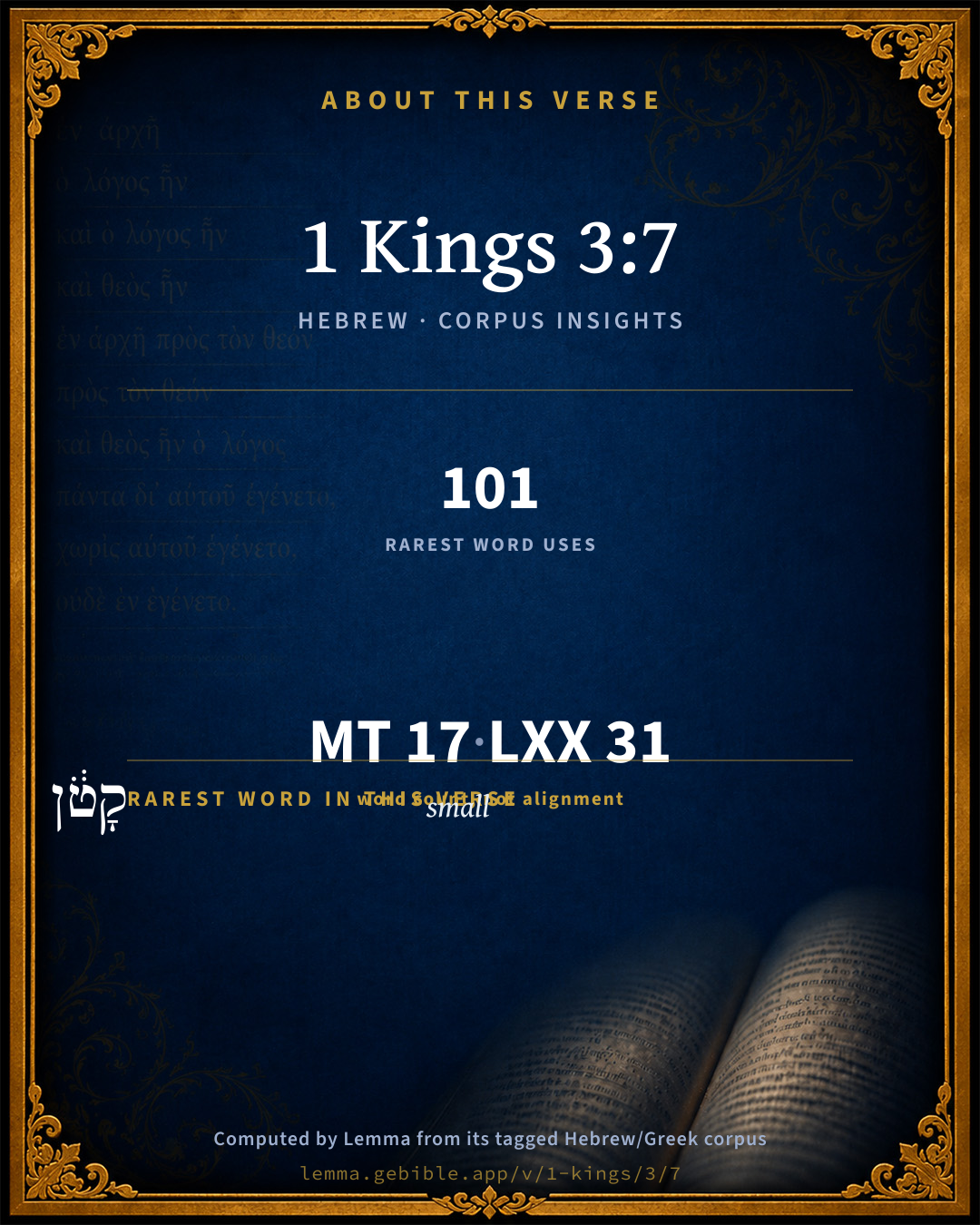
קָטֹ֔ן
qâṭân
H6996
“small”
Adjective, Adjective, Masculine, Singular, Absolute
Part of Speech
Adjective
Type
Adjective
Gender
Masculine
Number
Singular
State
Absolute
Full BDB Definition

Origin: from H6962

TWOT: 2009a , 2009b

young, small, insignificant, unimportant - small - insignificant - young - unimportant
  1. וְעַתָּה֙ ʻattâh H6258 “and · now” Conjunction + Adverb
  2. יְהוָ֣ה Yᵉhôvâh H3068 “LORD” Noun, Proper
  3. אֱלֹהָ֔י ʼĕlôhîym H430 “God(s) · my” Noun, Common, Masculine, Plural, Construct + Suffix, Personal, 1st Person, Common, Singular
  4. אַתָּה֙ ʼattâh H859 “you” Pronoun, Personal, 2nd Person, Masculine, Singular
  5. הִמְלַ֣כְתָּ mâlak H4427 “to reign” Verb, Hiphil, Perfect, 2nd Person, Masculine, Singular
  6. אֶֽת ʼêth H853 “-” Particle, Direct Object
  7. עַבְדְּךָ֔ ʻebed H5650 “servant · your” Noun, Common, Masculine, Singular, Construct + Suffix, Personal, 2nd Person, Masculine, Singular
  8. תַּ֖חַת tachath H8478 “under” Preposition
  9. דָּוִ֣ד Dâvid H1732 “David” Noun, Proper
  10. אָבִ֑י ʼâb H1 “father · my” Noun, Common, Masculine, Singular, Construct + Suffix, Personal, 1st Person, Common, Singular
  11. וְאָֽנֹכִי֙ ʼânôkîy H595 “and · I” Conjunction + Pronoun, Personal, 1st Person, Common, Singular
  12. נַ֣עַר naʻar H5288 “boy” Noun, Common, Masculine, Singular, Absolute
  13. לֹ֥א lôʼ H3808 “not” Particle, Negative
  14. אֵדַ֖ע yâdaʻ H3045 “to know” Verb, Qal, Imperfect, 1st Person, Common, Singular
  15. צֵ֥את yâtsâʼ H3318 “to go out” Verb, Qal, Infinitive Construct
  16. וָבֹֽא bôwʼ H935 “and · to enter” Conjunction + Verb, Qal, Infinitive Construct

About this verse

These counts appear in no published source. They are computed here, from the morphology-tagged text and Lemma’s own curated glosses. What Lemma adds →

17
words
17
distinct lemmas
Historical
section

Grammatical profile

  • 4 verbs
  • 6 nouns
  • 1 adjective
  • 2 pronouns
  • 1 preposition
  • 1 adverb
  • 2 particles

Verb forms

  • הִמְלַ֣כְתָּ Hiphil · Perfect
  • אֵדַ֖ע Qal · Imperfect
  • צֵ֥את Qal · Infinitive Construct
  • וָבֹֽא Qal · Infinitive Construct

Hebrew & Septuagint length

In English translation the verse runs 32 words from the Hebrew and 34 from the Septuagint (LXX English) — closely comparable.

A rough comparison of the two English renderings, which tokenize alike — not a word-level alignment.

Word counts can differ between the Hebrew and the Greek without any difference in meaning — e.g. the Hebrew direct-object marker אֵת has no separate Greek word, and Greek often adds the article ὁ.

In the original languages it is 17 Hebrew tokens and 31 Greek tokens — but the two are counted differently (Hebrew bundles its prefixes and suffixes into one token; the Greek is in lemma form), so that isn’t a like-for-like length.

Cross-references

17

Topical passages linked to 1 Kings 3:7 in the Treasury of Scripture Knowledge — connected by theme and wording, ordered by reader-vote popularity; previews shown in the World English Bible.

  • Numbers 27:17 who may go out before them, and who may come in before them, and who may lead them out, and who may bring them in; that the congregation of Yahweh not be as sheep which have no shepherd.
  • 1 Chronicles 29:1 David the king said to all the assembly, Solomon my son, whom alone God has chosen, is yet young and tender, and the work is great; for the palace is not for man, but for Yahweh God.
  • Jeremiah 1:6 Then said I, Ah, Lord Yahweh! behold, I don't know how to speak; for I am a child.
  • Matthew 18:3–4 and said, "Most assuredly I tell you, unless you turn, and become as little children, you will in no way enter into the Kingdom of Heaven.
  • 1 Samuel 18:16 But all Israel and Judah loved David; for he went out and came in before them.
  • 2 Samuel 5:2 In times past, when Saul was king over us, it was you who led out and brought in Israel: and Yahweh said to you, You shall be shepherd of my people Israel, and you shall be prince over Israel.
  • Job 32:6–8 Elihu the son of Barachel the Buzite answered, "I am young, and you are very old; Therefore I held back, and didn't dare show you my opinion.
  • Psalms 121:8 Yahweh will keep your going out and your coming in, From this time forth, and forevermore.
  • Ecclesiastes 10:16 Woe to you, land, when your king is a child, And your princes eat in the morning!
  • Daniel 2:21 He changes the times and the seasons; he removes kings, and sets up kings; he gives wisdom to the wise, and knowledge to those who have understanding;
  • Daniel 4:25 that you shall be driven from men, and your dwelling shall be with the animals of the field, and you shall be made to eat grass as oxen, and shall be wet with the dew of the sky, and seven times shall pass over you; until you know that the Most High rules in the kingdom of men, and gives it to whoever he will.
  • Daniel 4:32 and you shall be driven from men; and they dwelling shall be with the animals of the field; you shall be made to eat grass as oxen; and seven times shall pass over you; until you know that the Most High rules in the kingdom of men, and gives it to whoever he will.
  • Daniel 5:18 You king, the Most High God gave Nebuchadnezzar your father the kingdom, and greatness, and glory, and majesty:
  • Daniel 5:21 and he was driven from the sons of men, and his heart was made like the animals', and his dwelling was with the wild donkeys; he was fed with grass like oxen, and his body was wet with the dew of the sky; until he knew that the Most High God rules in the kingdom of men, and that he sets up over it whoever he will.
  • John 10:3–4 The gatekeeper opens the gate for him, and the sheep listen to his voice. He calls his own sheep by name, and leads them out.
  • John 10:9 I am the door. If anyone enters in by me, he will be saved, and will go in and go out, and will find pasture.
  • Deuteronomy 31:2 He said to them, I am one hundred twenty years old this day; I can no more go out and come in: and Yahweh has said to me, You shall not go over this Jordan.

Cross-references courtesy of OpenBible.info (CC BY 4.0).

Hebrew and Greek witnesses Masoretic Hebrew ↔ Greek Septuagint

The same verse in the two great witnesses to the Old Testament, shown verse-for-verse.

These are two independent witnesses, not word-aligned to each other, and the Septuagint is shown in lemma (dictionary) form.

Hebrew 1 Kings 3:7 Masoretic · Westminster Leningrad Codex

וְעַתָּה֙ יְהוָ֣ה אֱלֹהָ֔י אַתָּה֙ הִמְלַ֣כְתָּ אֶֽת עַבְדְּךָ֔ תַּ֖חַת דָּוִ֣ד אָבִ֑י וְאָֽנֹכִי֙ נַ֣עַר קָטֹ֔ן לֹ֥א אֵדַ֖ע צֵ֥את וָבֹֽא

Now, Yahweh my God, you have made your servant king instead of David my father: and I am but a little child; I don't know how to go out or come in.

World English Bible · Public Domain

Greek LXX 1 Kings 3:7 Septuagint · lemma form

καί νῦν κύριος ὁ θεός ἐγώ σύ δίδωμι ὁ δοῦλος σύ ἀντί δαυίδ ὁ πατήρ ἐγώ καί ἐγώ εἰμί παιδάριον μικρός καί οὐ οἶδα ὁ ἔξοδος ἐγώ καί ὁ εἴσοδος ἐγώ

And now, O Lord my God, you have appointed your servant in the room of David my father; and I am a little child, and know not my going out and my coming in.

LXX2012 (modern English Septuagint) · Public Domain

Hebrew: Westminster Leningrad Codex (CC BY 4.0). Greek: Septuagint (public domain); English from LXX2012 (modern English Septuagint) (Public Domain). How the Septuagint differs from the Hebrew →

Targum (Aramaic paraphrase)

1

The Targum is the ancient Jewish Aramaic paraphrase of the Hebrew Scriptures — an interpretive translation, not the Hebrew text itself. Onkelos (literal) and Pseudo-Jonathan (expansive) render the Torah, and Jonathan the Prophets. Coverage is partial: where no permissively-licensed English translation exists for a verse, only the Aramaic is shown. This is verse-level text, not a word-by-word alignment to the Hebrew.

  1. Targum Jonathan Prophets (Joshua–Malachi)
    וּכְעַן יְיָ אֱלֹהַי אַתְּ אַמְלִיכְתָּא יַת עַבְדָךְ תְּחוֹת דָוִד אַבָּא וַאֲנָא יַנִיק זְעֵיר לֵית אֲנָא יָדַע לְמִפַּק וּלְמֵיעַל:

    (no public-domain English translation for this verse)

    Targum Jonathan — Aramaic: “Mikraot Gedolot” (public domain). English: “Sefaria Community Translation” (CC0 1.0 (public-domain dedication)); “London "Chaldee Paraphrase," 1871” (public domain). Text via Sefaria.

Commentary

Notes on 1 Kings 3:7 from classic Christian and Jewish commentators (each source and its license shown beneath its notes). The classic Christian expositions comment on the surrounding passage and are grouped to its opening verse, so a note may address several verses; the Jewish commentaries on the Tanakh (Rashi and others) are per-verse, so they appear only where the commentator wrote on this verse.

Lemma curates 59 commentaries, every one of them public domain or Creative Commons licensed, each selected and text-cleaned for this edition rather than reprinted as found. About our sources →

Trapp's Complete Commentary

John Trapp

1Ki 3:7 And now, O LORD my God, thou hast made thy servant king instead of David my father: and I [am but] a little child: I know not [how] to go out or come in.

Ver. 7. And I am but a little child.] So he seemed to himself; though his father counted and called him a wise man, {1Ki 2:9} even before that wonderful increase of his wisdom after David’s death. See the like modesty in Agur, that great wise man. {Pro 30:2-3}

I know not how to go out or come in,] i.e., To sway this massy sceptre, to rule this great people. An allusion to captains or shepherds, or, as some think, to a little child who learneth of his mother to go out and come into the house. {a}

{a} Vatab. A Lapide.

John Trapp, A Commentary or Exposition upon All the Books of the Old and New Testament (1647–1656) — public domain. Text from a community e-Sword module.

Tyndale Open Study Notes

Tyndale Open Resources

3:7-9 The Hebrew term translated little child was often used of someone who lacked experience in his profession (“assistant,” 19:21). Solomon humbly recognized his inexperience and his need for an understanding heart. If he desired to govern the people well and render proper decisions, he knew that he needed God’s help.

Tyndale Open Study Notes — © Tyndale Open Resources, licensed CC BY-SA 4.0. Text via the HelloAO Bible API.

Geneva Bible (1599)

Geneva Bible translators

That is, to behave himself in executing this charge of ruling.

Geneva Bible (1599) marginal notes — public domain. Text via Bolls.life.

Jamieson, Fausset & Brown

Robert Jamieson, A. R. Fausset & David Brown

I am but a little child--not in age, for he had reached manhood (Kg1 2:9) and must have been at least twenty years old; but he was raw and inexperienced in matters of government.

Jamieson, Fausset & Brown — Commentary Critical and Explanatory on the Whole Bible (1871) — public domain (CC PDM 1.0). Text via the HelloAO Bible API.

Adam Clarke's Commentary

Verse 7. I know not how to go out or come in.] I am just like an infant learning to walk alone, and can neither go out nor come in without help.

Adam Clarke's Commentary on the Bible (1810–1826) — public domain. Text from a community e-Sword/MySword module.

The Cambridge Bible for Schools and Colleges

gen. ed. J. J. S. Perowne

7. I am but a little child] This is a form of expression meant to indicate want of experience, but cannot be pressed literally. What Solomon’s age may have been we have very imperfect data for judging. The ordinary chronology puts the murder of Uriah about twenty years before David’s death. If this be correct Solomon might be at this time 17 or 18 years old. Bunsen (Bibelwerk) says 22.

to go out or come in] This expression of going out and coming in is frequent in one form or another for the manner of leading one’s life, and engaging in one’s proper duties. So Joshua uses it (1Ki_14:11) of his fitness for the leadership of Israel. Moses (Deu_31:2) when he is speaking of his growing age, says he can no more go out and come in.

The Cambridge Bible for Schools and Colleges (gen. ed. J. J. S. Perowne; Cambridge University Press, 1878–1918) — public domain. Text from a community e-Sword module.

John Gill's Exposition

And now, O Lord my God, thou hast made thy servant king instead of David my father,.... Removed by death, in whose stead he reigned by the appointment of God, and through his overruling providence, notwithstanding the attempts made to prevent it, and therefore to God he ascribes it:

and I am but a little child; not in age and stature, but in knowledge and understanding; for though his father called him a wise man, and he was judged so by others, and really was one, yet in his own opinion and thought of himself such was his modesty and humility, that he was but a child as to his intellectual powers and capacity for government: some understand this of age; and the Jews commonly say he was but twelve years of age when he was anointed king, which they reckon thus; that he was born at the time that Ammon ravished Tamar, two years after which was Absalom's sheep shearing, when he slew Amnon, on which he fled to Geshur, and was there three years; here are five years; he returned thence and was at Jerusalem two years; lo, seven years; he rebelled and was slain, and after that there was a famine of three years, which make ten; and in the year following David numbered the people, which was nine or ten months in doing; the next year he died, which was the fortieth of his reign, in all twelve years; so reckon Jarchi and Kimchi; and Eupolemus, an Heathen writer (n), is express for it, who says, that David, when he had reigned forty years, delivered up the kingdom to Solomon his son, being then twelve years of age, which he must receive from the tradition of the Jews; the same is said by several of the ancient fathers, as Ignatius (o) and Jerom (p); but this cannot be fact; for, if so, his son Rehoboam must be born to him when he was but eleven years of age; See Gill on Kg1 3:5; it is best therefore to interpret this of the sense he had of the weakness of his understanding, and of his incapacity for government, as the next clause explains it:

I know not how to go out or come in; in the administration of government, to execute his office as a king, in allusion to shepherds, as kings are sometimes called, going in and out before their sheep.

(n) Apud Euseb. ut supra. (Praeparat. Evangel. l. 9. c. 30, 31, 32.) (o) Epist. ad Magnesios, p. 141. Ed. Voss. (p) Epist. Rufino & Vitali, fol. 24, 25. tom. 3.

John Gill's Exposition of the Whole Bible (1746–1763) — public domain (CC PDM 1.0). Text via the HelloAO Bible API.

Albert Barnes' Notes on the Bible

See 1Ki 2:2 note, and on the hyperbole contained in the phrase “little child,” compare Gen 43:8; Exo 33:11.

How to go out or come in - This expression is proverbial for the active conduct of affairs. (See the marginal reference.)

Albert Barnes' Notes on the Bible (1834–1885) — public domain. Text from a community e-Sword/MySword module.

Haydock's Catholic Bible Commentary

In. So as to judge with discretion, and to lead my people. (Calmet)

George Leo Haydock (1774–1849), Haydock's Catholic Family Bible and Commentary, 1859 edition — public domain. Excludes Psalms (Douay-Rheims chapter numbering differs from Protestant) and Deuterocanonical books (Catholic canon only).

Matthew Poole's English Annotations

I am but a little child; so he was in years; not as if he were now but twelve years old, as many gather from this name of child; for that name is given to Ishmael when eighteen years old, Gen 21:14,15, and to Rehoboam when forty-one years old, 2Ch 13:7, where the word is the same in the Hebrew; and before this time David calls him a wise man, 1Ki 2:9; but he was now not above twenty years old; and withal, (which he principally intends,) he was raw and unexperienced, as a child, in state affairs, and altogether unfit for so hard a task.

To go out or come in, i.e. to govern my people, and manage affairs, as that phrase signifies, Num 27:17; Deu 31:2; Jos 14:11.

Matthew Poole's English Annotations on the Holy Bible (1683–1685) — public domain. Text from a community e-Sword/MySword module.

Whedon's Commentary on the Bible

Daniel D. Whedon

7. I am but a little child — His exact age at this time is not known, but he was evidently still a youth, probably not more than twenty years of age. David, in his old age, spoke of him as “young and tender.” 1Ch_29:1. Solomon, with graceful modesty and humility, feels and acknowledges his youth and inexperience.

To go out or come in — An idiomatic expression denoting the whole official conduct of a ruler before his people. Compare Num_27:17.

Daniel D. Whedon (gen. ed.), Commentary on the Old and New Testaments (1874–1909) — public domain. Text from a community e-Sword module.

The Pulpit Commentary

And now, O Lord my Cod, thou hast made thy servant king instead of David my father; and I am but (Heb. and I...) a little child: These words are generally understood as indicating Solomon"s humility rather than his age. No doubt, there is some exaggeration in the expression, which manifestly is not to be taken au pied de la lettre; at the same time it is questionable whether such words would be used of himself by a young man of twenty, which Solomon is commonly supposed to have been. (ee 1Ki_2:2, and 1Ki_12:8) I know not how to go out or come in. The same phrase is found in the Pentateuch, Deu_28:6 Deu_31:2. Also 1Sa_18:13 2Sa_3:25 Psa_121:8. It is the formula for expressing behaviour, conduct, the outward life of man.

The Pulpit Commentary (1880–1919), ed. H.D.M. Spence-Jones & Joseph S. Exell — public domain. Text from a community e-Sword module.

John Wesley's Explanatory Notes

Child - So he was in years: not above twenty years old; and withal (which he principally intends) he was raw and unexperienced, as a child, in state affairs. Go out, &c. - To govern my people, and manage affairs.

John Wesley, Explanatory Notes Upon the Whole Bible (1754–1765) — public domain. Text via the GEBible commentary corpus.

unfoldingWord translationNotes

Door43 World Missions Community

General Information:

Solomon asks for wisdom.

your servant

Solomon speaks as if he is another person to show respect to Yahweh. AT: "me" (See: Pronouns)

I am only a little child

Solomon is saying that he is like a child who does not know as much as a father. (See: Metaphor)

I do not know how to go out or come in

This is an idiom that means Solomon does not know how to govern as king. AT: "I do not know how to be the king" or "I do not know the right way to do things as king" (See: Idiom)

For who is able to judge this great people of yours?

Solomon asks a question to emphasize that he knows that no one can judge. AT: "No one is able to judge this great people of yours." (See: Rhetorical Question)

translationWords

Yahweh

God

servant

king

David

ancestor

children

people group

chosen one

judge

discern

evil

unfoldingWord translationNotes — © Distant Shores Media and the Door43 World Missions Community, licensed CC BY-SA 4.0. Source: git.door43.org/Door43/en_tn.

Rashi

Rabbi Shlomo Yitzchaki (Rashi)

A small lad. He was twelve years old. And this is how [his age] is calculated: “And he called his name Yedidyah.” At the same time Amnon raped Tamar, as it is stated, “And it was after this, and Avsholom [the son of Dovid] had a sister.” At the end of, “two years, and Avsholom had sheep shearers,” and he killed Amnon. Avsholom fled and went to Geshur, and he remained there three years, so we have five years. Avsholom then returned to Yerusholayim, “and [Avsholom] lived in Yerusholayim two years,” so we have seven [years in the life] of Shlomo. And he [Avsholom] rebelled against his father and was killed. After this, [it states], “And there was famine in the days of Dovid [for] three years,” so we have ten [years]. In the eleventh [year] he counted the [Bnei] Yisroel, “and they scattered in all the land,” nine months. In the year of his death he instituted divisions as it is stated, “In the fortieth year of Dovid’s reign they were sought,” so we have twelve [years in the life] of King Shlomo.

Rashi on the Tanakh — English translations: “The Judaica Press complete Tanach with Rashi, translated by A. J. Rosenberg” (CC BY 4.0); “Pentateuch with Rashi's commentary by M. Rosenbaum and A.M. Silbermann, 1929-1934” (public domain); “The Metsudah Tanach series, Lakewood, N.J” (CC BY 4.0); and “The Book of Joshua, Metsudah Publications, 1997” (CC BY 4.0). Text via Sefaria.

Lesson kit

Teaching starters — assembled from the data on this page, not authored interpretation. Every prompt links to the verse data it draws on. Edit before teaching.

1 Kings, in the Historical, opens this verse with 17 words (17 distinct Hebrew lemmas). Its most distinctive word is qâṭân (“small”). A historical commentator’s framing appears above. Read the whole chapter for the surrounding context.

Discussion questions

  1. How does “small” (qâṭân) shape what this verse is saying?
  2. How does Numbers 27:17, which shares this passage’s theme, read alongside this verse?
  3. The translations on this page render this verse differently — a whole-verse word diff, not a word-by-word alignment. What might account for the different wordings?
  4. «הִמְלַ֣כְתָּ» is a Hiphil Perfect verb. How does that grammatical form shape the action described?
  5. Compare how Trapp's Complete Commentary and Tyndale Open Study Notes read this verse. Where do they agree or differ?

Things to notice

Reading settings

Reading text

Shown beneath each verse's original-language words.

Old Testament
Old Testament edition

Read the OT as the Masoretic Hebrew (MT) or the Greek Septuagint (LXX).

English shown for the Greek Septuagint (in the Hebrew ↔ Greek comparison).

Comparing translations? Open the Compare panel on any verse page to stack up to four side by side.