
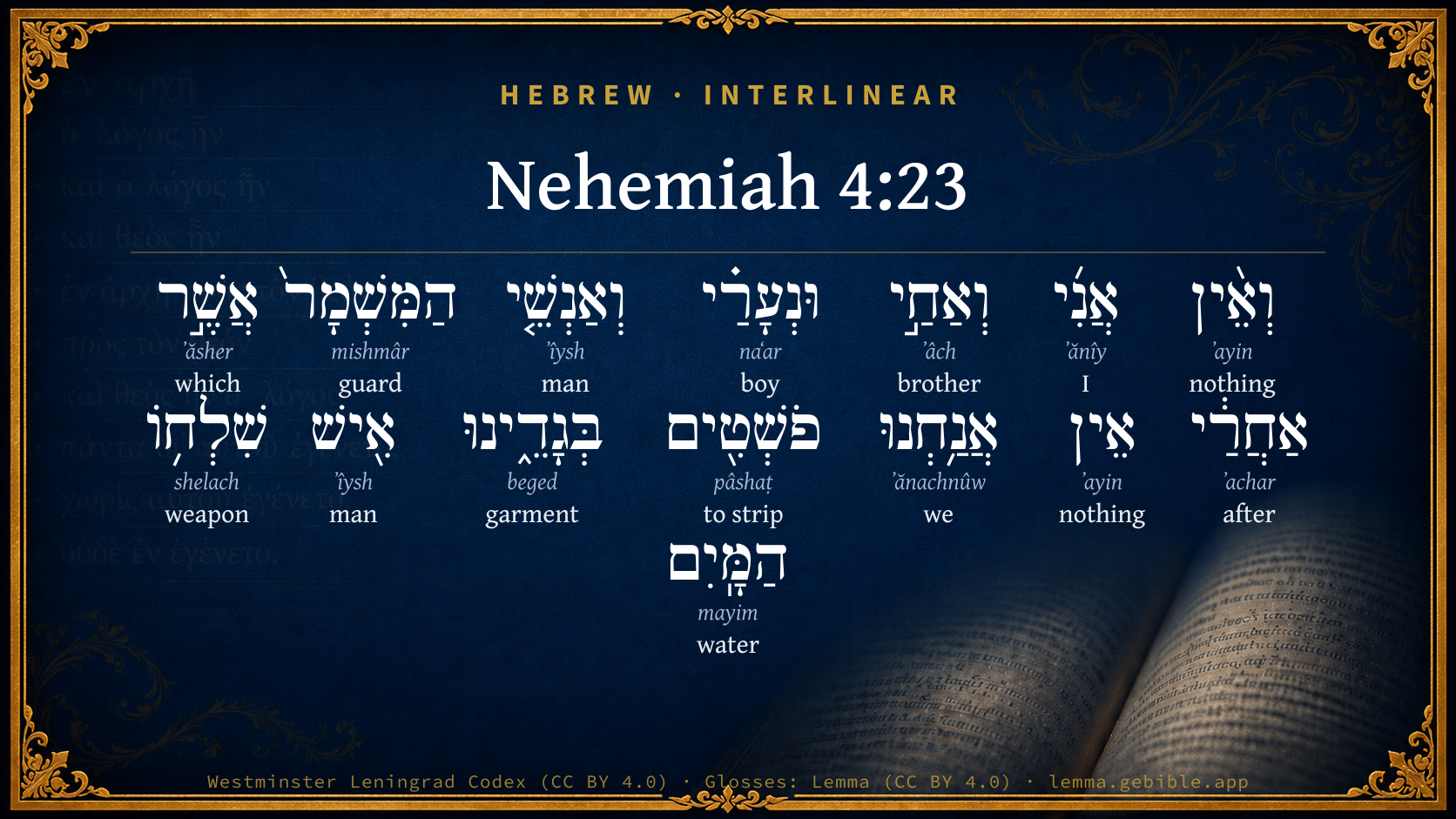
Nehemiah 4:23

Hebrew (Westminster Leningrad Codex) Nehemiah 4:23 appears in the Hebrew Old Testament. The text above is from the Westminster Leningrad Codex. Each word links to its Strong’s number, a concise gloss, and parsing drawn from the Open Scriptures Hebrew Bible morphology. Click any word for its full Brown-Driver-Briggs (BDB) entry.
Download image
Cite this verse

Nehemiah 4:23 (World English Bible). Public Domain. Lemma interlinear Bible study tool, https://lemma.gebible.app/v/nehemiah/4/23.

Show BibTeX & RIS
BibTeX
RIS
English Translation
So neither I, nor my brothers, nor my servants, nor the men of the guard who followed me, none of us put off our clothes, everyone [went with] his weapon [to] the water.
World English Bible · Public Domain
Download a study sheet

One document with this verse’s original text, its word-by-word gloss line, the meaning frame, cross-references with their text, attributed commentary, and full source and license credits — printable, and it pastes into notes with its structure intact.

This verse Autodidact and up

Study sheet (.html) Plain text (.txt)

A passage Seminary Student

Up to 50 verses in one chapter. A passage sheet keeps up to 6 commentary sources and 12 cross-references per verse, in the order this page ranks them, and says so on the sheet whenever that leaves anything out. Ask for a single verse and you get the Autodidact verse sheet above.

Everything on this page stays free to read, with no account — the sheet is a download of what is already on screen, not access to it.

Want to remove ads? Support Godless Engineer
Compare translations 3

The same verse in 3 English versions, stacked beneath the original-language interlinear above. Click any original word for its lexicon entry.

Each is an independent rendering of the whole verse — the interlinear is not word-aligned to these translations.

Highlighted words mark where these versions differ — a whole-verse word diff, not a word-by-word alignment.

  • World English Bible Public Domain
    So neither I, nor my brothers, nor my servants, nor the men of the guard who followed me, none of us put off our clothes, everyone [went with] his weapon [to] the water.
  • King James Version Public Domain
    So neither I, nor my brethren, nor my servants, nor the men of the guard which followed me, none of us put off our clothes, saving that every one put them off for washing.
  • unfoldingWord Literal Text CC BY-SA 4.0
    And neither I nor my brothers nor my young men nor the men of the guard who were behind me, none of us stripped off our clothes, or a man his weapon at the water.

unfoldingWord Literal Text — © unfoldingWord, licensed CC BY-SA 4.0. Word-aligned USFM3 via Door43 (git.door43.org/unfoldingWord/en_ult).

Versions to compare (up to 4)

3 of 4 selected

Show all 18 translations

Every available English version of this verse, each an independent rendering of the whole verse.

  • World English Bible Public Domain
    So neither I, nor my brothers, nor my servants, nor the men of the guard who followed me, none of us put off our clothes, everyone [went with] his weapon [to] the water.
  • Berean Standard Bible Public Domain
    So neither I nor my brothers nor my servants nor the guards with me changed out of our clothes; each carried his weapon, even to go for water.
  • Majority Standard Bible Public Domain
    So neither I nor my brothers nor my servants nor the guards with me changed out of our clothes; each carried his weapon, even to go for water.
  • King James Version Public Domain
    So neither I, nor my brethren, nor my servants, nor the men of the guard which followed me, none of us put off our clothes, saving that every one put them off for washing.
  • American Standard Version (1901) Public Domain
    So neither I, nor my brethren, nor my servants, nor the men of the guard that followed me, none of us put off our clothes, every one `went with' his weapon `to' the water.
  • Revised Version (1885) Public Domain
    So neither I, nor my brethren, nor my servants, nor the men of the guard which followed me, none of us put off our clothes, every one went with his weapon to the water.
  • Geneva Bible (1599) Public Domain
    So neither I, nor my brethren, nor my seruants, nor the men of the warde, (which followed me) none of vs did put off our clothes, saue euery one put them off for washing.
  • Douay-Rheims (1899) Public Domain
    Now I and my brethren, and my servants, and the watchmen that followed me, did not put off our clothes: only every man stripped himself when he was to be washed.
  • Young's Literal Translation Public Domain
    and there are none -- I and my brethren and my servants, the men of the guard who `are' after me -- there are none of us putting off our garments, each `hath' his vessel of water.
  • Literal Standard Version CC BY-SA 4.0
    and there are none—I, and my brothers, and my servants, the men of the watch who [are] after me—there are none of us putting off our garments, each [has] his vessel of water.
  • Unlocked Literal Bible CC BY-SA 4.0
    So neither I, nor my brothers, nor my servants, nor the men of the guard who followed me, none of us changed our clothes, and each of us carried his weapon, even if he went for water.
  • unfoldingWord Literal Text CC BY-SA 4.0
    And neither I nor my brothers nor my young men nor the men of the guard who were behind me, none of us stripped off our clothes, or a man his weapon at the water.
  • Darby Bible Public Domain
    And neither I, nor my brethren, nor my servants, nor the men of the guard that followed me, none of us put off our garments: every one had his weapon on his right side.
  • World Messianic Bible Public Domain
    So neither I, nor my brothers, nor my servants, nor the men of the guard who followed me took off our clothes. Everyone took his weapon to the water.
  • Webster's Bible Public Domain
    So neither I, nor my brethren, nor my servants, nor the men of the guard who followed me, none of us put off our clothes, saving that every one put them off for washing.
  • Free Bible Version CC BY-SA 4.0
    During that time none of us changed our clothes—not me or my brothers or my men or the guards with me. Everyone carried their weapons at all times, even to go for water.
  • Bible in Basic English Public Domain
    So not one of us, I or my brothers or my servants or the watchmen who were with me, took off his clothing, everyone went armed to the water.
  • JPS Tanakh (1917) Public Domain
    (4-17) So neither I, nor my brethren, nor my servants, nor the men of the guard that followed me, none of us put off our clothes, every one that went to the water had his weapon.

Literal Standard Version (2020), Covenant Press — licensed CC BY-SA 4.0. Text via the HelloAO Bible API (eBible.org). Unlocked Literal Bible (unfoldingWord) — licensed CC BY-SA 4.0. Text via the HelloAO Bible API (eBible.org). unfoldingWord Literal Text — © unfoldingWord, licensed CC BY-SA 4.0. Word-aligned USFM3 via Door43 (git.door43.org/unfoldingWord/en_ult). Free Bible Version, Dr. Jonathan Gallagher — licensed CC BY-SA 4.0. Text via the HelloAO Bible API (eBible.org).

Word by word

More ways to search: Search by grammar → Find every occurrence → Compare this word →

Practice this passage: Drill this verse → Learn its vocabulary →

שִׁלְח֥וֹ
shelach
H7973
“weapon · his”
Noun, Common, Masculine, Singular, Construct + Suffix, Personal, 3rd Person, Masculine, Singular
Part of Speech
Noun
Type
Common
Gender
Masculine
Number
Singular
State
Construct
Full BDB Definition

Origin: from H7971

TWOT: 2394a

weapon, missile, sprout - missile, weapon - sprout, shoot
  1. וְאֵ֨ין ʼayin H369 “and · nothing” Conjunction + Particle, Negative
  2. אֲנִ֜י ʼănîy H589 “I” Pronoun, Personal, 1st Person, Common, Singular
  3. וְאַחַ֣י ʼâch H251 “and · brothers · my” Conjunction + Noun, Common, Masculine, Plural, Construct + Suffix, Personal, 1st Person, Common, Singular
  4. וּנְעָרַ֗י naʻar H5288 “and · boys · my” Conjunction + Noun, Common, Masculine, Plural, Construct + Suffix, Personal, 1st Person, Common, Singular
  5. וְאַנְשֵׁ֤י ʼîysh H376 “and · men of” Conjunction + Noun, Common, Masculine, Plural, Construct
  6. הַמִּשְׁמָר֙ mishmâr H4929 “the · guard” Particle, Definite Article + Noun, Common, Masculine, Singular, Absolute
  7. אֲשֶׁ֣ר ʼăsher H834 “which” Particle, Relative
  8. אַחֲרַ֔י ʼachar H310 “after · me” Preposition + Suffix, Personal, 1st Person, Common, Singular
  9. אֵין ʼayin H369 “nothing” Particle, Negative
  10. אֲנַ֥חְנוּ ʼănachnûw H587 “we” Pronoun, Personal, 1st Person, Common, Plural
  11. פֹשְׁטִ֖ים pâshaṭ H6584 “stripping” Verb, Qal, Participle Active, Masculine, Plural, Absolute
  12. בְּגָדֵ֑ינוּ beged H899 “garments · our” Noun, Common, Masculine, Plural, Construct + Suffix, Personal, 1st Person, Common, Plural
  13. אִ֖ישׁ ʼîysh H376 “man” Noun, Common, Masculine, Singular, Absolute
  14. הַמָּֽיִם mayim H4325 “the · water(s)” Particle, Definite Article + Noun, Common, Masculine, Plural, Absolute

About this verse

These counts appear in no published source. They are computed here, from the morphology-tagged text and Lemma’s own curated glosses. What Lemma adds →

15
words
13
distinct lemmas
Historical
section

Notable vocabulary

The rarest word here is שִׁלְח֥וֹ weapon H7973 — appearing just 8 times in the whole Hebrew Bible.

Shared distinctive vocabulary

שִׁלְח֥וֹ weapon H7973 occurs in 8 verses of the Hebrew Bible. Also found in:

Grammatical profile

  • 1 verb
  • 8 nouns
  • 2 pronouns
  • 1 preposition
  • 3 particles

Verb forms

  • פֹשְׁטִ֖ים Qal · Participle Active

Repetition

Words recur within this verse — often emphatic in Hebrew:

  • וְאֵ֨ין nothing H369 ×2
  • וְאַנְשֵׁ֤י man H376 ×2

Cross-references

5

Topical passages linked to Nehemiah 4:23 in the Treasury of Scripture Knowledge — connected by theme and wording, ordered by reader-vote popularity; previews shown in the World English Bible.

  • Judges 5:11 Far from the noise of archers, in the places of drawing water, There shall they rehearse the righteous acts of Yahweh, [Even] the righteous acts of his rule in Israel. Then the people of Yahweh went down to the gates.
  • Judges 9:48 Abimelech got him up to Mount Zalmon, he and all the people who were with him; and Abimelech took an axe in his hand, and cut down a bough from the trees, and took it up, and laid it on his shoulder: and he said to the people who were with him, What you have seen me do, make haste, and do as I have done.
  • Nehemiah 5:16 Yes, also I continued in the work of this wall, neither bought we any land: and all my servants were gathered there to the work.
  • Nehemiah 7:2 that I gave my brother Hanani, and Hananiah the governor of the castle, charge over Jerusalem; for he was a faithful man, and feared God above many.
  • 1 Corinthians 15:10 But by the grace of God I am what I am. His grace which was bestowed on me was not futile, but I worked more than all of them; yet not I, but the grace of God which was with me.

Cross-references courtesy of OpenBible.info (CC BY 4.0).

Hebrew and Greek witnesses Masoretic Hebrew ↔ Greek Septuagint

The same verse in the two great witnesses to the Old Testament, shown verse-for-verse.

These are two independent witnesses, not word-aligned to each other, and the Septuagint is shown in lemma (dictionary) form.

Hebrew Nehemiah 4:23 Masoretic · Westminster Leningrad Codex

וְאֵ֨ין אֲנִ֜י וְאַחַ֣י וּנְעָרַ֗י וְאַנְשֵׁ֤י הַמִּשְׁמָר֙ אֲשֶׁ֣ר אַחֲרַ֔י אֵין אֲנַ֥חְנוּ פֹשְׁטִ֖ים בְּגָדֵ֑ינוּ אִ֖ישׁ שִׁלְח֥וֹ הַמָּֽיִם

So neither I, nor my brothers, nor my servants, nor the men of the guard who followed me, none of us put off our clothes, everyone [went with] his weapon [to] the water.

World English Bible · Public Domain

Greek LXX Structure differs

The Septuagint has no separate book of Nehemiah. Its Greek text is the second half of Esdras B (2 Esdras), chapters 11–23; Ezra is the first half (1–10).

A verse-for-verse comparison isn’t shown here because the chapters and verses don’t line up. Switch to the LXX edition with the MT / LXX toggle above to read the Greek directly.

On this verse, Adam Clarke's Commentary discusses the Septuagint’s reading. Read the note in Commentary ↓

Hebrew: Westminster Leningrad Codex (CC BY 4.0). Greek: Septuagint (public domain); English from a public-domain English Septuagint. How the Septuagint differs from the Hebrew →

Commentary

Notes on Nehemiah 4:23 from classic Christian and Jewish commentators (each source and its license shown beneath its notes). The classic Christian expositions comment on the surrounding passage and are grouped to its opening verse, so a note may address several verses; the Jewish commentaries on the Tanakh (Rashi and others) are per-verse, so they appear only where the commentator wrote on this verse.

Lemma curates 59 commentaries, every one of them public domain or Creative Commons licensed, each selected and text-cleaned for this edition rather than reprinted as found. About our sources →

Trapp's Complete Commentary

John Trapp

Neh 4:23 So neither I, nor my brethren, nor my servants, nor the men of the guard which followed me, none of us put off our clothes, [saving that] every one put them off for washing.

Ver. 23. So neither I] He said not to his men, Ite, but eamus, as Caesar did; Go ye, but go we; and as Abimelech, Jdg 9:48, What ye see me do, make haste and do accordingly. Velleius flattered when he said, Tiberius imperio maximus, exemplo maior. Nehemiah was so in very deed.

Saving that every one put them off for washing] To keep themselves clean, and from being nasty; or otherwise, to wash themselves from legal pollutions.

John Trapp, A Commentary or Exposition upon All the Books of the Old and New Testament (1647–1656) — public domain. Text from a community e-Sword module.

The Biblical Illustrator

Joseph S. Exell

Neh_4:23

None of us put off our clothes, saving that every one put them off for washing.

The necessary and the unnecessary

Some people waste all their energy in putting off and on their clothes: their whole life is a question of clothes; they cannot do anything until their clothes are right. Nehemiah showed how he distinguished between the necessary and the unnecessary. We must attend to health if we are to attend to successful toil. Time is not wasted that is spent in obeying the laws of life. (J. Parker, D. D.)

.

The Biblical Illustrator, edited by Joseph S. Exell (c. 1880s–1900s) — public domain. Text from a community e-Sword module.

Joseph Benson's Commentary

Neh 4:23. None of us put off our clothes — Neither by day nor by night, as the manner is when people go to rest, but they constantly kept themselves in readiness to fight, if any assault were made on the city. Saving that every one put them off for washing — When they were to wash and cleanse themselves from some impurity, which might befall them or their garments.

Joseph Benson's Commentary on the Old and New Testaments (1811–1818) — public domain. Text from a community e-Sword module.

Tyndale Open Study Notes

Tyndale Open Resources

4:23 Nehemiah and the other leaders were not elitists who relaxed while others toiled.

Tyndale Open Study Notes — © Tyndale Open Resources, licensed CC BY-SA 4.0. Text via the HelloAO Bible API.

Geneva Bible (1599)

Geneva Bible translators

That is, when they purified themselves, or else when they washed their clothes.

Geneva Bible (1599) marginal notes — public domain. Text via Bolls.life.

Adam Clarke's Commentary

Verse 23. None of us put off our clothes, saving that every one put them off for washing.] The Hebrew for all this is only אין אנחנו פשטים בגדינו איש שלחו המים ein anachnu poshetim begadeynu ish shilcho hammayim; which Montanus translates, Non nos exuentes vestes nostras, vir missile suum aquas; "We, not putting off our garments, a man his dart to the waters." Of this latter clause what sense can be made? Let us hear what the ancient versions say.

The Vulgate, Unusquisque tantum nudabatur ad baptismum, "Every one stripped himself for the bath."

The Septuagint omit the latter part of this clause, And there was none of us who put off his garments.

The Syriac, "None of us put off his clothes for a month each in his turn.

The Arabic, "Nor did we put off our clothes, but with our arms, at the end of a month."

There is a remarkable reading in one of De Rossi's MSS. אין אנחנו פשטים בגדינו משלחהעל המים, We did not lay aside our garments, but in order to send them to the washing. This is most likely the sense of the place.

It is curious to see how our old versions translate the place.

Coverdale: We put never of our clothes, so much as to wash ourselves. - 1535.

Becke: We put never of our clothes, so muche as to washe ourselves. - 1549.

Cardmarden: We put never of oure clothes no more than the other dyd theyr harnesse, save onely bycause of the water. - 1566.

This shows how all interpreters have been puzzled with this vexatious clause.

THE reading from De Rossi's MS., given above, is the most likely to be the true one, because it gives a good sense, which cannot be found in the Hebrew text as it now stands. The general meaning is sufficiently evident; they worked nearly day and night, only had their hours by turns for repose; this did not permit them time sufficient to undress themselves in order to take regular sleep, therefore they only put off their clothes when they were obliged to get them washed.

Adam Clarke's Commentary on the Bible (1810–1826) — public domain. Text from a community e-Sword/MySword module.

Ellicott's Commentary for English Readers

(23) Saving that every one put them off for washing.—This rendering is very improbable, as the words are simply: “every man his weapon water.” Some interpret that “each man’s weapon was his water”: evidently too subtle a turn of thought. It is best, on the whole, to supply the ellipsis: “every man went with his weapon to the water.”

A Bible Commentary for English Readers, edited by Charles John Ellicott (1878–1897) — public domain. Text from a community e-Sword module.

The Cambridge Bible for Schools and Colleges

gen. ed. J. J. S. Perowne

23. my brethren … servants … men of the guard which followed me] Nehemiah mentions in detail those in whom he had complete confidence and upon whose faithfulness the success of his project depended. These shared their leader’s vigilance and imitated his endurance. Not one of them put off his clothes the whole time that the building went on. They were prepared for an attack at any moment.

‘brethren.’ These would be the relatives of Nehemiah, cf. Neh_1:2. The whole house or clan to which he belonged staunchly supported him throughout the crisis.

‘servants’ … ‘men of the guard which followed me.’ Under these two heads Nehemiah seems to describe those whom he has mentioned in Neh_4:17 as ‘my servants.’ He distinguishes here between his personal attendants consisting of Jewish retainers, and the bodyguard consisting chiefly of foreigners allotted him as governor by the Persian king.

saving that every one put them off for washing] R.V. every one went with his weapon to the water. R.V. marg. ‘The text is probably faulty.’ The clause has occasioned great difficulty. Literally rendered the words run, ‘each one his weapon the water.’ The LXX. omit the words, probably from inability to discover their meaning. The error in the text is therefore of very early date. The Syriac seems to have conjectured ‘days’ for ‘water.’

(a) The A.V. follows the conjecture of the Vulg. ‘unusquisque tantum nudabatur ad baptismum,’ according to which the Hebrew word for ‘his weapon’ becomes by a change of vocalization a verb = ‘they sent (i.e. cast off) each one his clothes for the water,’ i.e. in order to wash. The Hebrew however could not possibly bear this very strained interpretation.

(b) Another old rendering is ‘each one his weapon was (in the place of, or equivalent to) water,’ i.e. ‘instead of washing they had each to stand fast to their arms,’ is equally improbable.

(c) Another rendering ‘each one had (by his side) his weapon (and) his (draught of) water’ gives intelligible sense, but not such as can be justified by the original.

(d) Ewald’s rendering, ‘the taking off of each man’s clothes was for water,’ i.e. ‘to satisfy his necessities, not to lie down to rest,’ seems very uncalled for. It is greatly to be questioned whether Nehemiah even ‘in his rough and open style’ would have introduced such an allusion or in such words. (Ewald, Hist. of Isr. vol. v. p. 156, note 1, Eng. Transl.).

(e) Some moderns rendering ‘his weapon’ (shil’kho) as if it were the verb (shâl’khû) translate ‘they sent each one for water.’ They could not leave their post, and had to have the necessaries of life brought to them where they stood. This use of ‘send’ as equivalent to ‘send for,’ is scarcely supported by 2Sa_15:12, since here a thing and not a person is the object of the verb. Others, reading ‘shâl’khû, render, ‘Every one gave up the use of water,’ a quite inadmissible translation.

(f) The R.V. rendering which introduces the words ‘went with … to’ makes good sense of the clause, but follows very unnaturally upon ‘none of us put off our clothes,’ neither stating an exception nor introducing a cognate idea.

(g) A good conjectural emendation of the text gives the sense ‘each one remained with his weapon in his hand’ (or ‘in his right hand’).

(h) But it is probable that the error of the text is due to the accidental omission of certain words. We expect some statement of the length of time during which Nehemiah and his followers continued without retiring to rest. Perhaps the clause may have run ‘each one with his weapon in his hand for a full month of days.’ The Syriac version ‘we will not put off our clothes during a month of days’ agrees with this suggestion, and the Arabic gives a similar rendering, ‘till the end of a month and days.’

The Cambridge Bible for Schools and Colleges (gen. ed. J. J. S. Perowne; Cambridge University Press, 1878–1918) — public domain. Text from a community e-Sword module.

John Gill's Exposition

So neither I, nor my brethren,.... The nobles and rulers:

nor my servants; his domestic servants that waited upon him:

nor the men of the guard which followed me; his bodyguard, which attended him as a commissioner of the king of Persia for state and grandeur:

none of us put off our clothes; at night when they laid themselves down to sleep, but laid in, them, that they might be ready upon an alarm made:

saving that everyone put them off for washing; not for common washing, because dirty, but for washing on account of ceremonial uncleanness, which required washing both of bodies and garments, see Lev 15:5, &c. and the Vulgate Latin version expresses it by baptism, as the apostle calls such ceremonial ablutions in Heb 6:2. It is in the margin of our Bibles, "everyone went with his weapon for water"; when he went to Siloam, or any other place, for water, he took a weapon with him to defend himself upon occasion; which is no bad sense of the words. Noldius (g) renders the words, "everyone with his weapon (and) water"; both were at his bolster, ready, if wanted, see Sa1 26:11.

(g) Ebr. Concord. Partic. p. 322.

Next: Nehemiah Chapter 5

John Gill's Exposition of the Whole Bible (1746–1763) — public domain (CC PDM 1.0). Text via the HelloAO Bible API.

Albert Barnes' Notes on the Bible

Saving ... - The text here is probably unsound. It yields no satisfactory sense. See the margin.

Albert Barnes' Notes on the Bible (1834–1885) — public domain. Text from a community e-Sword/MySword module.

Haydock's Catholic Bible Commentary

Clothes, even to sleep. --- Only. Septuagint (Complutensian), "man and his arms to the water." (Haydock) --- They went armed to fetch water; (Malvenda) or they had their armour and water always at hand. (Junius, &c.) --- Hebrew, "each kept his dart at the water." It may have various senses. (Calmet) --- Protestants agree with the Vulgate, "saving that every one put them off for washing" (Haydock) them, or themselves. (Tirinus)

George Leo Haydock (1774–1849), Haydock's Catholic Family Bible and Commentary, 1859 edition — public domain. Excludes Psalms (Douay-Rheims chapter numbering differs from Protestant) and Deuterocanonical books (Catholic canon only).

Matthew Poole's English Annotations

None of us put off our clothes; neither by day, nor by night, as the manner is when we go to bed; they constantly kept themselves in a readiness for fighting.

Saving that every one put them off for washing; when they were to wash and cleanse themselves from some natural or moral impurity, which might befall them or their garments.

Matthew Poole's English Annotations on the Holy Bible (1683–1685) — public domain. Text from a community e-Sword/MySword module.

Whedon's Commentary on the Bible

Daniel D. Whedon

23. Nor my brethren — Men of his own tribe and near kinsmen.

Nor my servants — See note on Neh_4:16.

Nor the men of the guard which followed me — This may refer to the persons mentioned in the preceding verse, who were retained in Jerusalem as a guard; or to a special bodyguard of Nehemiah, composed of the captains and horsemen who came up with him from Persia, (Neh_2:9,) and still followed him, or were behind him, to do his bidding.

None of us put off our clothes — Such was their constant wakefulness and watchfulness.

Saving that every one put them off for washing — Such is the meaning which the Vulgate and a number of expositors put upon the Hebrew, אישׁ שׁלחו המים. But these words contain in themselves no such meaning, and there is reason to suspect a corruption in the text. Literally, they read, a man, his weapons, the waters, and there is no connective to decide the meaning. The following are the principal conjectures: 1. That waters here are to be taken as a euphemism for a call of nature, and the sense is, that every man kept his weapons by him even when attending to a call of nature. 2. The marginal reading, that every one who went for water to the springs or wells carried his weapon along. 3. Instead of המים, the waters, we should read בידו, in his hand. Then it would smoothly read, every one (having) his weapon in his hand. 4. Instead of המים, read המינו, his right, when the sense would be, every one with his weapon on his right; that is, ready for immediate action in case of attack. This variety of conjectures sufficiently indicates that some connectives must have fallen out of the text.

Daniel D. Whedon (gen. ed.), Commentary on the Old and New Testaments (1874–1909) — public domain. Text from a community e-Sword module.

The Pulpit Commentary

My brethren. Actual brothers probably. That Nehemiah had brothers appears from Neh_1:2; that one of them, Hanani, had accompanied him to Jerusalem is evident from Neh_7:2. My servants. See above, ver. 16. The men of the guard that followed me. As governor, Nehemiah would maintain a body-guard, in addition to his band of slaves. Saving that every one put them off for washing. So the Vulgate: "Unnsquisque tantum nudabatur ad baptismum;" but it is at least doubtful whether the Hebrew words can possibly have this meaning. The most natural and literal sense of them is that given by Maurer and Rambach man"s weapon was his water;" the supposed connection of the clause with the preceding being, "No one took off his clothes," not even for the bath no one bathed; "a man"s only bath was his weapon." Some critics, however, defend the rendering of the A. V; others take the words in the same way, but explain the term "water" differently, of a natural want (Ewald, Stanley); while many regard the text as unsound, and propose emendations. None, however, that has as yet been proposed is satisfactory.

The Pulpit Commentary (1880–1919), ed. H.D.M. Spence-Jones & Joseph S. Exell — public domain. Text from a community e-Sword module.

John Wesley's Explanatory Notes

Washing - When they were to wash and cleanse themselves from some impurity, which might befall them or their garments.

John Wesley, Explanatory Notes Upon the Whole Bible (1754–1765) — public domain. Text via the GEBible commentary corpus.

Lesson kit

Teaching starters — assembled from the data on this page, not authored interpretation. Every prompt links to the verse data it draws on. Edit before teaching.

Nehemiah, in the Historical, opens this verse with 15 words (13 distinct Hebrew lemmas). Its most distinctive word is shelach (“weapon”). A historical commentator’s framing appears above. Read the whole chapter for the surrounding context.

Discussion questions

  1. The word shelach carries the sense “weapon.” How does it shape the verse?
  2. 2 Chronicles 23:10 shares the word «weapon» with this verse. How do the two illuminate each other?
  3. “nothing” occurs 2× in this one verse. What is the effect of the repetition?
  4. The translations on this page render this verse differently — a whole-verse word diff, not a word-by-word alignment. What might account for the different wordings?
  5. The verb «פֹשְׁטִ֖ים» is Qal Participle Active. How does its form color the action?
  6. Reading how Trapp's Complete Commentary and The Biblical Illustrator read this verse, where do the two commentators agree and where do they part?

Things to notice

Reading settings

Reading text

Shown beneath each verse's original-language words.

Old Testament
Old Testament edition

Read the OT as the Masoretic Hebrew (MT) or the Greek Septuagint (LXX).

English shown for the Greek Septuagint (in the Hebrew ↔ Greek comparison).

Comparing translations? Open the Compare panel on any verse page to stack up to four side by side.