
2 Kings 5:22

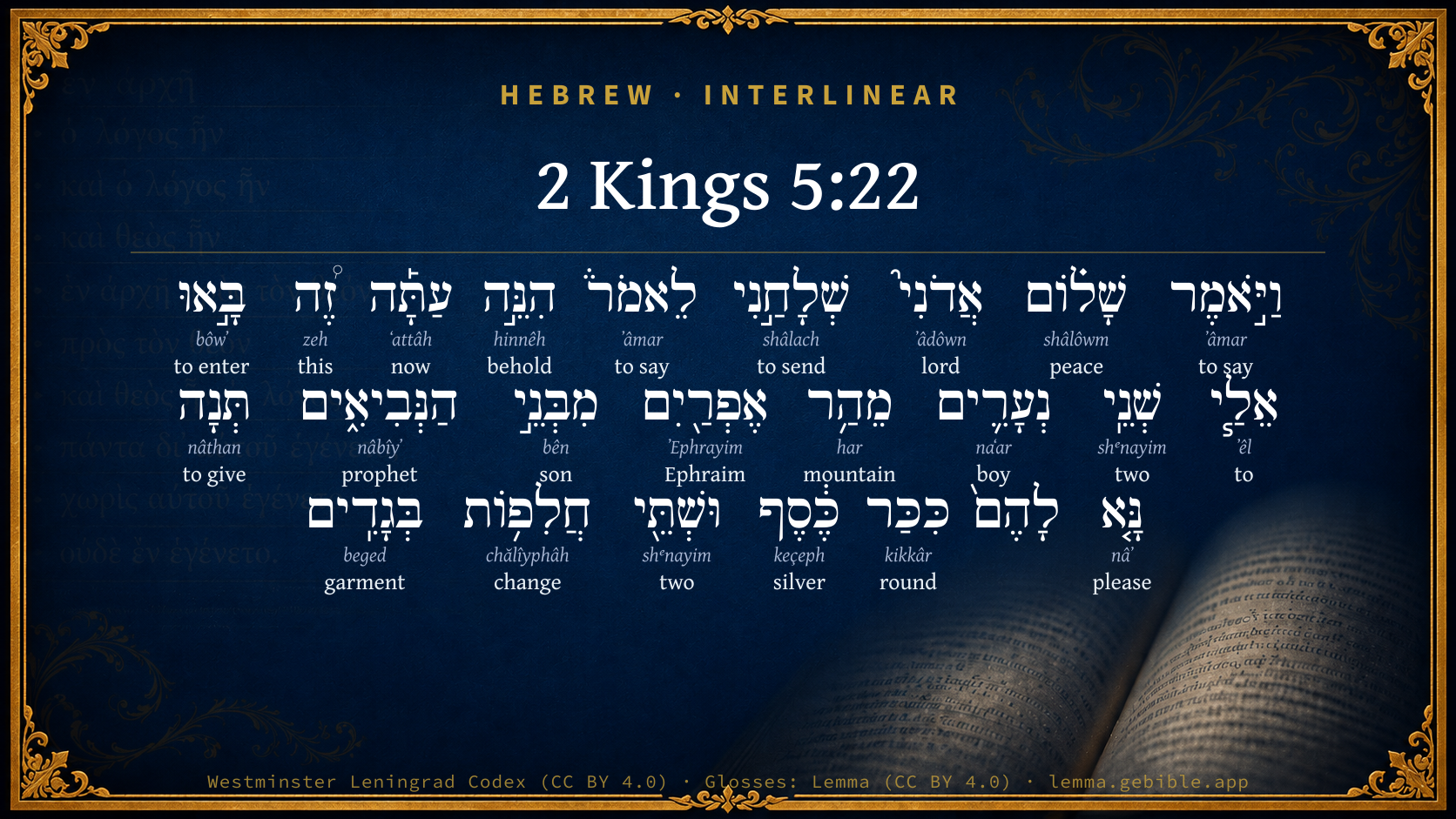
Hebrew (Westminster Leningrad Codex) 2 Kings 5:22 appears in the Hebrew Old Testament. The text above is from the Westminster Leningrad Codex. Each word links to its Strong’s number, a concise gloss, and parsing drawn from the Open Scriptures Hebrew Bible morphology. Click any word for its full Brown-Driver-Briggs (BDB) entry.
Download image
Cite this verse

2 Kings 5:22 (World English Bible). Public Domain. Lemma interlinear Bible study tool, https://lemma.gebible.app/v/2-kings/5/22.

Show BibTeX & RIS
BibTeX
RIS
English Translation
He said, All is well. My master has sent me, saying, Behold, even now there are come to me from the hill-country of Ephraim two young men of the sons of the prophets; please give them a talent of silver, and two changes of clothing.
World English Bible · Public Domain
Download a study sheet

One document with this verse’s original text, its word-by-word gloss line, the meaning frame, cross-references with their text, attributed commentary, and full source and license credits — printable, and it pastes into notes with its structure intact.

This verse Autodidact and up

Study sheet (.html) Plain text (.txt)

A passage Seminary Student

Up to 50 verses in one chapter. A passage sheet keeps up to 6 commentary sources and 12 cross-references per verse, in the order this page ranks them, and says so on the sheet whenever that leaves anything out. Ask for a single verse and you get the Autodidact verse sheet above.

Everything on this page stays free to read, with no account — the sheet is a download of what is already on screen, not access to it.

Want to remove ads? Support Godless Engineer
Compare translations 3

The same verse in 3 English versions, stacked beneath the original-language interlinear above. Click any original word for its lexicon entry.

Each is an independent rendering of the whole verse — the interlinear is not word-aligned to these translations.

Highlighted words mark where these versions differ — a whole-verse word diff, not a word-by-word alignment.

  • World English Bible Public Domain
    He said, All is well. My master has sent me, saying, Behold, even now there are come to me from the hill-country of Ephraim two young men of the sons of the prophets; please give them a talent of silver, and two changes of clothing.
  • King James Version Public Domain
    And he said, All is well. My master hath sent me, saying, Behold, even now there be come to me from mount Ephraim two young men of the sons of the prophets: give them, I pray thee, a talent of silver, and two changes of garments.
  • unfoldingWord Literal Text CC BY-SA 4.0
    And he said, “Peace. My master sent me, saying, ‘Behold, even now two young men from the sons of the prophets have come to me from the hill country of Ephraim. Please give to them a kikkar of silver and two changes of clothes.’”

unfoldingWord Literal Text — © unfoldingWord, licensed CC BY-SA 4.0. Word-aligned USFM3 via Door43 (git.door43.org/unfoldingWord/en_ult).

Versions to compare (up to 4)

3 of 4 selected

Show all 18 translations

Every available English version of this verse, each an independent rendering of the whole verse.

  • World English Bible Public Domain
    He said, All is well. My master has sent me, saying, Behold, even now there are come to me from the hill-country of Ephraim two young men of the sons of the prophets; please give them a talent of silver, and two changes of clothing.
  • Berean Standard Bible Public Domain
    “Everything is all right,” Gehazi replied. “My master has sent me to say, ‘I have just now discovered that two young men from the sons of the prophets have come to me from the hill country of Ephraim. Please give them a talent of silver and two sets of clothing.’”
  • Majority Standard Bible Public Domain
    “Everything is all right,” Gehazi replied. “My master has sent me to say, ‘Look, two young men from the sons of the prophets have just now come to me from the hill country of Ephraim. Please give them a talent of silver and two sets of clothing.’”
  • King James Version Public Domain
    And he said, All is well. My master hath sent me, saying, Behold, even now there be come to me from mount Ephraim two young men of the sons of the prophets: give them, I pray thee, a talent of silver, and two changes of garments.
  • American Standard Version (1901) Public Domain
    And he said, All is well. My master hath sent me, saying, Behold, even now there are come to me from the hill-country of Ephraim two young men of the sons of the prophets; give them, I pray thee, a talent of silver, and two changes of raiment.
  • Revised Version (1885) Public Domain
    And he said, All is well. My master hath sent me, saying, Behold, even now there be come to me from the hill country of Ephraim two young men of the sons of the prophets; give them, I pray thee, a talent of silver, and two changes of raiment.
  • Geneva Bible (1599) Public Domain
    And he answered, All is well: my master hath set me, saying, Behold, there be come to me, euen nowe from mount Ephraim two yong men of the children of the Prophets: giue them, I pray thee, a talent of siluer, and two change of garmets.
  • Douay-Rheims (1899) Public Domain
    And he said: Well: my master hath sent me to thee, saying: Just now there are come to me from mount Ephraim, two young men of the sons of the prophets: give them a talent of silver, and two changes of garments.
  • Young's Literal Translation Public Domain
    And he saith, `Peace; my lord hath sent me, saying, Lo, now, this, come unto me have two young men from the hill-country of Ephraim, of the sons of the prophets; give, I pray thee, to them, a talent of silver, and two changes of garments.'
  • Literal Standard Version CC BY-SA 4.0
    And he says, “Peace; my lord has sent me, saying, Behold, now, this, two young men of the sons of the prophets have come to me from the hill-country of Ephraim; please give a talent of silver and two changes of garments to them.”
  • Unlocked Literal Bible CC BY-SA 4.0
    Gehazi said, “Everything is alright. My master has sent me, saying, 'See, now there have come to me from the hill country of Ephraim two young men of the sons of the prophets. Please give them a talent of silver and two changes of clothes.'”
  • unfoldingWord Literal Text CC BY-SA 4.0
    And he said, “Peace. My master sent me, saying, ‘Behold, even now two young men from the sons of the prophets have come to me from the hill country of Ephraim. Please give to them a kikkar of silver and two changes of clothes.’”
  • Darby Bible Public Domain
    And he said, All is well. My master has sent me saying, Behold, even now there are come to me from mount Ephraim two young men of the sons of the prophets; give them, I pray thee, a talent of silver, and two changes of raiment.
  • World Messianic Bible Public Domain
    He said, “All is well. My master has sent me, saying, ‘Behold, even now two young men of the sons of the prophets have come to me from the hill country of Ephraim. Please give them a talent of silver and two changes of clothing.’”
  • Webster's Bible Public Domain
    And he said, All is well. My master hath sent me, saying, Behold, even now there have come to me from mount Ephraim two young men of the sons of the prophets: give them, I pray thee, a talent of silver, and two changes of garments.
  • Free Bible Version CC BY-SA 4.0
    “Everything's fine,” Gehazi replied. “My master sent me to tell you, ‘I've just found out that two young men have arrived to see me from the sons of the prophets who live in the hill country of Ephraim. Please let them have a talent of silver and two sets of clothing.’”
  • Bible in Basic English Public Domain
    And he said, All is well: but my master has sent me, saying, Even now, two young men of the sons of the prophets have come to me from the hill-country of Ephraim; will you give me a talent of silver and two changes of clothing for them?
  • JPS Tanakh (1917) Public Domain
    And he said: 'All is well. My master hath sent me, saying: Behold, even now there are come to me from the hill-country of Ephraim two young men of the sons of the prophets; give them, I pray thee, a talent of silver, and two changes of raiment.'

Literal Standard Version (2020), Covenant Press — licensed CC BY-SA 4.0. Text via the HelloAO Bible API (eBible.org). Unlocked Literal Bible (unfoldingWord) — licensed CC BY-SA 4.0. Text via the HelloAO Bible API (eBible.org). unfoldingWord Literal Text — © unfoldingWord, licensed CC BY-SA 4.0. Word-aligned USFM3 via Door43 (git.door43.org/unfoldingWord/en_ult). Free Bible Version, Dr. Jonathan Gallagher — licensed CC BY-SA 4.0. Text via the HelloAO Bible API (eBible.org).

Word by word

More ways to search: Search by grammar → Find every occurrence → Compare this word →

Practice this passage: Drill this verse → Learn its vocabulary →

חֲלִפ֥וֹת
chălîyphâh
H2487
“changes of”
Noun, Common, Feminine, Plural, Construct
Part of Speech
Noun
Type
Common
Gender
Feminine
Number
Plural
State
Construct
Full BDB Definition

Origin: from H2498

TWOT: 666c

a change, change (of garments), replacement - change (of raiment) - relays - relief (from death) - changing, varying (course of life)
  1. וַיֹּ֣אמֶר ʼâmar H559 “and · to say” Conjunction + Verb, Qal, Sequential Imperfect, 3rd Person, Masculine, Singular
  2. שָׁל֗וֹם shâlôwm H7965 “peace” Noun, Common, Masculine, Singular, Absolute
  3. אֲדֹנִי֮ ʼâdôwn H113 “lord · my” Noun, Common, Masculine, Singular, Construct + Suffix, Personal, 1st Person, Common, Singular
  4. שְׁלָחַ֣נִי shâlach H7971 “to send · me” Verb, Qal, Perfect, 3rd Person, Masculine, Singular + Suffix, Personal, 1st Person, Common, Singular
  5. לֵאמֹר֒ ʼâmar H559 “to say” Preposition + Verb, Qal, Infinitive Construct
  6. הִנֵּ֣ה hinnêh H2009 “behold” Particle, Demonstrative
  7. עַתָּ֡ה ʻattâh H6258 “now” Adverb
  8. זֶ֠ה zeh H2088 “this” Pronoun, Demonstrative, Masculine, Singular
  9. בָּ֣אוּ bôwʼ H935 “to enter” Verb, Qal, Perfect, 3rd Person, Common, Plural
  10. אֵלַ֧י ʼêl H413 “to · me” Preposition + Suffix, Personal, 1st Person, Common, Singular
  11. שְׁנֵֽי shᵉnayim H8147 “two” Adjective, Cardinal number, Masculine, Dual, Construct
  12. נְעָרִ֛ים naʻar H5288 “boys” Noun, Common, Masculine, Plural, Absolute
  13. מֵהַ֥ר har H2022 “from · mountain of” Preposition + Noun, Common, Masculine, Singular, Construct
  14. אֶפְרַ֖יִם ʼEphrayim H669 “Ephraim” Noun, Proper
  15. מִבְּנֵ֣י bên H1121 “from · sons of” Preposition + Noun, Common, Masculine, Plural, Construct
  16. הַנְּבִיאִ֑ים nâbîyʼ H5030 “the · prophets” Particle, Definite Article + Noun, Common, Masculine, Plural, Absolute
  17. תְּנָה nâthan H5414 “give” Verb, Qal, Imperative, 2nd Person, Masculine, Singular + Suffix, h
  18. נָּ֤א nâʼ H4994 “please” Particle, Interjection
  19. כִּכַּר kikkâr H3603 “round of” Noun, Common, Both, Singular, Construct
  20. כֶּ֔סֶף keçeph H3701 “silver” Noun, Common, Masculine, Singular, Absolute
  21. וּשְׁתֵּ֖י shᵉnayim H8147 “and · two” Conjunction + Adjective, Cardinal number, Feminine, Dual, Construct
  22. בְּגָדִֽים beged H899 “garments” Noun, Common, Masculine, Plural, Absolute

About this verse

These counts appear in no published source. They are computed here, from the morphology-tagged text and Lemma’s own curated glosses. What Lemma adds →

24
words
21
distinct lemmas
Historical
section

Notable vocabulary

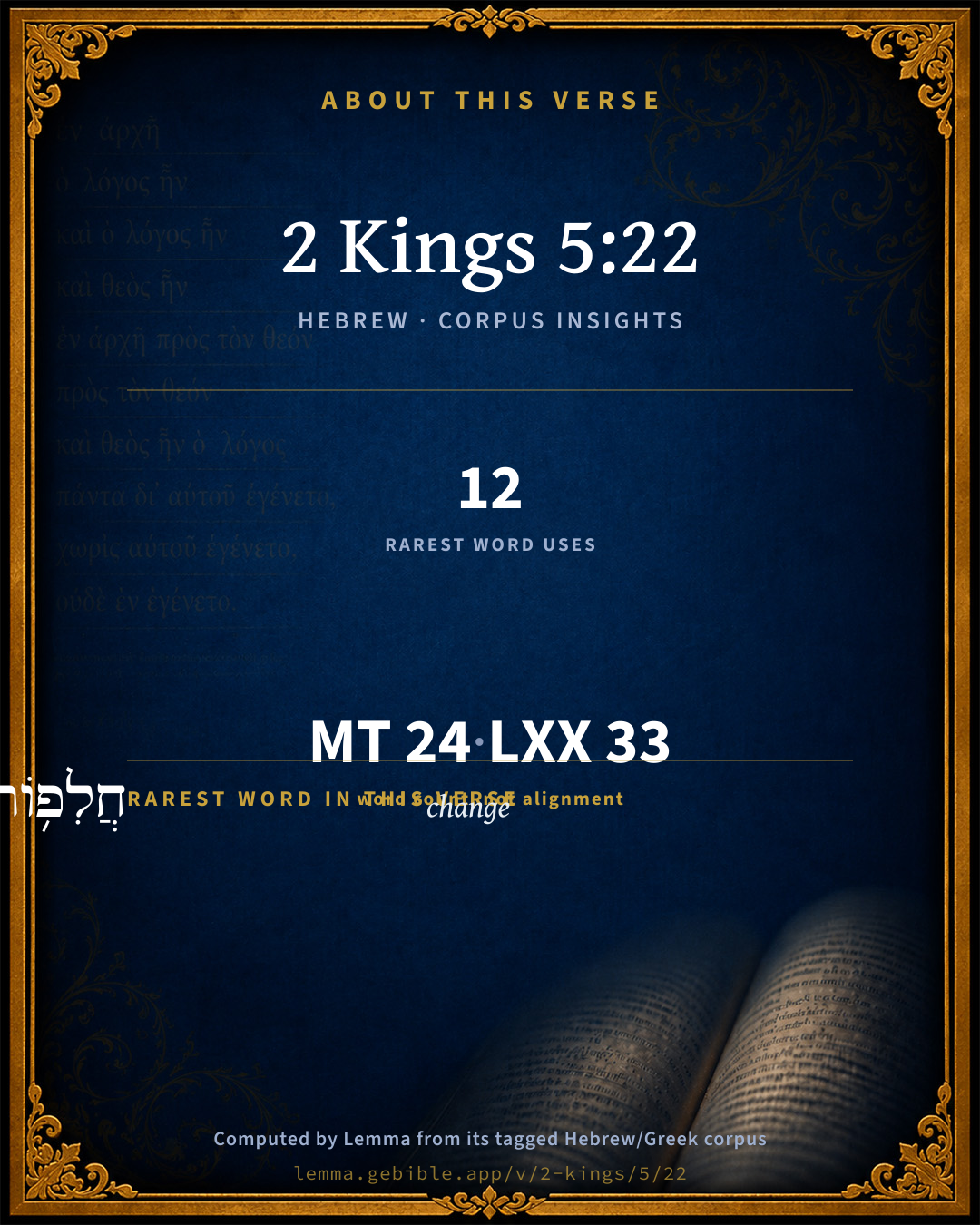
The rarest word here is חֲלִפ֥וֹת change H2487 — appearing just 12 times in the whole Hebrew Bible.

Shared distinctive vocabulary

חֲלִפ֥וֹת change H2487 occurs in 11 verses of the Hebrew Bible. Also found in:

Grammatical profile

  • 5 verbs
  • 11 nouns
  • 2 adjectives
  • 1 pronoun
  • 2 prepositions
  • 1 adverb
  • 2 particles

Verb forms

  • וַיֹּ֣אמֶר Qal · Sequential Imperfect
  • שְׁלָחַ֣נִי Qal · Perfect
  • לֵאמֹר֒ Qal · Infinitive Construct
  • בָּ֣אוּ Qal · Perfect
  • תְּנָה Qal · Imperative

Repetition

Words recur within this verse — often emphatic in Hebrew:

  • וַיֹּ֣אמֶר to say H559 ×2
  • שְׁנֵֽי two H8147 ×2

Hebrew & Septuagint length

In English translation the verse runs 45 words from the Hebrew and 45 from the Septuagint (LXX English) — the same length.

A rough comparison of the two English renderings, which tokenize alike — not a word-level alignment.

Word counts can differ between the Hebrew and the Greek without any difference in meaning — e.g. the Hebrew direct-object marker אֵת has no separate Greek word, and Greek often adds the article ὁ.

In the original languages it is 24 Hebrew tokens and 33 Greek tokens — but the two are counted differently (Hebrew bundles its prefixes and suffixes into one token; the Greek is in lemma form), so that isn’t a like-for-like length.

Cross-references

14

Topical passages linked to 2 Kings 5:22 in the Treasury of Scripture Knowledge — connected by theme and wording, ordered by reader-vote popularity; previews shown in the World English Bible.

  • 2 Kings 5:5 The king of Syria said, Go now, and I will send a letter to the king of Israel. He departed, and took with him ten talents of silver, and six thousand [pieces] of gold, and ten changes of clothing.
  • Jeremiah 9:5 They will deceive everyone his neighbor, and will not speak the truth: they have taught their tongue to speak lies; they weary themselves to commit iniquity.
  • John 8:44 You are of your Father, the devil, and you want to do the desires of your father. He was a murderer from the beginning, and doesn't stand in the truth, because there is no truth in him. When he speaks a lie, he speaks on his own; for he is a liar, and the father of it.
  • Acts 5:3–4 But Peter said, "Ananias, why has Satan filled your heart to lie to the Holy Spirit, and to keep back part of the price of the land?
  • Revelation 21:8 But for the cowardly, unbelieving, sinners, abominable, murderers, sexually immoral, sorcerers, idolaters, and all liars, their part is in the lake that burns with fire and sulfur, which is the second death."
  • Exodus 38:24–28 All the gold that was used for the work in all the work of the sanctuary, even the gold of the offering, was twenty-nine talents, and seven hundred thirty shekels, after the shekel of the sanctuary.
  • Joshua 24:33 Eleazar the son of Aaron died; and they buried him in the hill of Phinehas his son, which was given him in the hill-country of Ephraim.
  • 1 Kings 13:18 He said to him, I also am a prophet as you are; and an angel spoke to me by the word of Yahweh, saying, Bring him back with you into your house, that he may eat bread and drink water. [But] he lied to him.
  • 1 Kings 20:35 A certain man of the sons of the prophets said to his fellow by the word of Yahweh, Please strike me. The man refused to strike him.
  • 1 Kings 20:39 As the king passed by, he cried to the king; and he said, Your servant went out into the midst of the battle; and, behold, a man turned aside, and brought a man to me, and said, Keep this man: if by any means he be missing, then shall your life be for his life, or else you shall pay a talent of silver.
  • 2 Kings 2:3 The sons of the prophets who were at Bethel came forth to Elisha, and said to him, "Do you know that Yahweh will take away your master from your head today?" He said, "Yes, I know it; hold your peace."
  • Isaiah 59:3 For your hands are defiled with blood, and your fingers with iniquity; your lips have spoken lies, your tongue mutters wickedness.
  • Jeremiah 9:3 They bend their tongue, [as it were] their bow, for falsehood; and they are grown strong in the land, but not for truth: for they proceed from evil to evil, and they don't know me, says Yahweh.
  • 2 Corinthians 12:16–18 But be it so, I did not myself burden you. But, being crafty, I caught you with deception.

Cross-references courtesy of OpenBible.info (CC BY 4.0).

Hebrew and Greek witnesses Masoretic Hebrew ↔ Greek Septuagint

The same verse in the two great witnesses to the Old Testament, shown verse-for-verse.

These are two independent witnesses, not word-aligned to each other, and the Septuagint is shown in lemma (dictionary) form.

Hebrew 2 Kings 5:22 Masoretic · Westminster Leningrad Codex

וַיֹּ֣אמֶר שָׁל֗וֹם אֲדֹנִי֮ שְׁלָחַ֣נִי לֵאמֹר֒ הִנֵּ֣ה עַתָּ֡ה זֶ֠ה בָּ֣אוּ אֵלַ֧י שְׁנֵֽי נְעָרִ֛ים מֵהַ֥ר אֶפְרַ֖יִם מִבְּנֵ֣י הַנְּבִיאִ֑ים תְּנָה נָּ֤א לָהֶם֙ כִּכַּר כֶּ֔סֶף וּשְׁתֵּ֖י חֲלִפ֥וֹת בְּגָדִֽים

He said, All is well. My master has sent me, saying, Behold, even now there are come to me from the hill-country of Ephraim two young men of the sons of the prophets; please give them a talent of silver, and two changes of clothing.

World English Bible · Public Domain

Greek LXX 2 Kings 5:22 Septuagint · lemma form

καί εἶπον εἰρήνη ὁ κύριος ἐγώ ἀποστέλλω ἐγώ λέγω ἰδού νῦν ἔρχομαι πρός ἐγώ δύο παιδάριον ἐκ ὄρος ἐφράιμ ἀπό ὁ υἱός ὁ προφήτης δίδωμι δή αὐτός τάλαντον ἀργύριον καί δύο ἀλλάσσω στολή

And Giezi said, All is well: my master has sent me, saying, Behold, now are there come to me two young men of the sons of the prophets from mount Ephraim; give them, I pray you, a talent of silver, and two changes of raiment.

LXX2012 (modern English Septuagint) · Public Domain

Hebrew: Westminster Leningrad Codex (CC BY 4.0). Greek: Septuagint (public domain); English from LXX2012 (modern English Septuagint) (Public Domain). How the Septuagint differs from the Hebrew →

Targum (Aramaic paraphrase)

1

The Targum is the ancient Jewish Aramaic paraphrase of the Hebrew Scriptures — an interpretive translation, not the Hebrew text itself. Onkelos (literal) and Pseudo-Jonathan (expansive) render the Torah, and Jonathan the Prophets. Coverage is partial: where no permissively-licensed English translation exists for a verse, only the Aramaic is shown. This is verse-level text, not a word-by-word alignment to the Hebrew.

  1. Targum Jonathan Prophets (Joshua–Malachi)
    וַאֲמַר שְׁלָם רִבּוֹנִי שְׁלָחַנִי לְמֵימָר הָא כְעַן דֵין אֲתוֹ לְוָתִי תְּרֵין עוּלֵימִין מִטוּרָא דְבֵית אֶפְרַיִם מִתַּלְמִידֵי נְבִיַיָא הַב כְּעַן לְהוֹן כִּכְּרָא דְכַסְפָּא וּתְרֵין אִצְטְלָוָן דִלְבוּשָׁא:

    (no public-domain English translation for this verse)

    Targum Jonathan — Aramaic: “Mikraot Gedolot” (public domain). English: “Sefaria Community Translation” (CC0 1.0 (public-domain dedication)); “London "Chaldee Paraphrase," 1871” (public domain). Text via Sefaria.

Commentary

Notes on 2 Kings 5:22 from classic Christian and Jewish commentators (each source and its license shown beneath its notes). The classic Christian expositions comment on the surrounding passage and are grouped to its opening verse, so a note may address several verses; the Jewish commentaries on the Tanakh (Rashi and others) are per-verse, so they appear only where the commentator wrote on this verse.

Lemma curates 59 commentaries, every one of them public domain or Creative Commons licensed, each selected and text-cleaned for this edition rather than reprinted as found. About our sources →

Trapp's Complete Commentary

John Trapp

2Ki 5:22 And he said, All [is] well. My master hath sent me, saying, Behold, even now there be come to me from mount Ephraim two young men of the sons of the prophets: give them, I pray thee, a talent of silver, and two changes of garments.

Ver. 22. My master hath sent me.] This was all false and forged. Little conscience is made of lying by covetous cormorants, so they may get by it.

John Trapp, A Commentary or Exposition upon All the Books of the Old and New Testament (1647–1656) — public domain. Text from a community e-Sword module.

Tyndale Open Study Notes

Tyndale Open Resources

5:22-23 Naaman believed Gehazi’s fabricated story to be genuine and was happy to repay Elisha.

Tyndale Open Study Notes — © Tyndale Open Resources, licensed CC BY-SA 4.0. Text via the HelloAO Bible API.

Adam Clarke's Commentary

Verse 22. And he said] שלום shalom. It is peace; all is right. This was a common mode of address and answer.

There be come to me from mount Ephraim] There was probably a school of the prophets at this mount.

Adam Clarke's Commentary on the Bible (1810–1826) — public domain. Text from a community e-Sword/MySword module.

Ellicott's Commentary for English Readers

(22) Even now.—Or, this moment, just.

Mount Ephraim.—The hill-country of Ephraim,or highlands of Ephraim, where Gilgal and Bethel were situate.

Changes of garments.—The same phrase as in 2Ki_5:5.

A Bible Commentary for English Readers, edited by Charles John Ellicott (1878–1897) — public domain. Text from a community e-Sword module.

The Cambridge Bible for Schools and Colleges

gen. ed. J. J. S. Perowne

22. My master hath sent me] Naaman would naturally rejoice at hearing that circumstances had wrought for an acceptance of the present, which for himself the prophet had refused.

from mount [R.V. the hill country of] Ephraim] The Gilgal mentioned in the previous chapter [2Ki_4:38] seems to have been near the hill country of Ephraim. There, we know, there was a college of prophets, and in the neighbourhood may have been others. From all these centres the members would come to Elisha for counsel. Gehazi uses one of the probably common incidents of the prophet’s life to form the foundation for his deceit. The communities of prophets would naturally be poor, and few things were more likely than that they should reach Samaria in need both of money and clothing. The story was full of plausibility.

a talent of silver] Though a large sum to ask for as aid to the prophets, it would appear but little to the man who had brought ten times as much with him, in addition to six thousand shekels of gold. Hence he gives him twice what he asks, which Gehazi must have counted a wondrous gain.

The Cambridge Bible for Schools and Colleges (gen. ed. J. J. S. Perowne; Cambridge University Press, 1878–1918) — public domain. Text from a community e-Sword module.

John Gill's Exposition

And he said, all is well,.... He need give himself no uneasiness at the coming and sight of him:

my master hath sent me, saying, behold, even now there be come to me; just then, since he departed from him:

from Mount Ephraim two young men of the sons of the prophets: where perhaps was a school of them:

give them, I pray thee, a talent of silver, and two changes of garments: which, as it was a downright lie, so highly improbable that Elisha should ask so large a sum of money, with two changes of raiment, for two young scholars, see Kg2 5:5 and which Naaman, with a little reflection, might have seen through; but his heart was so filled with gratitude for the benefit received, that he was glad of an opportunity, at any rate, of showing respect to the prophet.

John Gill's Exposition of the Whole Bible (1746–1763) — public domain (CC PDM 1.0). Text via the HelloAO Bible API.

Albert Barnes' Notes on the Bible

From mount Ephraim - Bethel and Gilgal 2Ki 2:1, at both of which there were “schools of the prophets,” were situated on Mount Ephraim.

A talent of silver - A large demand in respect of the pretended occasion; but small compared with the amount which Naaman had pressed on the prophet 2Ki 5:4. Gehazi had to balance between his own avarice, on the one hand, and the fear of raising suspicion on the other.

Albert Barnes' Notes on the Bible (1834–1885) — public domain. Text from a community e-Sword/MySword module.

Matthew Poole's English Annotations

This was a very unlikely story; but Naaman was not willing to question it, but glad of the opportunity of showing his gratitude to the prophet.

Matthew Poole's English Annotations on the Holy Bible (1683–1685) — public domain. Text from a community e-Sword/MySword module.

The Pulpit Commentary

And he said, All is well. Gehazi"s reply was, "All is well." There has been no accident, no calamity only a casual circumstance has caused a change in my master"s wishes, which I am sent thus hurriedly to communicate to thee. My master hath sent me, saying, Behold, even now (i.e. just at this time) there be come to me from Mount Ephraim two young men of the sons of the prophets. The details are added to give a greater air of truthfulness to the story. Give them, I pray thee, a talent of silver, and two changes of garments; i.e. a change apiece, and a talent between them rather a large sum in respect of the pretended occasion, but a trifle compared with the amount which Naaman had expected to expend (ver. 5), and probably very much less than he had recently pressed upon the prophet (ver. 16). Gehazi had to balance between his own greed on the one hand, and the fear of raising suspicion on the other. His story was altogether most plausible, and his demand prudently moderate.

The Pulpit Commentary (1880–1919), ed. H.D.M. Spence-Jones & Joseph S. Exell — public domain. Text from a community e-Sword module.

Lesson kit

Teaching starters — assembled from the data on this page, not authored interpretation. Every prompt links to the verse data it draws on. Edit before teaching.

2 Kings, in the Historical, opens this verse with 24 words (21 distinct Hebrew lemmas). Its most distinctive word is chălîyphâh (“change”). A historical commentator’s framing appears above. Read the whole chapter for the surrounding context.

Discussion questions

  1. What does “change” (chălîyphâh) contribute to the verse as a whole?
  2. How does Genesis 45:22, which shares the word «change», read alongside this verse?
  3. What does the repetition of “to say” (2× in this one verse) do in this verse?
  4. These translations render this verse differently. What is at stake in choosing one wording over another?
  5. «וַיֹּ֣אמֶר» is a Qal Sequential Imperfect verb. How does that grammatical form shape the action described?
  6. Compare how Trapp's Complete Commentary and Tyndale Open Study Notes read this verse. Where do they agree or differ?

Things to notice

Reading settings

Reading text

Shown beneath each verse's original-language words.

Old Testament
Old Testament edition

Read the OT as the Masoretic Hebrew (MT) or the Greek Septuagint (LXX).

English shown for the Greek Septuagint (in the Hebrew ↔ Greek comparison).

Comparing translations? Open the Compare panel on any verse page to stack up to four side by side.